FIRST PART. The Story of Astronomy from Primitive Times until the Age of Dante.
Reading edition
I. APPARENT MOVEMENTS OF THE HEAVENLY BODIES AS SEEN FROM EARTH.
The stars appear to us like points of light, differing greatly in brightness, and scattered very irregularly over the dome above us. All are moving, some much more quickly than others, yet a little attention shows that they do not change their relative positions, and therefore that all must share in one connected movement. If, for instance, any one group be singled out, and looked for again some hours later, it will be evident that it has moved considerably as a whole, yet the stars composing it have kept the same places with regard to one another.
Careful and prolonged observations prove that to observers in the northern hemisphere one star has hardly any perceptible movement, that those nearest to it sweep round it in small circles, and those further away in larger and larger circles, parts of which are hidden below the horizon. All these circlings are performed in the same time, and therefore the stars near the stationary point move more slowly in their small circles than those further away.
All this is precisely what we should see if the sky were a great hollow sphere, turning about the earth on an axis which runs close to the almost stationary star—known therefore as the Pole Star. The direction is from east to west, and a complete revolution is made in a day and night.
We can plot the stars on a globe, and draw an equator on it, which will everywhere be at an equal distance from the poles, and we may add other circles, as on a terrestrial globe: then the position of each star can be referred to these circles as towns on earth are found by latitude and longitude, and the path of any moving body, such as a comet, may be traced.
The stars fade out when the sun rises, but he too sweeps across the sky as though carried round by the same sphere, and he sets like them, in the west. Has he a fixed place on the sphere, keeping always the same position relatively to the stars? No, for in the place where he has just set we do not always see the same stars. Night after night those which were clear in the western sky as soon as it was dark enough to see them, grow closer to him, till at last they are lost in his twilight beams. Thus the sun, though sharing in the daily east to west movement, has a slow movement of his own on the sky-sphere, slipping back from west to east, until in a year he has accomplished the whole round, and sets again among the same stars.
Moreover, this peculiar movement of the sun is not a mere lagging behind the stars, for his west to east motion is combined with a north and south motion. If we note the star-groups which are just behind him when he sets (or just before him when he rises), we shall find that they form a great circle round the globe, half of which lies north and half south of the celestial equator. The Greeks named this circle the Zodiac, or “Path of the Animals,” because the star-groups forming it were mostly called by the names of animals (the Ram, Lion, Fishes, etc.). When the sun is in the most northerly part of the zodiac it is summer in the northern hemisphere; when he is in the most southerly, it is summer in the south. (See Map).
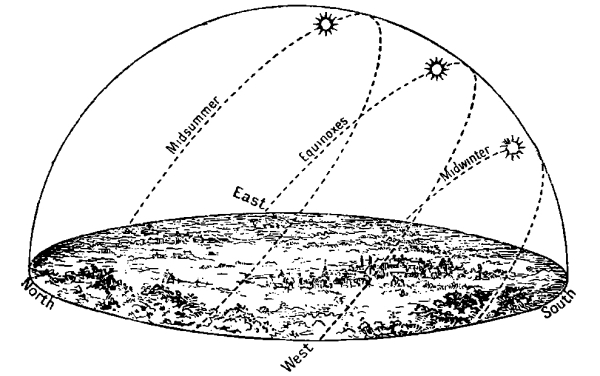
Fig. 1. The Sun’s path in the sky at different seasons.
This north and south motion of the sun may be noted more directly in another way. Seen from any given place on the earth, each star rises and sets at the same points of the horizon always, and has the same course in the sky; but the rising and setting points of the sun, which on about the 21st of March are due east and west, travel daily further north, and the sun mounts daily higher in northern skies until about the 20th of June; then he returns towards the south, passing the east and west points again about September 23, and reaches his furthest point south about December 21. (The dates vary slightly owing to Leap Year). The dates on which the sun reaches his furthest north and furthest south points in this yearly journey are called the “solstices,” because his motion seems to be checked, and he pauses or “stands” before reversing his direction; the dates on which he passes the midway point are the “equinoxes,” because at those points he is on the equator, and makes day and night equal all over the earth.
The time taken by the sun to pass from one vernal (spring) equinox to another is 365 days, 5 hours, 48 minutes, 45 seconds. Since this slow motion along the zodiac is from west to east, contrary to the rapid east to west motion which he shares with all the stars, he takes a little longer to complete a daily revolution than they do; and if we reckon a solar day as consisting of 24 hours, a “sidereal” (or star) day is equal to 23 hours, 56 minutes, 4 seconds.
These are very elementary facts, but they are the fundamental facts of astronomy, and without recollecting and holding them clearly in mind we cannot understand Dante’s allusions, nor see the fitness of any astronomical system, ancient or modern. To those who have only read about astronomy in books, and have not watched the skies, they may be puzzling, and I would beg these readers to make a few simple observations for themselves, as this will help them more than any written explanation can ever do to see the heavens with Dante’s eyes. To appreciate the connected movement of the whole sky, some bright stars near the Pole should first be watched, such as the Great Bear and Cassiopeia, or for those in the southern hemisphere the Southern Cross, Canopus, Achernar. Their motions should be compared with those of bright stars near the equator, such as Orion, Virgo, or Aquila. The constellations of the zodiac should be studied, and notes made of the seasons at which each disappears in the rays of the sun.
The sun’s north and south movements can be easily recognized by noting at what points of the horizon he rises or sets at different times of the year; and the different heights to which he rises in the sky are most simply observed by marking the length of the shadow of some tree or pole at midday. Or if some rough kind of gnomon[2] be made, even a flat piece of wood, laid on a sunny window-sill, with a long nail driven vertically into it, the movement and varying length of the shadow, from hour to hour, and from day to day, will make one realize vividly the diurnal and the seasonal movement of the sun. This device, in one form or another, was probably the first astronomical instrument invented, and by its means ancient astronomers in many lands solved important problems.
It is not necessary to explain that the daily apparent movements are caused in reality by the earth’s rotation on her axis, and the yearly apparent movements by her revolution round the sun. These are the book-learned facts which for the most part obscure our perception of the very things on which they are based. I would ask the reader to do his best, for the moment, to forget them.
The movements of the moon among the stars are much more easily observed than those of the sun, since we can see the stars at the same time, and her revolution is much more rapid. She also is apparently carried round with the daily east to west movement, and she also has a west to east motion of her own, but so fast that it takes her round the star sphere in one month, instead of one year. This revolution also takes place in the zodiac. She is first visible as a fine crescent, just following the sun, in the west, after he has set; next night she is markedly further from the sun, on her eastward course, and is a larger crescent; she continues increasing her distance from the sun and the size of her disc, until, as full moon, she is rising in the east when the sun sets opposite her in the west, and setting when the sun rises. After this, she begins to wane, and, still travelling in the same direction, rises later and later at night, and sets in the day; she draws gradually nearer to the sun on the western side, till at last, as a fine crescent with the horns turned in the other direction (i.e. always away from the sun), she appears just before the rising sun in the east. Then for a short time she is lost in his rays, till she emerges as a new moon on the sunset side again.
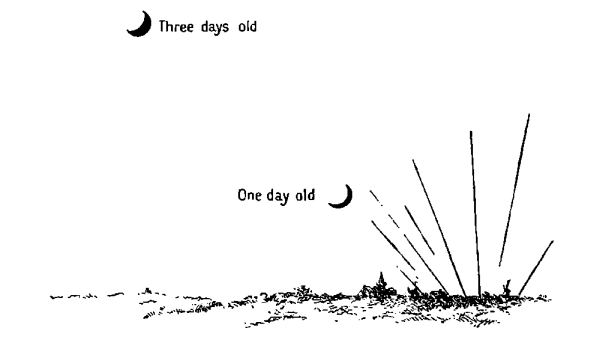
Fig. 2. The Moon at Sunset.
The moon completes a revolution among the stars in 27 days, 8 hours; but it takes her a little longer to come up with the sun again, since he has meanwhile been moving in the same direction along his yearly path; and the ‘synodic’ month, or period from one new moon to the next, is 29 days, 13 hours.
As well as the moving sun and the moving moon, there are five other bodies, visible to the naked eye, which move among the stars. They look like stars, but their movements would lead us rather to class them with sun and moon. They also are in the zodiac, and they also, while carried round with the universal movement from east to west, revolve slowly, each in its own period, from west to east. But their motions are more complicated than those of sun and moon. Two, which we call Venus and Mercury, are never seen very far from the sun, and they oscillate from side to side, sometimes appearing before him near sunrise, and sometimes after him at sunset. Mercury keeps closest to the sun, and is not so bright, and therefore less easy to see; but Venus is a brilliant object when she gradually swings out further from the sun, remaining longer each evening after sunset in the western sky. Then she gradually draws back, closer to the sun, is lost in his rays, and a few days after begins to appear on his other side, as a Morning Star, visible in the east before sunrise. Here she swings out again, like a pendulum, to her furthest distance west, and then draws in again, just as she did on the sunset side of the sun.
In this way, swinging slowly from side to side of the sun, Mercury and Venus make with him the circuit of the zodiac, completing a revolution from west to east in about a year. The average period of Mercury’s oscillation, counting, for instance, from one Greatest Western Elongation (i.e. furthest distance from the sun on the west) to the next, is 116 days; that of Venus is 584 days.
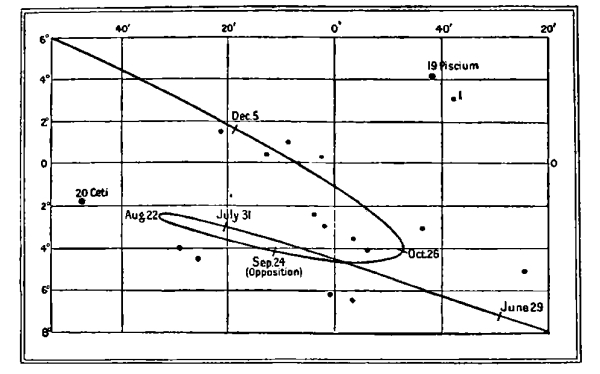
Fig. 3. The Path of Mars among the Stars, 1909.
The other three “wandering stars”—or “planets,”[3] as they were named by the ancient Greeks—Mars, Jupiter and Saturn, are also often seen as morning or evening stars near the sun, but they do not always accompany him, like Venus and Mercury. They may be seen at any distance from him, even exactly opposite, so that they rise as he sets. They keep as strictly to the zodiac, however, and travel in it from west to east, in periods of approximately two, twelve, and thirty years respectively; and their paths are also complicated by oscillations. Periodically they slacken speed, stop, and go back a little distance among the stars, then they slacken, stop, and advance again. These changes are technically called direct motion, stations or stationary points, and retrograde motion.
It must have originally taken many years of patient watching to discover and distinguish all these planets. In these days, by means of an almanac and some knowledge of the constellations, they may easily be found and traced. Mars and Venus move quickly during part of the time they are visible, and if sketches be made of their positions among the stars, and their paths marked for a few weeks, a very good idea may be gained of the motions of planets as seen in the skies.
Once again, it is not necessary to explain here that these movements of the planets are due partly to their revolution round the sun, and partly to the Earth’s motion. Nor need we, for our present purpose, consider them in any detail: all that is important to realize is the general character of the movements, and their likeness to those of sun and moon.
The distances, and therefore the sizes, of all the heavenly bodies are completely beyond measurement, except with instruments and refined methods; their physical nature could only be guessed at before the discoveries of universal gravitation and spectrum analysis, in the 17th and 19th centuries of our era. All that can be observed by naked eye astronomy is difference of brightness and colour; as for instance the contrast between ruddy Mars and white Jupiter; the steadier light of all the planets as compared with stars; and the interesting fact that the moon shines by reflected sunlight, which is made evident by the connection between her phases and her position with regard to the sun. Her surface, too, is clearly seen to be diversified by dark markings of definite shape, but on no other body in all the sky can we make out the least detail without a telescope.
The movements of the heavenly bodies, therefore, which still form one of the most important parts of astronomy, were almost all that could be studied by ancient astronomers, and gave them the only key they had to the problems of the universe.
To sum up:—The chief apparent movements of the heavens, visible to the naked eye, are eight, viz:—
The daily revolution of the entire heavens, carrying with it every visible celestial body, in a little less than 24 hours; the revolutions of sun, moon, and five naked eye planets, in seven different periods.
The first of these is from east to west, and is by far the most rapid. The axis of revolution passes through two points which we call the celestial poles, and the motion is parallel to the celestial equator.
All the others are in the main from west to east, though the progress of the planets is complicated by periodical retrograde movements. All take place in the zodiac, which is a series of constellations forming a great band round the heavens. The path of the sun is a great circle through this, called the Ecliptic (because eclipses can only happen when the moon is also on it); and the paths of moon and planets are slightly and variously inclined to it.
Thus the daily path of a star is affected only by the simple uniform movement of the entire heaven (in reality the rotation of the Earth) but the daily path of a planet, or of the sun or moon, results from a combination of this general movement with its own peculiar movement, which is generally in the opposite direction.
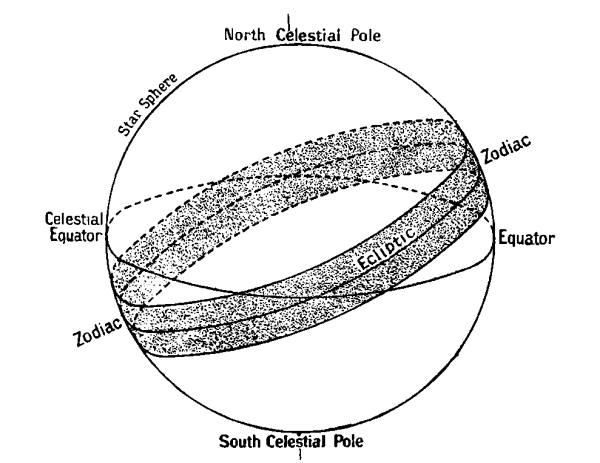
Fig. 4. The star sphere.
If it is difficult to conceive a body moving simultaneously in two different directions, an earthly analogy will make it easy. On a great moving platform, such as that which encircled the Paris Exhibition in 1900, there are fixed posts etc. which revolve exactly as the whole platform revolves and do not move about amongst themselves. These are like the fixed stars on the (apparently) revolving sphere. But human beings are free to add their own movements to that given them by the platform on which they stand. One man turns his back and walks steadily and very slowly in the opposite direction, and so he neutralizes part of the platform movement and is not carried onward quite so quickly as the stationary posts: he is the sun. A woman walks as he does, but much more quickly, so that she rapidly passes many posts, although all the time she is being carried backwards with them: she is the moon. Children run backwards and forwards: they are the planets. Finally, if all these people are also constantly crossing the platform slowly from right to left and back again, their movements will be oblique to the platform movement and will imitate the north and south movements of sun, moon, and planets.
It is in this fashion that the movements of the skies present themselves to careful observers on this seemingly stationary earth; and in the youth of the world these apparent movements were believed to be real. The ancients thought that the sky was actually revolving round a steadfast earth, while the sun and moon and certain other “wandering stars” had in addition various motions peculiar to themselves.
The table of periods which follows (see pp. 22-23) will be found useful for occasional reference. Some of the terms used will be explained later.
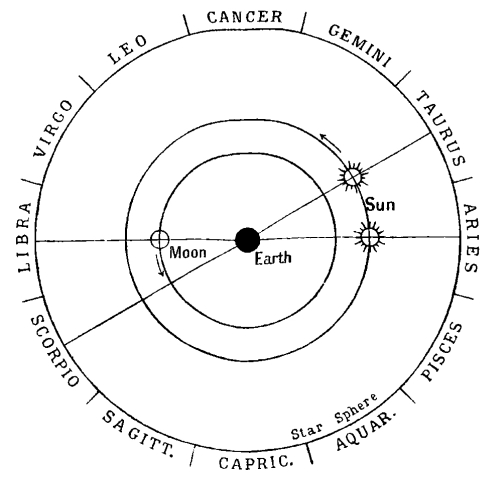
Fig. 5. Diagram illustrating Synodic and Sidereal Periods.
The arrows show the direction of the Moon’s monthly and the Sun’s yearly revolutions in the zodiac, as seen from Earth.
When the Moon is opposite the Sun, for instance in Libra while he is in Aries, she is full. In 27½ days she returns to the same place among the stars, and this is a SIDEREAL MONTH. But the Sun meanwhile has moved into Taurus, and not until the Moon has reached Scorpio, opposite to him, will she be full again, and complete her SYNODIC MONTH (29½ days).
REVOLUTIONS OF SUN, MOON, AND PLANETS AS SEEN FROM THE EARTH.
Days. Hrs. Mins. Secs.
Tropical Solar Year: period from one vernal equinox to another, or from one summer solstice to the next, &c. (Our civil year is based on this). 365 5 48 45·5
Sidereal Year: period between two successive returns of the sun to any star on his path 365 6 9 8·9
The difference between these two kinds of year is due to Precession of the Equinoxes, vide infra, p. 23.
Days. Hrs. Mins. Secs.
Solar Day: period between two successive passages of the sun across the meridian (noon) — 24 0 0
Sidereal Day: period between two successive passages of a star across the meridian — 23 56 4
The difference between these two kinds of day is due to lag of the sun behind the stars, his daily motion westward being slightly retarded by his slow yearly motion eastward.
Days. Hrs. Mins. Secs.
Mean Synodic Month: period between two full moons 29 12 44 2·8
Mean Sidereal Month: period between two successive returns of moon to any star on her path 27 7 43 11·5
The difference between these two kinds of months is due to the fact that while the moon is making her revolution among the stars, the sun is also moving slowly on in the same direction.
Days. Hrs. Mins. Secs.
Mean Anomalistic Month: period between perigee and perigee (vide infra) 27 13 18 37·4
Planets:—Mean Synodic Revolution: period between two successive conjunctions with the sun, and mean zodiacal revolution: period of revolution round the zodiac.
Mean Synodic Revolution. Mean Zodiacal Revolution.
Mercury 116 Days[4] 1·0 Years
Venus 584 ” 1·0 ”
Mars 780 ” 1·88 ”
Jupiter 399 ” 11·86 ”
Saturn 348 ” 29·46 ”
Precession of Equinoxes: 50·25 seconds of arc in one year; that is, 360 degrees (a revolution among the stars of the zodiac) in 25,800 years nearly.
II. THE BEGINNINGS OF ASTRONOMY.
Note.
As these pages are passing through the press, a letter from Mr. Maunder appears in The Observatory for August 1913 on “The Origin of the Constellations,” and this should be consulted by anyone interested in the subject. Mr. Maunder points out that Ptolemy gives us much more precise information than Aratus regarding the southern limits of the ancient constellations, and that the changes which he says he ventured to make in their traditional forms are extremely insignificant.
Mr. Maunder further observes that the celestial equator of Aratus cannot give any clue to the origin of the constellations (as R. Brown suggested), but only to the date of the work from which Aratus copied, when some astronomer had drawn the equator through the constellations. A slight alteration of the text, Mr. Maunder says, would give a correct equator for the date b.c. 1000.
See also Mr. and Mrs. Maunder’s article in Monthly Notices of the Royal Astronomical Society for March 1904.
Proctor’s “Origin of the Constellation Figures” is in his book Myths and Marvels of Astronomy.
The sky appears to us like an arch, embracing all our lives, Dante says.[5] From the dawn of intelligence man must have recognized his dependence upon the all-embracing heavens, especially the sun, without which life would be impossible. The consciousness expressed itself in many ways: in adoration of the sky, the sun, moon, and hosts of heaven; in superstitious fear which regarded events on earth as directly controlled by the heavenly bodies; in careful watching and recording of their movements for useful purposes. Thus, long before astronomy became an exact science, and was studied simply for its own sake, patient observers had laid the foundations, and were familiar with many of the movements we have been describing.
These are of great importance to primitive man. Sun, moon, and stars are invaluable as guides, especially at sea, and we know that the ancient Greek mariners used to steer their ships by observations of the Great Bear, while the Phoenicians preferred to use the Little Bear for this purpose. But the strongest and most universal incentive to careful and prolonged study of the skies is our complete dependence upon them for the measurement of time.
In the earliest period of their history, the Jews, the Greeks, and probably every other nation, divided the day simply into morning, noon, and evening, according as the sun was rising, or apparently stationary, or sinking, with regard to the horizon; and the passage of some bright stars indicated the time at night. But at a very early period the first of all astronomical instruments was invented, by which the sun’s varying height can be measured: hence the time of noon, the dates of equinoxes and solstices, and the length of the solar year can be determined. The gnomon in its simplest form is a pole set up vertically on a smooth level surface, on which its shadow as cast by the sun can be observed. The moment of shortest shadow marks the middle of the day, the shortest midday shadow marks the summer solstice, the longest the winter solstice, the equinoxes falling between. The instrument also indicates the points of the compass, for the sun is always due south in northern latitudes at midday: hence the Latin word meridies (French midi) means south as well as midday, and the Meridian in astronomy is a line which passes through the north and south points and the zenith, and is crossed by the sun at midday.
The gnomon was said to have been introduced into Greece by Anaximander about 600 b.c., and the Babylonians claimed to be the inventors, but it was probably invented independently by several races. The Chinese certainly observed the length of the shadow more than two thousand years b.c., and the very interesting fact has recently come to light that a tribe in a hitherto unexplored part of Borneo use such an instrument, invented by themselves. They set up a post about 6 ft. high, and throw over the top a piece of string weighted at each end to show when it is vertical; the length of the shadow cast by the post is measured with a notched stick. By this means they tell the time of day; and they also observe the sun (presumably with the gnomon) to know the right season for planting their rice.[6]
However rough the first gnomon may have been, its importance can scarcely be overrated, for it introduced measurement and calculation into observation of the sun’s movements, and it is the ancestor of our modern sextants, transit telescopes, and other instruments of precision.
It was also the beginning of the sundial. The course followed by the moving end of the shadow was traced on the ground, and divided into equal parts: hence arose the custom which the Greeks adopted from the Babylonians of counting twelve hours in every day, from sunrise to sunset, and twelve hours in every night, from sunset to sunrise, regardless of the varying lengths of day and night at different seasons. This is known as the system of “temporary hours.” If we used it in England, the twelve hours of a midsummer day would take twice as long to pass as the twelve fleeting hours of a midsummer night; but in Greece the inequality is much less, and in the latitudes of Babylonia it is never striking. The skill and knowledge of the Greeks enabled them, later on, to construct dials of different kinds, which marked “equal hours,” such as we use now; but the system of “temporary hours” did not altogether die out till after the invention of pendulum clocks in the 17th century of our era.
Clepsydras, or water-clocks, were also used in Egypt and Babylonia, and ancient Greece; and there is still a large one in Canton, where a reservoir is placed in a tower, and the water falling, drop by drop, into a receiver whose depth is marked in figures on the wall, indicates the passing of time just as sand does in running through an hour-glass. These clocks cannot have kept very good time, however, or they would have been more used by the Babylonian and Greek astronomers who took pains to ascertain the exact positions of the stars. Owing to the diurnal revolution of the skies, the time at which any celestial body rises or crosses the meridian after another is an index of their distance apart, east and west on the sphere, and this is how it is reckoned by modern astronomers. But the ancients seem to have been never able to trust their clepsydras sufficiently to use this method, and only referred to them for approximate time.
The gnomon, valuable as it is for marking the sun’s daily course, and the north and south part of his yearly motion, is a limited instrument. It cannot show his westerly motion on the sphere, nor is it of any use for the planets. To trace these motions, and the monthly journey of the moon, the first step is to distinguish the stars, by grouping and naming them, especially those which lie in the path of sun, moon, and planets. The invention of some kind of zodiac is probably older even than the invention of the gnomon, and also originated independently among different races. The germ of the idea may be found to-day among races low in the scale of civilization. The Australian aborigines are familiar with that unique star-cluster which we call the Pleiades, and know that its appearances and disappearances are periodical and coincide with the seasons. A Queensland tribe, for instance, has a legend in which the stars figure as six sisters who have been transported to the skies, and it is said that they sometimes appear before the sun in order to throw down icicles, an evident allusion to the fact that the Pleiades begin to appear just before sunrise in May, the Australian winter. The natives of Tahiti divide their year into “Matarii i nia” and “Matarii i raro,” which means Pleiades Above and Pleiades Below (i.e. the horizon at the beginning of night). Sir Norman Lockyer has shown that the mysterious alignments of stones found at Stonehenge, Carnac, and other places, may have been so arranged in order to show the direction, some of the sun at his rising on certain dates, notably the morning of the summer solstice, and some of the Pleiades or other striking stars, whose rising just before the sun would enable ancient astronomers to fix the dates of important festivals.
Such observations as these, of which many instances might be drawn from many parts of the world, are first steps towards studying the whole path of the sun through the stars, and of forming a calendar with a name or number for every day in the year. Until the stars are known, and a calendar fixed, the motions of sun and moon cannot be learned in detail, the planets can scarcely be distinguished from the stars and from one another, and there are no settled dates from which to calculate their periods.
The first zodiac of which we have written record is a lunar one of 28 constellations, which is referred to in the “Canon of the Emperor Yaou,” a Chinese emperor who began to reign in b.c. 2356. “Yaou commanded He and Ho, in reverend accordance with their observation of the wide heavens, to calculate and delineate the movements and appearances of the sun, the moon, the stars, and the zodiacal spaces, and so to deliver respectfully the seasons to the people.” That these astronomers studied “the movements and appearances” of the sun by means of the gnomon as well as observations of the stars is plain from what follows, where directions are given for determining the solstices. One astronomer was commanded by the Emperor to “reside at Nankeaou and arrange the transformations of the summer, and respectfully to observe the extreme limit of the shadow. The day, he said, is at its longest, and the star is Ho: you may thus exactly determine midsummer.” Ho (= fire) is the fiery red Antares in Scorpio. The star of the winter solstice, when “the day is at its shortest” was Maou, which is the Pleiades. Directions are also given for observing the spring and autumn equinoxes, when day and night are of medium length, and certain other stars are to be observed.[7]
The Hindus had also a lunar Zodiac, but with only 27 constellations, and the Arabs had their 28 “Mansions of the Moon.” These 27 or 28 asterisms were evidently suggested by the moon’s sidereal period of 27¼ days. But her synodical period, i.e. her revolution with regard to the sun, in which she runs through her phases, is much more convenient for marking a period of time for general uses, and this month of about 30 days has been almost universally adopted by primitive peoples, the first day being counted when the crescent new moon begins to be seen after sunset. From this custom arose another, that of counting the beginning of the day from sunset, but in various times and places other starting-points have been chosen—sunrise, midday, or midnight.
Twelve of these synodical lunar months are nearly equal to one solar year, and this doubtless suggested the solar zodiac of twelve constellations, each constellation marking the portion of sky passed over by the sun in a month. The Chinese “Yellow Path of the Sun” contained twelve animals, the Mouse, Cow, Tiger, Rabbit, Dragon, Serpent, Horse, Ram, Ape, Hen, Dog, and Pig. These animals were widely adopted by other nations—the Koreans and the Japanese, the Mongols of Tibet, the Tartars, and the Turks.
Another zodiac, however, was destined to have an even wider popularity, spreading, in the course of centuries, from Greece to Arabia, Persia, India, and China, where it finally superseded the native constellations; it crossed the Mediterranean into Africa, conquered the whole of Europe, and is used to-day over the whole civilised world.
The names of these twelve zodiacal constellations are familiar to us all:—
English Names. Latin Names.
Ram Aries
Bull Taurus
Twins Gemini
Crab Cancer
Lion Leo
Virgin Virgo
Scales Libra
Scorpion Scorpio
Archer Sagittarius
Capricorn Capricornus
Water-Bearer Aquarius
Fishes Pisces.
Strange to say, we cannot tell with any certainty where, when, or by whom, this ancient series of constellations was devised and named. The earliest full description which we possess is by a Greek poet of the 4th century b.c., Aratus. A line from the prologue to his “Phenomena” was quoted by St. Paul in his address to the Athenians on Mars’ Hill.
“From Zeus we lead the strain, he whom mankind Ne’er leave unhymned; of Zeus all public ways, All haunts of men are full, and full the sea And harbours; and of Zeus all stand in need. We are his offspring;[8] and he, mild to man, Gives favouring signs and rouses us to toil, Calling to mind life’s wants; when clods are best For plough and mattock, when the time is ripe For planting vines and sowing seeds he tells. Since he himself hath fixed in heaven these signs, The stars dividing; and throughout the year Stars he provides to indicate to men The seasons’ course, that all things duly grow.”[9]
But Aratus did not know who had invented the names of the star-groups which he describes. “Some man of yore,” he supposes,
“A nomenclature thought of and devised, And forms sufficient found. For men could not Or tell or learn the separate names of all, Since everywhere are many, size and tint Of multitudes the same, but all are drawn around. So thought he good to make the stellar groups, That each by other lying orderly, They might display their forms. And thus the stars At once took names and rise familiar now.”[10]
It is, to say the least, exceedingly doubtful, whether the naming of star-groups was so promptly carried out by one individual, especially as Aratus’ poem includes, besides the twelve zodiacal constellations, thirty-six others, which contain all the bright stars of the sky except those too far south to be seen in the temperate regions of our northern hemisphere. The spaces thus left blank were afterwards filled up, chiefly in the 17th and 18th centuries of our era, and the regions round the South Pole are now crowded with a mixture of birds and scientific instruments; but the names and the figures of the traditional forty-eight constellations still find undisputed places on our globes and star-maps.
Some of these figures are very strange and suggestive. We have a maiden with wings, a centaur shooting arrows, a flying horse, a water-snake with a crow and a cup on its back, a charioteer with a goat on his shoulder, a man strangling a serpent, another pouring water into the mouth of a fish, and a strange beast like a goat with a fish’s tail. All had their meaning, doubtless, to their originators, but to us they are cryptic characters, hard to decipher. Among the zodiacal constellations only one is obvious, Libra the Scales, the sign in which the sun is when days and nights are perfectly balanced in length; but this is comparatively recent, for Aratus and his contemporaries give in its place the Claws of the Scorpion, the latter being an enormous monster extending over the space of two asterisms. The figures may have been religious symbols, or an illustration of some myth concerning the sun’s yearly course, or each of the twelve may have indicated the weather or the occupation suitable to the month it represented. The ear of corn in the hand of the Virgin, and the juxtaposition of three watery figures in Capricornus, Aquarius, and Pisces, suggest the latter explanation. Many different ideas probably played a part in the origin of these mysterious constellation-forms. The Greeks, and after them the Romans, when adopting the old constellations, sometimes adopted also the old myths which still clung about them; sometimes they ascribed legends to them from their own mythology. Thus, the kneeling figure with his foot upon a dragon, became and remains the hero Hercules, although Aratus only describes him as a man toiling at some unknown task, and says he is called simply the Kneeler. Successive generations of astronomers altered some of the figures, but probably only to a slight extent.[11]
The poem of Aratus enjoyed an immense popularity in classical times and throughout the Middle Ages, and no doubt helped to stereotype the forms whose origin was already forgotten when he wrote. He was not an astronomer, however, and the poem is only a popular paraphrase of a lost work by Eudoxus. This Greek astronomer had lived a hundred years earlier, and it is thought that he himself copied from an older source. The attempt to discover this source has been the object of many ingenious conjectures, and much research among ancient monuments and writings. Some of the old constellations are met with in Isaiah and Job, in Homer, on tablets found at Nineveh, and an immense antiquity is sometimes claimed for them. Dupuis, writing at the end of the eighteenth century, thought he had conclusively proved that the figures of the zodiac were designed in Egypt 15,000 years ago![12] Miss Plunkett, in her “Ancient Calendars and Constellations” assigns them to the seventh millenium before Christ.
The Old Constellation Figures.
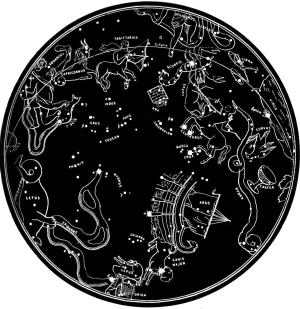
Southern Hemisphere.
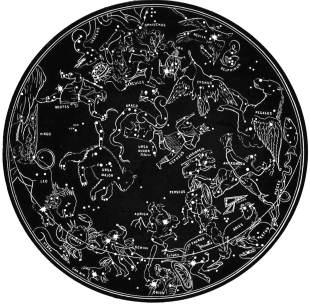
Northern Hemisphere.
THE OLD CONSTELLATION FIGURES ACCORDING TO ARATUS. In Ptolemy’s Catalogue Equuleus and Corona Australis are added to these. (From Peck’s “Constellations and How to Find Them.”)
An ingenious theory, suggested independently by Schwartz and Proctor, and developed by Mr. E. W. Maunder,[13] is founded on an examination of the space round the South Pole which was left blank by the ancient constellation designers. From its extent, Proctor concluded that they cannot have seen further south than about 40° from the South Pole, and therefore that they must have lived in a latitude of about 40° north of the equator (say, central Asia or Asia Minor); from the position of its centre, which must have been the Pole, he concluded that the date was about b.c. 2200. For the centre of the circular patch seems to lie near the star Delta Hydri, which was the South Pole star at that time. (This movement of the Pole among the stars, due to “precession,” will be explained later). This date does not differ much from that found by Robert Brown, from the position of the celestial equator among the stars, as described by Aratus; he says b.c. 2084.[14] Schwartz gave b.c. 1400; Mr. Maunder, from additional considerations of the positions of various constellation figures, says that they must all have been originally designed about b.c. 2800.
Unfortunately the descriptions of Aratus are neither very precise nor consistent with one another, and he is our oldest and our main authority for the forms and positions of the ancient constellations.[15] It may, however, be taken as practically certain that they had been designed many centuries before he wrote, and that the Greeks received them from the Babylonians. Orion and the Pleiades, the Great Bear and Arcturus, and perhaps many others, were familiarly known in the Levant as early as the tenth century before Christ; and we find traces of our zodiac, or its beginnings, in Babylonia at least as early as the eleventh. It is always to Egyptians and Babylonians that the Greeks referred as their predecessors and teachers in astronomy, but the native constellations of Egypt seem to have been different, and so far as we know at present the Babylonians began earlier and made greater progress in star-lore than any other nation before Greece. The latest results of expert investigation of astronomical tablets discovered in the ancient clay libraries of Babylonia and Assyria, tend to show that astronomy was of native growth there, and developed very slowly.[16] Star-worship and the need for a calendar led their inhabitants to observe the skies thousands of years ago; but their early work was naturally vague and rude.
This star-worship and star-study seems to have been learned by the Semitic Babylonians, and their descendants and rivals the Assyrians, from a race with whom they met and mingled in the grey dawn of history, but whose existence was unknown to us before the middle of last century.
[To face p. 36.
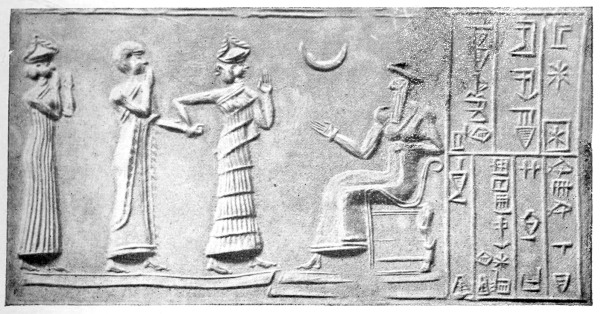
The Moon-God of Ur.
From a cylinder-seal in the British Museum, dated about b.c. 2400.
Reproduced by permission of the Trustees.
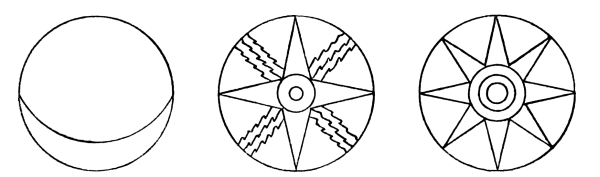
Fig. 6. The triple star-sign of the Babylonians.
This people, who belonged to a totally distinct family of nations, and are known to us now as Sumerians, had settled near the mouth of the Persian Gulf, when it ran further inland than it does now, and more than five thousand years ago used a kind of writing on soft stones (later, on bricks) which had obviously arisen from some form of picture writing, and ultimately developed into cuneiform. Their reverence for the heavenly bodies is shown by the fact that the familiar star sign, which appears on very early Sumerian inscriptions, denotes their word for god or lord, and on the monuments of Babylonia and Assyria we meet constantly the triple sign This, we learn from the inscriptions, stood for three great deities, the Moon-god, the Sun-god, and the goddess of the planet Venus. Our illustration shows an inscription in early Babylonian script, and a scene which represents the vassal of a king of Ur (Abraham’s “Ur of the Chaldees”) being led into the presence of the Moon-god.[17] It is believed to date from about b.c. 2400. The Babylonians were an intensely superstitious people, and a large part of their omens were drawn from observations of the skies. Every city from this period onward had its ziggurat or great tower formed of several superimposed cubes, usually seven in number, diminishing in size and probably crowned by the shrine of the local deity. It is not certain what purposes were served by these towers, but the successive platforms may well have been the observatories from which the Babylonian priests, gazing through the clear air and over the level plains, watched, year after year, and century after century, eclipses of sun and moon, risings and settings of stars and planets, and all the changing pageant of the skies, which to them were eloquent of peace and prosperity, or of war and misfortunes in their land.

Although this illusory art chiefly occupied the early Babylonian astronomers, they made some observations of real value, and gradually acquired true knowledge concerning the movements of the heavenly bodies.
Tablets a few centuries older than the Chinese Canon of Yaou containing lists of the Sumerian names of twelve months, show that this people had established a luni-solar year. Fortunately for the progress of astronomy the year does not contain an exact number of months, or even of days: at the end of twelve lunar months, a few more days and hours must elapse before the sun has returned to his original place among the stars, and before the round of the seasons is completed. Therefore the first rough approximation had to be constantly corrected if calendar festivals were to recur at the same seasons; and thus the priests, who in early times were usually the calendar makers and keepers, became gradually better and better acquainted with the movements of sun and moon, and the appearance of star-groups. It is interesting to compare the different ways in which various races have solved the problem of calendar-formation.
The Chinese had a year of twelve months, and added an intercalary month occasionally, in such a way that the average length of the year was brought up to 366 days. The written character for “intercalary” in both Chinese and Japanese is a compound of the characters for “gate” and “Emperor,” because in ancient days the Emperor used to perform the ceremonies proper to each of the twelve months in the special room of his palace dedicated to that month, but in the intercalary month he performed them in the doorway of the palace.
The Egyptians and the Arabs seem to have given up the attempt to harmonize the two periods, though both of these nations reckoned twelve months in their years. The Egyptians counted thirty days to each month, and added five days more at the end of the twelfth, so that the months can have had no connection with the moon: the year had, in fact, been calculated from the position of the sun among the stars, beginning with the morning on which Sirius rose just before it. This “heliacal rising” of Sirius heralded the great event of their year, the overflow of the Nile. The Arab year, on the contrary, was purely lunar, for it consisted of twelve months which were alternately of twenty-nine and thirty days: they therefore corresponded pretty closely with the moon’s phases, but had no connection with the sun or the seasons. The Mahomedans still use this lunar year.
The new moon festivals of the Hebrews prove that the moon was important to their calendar, but the three chief feasts of First-fruits, of Ingathering, and of the Passover, were so closely connected with the seasons that their year must have been luni-solar. It consisted of twelve months, one of which was sometimes doubled, but how they decided when this was necessary is nowhere described in the Old Testament. Some think, that as an offering of first-fruits was to be made on a certain day of a certain month, the month preceding it was doubled in every year in which it was evident that the crops would not be far enough advanced for the first-fruits to be gathered so soon: in this way no direct observations had to be made of the sun’s movements, but the year was accommodated to them by observations of the seasons.[18]
The Babylonian calendar is the most interesting of all, for it was the most intimately connected with star-observation. At first an extra month seems to have been added to the usual twelve, in an irregular way, whenever found necessary, judging by a tablet of the great king Hammurabi, who united all the cities of southern Babylonia under one rule, and gave them the famous Code of Laws, communicated to him by the Sun-god. The tablet runs as follows:—
“Thus saith Hammurabi: the year having gone wrong, let the coming month be registered by the name of Ululu the second. And instead of the payment of taxes being made on the 25th day of Tasritsu, let it be made on the 25th day of Ululu the second.”
Hammurabi reigned about b.c. 2200. A thousand years or more after this, we find that royal decrees for correcting the calendar were never necessary, for the astronomers had invented more than one system for keeping the year right. One of these was to observe, like the Egyptians, the heliacal rising of certain stars. The little group of three stars in the head of the Ram, which we call Alpha, Beta, and Gamma Arietis, was found very convenient for this purpose. When it rose just before the sun in the month Nisan, the observers knew that all the twelve months would fall in their right seasons, but when it remained invisible (hidden in the morning twilight) until the following month, the calendar was evidently running ahead of the sun, and that year was lengthened by adding a thirteenth month. This is the meaning of the directions given on a tablet now in the British Museum:—
“The asterism Dilgan[19] rises heliacally in the month of Nisan. Whenever this asterism remains invisible, let its month be forgotten,”
that is, let it be taken over again, as if it had not already been counted. Similar directions are given for some other asterisms and their corresponding months. But a second method, which was peculiar, so far as we know, to the Babylonians, was that of using the moon as a pointer to indicate the place of the sun. Whereas the sun’s place among the stars can only be inferred, the moon’s can be plainly seen, and her phase indicates her distance from the sun at any time. A tablet of unknown date, belonging to the last millenium before our era, or a little earlier, gives the following directions:—
“When on the first day of the month of Nisan the asterism Mulmul (the Pleiades)[20] and the Moon are seen together, the year will be normal. When on the third day of Nisan the asterism Mulmul and the Moon are together, the year will be full” (that is, will contain 13 months).
Each Babylonian month began when the new moon was first visible after sunset; if at this moment she was seen with the Pleiades, it is clear that the sun, which had just set, was not far west of the cluster; if however, it was not till the moon was three days old that she was seen with the Pleiades, she would then be some distance above the horizon at sunset: consequently the sun was some distance west of the Pleiades. In this case he would also be west of Dilgan, the Ram’s Head, so those stars would rise after him in the morning, and be hidden in his light: therefore, both the morning and the evening observation combined to show that his course was not completed, and that the year must be lengthened by the addition of an extra month.
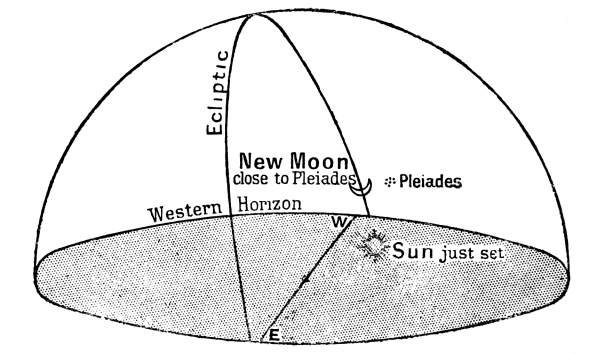
Fig. 7. First Year, normal. New Moon near the Pleiades after sunset on the 1st of Nisan.
The position of the young moon (which always closely follows the sun) showed that the sun was not far west of the Pleiades; and about 1000 b.c. this proved that it was near the vernal equinox. The sun’s position is given for about half an hour after sunset, when the Pleiades would first be visible.
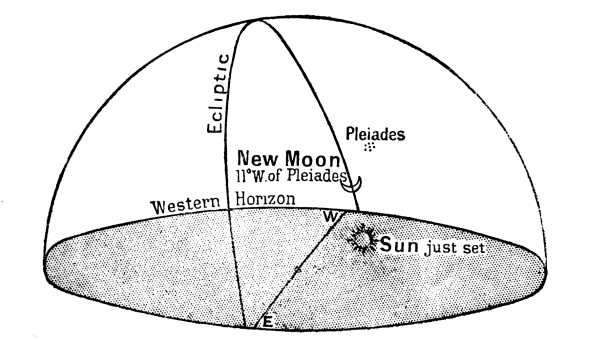
Fig. 8. Second Year, normal. New Moon not far from Pleiades on the 1st of Nisan.
It takes the sun 365 days to return to the same place among the stars, but the Babylonian year of 12 lunar months (each of 29 or 30 days) was 11 days short of this: therefore on the 1st of Nisan in this year the sun had still 11 days’ march before him ere he returned to the position of Fig. 7. This is equal to about 11°, so the young moon was also about 11° west of her former position, near the Pleiades. But as she travels about 13° eastward every day, she would be near the Pleiades on the following evening, the 2nd of Nisan, so this year was also counted normal.
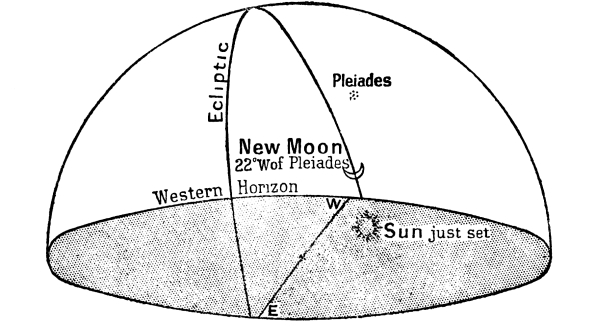
Fig. 9. Third Year, “full.” New Moon distant from the Pleiades on the 1st of Nisan.
The sun is now 2 × 11 = 22 days’ march, or about 22°, short of his first position, and the young moon consequently about 22° west of the Pleiades, so she will not come up with them until the 3rd Nisan, after travelling 2 × 13 = 26°. The year was therefore “full,” that is an extra month of 29 days was added, which is more than the 22 days needed to enable the sun to reach his first position by the 1st of Nisan in the fourth year.
It appears, therefore, that the extra month must have been added once in three or four years.
Several lists of stars and star-groups indicating the months in this way have been found, the early lists containing only a few, the later twelve. If our zodiac originated with the Babylonians, there is little doubt the idea took its rise from these monthly stars, but it is not possible, with our present knowledge, to say when these old astronomers first linked the isolated stars into a continuous series of twelve star-groups and connected the idea of the month with the invisible group among which the sun was known to be shining, instead of with the stars seen east or west of him, or in conjunction with the crescent moon.[21]
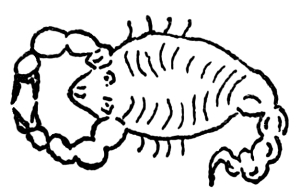
Fig. 10. The Scorpion.
From a boundary stone (now in the British Museum) set up in the reign of Nebuchadnezzar I., king of Babylonia, about 1100 b.c.
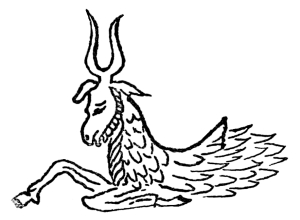
Fig. 11. The Goat, with Fishes’ Scales. From a Babylonian boundary stone.
A Scorpion with immense claws, and a Goat with fishes’ scales appear several times on monuments at least as old as 1000 b.c. and it is very probable, although this fact alone would not prove it, that they were then used as constellation figures. It has been definitely proved from inscriptions that before 600 b.c. the name of Scorpion was applied to some stars of our present Scorpion, that there was a Lion corresponding with ours, and the principal star in that asterism, which was called “The King” by Greeks and Romans (Basiliskos and Regulus), bore a name with the same meaning in Babylonia; the Celestial Bull seems to have been the group of the Hyades, and the Great Twins were the two stars Castor and Pollux. The last two identifications seem to show how the single stars or small groups of the monthly lists were expanded into the large zodiacal constellations, for the Hyades cluster is in our present Bull, and Castor and Pollux are in our Twins.
Under the great Assyrian kings who in the 8th and 7th centuries b.c. made Nineveh the capital of their empire, Babylonian astronomy flourished exceedingly, and it made much progress through all the political changes which followed, until the beginning of our era. The motions, phases, and eclipses of the moon were carefully studied and could be accurately predicted, the positions of many stars were determined; the zodiac was divided into twelve equal spaces, which afterwards became 36 by sub-division (the constellations being too unequal in size for convenience); and finally the whole circle was marked out in 360 degrees. The movements of all the naked eye planets were well understood, their positions being constantly compared with those of a number of standard stars, mostly in the zodiac; and after watching and recording these for a number of years the astronomers were able to calculate where each planet would be found at future dates. Tables have been found on clay tablets of the 2nd century b.c. predicting the heliacal risings and settings, and the stations and retrogressions etc., with considerable accuracy.
When astronomy had reached this stage of accurate prediction, it was no longer in its infancy, but was fairly on its way to become a true science.[22]
Nevertheless, the astronomy of the Babylonians, advanced as it was, seems never to have progressed beyond the empirical stage. With them, there seems to have been no desire to group the facts they so patiently and skilfully collected into a system, and form a theory to explain them.
And this must be said of other ancient nations also. The Egyptians made careful observations, especially of the heliacal risings of different stars, by means of which they determined the length of the year, as we have already mentioned, and oriented their temples and pyramids. They worshipped the sun in all his aspects, and their astrology so much resembles the Babylonian that it is believed to have been derived from it. The Babylonians seem to have been more interested in the planets than any other nation of antiquity, but they were known also in other countries. The Chinese recorded comets, and all races were greatly interested in eclipses, which they were able to predict with some accuracy, having discovered that they occur in cycles. Yet we find no more rational attempt to explain these phenomena than the Hindu legend of a great dragon that attacks the sun, or the Egyptian story of a sow that swallows the moon; and their cosmogonies can only be regarded as poetical descriptions or survivals of early childlike notions of the universe.
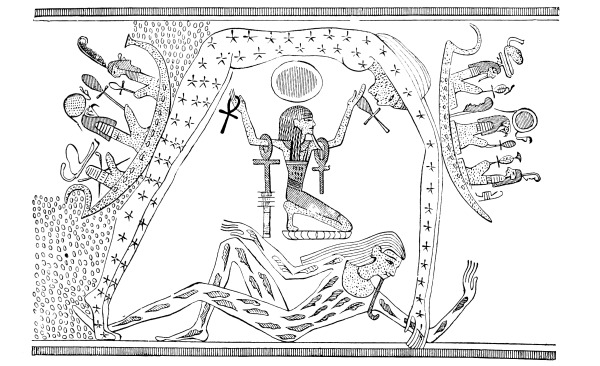
The Hindu world resting on the back of an elephant, and that on a tortoise, is no doubt but an allegory. The Egyptians pictured the earth as a great parallelogram, long from north to south but narrow from east to west, like their own land, with the sky over it, upheld by huge pillars or lofty mountains. The stars were set in this domed lid of the world, but sun, moon, and planets were floating each in its own boat on a great celestial river which ran just below the summits of the mountains, and whose course was hidden towards the north. The bark of the sun came nearer to Egypt in the summer, because at that time the celestial river overflowed its usual bank, like the Nile. The red Doshiri was said to sail backwards, referring no doubt to the retrograde movement of Mars.
In Eridu, one of the oldest cities of southern Babylonia, on the Persian Gulf, the great abyss of the ocean was looked upon as the origin of all things, and it was believed that it encircled the earth like a great river. Later on, we find the world described as a great mountain, resting on the watery deep, and under the mountain is the abode of the dead. It is entered from the west, which surely was suggested by the setting of the heavenly bodies in the west. The vaulted sky above the earth has divisions: the rim of the lowest part rests upon the supporting watery deep; above it are the upper waters (the source of rain); and above this again is the dwelling-place of the celestials. The sun issues forth each morning from a door in the upper heaven, or from the mount of sunrise, and enters another heavenly door, or the sunset mountain, at night.
The similarity to these Babylonian ideas of the Hebrew “firmament,” the “waters above the firmament,” and the “of the great deep,” in the book of Genesis,[23] and Ezekiel’s “Sheol” in “the nether parts of the earth,”[24] has often been noted.
[To face p. 46.
The Boat of the Sun travelling over the sky. From an ancient Egyptian papyrus.
The recumbent figure covered with leaves symbolizes the earth; the figure leaning over Earth, covered with stars, is the sky; the boat of the rising sun and of the setting sun floats over it. The central figure represents Maon, the Divine Intelligence which preserves the order of the universe.
(Reproduced from Flammarion’s ‘Astronomical Myths,’ by permission of Messrs. Macmillan & Co.)
To sum up:—
If we include as astronomy any observation of the heavenly bodies which leads to a recognition of order and periodicity in their movements and a power of forecasting their positions, then every race and age has had its astronomers, rough though their methods may be at first. With growing civilization more refined methods are used; the gnomon is invented for studying the movements of the sun; the changing positions of moon and planets are noted by means of certain stars; finally, all the visible stars are grouped into constellations, and it is recognized that a great band of star-groups crosses the sky, which forms the pathway alike of sun, moon, and planets; the length of the month and of the year are determined more or less accurately, and when an unvarying calendar has been formed, the celestial cycles can be better recorded and studied. But in all this there is as yet no scientific motive properly so called, no curiosity regarding the phenomena for the simple pleasure of knowing and understanding them, no attempt to group them into a system or to explain their underlying causes. The primitive idea that the heavenly bodies exist for the convenience of earth-dwellers is illustrated by the Egyptian hieroglyph for night, which consists of the sign for sky combined with a star suspended like a lamp; the other idea that they are mysterious divinities is shown by the Babylonian star-sign for a god or king, . The ancients found that the stars were of great use, especially for measuring periods of time; they recognised also in them a marvellous order and regularity, of which they dreamed that they found an echo on earth, and endeavoured to divine the future by watching the skies. Can we doubt that they were also attracted by the beauty that calls all men through all ages to lift their eyes and look upward?


HYMN TO THE SETTING SUN.
Sung by the Priests of Babylon.
Sun-god, in the midst of heaven, At thy setting May the latch of the glorious heavens Speak thee peace. May heaven’s door to thee be gracious, May the Director, thy beloved messenger, direct thee. Lord of E-bara, may the road of thy path be prosperous, Sun-god, cause thy highway to prosper, Going the everlasting road to thy rest. Sun-god, thou art he who is judge of the land, Causing her decisions to be prosperous. From a lecture by T. G. Pinches. (Nature, Dec. 31, 1891).
III. GREEK ASTRONOMY.
First Period. b.c. 900 to b.c. 350.
“Great men! elevated above the common standard of human nature by discovering the laws which celestial occurrences obey, and by freeing the wretched mind of man from the fears which eclipses inspired! Hail to you and to your genius, interpreters of heaven, worthy recipients of the laws of the universe, authors of the principles which connect gods and men!”
Pliny (Apostrophe to Thales and Hipparchus.)
1. HOMERIC GREECE.
To turn from the astronomy of Egypt and Assyria to the astronomy of the Greeks is like coming to a sudden bend in a river which has flowed through level country for many miles in a slow majestic course, and finding beyond the bend a series of rapids and waterfalls. Instead of patient age-long accumulation of observations, instead of a mystical adoration of stars, supposed to be beyond man’s power to understand, we find that the Greek’s first instinct is to inquire into the meaning and the origin of what he saw, even before he had taken time to investigate. Behind the varied splendours of earth and skies which fascinated his bodily eyes, his intellect divined laws and forces which held the whole together in a wonderful harmony. Then, as fresh facts, or a fresh point of view, thrust itself upon him, a new explanation must be attempted, and thus many complete systems of the universe were evolved. Not the name only, the idea of Cosmos was Greek.
Homer c. 900 b.c.
Hesiod c. 800 b.c.
The first ideas of astronomy among the Greeks were as primitive as those of any other race in its early stages. They evidently had no conception of the sky as a sphere, or of the revolution of the stars as a whole, round fixed poles, though they watched the motions of certain bright star-groups, and called them by the names that we use now (however these names may have reached them), as we see in Homer and Hesiod. Ulysses, guiding his raft cunningly by night, keeps on his left the Bear, also called the Wain, which turns round in her place and keeps watch on Orion, and never bathes in ocean; he watches also the Pleiades and the “slow-setting Ploughman” (Boötes)—an apt description, as anyone may see who watches Arcturus, the brightest star of Boötes, when low on the western horizon. Being a northern star, its motion seems very slow, and makes so small an angle with the horizon that for a long time Arcturus glides above it before finally dropping below; whereas the Pleiades, or any other stars near the equator, move very quickly and almost at right angles to the horizon, and so drop below it quite suddenly. It is Ulysses also who warns his companion, when they are setting out to spy upon the Trojan camp, that two watches of the night are already past, “for the stars have gone forward.” The stars also announced the seasons, for Hesiod says that the time of harvest is indicated by the heliacal rising of the Pleiades, and when Orion with Sirius stands in mid-heaven, and Arcturus rises in morning twilight, it is time for the vintage.
Homer and Hesiod both mention Venus, as a morning star “the brightest of all the stars, which comes to herald the light of dawn,” and also as an evening star, apparently without recognizing that it was the same star; as they do not mention any other planet we do not know if the others were known to the ancient Greeks.
The first appearance of the new moon’s slender crescent was watched for from hill-tops, and celebrated by sacrifices, and this—as with other ancient nations—fixed the first day of their month.
Mimnermus c. 580 b.c.
Day seems to have been divided into three parts, morning, midday, and evening, according as the sun was rising, or nearly stationary, or sinking. The sun was thought to rest upon and slide over the solid dome of the sky, otherwise perhaps it would have fallen to the ground; and at night it was supposed to go behind Mount Atlas, and then to travel behind high northern mountains to its rising place in the east. This primitive explanation of its movements is so poetically described by an early poet, Mimnermus, that I cannot resist a quotation, though the lines can hardly be regarded as an astronomical fragment. They may be freely rendered thus:—
Endlessly toiling Helios speeds. No rest for him or for his steeds When Dawn has climbed the height. Soon as he lays his weary head Upon the golden wingèd bed Made by Hephaestos’ might, It bears him sleeping o’er the seas, Far from the fair Hesperides, Through realms of darkest night; Till in the Ethiopian land He sees his horses ready stand; And when the child of light, The rosy-fingered, early-born, Has ushered in another morn, He mounts his chariot bright.
The earth, as pictured on the shield of Achilles, was flat and round, just as it appears from a height, and of course Greece was the centre, just as Egypt was the centre of the Egyptian, and Babylon the centre of the Babylonian cosmogonies. It was a small earth: a few countries lay round the Middle Sea, and further to the south was the land of the Ethiopians where the Sun passes overhead and burns the inhabitants black; there was another sea to the north, over which the Argonauts sailed, and in the extreme east was the Lake of the Sun, out of which he rose every morning. This was a great gulf of the River Oceanus which encircled the whole earth. Its sources were in the furthest west, just beyond the Pillars of Hercules, and thence it flowed north, east, and south, finally returning into itself. A branch from near the source, called the Styx, flowed down into the underground world of Hades, the abode of the dead, and beneath this again was Tartarus, where were imprisoned the Titans who had fought against Jove.
Above the flat earth the blue dome of heaven was spread like a tent, and across it travelled
“The never-wearied Sun, the Moon exactly round, And all those stars with which the ample brows of heaven are crowned.”
What a compact little universe, and how important a part of it was man! But as thought developed, the universe expanded.
2. THALES AND ANAXIMANDER.
b.c. 585.
Thales c. 600 b.c.
In the sixth year of the war of the Lydians against Cyaxares, king of the Medes, just when a battle was about to begin, day was suddenly changed into night by an eclipse of the sun, and Herodotus adds: Thales had told the Ionians of this before, and in what year it would happen. This does not necessarily imply any accurate understanding of eclipses on the part of the Ionian philosopher. He had visited Egypt, and may have learned from the priest-astronomers there that eclipses recur in cycles and so can be predicted. But Thales was not content with cycles. He wanted to know, not only that eclipses would happen at such and such times, but how they happened. Perhaps from reports of Babylonian observations, perhaps from questions put to Egyptian astronomers, he learned that solar eclipses only happen when the moon is new and in the ecliptic, that is, in the same part of the sky as the sun, and that the black body then seen on the sun has always a rounded edge. These no doubt were the arguments on which he founded his assertion that solar eclipses are caused by the moon passing in front of the sun; and he further added that this shows the moon to be of an “earthy” nature, that is, not made of fire or any substance either luminous or transparent, but of opaque matter, probably having weight and substance, and not altogether unlike what we know on earth. He is said to have stated also that the moon receives her light from the sun, a conclusion which would follow from a little attention and thought bestowed on her phases.
Besides his speculations regarding the moon, Thales took pains to note the sun’s movements as accurately as possible, by means of gnomons, with a view to discover the exact length of the solar year, and it was he who advised the Greeks to adopt the Phoenician method of directing their course at sea by the Little Bear instead of the Great Bear, which appears to have been the constellation used in Homeric times.
Thales imagined that Ocean did not merely encircle Earth, but that the whole Earth, which was a thin flat disc, floated upon the Ocean.
This zealous observer must have had something of the absent-mindedness of his great successor, Newton; for it is told of him that while star-gazing he fell into a well!
b.c. 611-545. Anaximander
It is evident that the moon’s passing in front of the sun implies a lesser distance from us, and it must have been this which suggested her place in the scheme of Anaximander. This scheme is rather difficult to understand, from the allusions and quotations of later writers, for we have no original writing by Anaximander; but we can gather enough to show that already in the sixth century b.c. the Greek philosophers were asking themselves what was the explanation of the movements and appearances of the heavenly bodies, how they were supported in the sky, what force moved them, how large and how distant they were, and what they were made of. Anaximander asserted boldly that sun and moon were larger than the whole earth: he thought the sun might be 27 and the moon 19 times as large. How he reached this conclusion it is impossible to say. The Egyptians had already tried to measure the apparent size of the sun as compared with the circumference of the sky, by noting how long it took to set from the moment the lower rim touched the horizon to the moment when the whole disc disappeared: this, divided by the 24 hours taken by the sun to traverse the 360 degrees of the sky, gave the sun’s size in degrees (it is about half a degree), and had they been able to find the actual distance of the sun from the earth, they could have deduced its actual size, but this they had no means of determining.
There are two possible ways of seeing that the moon is smaller than the sun, although they usually appear to us the same size. Anaximander may have seen or heard of an “annular” eclipse, in which the moon is rather more distant from us than at a total eclipse, and therefore her dark body just fails to cover the whole sun, and a bright ring of light surrounds her. More probably he realized what was implied in Thales’ explanation of solar eclipses, and concluded that the moon must be smaller than the sun, because she looks no larger although she is nearer to us.
His scheme is the first of which we have any knowledge in which the movements of the heavenly bodies are explained by supposing them not all in one sky together, but placed in a series of heavens, one above the other: hence it is of peculiar interest to the Dante student, for in it we trace the first attempt towards the theory of the Revolving Spheres. It is true that the Babylonians and Hebrews divided their heaven into three parts, one above the other, but this was only to divide the place of atmospheric phenomena from the dwelling-place of the gods, and sun, moon, planets and stars all moved in the same heaven. Here, in the universe of Anaximander, we find one heaven, the lowest, for air, rain, etc., another for all the stars, a higher heaven for the moon, a yet higher for the sun, and above all the region of fire, the brightest, lightest element, whose nature it was to ascend and which therefore is outside all, as it was the nature of earth to descend and therefore to be at the bottom. Probably either in or above the heaven of celestial fire was the heaven of the gods, for, as Aristotle remarks, all our ancestors, indeed all who believe in gods at all, whether Greek or of any other race, place the dwelling-place of the gods above in high heaven, as the unchanging, unmoving region of eternity.[25]
Unfortunately we do not know what would be of great interest, whether Anaximander also provided separate heavens for the planets, or found a home for them in the heaven of the stars. Perhaps he hardly knew of their existence, or said with Aratus who wrote nearly 800 years later:—
“Of these I dare not speak with certainty, As of the fixed stars’ orbits.”
The successive heavens were in layers, as it were, one above the other, “like the bark enclosing a tree,” but they were transparent and invisible. The heavens themselves were not in motion, carrying the stars, sun, and moon; Anaximander had an ingenious mechanical scheme of wheels or rings to carry them inside their respective heavens, which doubtless was clear to himself, though unfortunately it is not at all clear to us. Some writers have maintained that these heavens were spheres, but for several reasons it is difficult to believe this, and probably the sky was still to Anaximander, as to the Homeric Greeks, a slightly flattened hemisphere,[26] only divided into these layers, and instead of ending at the horizon it continued a little below, to allow of the passage of the heavenly bodies between setting and rising. Perhaps it was for this reason that he gave the earth a greater thickness than the disc of Thales, comparing it to a short thick pillar, three times as broad as high, the top of which only was inhabited. His Cosmos, then, would be something like the diagram, with regard to the disposition (though not the relative sizes) of Earth and the heavenly bodies.
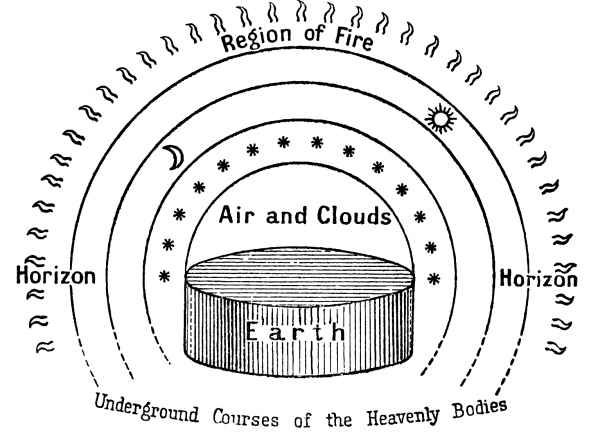
Fig. 12. The Universe according to Anaximander.
Somewhat timidly the barriers have been thrust back. The earth goes a little deeper into the dark unknown, the sky is wider and higher, the heavenly bodies are much larger and more distant and go under Earth’s surface; but they are cautiously upheld by solid domes, and worked by wheels. Earth is still the floor of the World, and Heaven—now a series of heavens—the vaulted roof above.
3. LATER FLAT EARTH SYSTEMS.
It is interesting to see how long this timidity persisted among the Greek philosophers, especially of the Ionian school, in spite of the fact that other schools had advanced much bolder ideas, as we shall presently see. Quite a number of universes were constructed somewhat after the pattern of Anaximander’s, with Earth as floor of the world; but some placed the stars beyond moon and sun, some definitely included the planets, though they do not seem to have explained their motions; and there were various ways of supporting the flat earth, and of supporting and moving the heavenly bodies.
Anaximenes c. 550 b.c.
Empedocles c. 450 b.c.
Anaxagoras died 428 b.c.
Anaximenes, a follower of Anaximander, having doubtless pondered the fact that very heavy bodies can float in water if only they are the right shape, and that Earth itself was supposed by Thales to be floating on the Ocean, suggested that the moon is so broad a disc that she floats in the ether, “like a leaf,” and of course the same would apply to the sun. Two later philosophers, Empedocles and Anaxagoras, held that a great whirlwind swept continually round the Earth, which both kept the heavenly bodies from falling down upon it and drove them across the sky.
Equally diverse were the opinions as to the nature and composition of the heavenly bodies. Most philosophers of this age believed that they were of pure fire, or else that they were vessels containing fire, which was extinguished, or in one way or another became invisible to us, during eclipses and when they set. Others held, as we have seen with Thales, that they were of an earthy nature; and Anaxagoras, seeing a meteorite which had fallen from the sky during the daytime, thought he actually held a piece of the sun in his hands, and concluded that the sun was an enormous mass of iron, “much greater than Peloponnesus,” and shone because it was red-hot. But the popular idea still was that the sun was a god, or the chariot driven by a god across the sky, and Anaxagoras was banished from Athens for his impious words.[27] The markings on the face of the moon were thought to prove that she was of mixed composition: she was made of air mingled with only a little fire, or earth mingled with fire; but according to Democritus the markings were shadows of mountains on her surface, and Anaxagoras is reported to have said that the moon was inhabited, and the markings were “plains and valleys.”
Anaxagoras suggested that the stars were fragments torn off the circumference of the earth by the encircling whirlwind, and that they glowed with the heat caused by friction, though they were too distant for us to feel this heat, being far beyond the sun. The Milky Way was a source of speculation: some said it was the former path of the sun, and still burning from his heat, but Democritus explained it as caused by the shining of innumerable stars, too faint and close together to be distinguished separately.
The doctrines of the different philosophers as to origin and first stages of the universe do not concern us here, but we must mention that of Empedocles, as his views are directly referred to by Dante.
This philosopher was the first to assert that everything consists of the four elements, earth, air, water, and fire, pure or in combination; and the combinations he supposed to be brought about by two forces, one attractive, the other repulsive, which he named Love and Discord. Of these, one alternately predominates at different ages of the world, and thus its history is divided into periods of different character.
A great step forward was taken when it was realized that the sky is not a hemisphere, ending at the horizon, or even extending a little way below, but that it surrounds Earth in every direction, like a sphere. This idea probably originated with the Pythagoreans, or it may have occurred independently to several thinkers, when the diurnal motion of the heavens was better observed, and geometrical conceptions understood and applied. Now it became no longer necessary to extinguish and rekindle the stars, nor to send the sun round swimming on River Ocean behind northern mountains, or creeping through strange underground regions, through the night. It was clearly recognized that the visible course of each heavenly body was part of a circle, the whole of which we could see if we could only travel fast enough and go to the underside of the earth.
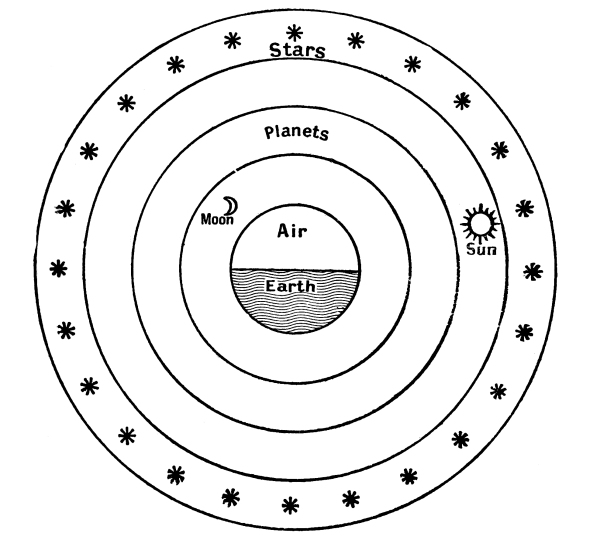
Fig. 13. The Universe of Leucippus.
Leucippus c. 450 b.c.
Democritus c. 430 b.c.
But this was just what never could be done, for outside the schools of the Greeks in Italy (Pythagorean and Eleatic), Earth still had an uninhabitable underside. Distinguished men like Leucippus and Democritus sought to combine the belief in an all-surrounding spherical heaven with a flat supported earth which might still give them a solid floor beneath their feet. Leucippus made the earth a hemisphere, with a hemisphere of air above, the whole surrounded by the supporting crystal sphere which held the moon. Above this came the planets, then the sun, and probably the stars were outside this. His disciple, Democritus, on the other hand, retained the disc-like earth, raised a little at the rim, to secure its contents, and made it divide the sphere of air into two parts, so that it rested upon air, and air was also in the sky above. The underside of the disc was not inhabited, no doubt because no one could stand upside down. His order of the successive heavens is not quite the same as that of Leucippus, as he puts the moon and the Morning Star together, and the rest of the planets beyond the sun.
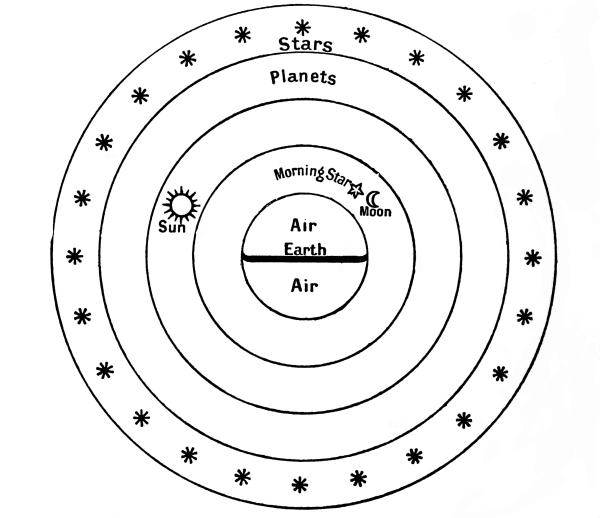
Fig. 14. The Universe of Democritus.
This scheme gave the universe a beautifully symmetrical form, which must have pleased the Greeks, but now they were puzzled to know why the heavenly bodies did not circle symmetrically with regard to the central earth. Why was not the pole in their zenith and the equator on the horizon? They could only guess that it must have been so at first, and that the disc had slipped out of position, either through some irregularity in its weight, or in the density of the underlying air. Compare Milton’s—
“Some say He bid His angels turn askance The poles of Earth twice ten degrees and more, From the Sun’s axle; they with labour pushed Oblique the centric globe.” Paradise Lost, Bk. X., 563-566.
All these theories and guesses may seem to us very crude and fanciful, and we may compare them to the eager questionings of intelligent children, too impatient to consider whether the answers given are satisfactory explanations or no. But we must remember that all we know of the early cosmogonies is from allusions and descriptions by later writers, who often—like Aristotle, for instance—only quote to condemn. “If each could defend his own opinion, may be we should see that there is truth in all.” (Conv. IV. xxi. 25-7).
At least we find a keen and disinterested desire to penetrate the causes of things, and a fertile imagination, without which science can make no advance: moreover there was a progress in true knowledge. It was discovered that the (apparent) diurnal paths of sun, moon, and every star were circles, although only a part of the paths could be seen; and that, although all were seen projected on a sphere, their actual distances from earth were very varied.
It is disappointing to find no record of observations of the planets, and from the almost random way in which they were placed in the heavens it seems that but little attention had been paid to them as yet. In fact, Seneca tells us that Democritus knew neither their number nor their names. They were often classed with comets, and thought to be entirely erratic, and the Greek mind was more attracted towards those phenomena which were seen to be orderly.
4. PYTHAGORAS AND HIS FOLLOWERS.
Socrates. As the eyes are appointed to look up at the stars, so are the ears to hear harmonious motions, and these are sister sciences. That is what the Pythagoreans say, and we, Glaucon, assent to them?
Yes, he replied.
Pythagoras c. 540 b.c.
About the same time that Anaximander was inventing solid hemispheres and rings to hold and move the heavenly bodies round about a flat earth, Pythagoras was founding a school in southern Italy which gave to the world a very different scheme. One of the characteristics of his school was secrecy, its methods were oral, and his later followers were fond of attributing to their master everything which had gradually grown out of his teaching: it is difficult therefore to say with certainty what he himself taught. It has often been stated by modern writers that he anticipated Copernicus, and discovered that the earth revolves round the sun. Though this is a mistake, we may venture to believe that Pythagoras taught that the earth is a sphere, hanging freely in space.
We are so familiar with this idea from childhood, that it is difficult to imagine what a tremendous innovation it was. Pythagorean noviciates, doubtless after solemn initiation and preparation, were told: This earth, which seems to you the floor of the world, with heaven stretched over it like a tent, is a round globe, with men like you living on the other side of it, and yet they do not fall, and earth does not fall, for it is poised in the centre of the world, and has no tendency to fall in one direction rather than in another. Earth, itself a perfect sphere, is in the centre of an infinitely greater sphere, the star-set heaven; and within this seven heavenly bodies move in perfect circles, each at its proper distance and pace, all needing no support and no force to drive them, for harmony is the motive power of the Cosmos. Their distances are proportional to the intervals between musical notes, and as they circle they make heavenly music, which we should hear did we not always hear it, like one who lives beside a waterfall[28]. There is no below, and no above, for above is below and below above to our antipodes: there is but the centre, where we live, and Heaven is all around.
How did Pythagoras reach this great and startling truth of the round unsupported earth?
His school relied more on experiment and observation than the Ionian, and the colonizing Greeks of Italy had travelled. They might have noticed the curvature of the sea, and the varying height of the Pole Star according to latitude. We know that in early days the Greeks were struck by the remarkable fact that the brilliant star Canopus (second only to Sirius in brightness), which was invisible in Greece, could just be seen close to the southern horizon in Rhodes, and was well seen in Egypt. Then the moon may have helped once more. When it was understood that lunar eclipses only happen at full moon, when we are between her and the sun, and that they may therefore be explained by the earth’s shadow falling on the moon, then, since the edge of that shadow is always a circle, it is demonstrable that the body throwing that shadow can have no form but that of a ball.
Sun and moon are obviously round: it was guessed that they also are globes rather than discs, and the spherical shape of all heavenly bodies was a doctrine of the later if not the earliest Pythagoreans.
Whatever may have been the steps which led to these two great discoveries that Earth is a sphere, and that the apparent path of every celestial body is a circle, the sphere and the circle were soon accepted as the only forms suitable for celestial bodies and their orbits. The founder of the school was a great mathematician, and it is not strange that these forms should have commended themselves to his disciples. The sphere, which has its surface everywhere similar, and its contents greater than those of any other figure with equal surface, was the “most perfect” of solids; and the circle, which has no beginning and no end, is alike in every part, and presents ideas of haunting suggestiveness to the geometer, was the “most perfect” of lines.
In the system of Pythagoras we first find the five planets distinctly enumerated, and playing as important parts as sun and moon. Number was the principle of this universe, and the planets with sun and moon made the sacred number of seven. Among the Greeks, and through the middle ages, all these bodies are spoken of as planets or “wanderers,” in distinction from the “fixed” stars which do not appear to move amongst themselves. These seven “planets” represented the seven notes of a musical scale, and the star sphere made up the octave. Pythagoras is said to have been the first to teach that Phosphor and Hesperus, the morning and the evening star, were the same. When, however, we ask what was the order of the planets in his scheme, we meet with many conflicting reports, and a serious difficulty suggests itself. If the planets had really been observed with care, it must have been seen that their motions could not be accounted for by simple circular movement. The large oscillations of Mercury and Venus on either side of the sun would strike an observer before he thought of tracing their movements among the stars, and noting that they made a circuit of the zodiac. Similarly, the other planets are most conspicuous, rising after sunset and remaining long visible through the night, at the very time of their retrograde movements, so these must have been noticed if a long enough series of observations had been made to distinguish them from one another. The only solution of the difficulty seems to be that Pythagoras, on the journeys into Egypt and Babylon which he is said to have made, learned that there exist planets to the number of five, which move in regular periods, and he may also have learned the length of their zodiacal periods at the same time, or perhaps these were only known to his school much later. If the order assigned to them was that which was finally and generally accepted by the ancient world, the periods must have been known, for this is the only possible clue to the order Moon, Mercury, Venus, Sun, Mars, Jupiter, Saturn. The planet with shortest period (the moon, with a month) was naturally placed by the Greeks nearest to earth, with the smallest circle to traverse, and so on outwards.
It is very possible, however, that the early Pythagoreans, at least, did not venture to assert more than that there were five planets, without assigning to them any order, for Aristotle tells us that their universe was divided thus:—
From Earth to Moon was the Ouranos, or sky, within which exists all that is changing and corruptible.
Cosmos, the place of ordered movement, was the region of Sun, Moon, and Planets.
Olympos, the place of pure elements, held the stars; the region of Celestial Fire came beyond this, and the Apeiron, the Infinite Space, or Infinite Air, from which the world draws its breath, was outside all.
Philolaus towards end of 5th century b.c.
The diagram shows, then, the earliest form of the Pythagorean universe. But they did not remain content with this. Out of it grew a most interesting scheme (referred to by Dante), which is usually attributed to one Philolaus, of whom hardly anything is known, not even his date.
It seems to have struck Philolaus as a difficulty that the seven planets, which were circling round Earth in the same direction but at very different distances and speeds, and also the immense sphere of stars beyond, were all sweeping together at the same time in an opposite direction, and at the almost incredible pace of one revolution in a day. The brilliant idea occurred to him: Leave the stars at rest, let the seven planets revolve in their seven orbits, the nearer to the centre the faster, and let earth herself revolve fastest of all, viz. in twenty-four hours, in the same direction. If she keeps one face always turned towards the centre, like the moon, this will account quite as well for the apparent diurnal revolution of all the heavenly bodies, and the change of day and night on the earth.
Philolaus did not make Earth remain stationary and simply turn on her axis, which would have had just the same effect on the apparent motions of the heavens; for it seemed more natural that she should revolve as did the rest. The five naked eye planets are all mentioned by name in his scheme.
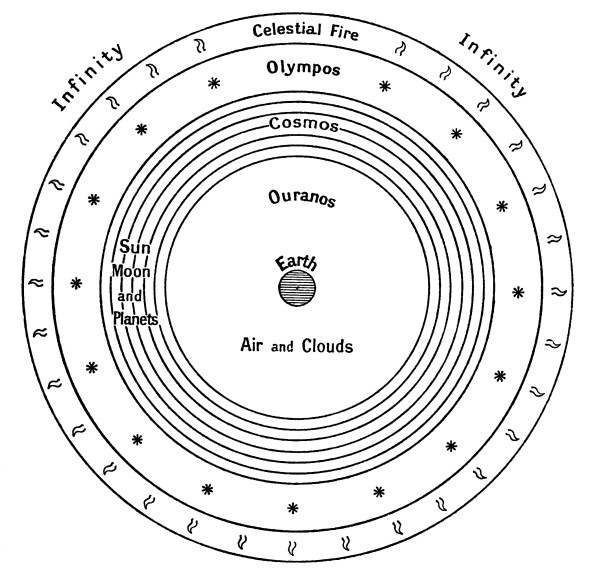
Fig. 15. The Universe of Pythagoras.
Was the centre, deprived of Earth, to be left empty? No, the centre was the Watch Tower of Zeus, the Hearth of the Universe, and here they placed the purest element, fire. It was invisible to us, because we live on the side of the earth-sphere turned away from the centre; and also invisible to us was another planet, Antichthon, or Counter-Earth, for this revolved within our orbit, and also in twenty-four hours. It was added to the system, because the addition of Earth as a heavenly body spoiled the sacred number of seven, but by adding Antichthon, and counting the star sphere as another, the total was brought up to ten, another sacred number.
The objection was made that, if Earth is moving in space, this must bring about a change in the apparent sizes of sun and moon, as Earth is nearer or farther from them, but the Pythagoreans were quite ready to believe that all the heavenly bodies are so distant that this journey of Earth makes no difference to their apparent size or brightness. The planets were thought to be worlds like ours, and inhabited; and it was even guessed that plants and animals on the moon must be fifteen times as strong as ours, apparently because there the average day consists of nearly fifteen of our days (of twenty-four hours), and the nights are equally long.
It was the braver of the Pythagoreans to shake the steady earth from her centre, and set her whirling in the depths of space, that they realized, as no one had done before, how large she must be; for Greece and the surrounding lands, the Middle and the other seas, instead of making the whole of the earth, were now understood to be only a portion of a great globe.
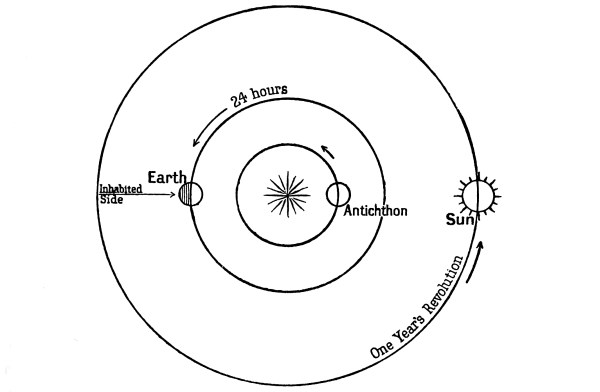
Fig. 16. The System of Philolaus: night on earth.
Only the side turned away from the centre is inhabited: consequently the Central Fire and Antichthon are invisible.
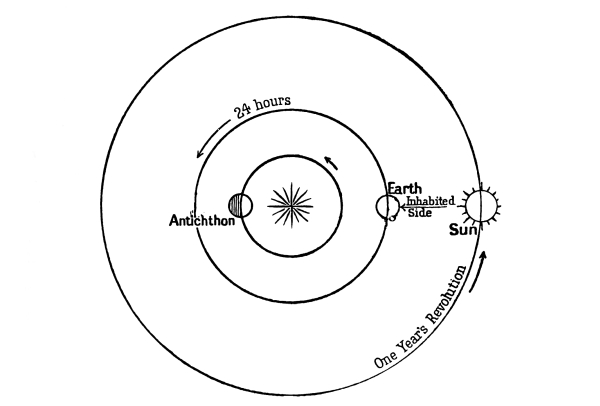
Fig. 17. Twelve hours later: day on earth.
Earth has made half a revolution and her outer side is now lighted by the sun, which has only moved about half a degree forward in its yearly orbit. Antichthon has also made half a revolution, therefore remains invisible.
Here, then, is a conception of the Universe widely different from Homer’s. The little flat disc has become a great round ball, a planet among planets, swiftly moving through space; the crystal dome that tenderly covered it like a bell-glass over some fragile flower, has lifted, and the vast sphere is seen, infinitely distant, and studded with enormous stars. Man himself is now a tiny creature on a great earth, and his world but one among many, but if he is humiliated by his insignificance, is he not elevated by the vastness of his outlook?
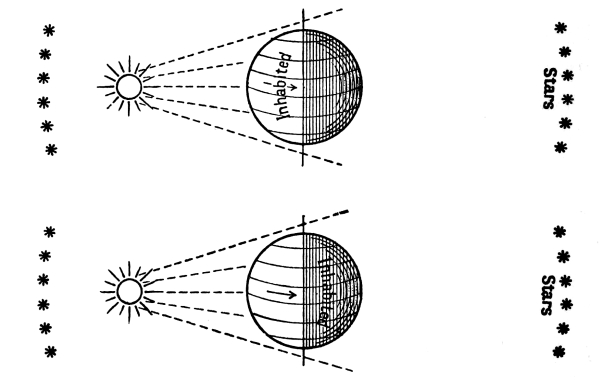
Fig. 18. Earth and sun according to Heracleides.
In the upper figure it is day, in the lower, night, on the inhabited side of Earth. The sun is on the equator, as at the time of equinox.
Heracleides c. 370 b.c.
But not even here did the Greeks stop. It was taking a less startling step than they had already taken, to reach the truth that Earth was merely rotating on her axis once in a day, and so causing the apparent diurnal revolution of the heavens. This step was taken (it is said) by a Pythagorean called Hicetas of Syracuse, who is quoted as saying that the earth, “while it turns and twists itself with the greatest velocity round its axis, produces all the same phenomena as if the heavens were moved and the earth were standing still.” We are told also that “Heracleides of Pontus and Ecphantus the Pythagorean let the earth move, not progressively, but in a turning manner like a wheel fitted with an axis, from west to east round its own centre.”