SECOND PART. The Astronomy of Dante.
Reading edition
I. POPULAR ASTRONOMY IN ITALY IN DANTE’S TIME.
In the first part of this book we have sketched the story of man’s thoughts about the stars, from primitive days until the thirteenth century of our era. We have seen what a wealth of imagination and invention the Greeks brought to bear on the purely empirical science of Egypt and Babylon and Homeric Greece, and how out of all the systems devised by them between 600 b.c. and 100 b.c. one survived, which was completed and expounded by Ptolemy in the second century after Christ in his great Syntax or Almagest. Its fundamental principles were that Earth is a sphere, at rest in the centre of the Universe, surrounded on all sides by spherical heavens, and that the movements of all the heavenly bodies are explained by a combination of uniform circular movements.
In the succeeding centuries there were few who could appreciate his work, and during the Dark Ages it was scarcely known in Europe, but was preserved by Nestorian Christians in schools and monasteries of Persia, whence it was unearthed by Mahomedan princes, five centuries after Ptolemy’s death; and when another five centuries had passed it was brought back to Europe, tinged with Oriental thought, and almost immediately became immensely popular among scholars.
Then there arose one of the world’s greatest poets, and, a thousand years after Ptolemy’s death, immortalized his work, writing in a tongue unknown to Ptolemy, and for nations which in his day were only just struggling into existence. As Homer reflects to us man’s primitive conceptions of the Universe, so Dante reflects the ideas of Ptolemy and his school.
And because he lived just at this time he was able to write with perfect confidence, quoting Ptolemy and the Catholic Faith side by side as infallible authorities in astronomy. Had he lived in the early Christian centuries he would have been obliged to choose between classical and orthodox views; had he been born three centuries later, he would have found Copernicus and Galileo ranged against Ptolemy and the Church. Even Milton writing a hundred years after the death of Copernicus, could not make up his mind which system to adopt, and the astronomy of Paradise Lost is a curious jumble of ancient, modern, and transitional ideas. He describes the Primum Mobile as a “firm opacous globe”[71] on which Satan alights and walks about, yet later on tells us that we need not believe in its existence if Earth is turning on her axis;[72] the archangel Raphæl describes to Adam the Creation, at which he was present, yet declares that he himself does not know whether the sun circles round Earth, or Earth round the sun. This the great Architect had wisely concealed from man and angel,
“perhaps to move His laughter at their quaint opinions wide, Hereafter when they come to model heaven, And calculate the stars, how they will wield The mighty frame, how build, unbuild, contrive, To save appearances; how gird the sphere With centric and eccentric scribbled o’er, Cycle and epicycle, orb in orb.”[73]
Such inconsistencies are not found in Dante’s work, and nothing could have been further from his thoughts than to imagine the Creator mocking at man’s mistakes and ignorance. Like the angelic doctor, Thomas Aquinas, he considered man’s desire for knowledge as one of his highest attributes, and believed that it had been given to him in order to be satisfied.
But before we examine Dante’s writings, it will be interesting to form an idea of the spirit in which astronomy was generally regarded by his fellow-countrymen, and what were his opportunities of studying it.
Dante Alighieri was born in Florence in or about the year 1265, and died in 1321. There can be no doubt that the part of star-lore which appealed most to the general public in Italy at this time, educated and ignorant alike, was the art of the astrologers. The movements of the heavenly bodies were regarded not merely as omens, but as the actual instruments by which every event on Earth was brought to pass. Every class of plants, every race of animals, was thought to be under the protection of some planet or constellation; so if it was a bad year for certain fruits, or if an epidemic broke out among the cattle, this was because the guardian planet was unfavourably placed, or an evil planet was in the protecting constellation. Floods and drought, prosperity and death, properties of minerals such as the lodestone’s attraction for iron or the emerald’s alleged power of blinding serpents, the instincts of animals and the impulses of men, all were subject to the influences of the stars; and naturally the men who understood and interpreted their movements were held in great repute.
Some of them were unscrupulous quacks, like the one-eyed prophet of Brescia, mentioned by the gossiping friar Salimbene.[74] He “called himself an astrologer and diviner,” and received daily “ten great pennies of silver, and nightly three great Genoese candles of the purest wax” from a political party in Modena, as a recompense for advising them how to act. On one occasion he prophesied a victory for them, but he had little faith in his own words, for being threatened with violence if his prophecy should fail, he “carried off all that he had gained and went his way without saluting his hosts.” “Then,” adds the friar, “the men of Sassuolo began to mock them, as men who sacrifice to devils and not to God, as it is written in Deuteronomy.”
But most of these men, like Asdente of Parma, sincerely believed in their own ability to foretell events, and they usually combined some other favourite forms of soothsaying, as well as a little alchemy, with astrology. Asdente is described by Salimbene as “a poor working cobbler, pure and simple, and fearing God, and courteous and urbane; illiterate, but with great illumination of mind.” His proper name was Master Benvenuto, but he was “commonly called Asdente, that is, toothless, by way of contrary, for he hath great and disordered teeth and an impediment in his speech, yet he understands and is understood well. He dwells at the bridge-head of Parma, hard by the city moat and the well, along the street which goes to Borgo San Donnino.” This humble prophet was said by Dante to be the best known citizen of all Parma (Conv., IV. xvi. 65-71): he was asked to dinner by a bishop, and consulted by the warring factions of Reggio and Parma. He was said to have foretold the death of two popes, and a naval defeat of Pisa by Genoa.
The greatest generals of the day governed their tactics by the advice of astrologers who regularly accompanied them to the field and the camp. The famous Ghibelline, Guido of Montefeltro, who is called by Villani the cleverest soldier of his times[75] retained Guido Bonatti[76] in his service and was believed to have gained his great victory at Forli (in 1282) through the advice of this astrologer. Bonatti is diversely described as a tiler and a lawyer, but whatever his original occupation may have been he found that the position of private astrologer brought him both more fame and more money. He wrote a book on Judicial Astronomy, and Vincent de Beauvais describes him as celebrated throughout the western world for his knowledge of the art.
But Bonatti’s fame was faint and fugitive compared with that of the wizard Michael Scot. He is one of the picturesque figures of the thirteenth century, round whom so many legends have gathered that the facts of his life are difficult to glean. It seems that he was born in Fifeshire of a noble Scottish family, at the end of the twelfth or beginning of the thirteenth century, that he studied in Oxford and Paris, and then spent some time in Toledo. Here he learned Arabic, and probably also astrology, for it was so commonly practised there, especially among the Arabs and the Jews, that it was sometimes called the Toletan art. Afterwards he went to Germany, and was discovered by Frederick II., who took him to Italy. His great learning earned the admiration of Pope Gregory IX., who speaks of him quite affectionately in a letter to the Archbishop of Canterbury; and it is said that Honorius II. would have liked to make him an archbishop. But Sir Michael the Scot found Frederick’s court more congenial. The Emperor, who was himself a poet, was a munificent patron of literature and art, and attracted to himself men of talent from all parts of the world. The culture of both East and West met at that brilliant Sicilian court[77] which was his for fifteen years before the title of Emperor was added to that of King of Naples and Sicily. Indeed it was his “fellowship with Saracens”[78] which was one great reason for the accusation of heresy on account of which Dante placed him among the Epicureans in the Inferno. He knew Arabic, as well as French, German, Italian, Latin, and Greek. Michael Scot’s acquaintance with Moorish literature and language was a bond of sympathy between them; he became astrologer to Frederick, and at the Emperor’s wish he superintended a new translation of Aristotle’s works from Arabic into Latin. His taste for astronomy is evidenced by the fact that out of these he chose to translate the De Cœlo himself.
An absurd story is told by Salimbene about Frederick and Michael Scot, which, however, shows what was believed of his capabilities as an astronomer. The Emperor one day asked him, when they were in the palace together, how far they were from the sky, and the astrologer told him the distance. They then took a long journey together, during which the palace was secretly lowered, and on their return Frederick asked casually whether the sky could really be so distant as Michael had said. “Whereupon he made his calculations, and made answer that certainly either the sky had been raised or the earth lowered; and then the Emperor knew that he spake truth.”
Michael Scot is said to have warned Frederick that he would die in Florence, for which reason the Emperor would not enter that city; but having thoughtlessly gone to a town called Florentiola he died there; “for this,” adds the historian, “is almost always the way, the devil tricks one by a play upon words.” It is curious to contrast this remark, attributing Michael’s prophecy to the evil powers, with Salimbene’s quotation from him, in exactly the same spirit as if he were quoting from an Old Testament prophet:—“that the word of Michael Scot may be fulfilled in them, which he wrote in his verses wherein he predicted the future, ‘And the factions at Reggio shall hold ill words together.’” The same author brackets him with others who have foretold the future, in a list which reads curiously to us—“Abbot Joachim, Merlin, Methodius and the Sybil, Isaiah, Jeremiah, Hosea, Daniel, and the Apocalypse, and Michael Scot who was astrologer to the deposed Emperor Frederick II.”
Besides these prophetic verses, Michael wrote several books which treat almost exclusively of astrology, alchemy, and other occult “sciences,” and even in the fifteenth century it was said that his magic books could not be opened without danger, because of the fiends who were thereby invoked! He seems to have returned to his native Scotland to die, but the date is very uncertain. We do not know whether Dante’s picture of him is drawn from memory, or hearsay of some who had seen the lanky Scotsman among the southerners, by nature taller and thinner than they, and worn by his prolonged studies.
“Quell’ altro che ne’ fianchi è così poco Michele Scotto fu, che veramente Delle magiche frode seppe il gioco.”[79] (Inf. xx. 115-117).
It was perhaps the winning personality or the prudence of the canny Scot which enabled him to bring a brilliant career to a peaceful close, favoured by the Church as well as by the excommunicated Emperor, although his studies were of so dubious a nature, and he was intimate with heretic Mahomedans and Jews. Cecco d’Ascoli was not so fortunate. This learned Italian received the high and honoured post of professor of astrology in Bologna, where he lectured and cast horoscopes for his students. He was well versed in natural science, but the shady side of astrology had a fatal attraction for him: he fell under suspicion as a sorcerer, was condemned, and burned at the stake in Florence in 1327 (six years after Dante’s death).
The reputations achieved by these and other thirteenth-century astrologers in Italy, belonging to such different ranks of life, show what an immense importance was attached to their art by the general public. Yet we shall be greatly mistaken if we think that it was only to acquire skill in this fascinating pursuit that men thronged to hear Cecco lecture, or pored over Latin manuscripts. The intense ardour for knowledge which marks this period made them eager to understand the world around them and the sky above their heads.
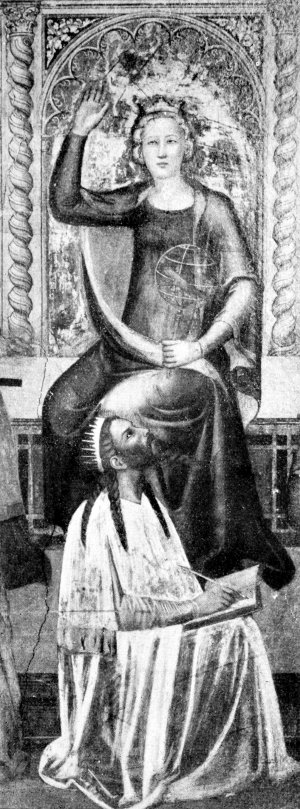
ASTRONOMY.
From a fresco in the Spanish Chapel of Santa Maria Novella, Florence. [To face p. 217.}
It would be a shame, writes one, to live in a house and not know how it is built or what shape it has, never to examine the walls, and floors, and ceilings, nor to consider the use of the wooden beams used in its construction. In like manner we should not be content without understanding the form and structure of the Universe in which we live. Man, with his upright attitude and his head held high, unlike the animals, was designed by his Creator to look and listen, to know and comprehend this marvellous Universe, and especially that noblest part of it above him, the heavens and their wonderful movements. For thus alone can he learn to know God Himself, the great Architect of the World.
In writing thus, Ristoro, the monk of Arezzo, was not only echoing the thoughts of Plato and Cicero, he was expressing the feeling for astronomy as a noble and elevating study which was general among thoughtful men of his time. It was expressed also in contemporary art. Visitors to the “Spanish Chapel” in the cloisters of a Florentine church will remember seeing on the frescoed walls the figure of Astronomy as she was personified in Tuscany in the fourteenth century. She sits among her peers, the sciences of the Trivium and Quadrivium, the only one who wears a crown; her fair hair frames a spiritual face, one hand is lifted heavenwards, the other holds a celestial sphere, on which the broad band of the zodiac crosses the “equator of the day.” At her feet sits a kingly figure in flowing robes, also crowned, and with a face of singular beauty and refinement; he gazes up into the skies with a rapt expression, and on his knee is a book in which he writes what he sees.
This nameless figure was identified doubtfully by Ruskin as Zoroaster, who was considered by many as the inventor of astrology, but surely it can be no other than Ptolemy with his Almagest. For Ptolemy, the prince of astronomers, was often and naturally confused with the royal race who had patronized astronomy at Alexandria; as for instance by Omons, a thirteenth-century writer, who says in his Image du Monde that “Ptolemy king of Egypt” wrote the Almagest. The curious mode of dressing the hair and beard may have been thought by the artist to represent an ancient Egyptian fashion.
Ptolemy, we know, was universely acknowledged at the time to be “Master of Astronomy,” as Brunetto Latini calls him. His Almagest was only known indirectly, but it was believed to contain all that could be known about the movements and the nature of the heavens. Some minor additions and corrections had been made, as we have seen, by the Arab astronomers, but the system was accepted as a complete and satisfactory explanation of all celestial phenomena. Hence no professional astronomer was expected to make discoveries; he was simply well versed in the work of those who went before him, skilful in the use of a few simple instruments and tables, and practised in applying the principles of astrology.
A general notion of the Ptolemaic system was widely diffused. For those who could not read Latin there were encyclopædic works written in the vernacular and in a popular style, such as the Trésor of Brunetto Latini, and these always contained a section on astronomy. The average educated man probably had only vague ideas about epicycles and eccentrics, and perhaps had never heard of the Arab estimates of the sizes of the planets; but he would know that astronomy taught that Earth is a globe, motionless at the centre of the universe, and smaller than any of the stars; he would know the names of the seven planets (including among these the sun and moon), and probably also their colours, their periods, and their astrological significance; the zodiacal constellations would be familiar, especially as they were often used decoratively; and he would believe that stars and planets are set in crystalline transparent spheres.
Moreover, he would often be more of an astronomer than he knew, for he would learn almost unconsciously many things of which modern men are ignorant. The ill-lighted streets and the dangers of night journeys would force him to be better acquainted with the motions and phases of the moon than most of us are to-day; he would know when and where to look for different stars; and the want of a watch would make it necessary for him to be able to take his time from the sun at any season of the year. He could, however, sometimes consult a sundial on a church wall or in a private garden, and the church chimes rang out at tierce, and nones, and vespers. These were heard at intervals which were much longer in summer than in winter, for the system of “temporary hours” was used by the Church, and the service of tierce was held halfway between sunrise and noon (or nones), and vespers was halfway between noon and sunset.
II. DANTE’S STUDIES.
Dante was far above the level of the average educated man. Not that his scientific ideas were in advance of his age: on the contrary, one special interest that they have for us is that they illustrate, like his political and religious views, the beliefs and feelings of the period. His authorities were the authorities of all, but he had studied them and made their thoughts his own, as few others did, except some churchmen and professed scholars. The extent and depth of his reading is evident from his own writings, and his great learning is noted with admiration by all his biographers. Giovanni Villani, in the earliest account we possess of Dante, says that he was “a great scholar in almost every branch of learning, although he was a layman.” Boccaccio would have us believe that while still a child, so young that he might be expected to spend his time playing with other children or sitting on his mother’s knee, he gave the whole of his time to reading and learning. Lionardo Bruni, however, assures us that though he was an ardent student, and showed unusual powers at an early age, he by no means tried to “sever himself from the world, but living and moving about amongst other young men of his age, he approved himself gracious and skilful in every youthful exercise.” It was wonderful, he says, how Dante maintained all his social and civic intercourse while he pursued his studies so fervently.
In truth, the poet’s troubled life was far removed from that life of calm retirement which one thinks suitable for a scholar. In his early youth he experienced a passionate love and sorrow; a year before the death of Beatrice he was fighting for Florence in the great battle of Campaldino, nor was it the first time he had borne arms; in 1296 he spoke in the council of the Hundred; in 1300 he was ambassador for the Tuscan League to San Gemignano, and was elected to the highest office a citizen could hold in his native city, that of Prior; in 1301 he was ambassador to the Pope in Rome, and in the year following he was exiled. After this he was always wandering, often in great poverty, dependent on first one patron and then another, always hoping that some turn of affairs would restore him to Florence, always taking a keen and active interest in Italian politics, until he died, still in exile, at Ravenna. Add to this the difficulties common to all scholars of his day, viz. absence of printed books, public libraries, and journals, etc., and we must marvel how he ever found the opportunities and the serenity of mind for his prolonged studies.
Boccaccio adds another obstacle—his wife! To console him for the death of Beatrice, his friends and relatives persuaded him to marry a wife of their choosing with melancholy results:—
“Dante formerly had been used to spend his time over his precious studies whenever he was inclined, and would converse with kings and princes, dispute with philosophers, and frequent the company of poets.... Now, whenever it pleased his new mistress he must at her bidding quit this distinguished company, and bear with the talk of women, and to avoid a worse vexation must not only assent to their opinions, but against his inclination must even approve them. He who, whenever the presence of the vulgar herd annoyed him, had been accustomed to retire to some solitary spot, and there to speculate on the motions of the heavens, or the source of animal life, or the beginnings of created things, or may be to indulge some strange fancy, or to compose somewhat which after his death should make his name live into future ages, he now, as often as the whim took his new mistress, must abandon all such sweet contemplation, and go in company with those who had little mind for such things.”[80]
However, after a long tirade against wives, Boccaccio owns that as far as concerns Dante the picture is entirely imaginary. He believes the marriage was an unhappy one, because after his exile Dante and his wife never met again, but we have no evidence whatever that while they were together their life was as Boccaccio depicts it. Doubtless family life and the care of four children interfered to some extent with Dante’s studies, but the one detail Boccaccio affirms as fact among his fancies, namely that the poet refused for nineteen years to see his wife, seems rather to imply that one thing poor Gemma did know how to do was to leave her husband in peace when he did not desire her company.
When and where Dante began to study astronomy seriously it is not easy to say. His favourite study in his youth was poetry, but his parents (says Bruni) gave him a good general education, engaging such teachers as could be found in Florence, where as yet there was no university. But seeing how clever the boy was, his relatives and friends helped and encouraged him, and among the latter Bruni mentions Brunetto Latini.
This famous Florentine was a very learned lawyer, who during Dante’s infancy and boyhood held high offices of state in the city. It is not possible, therefore, that he should have had pupils at this time, and he cannot have been Dante’s master in any strict sense of the word, as Vasari affirms, and as many commentators have assumed on the strength of the moving interview between these two in the Inferno.[81] Dante’s affectionate greeting mingled with reverence, and the fatherly solicitude of Brunetto, suggest just such a connection as Bruni indicates. The elderly man had taken an interest in the budding genius of the boy, and had held inspiring conversations with him from time to time on serious subjects, and by his own example had encouraged the youth to win fame through his pen. For Dante was no doubt well acquainted with Brunetto’s Tesoretto, and his more ambitious and voluminous Trésor, which Brunetto specially commends to his care.[82] This was a compendium of knowledge, a small part of which was devoted to the elements of astronomy, and it may well be that this short epitome was Dante’s first introduction to the science.
Some have thought that Brunetto’s advice to Dante to follow his star “Se tu segui tua stella ...,”[83] indicates that he had cast the poet’s horoscope; but there is no evidence that Brunetto had ever practised astrology, or even that he took special interest in it above other branches of learning.
Villani and other biographers tell us that after his banishment from Florence, therefore in middle age, Dante went to the University at Bologna, but they seem to have made this statement rather because of its probability than because they knew it for fact. It is, however, quite possible that he spent a couple of years there, between 1304 and 1306. He probably left his “primo rifugio”[84] at Verona when Bartolommeo della Scala[85] died in March 1304, and we know nothing of his whereabouts till August 1306, when he was in Padua, as is proved by a fifteenth century document.[86] Now in 1306 a number of Ghibelline students and professors left Bologna for Padua; and we know that Dante had friends among the Bolognese professors, for later on he seems to have corresponded with Cecco d’ Ascoli,[87] and Del Virgilio entreated him to come and receive the laurel crown, an invitation which the poet refused in one of his Latin Eclogues. Bologna and the Bolognese are referred to several times in Dante’s works, and the friar Catalano is no doubt alluding to the school of theology at the University when he says in Inf. xxiii. 142-144 that he used to hear at Bologna much about the wickedness and the lies of the Devil. One vivid passage can hardly be anything but a personal reminiscence of the Carisenda, the leaning tower at Bologna. The poet compares his fear when he saw the giant Antæus stooping over Virgil and himself to the sensation of looking up at the Carisenda from beneath the leaning side, when a cloud is passing over it, and the spectator feels that the tower is about to fall upon him.[88] (The tower was much higher in Dante’s day than it is now, part having been pulled down in the middle of the fourteenth century).
The University at Padua was also famous, and as it was originally an offshoot from Bologna and modelled on the same plan, it is sure to have included astronomy in its curriculum. But Dante does not seem to have stayed here more than a few months.
There is also a tradition that he went to Paris, the greatest intellectual centre of his times, and that he himself heard those lectures of Sigieri, the philosopher, in the Street of Straw, of which he makes mention in Par. x. 137. This is possible, but quite uncertain; the allusion to Sigieri is no proof, since it has lately been discovered that he died in Italy, and his story was well known there.
After sifting all the evidence available, we can only echo Boccaccio, and say of Dante that “As it was at divers ages that he studied and learned the divers sciences, so likewise it was at divers places of study that he mastered them under divers teachers.”
III. BOOKS ON ASTRONOMY USED BY DANTE.
We shall probably be right if we conclude that Dante’s knowledge of astronomy was principally gained from independent reading, and from conversation and discussion with learned men. Like a true scholar, he was learning all his life, for in the Paradiso he corrects the opinion expressed earlier in the Convivio about the origin of the markings in the moon.
Boccaccio’s description of his planning out a course of study and attacking some subjects alone in his youth agrees with his own account of his lonely struggles with Latin authors;[89] and it is quite credible that he suffered heat and cold, and went without food and sleep in his eagerness to learn, since he himself mentions quite casually that at one time he injured his sight by constant reading, so that the stars appeared blurred to him, until by rest and bathing with cold water it became strong again.[90]
His diligence must have been great, and his memory wonderful, judging from the numerous quotations from classical and contemporary authors to be found in his writings. They seem to be chiefly from memory, and it is not likely that he can often have had many books by him when writing. If he gives a reference it is often a vague one, and occasionally wrong: his authorities on astronomical questions are sometimes “the mathematicians,” “the astrologers,” or “the sages of Egypt,” by whom he means the Alexandrian astronomers.
One does not, of course, expect mediæval writers to verify their references, or to have our modern scruples about quoting other authors without acknowledgement: in those days they were only too glad to get their information wherever they could, often at second or third hand, and to make it their own by storing it in their memories. Nevertheless, from a careful study of Dante’s direct quotations, and his allusions and reminiscences, which are sometimes unconscious, a good idea may be gained of his range of reading, and of the books and authors on whom he chiefly relied for his astronomical data.
His supreme authority was of course Ptolemy. But it would only be by a rare chance that he could see the Almagest, even in a translation, and all the evidence that we can find in his own writings points to its being entirely unknown to him. On each of the three occasions that he quotes Ptolemy’s opinion on subjects dealt with in the Almagest he is wrong: once it is Ptolemy’s view on the physical nature of the Galaxy,[91] as to which none had been expressed, although its appearance was carefully described; in another case he implies that Ptolemy discovered precession, and says that he added a ninth heaven to account for it,[92] and this double mistake was apparently copied from Albertus Magnus or Averroës.[93] As we know, it was Hipparchus who discovered precession, and Ptolemy gives him the credit for in the Almagest; it was the Arabian astronomers who added the ninth sphere.
On the other hand Dante quotes twice quite correctly from the Tetrabiblios, which was more widely known.[94] He may, therefore, possibly have read it, and he alludes to it in the Convivio, though by a curious slip he does not give its name, thinking he has done so already: “Tolommeo dice nello allegato libro....”[95] This is in the fourteenth chapter of the second treatise, but so far from having just quoted any special work by Ptolemy he has said nothing at all about him since the third chapter, and then it was only his opinion and name that were mentioned. I have not been able to trace the quotation given in the Quæstio de Aqua et Terra (xxi. 29-31), where Ptolemy is said to have asserted that things on earth resemble things in heaven, but this probably comes also (or was supposed to come), from the “judicial astronomy” of the Tetrabiblios. It is not taken from the Almagest.
The elements of Ptolemy’s system, however, could be learned indirectly, and it seems that Dante had recourse to the excellent epitome of the Arab astronomer Alfraganus. It is true that his name is only mentioned once, and his book once; but nearly all Dante’s astronomical data appear to have been taken from him, and his very expressions are sometimes repeated.
One of the most striking examples of borrowing from the Elementa Astronomica of Alfraganus occurs in the Paradiso, where Dante likens twenty-four spirits to as many brilliant stars.[96] He makes up the number by taking fifteen specially bright stars from different parts of the sky, and adding to them the stars of Ursa Major and two stars of Ursa Minor. The seven chief stars of Ursa Major are well known, but Beta and Gamma Ursæ Minoris are not conspicuous nor specially familiar; and why, if he takes fifteen unnamed, should he name any of the twenty-four? Turning to chapter 19 of Alfraganus’ book, we find that he follows Ptolemy in enumerating fifteen first-magnitude stars in different parts of the sky, and then he gives as examples of the second magnitude (i.e. next in brightness) Benet Naax and Alfarcatein, Arab constellations which correspond with the tail of Ursa Major, and Beta and Gamma of Ursa Minor.
There is no reason to suppose that Dante knew Arabic, but there were several versions of Alfraganus in Latin, and it is even possible to determine with some certainty which of them he used. Speaking of the movements of the planet Venus, he says that they may be found, summarized from the best demonstrations of the astrologers, in the Book of the Collection of the Stars:—
“Li quali, secondochè nel Libro dell’ Aggregazione delle Stelle epilogato si trova, dalla migliore dimostrazione degli astrologi ....” (Conv. II. vi. 133-136).
Although the usual name for the book of Alfraganus in Latin was Elementa Astronomica, the version for which mediæval students were indebted to the indefatigable translator Gerard of Cremona bears in the MSS. the title Alfragani liber de aggregationibus Scientiæ Stellarum et de principiis cœlestium motuum. It is this book, therefore, that Dante means, though he has translated the title somewhat inaccurately.[97]
There were several other books known to Dante from which he must have gleaned information about Ptolemy’s system, but Alfraganus we may regard as his standard reference book. Many versions of Alfraganus are still extant, and it is pleasant to feel that we can hold in our own hands Dante’s text-book on astronomy. The best known is the printed edition of Golius, published in Amsterdam in 1669: it is in both Latin and Arabic, and opening in the middle we may turn the pages backwards to see the beautiful Arabic letters of Alfraganus’ own language, which is written from right to left, or forwards to look at the Latin in which he became known to Dante.
Next in importance to Alfraganus among Dante’s authorities on astronomy was Aristotle. We have seen how overwhelming his authority became in natural science in the second half of the thirteenth century, and how for some time scholars failed to distinguish between the system of spheres devised by Eudoxus, which was the scheme upheld by Aristotle, and the epicycles and eccentrics of Ptolemy. Among all Aristotle’s admirers none was more devoted than Dante: for him Aristotle is not only “Il Filosofo,” the Philosopher par excellence, as he was generally called in that age; he is “quello glorioso filosofo al quale la Natura più aperse li suoi segreti,” his intellect was “quasi divino,” and his words are of “somma e altissima autoritade.”[98] Throughout Dante’s own writings his references to Aristotle are so frequent that Dr. Moore observes: “The amount and variety of Dante’s knowledge of the contents of the various works of Aristotle is nothing less than astonishing.”[99]
He does not, however, consider Aristotle infallible as regards the details of astronomy, for in these the philosopher was only following the observers and mathematicians;[100] but in all matters which depend upon first principles, in which Dante would include the form of the earth, Aristotle’s authority may not be called in question.[101] In cosmical physics, such as the doctrine of the four elements, and in meteorology, Dante follows “il mio Maestro”[102] implicitly, and it is also largely from the De Cælo that he gained his knowledge of early Greek speculations regarding the universe.
Dante knew little more of Greek than of Arabic. His occasional use of Greek words is enough to prove this—for example when he discusses the Pythagorean theory of “Antictona,” using the accusative as if it were a nominative.[103] In several passages he implies that the language was not known to him, and he distinctly states that he used translations of Aristotle’s works. Here again we are able to identify the versions he used. In Conv. II. xv. 59-73 he complains that it is impossible to know what Aristotle believed about the Milky Way, because in the “old translation” he is made to say one thing, and in the “new translation” quite another. From his quotations of these two conflicting opinions, we are able to deduce that the “old translation” was that which Michael Scot made from the Arabic, and the “new translation” that of Aquinas, which was made direct from the Greek.
He had access, therefore, to more than one Latin translation of Aristotle; and beside this, his quotations seem to have been often taken from commentators and compilers of his own times, especially Aquinas and Albertus Magnus. This was frequently the case with the Meteorologica of Aristotle, for the De Meteoris of Albertus Magnus seems to have been much used by Dante in place of Aristotle’s own work. Dante quotes it by name as Meteora in Conv. II. xiv. 169, and also in Conv. IV. xxiii. 125-126, where he mentions “Alberto” as the author.
These two, then, the Arab Alfraganus and the Greek Aristotle, were Dante’s chief authorities in astronomy, both in Latin translations.
Besides these, there is evidence in his writings that he was familiar with several classical authors who treated of astronomy. He quotes frequently from many of Cicero’s works, and we find echoes, in two passages, of the Dream of Scipio,[104] which he is almost certain to have read, since it was a favourite book in his time. There are several references to Seneca, but the only time that an astronomical phenomenon recorded by him is mentioned[105] Dante is evidently quoting at second-hand from Albertus Magnus. With all the works of Virgil, and with the Metamorphoses of Ovid (from which he took his astronomical myths)[106] he was evidently very familiar; and Lucan is one of his authorities for the position of the earth’s equator. In this case the name of the author and the number of the book are precisely stated.[107]
Dante had a great reverence for Plato, whom he calls “uomo eccellentissimo,”[108] and of whom he repeats the mediæval legend that he was a prince who gave up all for the sake of acquiring wisdom.[109] Of his writings he only knew the Timaeus, probably the Latin translation and commentary of Chalcidius, which was widely known. Or he may have been acquainted with Aquinas’ commentary, which has since been lost. He also knew something of Plato’s teachings through Aristotle and Cicero, Albertus Magnus, and Aquinas, and perhaps St. Augustine. When he feels obliged to dissent from the great philosopher’s doctrine that the souls of men come from the stars, he does so with reluctance and great gentleness.[110]
Among other Greek philosophers who speculated on astronomy, Dante mentions Thales[111] and Pythagoras. The date when the latter flourished he takes (he tells us) from Livy, and his theory that the Universe is governed by the principle of number from Aristotle’s first book of Metaphysics. The astronomical theories of his school are also doubtless taken from Aristotle. Dante tells the story of Pythagoras that he was the first man to be called “philosopher,” because when asked if he considered himself a wise man, he replied, “No, but only a lover of wisdom.”[112] Dionysius the Academician and Socrates are referred to for their opinions on the influence of the stars upon human souls;[113] and Anaxagoras and Democritus for their galactic theories,[114] which Dante obtained from Albertus Magnus.
Except for Alfraganus, Dante refers but seldom to Arab astronomers. He does not seem to have known Albategnius. The De Substantia Orbis of Averroës is quoted in the Quæstio de Aqua et Terra,[115] and it is possible that from this book Dante derived a theory about the moon which he expounds in the Convivio. He quotes Alpetragius on circular existence (dependent on the spheres),[116] Avicenna on the Galaxy, and again with Algazel on the influence of the spheres,[117] and Albumassar on meteors.[118] The quotation from the latter, however, is second-hand from Albertus Magnus, and is a mistake, for the passage is not to be found in that astronomer’s works. He was born in Turkestan, in 805.
We may here remind our readers that the three Latin poets, Virgil, Ovid, and Lucan, were among the world’s five greatest poets met by Dante in Limbo; that next to Aristotle among the philosophers stood Socrates and Plato, and near these were Democritus, Anaxagoras, and Thales, Cicero and Seneca, Ptolemy, Avicenna and Averroës.[119]
Among Christian writers, Dante may have gathered some information about ancient Greek speculations from St. Augustine and Peter Lombard; and Orosius, the Spanish friend of Augustine, was his chief authority for that geographical system which, in connection with astronomy, plays an important part in the time-indications of the Divina Commedia. Orosius had a great reputation among geographers and map-makers. He had travelled much between Spain, Africa, and Palestine, and he devotes a chapter to describing the different parts of the earth in his history Adversus Paganos, which he wrote to prove that Christianity had not injured but benefitted the countries in which it had been accepted. This fifth century geography seems to have been largely based on the first-century geography of Strabo, who quotes Eratosthenes, Posidonius, and Hipparchus among his authorities. Orosius states that the land is entirely surrounded by Ocean, and is divided into three continents—Asia, with the mouths of Ganges in the middle of its eastern coast, Europe stretching vaguely very far to the north-east, and Africa a narrow and long strip from east to west between the Mediterranean and the southern ocean. This chapter is quoted in De Mon. II. iii. 87-90 and Qu. xix. 43; and Orosius is almost certainly “quell’ avocato dei tempi cristiani,”[120] seen by Dante among the learned doctors in the Heaven of the Sun.
The speaker who points him out in these words also mentions his own name and that of the spirit nearest to him:—
“Questi che m’è a destro più vicino Frate e maestro fummi, ed esso Alberto È di Cologna, ed io Thomas d’Aquino.”[121]
These two, so near in heaven, had been close companions on earth. The youthful Thomas, son of Count d’Aquino in southern Italy, after six years’ study at the University of Naples joined the Dominican Order, and went to Cologne to learn from Albert, who was also of noble family but born in Suabia on the Danube. Together they went to Paris, together returned to Cologne, but after six more years there their paths separated: Albert rose to be Bishop of Ratisbon; Aquinas, after lecturing in Paris, Rome, and Bologna, became a professor at Naples, and died in Italy in 1274. His master survived him by six years, dying at Cologne at the advanced age of eighty-seven in 1280.[122]
These two are in the foremost rank among authors of his own time who influenced Dante. He quotes both writers and several of their books by name,[123] and though he never mentions it he was very familiar with the Summa Theologica of Aquinas. To the works of these famous authors he was frequently indebted for astronomical facts, theories, and history, as already noted. Besides this, his reverence for Aristotle, his belief in the essential harmony between religion and science, and his whole attitude towards knowledge, are greatly due to the influence of St. Thomas and his “brother and master,” Albert of Cologne.
There are also three of Dante’s own fellow-countrymen and contemporaries whose books he is most likely to have read, although he does not mention them:—Brunetto Latini the Florentine, Cecco d’ Ascoli, professor at Bologna, and Ristoro the monk of Arezzo.
Brunetto Latini is only mentioned once in Dante’s works, besides the passage in the Inferno already referred to. In the De Vulgari Eloquentia Brunetus Florentinus is mentioned with admiration as a distinguished man of letters, but blamed with other Tuscans for writing in his own local dialect.[124] Brunetto, who was born in Florence about 1210, was sent on an embassy in 1260 to Alfonso X. of Castile, the learned king under whose guidance the famous astronomical Tables had been drawn up. But on his way back to Florence he was met by the news that the Florentine Guelphs had been defeated at the disastrous battle of Montaperti,[125] and expelled from Florence; and as he belonged to this party he took refuge in France, first at Montpellier and afterwards in Paris. When the Guelphs had regained the ascendancy through their victory at Benevento in 1266 (where Manfred lost his life),[126] Brunetto returned to Florence, and his name subsequently appears in no less than thirty-five public documents as having been consulted by the government of his native city on various important matters. For the most part, moreover, it is recorded that his advice was followed. He died at a venerable old age in Florence in 1294, and was buried in the church of Santa Maria Maggiore.
It was while exiled in France that Brunetto wrote the Italian poem Il Tesoretto, in which he represents himself as a pilgrim on an allegorical journey; and from this Dante perhaps derived some suggestions for his Vision. The poem is incomplete, and breaks off at a tantalizing point, for Brunetto has just met Ptolemy on Mount Olympus, and has put a question to him: Ptolemy “rispose in questa guisa”[127]—and here the poem ends!
In France also he wrote Li Louvres dou Trésor, a great compendium of learning, in French prose. The first part treats of the Creation and Biblical history, and of the natural sciences; the second of ethics, rhetoric, and politics. In the section on astronomy which is included in the first part, Brunetto gives a very brief account of Ptolemy’s system, and the sizes and distances of the heavenly bodies as estimated by the Arabs: it seems to be based chiefly on Alfraganus. But beside the periods of the planets he adds in each case their astrological properties, as for instance:—
“Saturnus, qui est le souverain sor tous, est cruex et felons et de froide nature ... Jupiter ... ast dous et piteus et plains de biens.... Mars et chaus et bataillereus, et mauvais, et est apelez Diex de batailles.”[128]
When speaking of the two principal movements of the skies, he quotes a curious old idea which had been mentioned by Isidore of Seville, that they are in contrary directions because the tremendous speed of the diurnal motion would shake the whole universe to pieces if it were not that the seven planets go as it were to meet it, and soften its vehemence:—
“Li firmamenz court de orient en occident entre jor et nuit une fois, si roidement et si fort que sa pesanteur et so grandor la feroient tout tressaillir, se ne fussent les VII. planetes qui vont aussi comme a l’encontre dou firmament, et atemprent son cours selonc son erre.”[129]
The Acerba of Cecco d’Ascoli was another encyclopædic work, but in Italian verse. It was very much the fashion in those days to undertake a compilation of all kinds of knowledge, and this was doubtless very useful when few books could be owned by any single reader. Cecco had a considerable knowledge of natural science, and astrology was of great importance in his eyes. Though Dante never mentions him or his work, he can hardly have been ignorant of it, especially as he himself is mentioned in it.
Nor does he mention Ristoro of Arezzo, yet we find many ideas and expressions in Dante’s writings which are also in the Composizione del Mondo. Even if he did not borrow from it, the book is worth study by anyone interested in the popular astronomy of the thirteenth century. We learn from the author that he wrote his book in Arezzo, finishing it in the year 1282, that is about thirty years before Dante’s Convivio appeared. The opening words run:—
“Incominiciasi il libro della Composizione del Mondo colle sue cagioni: composto da Ristoro di Arezzo in quella nobilissima città ... etc.”[130]
and the closing words are:—
“Compiuto e questo libro sotto li anni di Cristo nel mille dugento ottantadue. Ridolfo imperadore aletto. Martino quarto papa residente. Amen.”[131]
We learn further that he was a monk and a native of Arezzo in an interesting passage where he describes a total eclipse of the sun seen by himself from his monastery: the sky was very clear, and it must have been a specially dark eclipse, for besides Mercury he saw many stars; totality lasted for as long as a man could easily walk 250 steps; there was a feeling of chill, and birds and wild animals were so frightened that they allowed themselves to be caught. Fra Ristoro made a calculation and found that on that day sun and moon were in the same position in the sky. It was perhaps this event which induced him to study astronomy.
The extent and depth of Ristoro’s reading evidently bore no comparison to Dante’s, but he was able to sit writing in his quiet cell, day after day, and had such books as he wanted at hand. The monastery seems to have been furnished with astronomical tables, a celestial globe, and the books of Alfraganus and other Arab writers. All these he had studied, and he was something of an observer too. Alfraganus must have been always at his elbow when writing, for he turns to it constantly, quoting (unlike Dante) the chapter referred to:—
“Alfragano pose nell’ ottavo capitolo;” “è testimonio l’Alfragano nelli venti e due capitoli del suo libro;”[132]
one chapter is avowedly taken whole from Alfraganus, and where the opinions of “il grande Tolommeo”[133] are quoted they are evidently copied from the same source. Other Arab writers are quoted once or twice, for instance, Albumassar,
“il quale fu altissimo maestro d’astrologia,”[134]
and several lines are copied from a Latin translation of Algazel,[135] giving some astrological jargon about the twelve zodiacal signs.
We have already quoted from Ristoro’s preface, showing the high opinion he held of astronomy. But it is disappointing to find that the greatest part of his book is devoted to the “cagioni,” that is, to purely fanciful “reasons,” for all the facts and fallacies concerning nature which he has here brought together.
He gravely argues about the constellation figures as if they were real pictures of animals and things pricked out by nature in stars on the vault of heaven, and not a human convention. He notes their paucity in the southern hemisphere, and that nearly all have their heads towards the north, and from this he draws the conclusion that the northern part of the sky is the nobler, for we can see it is the upper side, just as we know the top side of a book by the position of its letters.
It is for this reason, he thinks, that only the northern hemisphere of the earth contains land and is inhabited. Some, especially the great Averroës, had indeed held that there is inhabited land south of the equator, because the sun goes there. But this is because his movements of recession and approach are necessary to produce the seasons, and hence the growth of plant life, in the north. The constellations are upside down for the south, so they can have no effect there, therefore, there are no animals there (since every race of animals is under the protection of a constellation); therefore no plants, since they exist for animals, and therefore, Ristoro concludes his chain of argument triumphantly, there are no men, and no lands, for land without life would be useless.
Ristoro reproduces Alfraganus’ description of the sun’s movements as seen in different latitudes, quotes him as saying that the equatoral regions are inhabited, and Avicenna that the temperature there is equable because days and nights are always equal. The city Arym which is exactly on the equator has a perfect climate, and as it has two summers and two winters there are two harvests; moreover, all the stars in the sky are visible at the equator; therefore, the best astronomers, and the wisest and richest men, ought to live there, says Ristoro. When writing thus, he seems to have had before him one of the “climate maps” which were common in Europe in the eleventh and following centuries, having been introduced by Arab cartographers, who adopted the idea from Greek maps. For he goes on to point out that the first “climate” is much the longest, and that the others diminish gradually towards the pole, all the “terra scoperta”[136] being thus contained in one quarter of the earth, and having the shape of the moon when we see it half full.[137]
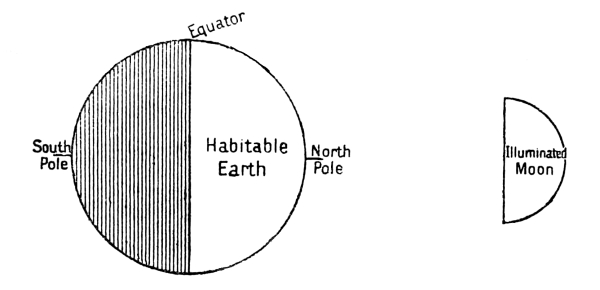
Fig. 38. The half-moon shape of the habitable earth. (Ristoro).
There is nothing but sea south of the equator, and the habitable earth lies wholly in one half of the northern hemisphere, the other half being sea. The habitable earth, therefore, is the same shape as the half-moon, i.e. a quarter sphere.
The accompanying climate map shows all these features, the famous city Arym—occupying nearly half the space, although it is supposed to be merely on the equator—the seven climates, and the region beyond the seventh, near the north pole, marked as uninhabitable through the cold. The half-moon shape of Earth’s habitable quarter is obvious. The map betrays Arab influence in the orientation, the south being at the top; and Arym, or Aren, was an Arab myth, perhaps derived from the Mount Meru of the Hindus, which is said in the Vedas to be “in the middle of the earth.”
According to Ristoro, the positions of the constellation figures do not only explain why one hemisphere of earth has land and the other none; they also explain the movements of the skies. For the figures of the zodiac face west (those that have faces), and this is why the diurnal movement of the whole heaven is towards the west, so that the constellations may move straightforward, in the natural way. On the other hand, the planets move in the opposite direction because it would not be seemly for them to pass each figure of the zodiac arriving first at the back and moving on to the head. This is the true reason of the contrary direction of the two principal celestial movements. Ristoro does not approve of the solution quoted by Brunetto Latini. He adds that the width of the zodiac was designed to contain the figures of the animals!
After this, we are not surprised to hear that the red colour of the planet Mars is the cause of its martial nature (not the reason for which such a nature is attributed to it). The markings on the moon Ristoro explains by saying that some body must exist in the World which is neither polished and shining all over, like the stars, nor altogether rugged and dark, as the earth was supposed to be, but partaking of both natures; and this body must be the moon, because of her intermediate position between the earth and the nearest of the other planets (Mercury).
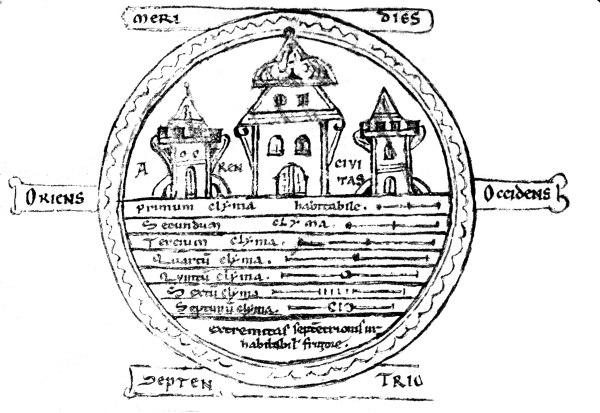
[To face p. 248.
CLIMATE MAP, OF ABOUT a.d. 1110.
Reproduced by permission from Beazley’s “Dawn of Modern Geography.”
Of the influence of the heavens on the earth Ristoro has very much to say, from general statements such as that the spheres impress their influence on things of Earth, just as a seal impresses wax, down to details about the births of horses. If the moon is strong in Aries, and Aries is powerful, then, because the moon signifies white among the colours and Aries signifies the head, the horse will be born with a white mark on its head, and if the influence is very strong it will be a beautifully-shaped mark. Again and again he tells us about the various properties and “virtues” of the seven planets, but he does not omit to mention that the powers which move the planets and cause them to influence Earth are spirits, which we call Angels, and the philosophers call Intelligences. These have their several dwelling-places in the spheres, and the nobler their nature the higher is the sphere which they inhabit.
From these quotations the reader may judge of the general trend of the eight books comprised in La Composizione del Mondo colle sue Cagioni: we shall have occasion to refer to it again, by way of comparison and contrast, when dealing with Dante’s works in detail.
It is rather curious that there is no trace in Dante’s writings of acquaintance with the great Roger Bacon, or with Sacrobosco, especially as Brunetto Latini knew the former personally, and Cecco d’Ascoli wrote a commentary on the latter, but Dante may have known them, and also the works of Isidore and Bede, who are both mentioned in Par., x. 131, as well as other books which are now completely lost. Those we have described above would, however, be enough to supply him with all the astronomical data, except one, which we find in his writings. It is now time to examine these, and see what use he made in literature of the knowledge he possessed.
IV. ASTRONOMY IN DANTE’S WRITINGS.
If we except the seven Penitential Psalms and the Profession of Faith, which are only paraphrases, and are very doubtfully ascribed to Dante, no work of his can be mentioned which does not contain some reference to the heavenly bodies.
When writing the Vita Nuova, that story of his love for Beatrice which he calls the work of his boyhood,[138] he was haunted by the sublime idea of the rolling spheres. Beatrice at her first appearance as a little girl of eight, and Beatrice when she died, suggested thoughts of the nine heavens;[139] almost the first words of the book allude to the circling spheres of the sun and of the stars:[140] and the last sonnet soars beyond them all to the Empyrean.[141] Already he seems to have read Alfraganus, for he takes a suggestion which occurs in the first chapter of the Elementa Astronomica et Chronologica. Alfraganus there describes the different methods of reckoning days, months, and years, in use among different nations, and gives a special list of the Syrian months with their corresponding Roman months; and Dante, by using the Arabian system of days and the Syrian months, is able to prove to himself that the day and the month when Beatrice died were both at the sacred number of nine.[142] According to our method of reckoning, the time was sunset on the eighth of June, but this was the first hour of the ninth day according to Arabian usage, and our sixth month corresponds with the ninth of the Syrians.
Dante had also read at this time Aristotle’s doctrines about the spheres and their Movers, for he quotes from the Metaphysics,[143] and this is the work in which they are found.
Yet a familiarity with Alfraganus and Aristotle so early as this is hardly consistent with the difficulty he says he found in understanding Latin books of philosophy some time after the death of Beatrice.[144] Perhaps the latter part of the Vita Nuova was written a good deal later; or it may be not altogether frivolous to suggest that in his youth Dante had read the first chapters of Alfraganus, which are easy, but did not master the rest of the book till later.
Out of his fifty-three short poems (including all in Moore’s Oxford Edition, except those which form part of the Vita Nuova or Convivio), twelve, or nearly a quarter, contain some reference to sun, moon, or stars, planets, or spheres; and from these alone we could form some idea of Dante’s acquaintance with astronomy. He speaks of the sun as measuring time,[145] and giving light to the stars[146] (according to the general belief); the moon[147] and each of the planets[148] is mentioned, some of the constellations also,[149] especially with reference to the seasons; the theory of the several heavens and their First Mover,[150] and the supposed influences of the stars and planets are alluded to.[151] These poems were written at different times, and some belong to a much later period than the Vita Nuova.
It is when we come to examine the Convivio, the work of his manhood,[152] that we find the clearest evidence of Dante’s careful study of astronomy. This book was written with the professed intention (as one of its aims) of sharing with others the learning he had been happy enough to acquire—not indeed as one of the guests at the Table of Wisdom, but as one sitting at their feet and gathering up the crumbs.[153] The thread which connects his discourse is a collection of his own Odes, on each of which he had intended to write a treatise or commentary, but the book never advanced beyond the fourth treatise. These Odes were nearly all love-poems, but the poet explains that they are a figurative expression of his devotion to Philosophy, and the whole book is a glorification of the pursuit of knowledge. In the opening sentences, with the reference to Aristotle, the manner of reasoning, the assumptions of our innate desire for absolute knowledge and the bliss brought by its attainment, Dante is the spokesman of his period.
“Siccome dice il Filosofo nel principio della Prima Filosofia, Tutti gli uomini naturalmente desideranno di sapere: La ragione di che puote essere, che ciascuna cosa, da providenza di propria natura impinta, è inclinabile alla sua perfezione. Onde, acciochè la scienza è l’ultima perfezione della nostra anima, nella quale sta la nostra ultima felicità, tutti naturalmente al suo desiderio siamo soggetti.”[154]
And from a study of the Convivio we may learn much of the authors most esteemed, the methods of study pursued, and the results obtained, by thirteenth-century scholars seeking to gain the ultimate perfection of the soul.
Astronomy is frequently introduced, especially in the second and third treatises. The Ode which forms the text of the second treatise is that which is quoted by Charles of Hungary in Par. viii. 37—“Voi che intendendo il terzo ciel movete,”[155] and it gives Dante the occasion to speak first of the heaven of Venus, explaining Ptolemy’s system of epicycles, and later of all the heavens in their order, and the celestial bodies contained in them. The ode of the third treatise contains the line “Non vede il Sol, che tutto il mondo gira ...”[156] and upon this he hangs a complete little essay describing the movements of the sun, and how they appear from different parts of the earth, as well as a short dissertation on the question whether it is Sun or Earth which actually moves.
The Latin works, De Monarchia, De Vulgari Eloquentia, the Eclogues, and the Letters, do not give much scope for astronomical references; yet there are many similes drawn especially from the sun and moon, and the thought of the spheres as instruments of God’s Will in bringing about events on earth is constantly recurring. In the curious work Quæstio de Aqua et Terra, Dante argues learnedly about the spheres, the orbit of the moon, and her effect on the tides, and the influences of the stars. The book purports to have been written at Verona in 1320 as the outcome of a discussion in which Dante had taken part as to the respective heights of land and ocean, a problem which had been dealt with by Ristoro d’ Arezzo some forty years earlier. Its authenticity has been questioned, partly under the mistaken idea that facts such as gravity, the spherical form of Earth, and the connection of tides with the moon were not known until much later; but as a matter of fact the discussion is quite in the manner of Dante’s day, and no facts or theories are put forward which he could not have learned from books with which we believe he was acquainted.[157] The internal evidence of his authorship is strong, and belief in it seems to be gaining ground among experts.[158]
Finally, the Divine Comedy, the work of Dante’s maturity, which took him so many years to write, and for which he had studied ever since he closed the Vita Nuova with the resolve to write more worthily one day of Beatrice,[159] focuses in one unique and finished work the thoughts and ideals, the knowledge and fancies, of the poet and his age. The subject of the poem, taken in its literal sense, is cosmical, for it describes a journey in which the author penetrates to the centre of the universe, and passes from planet to planet until he reaches the outermost sphere. Moreover, the journey is assumed to take a definite space of time, and the passing of the hours by day and by night is indicated by the successive positions of sun or stars, and the phases and movements of the moon. The Divine Comedy contains more than twice as many allusions to the heavenly bodies as all the other works of Dante put together.
But we must discriminate in drawing conclusions from these astronomical references so freely distributed in all Dante’s writings. If he wrote the Quæstio, it is his only professedly scientific work, written for scientific men, and astronomy is only brought in incidentally. The Convivio, in which astronomical facts and theories are set forth in much greater detail and fulness than elsewhere, was a popular work meant for those who had no inclination, or else no opportunity, for prolonged serious studies. We expect, therefore, that technical details will be avoided. Still more will they be omitted in the Divine Comedy and other poetical works, where difficult problems and pedantical accuracy would be most unsuitable. We can infer the knowledge which lay in Dante’s mind, behind his popular use of it in literature; and we can often find an explanation in the prose of the Convivio for a slight allusion in the poetical works; but we must not deal with any as if they were text-books, and set forth precisely and completely all that Dante knew of his favourite science. It is the poet’s artistic use of the astronomy of his day which merits our admiration quite as much as the scholar’s proficiency.
This being premised, we may now proceed to quote from his works, showing how he has dealt with first the facts, and secondly the theories, of astronomy. Finally we shall be able to form a clear mental picture of the universe as it was believed to exist by Dante, and not only by his contemporaries but by his successors for many generations.
V. OBSERVATIONAL ASTRONOMY.
“The heavens declare the glory of God; and the firmament sheweth His handy-work. Day unto day uttereth speech, and night unto night sheweth knowledge. There is no speech nor language where their voice is not heard. Their line is gone out through all the earth, and their words to the end of the world. In them hath he set a tabernacle for the sun; which is as a bridegroom coming out of his chamber, and rejoiceth as a strong man to run a race.”
1. MOVEMENTS OF THE MOON.
Of all the seven sciences of the Trivium and Quadrivium, Astronomy, Dante thought, was the noblest, and for two reasons. Aristotle had said that a science is noble in proportion to the nobility of its subject, and the certainty of its conclusions; and in both of these Astronomy excels. Its subject is the Movement of the Heavens, and its certainty is perfect. “E nobile e alta per nobile e alto suggetto, ch’è del movimento del cielo: è alta e nobile per la sua certezza, la quale è senza ogni difetto.”[160] If astronomers are sometimes mistaken, the fault lies in them, as Ptolemy said, and not in the science.
This quotation from Ptolemy is from his book on “judicial astronomy,”[161] and it may be that Dante was partly thinking of astrological predictions, as he almost certainly was in the passage that follows, where he adds that astronomy takes a long time to learn, not only because of its great range, but because experience is necessary to form a correct judgment. Nevertheless, it is probable that by its flawless certainty he meant that unchanging laws govern the celestial phenomena, so that they may always be predicted without error when the laws are known.
His definition of astronomy was accurate, for it was not until the middle of the nineteenth century that physical astronomy began to take its place beside the old “astronomy of position,” and in Dante’s day practically the only subject open to research concerning the heavenly bodies was their movements. Of these, and especially the “prime motion” of the diurnal revolution, he was vividly conscious. His favourite name for the heavens is “wheels”—“le ruote magne,” “eterne ruote,” “stellate ruote”;[162] and he often refers to them as a standard of motion. Thus when with Beatrice he was rapt from the summit of Mount Purgatory, to express the swiftness of their flight he says it was almost as rapid as the movement of the sky—“veloci, quasi come il ciel vedete.”[163] Constantine moving the capital of the Roman Empire eastwards is described as turning the Roman Eagle contrary to the course of the sky—“contra il corso del ciel,”[164] and the sky itself is described as a sphere which is ceaselessly at play like a lively child:—
... “la spera, Che sempre a guisa di fanciullo scherza.”[165]
To Dante, as to the Greeks, it is not the unusual or startling that appeals, but the unfailing harmony of the regular celestial movements. Comets he mentions only twice, and shooting stars twice, eclipses seven times; but there are scores of allusions to the rhythmical progression of Sun and stars, Moon and planets. The skies were familiar to him in all their daily aspects—sunset and dawn and radiant noons; cloudy nights “sotto pover cielo,”[166] brilliant starlit nights, nights of clear moonlight. He had seen the stars fade one by one, till at last even the brightest vanished in the glow of dawn:—
“E come vien la chiarissima ancella Del sol più oltre, così il ciel sì chiude Di vista in vista, infino alla più bella.”[167]
he had watched for their first appearance in the evening twilight:—
“E sì come al salir di prima sera Comincian per lo ciel nuove parvenze, Sì che la vista pare e non par vera....”[168]
Numberless other passages and expressions will occur to every Dante reader, proving how keenly he felt the beauty of the skies.
But they prove more than this. Other authors have felt and have described poetically the beauties of the skies, but they often remember imperfectly what they saw, or draw upon their imagination without any knowledge of the celestial movements, and so fall into absurd mistakes. The moon especially is a stumbling-block, and it is quite a rare thing for a modern novelist to introduce one without making it do something impossible. A new moon will rise at midnight, or a waning moon at sunset; she has even been known to rise and then to set in the dark hours of one short midsummer night;[169] and a well known author sees her in two phases at the same moment: “the full moon rose, yellow and gibbous!”[170]
Dante’s moon does indeed give us a little trouble once or twice, but he never makes flagrant mistakes of this kind. His consistency and truth of description prove his knowledge of astronomy, and also imply intelligent thoughtful watching of the celestial movements; for it is notorious that book-knowledge, if unassisted by acquaintance at first-hand with the facts of a subject like astronomy, will not save a writer from glaring inaccuracies.
His allusions to the motions of the moon, both diurnal and monthly, show plainly that he understood them well. His new moon appears in the evening, his waning moon rises late at night and sets in morning sunshine,[171] and his full moon comes on the meridian at midnight, for when he wishes to describe her at her brightest, as a comparison with a very brilliant light, he places her in a clear sky at midnight in her mid-month.[172] In the middle of a lunar month the moon is full, and being exactly opposite the sun will reach the meridian at midnight: this therefore is the time when she gives all the light she possibly can. In the Quæstio[173] Dante mentions that the moon does not move in the celestial equator, but sometimes north of it, and sometimes an equal amount south; in the Convivio he indicates the length of her period, and briefly describes her phases and their cause—“Ora luce da un lato, e ora luce dall’ altro, secondo che ’l sole la vede.”[174]
Her position in the zodiac is mentioned several times. In one passage he indicates a very brief space of time in the following curious way:—
“Quando ambo e due i figli di Latona, Coperti del Montone e della Libra, Fanno dell’ orizzonte insieme zona, Quant’ è dal punto che il zenit inlibra. Infin che l’uno e l’altro da quel cinto, Cambiando l’emisperio, si dilibra, Tanto, col volto di riso dipinto, Si tacque Beatrice.”[175]
That is to say, when Sun and Moon (the children of Latona) are both on the horizon, but one being in Aries and the other in Libra they are opposite one another, the zenith for a moment holds them, as it were, in balance; but the next moment one will drop below the horizon while the other rises above it, thus changing from the visible to the invisible hemisphere and vice versa, as each frees itself (“si dilibra”) of the common horizon that girdled them. The pause of Beatrice was as brief as the time during which sun and moon would thus hang in the balance.
Yet, though Dante shows that he was familiar with the movements and appearances of the moon, his allusions to her are cold and comparatively rare. Unlike modern poets, moonlight does not seem to have had any great fascination for him. In all his works there are only fifty-one references to the moon, and far the greater number of these are remarks about the measurement of time, or else her phases, her markings, her share in causing eclipses etc. In all his short poems (including those of the Vita Nuova and Convivio) there are but two references, and those as dry as possible. “Più lune”[176] is once used, meaning several months, and in a sonnet which describes the influences of each heaven on his lady, all he can find to say of the moon’s is “E ’l primo ciel di sè già non l’è duro.”[177]
The chill of moonlight is spoken of as with a shudder on the hill of Purgatory;[178] and its usefulness is recognized rather grudgingly when Virgil remarks that yesternight the moon was full, and adds that Dante must remember it, since it did him no harm in the depths of the Forest.[179] It is true there is some beauty in the description of the aurora which preceded moonrise[180] on the first night in Purgatory, but Dante gives it an ugly name, and the waning moon when seen on the following night, four days after full, is oddly compared to a bucket in shape. Dante did not admire this gibbous form, for he instances the outline of the moon when not quite full as an ignoble curve, contrasting it with the beauty of a perfect circle.[181]
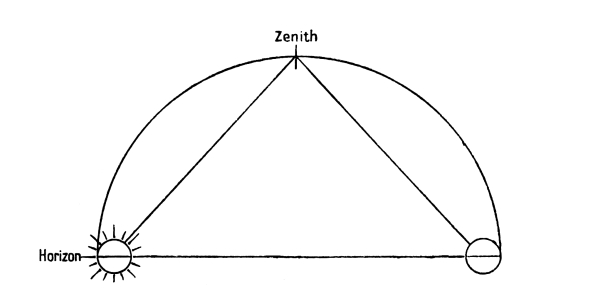
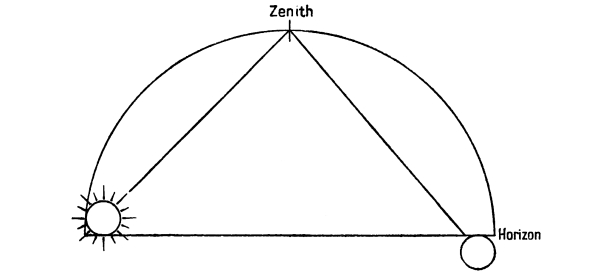
Fig. 39. Sun, moon, and zenith.
To illustrate Par. xxix. 1-6. (See p. 265).
In the first figure the sun and moon are balanced, as it were, being at equal distances from the zenith: in the second, a few minutes later, by the rising of the sun and the setting of the moon, the balance is disturbed, and each changes its hemisphere.
Hardly ever does he find a beautiful epithet for her: she is ruler of Hell,[182] Cain and the Thorns[183] (in reference to the legend which sees this figure in her dark markings); or she is simply Delia,[184] Trivia,[185] the daughter of Latona,[186] or with a little warmth the sister of the sun,[187] and with the sun one of the two Eyes of Heaven.[188] One exception to this harsh treatment is in the beautiful description of reaching the heaven of the moon,[189] for there she is the first star, the eternal pearl; and the sudden burst of eloquence in the midst of a grave argument in De Monarchia startles us doubly when we find that Justice is compared to the moon—not, as one might expect, resplendent in a dark sky, but Phœbe gazing at her brother opposite, in the purple of the morning calm.[190] The passage from Par. xxix. quoted above helps us to understand why the moon in this position should symbolize Justice, for here again is suggested the perfect balancing of the two great orbs, as the sun rises and the full moon sets.
Add to these passages two similes drawn not indeed from the moon itself but from the halo surrounding her,[191] and two descriptions of brilliant moonlight nights,[192] and we have all that Dante has written in praise of the moon. It is true that throughout the Inferno and Purgatorio the sun typifies Divine Grace, and the moon is his opposite, but this cannot altogether explain the difference in their treatment, even in the Divine Comedy. A deeper reason seems to be Dante’s true southerner’s love of the sun; and he doubtless had the astronomer’s feeling that moonlight always means loss of starlight, which he dearly loved (see Purg. xviii. 76, 77). Perhaps too the astrological views of the moon influenced him, consciously or not. According to Ristoro, the moon represents the poorest and lowest classes of people, who are servants and messengers to the rest; and as all the planets were supposed to be either masculine or feminine, he ungallantly adds—“E questa Luna, a cagione di sua viltà, potemo dire per ragione ch’ella sia femmina.”[193] Her only house, too, which is Cancer, is also poor and base. The moon, moreover, is nearer Earth than any other planet, and shows by her dark markings that she is less pure than the rest.
2. MOVEMENTS OF THE SUN.
Whatever the reason, Dante’s fifty-one references to the moon are in strong contrast to his allusions to the sun. These are four times as many, and they include warm expressions of admiration and delight, and beautiful epithets and similes. The sun is Titan with his chariot and horses,[194] he is a Mirror, a Car of Light, the Lantern of the World, the Prince of the Stars, the Father of all mortal life.[195] His beautiful form is admired, “la perfetta sua bella figura,”[196] and his intense brilliance often noted.[197] He is the guide that leads all aright,[198] to whom Virgil appeals:—
“O dolce Lume, a cui fidanza i’ entro Per lo nuovo cammin, tu ne conduci.”[199]
Under his rays the rose expands, the air is gladdened, mists are dispelled, snow melts, and all things are quickened into life.[200] Unlike the moon, the sun is the bringer of warmth and comfort, chasing away cold and darkness,[201] sunrise is the hour of renewed hope and confidence,[202] it strengthens our limbs, paralysed by the cold of night,[203] it is eagerly awaited through the darkness by the little bird on her nest;[204] and delicate flowers, bowed and closed during the cold night, rise upright on their stems and open as soon as the sun shines once more upon them.[205] The exquisite sunsets and sunrises of the Purgatorio are favourite passages with all readers.
Love is compared with the summer sun,[206] the generosity of a noble nature resembles “the great planet.”[207] The Emperor Henry VII., from whom Dante expected the regeneration of Italy and the whole Christian world, is likened to the rising sun;[208] the birth of St. Francis is described as “nacque al mondo un sole,”[209] and his birthplace ought rightly to be called not Assisi but Orient.[210] Virgil is addressed as “O Sol che sani ogni vista turbata;”[211] Beatrice is “Il sol degli occhi miei.”[212] Finally the sun is the best symbol of God,[213] and so it is used many times in the Divine Comedy: “Il Sol degli angeli,”[214] “Il Sol che raggia tutto nostro stuolo;”[215] a spirit turns to “il Sol che la riempie,”[216] and when Virgil laments that he is shut out of heaven it is in these words: “Ho i’ perduto Di veder l’ alto Sol che tu disiri.”[217]
But we may not dwell on those thoughts of the sun as the typical giver of light and life; we must ask what Dante says about his movements, since this was the chief subject-matter of mediæval astronomy.
His daily course, “il cammin del Sole,”[218] is often spoken of, and is indicated both by his position in the sky, and the length and direction of shadows. The second Eclogue begins with a description of a breathlessly hot midday, when objects, which are usually shorter than their own shadows, now surpassed them in length.
“Resque refulgentes, solitae superarier umbris, Vincebant umbras.” Ecl. ii. 5, 6.
At this time the sun appears most brilliant, and seems to move most slowly, since he is scarcely changing his position with regard to the horizon.
“E più corrusco, e con più lenti passi, Teneva il sole il cerchio di merigge.”[219]
The greatest number of references to the sun’s daily journey occur in the Purgatory, and we shall quote them in a later chapter.
His yearly journey through the zodiac is also very often referred to. When relating his first meeting with Beatrice, Dante names his age, not by simply saying that he was nearly nine years old, but by counting the number of the times that the “heaven of light,” that is, of the sun, had returned to the same point since his birth:—
“Nove fiate già, appresso al mio nascimento, era tornato lo cielo della luce quasi ad un medesimo punto, quanto alla sua proprio girazione.”[220]
The sun’s “own revolution” is of course its apparent yearly movement, as distinct from the diurnal movement which it shares with all the heavenly bodies.
The same thought is expressed in a sonnet:
“Io sono stato con Amore insieme Dalla circolazion del Sol mia nona.”[221]
We know further that Dante was born in either May or June, because he says, when he finds himself among the stars of Gemini, that the sun was rising and setting in this sign at the time of his birth.[222]
“O gloriose stelle Con voi nasceva e s’ascondeva vosco Quegli ch’è padre d’ogni mortal vita, Quand’ io senti’ da prima l’ aer tosco.”[223]
Boccaccio tells us that a Mayday feast, given by the father of Beatrice, was the occasion of Dante’s first meeting with her, and also that not long before his death in Ravenna he told a friend that he had completed his fifty-sixth year in the preceding May, so we may conclude that May was the month of his birth.
Dante seems to have taken some trouble to find out the exact period of the sun’s revolution. His text-book, the Elementa of Alfraganus, only gives it as 365¼ days nearly:—“Sol ... orbem confecit diebus 365 et propè ¼.” Ristoro d’Arezzo and Brunetto Latini were content to repeat this rough estimate, and call the year 365 days 6 hours, but Dante wished to be more exact, and somehow contrived to obtain a value which was much nearer the modern estimate of 365 days, 5 hours, 48 minutes, 46 seconds. We know this from two passages. In the Convivio he gives the half period as less than 182 days 15 hours; and in the Paradiso Beatrice says that January will in time cease to be a winter month, because of a neglected fraction of time.
“Prima che gennaio tutto si sverni Per la centesma ch’ è laggiù negletta.”[224]
January was in fact receding from the winter, and steadily though slowly advancing towards the spring, because the Julian year (as we saw, p. 171) was 11 minutes 14 seconds longer than the true solar tropical year. When Julius Cæsar reformed the Calendar, March 25 was made (as of old) to coincide with the spring equinox, but by Dante’s time this date was 13 days late, and the true equinox fell on March 12. Consequently though the day called January 1 still came 84 days before March 25, it was only 71 days before the spring equinox.
If Beatrice meant to speak with scientific precision, and was correct in her hundredth part of a day per annum, that is, if the difference between the astronomical and the Julian year was one day in a hundred years, it would be 7100 years before the first of January came to coincide with the spring equinox, and January became a spring month. But the error quoted is really rather too large, for a hundredth part of a day is 14 minutes 24 seconds, and it was in fact only 11 minutes 14 seconds.
It would be interesting to know where Dante found this value, which is practically the only astronomical datum not given in Alfraganus. Ptolemy, following Hipparchus, had given the tropical year as ¹/₃₀₀ part of a day less than 365¼; Albategnius gave a more accurate figure, and one which agrees well with the “centesma,” for his tropical year differs from the Julian by a little less than ¹/₁₀₆ of a day; but he also improved the value of precession, and Dante does not seem to have known this, so he was probably not acquainted with this astronomer’s work. The Alfonsine Tables gave a value which was very close indeed to the correct one, making the tropical year only 30 seconds longer than the modern value, and the difference between the Julian and true year ¹/₁₃₄ of a day. (The correct value is ¹/₁₂₈). Either of these figures may have been known to Dante indirectly: perhaps he had obtained the Alfonsine value in conversation with Brunetto Latini, who had visited Alfonso’s court. His fraction was evidently only approximate, but it is interesting to know that he had found out more than popular books could tell him about the period of the sun’s revolution, and that he had been sufficiently struck by the small difference between the calendar and astronomical years to mention it in a picturesque way in his poem. It is possible that he had heard of Roger Bacon’s appeal to the Pope in 1267 to correct the calendar because the date of the spring equinox was of importance in connection with the observation of Easter.
It is hardly necessary to remind my readers that this was done by another Pope three hundred years later, before January had made much more advance towards becoming a spring month. The hundredth part of a day, of which Beatrice complained, is now subtracted from the year by omitting to make century years leap years; but as the error was really not quite so great as she said, an exception is made for century years divisible by 400. Thus 1600 was a leap year, but not 1700, 1800, or 1900.
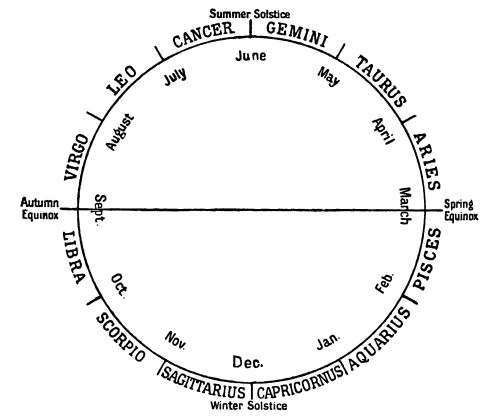
Fig. 40. The Zodiac and the Months.
Dante seems to have connected any season of the year with the sun’s path in the zodiac as readily as with the name of a month. The sun’s yearly course through the signs is shown diagrammatically in figure 40, and a glance at this will make clear a number of allusions without any explanation.
Starting from the first point of Aries at the spring equinox, which in Dante’s time fell in the middle of March, and taking one-twelfth of the year to traverse each sign, it is evident that during the end of March and beginning of April the sun was in Aries; he entered Cancer and reached the summer solstice in June, the autumnal equinox in Libra in September, and the winter solstice when he entered Capricornus in December. The six signs above the horizontal line are northern, the six below are southern.
The following are a few typical examples.
When Dante wishes to express the transition of his feelings from despondency to courage, at seeing the stern and troubled face of his guide melt suddenly to a smile, he compares himself to a poor shepherd who wakes early and sees the fields covered, as he thinks, with snow, but in a short time finds that it is only hoar-frost which has put on the semblance of her white sister, and seeing the face of the world changed he gladly leads out his sheep to pasture. The time at which this may happen is
“Quella parte del giovinetto anno, Che il sole i crin sotto l’Aquario tempra, E già le notti al mezzodì sen vanno.”[225]
That part of the youthful year when the sun cools his locks beneath Aquarius is clearly the end of January or beginning of February, but the last line may bear one of two meanings. If we translate “mezzodì” as “half the day” it means that the nights are growing shorter, and very soon (in March) when the sun will have reached the equinox, they will be just twelve hours long. If we take “mezzodì” as meaning “the south,” we must interpret the passage in the light of others in the Divine Comedy where Night is personified, and considered as circling in the zodiac always opposite to the sun. For instance in Purg. ii. 1-6 (a passage which will be more fully explained later) Night is described as circling opposite to the sun, “La notte, che opposita a lui cerchia,”[226] and as the sun at that time was in Aries, Night was in Libra, “le Bilance.” Henceforth for six months the sun will be in the northern signs, and the days longer than the nights, but as soon as Night begins to assert her supremacy, and the nights begin to be longer than the days, the sun enters Libra and then it is not visible all night. This is the meaning of
“le Bilance, Che le caggion di man quando soverchia.”[227]
When Night becomes dominant, the Scales fall from her hand, for the sun is in that sign.
Applying this idea to the passage quoted above, it will mean “The nights are going southward,” for the sun in Aquarius is not far from the point where he crosses the equator to the north, therefore Night circling opposite to him is nearing the point where she goes south. Either interpretation is faithful to fact, but perhaps the circumstance that the plural noun is used favours the first.
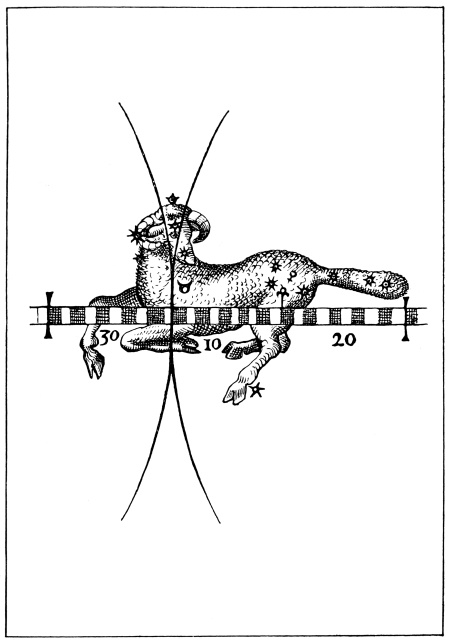
[To face p. 279.
Fig. 41. The Ram on the Ecliptic. From the “Cosmi Historia” of Robert Flud, a.d. 1612.
(Reproduced from Brown’s Phainomena of Aratos.)
Conrad Malaspina prophesied to Dante that his favourable opinion of the Malaspina family would be justified “before the sun had come to rest again seven times in the bed which the Ram covers and bestrides with his four feet.”
“Ed egli: Or va, che il Sol non si ricorca Sette volte nel letto che il Montone Con tutti e quattro i pie copre ed inforca Che cotesta cortese opinione ...”[228]
The sun was at the time in the Ram, and Malaspina means that less than seven years would elapse, before his prophecy was fulfilled. The aptness of the description may be seen by the figure of Aries as portrayed in an old seventeenth century book in which the Ram is uncomfortably trying to sit on the ecliptic.
Another instance is in the beautiful midwinter Ode, “Io son venuto al punto della rota.”[229] Each stanza pictures a feature of a severe winter—snow and rain, the absence of summer birds, bare trees and dead flowers, the favourite walk become a torrent; but the first describes the position of stars and planets. When the sun sets, the Twins appear on the eastern horizon, hence we know at once that the sun is in Sagittarius and the time is November or December. To confirm his melancholy, the poet adds that the Star of Love (Venus) is hidden from us by the sun’s rays which now shine athwart her, and that the planet which strengthens the cold (Saturn, the “frigida stella” of Virgil) displays himself in that arc of the sky in which all the seven planets cast the shortest shadow;[230] that is, either he is on the meridian at sunset, or he is in the most northerly part of the zodiac, in Gemini or Cancer. A planet in this place, as for instance the sun at midsummer, is visible longer, describes a longer arc, and casts shorter shadows, than in any other part of the zodiac. And as this is the part which rises over the eastern horizon as the sun sets, Saturn would also rise at that time and remain visible all night.
The opening lines of the Ode run thus:—
“Io son venuto al punto della rota, Che l’orizzonte, quando il Sol si corca, Ci parturisce il geminato cielo; E la stella d’amor ci sta rimota Per lo raggio lucente, che la ’nforca Sì di traverso, che le si fa velo; E quel pianeta che conforta il gelo Si mostra tutto a noi per lo grand’ arco, Nel qual ciascun de’ sette fa poca ombra.”[231]
It is astonishing that Giuliani should so completely miss the point of the “twinned sky,” that he substitutes “ingemmato” for “geminato,” and reads—
“ ... la rota, Ch’ all orizzonte, quando il Sol si corca, Ci parturisce l’ingemmato cielo.”[232]
He understands the hour of evening to be meant, when the Wheel of Day and Night brings a jewelled, i.e. starry sky on the horizon as the sun sets. But it is not only on the horizon that stars appear at sunset; and the mention of Gemini to indicate the time of year is thoroughly characteristic of Dante. The Wheel is the revolving year which has carried the sun into Sagittarius.
Angelitti remarks that the whole description was literally true for December 1296, since Venus was then in conjunction with the sun, and Saturn in Cancer;[233] and as this poem is a complaint of the hardness of his lady, to whom the poet is nevertheless wholly devoted, it may well have been written in that time when the lady Philosophy refused to smile upon her lover.[234]
Further on in the same poem the effects of the sun in spring, when he is in the sign of Aries, are alluded to as “the virtue of Aries”:—
“Passato hanno lor termine le fronde, Che trasse fuor la virtù d’Ariete, Per adornare il mondo, e morta è l’ erba.”[235]
Contrast with this the passage in the Paradiso where “nocturnal Aries” is used as a synonym for autumn.
“Questa primavera sempiterna Che notturno Ariete non dispoglia.”[236]
For although Aries may be seen during some part of the night in the greater part of the year, it is most emphatically a noctural sign when it rises as the sun sets, and remains above the horizon until he rises; this happens when the sun is in the opposite sign of Libra, which he enters at the autumnal equinox.
A rather curious passage in the Paradiso is incomprehensible unless we think of the sun’s path in the zodiac, and realize that Dante is comparing the brightness of the spirit of St. John in an indirect way with the brightness of the sun.
“Poscia tra esse un lume si schiarì, Sì che, se il Cancro avesse un tal cristallo, L’inverno avrebbe un mese d’un sol dì.”[237]