FIRST PART. The Story of Astronomy from Primitive Times until the Age of Dante. (continued 2)
Reading edition
A brilliant guess,[29] which seems fully justified by facts, has recently explained the personalities of these two mysterious Pythagoreans of unknown date, Hicetas and Ecphantus, whose names have been coupled for centuries with that of Heracleides, as teaching the rotation of Earth on her axis. It seems that they resemble the Shadow in Hans Andersen’s tale, which became a man and lived apart from the man to whom it originally owed its existence, for it is now thought that they were speakers introduced by Heracleides into one of his dramatic dialogues to discuss astronomy.
Heracleides, therefore, was the sole author of this remarkable discovery.
In this way Earth was restored to her central position, but as a rotating sphere, and the later Pythagoreans apparently tried to reconcile their new scheme with the old by calling Antichthon the uninhabited hemisphere of Earth, and placing the central fire within the earth.
IV. GREEK ASTRONOMY.
Second Period. b.c. 400 to a.d. 150.
“Chiamavi il cielo, e intorno vi si gira, Mostrandovi le sue bellezze eterne.”
1. PLATO.
The Ionian school of philosophy died about the middle of the fifth century b.c., and the Pythagorean towards the end of the fourth. But meanwhile a new school of astronomers was growing up. The philosophers still laid down general principles, founded on abstract reasoning, which they believed must regulate the nature and movements of the heavenly bodies, but astronomy began to be regarded as a branch of mathematics, not of philosophy, and the mathematicians, leaving problems of ultimate causes to the philosophers, devoted themselves to observation and calculation. They carefully studied the peculiar motions of each planet, and their chief aim was to represent these geometrically by some scheme which should include them all, and make it possible to predict the places of the heavenly bodies in the sky for any given date.
One cause of this great progress in methods was no doubt the natural intellectual growth of the Greek race, as they discovered that their eager curiosity concerning nature could only be satisfied by patient investigation. The value of observation was taught, in the latter half of the fourth century, by the philosophy of Aristotle, and a great impetus must have been given by the campaigns of Alexander, in which the Greeks saw distant countries, new climates, strange peoples and customs.
Callisthenes c. 330 b.c.
But a potent cause of the advance in astronomy seems to have been the closer connection between Greek astronomers and those of Egypt and Babylon. The astronomer Callisthenes went with Alexander to the East, and received a letter from Aristotle praying him to send to Athens the Babylonian eclipse records which were centuries old; and Aristotle mentions, when speaking of the motions of the planets, that the Babylonians and Egyptians had furnished trustworthy information about each one of them. Even before this, we find that the Greek descriptive names of the planets were changed for names of Greek deities which are believed to correspond with the Babylonian gods and goddesses who presided over the planets. Thus Plato speaks of “the star sacred to Hermes” as well as Stilbon the Glitterer, and he is the last to use commonly the name of Phosphor for the planet which henceforth was known as Aphrodite among the Greeks, and Venus among the Romans, corresponding with the Babylonian Ishtar; and so on with the rest. Instead of vague records of journeys in Egypt or Babylonia, we have a definite statement that Eudoxus, who was the founder of the new school, went to Egypt about 378 b.c., with letters from the king of Sparta to the king of Egypt, and we are told that he studied the planetary motions under a priest of Heliopolis. It seems highly probable, to say the least, that Eudoxus was the first Greek to appreciate the value of those methods of observation and continuous recording of phenomena which he found among the Egyptians, and to understand the wonderful regularity which was hidden behind the seeming irregularities of the “wandering stars.” He was also, apparently, the first Greek to write a detailed description of the forty-eight ancient constellations.
But if Egypt and Babylonia gave to Greece records of celestial phenomena, and set the example of accurate and long-continued observations, Greece made the new knowledge her own, and transformed it. The legend that Eudoxus applied his mathematical skill to the ancient monuments of the Egyptians, and showed them how to calculate the height of the Great Pyramid by measurements of its shadow, is typical of the history of Greek treatment of Oriental astronomy. One geometrical theory after another was invented to represent the planetary motions, was compared with the skies, and rejected or improved, and meanwhile observation became much more close and accurate; new instruments were introduced, new methods of calculation invented, new motions discovered which had to be accounted for; finally, five hundred years after Eudoxus’ visit to Egypt, the result of all this labour was summarized in a truly epoch-making work, which remained the standard treatise on astronomy until the time of Copernicus.
Plato c. 427-347 b.c.
Eudoxus was born at Cnidos, in Asia Minor, but at the age of twenty-three he went to Athens, and studied under Plato. It is said to have been Plato who inspired the young man with the idea of devoting his brilliant mathematical powers to solving the problem of celestial motions, and with this view he went to Egypt. The story is easy to believe when we recall the many passages in the Dialogues in which Plato uses the splendid imagery of the skies to illustrate his philosophic doctrines, dwelling especially on the perfect though little understood symmetry of the celestial motions, and it will be remembered that astronomy was one of the subjects to be learned by the rulers of his ideal state.
It is true that Glaucon is gently but decidedly snubbed by Socrates in the Republic, for suggesting that the study of astronomy is valuable because of its use in navigation, husbandry, and the arts of war. This is “vulgar praise,” but has there ever been nobler praise of astronomy than that which Socrates himself then proceeds to give? Although he believes that true knowledge, knowledge of realities, is only to be obtained by the exercise of pure reason without the aid of sense, he considers that the study of celestial motions is one of the best means of training the mind to reach those heights, and he does not hesitate to say that sight was given to us in order that we might look at the skies. For the embroidery of heaven, says Socrates, though wrought upon a visible ground, is the fairest and most perfect of visible things; and it is displayed to our mortal eyes as a pattern of the eternal realities which are granted to the vision of the soul.
In the Timaeus this idea is elaborately developed, and it undoubtedly had an effect on Plato’s contemporaries, although his direct influence on astronomy cannot be compared with that of Aristotle. The Timaeus was widely read also in the Middle Ages, during the long period when Plato’s other writings were unknown, and it is quoted by Dante. We are often reminded of him when reading the astronomical and quasi-astronomical parts.
Timaeus, who is introduced to Socrates by Critias as “the most of an astronomer among us, and one who has made a special study of the nature of the Universe,”[30] describes the Creation as he conceives it most probable that it took place. He assumes a chaos to begin with, where there is no order, and no matter which can be distinguished by name, but all is confused and seething with random restless motions.
Of this, in order to produce something which should express his own goodness,[31] the Creator formed the four elements,—earth, water, air, and fire,—and of them he made a world, which became a fair and intelligent being, animated by a living soul. He made it in the most perfect form, that of a sphere, polished and smooth on the outside, “as if from a lathe.” The soul was placed in the centre, and hence diffused throughout the whole bodily frame. It is the cause of the harmonious motions of the stars, and of these there are two kinds: the motion of the Same (the diurnal revolution of the whole heavens) is in the noblest direction, simple and uniform; the motion of the Diverse is in the opposite direction and diagonal to the first, and it is divided into seven parts (the seven orbits of the planets), which bear certain definite ratios to one another.
Timaeus does not name the planets, but in the Republic Socrates names some, and indicates the rest by their colour or other characteristic,[32] so we know that the order which he assigns to them, counting outwards from the central earth, is: Moon, Sun, Mercury, Venus, Mars, Jupiter, Saturn.
It was in order to make the world like its eternal pattern that the Creator made a “moving image of eternity,” which we call Time, in the revolutions of the heavenly bodies; and to make it visible he “lighted a fire which we now call the sun, in the second of these orbits, that it might give light to the whole of heaven [note that the stars shine by reflected sunlight, as well as moon and planets], and that the animals who were by nature fitted might participate in number: this was the lesson they were to learn from the revolutions of the Same and the Like. Thus, then, and by these means, the night and the day were created, being the period of the one most intelligent revolution. And the month was created when the moon had completed her orbit and overtaken the sun; and the year, when the sun had completed his own orbit. The periods of the other stars [the planets] have not been understood by men in general, but only by a few, and they have no name for them, and do not estimate their comparative length by the aid of a number, and hence they are hardly aware that their wanderings, which are infinite in number and admirable for their variety, make up time. And yet there is no difficulty in seeing that the perfect number of time completes the perfect year when all the eight revolutions, having their relative degrees of swiftness, are accomplished together, and again meet at their original point of departure, measured by the circle of the Same moving equally.”
The heavenly bodies, according to Timaeus, are all divine intelligent beings. In form they are perfect spheres, like the world of which they form part, and they are composed of fire. The stars have two motions, for each rotates on its own axis while it is carried round the centre on the rotating star sphere.
Earth is also a sphere, immoveable at the centre of the World. Of her Timaeus says: “The earth, which is our nurse, encircling the pole which is extended through the universe, he made to be the guardian and artificer of night and day.”
This passage has given rise to the idea that Plato believed the apparent diurnal revolution of the heavens to be caused by earth’s rotation on her axis; but the word here translated “encircling”[33] may mean—as that does—either motion or situation round about something, and the whole context ascribes the diurnal movement so clearly and emphatically to the heavens, that it seems evident Plato could only have meant that earth was guardian and artificer of day and night by virtue of her position. The only strong argument in favour of the other meaning is that Aristotle, when speaking of Earth as supposed by some to be central in the Universe but moving, quotes Plato and the Timaeus. It might easily happen, however, that Aristotle knew from other sources, perhaps from conversation with Plato, that at some time the latter had inclined towards belief in Earth’s motion, and remembering the ambiguous expression in the Timaeus he quoted it from memory as a statement of Plato’s belief.
There is some evidence that late in life Plato accepted the doctrine of Philolaus that Earth was not only in motion, but in motion round a Central Fire. There is a legend that he bought the books of Philolaus at a great price, and Theophrastus, a disciple of Aristotle, is reported by Plutarch to have said that “Plato when old assigned to Earth another place, the central and nobler place being reserved for something else more worthy of it.” However this may be, he does not teach either theory in his writings. His views seem to be quite the same as those of Pythagoreans of the old school, whom he sometimes quotes.
After describing the creation of the Universe, Timaeus relates that the Creator deputed the gods whom he had made (including the stars) to create living beings on the earth, he himself creating directly only their immortal part, which he made of the same essence as the World-Soul, but diluted. Then follows the passage which came to the mind of Dante when he met the first spirits of Paradise in the moon.
“And when he had framed the Universe, he distributed souls in equal numbers to the stars, and assigned each soul to a star; and having placed them as in a chariot, he showed them the nature of the Universe, and the decrees of destiny appointed for them, and told them that no one should suffer at his hands, and that they must be sown in the vessels of the times severally adopted to them.... He said that he who lived well during his appointed time [on earth] would return to the habitation of his star, and there have a blessed and suitable existence.” If he lived ill, he would be a woman at his second birth, if a bad woman, then a beast, and as long as he continued to do ill he would “not cease from his toils and transformations until he followed the original principle of sameness and likeness within him.... When he had given all these laws to his creatures ... he sowed some of them in the earth, and some in the moon, and some in the other stars which are the measures of Time.”
The creation of man’s body and all the remainder of the Timaeus does not concern us here, except that when speaking of the highest use of man’s faculty of sight, we realize how near Dante and Plato are in their feeling for the revolving heavens:
“God invented and gave us sight to this end, that we might behold the courses of intelligence in the heaven, and apply them to the courses of our own intelligence which are akin to them, the unperturbed to the perturbed; and that we, learning them and being partakers of the true computations of nature, might imitate the absolutely unerring courses of God and regulate our own vagaries.”
2. EUDOXUS.
Eudoxus 408 b.c. to c. 355 b.c.
With words like these ringing in his ears, Eudoxus went from the Greek philosopher to the Egyptian priest, and studied “the courses of intelligence in the heaven.” Legend says that the sacred Egyptian Bull licked his garment, and the priests no doubt were encouraged by this omen to divulge their secrets to a person so highly favoured by the gods. They prophesied that he would have a short but very illustrious life.
After a year, or perhaps more, spent in Egypt, Eudoxus returned to his own city, set up an observatory of his own, received pupils, and worked out an exceedingly ingenious and original planetary scheme. He did not accept (if he knew of them) the risky theories of the Pythagoreans as to Earth’s motion, but assumed a central stable earth, round which circled the stars and the seven planets, according to the teaching of Plato and the general belief among educated Greeks of his day. But Egyptian observation and Greek geometry enabled him to describe for the first time the complicated movements of the planets, and to represent them by an imaginary mechanism.
This was a series of spheres, or hollow balls, fitting inside one another, and gradually diminishing in size like the ivory boxes of a Chinese puzzle, or the coats of an onion. Their size was stupendous, for the outer one, which contained all the rest, was nothing less than the sky we see, and was encrusted all over with stars. Of the inner smaller spheres, one bore, fixed in it like a jewel set in a ring, the sun; and six others bore, in the same way, the moon and the planets, one in each. All these hollow spheres were symmetrically placed so that all centred in a single point, and at this point was a solid sphere, exceedingly small in comparison, which was the earth. The star sphere, without moving from its place, rotated round this central Earth, and this caused the diurnal motion that we see in the stars. Each planet-bearing sphere rotated also, but the special characteristic of Eudoxus’ system is that each of these was surrounded by its own complete set of spheres, bearing no planet, but all attached together, the poles of one sphere resting on the surface of the next, and moving with different speeds, in different directions, and with differently inclined axes: these motions being all communicated to the innermost sphere on which the planet was fixed, the net result was the movement of the planet as we see it in the sky. Each planetary set was quite separate from the rest, and did not interfere with their movements, although each set was enclosed within the next larger. Since all the planets have a diurnal motion like the stars, as well as their own proper motions, each set had to be provided with a sphere which moved exactly like the great all-enclosing star sphere.
Thus, the sun had one sphere turning like the star sphere, and within this was a second, on which the sun was fixed, which turned round in a year, in a west to east direction. The sun, carried along by the combined motion, travelled through the sky with the daily and yearly motions, as we see them.
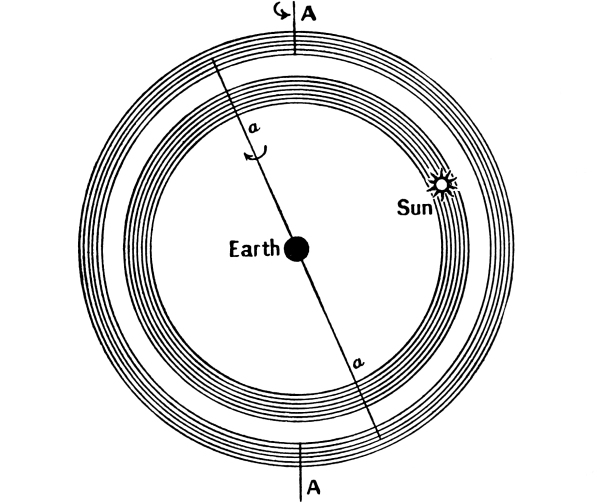
Fig. 19. The spheres of the sun in the system of Eudoxus.
The outer sphere turns on its axis A A in a day and night; the inner on its axis a a in a year, in the opposite direction.
The planetary spheres were much more difficult to arrange. Eudoxus used four spheres for each, and these had in every case to be carefully adjusted to the very different periods and amplitudes of the planetary oscillations. It must be confessed that the scheme failed with the difficult case of Mars, and was not quite satisfactory with Venus, but it represented remarkably well the movement—so far as then known—of Sun and Moon, Saturn, Jupiter, and Mercury. It was certainly a feat for those days, whether we consider it merely as the solution of a mathematical problem, or as an embodiment of astronomical knowledge. The periods of the planets as known to Eudoxus, stated in round numbers only, are given in the following table. They are taken from Simplicius, who describes the system of Eudoxus, but as in the so-called Papyrus of Eudoxus the synodical revolution of Mercury is given as 116 days, the same as the modern value, Eudoxus may have had much more exact data. It will be seen that his synodic period for Mars is the only one which is totally wrong, and the large error is difficult to explain.
Planet. Synodic Period. Modern Value. Zodiacal Peroid. [34] Modern Value.
Mercury 110 days 116 days 1 year 1.0 year
Venus 19 months 584 ” ” 1.0 ”
Mars 8 months, 20 days 780 ” 2 years 1.88 ”
Jupiter 13 months 399 ” 12 ” 11.86 ”
Saturn 13 months 378 ” 30 ” 29.46 ”
It is disappointing, after the splendid hypotheses of the Pythagoreans, to be back again on a central stationary Earth among mechanical contrivances for moving the heavenly bodies, which remind us of Anaximander’s series of hemispherical heavens and heavenly wheels, but at least the earth is spherical, owing to the Pythagoreans, and the sky extends like a sphere all round, and we shall never have a flat Earth or a hemispherical sky again among the Greeks. We do not know whether Eudoxus regarded his spheres as convenient mathematical abstractions only, or whether he reasoned that the stars were evidently set in an invisible uniformly rotating sphere, and Plato considered this kind of movement the most suitable for all heavenly bodies; that therefore he would try whether a series of similar spheres interacting on one another would account for the complicated motions of a planet, and finding that they would, taught that they must truly exist. In any case the basis of his system was a detailed knowledge of planetary motions hitherto unapproached by the Greeks, and its chief merit was that it challenged comparison with the skies.
3. CALIPPUS.
Calippus c. 330 b.c.
The challenge was soon taken up, for twenty or thirty years later one of the pupils of Eudoxus, Calippus of Cyzicus, undertook to improve the system. The defects in the theories of Mars and Venus had evidently been discovered, for Calippus added another sphere to each of these, as well as one to Mercury, which would be quite enough to bring the theories into better agreement with the facts.
With regard to the sun and moon, Calippus had paid special attention to their movements, for he made an improvement in the old luni-solar cycle of Meton, to which we shall return later. Eudoxus had ignored a very important fact discovered by Meton and Euctemon about b.c. 430, viz.: that the seasons are of unequal length, showing that the sun takes unequal times to pass over the four arcs of his orbit lying between the four points of the vernal and autumnal equinoxes and the summer and winter solstices. “Why,” exclaims a later writer[35] “are there unequal numbers of days in the four seasons, seeing that the course of the heavenly bodies must be regular, not being swayed by human passions or affairs?”
Calippus considered this question very seriously, and made a careful determination of the length of the four seasons. It seems at first sight impossible to reconcile their inequality with uniform circular motion of the sun round the earth, but he found that he could do it by adding two more spheres to the sun’s set, rotating uniformly but so arranged that their motion, added to the others, would result in an actual velocity in the sun itself varying just in the way required by the facts. The same had to be done for the moon, for the same reason, so the number of spheres, which Eudoxus had made twenty-seven, was brought up to thirty-four (including the star sphere). The varying velocity of the five planets had not yet been perceived.[36]
4. ARISTOTLE.
Aristotle b.c. 384-322.
Calippus went up to Athens about 330 b.c. to lay his scheme before the great master, Aristotle, and it had his cordial approval. But Aristotle definitely accepted the spheres as things having a concrete existence, for he says (De Cœlo II, 12) that we must regard them as heavenly bodies like the stars and planets, and that they are composed of the same celestial stuff.
He made one change, when incorporating the system in his scheme of the Universe. He was not satisfied that each set of spheres should work quite independently of the rest, and thought that the outermost sphere of stars ought to communicate its motion to those below (i.e. nearer Earth); and no doubt it did seem rather clumsy to have a separate sphere in every set rotating in exactly the same manner as the star sphere. But how could the impulse be communicated without disturbing the other movements? Aristotle introduced below each set another set of “unrolling” spheres, as he called them, which successively neutralized the rotations of all spheres in that set except the one with diurnal rotation, hence this movement alone was communicated to the set next below. This seems, however, more clumsy than the defect it was intended to remedy. Aristotle was perhaps led to it by his wish to give greatest importance to the star sphere; and if so, he acted on the principle which he blamed in the Pythagoreans, of making deductions not from things as they are seen, but as, according to his own ideas, they ought to be.
For indeed Aristotle, in spite of his own doctrines, and the great impulse which he gave to truly scientific methods of observation and experiment, could not rise altogether above the prejudices of his age, and consequently his Cosmos is a curious mixture of sound reasoning, based on observation, and of metaphysics, the latter predominating. For instance, it is only at the end of his second book On the Heavens, after he has “proved,” from purely metaphysical reasons, that Earth must necessarily be spherical and at the centre of the World, that he adds in support of his assertions the fact that the curved line of Earth’s shadow seen on the moon during eclipses is always round, that stars vary in visibility as we change our horizon, and that astronomers say that the celestial phenomena occur as they would if Earth were at the centre of the World.
Nevertheless, Aristotle’s teaching had so overwhelming an influence, not only throughout this epoch, but in the age of Dante, and the latter was so greatly influenced by him, both directly and indirectly, that it is exceedingly interesting to know his ideas about the Cosmos. We find them in the two books On the Heavens, in the Meteorology, the Metaphysics, and some other works. A special treatise on Astronomy, to which he refers[37], is unfortunately not extant.
The form of the Universe, Aristotle says, must be a sphere, because a sphere is the most perfect of solids and a solid is more perfect than a surface or a line, because it is in three dimensions, and three means completion, perfection.[38]
The Universe had no beginning, and will have no end; and this conclusion, drawn from reasoning, is supported by the belief which all have who believe in gods, “whether Greeks or not Greeks,” that the gods, who are immortal, live in the highest heaven, which is therefore also immortal; and by the fact that no one, throughout the ages, so far as we know, has ever seen any change in it.
But it is of finite dimensions, for no infinitely great body could rotate in a finite time; and it is the only universe which exists or ever can exist: outside is neither space, nor void, nor time. For space is that which is or may be occupied by matter, and time is the measure of motion occurring in matter, and no matter exists or can exist there. Therefore that which exists there is not in space nor is altered by time, but lives for ever the best and the self-sufficing life (i.e. the purely spiritual).
As matter has three dimensions, so motion is of three kinds: viz. (1) in a straight line down, that is, towards the centre of the World; (2) in a straight line up, that is, towards the circumference; (3) in a circle round the centre. Thus simple heavy bodies such as all kinds of earth, have a simple motion downwards; simple light bodies such as fire, move upwards; and when they reach their respective goals they remain where they are, unless disturbed by external force—earthy things on the earth, fiery vapours in the upper atmosphere. Composite bodies have composite motions, the motion proper to the predominant substance predominating. But for the heavenly bodies the only possible motion is in a circle, where there is neither beginning nor end, no goal and no limit, hence this motion is eternal.
Thus Aristotle solved for himself the problem of the early philosophers: how the stars in the sky remain there, for ever circling round us, and never falling to the ground. There is no need, he says, to assume an Atlas to support the sky on his shoulders, as in the old myths, nor a whirlwind such as Empedocles suggested, nor a Soul of the World, as Plato said; for the heavenly bodies are not heavy things like Earth to need support, and they are not moved by force, but are eternally in motion from the nature of their being.
In the same way he disposes of the difficulty of supporting Earth, having first “proved” that because there is an ever-circling spherical Heaven, there must also be an ever-resting spherical central Earth; there must be its opposite, the ever upward-striving Fire; and there must be the intermediate pairs of opposites, Air and Water. It is indeed, he says, a strange thing, and one to set any thoughtful man thinking, that the smallest clod of earth, when thrown up into the air, immediately falls down, and presumably would never stop falling if the earth were suddenly removed from beneath it; yet here is Earth herself, so large and heavy, not falling, but remaining steady in one place. But the explanations given by philosophers are more difficult than the fact they seek to explain. Xenophanes of Colophon said that the earth roots in the infinite, which simply saved him the trouble of considering further; others that the earth rests on water, which is our oldest tradition, said to be derived from Thales; but on what then does water rest and how can water, which is lighter than earth, support it? Do we not see that even small pieces of earth sink in water, and larger ones still more quickly? Anaximenes, Anaxagoras, and Democritus said that Earth rests on air, through her flat shape, as a leaf can float on the wind, and they added that the air cannot escape because the flat earth fits close down upon it, like a lid, which is also the reason that it can support the earth, because it is compressed, and they brought forward many proofs to show that air, when compressed and still, can support great weights. Others, like Anaximander, said that Earth rests because she is in equilibrium, for there is no reason why she should move in one direction rather than another. But all earthy things (says Aristotle) do not merely remain at the centre when there, they move thither whenever displaced. They are not suspended like a hair which is powerfully but uniformly stretched, and so never breaks, nor like a man who is equally hungry and thirsty, and has meat and drink at equal distances from him and therefore starves.[39] No, the truth is that Earth, and every particle of Earth, tends naturally towards the centre of the Universe, and rests when at its goal. We must remember that on every part of the sphere of Earth, heavy bodies fall vertically to its surface, showing that it is not to the surface in general that they fall, but exactly to the centre, which is also the centre of the Universe.
Of course it was no solution of the mystery, but only moving it a step back, to say that the stars circle because it is their nature to do so, and heavy bodies fall to Earth because that is their nature. But the interesting point is that the Greeks did reason about these two motions, and compare them; that they clearly grasped the fact that “weight” simply means a tendency to move, and that the motion of falling bodies at Earth’s surface is invariably towards Earth’s centre, accelerating as it appproaches the surface (De Cœlo I. 8). It is only the fresh mind of a little child, or of a really intelligent man, which is forcibly struck by the mystery of everyday sights, such as stones falling, and stars not falling but eternally moving in the sky. The force which makes bodies move towards one another we still call “heaviness,” i.e. gravity, and the mystery of its ultimate nature and mode of action is still unsolved. It is so weak and so often complicated by other forces that, except in very delicate experiments or with the mind’s eye, we can only see it in action when bodies fall to the ground; and thus Nature guarded for centuries the secret that every tiny particle on the whole earth attracts every other, and also the earth itself, as surely as the earth attracts them. The further grand secret concerning this force Eudoxus had unwittingly set out to discover, with his planetary periods learned from the Egyptians, and his three motions of the moon. For when this study was far enough advanced, the necessary data were at hand for Newton, as he pondered the mystery which had baffled Greece; and he was able, from the moon’s motions, to verify his guess, that even the heavenly bodies are in truth always falling, falling, towards one another, exactly as Aristotle’s “smallest clod of earth” fell to the ground.
From the theory of the three simple motions, it obviously follows that Earth must be at the centre of the world, that her particles must be arranged in a spherical form round the central point, also the sphere must be at rest.
But all are not agreed about this, says Aristotle. All who consider the Universe finite say Earth is at the centre; but the philosophers in Italy, the so-called Pythagoreans, on the contrary, say that in the centre is Fire, and that Earth, which is one of the stars, is in motion round the centre, and so causes day and night. They also assume a Counter-Earth, merely from pre-conceived ideas, not from observation of facts. And some agree about the Central Fire, from pre-conceived ideas, because they think that the noblest should have the noblest place: fire is nobler than earth, and boundary nobler than what is bounded, and circumference and centre are both boundaries; therefore (they say) Fire and not Earth is at the centre. Moreover, the Pythagoreans say that the most important part of the Universe is the best guarded, and that the centre is such a part, and they call it the Watch Tower of Zeus.
To these metaphysical reasons Aristotle replies that the centre is not a true boundary, it is rather an end than a source, it is the material, the limited, while it is the circumference which limits, encloses, and gives the form. Besides, the centre of a thing is not necessarily the centre of its being; as with animals the centre of their life (meaning the heart) is not the centre of their body. So the philosophers need not disturb themselves to put Earth out of her local centre, but they would be wiser to examine that other centre of the Universe (meaning the sun), and find out what is its nature and its place, for it also is a point of origin, and noble.
He continues “Some also assert that though Earth is at the centre, it is wound and moving round the axis which is extended through the Universe, as is written in the Timaeus.” Plato’s actual words in the Timaeus will not bear this interpretation, as we have already seen (p. 85). It is a little surprising that Aristotle does not mention the names of Ecphantus the Pythagorean and Heracleides of Pontus in this connection, since the latter was his contemporary, and perhaps the other also, for they are mentioned together as teaching the doctrine of Earth’s rotation on her axis.[40] Also Aristotle seems hardly fair to either this or the Central Fire theory, in that he only answers the metaphysical reasons of the Pythagoreans, and omits to mention that either would unify the diurnal celestial motions in a much simpler way than all his “unrolling” spheres. If he had not especially mentioned that Earth’s motion was supposed by the Pythagoreans to cause day and night, we should be inclined to think that he did not understand that the period was twenty-four hours, and that its effect would be to produce the apparent diurnal rotation of all the heavens.
The passage, however, has been a cause of endless controversy from the earliest commentators of Aristotle to the present day, and such a thorny question would have been avoided altogether in this book were it not that it is actually quoted by Dante in the Convivio.
As to the size of the earth, Aristotle held that it was not a large sphere, and small when compared with the stars. For, he says, if we take quite a short journey to north or south, our horizon changes markedly, so that the stars above us look quite different, and we do not see the same stars; for some which are well seen in Egypt and near Cyprus are not visible at all in northern parts, and those which in the north are always in the sky, set when we go south. And therefore, he adds, those who say that the regions near the Pillars of Hercules are connected with India, so that the ocean is one, are not saying anything altogether incredible; and their proof is that there are elephants both in the extreme east and the extreme west. He does not mean, evidently, that there was no sea at all between, but only that one could quickly travel from one to the other, always going west: there is no immense stretch of land or sea between west Africa and east India, nor are they the extremities of a flat disc-like earth. Aristotle tells us, moreover, that the mathematicians, who have tried to measure the circumference of the earth, find that it is about 400,000 stadia. This is the first time we hear of an attempt to measure the earth, but unfortunately we do not know what stadium was used, nor what was the method employed.
Aristotle’s Cosmos is arranged as follows:—
Upon the central spherical Earth rests water, and above this is air, but these intermingle more or less, and are not sharply divided; in the same way, though fire rises highest of the four elements, there is not a distinct sphere of fire, but the higher part of the atmosphere is chiefly composed of it. It is in this upper fiery atmosphere that shooting stars are produced: hot and dry exhalations rising from Earth take fire there, but are quickly consumed. Comets have their origin in the same place, when large masses of vapour rise and are directly below the sun (had the Greeks noticed that comets’ tails are always streaming away from the sun?). Aristotle also explains that the Milky Way is formed from these constantly-rising vapours, but under the influence of the stars, for it always has the same position amongst them, and that is where the most numerous and brightest stars congregate.
Thus within and below the fiery atmosphere constant changes are taking place, and all things are perishable, but as soon as we reach the lowest of the heavenly spheres, the moon’s, we enter another world. All is changeless, eternal, divine. Motion is in circles, space is filled with ether, the heavenly bodies as well as their spheres are of an ethereal substance.
The Pythagorean idea of music made by the spheres, Aristotle dismisses as very pretty but unfortunately not true. For if in truth these immense spheres made a sound as they moved, even if we could not hear it (as they said) we should feel it, for even earthly thunder bursts rocks asunder! And there is no reason why they should make any sound, for nothing moves out of one place: the spheres are simply rotating, which is the natural movement for a sphere, unless it rolls along, which they are not doing. If nature had wished the spheres or the stars and planets to move forward, she would not have treated them worse than terrestrial animals, in giving them no limbs by which they could progress! The stars and planets have no motion themselves of any kind, but are simply carried along by their rotating spheres, as we can plainly see by the moon turning always the same face towards us: hence they make no more noise than a ship’s mast set in a ship, or the whole ship as it glides down a river.
Stress is laid both by Plato and Aristotle on this absence of any motion of translation in the heavenly bodies and their spheres; both insist that a movement of rotation, in which the moving body continually occupies the same place, is the only movement existing in the heavens. One wonders whether the spheres of Eudoxus suggested or resulted from this idea.
Aristotle does not enter into detail about the separate planetary motions, in any extant work, but explains as the general principle that the outermost, the prime movement of the whole universe, is simple, and the most rapid, while the inner are complex, slower, and in the contrary direction; so that the planet nearest to the prime movement (Saturn) is longest in making his own revolution, because most affected by it, and the others less so in proportion to their distance. He refers his readers to the mathematicians, and quotes the Egyptians and Babylonians as having furnished satisfactory proofs of the relative positions of the planets, by such observations as occultations of other planets by the moon, which show that she is below them (i.e. nearer to us). The passage is quoted by Dante[41], in which Aristotle describes how he himself once saw an occultation of Mars. “When the moon was a half sphere, she passed beneath Mars and he disappeared under her dark side, but came forth again on her bright illumined side. And the same kind of thing,” he adds, “is reported to happen with the other planets also, as those tell us who for a vast number of years have made observations, viz. the Egyptians and Babylonians.”
There is one point which is elaborately discussed in the De Cœlo, which seems very curious to us, but the main point must be noted here, since it is of some interest to the Dante student. Aristotle tells us that he considers the sphere of the Universe to have a top and a bottom, and that the Pole which is not seen by us (the south) is at the top. One cannot help thinking that Dante had this in mind when he chose the southern hemisphere for the mount of Purgatory, whither, after all their mistakes and wrong-doing on this underside of the earth, souls go to purify themselves on the upper side, under the stars of the southern pole.
In his book on metaphysics, Aristotle gives a very brief sketch of the spheres of Eudoxus and his own “unrolling” spheres; and says that all these planetary movements prove the existence of Essences, eternal and immoveable themselves, who cause these movements. And it has been handed down to us in a mythical way, from the most ancient teachers, that these eternal Essences are gods. Above all these must be a First Mover, the Primum Movens Immobile, who is one, eternal, and enjoys for ever the kind of existence which we only experience in our best moments. Upon this First Mover depend the whole heaven and all nature.
5. ARISTARCHUS.
With a system of revolving spheres accepted by the mathematical astronomers, and sanctioned by the great philosopher Aristotle, it may be thought that we are within sight of our goal, the system of Greek astronomy which was to dominate the scientific world for many centuries, including the age of Dante. But so exacting had the careful observers become that the system of Eudoxus must be completely transformed, by aid of two quite new hypotheses, before it would satisfy their demands. Also, about half a century after the consultation of Calippus and Aristotle in Athens, a strange new theory was propounded, the boldest and strangest of all.
Aristarchus c. b.c. 281.
Nearly two thousand years before Galileo was summoned before the Inquisition, and forced to recant upon his knees his “most damnable heresy” that the earth goes round the sun, Aristarchus of Samos was accused of impiety by his countrymen for the same crime. But he met an even sadder fate than Galileo—neglect. His daring scheme was almost ignored by his contemporaries, and but for a casual mention by Archimedes and by Plutarch, we should know nothing about it.[42]
He was, however, very famous as a mathematician, and also as an observer. Ptolemy quotes his determination of the summer solstice of the year b.c. 281, and this tells us the date at which he flourished. He was renowned for a very ingenious method by which he tried to discover how much further from us the sun is than the moon. When the moon is half full the angle sun-moon-earth is a right angle, and if the angle sun-earth-moon be measured, by pointing the astrolabe first to sun and then to moon, the third angle, at the sun, may be computed, and then the ratio sun-earth to moon-earth will be known. The method is perfect theoretically, and if the sun were comparatively near, say about ten times the moon’s distance, it would be practicable; but the distance is really so much greater that the angle at the sun almost vanishes, and a very small error in estimating it causes an error equal to many millions of miles in the result. It is also impossible to determine from looking at the moon the exact time when the division between light and dark is a straight line. Aristarchus made the angle at Earth 87° instead of 89° 50′, and this gave the sun a distance of about 19 times as far as the moon, instead of 400 times, which is the true value.
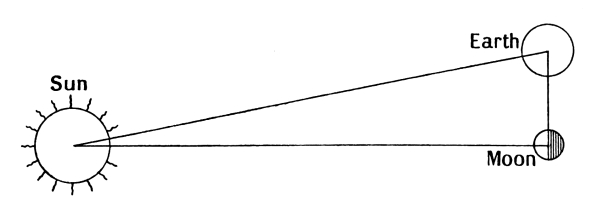
Fig. 20. Method of Aristarchus for finding the distance of the sun.
The foolish fad (as they thought it) about Earth’s motion, held by this otherwise great man, is described quite clearly by the two writers above-mentioned. He suggested that the stars might be immoveable, and Earth be turning on her axis at the same time that she moves in a circle round the sun. Moreover realizing all that this implies with regard to the immense distance of the stars, he said that the circle in which Earth revolves round the sun, compared with the sphere of the stars, is as the centre of a sphere compared with its circumference. That is, not only Earth, but Earth’s whole orbit, shrinks to a point when compared with the infinite distance of the stars.
We have unfortunately absolutely no information as to the way in which Aristarchus was led to these remarkable truths, and can only make conjectures from what we know of his times. Evidently the Central Fire theory was a suggestive step, and so was another theory which was afloat about this time, and has been called the “Egyptian system” on the authority of Macrobius in his commentary on Cicero’s Dream of Scipio. No one really knows where it arose, but it is ascribed with much probability to Heracleides of Pontus. According to this, the two planets Mercury and Venus circled round the sun, and all three together circled round Earth, which still remained the centre of the Universe and of the other celestial motions. It was an idea which might have occurred to any unprejudiced observer, since the oscillations of Mercury and Venus from side to side of the sun are more striking than their movements through the stars. They never go far from him in the sky, like the other planets, and seem to belong to him.
Further, the clear understanding of the periodic motions of Mars, Jupiter, and Saturn, and the accurate observation which had been introduced by Eudoxus, must have revealed the fact that the loops in the orbits of these planets are connected with the apparent movement of the sun; and the varying brightness (especially noticeable with Mars) is inconsistent with the assumption of unvarying distance from Earth.
The great importance of the sun, above all the other planets, had of course always been recognised, and it is possible that Aristarchus was struck by an unconscious suggestion in Aristotle’s advice to the Pythagoreans to examine the nature and place of the sun, “that other centre of the Universe,” for that was also a point of origin, and a noble one.[43] His own work, too, would lead him to attribute a commanding position to the sun, for as it was nineteen times as distant as the moon, it must also be nineteen times as large (since they appear equal), so he must have felt certain that it was a very great size, probably much the largest of all bodies in the Universe.
It was the grandest and truest of all the Greek astronomical theories. But it was not accepted, it was hardly even discussed, and we can scarcely be surprised at this. Such an improbable theory needed many more convincing proofs than Aristarchus could bring forward. Observation, calculation, comparison of theory with facts, this was what was needed before safe ground could be won for belief, and in this Eudoxus was a true pioneer. But freedom of thought and courage in imagination is needed also in science, and Aristarchus seems to have been almost the last to possess this.
Seleucus b.c. 160.
Aryabhata born a.d. 467.
A certain Babylonian, named Seleucus, who lived about b.c. 160, perhaps on the Tigris, and an Indian astronomer, Aryabhata, of the fifth century a.d., both taught that Earth turns on her axis, but Aristarchus stood alone in suggesting that she also has a movement of revolution round the sun. The possibility of Earth’s motion was alluded to but seldom by classical and mediæval writers, and then almost always as a foolish fancy hardly worth discussion;[44] until at last Copernicus, hardly daring to publish his bold idea in sixteenth century Europe, for fear of persecution, sought and found among the followers of Pythagoras, and in Aristarchus of Samos, kindred spirits with his own.
6. THE SCHOOL OF ALEXANDRIA.
The spheres of Eudoxus would not work. The system was already overladen, and more variations in velocity were becoming known. Observation shows, too, that the planets, especially Mars and Venus, vary greatly in brightness, in regular periods which correspond with their movements, and this could not be accounted for by any possible number or arrangement of spheres if all were to remain concentric to Earth, so that every planet remained always at a uniform distance. Yet Aristotle had said that Earth must be at the centre of the Universe. The new philosophers of the Stoic school agreed with him, and among mathematicians only Aristarchus dared to disagree.
But they were not long at a loss. The homocentric spheres[45] were thrown aside, and during the third century two new hypotheses were suggested (beside that of Aristarchus), and although we do not certainly know by whom, there is little doubt as to the place in which they originated. By a strange fate, Egypt, the home of astronomy many centuries before, became the seat of the latest, most brilliant, and most successful astronomical school of ancient times, and the knowledge won there in the five centuries between b.c. 300 and a.d. 200 spread, following in the wake of Alexander’s conquests, over the whole of the civilized world.
It was a purely Greek school, however. Greece lost her independence under Alexander, and was finally crushed by Rome in 146 b.c., but never was Greek learning and culture so much honoured and sought after as in this age. In Egyptian Alexandria, Greek men of science found a welcome, and opportunities of research which did not exist in any other place in the world. In the Museum, founded and liberally endowed by the royal Ptolemies, was a great library whose custodians were bidden to obtain every book that had ever been written, and it is said that when any stranger arrived with a new book it was taken from him and copied for the Museum, and the copy returned to the owner. Within the great marble colonnaded building were lecture-halls, and reading rooms, and laboratories; there were gardens for botanists and zoologists, and observatories for astronomers. These astronomers were all Greeks, and though now living in Egypt they do not seem to have learned anything more from the Egyptians. Perhaps the priests resented the intrusion, and kept their secrets jealously to themselves; perhaps Eudoxus and his immediate followers had learned all they had to teach. This seems the more probable because, although the Greeks of this age did use Babylonian records of eclipses to form a lunar theory, they complained of the insufficient accuracy of all available planetary records. Moreover, they were not hindered from learning astrology: the sacred books of the Egyptians which taught its principles were translated into Greek about 300 b.c.; but it was always treated by them as quite a separate branch of study. Their geometrical methods were entirely their own. They introduced a system of notation which greatly simplified calculation[46]; their discovery of the principles of spherical trigonometry inaugurated a new era in astronomy; and they invented a new class of astronomical instrument.
We know what these instruments were like, and it is even possible to give an illustration; for, from descriptions in Ptolemy’s Almagest, we find that the “well-made copper circles,” the gnomons, and the celestial globes, which were set up in the Square Portico of the Museum, were of the same pattern as instruments which existed in Pekin, in the ancient observatory on the ramparts, until they were looted by the Germans during the late Chinese war. The Alexandrian instruments were not supported on their stands by beautiful bronze dragons, but on the other hand the circles were more accurately divided, which after all was of more importance from the astronomers’ point of view. Fig. 21 gives a general view of the Pekin Observatory, and Fig. 22 one of their astrolabes dating from the 13th century a.d.
At first glance there seems to be here absolutely nothing like our modern observatories. Ancient and mediæval astronomers had indeed no telescopes, being ignorant of the properties of lenses: therefore they were unable to study the features of any heavenly body except the moon, and they had no way of finding out anything about their physical constitution; but they had many ways of measuring their distances and motions, and even the angular sizes of sun and moon, and their instruments were the forerunners of our sextants, micrometers, and transit instruments, our chronometers and sidereal clocks.
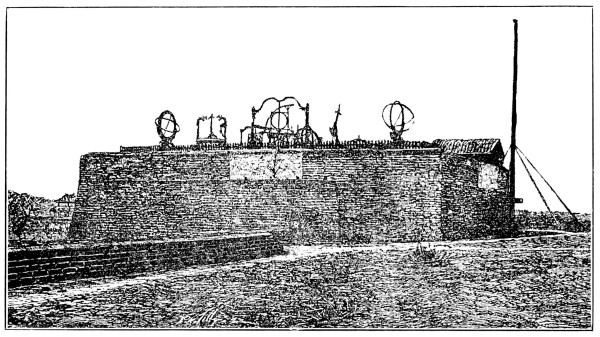
[To face p. 114.
PEKIN OBSERVATORY.
From a photograph taken in 1888, and published in the “Bulletin de la Société belge d’Astronomie”.
The gnomon has been already described[47], and it was one of the most valuable instruments used by the Greeks. The Pekin gnomon at the right of figure 21 was more than 40 feet in height, and on the top had a little plate of copper which was pierced by a hole as fine as the eye of a needle: the observations made with this were much more exact than observations of the end of the shadow, which must always be vague, and the Chinese records of the sun’s movements made with this instrument between 1270 and 1280 a.d. are of great value in modern research. Ptolemy explains that his gnomon was made accurately vertical by the use of a plumb-line, and that one way of testing the level of the surface on which the shadow fell was to flood it with water.
Clepsydras, or water-clocks, were used by the Greeks, and many kinds of sundials for telling the time by day. Tables were also made of the risings of bright stars which served for clocks by night.
The instrument in the middle of the platform is a quadrant, and beyond this on the left is a large celestial globe, which, however, only dates from the Jesuit missionaries of the seventeenth century. Ptolemy says that his globe was made the colour of the night sky; Sirius being marked in his proper place, all other stars were placed relatively to him, and in their own colours as nearly as might be; the Galaxy was drawn, and the figures of the constellations outlined. The globe was arranged to turn on either the poles of the ecliptic or of the equator; circles of wood represented the horizon and meridian, and the pole could be arranged at any altitude according to the latitude of the place.[48]
But perhaps the most interesting are the astrolabes, and these owe their origin to the Greeks. The essential part of any instrument for determining angular distances is a divided circle and a pointer: the pointer is directed first to one object then to another, and the angle between them is then read off on the circle. In the astrolabe, the pointers themselves were also circles, provided with little perforated rods for “sights.” (These are not visible on the instrument in Fig. 22, and have probably been broken off.) There were two fixed circles, set in the plane of the ecliptic and perpendicular to it. Three other circles could be rotated round the poles of the ecliptic. One of these was directed (by means of the sights), to some body whose position was already known, another to the body whose position was to be ascertained, and the angle between them was read off on the ecliptic circle; on the third the angular distance north or south of the ecliptic circle could be read. This last and the ecliptic circle were both divided into 360 degrees, and as many fractions of a degree as space and skill would allow.
The equinoctial astrolabe was similar, but the fixed circle was in the plane of the equator, instead of the ecliptic. One of each of these is seen in the view of the Pekin Observatory.
But how did the old astronomers know how to find the ecliptic and the equator in the sky, and set their circles in those planes? This they did by means of the sun’s motion. The gnomon told them the day of the equinox (see p. 25), and on that day the sun was in the equator: therefore, if a circle was set up so that the shadow of the upper part fell symmetrically upon the lower, with a little line of light each side, it must be exactly in the plane of the equator. In the Square Porch such a circle was erected, a large one of copper, and when once correctly adjusted it was a standard plane, and also showed the date of the equinoxes, as accurately as the gnomon itself. Since the ecliptic is the path of the sun as seen in the sky, it is obvious that it could be determined from a number of different observations of his position at different times of the year.
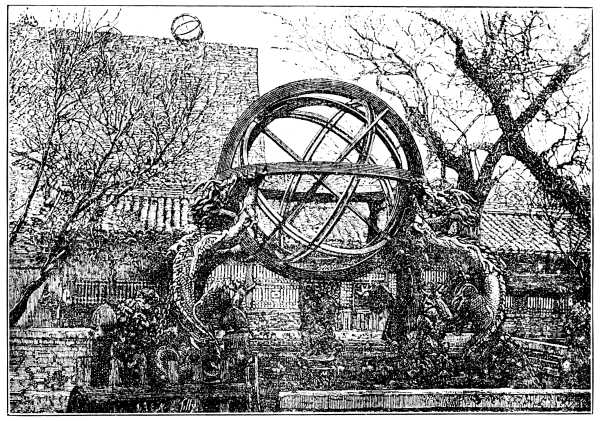
[To face p. 116.
A PEKIN ASTROLABE OF THE 13th CENTURY, a.d.
From a photograph taken in 1888, and published in the “Bulletin de la Société belge d’Astronomie”.
Finally, accurate solar tables were drawn up, showing the sun’s position in the sky in degrees for different dates, and then from these it was possible to find the places of planets and stars. They could not of course be compared directly, but the position of sun and moon were compared during the day, when both were in the sky, and then after dark the planets and stars were compared with the moon, allowing for her motion among the stars in the meantime. Or secondly, when the moon was eclipsed, and therefore known to be in the ecliptic and exactly opposite the sun, the places of stars could be found directly.
This very brief description will give some idea of the chief instruments and methods used, and when we see how very rough and elementary they were, and remember that the Greeks had to work out their observations without algebra, or decimal notation, we are amazed at their results, and their far-reaching ambitions.
Eratosthenes b.c. 276-194.
Already in the very early days of the Museum, Eratosthenes, a celebrated geographer, made a bold attempt to utilize observations of the sun measuring the size of the earth. It was known that in Syene (the modern Assuan) on the day of the summer solstice at noon no shadows were thrown, and the bottoms of wells could be seen: evidently therefore the sun was in the zenith. Eratosthenes found that the sun’s distance from the zenith in Alexandria at noon on the same day was 7° 12′, or one-fiftieth of the circumference of the heavenly sphere, consequently the two towns must be distant from one another (assuming them to be nearly in the same meridian) one fiftieth of the circumference of the earth. The distance from Alexandria to Meroe was known, and from Meroe to Syene had been paced by the king’s professional pacers; the whole was 5000 stadia. 50 times 5000 = 250,000. The figure always quoted by the ancients is however 252,000. If the stadium used by Eratosthenes was the measure generally used for long distances which have been paced, this estimate is equal to 24,662 miles, only about 200 miles less than the modern value. It was partly by luck that Eratosthenes got such a good result, for he was evidently only working with round numbers, and the extra 2000 stadia seem to have been added in order to make one degree equal to exactly 700 stadia. But in any case it was a highly creditable performance.
Euclid c. b.c. 300.
Apollonius c. b.c. 270.
There were celebrated mathematicians and geometers at Alexandria, whose work was most useful to astronomy, such as Euclid, and Apollonius of Perge. The latter is specially mentioned by Ptolemy in connection with the new theory of “moveable eccentrics,” which was invented to account for the varying brightness of the planets, as well as their peculiar movements.
Fig. 23 explains this theory. Let P A be a great revolving circle upon which Mars is fixed. (In the hands of the Alexandrian mathematicians the spheres almost disappear, and they deal practically only with circles.) If the earth were at its centre, as Eudoxus demanded, Mars must always be at the same distance, but if we make the circle eccentric to Earth, by putting its centre at C while Earth is at E, then the distance and consequently the brightness will constantly vary, and Mars will be brightest when at perigee P (point nearest Earth), and faintest when in apogee A (point furthest from Earth).[49]
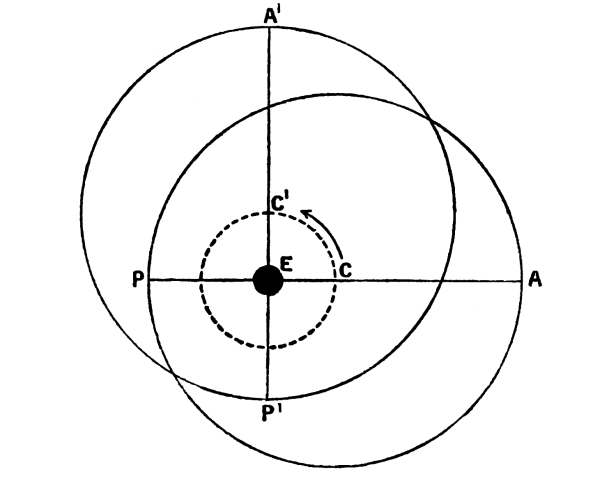
Fig. 23. The Moveable Eccentric.
But, as the Greeks had discovered, Mars attains his greatest brilliance at different points of the zodiac, so P must be made moveable, and it always happens when he is opposite the sun, therefore P must keep pace with the sun’s apparent motion in the zodiac and P E always point towards him. This was accomplished by making P C A turn round upon the fixed point E, so that for instance when the sun had moved through a quarter of his circle (in three months) P A had moved to P′ A′, and the whole eccentric had moved into the new position shown in the diagram, its centre C being now at C′. In other words, the centre of the eccentric moves round Earth in the same time and in the same direction as the sun, that is in one year, and “with the signs” (from west to east).
At the same time, Mars is moving in an opposite direction on the eccentric, and without entering into all the details of the problem, we may add that the Greek geometers found that by determining the proper relative sizes of the large and the small circle they could make the two motions neutralize one another when the planet reached its stationary points, and the retrograde motion prevail over the direct when it retrograded. A similar arrangement was made for Jupiter and Saturn.
In this very ingenious way the varying brightness as well as the varying motions of these three planets were accounted for, without violating the principle of uniform circular motion, and without removing Earth from the centre of the Universe. She was also still the centre of planetary motion, in a certain sense; but to place the true centres of these planets’ spheres outside Earth and in the direction of the sun was a very suggestive step, and may well have helped Aristarchus to his bold hypothesis. For he had only to put the sun, not at some indefinite point along the line E A, but exactly at the point C, and it became the centre of motion for Mars, Jupiter, and Saturn, just as in the “Egyptian theory” it was the centre of motion for Venus and Mercury. In this way he would arrive at the conception of the sun circling round Earth and carrying all the planets with him, (a theory which was held by the great astronomer Tycho Brahé in the sixteenth century a.d.). Then a flash of insight may have revealed to him the fact that this motion of the sun is apparent only, being but the reflection of Earth’s own motion; for she is circling round the sun like all the other planets.
It is, however, only a guess that the Moveable Eccentrics played this part in the theory of Aristarchus. They did not long hold the field, because they were not applicable to Venus and Mercury, which are never seen in opposition to the sun. So they were thrown aside for another system, the Epicycles, which illustrates much more simply the stations and retrogressions of the planets, and can be used for them all.
Later on, when more irregularities of motion were discovered, it was found necessary to combine eccentrics and epicycles, and by means of this joint system it became possible at last to represent completely, and as accurately as they could be observed, all the apparent movements of the heavens. First, however, an immense amount of work had to be done, and new methods devised, both in observation and mathematics. The man who contributed most, in both ways, to make it possible, was Hipparchus.
7. HIPPARCHUS.
Hipparchus c. 140 b.c.
Of this great man we know scarcely anything but what can be gathered from the work he did, and this corroborates Ptolemy’s description of him: “Hipparchus, lover of toil and truth φιλοπονον και φιλαληθεα.” He lived about b.c. 140, since this is the date of the only book of his still extant, and his work was not done in Alexandria, though he may have studied there in his youth, and he used the Museum records. We count him among the Alexandrians, as he belongs to this era, but he seems to have been a private astronomer, who set up an observatory of his own in Rhodes, his native place. Here we seem to see him, surrounded by his primitive instruments and his papyrus books, patient, eager, modest, seeking no fame and no reward but the joy of his work. By day he would keep watch over the sliding shadow of his gnomon, would write up his observations, make long calculations, and devise new methods in mathematics, improve and modify his astrolabes and his clepsydras; at night he would spend long hours with moon, planets, and stars, making up for the defects and shortcomings of his instruments by the skill and care with which he applied them to measure positions in the sky. Nothing but the most loving and conscientious care could have raised his work to such a pitch of accuracy, and made such rude means suffice for such splendid achievements.
The book we possess, apparently an early one, is chiefly concerned with the positions, the risings and the settings, of stars, and at the end is a list of sixteen which came to the meridian at intervals of an hour: from this list and the knowledge of spherical trigonometry which he possessed, it would be possible to calculate the time at night to within about a minute.
Hipparchus was able to construct a satisfactory theory of the sun and to some extent of the moon, but he found more irregularities in the planetary motions than Eudoxus had suspected. The records of his predecessors were not accurate enough for him to construct a theory for the planets, and he soon realized that one life-time would not be long enough to collect all the data necessary, so, as Ptolemy tells us, “Hipparchus, who loved truth above all things,” quietly set to work to make as good and as many observations as possible, leaving it to his successors to complete and explain them.
In the same spirit he undertook the laborious task, of which Pliny speaks with awe as a presumptuous scheme, even for a god, “rem etiam Deo improbam,” of numbering the stars. Pliny says he was led to do this by the appearance of a New Star, which blazed out suddenly in the constellation of Scorpio in b.c. 136, just as Nova Persei did in Perseus in February 1901. He saw that even in the upper regions of the eternal heavens, which Aristotle had supposed absolutely changeless, changes may occur, and in order that even the least of these should not pass unnoticed, he set to work to note the number, brightness, and position of all he could see. This great catalogue of 1080 stars, copied by Ptolemy in his Almagest, was the basis for all succeeding catalogues, from Spain to Turkestan, until quite modern times. In it, for the first time, the places of the stars were not merely described according to their position in the constellation figures, but were noted in degrees on the sphere, as is done to-day.
Timocharis c. b.c. 280.
One day, when comparing his notes with those of Timocharis, who had worked at Alexandria about a century and a half earlier, he found that the brilliant star Spica, the Ear-of-Corn which the Virgin carries in her hand, had apparently moved nearer to the autumnal equinox by about 2°. (Two degrees is about four times the angular diameter of the sun). Of course he or Timocharis might have made a mistake, or Spica might really be moving among the stars, or she might be carried along with the rest by a slow movement of the whole star sphere. Apparently Hipparchus satisfied himself that he could rely upon Timocharis’ observation, and took pains to verify his own; the second hypothesis could be disproved by the fact that Spica does not change her place perceptibly among her neighbours; and finally it became clear that her motion is part of a slow apparent movement of the whole heavens.
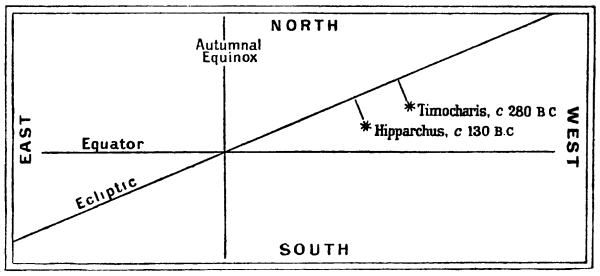
Fig. 24. The movement of Spica.
Here was a discovery of first importance, an unexpected reward of patient accuracy, of which the white Spica, flashing down from summer skies, may always remind us. Hipparchus had discovered the grand cycle which we call the “Precession of the Equinoxes,” and before Spica returns to the same position in which he saw her then, when she led him to his great discovery, she will have been watched by generations of astronomers for another twenty-four thousand years. No notice of the cycle has been found as yet among the records of any other nation, although it seems as if the astronomers of Babylon and Egypt, and other countries where observations had been carried on for many centuries, must have been aware of it. We can only imagine that at long intervals of time they found that the stars had somehow changed, and made corrections accordingly, but without understanding the nature of the change. What Hipparchus thought about its cause we cannot tell: probably he left all speculations to future astronomers, and confined himself to noting the fact.
The displacement of Spica which he observed is shown in the diagram.
Both Timocharis and Hipparchus evidently measured her position indirectly by comparing it with that of the moon, which was eclipsed at the time,[50] and therefore known to be in the ecliptic and opposite the sun. To find the sun’s distance from the equinox was an easy matter, since his yearly course had long been carefully studied, and the days on which he passed the equinoxes were regularly observed with the gnomon. Spica, then, had moved eastward along an arc parallel to the ecliptic, and since celestial latitude and longitude are referred to the ecliptic, we may define her apparent movement in astronomical language by saying that while her latitude had remained constant, her longitude had increased by about two degrees; and further, as the celestial equator is oblique to the ecliptic, this implied that her declination (position north or south of the equator) had also varied. The diagram shows that she had a less northerly declination than before.
At this rate, Spica, which was now only 6° from the autumnal equinox, would reach it in less than five hundred years, and thereafter would lie east instead of west of it; and that she has in fact done so, may be seen by consulting a modern star atlas. She is now 22½° of longitude east of the autumnal equinox, and nearly 11° south of the equator. Her south declination will continue to increase for about five thousand years, after which she will come north again.
Ptolemy says that Hipparchus examined other stars, and found that they also were increasing their longitude at what appeared to be the same rate as Spica. The yearly amount of the movement, derived from the Spica observations, is within a few seconds of arc of the true value, which is 50¼ seconds; but Hipparchus would not fix any value until it had been tested by further observation, and merely stated that it could not be less than one degree in a century i.e. 36 seconds per annum.
This is a very uncomfortable phenomenon for astronomers, since every star is for ever changing its measured position on the celestial sphere. Take three stars, one at the north pole, another on the equator, and a third in the southern hemisphere. After some years, the first will no longer be a pole star, the second no longer an equatorial star, and the third may have so far increased its south declination that it will be invisible at latitudes in our northern hemisphere where formerly it used to rise above the horizon. One compensation for this inconvenience is that if we know what star was near the pole, or which stars lay along the equator, on any given occasion, we can calculate the date. Thus it is believed that the Great Pyramid was built when Alpha Draconis was the Pole Star, that is, nearly 3000 years b.c.; and by a similar method Mr Maunder determines the epoch at which the ancient southern constellations were invented, as we have already seen.
The greatest inconvenience, and also the greatest historical interest, attaches to stars like Spica which belong to constellations of the zodiac, for if they are not stationary with regard to the equinoxes and solstices they are not such simple guides to the length of the solar year as the ancients supposed them to be. The scheme of the Babylonians for beginning their month Nisan when the stars of Dilgan rose just before the sun was an excellent one for a time, but if they had continued it for many centuries they would have found that their year was too long, and the months were all falling in the wrong seasons. This has actually happened with Hindus and Parsis, who now keep their New Year in the middle of our April, although when their calendar was fixed, about thirteen hundred years ago, the years began at the spring equinox. For the sun is like a runner in a circular race-course who thinks he has completed a lap when he returns opposite a group of spectators originally standing at the starting-point, but after several laps he finds that the spectators and the goal no longer coincide; either they, and also all the others surrounding the course are walking away from it, or an unseen hand has been moving the flag towards him, and so shortening the lap.
It is the flag which must count, in any case, not the spectators, and with the sun it is the equinox which must count, and not the stars, for this is the point at which he crosses the equator, making day and night equal, and from this we count the beginning and ending of our seasons. So our year is counted from equinox to equinox, and is twenty minutes shorter than the “sidereal,” or star year, of the ancient Babylonians. Hipparchus, from observations of equinoxes and solstices, made the year 365 days 5 hours and nearly 55 minutes, which is only 6 minutes longer than the correct value.
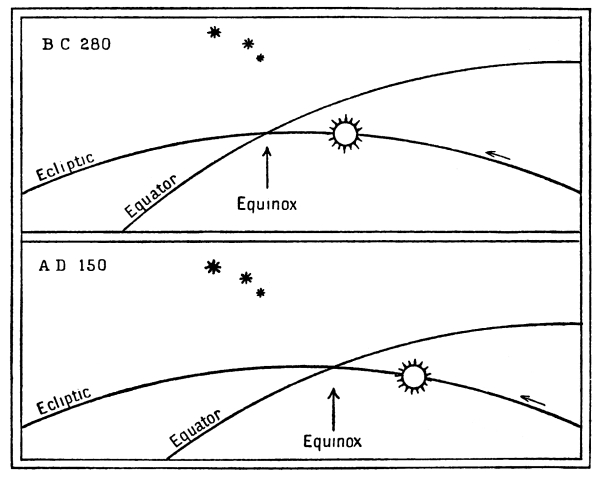
Fig. 25. The Sun and the Equinox.
After Hipparchus had made his discovery, astronomers agreed upon a somewhat clumsy and very confusing device, by which the zodiac was divided into twelve equal “signs” of 30 degrees, which bear the same names as the zodiacal constellations, but whose beginning is always reckoned from the vernal equinox. These twelve “signs of the zodiac,” therefore, do not now agree with the twelve constellations of the zodiac, and our present “first point of Aries,” which marks the vernal equinox, is in the constellation of Pisces.
What is the true cause of this strange phenomenon? Are the stars really all in motion, or is it the equinox which moves?
The successors of Hipparchus, who believed that the stars were fixed on a sphere, found no great difficulty in conceiving that this sphere had a very slow easterly motion, round the poles of the ecliptic, completing a revolution once in 36,000 years (i.e. one degree in century). To us, however, it is impossible to believe that the stars, which we have found to be at enormous and varied distances, are all revolving at one rate, parallel to the ecliptic. The ecliptic, to us, is simply the plane of Earth’s own orbit, and as she moves in it she has a very slow “wobbling” motion on her axis, as well as the rapid spinning of the diurnal motion, like the “wobble” of a spinning top. The top has this motion because gravity is trying to pull it down from its upright position; the earth because the sun is trying to drag her slightly protuberant equator into the plane of her orbit.
The resulting motion is not a revolution of the earth, nor an apparent revolution of the star sphere round Earth: what really happens may be illustrated with the traditional orange and knitting needle.
Ignoring all motions but the one we are speaking of, let the points of the knitting needle (Earth’s axis of rotation) trace out small circles in space, and the equator of the orange will be seen to alter the direction of its tilt, but without turning round (Fig. 26). Stick a pin in the equator, and others in north or south latitudes, between equator and pole; these will always remain facing you, but while the pole makes its small circle, the equatorial pin will be seen to move up and down, while the tropical and temperate pins trace out ellipses. These are the movements which we see reflected in the stars; and if Earth’s diurnal rotation were suddenly to cease, while her revolution in her orbit and the movement of “precession” continued, we should see Spica, for instance, sink slowly lower in the southern sky and after ages rise again northwards, but there would be very little preceptible movement east or west.
The movement observed by Hipparchus, then, was not a movement of Spica and other stars, but a movement of the equinox. For the celestial equator is simply a reflection of Earth’s equator in the skies, and as it keeps changing the direction of its tilt in the way described, it changes the point at which it cuts the ecliptic. This may best be seen by taking two rings or hoops (two large curtain rings, for instance), one of which just fits inside the other. Tilt the inner ring, so that half of it is above and half below the other ring, and they touch at two points, 1 and 2 (Fig. 27). The outer ring is the Ecliptic, the inner the Equator, and where they touch each other are the Equinoxes. Now move the inner ring, not sliding it round, nor making any difference in the angle between the two, but simply so that they touch at fresh points, 1′ and 2′. In this way you may make the points of contact revolve entirely round. This is what the real equinoxes are doing: while the equator opposite the group of stars in figure 25 rises and falls, the equinox travels on, and finally returns to the same place.
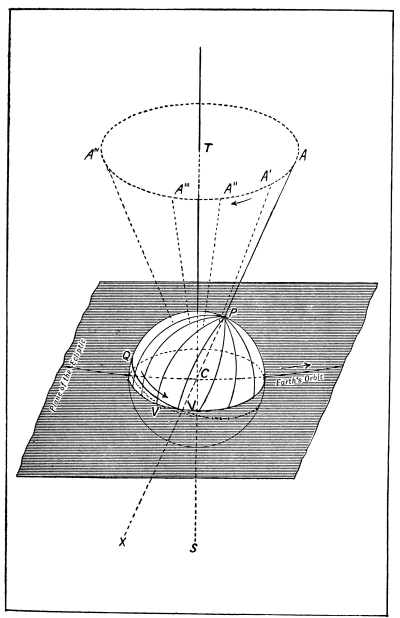
Fig. 26. The movement of Earth’s axis, which is the true cause of Precession.
V is the vernal equinox, at the intersection of the equator and plane of the ecliptic: APX the earth’s axis, which always preserves the same inclination (23½%) to the plane of the ecliptic. As APX slowly revolves round T in the direction of the arrow, the vernal equinox is gradually shifted to V′, and so on.
(From Young’s “Manual of Astronomy,” 1902.)
The phenomenon is called “precession of the equinoxes,” because they thus move on to meet the sun in his yearly course.
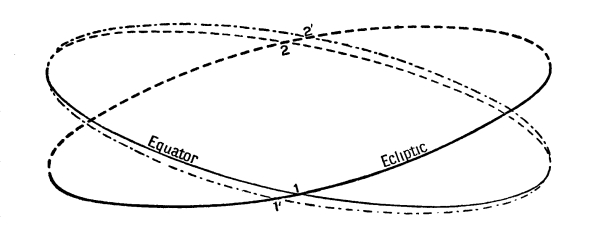
Fig. 27. Precession of the equinoxes.
The discovery of precession is what has chiefly made Hipparchus famous, but the invention of the astrolabe and of spherical trigonometry, both believed to be due to him, his star catalogue, and his many observations, more accurate than any made before, were so valuable as pioneer work that Ptolemy justly called him the Father of Astronomy. If Hipparchus could visit one of our observatories to-day, and see the clock-driven equatorials, the transit instruments, the beautifully divided circles read with microscopes, and the sidereal clocks, one wonders whether he would be more astonished at the advance on his astrolabes and clepsydras or at the homage paid to him as one in whose footsteps all astronomers are proud to tread.
8. PTOLEMY.
Claudius Ptolemœus. I know that I am mortal and ephemeral, but when I scan the multitudinous circling spirals of the stars, no longer do I touch Earth with my feet, but sit with Zeus himself, and take my fill of the ambrosial food of the gods.
For more than two centuries after Hipparchus very little original work was done in astronomy, and no one seems to have had the courage to take up his unfinished task and study seriously the difficult problem of planetary motions.
Posidonius c. 135 b.c. to c. 50 b.c.
Posidonius the Stoic, who lived for some years in Rhodes, made a fresh determination of the earth’s circumference, basing it not on observations of the sun, like Eratosthenes, but of the star Canopus, which in his time was just visible at Rhodes while in Alexandria it rose “a quarter of a sign” (i.e. 7½ degrees) above the horizon. By his method, the earth was a little smaller, (240,000 stadia instead of 250,000), but it must have been difficult to measure the distance between Rhodes and Alexandria over the sea, and it is impossible to say when a star is exactly on the horizon. Posidonius also observed the tides in the Mediterranean, and showed that “Ocean follows the movements of the heavens,” and especially of the moon, having daily and monthly periods.
Geminus c. 70 b.c.
A little later Geminus wrote an Introduction to Astronomy, which was an excellent little book as far as it went, but although he was apparently a native of Rhodes, and speaks of Hipparchus, he seems to know nothing of his work, for he does not quote his careful determination of the length of the year, nor his discovery of precession.
Cleomedes c. 20 b.c.
Theon of Smyrna c. 100 a.d.
Nor were other writers, such as Cleomedes and Theon of Smyrna, better informed, and they added nothing new to the advance of astronomical science.
Ptolemy c. 140 a.d.
But at last a worthy successor arose at Alexandria, the immortal Ptolemy, whom Dante met in that Limbo of antique spirits which was almost Elysium, although on the brink of the Inferno.
We do not know when Ptolemy was born nor when he died, nor where was his native town: we only know that his first recorded observation was made in the eleventh year of the Emperor Hadrian, that is a.d. 127, and his latest in a.d. 150, and that he lived and studied in Alexandria. He had splendid opportunities for carrying on the work of Hipparchus, for besides the use of the instruments in the Museum Observatory, he had at hand all the Museum records, which included the writings of Hipparchus. Ptolemy was not so painstaking and accurate an observer as Hipparchus, but he was a very able mathematician to whom it was evidently a joy to handle figures and work out problems. By examining a number of observations spread over several centuries, and combining them with his own, he was able to accomplish the task in which so many others had failed, and to frame a system which embraced all the celestial motions then observed. The monumental summary in which he set forth this system contains a great deal of interesting information about his methods and instruments, and about the work of Hipparchus, for whom he always expresses the most generous admiration. The original name of his book was the “Mathematical System of Astronomy,” but his admirers having called it the “Great System,” Megiste Syntaxis, the Arabs affixed their article al and gave it the name it preserves to this day, of Almagest. It remained the standard treatise on astronomy until the De Revolutionibus Orbium Celestium of Copernicus appeared in 1543.
The name of his book indicates the scope of Ptolemy’s work. It was to represent all the observed motions of the heavenly bodies by means of a mathematical system, so that they became amenable to calculation; but to explain the causes of these motions was thought to lie quite outside an astronomer’s province. It was not for a mere observer and calculator to determine which motions were real and which apparent, else Ptolemy must have decided in favour of Earth’s rotation, for he says that it would be much easier to account for celestial motions on this assumption. Nor was it his business to investigate the substance of the stars. Little did he dream that astronomers would one day solve such problems, and uphold their conclusions in the face of all the world: for him, as for his contemporaries, the decisions of the philosophers, and especially of Aristotle, were final, and his task was to describe what he saw in the light of their teaching.
He brings forward, in the introduction to his book, a few arguments against the absurd notion, taught by some, that Earth is in motion, turning on her axis or moving through space; but all that he proves is the immense difficulty, even to a trained mind, of accepting these theories, and the great authority of the philosophers who denied them on abstract principles. Educated Greeks might still discuss the nature of the heavenly bodies, as in Plutarch’s delightful dialogue On the Face of the Moon, (written about half a century before the days of Ptolemy), and might ridicule the law of gravity, laughing at the absurdity of supposing that if the middle of a man’s body were at the middle of the earth, his feet as well as his head would be “up,” and that falling weights if they reached this point would stop short, or oscillate to and fro. Yet even they all agreed that the fixed stars do most probably move “in a circle of eternal and never-ending revolution,” and that they are of a pure and eternal substance unlike Earth; and for the professional astronomers of Alexandria these axioms were assumed as the basis of all their work. Earth must be immoveable at the centre of the Universe because the heavy stuff of which she is made sinks necessarily to the centre and there remains in globular form without need of support; the heavenly bodies must be in motion, because, being of ethereal substance, it is their nature to revolve eternally in circles.
This being granted, we can feel nothing but admiration for the extent of Ptolemy’s knowledge, the comprehensiveness of his scheme, and the skill and patience with which he overcame its difficulties.
Earth, according to Ptolemy, is but a point compared with the immense surrounding sphere in which the stars are set, and this turns always round us, communicating its motion (he does not inquire how) to sun, moon and planets, so that day follows night, and the heavenly bodies daily rise and set. For the slow movement of precession, which also affects all heavenly bodies, Ptolemy accepted the least value of Hipparchus, one degree in a century, only testing it in rather a perfunctory way, which was a great pity, for he might have determined it much more closely after an interval of some 250 years. But one man cannot do everything, and he doubtless thought it best to spend more time on the planets, whose intricacies had baffled Hipparchus and gave him also a great deal of trouble.
He retained the great spheres which were supposed to carry them round Earth, inside the star sphere, but the chief feature of his system is the use of small spheres, which were fixed on the larger, and therefore called “epicycles,” while the large were known as “deferents” or carriers. The general principle of epicycles is very simple, as may be seen by comparing the two diagrams.
Fig. 28 shows the path of Mars as we saw it among the stars of Pisces in the year 1909. Throughout July the planet was travelling in its usual direction, “with the signs,” but on August 22nd it came to a stop, then turned and travelled backwards “against the signs” until October 26th, when it stopped again, reversed its direction once more, and during the rest of the year moved rapidly forward.
Fig. 29 shows the principle on which Ptolemy would have explained this curious track. Each planet was supposed to be fixed on a small circle, the epicycle, and this was fixed upon a large circle, or deferent, upon which it travels in the direction shown by the arrow, at a uniform speed, returning to the same place in the sidereal period of the planet. Thus Mars, as seen from Earth, which is near C the centre of the deferent, makes a great circle through all the zodiac in two years, Jupiter in twelve, and so on. But meanwhile the epicycle is rotating round its own centre, C1, and when the planet reaches the point marked S, the two motions neutralize one another, so that it appears stationary, as Mars did on August 22, 1909. After this, the motion of the epicycle more than counter-balances the motion of the deferent, and the planet seems to reverse its direction until it reaches the point on the epicycle marked S′. After this the two motions are once more in the same direction, so the planet is seen to move rapidly forward, as Mars did after October 26.
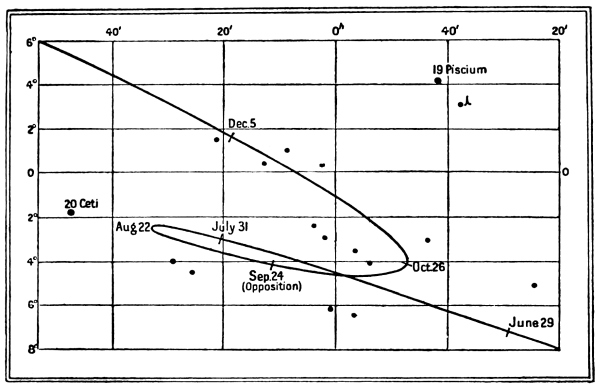
Fig. 28. The Path of Mars among the Stars, 1909.
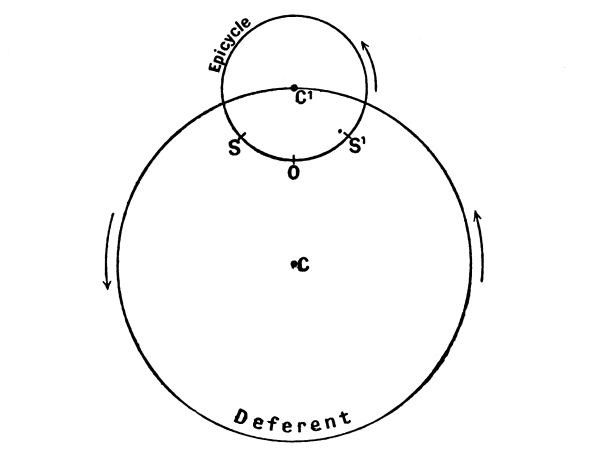
Fig. 29. The Epicycle.
Ptolemy’s method of accounting for movements such as those shown in Fig. 28.
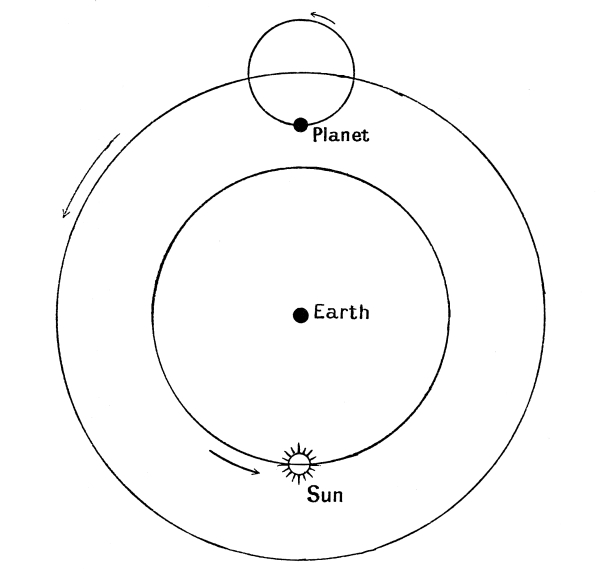
Fig. 30. Planet retrograding, and in opposition (i.e. in opposition to the sun.)
In this extremely ingenious way the strange planetary oscillations were accounted for, without violating the law of uniform circular motion, and in a more convenient and satisfactory way than by the concentric spheres of Eudoxus or the moveable eccentrics of Apollonius. Each of the five planets was provided with an epicycle and a deferent, and these were made of the proper relative size and given the right speed, so that the motions should correspond with what we see in the sky.
Ptolemy calls the oscillation a planet’s “anomaly with regard to the sun,” because (as we have seen when discussing the moveable eccentrics) it was known to be connected in every case with a planet’s angular distance from the Sun. On September 24, when Mars was in the middle of his retrograde arc in Pisces, the sun was exactly opposite, in the constellation of Virgo. This is found to be always the case, not only with Mars, but with Saturn and Jupiter too. Whenever one of these planets has the position O on its epicycle, and therefore is retrograding, the sun will be found to be exactly opposite in the sky. Mars comes into this position, and is opposite the sun, once in 780 days; this, therefore, Ptolemy called the period of his epicycle, while a little less than two years was the period of the deferent. The two periods of Saturn are 378 days and 29½ years nearly; of Jupiter 399 days and nearly 12 years.
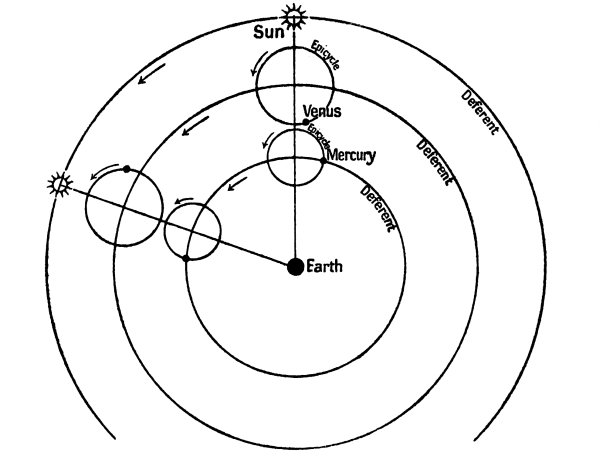
Fig. 31. Venus, Mercury, and the sun.
Venus and Mercury betray their dependence upon the sun in more striking fashion, for since these planets simply oscillated from one side to the other of the sun, their epicycles must be supposed to be keeping pace with him all the way round the zodiac. Fig. 31 shows their relation to one another. On September 25, 1911, Mercury was seen from Earth as a morning star as far west of the sun as it is possible for him to travel, while Venus, after shining as an evening star all the summer, had come into line with the sun and become invisible.[51] On December 7 following, the rotation of the epicycles (Ptolemy would say) had brought both planets to new positions, Mercury now being an evening star at his “greatest elongation east,” and Venus a morning star. But the centres of the two epicycles always remain in a line with one another and the sun, and so their periods on the deferents are the same as his, viz. one year. The epicyclic periods, or intervals between two “greatest elongations” west or east, are 116 days for Mercury, 584 days for Venus.
We still explain the complicated course of the planets by resolving it into two approximately circular motions, but we know now that only one belongs to the planet itself, the other is Earth’s own motion. The reason why the sun’s position affects the position of every planet is simply that the epicycles of Mars, Jupiter, and Saturn, and the deferents of Venus and Mercury are reflections of Earth’s yearly journey round the sun.
Ptolemy had by no means finished with the planets when he had provided each one with an epicycle to represent the “anomaly with regard to the sun.” Hipparchus had noticed that there was another lesser irregularity, which seemed to be periodical likewise, although no former system had taken it into account; and this he called the “anomaly with regard to the zodiac,” because the speed of each planet and the amplitude of its loop varies slightly according to the part of the zodiac it happens to be in. He suggested that this might be dealt with by combining the two theories of epicycles and eccentrics, and this suggestion Ptolemy adopted with success. He placed each deferent with its centre not exactly at the earth, but at a certain small distance which was different for each planet. (This is not shown on our small-scale diagrams, therefore Earth appears at the exact centre.) The true explanation of this irregularity is that each planet’s path is not strictly circular, but elliptical.