TUSCAN SCULPTURE AND ENAMEL
Reading edition
In Florence the art of the modeller was far in advance of the painter’s. This is not unintelligible, for the sculptor had under his eyes the sculpture of the past, whereas the painter had no painting; he had the conventions and code of a virtually new art to decide. The mosaics and the illuminations were all that the early painters possessed for precedents and models. The difficult art of bas-relief had become Italian through the first Tuscan who learnt of the last Greek; but Italian painting had nothing nearer to Antiquity than some so-called Madonnas of the painter-Evangelist Saint Luke. The mosaics and the illuminations were, indeed, Byzantine, and indirectly Greek. But compare the figures of the enthroned mosaic Madonna at Ravenna, and her ceremonial Child, with the classic sarcophagus that inspired the Pisan. The one is Byzantine, the other Greek. The sculptor, then, inherited the rules of the art. The painter had to devise, for instance, the treatment of a certain degree of perspective by means of the linear art. Margaritone d’Arezzo, born in the year of Magna Charta, and the Sienese who was his contemporary, and Cimabue who followed him after a score of years, together established the general terms of painting.
Thus the Tuscan sculptor, set free by his possession of an established art, was at ease with nature and the convention of bust and bas-relief, and with nature’s simple and wild creature the child.
18Giovanni Pisano was born some five years before the nearly Byzantine, the majestic but captive, Cimabue. In the cathedral of Prato and in the Camposanto at Pisa are Bambini of Giovanni’s that are agile, springing in the mother’s arms, playing with her diadem, perfect children. His father Niccola was in art virtually a Greek, but his glorious “Nativity” upon the Pisa pulpit and that on the Siena pulpit do not, of course, show us a spirited child; though, by the way, Fra Guglielmo of Pisa has an animated little infant whom the women attending the Virgin wash in a stream, at the mouth of the cave of the Nativity, from which sheltered sheep are drinking. Giovanni Pisano’s Bambino is assuredly one of the earliest of Italian children studied from life and full of life. And when we speak of the fifteenth-century’s re-discovery of childish proportion, let us remember that this great sculptor observed it, and was born early in the thirteenth.
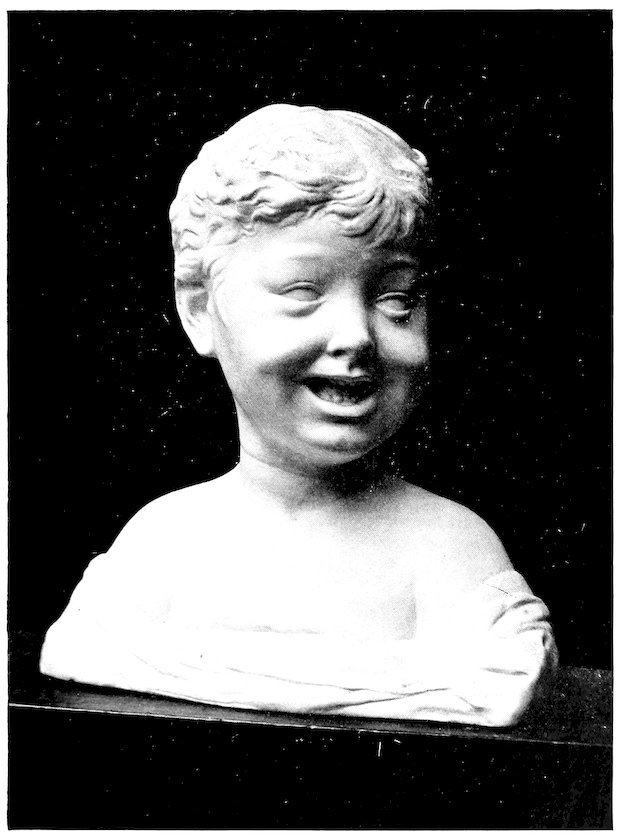
Alinari DONATELLO. HEAD OF A CHILD (FLORENCE)
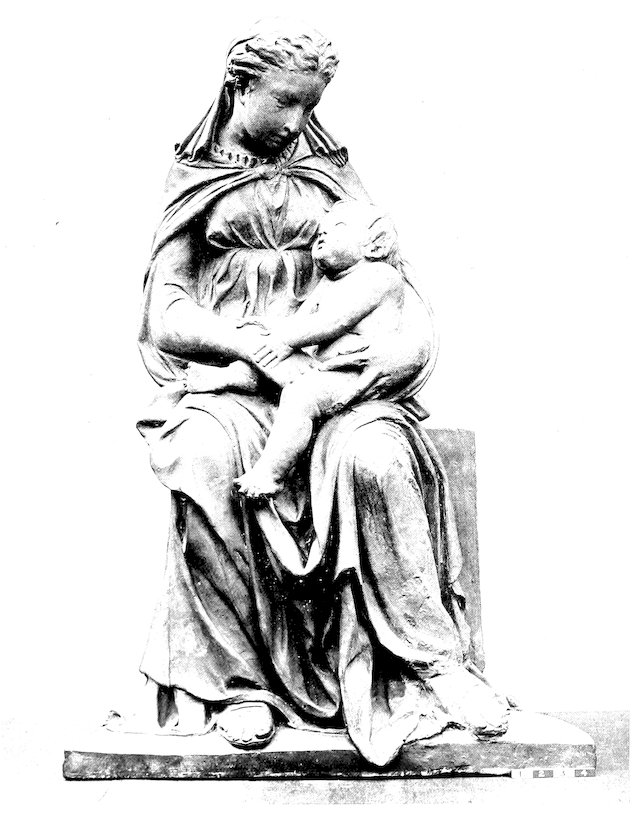
JACOPO DELLA QUERCIA. MADONNA AND CHILD (SOUTH KENSINGTON)
Painting was still an art in bonds and difficulties when Donatello produced his beautiful bas-reliefs of a natural Bambino, and the exquisitely modelled bust with the face delicately broad across the charming eyes, and narrowing to the chin—whether called the young St. John or not, purely the portrait of a tender boy; and his lovely boy-Mercury. Fra Angelico was demurely reckless with his anatomy when Jacopo della Quercia, the Sienese, was modelling the perfect hands of his Madonna and her perfect Child in one of the statuettes by the master which are amongst the original treasures of South Kensington Museum; also when Luca della Robbia was using his material with a masterly and liberal hand in the sketch for his bas-relief for the singing gallery of the Duomo at Florence, a sketch wilder and more 19animated than the finished work. (South Kensington has this incomparable stucco.) The children of this relief move with impulse and energy in a youthful dance; in another panel they go clashing cymbals, six cymbals at once used with a will. The works of this master, the inventor of the enamelled coloured terra cotta that bears his name, and the eldest of the three who used it, are of ever fresh variety. His, amongst others, is the Bambino who gives best the Papal blessing. There is nothing but what is charming in this action; fantastic as it looks with a baby face fresh from nature, it does nothing but delight us. Botticelli’s wonderful picture, his masterpiece, the “Magnificat,” in which the Child, turning his face upwards, points to the open page, does not reconcile the action with infancy, but Luca della Robbia makes his little infant a Pontiff with sweetness and ease. Somewhat like this wholly delightful Bambino is Rossellino’s, the terra cotta statuette at South Kensington, in which the smile breaks into an open laugh. The Madonna laughs also; at least she has a sub-hilarious face as she looks down at her noisy child, sees the soft gap-toothed mouth, and feels the little tumult of mirth in the breast under her hand. This is something altogether different from the benignant smile, a bestowed smile, with which the painter in the later centuries adorns the Virgin and Child. Luca della Robbia also has a laughing Child in a bas-relief now in the Berlin Museum, and he too makes the Mother laugh with him.
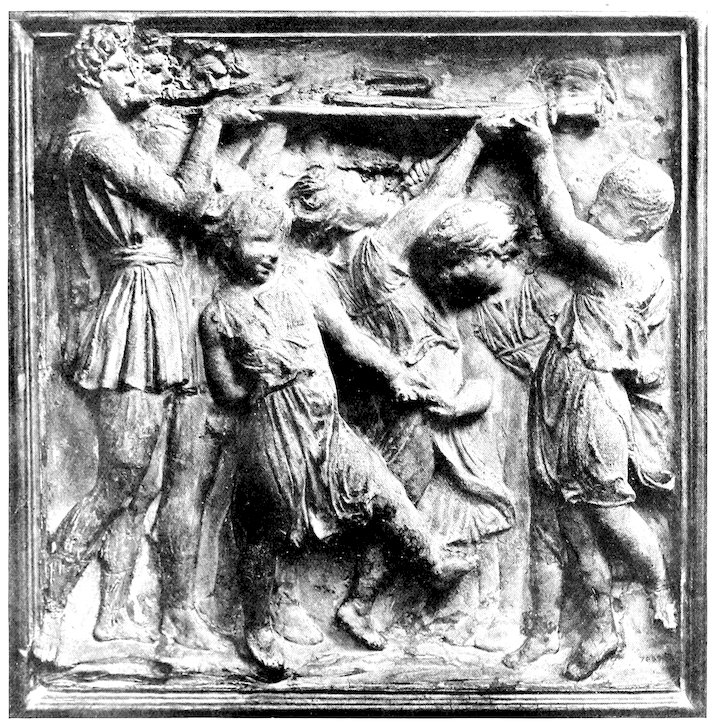
LUCA DELLA ROBBIA. SKETCH FOR A PANEL OF THE SINGING GALLERY IN THE DUOMO, FLORENCE (SOUTH KENSINGTON)
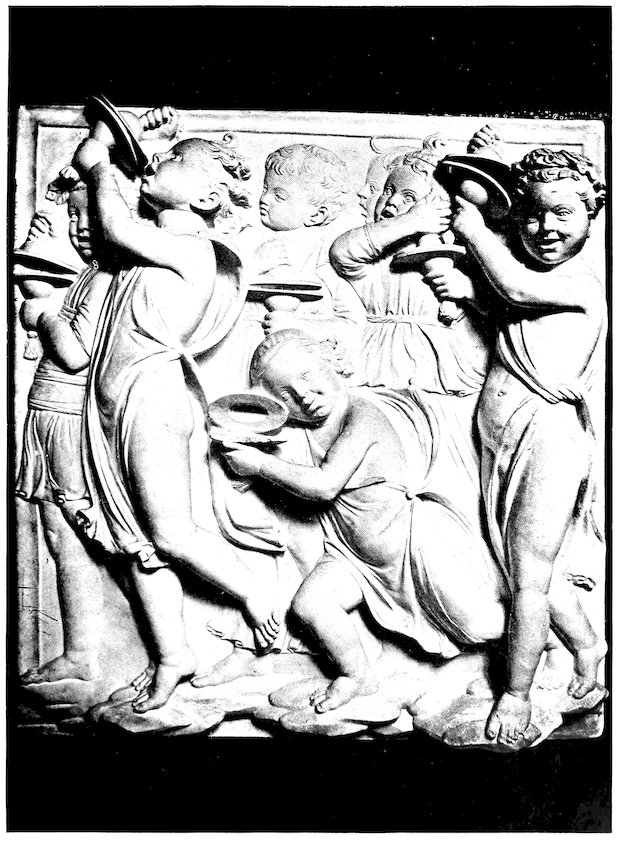
Houghton LUCA DELLA ROBBIA. PANEL OF THE SINGING GALLERY IN THE DUOMO, FLORENCE (FLORENCE)
When we turn to the putti who are not Christs nor perhaps angels, little laymen dancing in a rondo or joyous in procession, or decoratively employed, loaded with thick wreaths of flower, fruit, 20and leaf, laurel, pomegranate, and convolvulus, it is still more difficult to remember that Luca della Robbia and Angelico da Fiesole were of the same age; according to one computation the one but a year older than the other. Luca with his ware not only was a liberal student of nature, but was free enough to use his material gaily. The painter meanwhile was moving with the stiffness of experiment; we might place his child in a church of the early Gothic that had long ceased when he was painting, but Luca della Robbia’s enamel puttino would seem in place in any age of worthy architecture. Stone, colour, and the Della Robbia ware had their several historic ages, concurrent, but different. More than sixty years later, two other contemporaries, Andrea della Robbia and Botticelli, show something of the same contrast, generally in a lesser degree; but in one respect the contrast of the two later men is equal to that of the two earlier—the anatomy of Botticelli was still reckless, at any rate in the draped figure, whilst that of Andrea della Robbia was easily correct. Botticelli, indeed, follows Angelico, his much less expert predecessor, precisely in a strange ideal of the female figure; both feign that the body has a long region from the ribs to the hip; they interpolate a tract, as it were, unknown to nature. Below this, Botticelli sets the jutting legs of his Graces. Below this, in like manner, but under draperies that disguise the manner of junction, Fra Angelico discreetly places the limbs of his seated figures, with entirely arbitrary knees. It is worth noting that Botticelli does not play this anatomical prank with the nude figure in his beautiful “Birth of Venus.” This, however, is not a matter of childish proportion; Botticelli habitually tries for the right proportions of nature in his children.
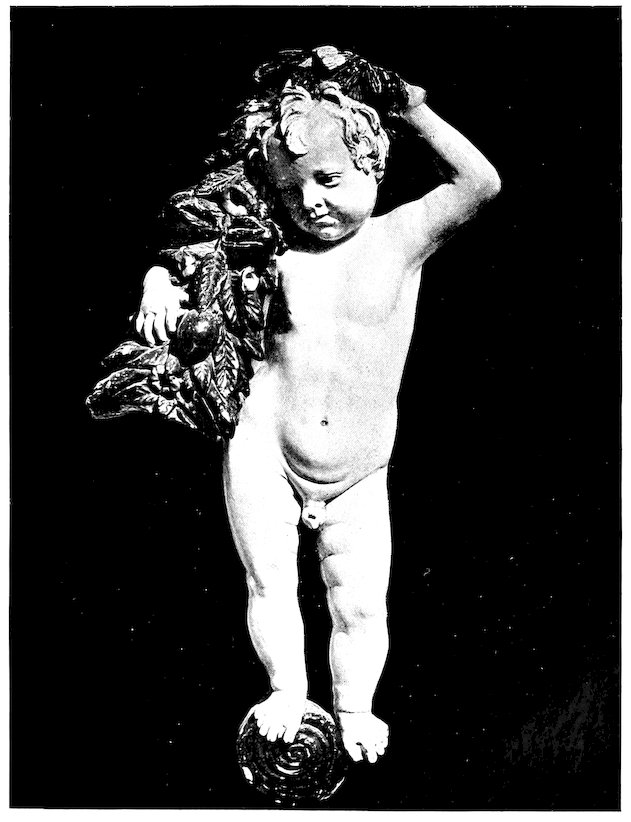
Alinari LUCA DELLA ROBBIA. CHILD WITH FLOWERS AND FRUIT (CITTA DI CASTELLO)
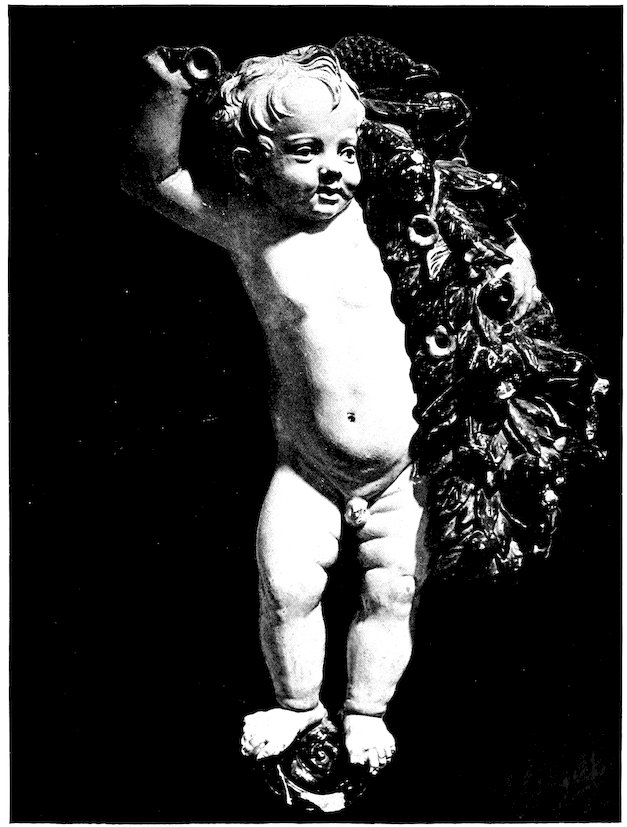
Alinari LUCA DELLA ROBBIA. CHILD WITH FLOWERS AND FRUIT (CITTA DI CASTELLO)
21Luca della Robbia is surely one of those immortal artists whose work hardly has a date. It might have been immortal a parte ante as well as a parte post. It has no obvious beginning, being purely natural and simple. His own invention of enamelled terra cotta, which after a time he perfected with colour, gave him a material that did not alter and the dainty clear surface whereof takes no smirch of time. It is most appropriate to his fresh and spiritual genius, which, finding nothing quite fitted to it in the gold and bronze of its earlier labours, devised this ware, plastic as clay and cheerful as porcelain. Enamelled terra cotta is perpetually young. Most appropriate to his genius and to his material also was the subject of his art. The Virgin and Child are necessary to that lovely art; they are the centre, they sit enthroned over the arch or the middle stone of the doorway it decorates, and the little laymen stand about them with their heavy garlands. Let us add that with the gaiety of porcelain, the Della Robbia ware has no triviality; it is sweetly venerable; its pale blue and white especially accords with the oldest convent threshold that it ever brightened. Matteo Civitali and Verrocchio, also Tuscans, and like the Della Robbias sculptors of children (to apply the name of sculptor somewhat loosely), were architects chiefly, and therefore sculptors as a matter of course. They are not so sportive as their predecessor Donatello in his earlier work, but follow him rather in the graver dignity to which that great sculptor had changed his type in course of time. A Bambino of Verrocchio’s gives the benediction, standing before a regal mother richly apparelled; so does a Bambino of Benedetto da Maiano’s; one of Pellegrini’s clings closely to the neck of her who leans one 22beautiful cheek upon his head; but amongst the innumerable variations of attitude appropriate to sculpture in many a form, from that of enamel to that of bronze, there is nothing quite like one of Jacopo della Quercia’s groups, where the Bambino and the Virgin look into each other’s eyes. The Madonna and Child of a thousand other designs, in sculpture as in painting, are not intended to seem alone. The Child giving the benediction has the city and the world before him, or at any rate a congregation of Tuscan people; he who smiles from his place on the mother’s knee has the passers-by on the dusty roads in sight; and the Suckling who looks over his round shoulder is startled because someone perhaps kneels too near. But this one Mother and Child are quite alone; he has both hands upon her shielding arm, and holds back his head and meets her eyes fully. In much Italian art (as I have been obliged to repeat) there is some form of grace that hinders immediate action and expression; but these workers in terra cotta have no such interception, no such thing postponing, deferring, removing the expression of life, preventing and hindering the close clasp which is the only real manner of holding a baby. Let this solitary Mother and Child be one example, and we shall find others in Desiderio da Settignano’s portrait-busts at South Kensington, tender and fine models of creative childish life. Here we find no preoccupation or prejudice (such as the painters so soon assumed), tending quickly to commonplace and platitude. Desiderio (his date is somewhat later than Luca della Robbia’s, but Luca is the master of the rest) has observed the childishness of the protruding upper lip, that innocent incident of infancy, as the protruding lower lip is an experienced incident of old age. The one and the other were modelled in these terra cotta busts from life. Luca della Robbia observes also the weakness of the soft mouth of childhood, with the underlip a little sucked in; he models the lips lightly and feebly apart, in two of the portrait-busts at South Kensington. Domenico da Capo d’Istria has a fine erect Bambino, as upright in his spirit as in his attitude; no twist, no head aside is his; and Mino da Fiesole is equally frank in his Saint John the Baptist. These are examples, and no more, representatives of a great school of natural art that lasted nearly a century in Italy.
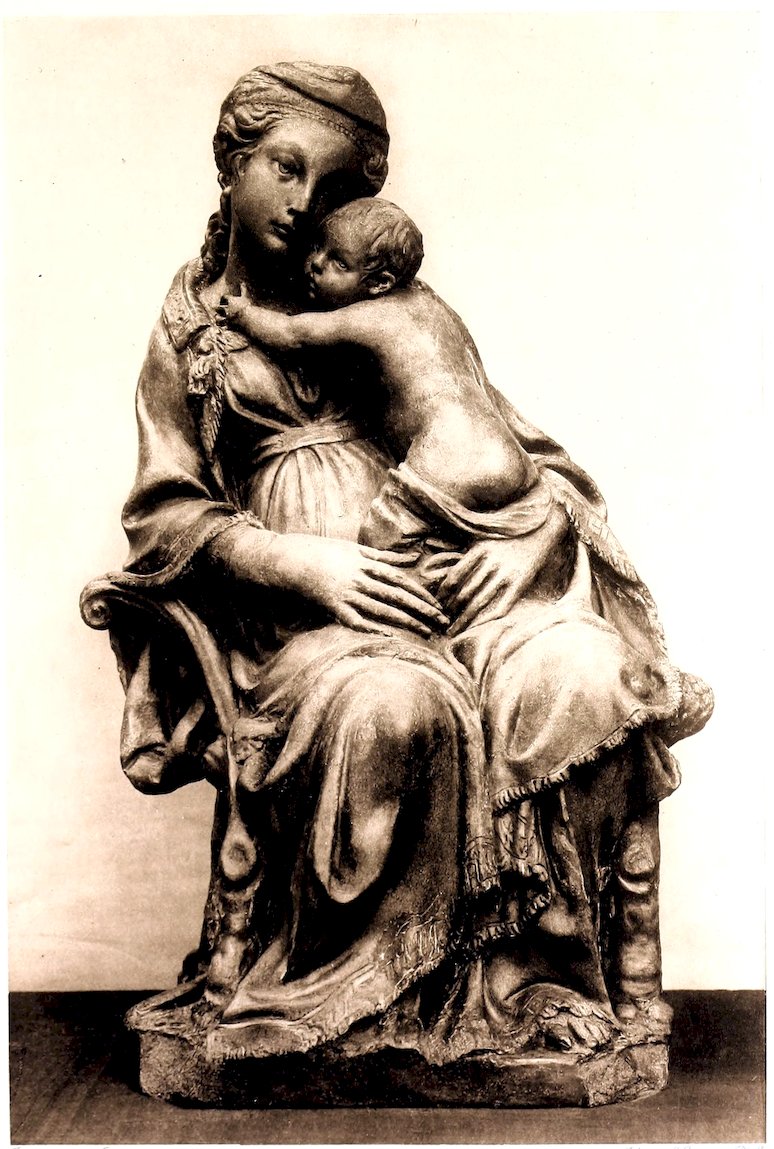
Jacopo della Quercia Walker & Cockerell Ph Sc Madonna and Child.
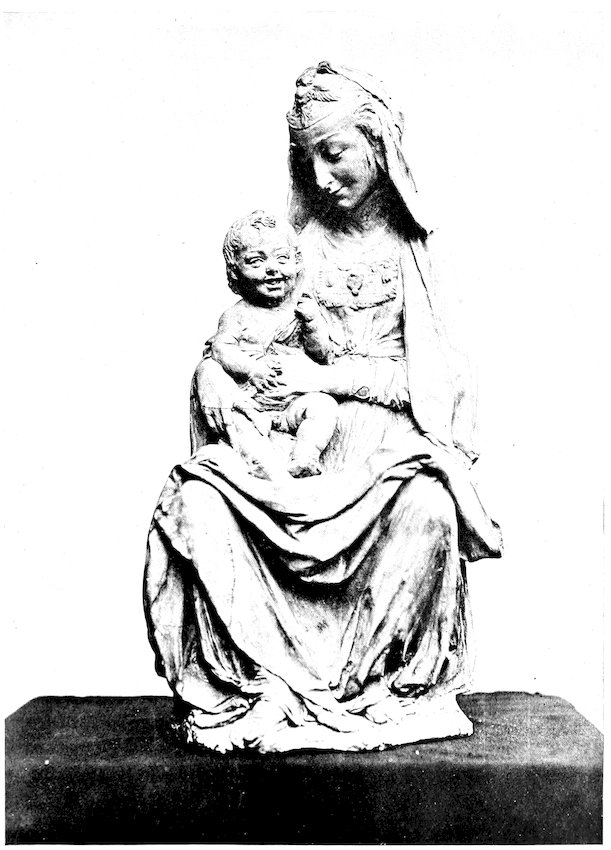
ROSSELLINO. MADONNA AND CHILD (SOUTH KENSINGTON)
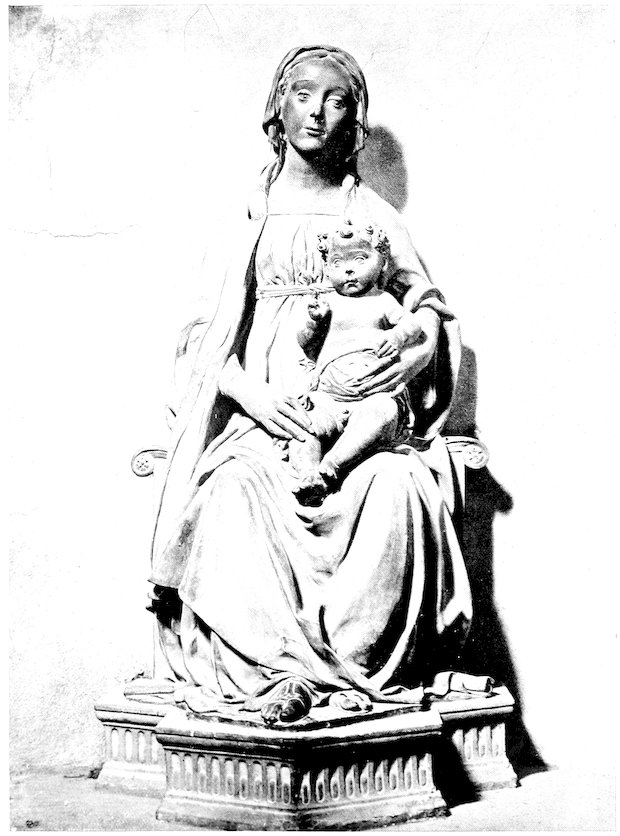
Alinari BENEDETTO DA MAIANO. MADONNA AND CHILD (PRATO)
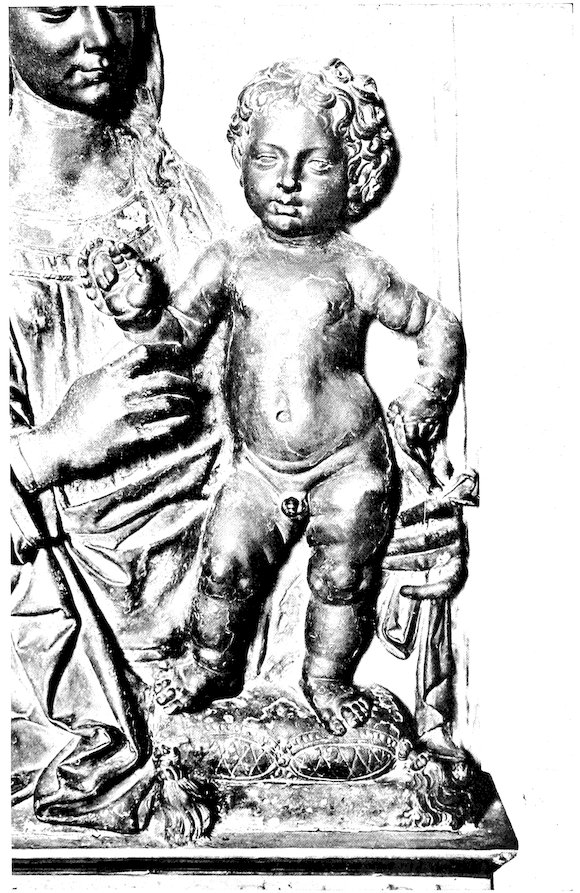
Houghton VERROCCHIO. MADONNA AND CHILD (FLORENCE)
23Luca della Robbia is simple, but Andrea della Robbia, in the succeeding generation, is more divinely simple yet. It would be difficult to place him “later” in spirit than his elder. In such a detail as the treatment of the framing wreaths of close leaves and fruits, he keeps the rich severity of the natural design. Giovanni, the third of the name, lost the severity. And Andrea, in his groups of Madonna and Child, rejects everything that is less than perfect; here is the blue ground, here the lovely Virgin and the lovely Child—two tranquil heads, the veil, the hands, and a few straight summer clouds lying in a blue sky. The altar-piece, probably by him, which represents the Madonna giving her girdle to Saint Thomas in a vision after the Assumption, has a mandorla of little angels’ heads, and in another beautiful relief they are yet more various—a canopy of delicate portraits with the childish gravity and the childish laugh and the incidents of vital likeness. The “Madonna of the Cushion,” at Palermo, is crowned with five such portraits of living angels. It is worth noting, too, how well this master observed the childish 24figure, for in one of the medallions for the Hospital of the Innocents he shows the slight infantine narrowness across the body just under the arms. To the works of these great artists must be added some terra cottas to which no name has been assigned—a fine Florentine boy looking out broadly—called, like most of these portrait-busts, Saint John the Baptist; a beautiful Bacchic cupid, also Florentine and fifteenth-century. But the cupids are few in this art, which was altogether natural and sacred.
Before ending this glance at the children of Italian fifteenth-century sculpture, let a brief word be said of one child by the sixteenth-century master, the master of masters, Michelangiolo. His bas-relief in the National Museum at Florence is a tondo which contains the whole figures of Mother and Child, because she sits crouching with her feet drawn back, and the curve of the little figure of the child-Christ holds just within the circle. The master has not intended to give any childish action to this childish form. With the artificial action and attitude of a man, the Infant leans one elbow on his mother’s open book, and his head on his hand. Nor is the Infant of the famous Bruges Virgin less unchildlike. It is not to Michelangiolo that we must look for a child indeed. From the meek masters of a hundred influential years before, the passage is not less than disastrous to this arrogant work of a greatness o’er-leaping itself and falling into a sort of sickliness.
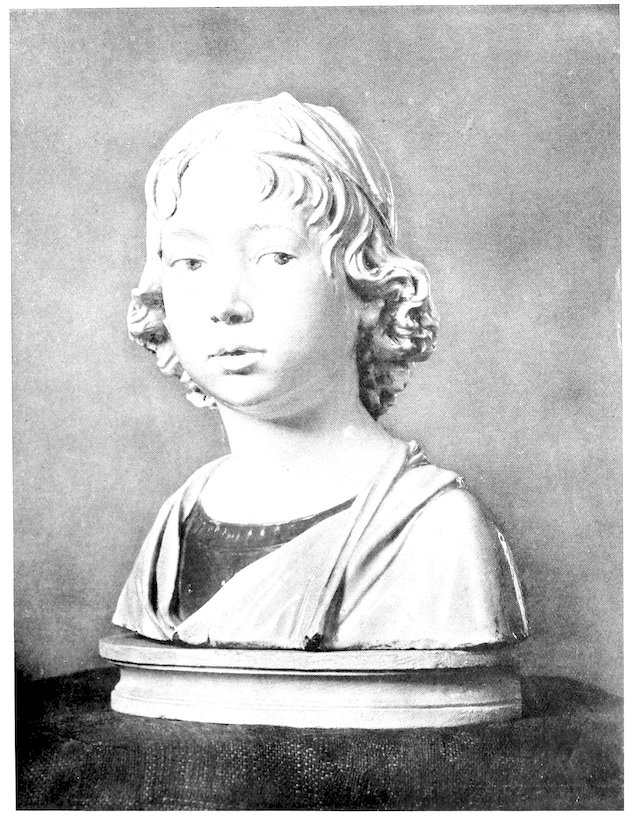
Alinari ANDREA DELLA ROBBIA. HEAD OF A CHILD (FLORENCE)
But there is another step to be taken from the noble presence of Donatello, the Della Robbias, Desiderio da Settignano, Pellegrini, Benedetto da Maiano, Jacopo della Quercia, and the rest of that company; it is the step into the nineteenth-century tea-room under the 25same roof at South Kensington. This is a room decorated in enamelled terra cotta, Luca della Robbia’s imperishable happy material, from top to bottom, in singularly distressing colours and designs of which the figures of children form a part—putti dancing, playing with animals, making music and so forth, on the brown and white columns. He, or they, who made these deplorable little figures, had not learnt the principles of the difficult art of relief, and, working in relief on a cylinder, produced arms and legs out of all measure and shape. This discouraging parenthesis is worth writing, if only for the sake of protest against the modern usurpation of material. The decorators of this tea-room ought to make their figures out of something modern, and to leave enamelled terra cotta to those who had a right to it.
To return to Michelangiolo, master of our mixed feelings. Most adult of men, he creates unearthly, unheavenly children of violence, and twists them in strife and effort amongst the mighty ornaments of his Sistine roof; but the young Christs of his sculpture are less than mighty.
26