THE VENETIANS
Reading edition

Venice is not “after” Raphael. Her school is the only school of Italy that bears to him no such reference. Its date, though later, has none of the indignity of that sequence. It is true that the natural and inevitable derivation, the heredity as well as the inheritance, from the whole national past, helped the genius of the place, the genius of the East, and the genius of the transalpine North, to make the Venetian art; but Venice had no part in the general rhythm, the rise and fall. She kept her own time and walked at her own speed. As her Tintoretto is not “after” Raphael, her Gentile Bellini is not a pre-Raphaelite.
Moreover, she has this singular favour: that whereas other cities had one inspiration, held it while it lasted, then remembered it, later remembered that they had remembered it, and then lost even this “darling of their widowhead,” regret, and, lacking it, grew fat and cheerful, Venice received two inspirations. The first was in the time of the Bellinis, and the second after fifty and more years, when, with the birth of Titian, colour and tone, in a new sense, and as a new gift to the Occident, began to warm our world. At the earlier date, as at the later, Venice was original. No other master of his time was original as was Giovanni Bellini. But more 74wonderful is the originality and illustrious novelty of the late masters of Venice, contemporaries of the decadent painters of every other city of Italy, from Naples to the Alps; and it is to the present purpose that we should find the signs of this fresh and imperial source of life in the painting of childhood.
Giovanni Bellini’s children are unlike those of the Tuscan and the Roman; if, in his design, he does not attempt to transcend nature, neither does he see her amiss, or force her. The Divine Child is studied from the poor infant in the arms of the Venetian woman. She is made graver and more beautiful than life, arbitrarily beautiful with her long features, long eyebrows, and full yet delicate cheeks; but the Child is made simply natural, and less beautiful than pathetic. Pathos had hardly entered into the Florentine idea of the infancy of Christ, but it is seldom absent from the Venetian. And this is not said on account of the art of Giovanni Bellini only; the most pathetic child in our National Gallery is another Venetian’s—the sleeping Child whose heavy little chin is propped upon the Mother’s arm in Crivelli’s great gilded and inlaid picture, in three stages, of the “Virgin and Child with Saints.” In the midst of the “bearded councillors of God,” flanked by pontiffs, doctors, and virgins, on the knees of the woman who was clothed with the sun, lifted over some gold fifteenth-century altar, Crivelli sets a wearied baby, not only tired but sad with his fatigue, slipping, all unbraced, with his chin caught up; in the first months of a hard life, weak as a spent wave, light, but too heavy for his own strength, sheltered from privation and sickness by the depth of the refuge of sleep. There is not, of course, the modern appeal of expression; the mother 75is tranquil, and the child’s face locked in peace, but the painter gives to the childish figure all the sadness possible with closed eyes.
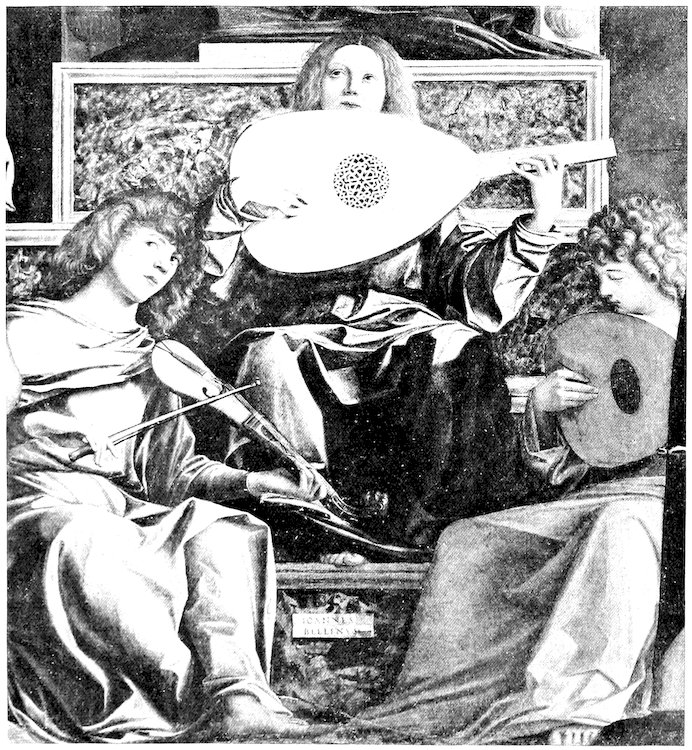
Alinari GIOVANNI BELLINI. ALTAR-PIECE OF S. GIOBBE (Detail) (VENICE)
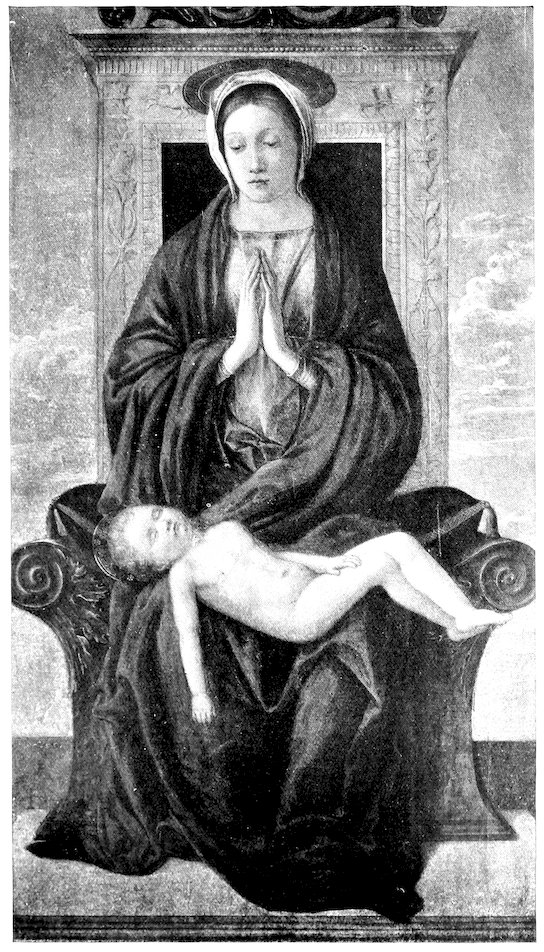
Anderson GIOVANNI BELLINI. MADONNA AND CHILD (VENICE)
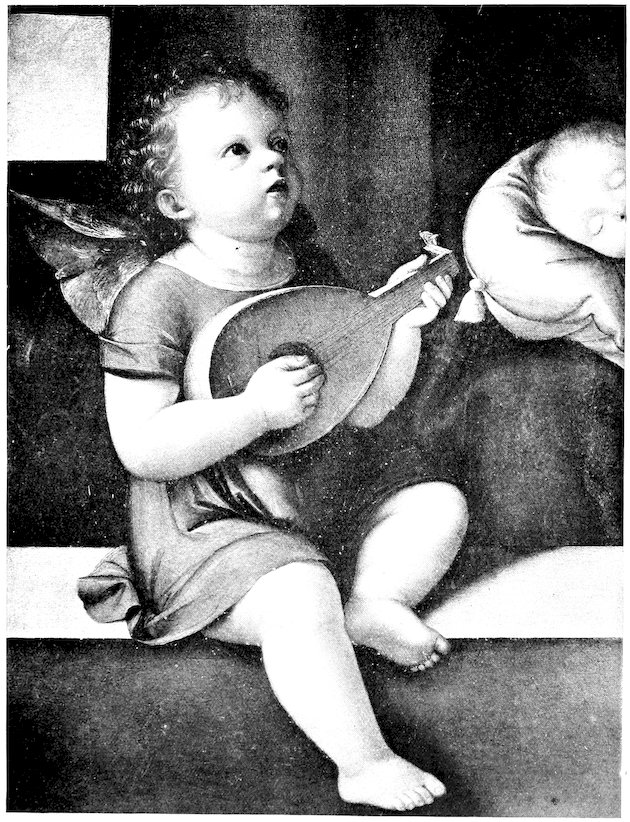
Alinari ALVISE VIVARINI (formerly attributed to Bellini). ANGEL (VENICE)
Bellini also has the Bambino asleep, a beautiful but meagre figure of a young child with one arm dropped, and something sombre in the depth of sleep. Here is no geste arrondi, the grace is purely nature’s, and it is lovely beyond the rivalry of artifice; I will not say of art, for an English wit has well said that affectation displeases us because it has not too much, but too little, art. Bellini has not been afraid of a straight arm and a heavy head, and his art is more, not less, than his Florentine contemporary Verrocchio’s. Furthermore, one may wonder why Venice alone in Italy did not play the gossip nor boast like a nurse of the weight of the central child of pictures. Christ is tender, thin, and delicate in the designs of the Adriatic painters; never more sweet or more worn than in Giovanni Bellini’s group referred to at the beginning of this volume. The tender figure is tenderly treated; the little silken rings of curls—no signs of vigour as with Botticelli or Raphael—are exquisitely drawn. And it is only when he paints an attendant angel that the master makes childhood flourish, sleeks the hair, and creases the wrist. Bellini’s flute-playing winged putto from the Frari picture is more conventional, but he does not cease to be a child. Nor does Vivarini’s, long taken for a work of Bellini, the detail of the beautiful picture in the church of the Redentore, who sings to his lute, as befits his wings, beyond his years, but has the attitude of a human child, the only attitude tolerable with limbs so fair and full. Here also is the Venetian characteristic. And doubtless it is also in that singular design of Giovanni Bellini’s which is catalogued (at 76the Uffizi, Florence) by no more definite name than that of Un’ allegoria religiosa. We see here a landscape full of caves, rocks, steps, and houses, a landscape into the depths of which the eye may follow Saints to their business or their solitudes, wayfaring with an ass or in retreat within a hollow. In the foreground is a well-paved court inclosed within a white marble balustrade, waist-high. A beautiful throne is raised to the left for the veiled and enwrapped Virgin, and at her feet kneels one of the martyr-patronesses—Catherine, Barbara, Agnes, or Lucy—with flowing hair; a humbler woman-saint, with gathered hair, stands on the other side of the throne; Saint Paul, Saint Peter, Saint Sebastian, and Saint Paul the Hermit, or some other anchorite, stand praying, whilst four children at play have these reverend eyes, and evidently the reverend thoughts, fixed upon them. They are all putti unwinged; one shakes a little orange-tree growing in a pot in the middle of the court, and the others catch the oranges, with charming actions, hold them, and eat them, all absorbed in their pleasure, as are their holy spectators. Saint Peter especially is intent upon them, holding up his hands to pray, and the Virgin Mother herself, praying also, seems to return to them the morning and evening prayers of childhood. There is no interpreting the allegory. The little boys are symbolical, but they are also mere boys, and not about the usual business of angels.
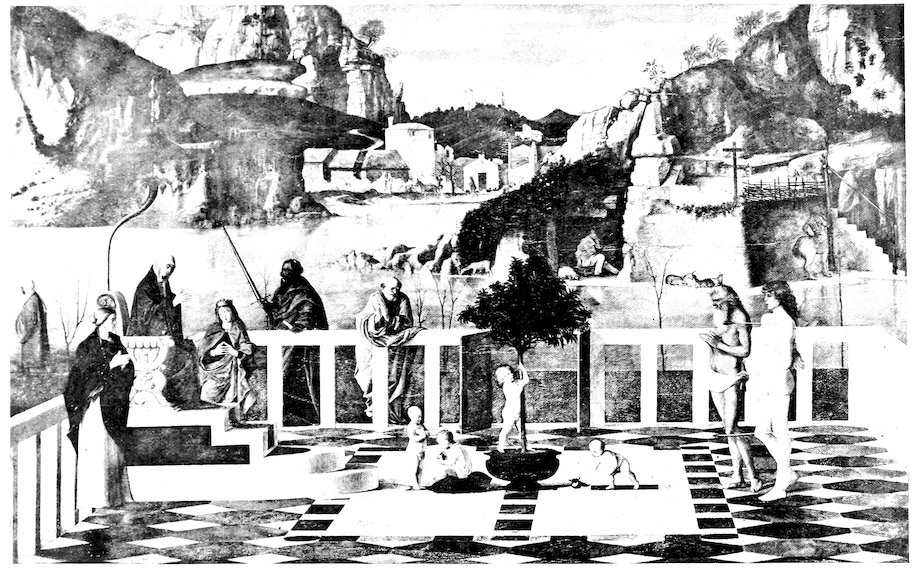
Alinari GIOVANNI BELLINI. AN ALLEGORY (FLORENCE)
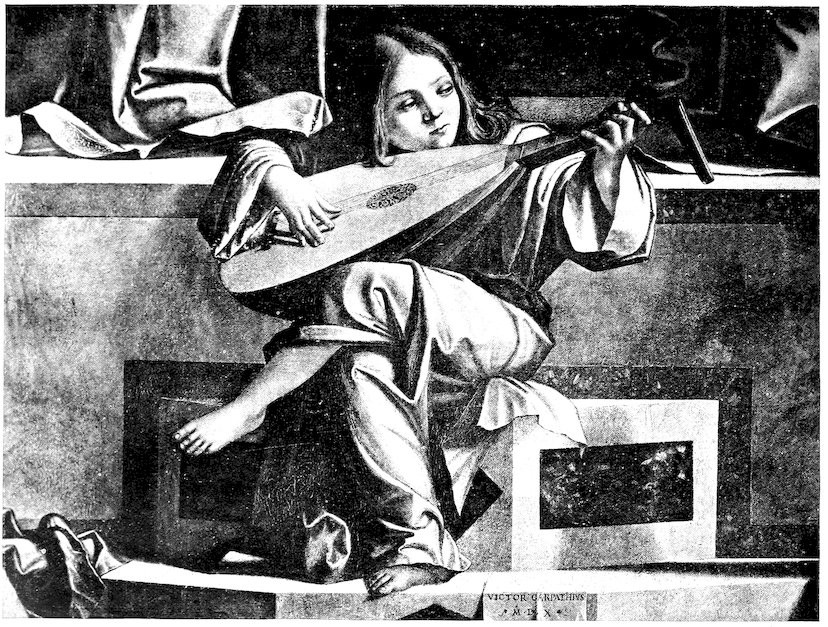
Alinari CARPACCIO. “THE PRESENTATION” (Detail) (VENICE)
Also to Giovanni Bellini’s noble hand do we owe the group of three young ones—children they are hardly—playing their instruments at the foot of the Madonna’s chair. Such a group of three was a peculiarly Venetian gathering of the Society of the Mysteries. The ceremonial passes above—a New-Testament incident, or merely the 77enthronement of Mother and Child; tall Saints stand at either side, and the three, a little under life-size, and of about the age of Botticelli’s younger angels and Baptists, sit making music on the unequal steps. In the same Accademia with this beautiful Bellini is the more beautiful Carpaccio thus arranged, and other examples of this Venetian group of grace and gravity are in the memories of all. Carpaccio followed Bellini after some twenty years, and he evidently followed him in the convention of this trio of strings. Bellini’s violinist is one of the most youthfully and freely graceful figures of Italian art—graceful with what innocence of the postures of the other schools! There is much difference between the leaning-aside of this most beautiful head and the leaning-aside of a Roman angel’s. The Venetian youth has a masculine rectitude; and with this a glance of genius, candid and grave. Where, in Florence, are such simple eyes? If he were more a child this would be the place to pause longer upon their significance, and upon the heedless beauty of the soft and spreading hair.
But between Bellini’s date and Carpaccio’s comes that of Crivelli, a master of the period that was early for Venice, yet a contemporary of Mantegna at Mantua and of Verrocchio in Tuscany. Something has already been said here of Crivelli’s Bambino, the sad Child over-tired. In another National Gallery picture, the famous “Annunciation,” full of architecture, there is a glimpse of an inceremonial wayside child; and for once it is probably a girl. A citizen or two passes on the noble and narrow ways of the fifteenth-century city. The mystic Dove is coming upon a beam of light in at a ground-floor palace window; within, Mary kneels at prayer, and behind her are the 78flowered curtains of her bed, its coverlet and pillow, brackets with vases, pots, books, a glass bottle, a candlestick, a box, and dishes of majolica. Plants are in the window behind the bars; above the room is a magnificent loggia, and a peacock sits upon the parapet with a tail sweeping down to the architrave of the Virgin’s beautiful door. Without, a street leads to an archway, and beyond lies a stepped garden inclosed by a machicolated wall. The herald of Heaven, on his knees upon the foreground pavement, has a twisted feather fastened to the jewel in his cap, a chain of gold, plumes upon his shoulder, and acanthus-leaves. The young Emidius, Bishop and patron of Ascoli, seems to interrupt the Archangel in order to recommend to him the turretted city he holds in his hands. Far off, on the terrace of the archway, one man reads a paper to another. On some narrow palace-steps, truly a Venetian little staircase, a gentleman of the city and two monks hold a conversation. And all this takes a new animation from the childlike action of a little girl whom that conversation does not amuse, but who perceives something to be taking place in the street, and thrusts a curious head, in a cap, round the staircase balustrade, to look below. How rare, in Italian art, is such a child. Venice here has a heart for something simple, something serious as well as slight, and something other than adult and condescending. The glorious Venetian master has this heart in common with the German and the Fleming, and with that divine Dutchman whose picture in the National Gallery, “Christ blessing Children,” was taken for a Rembrandt, and—whatever technical cause may have altered the attribution—was in spirit worthy of that name of names.
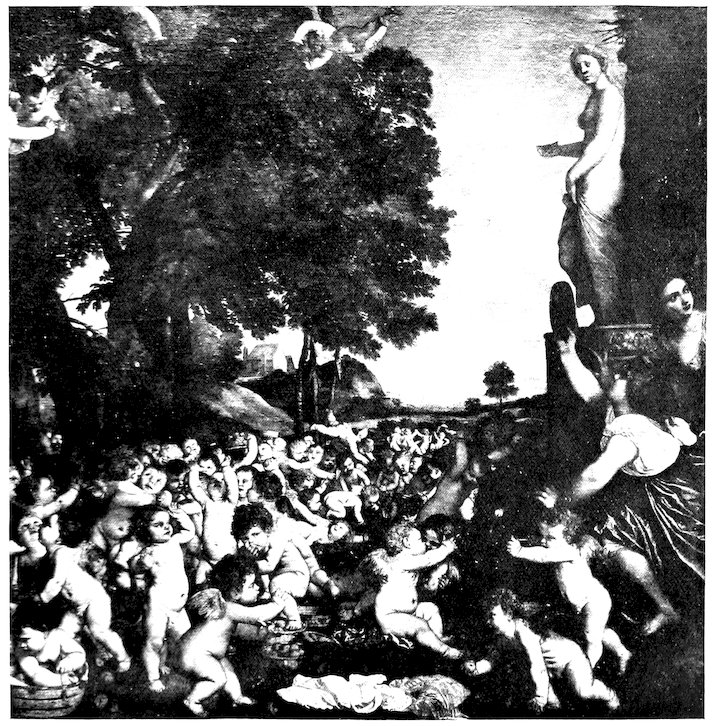
D. Anderson TITIAN. THE GARDEN OF THE LOVES (MADRID)
79And now the next child is Carpaccio’s. That great master’s work was dear to Ruskin in his later Venetian visits; in his earlier he had not seen it with that first true sight which is virtually first sight, and makes a shepherd and a Romeo of the lagging lover. When he was well aware of Carpaccio Ruskin studied his lovely work in the Schiavoni chapel, and the Saint Ursula series, described in the latest and the freshest of his writings. But there is one figure—one of three—that sits in the midst of Carpaccio’s designs, and in the midst of the art of Italy, a child playing a lute, one of the chief creatures of the work of line and colour. The Presentation of Christ in the Temple is going forward above; the three boy-angels are at their music, and this one, the most simply assiduous, props his instrument upon his lifted knee, and sedulously watches over his left-hand fingering. The incomparable composition of this figure owes nothing to any arbitrary ideal of form or action, nothing to the bodily grimace in which taste had resolved that the necks of saints, women, and children, in contradistinction to donors, must, for the purposes of art, be twisted. Venice thought a child to be a touching creature, thought natural action in a child to be not lower but higher than make-believe; and when to these new and imperial perceptions and convictions, she added the new perception of colour and tone, she proved herself indeed a great and solitary power in painting. The art of Venice, in the event, turned to the light, and set the darkened head of a man against the sun and against the cloud. I think there never was a greater new act in the history of art than this facing of the sun, this contemplation of the shadow side of things. Tone, with all its mystery, as well as light with all its 80mystery, comes about by that change of the gazer’s station. Did Claude “first set the sun in heaven”? Tintoretto was born nearly a century earlier than he, and Tintoretto did more than paint the sun, he implied it by the soft darkness of withdrawal or eclipse, by the half-light and the half-darkness, by the tenderness of reflected lights lodged within delicate shadows, or merely in colour by the Venetian presence of a latent gold. Carpaccio, and masters of an earlier date than his, had made the discovery of the profounder warmth of colour, or had perceived the value of that rich secret of the colours of the East. Carpaccio was—some of the Schiavoni paintings prove it—a colourist even in the great Venetian sense; but tone, in the great Venetian sense, was to be the work of Titian. In design, however, Carpaccio’s minstrel angel has a beauty and spirit that Titian could not rival, something of the freshness of the flower compared with Titian’s fruit, both rich and both fragrant, but differently. The Elizabethan lyric has somewhat the same relation of beauties to the lyric of the late seventeenth-century—Milton’s, Crashaw’s, Lovelace’s, or Vaughan’s: peach-blossom to peach, and Carpaccio’s angel to Tintoretto’s.
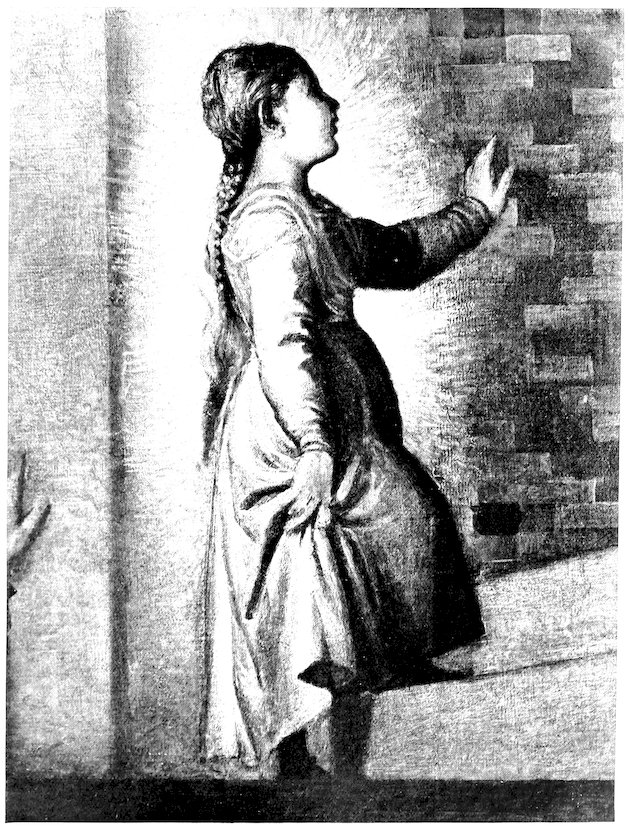
Alinari TITIAN. “THE PRESENTATION IN THE TEMPLE” (Detail) (VENICE)
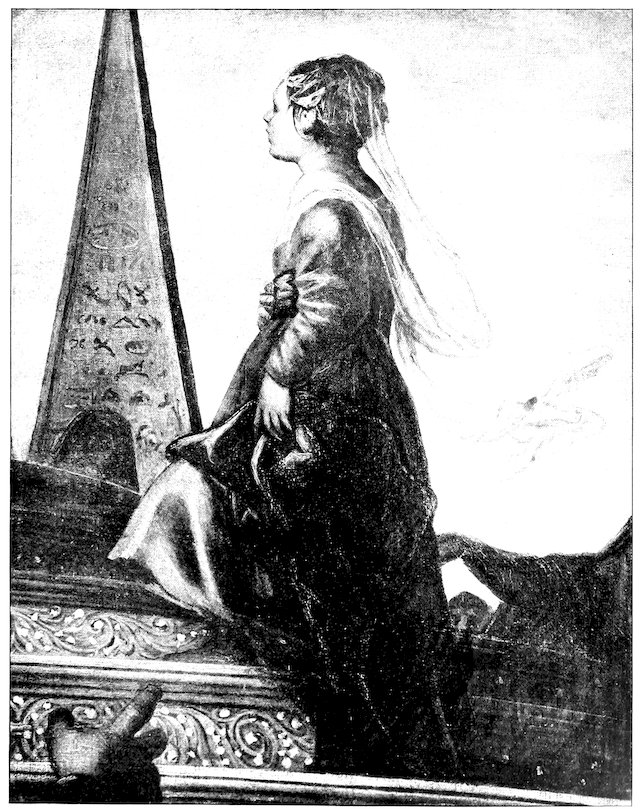
Alinari TINTORETTO. “THE PRESENTATION IN THE TEMPLE” (Detail) (VENICE)
The persons of Titian’s children are those of the other masters—the Virgin’s Child, the little angels, the little loves, a Ganymede, a faun or sylvan—with the addition of the portraits of princes already noted, and the more memorable addition of the little Virgin. To the humming-bird angel of the Mysteries he gives no other character than that so familiar to us in all the schools, except only that with him the frolic movement looks more sincere; needless to say, the tone is more beautiful than anything yet known in the West. The little 81angels that fly below the ascending Madonna of the “Assumption” have Titian’s delicate darkness of shadows that are winged with secondary lights; if pearls had the colours of flesh, one would liken them to pearls. To the beautiful “Ganymede” in our National Gallery, at one time ascribed to Titian, is now hardly accorded the certainty of a pupil’s name; but we have possession of a part of an assured Titian child in the human half of the little satyr or faun who goes in the train of Dionysos. He is a satyr-urchin of the ways of the woods, an enfant des rues of the forest and the shore of Naxos; he drags by a string the remnants and fragments of a sacrifice, as a child going on human feet pulls a toy horse after him, happy in knowing that it follows, as a backward glance now and then assures him. He does not laugh, but has a festal gravity as he skips that is perfectly childish. He is savage, simple, and idle, and has joined the rout of the progress of the god as a boy in London follows a show. The Venetian honesty and the Venetian freshness are manifest in this strolling, trolling figure of Antiquity and the wild coast. The beauty of the head and the dark eyes is unmarred by any habitual form of prettiness. The sense of childhood is sincere. If a child—or but a half-child—is to bear a part in the journeys of the wine-god, his Silenus, his nymphs, and his leopards, with clashing cymbals and outcries, this is the childish part—to drag something with a string. A Florentine would have made the little faun playing an instrument—he would have had, at the least, to know something of the cymbals or the triangle. I think that Botticelli’s amorini sporting with the arms and casque of the sleeping Mars show less feeling for child’s-play. Titian’s faun is a child of sunshine, as is 82the beautiful god leaping from his car, embrowned with summer. Is it indeed of this picture (we must not doubt it) that Keats was thinking when he made his Bacchus, journeying eastwards,
“enough white
For Venus’ pearly bite”?
Keats was a great poet of the imagination, and would have been, with other examples and a riper life, an infinitely great poet of the imaginative and impassioned intellect. As it is, he is praised as a poet of the senses, whereas the truth is that his senses were not rich, but sickly. Of a fruit he loved the “pulp” rather than the “heartening savour”; of lips, the “pulp” again; of a woman, her “softling” hand and a “bleat”; of Bacchus his plumpness and the unsunned whiteness of his flesh.
Titian’s “Garden of the Loves,” or “Hill of Venus,” at the Prado, is a very beautiful picture, expressing the delight, that Italy learnt from Antiquity, in an infant court of the maternal Venus. Delight is perhaps not the word, for the pleasure of the Renascence in these frolic putti does not reach close to the heart; it is rather a pleasure at arm’s length. The babes of this rich “Garden” are not drawn very realistically, but they are not falsified, and it is natural to find in them some likeness to the children of the fishermen of the islands.
It is in his majestic painting of the “Presentation of the Virgin in the Temple” that Titian has drawn his simplest child. The picture is a great state-picture, a Venetian reading of the Apocryphal Scriptures, and an example of the Venetians’ incomparable sense of the dignity of place and approach. Titian causes us to look upwards 83at his noble figures, his noble priest, and at their action, worthy to take place under the sky. Even in their modern decline and fall, Italians generally keep that sense of distant approach and room which is the most obvious part of Titian’s dignities; they still know the value of a staircase, which English architects, going, as it were, with their elbows close to their sides, have never had. The Italian takes measures at a suitable distance, addresses himself, begins spaciously to draw near. But the master, having this, had also a greater and finer feeling, and his architecture serves to lift the paternal priest, the humble girl, into splendid light and sight. The legend that gives him the subject of his picture had been illustrated by the masters, but not very often or by them all. We find it in Florence, at Siena, at Padua. It is amongst the miniatures of the Homilies of James the Monk in the National Library of Paris. Giotto painted it at Padua, and shows himself embarrassed by the little girl; Taddeo Gaddi gives her great stature and a small head, an equivocal figure turning on the stairway to take leave of the world; Giovanni da Milano has a simpler child; Orcagna counts strictly the fifteen stairs of the legend; Ghirlandajo shows a young princess of fifteen in a starred mantle; Sodoma has a child, tenderly relinquished by her mother; Cima da Conegliano and Carpaccio bring the scene to Venice. But it is not one of the habitual subjects. Its legend tells (by means of a “gospel” not accepted as canonical by the Catholic Church, and, therefore, so accepted by none of the sects) of the dedication of Mary in her early girlhood to the service of the Temple of Solomon. Some traditions add the miraculous detail of her infancy, and of her climbing the steps alone though 84too young, in the ordinary course of life, to walk; of the wonder of Joachim and Anne to whom their little daughter bade farewell, turning to them from the Temple steps. Titian keeps the tradition of her going up, and he makes her go alone. But she is no infant—a little girl of seven years or more, whose beautiful hair has had time to grow. With a charming symbolism, Titian has made the nimbus, worn by other Saints around their heads, to crown her whole figure, from head to foot. This is one of the few little girls in Italian art; and the Venetian has not taken that sweet opportunity with less than the simplicity of his noble nature; he has not taken occasion for a trivially beautiful, or, as we say now, a sentimental little maiden. He has made her nothing but simple in her loveliness; she is erect, a straightforward child, and with this the whole expression of the lifted head accords. The action is perhaps somewhat of another time of life, but all else is purely childlike, and incomparably sweet.
Much like Titian’s is Tintoretto’s “Presentation of the Virgin,” but the picture, and the figure, are less simple. It is still the most beautiful of his children, but, though somewhat more “touching,” is less great and less unconscious than Titian’s. It is wonderful that the two profiles, both so young and so little spoilt by posture, should yet be lifted up thus with a difference. Tintoretto’s picture, none the less, is a splendid one. It has more passion, more movement, and that splendour of the shadow-view in which Tintoretto surpassed Titian. The shadow-view is the luminous view. Best of all, the Virgin’s little figure going up the stair is directly against the sky and the cloud, whereas in Titian’s picture the child is backed by a pillar.
85Amongst Tintoretto’s children are some exquisite Bambini. The new-born Christ of his “Adoration of the Shepherds” (in the Scuola di San Rocco), unveiled in a stream of lovely light by a most beautiful Virgin, is a sincere baby; so is the Child in the strangely splendid group of Madonna and Child in the Accademia picture. We have seen the Madonna’s Child in a thousand forms, and on the knees and in the arms of a Mother under a thousand forms; but Tintoretto’s Virgin and Child are both different, and fresh, as are Tintoretto’s “Nativity” and his most dramatic and solemn “Last Supper.” He takes very literally “a new point of view,” by placing his figures aloft, or his table in perspective, away, in a large room. True, Parmigiano has a Madonna and Child raised up higher than Tintoretto’s, looking purely commonplace and conventional—a revelation without alarm, an insurprising vision; but Tintoretto’s Virgin, against a visionary sun, sits as though no other had ever been enthroned, and holds a veritable Child, a beautiful and animated creature, looking downwards with an infantile impulse, full of liberal grace; the little head, in a Tintoretto radiance, casting a Tintoretto shadow on the shoulder and breast. Of this master’s “Massacre of the Innocents” and of the many repetitions of this subject in the Italian schools, I give neither reproduction nor description. The painters made this a picture of women, in strife with the assassins, rather than of children, and the character of children or their action is hardly in question; an executioner has them by the leg, or their fragments are on the ground. But Tintoretto’s picture at San Rocco—he has another at the Frari—is magnificent. With his characteristic tenderness he has drawn the little figure of a child that has crawled from the slaughter.
86The last of all the examples of Italian children in this picture-book shall be a peaceful and emblematic puttino. It represents Paolo Veronese, “a noble Venetian,” but no equal to Tintoretto. The child has the Venetian sincerity; he is really burdened by his sheaf, and even anxious about the carriage, and is in his own rich person a sign of abundance.
Italy is said to have much sweetened and softened the children of the German, Flemish, and Dutch schools by her amiable example. She civilized the nations of children, fed them high, put an end to all crying and frowardness, sleeked them, and proclaimed a holiday in the nurseries of art. It may be so; but after this mission, she might have brought home a lesson, to make her own sweet humour more valuable. And one master of masters, Rembrandt, had nothing to learn from “le clair génie latin.” Velazquez studied Titian and Tintoretto; Reynolds studied Michelangiolo—where did he find the “Strawberry Girl”? Not in such a nursery as the Sistine Chapel.
If these pages are varied—in all their delight in the children of the arts—by some disparagement of a certain number of putti who turn out their feet in a manner that seems but a poor improvement on the ways of Nature, no descendant exists to resent the criticism, for those children never grew up. But the little boys of the Della Robbias, of Giovanni Bellini, of Tintoretto, mortals, ideally sweet, have left their seed in “sub-celestial” Italy, and the angels of Botticelli never died.
87

CHISWICK PRESS: CHARLES WHITTINGHAM AND CO.
TOOKS COURT, CHANCERY LANE, LONDON.
TRANSCRIBER’S NOTES
Fixed typos; non-standard spelling and dialect retained.