PORTRAITS
Reading edition

Nevertheless, another painter born after Raphael, a sixteenth-century painter who nearly closed the Florentine school—Bronzino—restores the love of the nature of childhood, that had been habitually a little falsified after the days of the Della Robbias and before his own. Bronzino virtually restored in Florence the portraiture of children; giving, as he did, the name of the child to a ceremonial portrait in the apparel of the day, he may be said to have been the first explicit portraitist of little boys and girls; for Desiderio da Settignano, Luca della Robbia, Jacopo della Quercia, and the rest of that all-noble company changed the name, while they studied the incidents of the face, of a living child. They named the boy Saint John the Baptist, but Bronzino gives him a more personal as well as a lesser dignity, takes from him the heavenly and gives him the courtly honours. While Desiderio da Settignano modelled the oval of a soft cheek, and showed to the light of all these centuries how two weak lips met, and how the whole face of one Florentine child was made, that child’s name passed into the innumerable multitude of names forgotten upon earth. But now Bronzino, after many years, stepping aside from the convention of the Holy Family that prevailed in his own art of painting, names a likeness; and at once we acknowledge 49a fellow-creature. The portrait of a boy in the National Gallery is one of a long series of portraits of children. Noble patrons seem to have finally forgotten, at this time—full sixteenth-century—the early scruple that prevented the portraiture of the living and individual face, except by way of devotion in order to recommend to Heaven the soul that was lodged in such or such a body; and the body was meekly drawn, whether subdued by a small scale or subdued by plain raiment; in either case in profile, with joined hands, looking to the Saint or contemplating the Mystery, never turning faces and jewels to the world, and implying no respect on the part of the painter or of the donor to the history, character, or date of the person. Such a scruple of humility did exist, but gave way by degrees, for Andrea del Sarto, Franciabigio, and Ghirlandajo, in Florence (as well as Titian and Raphael without), painted portraits. Francia, in Bologna, painted children’s portraits. In Bronzino’s figures we have at once the patent personality, and the assertion of the importance of the name, the year, the circumstance. The picture of Eleonora da Toledo, at the Uffizi, having all the tranquillity of countenance that was held to comport with the nobility of portraiture, has yet an expressive action, inasmuch as the mother has her hand on the shoulder of the child a certain passage of whose life she desired to record, and he has his foreshortened little hand on the rich dress in which she sits encased in state. So rested the hand of Cowper on the English flowers of a flimsier dress than this magnificent broccato, one worn by his own mother. The likeness of child to mother, especially the resemblance of eyes and eyebrows, is one of those human incidents of which the record touches us; the 50mere simple fact is close to one of the sources of the “tears of things.”
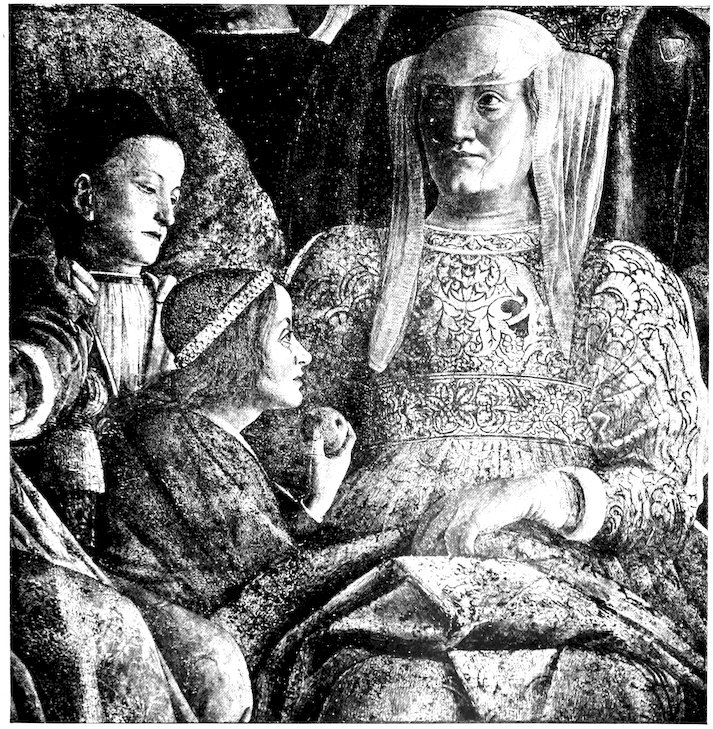
Anderson ANDREA MANTEGNA. FAMILY OF LODOVICO GONZAGA (Detail) (MANTUA)
With Bronzino, art in Florence enters on a new century; so does Italy. Fathers and mothers desired that their children’s own childhood should be remembered, and not merely childhood at its best. It is worth noting that with the portraiture of children, the exaggerated grace is allowed to rest, at any rate for the purpose of the moment. The painter is persuaded, by the erect and forthright aspect of a living child before him, to leave his tricks of posture aside, or to give them up to the children of holier families than the best of the Florentine. The boy whose portrait is painted is straight, or full-face, upright, thickset, quite inapt to bend or glance or in any way to copy the ideal of sweetness so habitual in Italian design. And with this fidelity to the square shape of nature comes a certain severity of design, or rather of composition, which makes it seem strange that Bronzino the portrait-painter should be a pupil and successor of painters of the most ideal boys. Nature is more rigid than Italian design of the fifteenth-century and onward; for whereas the linear arts elsewhere and at another time may be thought stiffer than life, in the country and the age that were ripening for Raphael they were more lax and easier, more coulant and unbraced, and therefore soon to be more inelastic and sickly, than life. Elegance and ease of posture in design run that risk of dullness which awaits rhetoric in literature. When rhetoric has been strained too much and too often its language looses elasticity; loses the sensible flexion and tension that are welcome in the using; loses the friction, friction of air to the pinion or of water to the oar, that makes the using worth while. Relaxed imagery, or hyberbole, or 51literary violence of any kind, is all too easy, as was the task of drawing water in a sieve, assigned to the daughters of Danaus. We must pity them, not because their work was hard, but because it was light. And so it is with the Italian painters and the relaxed ideal they so long abused.
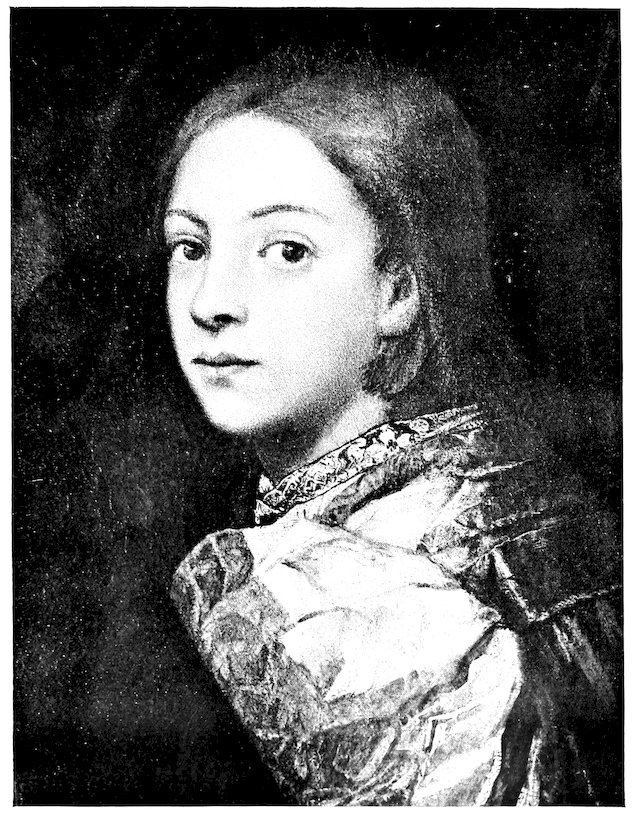
Alinari TITIAN. PORTRAIT (VENICE)
Moreover, taking the suggestion of portraiture and its honest action, and looking through the years and centuries before Bronzino, we glean here and there a slight accessory figure, an incident in a composition, which is childlike and looks solitary. An example much to the point is Jacopo da Pontormo’s “Joseph and his Kindred in Egypt” at the National Gallery. Here are the putti, ambiguous as usual, turning and running in the way of Italian art; and here are in the midst two little boys who are little boys such as humanity bears, children turning the way they look and supplying no antithesis of the movement of limbs and head. The boys, in fact, have been fighting; they are apart from the fluent good and unclothed children; they wear street clothes and have less good manners. They are possibly the first street boys of painting. Now this group from the life is small and unnoticeable, but it has the sincerity of portraiture; and, in effect, we find one of the two figures to be, conjecturally at least, a portrait, and the portrait of Bronzino himself as a boy! Again, in that very beautiful little picture, also in the National Gallery, Ercole de’ Roberti’s “Israelites gathering Manna in the Wilderness,” there is a stray infant not on artistic duty, a little by-way child, quite insignificant except to the eye looking for life, a little thing, as far as it goes a portrait; and distantly akin to another by-way child, one of the most perfect children of any of 52the schools—Rembrandt’s wonderful little spectator in his National Gallery “Nativity.” This last looks over, leaning, at the Child lying in the light, and the light shows us his own most beautiful and touching person and the exquisite folded hands. What other painters did by rote, or with habitual intention, Rembrandt did with actual intention. And there is no surer sign of that immeasurable superiority of spirit and truth than the power and peace of this mere action of looking-on, the action of a child, under the touch of that incomparable genius. Dramatic, instant, unconscious, and perfectly simple is the attitude of that little boy, brought thither by the shepherds, leaning on his hands. And Rembrandt leads him into the company of this volume; but he is an alien in this Italian society.
One of the noblest of portrait groups by one of the noblest masters—Mantegna’s picture of the “Family of Lodovico Gonzaga”—has the portraits of two children at the majestic mother’s knee. The girl is at play; the boy, with his father’s hands on his shoulders, has extraordinary beauty of drawing and expression.
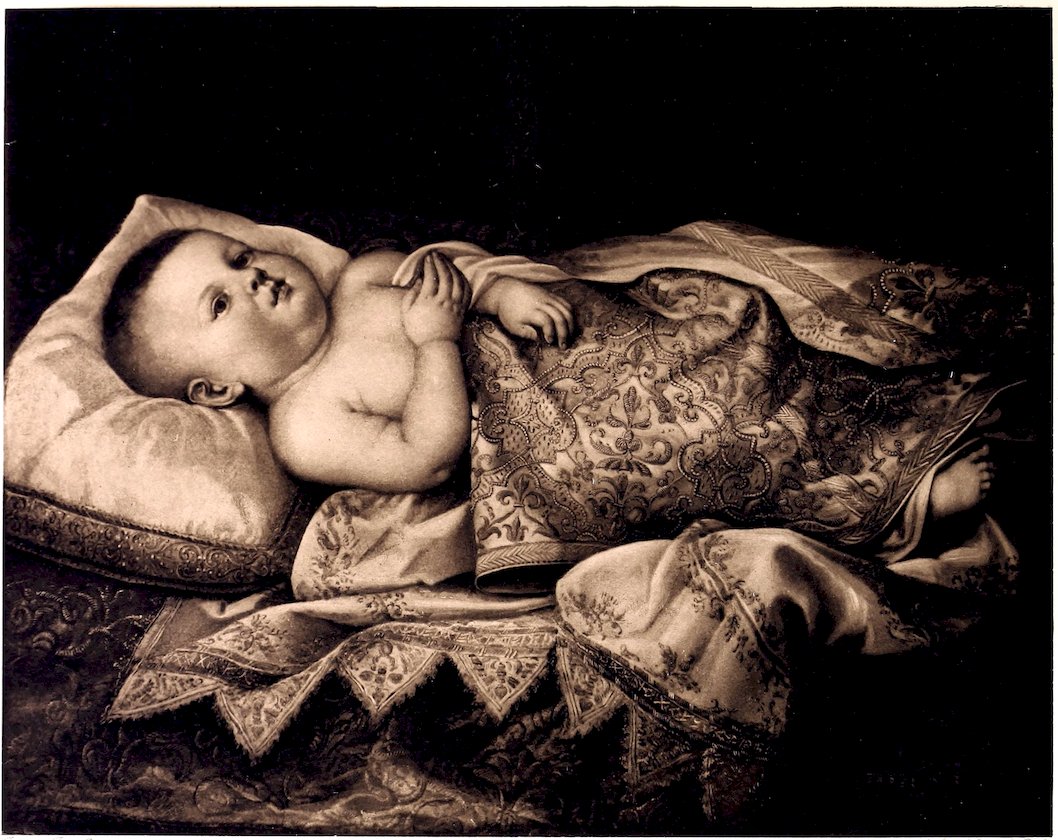
Tiberio Titi. Pinx. Walker & Cockerell Ph. Sc. Infant Prince Leopoldo.
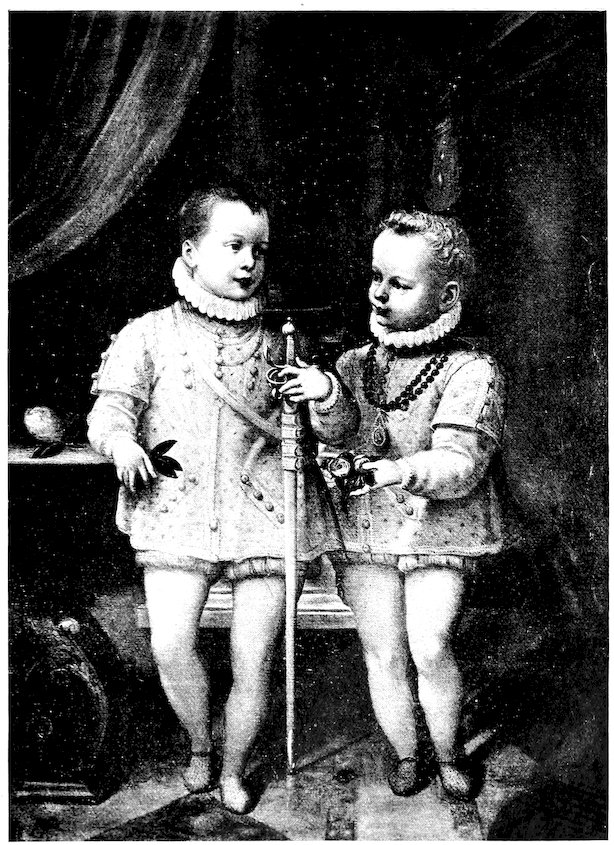
Alinari TITIAN. CHILDREN OF CHARLES V. (ROME)
Portraits of children are found also amongst the Venetians of the great time, for in Venice the great time was late enough to give effect to so much of the pride of life as delights in portraiture, and so much of the personal love of children as desires the portraiture of sons and daughters. It is to be supposed that patriarchal love of children, such as consoled the heart of Job with latter offspring for the former destroyed in their youth, would not have thought of portraits. Some centuries of decline from such simplicity brought about the portraits painted by a little Greek artist for the tombs of Fayum in the second century, and the art of portraiture seems often 53to comfort or flatter some phases of national decadence. (Has not nearly this been said also of music?) In Venice, in Spain, and in Holland, during the sixteenth-century in the first nation and during the seventeenth-century in the two following, there were great exceptions to such a rule. Titian, Velazquez, and Rembrandt were no flatterers or soothers, nor were their times poor. But Reynolds, though a great painter, painted in no great century. The truth may be simply that portraits are “late,” and that late art in Rome, in Florence, and everywhere in Italy except only in Venice, is art that has lost irrecoverable things. In Venice, corruption was prevented by colour and tone. While colour lasted in its plenitude it borrowed the health of the golden sun, and the art it filled with life could not die or see corruption. That Titian, being a great portrait-painter, is a great portrait-painter of children might be held on the strength of one lovely picture only. This is the beautiful detail from the Pesaro portraits—the head in three quarters. And this is the portrait of one old enough to be treated with the dignity of the Titian quality. Titian, like Michelangiolo, was a painter of the adult, and this one young creature whose face he has drawn so finely and in whose eyes he has lodged so much power and peace, is adolescent. In the portraits, also in Venice, of the two little sons of Charles V., the master has sought to give the childish interest; but these two boys of a great Emperor, made to hold their fruits, and a real sword as a toy, so that they may look infantine, are obviously placed there as princes. Unequal in height by a bare year, they are fellow-upholders of the state of a court. Doubtless the technical critic would find the minimum of Titian’s beauty in this group, as also in the portrait of 54the little daughter of Roberto Strozzi, at Berlin. Here is that rare subject of art, an infant girl, and Roberto Strozzi had wished to have his girl painted in her simplicity. The child is not on courtly duty, nor clothed like a duchess; her hair is short and undressed, her ornaments are simple, and she has her dog.
Titian’s pupils, moreover, painted the portraits of children, amongst them Paris Bordone, who leaves us the delightful picture of a boy in a plumed cap, now at the Uffizi, a portrait once named; the accidents of time have stripped it of its name and title, so that the little soft-faced child, dressed with so much pretty dignity for the sitting, appears in the catalogues as a “giovane ignoto”—the unknown youth being about eight years old, his cheeks not yet narrowed from their childish round. An unconfessed smile, forbidden to his dark eyes, is lodged in the infantine mouth and chin. Paris Bordone was the contemporary of Titian, Tintoretto, and Palma Vecchio, and therefore belonged to the greatest time of Venetian painting; Palma Giovane and Paolo Veronese were, by a score or two of years, of a later, more artificial, and less vigorous genius. Tiburio de’ Titi was employed to make the portrait of the infant Leopoldo da Modena, in the beginning of the seventeenth-century, and painted the baby in the modern spirit. The little boy with his counted dimples lies cushioned and covered with embroidered silks, the hands and the feet shown as a nurse would have them.
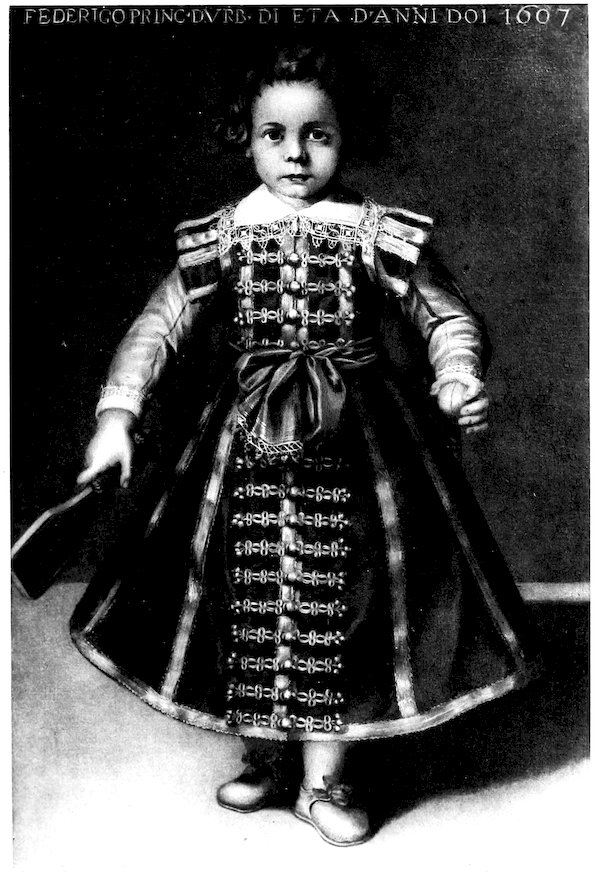
Boraccio Pinx. Walker & Cockerell Ph. Sc. Infant Prince Federigo.
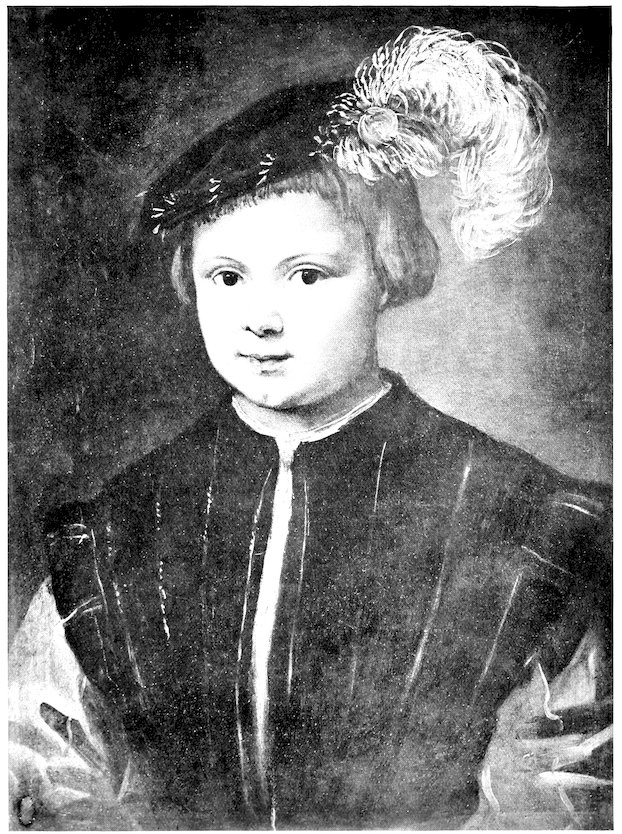
Alinari PARIS BORDONE. PORTRAIT OF A BOY (FLORENCE)
Later than Bordone, and not so late as Tiburio de’ Titi, is Baroccio, one of the many painters born at Urbino, but too modern a man to be affiliated to any local school, even when the metropolitan locus of Raphael is in question. By the time that Baroccio 55had gained courage to place a child quite erect, quite full-face, in the charm of its own ways, and in the simplicity of childish action, art had lost much. The loss ought not to cause us to despise the gain, which is a gain of dignity and not of trivial charm. It makes for the dignity of art and of the little son of man that his likeness should be designed honestly, and without fictitious graces. Yet the noblest time of art used these fictitious graces, and the less noble time respected the noble nature. History shows us many such paradoxes; for example, music underwent irrevocable losses when she made her profoundest discoveries. Some genius of the single note vanished when harmonies were found.
56