SIENA AND UMBRIA AND OUTLYING SCHOOLS
Reading edition

When Siena came out of the bassi tempi, she grew for a short time side by side with Florence. She was not Florentine, but she was Tuscan. The evolution from the Byzantine took place in the sister cities at much the same date, but with a difference. Pietro Lorenzetti, for some years probably a contemporary of Cimabue, struggled out of the bonds with a different gesture. And the dissimilarity is manifest in the wonderful figure of a child. In the painting of the Madonna, with the Infant Christ between Saint John and Saint Francis, in the lower church at Assisi, Lorenzetti shows us surely the earliest example of intent, instant expression. The Mother looks close into her Child’s eyes, and Christ gives the Pontifical benediction to Saint Francis, in obedience to the Virgin’s sign. The drawing is still quite arbitrary and irresponsible in such matters as the placing of the Child on the Mother’s fore-arm; the little figure is vacant of weight and substance; and, though the perspective of the three faces in three quarters has been courageously attempted, the eyes have still the Byzantine length; the hands are, by the usual anomaly, altogether undramatic and inexpressive; only on the English stage can we find any hand so inexpert as in early Italian art—always excepting the extraordinary and untimely genius of the sculptors. And the whole design is as it were tied up in bands of anxious 57inexperience. But, fettered as it is, the pencil is strong in its constraint. And in this one figure of the Child the great genius of expression, destined to perturb the heart of all the human arts; to strike with a tremor for a thousand weak distresses that literature which had told unshaken and unappealing the despair of Cain and the Crucifixion of the Lord; to break the voice of that music which had steadfastly sung the Good Friday liturgies; to move the arts of design from their tranquillity so as to make even of portraiture a kind of familiarity and confidence to the passer-by; to make the statue the image of the hour, and even to weaken the walls of architecture; the genius of expression, I say, seems to make nearly its first appeal in this momentous painting of a child. Pietro Lorenzetti has made the action, as well as the look, expressive. He has set aside the habit of ceremonial attitude in order to raise the child’s head and to direct the speech of this energetic mouth. Amongst the many beginnings of modern art—as many as the scattered sources of one large river—here, in the prophetic painting of the Sienese master, is one.
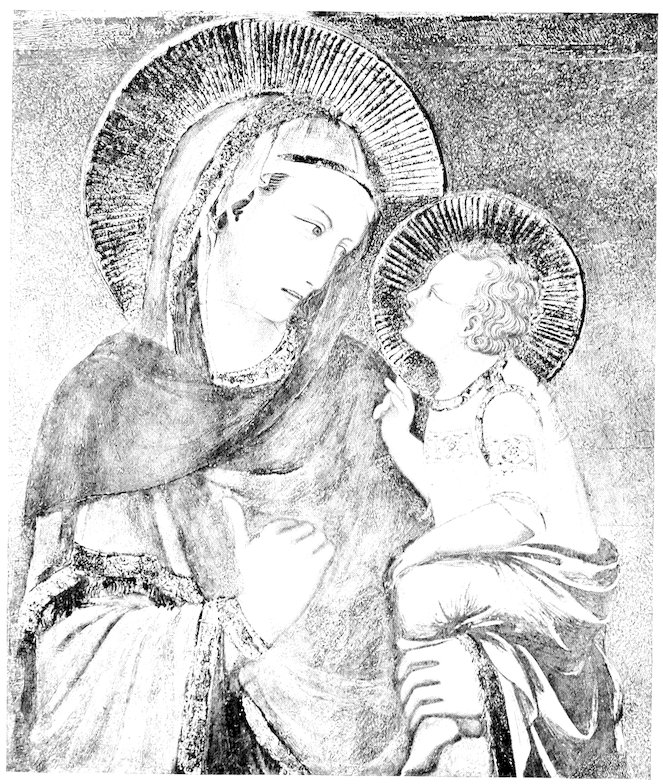
Alinari PIETRO LORENZETTI. MADONNA AND CHILD (Detail) (ASSISI)
Matteo di Giovanni, called also Matteo da Siena, is of a century and a half later, and the Bambini of his paintings have in some examples the affectation that all the Italian schools of the noblest ages shared amongst them and in a measure taught in time to Germany and Flanders. Moreover with him the “fineness” (to use the word in its strange corruption), the fineness of the “fine child,” his superlatively good physical estate, is in an extreme form, as in the case of the picture in the Palazzo della Signoria, now called the Palazzo Comunale, at Siena. But, again, we find a little movement 58observed from life in the Accademia picture; the poor and puerile drawing of a work full of noble feeling yet served the painter in his desire to give something of childhood, besides fat, to the weak but thriving limbs. In another Accademia painting, in which the Child holds a string of beads, it is not only the action but the expression that has natural vitality. It is simple, and we have seen, amongst a multitude of Bambini, how rare is simplicity in the dealings of art with the figure of childhood. The naturally parted lips have evidently been watched in a living child. In this picture, too, there is a curious group of angels some ten years old, all unchildish in the artificial employment of their hands; and yet for these, four children of Siena may have been the models, for they have character, and it is doubtless in obedience to the painter’s commands that one of them holds his head too much on one side.
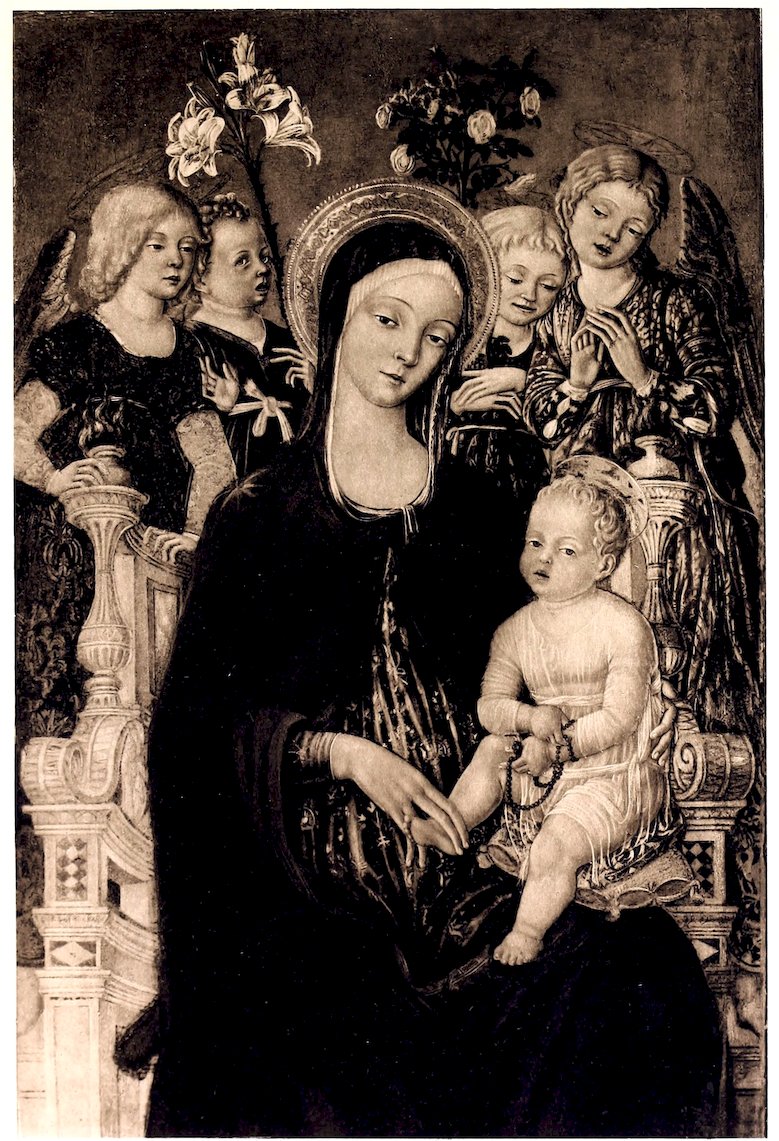
Matteo di Giovanni Pinx. Walker & Cockerell Ph. Sc. Virgin and Child with Angels. (Accademia, Siena)
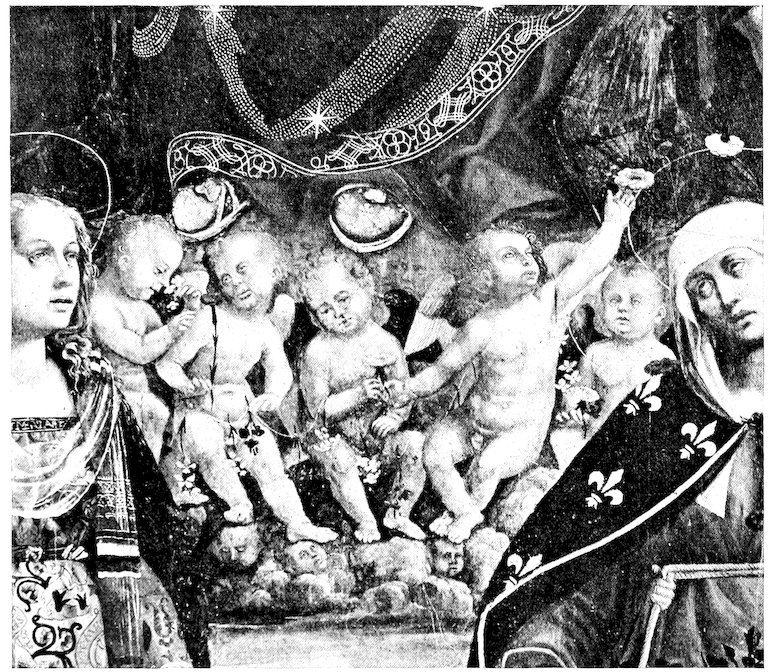
Alinari LUCA SIGNORELLI. THE CORONATION OF S. CECILIA (Detail) (CITTA DI CASTELLO)
Clear, in all these devotional and beatific groups, is the anxious preoccupation of the pencil in search as eager as a child’s for beauty of face and figure. The painters of the centuries of art and religion had no other wish than to paint something beautiful; the objects of their adoration and admiration were held to possess all beauty possible to men and angels. They had no dealings with creatures imperfect and marred, or subject to the waste of accident or crime. The devils were invested with every sign of evil imaginable by the mind of man so many centuries old and Italian, and their unhandsome figures introduced into the very rare pictures that admitted them; but, apart from these, everything less than beautiful and less than innocent was banished and cast out. Until the portrait came to be more practised, when that which modern feeling holds to 59be the best time of art—the time of the flower rather than of the fruit—had passed by in the perpetual movement of human things; until men began to desire their own storied faces and the presage of their children’s faces to be secured in painting, there was not so much as the incident of personality to engage the painter; he had not the differences of the multitudes of the living to respect. He was always bent on drawing a beautiful woman and a beautiful child; secondarily beautiful angels, and next beautiful martyrs, virgins, and evangelists. Saint Joseph was to be beautiful in age and Saint Sebastian in youth. The fact that these centuries of living art were intent upon the contemplation of moral good is perhaps too manifest to capture our attention; we know the fact, and pass on; that fact would be wonderful if only it were strange, for to this habit the custom of our own age has no likeness. As steadfast as the morality was the beauty of the aspiration common to all painters during five hundred years. But the sincere spectator has to confess that the pencil, the hand, the eye, the invention did not thoroughly serve the will. Matteo di Giovanni and his contemporaries of all the schools intended to paint the most beautiful, and the prettiest, faces they could by any means achieve. For fear of loss of beauty they dared not forego anything of the prescription—the long oval for a woman’s face with the arched eyebrows high above the eyeball, and for a child abundant flesh. The sense of some failure in the effect of this patient observance of the inventory of beauties has obviously discouraged a master now and then. He was far too simple to dread the name of prettiness, and he was sorry to miss it; missing it, he sought at any rate for grace.
60In the church of Santo Spirito, also in Siena, there is, attributed to Matteo Balducci, a curious Tuscan picture—it is, if he is the painter, Florentine, nevertheless it has something of the outlying provincial manner in design and in the character of his Madonna’s face. The painter surrounds the seated figure, rising from the symbolical tomb, with the mandorla of winged angel-heads, children frankly drawn from life, with a careful variety of attitude. These little bodiless ones are a characteristically Italian version of the prophet’s angels, each with six wings—“With twain he covered his face, and with twain he covered his feet, and with twain he did fly.” Italian art gives this angel no feet, but crosses the lower twain of his wings under the chin, no doubt to hide the decollation; the twain that should veil the face are open and erect, for so amiable and so pretty a head is not to be covered, and the twain that fly have little to do but to carry a strange little monster, moth-like, on his fluttering way. Nothing could be less ancient and less Hebrew. The bodiless ones became a commonplace of art, and their strangeness soon disappeared in tediousness; in all dull art there is nothing duller, and the little heads flutter, a proverb for absurdity, and with the last inappropriateness, on the tombstones of the eighteenth-century. One cannot easily believe that they were at any time really interesting, and yet Matteo Balducci almost persuades us that he liked them. This picture of his has, besides the six-winged heads, four entire child-angels, winged like the commonalty of heaven; two wearing the ribbons of Italian taste and running, each upon a piece of cloud; and two standing as little guards before the vacant tomb, one rather prettily alert, the other in an adult attitude of meditation which—one would think—might 61strike even the simplest spectator as insincere. Saint Francis on one side and Saint Catherine of Siena on the other contemplate the mystery of the Assumption, and in the distance is an ingenious landscape of coast and winding reaches of the sea. Triviality and gravity, both of a kind alien to our thoughts, divide this design, and many a remotely Oriental composition would seem nearer to our present mind, more intelligible and interesting.
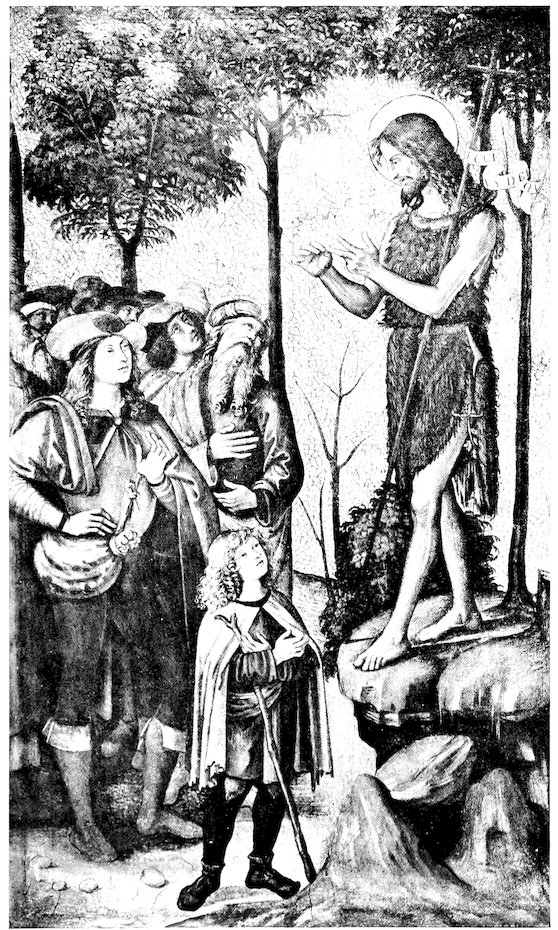
Alinari PINTURICCHIO. ST. JOHN PREACHING (SIENA)
Luca Signorelli, born in another of the steep cities of the hill country of middle Italy, into which the sun looks as they go up their mountains by steps—Cortona—was one of the Sistine painters, but his best works are at Orvieto and at Città di Castello. The “Coronation of Saint Cecilia” is decorated by a number of putti of the conventional kind, playing with flowers which they hold with a detached little finger en minaudant. At any rate one of them performs this action of Italian elegance—the dancing-master again!—but another has a fresher and truer movement as he reaches up to catch a falling rose, for the flowers are scattered by the hands of the Virgin. Her Child stands on her knee to crown Saint Cecilia, who wears roses for a wreath, as Tennyson has her, and carries her organ-pipes and her palm. Crowns like hers lie at the feet of Saint Catherine of Alexandria and Saint Elizabeth of Hungary. The expressions of these and of the episcopal and monastic Saints standing above is unequal—very sweet and still in some instances, and in others somewhat conventional, strained in the manner that grows tedious with a tediousness wholly of Latin race, the tediousness of habitual exaggeration. That habit—exaggeration—has relaxed the whole language of French religion, for instance; the 62French paraphrase of the Scriptures is as it were an instrument with strings so loosened as to be incapable of music or meaning. If the tense habit can do so much for a language, it may well overtax an art indifferently vigorous.
In a picture at the Poldi-Pezzoli Gallery, Milan, by the Ferrarese master Cosimo Tura, or more probably by one of his school, we have at last three boys who, though nude and symbolical, are neither the putti of the schools nor the angels of a sentimental Italian convention. A young maternal Charity, seated under a few white horizontal clouds, such as a tender blue May sky so often bears in Italy, holds a scroll-like scarf for the rather aimless play of two of the boys, but the third is really playing at horses with it; he prances and obviously makes a horsey noise.
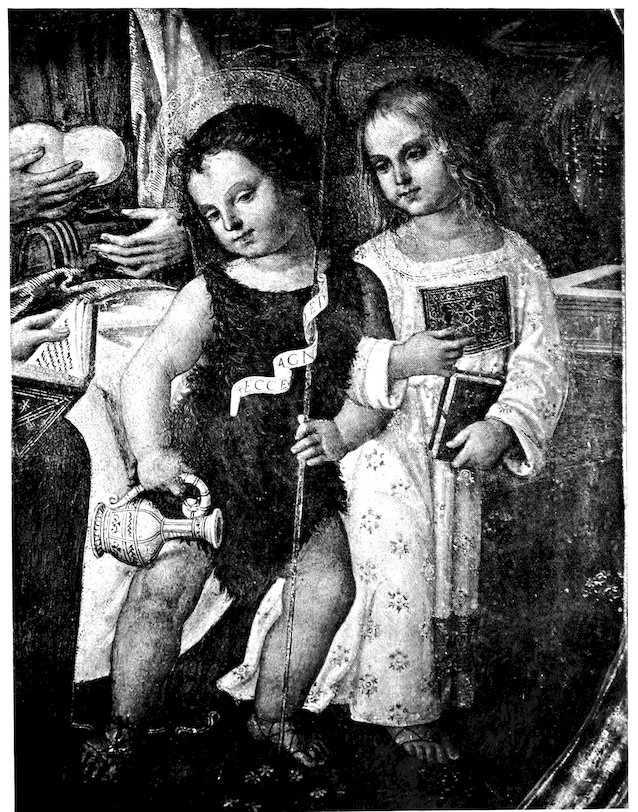
Alinari PINTURICCHIO THE CHILD JESUS AND THE LITTLE ST. JOHN (Detail) (SIENA)
And now Perugia and Urbino become central to the art of Italy. Pinturicchio, Perugino, and Raphael rule the time, and the time is a great one. Perugino may not be to us all that criticism held him to be in the time of reaction against the love of the Carracci—who were the greatest (as well as the latest) of all the Italians, in the grotesque opinion of Horace Walpole. On its way back to the older Florentines, the taste of the dilettante paused upon Pietro Perugino as on a master comparatively early, tender, spiritual, and candid. It was a higher thing to admire the recollected and feminine attitude of a saint of his under a blue sky than the muscular action of a saint of Guercino’s against a convention of cloud; and the little tree of the Umbrian background than the gloomy Neapolitan’s twisted forests. And with this master of Raphael is Raphael’s father, Giovanni Santi, contemporaries together, and heralds and forerunners of the painter 63whom nearly all men love to praise. In relation to children Giovanni Santi seems to be memorable chiefly by reason of a little girl, a daughter of donors, set on her knees in front of her father and mother to offer her devotions to the Bambino of a pale Madonna—a Bambino having nothing remarkable, granted the time and school. But this little girl in her close cap, who is evidently there because the pair behind her have no son, is purely childlike, and kneels, like a child, on both knees, simple and erect, her hands before her and the soles of her feet behind her, under her little sombre petticoat. Santi’s angels are much like those of Balducci, if Balducci it be—winged heads of veritable children making a crown. Their roundness is here in contrast with the worn and patient Saints, a wrinkled Saint Francis of Assisi showing his transfixed hands, Saint John the Baptist hollow-cheeked, Saint John the Evangelist in extreme old age (we must suppose that the donor’s name is John, like the painter’s); and Saint Sebastian only of the four is young, and his whole body is pierced with arrows. Of Perugino’s many Bambini none has more sweetness than the Child whom a young angel has placed on a cushion so that the Virgin’s hands, released from their burden, might be folded. To some charming angel, almost feminine in action, many a master has given this office, making of the heavenly youth a little nurse for a time, so that the maternal knees, all day long the throne of Christ, may be bent and press the earth like those of all mankind. The Child here has the beauty of a direct look, meeting the Virgin’s eyes, and his hands have the action of a child; hardly so the boy Saint John with his light cross against his shoulder, daintily kneeling upon one knee.
64It would be hard if in Pinturicchio’s gaiety the children of his pictures had not their part. And there is actually something cheerful in the two figures of Christ and Saint John (in the Siena Accademia), the one in a patterned vestment, the other in his camel’s hair, both with their feet curiously laced. The attitudes are arbitrary and not infantine, but there is a smile closed within the face, and especially within the mouth, of each. In the Città di Castello picture, the young Saint John has something recalling the sprightly look of a San Giovannino of Filippo or Filippino Lippi, but at some distance. Pinturicchio’s gaiety is not quite Florentine; the gentler city had, if not the lighter heart, the lighter wit, and the Tuscan smile is more intelligent. Pinturicchio’s is rather a doll-like Bambino in this beautiful picture, small-headed, but the expression is tender, much more explicitly and intelligibly tender than is usual in this age. The young Saint John takes here the benediction of his Lamb.
The same Saint John, grown a man, preaches to a little boy, in the Siena Cathedral. Pinturicchio, repeating yet once more the ever-unintelligible failure of the fifteenth-century Italian to make any Saint do what he himself could not but do—give his hands vivacity to carry a meaning—can think of nothing better than that poor ineptitude of gesture I have already mentioned; his Baptist convinces the audience before him, including the little boy, by counting his reasonings and proofs on his left fingers with his right. See how unable are also the other hands, and how ineloquent; a young man lifts one hand in the gesture wherewith the whole art of Italy wearies us, and the boy crosses his two hands over his breast, not child-wise. But there is an unwonted thought in the placing of this little auditor 65in the forefront, for he is not a saint by name, but only a very good Umbrian. In the minds of English people, doubtless the most conspicuous Pinturicchio child-Christ is the curled one standing by the prettiest of Madonnas on a carpeted parapet, in the National Gallery picture. The prettiest she is, with each eye larger than her mouth, and the Child stands with a kind of Perugino salience of the hip. His little features are gathered close together under a vast forehead. But in these two faces, so conventional and rigid in their beauty, the genius of Pinturicchio and the habit of feeling of the fifteenth-century have placed sanctity and a remote tranquillity.
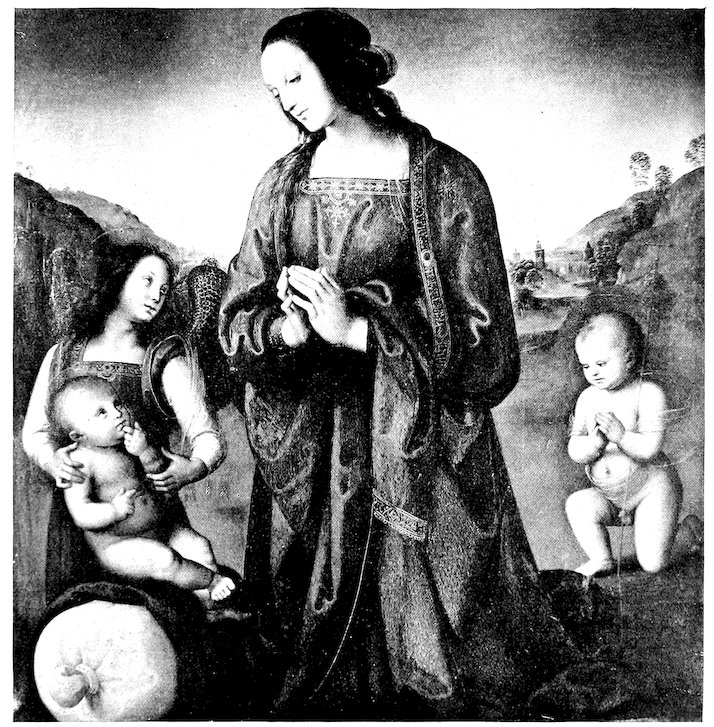
PERUGINO. MADONNA AND CHILD WITH THE LITTLE ST. JOHN
As for Mantegna, few infants of his have become the darlings of the Galleries, but there is something memorable in the slightest of his designs. The Madonna of one of his drawings, whose long mantle comes into the foreground with something Flemish in its angular folds, has laid her Son upon the end of this garment spread upon the ground. He is the youngest and most helpless of the Children of the Masters, but Mantegna’s grave hand has moulded with power the powerless bent limbs and closed hands of the new-born. There is a suggestion of the North in this figure as well as in the drapery.
66