INTRODUCTORY NOTE
Reading edition
The making of images was, in an earlier world, so well understood to be for the sake of honour, that it was the act of homage which must needs be, by law, restrained. The picture, the statue, the doll are likenesses of things admired, and although a strange concourse of unchildlike children face us as we look at the pictures of the Masters, we are constrained to confess—seeing how his image is repeated—that these Masters admired a child, and that the populace of their centuries must have had popular admiration for a child.
It has been left chiefly for our day, and for our populace, to make an image in irony, to clothe it in burlesque, to carry it in the procession of insult. There is but one day in the year on which the people, in London, make an image, and they set it up for the sake of derision, draw it through a November fog, hoot it at the pauses of procession, and, at the end of a day of contempt, give it to the flames. It is an act of idolatry à rebours, an inversion of the admiring motive of human art, an act of delight in disrespect not only towards something unworshipful on earth, but towards the work of the 2maker’s own hands, to which the old and general art of caricature has no real likeness. For there is no ritual about the comic paper; nor is its illustration the work of the people, leaving for a day their labour of making or carrying merchandise to make and carry a work of art. Whereas they do deride the November image with a kind of song, and it is the thing of their invention, their burden, their own, thought out and put together and prepared to its unhandsome end.
Thus the townspeople of to-day intend to tell us that they contemn—if contempt is the word—the notorious man, national enemy, or what not, and their own image of him. They do not express by means of an image what the makers love, like, or admire. But the images carried by the people of Europe in the thirteenth-century and onward had no other end.
The Italian schools of painting throughout that long evolution in which they travelled a great way in mind, a great way in time, but in place shifted only from Pisa first to Bologna last, dealt less with children than with one Child. An infantine figure was the very centre of their attention; and this fact has certainly had an incalculably wide and persistent influence upon character, and therefore upon the course of history; but it was not less an effect than a cause of gentleness and civilization. Art was a matter of importance in Europe for four or five hundred years, and during those centuries the centre of art was the portraiture of a child in a woman’s arms. Our own day would not suffer such a thing. Misplaced irony, and the love and fear, at once, of a quite inappropriate burlesque would forbid it. There was, then, a straightforward, a natural sentiment, now vanished, in the ages that chose this young and helpless group 3for endless repetition; albeit we call those ages violent. They had the whole Bible to choose from. The Madonna and Child look so merely a matter of course in the eyes of everyone who so much as knows the “Old Masters” by their generic name, that these modern eyes miss the impulse that once set the making of the Madonna and Child afoot. A manufacture it became, but it had a fresh beginning and a continuous sanction. The Byzantine who brought the first Virgin and Child into Italy represented what we should call in our modern way a public. In order to serve it he made these figures, in their simplicity and sentiment, the one chief preoccupation of the art of the new—the second—civilization of Europe. Yet the Crucifixion, the Descent from the Cross, the great masculine actions and compositions, were not entirely postponed by this early art. There was no hesitation, for example, as to their difficulty, inasmuch as the first mediaeval sculptor was unaware of what modern art calls difficulty; he knew that his materials must serve him, roughly, in his approach to drama, and in his use of mere symbols, alike. Assuredly he had no misgivings as to the representation of the action of a Resurrection, to be indicated in unpractised and startled stone. It was not, therefore, for the sake of material simplicity that he and the painter alike chose the Madonna and Child as the first and the permanent group. We have to ascribe their choice to the inclination of the mind of the time, first in the country through which Greek art entered central Europe, and next in the countries that followed, while they altered, the fashion of foremost Italy.
Let us grant that this love for children was less conscious, less deliberate, less meditative, and less articulate than the feeling which, 4apart from the arts, we cherish now, but we may well insist that it was more serious. It was eager to confess the Divinity of a Child; and it is well worthy of remark that art put out its hand to stay the passing of the Divine childhood. It took Goethe’s word and cried to the passing moment: “Stay, thou art so fair!” And that moment was the moment of the Infancy of Christ. We are inclined, and with justice, to accuse our fathers—say our fathers of the seventeenth-century and onwards—of considering childhood too hurriedly, too inconsiderately, as a passage. Had they known, we aver, of the law of unresting change, of the passage through which everything living, and even the inorganic creature, journeys alike; had they known that the very crystals have to grow old, they would not have been urgent, impatient, and in haste with childhood, as they certainly were, because it is but a state of transition; they would not have seen the character of transitoriness, which is everywhere, exclusively in human childhood, and would not have reproached the innocent child with what is the universal lot. They thought great things of their own maturity, and hurried their children on to that state which is, after all, so brief that it hardly stays long enough to be known. It is wonderful that they should have been thus hasty with childhood, and so pushing to get it done, so ill-content with the state of the infancy of their children, in the age in which Reynolds painted the “Strawberry Girl,” and later when Blake was writing. For the genius of the painter and the poet had an incomparable apprehension of childhood.
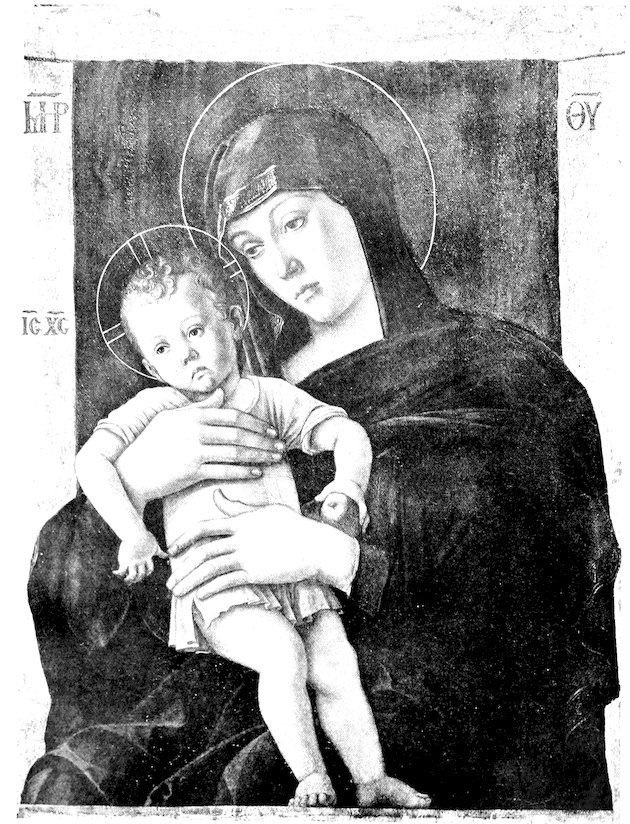
Alinari GIOVANNI BELLINI. MADONNA AND CHILD (MILAN)
One age, then, there was, so little impatient of childhood as to make perpetual that childhood on which the attention of its art was fixed. The Infancy of Nazareth was to last for ever. We must not 5forget the certain fact that while the painters of the early schools made pictures of the Child in the Virgin’s arms they prayed to the Child himself as though he had never grown older. The infancy they worshipped was to them a permanent mystery. They were indeed in no haste to have it over. If we often find in the fifteenth-century and the sixteenth-century Bambino a lack of that which we call infantine, we must not forget that the painters intended to paint an infant. A very “fine” one in the first place. No gossips at a christening were ever so eager over the fatness of a babe as were the masters. And while they intended to paint an infant, it must not be a child new-born. They would not have him wrapped in swaddling-clothes and a few hours old, but a full six months old and with bared limbs, proved to be the finest child “in twenty parishes round.” There is a Bambino of Giovanni Bellini, in the Brera Gallery of Milan, in whom, at a year old or so, there appears a definite sadness, with the signs of fretting disease in the droop of the rounded cheeks—the cheeks of the thinnest baby are round, but the little spheres are flaccid; so are they in Bellini’s Bambino, and the limbs are helpless with fatigue. But this is a rare exception. We may take all this vaunting of the fine child in the Italian school as a simplicity, or else as a lack of delicate feeling. Children appeal to us by a variant of the quality of pathos; for a certain time men and women loved them best when they were to die like little Dombey. That temper is past; but we, to-day, find a child who is to live, at least as pathetic as the readers of Mrs. Beecher Stowe found a child who was to die; and assuredly ours is the blacker humour, the more ill-conditioned melancholy; but it is, with differences, all one pathos together, and modern. The fourteenth-century 6and after loved a child (in the natural manner) the better for being high in health and full in flesh.
And yet, after all this apology, I have to confess how seldom childlike is the Italian Old Masters’ child. The collection in this volume represents in chief part the exceptions. Rarely and most beautifully, a purely infantile child—Bambino or angel—more rarely a little Virgin, and almost as rarely a portrait—shows how suddenly a master perceived the real character of childishness amid the conventions of his time and of his art. The Della Robbias, sometimes Botticelli, and Titian in one great example—these gave the childish look and the childish action of which they were aware, one hardly knows how, seeing that both were before the eyes of other masters unperceived. Even through Raphael’s preoccupation of grace, which has inspired all dancing masters these many, many years down to Alfred de Musset’s maître à danser, when he told his maiden pupil that she must turn her head over the right shoulder when her feet went skimming to the left, and over the left shoulder when they had to speed to the right: “But, that way, I shall fall,” says the jeune fille; “But no,” he replies, sketching with agility a chassé, “Look at me, I don’t fall”; even, I say, through Raphael’s attitude, destined to so speedy and so long and so Italian a platitude and commonplace, a perception of the attitude of childhood breaks at times like a natural action. But not once did it appear to his followers. The slight corruption of the Raphaelesque attitude was one of the easiest corruptions in the history of corruptible art. It suited every tendency of the Latin mind and the whole school of ornament. Rome, Bologna, and the later Venice improved upon the child of Raphael, used him for the very structure of 7decorative composition—his curves, especially the bow of his young figure, which supports the canopies of thrones, not manifestly, as it was done by caryatides, but entirely by way of attitude and composition. But for the plastic art—for the exquisite art of Luca and Andrea della Robbia—a collection of children of the Italian schools would have lacked much.
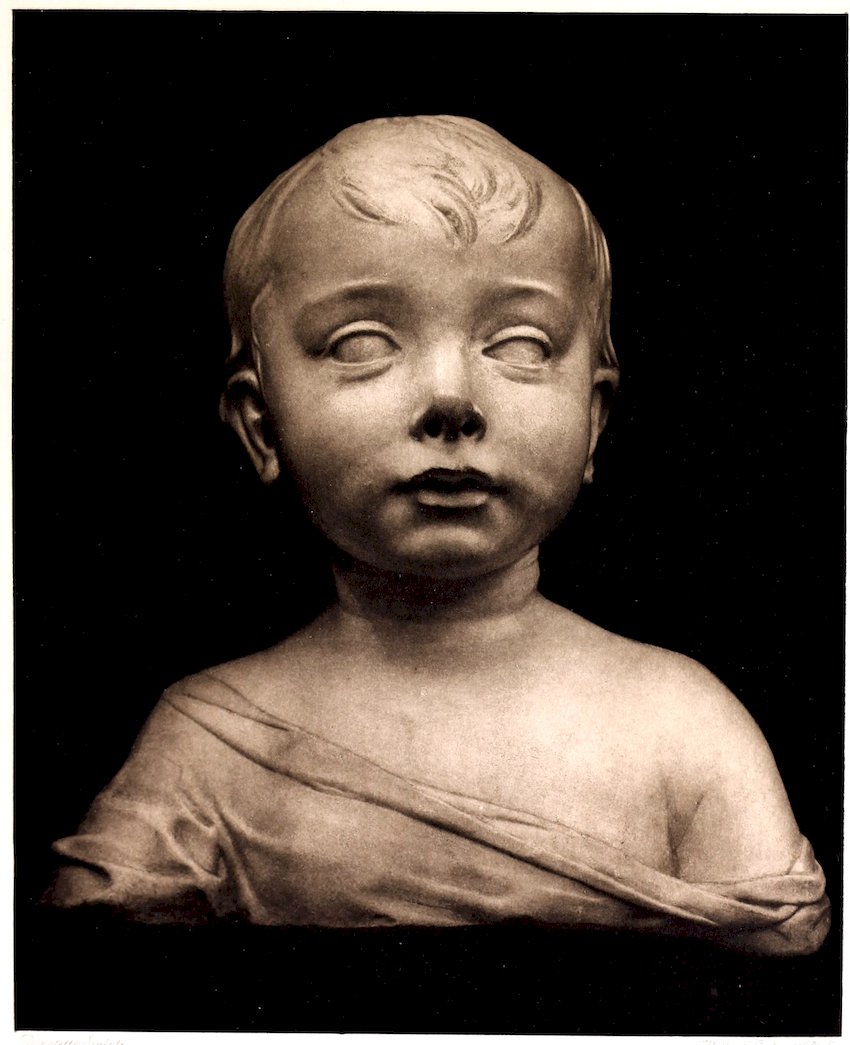
Donatello, Sculptr. Walker & Cockerell Ph. Sc. Head of a Child.
The Bambino, the boy St. John, the little angel who hauls his brother by the hand in the “Last Communion of St. Jerome,” with all their kind, and the Loves of Titian’s “Garden” with theirs, are of course men-children. The woman-child is much neglected; but for a little Virgin at the knee of St. Anne, or a legendary Presentation of the Child Mary in the Temple, one might look long for a little girl. Chaucer seems to allot some of the economy of his tenderness to the little daughter of Griselda; but soon he makes her masquerade as a bride at twelve years old: and this was their way, in those days, in earnest, of suppressing the girl-child; they married her out of the way of danger.
“Have here again thy little youngë maid.”
Chaucer’s exquisite line, and the tenderness of the poem “Pearl,” must stand for the scantling of literary allusion to the woman-child of these many ages.
In a word, the thirteenth, fourteenth, fifteenth, and sixteenth centuries had a sentiment of their own for childhood, somewhat unlike each other’s, together very different from ours. We might be slow to accuse them, whether of error or defect, seeing that they cannot accuse us again. Nor had they the experience of our older age, nor the choice of spirits that lies before us. They were not aware 8of the turn human emotions were to take, and doubtless if they had speculated they would never have guessed prophetically at anything like the child of Reynolds, or the child of Wordsworth, the child of the Sunday-school, the child of Mrs. Turner’s moral tales, the child of Dickens, or of Thackeray, or of the American diarist, or of the naturalist who showed how the new-born could hang by their hands.
The children of the Italian masters for the greater part are such as the prejudice of the time would have them, graceful according to an adult ideal, fat and well-liking, and as beautiful as the hand could make them when the eye had not learnt to condescend frankly to the conditions of their life, whether in form or in action. The Greeks had been most reluctant to recognize the true form—the proportion, for instance, the relative size of the head and the relative length of upper and lower limbs. The Italians confessed the characteristic form, but clung to their own banal idea of grace, the grace that carries the head aside, the grace of the dancing-master; and imposing this upon the ultra-childish fat, the exaggerated infancy, the rolling limbs, of their bimbi, they created a little corpulent artificial figure, not like a man, not like a child, the pet of the ages that brought mediaeval Rome to the ground by the pickaxe, and set the seal of one style upon the city and world. It is difficult to associate the painting of Angelico or that of Benozzo Gozzoli with the neo-classic architecture; insensibly we place the painters further back, a step nearer to the Gothic, than the builders. We do so, that is, in regard to their Madonnas, to their Apostles, Evangelists, Martyrs, and Doctors; in these there is the upright spirit—they are “early.” Thus the arts are at odds, or look so, as to “periods.” But that 9impression disappears when we attend only to the Bambino. Here is full “Renaissance.” The Bambino goes well with the classic temple of the academy, with the portico and the pediment, even the broken pediment; he is of their time.
Amid so many little boys wearing their make-believe childhood in the posture of indirect grace that living childhood never assumed—a posture conceived in the adult mind before it was assigned to any picture-child; amid so many falsified little boys, stand the smaller number of authentic children. They may be gathered un peu partout from all the schools of Italy early and late; Florence yields them in the fourteenth-century and Venice in the sixteenth. The grace of life, as it were something unexpected, puts out its impulsive and simple arms, or a laugh breaks through. We find again the child whom the painters had a little outdone or a little altered for their art, but whose own incomparable charms meanwhile had never flagged. It had doubtless been dear to women, in private, outside of the schools, renewing itself in the freshness of the repetitions of human generations. If the thrush sings each song twice over, with the “careless rapture” note for note rehearsed, his indomitable little fathers had sent the same song afloat, with the same impulse of invention, in the course of centuries. Nor do the sallies of kittens change, and doubtless the sacred antics of the spirited Egyptian imp in ambush that is now a mummy were those which the kitten tries to-day under the spur of an old but unpremeditated joy. Children in like manner recapture and recapture the outbreak of their smiles and their fresh ingenuities of play. And the Italian master who has moulded his bambino heavily, creased his legs and puffed his cheeks 10so as to make him very much a child—a fine one, and has turned his neck, disposed his legs, and raised his eyes so as to make him something more elegant than a child; the same master, I say, sees at another moment the sweetness of the truth, and his efforts and prejudices are set aside. Could there be a better example of this repentance than we may see in the work of Raphael?
It may be necessary to say that the slight essay following is not a work of art-criticism, and less—if less could be—an historical study. It does but record some of the changes of sight and spirit, during the course of the five centuries of Italian art, in the contemplation and representation of childhood. It is therefore an essay on a subject of the designs of certain painters and sculptors, and not on their workmanship.
11