THE FLORENTINE PAINTERS—II
Reading edition

When Domenico Ghirlandajo painted for the church of Santa Maria Novella the stateliest of all the Nativities of Mary, arranging the scene in a palace chamber and admitting a company of Florentine ladies to congratulate Saint Anne, he crowned the decorated room with a frieze of nude children at play. They are the putti of whom art, by that time, had made an established convention, and of whom in time to come art was to make a continual commonplace. Something in these equivocal children, infantile and yet not infantile, graceful as the adult would have them and corpulent as the gossip would have them, so took the fancy of Italy as to make a rule and an example for centuries. Your Italian house-decorator to-day is fairly able to make you a design of putti, dolphins, and garlands after the manner of the fifteenth-century. The child in question has become a kind of repeating pattern, and he owes his long life in art, through high times and decadent, to a love of the beauty of children that was an incomplete love, or one might rather say a love that filled completely the capacities of a somewhat shallow heart—like, d’ailleurs, some Italian music. Yet it is to Ghirlandajo that we owe one of the most direct and sincere children of that time or the times following, one of the best children of Tuscan art, whom Parma, Rome, nor Bologna was to 38match. This is the child who loves the bottle-nosed man in Ghirlandajo’s beautiful picture, a charming child exceedingly urgent yet gentle, with the little childish upper lip out, and the lower lip soft. The man loves him, and is a sweet old man, as gentle as the boy, and the two profiles turn to each other, records of a tenderness certainly alive four hundred years ago. In his noble “Adoration of the Kings” (Chapel of the Innocenti, Florence), with its glorious company of visitors at the shed of the Nativity, and its great animated landscape of river and mountains, Ghirlandajo has made the unusual introduction of two little boys amongst the worshippers. They seem to be little Florentines rather than little angels, and each kneels meekly on both knees. Saint John the Baptist brings one, and a bearded Saint whom I do not recognize brings the other. The same master treats “The Espousals” as a festival ceremony under the arches of a great palace court. With all possible simplicity and gravity he deals with the grotesque incident of the spite of Mary’s rejected suitors—an incident that seems to have been added to the tradition by the busy fancy of painters; for many of them represent it: one of the young men, in the extremity of his disappointment, deals Saint Joseph a hearty blow on the head at the moment of the marriage benediction. What is to the present purpose is that Ghirlandajo gives a kind of under-plot to his composition by the brisk movement of children. A little girl whisks, much excited, into the picture with her mother, to see the wedding; two other little girls run in from the other side.
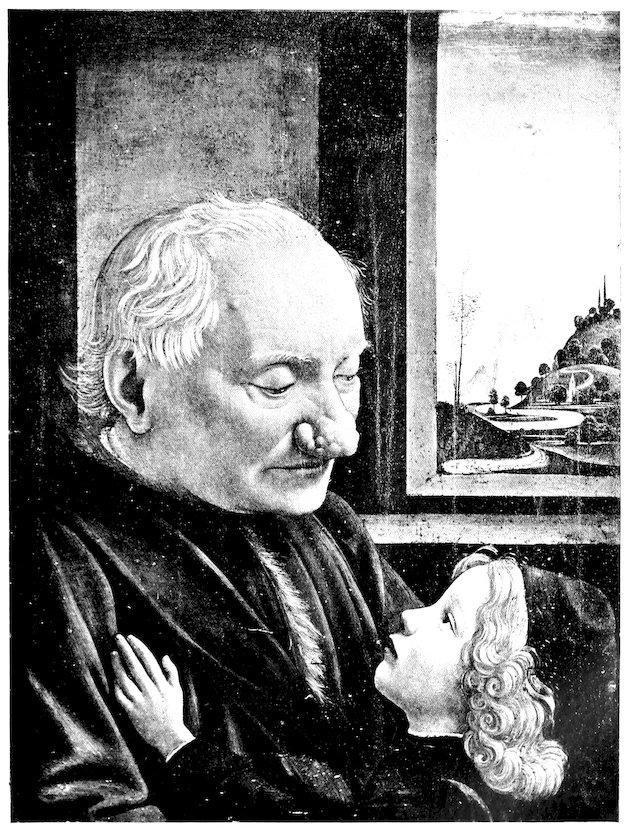
D. Anderson GHIRLANDAJO. OLD MAN AND CHILD (LOUVRE)
Young if not infantine angels are in the picture by Leonardo da Vinci and Verrocchio—a beautiful detail of which is detached 39here. The heads are lovely and noble, the nearer all-eloquent, with sweetness, eagerness and tranquillity at once in the expression—the “countenance”—of all the mobile features, the quick mouth and the eyes a little caught up with dramatic impulse of feeling. (It is this angel that is judged to be Leonardo’s most certain share in the picture.) If the first young creature is hardly a child, the second angel is younger, as he is also graver. Both are in a profound and tender ecstasy, but the angelic nature differs, as though these were children indeed, and had their human inheritance of character. Both are loving and both are intellectual, but the elder resembles the loving seraphim, and the younger the wise cherubim, as the Doctors of the Church divided them. The Florentine painters were theologians one and all.
Among Leonardo da Vinci’s innumerable and admirable designs is the head of a child, here reproduced, beautiful in drawing, with the solid of the round cheek and the strong lines of the curved eyelids. The master’s hand has so carefully followed the thin curls of soft hair in this study from life, that a writer on the spiral forms of art and nature has attempted to give unlooked-for significance to those touches. Nay, he sees in one or two spiral curls on the middle forehead, where a baby’s scanty hair is a little thicker, evidence that Leonardo da Vinci built the spiral staircase at Amboise. However this may be, here is a child’s head that is indeed a child’s, childish in such observed details as the fullness over the upper eyelid, and the infantine parody of the line of age beneath the under; purely a baby’s head, untouched by the fifteenth-century prejudice, and we know that it is thus untampered with because it is only a 40head, and goes no further. Were there so much as a line to indicate the shoulders!—nay, it is easy to draw, in fancy, the suggestion of shoulders turned aside in the fifteenth-century manner, in an attitude at odds with the character of the face not many months old.
Amongst Leonardo da Vinci’s Bambini there is one to whom the master has manifestly intended to present the lowliest homage of extreme old age. This is the child-Christ of his “Adoration of the Kings” at the Uffizi. There is the customary twist and curve of adult and conscious elegance, and the Child shares it with his mother, but the group is a lovely one. At the feet of the Virgin the Wise Men are prostrate; one, white-bearded, kisses the green grass; another, crouching, raises himself on one hand to offer his gift of gold; and this the Child stretches a hand to touch in sign of acceptance.
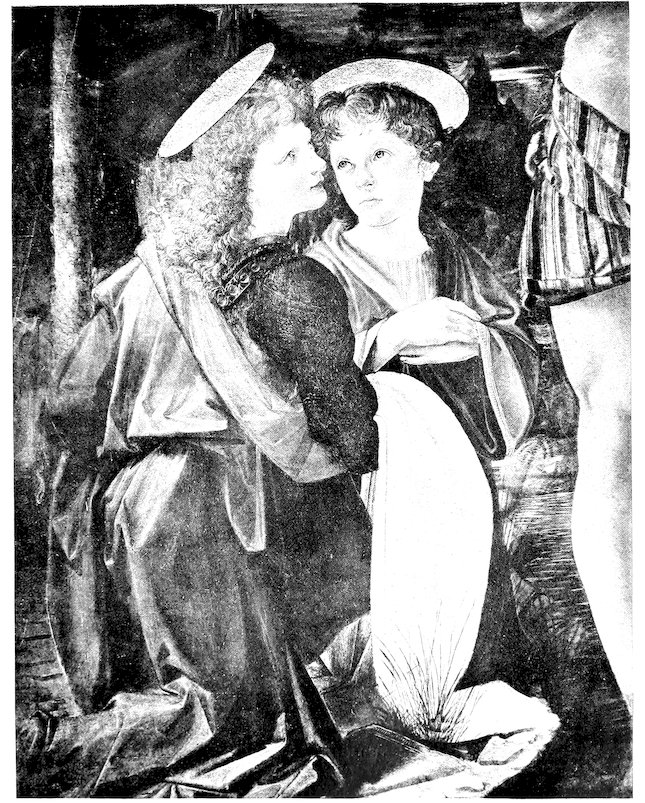
Alinari ANDREA VERROCCHIO, AND LEONARDO. ANGELS FROM “THE BAPTISM OF CHRIST” (Detail) (The foremost figure probably painted by Leonardo) (FLORENCE)
It would be too rash to question the change of attribution whereby the “Christ disputing with the Doctors,” in the National Gallery, has been withdrawn from Leonardo da Vinci and given to Luini. Yet, questions of execution apart, those doctors to the right have much of the Leonardo caricature, the short profile in particular. And an inexpert but observant eye may see Leonardo da Vinci also in the smoothness and relief; in the type of the figure of Christ, too, the master’s design and his taste look well-known. But whoever painted this once famous picture, having to paint the Saviour at twelve years old, was not content with that age, but added some years. Dramatically, the figure is lacking, but lacking in the manner to which the work of masters has accustomed us. Often do the dramatic Italian hands fail us in their work in the schools, and 41nowhere do they fail us more languidly than in the hands they painted. The merest wayside theatre in Italy shows us the living language of the hands; yet the painter of “Christ disputing with the Doctors” has devised no better action for a disputant than this of checking off arguments in order, with the fingers of the right hand upon the fingers of the left. There is no weaker presentation of a course of reasoning. But the National Gallery has now a Leonardo da Vinci of somewhat more authority, a variant of the picture in the Louvre, the “Madonna of the Rocks.” The sweetness of the two children here is perhaps the best character that the master intended to bring about in any Christ or Saint John known to be his. The little Baptist prays with folded hands, kneeling, as no young child ever knelt in life, upon one knee. The Madonna draws him prettily nearer, with her hand on his shoulder, to her own Child, who gives him the benediction. A young angel attends on the child-Christ, and in the French picture points to the praying Saint John.
The nearest in order of chronology to Leonardo da Vinci is Filippino Lippi, but this great and exquisite master is nearer to Sandro Botticelli in genius. We know that Botticelli was his protector and friend, and somewhat like his elder brother, inasmuch as both learnt of the younger man’s father, Fra Filippo. The bonds of the three in their art are signs full of interest, not only for the modern measuring expert student, but for the plainer pilgrim in the galleries. They loved alike the half-grown angel who may barely enter this book’s company of children. Their Saint John the Baptist is much of the same age, and sometimes may not be known amongst them but by his camel’s hair and the long light rod of his distinctive 42cross. Filippo, Botticelli, Filippino, and he who painted the National Gallery full-face Madonna, and he again who painted the lovely profile Virgin, so long called a Botticelli, in the Louvre, designed the same full bow-mouth, the same somewhat heavy hair, but hair with life in its spring from the head and in the slight final curl of the several locks. And the eyes are not large, under eyelids that withdraw beneath the fullness of the orbit and the high-uplifted eyebrows, and the glances are sidelong and most charming and candid. Filippino Lippi did not generalize his companies of men, or make them resemble each other; he distinguished, intently, head from head amongst the old, but these angels and their friend the tender Baptist are like one another in the sweetness of their touching beauty on the fine edge of gaiety and sadness. Filippino designed now the shorter face, with wider-parted eyes, of his father’s pictures, and now the narrower and longer form of his friend’s choice, though always with the eyebrows much above the eyes. Notwithstanding this variation, there is rather a monotony of beauty in these groups of full-lipped young creatures, tranquilly animated, with their obsequious eyes bent on the child-Christ, or glancing softly aside into the world or into the heavens, to see whether men or seraphim are aware of his greatness. In the detail from the lovely picture in the Pitti Palace, which shows a fair-haired angel dropping rose-leaves, the Saint John is much the youngest of the heavenly children. A little of the camel’s hair on his shoulder and his long cross mark him; he is quick and childlike, dark-haired and dark-eyed, and his locks are somewhat wilder than those of the angels, who are very trimly combed. The minister of rose-petals wears, besides his beautiful 43wings, a glorious and elaborate dress; the little downward-gazing one has sleeves of his pattern, the aureoles are transparent but delicately patterned. In the group of two companion angels, with the springing hair, a gentle difference of character in seraph and cherub resembles that of Leonardo da Vinci’s and Verrocchio’s pair. If we may place these delicate boys in the company of children, we cannot count the Archangel in those ranks. Gabriel, though but a celestial year or so more advanced in age than the young comrades of Saint John, is a grown angel. Filippino Lippi’s Gabriel is an energetic and most beautiful messenger, not so impetuous as Titian’s, who comes in at a run, with fleet foot, open wing, arm aloft, and flying apparel, under a bursting cloud, to a Virgin overwhelmed. Filippino’s announcing angel is tranquil, but his action is direct and full of power. This is one of the Saint Gabriels of art who kneel to the kneeling Mary.
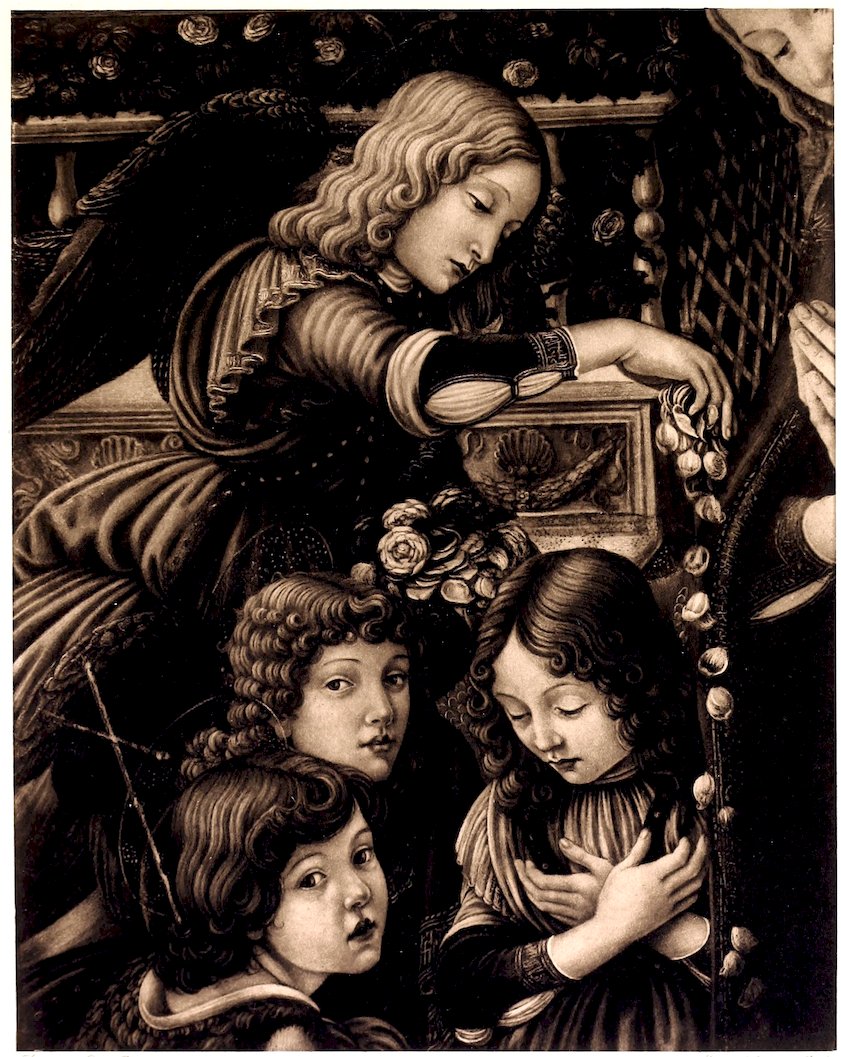
Filippino Lippi, Pinx. Walker & Cockerell Ph. Sc. From a painting of the Holy Family. (Pitti Palace, Florence)
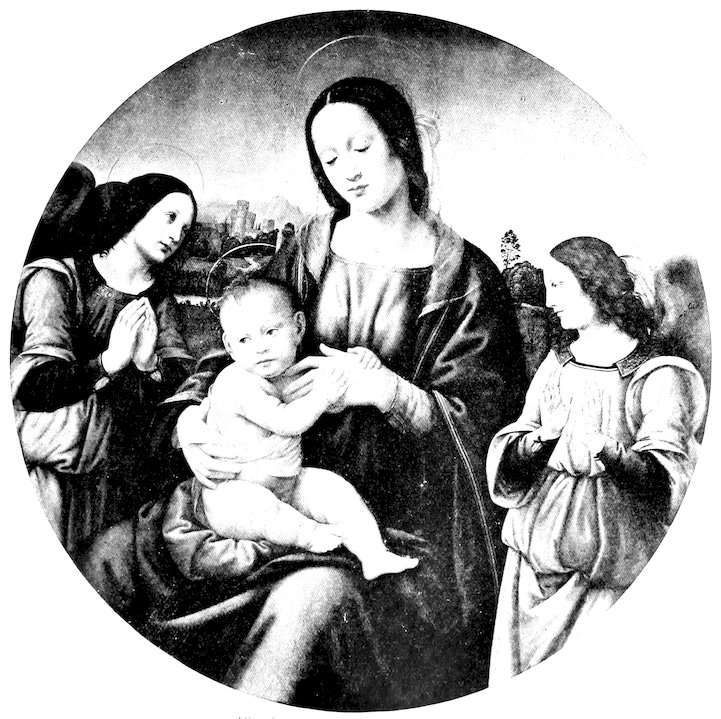
Alinari LORENZO DI CREDI. MADONNA AND CHILD WITH ANGELS (ROME)
Filippino’s angels in his great Cistercian picture, “The Vision of Saint Bernard,” are young; their stature is more childish than the character of their heads, and they are moreover bent, so that the erect figure of Mary may have a foil. They share something of the commonplace of angelic beauty, as the rocks under which Saint Bernard sits writing at a rustic desk have the commonplace of an unobserved nature, being designed by the hand of a man who never cared to see a rock or a wayside stone as it is. The chief beauty of this work is in the tender and majestic figure and countenance of Saint Bernard. It is perhaps worth noting that in drawing his angels on a moderately small scale Filippino Lippi followed, with his later feeling, a convention of his predecessors, who frankly varied 44the scale of their figures. I have not called certain companies of angels children, because they were rather small than young, designed to give dignity to a great Madonna. They have no part in this volume.
Lorenzo di Credi’s gentle designs have their differences amongst the works of other minor Florentines of the second half of the fifteenth-century, but those differences, though visible, are not easily to be described. He seeks for all possible expression in his young angels, expression of devotion and sweetness, and places a representative of the impetuous seraphim and of the thoughtful cherubim on either side of a tranquil Mother and Child: young angels of fourteen, small-headed, and on a small scale. Lorenzo di Credi’s variants of these well-known creatures are sleeker and more smooth than others. Though a Florentine citizen and the pupil of a Florentine, he is even less distinctively Tuscan than Leonardo da Vinci, who was his fellow-pupil in Verrocchio’s workshop.
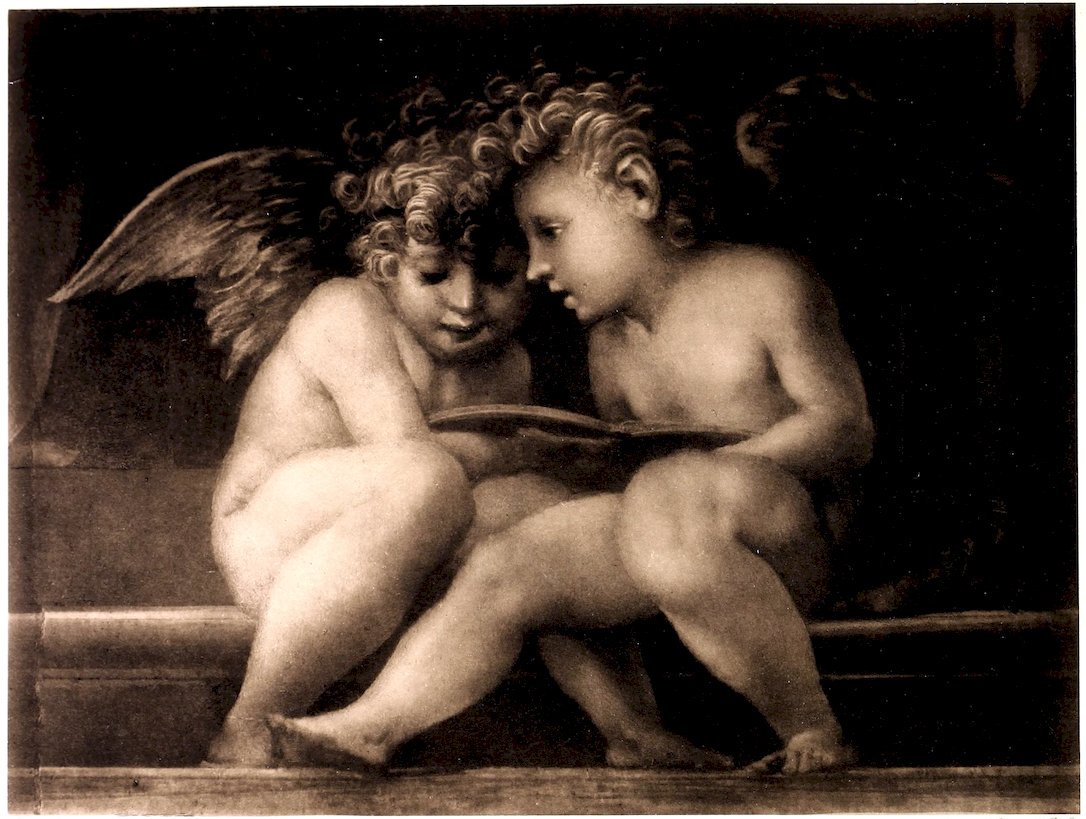
Rosso, Pinx Walker & Cockerell Ph. Sc. Angels.
Younger, more childlike, and nearer to nature than the young adolescent angels of contemplation are the little musicians. They are less smooth, more active, and busy with their strings. The players and singers of the earlier masters produced their music with an angelic ease and carelessness of method; but the child of the later school is industrious and able. He is the pleasant fiction of a day in which simple action had begun to amuse or attract the painter’s eye, in which the pencil paused with pleasure upon the way of a player with a lute and the incidents of the fingering. To feign the musicianly activity of a little child, to bend a babe’s hand to the strings or to put his small mouth to the recorders, was a game that 45pleased the fifteenth-century in Italy; it was such a mixture of realism and miracle as took the fancy of the time. One is reminded of the distant, different northern fancy, the mixing of observed fact with a pathetic convention in the insanity of the tragic stage, the sweetness of an innocent intelligence astray, the favour and the prettiness of the distracted woman. Carpaccio, Bellini, Bonifazio Veronese, Fra Bartolommeo, Frate Antonio the Olivetan, Rosso Fiorentino, are but a few of the painters, major and minor, who have put instruments into these infant hands; gross hands of natural-unnatural putti are some of them, and some again are animated with an eager grace. Frate Antonio gives to one fleshly babe (standing with one bent leg, for elegance) a triangle, and to another a flute; Bonifazio puts a large lute into the round arms of a winged musician; Raphael (in the “Madonna del Baldacchino” at the Pitti Palace) gives to two corpulent little boys, in attitudes both adult and effeminate, a scroll to sing from; Rosso gives us a sudden delight in the impetuous head of his angioletto with the cheek pressed upon the lute, the mouth close to the strings, the wings erect and the wild hair; Fra Bartolommeo makes his beautiful winged boy, in the cathedral at Lucca, a singer to his lute; Carpaccio’s middle child in the “Presentation of Christ,” one of the loveliest figures in Venetian art, is intent upon his lute.
Fra Bartolommeo’s boy is as much unlike a human child as might be one of the fifteenth-century heavenly choir, no more. He is not grown up, but has an alien felicity and sweetness in his beautiful eyes and in his majestic action. Here is expression, and here is a childish abundance fairly accordant with nature at her 46richest. Fra Bartolommeo, the Dominican successor of Fra Angelico after nearly a hundred years, is generally of a cold nature; his nobility of composition has a look of unheavenly state. He does not stoop, it is true, to the demonstrative and obvious dignities and graces practised sometimes by greater masters in the “late” period of Florentine art about to set in when he was painting. His design is too haughty for that consciousness, but the haughtiness is somewhat mundane. His work does not make that grave appeal to tenderness of which all art before the latter half of the quattrocento was full—architecture, sculpture, painting, music—or at any rate we in our day think it to have been thus full, and take upon ourselves the reply of sensibility. If we were children we should call him “grand,” with the protest implied in that childish word. When we were young, he seemed the most unsympathetic of the masters of the great time; and the English pre-Raphaelites doubtless renounced him as flatly as any master one could name. Yet, for all the chill, for all the gesture, for all his entirely adult spirit, he could design so beautiful a natural thing as this minstrel child. It is not a figure of the divine beauty of Carpaccio’s angel also playing his instrument in the foreground of a Mystery; and the difference is one evidently of genius or inspiration; but short of the wilder and simpler loveliness of the Venetian’s child, the Florentine’s is a noble creature.
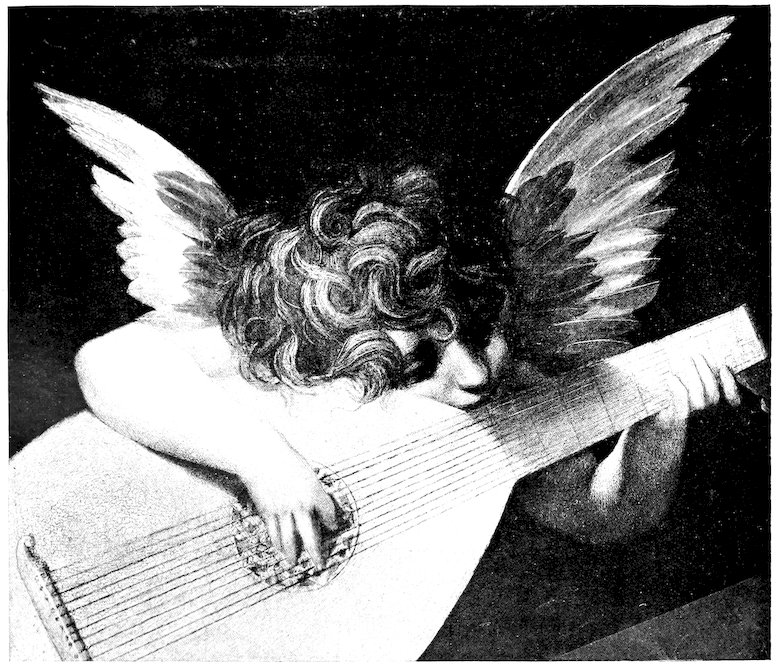
Houghton ROSSO. ANGEL PLAYING THE LUTE (Detail) (FLORENCE)
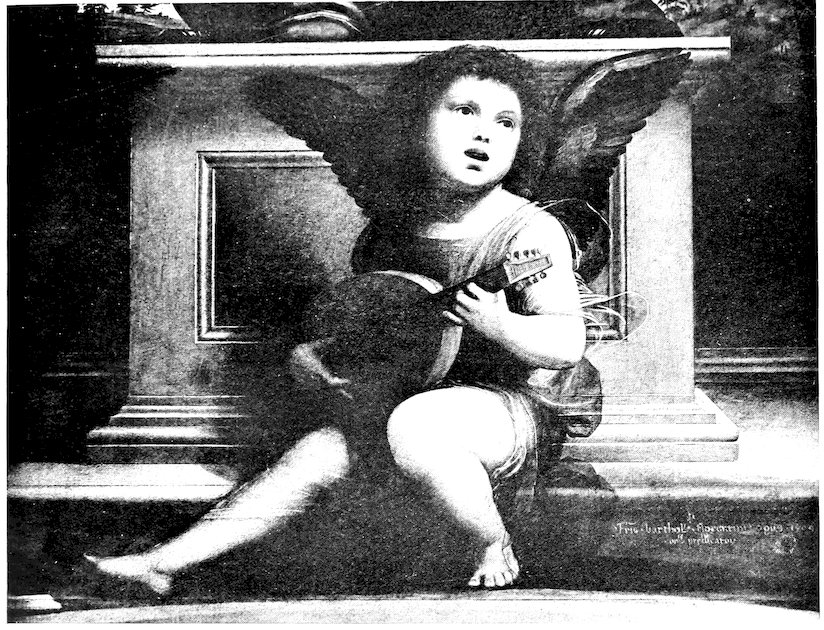
Houghton FRA BARTOLOMMEO. ANGEL (LUCCA)
Thus far these Tuscan children have been designed by “pre-Raphaelites”; for the arbitrary incompleteness of the definition which the name expresses is proved by the inclusion of Michelangiolo in those ranks. But Andrea del Sarto was a Florentine painter born next after the Umbrian master who was to leave so 47much corruptible, if not corrupt, in the art of Italy. Andrea del Sarto improves on the graceful game played by so many Florentines with the soft nude figures of the two children at the knees of their mothers, Mary and Elizabeth. If the former Italian painters had rounded the gesture, and bent the knee, and turned aside the head, his design was yet more curved and facile. It was yet more manifestly the design of the “sentimentalist,” to use a modern word not very handsome in form, but necessary now that we have begun to unmask and expose the character. In painting, the sentimentalist, all preoccupied with the banalité of his own device, had neither sight nor insight of incomparable nature. Sentimental without sensibility, he kept unwarmed the secret coldness and unmoved the obscure hardness of the sentimental heart.
For, watching thus the artificial attitude rehearsed by generation after generation of painters, I doubtless have dwelt too much upon the sin of commission in those who attributed to little children these graces, these rounded elbows, and these legs placed like those of a club-man standing to talk before a stroll. But assuredly it is the graver offence of omission—“Ye did it not”—wherewith we have chiefly to charge the Italians. They would not see the unconscious child, “the poor child at his play,” as Henry Vaughan says, or the wayside nursling as he looked every day, plain to be seen; they not only devised, but they neglected; gave no attention to that simple and abundant beauty, that straight aspect and direct gesture of innumerable children; and inasmuch as they did it not to the least of these, they did it not to the Child painted in a thousand pictures upon the Virgin’s knees.
48