THE FLORENTINE PAINTERS—I
Reading edition

The sculptors had recognized the form and proportion of the childish figure, and, more, the incidental characters of the units of childhood. The heavenly Della Robbias had nothing left unlearnt that their art needed to know of nature. But when painting, belated, began to represent the figure, it looked backward to its few examples, chiefly the mosaics, and adopted their bantling, the small-headed child, the son of Greek tradition, whose second life in the early Renascence in Italy was due perhaps to a corrupt following of Greece (one cannot say of Greek art in the “Laocoon,” for that very late Rhodian work was not unburied until the sixteenth-century), perhaps to some authentic ignorance appropriate to the inexpert art of painting. However this may be, here are painters, contemporary with our sculptors, reverting to the conventional child of the bassi tempi. Not only Cimabue did this, but Fra Angelico, and sometimes Benozzo Gozzoli. Fra Angelico is in all respects a man of a certain character rather than a certain date. He was early in character, and should perhaps have had his place in the preceding chapter, in spite of the prevalent sentiment that honours him as one of the masters of the noblest Florentine school. It is at least a tenable opinion that Masaccio was the first great Florentine painter; that Giotto is to be judged, for all his genius, and despite 27the certain truth that he takes the longest stride set by any man in the course of modern art, with indulgence; whereas Masaccio is absolutely a great designer. As for Fra Angelico, we have to remind ourselves that more than a hundred years lie between his birth and Giotto’s. That his painting was an untimely contemporary with the enamel of Luca della Robbia we have already wondered to observe. And being thus passed on the road, Fra Angelico shows the lagging of his art—lagging, with all its beauties—to be different from the custom of his time, or from that just about to develop, chiefly in two things, facial expression and the natural form of childhood.
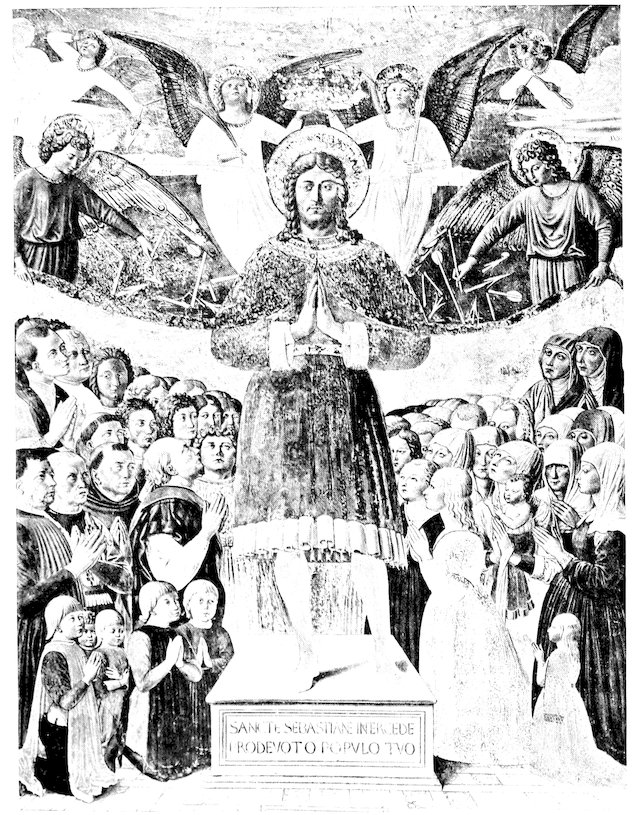
Alinari BENOZZO GOZZOLI. ST. SEBASTIAN (SAN GIMIGNANO)
He was, in a degree, dramatic; but if we take expression to refer to the face, and to the eyes above all—“countenance,” in the eighteenth-century, was much what we call expression now—then we cannot say that he was the painter of expressive looks. That he could be, in an infantile way, dramatic, he proved by the activity of some of his little devils when the sweet Frate compelled himself to oppose these symbols of evil to the garlanded representatives of good; and it might be possible to find something a little dramatic in the movement of those figures of trumpet-bearing angels by which his various and most interesting art continues to be made popular. He has, in fact, possession of a certain little energy of action, in the absence of any changes in the wreathed faces of the blest, or in the still looks of a Madonna. For expression he does little more than mark a harmless forehead with a frown. As he took no part in the then modern search for expression, so he took very little in the new knowledge of the figure of children. See, for example, the children in the Vatican picture, “Saint Laurence distributing alms to the poor and widows.” There is sweetness 28in the Frate’s design of the four little ones in this composition. The baby caresses his mother, a little girl looks up at the beneficent deacon, a very good boy and girl who have received their alms go away together with an affectionate little game, and the painter has made them pretty to the utmost of his power, giving them orderly curls, with a forehead of great height for the girl—and a fifteenth-century painter could do no more than this for woman or girl. But the proportions are nearly those of the adult figure, and the little ones with their graces look like smooth-headed dolls. In the “Madonna and Child” of the San Marco Museum at Florence, in the “Madonna and Child” at the Uffizi Gallery, as in the same master’s repetition of the same subject, the Bambini are little dolls—the first an affectionate doll, full of something lighter than sawdust, sitting on nothing, but still trying sincerely to lay a filial little face against the Madonna’s cheek; the second a ceremonial doll, holding the globe and giving the benediction, but yet all dolls because of their proportions. In the most important of Fra Angelico’s altar-pieces—the “Coronation of the Virgin” in the Accademia at Florence, painted in 1441 for the Prior Francesco Maringhi—two little children have the middle place in the foreground; they are evidently introduced at the suggestion of their parents in order to recommend them devoutly to heavenly favour. They have been given into the care of two Saints, a man and a woman, doubtless their patrons. If the Frate has intended any portraiture, it is not enough to define them; they are merely little Tuscans on their knees.
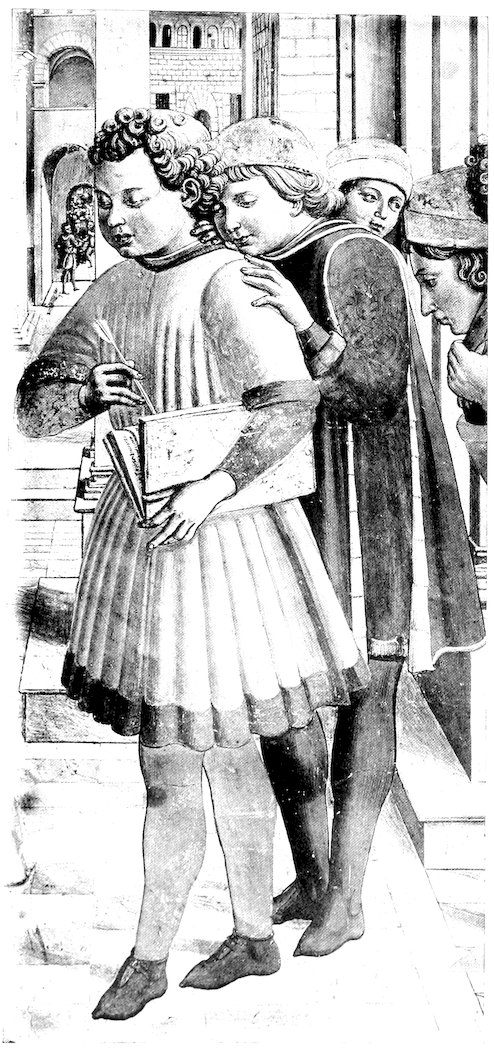
Houghton BENOZZO GOZZOLI. ST. AUGUSTINE AT SCHOOL (Detail) (SAN GIMIGNANO)
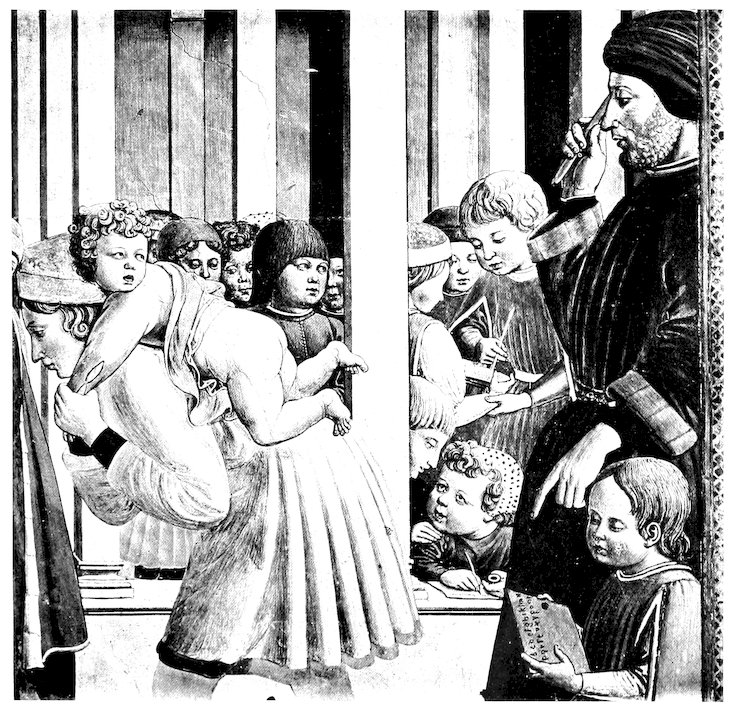
Houghton BENOZZO GOZZOLI. ST. AUGUSTINE AT SCHOOL (Detail) (SAN GIMIGNANO)
Masaccio yields us little. He was as much an adult as Michelangiolo; but when he designs a little child it is with more feeling 29and less condescension. I find a slight figure in the “Almsgiving” of the Brancacci chapel, in the Carmelite Church at Florence, an infant naturally unconcerned in what is going forward; in the San Clemente paintings another child naturally clumsy; a Bambino clasping the Virgin’s neck closely, at Bremen; at San Clemente, again, a doll-like child on the shoulder of Saint Christopher.
In the order of time, Fra Filippo Lippi follows near to Fra Angelico, being twenty-five years later in date of birth, but much more in the consciousness and complexity of mind, and the learning of the art. With Fra Filippo, as with many others, the child-Christ and the boy Saint John are nearly the whole of childhood. In the beautiful Berlin picture, the Bambino lies with one finger to his mouth, on a carpet of flowers in a wood. The figure is infantine, the action infantine, but the grace is artificial; almost as equivocal is the Saint John, round and youthful, standing with his thin rod of a cross and his little pennon, but—resolved to compass an Italian elegance as indispensable to design—the painter has disposed the little legs in the attitude of adult strength and adult idleness and leisure; no child stands so, in unstable equilibrium; a child uses both legs in repose, and gets what grip of the ground he can. It is evident that Filippo Lippi did not intend to give the familiar way of a child, but the ideal way of a “San Giovannino” in Florentine art. In a tondo at the Pitti Palace, Fra Filippo introduces the “Nativity of the Virgin” in the background of a “Virgin and Child.” Of the new-born Mary in the distance there is nothing to say, except that Saint Anne seems to be caressing the cheek of her swaddled daughter. A little girl, of no obvious meaning, is also in the picture; 30through an archway is seen the encounter of Saint Joachim and Saint Anne, the tired husband welcomed by his wife on the steps of their dwelling before the birth of Mary. The Bambino himself, in the foreground group, is, truth to say, an ugly Bambino, in the painter’s despite, seated in the lap of a very lovely and innocent Madonna. In one of the most beautiful of Fra Filippo’s simpler paintings, the group at the Uffizi, two angels lift up the Child on their hands, so that the Madonna, in her charmingly elaborate veil, may contemplate her son and pray with her two hands joined. One of these young boy-angels looks over his shoulder with the wearisome Italian grace, even then already a platitude.
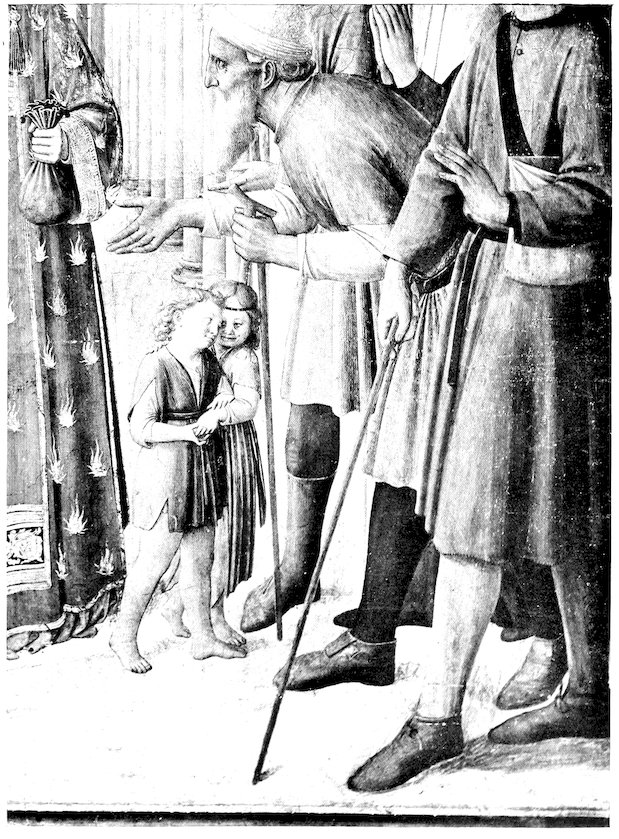
Houghton FRA ANGELICO. ST. LAURENCE GIVING ALMS (Detail)
Benozzo Gozzoli’s seventy years were well within the quattrocento; he did not see the summits of the sixteenth-century. In a symbolic composition such as his “Saint Sebastian” in the Church of Sant’ Agostino at Gimignano, he gives to his children something of the old conventional proportion. The whole noble gathering of heaven and earth is, in this painting, arbitrary. Saint Sebastian is colossal, and amongst the little people on their knees at his pedestal are smaller people who are a kind of children, smooth boys on this side, smooth girls on that. It is a singular Sebastian, free of all his arrows, clothed and combed with decorum, his martyrdom finished, and the long work of intercession begun. But Heaven is busy with his arrows. One is in the hand of the Eternal Father; the seraphim hold arrows instead of trumpets, and pierce with them the clouds of the floor of the skies; the angels that crown the Saint hold the arrow and the palm; broken arrows are scattered in the middle region, a flying angel snaps one in two. With all this, the action is 31curiously undramatic. That amid a dramatic people whose daily talk, whose voices, whose hands, are dramatic, there should be painters so failing—and there are many—is hard to understand unless we consider the embarrassment of the celestial company and attitude—the real shyness. An Italian himself would call it “soggezione.” And in fact he does lose something of his drama in talk when he is addressing a stranger or a superior, and regains it instantly with an almost grotesque expressiveness—for the tone of the voice, the language of the fingers are more than fit—when he turns from the stranger to say something to a fellow-citizen, or when he has to talk of his own daily affairs. So Benozzo Gozzoli, whose upper angels have rigid and unmeaning hands, and whose Christ and Madonna in this same picture use symbolic but inexpressive actions, has more drama in the multitude of the faithful on earth; and in the “Saint Augustine at School” he is free and has the natural impulse. In the sad scene of the chastisement in this picture is an urchin in a spotted cap, holding his inkhorn and pen, who is dramatically admirable. So are the two boys on their way to school, although they are doing little. The painter has intended—except perhaps for a slight convention in the hands—to design childish children, and to make them childishly beautiful. We see more of boys, clothed and about their business, in Benozzo Gozzoli’s frescoes at the Camposanto of Pisa than in a hundred years of the work of other Tuscans.
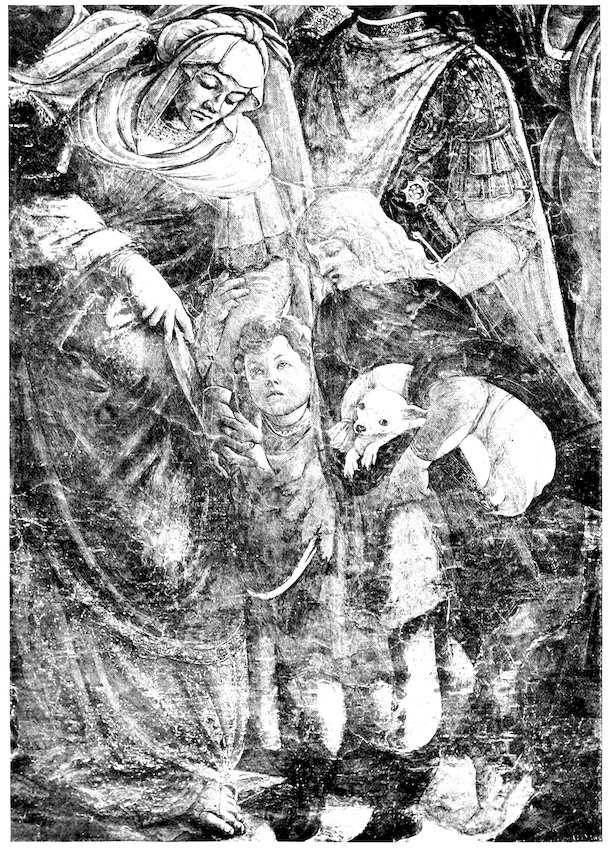
BOTTICELLI. From the “STORY OF MOSES” (Detail) (ROME)
The “re-animate Greek,” Botticelli, had but to recall, and hardly to learn, Antiquity, when that “new learning” which was the old came to Florence; such is Ruskin’s judgment of this painter, of 32whom others are not so sure. For example, one might think his sadness—the sadness of his Venus—to be something rather of the latter civilization than of the former; another might find the whole spirit that looks askance from the beautiful eyes of Botticelli’s Saint Johns and his stripling angels to be wholly mediaeval and Christian. But in the Madonna he has, almost invariably, the undisturbed look, above expression, which it is possible, by some effort, to assign to the Greek original, the antique ancestry, of his mind. This serenity the Madonna shares with the rejoicing goddess, with the Graces, with all the gay flower-spotted persons of the “Primavera.” Needless to say, his children are not Greek. His child-Christ would be more beautiful if Botticelli had not been obviously bound to the good gossiping parochial fifteenth-century idea of a fine child, a champion child. It must be what the French call plantureux. To assign to this physique a conscious intelligence, to make of a full-fed boy, six months old, a kind of theologian, is to create a little figure of ambiguous aspect and manners. In one group he points to the open book, in another he seems to teach his mother from the spread page. Botticelli was a religious man and, according to Mr. Berenson, “the greatest artist of lineal design that Europe has ever had.” His double preoccupation had regard, firstly, to the beauty and dignity of the Mother and the splendid physical condition and wisdom of the Child, so that his picture should express his devotion and satisfy that of all who looked at it; and secondly, to the perfection of the decorative composition. He had few of the group of “feelings” with which, after five hundred years of life, art, and literature, true and false, we contemplate a child. It is 33impossible that the world should have passed these centuries without learning some new loves amongst many studies in humanity; and, accordingly, we, having lost much, have gained that company of emotions which we call our love of nature. It would be insincere to profess that we find it in Botticelli; his true lovers prize him for more appropriate, more timely, and more national qualities of heart and vision. His love of nature in the Bambino brings about that charming holding-out of the arms, and inexpert caressing, of the Bardi picture at Berlin, the early Santa Maria Nuova “Madonna and Child with Angels,” and the “Madonna delle Rose” of the Pitti Palace, to take typical examples. The last-named is generally judged to be, though something more than a quadro di scuola, not altogether from Botticelli’s hands. But the Child’s action, if not the drawing, is at any rate Botticellian; and it assuredly does not come within our present love of nature. It is not nearer to our sense of childish attitude and action than are the roses that fill the background of this tondo to our sense of the character, the growth, the aspect, the stalks, leaves, thorns, buds, and faces of roses. Here is something different from convention, which uses the mere suggestions of natural form for rigid decoration. Botticelli’s roses and golden fruits are not ruled in ranks. They and his Bambini are the fruits of his love of nature, a love of nature at arm’s length. It is in some of the angels, and in more than one Saint John, that the look is more direct; both the beauty and the expression are immediate, or almost immediate, as close as Botticelli chose to approach, or perhaps was able to approach. The lovely tondo in our National Gallery has been at different times held to be by the master, by a 34pupil working under the master’s direction, and by a painter merely of the Florentine school of Botticelli’s century. Whatever hand designed and painted this beautiful group was the hand of genius. No study of children painted by the Italian masters could pass over these exquisite heads. They are heads of later childhood, the age of Saint John the Baptist being decided upon by the painter’s choice. Historically he would be, as Raphael so often makes him, a companion infant to our Lord; it is characteristic of the painter of this Madonna and of other doubtful Botticellian work—for instance, the picture at the Louvre—to group a Baptist of some twelve years old with the infant Christ. The three heads have thus a touching difference in their youthfulness. In the National Gallery picture there are angels of Saint John’s age, and of equal beauty. The young Baptist is clad in his camel’s hair and carries his slender cross. In all these lovely faces there is the Botticellian length; but whereas the undoubted Botticelli was somewhat fond of an oblong shape, especially, it would seem, when he aimed at singular beauty, the school-painter has the long form with a pointed chin. Botticelli in his later years drew the face with a slightly pointed chin. He and his pupil, if pupil it was, had alike an ideal eyebrow, arched and far above the eye, implying a huge eye-socket or orbit, but one filled smoothly with flesh. That space between the eyebrow and the closure of the eyelid was so dear to the painter in question that he carried it perhaps beyond the probabilities of anatomy, certainly beyond experience; in the unquestioned work of Botticelli it has hardly the look of wistfulness that the school-painter gives it, allying it with the gaiety of the chin. The Saint John of the 35Louvre group, that beautiful boy with sidelong look and folded arms, has the eyebrows and the chin. So has Botticelli’s own Bambino in the picture at the Pitti, in which the Child is about to kiss his Mother.
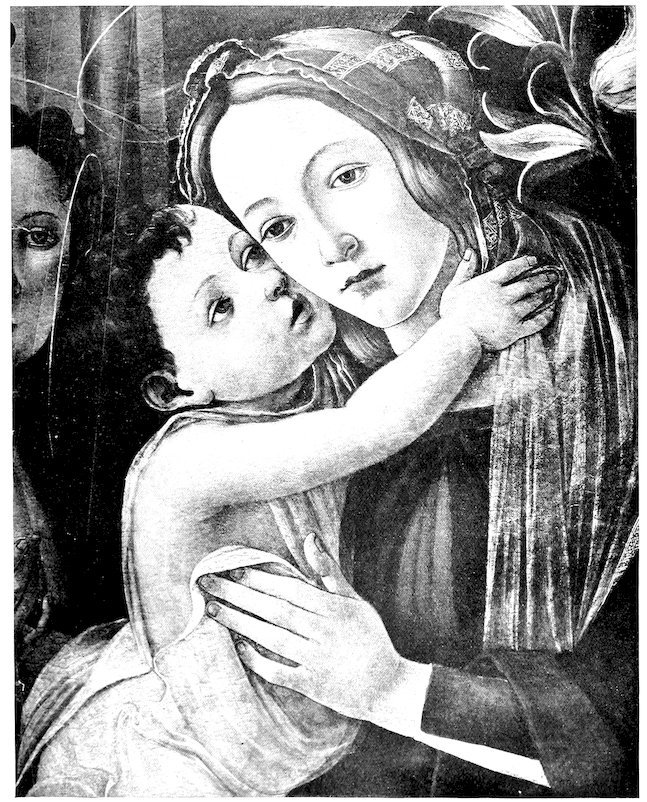
Houghton BOTTICELLI. MADONNA AND CHILD (Detail) (FLORENCE)
Finally, these notes on the typical children of Botticelli should close upon the most noble composition known as “The Childhood of Moses” amongst the frescoes in the Sistine Chapel. It is a part of the great composition of the “History of Moses,” in which Botticelli painted seven scenes from the life, or rather the early life, of the Patriarch—that is, from the smiting of the Egyptian who had slain a Hebrew, to the Exodus. The childhood of Moses does not appear, but the latest scene of the picture, the leading-forth of Israel, contains the figures of two children; hence, perhaps, through some misapprehension, the customary name. It is the child who, without labour, bears the burden of all pilgrimages, even that of the mere change of home; here are the people going into the wilderness, and Botticelli bears in mind the children who are to be tired and to weep upon the road. Moses leads out a little company whereby the painter represents Israel. They are loaded with their few possessions; and the foremost group is that of two young unequal boys. The elder carries his bundle, and with the bundle a little lively dog; the younger uses both hands to cling to his mother’s hand and arm; he must make two steps to one of the men and women. He too is a “fine child” of the time; but perhaps because the master in designing this beautiful head did not labour especially for wisdom and the favour of God and man, he has produced more simple nobility than in painting many a child-Christ. The elder boy pities him, 36looking down with the passionless aspect of quattrocento feeling at the largely-moulded infantine face; and the young one looks up with a directly sorrowful appeal, but with beauty undiscomposed. Also in the Sistine frescoes is Botticelli’s boy with a snake. It is evidently a fine figure, now more than half effaced; the child, encumbered with an armful of grapes, looks down at his leg, around which the snake is clinging. Professor Steinmann sees in this design—and the likeness is manifest even in the present decay—an imitation of the antique statue, “The Child with a Serpent,” now in the museum of the Capitol. Botticelli, the Florentine, summoned to Rome by Pope Sixtus IV., to work with Ghirlandajo, Perugino, and Cosimo Rosselli at the decoration of those walls of his chapel which Michelangiolo was not to paint, had the art of Antiquity before his eyes, fragments of much that had been then newly shattered, relics of ancient Rome, and some few of that ancient Greece of which Ruskin holds him to have been the true citizen. He gives us this one clear sign of his attention to the art of the past—the figure of a child. Leaving Rome, he returned to his work for convent and church—the Madonna, the young angel, the holy Child. He returned also to the study of Dante; Vasari charges him, without reason, with giving to this literature the time due to his art. Botticelli did, in fact, follow his own art diligently until those last years which were given to the yet closer practice of his religion.
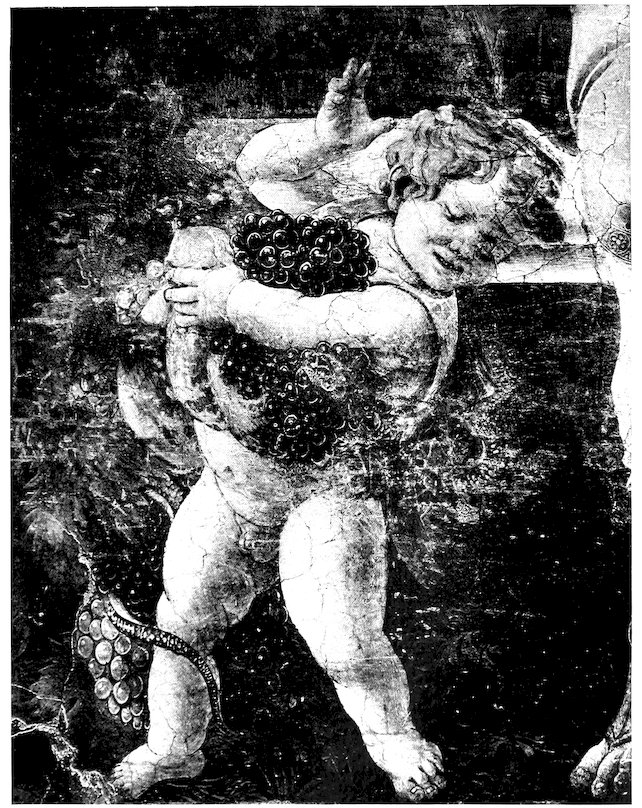
D. Anderson BOTTICELLI. BOY WITH A SNAKE (Detail) (ROME)
37