THE CHILD OF EARLY ART
Reading edition

In the ages that, since the Renascence, have been called dark, the scanty art knew but one Child, but this was virtually the first child in art—the first prevalent child. Whether we hold the art of the time between the fall of the Roman Empire and the entry of Byzantine art into Italy—the time that is darkened by the smoke of the destruction, and the dust of the demolition, of Rome—to be the last art of the antique world or the first of the modern world; a seed-pod or a bud; an art rigid, grave, and inexpert with exceeding youth, or bearing those characters because of extreme age; we find it separated from the past, and allied to the future, by the motive of its effort, by its desire, by what we call in our loose language its subject. That subject was chiefly the child-Christ in the arms of his Mother. When the linear arts came out of hiding in the Catacombs they came with this burden and for the sake of this. Learning has not said its last word as to the female figure so often traced on the subterranean wall—whether the “Orante” was a symbolic woman or a Madonna; she has no child. But about the woman with a child there is no doubt. A half-effaced fresco in the Catacomb of Priscilla has a singular, natural, vivid, well-observed Child glancing suddenly round from his Mother’s breast with animated eyes—“falcon 12eyes,” an Italian writer calls them; and this is from an early hour of the dark ages, and a mere scratch in a dark place. Since this Catacomb design has still a spirit, a vitality, a dramatic impulse that relate it to antiquity, then it is in these places of Christian sepulture that the old art lived its latest unmistakable life, and then passed into that ambiguous state I spoke of but now. For the falcon-eyed child is conjecturally of the early part of the third century, thirteen hundred years, that is, before Raphael; Raphael has much the same action in the “Madonna della Seggiola.” It would be too much to say that, except in sculpture, this vitality of childish movement lapsed during those thirteen centuries, passed, in linear art, from the nameless hand of the Christian in the Catacomb into the glorious hand of Raphael on the summits of sixteenth-century Rome; but it might almost be said. For in the pre-Raphaelite painted Bambini there is something less quick, less instant, than in the little head of the Catacomb of Priscilla, and in the little head of Raphael’s picture.
The rest of the Catacomb designs are, as has been said, ambiguous, between two worlds; the rigidity of weakness is in them; the proportion of childhood is lost—for let us add to the strange honours of the Priscilla drawing this fact—that the size of the Child’s head is there according to nature. After this the Catacomb designs keep their “dark-ages” character. Moreover, from a Roman tomb of an even earlier date than that of the Catacomb Child—the vault of a tomb of the first or second century—we have slight sketches in relief, amongst which is a child; he is exceedingly young, and springs, seated, as a child who cannot walk springs on his nurse’s arm; but 13this child is driving a dragon, and doing it with spirit and with shouting. He is perfectly childish in proportion, a large-headed, animated boy, for whom some baby sat, in the time of Trajan, leaping at some vigorous fancy of his own. This work, by the way, is so skilful, as bas-relief, that we cannot rank it with the equivocal early Christian drawing; this dragon-driver and all the other work from the same tomb is decidedly late-antique, and not early-modern; it is only the Christian art that bears the twilight character—twilight of nightfall or of daybreak?—in its seclusion.
Next come the majestic mosaics of the Byzantine churches, from the sixth-century Madonna and Child in the Basilica of Sant’ Apollinare Nuovo, at Ravenna, to the beautiful twelfth-century Madonna and Child of the Duomo of Torcello. Majestic, indeed, are they, albeit not only ignorant but weak, barbaric in the early examples, and loaded—the crowned woman and the crowned doll-child—with ornaments as rigid as their eyes; but all-noble at their worst and best. It is only at the close of these ages that notes on Italian schools should properly begin. The Italian schools grew from the Byzantine in Italy; and they had there a great origin. The Renascence, if we give the name to this evolution of an art, was no sudden thing. Imperceptibly the art of the alien mosaic passed into the art of national painting. Cimabue made, if one may say so bold a thing, very little difference. That his Madonna was portable may have been, after all, the chief cause for the carrying in procession; that he “held the field” in Florence may have been chiefly by reason of his Florentine citizenship. At Siena, in the same Tuscan country, Cimabue had contemporaries and equals. Margaritone d’Arezzo was 14born some twenty-five years earlier than he, and was hardly that quarter of a century more Byzantine. Duccio di Buoninsegna, whose “Madonna and Child,” with contemplative angels, has at least as much as Cimabue’s flexibility, followed him closely in time. And Duccio’s angels, leaning on their hands on the back of the Madonna’s throne to look at her Child and her, have a quiet drama of attitude and look, as full of promise as the best action of the attendant angels of Cimabue. The Child of all these first masters of Italy has the arbitrary proportions, the erect attitude of the time, the aspect of a strange small man, which was, let us remember, as far as we know, the fiction that Greece herself approved. Cimabue places him on his mother’s arm, rather than on her knee, but, needless to say, with no weight; one hand is raised in the action of the Papal blessing—three fingers up to represent the Holy Trinity. Cimabue does not give child-angels to the Bambino for companions; none of his angels, I think, can be said to be children.
When we pass from the mere image of the Virgin and Child to the representation of the Nativity, art becomes, in a certain degree, dramatic. Inasmuch as it “illustrates,” the criticism of our day would call it literary; but it is not more literary than life is literary. The plastic and linear arts have to do with all that the eyes can see; that is their large province: expression, action, significant attitude, moral beauty and intellectual beauty in their aspect, passion in its aspect; all these as well as decoration. The great schools had no doubts as to this matter. And the art that was not yet a school, and hardly still, or hardly yet, an art at all, fumbled at the scene of action, even in the Catacombs. In the acrosolium of one of the dark galleries of the 15Catacomb hard by the basilica of Saint Sebastian, on the Appian Way, is a little painting of a wooden bench, upon which lies the child-Christ, swaddled, with two animals at his side. This is conjecturally of the fourth-century. It is the first “Nativity.” In regard to the character of art it is the first, and Correggio’s “Notte” is among the last. For after Parma and Venice art ceases to go on a steadfast, confident and coherent way; it breaks as a thread of water breaks into drops. Virtually, if not in actual date, Correggio was the latest of the great. He showed plainly the corruption of art in the near future, while in the immortal Venetians who were his contemporaries there was not even corruptibility. Incomparable colour kept them in exalted health—colour and tone. As much as colour, assuredly the tone of Titian and Tintoretto—the tone of a head against the sky as Tintoretto painted it, or the tone of the arm against the cloud in Titian’s “Amor Sagro e Profano,” secured the art of Venice against the thought of decadence. But decadence was close upon Parma and Rome. During all these ages of genius, then, the art of painting was intent upon the representation of the Nativity.
It shrank, however, from representing a new-born child, even in the manger; the Nativity, though dramatically rendered, was to be contemplated as a mystery, rather than watched in the taking-place. Thus the Child is nearly always nude, for the sake of the round forms, and some months old. But Giotto, who clothes all his figures heavily, has sometimes a draped and sometimes a swaddled Child, and obviously tries to make the scene “like” the fact. And the two intentions keep pace for some time until the Mystery gains. The Nativity takes place then in the open country, amongst splendid buildings, or under 16a triumphal arch; and the donors of the picture and their patron saints attend with Milton’s “bright-harness’d angels” at the “courtly stable.”
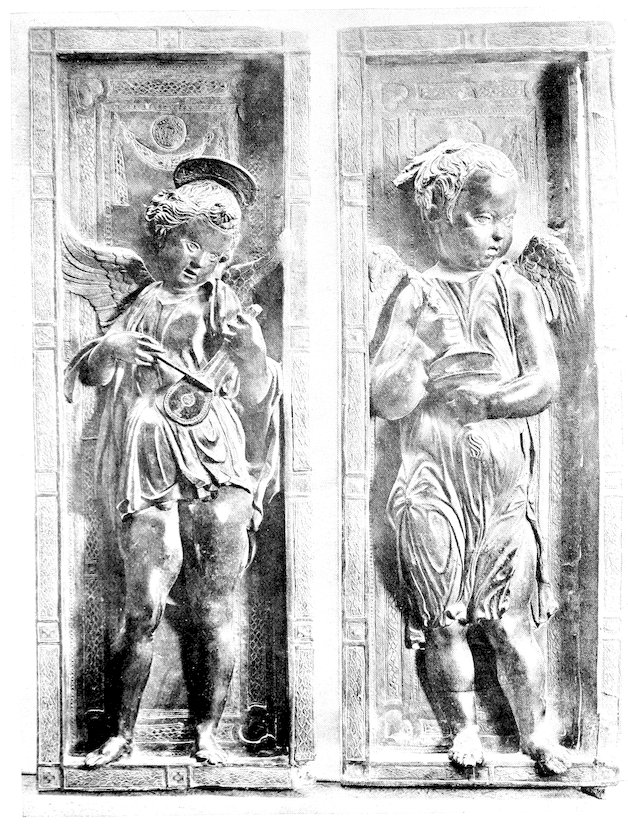
Alinari SCHOOL OF DONATELLO. ANGELS (PADUA)
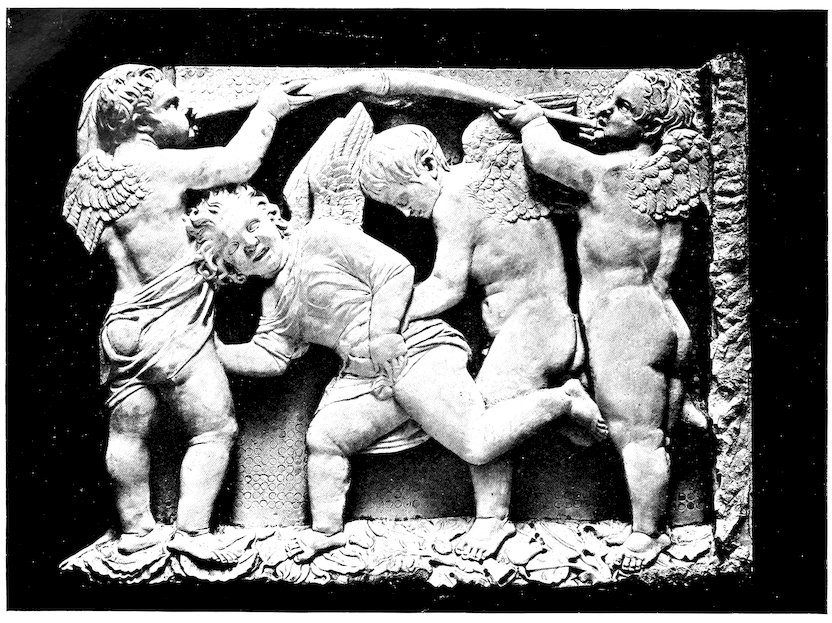
Houghton DONATELLO. WINGED PUTTI (FLORENCE)
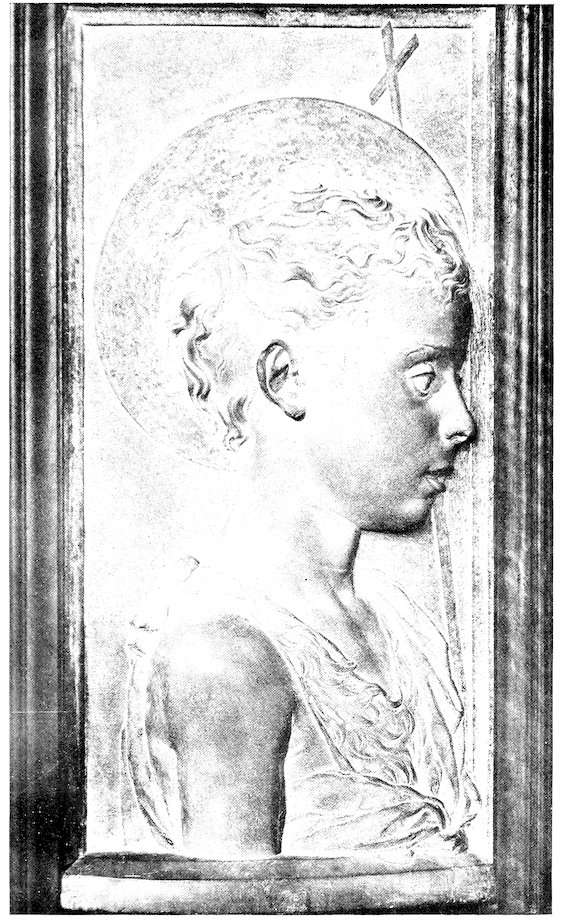
Houghton DONATELLO. THE LITTLE ST. JOHN (FLORENCE)
17