RAPHAEL AND AFTER
Reading edition
It is the Raphael of children, and not the whole Raphael, that is in question here; and any temerity of opinion whereto these pages may bear witness will for that cause be more easily forgiven. The master whose name is tender and august, sweet and venerable, in the ears of generations in all Europe, added this or that to the arts of arrangement and design, but he rather continued and fulfilled than renewed the painting of childhood; he certainly did not invent the grace we call Raphaelesque, for we have seen this misunderstanding and misconception of childhood persist, before his date, in all the schools of the peninsula; we have had it by rote, and the formula is known. In Santa Maria della Pace, in Rome, Raphael has some loves or angels, part of the fresco of the four Sibyls, figures nobly composed as design, but far less than noble or natural as studies of children. One, in particular, may be taken as the representative of the whole convention, and this is his attitude: he kneels upon one knee, and the other corpulent leg is bent, and its foot turned out excessively; the body is twisted from the hip so that—as De Musset’s dancing-master danced—it should contradict the turn of the foot, and it is also bent abruptly at the waist; and this twist is wrenched aside again by the turn of the head and neck; there are five zigzags, or perhaps one 67should say three zigs and two zags; and all this elegance performed by a babe for whom those pranks were never intended, for whose shape they are unfitted, whose mind could not grasp them, whose spirit they do not express, whose simplicity they violate, and for whose own honest graces they prove the painter inventing them to have neither heart nor eye. Raphael was not that painter, he had no kind of originality in the device, he fell in with the custom, only carrying it, in this instance of the angel, somewhat farther; but his was the propaganda which is seldom the inventor’s; he imposed the formula of grace upon all Europe; he declined upon Canova, upon Sir Thomas Lawrence, upon the Italian decorator, upon George IV. True distinction, such as that of Sir Joshua Reynolds—true freshness—was untouched by that sickly prescription, but nothing inferior escaped it. It was the rhetoric of the body, it depreciated attitude. Chancing lately to enter a Chinese temple in San Francisco on a great festival night, and to see a priest diligently dancing to and fro in front of the altar of his gods, I had one chief thought. The priest was, unlike the men of his crowded congregation, a majestic creature, of stature and spirit, with an oval face flanked narrowly by the long lappets of a fine headdress. He danced long and fervently, with a whole code of actions and attitudes altogether alien in our eyes and of unintelligible beauty. And the chief thought of the European stranger was this—that here was a grace in which Raphael had no part. Nothing I had ever before seen in adult public life, nothing in church, street or theatre, on platform, or on the trapeze, had been so unlike Raphael. There was nothing of Raphael in the derivation of that elegance, not even the protest 68against Raphael whereby the English pre-Raphaelites of the middle of the nineteenth-century implicitly recognized, while they renounced him. The Chinese priest was all apart from Raphael, and this was the thing that struck the traveller—so long, so wide and general is the obsession of Raphael in Europe, and the dancer from beyond the East and beyond the West came thus far to prove another lineage.
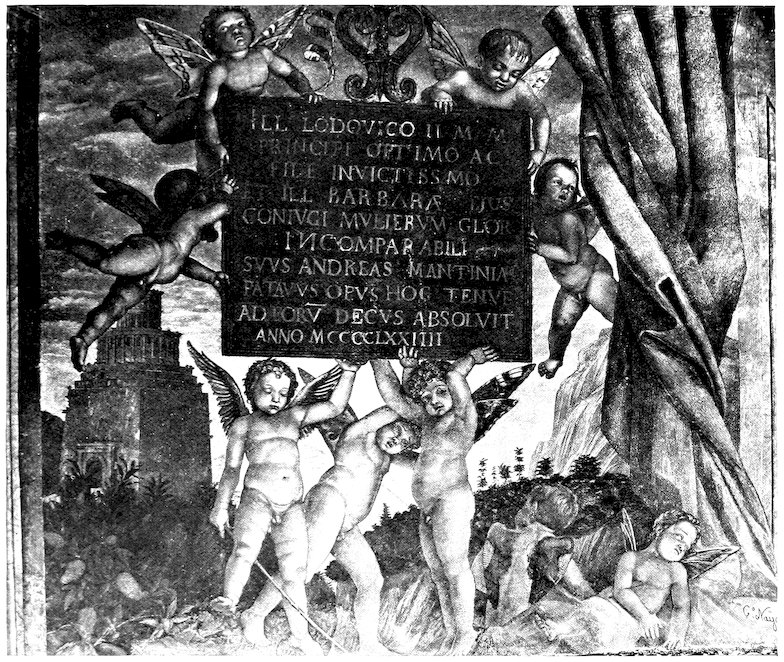
Naya ANDREA MANTEGNA. CHERUBS (Detail.)
Meantime, nevertheless, there was always the child at home, the Italian child and the English alike, visibly as free from Raphael as the Chinese priest. Art, the dance, and the stage might take the sickly pose, but the child’s body was free. And Raphael himself saw this. He was more original when he drew children that were not, than when he designed children that were, Raphaelesque. That is, he saw for himself the grave childish glance and the huddled position of the Boy of the “Madonna della Seggiola”; here is no twist of attitude; the head is aside, indeed, but as nature turns it, and not for the sake of attitude. Moreover, this is a clasped child, not one touched at the distance, and with the unconstraining hand and the parted fingers, of Italian grace. The Madonna of this picture is the most popular of all the master’s Madonnas, but she is not fine enough to resist the wearying effect of her scattered fame; her face, often repeated, grows tedious. But the Boy’s head does not tire our interest and admiration. If we are weary of the picture, we know that of one part we are not so, and that the “Madonna della Seggiola” is at once a hackneyed work and a fresh.
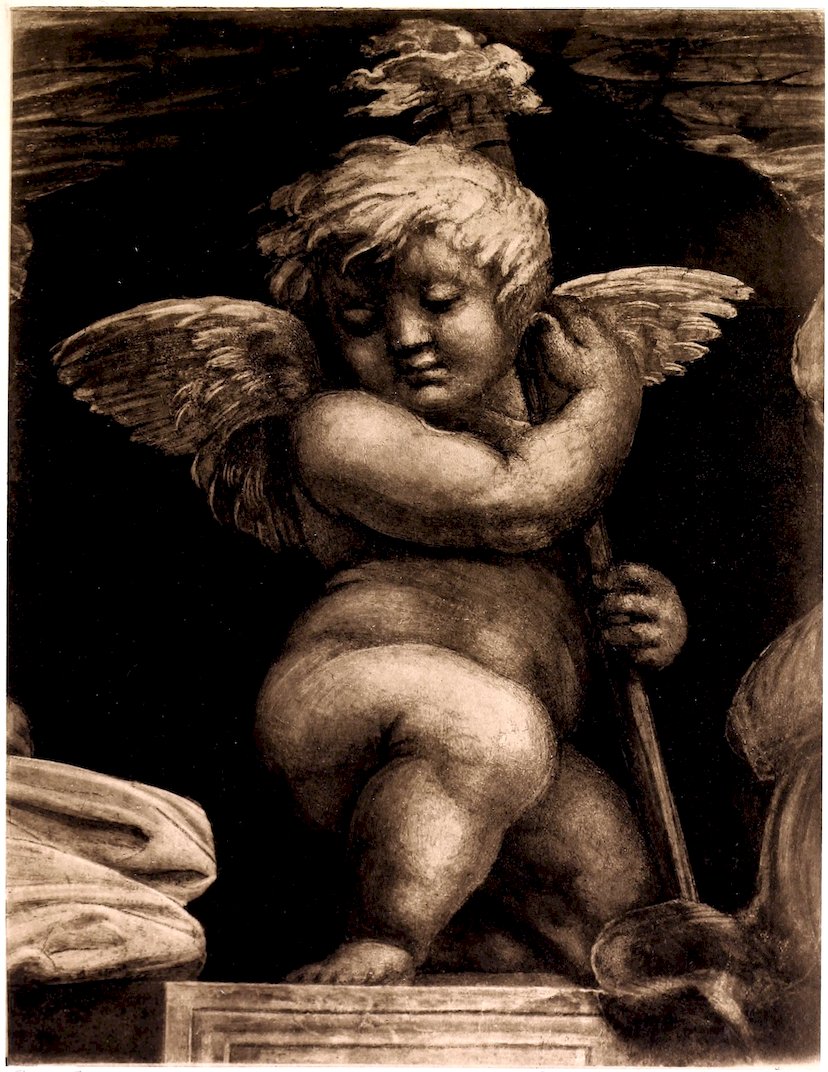
Raphael Pinx. Walker & Cockerell Ph. Sc. Angel from the fresco of the four Sibyls (Santa Maria della Pace, Rome)
No less beautiful, and invested in the imaginations of some spectators with greater nobility, is the Child of the Dresden “Madonna di San Sisto.” He too is free from the Raphaelesque pose, 69and the childish figure bears a head forced not at all from the character of its age by its look of intellect and power. There is all the quality of a portrait in that head, with its eyelids folded down at the outer corner—a not beautiful but not ignoble irregularity wherewith the older masters would not have had the heart to roughen the features of a little Christ. For them were the long and fine corners of well-finished eyes. Raphael probably saw such severe eyelids in a living boy; and in this picture they make a detail of likeness between the Child and the most worthy of the master’s Virgins. This young dark-haired woman walks all the ages and all the spaces, and in some happy hour Raphael set on her arm his single solemn Child. Only in the arbitrary and not very fortunate puff of her veil is this beautiful group marred by evident convention. But in the Saint Barbara kneeling below, in the two angels to whom she smiles, Raphael turns again to the adulterated feeling of Italy. The two putti have no more than a pretence of natural action—a somewhat deliberate make-believe in the raised shoulders of the one, the huddled chin and pushed-up mouth of the other. These puttini are intended to be at their ease, and in designing them the master has denied himself his habitual grace; none the more are they true. For beauty and extreme sweetness—mere sweetness—a foremost babe of Raphael’s is that of the “Madonna del Cardellino,” who with languishing looks, and the attitude of a woman, with projected hip and languid leg, caresses the bird brought to him by a laughing Saint John. And of the putti, none are more artificial than two in the “Madonna del Baldacchino,” who are singing their parts from a scroll of music. Women’s attitudes again are theirs, and women’s 70looks, but the women who should practise these would be lacking in uprightness and simplicity.
See also the twist of the Bambino of the Foligno Madonna, who turns shoulders, head, pelvis, knees, and feet in as many directions in a kind of convulsion of affectation and grace; and the unchildish manner of standing of the Child in the Louvre picture; all these are Italian improvements upon a nature unwatched and neglected. The great time of art is checked in its greatness by this figure of a child mishandled. That it is not altogether a great time we know by the rebuke, always at hand, of a living child’s authentic action and incomparable beauty. The pride of the sixteenth-century is, in this sense, at the mercy of a photograph.
Close upon Raphael followed the painters of Parma, more fluent, softer, riper than even he. A reaction against Raphael probably strikes with still more vigour against Correggio. Yet this last-named has more of the false elegance in the woman’s action, and less in the child’s. The smiling mother turns her shoulders and her head, but the Bambino is often straightforward; thus Correggio tampers with the lesser simplicity. He is fond of a dainty strife between the baby and the mother, the one catching at the veil, the other checking the little hands. For the famous putti of Parma, with their exuberant and sentimental prettiness, few men with modern feeling can have a warm admiration. It is a surprise to find Ruskin owning a rich and gay charm in these frolic children. Whether as pictures of beautiful boys and angels or as a decoration, is a company of Correggio’s children in their hide and seek what we would choose for beauty and delight? Were these happy 71ends ever attained by means so conscious and so luxurious? We have learnt, rather, that something more sparing is not only more beautiful, but more joyous.
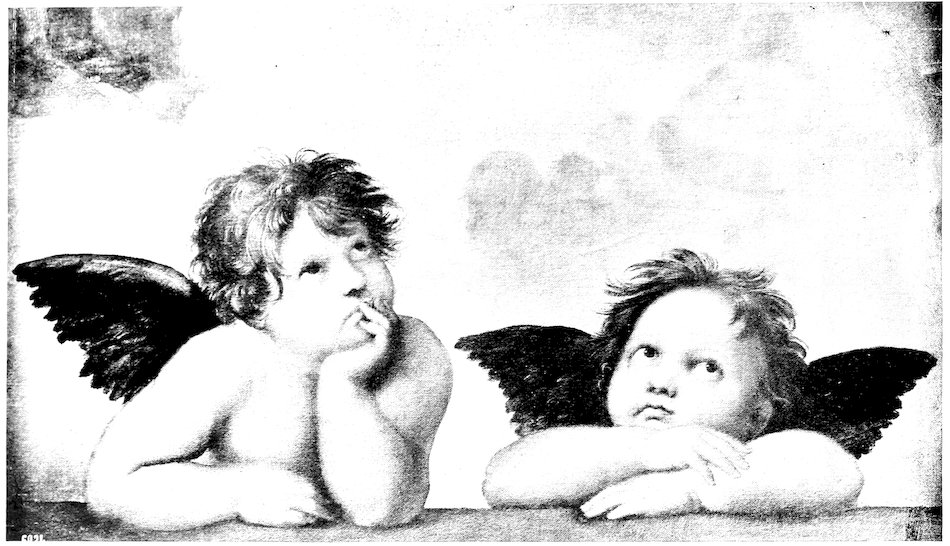
Houghton RAPHAEL. ANGELS, “MADONNA DI S. SISTO” (Detail) (DRESDEN)
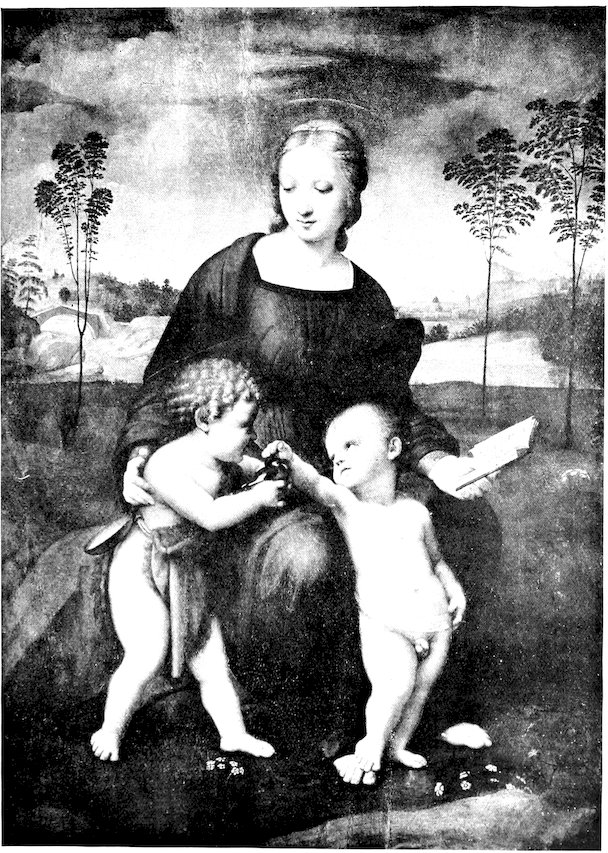
Alinari RAPHAEL. MADONNA “WITH THE GOLDFINCH,” CHRIST AND INFANT ST. JOHN (FLORENCE)
After Correggio the decline comes quickly; and the word “decline” seems to express but ill the flimsy scattering of genius. For genius grows thin, light, and cold, and wastes. Parmigiano, aiming at beauty only, should perhaps have aimed at something loftier or further in order to hit the swift and incontrollable creature. I cannot think that the composition of his, held to be most beautiful, does cause the delight that is the sanction of beauty. This is the group of eight young figures—“Amorini Scherzanti”—of the picture in the Palazzo Mancini gallery at Città di Castello. One of the eight is a youth, the others are little rounded boys; the elder is Love, and the seven play with his arrows. Nothing could be more purely a work dedicated to loveliness and pleasure; and yet there is not a figure there but has, in spite of the action, the movement, the sport of lines, an invincible dullness. It is not extravagance, it is not excitement, it is not excess, or dizziness, or delirium, that chastises habitual pleasure in art, but only dullness; and when children are made the ministers of that habit, the dullness looks the more foolish. One of the Latin races, having the dullness and keeping wit enough to name it, has the word for it—banalité.
Thus the figure of a child corrects and rebukes. The review of children in art seems to promise delight and indulgence, but we find in it various sentences of judgment.
In Rome, where all ornaments are cast into a certain mould, the sixteenth- and seventeenth-century taste held upright things in 72so much dislike that the straightest thing in the world, the chasuble of a priest, must be caught in a gale, so that it should flutter with folds like the scarf of a woman. A hurricane would hardly suffice, in fact, to set flying this rigid Romanesque vestment, but there is no sculpture where Bernini lets it hang plainly in the attitude for which it was made. The inappropriate flight is much like the forbidding of the Italian urchin to stand upon two simple and equal feet.
The word “after” has doubtless more significance when it waits upon the name of Raphael than in any other of the conditions of the history of art. To follow Raphael is to follow that which, in certain aspects great, in certain qualities nobly ideal, in certain examples incorrupt, was yet in a greater number manifestly and explicitly corruptible.
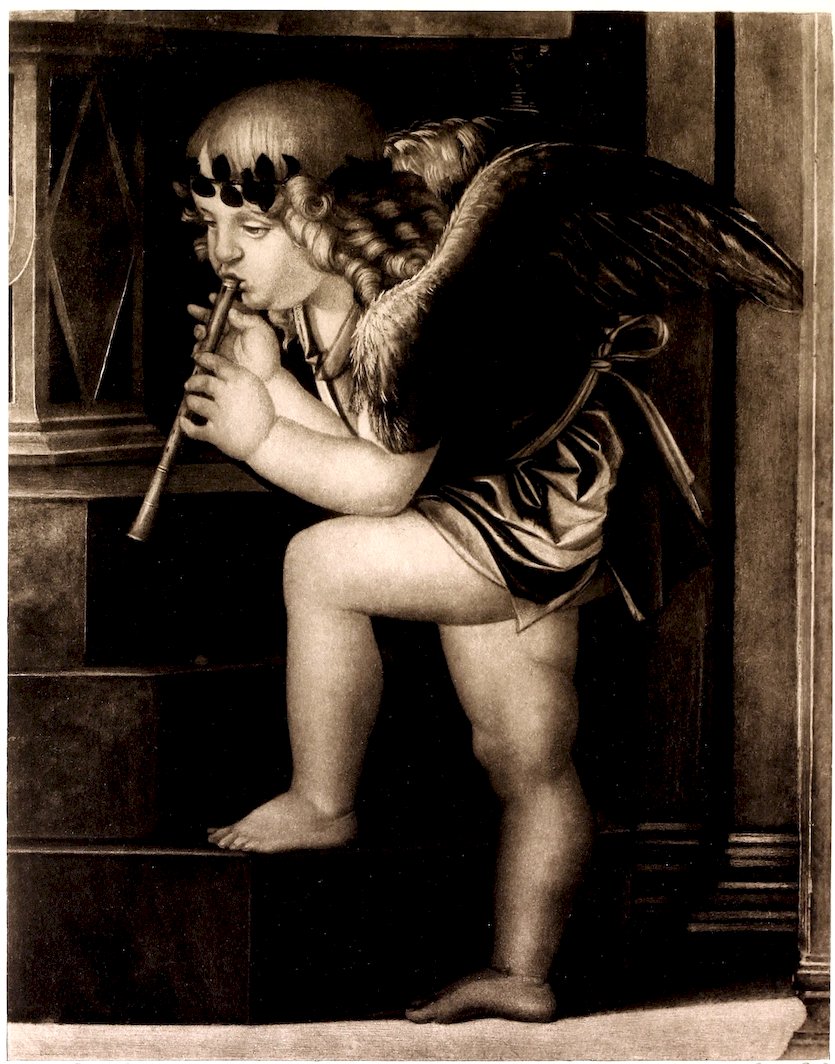
Giovanni Bellini. Pinx. Walker & Cockerell Ph. Sc. Angel playing the Flute.
73