Volume 6 — S (continued 2)
Reading edition
“Each group of Savaras,” Mr. Ramamurti writes, “is under the government of two chiefs, one of whom is the Gōmong (or great man) and the other, his colleague in council, is the Bōya, who not only discharges, in conjunction with the Gōmong, the duties of magistrate, but also holds the office of high priest. The offices of these two functionaries are hereditary, and the rule of primogeniture regulates succession, subject to the principle that incapable individuals should be excluded. The presence of these two officers is absolutely necessary on occasions of marriages and funerals, as well as at harvest festivals. Sales and mortgages of land and liquor-yielding trees, partition and other dispositions of property, and divorces are effected in the council of village elders, presided over by the Gōmong and Bōya, by means of long and tedious proceedings involving various religious ceremonies. All cases of a civil and criminal nature are heard and disposed of by them. Fines are imposed as a punishment for all sorts of offences. These invariably consist of liquor and cattle, the quantity of liquor and the number of animals varying according to the nature of the offence. The murder of a woman is considered more heinous than the murder of a man, as woman, being capable of multiplying the race, is the more useful. A thief, while in the act of stealing, may be shot dead. It is always the man, and not the woman, that is punished for adultery. Oaths are administered, and ordeals prescribed. Until forty or fifty years ago, it is said that the Savara magistrate had jurisdiction in murder cases. He was the highest tribunal in the village, the only arbitrator in all transactions among the villagers. And, if any differences arose between his men and the inhabitants of a neighbouring village, for settling which it was necessary that a battle should be fought, the Gōmong became the commander, and, leading his men, contested the cause with all his might. These officers, though discharging such onerous and responsible duties, are regarded as in no special degree superior to others in social position. They enjoy no special privileges, and receive no fees from the suitors who come up to their court. Except on occasions of public festivals, over which they preside, they are content to hold equal rank with the other elders of the village. Each cultivates his field, and builds his house. His wife brings home fuel and water, and cooks for his family; his son watches his cattle and crops. The English officials and the Bissoyis have, however, accorded to these Savara officers some distinction. When the Governor’s Agent, during his annual tour, invites the Savara elders to bhēti (visit), they make presents of a fowl, sheep, eggs, or a basket of rice, and receive cloths, necklaces, etc. The Bissoyis exempt them from personal service, which is demanded from all others.” At the Sankaranthi festival, the Savaras bring loads of firewood, yams (Dioscorea tubers), pumpkins, etc., as presents for the Bissoyi, and receive presents from him in return.
In a report on his tour through the Savara country in 1863, the Agent to the Governor of Madras reported as follows. “At Gunapur I heard great complaints of the thievish habits of the Soura tribes on the hills dividing Gunapur from Pedda Kimedy. They are not dacoits, but very expert burglers, if the term can be applied to digging a hole in the night through a mud wall. If discovered and hard pressed, they do not hesitate to discharge their arrows, which they do with unerring aim, and always with fatal result. Three or four murders have been perpetrated by these people in this way since the country has been under our management. I arranged with the Superintendent of Police to station a party of the Armed Reserve in the ghaut leading to Soura country. One or two cases of seizure and conviction will suffice to put a check to the crime.”
It is recorded, in the Gazetteer of the Vizagapatam district, that “in 1864 trouble occurred with the Savaras. One of their headmen having been improperly arrested by the police of Pottasingi, they effected a rescue, killed the Inspector and four constables, and burnt down the station-house. The Rāja of Jeypore was requested to use his influence to procure the arrest of the offenders, and eventually twenty-four were captured, of whom nine were transported for life, and five were sentenced to death, and hanged at Jaltēru, at the foot of the ghāt to Pottasingi. Government presented the Rāja with a rifle and other gifts in acknowledgment of his assistance. The country did not immediately calm down, however, and, in 1865, a body of police, who were sent to establish a post in the hills, were attacked, and forced to beat a retreat down the ghāt. A large force was then assembled, and, after a brief but harassing campaign, the post was firmly occupied in January, 1866. Three of the ringleaders of this rising were transported for life. The hill Savaras remained timid and suspicious for some years afterwards, and, as late as 1874, the reports mention it as a notable fact that they were beginning to frequent markets on the plains, and that the low-country people no longer feared to trust themselves above the ghāts.”
In 1905, Government approved the following proposals for the improvement of education among the Savaras and other hill tribes in the Ganjam and Vizagapatam Agencies, so far as Government schools are concerned:—
(1) That instruction to the hill tribes should be given orally through the medium of their own mother tongue, and that, when a Savara knows both Uriya and Telugu, it would be advantageous to educate him in Uriya;
(2) That evening classes be opened whenever possible, the buildings in which they are held being also used for night schools for adults who should receive oral instruction, and that magic-lantern exhibitions might be arranged for occasionally, to make the classes attractive;
(3) That concessions, if any, in the matter of grants admissible to Savaras, Khonds, etc., under the Grant-in-aid Code, be extended to the pupils of the above communities that attend schools in the plains;
(4) That an itinerating agency, who could go round and look after the work of the agency schools, be established and that, in the selection of hill school establishments, preference be given to men educated in the hill schools;
(5) That some suitable form of manual occupation be introduced, wherever possible, into the day’s work, and the schools be supplied with the requisite tools, and that increased grants be given for anything original.
Savara.—A name, denoting hill-men, adopted by Malē Kudiyas.
Sāvu (death).—A sub-division of Māla.
Sāyakkāran.—An occupational term, meaning a dyer, returned, at times of census, by Tamil dyers.
Sāyumpadai Tāngi.—The name, meaning supporter of the vanquished army, of a section of Kallans.
Segidi.—The Segidis are a Telugu caste of toddy sellers and distillers of arrack, who are found mainly in Ganjam and Vizagapatam.
Arrack is a spirituous liquor distilled from the fermented sap of various palms. In some parts of the Madras Presidency, arrack vendors consider it unlucky to set their measures upside down. Some time ago, the Excise Commissioner informs me, the Excise department had some aluminium measures made for measuring arrack in liquor shops. It was found that the arrack corroded the aluminium, and the measures soon leaked. The shopkeepers were told to turn their measures upside down, in order that they might drain. This they refused to do, as it would bring bad luck to their shop. New measures with round bottoms were evolved, which would not stand up. But the shopkeepers began to use rings of india-rubber from soda-water bottles, to make them stand. An endeavour has since been made to induce them to keep their measures inverted by hanging them on pegs, so that they will drain without being turned upside down. The case illustrates well how important a knowledge of the superstitions of the people is in the administration of their affairs.
The Segidis do not draw the liquor from the palm-tree themselves, but purchase it from the toddy-drawing castes, the Yātas and Gamallas.
They have a caste headman, called Kulampedda, who settles disputes with the assistance of a council. Like other Telugu castes, they have intipērulu or house names, which are strictly exogamous. Girls are married either before or after puberty. The custom of mēnarikam is practiced, in accordance with which a man marries his maternal aunt’s daughter. A Brāhman officiates at marriages, except the remarriage of widows. When a widow is remarried, the caste-men assemble, and the Kulampedda ties the sathamānam (marriage badge) on the bride’s neck.
The dead are usually cremated, and the washerman of the village assists the chief mourner in igniting the pyre. A Sātāni conducts the funeral ceremonies.
The Segidis worship various village deities, and pērantālammas, or women who killed themselves during their husbands’ lives or on their death.
The more well-to-do members of the caste take the title Anna.
Sekkān (oil-man).—A synonym of Vāniyan.
Sembadavan.—The Sembadavans are the fishermen of the Tamil country, who carry on their calling in freshwater tanks (ponds), lakes and rivers, and never in the sea. Some of them are ferrymen, and the name has been derived from sem (good), padavan (boatmen). A legend runs to the effect that the goddess Ankalamman, whom they worship with offerings of sheep, pigs, fowls, rice, etc., was a Sembadava girl, of whom Siva became enamoured, and Sembadavan is accordingly derived from Sambu (Siva) or a corruption of Sivan padavan (Siva’s boatmen). Some members of the caste in the Telugu country returned themselves, at the census, 1901, as Sambuni Reddi or Kāpu. According to another legend, the name is derived from sembu padavor or copper boatmen. Parvatha Rāja, disguised as a boatman, when sailing in a copper boat, threw out his net to catch fish. Four Vēdas were transformed into nets, with which to catch the rākshasas, who assumed the form of fishes. Within the nets a rishi was also caught, and, getting angry, asked the boatman concerning his pedigree. On learning it, he cursed him, and ordained that his descendants should earn their living by fishing. Hence the Sembadavans call themselves Parvatha Rājavamsam. Yet another legend states that the founder of the caste, while worshipping God, was tried thus. God caused a large fish to appear in the water near the spot at which he was worshipping. Forgetting all about his prayers, he stopped to catch the fish, and was cursed with the occupation of catching fish for ever. According to yet another account of the origin of the Sembadavans, Siva was much pleased with their ancestors’ devotion to him when they lived upon the sea-shore by catching a few fish with difficulty, and in recognition of their piety furnished them with a net, and directed various other castes to become fish-eaters, so that the Sembadavar might live comfortably.
The Sembadavans consider themselves to be superior to Pattanavans, who are sea-fishermen. They usually take the title Nāttan, Kavandan, Maniyakkāran, Paguththar, or Pillai. Some have assumed the title Guha Vellāla, to connect themselves with Guha, who rowed the boat of Rāma to Ceylon. At the census, 1901, Savalakkāran (q.v.) was returned as a sub-caste. Savalalai or saval thadi is the flattened paddle for rowing boats. A large number call themselves Pūjāri, (priest), and wear the lingam enclosed in a silver casket or pink cloth, and the sacred thread. It is the pūjāri who officiates at the temple services to village deities. At Malayanūr, in the South Arcot district, all the Sembadavans call themselves pūjāri, and seem to belong to a single sept called Mukkāli (three-legged).
Most of the Sembadavans call themselves Saivites, but a few, e.g., at Kuppam in North Arcot, and other places, say that they are Vaishnavites, and belong to Vishnu gōtram. Even among those who claimed to be Vaishnavites, a few were seen with a sandal paste (Saivite) mark on the forehead. Their explanation was that they were returning from the fields, where they had eaten their food. This they must not do without wearing a religious emblem, and they had not with them the mirror, red powder, water, etc., necessary for making the Vaishnavite nāmam mark. They asserted that they never take a girl in marriage from Saivite families without burning her tongue with a piece of gold, and purifying her by punyāvāchanam.
The Sembadavans at Chidambaram are all Saivites, and point out with pride their connection with the temple. It appears that, on a particular day, they are deputed to carry the idol in procession through the streets, and their services are paid for with a modest fee and a ball of cooked rice for each person. Some respect is shown to them by the temple authorities, as the goddess, when being carried in procession, is detained for some time in their quarters, and they make presents of female cloths to the idol.
The Sembadavans have exogamous septs, named after various heroes, etc. The office of Nāttan or Nāttamaikkāran (headman) is confined to a particular sept, and is hereditary. In some places he is assisted by officers called Sangathikkar or Sangathipillai, through whom, at a council, the headman should be addressed. At their council meetings, representatives of the seven nādus (villages), into which the Sembadavans of various localities are divided, are present. At Malayanūr these nādus are replaced by seven exogamous septs, viz., Dēvar, Seppiliyan, Ethīnāyakan, Sangili, Māyakundali, Pattam, and Panikkan. If a man under trial pleads not guilty to the charge brought against him, he has to bear the expenses of the members of council. Sometimes, as a punishment, a man is made to carry a basket of rubbish, with tamarind twigs as the emblem of flogging, and a knife to denote cutting of the tongue. Women are said to be punished by having to carry a basket of rubbish and a broom round the village.
Sembadavans who are ferrymen by profession do special worship to Ganga, the goddess of water, to whom pongal (rice) and goats are offered. It is believed that their immunity from death by drowning, caused by the upsetting of their leather coracles, is due to the protection of the goddess.
The ceremonial when a girl reaches puberty corresponds to that of various other Tamil castes. Meat is forbidden, but eggs are allowed to be eaten. To ward off devils twigs of Vitex Negundo, margosa (Melia Azadirachta), and Eugenia Jambolana are stuck in the roof. Sometimes a piece of iron is given to the girl to keep. During the marriage ceremonies, a branch of Erythrina indica is cut, and tied, with sprays of the pīpal (Ficus religiosa) and a piece of a green bamboo culm, to one of the twelve posts, which support the marriage pandal (booth). A number of sumangalis (married women) bring sand, and spread it on the floor near the marriage dais, with pots, two of which are filled with water, over it. The bride and bridegroom go through a ceremony called sige kazhippu, with the object of warding off the evil eye, which consists in pouring a few drops of milk on their foreheads from a fig or betel leaf. To their foreheads are tied small gold or silver plates, called pattam, of which the most conspicuous are those tied by the maternal uncles. The plate for the bridegroom is V-shaped like a nāmam, and that for the bride like a pīpal leaf. The bride and bridegroom go through a mock ceremony representative of domestic life, and pot-searching. Seven rings are dropped into a pot. If the girl picks up three of these, her first-born will be a girl. If the bridegroom picks up five, it will be a boy. Married women go in procession to an ant-hill, and bring to the marriage booth a basket-load of the earth, which they heap up round the posts. Offerings of balls of rice, cooked vegetables, etc., are then made. After the wrist-threads (kankanam) have been removed, the bride and bridegroom go to a tank, and go through a mock ploughing ceremony. In some places, the purōhits give the bridegroom a sacred thread, which is finally thrown into a tank or well.
By some Sembadavans a ceremony, called muthugunir kuththal (pouring water on the back) is performed in the seventh month of pregnancy. The woman stands on the marriage dais, and red-coloured water, and lights are waved. Bending down, she places her hands on two big pots, and milk is poured over her back from a betel leaf by all her relations.
The Vaishnava Sembadavans burn, and the Saivites bury their dead in a sitting posture. Fire is carried to the burial-ground by the barber. In cases of burial the face is covered over by a cloth, in which a slit is made, so that the top of the head and a portion of the forehead are exposed. A figure representing Ganēsa is made on the head with ashes. All present throw sacred ashes, and a pie (copper coin) into the grave, which is then filled in. While this is being done, a bamboo stick is placed upright on the head of the corpse. On the surface of the filled-in grave an oblong space is cleared, with the bamboo in the centre. The bamboo is then removed, and water poured through the hole left by it, and a lingam made, and placed over the opening.
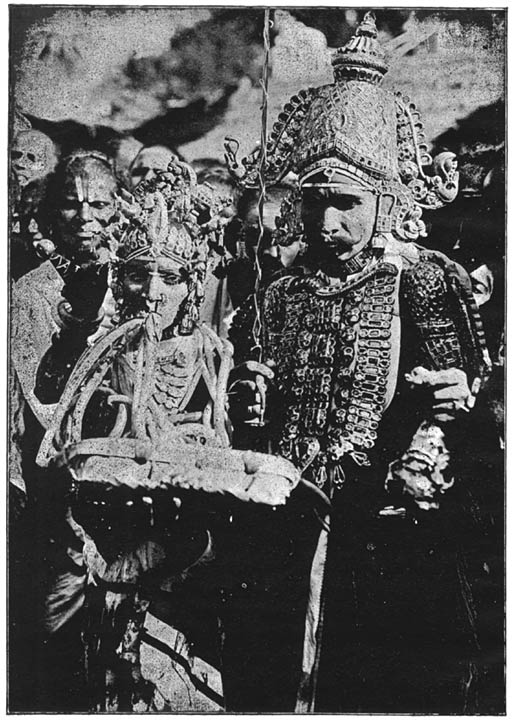
Sembadavan Mayana Kollai.
Sembunādu.—The name, meaning the Pāndya country, of a sub-division of Maravan.
Semmadi.—A Telugu form of Sembadavan.
Semmān.—The Semmāns are described, in the Madras Census Report, 1891, as “an insignificant caste of Tamil leather-workers, found only in the districts of Madura and Tinnevelly (and in the Pudukōttaī State). Though they have returned tailor and lime-burner as their occupations, the original occupation was undoubtedly leather-work. In the Tamil dictionaries Semmān is explained as a leather-worker, and a few of them, living in out-of-the way villages, have returned shoe-making as their occupation. The Semmāns are, in fact, a sub-division of the Paraiyans, and they must have been the original leather-workers of the Tamil tribes. The immigrant Chakkiliyans have, however, now taken their place.” The Semmāns are described, in the Madura Manual, as burning and selling lime for building purposes. In the Census Report, 1901, the caste is said to have “two hypergamous sub-divisions, Tondamān and Tōlmēstri, and men of the former take wives from the latter, but men of the latter may not marry girls of the former.”
Girls are married after puberty, and divorce and remarriage are freely allowed. As the caste is a polluting one, the members thereof are not allowed to use village wells, or enter caste Hindu temples. The caste title is Mēstri.
Sem Puli (red tiger).—A section of Kallan.
Sēnaikkudaiyān.—The Sēnaikkudaiyāns are betel vine (Piper Betel) cultivators and betel leaf sellers, who are found in large numbers in the Tinnevelly district, and to a smaller extent in other parts of the Tamil country. The original name of the caste is said to have been Elai (leaf) Vāniyan, for which the more high-sounding Sēnaikkudaiyān (owner of an army) or Sēnaittalavan (chief of an army) has been substituted. They also called themselves Kodikkāl Pillaimar, or Pillaimars who cultivate betel gardens, and have adopted the title Pillai. The titles Muppan and Chetti are also borne by members of the caste.
It is recorded, in the Madras Census Report, 1901, that “the priests of the Sēnaikkudaiyāns are Vellālas, and occasionally Brāhmans. They do not wear the sacred thread. They burn their dead, and perform annual srāddhas (memorial services). In 1891, following the Tanjore Manual, they were wrongly classed with Vāniyans or oil-mongers, but they are superior to these in social position, and are even said to rank above Nāttukōttai Chettis. Yet it is stated that, in Tanjore, Paraiyans will not enter the Sēnaikkudaiyāns’ houses to carry away dead cattle, and ordinary barbers will not serve them, and food prepared by them will not be accepted even by barbers or washermen. Somewhat similar anomalies occur in the case of the Kammālas, and the explanation may be that these two castes belonged to the old left-hand faction, while the Pariyans, and the barbers and washermen belonged to the right-hand. Paraiyans similarly will not eat in the houses of Bēri Chettis, who were of the left-hand faction.”
Sēnapati.—A title, denoting commander-in-chief, said to be sold to Khōduras, and also occurring as a title of other Oriya castes, e.g., Kurumo and Ronguni. Among the Rongunis, the title is practically an exogamous sept. Sēnapati is further a name for Sālēs (Telugu weavers), the headman among whom is called Pedda (big) Sēnapati. The headman of the Sālāpu weavers, who do not intermarry with the Sālēs, is also styled Sēnapati. It is also a title of the Rāja of Sandūr.
Sendalai (red-headed man).—Returned as a sub-division of Konga Vellālas at times of census.
Sengundam (red dagger).—A synonym, connected with a caste legend, of Kaikōlan.
Seniga (Bengal gram: Cicer arietinum).—An exogamous sept of Mēdara and Pedakanti Kāpu.
Sēniyan.—The name Sēniyan is generally used to denote the Karna Sālē weavers, but at Conjeeveram it is applied to Canarese Dēvāngas. Elsewhere Canarese Dēvāngas belong to the left-hand section, but at Conjeeveram they are classed with the right-hand section. Like other Dēvāngas, the Conjeeveram Sēniyans have exogamous house-names and gōtras, which are interesting inasmuch as new names have been, in recent times, substituted for the original ones, e.g., Chandrasēkhara rishi, Nīlakanta rishi, Markandēya rishi. The Dēvāngas claim Markandēya as their ancestor. The old house-name Picchi Kaya (water-melon: Citrullus vulgaris) has been changed to Desimarada, and eating the melon is tabu. A list of the house-names and gōtras is kept by the headman for reference. The Conjeeveram Sēniyans are Lingāyats, but are not so strict as the Canarese Lingāyats. Jangams are respected, but rank after their own stone lingams. In the observance of death rites, a staunch Lingāyat should not bathe, and must partake of the food offered to the corpse. These customs are not observed by the Sēniyans. Until quite recently, a man might tie a tāli (marriage badge) secretly on a girl’s neck, with the consent of the headman and his relatives, and the girl could then be given in marriage to no other man. This custom is said to have been very common, especially in the case of a man’s maternal uncle’s or paternal aunt’s daughter. At Conjeeveram it was extended to girls not so related, and a caste council was held, at which an agreement was drawn up that the secret tāli-tying was forbidden, and, if performed, was not to be regarded as binding. The priest of the Conjeeveram Sēniyans is a Vellāla Pandāram, who is the head of the Tirugnāna Sambanda Murti mutt (religious institution) at Conjeeveram.
Sērvai.—Sērvai, meaning service, has been recorded as the title of Agamudaiyans and Valaiyans. Sērvaikāran or Sērvaigāran (captain or commander) is the title of Agamudaiyan, Ambalakāran, Kallan, Maravan, and Parivāram. It further occurs as the name for a headman among the Vallambans, and it has been adopted as a false caste name by some criminal Koravas in the south.
Setti.—See Chetti.
Settukkāran.—A castle title, meaning economical people, sometimes used by Dēvāngas instead of Setti or Chetti.
Sevagha Vritti.—A sub-division of Kaikōlan.
Sēvala (service).—An exogamous sept of Golla.
In a petition to myself from certain Shānāns of Nazareth, signed by a very large number of the community, and bearing the title “Short account of the Cantras or Tamil Xātrās, the original but down-trodden royal race of Southern India,” they write as follows. “We humbly beg to say that we are the descendants of the Pāndya or Dravida Xatra race, who, shortly after the universal deluge of Noah, first disafforested and colonized this land of South India under the guidance of Agastya Muni. The whole world was destroyed by flood about B.C. 3100 (Dr. Hale’s calculation), when Noah, otherwise called Vaivasvata-manu or Satyavrata, was saved with his family of seven persons in an ark or covered ship, which rested upon the highest mountain of the Āryāvarta country. Hence the whole earth was rapidly replenished by his descendants. One of his grandsons (nine great Prajāpatis) was Atri, whose son Candra was the ancestor of the noblest class of the Xatras ranked above the Brahmans, and the first illustrious monarch of the post-diluvian world.”
“Apparently,” the Census Superintendent continues, “judging from the Shānān’s own published statements of their case, they rest their claims chiefly upon etymological derivations of their caste name Shānān, and of Nādān and Grāmani, their two usual titles. Caste titles and names are, however, of recent origin, and little can be inferred from them, whatever their meaning may be shown to be. Brāhmans, for example, appear to have borne the titles of Pillai and Mudali, which are now only used by Sūdras, and the Nāyak kings, on the other hand, called themselves Aiyar, which is now exclusively the title of Saivite Brāhmans. To this day the cultivating Vellālas, the weaving Kaikōlars, and the semi-civilised hill tribe of the Jātapus use equally the title of Mudali, and the Balijas and Telagas call themselves Rao, which is properly the title of Mahrātta Brāhmans. Regarding the derivation of the words Shānān, Nādān and Grāmani, much ingenuity has been exercised. Shānān is not found in the earlier Tamil literature at all. In the inscriptions of Rājarāja Chōla (A. D. 984–1013) toddy-drawers are referred to as Īluvans. According to Pingalandai, a dictionary of the 10th or 11th century, the names of the toddy-drawer castes are Palaiyar, Tuvasar, and Paduvar. To these the Chūdāmani Nikandu, a Tamil dictionary of the 16th century, adds Saundigar. Apparently, therefore, the Sanskrit word Saundigar must have been introduced (probably by the Brāhmans) between the 11th and 16th centuries, and is a Sanskrit rendering of the word Īluvan. From Saundigar to Shānān is not a long step in the corruption of words. The Shānāns say that Shānān is derived from the Tamil word Sānrār or Sānrōr, which means the learned or the noble. But it does not appear that the Shānāns were ever called Sānrār or Sānrōr in any of the Tamil works. The two words Nādān and Grāmani mean the same thing, namely, ruler of a country or of a village, the former being a Tamil, and the latter a Sanskrit word. Nādān, on the other hand, means a man who lives in the country, as opposed to Ūrān, the man who resides in a village. The title of the caste is Nādān, and it seems most probable that it refers to the fact that the Īluvan ancestors of the caste lived outside the villages. (South Indian Inscriptions, vol. II, part 1.) But, even if Nādān and Grāmani both mean rulers, it does not give those who bear these titles any claim to be Kshatriyas. If it did, all the descendants of the many South Indian Poligars, or petty chiefs, would be Kshatriyas.”
The whole story of the claims and pretensions of the Shānāns is set out at length in the judgment in the Kamudi temple case (1898) which was heard on appeal before the High Court of Madras. And I may appropriately quote from the judgment. “There is no sort of proof, nothing, we may say, that even suggests a probability that the Shānārs are descendants from the Kshatriya or warrior castes of Hindus, or from the Pandiya, Chola or Chera race of kings. Nor is there any distinction to be drawn between the Nādars and the Shānārs. Shānār is the general name of the caste, just as Vellāla and Maravar designate castes. ‘Nādar’ is a mere title, more or less honorific, assumed by certain members or families of the caste, just as Brāhmins are called Aiyars, Aiyangars, and Raos. All ‘Nādars’ are Shānārs by caste, unless indeed they have abandoned caste, as many of them have by becoming Christians. The Shānārs have, as a class, from time immemorial, been devoted to the cultivation of the palmyra palm, and to the collection of the juice, and manufacture of liquor from it. There are no grounds whatever for regarding them as of Aryan origin. Their worship was a form of demonology, and their position in general social estimation appears to have been just above that of Pallas, Pariahs, and Chucklies (Chakkiliyans), who are on all hands regarded as unclean, and prohibited from the use of the Hindu temples, and below that of Vellālas, Maravans, and other classes admittedly free to worship in the Hindu temples. In process of time, many of the Shānārs took to cultivating, trade, and money-lending, and to-day there is a numerous and prosperous body of Shānārs, who have no immediate concern with the immemorial calling of their caste. In many villages they own much of the land, and monopolise the bulk of the trade and wealth. With the increase of wealth they have, not unnaturally, sought for social recognition, and to be treated on a footing of equality in religious matters. The conclusion of the Sub-Judge is that, according to the Agama Shastras which are received as authoritative by worshippers of Siva in the Madura district, entry into a temple, where the ritual prescribed by these Shāstras is observed, is prohibited to all those whose profession is the manufacture of intoxicating liquor, and the climbing of palmyra and cocoanut trees. No argument was addressed to us to show that this finding is incorrect, and we see no reason to think that it is so.... No doubt many of the Shānārs have abandoned their hereditary occupation, and have won for themselves by education, industry and frugality, respectable positions as traders and merchants, and even as vakils (law pleaders) and clerks; and it is natural to feel sympathy for their efforts to obtain social recognition, and to rise to what is regarded as a higher form of religious worship; but such sympathy will not be increased by unreasonable and unfounded pretensions, and, in the effort to rise, the Shānārs must not invade the established rights of other castes. They have temples of their own, and are numerous enough, and strong enough in wealth and education, to rise along their own lines, and without appropriating the institutions or infringing the rights of others, and in so doing they will have the sympathy of all right-minded men, and, if necessary, the protection of the Courts.”
By Regulation XI, 1816, it was enacted that heads of villages have, in cases of a trivial nature, such as abusive language and inconsiderable assaults or affrays, power to confine the offending members in the village choultry (lock-up) for a time not exceeding twelve hours; or, if the offending parties are of the lower castes of the people, on whom it may not be improper to inflict so degrading a punishment, to order them to be put in the stocks for a time not exceeding six hours. In a case which came before the High Court it was ruled that by “lower castes” were probably intended those castes which, prior to the introduction of British rule, were regarded as servile. In a case which came up on appeal before the High Court in 1903, it was ruled that the Shānārs belong to the lower classes, who may be punished by confinement in the stocks.
With the physique of the Shānāns, whom I examined at Nazareth and Sawyerpūram in Tinnevelly, and their skill in physical exercises I was very much impressed. The programme of sports, which were organised in my honour, included the following events:—
Fencing and figure exercises with long sticks of iron-wood (Mesua ferrea).
Figure exercises with sticks bearing flaming rags at each end.
Various acrobatic tricks.
Feats with heavy weights, rice-pounders, and pounding stones.
Long jump.
Breaking cocoanuts with the thrust of a knife or the closed fist.
Crunching whiskey-bottle glass with the teeth.
Running up, and butting against the chest, back, and shoulders.
Swallowing a long silver chain.
Cutting a cucumber balanced on a man’s neck in two with a sword.
Falconry.
One of the good qualities of Sir Thomas Munro, formerly Governor of Madras, was that, like Rāma and Rob Roy, his arms reached to his knees, or, in other words, he possessed the kingly quality of an Ajānubāhu, which is the heritage of kings, or those who have blue blood in them. This particular anatomical character I have met with myself only once, in a Shānān, whose height was 173 cm. and span of the arms 194 cm. (+ 21 cm.). Rob Roy, it will be remembered, could, without stooping, tie his garters, which were placed two inches below the knee.
For a detailed account of demonolatry among the Shānāns, I would refer the reader to the Rev. R. (afterwards Bishop) Caldwell’s now scarce ‘Tinnevelly Shanans’ (1849), written when he was a young and impulsive missionary, and the publication of which I believe that the learned and kind-hearted divine lived to regret.
In the palmyra forests of Attitondu, in Tinnevelly, I came across a troop of stalwart Shānān men and boys, marching out towards sunset, to guard the ripening chōlum crop through the night, each with a trained dog, with leash made of fibre passed through a ring on the neck-collar. The leash would be slipped directly the dog scented a wild pig, or other nocturnal marauder. Several of the dogs bore the marks of encounters with pigs. One of the party carried a musical instrument made of a ‘bison’ horn picked up in the neighbouring jungle.
The Shānāns have a great objection to being called either Shānān or Maramēri (tree-climber), and much prefer Nādān. By the Shānāns of Tinnevelly, whom I visited, the following five sub-divisions were returned:—
1. Karukku-pattayar (those of the sharp sword), which is considered to be superior to the rest. In the Census Report, 1891, the division Karukku-mattai (petiole of the palmyra leaf with serrated edges) was returned. Some Shānāns are said to have assumed the name of Karukku-mattai Vellālas.
2. Kalla. Said to be the original servants of the Karukku-pattayar, doing menial work in their houses, and serving as palanquin-bearers.
3. Nattāti. Settled at the village of Nattāti near Sawyerpūram.
4. Kodikkāl. Derived from kodi, a flag. Standard-bearers of the fighting men. According to another version, the word means a betel garden, in reference to those who were betel cultivators.
5. Mēl-nātar (mēl, west). Those who live in the western part of Tinnevelly and in Travancore.
At the census, 1891, Konga (territorial) and Madurai were returned as sub-divisions. The latter apparently receives its name, not from the town of Madura, but from a word meaning sweet juice. At the census, 1901, Tollakkādan (man with a big hole in his ears) was taken as being a sub-caste of Shānān, as the people who returned it, and sell husked rice in Madras, used the title Nādān. Madura and Tinnevelly are eminently the homes of dilated ear-lobes. Some Tamil traders in these two districts, who returned themselves as Pāndyan, were classified as Shānāns, as Nādān was entered as their title. In Coimbatore, some Shānāns, engaged as shop-keepers, have been known to adopt the name of Chetti. In Coimbatore, too, the title Mūppan occurs. This title, meaning headman or elder, is also used by the Ambalakāran, Valayan, Sudarmān, Sēnaikkudaiyān, and other castes. In the Tanjore Manual, the Shānāns are divided into Tennam, Panam, and Ichcham, according as they tap the cocoanut, palmyra, or wild date (Phœnix sylvestris). The name Enādi for Shānāns is derived from Enādi Nayanar, a Saivite saint. But it also means a barber.
The community has, among its members, land-owners, and graduates in theology, law, medicine, and the arts. Nine-tenths of the Native clergy in Tinnevelly are said to be converted Shānāns, and Tinnevelly claims Native missionaries working in Madagascar, Natal, Mauritius, and the Straits. The occupations of those whom I saw at Nazareth were merchant, cultivator, teacher, village munsif, organist, cart-driver, and cooly.
The Shānāns have established a school, called Kshatriya Vidyasala, at Virudupati in Tinnevelly. This is a free school, for attendance at which no fee is levied on the pupils, for the benefit of the Shānān community, but boys of other castes are freely admitted to it. It is maintained by Shānāns from their mahimai fund, and the teachers are Brāhmans, Shānāns, etc. The word mahimai means greatness, glory, or respectability.
It is noted by Mr. W. Robinson, in a report on the Laccadive islands (1869), that “the Monegar has the assistance of one of the islanders as a Karany, to take down depositions, and to read them, for the character used is the Arabic. In addition to these duties, the Karany has those of the Shanbogue. He keeps the accounts of the trees, and the coir (cocoanut fibre) in the islands, and makes out and delivers the accounts of coir brought to the coast.”
I gather from a correspondent that the following tradition concerning their origin is current. In days of yore there lived two brothers in the Geddesala hills, by name Kārayan and Billaya or Mādhēswara. The Uralis and Shōlagas are descended from Kārayan, and the Sivachāris (Lingāyats) from Mādhēswara. The two brothers fell into the hands of a terrible Rākshasha (demon), by name Savanan, who made Kārayan a shepherd, but imprisoned Mādhēswara for not paying him sufficient respect, and extracted all kinds of menial work from him. Last of all he ordered him to make a pair of shoes, whereupon Mādhēswara asked for his liberty for a few days, to enable him to have the shoes well made. His request being granted, Mādhēswara betook himself to the god Krishnamurti, and asked him for his help in his troubles. The god was only too happy to assist, and suggested that the shoes should be made of wax. Helped by Krishnamurti, Mādhēswara made a very beautiful-looking pair of shoes. Krishnamurti then ordered him to pile up and light a huge bonfire on a bare rocky hill east of Geddesala, so as to make it nearly red-hot. The ashes were then cleared away, so as to leave no trace of their plot. Mādhēswara then took the shoes, and presented them to Savanan, who was much pleased with them, and willingly acceded to Mādhēswara’s request that he would put them on, and walk along the rock. But, as soon as he stepped upon it, the shoes melted, and Savanan fell heavily on the rock, clutching hold of Mādhēswara as he fell, and trying to strangle him. Krishnamurti had assembled all the gods to witness the carrying out of the plot, and, telling each of them to pile a stone on Savanan’s head, himself rescued Mādhēswara from his clutches, and all jumped upon the Rākshasha till no trace of him was left. While this was going on, Kārayan was tending Savanan’s herds in the forest, and, when he came to hear about it, was angry with his brother for not consulting him before destroying Savanan. Flying from Kārayan, who was armed with a knife, Mādhēswara implored Krishnamurti’s help, by which he was able to leap from Kotriboli to the hill called Urugamalai, a distance of some ten miles. The force of the leap caused the hill to bend—hence its name meaning the bending hill. Finding that the hill was bending, and being still hotly pursued by his brother, knife in hand, Mādhēswara again appealed to Krishnamurti, and was enabled to make another leap of about five miles to a hill called Eggaraimalai, which immediately began to subside. Hence its name, meaning the subsiding hill. Thence he fled to Munikanal, and concealed himself under a rock, closely followed by Kārayan, who slashed the rock with his knife, and left marks which are visible to this day. From Munikanal he fled to the hill now known as Mādhēswaranamalai, and hid in a rat hole. Kārayan, not being able to unearth him, sent for a lot of shepherds, and made them pen their sheep and cattle over the hole. The effluvium became too strong for the fugitive, so he surrendered himself to his brother, who pardoned him on the understanding that, on deification, Kārayan should have prior claim to all votive offerings. To this Mādhēswara agreed, and to this day Sivachāris, when doing pūja, first make their offerings to Kārayan and afterwards to Mādhēswara. In connection with this legend, any one proceeding to the top of Kotriboli hill at the present day is expected to place a stone upon the rock, with the result that there are many piles of stones there. Even Europeans are asked to do this.
The Shōlagas are said to call themselves men of five kulams, or exogamous septs, among which are Chalikiri, Tēneru, Belleri, Surya (the sun), and Aleru. By members of the twelve kulam class, everything is done by twelves. For example, on the twelfth day after a birth, twelve elders are invited to the house to bless the child. At a marriage, twelve of the bridegroom’s relations go and fetch the bride, and the wedding pandal (booth) has twelve posts. The parents of the bridegroom pay twelve rupees to the bride’s father, and a tāli (marriage badge) worth twelve annas is tied round the bride’s neck. In case of death, the body is borne on a stretcher made of twelve bamboos, and mourning lasts for twelve days.
Tribal disputes, e.g., quarrelling and adultery, are decided by the Yejamāna, assisted by a Pattagara and a few leading men of the community. Under the orders of the two former is the Chalavāthi or village servant. The Yejamāna, Pattagara, and Chalavāthi must belong respectively to the Chalikiri, Teneri, and Surya septs.
When a girl reaches puberty, she occupies a separate hut for five days, and then returns home after a bath. The maternal uncle should present her with a new cloth, betel leaves and areca nuts, and plantain fruits. In the formal marriage ceremony, the tāli is tied by the bridegroom inside a booth; the maternal uncle, if he can afford it, presents a new cloth to the bride, and a feast is held. Sometimes even this simple rite is dispensed with, and the couple, without any formality, live together as man and wife, on the understanding that, at some time, a feast must be given to a few of the community. I am told that the Shōlagas of the Burghur hills have a very extraordinary way of treating expectant mothers. A few days before the event is expected to take place, the husband takes his wife right away into the jungle, and leaves her there alone with three days’ supply of food. There she has to stay, and do the best she can for herself. If she does not come back at the end of the three days, the husband goes out and takes her more food. But she may not return to her village till the baby is born. When one of these unfortunate creatures comes back safely, there is a great celebration in her honour, with beating of tom-tom, etc.
The dead are buried with the body lying on its left side, and the head to the south. On their return home from a funeral, those who have been present thereat salute a lighted lamp. On the spot where the dead person breathed his last, a little rāgi (Eleusine Coracana) paste and water are placed, and here, on the fourth day, a goat is sacrificed, and offered up to the soul of the departed. After this the son proceeds to the burial ground, carrying a stone, and followed by men selected from each of the exogamous septs. Arrived near the grave, they sit down, while the son places the stone on the ground, and they then lift it in succession. The last man to do so is said to fall into a trance. On his recovery, leaves (plantain, teak, etc.) corresponding in number to the exogamous septs, are arranged round the stone, and, on each leaf, different kinds of food are placed. The men partake of the food, each from the leaf allotted to his sept. The meal concluded, the son holds the stone in his hands, while his companions pour rāgi and water over it, and then carries it away to the gopamane (burial-ground) of his sept, and sets it up there.
On the occasion of a death in a Mala Vellāla village, the Shōlagas come in crowds, with clarionets and drums, and bells on their legs, and dance in front of the house. And the corpse is borne, in musical procession, to the burning-ground.
The staple food of the Shōlagas is rāgi paste and yams (Dioscorea), which, like the Urālis, they supplement by sundry jungle animals and birds. Paroquets they will not eat, as they regard them as their children.
Their main occupation is to collect minor forest produce, myrabolams, vembadam bark (Ventilago madraspatana), avaram bark (Cassia auriculata), deers’ horns, tamarinds, gum, honey, soap-nuts, sheekoy (Acacia Concinna),etc. The forests have been divided into blocks, and a certain place within each block has been selected for the forest depôt. To this place the collecting agents, mostly Shōlagas and Urālis, bring the produce, and there it is sorted and paid for by special supervisors appointed for the work.
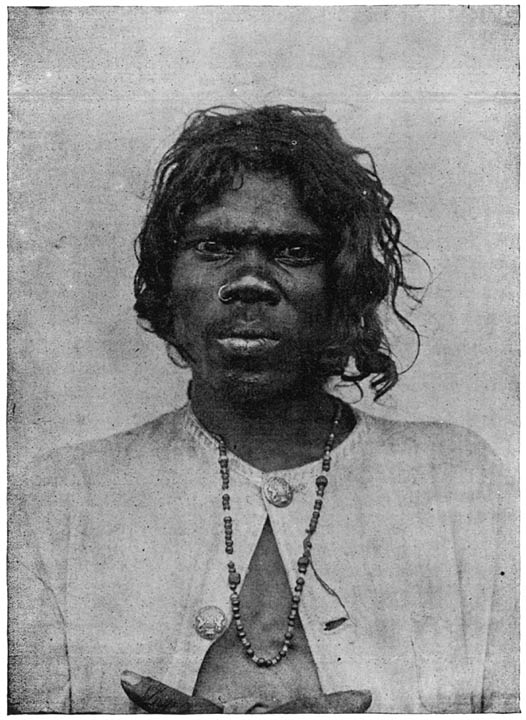
Shōlaga.
In the Coimbatore district the Shōlagas are said to collect honey from rocky crevices. The combs are much larger than those found on trees, and are supposed to contain twice as much wax in proportion to the honey. On the Nilgiri hills honey-combs are collected by Jēn Kurumbas and Shōlagas. The supply of honey varies according to the nature of the season, and is especially plentiful and of good quality when Strobilanthes Wightianus, S. Kunthiana, and other species are in flower.
It has been said that even wild beasts will scent a Shōlaga, and flee before the aroma.
The Shōlagas, who were examined by Dr. Rivers and myself, came to the conclusion that the object of our enquiry was to settle them in a certain place near London, and that the wools of different colours (used for testing colour vision) given to them for selection, were for tying them captive with. Others said that they could not understand why the different organs of their bodies were measured; perhaps to reduce or increase the size of their body to suit the different works, which they were expected to do near London. It has been pointed out to me, as an interesting fact, that a similarity of idea concerning the modification of different organs to suit men for the doing of special work has been arrived at by the jungle folk, and by Mr. Wells in his book, ‘The first men in the moon,’ where the lunar inhabitants are described as carrying on the practice.
Shōla Naiker.—A synonym of Jēn Kurumbas in the Wynād.
Sibbi Dhompti (brass vessel offering).—A subdivision of Mādigas, who, at marriages, offer food to the god in brass vessels.
Siddaru.—A synonym of Jōgi mendicants.
Sika (kudumi or hair-knot).—An exogamous sept of Dēvānga.
Sīkili (broom).—An exogamous sept of Mādiga.
Sikligar.—In the Madras Census Report, 1901, eleven individuals are returned as belonging to an Upper India caste of knife-grinders (Sikligar). In the Madura Manual, Sikilkārars are described as knife-grinders, who wander about in quest of work from village to village.
Sila (stone).—An exogamous sept of Omanaito.
Sīlam (good conduct).—An exogamous sept of Māla.
Sīlavant.—In the Madras Census Report, 1901, Sīlavant is recorded as meaning the virtuous, and as being a sub-sect of Lingāyats. In the Mysore Census Report, Sīlavanta is given as a name for Lingāyat Nayindas. For the following note on the Sīlavantalu or Sīlēvantalu of Vizagapatam, I am indebted to Mr. C. Hayavadana Rao.
They are a sect of Lingāyats, who, though they do not admit it, appear to be an offshoot of Pattu Sālēs, who became converts to the Lingāyat religion. They are engaged in the manufacture of fine cloths for males and females. The religious observances which secured them their name, meaning those who practice or possess particular religious customs, have been thus described. In the seventh month of pregnancy, at the time of quickening, a small stone linga is enclosed in black lac, wrapped in a piece of silk cloth, and tied to the thread of the linga which is on the woman’s neck. The child is thus invested with the linga while still in utero. When it is about a year old, and weaned, the linga is taken off the mother’s neck, and replaced by a silver locket. The linga is tied on the neck of the child. At the beginning of the twelfth year in the case of boys, and just before the marriage of girls, this linga is taken off, and a fresh one suspended round the neck by a guru.
The Sīlavantalu are divided into exogamous septs, or intipērulu. The custom of mēnarikam, whereby a man marries his maternal uncle’s daughter, is the rule. But, if the maternal uncle has no daughter, he must find a suitable bride for his nephew. Girls are married before puberty, and a Jangam, known as Mahēsvara, officiates at weddings.
The dead are buried in a sitting posture, facing north. The linga is suspended round the neck of the corpse, and buried with it. Six small copper plates are made, each containing a syllable of the invocation Ōm na ma Si va ya. Two of these are placed on the thighs of the corpse, one on the head, one on the navel, and two on the shoulders, and stuck on with guggilam paste. The corpse is then tied up in a sack. The relatives offer flowers to it, and burn camphor before it. The grave is dug several feet deep, and a cavity or cell is made on the southern side of it, and lined with bamboo matting. The corpse is placed within the cell, and salt thrown into the grave before it is filled in. A Jangam officiates at the funeral. Monthly and annual death ceremonies are performed. A samāthi or monument is erected over the grave. Such a monument may be either in the form of a square mound (brindavan) with niches for lights and a hole in the top, in which a tulsi (Ocimum sanctum) is planted, or in the form of a small chamber. Relations go occasionally to the grave, whereon they deposit flowers, and place lights in the niches or chamber.
The Sīlavantalu are strict vegetarians and total abstainers. Their titles are Ayya and Lingam.
Silpa (artisan).—A sub-division of the Kammālans, Panchālas or Kamsalas, whose hereditary occupation is that of stone-masons. In the Silpa Sāstra, the measurements necessary in sculpture, the duties of a Silpi, etc., are laid down. I am informed that the carver of a stone idol has to select a male or female stone, according as the idol is to be a god or goddess, and that the sex of a stone can be determined by its ring when struck.
Sindhu.—The Sindhuvāllu (drummers) are Mādigas, who go about acting scenes from the Rāmayana or Mahābhāratha, and the story of Ankamma. Sindhu also occurs as a gōtra of Kurni. The beating of the drum called sindhu is, I gather, sometimes a nuisance, for a missionary writes to the paper enquiring whether there is any order of Government against it, as the practice “causes much crime, and creates extra work for police and magistrates. Village officials believe they have no authority to suppress it, but there are some who assert that it is nominally forbidden.”
Singamu-vāru.—Singam is described, in the Madras Census Report, 1901, as a class of beggars, who beg only from Sālēs. They are, however, described by Mr. C. Hayavadana Rao as a class of itinerant mendicants attached to the Dēvāngas. “The name,” he writes, “is a variant of Simhamu-vāru, or lion-men, i.e., as valourous as a lion. They are paid a small sum annually by each Dēvānga village for various services which they render, such as carrying fire before a Dēvānga corpse to the burial-ground, acting as caste messengers, and cleaning the weaving instruments.”
Sinnata (gold).—An exogamous sept of Kuruba.
Sīolo.—A small class of Oriya toddy-drawers, whose touch conveys pollution. The Sondis, who are an Oriya caste of toddy-sellers, purchase their liquor from the Sīolos.
Sipiti.—The Sipitis are described, in the Madras Census Report, 1901, as “Oriya temple priests and drummers; a sub-caste of Rāvulo.” In an account of them as given to me, they are stated to be Smartas, and temple priests of village deities, who wear the sacred thread, but do not employ Brāhmans as purōhits, and are regarded as somewhat lower in the social scale than the Rāvulos. Some of their females are said to have been unrecognised prostitutes, but the custom is dying out. The caste title is Mūni. (See Rāvulo.)
Sir.—A sub-division of Kanakkan.
Sirpādam.—A sub-division of Kaikōlan.
Sirukudi.—A nādu or territorial division of Kallan.
Siru Tāli.—The name, indicating those who wear a small tāli (marriage badge), of a sub-division of Kaikōlan and Maravan.
Sītikan.—Recorded, in the Travancore Census Report, 1901, as an occupational sub-division of Mārān.
Sitra.—See Pāno.
Siva Brāhmana.—Recorded as a synonym of Stānika.
Sivachāra.—It is noted, in the Mysore Census Report, 1901, that the Lingāyats call themselves “Vīra Saivas, Sivabhaktas, or Sivachars. The Vīrasaiva religion consists of numerous castes. It is a religion consisting of representatives from almost every caste in Hindu society. People of all castes, from the highest to the lowest, have embraced the religion. There are Sivachar Brāhmins, Sivachar Kshatriyas, Sivachar Vaisyas, Sivachar carpenters, Sivachar weavers, Sivachar goldsmiths, Sivachar potters, Sivachar washermen, and Sivachar barbers, and other low castes who have all followed the popular religion in large numbers.”
Sivadvija.—The name, denoting Saivite Brāhman, by which Mūssads like to be called. Also recorded as a synonym of Stānika.
Sivarātri.—An exogamous sept of Oddē, named after the annual Mahāsivarātri festival in honour of Siva. Holy ashes, sacred to Siva, prepared by Smartas on this day, are considered to be very pure.
Sivarchaka.—The word means those who do pūja (worship) to Siva. Priests at the temple of village deities are ordinarily known as Pūjāri, Pūsāli, Ōcchan, etc., but nowadays prefer the title of Ūmarchaka or Sivarchaka. The name Sivala occurs in the Madras Census Report, 1901.
Siviyar.—Siviyar means literally a palanquin-bearer, and is an occupational name applied to those employed in that capacity. For this reason a sub-division of the Idaiyans is called Siviyar. The Siviyars of Coimbatore say that they have no connection with either Idaiyans or Toreyas, but are Besthas who emigrated from Mysore during the troublous times of the Muhammadan usurpation. The name Siviyar is stated to have been given to them by the Tamils, as they were palanquin-bearers to officers on circuit and others in the pre-railway days. They claim origin, on the authority of a book called Parvatharāja Charithum, from Parvatharāja. Their main occupations at the present day are tank and river fishing, but some are petty traders, physicians, peons, etc. Their language is Canarese, and their title Naickan. They have eighteen marriage divisions or gōtras, named after persons from whom the various gōtras are said to have been descended. On occasions of marriage, when betel leaf is distributed, it must be given to members of the different gōtras in their order of precedence. In cases of adultery, the guilty parties are tied to a post, and beaten with tamarind switches. When a grown-up but unmarried person dies, the corpse is made to go through a mock marriage with a human figure cut out of a palm leaf.
Sōdabisiya.—A sub-division of Dōmb.
Soi.—A title of Doluva. It is a form of Sui or Swayi.
Sōlaga.—See Shōlaga.
Sōliyan.—Sōliyan or Sōliya is a territorial name, meaning an inhabitant of the Chōla country, recorded as a sub-division of Karnam, Idaiyan, Pallan, and Vellāla. The equivalent Sōlangal occurs as an exogamous sept of Vallamban, and Sōliya illam (Malayālam, house) as an exogamous sept of Panikkans in the Tamil country. Some Pallis style themselves Sōlakanar (descendants of Chōla kings), or Sōlakula Kshatriya. (See Sōzhia.)
Sōmakshatri.—A name sometimes adopted by Canarese Gānigas in South Canara.
Sōmara.—Recorded, in the Madras Census Report, 1901, as a small class of potters in the Vizagapatam hills.
Sōmari (idler).—A division of Yānādis, who do scavenging work, and eat the refuse food thrown away by people from the leaf plate after a meal.
Sōma Vārada (Sunday).—The name of Kurubas who worship their god on Sundays.
Sōnagan.—See Jōnagan.
In the Madras Census Report, 1901, the Sunnāri (or Sonnāri) are described as Oriya goldsmiths (see Risley, Tribes and Castes of Bengal, Sonar). These goldsmiths, in the Oriya portion of the Madras Presidency, are, I am informed, Kamsalas from the Telugu country. Unlike the Oriyas, and like other Telugu classes, they invariably have a house-name, and their mother tongue is Telugu. They are Saivites, bury their dead, claim to be descendants of Viswakarma, and call themselves Viswa Brāhmans. They do not eat meals prepared by Brāhmans, or drink water at the hands of Brāhmans.
In former times, goldsmiths held the post of Nottakāran (tester) or village shroff (money-changer). His function was to test the rupees tendered when the land revenue was being gathered in, and see that they were not counterfeit. There is a proverb, uncomplimentary to the goldsmiths, to the effect that a goldsmith cannot make an ornament even for his wife, without first secreting some of the gold or silver given him for working upon.
For the following note on the Sondis of Vizagapatam, I am indebted to Mr. C. Hayavadana Rao. According to a current tradition, there was, in days of old, a Brāhman, who was celebrated for his magical powers. The king, his patron, asked him if he could make the water in a tank (pond) burn, and he replied in the affirmative. He was, however, in reality disconsolate, because he did not know how to do it. By chance he met a distiller, who asked him why he looked so troubled, and, on learning his difficulty, promised to help him on condition that he gave him his daughter in marriage. To this the Brāhman consented. The distiller gave him a quantity of liquor to pour into the tank, and told him to set it alight in the presence of the king. The Brāhman kept his word, and the Sondis are the descendants of the offspring of his daughter and the distiller. The caste is divided into several endogamous divisions, viz., Bodo Odiya, Madhya kūla, and Sanno kūla. The last is said to be made up of illegitimate descendants of the two first divisions.
The Sondis distil liquor from the ippa (Bassia) flower, rice, and jaggery (crude sugar). There is a tradition that Brahma created the world, and pinched up from a point between his eyebrows a little mud, from which he made a figure, and endowed it with life. Thus Suka Muni was created, and authorised to distil spirit from the ippa flowers, which had hitherto been eaten by birds.
When a girl reaches puberty, she is set apart in a room within a square enclosure made with four arrows connected together by a thread. Turmeric and oil are rubbed over her daily, and, on the seventh day, she visits the local shrine.
Girls are married before puberty. Some days before a wedding, a sāl (Shorea robusta) or neredu (Eugenia Jambolana) post is set up in front of the bridegroom’s house, and a pandal (booth) erected round it. On the appointed day, a caste feast is held, and a procession of males proceeds to the bride’s house, carrying with them finger rings, silver and glass bangles, and fifty rupees as the jholla tonka (bride price). On the following day, the bride goes to the house of the bridegroom. On the marriage day, the contracting couple go seven times round the central post of the pandal, and their hands are joined by the presiding Oriya Brāhman. They then sit down, and the sacred fire is raised. The females belonging to the bridegroom’s party sprinkle them with turmeric and rice. On the following day, a Bhondāri (barber) cleans the pandal, and draws patterns in it with rice flour. A mat is spread, and the couple play with cowry shells. These are five in number, and the bridegroom holds them tightly in his right hand, while the bride tries to wrest them from him. If she succeeds in so doing, her brothers beat the bridegroom, and make fun of him; if she fails, the bridegroom’s sisters beat and make fun of her. The bride then takes hold of the cowries, and the same performance is gone through. A basket of rice is brought, and some of it poured into a vessel. The bridegroom holds a portion of it in his hand, and the bride asks him to put it back. This, after a little coaxing, he consents to do. These ceremonies are repeated during the next five days. On the seventh day, small quantities of food are placed on twelve leaves, and twelve Brāhmans, who receive a present of money, sit down, and partake thereof. The marriage of widows is permitted, and a younger brother may marry the widow of an elder brother.
The dead are burned, and death pollution lasts for ten days. Daily, during this period, cooked food is strewed on the way leading to the burning-ground. On the eleventh day, those under pollution bathe, and the sacred fire (hōmam) is raised by a Brāhman. As at a wedding, twelve Brāhmans receive food and money. Towards midnight, a new pot is brought, and holes are bored in it. A lighted lamp and food are placed in it, and it is taken towards the burning-ground and set down on the ground. The dead man’s name is then called out three times. He is informed that food is ready, and asked to come.
Men, but not women, eat animal food. The women will not partake of the remnants of their husbands’ meal on days on which they eat meat, because, according to the legend, their female ancestor was a Brāhman woman.
Among the Sondis of Ganjam, if a girl does not secure a husband before she reaches maturity, she goes through a form of marriage with an old man of the caste, or with her elder sister’s husband, and may not marry until the man with whom she has performed this ceremony dies. On the wedding day, the bridegroom is shaved, and his old waist-thread is replaced by a new one. The ceremonies commence with the worship of Ganēsa, and agree in the main with those of many other Oriya castes. The remarriage of widows is permitted. If a widow was the wife of the first-born or eldest son in a family, she may not, after his death, marry one of his younger brothers. She may, however, do so if she was married in the first instance to a second son.
It is noted by Mr. C. F. MacCartie, in the Madras Census Report, 1881, that “a good deal of land has been sold by Khond proprietors to other castes. It was in this way that much territory was found some years ago to be passing into the hands of the Sundis or professional liquor distillers. As soon as these facts were brought to the notice of Government, no time was lost in the adoption of repressive measures, which have been completely successful, as the recent census shows a great reduction in the numbers of these Sundis, who, now that their unscrupulous trade is abolished, have emigrated largely to Boad and other tracts. This is the only case to my knowledge in which a special trade has decayed, and with the best results, as, had it not been so, there is no doubt that the Khond population would very soon have degenerated into pure adscripti glebæ, and the Sundis become the landlords.”
“The Sondis are gradually getting much of the best land into their hands, and many of the guileless hill ryots into their power. Mr. Taylor stated in 1892 that ‘the rate of interest on loans extorted by these Sondis is 100 per cent. and, if this is not cleared off in the first year, compound interest at 100 per cent. is charged on the balance. The result is that, in many instances, the cultivators are unable to pay in cash or kind, and become the gōtis or serfs of the sowcars, for whom they have to work in return for mere batta (subsistence allowance), whilst the latter take care to manipulate their accounts in such a manner that the debt is never paid off. A remarkable instance of this tyranny was brought to my notice a few days since. A ryot some fifty years ago borrowed Rs. 20; he paid back Rs. 50 at intervals, and worked for the whole of his life, and died in harness. For the same debt the sowcar (money-lender) claimed the services of his son, and he too died in bondage, leaving two small sons aged 13 and 9, whose services were also claimed for an alleged arrear of Rs. 30 on a debt of Rs. 20 borrowed 50 years back, for which Rs. 50 in cash had been repaid in addition to the perpetual labour of a man for a similar period.’ This custom of gōti is firmly established, and, in a recent case, an elder brother claimed to be able to pledge for his own debts the services of his younger brother, and even those of the latter’s wife. Debts due by persons of respectability are often collected by the Sondis by an exasperating method, which has led to at least one case of homicide. They send Ghāsis, who are one of the lowest of all castes, and contact with whom is utter defilement entailing severe caste penalties, to haunt the house of the debtor who will not pay, insult and annoy him and his family, and threaten to drag him forcibly before the Sondi.” A friend was, on one occasion, out after big game in the Jeypore hills, and shot a tiger. He asked his shikāri (tracker) what reward he should give him for putting him on to the beast. The shikāri replied that he would be quite satisfied with twenty-five rupees, as he wanted to get his younger brother out of pledge. Asked what he meant, he replied that, two years previously, he had purchased as his wife a woman who belonged to a caste higher than his own for a hundred rupees. He obtained the money by pledging his younger brother to a sowcar, and had paid it all back except twenty-five rupees. Meanwhile his brother was the bondsman of the sowcar, and cultivating his land in return for simple food.
It is further recorded, in the Gazetteer of the Vizagapatam district, that Dombu (or Dōmb) dacoits “force their way into the house of some wealthy person (for choice the local Sondi liquor-seller and sowcar—usually the only man worth looting in an Agency village, and a shark who gets little pity from his neighbours when forced to disgorge), tie up the men, rape the women, and go off with everything of value.”
The titles of the Ganjam Sondis are Bēhara, Chowdri, Podhāno, and Sāhu. In the Vizagapatam agency tracts, their title is said to be Bissōyi.
Sonkari.—The Sonkaris are a small class of Oriya lac bangle (sonka) makers in Ganjam and Vizagapatam, who should not be confused with the Telugu Sunkaris. The men are engaged in agriculture, and the women manufacture the bangles, chains, chāmaras (fly-flappers), kolātam sticks (for stick play), and fans ornamented with devices in paddy (unhusked rice) grains, which are mainly sold to Europeans as curios.
Sonkari girls are married before puberty. A man should marry his paternal aunt’s daughter, but at the present day this custom is frequently disregarded. Brāhmans officiate at their marriages. The dead are cremated. The caste title is Pātro.
Sonkuva.—A sub-division of Māli.
Sonti (dried ginger).—An exogamous sept of Asili.
Soppu (leaf).—The name for Koragas, who wear leafy garments.
Sōzhia.—A territorial name of sub-divisions of various Tamil classes who are settled in what was formerly the Chōla country, e.g., Brāhman, Chetti, Kaikōlan, Kammālan, Pallan, and Vellāla.
Stala (a place).—Lingāyats sometimes use the word Staladavāru, or natives of a place, to distinguish them from recent settlers.
Stānika.—The Stānikas are summed up, in the Madras Census Report, 1901, as being “Canarese temple servants. They claim to be Brāhmans, though other Brāhmans do not admit the claim; and, as the total of the caste has declined from 4,650 in 1891 to 1,469, they have apparently returned themselves as Brāhmans in considerable numbers.” The Stānikas are, in the South Canara Manual, said to be “the descendants of Brāhmins by Brāhmin widows and outcast Brāhmin women, corresponding with Manu’s Golaka. They however now claim to be Siva Brāhmins, forcibly dispossessed of authority by the Mādhvas, and state that the name Stānika is not that of a separate caste, but indicates their profession as managers of temples, with the title of Dēva Stānika. This claim is not generally conceded, and as a matter of fact the duties in which Stānikas are employed are clearly those of temple servants, namely, collecting flowers, sweeping the interiors of temples, looking after the lamps, cleaning the temple vessels, ringing bells, and the like. Many of them, however, are landowners and farmers. They are generally Sivites, and wear the sacred thread. Their special deities are Venkatrāmana and Ganapati. Drāvida Brāhmins officiate as their priests, but of late some educated men of the caste have assumed the priestly office. The caste has two sub-divisions, viz., Subramania and Kumbla. Girls must be married in infancy, i.e., before they attain puberty. Widow remarriage is neither permitted nor practiced. Their other customs are almost the same as those of the Kōta Brāhmans. They neither eat flesh nor drink liquor.” It is stated in the Manual that the Stānikas are called Shānbōgs and Mukhtesars. But I am informed that at an inquest or a search the Moktessors or Mukhtesars (chief men) of a village are assembled, and sign the inquest report or search list. The Moktessors of any caste can be summoned together. Some of the Moktessors of a temple may be Stānikas. In the case of social disputes decided at caste meetings, the Shānbōg (writer or accountant) appointed by the caste would record the evidence, and the Moktessor would decide upon the facts.
Of the two sections Subramanya and Kumbla, the former claim superiority, and there is no intermarriage between them. The members of the Subramanya section state that they belong to Rig Sāka (Rig Vēda) and have gōtras, such as Viswamitra, Angirasa, and Bāradwaja, and twelve exogamous septs. Of these septs, the following are examples:—
Arli (Ficus religiosa). Konde, tassel or hair-knot.
Aththi (Ficus glomerata). Adhikāri.
Bandi, cart. Pandita.
Kēthaki (Pandanus fascicularis). Heggade.
The famous temple of Subramanya is said to have been in charge of the Subramanya Stānikas, till it was wrested from them by the Shivalli Brāhmans. In former times, the privilege of sticking a golden ladle into a heap of food piled up in the temple, on the Shasti day or sixth day after the new moon in December, is said to have belonged to the Stānikas. They also brought earth from an ant-hill on the previous day. Food from the heap and earth are received as sacred articles by devotees who visit the sacred shrine. A large number of Stānikas are still attached to temples, where they perform the duties of cleaning the vessels, washing rice, placing cooked food on the bali pitam (altar stone), etc. The food placed on the stone is eaten by Stānikas, but not by Brāhmans. In the Mysore province, a Brāhman woman who partakes of this food loses her caste, and becomes a prostitute.
At times of census, Sivadvija and Siva Brāhman have been given as synonyms of Stānika.
Sthāvara.—Recorded, at times of census, as a sub-division of Jangam. The lingam, which Lingāyats carry on some part of the body, is called the jangama lingam or moveable lingam, to distinguish it from the sthāvara or fixed lingam of temples.
Subuddhi.—A title, meaning one having good sense, among several Oriya castes.
Sudarmān.—See Udaiyān.
Suddho.—Two distinct castes go by this name, viz., the Savaras who have settled in the plains, and a small class of agriculturists and paiks (servants) in the low country of Ganjam. The Suddhos who live in the hills eat fowls and drink liquor, which those in the plains abstain from. The caste name Suddho means pure, and is said to have its origin in the fact that Suddho paiks used to tie the turbans of the kings of Gumsūr. Like other Oriya castes, the Suddhos have Podhāno, Bissōyi, Bēhara, etc., as titles. The caste has apparently come into existence in recent times.
Sūdra.—The fourth of the traditional castes of Manu. The Sūdra Nāyars supply the female servants in the houses of Nambūtiris.
Sūdra Kāvutiyān.—A name adopted by barbers who shave Nāyars, to distinguish them from other barbers.
Sugāli.—Sugāli and Sukāli are synonyms of Lambādi.
Sugamanchi Balija.—A name said to mean the best of Balijas, and used as a synonym for Gāzula Balija.
Sukka (star).—An exogamous sept of Yerukala. The equivalent Sūkra occurs as a gōtra of Oriya Kālinjis.
Sūlē.—A Canarese name for professional prostitutes. Temple dancing-girls object to the name, as being low. They call themselves Vēsyas or Bēsyas, Naiksāni, or Naikini (Naik females).
Sullokondia.—The highest sub-division of the Gaudos, from whose hands Oriya Brāhmans will accept water.
Sunar.—See Sonar. <b>Sundarattān.—A sub-division of Nāttukōttai Chetti.
Sundi.—See Sondi.
Sunna Akki (thin rice).—A family name or bedagu of Donga Dāsari.
Sunnambukkāran (lime man).—An occupational name for Paravas, Paraiyans, and other classes, who are employed as lime (chunam) burners. Sunnapu, meaning shell or quick-lime, occurs as an exogamous sept of Balija.
Sunnata.—A sub-division of Kurumbas, who are said to make only white blankets.
Sūrakkudi.—A section or kōvil (temple) of Nāttukōttai Chetti.
Sūrti.—The name for domestic servants of Europeans in Bombay, who come from Surat.
Sūrya (the sun).—Recorded as a sept of Dōmb, Kuruba, and Pentiya, and a sub-division of Ambalakkāran. The equivalent Sūryavamsam (people of the solar race) occurs as a sub-division of Rāzu, and as a synonym of the Konda Doras or Konda Kāpus, some of whom style themselves Raja (= Rāzu) Kāpus or Reddis.
Sūthala (needle).—An exogamous sept of Kamma.
Swāyi.—A title of Alia, Aruva, Kālinji, and other Oriya classes.
Swetāmbara (clad in white).—One of the two main divisions of the Jains.
Syrian Christian.—The following note, containing a summary of the history of a community in connection with which the literature is considerable, is mainly abstracted from the Cochin Census Report, 1901, with additions.
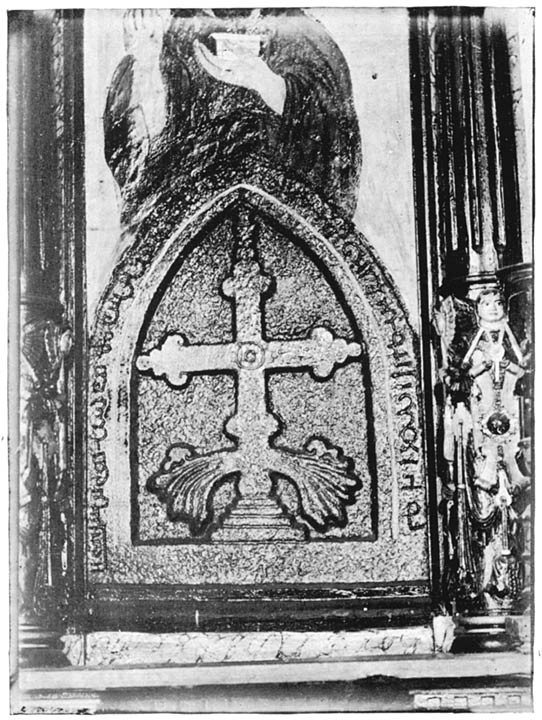
St. Thomas cross, Kōttayam.
In the Asiatic Journal (Vol. VI), Mr. Whish refutes the assertions made by Mr. Wrede in the Asiatic Researches (Vol. VII) that the Christians of Malabar settled in that country “during the violent persecution of the sect of Nestorius under Theodosius II, or some time after,” and says, with reference to the date of the Jewish colonies in India, that the Christians of the country were settled long anterior to the period mentioned by Mr. Wrede. Referring to the acts and journeyings of the apostles, Dorotheus, Bishop of Tyre (254–313 A.D.), says “the Apostle Thomas, after having preached the Gospel to the Parthians, Medes, Persians, Germanians, Bactrians, and Magi, suffered martyrdom at Calamina, a town of India.” It is said that, at the Council of Nice held in 325 A.D., India was represented by Johannes, Bishop of India Maxima and Persia. St. Gregory of Nazianzen (370–392 A.D.), in answering the reproach of his being a stranger, asks “Were not the apostles strangers? Granting that Judæa was the country of Peter, what had Paul in common with the Gentiles, Luke with Achaia, Andrew with Epirus, John with Ephesus, Thomas with India, Mark with Italy”? St. Jerome (390 A.D.) testifies to the general belief in the mission of St. Thomas to India. He too mentions Calamina as the town where the apostle met with his death. Baronius thinks that, when Theodoret, the Church historian (430–458 A.D.), speaks of the apostles, he evidently associates the work in India with the name of St. Thomas. St. Gregory of Torus relates that “in that place in India, where the body of Thomas lay before it was transferred to Edessa, there is a monastery and temple of great size.” Florentius asserts that “nothing with more certainty I find in the works of the Holy Fathers than that St. Thomas preached the Gospel in India.” Rufinus, who stayed twenty-five years in Syria, says that the remains of St. Thomas were brought from India to Edessa. Two Arabian travellers of the ninth century, referred to by Renaudot, assert that St. Thomas died at Mailapur.
Coming to modern times, we have several authorities, who testify to the apostolic origin of the Indian Church, regarded as apocryphal by Mr. Milne Rae, Sir W. W. Hunter, and others. The historian of the ‘Indian Empire,’ while rejecting some of the strongest arguments advanced by Mr. Milne Rae, accepts his conclusions in regard to the apostolic origin. The Romanist Portuguese in their enthusiasm coloured the legends to such an extent as to make them appear incredible, and the Protestant writers of modern times, while distrusting the Portuguese version, are not agreed as to the rare personage that introduced Christianity to India. Mr. Wrede asserts that the Christians of Malabar settled in that country during the violent persecution of the sect of Nestorius under Theodosius II, or some time after. Dr. Burnell traces the origin to the Manichæan Thomas, who flourished towards the end of the third century. Mr. Milne Rae brings the occurrence of the event down to the sixth century of the Christian era. Sir William Hunter, without associating the foundation of the Malabar Church with the name of any particular person, states the event to have taken place some time in the second century, long before the advent of Thomas the Manichæan, but considers that the name St. Thomas Christians was adopted by the Christians in the eighth century. He observes that “the early legend of the Manichæan Thomas in the third century and the later labours of the Armenian Thomas, the rebuilder of the Malabar Church in the eighth century, endeared that name to the Christians of Southern India.” [It has recently been stated, with reference to the tradition that it was St. Thomas the apostle who first evangelised Southern India, that, “though this tradition is no more capable of disproof than of proof, those authorities seem to be on safer ground, who are content to hold that Christianity was first imported into India by Nestorian or Chaldæan missionaries from Persia and Mesopotamia, whose apostolic zeal between the sixth and twelfth centuries ranged all over Asia, even into Tibet and Tartary. The seat of the Nestorian Patriarchate of Babylon was at Bagdad, and, as it claimed to be par excellence the Church of St. Thomas, this might well account for the fact that the proselytes it won over in India were in the habit of calling themselves Christians of St. Thomas. It is, to say the least, a remarkable coincidence that one of the three ancient stone crosses preserved in India bears an inscription and devices, which are stated to resemble those on the cross discovered near Singanfu in China, recording the appearance of Nestorian missionaries in Shenshi in the early part of the seventh century.”]
As already said, there are those who attribute the introduction of the Gospel to a certain Thomas, a disciple of Manes, who is supposed to have come to India in 277 A.D., finding in this an explanation of the origin of the Manigrāmakars (inhabitants of the village of Manes) of Kayenkulam near Quilon. Coming to the middle of the fourth century, we read of a Thomas Cana, an Aramæan or Syrian merchant, or a divine, as some would have it, who, having in his travels seen the neglected conditions of the flock of Christ on the Malabar coast, returned to his native land, sought the assistance of the Catholics of Bagdad, came back with a train of clergymen and a pretty large number of Syrians, and worked vigorously to better their spiritual condition. He is said to have married two Indian ladies, the disputes of succession between whose children appear, according to some writers, to have given rise to the two names of Northerners (Vadakkumbagar) and Southerners (Thekkumbagar)—a distinction which is still jealously kept up. The authorities are, however, divided as to the date of his arrival, for, while some assign 345 A.D., others give 745 A.D. It is just possible that this legend but records the advent of two waves of colonists from Syria at different times, and their settlement in different stations; and Thomas Cana was perhaps the leader of the first migration. The Syrian tradition explains the origin of the names in a different way, for, according to it, the foreigners or colonists from Syria lived in the southern street of Cranganūr or Kodungallūr, and the native converts in the northern street. After their dispersion from Cranganūr, the Southerners kept up their pride and prestige by refusing to intermarry, while the name of Northerners came to be applied to all Native Christians other than the Southerners. At their wedding feasts, the Southerners sing songs commemorating their colonization at Kodungallūr, their dispersion from there, and settlement in different places. They still retain some foreign tribe names, to which the original colony is said to have belonged. A few of these names are Baji, Kojah, Kujalik, and Majamuth. Their leader Thomas Cana is said to have visited the last of the Perumāls and to have obtained several privileges for the benefit of the Christians. He is supposed to have built a church at Mahādēvarpattanam, or more correctly Mahodayapūram, near Kodungallūr in the Cochin State, the capital of the Perumāls or Viceroys of Kērala, and, in their documents, the Syrian Christians now and again designate themselves as being inhabitants of Mahādēvarpattanam.
Translation.
Hari! Prosperity! Adoration to the great Ganapati! On the day of (the Nakshatra) Rōhini, a Saturday after the expiration of the twenty-first (day) of the solar month Mina (of the year during which) Jupiter (was) in Makara, while the glorious Vīra-Rāghava-Chakravartin,—(of the race) that has been wielding the sceptre for several hundred thousands of years in regular succession from the glorious king of kings, the glorious Vīra-Kērala-Chakravartin—was ruling prosperously:—
While (we were) pleased to reside in the great palace, we conferred the title of Manigrāmam on Iravikorttan, alias Sēramānlōka-pperun-jetti of Magōdaiyarpattinam.
We (also) gave (him the right of) festive clothing, house pillars, the income that accrues, the export trade (?), monopoly of trade, (the right of) proclamation, forerunners, the five musical instruments, a conch, a lamp in day-time, a cloth spread (in front to walk on), a palanquin, the royal parasol, the Telugu (?) drum, a gateway with an ornamental arch, and monopoly of trade in the four quarters.
We (also) gave the oilmongers and the five (classes of) artisans as (his) slaves.
We (also) gave, with a libation of water—having (caused it to be) written on a copper-plate—to Iravikorttan, who is the lord of the city, the brokerage on (articles) that may be measured with the para, weighed by the balance or measured with the tape, that may be counted or weighed, and on all other (articles) that are intermediate—including salt, sugar, musk (and) lamp oil—and also the customs levied on these (articles) between the river mouth of Kodungallūr and the gate (gōpura)—chiefly between the four temples (tali) and the village adjacent to (each) temple.
We gave (this) as property to Sêramân-lôka-pperun-jetti, alias Iravikorttan, and to his children’s children in due succession.
(The witnesses) who know this (are):—We gave (it) with the knowledge of the villagers of Panniyûr and the villagers of Sôgiram. We gave (it) with the knowledge (of the authorities) of Vênâdu and Odunâdu. We gave (it) with the knowledge (of the authorities) of Ēranâdu and Valluvanâdu. We gave (it) for the time that the moon and the sun shall exist.
The hand-writing of Sêramân-lôka-pperun-dattān Nambi Sadeyan, who wrote (this) copper-plate with the knowledge of these (witnesses).
Nestorius, a native of Germanicia, was educated at Antioch, where, as Presbyter, he became celebrated, while yet very young, for his asceticism, orthodoxy, and eloquence. On the death of Sisinnius, Patriarch of Constantinople, this distinguished preacher of Antioch was appointed to the vacant See by the Emperor Theodosius II, and was consecrated as Patriarch in 428 A.D. The doctrine of a God-man respecting Christ, and the mode of union of the human and the divine nature in Him left undefined by the early teachers, who contented themselves with speaking of Him and regarding Him as “born and unborn, God in flesh, life in death, born of Mary, and born of God,” had, long before the time of Nestorius, begun to tax the genius of churchmen, and the controversies in respect of this double nature of Christ had led to the growth and spread of important heretical doctrines. Two of the great heresies of the church before that of Nestorius are associated with the names of Arius and Apollinaris. Arius “admitted both the divine and the human nature of Christ, but, by making Him subordinate to God, denied His divinity in the highest sense.” Apollinaris, undermining the doctrine of the example and atonement of Christ, argued that “in Jesus the Logos supplied the place of the reasonable soul.” As early as 325 A.D. the first Œcumenical Council of Nice had defined against the Arians, and decreed that “the Son was not only of like essence, but of the same essence with the Father, and the human nature, maimed and misinterpreted by the Apollinarians, had been restored to the person of Christ at the Council of Constantinople in 381.” Nestorius, finding the Arians and Apollinarians, condemned strongly though they were, still strong in numbers and influence at Constantinople, expressed in his first sermon as Patriarch his determination to put down these and other heretical sects, and exhorted the Emperor to help him in this difficult task. But, while vigorously engaged in the effectual extinction of all heresies, he incurred the displeasure of the orthodox party by boldly declaring, though in the most sincerely orthodox form, against the use of the term Theotokos, that is, Mother of God, which, as applied to the Virgin Mary, had then grown into popular favour, especially amongst the clergy at Constantinople and Rome. While he himself revered the Blessed Virgin as the Mother of Christ, he declaimed against the use of the expression Mother of God in respect of her, as being alike “unknown to the Apostles, and unauthorised by the Church,” besides its being inherently absurd to suppose that the Godhead can be born or suffer. Moreover, in his endeavour to avoid the extreme positions taken up by Arians and Apollinarians, he denied, while speaking of the two natures in Christ, that there was any communication of attributes. But he was understood on this point to have maintained a mechanical rather than a supernatural union of the two natures, and also to have rent Christ asunder, and divided Him into two persons. Explaining his position, Nestorius said “I distinguish the natures, but I unite my adoration.” But this explanation did not satisfy the orthodox, who understood him to have “preached a Christ less than divine.” The clergy and laity of Constantinople, amongst whom Nestorius had thus grown unpopular, and was talked of as a heretic, appealed to Cyril, Bishop of the rival See of Alexandria, to interfere on their behalf. Cyril, supported by the authority of the Pope, arrived on the scene, and, at the Council of Ephesus, hastily and informally called up, condemned Nestorius as a heretic, and excommunicated him. After Nestorianism had been rooted out of the Roman Empire in the time of Justinian, it flourished “in the East,” especially in Persia and the countries adjoining it, where the churches, since their foundation, had been following the Syrian ritual, discipline, and doctrine, and where a strong party, among them the Patriarch of Seleucia or Babylon, and his suffragan the Metropolitan of Persia, with their large following, revered Nestorius as a martyr, and faithfully and formally accepted his teachings at the Synod of Seleucia in 448 A.D. His doctrines seem to have spread as far east as China, so that, in 551, Nestorian monks who had long resided in that country are said to have brought the eggs of the silkworm to Constantinople. Cosmos, surnamed Indicopleustes, the Indian traveller, who, in 522 A.D., visited Male, “the country where the pepper grows,” has referred to the existence of a fully organised church in Malabar, with the Bishops consecrated in Persia. His reference, while it traces the origin of the Indian church to the earlier centuries, also testifies to the fact that, at the time of his visit, the church was Nestorian in its creed “from the circumstance of its dependence upon the Primate of Persia, who then unquestionably held the Nestorian doctrines.”
The next heresy was that of Eutyches, a zealous adherent of Cyril in opposition to Nestorius at the Council of Ephesus in 431 A.D. But Eutyches, in opposing the doctrine of Nestorius, went beyond Cyril and others, and affirmed that, after the union of the two natures, the human and the divine, Christ had only one nature the divine, His humanity being absorbed in His divinity. After several years of controversy, the question was finally decided at the Council of Chalcedon in 451, when it was declared, in opposition to the doctrine of Eutyches, that the two natures were united in Christ, but “without any alteration, absorption, or confusion”; or, in other words, in the person of Christ there were two natures, the human and the divine, each perfect in itself, but there was only one person. Eutyches was excommunicated, and died in exile. Those who would not subscribe to the doctrines declared at Chalcedon were condemned as heretics; they then seceded, and afterwards gathered themselves around different centres, which were Syria, Mesopotamia, Asia Minor, Cyprus and Palestine, Armenia, Egypt, and Abyssinia. The Armenians embraced the Eutychian theory of divinity being the sole nature in Christ, the humanity being absorbed, while the Egyptians and Abyssinians held in the monophysite doctrine of the divinity and humanity being one compound nature in Christ. The West Syrians, or natives of Syria proper, to whom the Syrians of this coast trace their origin, adopted, after having renounced the doctrines of Nestorius, the Eutychian tenet. Through the influence of Severus, Patriarch of Antioch, they gradually became Monophysites. The Monophysite sect was for a time suppressed by the Emperors, but in the sixth century there took place the great Jacobite revival of the monophysite doctrine under James Bardæus, better known as Jacobus Zanzalus, who united the various divisions, into which the Monophysites had separated themselves, into one church, which at the present day exists under the name of the Jacobite church. The head of the Jacobite church claims the rank and prerogative of the Patriarch of Antioch—a title claimed by no less than three church dignitaries. Leaving it to subtle theologians to settle the disputes, we may briefly define the position of the Jacobites in Malabar in respect of the above controversies. While they accept the qualifying epithets pronounced by the decree passed at the Council of Chalcedon in regard to the union of the two natures in Christ, they object to the use of the word two in referring to the same. So far they are practically at one with the Armenians, for they also condemn the Eutychian doctrine; and a Jacobite candidate for holy orders in the Syrian church has, among other things, to take an oath denouncing Eutyches and his teachers.
We know but little of the history of the Malabar Church for nearly six centuries prior to the arrival of the Portuguese in India. We have, however, the story of the pilgrimage of the Bishop of Sherborne to the shrine of St. Thomas in India about 883 A.D., in the reign of Alfred the Great; and the reference made to the prevalence of Nestorianism among the St. Thomas’ Christians of Malabar by Marco Polo, the Venetian traveller.
The Christian community seem to have been in the zenith of their glory and prosperity between the 9th and 14th centuries, as, according to their tradition, they were then permitted to have a king of their own, with Villiarvattam near Udayamperūr (Diamper) as his capital. According to another version, the king of Villiarvattam was a convert to Christianity. The dynasty seems to have become extinct about the 14th century, and it is said that, on the arrival of the Portuguese, the crown and sceptre of the last Christian king were presented to Vasco da Gama in 1502. We have already referred to the high position occupied by the Christians under the early kings, as is seen from the rare privileges granted to them, most probably in return for military services rendered by them. The king seems to have enjoyed, among other things, the right of punishing offences committed by the Christian community, who practically followed his lead. A more reasonable view of the story of a Christian king appears to be that a Christian chief of Udayamperūr enjoyed a sort of socio-territorial jurisdiction over his followers, which, in later times, seems to have been so magnified as to invest him with territorial sovereignty. We see, in the copper-plate charters of the Jews, that their chief was also invested with some such powers.
Mention is made of two Latin Missions in the 14th century, with Quilon as head-quarters, but their labours were ineffectual, and their triumphs but short-lived. Towards the end of the 15th, and throughout the whole of the 16th century, the Nestorian Patriarch of Mesopotamia seems to have exercised some authority over the Malabar Christians, as is borne out by the occasional references to the arrival of Nestorian Bishops to preside over the churches.
When the Portuguese first came to India, the Indian trade was chiefly in the hands of the Moors, who had no particular liking for the Hindus or Christians, and the arrival of the Portuguese was therefore welcome alike to the Hindus and Christians, who eagerly sought their assistance. The Portuguese likewise accepted their offers of friendship very gladly, as an alliance, especially with the former, gave them splendid opportunities for advancing their religious mission, while, from a friendly intercourse with the latter, they expected not only to further their religious interests, but also their commercial prosperity. In the work of conversion they were successful, more especially among the lower orders, the Illuvans, Mukkuvans, Pulayans, etc. The labours of Miguel Vaz, afterwards Vicar-General of Goa, and of Father Vincent, in this direction were continued with admirable success by St. Francis Xavier.
We have seen how the strict and rigid discipline of the Jesuit Archbishops, their pride and exclusiveness, and the capture and murder of Ahattala brought about the outburst at the Coonen Cross. Seeing that the Jesuits had failed, Pope Alexander VII had recourse to the Carmelite Fathers, who were specially instructed to do their best to remove the schism, and to bring about a reconciliation; but, because the Portuguese claimed absolute possession of the Indian Missions, and as the Pope had despatched the Carmelite Fathers without the approval of the King of Portugal, the first batch of these missionaries could not reach the destined field of their labours. Another body of Carmelites, who had taken a different route, however, succeeded in reaching Malabar in 1656, and they met Archdeacon Thomas who had succeeded Archdeacon George. While expressing their willingness to submit to Rome, the Syrians declined to place themselves under Archbishop Garcia, S.J., who had succeeded Archbishop Roz, S.J. The Syrians insisted on their being given a non-Jesuit Bishop, and, in 1659, Father Joseph was appointed Vicar Apostolic of the “Sierra of Malabar” without the knowledge of the King of Portugal. He came out to India in 1661, and worked vigorously for two years in reconciling the Syrian Christians to the Church of Rome. But he was not allowed to continue his work unmolested, because, when the Dutch, who were competing with the Portuguese for supremacy in the Eastern seas, took the port of Cochin in 1663, Bishop Joseph was ordered to leave the coast forthwith. When he left Cochin, he consecrated Chandy Parambil, otherwise known as Alexander de Campo.