Volume 6 — S (continued 3)
Reading edition
By their learning, and their skill in adapting themselves to circumstances, the Carmelite Fathers had continued to secure the good-will of the Dutch, and, returning to Cochin, assisted Alexander de Campo in his work. Father Mathew, one of their number, was allowed to build a church at Chatiath near Ernakulam. Another church was built at Varapuzha (Verapoly) on land given rent-free by the Rāja of Cochin. Since this time, Varapuzha, now in Travancore, has continued to be the residence of a Vicar Apostolic.
The history of a quarter of a century subsequent to this is uneventful, except for the little quarrels between the Carmelite Fathers and the native clergy. In 1700, however, the Archbishop of Goa declined to consecrate a Carmelite Father nominated by the Pope to the Vicariate Apostolic. But Father Anjelus, the Vicar Apostolic elect, got himself consecrated by one Mar Simon, who was supposed to be in communion with Rome. The Dutch Government having declined admission to Archbishop Ribeiro, S.J., the nominee of the Portuguese King to their dominions, Anjelus was invested with jurisdiction over Cochin and Cranganūr. Thereupon, the Jesuit Fathers sought shelter in Travancore, and in the territories of the Zamorin. With the capture of Cranganūr by the Dutch, which struck the death-blow to Portuguese supremacy in the East, the last vestige of the church, seminary and college founded by the Jesuits disappeared. As the Dutch hated the Jesuits as bigoted Papists and uncompromising schismatics, several of the Jesuit Fathers, who were appointed Archbishops of Cranganūr, never set foot within their diocese, and such of them as accepted the responsibility confined themselves to the territories of the Rāja of Travancore. It was only after the establishment of British supremacy that the Jesuit Fathers were able to re-enter the scene of their early labours. An almost unbroken line of Carmelite Fathers appointed by the Pope filled the Vicariate till 1875, though the Archbishop of Goa and the Bishop of Cochin now and then declined to consecrate the nominee, and thus made feeble attempts on behalf of their Faithful King to recover their lost position.
Salvador, S.J., Archbishop of Cranganūr, died in 1777. Five years after this, the King of Portugal appointed Joseph Cariatil and Thomas Paramakal, two native Christians, who had been educated at the Propaganda College at Rome, as Archbishop and Vicar-General, respectively, of the diocese of Cranganūr.
The native clergy at the time were mostly ignorant, and the discipline amongst them was rather lax. The Propaganda attempted reforms in this direction, which led to a rupture between the Latin and the native clergy. The Carmelite Fathers, like the Jesuits, had grown overbearing and haughty, and an attempt at innovation made by the Pope through them became altogether distasteful to the natives. Serious charges against the Carmelites were, therefore, formally laid before the Pope and the Rāja of Travancore by the Syrians. They also insisted that Thomas should be consecrated Bishop. At this time, the Dutch were all-powerful at the courts of native rulers, and, though the Carmelite missionaries who had ingratiated themselves into the good graces of the Dutch tried their best to thwart the Syrians in their endeavours, Thomas was permitted to be consecrated Bishop, and the Syrians were allowed the enjoyment of certain rare privileges. It is remarkable that, at this time and even in much earlier times, the disputes between the foreign and the native clergy, or between the various factions following the lead of the native clergy, were often decided by the Hindu kings, and the Christians accepted and abided by the decisions of their temporal heads.
In 1838, Pope Gregory XVI issued a Bull abolishing the Sees of Cranganūr and Cochin, and transferring the jurisdiction to the Vicar Apostolic of Varapuzha. But the King of Portugal questioned the right of the Pope, and this led to serious disputes. The abolition of the smaller seminaries by Archbishop Bernardin of Varapuzha, and his refusal to ordain candidates for Holy Orders trained in these seminaries by the Malpans or teacher-priests, caused much discontent among the Syrian Christians, and, in 1856, a large section of the Syrians applied to the Catholic Chaldæan Patriarch of Babylon for a Chaldæan Bishop. This was readily responded to by the Patriarch, who, though under the Pope, thought that he had a prescriptive right to supremacy over the Malabar Christians. Bishop Roccos was sent out to Malabar in 1861, and though, owing to the charm of novelty, a large section of the Christians at once joined him, a strong minority questioned his authority, and referred the matter to the Pope. Bishop Roccos was recalled, and the Patriarch was warned by the Pope against further interference.
Subsequently, the Patriarch, again acting on the notion that he had independent jurisdiction over the Chaldæan Syrian church of Malabar, sent out Bishop Mellus to Cochin. The arrival of this Bishop in 1874 created a distinct split among the Christians of Trichūr, one faction acknowledging the supremacy of the Pope, and the other following the lead of Bishop Mellus. This open rupture had involved the two factions in a costly litigation. The adherents of Bishop Mellus contend that their church, ever since its foundation in 1810 or 1812, has followed the practice, ritual, and communion of the Chaldæan church of Babylon, without having ever been in communion with Rome. The matter is sub judice. They are now known by the name of Chaldæan Syrians. The Pope, in the meanwhile, excommunicated Bishop Mellus, but he continued to exercise spiritual authority over his adherents independently of Rome. In 1887 the Patriarch having made peace with the Pope, Bishop Mellus left India, and submitted to Rome in 1889. On the departure of Bishop Mellus, the Chaldæan Syrians chose Anthony Kathanar, otherwise known as Mar Abdeso, as their Archbishop. He is said to have been a Rome Syrian priest under the Archbishop of Varapuzha. It is also said that he visited Syria and Palestine, and received ordination from the anti-Roman Patriarch of Babylon. Before his death in 1900, he ordained Mar Augustine, who, under the title of Chorepiscopus, had assisted him in the government of the Chaldæan church, and he now presides over the Chaldæan Syrian churches in the State.
In 1868, Bishop Marcellinus was appointed Coadjutor to the Vicar Apostolic of Varapuzha, and entrusted with the spiritual concerns of the Romo-Syrians. On his death in 1892, the Romo-Syrians were placed under the care of two European Vicars Apostolic. We have seen how the Jesuits had made themselves odious to the native Christians, and how reluctantly the latter had submitted to their rigid discipline. We have seen, too, how the Carmelites who replaced them, in spite of their worldly wisdom and conciliatory policy, had their own occasional quarrels and disputes with the native clergy and their congregations. From the time of the revolt at the Coonen Cross, and ever afterwards, the Christians had longed for Bishops of their own nationality, and made repeated requests for the same. For some reason or other, compliance with these requisitions was deferred for years. Experience showed that the direct rule of foreign Bishops had failed to secure the unanimous sympathy and hearty co-operation of the people. The Pope was, however, convinced of the spiritual adherence of the native clergy and congregation to Rome. In these circumstances, it was thought advisable to give the native clergy a fair trial in the matter of local supremacy. Bishops Medlycott and Lavigne, S.J., who were the Vicars Apostolic of Trichūr and Kottayam, were therefore withdrawn, and, in 1896, three native Syrian priests, Father John Menacheri, Father Aloysius Pareparambil, and Father Mathew Mackil, were consecrated by the Papal Delegate as the Vicars Apostolic of Trichūr, Ernākulam, and Chenganacheri.
The monopoly of the Indian missions claimed by the Portuguese, and the frequent disputes which disturbed the peace of the Malabar church, were ended in 1886 by the Concordat entered into between Pope Leo XIII and the King of Portugal. The Archbishop of Goa was by this recognised as the Patriarch of the East Indies with the Bishop of Cochin as a suffragan, whose diocese in the Cochin State is confined to the seaboard tāluk of Cochin. The rest of the Latin Catholics of this State, except a small section in the Chittūr tāluk under the Bishop of Coimbatore, are under the Archbishop of Varapuzha.
Since the revolt of the Syrians at the Coonen Cross in 1653, the Jacobite Syrians have been governed by native Bishops consecrated by Bishops sent by the Patriarch of Antioch, or at least always received and recognised as such. In exigent circumstances, the native Bishops themselves, before their death, consecrated their successors by the imposition of hands. Immediately after the defection, they chose Archdeacon Thomas as their spiritual leader. He was thus the first Metran or native Bishop, having been formally ordained after twelve years of independent rule by Mar Gregory from Antioch, with whose name the revival of Jacobitism in Malabar is associated. The Metran assumed the title of Mar Thomas I. He belonged to the family that traced its descent from the Pakalomattom family, held in high respect and great veneration as one of the Brāhman families, the members of which are supposed to have been converted and ordained as priests by the apostle himself. Members of the same family continued to hold the Metranship till about the year 1815, when the family is supposed to have become extinct. This hereditary succession is supposed by some to be a relic of the Nestorian practice. It may, however, be explained in another way. The earliest converts were high-caste Hindus, amongst whom an Anandravan (brother or nephew) succeeded to the family estates and titles in pursuance of the joint family system as current in Malabar. The succession of a brother or a nephew might, therefore, be quite as much a relic of the Hindu custom. The Metrans possessed properties. They were, therefore, interested in securing the succession of their Anandravans, so that their properties might not pass to a different family. Mar Thomas I was succeeded by his brother Mar Thomas II, on whose death his nephew became Metran under the title of Mar Thomas III. He held office only for ten days. Mar Thomas IV, who succeeded him, presided over the church till 1728. Thomas III and IV are said to have been consecrated by Bishop John, a scholar of great repute, who, with one Bishop Basil, came from Antioch in 1685. During the régime of Mar Thomas IV, and of his nephew Thomas V, Mar Gabriel, a Nestorian Bishop, appeared on the scene in 1708. He seems to have been a man without any definite creed, as he proclaimed himself a Nestorian, a Jacobite, or a Romanist, according as one or the other best suited his interests. He had his own friends and admirers among the Syrians, with whose support he ruled over a few churches in the north till 1731. The consecration of Mar Thomas V by Mar Thomas IV was felt to be invalid, and, to remedy the defect, the assistance of the Dutch was sought; but, being disappointed, the Christians had recourse to a Jewish merchant named Ezekiel, who undertook to convey their message to the Patriarch of Antioch. He brought from Bassorah one Mar Ivanius, who was a man of fiery temper. He interfered with the images in the churches. This led to quarrels with the Metran, and he had forthwith to quit the State. Through the Dutch authorities at Cochin, a fresh requisition was sent to the Patriarch of Antioch, who sent out three Bishops named Basil, John, and Gregory. Their arrival caused fresh troubles, owing to the difficulty of paying the large sum claimed by them as passage money. In 1761, Mar Thomas V, supposed to have died in 1765, consecrated his nephew Mar Thomas VI. About this time, Gregory consecrated one Kurilos, the leader of a faction that resisted the rule of Thomas VI. The disputes and quarrels which followed were ended with the flight of Kurilos, who founded the See of Anjoor in the north of Cochin and became the first Bishop of Tholiyur. Through the kind intercession of the Maharāja of Travancore, Thomas VI underwent formal consecration at the hands of the Bishops from Antioch, and took the title of Dionysius I, known also as Dionysius the Great. In 1775, the great Carmelite father Paoli visited Mar Dionysius, and tried to persuade him to submit to Rome. It is said that he agreed to the proposal, on condition of his being recognised as Metropolitan of all the Syrians in Malabar, but nothing came of it. A few years after this, the struggle for supremacy between the Dutch and the English had ended in the triumph of the latter, who evinced a good deal of interest in the Syrian Christians, and, in 1805, the Madras Government deputed Dr. Kerr to study the history of the Malabar Church. In 1809, Dr. Buchanan visited Mar Dionysius, and broached the question of a union of the Syrian Church with the Church of England. The proposal, however, did not find favour with the Metropolitan, or his congregation. Mar Dionysius died in 1808. Before his death, he had consecrated Thomas Kathanar as Thomas VIII. He died in 1816. His successor, Thomas IX, was weak and old, and he was displaced by Ittoop Ramban, known as Pulikōt Dionysius or Dionysius II. He enjoyed the confidence and good-will of Colonel Munro, the British Resident, through whose good offices a seminary had been built at Kottayam in 1813 for the education of Syrian youths. He died in 1818. Philixenos, who had succeeded Kurilos as Bishop of Tholiyur, now consecrated Punnathara Dionysius, or Dionysius III.
We have now to refer to an important incident in the history of the Jacobite Syrians. Through the influence of the British Resident, and in the hope of effecting the union proposed by Dr. Buchanan, the Church Mission Society commenced their labours in 1816. The English Missionaries began their work under favourable circumstances, and the most cordial relations existed between the Syrians and the missionaries for some years, so much so that the latter frequently visited the Syrian churches, and even preached sermons. On the death of Dionysius III in 1825, or as some say 1827, Cheppat Dionysius consecrated by Mar Philixenos again, succeeded as Metropolitan under the title of Dionysius IV. During his régime, there grew up among the Syrians a party, who suspected that the missionaries were using their influence with the Metropolitan, and secretly endeavouring to bring the Syrians under the Protestant Church. The conservative party of Syrians stoutly opposed the movement. They petitioned the Patriarch of Antioch, who at once sent out a Bishop named Athanasius. On arrival in 1825, a large number of Syrians flocked to him. He even went to the length of threatening Mar Dionysius with excommunication. But the Protestant missionaries and the British Resident came to the rescue of the Metropolitan, and exercised their influence with the ruler of Travancore, who forthwith deported Athanasius. The deportation of Athanasius strengthened the position of the missionaries. The British Resident, and through his influence the native ruler, often rendered them the most unqualified support. The missionaries who superintended the education of the Syrian students in the seminary, having begun to teach them doctrines contrary to those of the Jacobite Church, the cordiality and friendship that had existed between the missionaries and the Metropolitan gradually gave place to distrust and suspicion. The party that clung to the time-honoured traditions and practices of their church soon fanned the flame of discord, and snapped asunder the ties of friendship that had bound the Metropolitan to the missionaries. Bishop Wilson of Calcutta proceeded to Travancore to see if a reconciliation could be effected. But his attempts in this direction proved fruitless, because the Syrians could not accept his proposal to adopt important changes affecting their spiritual and temporal concerns, such as doing away with prayers for the dead, the revision of their liturgy, the management of church funds, etc., and the Syrians finally parted company with the missionaries in 1838. Soon after this, disputes arose in regard to the funds and endowments of the seminary, but they were soon settled by arbitration in 1840, and the properties were divided between the Metropolitan and the missionaries. The missionaries had friends among the Jacobites, some of whom became members of the Church of England.
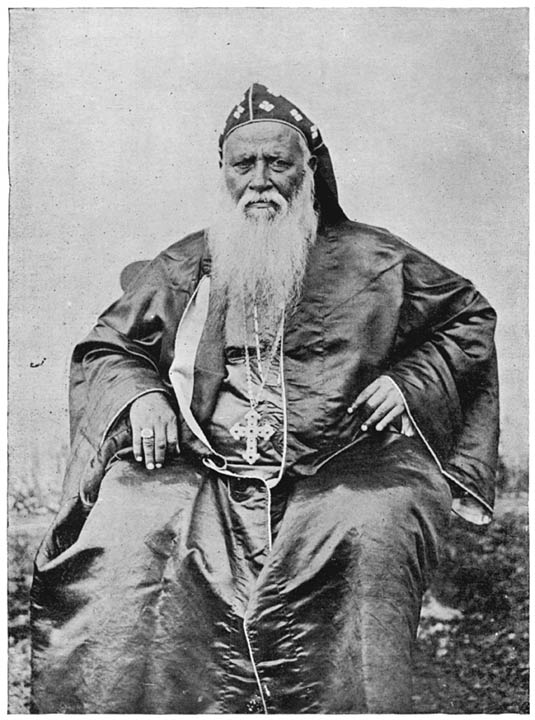
Mar Dionysius.
The Syrians were rather distressed, because they thought that the consecration of their Metropolitan by Mar Philixenos was insufficient. They therefore memorialised the Patriarch of Antioch. There grew up also a party hostile to the Metropolitan, and they sent to Antioch a Syrian Christian named Mathew. His arrival at Antioch was most opportune. The Patriarch was looking out for a proper man. Mathew was therefore welcomed, and treated very kindly. He was consecrated as Metropolitan by the Patriarch himself in 1842, and sent out with the necessary credentials. He arrived in 1843 as Metropolitan of Malankara under the title of Mathew Anastatius, and advanced his claims to the headship of the Church, but Mar Dionysius resisted him, and sent an appeal to the Patriarch of Antioch, in which he denounced Mathew as one who had enlisted his sympathies with the Protestant missionaries. Upon this, the Patriarch sent out one Cyril with power to expel Mathew, and, with the connivance of Mar Dionysius, Cyril cut the gordian knot by appointing himself as Metropolitan of Malabar. Disputes arising, a committee was appointed to examine the claims of Athanasius and Cyril. The credentials of Cyril were proved to be forged, whereupon Athanasius was duly installed in his office in 1862, and Cyril fled the country. Cyril having failed, the Patriarch sent another Bishop named Stephanos, who contributed his mite towards widening the breach, and, on the British Resident having ordered the Bishop to quit the country, an appeal was preferred to the Court of Directors, who insisted on a policy of non-interference. This bestirred Mar Cyril, who reappeared on the scene, and fanned the flame of discord. Being ordered to leave Mar Athanasius unmolested, he and his friends sent one Joseph to Antioch, who returned with fresh credentials in 1866, assumed the title of Dionysius V, claimed the office of Metropolitan, and applied to the Travancore Government for assistance. Adopting a policy of non-interference, the darbar referred him to the Law Courts, in case he could not come to terms with Mar Athanasius. The Patriarch of Antioch himself visited Cochin and Travancore in 1874, and presided over a Synod which met at Mulanthurutha in the Cochin State. Resolutions affirming the supremacy of Antioch, recognising Mar Dionysius as the accredited Metropolitan of Malabar, and condemning Mathew Athanasius as a schismatic, were passed by the members of the assembly, and the Patriarch returned to Mardin in 1876. This, however, did not mend matters, and the two parties launched themselves into a protracted law suit in 1879, which ended in favour of Mar Dionysius in 1889. Mar Athanasius, who had taken up an independent position, died in 1875, and his cousin, whom he had consecrated, succeeded as Metropolitan under the title of Mar Thomas Anastatius. He died in 1893, and Titus Mar Thoma, consecrated likewise by his predecessor, presides over the Reformed Party of Jacobite Syrians, who prefer to be called St. Thomas’ Syrians. We have thus traced the history of the Jacobite Syrians from 1653, and shown how they separated themselves into two parties, now represented by the Jacobite Syrians under Mar Dionysius, owing allegiance to the Patriarch of Antioch, and the Reformed Syrians or St. Thomas’ Syrians owning Titus Mar Thoma as their supreme spiritual head. Thus, while the Jacobite Syrians have accepted and acknowledged the ecclesiastical supremacy of the Patriarch of Antioch, the St. Thomas’ Syrians, maintaining that the Jacobite creed was introduced into Malabar only in the seventeenth century after a section of the church had shaken off the Roman supremacy, uphold the ecclesiastical autonomy of the church, whereby the supreme control of the spiritual and temporal affairs of the church is declared to be in the hands of the Metropolitan of Malabar. The St. Thomas’ Syrians hold that the consecration of a Bishop by, or with the sanction of the Patriarch of Babylon, Alexandria or Antioch, gives no more validity or sanctity to that office than consecration by the Metropolitan of Malabar, the supreme head of the church in Malabar, inasmuch as this church is as ancient and apostolic as any other, being founded by the apostle St. Thomas; while the Jacobites hold that the consecration of a Bishop is not valid, unless it be done with the sanction of their Patriarch. The St. Thomas’ Syrians have, however, no objection to receiving consecration from the head of any other episcopal apostolic church, but they consider that such consecrations do not in any way subject their church to the supremacy of that prelate or church.
Both the Latins and the Romo-Syrians use the liturgy of the Church of Rome, the former using the Latin, and the latter the Syriac language. It is believed by some that the Christians of St. Thomas formerly used the liturgy of St. Adæus, East Syrian, Edessa, but that it was almost completely assimilated to the Roman liturgy by Portuguese Jesuits at the Synod of Diamper in 1599. The Chaldæan Syrians also use the Roman liturgy, with the following points of difference in practice, communicated to me by their present ecclesiastical head:—(1) They perform marriage ceremonies on Sundays, instead of week days as the Romo-Syrians do. (2) While reading the Gospel, their priests turn to the congregation, whereas the Romo-Syrian priests turn to the altar. (3) Their priests bless the congregation in the middle of the mass, a practice not in vogue among the Romo-Syrians. (4) They use two kinds of consecrated oil in baptism, which does away with the necessity of confirmation. The Romo-Syrians, on the other hand, use only one kind of oil, and hence they have to be subsequently confirmed by one of their Bishops.
The liturgy used by the Jacobite Syrians and the St. Thomas’ Syrians is the same, viz., that of St. James. The St. Thomas’ Syrians have, however, made some changes by deleting certain passages from it. [A recent writer observes that “a service which I attended at the quaint old Syrian church at Kōttayam, which glories in the possession of one of the three ancient stone crosses in India, closely resembled, as far as my memory serves me, one which I attended many years ago at Antioch, except that the non-sacramental portions of the mass were read in Malayālam instead of in Arabic, the sacramental words alone being in both cases spoken in the ancient Syriac tongue.] In regard to doctrine and practice, the following points may be noted:—(1) While the Jacobite Syrians look upon the Holy Bible as the main authority in matters of doctrine, practice, and ritual, they do not allow the Bible to be interpreted except with the help of the traditions of the church, the writings of the early Fathers, and the decrees of the Holy Synods of the undivided Christian period; but the St. Thomas’ Syrians believe that the Holy Bible is unique and supreme in such matters. (2) While the Jacobites have faith in the efficacy and necessity of prayers, charities, etc., for the benefit of departed souls, of the invocation of the Virgin Mary and the Saints in divine worship, of pilgrimages, and of confessing sins to, and obtaining absolution from priests, the St. Thomas’ Syrians regard these and similar practices as unscriptural, tending not to the edification of believers, but to the drawing away of the minds of believers from the vital and real spiritual truths of the Christian Revelation. (3) While the Jacobites administer the Lord’s Supper to the laity and the non-celebrating clergy in the form of consecrated bread dipped in consecrated wine, and regard it a sin to administer the elements separately after having united them in token of Christ’s resurrection, the St. Thomas’ Syrians admit the laity to both the elements after the act of uniting them. (4) While the Jacobite Syrians allow marriage ceremonies on Sundays, on the plea that, being of the nature of a sacrament, they ought to be celebrated on Sundays, and that Christ himself had taken part in a marriage festival on the Sabbath day, the St. Thomas’ Syrians prohibit such celebrations on Sundays as unscriptural, the Sabbath being set apart for rest and religious exercises. (5) While the Jacobites believe that the mass is as much a memorial of Christ’s oblation on the cross as it is an unbloody sacrifice offered for the remission of the sins of the living and of the faithful dead, the St. Thomas’ Syrians observe it as a commemoration of Christ’s sacrifice on the cross. (6) The Jacobites venerate the cross and the relics of Saints, while the St. Thomas’ Syrians regard the practice as idolatry. (7) The Jacobites perform mass for the dead, while the St. Thomas’ Syrians regard it as unscriptural. (8) With the Jacobites, remarriage, marriage of widows, and marriage after admission to full priesthood, reduce a priest to the status of a layman, and one united in any such marriage is not permitted to perform priestly functions, whereas priests of the St. Thomas’ Syrian party are allowed to contract such marriages without forfeiture of their priestly rights. (9) The Jacobite Syrians believe in the efficacy of infant baptism, and acknowledge baptismal regeneration, while the St. Thomas’ Syrians, who also baptise infants, deny the doctrine of regeneration in baptism, and regard the ceremony as a mere external sign of admission to church communion. (10) The Jacobites observe special fasts, and abstain from certain articles of food during such fasts, while the St. Thomas’ Syrians regard the practice as superstitious.
The Jacobite Syrian priests are not paid any fixed salary, but are supported by voluntary contributions in the shape of fees for baptism, marriages, funerals, etc. The Romo-Syrian and Latin priests are paid fixed salaries, besides the above perquisites. The Syrian priests are called Kathanars, while the Latin priests go by the name of Pādres. For the Jacobite Syrians, the morone or holy oil required for baptism, consecration of churches, ordination of priests, etc., has to be obtained from Antioch. The churches under Rome get it from Rome. Unlike the Catholic clergy, the Jacobite clergy, except their Metropolitan and the Rambans, are allowed to marry.
The generality of Syrians of the present day trace their descent from the higher orders of the Hindu society, and the observance by many of them of certain customs prevalent more or less among high-caste Hindus bears out this fact. It is no doubt very curious that, in spite of their having been Christians for centuries together, they still retain the traditions of their Hindu forefathers. It may sound very strange, but it is none the less true, that caste prejudices which influence their Hindu brethren in all social and domestic relations obtain to some extent among some sections of the Syrian Christians, but, with the spread of a better knowledge of the teachings of Christ, the progress of English education, and contact with European Christians, caste observances are gradually dying out. The following relics of old customs may, however, be noted:—
(1) Some Christians make offerings to Hindu temples with as much reverence as they do in their own churches.
Some non-Brāhman Hindus likewise make offerings to Christian churches.
(2) Some sections of Syrians have faith in horoscopes, and get them cast for new-born babies, just as Hindus do.
(3) On the wedding day, the bridegroom ties round the neck of the bride a tāli (small ornament made of gold). This custom is prevalent among all classes of Native Christians. On the death of their husbands, some even remove the tāli to indicate widowhood, as is the custom among the Brāhmans.
(4) When a person dies, his or her children, if any, and near relatives, observe pula (death pollution) for a period ranging from ten to fifteen days. The observance imposes abstinence from animal food. The pula ends with a religious ceremony in the church, with feasting friends and relatives in the house, and feeding the poor, according to one’s means. Srādha, or anniversary ceremony for the soul of the dead, is performed with services in the church and feasts in the house.
(5) In rural parts especially, the Ōnam festival of the Malayāli Hindus is celebrated with great éclat, with feasting, making presents of cloths to children and relatives, out-door and in-door games, etc.
(6) Vishu, or new-year’s day, is likewise a gala day, when presents of small coins are made to children, relatives, and the poor.
(7) The ceremony of first feeding a child with rice (annaprāsanam or chōrūnu of the Hindus) is celebrated generally in the sixth month after birth. Parents often make vows to have the ceremony done in a particular church, as Hindu parents take their children to particular temples in fulfilment of special vows.
(8) The Syrians do not admit within their premises low-castes, e.g., Pulayans, Paraiyans, etc., even after the conversion of the latter to Christianity. They enforce even distance pollution, though not quite to the same extent as Malayāli Hindus do. Iluvans are allowed admission to their houses, but are not allowed to cook their meals. In some parts, they are not even allowed to enter the houses of Syrians.
There are no intermarriages between Syrians of the various denominations and Latin Catholics. Under very exceptional circumstances, a Romo-Syrian contracts a marriage with one of Latin rite, and vice versâ, but this entails many difficulties and disabilities on the issues. Among the Latins themselves, there are, again, no intermarriages between the communities of the seven hundred, the five hundred, and the three hundred. The difference of cult and creed has led to the prohibition of marriages between the Romo-Syrians and Jacobite Syrians. The Jacobite Syrians properly so called, St. Thomas’ Syrians, and the Syro-Protestants do, however, intermarry. The Southerners and Northerners do not intermarry; any conjugal ties effected between them subject the former to some kind of social excommunication. This exclusiveness, as we have already said, is claimed on the score of their descent from the early colonists from Syria. The Syrians in general, and the Jacobite Syrians in particular, are greater stricklers to customs than other classes of Native Christians.
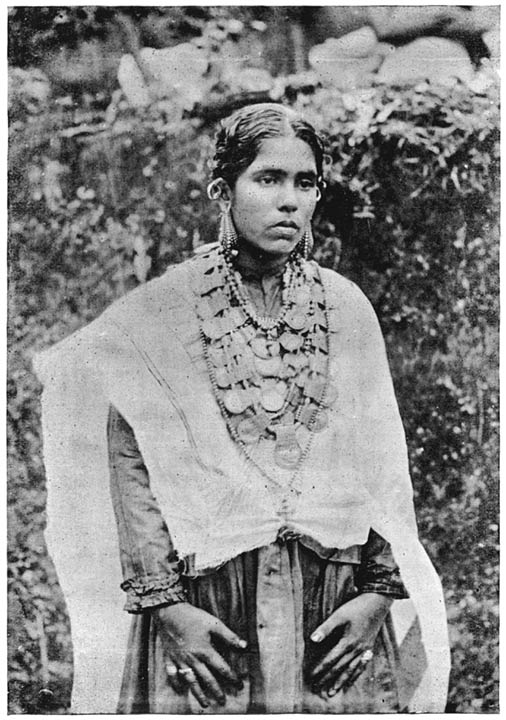
Syrian Christian bride.
“Amongst the Syrian Christians, as amongst the Māppillas, there are many survivals of Hindu customs and superstitions, and caste prejudices have by no means disappeared amongst the various sections of the community. Southerners and Northerners will not intermarry, and families who trace their descent from Brāhmans and Nāyars will, in many cases, not admit lower classes to their houses, much less allow them to cook for them or touch them. Most of the Syrians observe the Ōnam and Vishnu festivals; the astrologer is frequently consulted to cast horoscopes and tell omens; while it is a common custom for persons suffering from diseases to seek a cure by buying silver or tin images of the diseased limb, which their priest has blessed. Similar survivals are to be noticed in their social ceremonies. A Pulikudi ceremony, similar to that of the Hindus, was commonly performed till recently, though it has now fallen into disuse. Immediately on the birth of a child, three drops of honey in which gold has been rubbed are poured into its mouth by its father, and the mother is considered to be under pollution till the tenth day. Baptism takes place on the fourteenth day amongst the Southern Jacobites, and amongst other divisions on the fifty-sixth day. A rice-giving ceremony similar to the Hindu Chōrunnu is still sometimes performed in the fifth or sixth month, when the child is presented by the mother with a gold cross, if a boy, or a small gold coin or talūvam if a girl, to be worn round the neck.
“Among the Jacobites early marriage was the rule until comparatively recently, boys being married at ten or twelve years of age, and girls at six or seven. Now the more usual age for marriage is sixteen in the case of boys, and twelve in the case of girls. Weddings take place on Sundays, and, amongst the Northerners, may be celebrated in either the bride’s or the bridegroom’s parish church. On the two Sundays before the wedding, the banns have to be called in the two churches, and the marriage agreements concluded in the presence of the parish priests (Ottu kalyānam). The dowry, which is an essential feature of Syrian weddings, is usually paid on the Sunday before the wedding. It should consist of an odd number of rupees, and should be tied up in a cloth. On the Thursday before the wedding day, the house is decorated with rice flour, and on the Saturday the marriage pandal (booth), is built. The first ceremonial takes place on Saturday night when bride and bridegroom both bathe, and the latter is shaved. Next morning both bride and bridegroom attend the ordinary mass, the bridegroom being careful to enter the church before the bride. Now-a-days both are often dressed more or less in European fashion, and it is essential that the bride should wear as many jewels as she has got, or can borrow for the occasion. Before leaving his house, the bridegroom is blessed by his guru to whom he gives a present (dakshina) of clothes and money. He is accompanied by a bestman, usually his sister’s husband, who brings the tāli. After mass, a tithe (pathuvaram) of the bride’s dowry is paid to the church as the marriage fee, a further fee to the priest (kaikasturi), and a fee called kaimuttupanam for the bishop. The marriage service is then read, and, at its conclusion, the bridegroom ties the tāli round the bride’s neck with threads taken from her veil, making a special kind of knot, while the priest holds the tāli in front. The priest and the bridegroom then put a veil (mantravadi) over the bride’s head. The tāli should not be removed so long as the girl is married, and should be buried with her. The veil should also be kept for her funeral. The bridal party returns home in state, special umbrellas being held over the bride and bridegroom. At the gate they are met by the bride’s sister carrying a lighted lamp, and she washes the bridegroom’s feet. The married couple then go to the pandal, where they are ceremonially fed with sweets and plantains by the priest and by representatives of their two families, to the accompaniment of the women’s kurava (cry), and in the presence of the guests, who are seated in order of precedence, the chief persons having seats of honour covered with black rugs and white cloths (vellayum karimbadavum), traditionally a regal honour. The bride and bridegroom are then led into the house by the bestman and bride’s uncle, the bride being careful to enter it right foot first; and the guests are feasted in order of rank. It is a peculiar custom of the Syrian Christians at these feasts to double up the ends of the plantain leaves which serve them as plates, and is supposed to be symbolical of the royal privilege of eating off a double plate. Until the following Wednesday, the bestman sleeps with the bridegroom in the bridal chamber, the bride occupying another room. On Wednesday evening comes the ceremony called nālām kuli, or fourth day bath. The bridegroom and the bestman, who are in the bridal chamber, lock the door; the bride’s mother knocks and begs the bridegroom to come out, which he at last does after she has sung a song (vathilturapattu) celebrating the attractions and virtues of the bride. The bridegroom and bride then bathe, dress in new clothes, and go to the pandal, where they perform paradakshinams round a lighted lamp, and the bridegroom gives cloths to the bride’s uncle, mother, and grand-parents. The married couple are then escorted to the bridal chamber, which has in the interval been cleaned and prepared for them. The next morning they have to go to the bridegroom’s or bride’s house as the case may be, and there eat together and go through a ceremonial similar to that which they performed on the wedding day in the other house. This concludes the marriage ceremonies, but on Sunday the bridegroom and bride should attend mass together in the bride’s parish church if they were married in the bridegroom’s, and vice versâ. Amongst the Southern Jacobites, the ceremonies are very similar, but the dowry is not paid till the marriage day, or till the girl’s first confinement. Half the pathuvaram is paid to the priest instead of a kaikasturi, and the bridegroom puts a ring on the bride’s finger during the marriage service. After the church service, the couple go to the bridegroom’s house, where they are fed ceremonially by the bride’s mother, and the subsequent feast is at the expense of the bride’s people. On Monday morning, the bridegroom is ceremonially fed by the bride’s mother in the bridal chamber (manavālan chōru), and in the evening there is a ceremony called manavālan tazhukkal, in which the bride and bridegroom are embraced in turn by their respective parents and relations, after which there is a feast with singing of hymns. Before the couple leave for the bride’s house on Thursday, there is a big feast, called kudivirunnu, given by the bridegroom to the bride’s people, followed by a ceremony called vilakku toduga, in which men and women sing hymns and dance round a lighted lamp, which they touch at intervals. Amongst the Romo-Syrians and the Reformed sect, the marriage ceremonies have less trace of Hindu ritual; they do not celebrate weddings on Sundays, and have no nālām kuli ceremony, but a tāli is usually tied in addition to the giving of a ring.
“At funerals (except amongst the Reformed sect) it is usual for each of the dead man’s connections to bring a cloth to serve as a shroud. Before the body is lowered into the grave, holy oil is poured into the eyes, nostrils and ears. The mourners are under pollution, and fast till the day of the second funeral or pula kuli (purification), and till then masses should be said daily for the dead. The pula kuli is celebrated usually on the 11th day, but may be deferred till the 15th, 17th or 21st, or sometimes to the 41st. The mourners are incensed, while hymns are sung and prayers offered. Each then gives a contribution of money to the priest, and receives in return a pinch of cummin. A feast is then given to the neighbours and the poor. On the 40th day there is another feast, at which meat is eaten by the mourners for the first time. A requiem mass should be said each month on the day of death for twelve months, and on the first anniversary the mourning concludes with a feast.”
To the foregoing account of the Syrian Christians, a few stray notes may be added.
Some years ago, the wife of a District Judge of Calicut asked the pupils of a school how long they had been Christians. “We were,” came the crushing reply, “Christians when you English were worshipping Druids, and stained with woad.” More recently, the master at a college in Madras called on all Native Christians in his class to stand up. Noticing that one boy remained seated, he called on him for an explanation, when the youth explained that he was a Syrian Christian, and not a Native Christian.
It is noted by the Rev. W. J. Richards that “at the very time that our King John was pulling out Jews’ teeth to make them surrender their treasures, Hindu princes were protecting Jewish and Christian subjects, whose ancestors had been honoured by Royal grants for hundreds of years.”
The Southerners say that they can be distinguished from the Northerners by the red tinge of their hair. A man with reddish moustache, and a dark-skinned baby with brilliant red hair, whose father had red whiskers, were produced before me in support of the claim.
As examples of Old and New Testament names occurring, in a changed form, among Syrian Christians, the following may be cited:—
Abraham, Abragam.
Joshua, Kōshi.
Peter, Puthrōs, Ittiyerah, Itte.
Paul, Powlos.
John, Yohan, Sonanan, Chōna.
Titus, Tetōs.
Matthew, Mathai, Māthen.
Philip, Philippos, Papi, Eippe, Eapen.
Thomas, Thōma, Thommi, Thommen.
Joseph, Ouseph.
Jacob, Yacob, Chāko
Alexander, Chandi.
Samuel, Chamuel.
Mary, Maria, Mariam.
Sarah, Sāra.
Susannah, Sosā.
Rebecca, Rābka, Rācā.
Elizabeth, Elspeth, Elia, Elachā.
Rachael, Rāchi, Rāghael, Chācha.
Syrian Christians take the name of their father, their own name, and that of their residence. Whence arise such names as Edazayhikkal Mathoo Philippos, Kunnampuram Thommen Chāndi, and Chandakadayil Joseph Chommi.
I have seen some Syrian Christian men tattooed with a cross on the upper arm, and a cross and their initials on the forearm.
In conclusion, I may, for the sake of comparison, place on record the averages of the more important physical measurements of Northerner and Southerner Syrian Christians and Nāyars.
30 Syrian Christians. 40 Nāyars.
Northerner. Southerner.
Stature 165.3 164.8 165.2
Cephalic length 18.7 18.9 18.7
Cephalic breadth 14.3 14.1 13.9
Cephalic index 76.3 74.8 74.4
Nasal height 4.9 4.9 4.9
Nasal breadth 3.5 3.5 3.5
Nasal index 72.3 71.6 71.1
It may be noted that, in his ‘Letters from Malabar,’ Canter Visscher, in the middle of the eighteenth century, writes that the St. Thomas’ Christians “keep very strict genealogical records, and they will neither marry nor in any way intermingle with the new low-caste Christians, being themselves mostly Castade Naiross, that is, nobility of the Nāyar caste, in token of which they generally carry a sword in the hand, as a mark of dignity.”
In the following table, the averages of some of the more important measurements of the Syrian Christians and Tachtadschy people are recorded:—
Stature, cm. Cephalic length, cm. Cephalic breadth, cm. Cephalic, index.
Syrian Christians, Northerner 165.3 18.7 14.3 76.3
Syrian Christians, Southerner 164.8 18.9 14.1 74.8
Tachtadschy 168. 17.9 15.3 85.7
Madras: Printed by The Superintendent, Government Press.