Volume 6 — P (Continued) (continued 2)
Reading edition
Polygamy is not common among the Paraiyans, but Mr. Clayton has known a few instances in which a Paraiyan had two regularly married wives, each wearing a tāli. But it is very common to find that a Paraiyan has, in addition to his formally married wife, another woman who occupies a recognised position in his household. The first wears the tāli. The other woman does not, but is called the second wife. She cannot be dismissed without the sanction of the parachēri council. The man who maintains her is called her husband, and her children are recognised as part of his family. Mr. Clayton believes that a second wife is usually taken only when the more formally married wife has no children, or when an additional worker is wanted in the house, or to help in the daily work. Thus a horsekeeper will often have two wives, one to prepare his meals and boil the gram for the horse, the other to go out day by day to collect grass for the horse. The Tamil proverb “The experience of a man with two wives is anguish” applies to all these double unions. There are constant quarrels between the two women, and the man is generally involved, often to his own great inconvenience. It is quite common for a Paraiyan to marry his deceased wife’s sister, if she is not already married.
A Paraiya woman usually goes to her mother’s house a month or two before she expects the birth of her first child, which is born there. Sometimes a medicine woman (maruttuvacchi), who possesses or professes some knowledge of drugs and midwifery, is called in, if the case is a bad one. Generally her barbarous treatment is but additional torture to the patient. Immediately after the birth of the child, the mother drinks a decoction called kashāyam, in which there is much ginger. Hence the Tamil proverb “Is there any decoction without ginger in it?” About a week after the birth, the mother, as a purificatory ceremony, is rubbed with oil and bathed.
Among Sūdras there is a family ceremony, to which the Sanskrit name Simanta has been assigned, though it is not the true Simanta observed by Brāhmans. It occurs only in connection with a first pregnancy. The expectant mother stands bending over a rice mortar, and water or human milk is poured on her back by her husband’s elder or younger sister. Money is also given to buy jewels for the expected child. The ceremony is of no interest to anyone outside the family. Hence the proverb “Come, ye villagers, and pour water on this woman’s back.” This is used when outsiders are called in to do for a member of a family what the relatives ought to do. This ceremony is sometimes observed by Paraiyans. Among Brāhmans it is believed to affect the sex of the child. It should be added that it is firmly believed that, if a woman dies during pregnancy or in childbed, her spirit becomes an exceedingly malignant ghost, and haunts the precincts of the village where she dies.
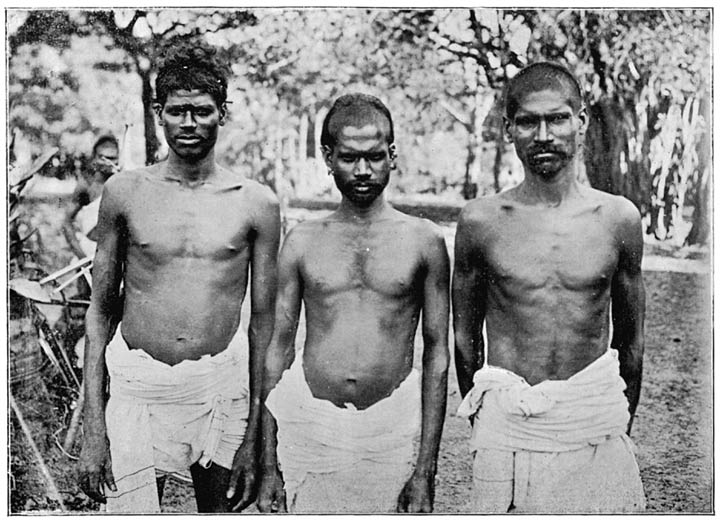
Paraiyans.
Like all other Dravidians, the Paraiyans acknowledge the existence of a supreme, omnipresent, personal spiritual Being, the source of all, whom they call Kadavul (He who is). Kadavul possesses no temples, and is not worshipped, but he is the highest conception of Paraiya thought. Paraiyans worship at least three classes of godlings or dēvata, generally called the mothers (ammā). Sometimes they are worshipped as the virgins (Kanniyammā) or the seven virgins. These mothers may be worshipped collectively in a group. They are then symbolised by seven stones or bricks, perhaps within a little enclosure, or on a little platform in the Paraiya hamlet, or under a margosa (Melia Azadirachta) tree, or sheltered by a wattle hut, or even by a small brick temple. This temple is universally known as the Amman Koil. More usually, one particular mother is worshipped at the Paraiya shrine. She is then called the grāma dēvata, or village goddess, of the particular hamlet. The names of these goddesses are legion. Each village claims that its own mother is not the same as that of the next village, but all are supposed to be sisters. Each is supposed to be the guardian of the boundaries of the chēri or grāmam where her temple lies, sometimes of both grāmam and chēri. She is believed to protect its inhabitants and its livestock from disease, disaster and famine, to promote the fecundity of cattle and goats, and to give children. In a word, she is called the benefactress of the place, and of all in it who worship her. The following are a few of the names of these village tutelary deities:—
Ellammā, goddess of the boundary, worshipped by Tamil and Telugu Paraiyans.
Mūngilammā, bamboo goddess.
Padeiyattāl or Padeiyācchi.
Parrapotammā, a Telugu goddess supposed to cure cattle diseases.
Pīdarīyammā, sometimes called Ellei Pidāri.
The symbol of the goddess may be a conical stone, or a carved idol. Occasionally a rude figure of the bull Nandi, and an iron trident mark the shrine. A lamp is often lighted before it at night.
The ceremonial of worship of all classes of dēvata is very simple. The worshipper prostrates himself before the symbol of the deity, whether one stone, seven stones, or an image. He anoints it with oil, smears it with saffron, daubs it with vermilion, garlands it with flowers (Nerium odorum by preference), burns a bit of camphor, and circumambulates the shrine, keeping his right side towards it. On special occasions he breaks cocoanuts, kills fowls, goats or sheep, of which the two last must be killed at one blow, pours out their blood, perhaps offers a little money, and goes his way, satisfied that he has done his best to propitiate the dēvata whom he has honoured.
Special shrines attain very great fame. Thus the goddess Bāvaniyammāl of Periyapālayam, some sixteen miles from Madras, is well known, and crowds come to her annual festival. Paraiyans, Pallis, and Chakkilians form the majority of the worshippers, but of late years Sūdras and even Brāhmans are to be found at her shrine. The homage rendered to her is twofold. Her worshippers sacrifice some thousands of sheep on the river bank outside her temple, and, entirely divesting themselves of their garments, and covering themselves with bunches of margosa leaves, go round the temple. Except on the five Sundays, usually in July and August, on which the festival is held, the shrine is forsaken, and the goddess is said to be a vegetarian; but on the five festival Sundays she is said to be as greedy for flesh as a leather-dresser’s (Chakkiliyan) wife.
Two goddesses hold a position distinct from the mothers as a group, or as tutelary goddesses. These are Gangammāl and Māriyattāl, and their peculiarity is that they are itinerant deities. Gangammāl is often described as the goddess of cholera, and Māriyattāl, as the goddess of small-pox, though both diseases are frequently ascribed to the latter. Māriyattāl is worshipped under the names of Poleramma and Ammavāru by Telugus. For instance, near Arcotkuppam in the North Arcot district, a festival is held in honour of Gangammāl in the Tamil month Vaikasi (May-June), in which Sūdras join. The main feature of the festival is the boiling of new rice as at Pongal. Men also put on women’s clothes, and perform grotesque dances. In the same way, in the ten days’ festival in honour of Māriyattāl held at Uttaramallūr during the Tamil month Avani (August), the goddess is carried about by washermen (Vannān), who perform a kind of pantomime (vilas) in her honour. There is a curious belief that these goddesses (or Gangammāl, if they are distinguished) must travel along roads and paths, and cannot go across country, and that they cannot pass over the leaves of the margosa or the stems of the plant called in Tamil perandei (Vitis quadrangularis). Consequently, when cholera is about, and the goddess is supposed to be travelling from village to village seeking victims, branches of margosa and long strings of perandei are placed on all the paths leading into the grāmam or chēri. Sometimes, also, leaves of the margosa are strung together, and hung across the village street. These are called toranam.
Besides the deities already referred to, there are a number of ghosts, ghouls, and goblins (pey or pisāsu), whom Paraiyans propitiate. Mathureivīran and Vīrabadran are, for example, two well-known demons.
Among Tamil Paraiyans there are families in almost every village, who hold a kind of sacerdotal rank in the esteem of their fellows. They are called Valluvans, Valluva Pandārams, or Valluva Paraiyans. Their position and authority depend largely on their own astuteness. Sometimes they are respected even by Brāhmans for their powers as exorcists. It is often impossible to see any difference between the Valluvans and the ordinary Paraiyans, except that their houses are usually a little apart from other houses in the chēri. They take a leading part in local Paraiya festivals. At marriages they pronounce the blessing when the tāli is tied round the bride’s neck.
In cases of supposed possession by demons, or by the mothers, the Valluvan is consulted as to the meaning of the portent, and takes part in driving the spirit out of the victim, sometimes using violence and blows to compel the spirit to deliver its message and be gone. The Census Report, 1901, states that Valluvans do not eat or intermarry with other sections of the Paraiyans. Mr. Clayton is unable to confirm this, and is inclined to doubt whether it is generally true.
The following note on the death ceremonies of the Paraiyans at Coimbatore was supplied by Mr. V. Govindan. If the deceased was a married man, the corpse is placed in a sitting posture in a booth made of twigs of margosa and milk-hedge (Euphorbia Tirucalli), and supported behind by a mortar. The widow puts on all her ornaments, and decorates her hair with flowers. She seats herself on the left side of the corpse, in the hands of which some paddy (unhusked rice) or salt is placed. Taking hold of its hands, some one pours the contents thereof into the hands of the widow, who replaces them in those of the corpse. This is done thrice, and the widow then ties the rice in her cloth. On the way to the burial ground (sudukadu), the son carries a new pot, the barber a pot of cooked rice and brinjal (Solanum Melongena) fruits and other things required for doing pūja. The Paraiyan in charge of the burial ground carries a fire-brand. The mats and other articles used by the deceased, and the materials of which the booth was made, are carried in front by the washerman, who deposits them at a spot between the house of the deceased and the burial ground called the idukādu, which is made to represent the shrine of Arichandra. Arichandra was a king, who became a slave of the Paraiyans, and is in charge of the burial ground. At the idukādu the corpse is placed on the ground, and the son, going thrice round it, breaks the pot of rice near its head. The barber makes a mark at the four corners of the bier, and the son places a quarter anna on three of the marks, and some cowdung on the mark at the north-east corner. The widow seats herself at the feet of the corpse, and another widowed woman breaks her tāli string, and throws it on the corpse. Arrived at the grave, the gurukal (priest) descends into it, does pūja and applies vibhūti (sacred ashes) to its sides. The body is lowered into it, and half a yard of cloth from the winding-sheet is given to the Paraiyan, and a quarter of a yard to an Āndi (religious mendicant). The grave is filled in up to the neck of the corpse, and bael (Ægle Marmelos) leaves, salt, and vibhūti are placed on its head by the gurukal. The grave is then filled in, and a stone and thorny branch placed at the head end. As the son goes, carrying the water-pot, three times round the grave, the barber makes a hole in the pot, which is thrown on the stone. The son and other relations bathe and return to the house, where a vessel containing milk is set on a mortar, and another containing water placed at the door. They dip twigs of the pīpal (Ficus religiosa) into the milk, and throw them on the roof. They also worship a lighted lamp. On the third day, cooked rice, and other food for which the deceased had a special liking, are taken to the grave, and placed on plantain leaves. Pūja is done, and the crows are attracted to the spot. If they do not turn up, the gurukal prays, and throws up water three times. On the seventeenth day, the son and others, accompanied by the gurukal, carry a new brick and articles required for pūja to the river. The brick is placed under water, and the son bathes. The articles for pūja are spread on a plantain leaf, before which the son places the brick. Pūja is done to it, and a piece of new cloth tied on it. It is then again carried to the water, and immersed therein. The ceremonial concludes with the lighting of the sacred fire (hōmam).
The death ceremonies of the Paraiyan, as carried out in the Chingleput district, are thus described by Mr. K. Rangachari. The corpse is washed, dressed, and carried on a bier to the burning or burial ground. Just before it is placed on the bier, all the relations, who are under pollution, go round it three times, carrying an iron measure round which straw has been wrapped, and containing a light. On the way to the burial ground, the son or grandson scatters paddy, which has been fried by the agnates. A pot of fire is carried by the Vettiyan. At a certain spot the bier is placed on the ground, and the son goes round it, carrying a pot of cooked rice, which he breaks near the head of the corpse. This rice should not be touched by man or beast, and it is generally buried. When the corpse has been placed on the pyre, or laid in the grave, rice is thrown over it by the relations. The son, carrying a pot of water, goes thrice round it, and asks those assembled if he may finish the ceremony. On receiving their assent, he again goes three times round the corpse, and, making three holes in the pot, throws it down, and goes home without looking back. If the dead person is unmarried, a mock marriage ceremony, called kanni kaziththal (removing bachelorhood), is performed before the corpse is laid on the bier. A garland of arka (Calotropis gigantea) flowers and leaves is placed round its neck, and balls of mud from a gutter are laid on the head, knees, and other parts of the body. In some places a variant of the ceremony consists in the erection of a mimic marriage booth which is covered with leaves of the arka plant, flowers of which are placed round the neck as a garland. On the third day after death, cooked rice, milk, fruits, etc., are offered to the soul of the departed on two leaves placed one near the head, the other near the feet of the corpse. Of these, the former is taken by men, and the latter by women, and eaten. The karmānthiram, or final ceremony, takes place on the twelfth or sixteenth day. All concerned in it proceed to a tank with cooked rice, cakes, etc. A figure of Ganēsa (Pillayar) is made with mud, and five kalasam (vessels) are placed near it. The various articles which have been brought are set out in front of it. Two bricks, on which the figures of a man and woman are drawn, are given to the son, who washes them, and does pūja to them after an effigy has been made at the waterside by a washerman. He then says “I gave calves and money. Enter Kailāsam (the abode of Siva). Find your way to paralōkam (the other world). I gave you milk and fruit. Go to the world of the dead. I gave gingelly (Sesamum) and milk. Enter yamalōkam (abode of the god of death). Eleven descendants on the mother’s side and ten on the father’s, twenty-one in all, may they all enter heaven.” He then puts the bricks into the water. On their return home, the sons of the deceased are presented with new clothes.
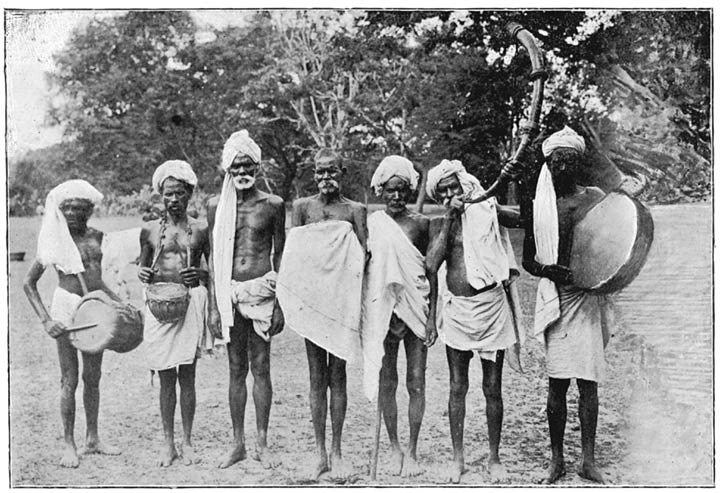
Paraiyans.
It is recorded, in the Gazetteer of the Tanjore district, that, when a man dies, camphor is not burnt in the house, but at the junction of three lanes. Some Paraiyans, on the occurrence of a death in a family, put a pot filled with dung or water, a broomstick and a fire-brand at some place where three roads meet, or in front of the house, in order to prevent the ghost from returning. An impression of the dead man’s palm is taken in cow-dung, and stuck on the wall. In some places, e.g., at Tirutturaippūndi, the Paraiyans observe a ceremony rather like that observed by Valaiyans and Karaiyans on the heir’s return from the burning-ground on the second day. Three rice-pounders and a chembu (vessel) of water are placed outside the door, and the heir sits on these, chews a piece of fish, spits thrice, and then goes and worships a light burning in the house.
Tattooing is practiced on women and children of both sexes, but not on grown men. With children it is confined to a simple line drawn down the forehead. Among Paraiyans who have become Roman Catholics, the device is sometimes a cross. Women, like those of other Tamil castes, frequently have their arms elaborately tattooed, and sometimes have a small pattern between the breasts. A legend runs to the effect that, many years ago, a Paraiyan woman wished her upper arms and chest to be tattooed in the form of a bodice. The operation was successfully carried out till the region of the heart was reached, and then a vulnerable part was punctured by the needles, with the result that the woman died. Whence has arisen a superstitious objection to tattooing of the breasts.
Sometimes an arei-mūdi, shaped like the leaf of the pūvarasa tree (Thespesia populnea), made of silver or silvered brass, is tied round the waist of female infants as an ornament. Small, flat plates of copper, called takudu, are frequently worn by children. One side is divided into sixteen squares, in which, what look like the Telugu numerals nine, ten, eleven and twelve are engraved. On the other side a circle is drawn, which is divided into eight segments, in each of which a Telugu letter is inscribed. This charm is supposed to protect the wearer from harm coming from any of the eight cardinal points of the Indian compass. Charms, in the form of metal cylinders, are worn for the same purpose by adults and children, and procured from some exorcist. Similar or the same charms are worn to avoid the baneful influence of the evil eye. To prevent this from affecting their crops, Paraiyans put up scarecrows in their fields. These are usually small broken earthen pots, whitewashed or covered with spots of whitewash, or even adorned with huge clay noses and ears, and made into grotesque faces. They are set up on the end of poles, to attract the eye of the passer-by from the crop. For the same reason more elaborate figures, made of mud and twigs, in human shape, are sometimes set up. Before wells are sunk, a charmer (mantirakkāran) is called in to recite spells and find a likely spot, cocoanuts are broken, and the milk thereof poured out to propitiate the gods of the place.
Current Tamil speech and custom divide the landless labouring Paraiyans into padiyāl and kūliyāl. The padiyāl is definitely and hereditarily attached to some land-holding family in the Hindu grāma. He can work for no one else, and cannot change masters. His privilege is that in times of drought and famine his master must support him. The kūliyāl is a mere day labourer, only employed, and therefore only receiving pay (kūli) when required. He has no claim for maintenance in seasons of scarcity, and, though no man’s serf, is worse off than the padiyāl.
There are many proverbs in Tamil, which refer to Paraiyans, from which the following are selected:—
(1) If a Paraiyan boils rice, will it not reach God? i.e., God will notice all piety, even that of a Paraiyan.
(2) When a Paraiya woman eats betel, her ten fingers (will be daubed with) lime. The Paraiya woman is a proverbial slut.
(3) Though a Paraiya woman’s child be put to school, it will still say Ayyē. Ayyē is vulgar Tamil for Aiyar, meaning Sir.
(4) The palmyra palm has no shadow; the Paraiyan has no decency. A contemptuous reference to Paraiya morality.
(5) The gourd flower and the Paraiyan’s song have no savour. Paraiyans use this saying about their own singing.
(6) Though seventy years of age, a Paraiyan will only do what he is compelled.
(7) You may believe a Paraiyan, even in ten ways; you cannot believe a Brāhman. Almost the only saying in favour of the Paraiyan.
(8) Is the sepoy who massacred a thousand horse now living in disgrace with the dogs of the parachēri?
(9) Paraiyan’s talk is half-talk. A reference to Paraiya vulgarisms of speech.
(10) Like Paraiya and Brāhman, i.e., as different as possible.
(11) Not even a Paraiyan will plough on a full moon day.
(12) Parachēri manure gives a better yield than any other manure.
(13) The drum is beaten at weddings, and also at funerals. Said, according to the Rev. H. Jensen, of a double-dealing unreliable person, who is as ready for good as for evil.
(14) The harvest of the Paraiya never comes home.
The term Paraiya, it may be noted, is applied to the common dog of Indian towns and villages, and to the scavenger kite, Milvus Govinda.
A legend runs to the effect that Vararuchi, the famous astrologer, and son of a Brāhman named Chandragupta and his Brāhman wife, became the King of Avanthi, and ruled till Vikramāditya, the son of Chandragupta by his Kshatriya wife, came of age, when he abdicated in his favour. Once, when he was resting under an ashwastha tree (Ficus religiosa), invoking the support of the deity living therein, he overheard the conversation of two Gandarvas on the tree, to the effect that he would marry a Paraiya girl. This he prevented by requesting the king to have her enclosed in a box, and floated down a river with a nail stuck into her head. The box was taken possession of by a Brāhman, who was bathing lower down, and, on opening it, he found a beautiful girl, whom he considered to be a divine gift, and regarded as his own daughter. One day the Brāhman, seeing Vararuchi passing by, invited him to mess with him, and his invitation was accepted on condition that he would prepare eighteen curries, and give him what remained after feeding a hundred Brāhmans. The Brāhman was puzzled, but the maiden, taking a long leaf, placed thereon a preparation of ginger corresponding to eighteen curries, and with it some boiled rice used as an offering at the Vaiswadēva ceremony, as the equivalent of the food for Brāhmans. Knowing this to be the work of the maiden, Vararuchi desired to marry her, and his wish was acceded to by the Brāhman. One day, while conversing with his wife about their past lives, he chanced to see a nail stuck in her head, and he knew her to be the girl whom he had caused to be floated down the stream. He accordingly resolved to go on a pilgrimage with his wife, bathing in rivers, and worshipping at temples. At last they came to Kērala, where the woman bore him twelve sons, all of whom, except one, were taken care of by members of different castes. They were all remarkable for their wisdom, and believed to be the avatar (incarnation) of Vishnu, gifted with the power of performing miracles. One of them was Pakkanar, the great Malayālam bard. Once, it is said, when some Brāhmans resolved to go to Benares, Pakkanar tried to dissuade them from so doing by telling them that the journey to the sacred city would not be productive of salvation. To prove the fruitlessness of their journey, he plucked a lotus flower from a stagnant pool, and gave it to them with instructions to deliver it to a hand which would rise from the Ganges, when they were to say that it was a present for the goddess Ganga from Pakkanar. They did as directed, and returned with news of the miracle. Pakkanar then led them to the stagnant pool, and said “Please return the lotus flower, Oh! Ganga,” when it appeared in his hand. Pakkanar is said to have earned his living by the sale of the wicker-work, which he made. One day he could not sell his baskets, and he had to go starving. A neighbour, however, gave him some milk, which Pakkanar accepted, and told the donor to think of him if ever he was in danger. The neighbour had a married daughter living with him, who, some time after, was dying of snake-bite. But her father remembered the words of Pakkanar, who came to the rescue, and cured her. One of Pakkanar’s brothers was named Narayana Branthan, who pretended to be a lunatic, and whose special delight was in rolling huge stones up a hill, for the pleasure of seeing them roll down. Though the son of a Brāhman, he mixed freely with members of all castes, and had no scruple about dining with them. A Nambūtiri Brāhman once asked him to choose an auspicious day for the performance of his son’s upanayanam (thread ceremony). He selected a most inauspicious day and hour, when the boy’s family assembled and asked Narayana whether the rite should be celebrated. He told the father to look at the sky, which became brilliantly illuminated, and a Brāhman was seen changing his sacred thread. The omen being considered favourable, the investiture ceremony was proceeded with.
The Paraiyas of Malabar and Cochin are celebrated for their knowledge of black magic, and are consulted in matters relating to theft, demoniacal influence, and the killing of enemies. Whenever anything is stolen, the Paraiya magician is consulted. Giving hopes of the recovery of the stolen article, he receives from his client some paddy (rice) and a few panams (money), with which he purchases plantain fruits, a cocoanut or two, toddy, camphor, frankincense, and rice flour. After bathing, he offers these to his favourite deity Parakutti, who is represented by a stone placed in front of his hut. Rattling an iron instrument, and singing till his voice almost fails, he invokes the god. If the lost property does not turn up, he resorts to a more indignant and abusive form of invocation. If the thief has to be caught, his prayers are redoubled, and he becomes possessed, and blood passes out of his nose and mouth. When a person is ill, or under the influence of a demon, an astrologer and a magician named by the former are consulted. The magician, taking a cadjan (palm) leaf or copper or silver sheet, draws thereon cabalistic figures, and utters a mantram (prayer). Rolling up the leaf or sheet, he ties it to a thread, and it is worn round the neck in the case of a woman, and round the loins in the case of a man. Sometimes the magician, taking a thread, makes several knots in it, while reciting a mantram. The thread is worn round the neck or wrist. Or ashes are thrown over a sick person, and rubbed over the forehead and breast, while a mantram is repeated. Of mantrams, the following may be cited as examples. “Salutation to god with a thousand locks of matted hair, a thousand hands filling the three worlds and overflowing the same. Oh! Goddess mother, out of the supreme soul, descend. Oh! Sundara Yaksha (handsome she-devil), Swaha (an efficacious word).” “Salutation to god. He bears a lion on his head, or is in the form of a lion in the upper part of his body. In the mooladhara sits Garuda, the lord of birds, enemy of serpents, and vāhana (vehicle) of Vishnu. He has Lakshmana to the left, Rāma to the right, Hanumān in front, Rāvana behind, and all around, above, below, everywhere he has Srī Narayana Swaha. Mayst thou watch over or protect me.”
The Paraiyans are notorious for the performance of marana kriyakal, or ceremonies for the killing of enemies. They resort to various methods, of which the following are examples:—
(1) Make an image in wax in the form of your enemy. Take it in your right hand, and your chain of beads in your left hand. Then burn the image with due rites, and it shall slay your enemy in a fortnight.
(2) Take a human bone from a burial-ground, and recite over it a thousand times the following mantra:—“Oh, swine-faced goddess! seize him, seize him as a victim. Drink his blood; eat, eat his flesh. Oh, image of imminent death! Malayala Bhagavathi.” The bone, thrown into the enemy’s house, will cause his ruin.
Odi or oti cult (breaking the human body) is the name given to a form of black magic practiced by the Paraiyans, who, when proficient in it, are believed to be able to render themselves invisible, or assume the form of a bull, cat, or dog. They are supposed to be able to entice pregnant women from their houses at dead of night, to destroy the fœtus in the womb, and substitute other substances for it; to bring sickness and death upon people; and so to bewitch people as to transport them from one place to another. A Paraiya who wishes to practice the cult goes to a guru (preceptor), and, falling at his feet, humbly requests that he may be admitted into the mysteries of the art. The master first tries to dissuade him, but the disciple persists in the desire to learn it. He is then tried by various tests as to his fitness. He follows his master to the forests and lonely places at midnight. The master suddenly makes himself invisible, and soon appears before him in the form of a terrible bull, a ferocious dog, or an elephant, when the novice should remain calm and collected. He is also required to pass a night or two in the forest, which, according to his firm belief, is full of strange beings howling horribly. He should remain unmoved. By these and other trials, he is tested as to his fitness. Having passed through the various ordeals, the guru initiates him into the brotherhood by the performance of pūja on an auspicious day to his favourite Nīli, called also Kallatikode Nīli, through whose aid he works his black art. Flesh and liquor are consumed, and the disciple is taught how to prepare pilla thilam and angola thilam, which are the potent medicines for the working of his cult. The chief ingredient in the preparation of pilla thilam, or baby oil, is the sixth or seventh month’s fœtus of a primipara, who should belong to a caste other than that of the sorcerer. Having satisfied himself that the omens are favourable, he sets out at midnight for the house of the woman selected as his victim, and walks several times round it, waving a cocoanut shell containing a mixture of lime and turmeric water (gurusi), and muttering mantrams to secure the aid of the deity. He also draws yantrams (cabalistic devices) on the ground. The woman is compelled to come out of her house. Even if the door is locked, she will bang her head against it, and force it open. The sorcerer leads her to a retired spot, strips her naked, and tells her to lie flat on the ground. This she does, and a vessel made of a gourd (Lagenaria) is placed close to her vagina. The uterus then contracts, and the fœtus emerges. Sometimes, it is said, the uterus is filled with some rubbish, and the woman instantly dies. Care is taken that the fœtus does not touch the ground, as the potency of the drug would thereby be ruined. The fœtus is cut to pieces, and smoked over a fire. It is then placed in a vessel provided with a few holes, below which is another vessel. The two are placed in a larger receptacle filled with water, which is heated over a fire. From the fœtus a liquid exudes, which is collected in the lower vessel. A human skull is then reduced to a fine powder, which is mixed with a portion of the liquid (thilam). With the mixture a mark is made on the forehead of the sorcerer, who rubs some of it over various parts of his body, and drinks a small quantity of cow-dung water. He then thinks that he can assume the form of any animal he likes, and achieve his object in view, be it murder or bodily injury. The magic oil, called angola thilam, is extracted from the angola tree (Alangium Lamarckii), which bears a very large number of fruits. One of these is believed to be endowed with life and power of motion, and to be capable of descending and returning to its original position on dark nights. Its possession can be attained by demons, or by an expert watching at the foot of the tree. When it has been secured, the extraction of the oil involves the same operations as those for extracting the pilla thilam, and they must be carried out within seven hours. A mark made on the forehead with the oil enables its wearer to achieve his desires, and to transform himself into some animal.
When a person has an enemy whom he wishes to get rid of, the Paraiya magician is consulted, and the name of the enemy given to him. Identifying his residence, the Paraiya starts off on a dark night, and anyone whom he comes across is at once dispatched with a blow. The victim comes out of his house in a state of stupefaction, and the magician puts him to death either by a blow on the head, or by suffocating him with two sticks applied to his neck. Odi cult is said to have been practiced till only a few years ago in the rural parts of the northern part of the State, and in the tāluks of Palghāt and Walluvanād in Malabar, and even now it has not entirely died out. But cases of extracting fœtuses and putting persons to death are not heard of at the present day, owing to the fear of Government officials, landlords, and others. The story is current of a Nāyar village official, who had two fine bullocks, which a Māppila wished to purchase. The Nāyar, however, was unwilling to part with them. The Māppila accordingly engaged some men to steal the animals. Availing themselves of the absence of the Nāyar from home, the robbers went to his house, where they saw a Paraiya and his wife practicing the odi cult, and compelling a young woman to come out of the house, and lie on the ground. Catching hold of the Paraiya, the robbers tied him to a tree, and secured him. The man and his wife were beaten, and the would-be robbers rewarded with a present of the bullocks.
The Paraiyans have no temples of their own, but worship Siva or Kāli. According to a legend, in Tretayūga (the second age), a Paraiya named Samvara, and his wife Pulini were living in a forest, and one day came across a Sivalinga (stone lingam) at a dilapidated temple, which they kept, and worshipped with offerings of flesh, and by smearing it with ashes from the burial-ground. On a certain day, no ashes were available, and the woman offered to have her body burnt, so that the ashes thereof might be used. With much reluctance her husband sacrificed her, and performed pūja. Then he turned round to offer, as usual, the prasadam to his wife forgetting that she was dead, and he was surprised to see her standing before him, receiving his offering (prasadam), in flesh and blood. Highly pleased with their conduct, Siva appeared in person before them, and gave them absolution.
In every small village in the rural parts, is a small Bhagavati temple, to the deity of which the Paraiyas are devotedly attached, and look to it for protection in times of cholera, small-pox, or other calamities. Kodungallūr Bhagavati is their guardian deity, and they take part in the festivals (yēla) at the shrine. A few days before the festival, a piece of cloth is given to the Velichapād (oracle), who dresses himself in it, wears a piece of red cloth round his neck, a peculiar dress around his loins, and ties a few small bells (chelamba) round his legs. Accompanied by others with drums and fife and a basket, he goes to every Nāyar house daily for seven days, and receives presents of paddy, wherewith to defray the expenses of the festival. During the celebration thereof, the Velichapād and others go to a shed at a distance from the temple (kavu), some dressed up as ghosts, and dance and sing, to the accompaniment of a band, in honour of the deity.
On the first of every month, a ceremony called kalasam is performed on behalf of the spirits of the departed. Fish, cooked meat, rice, parched grain, plantain fruits, cocoanuts, toddy, and other things, are placed on a leaf with a lighted lamp in front of it. A prayer is then uttered, expressing a hope that the ancestors will partake of the food which has been procured for them with much difficulty, and protect the living. One man, becoming inspired, acts the part of an oracle, and addresses those assembled.
The following story is narrated concerning the origin of the Elankunnapuzha temple on the island of Vypīn. When some Paraiyas were cutting reeds, one of them discovered a remarkable idol and fell into a trance, under the influence of which he informed the Rāja of Cochin that the idol originally belonged to the Trichendur temple in Tinnevelly, and that he must build a shrine for it. This was accordingly done, and to the Paraiyan who discovered the idol a daily allowance of rice, and a larger quantity of rice during the annual temple festival were given. In return, he had to supply cadjan (palm leaf) umbrellas used at the daily procession, and bamboo baskets required for washing the rice offered to the idol. These allowances were received by the Perum or big Paraiyan up to a recent date, even if he is not receiving them at the present day.
When a Paraiyan woman is delivered, she is secluded for two weeks in a temporary hut erected at a short distance from the dwelling hut. On the tenth day, some male member of the family goes to his Brāhman or Nāyar landlord, from whom he receives some milk, which is sprinkled over the woman and her infant. She can then come to the verandah of her home, and remains there for five days, when she is purified by bathing. The temporary hut is burnt down.
The dead are buried, and the corpse, after being laid in the grave, is covered with a mat.
The Paraiyas are engaged in the manufacture of wicker baskets, bamboo mats, and cadjan umbrellas. They also take part in all kinds of agricultural work, and, when ploughing, will not use buffaloes, which are regarded as unclean beasts, the touch of which necessitates a ceremonial ablution.
Many Paraiyans become converts to Christianity, and thereby receive a rise in the social scale, and a freedom from the disabilities under which their lowly position in the social scale places them.
In 1829 several natives of Malabar were charged with having proceeded, in company with a Paraiyan, to the house of a pregnant woman, who was beaten and otherwise ill-treated, and with having taken the fœtus out of her uterus, and introduced in lieu thereof the skin of a calf and an earthen pot. The prisoners confessed before the police, but were acquitted, mainly on the ground that the earthen pot was of a size which rendered it impossible to credit its introduction during life.
In 1834 the inhabitants of several villages in Malabar attacked a village of Paraiyans on the alleged ground that deaths of people and cattle, and the protracted labour of a woman in childbed, had been caused by the practice of sorcery by the Paraiyans. They were beaten inhumanely, with their hands tied behind their backs, so that several died. The villagers were driven, bound, into a river, immersed under water so as nearly to produce suffocation, and their own children were forced to rub sand into their wounds. Their settlement was then razed to the ground and they were driven into banishment.
The following extract is taken from a note on the Paraiyans of Travancore by Mr. N. Subramani Aiyar. The Paraiyas may be broadly divided into two classes, viz., the Tamil-speaking Paraiyas of the east coast who are found in considerable numbers in the southern tāluks, and the indigenous Paraiyas, who mostly abound in Central Travancore, avoiding the sea-coast tāluks. The latter only are considered here. The titles owned by some are Vēlan conferred upon certain families for their skill in magic; Panikkan; and Mūppan. The Paraiyas may be mainly divided into four divisions, viz., Vellam (water or jaggery?), Vēl (a lance), Natuvile (middle), and Pani (work). The last is considered to be the lowest in the social scale, and members thereof are not admitted into the houses of the other divisions. One theory of the origin of the Paraiyas is that they were formerly one with the Pulayas, from whom they separated on account of their eating beef. The Paraiyas have a dialect of their own, with which the Pulayas are not familiar, and which would seem to be worthy of study. In the Kēralolpathi, they are classed as one of the sixteen hill tribes. Concerning their origin the following tradition is current. They were originally Brāhmans, but, on certain coparceners partitioning the common inheritance, the carcase of a cow, which was one of the articles to be partitioned, was burnt as being useless. A drop of oil fell from the burning animal on to one of the parties, and he licked it up with his tongue. For this act he was cast out of society, and his descendants, under the name of Paraiyas, became cow-eaters. Pakkanar is said to have been born a Paraiyan, though subsequent tradition honours him with Brāhmanical parentage.
The houses of the Paraiyas are, like those of the Pulayas, mean thatched sheds, with a couple of cocoanut leaves often serving as the wall between one room and another. The village sites are shifted from place to place, according to the exigencies of the inhabitants thereof. The Paraiyas imbibe freely, and toddy is the drink most scrupulously prescribed for those who are under a vow. Like the Pulayas, the Paraiyas work in the rice fields and cocoanut gardens, and are employed in hill cultivation, and the manufacture of wicker baskets. The sun god is their principal deity, and in his name all solemn oaths are uttered. It is believed that the Brāhman who originally became a Paraiya cursed Brahma. To remove the evil effects of the curse, the sun gave to his descendants as objects of worship forty-eight thousand gods and eight special deities. A certain portion of the house is regarded as their own, and to them offerings of beaten rice and toddy are made on the first of every month, and, if convenient, every Tuesday and Friday. To these deities small shrines are dedicated, whereat the priests, on the 28th of Makaram (January-February), become inspired, and answer questions concerning the future put to them by the assembled Paraiyas. The priests are known as Kaikkārans, and belong ordinarily to the lowest or Pani division.
Adultery, be it said to the credit of the Paraiyas, is an offence which is severely punished. The man is fined, and the erring woman has to jump over a fire which is blazing in a deep pit. This ordeal recalls to mind the smarthavicharam of the Nambūri Brāhman.
Pollution, on the occurrence of the first monthly period, lasts for seven days. The headmen and elders, called Jajamanmar and Karanavanmar, are invited to attend, and direct four women of the village to take the girl to a hut erected at a considerable distance from the house. This hut is called pachchakottilil kutiyiruttuka, or seating a person within a hut made of green leaves. On the fourth day the girl has a bath, and the Kaikkāran waves paddy and flowers in front of her. On the morning of the eighth day the shed is burnt down, and the place occupied by it cleansed with water and cow-dung. The girl bathes, and is thus rendered free from pollution. A woman, during her menses, should remain at a distance of sixty-four feet from others.
The Paraiyas observe two marriage rites, the tāli-kettu and sambandham. The former ceremony must be performed before the girl reaches puberty, and the tāli-tier is her maternal uncle’s or paternal aunt’s son. The Kaikkāran invites at least four headmen to be present, and they prescribe the manner in which the ceremony is to be performed. The auspicious time for the marriage celebration is fixed by a Kaniyan (astrologer), and, on the day before the wedding, the Kaikkāran invites the Paraiyas of the village to be present at the tunniruttal, or erection of the pandal (booth). All those who attend are presented with betel, tobacco, and a liberal allowance of toddy. The next item in the programme is the vachchorukkal, or placing beaten and cooked rice, flowers, toddy, and other things in the pandal, under the direction of the Kaikkāran. Some of the assembled males then sing a song called maranpattu, or song of the god of love. The bride then becomes inspired, and dances, while the sorcerer rolls out mystic hymns. On the following morning, the bridegroom goes to the home of the bride in procession, and is led to a wooden seat in the centre of the pandal, where he is joined by the bride, who seats herself on his left. He then ties the minnu (marriage badge) round her neck, and retires with her to the maniyara, or bedroom, where they remain together for some minutes. On the final day of the ceremonies, the bride is bathed.
When a Kaikkāran dies, a conch shell is buried with the corpse. Once a year, and on some new moon day, offerings are made to all the deceased ancestors.
The Paraiyas have a dramatic entertainment called Paraiyan Kali, in which the performer plays his part, standing on a mortar, to the accompaniment of music.
Paraiyas are required to keep at a distance of 128 feet from Brāhmans, i.e., double the distance required of a Pulaya. But they will not receive food at the hands of the Pulayas.
“After the wife’s confinement, the husband is starved for seven days, eating no cooked rice or other food, only roots and fruits, and drinking only arrack or toddy. The shed, in which she was confined, is burnt down.
“In cases of sickness, the diviner is first consulted as to its cause. He names a demon, and offerings are demanded of rice, fruits, flowers, and fowls. Being daily supplied with these articles, the diviner spreads cow-dung thinly over a small space in the yard, where he places the offerings on three plantain leaves, invokes the presence of the demons, dances and repeats mantras, looking towards the east. He catches the demon that is supposed to come in an old piece of cloth filled with flowers and parched rice, and carries both demon and offerings into the jungle, where, again preparing a spot as before, two torches are set, the food arranged, and, after further mantras, a fowl is sacrificed. He takes the whole afterwards for himself, gets a good meal, and is also paid twelve chuckrams (small silver coins) for the service.
“In cases of small-pox, one who has had this disease is called in to attend. He takes the patient to a temporary hut in a lonely place, and is well paid, and supplied with all that he requires. Through fear, none of the relatives will go near. Should the patient die, the attendant buries him on the spot, performing the ceremonies himself, then comes to the house, repeats mantras, and waves his hands round the head of each to remove further alarm. If a woman with child dies, she is buried at a great distance away. Occasionally the remains of an aged man are burnt on a funeral pile, as being more honourable than burial, and providing some merit to the soul.
“Let us pay a visit to one of the rural hamlets of the Kōlām Paraiyans, a considerable sub-division of this caste. The cattle manure is saved, but handed over to the Sūdra farmers. The Paraiyas plant a few trees around their settlement as otti (mortgage) and kurikānam (a kind of tenant right), then pay a sum to the Sūdra landowner to permit them to enjoy the produce, as it is so difficult for them to get waste lands registered in their own name. Some have cleared lands, and possess a few cocoanut and betel-nut palms, mangoes, etc. They may have a few cattle also, and let out a milch cow to the shepherds at one rupee per month. They grow some vegetables, etc., in waste valley lands temporarily cleared and cultivated. They work in the rice fields, sowing, planting, and reaping, for which they are paid in paddy. During the slack season they work at making mats of Ochlandra Rheedii, for which the men bring loads of the reeds from the hills, and the women do the work of plaiting. This art they are said to have learnt from the Kanikar hill-men.
“Some Paraiyas in Nanjinād have enjoyed ancestral property for six generations, and a few still have good properties. Titles were purchased for money of the Rājas of Travancore, e.g., Sāmbavan, an old name for Pāndi Paraiyas. The Rāja gave to such a headman a cane, and authority to claim a double allowance of betel, etc. He, however, had in his turn to give double at funerals and festivals to his visitors. This head Paraiyan would be met with drums and marks of honour by his people, and the arrangement would enable the Government to rule the Paraiyas more easily. It is said that some Rāja, fleeing in war, hid himself in Paraiya huts at Changankadei, and was thereby saved, for which he gave them a small grant of land producing a few fanams annually, which they still enjoy. They have a tradition that, in M.E. 102 (A.D. 927), one Vanji Mannan Rāja granted privileges to Paraiyas. During the war with Tippu, proclamation was made that every Paraiyan in this district must have a Nāyar or master, and belong to some one or other. All who were not private property would be made slaves of the Sirkar (Government), which was greatly dreaded on account of the merciless oppression, and obliged to cut grass for the troops, and do other services. Many, therefore, became nominally slaves to some respectable man, asking it as a kindness to free them from Government slavery. Several respectable families begged the Nambūri high priest, visiting Suchindram and other temples, to call them his slaves, for which they paid him one fanam a head per annum. This payment is still kept up. This priest conferred upon them additional benefits, for in their troubles and oppressions, he wrote to the Government, requiring from them justice and proper treatment. The slaves of the Nambūri would also be treated with consideration on account of his sacred position and rank. These families, ‘Potty slaves,’ still intermarry only among themselves, as in this case the wife could not be claimed by a different owner from the husband’s.
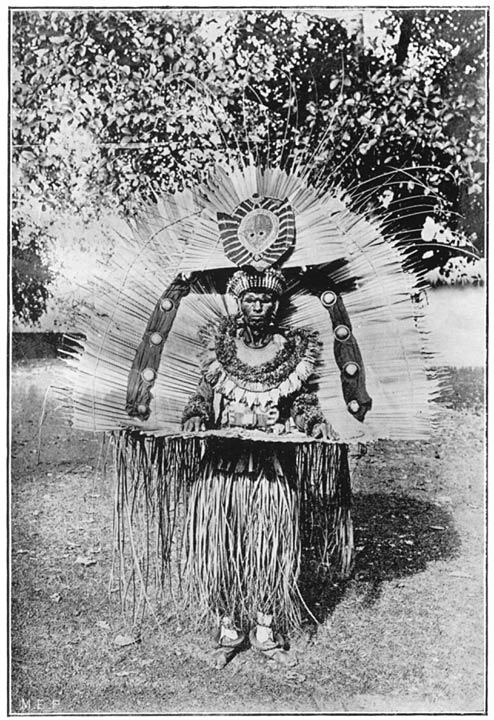
Parava devil-dancer.
Pārasaivan.—A title of Ōcchans, who are Saivites, and priests at temples of Grāma Dēvatas (village deities). In the Malayālam country Pārasāva occurs as a title of Variyar, a section of Ambalavāsi. The word indicates the son of a Brāhman by a Sūdra woman.
Parava.—The Tulu-speaking Paravas of South Canara are, like the Nalkes and Pombadas, devil-dancers, and are further employed in the manufacture of baskets and umbrellas. Socially, they occupy a higher position than the Nalkes, but rank below the Pombadas. The bhūthas (devils) whose disguise they assume are Kodamanitaya and the Baiderukalu, who may not be represented by Nalkes; and they have no objection to putting on the disguise of other bhūthas. Paravas are engaged for all kinds of devil-dances when Nalkes are not available. (See Nalke.)
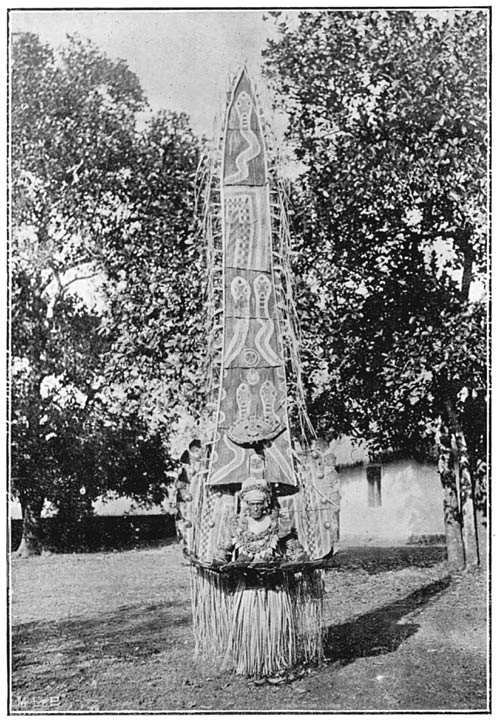
Parava devil-dancer.
It is noted, in the Madras Census Report, 1901, that “there are in reality three castes which answer to the name Paravan, and which speak Tamil, Malayālam, and Canarese respectively. Probably all three are descended from the Tamil Paravans or Paratavans. The Tamil Paravans are fishermen on the sea coast. Their head-quarters is Tuticorin, and their headman is called Talavan. They are mostly Native Christians. They claim to be Kshatriyas of the Pāndyan line of kings, and will eat only in the houses of Brāhmans. The Malayālam Paravans are shell collectors, lime burners and gymnasts, and their women act as midwives. Their titles are Kurup, Vārakurup, and Nūrankurup (nūru, lime). The Canarese Paravas are umbrella-makers and devil-dancers.” It has been suggested that the west coast Paravas are the descendants of those who fled from Tinnevelly, in order to avoid the oppression of the Muhammadans.
“The Paravas,” Mr. Hornell continues, “although the original holders of the fishery rights, had begun, prior to the arrival of the Portuguese, to feel the competition of the restless Muhammadan settlers on the coast, who, coming, as many must have done, from the coast of the Persian Gulf, knew already all there was to know of pearl-fishing. The descendants of these Arabs and their proselytes, known as Moros to the Portuguese, are the Moormen or Lubbais of to-day. Their chief settlement was Kayal, a town situated near the mouth of the river Tambrapurni, and which in Marco Polo’s time (1290–91) was a great and noble city. It shared with Tuticorin for fully 500 years the honour of being one of the two great pearl markets of the coast—the one being the Moor, the other the Parava, head-quarters.... Menezes, writing in 1622, states that for many years the fisheries had become extinct because of the great poverty into which the Paravas had fallen. Tuticorin, and the sovereignty of the pearl banks and of the Paravas, passed to the Dutch in 1658.
In the report of the pearl fishery, 1708, the following entries occur in the list of free stones according to ancient customs:—
96½ to the Naick of Madura—4 Xtian, 92½ Moorish;
10 to Head Moorman of Cailpatnam—5 Xtian, 5 Moorish.
60 to Theuver—60 Moorish.
185 to the Pattangatyns of this coast—all Xtian stones.
“The 185 stones,” Mr. Hornell writes, “given to the Pattangatyns or headmen of the Paravas was in the nature of remuneration to these men for assistance in inspecting the banks, in guarding any oyster banks discovered, in recruiting divers, and in superintending operations during the course of the fishery.... In 1889, the Madras Government recorded its appreciation of the assistance rendered by the Jati Talaivan, and directed that his privilege of being allowed the take of two boats be continued. Subsequently, in 1891, the Government, while confirming the general principle of privilege remuneration to the Jati Talaivan, adopted the more satisfactory regulation of placing the extent of the remuneration upon the basis of a sliding scale, allowing him but one boat when the Government boats numbered 30 or less, two for 31 to 60 boats, three for 61 to 90 boats employed, and so on in this ratio. The value of the Jati Talaivan’s two privilege boats in the 1890 fishery was Rs. 1,424, in that of 1900 only Rs. 172.” The Jādi Talaivān is said to have been denominated by the Dutch the prince of the seven havens. It is noted in the pearl fishery report, 1900, that “the Paravas are a constant source of trouble, both on the banks and in the kottoo (shed), where they were constantly being caught concealing oysters, which of course were always confiscated. Only one Arab was caught doing this, and his companions abused him for disgracing them.”
According to Mr. Casie Chitty, the Paravas are divided into thirteen classes, viz.:—
Headmen.
Dealers in cloth.
Divers for corals.
Sailors.
Divers for pearl-oysters.
Divers for chanks.
Packers of cloth.
Fishers who catch tortoises (turtles).
Fishers who catch porpoises.
Fishers who catch sharks and other fish.
Palanquin bearers.
Peons, who wait about the person of the Chief.
Fishers, who catch crabs.
It is noted by Canon A. Margoschis that the Parava females are famous for the excessive dilatation of the lobes of the ears, and for wearing therein the heaviest and most expensive gold ear jewels made of sovereigns. Ordinary jewels are said to cost Rs. 200, but heavy jewels are worth Rs. 1,000 and even more. The longer the ears, the more jewels can be used, and this appears to be the rationale of elongated ears.
In a note on the Paravans of Travancore, Mr. N. Subramani Aiyar writes that “they are found in most tāluks of the State. The title sometimes used by them is Kuruppu. The Paravans of Chengannūr and Tiruvella call themselves Chakka, a word supposed by the castemen to be derived from slaghya or praiseworthy, but perhaps more correctly from Chakku, the basket carried by them in their hands. The Paravans are divided into numerous sections. In the south, the Tamil-speaking division follows the makkathāyam, while all the Malayālam-speaking sections follow the marumakathāyam law of inheritance. There is also a difference in the dress and ornaments of the two sections, the former adopting the fashion of the east coast, and the latter that of the west. The Travancore Paravas are really one with the Tamil-speaking Paravas of the east coast. While most of them became converts to Christianity, in Travancore they have tried to preserve their separate existence, as they had already spread into the interior of the country before the proselytism of St. Xavier had made its enduring mark on the sea-coast villages. There is a curious legend about the settlement of the Chakkas in Central Travancore. Formerly, it would appear, they were Sūdras, but, for some social offence committed by them, they were outcasted by the Edappalli chieftain. They were once great devotees of Srī Krishna, the lord of Tiruvaranmulai in the Tiruvella tāluk. The Paravas say further that they are descended from a high-caste woman married to an Izhava. The word Parava is accordingly derived from para, which in Sanskrit means foreign. The Paravas engage in various occupations, of which the most important in Central Travancore are climbing palm trees, catching fish, and washing clothes for Christians, Muhammadans, and depressed classes of Hindus. In South Travancore they make wicker baskets, rattan chairs, and sofas. Women, in all parts of the State, are lime and shell burners. They worship at the Aranmula temple, and pay special worship to Bhadrakāli. Their priest is known as Parakuruppu, who, having to perform four different functions, is also entitled Nālonnukāran. It is his duty to preside at marriage and other rites, to be caste barber, to carry the news of death to the relations, and to perform the priestly functions at funerals. The Paravas perform both the tāli-kettu and sambandham ceremonies.”
Parēl Maddiyala.—Barbers of the Billavas.
Pārenga.—A sub-division of Gadaba.
Pariah.—See Paraiyan.
Parikimuggula.—Professional tattooing women in the Telugu country. The name refers to the patterns (parika or muggu), which they carry about with them, as designs for tattooing or to be drawn on the floor on occasions of festival and ceremonial.
Parivāra.—A sub-division of Bant.
Parivāram.—It is noted, in the Census Report, 1891, that “this is a caste, which presents some difficulty. Parivāram means ‘an army, a retinue,’ and it is alleged that the people of this caste were formerly soldiers. Parivāram is found as a sub-division of Maravan and Agamudaiyan, and the Parivāras of Madura and Tinnevelly are probably either a sub-division or an offshoot of the Maravans. In Coimbatore, the only other district in which the Parivāras are numerous, they seem to be a sub-division of Toreyas, a fishing caste, and Mr. Rice, in his Gazetteer (of Mysore), says that Parivāra is a synonym of Besta.” Further, in the Census Report, 1901, it is stated that “the word Parivāram means ‘a retinue,’ and was probably originally only an occupational term. It is now-a-days applied to the domestic servants and the Tottiya zamindars in the districts of Coimbatore, Trichinopoly, Madura, and Tinnevelly, who are recruited from several castes, but have come to form a caste by themselves. The Kōtāris of South Canara are a somewhat parallel case, and probably in time the Paiks among the Oriyas, and the Khāsas, who are servants to the Telugu zamindars, will similarly develop into separate castes. The caste is said to require all its members of both sexes to do such service for its masters as they may require. Persons of any caste above the Paraiyas are admitted into its ranks, and the men in it may marry a woman of any other caste with the permission of the zamindar under whom they serve. They do not habitually employ Brāhmans as priests, and in places the head of the Tottiyan caste conducts their ceremonies. Their titles are Maniyagāran and Sērvaigāran. The latter is also used by the Agamudaiyans.”
The title Sērvaigāran or Servaikāran indicates that members of the caste do servai, or service, and the further title ūliyakkāran is a sign that they do ūliyam, or menial work. Sērvaikāran is also a title of the Tamil Ambalakārans, Agamudaiyans, Kallans, and Maravans, and the Canarese Toreyas, some of whom have settled in the Tamil districts of Madura and Coimbatore. It also occurs as a synonym of the Canarese Kōtēgaras.
The illegitimate offspring of Maravans, Kallans, and Agamudaiyans, are said to become members of the mixed Parivāram caste.
It is recorded, in the Gazetteer of the Madura district, that the Parivāram caste “is divided into two endogamous sections; the Chinna Ūliyam (little services) who are palanquin-bearers, and have the title Tēvan, and the Periya Ūliyam (big services), who are called Maniyakāran. The Kōmbai Parivārams, who are the servants of the Kāppiliyan Zamindars of Kōmbai and Tēvāram in the Periyakulam tāluk, are a separate community, and do not intermarry with the others. When a girl attains maturity, she is kept for sixteen days in a hut, which is guarded at night by her relations. This is afterwards burnt down, and the pots she used are broken into very small pieces, as there is an idea that, if rain-water collects in any of them, the girl will be childless. Some of the ceremonies at weddings are unusual. On the first day, a man takes a big pot of water with a smaller empty pot on top of it, and marches three times round the open space in front of the bride’s house. With him march the happy couple carrying a bamboo, to which are tied in a turmeric-coloured cloth the nine kinds of grain. After the third journey round, these things are put down at the north-east corner, and the marriage pandal is made by bringing three more poles of the same size. Afterwards the wrists of the couple are tied together, and bridegroom’s brother carries the pair a short distance. They plunge their hands into a bowl of salt. Next the husband takes an ordinary stone rolling-pin, wraps it in a bit of cloth, and gives it to his wife, saying ‘Take the child; I am going to the palace.’ She takes it, replying ‘Yes, give me the child, the milk is ready.’ This has to be repeated three times in a set formula. Several other odd rites are observed. Brāhmans officiate, and the bridegroom’s sister, as usual, ties the tāli. Divorce is allowed to both sides. Adultery within the caste, or with the Zamindar, is tolerated. The husbands accept as their own any children their wives may bear to the Zamindar. Such children are called Chinna Kambalattar, and may marry with Tottiyans. But adultery outside the caste is most rigorously prohibited, and sternly punished with excommunication. A mud image of the girl who so offends is made, two thorns are poked into its eyes, and it is thrown away outside the village.”
Pariyāri (doctor).—A name given to Tamil barbers (Ambattan), who practice as barber-surgeons.
Pariyāta.—Five individuals were recorded, at the census, 1901, under the name Pariyāta or Parit, as members of a Bombay caste of washermen in South Canara.
Parvatha.—Parvatha or Parvathāla, meaning hill or mountain, has been recorded as an exogamous sept of Gamalla, Kāpu, Māla, and Mēdara.
Pasu.—Pasu (cow) or Pasula has been recorded as an exogamous sept of Bōya, Māla and Mādiga, and a sub-division of west coast Pulayans, who eat beef.
Pasupula (turmeric).—Pasula or Pasupula is an exogamous sept of Bōya and Dēvanga. Pasupulēti occurs as a sub-division of Balija. See Arashina.
Patābonka.—A sub-division of Bonka.
Pātāli.—An occupational name applied to priests of temples and bhūthasthanas (devil shrines), and Stānikas in South Canara.
Pātha (old).—A sub-division of Īdiga, and a sept of Togata.
Pathanchitannāya (green pea sept).—An exogamous sept of Bant.
Pathi (cotton).—A sub-division of Kurubas, who use a wrist-thread made of cotton and wool mixed during the marriage ceremony. Also an exogamous sept of Gūdala and Padma Sālē.
Paththar.—A section of Saivite Chettis, who wear the lingam, and have separated from the Acharapākam Chettis. They bury their dead in a sitting posture. A bamboo stick is tied to the kudumi (hair-knot) of the corpse, and the head pulled by its means towards the surface of the grave. Paththar is also a name given to goldsmiths by other castes.
Patnaik.—A title of Karnam.
Patnūlkāran.—The Patnūlkārans are described, in the Madras Census Report, 1901, as “a caste of foreign weavers found in all the Tamil districts, but mainly in Madura town, who speak Patnūli or Khatri, a dialect of Gujarāti, and came originally from Gujarāt. They have always been known here as Patnūlkārans, or silk thread people. They are referred to in the inscriptions of Kumāra Gupta (A.D. 473) at Mandasōr, south of Gujarāt, by the name of Pattavāyaka, which is the Sanskrit equivalent of Patnūlkāran, and the sāsanam of Queen Mangammāl of Madura, mentioned below, speaks of them by the same name, but lately they have taken to calling themselves Saurāshtras from the Saurāshtra country from which they came. They also claim to be Brāhmans. They thus frequently entered themselves in the schedules as Saurāshtra Brāhmans. They are an intelligent and hard-working community, and deserve every sympathy in the efforts which they are making to elevate the material prosperity of their members and improve their educational condition, but a claim to Brāhmanhood is a difficult matter to establish. They say that their claim is denied because they are weavers by profession, which none of the Southern Brāhmans are, and because the Brāhmans of the Tamil country do not understand their rites, which are the northern rites. The Mandasōr inscriptions, however, represent them as soldiers as well as weavers, which does not sound Brāhmanical, and the Tamil Brāhmans have never raised any objections to the Gauda Brāhmans calling themselves such, different as their ways are from those current in the south. In Madura their claim to Brāhmanhood has always been disputed. As early as 1705 A.D. the Brāhmans of Madura called in question the Patnūlkarans’ right to perform the annual upākarma (or renewal of the sacred thread) in the Brāhman fashion. [Eighteen members of the community were arrested by the Governor of Madura for performing this ceremony.] The matter was taken to the notice of the Queen Mangammāl, and she directed her State pandits to convene meetings of learned men, and to examine into it. On their advice, she issued a cadjān (palm leaf) sāsanam (grant) which permitted them to follow the Brāhmanical rites. But all the twice-born—whether Brāhmans, Kshatriyas, or Vaisyas—are entitled to do the same, and the sāsanam establishes little. The Patnūls point out that, in some cases, their gōtras are Brāhmanical. But, in many instances which could be quoted, Kshatriyas had also Brāhmanical gōtras.”
It is stated, in the Gazetteer of the Madura district, that the inscription at Mandasōr in Western Mālwa “relates how the Pattavāyas, as the caste was then called, were induced to migrate thither from Lāta on the coast of Gujarāt by king Kumāra Gupta (or one of his lieutenants), to practice there their art of silk-weaving. The inscription says many flattering things about the community, and poetically compares the city to a beautiful woman, and the immigrants to the silk garments in which she decks herself when she goes to meet her lover. [The inscription further records that, while the noble Bandhuvarman was governing this city of Dasapura, which had been brought to a state of great prosperity, a noble and unequalled temple of the bright-rayed (sun) was caused to be built by the silk-cloth weavers (pattavāyair) as a guild with the stores of wealth acquired by (the exercise of their) craft.] On the destruction of Mandasōr by the Mussalmans, the Pattavāyas seem to have travelled south to Dēvagiri, the modern Daulatābād, the then capital of the Yādavas, and thence, when the Mussalmans again appeared on the scene at the beginning of the fourteenth century, to Vijayanagar, and eventually to Madura. A curious ceremony confirming this conjecture is performed to this day at Patnūlkāran weddings in South India. Before the date of the wedding, the bridegroom’s party go to the bride’s house, and ask formally for the girl’s hand. Her relations ask them in a set form of words who they are, and whence they come, and they reply that they are from Sōrath (the old name for Saurāshtra or Kathiawar), resided in Dēvagiri, travelled south (owing to Mussalman oppression) to Vijayanagar, and thence came to Madura. They then ask the bride’s party the same question, and receive the same reply. A Marāthi MS., prepared in 1822 at Salem under the direction of the then Collector, Mr. M. D. Cockburn, contains the same tradition. Mr. Sewell’s ‘A Forgotten Empire: Vijayanagar’ shows how common silk clothing and trappings were at Vijayanagar in the days of its glory. Most of the Patnūlkārans can still speak Telugu, which raises the inference that they must have resided a long time in the Telugu country, while their Patnūli contains many Canarese and Telugu words, and they observe the feast of Basavanna (or Boskanna), which is almost peculiar to the Bellary country. After the downfall of Vijayanagar, some of the caste seem to have gone to Bangalore, for a weaving community called Patvēgars, who speak a dialect similar to Patnūli, still reside there.” Concerning the Patnūlis who have settled in the Mysore Province, it is noted, in the Mysore Census Report, 1891, that “with silk they manufacture a fine stuff called katni, which no other weavers are said to be able to prepare. It is largely used by Mussalmans for trousers and lungas (gowns). It is said that Haider Ali, while returning from his expeditions against Madras, forcibly brought with him some twenty-five families of these weavers, who were living in the Tanjore district, and established them at Ganjam near Seringapatam, and, in order to encourage silk and velvet weaving, exempted them from certain taxes. The industry flourished till the fall of Seringapatam, when most of the class fled from the country, a few only having survived those troublous times. At present there are only 254 souls returned to these people, employed in making carpets in Bangalore.”
The Patnūlkārans, according to one tradition, claim descent from a certain Brāhman sage, known as Tantuvardhanar, meaning literally a person who improves threads, i.e., manufactures and weaves them into cloths. This is, it is suggested, probably only an eponymous hero.
In an order of the Director of Public Instruction, in 1900, it was laid down that “Saurāshtras having been recognised (in 1892) as a backward class falling under Pattunulgars, the manager cannot continue to enjoy the privileges accorded under the grant-in-aid code to schools intended for backward classes, if he returns his pupils as Brāhmans. If the pupils have been returned as Saurāshtra Brāhmans, the manager should be requested to revise, as no such caste is recognised.” A deputation had an interview with the Director, and it was subsequently ruled that “Saurāshtras will continue to be treated as a backward class. Pupils belonging to the above class should invariably be returned in future as Saurāshtras, whether the word Brāhman is added or not.”
The affairs of the Patnūlkārans at Madura are managed by a Saurāshtra Sabha, which was started in 1895. Among the laudable objects for which the Sabha was established, the following may be noted:—
(a) To manage the Madura Saurāshtra school, and establish reading-rooms, libraries, etc., with a view to enable members of the Saurāshtra community to receive, on moderate terms, a sound, liberal, general and technical education.
(b) To manage the temple known as the Madura Srī Prasanna Venkatēswara Swāmi’s temple, and contribute towards its maintenance by constructing, repairing and preserving buildings in connection therewith, making jewels, vehicles and other things necessary therefor, and conducting the festivals thereof.
(c) To found charitable institutions, such as orphanages, hospitals, poor-houses, choultries (resting-places for travellers), water-sheds, and other things of a like nature for the good of the Saurāshtra community.
(d) To give succour to the suffering poor, and the maimed, the lame, and the blind in the Saurāshtra community.
(e) To give pecuniary grants in aid of upanayanams (thread marriages) to the helpless in the Saurāshtra community.
(f) To erect such works of utility as bathing ghauts, wells, water fountains, and other works of utility for the benefit of the Saurāshtra community.
(g) To fix and raise subscriptions known as mahamais (a sort of income-tax).
Among the subjects of the lectures delivered in connection with the Saurāshtra Upanyasa Sabha at Madura in 1901 were the life of Mrs. Annie Besant, the Paris Exhibition of 1900, Mr. Tata and higher education, Saurāshtra bank, Columbus, and the Saurāshtra reform hotel.
For the following note on the Patnūlkāran weavers of Madura, I am indebted to Mr. A. Chatterton, Director of Technical Enquiries:—“As a general rule, they are in a flourishing condition, and much better off than the Saurāshtra weavers in Salem. This is probably due to the fact that the bulk of the Madura trade is in a higher class of cloth than at Salem, and the weavers are consequently less affected by fluctuations in demand for their goods due to seasonal variations. In various ways the Saurāshtras of Madura have furnished evidence that they are a progressive community, particularly in the attention which they pay to education, and the keenness with which they are on the look-out for improvements in the methods of carrying out their hereditary craft. Nearly all the so-called improvements have been tried at Madura, and the fact that they have rejected most of them may be taken to some extent as evidence of their unsuitability for Indian conditions. Some time ago, one A. A. Kuppusawmy Iyer invented certain improvements in the native shedding apparatus, whereby ornamental patterns are woven along the borders, and on the ends of the better class of silk and cotton cloths. This apparatus was undoubtedly a material improvement upon that which is ordinarily used by the weaver, and it has been taken up extensively in the town. It is said that there are 350 looms fitted with this shedding apparatus, and the inventor, who has obtained a patent for it, is trying to collect a royalty of Rs. 1–4–0 a month on each loom. But this claim is resisted by a combination of the weavers using this shedding apparatus, and a suit is at the present time (1907) pending in the District Court. One of the most important weaving enterprises at Madura is the Meenakshi Weaving Company, the partners of which are Ramachandra Iyer, Muthurama Iyer, and Kuppusawmy Iyer. Their subscribed capital is Rs. 1,00,000, of which they are spending no less than Rs. 40,000 on building a weaving shed and office. The Madura dyeing industry is in the hands of the Saurāshtras, and the modern phase dates back only as far as 1895, when Mr. Tulsiram started dyeing grey yarn with alizarine red, and, in the twelve years which have since elapsed, the industry has grown to very large proportions. The total sales at Madura average at present about 24 lakhs a year. There are from 30 to 40 dye-houses, and upwards of 5,000 cwt. of alizarine red is purchased every year from the Badische Aniline Soda Fabrik. The yarn is purchased locally, mainly from the Madura Mills, but, to some extent, also from Coimbatore and Tuticorin. The mordanting is done entirely with crude native earths, containing a large percentage of potassium salts. Drying the yarn presents considerable difficulty, especially in the wet weather. To secure a fast even colour, the yarn is mordanted about ten times, and dyed twice, or for very superior work three times, and between each operation it is essential that the yarn should be dried. The suburbs of Madura are now almost entirely covered with drying yards.”
In a note on the Patnūlkārans who have settled in Travancore, Mr. N. Subramani Aiyar writes as follows. “The Patnūlkārans are generally of yellowish tinge, and in possession of handsomer and more intellectual features than the Tamil castes, from which they may be easily differentiated by even a casual observer. They are, however, more fair than cleanly. They keep in Travancore, as elsewhere, aloof from other castes, and live independently of general society, speaking a foreign language. This they have preserved with astonishing attachment, and recently a Saurāshtra alphabet has been invented, and elementary books have begun to be written in that dialect. They are a very conservative class, religious enthusiasts of a very remarkable order, and skilful and industrious workmen. They take a peculiar pleasure in music, and many of them are excellent songsters. There are many kinds of amusement for both men and women, who generally spend their leisure in singing songs of a devotional nature. They believe largely in omens, of which the following may be noted:—
Good.—A pot full of water, a burning light, no Brāhmans, a Sūdra, a cow, a married woman, and gold.
Bad.—A barber, a patient, a person with some bodily defect, fuel, oil, a donkey, a pick-axe, a broom, and a fan.
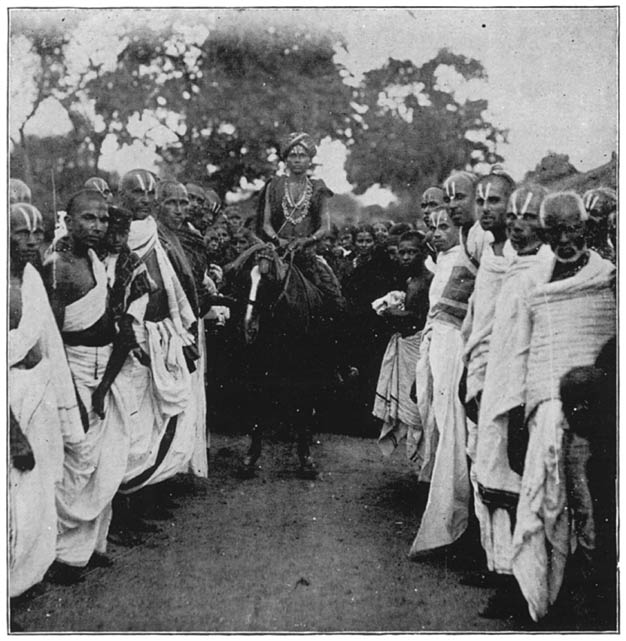
Patnūkāran marriage procession.
“On entering a Patnūlkāran’s house, we are led to a courtyard, spacious and neat, where all the necessary arrangements are made for weaving purposes. The Patnūlkārans live in streets. A male Patnūlkāran resembles a Tamil Vaishnava Brāhman in outward appearance, but the women follow the custom of the Telugu Brāhmans alike in their costume and ornaments. Their jewels exactly resemble those of the Telugu Brāhman women, and indicate a temporary residence of the caste in the Telugu country on the way from Gujarat to Madura. There is a Tamil proverb to the effect that, if a male Patnūlkāran is seen without his wife, he will be taken for a Vaishnava Brāhman, whereas, in the case of the Tātan caste, a woman without her husband will be taken for an Aiyangar. Children wear the kārai round the neck. Tattooing prevails on a very large scale.
“The Patnūlkārans may be divided into three classes on a religious basis, viz., (1) pure Vaishnavites, who wear the vertical Vaishnavite mark, and call themselves Vadakalas or northerners; (2) those who are mainly Smartas; (3) Sankara Vaishnavas, who wear gōpi (sandal paste) as their sect-mark. It is to the last of these religious sects that the Travancore Patnūlkārans belong, though, in recent times, a few Smartas have settled at Kottar. All these intermarry and interdine, and the religious difference does not create a distinction in the caste. The chief divinity of the Patnūlkārans is Venkatāchalapati of Tirupati. The month in which he is most worshipped is Kanni (September-October), and all the Saturdays and the Tiruvonam star of the month are particularly devoted to his adoration. One of their men becomes possessed on any of these days, and, holding a burning torch-light in his hand, touches the foreheads of the assembled devotees therewith. The Patnūlkārans fast on those days, and take an image of Garuda in procession through the street. The Dīpāvali, Pannamasi in Chittiray, and the Vaikuntha Ēkādasi are other important religious days. The Dusserah is observed, as also are the festivals of Srī Rāma Navami, Ashtami, Rohini, Avani Avittam, and Vara Lakshmivratam. Formal worship of deities is done by those who have obtained the requisite initiation from a spiritual preceptor. Women who have husbands fast on full-moon days, Mondays, and Fridays. The serpent and the banyan tree are specially worshipped. Women sing songs in praise of Lakshmi, and offer fruits and cocoanuts to her. The Patnūlkārans have a temple dedicated to Srī Rāma at Kottar. This temple is visited even by Brāhmans, and the priests are Aiyangars. The Achārya, or supreme religious authority of the Patnūlkārans, in Travancore is a Vaishnava Brāhman known as Ubhaya Vēdānta Kōti Kanyakādāna Tātāchāriyar, who lives at Aravankulam near Tinnevelly, and possesses a large number of disciples. Once a year he visits his flock in Travancore, and is highly respected by them, as also by the Mahārajā, who makes a donation of money to him. Elders are appointed to decide social disputes, and manage the common property of the caste. In Travancore there are said to be only three families of Patnūlkāran priests. For the higher ceremonies, Brāhman priests are employed.
“The nāmakarana, or name-giving ceremony, is performed on the eleventh day after birth. An eighth child, whether male or female, is called Krishna, owing to the tradition that Krishna was born as the eighth child of Vasudēva. Babies are affectionately called Duddu (milk) or Pilla (child). The annaprāsana, or first feeding of the child, is sometimes celebrated at the end of the first year, but usually as a preliminary to some subsequent ceremony. Sometimes, in performance of a vow, boys are taken to the shrine at Tirupati for the tonsure ceremony. The upanayana is performed between the seventh and twelfth years, but neither brāhmacharya nor samāvartana is observed.
“The dead are burnt, and the remains of the bones are collected and deposited under water. Death pollution lasts only for ten days. The srādh, or annual ceremony, when oblations are offered to ancestors, is observed. Widows are allowed to retain their hair, but remove the bottu. Unlike Brāhman women, they chew betel, and wear coloured cloths, even in old age.”
The Patnūlkārans have a secret trade language, concerning which Mr. C. Hayavadana Rao writes as follows. “The most remarkable feature about it is the number of terms and phrases borrowed from the craft, to which special meanings are given. Thus a man of no status is stigmatised as a rikhta khandu, i.e., a spindle without the yarn. Similarly, a man of little sense is called a mhudha, the name of a thick peg which holds one side of the roller. Likewise, a talkative person is referred to as a rhetta, or roller used for winding the thread upon spindles, which makes a most unpleasant creaking noise. Kapinikēr, from kapini, a technical term used for cutting the loom off, means to make short work of an undesirable person. A man who is past middle age is called porkut phillias, which, in weavers’ parlance, means that half the loom is turned.”
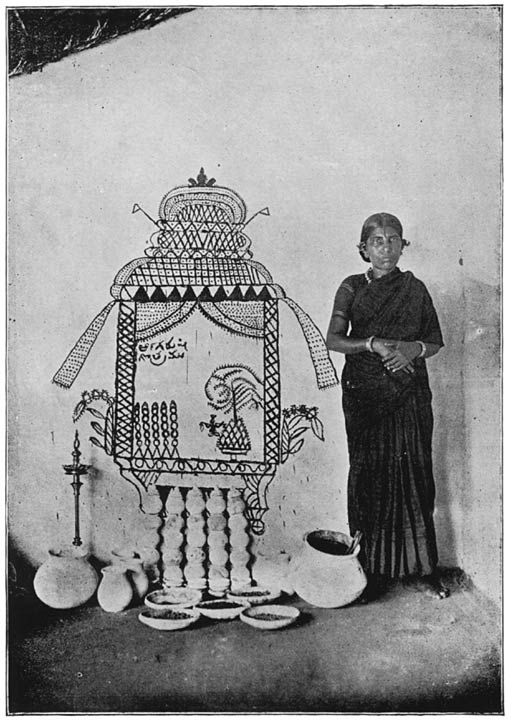
Patnūkāran marriage wall design.
Patrā.—The Patrās are an Oriya caste, which is divided into two sections, one of which is engaged in the manufacture of silk (pata) waist-threads, tassels, etc., and the other in weaving silk cloths. The members of the two sections do not interdine. The former have exogamous septs or bamsams, the names of which are also used as titles, e.g., Sāhu, Pātro, and Prushti. The latter have exogamous septs, such as Tenga, Jaggali, Telaga, and Mahānāyako, and Bēhara and Nāyako as titles. The chief headman of the cloth-weaving section is called Mahānāyako, and there are other officers called Bēhara and Bhollobaya. The headman of the other section is called Sēnāpati, and he is assisted by a Dhanapati. Infant marriage is the rule, and, if a girl does not secure a husband before she reaches maturity, she must, if she belongs to the cloth-weaving section, go through a form of marriage with an old man, and, if to the other section, with an arrow.
The Telugu Patrās are summed up, in the Madras Census Report, 1901, as “a Telugu caste of hunters and cultivators, found chiefly in the districts of Cuddapah and Kurnool. It has two divisions, the Doras (chiefs), and Gurikalas (marksmen), the former of which is supposed to be descended from the old Poligars (feudal chiefs), and the latter from their followers and servants. This theory is supported by the fact that, at the weddings of Gurikalas, the Doras receive the first pān-supāri (betel leaf and areca nut). Widows may not remarry, nor is divorce recognised. They usually employ Brāhmans at marriages, and Sātānis at funerals. Though they are Vaishnavites, they also worship village deities, such as Gangamma and Ellamma. They bury their dead, and perform annual srāddhas (memorial services for the dead). They will eat with Gollas. Their title is Naidu.”
Pātro.—The title of the head of a group of villages in Ganjam, and also recorded, at times of census, as a title of Alia, Kālinga Kōmati, Dolai, and Jaggala. The conferring of a cloth (sādhi) on a Pātro is said to be emblematic of conferring an estate. The Pātro, among other perquisites, is entitled to a fee on occasions of marriage. I am informed that, in the Ganjam Māliahs, if a Kondh was unable to pay the fee, he met his love at night beneath two trysting trees, and retired with her into the jungle for three days and nights.
Pātrudu.—The title, meaning those who are fit to receive a gift, of Aiyarakulu and Nagarālu.
Pāttadhikāri.—A class of Jangams, who have settled head-quarters.
Pattan.—The equivalent of the Brāhman Bhatta. A name by which some Kammālans, especially goldsmiths, style themselves.
Pattanavada.—A synonym for the Mogēr fishing caste, the settlements of which are called pattana.
Pattanavan.—The fishermen on the east coast, from the Kistna to the Tanjore district, are popularly called Karaiyān, or sea-shore people. Some Karaiyāns have, at times of census, returned themselves as Taccha (carpenter) Karaiyāns.
Pattanavan means literally a dweller in a town or pattanam, which word occurs in the names of various towns on the sea-coast, e.g., Nāgapattanam (Negapatam), Chennapattanam (Madras). The Pattanavans have two main divisions, Periya (big) and Chinna (small), and, in some places, for example, at Nadukuppam in the Nellore district, exogamous septs, e.g., Gengananga, Pēyananga, Kathananga (children of Ganga, Pēyan, and Kathanar), and Kullananga (children of dwarfs). In the Telugu country, they go by the name of Pattapu or Tūlivāndlu.
Some Pattanavans give themselves high-sounding caste titles, e.g., Āriyar, Ayyayiraththalaivar (the five thousand chiefs), Āriya Nāttu Chetti (Chettis of the Ariyar country), Acchu Vellāla, Karaiturai (sea-coast) Vellāla, Varunakula Vellāla or Varunakula Mudali after Varuna, the god of the waters, or Kurukula vamsam after Kuru, the ancestor of the Kauravas. Some Pattanavans have adopted the title Pillai.
The Pattanavans are said to be inferior to the Sembadavans, who will not accept food at their hands, and discard even an earthen pot which has been touched by a Pattanavan.
In 1907, two Madras fishermen were invested with silver wrist bangles, bearing a suitable inscription, which were awarded by the Government in recognition of their bravery in saving the lives of a number of boatmen during a squall in the harbour.
The following are the fishes, which are caught by the fishermen off Madras and eaten by Europeans:—
Cybium guttatum, Bl. Schn. Seir.
Cybium Commersonii, Lacep. Seir.
Cybium lanceolatum, Cuv. & Val. Seir.
Sillago sihama, Forsk. Whiting.
Stromateus cinereus, Bloch.— Immature, silver pomfret. Adult, grey pomfret.
Stromateus niger, Bloch. Black pomfret.
Mugal subviridis, Cuv. & Val. Mullet.
Psettodes erumei, Bl. Schn. ‘Sole.’
Lates calcarifer, Bloch. Cock-up; the begti of Calcutta.
Lutjanus roseus, Day.
Lutjanus marginatus, Cuv. & Val.
Polynemus tetradactylus, Shaw.
Chorinemus lysan, Forsk.
‘Whitebait.’
The Pattanavans are Saivites, but also worship various minor gods and Grāma Dēvatas (village deities). In some places, they regard Kuttiyāndavan as their special sea god. To him animal sacrifices are not made, but goats are sacrificed to Sembu Vīrappan or Mīnnodum Pillai, an attendant on Kuttiyāndavan. In Tanjore, the names of the sea gods are Pāvadairāyan and Padaithalaidaivam. Before setting out on a fishing expedition, the Pattanavans salute the god, the sea, and the nets. In the Tanjore district, they repair their nets once in eight days, and, before they go out fishing, pray to their gods to favour them with a big catch. On a fixed day, they make offerings to the gods on their return from fishing. The gods Pāvadairāyan and Padaithalaidaivam are represented by large conical heaps of wet sand and mud, and Ayyanar, Ellamma, Kuttiyāndavar, Muthyālrouthar and Kiliyēndhi by smaller heaps. At the Māsimakam festival, the Pattanavans worship their gods on the sea-shore. The names Jāttan and Jātti are given to children during the Jātre or periodic festival of the village goddesses.
The Pattanavans afford a good example of a caste, in which the time-honoured village council (panchāyat) is no empty, powerless body. For every settlement or village there are one or more headmen called Yejamānan, who are assisted by a Thandakāran and a Paraiyan Chalavāthi. All these offices are hereditary. Questions connected with the community, such as disrespect to elders, breach of social etiquette, insult, abuse, assault, adultery, or drinking or eating with men of lower caste, are enquired into by the council. Even when disputes are settled in courts of law, they must come before the council. Within the community, the headman is all powerful, and his decision is, in most instances, considered final. If, however, his verdict is not regarded as equitable, the case is referred to a caste headman, who holds sway over a group of villages. No ceremony may be performed without the sanction of the local headman, and the details of ceremonies, except the feasting, are arranged by the headman and the Thandakāran. In the case of a proposed marriage, the match is broken off if the headman objects to it. He should be present at the funeral rites, and see that the details thereof are properly carried out. It is the duty of the Chalavāthi to convey the news of a death to the relations. Should he come to the shore when the fishes are heaped up, he has the right to take a few thereof as his perquisite. The Thandakāran, among other duties, has to summon council meetings. When the members of council have assembled, he ushers in the parties who have to appear before it, and salutes the assembly by prostrating himself on the floor. The parties take a bit of straw, or other object, and place it before the headman in token that they are willing to abide by the decision of the council. This formality is called placing the agreement (muchchilika).
The consent of the maternal uncles is necessary before a pair can be united in matrimony. When the wedding day has been fixed, the bridegroom’s party distribute grāma thāmbūlam (village pān-supāri or betel) to the headman and villagers. The marriage milk-post is made of Mimusops hexandra, Erythrina indica, Casuarina equisetifolia, the green wood of some other tree, or even a pestle. In one form of the marriage ceremony, which varies in detail according to locality, the bridegroom, on the arrival of the bride at the pandal (booth), puts on the sacred thread, and the Brāhman purōhit makes the sacred fire, and pours ghī (clarified butter) into it. The bridegroom ties the tāli round the bride’s neck, and the maternal uncles tie flat silver or gold plates, called pattam, on the foreheads of the contracting couple. Rings are put on their second toes by the brother-in-law of the bridegroom and the maternal uncle of the bride. Towards evening, the sacred thread, the threads which have been tied to the marriage pots and the milk-post, and grain seedlings used at the ceremony, are thrown into the sea. Some Pattanavans allow a couple to live together as man and wife after the betrothal, but before the marriage ceremony. This is, however, on condition that the latter is performed as soon as it is convenient. The remarriage of widows is freely permitted. No marriage pandal is erected, and the bridegroom, or a female relation, ties the tāli on the bride’s neck within the house. Such marriage is, therefore, called naduvīttu (interior of the house) tāli. When a woman, who has been guilty of adultery, is remarried, a turmeric string is substituted for the golden tāli, and is tied on the bride’s neck by a woman.
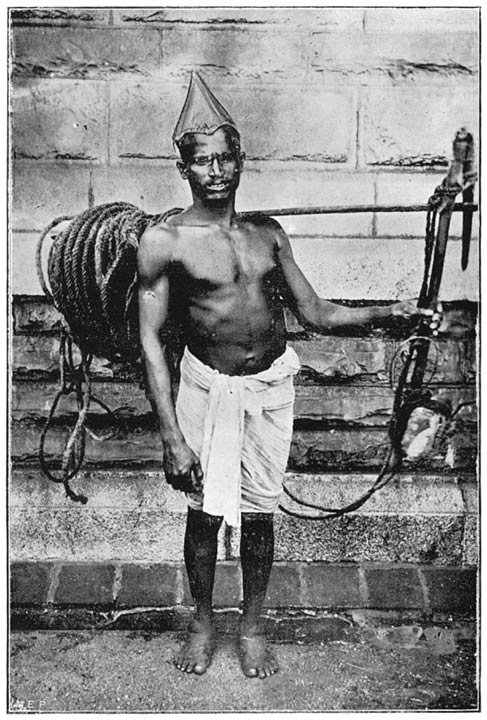
Pattanavan.
Some Pattanavans have adopted the custom of burying their dead in a seated posture (samathi). If a corpse is cremated, fire is carried to the burning-ground by a barber. When the corpse has been laid on the pyre, rice is thrown over it. The son, accompanied by a barber and a Panisavan or washerman, and carrying a pot of water on his shoulder, goes thrice round the pyre. At the third round, the Panisavan or washerman makes holes in the pot, and it is thrown away. On the day of the funeral, all the agnates shave their heads. On the following day, they go to the burial or burning ground with tender cocoanuts, milk, cakes, etc., and Arichandra, who presides over the burial-ground, is worshipped. Milk is then poured over the grave, or the remains of the bones, which are thrown into the sea. On the night of the fifteenth day, Panisavans blow the conch and horn, and red cloths are presented to the widow of the deceased by her relations. At about 4 A.M., a white cloth is thrown on her neck, and the tāli string is cut by an old woman. The tāli is removed therefrom, and dropped into a new pot filled with water. Hence, a form of abuse among Pattanavan women is, May your tāli be snapped, and thrown into water. The tāli is removed from the pot, which is thrown into the sea. The tāli is laid on a dish containing milk, and all those who visit the widow must set eyes on it before they see her.
In the city of Madras, the Pattanavans have the privilege of supplying bearers at temples, and the atmosphere surrounding them as they carry the idols on their sturdy shoulders through Triplicane is said to be “redolent of brine and the toddy shop.”