Volume 6 — S
Reading edition
Sachchari.—A synonym of Relli. Another form of the word Chachchadi.
Sādaru.—A sub-division of Lingāyats, found mainly in the Bellary and Anantapur districts, where they are largely engaged in cultivation. Some Bēdars or Bōyas, who live amidst these Lingāyats, call themselves Sādaru. It is noted in the Mysore Census Reports that the Sadas are “cultivators and traders in grain. A section of these Sadas has embraced Lingāyatism, while the others are still within the pale of Hinduism.”
Saddikūdu (cold rice or food).—An exogamous sept of Golla.
Sādhana Sūrulu.—Sādhanasūra is recorded, in the Madras Census Report, 1901, as a synonym of Samayamuvādu. In a note on this class of itinerant mendicants, Mr. C. Hayavadana Rao states that, unlike the Samayamuvāru, they are attached only to the Padma Sālē section of the Sālē caste. “They say,” he writes, “that their name is an abbreviated form of Rēnukā Sakthini Sādhinchinavāru, i.e., those who conquered Rēnukā Sakthi. According to tradition, Rēnukā was the mother of Parasurāma, one of the avatars of Vishnu, and is identified with the goddess Yellammā, whom the Padma Sālēs revere. The Sādhana Sūrulu are her votaries. Ages ago, it is said, they prayed to her on behalf of the Padma Sālēs, and made her grant boons to them. Since that time they have been treated with marked respect by the Padma Sālēs, who pay them annually four annas, and see to their marriages.”
Sādhu (meek or quiet).—A sub-division or exogamous sept of Gāniga and Padma Sālē. The equivalent Sādhumatam has been recorded, at times of census, by Janappans. The name Sādhu is applied to ascetics or Bairāgis.
Sagarakula.—A synonym of the Upparas, who claim descent from a king Sagara Chakravarthi of the Mahābhārata.
Sahavāsi.—The Sahavāsis are described, in the Mysore Census Report, 1891, as “immigrants like the Chitpāvanās. Sahavāsi means co-tenant or associate, and the name is said to have been earned by the community in the following manner. In remote times a certain Brāhman came upon hidden treasure, but, to his amazement, the contents appeared in his eye to be all live scorpions. Out of curiosity, he hung one of them outside his house. A little while after, a woman of inferior caste, who was passing by the house, noticed it to be gold, and, upon her questioning him about it, the Brāhman espoused her, and by her means was able to enjoy the treasure. He gave a feast in honour of his acquisition of wealth. He was subsequently outcasted for his mésalliance with the low caste female, while those that ate with him were put under a ban, and thus acquired the nickname.”
Sāhu.—A title of Bolāsis, Gōdiyas, and other Oriya castes.
Sāindla (belonging to the death-house).—A sub-division of Māla.
Sajjana (good men).—A synonym of Lingāyat Gānigas.
Sajje (millet: Setaria italica).—An exogamous sept of Dēvānga.
Sākala.—See Tsākala.
Sakkereya.—Some Upparas style themselves Mēl (western) Sakkereya-vāru. Their explanation is that they used to work in salt, which is more essential than sugar, and that Mēl Sakkare means superior sugar.
According to their own account, the Sakuna Pakshis are Telagas who emigrated to Vizagapatam from Peddāpuram in the Godāvari district.
A member of the caste, before proceeding on a begging expedition, rises early, and has a cold meal. He then puts the Tengalai Vaishnava nāmam mark on his forehead, slings on his left shoulder a deer-skin pouch for the reception of the rice and other grain which will be given him as alms, and takes up his little drum (gilaka or damaraka) made of frog’s skin. It is essential for a successful day’s begging that he should first visit a Māla house or two, after which he begs from other castes, going from house to house.
The members combine with begging the professions of devil-dancer, sorcerer, and quack doctor. Their remedy for scorpion sting is well-known. It is the root of a plant called thēlla visari (scorpion antidote), which the Sakuna Pakshis carry about with them on their rounds. The root should be collected on a new-moon day which falls on a Sunday. On that day, the Sakuna Pakshi bathes, cuts off his loin-string, and goes stark naked to a selected spot, where he gathers the roots. If a supply thereof is required, and the necessary combination of moon and day is not forthcoming, the roots should be collected on a Sunday or Wednesday.
Salangukāran.—In the Madras Census Report, 1901, Salangaikāran is returned as a synonym of Karaiyān or Sembadavan fishermen. The word salangu or slangu is used for pearl fisheries, and Salangukāran is, I imagine, a name applied to pearl divers.
Sālāpu.—The Sālāpus are a small caste of Telugu weavers in Vizagapatam, for the following note on whom I am indebted to Mr. C. Hayavadana Rao. The name Sālāpu seems to be a corruption of Saluppan, a caste which formerly engaged in the manufacture of gunny-bags and coarse cloths. The Sālāpus at the present day make such cloths, commonly called gāmanchālu. Like some other weaving castes, they claim descent from Markandēya rishi, who was remarkable for his austerities and great age, and is also known as Dīrghāyus. The Sālāpus will not eat, or intermarry with Sālēs. The caste is governed by a headman called Sēnāpati. He decides disputes, and, on occasions of marriage, receives the first share of betel and sandal, and is the first to touch the sathamānam (marriage badge) when it is passed round to be blessed by those assembled. He is, at marriages, further presented with a rupee. At caste feasts, it is his privilege to partake of food first.
Like other Telugu castes, the Sālāpus have intipērulu, or exogamous septs. Girls are generally married before puberty. The custom of mēnarikam, by which a man should marry his maternal uncle’s daughter, is in force. The turmeric ceremony takes place some months before marriage. Some male and female relations of the future bridegroom repair to the house of the girl, taking with them a few rupees as the bride-price (vōli). The girl bathes, and daubs herself with turmeric paste. A solid silver bangle is then put on her right wrist. The remarriage of widows and divorce are permitted.
The Sālāpus are divided into Lingavantas and Vaishnavas, who intermarry. The former bury their dead in a sitting posture, and the latter practice cremation. Jangams officiate for the Lingavantas, and Sātānis for Vaishnavas. Both sections observe the chinna (little) and pedda rōzu (big day) death ceremonies.
The caste title is generally Ayya.
Sālāpu.—A form of Sārāpu, an occupational term for those who deal in coins, jewelry, coral, etc.
Sālē.—The Sālēs are the great weaver class among the Telugus, for the following note on whom I am indebted to Mr. C. Hayavadana Rao.
The name is derived from Sanskrit, Sālika, a weaver. The Sālēs call themselves Sēnāpati (commander-in-chief), and this is further the title of the caste headman. They are divided into two main endogamous sections, Padma or lotus, and Pattu or silk. Between them there are three well-marked points of difference, viz., (1) the Pattu Sālēs wear the sacred thread, whereas the Padma Sālēs do not; (2) the Pattu Sālēs do not take food or water at the hands of any except Brāhmans, whereas the Padma Sālēs will eat in Kāpu, Golla, Telaga, Gavara, etc., houses; (3) the Pattu Sālēs weave superfine cloths, and, in some places, work in silk, whereas Padma Sālēs weave only coarse cloths. Each section is divided into a number of exogamous septs or intipērulu. Both speak Telugu, and are divided into Vaishnavites and Saivites. These religious distinctions are no bar to intermarriage and interdining.
It is recorded, in the Gazetteer of the Vizagapatam district (1907), that “on the plains, cotton cloths are woven in hundreds of villages by Sālēs, Padma Sālēs, Pattu Sālēs, Dēvāngas, and Sālāpus. The ryots often spin their own cotton into thread, and then hand it over to the weavers to be made into cloths, but large quantities of machine-made yarn are used. In the south, the chief weaving centres are Nakkapalli and Pāyakaraopēta in Sarvasiddhi tāluk, the Pattu Sālēs in the latter of which turn out fabrics of fine thread, enriched with much gold and silver ‘lace,’ which are in great demand in the Godāvari and Ganjam districts. At Rāzām, coloured cloths for women are the chief product, and in the country round this place the white garments so universal everywhere give place to coloured dress. The cloths are sold locally, and also sent in large quantities to Berhampur, Cuttack, and even Calcutta. Most of the weaving is in the hands of Dēvāngas, but the dyeing of the thread is done with imported aniline and alizarine colours by the Balijas of Sigadam in Chīpurupalle tāluk and Balijapēta in Bobbili. In Siripuram and Pondūru, the Pattu Sālēs make delicate fabrics from especially fine thread, called Pattu Sālē nūlu, or silk-weaver’s thread, which the women of their caste spin for them, and which is as fine as imported 1508. These are much valued by well-to-do natives for their softness and durability. The weaving industry is on the decline throughout the district, except perhaps in Rāzām, and the weaver castes are taking to other means of livelihood. Round Chīpurupalle, for example, the Pattu Sālēs have become experts in tobacco-curing, and have made such profits that they are able to monopolise much of the trade and money-lending of the locality.”
Concerning the origin of the Sālē caste, it is stated, in the Āndhrapada Pārijātamu, that it is the result of an union between a Kamsala man and a potter woman. According to a current legend, the celestials (dēvatas), being desirous of securing clothing for themselves and their dependents, asked Markandēya Rishi to supply them with it. He went to Vishnu, and prayed to him. The god directed him to make a sacrificial offering to Indra, the celestial king. Markandēya accordingly performed a great sacrifice, and from the fire issued Bhāvana Rishi, with a ball of thread in his hands, which he had manufactured, under Vishnu’s direction, from the fibre of the lotus which sprang from the god’s navel. With this ball of thread he proceeded to make cloths for the celestials. He subsequently married Bhadravāthi, the daughter of Sūrya (the sun), who bore him a hundred and one sons, of whom a hundred became the ancestors of the Padma Sālēs, while the remaining man was the ancestor of the Pattu Sālēs.
The caste worships Bhāvana Rishi. At the close of the year, the caste occupation is stopped before the Sankramanam for ten days. Before they start work again, the Pattu Sālēs meet at an appointed spot, where they burn camphor, and wave it before a ball of thread, which represents Bhāvana Rishi. A more elaborate rite is performed by the Padma Sālēs. They set apart a special day for the worship of the deified ancestor, and hold a caste feast. A special booth is erected, in which a ball of thread is placed. A caste-man acts as pūjāri (priest), and fruits, flowers, camphor, etc., are offered to the thread.
The Telugu Padma Sālēs, and Marāthi-speaking Sukūn and Suka Sālēs, are, as will be seen from the following table, short of stature, with high cephalic index:—
Stature. cm. Cephalic index.
Padma Sālē 159.9 78.7
Suka Sālē 161.1 81.8
Sukūn Sālē 160.3 82.2
The Padma and Karna Sālēs are dealt with in special articles.
Weavers, like many other classes in Southern India, are eminently conservative. Even so trifling an innovation as the introduction of a new arrangement for maintaining tension in the warp during the process of weaving gave rise a short time ago to a temporary strike among the hand-loom weavers at the Madras School of Arts.
In a speech delivered at Salem in 1906, Sir Arthur Lawley, Governor of Madras, spoke as follows. “I know something of the prosperity of the weaving industry in days gone by, and I regret exceedingly to learn that it is not in so flourishing a condition as at one time it well claimed to be. Now, we have all of us heard a good deal of Swadēshi, and the Government is being constantly urged, from time to time, to do something to foster the industries of this country. We made a beginning here by setting up a Weaving Institute. We believed that by doing so we should put within the knowledge of the weavers of this district methods whereby their output of cloth would be greater, while the cost was reduced, and that thus their material prosperity would be considerably advanced. Now it is somewhat of a surprise, and considerable disappointment to me to learn that this effort which we have made is regarded with suspicion, if not with hostility. I am afraid our motives have been misunderstood, because I need hardly assure you that the idea that the Government should enter into competition with any of the industries of the country never suggested itself to us. We desired simply and solely to infuse some fresh spirit into an industry which was languishing.”
As bearing on the general condition of the weaving community, the following extract from the Report of the Famine in the Madras Presidency, 1896–97, may be quoted. “Among the people who felt the distress at the beginning were the weavers. It is a well-known fact that the people of the weaver castes, as well as Mussalman weavers, are generally improvident, and consequently poor. In favourable times, the weavers generally earn fair wages. They, however, spend all they earn without caring to lay by anything, so that very few of their caste are in well-to-do circumstances. The same is the case with the Mussalman weavers. All these weavers are entirely in the hands of the sowcars (money-lenders), who make advances to them, and get cloths in return. The cloths thus obtained by the sowcars are exported to other parts of the country. It may be taken as a general fact that most of the professional weavers are indebted to the sowcars, and are bound to weave for them. So long as the seasons are favourable, and sowcars get indents for cloths from their customers, they continue their advances to their dependent weavers. But when, owing to any cause, the demand decreases, the sowcars curtail their advances proportionately, and the weavers are at once put to difficulty. According to the fineness and kind of fabrics turned out by the weavers, they may be divided into fine cloth weavers and silk weavers, and weavers of coarse cloths. It is the coarse cloth weavers that would be affected with the first appearance of distress. The consumers of their manufactures are the poorer classes, and, with the appearance of scarcity and high prices, the demand for the coarser kinds of cloths would cease. Such was actually the case at the beginning of the recent distress. The weavers are, as a class, not accustomed to hard manual labour, nor are they able to work exposed to heat and sun. If such people are put on earth-work, they would certainly fail to turn out the prescribed task, and consequently earn insufficient wages. They would thus be, as it were, punished for no fault of theirs. This state of things would last at least for some time, until the weavers got accustomed to earth-work. Again, these people have, by constant work at their own craft, attained to a certain degree of skill and delicacy, and, if compelled to do earth-work during the temporary unfavourable season, they would certainly lose, to some extent, their skill and delicacy of hand, and would become unfit, in that degree, for their accustomed work when favourable season returns. They would thus be put to inconvenience doubly. During the first part of the distress, their skill of hand, and delicacy of constitution would stand in their way, and, after the return of good season, the loss of manual skill and delicacy would place them at a disadvantage. It can be easily seen that giving relief to the weavers in their own calling is the most economical form of relief. In this form of special relief, Government advances materials to the weavers to be woven into different kinds of cloths. Government has no doubt to incur a large initial expenditure in the shape of value of materials, and wages for weavers for making these materials into cloths. But all the materials are returned woven into cloths, so that, at the close of the operations, Government has a stock of cloths, which can be disposed of without difficulty on the return of favourable times, and the cost incurred recovered. In this way, Government not only administers relief to a pretty large section of its poor subjects, but keeps up, with little or no cost to itself, the industrial skill of this section of the people.”
Salige (wire).—A gōtra of Kurni.
Sāliyan.—The Sāliyan weavers of Kornād and Ayyampet, in the Tanjore district, are a Tamil-speaking class, who must not be confused with the Telugu Sālēs. They afford an interesting example of how a limited number of families, following the same occupation, can crystallise into a separate caste. They claim to have a Purānam relating to their origin, which is said to be found in the Sthalapurānam of the Nallādai temple. They believe that they are the descendants of one Sāliya Mahā Rishi, a low-caste man, who did service for one Visākar, who was doing penance near Nallādai. Through the grace of the rishi Visākar, Sāliya became a rishi, and married two wives. The Sāliyans are said to be descended from the offspring of the first wife, and the Mottai Sāliyans from the offspring of the second.
The Sāliyans have taken to wearing the sacred thread, engage Brāhman purōhits, and are guided by Brāhman priests. They are said to have had their own caste priests until a Brāhman from Sendangudi, near Mayāvaram, accepted the office of priest. It is reported that, in former days, the Sāliyans were not allowed to sell their goods except in a fixed spot called māmaraththumēdu, where they set out their cloths on bamboos. High-caste people never touched the cloths, except with a stick. At the present day the Sāliyans occupy a good position in the social scale, and employ Brāhman cooks, though no other castes will eat in their houses.
A curious feature in connection with the Sāliyans is that, contrary to the usual rule among Tamil castes, they have exogamous septs or vīdu (house), of which the following are examples:—
Mandhi, black monkey. Kottāngkachchi, cocoanut shell. Thuniyan, cloth. Kachchandhi, gunny-bag. Vellai parangi, white vegetable marrow. Ettadiyan, eight feet. Thadiyan, stout. Kazhudhai, donkey. Thavalai, frog. Sappaikālan, crooked-legged. Malaiyan, hill. Kāththan, an attendant on Aiyanar. Ozhakkan, a measure. Thondhi, belly. Mungināzhi, bamboo measure. Ōdakkazhinjan, one who defæcated when running. Kamban, the Tamil poet. Ōttuvīdu, tiled house. Kalli, Euphorbia Tirucalli. Sirandhān, a noble person. Thambirān, master or lord. Kollai, backyard. Mādīvīdu, storeyed house. Murugan, name of a person.
The Sāliyans have further acquired gōtras named after rishis, and, when questioned as to their gōtra, refer to the Brāhman purōhits.
The Sāliyan weavers of silk Kornād women’s cloths, who have settled at Mayāvaram in the Tanjore district, neither intermarry nor interdine with the Sāliyans of the Tinnevelly district, though they belong to the same linguistic division. The Tinnevelly Sāliyans closely follow the Kaikōlans in their various ceremonials, and in their social organisation, and interdine with them. Sāliya women wear three armlets on the upper arm, whereas Kaikōla women only wear a single armlet. The Sāliyans may not marry a second wife during the lifetime of the first wife, even if she does not bear children. They may, however, adopt children. Some of the Tinnevelly Sāliyans have taken to trade and agriculture, while others weave coarse cotton cloths, and dye cotton yarn.
The Adaviyars follow the Tamil Purānic type of marriage ceremonies, and have a sirutāli (small tāli) as a marriage badge. The caste deity is Mukthākshiamman. The dead are always cremated.
Saluppan.—The Tamil equivalent of the Telugu Janappan, which is derived from janapa, the sunn hemp (Crotolaria juncea).
In a suit brought against the Collector of Malabar (Mr. Logan) some years ago by one Nilambūr Thachara Kōvil Mana Vikrama, alias Elaya Tirumalpād, the plaintiff entered an objection to his being said by the Collector to be of “a caste (Nāyar), who are permitted to eat fish and flesh, except of course beef.” He stated in court that he was “a Sāmantan by caste, and a Sāmantan is neither a Brāhman, nor a Kshatriya, nor a Vaisya, nor a Sūdra.” Sāmantan, according to him, is a corruption of Sāmantran, which, he stated, meant one who performs ceremonies without mantrams. He said that his caste observes all the ceremonies that Brāhmans do, but without mantrams. And he gave the following as the main points in which his caste differs from that of the Nāyars. Brāhmans can take their food in the houses of members of his caste, while they cannot do so in those of Nāyars. At the performance of srādhs in his caste, Brāhmans are fed, while this is not done in the case of Nāyars. Brāhmans can prepare water for the purpose of purification in his house, but not in that of a Nāyar. If a Nāyar touches a Sāmantan, he has to bathe in the same way as a Brāhman would have to do. For the performance of marriages and other ceremonies in his caste, Malabar Brāhmans are absolutely necessary. At marriages the tāli is tied by Kshatriyas. A Sāmantan has fourteen days’ pollution, while a Nāyar has fifteen. He can only eat what a Brāhman can eat. He added that he was of the same caste as the Zamorin of Calicut. A number of witnesses, including the author of the Kēralavakhsha Kramam, were examined in support of his assertions. It was noted by the District Judge that no documentary evidence was produced, or reference to public records or works of authority made in support of the theory as to the existence of a caste of Sāmantas who are not Nāyars, and are classed under Kshatriyas, and above the Vaisyas. The following account is given by the author of the Kēralavakhsha Kramam of the origin of the Sāmantas. Some Kshatriyas who, being afraid of Parasu Rāma, were wandering in foreign parts, and not observing caste rules, came to Malabar, visited Chēraman Perumāl, and asked for his protection. On this Chēraman Perumāl, with the sanction of the Brāhmans, and in pursuance of the rules laid down by the Maharājas who had preceded him, classed these people as members of the Sāmantra caste. “That this book,” the Judge observed, “can be looked on as being in any way an authority on difficult and obscure historical questions, or that the story can be classed as more than a myth, there are no grounds for supposing.” No linguistic work of recognised authority was produced in support of the derivation of the word Sāmantan from Sāmantran, meaning without mantrams.
One exhibit in the case above referred to was an extract from the report of a commission appointed to inspect the state and condition of the province of Malabar. It is dated 11th October, 1793, and in it allusion is made to the ‘Tichera Tiroopaar’ who is described as a chief Nāyar of Nilambūr in the southern division of the country. Evidence was given to show that Tichera Tiroopaar is the Nilambūr Tirumulpād. And, in a letter from the Supervisor of Malabar, dated 15th November, 1793, allusion is made to Tichera Tiroopaar as a Nāyar. Two extracts from Buchanan’s well-known work on Mysore, Canara and Malabar, were also filed as exhibits. In one Buchanan relates what was told him by the Brāhmans of the history of ‘Malayāla’. Among other things, he mentions that Chēraman Perumāl, having come to the resolution of retiring to Mecca, went to Calicut. “He was there met by a Nāyar who was a gallant chief, but who, having been absent at the division, had obtained no share of his master’s dominions. Chēraman Perumāl thereupon gave him his sword, and desired him to keep all that he could conquer. From this person’s sisters are descended the Tamuri Rajahs or Zamorins.” In the second extract, Buchanan sums up the result of enquiries that he had made concerning the Zamorin and his family. He states that the head of the family is the Tamuri Rajah, called by Europeans the Zamorin, and adds: “The Tamuri pretends to be of a higher rank than the Brāhmans, and to be inferior only to the invisible gods, a pretension that was acknowledged by his subjects, but which is held as absurd and abominable by the Brāhmans, by whom he is only treated as a Sūdra.”
The Sāmantans are summed up as follows in the Gazetteer of Malabar. “Sāmantan is the generic name of the group of castes forming the aristocracy of Malabar, and it includes the following divisions:—Nambiyār, Unnitiri, Adiyōdi, all belonging to North Malabar; and Nedungādi, Vallōdi, Ērādi, and Tirumulpād, all belonging to South Malabar. There are also Nāyars with the title of Nambiyar and Adiyōdi. Nedungādi, Vallōdi and Ērādi, are territorial names applied to the Sāmantans indigenous to Ērnād, Walavanād, and Nedunganād respectively; or perhaps it may be more correct to say that the tracts in question take their names from the ruling classes, who formerly bore sway there. Ērādi is the caste to which belongs the Zāmorin Rāja of Calicut. It is also the name of a section of Kiriyattil Nāyars. The Rāja of Walavanād is a Vallōdi. Tirumulpād is the title of a class of Sāmantans, to which belong a number of petty chieftains, such as the Karnamulpād of Manjeri and the Tirumulpād of Nilambūr. The ladies of this class are called Kolpāds or Koilammāhs. Many Nambiyārs in North Malabar claim to belong to the Sāmantan caste, but there is at least reason to suppose that they are properly Nāyars, and that the claim to the higher rank is of recent date. That such recruitment is going on is indicated by the difference between the number of persons returned as Sāmantans in the censuses of 1901 and 1891 (4,351 and 1,225 respectively), which is far above the normal percentage of increase of population. Kshatriyas wear the pūnūl (thread); Sāmantans as a rule do not. Most Kshatriyas eat with Brāhmans, and have a pollution period of eleven nights, indicating that their position in the caste hierarchy lies between the Brāhmans with ten days and the Ambalavāsis proper with twelve. Sāmantans as a rule observe fifteen days’ pollution, and may not eat with Brāhmans. Both follow marumakkatāyam (inheritance in the female line), and their women as a rule have sambandham (alliance) only with Brāhmans or Kshatriyas. Those who belong to the old Royal families are styled Rāja or Tamburān (lord), their ladies Tamburāttis, and their houses Kōvilagams or palaces. Some Sāmantans have the caste titles of Kartāvu and Kaimal. But it does not appear that there are really any material differences between the various classes of Sāmantans, other than purely social differences due to their relative wealth and influence.”
In the Madras Civil List of titles and title-holders, the Zamorin of Calicut, and the Valiya Rājas of Chirakkal, Kadattanād, Palghāt, and Waluvanād, are returned as Sāmantas.
Sāmanthi (Chrysanthemum indicum).—An exogamous sept of Kuruba and Togata. The flowers of the chrysanthemum are largely used for garlands, etc., in temple worship.
Sāmantiya.—The Sāmantiyas are an Oriya caste of agricultural labourers and firewood sellers. It has been suggested that the caste name is derived from samantiba, which denotes sauntering to pick up scattered things. The Sāmantiyas are one of the castes, whose touch is supposed to convey pollution, and they consequently live apart in separate quarters.
All the Sāmantiyas are said to belong to the nāgasa (cobra) gōtra. The headman is called Bēhara, and he is assisted by an official called Poricha. There is also a caste servant entitled Dogara. The caste title is Podhāno, which is also frequently given out as being the name of the caste.
Sāmantiya women will not eat food prepared by Brāhmans or members of other castes, and they apparently object to cooking in open places when travelling, and leave this work for the men to perform. An Oriya Brāhman purōhit officiates at the marriage ceremonies, which, with slight variations, conform to the standard Oriya type. The marriage pandal (booth) is generally covered with cocoanut leaves and leafy twigs of Eugenia Jambolana and Zizyphus Jujuba. Four lights, and a vessel of water, are kept on the dais throughout the marriage ceremonies. The knot, with which the cloths of the bride and bridegroom are tied together, is untied on the evening of the bibha (wedding) day, instead of on the seventh day as among many other castes.
Sāmanto.—A title of Jātapus, and other Oriya castes.
Samayamuvāru.—An itinerant class of mendicants attached to the Sālē caste. From a note by Mr. C. Hayavadana Rao, I gather that they say that the name is an abbreviation of Rānasamayamuvāru, or men of the day of battle. According to a legend, when Bhāvana Rishi, the patron saint of the caste, was challenged to battle by Kālavasīna, a rākshasa, these people were created, and, with their assistance, the rākshasa was conquered. In recognition of their services, Bhāvana Rishi made the Sālēs maintain them. They wander from place to place in single families, and, when they reach a halting-place, dress up, and visit the house of the Pedda Sēnāpati (headman), who feeds them for the day, and gives a chit (note) showing the amount paid by him. At their visits to Sālē houses, Bhāvana Rishi is praised. They marry in the presence of, and with the aid of the Sālēs.
Sāmban.—Sāmban, meaning Sāmba or Siva, has been recorded as a sub-division of Idaiyan and Paraiyan. At times of census, Sāmbuni Kāpu has been returned as the caste name by some Palle fishermen in Nellore.
Sāmē (millet: Panicum miliare).—An exogamous sept of Kuruba.
Sāmi Puli (holy tiger).—An exogamous sept of Kallan.
Sammathi Makkal (hammer-men).—An exogamous section of Kallan.
Sammērāya.—A name for Telugu beggars employed as servants and messengers by the heads of Lingāyat mutts (religious institutions). It is derived from sammē, denoting confederacy or league, and denotes those who are bound to the rules laid down by Lingāyats.
Sāmolo.—A title of Doluva.
Sampigē.—Sampigē and Sampangi (champac: Michelia Champaca) have been recorded as an exogamous sept of Kurni and Oddē. Champac flowers are used in the manufacture of temple garlands.
Samudra.—Samudra, Samudram, or Samudrala, meaning the ocean, has been recorded as an exogamous sept of Telugu Brāhmans, Koravas, Kurubas, Balijas, and Mālas. The equivalent Tamudri occurs as the title of the Zamorin, who is the sea-king or ruler of Calicut.
Sāni.—The Sānivāllu, who are a Telugu dancing-girl caste, are described, in the Vizagapatam Manual, as women who have not entered into matrimony, gain money by prostitution, and acting as dancers at feasts. Sāni is also a title of the Oriya Doluvas in Ganjam, who are said to be descended from Puri Rājas by their concubines. The streets occupied by Sānis are, in Ganjam, known as Sāni vīdhi. I have heard of missionaries, who, in consequence of this name, insist on their wives being addressed as Ammāgaru instead of by the customary name Dorasāni.
In a note on the Sānis of the Godāvari district, Mr. F. R. Hemingway writes as follows. “In this district, dancing-girls and prostitutes are made up of six perfectly distinct castes, which are in danger of being confused. These are the Sānis proper, Bōgams, Dommara Sānis, Turaka Sānis, Mangala Bōgams, and Mādiga Bōgams. Of these, the Bōgams claim to be superior, and will not dance in the presence of, or after a performance by any of the others. The Sānis do not admit this claim, but they do not mind dancing after the Bōgams, or in their presence. All the other classes are admittedly inferior to the Sānis and the Bōgams. The Sānis would scorn to eat with any of the other dancing castes. The Sāni women are not exclusively devoted to their traditional profession. Some of them marry male members of the caste, and live respectably with them. The men do not, as among the dancing castes of the south, assist in the dancing, or by playing the accompaniments or forming a chorus, but are cultivators and petty traders. Like the dancing-girls of the south, the Sānis keep up their numbers by the adoption of girls of other castes. They do service in the temples, but they are not required to be formally dedicated or married to the god, as in the Tamil country. Those of them who are to become prostitutes are usually married to a sword on attaining puberty.”
Sāni, meaning apparently cow-dung, occurs as a sub-division of the Tamil Agamudaiyans.
Sanjōgi.—The Sanjōgis are an Oriya class of religious mendicants, who wear the sacred thread, and act as priests for Pānos and other lowly people. The name indicates connection, and that they are the connecting link between ordinary people and those who have given up earthly pleasures (Sanyāsis). The Sanjōgis follow the ordinary as well as the ascetic life. Mr. G. Ramamurti Pantulu informs me that they are believed to be the offspring of ascetics who have violated their vow of celibacy, and women with whom they have lived. They make and sell bead rosaries of the sacred tulsi or basil (Ocimum sanctum) which are worn by various Oriya castes. Some are cultivators, while others are beggars. A Sanjōgi beggar goes about with a bell on the thigh, and a coloured pot on the left shoulder. A few are employed at Oriya maths (religious institutions), where it is their duty to invite Bairāgis and ascetics to a dinner party, and afterwards to remove the leaf platters, and eat the food which is left.
Sankāti (rāgi or millet pudding).—An exogamous sept of Bōya. Rāgi is the staple dietary of many of the lower classes, who cannot afford rice.
Sanku.—Sanku, the conch or chank (Turbinella rapa) has been recorded as a sub-division of Dāsaris, Koppala Velamas, and Paraiyans who act as conch-blowers at funerals, and as an exogamous sept of Kuruba. Sankukatti, or those who tie the chank, occurs as a sub-division of Idaiyan. The chank shell, which is regularly collected by divers off Tuticorin in the Tinnevelly district, is highly prized by Hindus, and used for offering libations, and as a musical instrument at temple services, marriages, and other ceremonials. Vaishnavites and Mādhvas are branded with the emblems of the chank and chakram. The rare right-handed chank shell is specially valued, and purchased for large sums. A legend, recorded by Baldæus, runs to the effect that “Garroude (Garuda) flew in all haste to Brahma, and brought to Kistna the chianko or kinkhorn twisted to the right”. Such a shell appears on the coat-of-arms of the Rāja of Cochin and on the coins of Travancore.
Sanno (little).—A sub-division of Bottada, Omanaito, Pentiya, and Sondi.
Sanror.—A synonym of Shānāns, who claim that Shānān is derived from Sānrōr, meaning the learned or noble.
Santārasi.—An exogamous sept of Dandāsi. The members thereof may not use mats made of the sedge of this name.
Santha (a fair).—An exogamous sept of Dēvānga and Oddē.
Sānto.—A sub-division of Oriya Brāhmans and Bhāyipuos.
Sapiri.—A synonym of Relli.
Sappaliga.—It is noted, in the Madras Census Report, 1901, that “in some tāluks of South Canara they are said to be identical with, or a sub-caste of Gāniga.” The Gānigas are a Canarese caste, of which the traditional occupation is oil-pressing. In the Manual of the South Canara district, it is recorded that “Sappaligs appear to be identical with the Dēvādigas (temple musicians) in North Canara, though they are regarded as distinct castes in South Canara. The Sappaligs are, as the name sappal (noise) implies, a class of musicians in temples, but a number of them are cultivators.” Sappaliga is an occupational term. The musicians among the Tulu Mogēr fishing caste are called Sappaligas, in the same way that those Mogērs who are engaged as oil-pressers are called Gānigas, both being occupational names.
Sara (thread).—A gōtra of Kurni.
Saragu (dried or withered leaves).—A sub-division of Valaiyan.
Sarattu (sacred thread).—A sub-division of Kanakkan, members of which wear the sacred thread.
Sārāyi (alcoholic liquor).—A sub-division of Balija.
Sārigē (lace).—The name of a class of gold-lace makers in Mysore, and of an exogamous sept of Kuruba.
Sāstri.—In the Madras Census Report, 1901, Sāstri (one learned in the shāstras) is described as “unrecognizable. The word is used as a title by Smarta Brāhmans in the Madras Presidency, but the persons returning it came from Bombay, and were not Brāhmans.” Sāstri is recorded in my notes as a title of Dēvāngas.
Sātāni.—The Sātānis are described in the Madras Census Report, 1891, as “a class of temple servants very much like the Mālis of Bengal. The word Sātāni is a corrupt form of Sāttādavan, which, literally means one who does not wear (the sacred thread and tuft of hair). For temple services Rāmānuja classed Vaishnavites into Sāttinavan and Sāttādavan. The former are invariably Brāhmans, and the latter Sūdras. Hence Sātāni is the professional name given to a group of the Vaishnava creed. It is sometimes stated that the Sātānis of the Madras Presidency are the disciples of the famous Bengāli reformer Chaitanya (15th century), from whom, they say, the term Sātāni took its origin. But, so far as I can ascertain, this supposition rests on no better foundation than the similarity in sound of the two names, and it seems to me more than doubtful. There is no evidence of Chaitanya having ever preached in the Dravidian country, and the tenets of the Sātānis of this Presidency differ widely from those of the followers of Chaitanya. The former worship only Krishna, while the latter venerate Vishnu in the form of Nārāyana also. The Sātānis, too, have as much reverence for Rāmānuja as the followers of Chaitanya have towards their guru, who is said to be an incarnation of Krishna. With regard to their religion, it will suffice to say that they are Tengalai Vaishnavites. They shave their heads completely, and tie their lower cloth like a Brāhman bachelor. In their ceremonies they more or less follow the Brāhmans, but the sacred thread is not worn by them. Though the consumption of alcoholic liquor and animal food is strictly prohibited, they practice both to a considerable extent on all festive occasions, and at srādhs. Drinking and other excesses are common. Some Sātānis bury the dead, and others burn them. The principal occupations of Sātānis are making garlands, carrying the torches during the god’s procession, and sweeping the temple floor. They also make umbrellas, flower baskets and boxes of palmyra leaves, and prepare the sacred balls of white clay (for making the Vaishnavite sectarian mark), and saffron powder. Their usual agnomen is Aiya.”
In the Madras Census Report, 1901, the Sātānis are summed up as being “a Telugu caste of temple servants supposed to have come into existence in the time of the great Vaishnavite reformer Srī Rāmānujāchārya (A.D. 1100). The principal endogamous sub-divisions of this caste are (1) Ekākshari, (2) Chaturākshari, (3) Ashtākshari, and (4) Kulasēkhara. The Ekāksharis (ēka, one, and akshara, syllable) hope to get salvation by reciting the one mystic syllable Ōm; the Chaturāksharis believe in the religious efficacy of the four syllables Rā-mā-nu-jā; the Ashtāksharis hold that the recitation of the eight syllables Ōm-na-mō-nā-rā-ya-nā-ya (Ōm! salutation to Nārāyana) will ensure them eternal bliss; and the Kulasēkharas, who wear the sacred thread, claim to be the descendants of the Vaishnava saint Kulasēkhara Ālvār, formerly a king of the Kērala country. The first two sections make umbrellas, flower garlands, etc., and are also priests to Balijas and other Sūdra castes of the Vaishnava sects, while the members of the other two have taken to temple service. In their social and religious customs, all the sub-divisions closely imitate the Tengalai Vaishnava Brāhmans. The marriage of girls after puberty, and the remarriage of widows, are strictly prohibited. Most of them employ Brāhman purōhits, but latterly they have taken to getting priests from their own caste. They attach no importance to the Sanskrit Vēdas, or to the ritual sanctioned therein, but revere the sacred hymns of the twelve Vaishnava saints or Ālvārs, called Nālāyira Prabandham (book of the four thousand songs), which is in Tamil. From this their purōhits recite verses during marriages and other ceremonies.” At the census, 1901, Rāmānuja was returned as a sub-caste of Sātāni. In the Manual of the North Arcot district, Mr. H. A. Stuart describes the Sātānis as “a mixed religious sect, recruited from time to time from other castes, excepting Paraiyans, leather-workers, and Muhammadans. All the Sātānis are Vaishnavites, but principally revere Bāshyakār (another name for Rāmānuja), whom they assert to have been an incarnation of Vishnu. The Sātānis are almost entirely confined to the large towns. Their legitimate occupations are performing menial services in Vishnu temples, begging, tending flower gardens, selling flower garlands, making fans, grinding sandalwood into powder, and selling perfumes. They are the priests of some Sūdra castes, and in this character correspond to the Saivite Pandārams.”
In the Census Report, 1871, the Sātānis are described as being “frequently religious mendicants, priests of inferior temples, minstrels, sellers of flowers used as offerings, etc., and have probably recruited their numbers by the admission into their ranks of individuals who have been excommunicated from higher castes. As a matter of fact, many prostitutes join this sect, which has a recognised position among the Hindus. This can easily be done by the payment of certain fees, and by eating in company with their co-religionists. And they thus secure for themselves decent burial with the ceremonial observances necessary to ensure rest to the soul.”
In the Mysore Census Report, 1891, it is noted that Sātānis are also styled Khādri Vaishnavas, Sāttādavāl, Chātāli, Kulasēkhara, and Samērāya. These names, however, seem to have pricked their amour propre in the late census, and they took considerable pains not only to cast them off, but also to enrol themselves as Prapanna Vaishnavās, Nambi, Venkatapura Vaishnavās, etc. The idea of being tabulated as Sūdras was so hateful to them that, in a few places, the enumerators, who had so noted down their caste according to precedent, were prosecuted by them for defamation. The cases were of course thrown out. Further, the Mysore Census Superintendent, 1901, writes that “the sub-divisions of the Sātānis are Khadri Vaishnavās, Natacharamurti, Prathama Vaishnava, Sameraya or Samogi, Sankara, Suri, Sattādhava, Telugu Sātāni, and Venkatapurada. Some are employed in agriculture, but as a rule they are engaged in the service of Vishnu temples, and are flower-gatherers, torch-bearers, and strolling minstrels.”
The Sātānis are also called Dāsa Nambis. They are flesh-eaters, but some have now become pure vegetarians. There are, for example, at Srivilliputtūr in the Tinnevelly district, a large number who have abandoned a meat dietary. They are connected with the temple of Āndāl, and supply flowers and tulsi (Ocimum sanctum) leaves for worship, carry torches before the goddess during processions, and watch the gate of the temple during the night. The small income which they derive from the temple is supplemented by the manufacture and sale of palmyra leaf baskets, and umbrellas made from Pandanus leaves. As a class, the Sātānis are given to liquor, and all important ceremonial occasions are made the excuse for copious potations. This weakness is so well known that, in the north of the Presidency, the term Rāmānuja Matham is used to denote the consumption of meat and drink at death or srādh ceremonies, just as Saivam signifies vegetarianism. The Sātāni mendicant can be recognised by the peculiar flat gourd-shaped brass pot and palm leaf fan which he carries. The Sātānis claim to have sprung from the sweat of Virāt Purusha (lord of the universe). The following legend is told, as accounting for the removal of the kudumi (tuft of hair on the head), and wearing the cloth without a fold behind. In the time of Rāmānuja, the Sātānis enjoyed certain privileges in the temples, but, not satisfied with these, they claimed to take rank next to Brāhmans. This privilege was accorded, and, when flowers and other things used in the worship of the god were to be distributed, they were handed over to the Sātānis. They, however, were unable to decide who should be deputed to represent the community, each person decrying the others as being of low caste. Rāmānuja accordingly directed that they should shave their heads, and wear their loin-cloths with a fold in front only.
In addition to other occupations already noted, Sātānis sell turmeric, coloured powders, and sacred balls of white clay used by Vaishnavites. Some act as priests to Balijas and Kōmatis, at whose death ceremonies the presence of a Sātāni is essential. Immediately after death, the Sātāni is summoned, and he puts sect marks on the corpse. At the grave, cooked food is offered, and eaten by the Sātāni and members of the family of the deceased. On the last day of the death ceremonies (karmāndiram), the Sātāni comes to the house of the dead person late in the evening, bringing with him certain idols, which are worshipped with offerings of cooked rice, flesh, and liquor in jars. The food is distributed among those present, and the liquor is doled out from a spoon called parikam, or a broom dipped in the liquor, which is drunk as it drips therefrom.
Sātāni women dress just like Vaishnava Brāhman women, from whom it is difficult to distinguish them. In former days, the Sātānis used to observe a festival called ravikala (bodice) utchavam, which now goes by the name of gandapodi (sandal powder) utchavam. The festival, as originally carried out, was a very obscene rite. After the worship of the god by throwing sandal powder, etc., the Sātānis returned home, and indulged in copious libations of liquor. The women threw their bodices into vessel, and they were picked out at random by the men. The woman whose bodice was thus secured became the partner of the man for the day.
Sāthu.—A synonym, meaning a company of merchants or travellers, of Perike and Janappan.
Saurāshtra.—A synonym of the Patnūlkārans, derived from the Saurāshtra country, whence they came southward. They also style themselves Saurāshtra Brāhmans.
Savalaikkāran.—A Tamil name for fishermen, who fish in the sea. Savalai or saval thadi is the flattened paddle used for rowing boats. The Savalaikkārans are more akin to the Pallis or Vanniyans than to the Sembadavans. Though a large number are agriculturists, some play on the nāgasaram (reed instrument). In the Tinnevelly district, where Mēlakkārans are scarce, the temple musicians are either Savalaikkārans or Panisavans. The agricultural Savalaikkārans use the title Padayāchi, and the musicians the title Annāvi. Their marriages last three days, and the milk-post is made of teak-wood. Widow remarriage is prohibited. The dead are always buried. Socially they are on a par with the Maravans, with whom they interdine.
Sāvali.—A synonym of Budubudike.
Sāvantiya.—A synonym of Sāmantiya.
The sub-divisions among the Savaras, which, so far as I can gather, are recognised, are as follows:—
A.—Hill Savaras.
(1) Savara, Jāti Savara (Savaras par excellence), or Māliah Savara. They regard themselves as superior to the other divisions. They will eat the flesh of the buffalo, but not of the cow.
(2) Arsi, Arisi, or Lombo Lanjiya. Arsi means monkey, and Lombo Lanjiya, indicating long-tailed, is the name by which members of this section are called, in reference to the long piece of cloth, which the males allow to hang down. The occupation is said to be weaving the coarse cloths worn by members of the tribe, as well as agriculture.
(3) Luāra or Mūli. Workers in iron, who make arrow heads, and other articles.
(4) Kindal. Basket-makers, who manufacture rough baskets for holding grain.
(5) Jādu. Said to be a name among the Savaras for the hill country beyond Kollakota and Puttāsingi.
(6) Kumbi. Potters who make earthen pots. “These pots,” Mr. Fawcett writes, “are made in a few villages in the Saora hills. Earthen vessels are used for cooking, or for hanging up in houses as fetishes of ancestral spirits or certain deities.”
B.—Savaras of the low country.
(7) Kāpu (denoting cultivator), or Pallapu.
(8) Suddho (good).
It has been noted that the pure Savara tribes have restricted themselves to the tracts of hill and jungle-covered valleys. But, as the plains are approached, traces of amalgamation become apparent, resulting in a hybrid race, whose appearance and manners differ but little from those of the ordinary denizens of the low country. The Kāpu Savaras are said to retain many of the Savara customs, whereas the Suddho Savaras have adopted the language and customs of the Oriya castes. The Kāpu section is sometimes called Kudunga or Baseng, and the latter name is said by Mr. Ramamurti to be derived from the Savara word basi, salt. It is, he states, applied to the plains below the ghāts, as, in the fairs held there, salt is purchased by the Savaras of the hills, and the name is used to designate the Savaras living there. A class name Kampu is referred to by Mr. Ramamurti, who says that the name “implies that the Savaras of this class have adopted the customs of the Hindu Kampus (Oriya for Kāpu). Kudumba is another name by which they are known, but it is reported that there is a sub-division of them called by this name.” He further refers to Bobbili and Bhīma as the names of distinct sub-divisions. Bobbili is a town in the Vizagapatam district, and Bhīma was the second of the five Pāndava brothers.
The modern Savara settlement is described by Mr. Fawcett as having two rows of huts parallel and facing each other. “Huts,” he writes, “are generally built of upright pieces of wood stuck in the ground, 6 or 8 inches apart, and the intervals filled in with stones and mud laid alternately, and the whole plastered over with red mud. Huts are invariably built a few feet above the level of the ground, often, when the ground is very uneven, 5 feet above the ground in front. Roofs are always thatched with grass. There is usually but one door, near one end wall; no windows or ventilators, every chink being filled up. In front of the doorway there is room for six or eight people to stand, and there is a loft, made by cross-beams, about 5 feet from the floor, on which grain is stored in baskets, and under which the inmates crawl to do their cooking. Bits of sun-dried buffalo meat and bones, not smelling over-sweet, are suspended from the rafters, or here and there stuck in between the rafters and the thatch; knives, a tangi (battle-axe), a sword, and bows and arrows may also be seen stuck in somewhere under the thatch. Agricultural implements may be seen, too, small ones stuck under the roof or on the loft, and larger ones against the wall. As in Ireland, the pig is of sufficient importance to have a room in the house. There is generally merely a low wall between the pig’s room and the rest of the house, and a separate door, so that it may go in and out without going through that part of the house occupied by the family. Rude drawings are very common in Saora houses. They are invariably, if not always, in some way that I could never clearly apprehend, connected with one of the fetishes in the house.” “When,” Mr. Ramamurti writes, “a tiger enters a cottage and carries away an inmate, the villages are deserted, and sacrifices are offered to some spirits by all the inhabitants. The prevalence of small-pox in a village requires its abandonment. A succession of calamities leads to the same result. If a Savara has a number of wives, each of them sometimes requires a separate house, and the house sites are frequently shifted according to the caprice of the women. The death or disease of cattle is occasionally followed by the desertion of the house.”
When selecting a site for a new dwelling hut, the Māliah Savaras place on the proposed site as many grains of rice in pairs as there are married members in the family, and cover them over with a cocoanut shell. They are examined on the following day, and, if they are all there, the site is considered auspicious. Among the Kāpu Savaras, the grains of rice are folded up in leaflets of the bael tree (Ægle Marmelos), and placed in split bamboo.
It is recorded by Mr. Fawcett, in connection with the use of the duodecimal system by the Savaras that, “on asking a Gōmango how he reckoned when selling produce to the Pānos, he began to count on his fingers. In order to count 20, he began on the left foot (he was squatting), and counted 5; then with the left hand 5 more; then with the two first fingers of the right hand he made 2 more, i.e., 12 altogether; then with the thumb of the right hand and the other two fingers of the same, and the toes of the right foot he made 8 more. And so it was always. They have names for numerals up to 12 only, and to count 20 always count first twelve and then eight in the manner described, except that they may begin on either hand or foot. To count 50 or 60, they count by twenties, and put down a stone or some mark for each twenty. There is a Saora story accounting for their numerals being limited to 12. One day, long ago, some Saoras were measuring grain in a field, and, when they had measured 12 measures of some kind, a tiger pounced in on them and devoured them. So, ever after, they dare not have a numeral above 12, for fear of a tiger repeating the performance.”
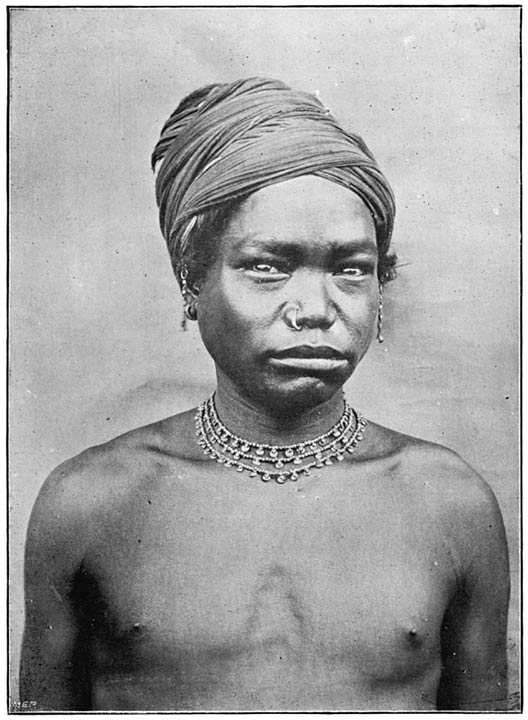
Savara.
The Savaras are described by Mr. Fawcett as “below the middle height; face rather flat; lips thick; nose broad and flat; cheek bones high; eyes slightly oblique. They are as fair as the Uriyas, and fairer than the Telugus of the plains. Not only is the Saora shorter and fairer than other hill people, but his face is distinctly Mongolian, the obliquity of the eyes being sometimes very marked, and the inner corners of the eyes are generally very oblique. [The Mongolian type is clearly brought out in the illustration.] The Saora’s endurance in going up and down hill, whether carrying heavy loads or not, is wonderful. Four Saoras have been known to carry a 10-stone man in a chair straight up a 3,800 feet hill without relief, and without rest. Usually, the Saora’s dress (his full dress) consists of a large bunch of feathers (generally white) stuck in his hair on the crown of his head, a coloured cloth round his head as a turban, and worn much on the back of the head, and folded tightly, so as to be a good protection to the head. When feathers are not worn, the hair is tied on the top of the head, or a little at the side of it. A piece of flat brass is another head ornament. It is stuck in the hair, which is tied in a knot at the crown of the head, at an angle of about 40° from the perpendicular, and its waving up and down motion as a man walks has a curious effect. Another head ornament is a piece of wood, about 8 or 9 inches in length and ¾ inch in diameter, with a flat button about 2 inches in diameter on the top, all covered with hair or coloured thread, and worn in the same position as the flat piece of brass. A peacock’s feather, or one or two of the tail feathers of the jungle cock, may be often seen stuck in the knot of hair on the top of the head. A cheroot or two, perhaps half smoked, may often be seen sticking in the hair of a man or woman, to be used again when wanted. They also smoke pipes, and the old women seem particularly fond of them. Round the Saora’s neck are brass and bead necklaces. A man will wear as many as thirty necklaces at a time, or rather necklaces of various lengths passed as many as thirty times round his neck. Round the Saora’s waist, and under his fork, is tied a cloth with coloured ends hanging in front and behind. When a cloth on the body is worn, it is usually worn crossed in front. The women wear necklaces like the men. Their hair is tied at the back of the head, and is sometimes confined with a fillet. They wear only one cloth, tied round the waist. During feasts, or when dancing, they generally wear a cloth over the shoulders. Every male wears a small ring, generally of silver, in the right nostril, and every female wears a similar ring in each nostril, and in the septum. As I have been told, these rings are put in the nose on the eighth or tenth day after birth. Bangles are often worn by men and women. Anklets, too, are sometimes worn by the women. Brass necklets and many other ornaments are made in Saora hills by the Gangsis, a low tribe of workers in brass. The Saora’s weapons are the bow, sometimes ornamented with peacock’s feathers, sword, dagger, and tangi. The bow used by the Saoras is much smaller than the bow used by any of the other hill people. It is generally about 3½ feet long, and the arrows from 18 to 21 inches. The bow is always made of bamboo, and so is the string. The arrows are reeds tipped with iron, and leathered on two sides only. A blunt-headed arrow is used for shooting birds. Every Saora can use the bow from boyhood, and can shoot straight up to 25 or 30 yards.”
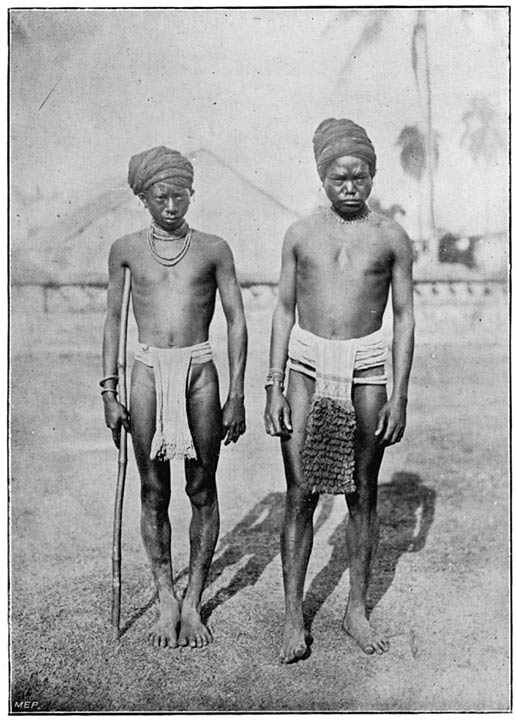
Savaras.
As regards the marriage customs of the Savaras, Mr. Fawcett writes that “a Saora may marry a woman of his own or of any other village. A man may have as many as three wives, or, if he is a man of importance, such as Gōmango of a large village, he may have four. Not that there is any law in the matter, but it is considered that three, or at most four, are as many as a man can manage. For his first marriage, a man chooses a young woman he fancies; his other wives are perhaps her sisters, or other women who have come to him. A woman may leave her husband whenever she pleases. Her husband cannot prevent her. When a woman leaves her husband to join herself to another, the other pays the husband she has left a buffalo and a pig. Formerly, it is said, if he did not pay up, the man she left would kill the man to whom she went. Now arbitration comes into play. I believe a man usually takes a second wife after his first has had a child; if he did so before, the first wife would say he was impotent. As the getting of the first wife is more troublesome and expensive than getting the others, she is treated the best. In some places, all a man’s wives are said to live together peaceably. It is not the custom in the Kolakotta villages. Knowing the wives would fight if together, domestic felicity is maintained by keeping up different establishments. A man’s wives will visit one another in the daytime, but one wife will never spend the night in the house of another. An exception to this is that the first wife may invite one of the other wives to sleep in her house with the husband. As each wife has her separate house, so has she her separate piece of ground on the hill-side to cultivate. The wives will not co-operate in working each other’s cultivation, but they will work together, with the husband, in the paddy fields. Each wife keeps the produce of the ground she cultivates in her own house. Produce of the paddy fields is divided into equal shares among the wives. If a wife will not work properly, or if she gives away anything belonging to her husband, she may be divorced. Any man may marry a divorced woman, but she must pay to her former husband a buffalo and a pig. If a man catches his wife in adultery (he must see her in the act), he thinks he has a right to kill her, and her lover too. But this is now generally (but not always) settled by arbitration, and the lover pays up. A wife caught in adultery will never be retained as a wife. As any man may have as many as three wives, illicit attachments are common. During large feasts, when the Saoras give themselves up to sensuality, there is no doubt a great deal of promiscuous intercourse. A widow is considered bound to marry her husband’s brother, or his brother’s sons if he has no younger brothers. A number of Saoras once came to me to settle a dispute. They were in their full dress, with feathers and weapons. The dispute was this. A young woman’s husband was dead, and his younger brother was almost of an age to take her to wife. She had fixed her affections on a man of another village, and made up her mind to have him and no one else. Her village people wanted compensation in the shape of a buffalo, and also wanted her ornaments. The men of the other village said no, they could not give a buffalo. Well, they should give a pig at least—no, they had no pig. Then they must give some equivalent. They would give one rupee. That was not enough—at least three rupees. They were trying to carry the young woman off by force to make her marry her brother-in-law, but were induced to accept the rupee, and have the matter settled by their respective Bissoyis. The young woman was most obstinate, and insisted on having her own choice, and keeping her ornaments. Her village people had no objection to her choice, provided the usual compensation was paid.
“In one far out-of-the-way village the marriage ceremony consists in this. The bride’s father is plied with liquor two or three times; a feast is made in the bridegroom’s house, to which the bride comes with her father; and after the feast she remains in the man’s house as his wife. They know nothing of capture. In the Kolakotta valley, below this village, a different custom prevails. The following is an account of a Saora marriage as given by the Gōmango of one of the Kolakotta villages, and it may be taken as representative of the purest Saora marriage ceremony. ‘I wished to marry a certain girl, and, with my brother and his son, went to her house. I carried a pot of liquor, and arrow, and one brass bangle for the girl’s mother. Arrived at the house, I put the liquor and the arrow on the floor. I and the two with me drank the liquor—no one else had any. The father of the girl said ‘Why have you brought the liquor?’ I said ‘Because I want your daughter.’ He said ‘Bring a big pot of liquor, and we will talk about it.’ I took the arrow I brought with me, and stuck it in the thatch of the roof just above the wall, took up the empty pot, and went home with those who came with me. Four days afterwards, with the same two and three others of my village, I went to the girl’s father’s house with a big pot of liquor. About fifteen or twenty people of the village were present. The father said he would not give the girl, and, saying so, he smashed the pot of liquor, and, with those of his village, beat us so that we ran back to our village. I was glad of the beating, as I know by it I was pretty sure of success. About ten days afterwards, ten or twenty of my village people went with me again, carrying five pots of liquor, which we put in the girl’s father’s house. I carried an arrow, which I stuck in the thatch beside the first one. The father and the girl’s nearest male relative each took one of the arrows I had put in the thatch, and, holding them in their left hands, drank some of the liquor. I now felt sure of success. I then put two more arrows in the father’s left hand, holding them in his hand with both of my hands over his, and asked him to drink. Two fresh arrows were likewise placed in the left hands of all the girl’s male relatives, while I asked them to drink. To each female relative of the girl I gave a brass bangle, which I put on their right wrists while I asked them to drink. The five pots of liquor were drunk by the girl’s male and female relations, and the villagers. When the liquor was all drunk, the girl’s father said ‘Come again in a month, and bring more liquor.’ In a month I went again, with all the people of my village, men, women and children, dancing as we went (to music of course), taking with us thirty pots of liquor, and a little rice and a cloth for the girl’s mother; also some hill dholl (pulse), which we put in the father’s house. The liquor was set down in the middle of the village, and the villagers, and those who came with me, drank the liquor and danced. The girl did not join in this; she was in the house. When the liquor was finished, my village people went home, but I remained in the father’s house. For three days I stayed, and helped him to work in his fields. I did not sleep with the girl; the father and I slept in one part of the house, and the girl and her mother in another. At the end of the three days I went home. About ten days afterwards, I, with about ten men of my village, went to watch for the girl going to the stream for water. When we saw her, we caught her, and ran away with her. She cried out and the people of her village came after us, and fought with us. We got her off to my village, and she remained with me as my wife. After she became my wife, her mother gave her a cloth and a bangle.” The same individual said that, if a man wants a girl, and cannot afford to give the liquor, etc., to her people, he takes her off by force. If she likes him, she remains, but, if not, she runs home. He will carry her off three times, but not oftener; and, if after the third time she again runs away, he leaves her. The Saoras themselves say that formerly every one took his wife by force. In a case which occurred a few years ago, a bridegroom did not comply with the usual custom of giving a feast to the bride’s people, and the bride’s mother objected to the marriage on that account. The bridegroom’s party, however, managed to carry off the bride. Her mother raised an alarm, whereon a number of people ran up, and tried to stop the bridegroom’s party. They were outnumbered, and one was knocked down, and died from rupture of the spleen.
A further account of the Saora marriage customs is given by Mr. Ramamurti Pantulu, who writes as follows. “When the parents of a young man consider it time to seek a bride for him, they make enquiries and even consult their relatives and friends as to a suitable girl for him. The girl’s parents are informally apprised of their selection. On a certain day, the male relatives of the youth go to the girl’s house to make a proposal of marriage. Her parents, having received previous notice of the visit, have the door of the house open or closed, according as they approve or disapprove of the match. On arrival at the house, the visitors knock at the door, and, if it is open, enter without further ceremony. Sometimes the door is broken open. If the girl’s parents object to the match, they remain silent, and will not touch the liquor brought by the visitors, and they go away. Should, however, they regard it with favour, they charge the visitors with intruding, shower abuse on them, and beat them, it may be, so severely that wounds are inflicted, and blood is shed. This ill-treatment is borne cheerfully, and without resistance, as it is a sign that the girl’s hand will be bestowed on the young man. The liquor is then placed on the floor, and, after more abuse, all present partake thereof. If the girl’s parents refuse to give her in marriage after the performance of this ceremony, they have to pay a penalty to the parents of the disappointed suitor. Two or three days later, the young man’s relatives go a second time to the girl’s house, taking with them three pots of liquor, and a bundle composed of as many arrows as there are male members in the girl’s family. The liquor is drunk, and the arrows are presented, one to each male. After an interval of some days, a third visit is paid, and three pots of liquor smeared with turmeric paste, and a quantity of turmeric, are taken to the house. The liquor is drunk, and the turmeric paste is smeared over the back and haunches of the girl’s relatives. Some time afterwards, the marriage ceremony takes place. The bridegroom’s party proceed to the house of the bride, dancing and singing to the accompaniment of all the musical instruments except the drum, which is only played at funerals. With them they take twenty big pots of liquor, a pair of brass bangles and a cloth for the bride’s mother, and head cloths for the father, brothers, and other male relatives. When everything is ready, the priest is called in. One of the twenty pots is decorated, and an arrow is fixed in the ground at its side. The priest then repeats prayers to the invisible spirits and ancestors, and pours some of the liquor into leaf-cups prepared in the names of the ancestors [Jojonji and Yoyonji, male and female], and the chiefs of the village. This liquor is considered very sacred, and is sprinkled from a leaf over the shoulders and feet of the elders present. The father of the bride, addressing the priest, says ‘Bōya, I have drunk the liquor brought by the bridegroom’s father, and thereby have accepted his proposal for a marriage between his son and my daughter. I do not know whether the girl will afterwards agree to go to her husband, or not. Therefore it is well that you should ask her openly to speak out her mind.’ The priest accordingly asks the girl if she has any objection, and she replies ‘My father and mother, and all my relatives have drunk the bridegroom’s liquor. I am a Savara, and he is a Savara. Why then should I not marry him?’ Then all the people assembled proclaim that the pair are husband and wife. This done, the big pot of liquor, which has been set apart from the rest, is taken into the bride’s house. This pot, with another pot of liquor purchased at the expense of the bride’s father, is given to the bridegroom’s party when it retires. Every house-holder receives the bridegroom and his party at his house, and offers them liquor, rice, and flesh, which they cannot refuse to partake of without giving offence.”
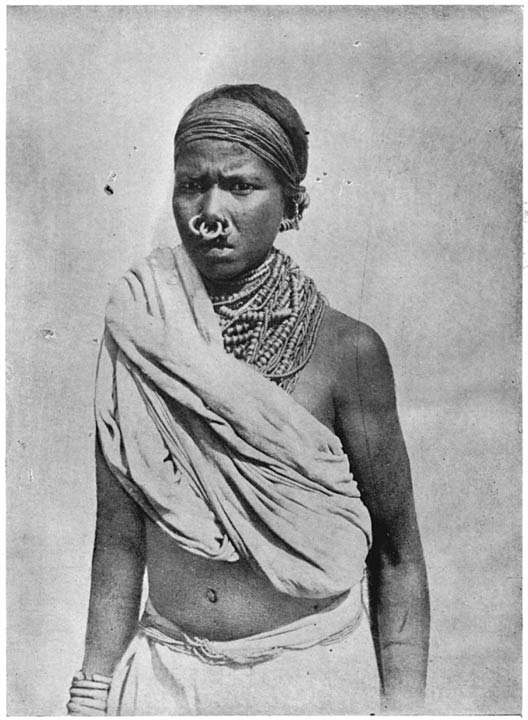
Savara.
“Whoever,” Mr. Ramamurti continues, “marries a widow, whether it is her husband’s younger brother or some one of her own choice, must perform a religious ceremony, during which a pig is sacrificed. The flesh, with some liquor, is offered to the ghost of the widow’s deceased husband, and prayers are addressed by the Bōyas to propitiate the ghost, so that it may not torment the woman and her second husband. ‘Oh! man,’ says the priest, addressing the deceased by name, ‘Here is an animal sacrificed to you, and with this all connection between this woman and you ceases. She has taken with her no property belonging to you or your children. So do not torment her within the house or outside the house, in the jungle or on the hill, when she is asleep or when she wakes. Do not send sickness on her children. Her second husband has done no harm to you. She chose him for her husband, and he consented. Oh! man, be appeased; Oh! unseen ones; Oh! ancestors, be you witnesses.’ The animal sacrificed on this occasion is called long danda (inside fine), or fine paid to the spirit of a dead person inside the earth. The animal offered up, when a man marries a divorced woman, is called bayar danda (outside fine), or fine paid as compensation to a man living outside the earth. The moment that a divorcée marries another man, her former husband pounces upon him, shoots his buffalo or pig dead with an arrow, and takes it to his village, where its flesh is served up at a feast. The Bōya invokes the unseen spirits, that they may not be angry with the man who has married the woman, as he has paid the penalty prescribed by the elders according to the immemorial custom of the Savaras.
From a still further account of the ceremonial observances in connection with marriage, with variations, I gather that the liquor is the fermented juice of the salop or sago palm (Caryota urens), and is called ara-sāl. On arrival at the girl’s house, on the first occasion, the young man’s party sit at the door thereof, and, making three cups from the leaves kiredol (Uncaria Gambier) or jāk (Artocarpus integrifolia), pour the liquor into them, and lay them on the ground. As the liquor is being poured into the cups, certain names, which seem to be those of the ancestors, are called out. The liquor is then drunk, and an arrow (ām) is stuck in the roof, and a brass bangle (khadu) left, before the visitors take their departure. If the match is unacceptable to the girl’s family, the arrow and bangle are returned. The second visit is called pank-sāl, or sang-sang-dal-sol, because the liquor pots are smeared with turmeric paste. Sometimes it is called nyanga-dal-sol, because the future bridegroom carries a small pot of liquor on a stick borne on the shoulder; or pojang, because the arrow, which has been stuck in the roof, is set up in the ground close to one of the pots of liquor. In some places, several visits take place subsequent to the first visit, at one of which, called rodai-sāl, a quarrel arises.
It is noted by Mr. Ramamurti Pantulu that, among the Savaras who have settled in the low country, some differences have arisen in the marriage rites “owing to the introduction of Hindu custom, i.e., those obtaining among the Sūdra castes. Some of the Savaras who are more Hinduised than others consult their medicine men as to what day would be most auspicious for a marriage, erect pandals (booths), dispense with the use of liquor, substituting for it thick jaggery (crude sugar) water, and hold a festival for two or three days. But even the most Hinduised Savara has not yet fallen directly into the hands of the Brāhman priest.” At the marriage ceremony of some Kāpu Savaras, the bride and bridegroom sit side by side at the auspicious moment, and partake of boiled rice (korra) from green leaf-cups, the pair exchanging cups. Before the bridegroom and his party proceed to their village with the bride, they present the males and females of her village with a rupee, which is called janjul naglipu, or money paid for taking away the girl. In another form of Kāpu Savara marriage, the would-be bridegroom and his party proceed, on an auspicious day, to the house of the selected girl, and offer betel and tobacco, the acceptance of which is a sign that the match is agreeable to her parents. On a subsequent day, a small sum of money is paid as the bride-price. On the wedding day the bride is conducted to the home of the bridegroom, where the contracting couple are lifted up by two people, who dance about with them. If the bride attempts to enter the house, she is caught hold of, and made to pay a small sum of money before she is permitted to do so. Inside the house, the officiating Dēsāri ties the ends of the cloths of the bride and bridegroom together, after the ancestors and invisible spirits have been worshipped.
Of the marriage customs of the Kāpu Savaras, the following account is given in the Gazetteer of the Vizagapatam district. “The Kāpu Savaras are taking to mēnarikam (marriage with the maternal uncle’s daughter), although the hill custom requires a man to marry outside his village. Their wedding ceremonies bear a distant resemblance to those among the hill Savaras. Among the Kāpu Savaras, the preliminary arrow and liquor are similarly presented, but the bridegroom goes at length on an auspicious day with a large party to the bride’s house, and the marriage is marked by his eating out of the same platter with her, and by much drinking, feasting, and dancing.”
Children are named after the day of the week on which they were born, and nicknames are frequently substituted for the birth name. Mr. Fawcett records, for example, that a man was called Gylo because, when a child, he was fond of breaking nuts called gylo, and smearing himself with their black juice. Another was called Dallo because, in his youthful days, he was fond of playing about with a basket (dalli) on his head.
Concerning the religion of the Savaras, Mr. Fawcett notes that their name for deity is Sonnum or Sunnam, and describes the following:—
(1) Jalia. In some places thought to be male, and in others female. The most widely known, very malevolent, always going about from one Saora village to another causing illness or death; in some places said to eat people. Almost every illness that ends in death in three or four days is attributed to Jalia’s malevolence. When mangoes ripen, and before they are eaten cooked (though they may be eaten raw), a sacrifice of goats, with the usual drinking and dancing, is made to this deity. In some villages, in the present year (1887), there were built for the first time, temples—square thatched places without walls—in the villages. The reason given for building in the villages was that Jalia had come into them. Usually erections are outside villages, and sacrifice is made there, in order that Jalia may be there appeased, and go away. But sometimes he will come to a village, and, if he does, it is advisable to make him comfortable. One of these newly built temples was about four feet square, thatched on the top, with no walls, just like the hut for departed spirits. A Saora went inside, and showed us the articles kept for Jalia’s use and amusement. There were two new cloths in a bamboo box, two brushes of feathers to be held in the hand when dancing, oil for the body, a small looking-glass, a bell, and a lamp. On the posts were some red spots. Goats are killed close by the temple, and the blood is poured on the floor of the platform thereof. There are a few villages, in or near which there are no Jalia erections, the people saying that Jalia does not trouble them, or that they do not know him. In one village where there was none, the Saoras said there had been one, but they got tired of Jalia, and made a large sacrifice with numerous goats and fowls, burnt his temple, and drove him out. Jalia is fond of tobacco. Near one village is an upright stone in front of a little Jalia temple, by a path-side, for passers-by to leave the ends of their cheroots on for Jalia.
(2) Kitung. In some parts there is a story that this deity produced all the Saoras in Orissa, and brought them with all the animals of the jungles to the Saora country. In some places, a stone outside the village represents this deity, and on it sacrifices are made on certain occasions to appease this deity. The stone is not worshipped. There are also groves sacred to this deity. The Uriyas in the Saora hills also have certain sacred groves, in which the axe is never used.
(3) Rathu. Gives pains in the neck.
(4) Dharma Boja, Lānkan (above), Ayungang (the sun). The first name is, I think, of Uriya origin, and the last the real Saora name. There is an idea in the Kolakotta country that it causes all births. This deity is not altogether beneficent, and causes sickness, and may be driven away by sacrifices. In some villages, this deity is almost the only one known. A Saora once told me, on my pointing to Venus and asking what it was, that the stars are the children of the sun and moon, and one day the sun said he would eat them all up. Woman-like, the moon protested against the destruction of her progeny, but was obliged to give in. She, however, managed to hide Venus while the others were being devoured. Venus was the only planet he knew. In some parts, the sun is not a deity.
(5) Kanni. Very malevolent. Lives in big trees, so they are never cut in groves which this deity is supposed to haunt. I frequently saw a Saora youth of about 20, who was supposed to be possessed by this deity. He was an idiot, who had fits. Numerous buffaloes had been sacrificed to Kanni, to induce that deity to leave the youth, but to no purpose.
“There are many hill deities known in certain localities—Dērēmā, supposed to be on the Deodangar hill, the highest in the neighbourhood, Khistu, Kinchinyung, Ilda, Lobo, Kondho, Balu, Baradong, etc. These deities of the hills are little removed from the spirits of the deceased Saoras. [Mr. Ramamurti Pantulu refers to two hills, one at Gayaba called Jum-tang Baru, or eat cow hill, and the other about eight miles from Parlakimedi, called Media Baru. At the former, a cow or bull is sacrificed, because a Kuttung once ate the flesh of a cow there; at the latter the spirits require only milk and liquor. This is peculiar, as the Savaras generally hold milk in abhorrence.]”
“There is invariably one fetish, and generally there are several fetishes in every Saora house. In some villages, where the sun is the chief deity (and causes most mischief), there are fetishes of the sun god; in another village, fetishes of Jalia, Kitung, etc. I once saw six Jalia fetishes, and three other fetishes in one house. There are also, especially about Kolakotta, Kulba fetishes in houses. The fetish is generally an empty earthen pot, about nine inches in diameter, slung from the roof. The Kudang slings it up. On certain occasions, offerings are made to the deity or Kulba represented by the fetish on the floor underneath it. Rude pictures, too, are sometimes fetishes. The fetish to the sun is generally ornamented with a rude pattern daubed in white on the outside. In the village of Bori in the Vizagapatam Agency, offerings are made to the sun fetish when a member of the household gets pains in the legs or arms, and the fetish is said on such occasion to descend of itself to the floor. Sacrifices are sometimes made inside houses, under the fetishes, sometimes at the door, and blood put on the ground underneath the fetish.”
It is noted by Mr. Ramamurti Pantulu that “the Kittungs are ten in number, and are said to be all brothers. Their names are Bhīma, Rāma, Jodepulu, Pēda, Rung-rung, Tumanna, Garsada, Jaganta, Mutta, and Tete. On some occasions, ten figures of men, representing the Kittungs, are drawn on the walls of a house. Figures of horses and elephants, the sun, moon and stars, are also drawn below them. The Bōya is also represented. When a woman is childless, or when her children die frequently, she takes a vow that the Kittungpurpur ceremony shall be celebrated, if a child is born to her, and grows in a healthy state. If this comes to pass, a young pig is purchased, and marked for sacrifice. It is fattened, and allowed to grow till the child reaches the age of twelve, when the ceremony is performed.
The Madras Museum possesses a series of wooden votive offerings which were found stacked in a structure, which has been described to me as resembling a pigeon-cot. The offerings consisted of a lizard (Varanus), paroquet, monkey, peacock, human figures, dagger, gun, sword, pick-axe, and musical horn. The Savaras would not sell them to the district officer, but parted with them on the understanding that they would be worshipped by the Government.
I gather that, at the sale or transfer of land, the spirits are invoked by the Bōya, and, after the distribution of liquor, the seller or mortgager holds a pīpal (Ficus religiosa) leaf with a lighted wick in it in his hand, while the purchaser or mortgagee holds another leaf without a wick. The latter covers the palm of the former with his leaf, and the terms of the transaction are then announced.
A long account of a big sacrifice is given by Mr. Fawcett, of which the following is a summary. The Kudang was a lean individual of about 40 or 45, with a grizzled beard a couple of inches in length. He had a large bunch of feathers in his hair, and the ordinary Saora waist-cloth with a tail before and behind. There were tom-toms with the party. A buffalo was tied up in front of the house, and was to be sacrificed to a deity who had seized on a young boy, and was giving him fever. The boy’s mother came out with some grain, and other necessaries for a feed, in a basket on her head. All started, the father of the boy carrying him, a man dragging the buffalo along, and the Kudang driving it from behind. As they started, the Kudang shouted out some gibberish, apparently addressed to the deity, to whom the sacrifice was to be made. The party halted in the shade of some big trees. They said that the sacrifice was to the road god, who would go away by the path after the sacrifice. Having arrived at the place, the woman set down her basket, the men laid down their axes and the tom-toms, and a fire was lighted. The buffalo was tied up 20 yards off on the path, and began to graze. After a quarter of an hour, the father took the boy in his lap as he sat on the path, and the Kudang’s assistant sat on his left with a tom-tom before him. The Kudang stood before the father on the path, holding a small new earthen pot in his hand. The assistant beat the tom-tom at the rate of 150 beats to the minute. The Kudang held the earthen pot to his mouth, and, looking up to the sun (it was 9 A.M.), shouted some gibberish into it, and then danced round and round without leaving his place, throwing up the pot an inch or so, and catching it with both hands, in perfect time with the tom-tom, while he chanted gibberish for a quarter of an hour. Occasionally, he held the pot up to the sun, as if saluting it, shouted into it, and passed it round the father’s head and then round the boy’s head, every motion in time with the tom-tom. The chant over, he put down the pot, and took up a toy-like bow and arrow. The bow was about two feet long, through which was fixed an arrow with a large head, so that it could be pulled only to a certain extent. The arrow was fastened to the string, so that it could not be detached from the bow. He then stuck a small wax ball on to the point of the arrow head, and, dancing as before, went on with his chant accompanied by the tom-tom. Looking up at the sun, he took aim with the bow, and fired the wax ball at it. He then fired balls of wax, and afterwards other small balls, which the Uriyas present said were medicine of some kind, at the boy’s head, stomach, and legs. As each ball struck him, he cried. The Kudang, still chanting, then went to the buffalo, and fired a wax ball at its head. He came back to where the father was sitting, and, putting down the bow, took up two thin pieces of wood a foot long, an inch wide, and blackened at the ends. The chant ceased for a few moments while he was changing the bow for the pieces of wood, but, when he had them in his hands, he went on again with it, dancing round as before, and striking the two pieces of wood together in time. This lasted about five minutes, and, in the middle of the dance, he put an umbrella-like shade on his head. The dance over, he went to the buffalo, and stroked it all over with the two pieces of wood, first on the head, then on the body and rump, and the chant ceased. He then sat in front of the boy, put a handful of common herbs into the earthen pot, and poured some water into it. Chanting, he bathed the boy’s head with the herbs and water, the father’s head, the boy’s head again, and then the buffalo’s head, smearing them with the herbs. He blew into one ear of the boy, and then into the other. The chant ceased, and he sat on the path. The boy’s father got up, and, carrying the boy, seated him on the ground. Then, with an axe, which was touched by the sick boy, he went up to the buffalo, and with a blow almost buried the head of the axe in the buffalo’s neck. He screwed the axe about until he disengaged it, and dealt a second and a third blow in the same place, and the buffalo fell on its side. When it fell, the boy’s father walked away. As the first blow was given, the Kudang started up very excited as if suddenly much overcome, holding his arms slightly raised before him, and staggered about. His assistant rushed at him, and held him round the body, while he struggled violently as if striving to get to the bleeding buffalo. He continued struggling while the boy’s father made his three blows on the buffalo’s neck. The father brought him some of the blood in a leaf cup, which he greedily drank, and was at once quiet. Some water was then given him, and he seemed to be all right. After a minute or so, he sat on the path with the tom-tom before him, and, beating it, chanted as before. The boy’s father returned to the buffalo, and, with a few more whacks at it, stopped its struggles. Some two or three men joined him, and, with their axes and swords, soon had the buffalo in pieces. All present, except the Kudang, had a good feed, during which the tom-tom ceased. After the feed, Kudang went at it again, and kept it up at intervals for a couple of hours. He once went for 25 minutes at 156 beats to the minute without ceasing.
A variant of the ceremonial here described has been given to me by Mr. G. F. Paddison from the Gunapur hills. A buffalo is tied up to the door of the house, where the sick person resides. Herbs and rice in small platters, and a little brass vessel containing toddy, balls of rice, flowers, and medicine, are brought with a bow and arrow. The arrow is thicker at the basal end than towards the tip. The narrow part goes, when shot, through a hole in the bow, too small to allow of passage of the rest of the arrow. The Bēju (wise woman) pours toddy over the herbs and rice, and daubs the sick person over the forehead, breasts, stomach, and back. She croons out a long incantation to the goddess, stopping at intervals to call out “Daru,” to attract her attention. She then takes the bow and arrow, and shoots into the air. She then stands behind the kneeling patient, and shoots balls of medicine stuck on the tip of the arrow at her. The construction of the arrow is such that the balls are dislodged from the tip of the arrow. The patient is thus shot at all over the body, which is bruised by the impact of the balls. Afterwards the Bēju shoots one or two balls at the buffalo, which is taken to a path forming the village boundary, and killed with a tangi (axe). The patient is then daubed with blood of the buffalo, rice and toddy. A feast concludes the ceremonial.
The following account of a sacrifice to Rathu, who had given fever to the sister of the celebrant Kudang, is given by Mr. Fawcett. “The Kudang was squatting, facing west, his fingers in his ears, and chanting gibberish with continued side-shaking of his head. About two feet in front of him was an apparatus made of split bamboo. A young pig had been killed over it, so that the blood was received in a little leaf cup, and sprinkled over the bamboo work. The Kudang never ceased his chant for an hour and a half. While he was chanting, some eight Saoras were cooking the pig with some grain, and having a good feed. Between the bamboo structure and the Kudang were three little leaf cups, containing portions of the food for Rathu. A share of the food was kept for the Kudang, who when he had finished his chant, got up and ate it. Another performance, for which some dried meat of a buffalo that had been sacrificed a month previously was used, I saw on the same day. Three men, a boy, and a baby, were sitting in the jungle. The men were preparing food, and said that they were about to do some reverence to the sun, who had caused fever to some one. Portions of the food were to be set out in leaf cups for the sun deity.”
It is recorded by Mr. Ramamurti Pantulu that, when children are seriously ill and become emaciated, offerings are made to monkeys and blood-suckers (lizards), not in the belief that illness is caused by them, but because the sick child, in its emaciated state, resembles an attenuated figure of these animals. Accordingly, a blood-sucker is captured, small toy arrows are tied round its body, and a piece of cloth is tied on its head. Some drops of liquor are then poured into its mouth, and it is set at liberty. In negotiating with a monkey, some rice and other articles of food are placed in small baskets, called tanurjal, which are suspended from branches of trees in the jungle. The Savaras frequently attend the markets or fairs held in the plains at the foot of the ghāts to purchase salt and other luxuries. If a Savara is taken ill at the market or on his return thence, he attributes the illness to a spirit of the market called Biradi Sonum. The bulls, which carry the goods of the Hindu merchants to the market, are supposed to convey this spirit. In propitiating it, the Savara makes an image of a bull in straw, and, taking it out of his village, leaves it on the foot-path after a pig has been sacrificed to it.