Volume 6 — P (Continued)
Reading edition
Palli or Vanniyan.—Writing concerning this caste the Census Superintendent, 1871, records that “a book has been written by a native to show that the Pallis (Pullies or Vanniar) of the south are descendants of the fire races (Agnikulas) of the Kshatriyas, and that the Tamil Pullies were at one time the shepherd kings of Egypt.” At the time of the census, 1871, a petition was submitted to Government by representatives of the caste, praying that they might be classified as Kshatriyas, and twenty years later, in connection with the census, 1891, a book entitled ‘Vannikula Vilakkam: a treatise on the Vanniya caste,’ was compiled by Mr. T. Aiyakannu Nayakar, in support of the caste claim to be returned as Kshatriyas, for details concerning which claim I must refer the reader to the book itself. In 1907, a book entitled Varuna Darpanam (Mirror of Castes) was published, in which an attempt is made to connect the caste with the Pallavas.
Kulasēkhara, one of the early Travancore kings, and one of the most renowned Ālwars reverenced by the Srī Vaishnava community in Southern India, is claimed by the Pallis as a king of their caste. Even now, at the Parthasārathi temple in Triplicane (in the city of Madras), which according to inscriptions is a Pallava temple, Pallis celebrate his anniversary with great éclat. The Pallis of Kōmalēsvaranpettah in the city of Madras have a Kulasēkhara Perumāl Sabha, which manages the celebration of the anniversary. The temple has recently been converted at considerable cost into a temple for the great Ālwar. A similar celebration is held at the Chintādripettah Ādikēsava Perumāl temple in Madras. The Pallis have the right to present the most important camphor offering of the Mylapore Siva temple. They allege that the temple was originally theirs, but by degrees they lost their hold over it until this bare right was left to them. Some years ago, there was a dispute concerning the exercise of this right, and the case came before the High Court of Madras, which decided the point at issue in favour of the Pallis. One of the principal gōpuras (pyramidal towers) of the Ēkāmranātha temple at Big Conjeeveram, the ancient capital of the Pallavas, is known as Palligōpuram. The Pallis of that town claim it as their own, and repair it from time to time. In like manner, they claim that the founder of the Chidambaram temple, by name Swēta Varman, subsequently known as Hiranya Varman (sixth century A.D.) was a Pallava king. At Pichavaram, four miles east of Chidambaram, lives a Palli family, which claims to be descended from Hiranya Varman. A curious ceremony is even now celebrated at the Chidambaram temple, on the steps leading to the central sanctuary. As soon as the eldest son of this family is married, he and his wife, accompanied by a local Vellāla, repair to the sacred shrine, and there, amidst crowds of their castemen and others, a hōmam (sacrificial fire) is raised, and offerings are made to it. The couple are then anointed with nine different kinds of holy water, and the Vellāla places the temple crown on their heads. The Vellāla who officiates at this ceremony, assisted by the temple priests, is said to belong to the family of a former minister of a descendant of Hiranya Varman. It is said that, as the ceremony is a costly one, and the expenses have to be paid by the individual who undergoes it, it often happens that the eldest son of the family has to remain a bachelor for half his lifetime. The Pallis who reside at St. Thomé in the city of Madras allege that they became Christians, with their King Kandappa Rāja, who, they say, ruled over Mylapore during the time of the visit of St. Thomas. In 1907, Mr. T. Varadappa Nayakar, the only High Court Vakil (pleader) among the Palli community practising in Madras, brought out a Tamil book on the history of the connection of the caste with the ancient Pallava kings.
In reply to one of a series of questions promulgated by the Census Superintendent, it was stated that “the caste is known by the following names:—Agnikulas and Vanniyas. The etymology of these is the same, being derived from the Sanskrit Agni or Vahni, meaning fire. The following, taken from Dr. Oppert’s article on the original inhabitants of Bharatavarsa or India, explains the name of the caste with its etymology:—‘The word Vanniyan is generally derived from the Sanskrit Vahni, fire. Agni, the god of fire, is connected with regal office, as kings hold in their hands the fire-wheel or Agneya-chakra, and the Vanniyas urge in support of their name the regal descent they claim.’ The existence of these fire races, Agnikula or Vahnikula (Vanniya), in North and South India is a remarkable fact. No one can refuse to a scion of the non-Aryan warrior tribe the title of Rajputra, but in so doing we establish at once Aryan and non-Aryan Rajaputras or Rajputs. The Vanniyan of South India may be accepted as a representative of the non-Aryan Rajput element.”
I gather, from a note by Mr. F. R. Hemingway, that the Pallis “tell a long story of how they are descendants of one Vīra Vanniyan, who was created by a sage named Sambuha when he was destroying the two demons named Vātāpi and Enatāpi. This Vīra Vanniyan married a daughter of the god Indra, and had five sons, named Rūdra, Brahma, Krishna, Sambuha, and Kai, whose descendants now live respectively in the country north of the Pālār in the Cauvery delta, between the Pālār and Pennar. They have written a Purānam and a drama bearing on this tale. They declare that they are superior to Brāhmans, since, while the latter must be invested with the sacred thread after birth, they bring their sacred thread with them at birth itself.”
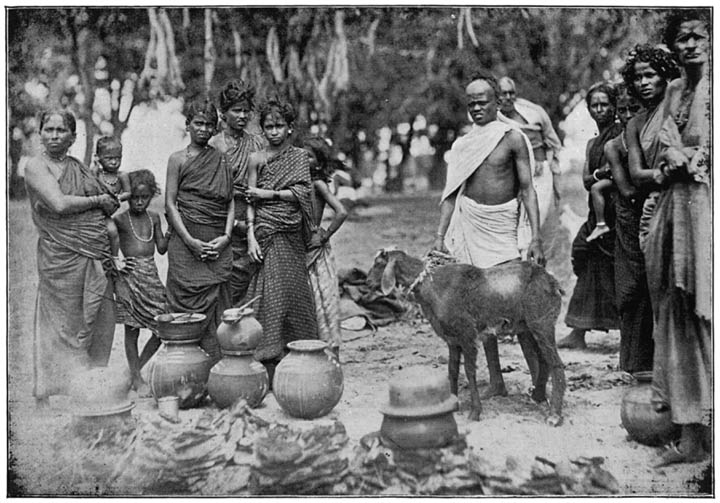
Pallas performing Pongal ceremonies.
Kūvvākkam is known for its festival to Aravān (more correctly Irāvān) or Kūttāndar, which is one of the most popular feasts with Sūdras in the whole district. Aravān was the son of Arjuna, one of the five Pāndava brothers. Local tradition says that, when the great war which is described in the Mahābhārata was about to begin, the Kauravas, the opponents of the Pāndavas, sacrificed, to bring them success, a white elephant. The Pāndavas were in despair of being able to find any such uncommon object with which to propitiate the gods, until Arjuna suggested that they should offer up his son Aravān. Aravān agreed to yield his life for the good of the cause, and, when eventually the Pāndavas were victorious, he was deified for the self-abnegation which had thus brought his side success. Since he died in his youth, before he had been married, it is held to please him if men, even though grown up and already wedded, come now and offer to espouse him, and men who are afflicted with serious diseases take a vow to marry him at his annual festival in the hope of thereby being cured. The festival occurs in May, and for eighteen nights the Mahābhārata is recited by a Palli, large numbers of people, especially of that caste, assembling to hear it read. On the eighteenth night, a wooden image of Kūttāndar is taken to a tope (grove), and seated there. This is the signal for the sacrifice of an enormous number of fowls. Every one who comes brings one or two, and the number killed runs literally into thousands. Such sacrifices are most uncommon in South Arcot, though frequent enough in other parts of the Presidency—the Ceded Districts for example—and this instance is noteworthy. While this is going on, all the men who have taken vows to be married to the deity appear before his image dressed like women, make obeisance, offer to the priest (who is a Palli by caste) a few annas, and give into his hands the tālis (marriage badges) which they have brought with them. These the priest, as representing the God, ties round their necks. The God is brought back to his shrine that night, and when in front of the building he is hidden by a cloth being held before him. This symbolises the sacrifice of Aravān, and the men who have just been married to him set up loud lamentations at the death of their husband. Similar vows are taken and ceremonies performed, it is said, at the shrines to Kūttāndar at Kottattai (two miles north-west of Porto Novo), and Ādivarāhanattum (five miles north-west of Chidambaram), and, in recent years, at Tiruvarkkulam (one mile east of the latter place); other cases probably occur.”
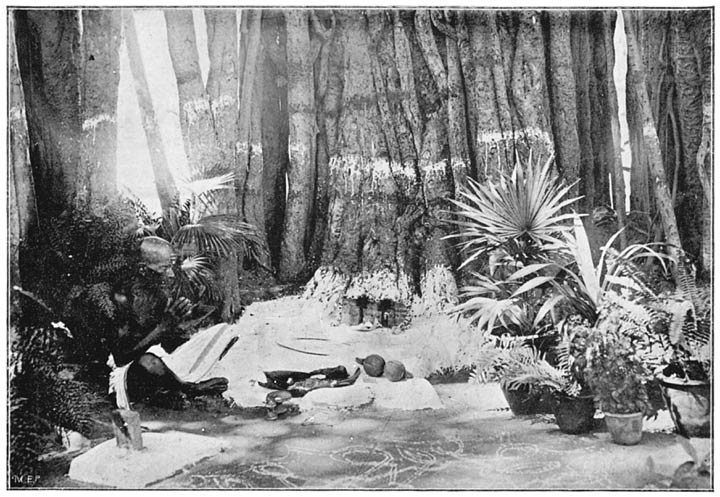
Palli worshipping Munēswara.
Some Palli Poligars have very high-sounding names, such as Agni Kudirai Eriya Rāya Rāvutha Minda Nainar, i.e., Nainar who conquered Rāya Rāvutha and mounted a fire horse. This name is said to commemorate a contest between a Palli and a Rāvutha, at which the former sat on a red-hot metal horse. Further names are Sāmidurai Surappa Sozhaganar and Anjāda Singam (fearless lion). Some Pallis have adopted Gupta as a title.
A few Palli families now maintain a temple of their own, dedicated to Srīnivāsa, at the village of Kumalam in the South Arcot district, live round the temple, and are largely dependent on it for their livelihood. Most of them dress exactly like the temple Battars, and a stranger would certainly take them for Battar Brāhmans. Some of them are well versed in the temple ritual, and their youths are being taught the Sandyavandhana (morning prayer) and Vēdas by a Brāhman priest. Ordinary Palli girls are taken by them in marriage, but their own girls are not allowed to marry ordinary Pallis; and, as a result of this practice of hypergamy, the Kumalam men sometimes have to take to themselves more than one wife, in order that their young women may be provided with husbands. These Kumalam Pallis are regarded as priests of the Pallis, and style themselves Kōvilar, or temple people. But, by other castes, they are nicknamed Kumalam Brāhmans. They claim to be Kshatriyas, and have adopted the title Rāyar.
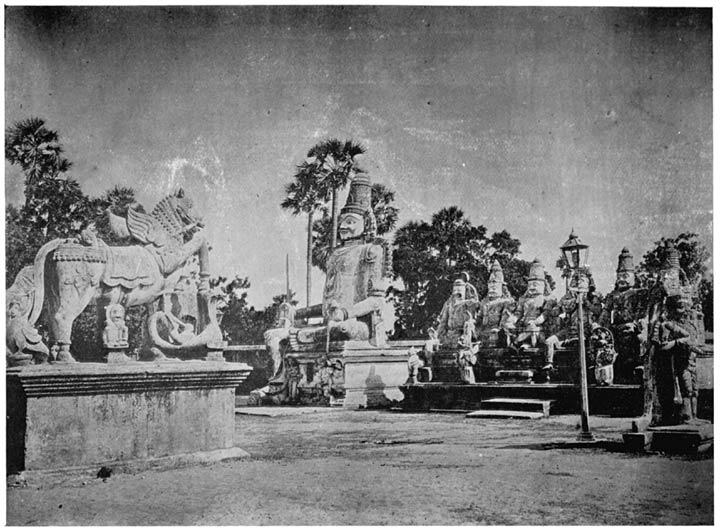
Mannarswāmi in front of shrine.
The Pallis are classed with the left-hand section. But the Census Superintendent, 1871, records that “the wives of the agricultural labourers (Pallis) side with the left hand, while the husbands help in fighting the battles of the right; and the shoe-makers’ (Chakkiliyan) wives also take the side opposed to their husbands. During these factional disturbances, the ladies deny to their husbands all the privileges of the connubial state.” This has not, however, been confirmed in recent investigations into the customs of the caste.
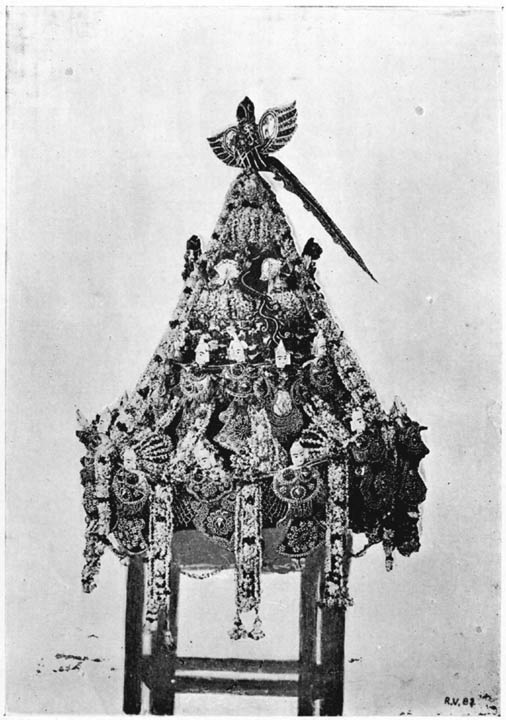
Palli pū karagam.
Huge human figures, representing Mannarswāmi in a sitting posture, constructed of bricks and mortar, and painted, are conspicuous objects in the vicinity of the Lawrence Asylum Press, Mount Road, and in the Kottawāl bazar, Madras. At the village of Tirumalavāyal near Āvadi, there is a similar figure as tall as a palmyra palm, with a shrine of Pachaiamman close by. Mannarswāmi is worshipped mainly by Pallis and Bēri Chettis. An annual festival is held in honour of Pachaiamman and Mannarswāmi, in which the Bēri Chettis take a prominent part.
During the festivals of village deities, the goddess is frequently represented by a pile of seven pots, called karagam, decorated with garlands and flowers. Even when there is an idol in the temple, the karagam is set up in a corner thereof, and taken daily, morning and evening, in procession, carried on the head of a pūjāri or other person. On the last day of the festival, the karagam is elaborately decorated with parrots, dolls, flowers, etc., made of pith (Æschynomene aspera), and called pu karagam (flower pot).
The Pallis live in separate streets or quarters distinctively known as the Palli teru or Kudi teru (ryots’ quarter). The bulk of them are labourers, but many now farm their own lands, while others are engaged in trade or in Government service. The occupations of those whom I have examined at Madras and Chingleput were as follows:—
Merchant. Cultivator. Bullock and pony cart driver. Printer. Lascar. Sweetmeat vendor. Flower vendor. Fitter. Sawyer. Oil-presser. Gardener. Polisher. Bricklayer. Mason.
Some of the Chingleput Palli men were tattooed, like the Irulas, with a dot or vertical stripe on the forehead. Some Irulas, it may be noted en passant, call themselves Tēn (honey) Vanniyans, or Vana (forest) Pallis.
Like many other castes, the Pallis have their own caste beggars, called Nōkkan, who receive presents at marriages and on other occasions. The time-honoured panchāyat system still prevails, and the caste has headmen, entitled Perithanakkāran or Nāttamaikkāran, who decide all social matters affecting the community, and must be present at the ceremonial distribution of pānsupāri.
The Kōvilars, and some others who aspire to a high social status, practice infant marriage, but adult marriage is the rule. At the betrothal ceremony, the future bridegroom goes to the house of his prospective father-in-law, where the headman of the future bride must be present. The bridegroom’s headman or father places on a tray betel, flowers, the bride-price (pariyam) in money or jewels, the milk money (mulapāl kūli), and a cocoanut. Milk money is the present given to the mother of the bride, in return for her having given nourishment to the girl during her infancy. All these things are handed by the bridegroom’s headman to the father or headman of the bride, saying “The money is yours. The girl is ours.” The bride’s father, receiving them, says “The money is mine. The girl is yours.” This performance is repeated thrice, and pān-supāri is distributed, the first recipient being the maternal uncle. The ceremony is in a way binding, and marriage, as a rule, follows close on the betrothal. If, in the interval, a girl’s intended husband dies, she may marry some one else. A girl may not marry without the consent of her maternal uncle, and, if he disapproves of a match, he has the right to carry her off even when the ceremony is in progress, and marry her to a man of his selection. It is stated, in the Vannikula Vilakkam, that at a marriage among the Pallis “the bride, after her betrothal, is asked to touch the bow and sword of the bridegroom. The latter adorns himself with all regal pomp, and, mounting a horse, goes in procession to the bride’s house where the marriage ceremony is celebrated.”
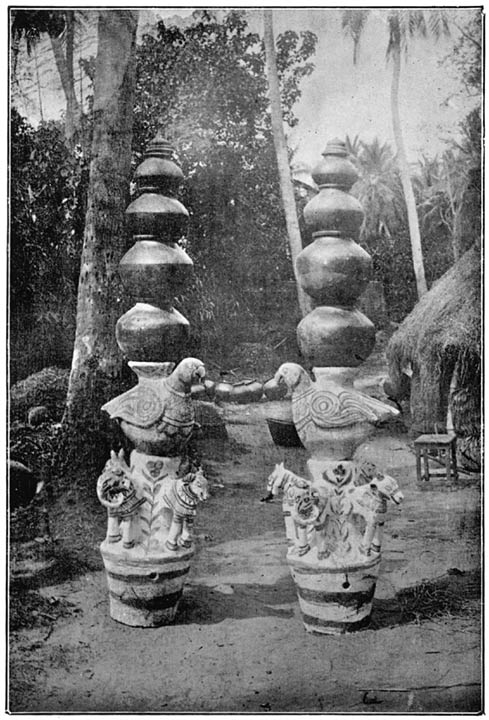
Pandamutti (marriage pots).
It is noted by Mr. Hemingway that some of the Pandamuttu Pallis of the Trichinopoly district “practice the betrothal of infant girls, the ceremony consisting of pouring cow-dung water into the mouth of the baby. They allow a girl to marry a boy younger than herself, and make the latter swallow a two-anna bit, to neutralise the disadvantages of such a match. Weddings are generally performed at the boy’s house, and the bride’s mother does not attend. The bride is concealed from view by a screen.”
It is said that, some years ago, a marriage took place at Panruti near Cuddalore on the old Svayamvara principle described in the story of Nala and Damayanti in the Mahābhārata. According to this custom, a girl selects a husband from a large number of competitors, who are assembled for the purpose.
Widow remarriage is permitted. At the marriage of a widow, the tāli is tied by a married woman, the bridegroom standing by the side, usually inside the house. Widow marriage is known as naduvittu tāli, as the tāli-tying ceremony takes place within the house (naduvīdu).
To get rid of the pollution of the first menstrual period, holy water is sprinkled over the girl by a Brāhman, after she has bathed. She seats herself on a plank, and rice cakes (puttu), a pounding stone, and ārathi are waved in front of her. Sugar and betel are then distributed among those present.
A curious death ceremony is said by Mr. Hemingway to be observed by the Arasu Pallis in the Trichinopoly district. On the day after the funeral, two pots of water are placed near the spot where the corpse was cremated. If a cow drinks of the water, they think it is the soul of the dead come to quench its thirst.
In some places, Palli women live in strict seclusion (Gōsha). This is particularly the case in the old Palaigar families of Ariyalūr, Udaiyarpālaiyam, Pichavaram, and Sivagiri.
The caste has a well-organised Sangham (association) called Chennai Vannikula Kshatriya Mahā Sangham, which was established in 1888 by leaders of the caste. Besides creating a strong esprit de corps among members of the caste in various parts of the Madras Presidency, it has been instrumental in the opening of seven schools, of which three are in Madras, and the others at Conjeeveram, Madhurantakam, Tirukalikundram and Kumalam. It has also established chuttrams (rest-houses) at five places of pilgrimage. Chengalvarāya Nāyakar’s Technical School, attached to Pachaiappa’s College in Madras, was founded in 1865 by a member of the Palli caste, who bequeathed a large legacy for its maintenance. There is also an orphanage named after him in Madras, for Palli boys. Gōvindappa Nāyakar’s School, which forms the lower secondary branch of Pachaiappa’s College, is another institution which owes its existence to the munificence of a member of the Palli caste. The latest venture of the Pallis is the publication of a newspaper called Agnikuladittan (the sun of the Agnikula), which was started in 1908.
Palli Dāsari.—A name for Tamil-speaking Dāsaris, as distinguished from Telugu-speaking Dāsaris.
Palli Īdiga.—A name given by Telugu people to Tamil Shānāns, whose occupation is, like that of Īdigas, toddy-drawing.
Pallicchan.—A sub-division of Nāyars, the hereditary occupation of which is palanquin-bearing. In the Cochin Census Report, the Pallicchans are recorded as being palanquin-bearers for Brāhmans.
Pallikkillam.—An exogamous sept or illam of Tamil Panikkans.
Pālua.—A sub-division of Badhōyi.
Pambaikkāran.—An occupational name for Paraiyans, who play on a drum called pambai.
Pambala.—The Pambalas, or drum (pamba) people, are Mālas who act as musicians at Māla marriages and festivals in honour of their deities. They also take part in the recitation of the story of Ankamma, and making muggu (designs on the floor) at the peddadinamu death ceremony of the Gamallas.
Pammi (a common lamp).—An exogamous sept of Dēvānga.
Pāmula (snake people).—A name for snake-charming Koravas, and Jōgis, who, in the character of itinerant showmen, exhibit snakes to the public. The name also occurs as an exogamous sept of Māla and Yānādi.
Panam (palmyra palm: Borassus flabellifer.)—A sub-division of Shānān. It also occurs as a branch or kothu of Kondaiyamkotti Maravans.
The following account of the Pānāns is given in the Gazetteer of Malabar. “The name is perhaps connected with pān, music. They follow the makkattāyam family system (of inheritance from father to son), and practice fraternal polyandry. In South Malabar there are said to be four sub-divisions, called Tirurengan, Kōdaketti (umbrella tying), Mīnpidi (fish catching), and Pulluvan, of which the last named is inferior in status to the other three. They are also divided into exogamous illams or kiriyams. They worship Kāli, and inferior deities such as Parakutti, Karinkutti, Gulikan, and Kutti Chāttan. Their methods of exorcism are various. If any one is considered to be possessed by demons, it is usual, after consulting the astrologer, to ascertain what Murti (lit. form) is causing the trouble, to call in Pānāns, who perform a ceremony called Teyāttam, in which they wear masks, and, so attired, sing, dance, tom-tom, and play on rude and strident pipes. Other of their ceremonies for driving out devils called Ucchavēli seem to be survivals of imitations of human sacrifice, or instances of sympathetic magic. One of these consists of a mock living burial of the principal performer, who is placed in a pit which is covered with planks, on the top of which a sacrifice (hōmam) is performed with a fire kindled with jack (Artocarpus integrifolia) branches. In another variety, the Pānan cuts his left forearm, and smears his face with the blood thus drawn. Pānans also take part with Mannāns in various ceremonies at Badrakāli and other temples, in which the performers personate, in suitable costumes, some of the minor deities or demons, and fowls are sacrificed, while a Velicchapād dances himself into a frenzy, and pronounces oracles.” It is further noted, in the Gazetteer of Malabar, that “to constitute a valid divorce, the husband pulls a thread from his cloth, and gives it to his wife’s brother, saying ‘Your parisha is over.’ It is a traditional duty of the Pānans to furnish a messenger to announce to an Izhuvan (or Tandān) girl’s mother or husband (according to where she is staying) that she has attained puberty.”
In the Census Report, 1901, Anjūttān (men of the five hundred) and Munnūttān (men of the three hundred) are returned as sub-castes of the Malayālan Pānāns.
For the following account of the Pānāns of Travancore, I am indebted to Mr. N. Subramani Aiyar. The word is of Tamil origin, and means a tailor. The title taken by them is Panikkan, the usual honorific appellation of most of the industrial castes of Malabar. They are supposed to be one with the Pānāns of the Tamil country, though much below them in the social scale. They observe a pollution distance of thirty-six feet, but keep Mannāns and Vēdans at a distance of eight, and Pulayas and Paraiyas at a distance of thirty-two feet from them. They are their own barbers and washermen. They will eat food prepared by Kammālans, of whom there is a tradition that they are a degraded branch. Tiruvarangan, one of the popular sages of Malabar, who are reputed to be the descendants of a Paraiya woman, is said to have been a Pānān, and the Pānāns pay him due reverence. In the Kēralolpatti, the traditional occupation of the Pānāns is said to be exorcism, and in British Malabar this occupation seems to be continued at the present day. Umbrella-making is a secondary occupation for the men. In Travancore, however, the only occupation pursued by the Pānāns is tailoring. The tāli-kettu celebration takes place before the girl attains puberty. If this ceremony is intended to signify a real marriage, the girl is taken to her husband’s house on the fourth day of the first menstrual period, and they remain thenceforth man and wife. Otherwise a sambandham ceremony has to be performed either by the tāli-tier or some one else, to establish conjugal relations. Inheritance is mostly paternal. The dead are buried, and death pollution lasts for sixteen days. The spirits of deceased ancestors are appeased once a year by the offering of cooked food on the new-moon day in the month of Karkatakam (July-August). Ancestors who died from some untoward accident are propitiated in the month of Avani (August-September) by offerings of flesh and liquor. The latter ceremonial is termed vellamkuli or water drinking. Small earthen sheds, called gurusalas or kuriyalas and matams, are erected in memory of some ancestors.
“The Pānāns give, as the traditional account of their origin, a distorted version of the tradition as to the origin of the Izhuvans, which is found in the Mackenzie Manuscripts. The Pānān version of the story is as follows. One day a washerman of Cheraman Perumāl chanced to wash his dress very clean. On being asked by the Perumāl as to the cause of it, the washerman said that it was due to the suggestion of a handsome carpenter girl, who saw him while washing. The Perumāl, pleased with the girl, desired her to be married to his washerman. The parents of the girl were duly consulted, and they could not refuse the offer, as it came from their sovereign. But his fellow carpenters resented it, for, if the proposal was accepted, and the marriage celebrated, it might not only place the members of her family under a ban, but would also bring dishonour to the castemen. To avert the contemplated union, they resorted to the following device. A pandal (marriage booth) was erected and tastefully decorated. Just at the auspicious hour, when the bridegroom and his party were properly seated on mats in the pandal, the carpenters brought a puppet exactly resembling the bride, and placed it by his side, when suddenly, by a clever artifice, the carpenters caused the building to tumble down, and thereby killed all those who were in it. They immediately left the Perumāl’s country, and took refuge in the island of Ceylon. The ruler was much embarrassed by the disaster to the washerman, and by the flight of the carpenters, for he had none in his country to build houses. A few Pānāns were sent for, and they brought the carpenters back. On their return, they were given some fruit of the palmyra palm, which they ate. They sowed the seeds in their own places, and these grew into large fruit-bearing palms. The Pānāns possessed the privilege of keeping these trees as their own, but subsequently made them over to the Izhuvans, who, in memory of this, give even to-day two dishes of food to the Pānāns on all ceremonial occasions in their houses. They have been, on that account, called by the Izhuvans nettaries, for their having originally planted these trees.
“There are no titles among the Pānāns, but one, who was brought for examination at Trichūr, told me that one of his ancestors got the title of Panikkan, and that he had the privilege of wearing a gold ear-ring, carrying a walking-stick lined with silver, and using a knife provided with a style. Kapradan is a title given to the headman in the Palghat taluk. In Palghat, when the Kapradan dies, the Rāja is informed, and he sends to the chief mourner (the son) a sword, a shield, a spear, a few small guns with some gunpowder, a silver bangle, and a few necklaces. As the dead body is taken to the burial ground, the chief mourner, wearing the ornaments above mentioned, goes behind it. In front go a few persons armed with the weapons referred to. Three discharges are made (1) when the dead body is removed from the house, (2) when it is placed on the ground, (3) when it is burnt. The next day, the chief mourner pays his respects to the Rāja, with an umbrella of his own making, when the Rāja bestows upon him the title of Kapradan.
“There are magicians and sorcerers among the Pānāns, who sometimes, at the request even of the high-caste men, practice the black art. Some of the Pānāns, like the Parayans, engage in magical rites of a repulsive nature, in order to become possessors of a powerful medicine, the possession of which is believed to confer the power of obtaining anything he wishes. They also believe in the existence of a demoniacal hierarchy. Changili Karuppan, Pechi, Oodara Karuppan, Kāli, Chotala Karuppan, Chotala Bhadrakāli, Yakshi, Gandharvan, and Hanumān are the names of the chief demons whom they profess to control with the aid of mantrams (consecrated formulæ) and offerings. They also profess that they can send one or more of these demons into the bodies of men, and cast them out when persons are possessed of them. They profess to cure all kinds of diseases in children with the aid of magic and medicines, and all the castemen believe that harm or even death may be caused to men with the aid of sorcerers. In such cases, an astrologer is consulted, and, according to his calculations, the aid of a magician is sought for. When a person is suffering from what are believed to be demoniacal attacks, he is relieved by the performance of the following ceremony, called pathalahōmam. A pit about six feet in length, three feet in depth, and a foot or two in breadth, is dug. A Pānān, covered with a new piece of cloth, is made to lie in the pit, which is filled in with earth, leaving a small hole for him to breathe. Over the middle of his body, the earth is raised and made level. A sacred fire (hōmam) is made over this with the branches of a jack tree. Near it a large square is drawn with sixty-four small divisions, in each of which a small leaf, with some paddy (unhusked rice), rice, flour, and lighted torches, is placed. Gingelly (Sesamum) seeds, mustard seeds, grains of chama (Panicum miliaceum), horse gram (Dolichos biflorus), eight fragrant things, the skin of snakes, dung of the elephant, milk of the pala tree, twigs of the banyan tree, dharba grass, nila narakam (Naregamia alata) oil, and ghee (clarified butter) are put into it until it burns bright. The sick man is brought in front of it, and the sorcerer authoritatively asks him—or rather the demon residing in his body—to take these things. The sorcerer puts the above mentioned substances into the fire, muttering all the while his mantrams invoking the favour of Vīra Bhadra or Kandakaruna. The significance of these is ‘Oh! Kandakaruna, the King of the Dēvas, I have no body, that is, my body is getting weaker and weaker, and am possessed of some demon, which is killing me, kindly help me, and give me strength.’ This done, another operation is begun. A fowl is buried, and a small portion of the earth above it is raised and made level. The figure of a man is drawn by the side of it. Three hōmams (sacred fires) are raised, one at the head, one in the middle, and one at the feet. The above mentioned grains, and other substances, are put into the fire. A large square with sixty-four smaller squares in it is drawn, in each of which a leaf, with grains of paddy, rice, and flowers, is placed. Another mantram in praise of the demons already mentioned is uttered, and a song is sung. After finishing this, a small structure in the form of a temple is made. A small plantain tree is placed by the side of it. A padmam is drawn, and a pūja (worship) is performed for the Paradēvatha, the queen of demons. The sorcerer makes offerings of toddy, beaten rice, plantains, and cocoanuts, and soon turns oracle, and, as one inspired, tells what the deity wishes, and gives information as regards the departure of the demons from the body. It is now believed that the patient is free from all demoniacal attacks. The buried man is exhumed, and allowed to go home.
“In the Palghat tāluk, the following form of sorcery is practiced, which is believed to relieve persons from demoniacal attacks and disease. If, in the house of any casteman, it is suspected that some malign influence is being exercised by demons, a Pānān is sent for, who comes in the evening with his colleagues. A hōmam is lighted with the branches of the trees already mentioned, and into it are thrown six kinds of grains, as well as oil and ghee. As this is being done, Kallatikode Nili, the presiding archdemon, is propitiated with songs and offerings. The next part of the ceremony consists in bringing a bier and placing a Pānān on it, and a measure of rice is placed at his head. He is, as in the case of a dead body, covered with a piece of new cloth, and a small plantain tree is placed between the thighs. At his head a sheep and at his feet a fowl are killed. He pretends gradually to recover consciousness. In this state he is taken outside the compound. The Pānān, lying on the bier, evidently pretends to be dead, as if killed by the attack of some demon. The propitiation with songs and offerings is intended to gratify the demons. This is an instance of sympathetic magic.
“Some among the Pānāns practice the oti (or odi) cult, like the Parayas. The following medicines, with the aid of magic, are serviceable to them in enticing pregnant women from their houses. Their preparation is described as follows. A Pānān, who is an adept in the black art, bathes early in the morning, dresses in a cloth unwashed, and performs pūja to his deity, after which he goes in search of a Kotuveli plant (Manihot utilissima). When he finds such a one as he wants, he goes round it three times every day, and continues to do so for ninety days, prostrating himself every day before it. On the last night, which must be a new-moon night, at twelve o’clock he performs pūja to the plant, burning camphor, and, after going round it three times, prostrates himself before it. He then places three small torches on it, and advances twenty paces in front of it. With his mouth closed, and without any fear, he plucks the plant by the root, and buries it in the ashes on the cremation ground, on which he pours the water of seven green cocoanuts. He then goes round it twenty-one times, muttering all the while certain mantrams, after which he plunges himself in the water, and stands erect until it extends to his mouth. He takes a mouthful of water, which he empties on the spot, and then takes the plant with the root, which he believes to possess peculiar virtues. When it is taken to the closed door of a house, it has the power to entice a pregnant woman, when the fœtus is removed (cf. article Parayan). It is all secretly done on a dark midnight. The head, hands and legs are cut off, and the trunk is taken to a dark-coloured rock, on which it is cut into nine pieces, which are all burned until they are blackened. At this stage, one piece boils, and is placed in a new earthen pot, with the addition of the water of nine green cocoanuts. The pot is removed to the burial-ground. The Pānān performs a pūja here in favour of his favourite deity. Here he fixes two poles deep in the earth, at a distance of thirty feet from each other.
The poles are connected by a strong wire, from which is suspended the pot to be heated and boiled. Seven fire-places are made, beneath the wire. The branches of bamboo, katalati (Achyranthes Emblica), conga (Bauhinea variegata), cocoanut palm, jack tree (Artocarpus integrifolia), and pavatta (Pavatta indica), are used in forming a bright fire. The mixture in the pot soon boils and becomes oily, at which stage it is passed through a fine cloth. The oil is preserved, and a mark made with it on the forehead enables the possessor to realise anything that is thought of. The sorcerer must be in a state of vow for twenty-one days, and live on a diet of chama kanji. The deity, whose aid is necessary, is propitiated with offerings.
“One of the ceremonies which the Pānāns perform is called Thukil Onarthuka (waking thukil, a kind of drum). In the month of Karkadakam (July-August), a Pānān, with his wife, provided with a drum and kuzhithalam (circular bell-metal cymbals), goes to the houses of Brāhmans and Nāyars after midnight, and sings sacred songs. During the week, they sing standing underneath a banyan tree near the western gate of the Trichūr temple. From the temple authorities they get five measures of paddy, half a measure of rice, some gingelly oil, and a cocoanut. For their services in other houses, they receive a similar remuneration. This is intended to drive evil spirits, if any, from houses. Another of their festivals is known as Pānān Kali. The traditional account therefor is as follows. Once, when a Pānān and his wife went to a forest to bring bamboos for the manufacture of umbrellas, they missed their way, night approached, and they could not return. They began to be frightened by the varieties of noise heard by them in the wilderness. They collected pieces of dry bamboo and leaves of trees, and burned them. In the presence of the light thus obtained, the woman caught hold of a creeper hanging from a tree, and danced in honour of Bhagavathi, while her husband sang songs praising her. The day dawned at last, and they found their way home in safety. In memory of this incident, the Pānāns organise a party for a regular play. There are ten male and two female actors, and the play is acted during the whole night.
“The religion of the Pānāns consists of an all-pervading demonology. Their chief gods are Mukkan, Chāthan, Kappiri, Malankorathi, and Kali. Pūjas are performed to them on the first of Medom (April-May), Karkadakam (July-August), Desara, and on Tuesday in Makaram (January-February). These deities are represented by stones placed under a tree. They are washed with water on the aforesaid days, and offerings of sheep and fowls, malar (parched rice), plantains, cocoanuts, and boiled rice are made to them. Their belief is that these deities are ever prone to do harm to them, and should therefore be propitiated with offerings. The Pānāns also worship the spirits of their ancestors, who pass for their household gods, and whose help they seek in all times of danger. They fast on new-moon nights, and on the eleventh night after full-moon or new-moon.
“The Pānān is the barber of the polluting castes above Cherumans. By profession he is an umbrella-maker. Pānāns are also engaged in all kinds of agricultural work. In villages, they build mud walls. Their women act as midwives.
“As regards social status, the Pānāns eat at the hands of Brāhmans, Nāyars, Kammālans, and Izhuvans. They have to stand at a distance of thirty-two feet from Brāhmans. Pānāns and Kaniyans pollute one another if they touch, and both bathe should they happen to do so. They are their own barbers and washermen. They live in the vicinity of the Izhuvans, but cannot live in the Nāyar tharas. Nor can they take water from the wells of the Kammālans. They cannot approach the outer walls of Brāhman temples, and are not allowed to enter the Brāhman streets in Palghat.”
Panasa.—The Panasas are a class of beggars in the Telugu country, who are said to ask alms only from Kamsalas. The word panasa means constant repetition of words, and, in its application to the Panasa, probably indicates that they, like the Bhatrāzu bards and panegyrists, make up verses eulogising those from whom they beg. It is stated in the Kurnool Manual (1886) that “they take alms from the Bēri Kōmatis and goldsmiths (Kamsalas), and no others. The story goes that, in Golkonda, a tribe of Kōmatis named Bacheluvāru were imprisoned for non-payment of arrears of revenue. Finding certain men of the artificer class who passed by in the street spit betel nut, they got it into their mouths, and begged the artificers to get them released. The artificers, pitying them, paid the arrears, and procured their release. It was then that the Kamsalis fixed a vartana or annual house-fee for the maintenance of the Panasa class, on condition that they should not beg alms from the other castes.” The Panasas appear every year in the Kurnool district to collect their dues.
Pāncha.—Pāncha, meaning five, is recorded as a sub-division of the Linga Balijas, and Pānchachāra or Pānchamsāle as a sub-division of Lingāyats. In all these, pāncha has reference to the five ācharas or ceremonial observances of the Lingāyats, which seem to vary according to locality. Wearing the lingam, worshipping it before meals, and paying reverence to the Jangam priests, are included among the observances.
Pānchāla.—A synonym for Canarese Kammālans, among whom five (pānch) classes of workers are included, viz., gold and silver, brass and copper, iron, and stone.
Pānchalinga (five lingams).—An exogamous sept of Bōya. The lingam is the symbol of Siva.
The following educational privileges according to the various classes classified as Panchama may be noted:—
(1) They are admitted into schools at half the standard rates of fees.
(2) Under the result grant system (recently abolished), grants were passed for Panchama pupils at rates 50 per cent. higher than in ordinary cases, and 15 per cent. higher in backward localities.
(3) Panchama schools were exempted from the attendance restriction, i.e., grants were given to them, however small the attendance. Ordinary schools had to have an attendance of ten at least to earn grants.
(4) Panchama students under training as teachers get stipends at rates nearly double of those for ordinary Hindus.
Panchama is returned, in the Census Reports, 1891 and 1901, as a sub-division of Balija and Banajiga.
Panchāramkatti.—A sub-division of Idaiyan, which derives its name from the neck ornament (panchāram) worn by the women.
Pandamuttu.—A sub-division of Palli. The name is made by Winslow to mean a number of torches arranged so as to represent an elephant. The Pallis, however, explain it as referring to the pile of pots, which reaches to the top of the marriage pandal (pandal, booth, mutti, touching). The lowest pot is decorated with figures of elephants and horses.
It is recorded, in the Gazetteer of the Trichinopoly district, that “the water for the god’s bath at Ratnagiri is brought by a caste of non-Brāhmans known as Tirumanjana Pandārams, who fetch it every day from the Cauvery. They say that they are descended from an Āryan king, who came to the god with the hope of getting rubies from him. The god, in the guise of a Brāhman, tested his devotion by making him fill a magic vessel with Cauvery water. The vessel would not fill, and the Āryan stranger in a fit of anger cut off the Brāhman’s head. The dead body at once turned into a lingam, and the Āryan was ordered to carry water for the temple till eternity.”
Pandāram is used both as the name of a caste, and of a class composed of recruits from various castes (e.g., Vellāla and Palli). The Pandāram caste is composed of respectable people who have settled down as land-holders, and of Sanyāsis and priests of certain matams (religious institutions), and managers of richly endowed temples, such as those at Tiruvādudurai in Tanjore and Mailām in South Arcot. The common name for these managers is Tambirān. The caste Pandārams are staunch Saivites and strict vegetarians. Those who lead a celibate life wear the lingam. They are said to have been originally Sōzhia Vellālas, with whom intermarriage still takes place. They are initiated into the Saivite religion by a rite called Dhīkshai, which is divided into five stages, viz., Samaya, Nirvāna, Visēsha, Kalāsothanai, and Achārya Abhishēkam. Some are temple servants, and supply flowers for the god, while others sing dēvaram (hymns to the god) during the temple service. On this account, they are known as Meikāval (body-guard of the god), and Ōduvar (reader). The caste Pandārams have two divisions, called Abhishēka and Dēsikar, and the latter name is often taken as a title, e.g., Kandasāmi Dēsikar. An Abhishēka Pandāram is one who is made to pass through some ceremonies connected with Saiva Āgama.
The mendicant Pandārams, who are recruited from various classes, wear the lingam, and do not abstain from eating flesh. Many villages have a Pandāram as the priest of the shrine of the village deity, who is frequently a Palli who has become a Pandāram by donning the lingam. The females are said to live, in some cases, by prostitution.
The Lingāyat Pandārams differ in many respects from the true Lingāyats. The latter respect their Jangam, and use the sacred water, in which the feet of the Jangam are washed, for washing their stone lingam. To the Pandārams, and Tamil Lingāyats in general, this proceeding would amount to sacrilege of the worst type. Canarese and Telugu Lingāyats regard a Jangam as superior to the stone lingam. In the matter of pollution ceremonies the Tamil Lingāyats are very particular, whereas the orthodox Lingāyats observe no pollution. The investiture with the lingam does not take place so early among the Tamil as among the Canarese Lingāyats.
“Pandārams speak Tamil. They are of two classes, the married and celibate. The former are far more numerous than the latter, and dress in the usual Hindu manner. They have the hind-lock of hair known as the kudumi, put on sacred ashes, and paint the point between the eyebrows with a sandal paste dot. The celibates wear orange-tawny cloths, and daub sacred ashes all over their bodies. They allow the hair of the head to become matted. They wear sandals with iron spikes, and carry in their hands an iron trisūlam (the emblem of Siva), and a wooden baton called dandāyudha (another emblem of Siva). When they go about the streets, they sing popular Tamil hymns, and beat against their begging bowl an iron chain tied by a hole to one of its sides. Married men also beg, but only use a bell-metal gong and a wooden mallet. Most of these help pilgrims going to the more famous Siva temples in the Madras Presidency, e.g., Tirutani, Palni, Tiruvānnāmalai, or Tirupparankunram. Among both sections, the dead are buried in the sitting posture, as among other Lingāyats. A samādhi is erected over the spot where they are buried. This consists of a linga and bull in miniature, which are worshipped as often as may be found convenient.
“The managers of temples and mutts (religious institutions), known as Pandāra Sannadhis, belong to the celibate class. They are usually learned in the Āgamas and Purānas. A good many of them are Tamil scholars, and well versed in Saiva Siddhānta philosophy. They call themselves Tambirāns—a title which is often usurped by the uneducated beggars.”
In the Census Report, 1901, Vairāvi is returned as a sub-caste of Pandāram, and said to be found only in the Tinnevelly district, where they are measurers of grains and pūjāris in village temples. Vairāvi is further used as a name for members of the Mēlakkāran caste, who officiate as servants at the temples of the Nāttukōttai Chettis.
Pandāram is a title of the Panisavans and Valluvan priests of the Paraiyans.
In a lecture delivered some years ago at Trivandrum, Mr. O. H. Bensley described the hill Pandārams as being “skilful in catching fish, their mode of cooking which is to place the fish on roots on a rock, and cover them with fire. They keep dogs, and, by their aid, replenish their larder with rats, mungooses, iguanas (lizard, Varanus), and other delicacies. I was told that the authority recognised by these people is the head Arayan, to whom they give a yearly offering of jungle produce, receiving in exchange the scanty clothing required by them. We had an opportunity of examining their stock-in-trade, which consisted of a bill-hook similar to those used by other hillmen, a few earthen cooking-pots, and a good stock of white flour, which was, they said, obtained from the bark of a tree, the name of which sounded like āhlum. They were all small in stature, with the exception of one young woman, and, both in appearance and intelligence, compared favourably with the Urālis.”
Pandāriyar.—Pandāriyar or Pandārattar, denoting custodians of the treasury, has been returned as a title of Nattamān, Malaimān, and Sudarmān.
Pāndava-kulam.—A title, indicative “of the caste of the Pāndava kings,” assumed by Jātapus and Konda Doras, who worship the Pāndavas. The Pāndava kings were the heroes of the Mahābhārata, who fought a great battle with the Kauravas, and are said to have belonged to the lunar race of Kshatriyas. The Pāndavas had a single wife named Draupadi, whom the Pallis or Vanniyans worship, and celebrate annually in her honour a fire-walking festival. The Pallis claim to belong to the fire race of Kshatriyas, and style themselves Agnikula Kshatriyas, or Vannikula Kshatriyas.
Pandi (pig).—Recorded as an exogamous sept of Asili, Bōya, and Gamalla. Pandipattu (pig catchers) and Pandikottu (pig killers) occur as exogamous septs of Oddē.
Pandita occurs as an exogamous sept of Stānikas.
Pāndya.—The territorial name Pāndya, Pāndiya, Pāndiyan, or Pāndi has been returned, at recent times of census, as a sub-division of various Tamil classes, e.g., Ambattan, Kammālan, Ōcchan, Pallan, Vannān, and Vellāla. Pāndiya is further a title of some Shānāns. In Travancore, Pāndi has been returned by some Izhavans. The variant Pāndiangal occurs as an exogamous sept of the Tamil Vallambans, and Pāndu as a Tamil synonym for Kāpu or Reddi.
Panikkar.—Panikkar, meaning teacher or worker, has been recorded, in the Malayālam country, as a title of barbers, Kammālan, Mārān, Nāyar, Pānān, and Paraiyan. In former times, the name was applied, in Malabar, to fencing-masters, as the following quotations show :—
1518. “And there are very skilful men who teach this art (fencing), and they are called Panicars.”—Barbosa.
1553. “And when the Naire comes to the age of 7 years, he is obliged to go to the fencing-school, the master of which (whom they call Panical) they regard as a father, on account of the instruction he gives them.”—Barros.
1583. “The maisters which teach them be graduates in the weapons which they teach, and they be called in their language Panycaes.”—Castaneda.
Panimagan (work children).—A name for Mukkuvans who are employed as barbers for members of their caste.
There are two classes of Panisavans, of which one works for the right-hand section, and the other for the left. This division is purely professional, and there is apparently no bar to intermarriage between the two classes. The insignia of a Panisavan are the conch-shell (Turbinella rapa) and thārai, which he supports from the ground by means of a bamboo pole while he blows it. At marriage processions, it is his duty to go in front, sounding the thārai from time to time. On such occasions, and at festivals of the village goddesses, the thārai is decorated with a string bearing a number of small triangular pieces of cloth, and tufts of yak’s hair. The cloth should be white for the right-hand section, and of five different colours for the left. At the present day, the Panisavan is more in request for funerals than for weddings. In the city of Madras, all the materials necessary for the bier are sold by Panisavans, who also keep palanquins for the conveyance of the corpse in stock, which are let out on hire. At funerals, the Panisavan has to follow the corpse, blowing his conch-shell. The thārai is only used if the deceased was an important personage. When the son goes round the corpse with a pot of water, the Panisavan accompanies him, and blows the conch. On the last day of the death ceremonies (karmāndhiram), the Panisavan should be present, and blow his conch, especially when the tāli (marriage badge) is removed from a widow’s neck. In some places, the Panisavan conveys the news of death, while in others this duty is carried out by a barber. In the Chingleput and North Arcot districts, the Panisavans constitute a separate caste, and have no connection with the Nōkkans, who are beggars attached to the Palli or Vanniyan caste. In South Arcot and Tanjore, on the other hand, the name Nōkkan is used to signify the caste, which performs the duties of the Panisavan, for which it seems to be a synonym. The Panisavans of the Tinnevelly district have nothing in common with those of the northern districts, e.g., Chingleput and North Arcot, whose duty it is to attend to the funeral ceremonies of the non-Brāhman castes. The main occupations of the Tinnevelly Panisavans are playing in temples on the nāgasaram (reed instrument), and teaching Dēva-dāsis dancing. Another occupation, which is peculiar to the Tinnevelly Panisavans, is achu vēlai, i.e., the preparation of the comb to which the warp threads of a weaving loom are tied. Socially the Panisavans occupy a lowly position, but they use the title Pulavar. Their other titles are Pandāram, Pillai, and Mudali.
Paniyan.—The Paniyans are a dark-skinned tribe, short in stature, with broad noses, and curly or wavy hair, inhabiting the Wynād, and those portions of the Ernād, Calicut, Kurumbranād and Kottayam tāluks of Malabar, which skirt the base of the ghāts, and the Mudanād, Cherangōd, and Namblakōd amshams of the Nīlgiri district.
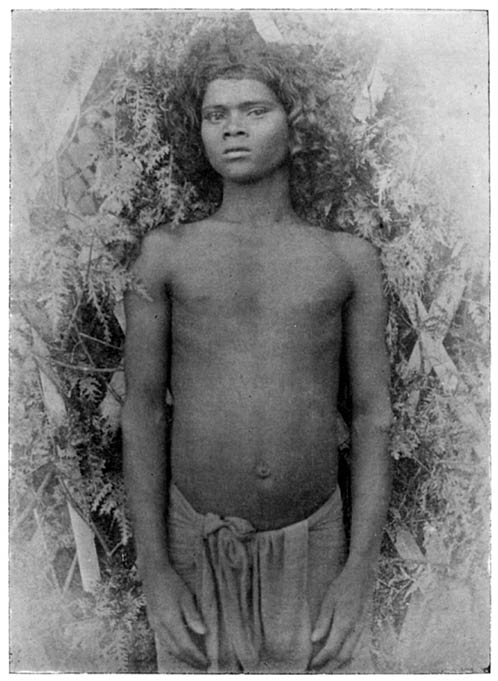
Paniyan.
A common belief, based on their general appearance, prevails among the European planting community that the Paniyans are of African origin, and descended from ancestors who were wrecked on the Malabar coast. This theory, however, breaks down on investigation. Of their origin nothing definite is known. The Nāyar Janmis (landlords) say that, when surprised in the act of some mischief or alarmed, the Paniyan calls out ‘Ippi’! ‘Ippi’! as he runs away, and they believe this to have been the name of the country whence they came originally; but they are ignorant as to where Ippimala, as they call it, is situated. Kapiri (Africa or the Cape?) is also sometimes suggested as their original habitat, but only by those who have had the remarks of Europeans communicated to them. The Paniyan himself, though he occasionally puts forward one or other of the above places as the home of his forefathers, has no fixed tradition bearing on their arrival in Malabar, beyond one to the effect that they were brought from a far country, where they were found living by a Rāja, who captured them, and carried them off in such a miserable condition that a man and his wife only possessed one cloth between them, and were so timid that it was only by means of hunting nets that they were captured.
The number of Paniyans, returned at the census, 1891, was 33,282, and nine sub-divisions were registered; but, as Mr. H. A. Stuart, the Census Commissioner, observes:—“Most of these are not real, and none has been returned by any considerable number of persons.” Their position is said to be very little removed from that of a slave, for every Paniyan is some landlord’s ‘man’; and, though he is, of course, free to leave his master, he is at once traced, and good care is taken that he does not get employment elsewhere.
In the fifties of the last century, when planters first began to settle in the Wynād, they purchased the land with the Paniyans living on it, who were practically slaves of the land-owners. The Paniyans used formerly to be employed by rich receivers as professional coffee thieves, going out by night to strip the bushes of their berries, which were delivered to the receiver before morning. Unlike the Badagas of the Nīlgiris, who are also coffee thieves, and are afraid to be out after dark, the Paniyans are not afraid of bogies by night, and would not hesitate to commit nocturnal depredations. My friend, Mr. G. Romilly, on whose estate my investigation of the Paniyans was mainly carried out, assures me that, according to his experience, the domesticated Paniyan, if well paid, is honest, and fit to be entrusted with the responsible duties of night watchman.
In some localities, where the Janmis have sold the bulk of their land, and have consequently ceased to find regular employment for them, the Paniyans have taken kindly to working on coffee estates, but comparatively few are thus employed. The word Paniyan means labourer, and they believe that their original occupation was agriculture as it is, for the most part, at the present day. Those, however, who earn their livelihood on estates, only cultivate rice and rāgi (Eleusine coracana) for their own cultivation; and women and children may be seen digging up jungle roots, or gathering pot-herbs for food. They will not eat the flesh of jackals, snakes, vultures, lizards, rats, or other vermin. But I am told that they eat land-crabs, in lieu of expensive lotions, to prevent baldness and grey hairs. They have a distinct partiality for alcohol, and those who came to be measured by me were made more than happy by a present of a two-anna piece, a cheroot, and a liberal allowance of undiluted fiery brandy from the Meppādi bazār. The women are naturally of a shy disposition, and used formerly to run away and hide at the sight of a European. They were at first afraid to come and see me, but confidence was subsequently established, and all the women came to visit me, some to go through the ordeal of measurement, others to laugh at and make derisive comments on those who were undergoing the operation.
Practically the whole of the rice cultivation in the Wynād is carried out by the Paniyans attached to edoms (houses or places) or dēvasoms (temple property) of the great Nāyar landlords; and Chettis and Māppillas also frequently have a few Paniyans, whom they have bought or hired by the year at from four to eight rupees per family from a Janmi. When planting paddy or herding cattle, the Paniyan is seldom seen without the kontai or basket-work protection from the rain. This curious, but most effective substitute for the umbrella-hat of the Malabar coast, is made of split reeds interwoven with ‘arrow-root’ leaves, and shaped something like a huge inverted coal-scoop turned on end, and gives to the individual wearing it the appearance of a gigantic mushroom. From the nature of his daily occupation the Paniyan is often brought in contact with wild animals, and is generally a bold, and, if excited, as he usually is on an occasion such as the netting of a tiger, a reckless fellow. The young men of the villages vie with each other in the zeal which they display in carrying out the really dangerous work of cutting back the jungle to within a couple of spear-lengths of the place where the quarry lies hidden, and often make a show of their indifference by turning and conversing with their friends outside the net.
Years ago it was not unusual for people to come long distance for the purpose of engaging Wynād Paniyans to help them in carrying out some more than usually desperate robbery or murder. Their mode of procedure, when engaged in an enterprise of this sort, is evidenced by two cases, which had in them a strong element of savagery. On both these occasions the thatched homesteads were surrounded at dead of night by gangs of Paniyans carrying large bundles of rice straw. After carefully piling up the straw on all sides of the building marked for destruction, torches were, at a given signal, applied, and those of the wretched inmates who attempted to escape were knocked on the head with clubs, and thrust into the fiery furnace.
The Paniyans settle down happily on estates, living in a settlement consisting of rows of huts and detached huts, single or double storied, built of bamboo and thatched. During the hot weather, in the unhealthy months which precede the advent of the south-west monsoon, they shift their quarters to live near streams, or in other cool, shady spots, returning to their head quarters when the rains set in.
They catch fish either by means of big flat bamboo mats, or, in a less orthodox manner, by damming a stream and poisoning the water with herbs, bark, and fruit, which are beaten to a pulp and thrown into the water. The fish, becoming stupified, float on the surface, and fall an easy and unfairly earned prey.
In 1907, rules were issued, under the Indian Fisheries Act, IV of 1897, for the protection of fish in the Bhavāni and Moyar rivers. These rules referred to the erection and use of fixed engines, the construction of weirs, and the use of nets, the meshes of which are less than one and a half inches square for the capture or destruction of fish, and the prohibition of fishing between the 15th March and 15th September annually. Notice of the rules was given by beat of tom-tom (drum) in the villages lying on the banks of the rivers, to which the rules applied.
The Paniyan language is a debased Malayālam patois spoken in a curious nasal sing-song, difficult to imitate; but most of the Paniyans employed on estates can also converse in Kanarese.
Wholly uneducated and associating with no other tribes, the Paniyans have only very crude ideas of religion. Believing in devils of all sorts and sizes, and professing to worship the Hindu divinities, they reverence especially the god of the jungles, Kād Bhagavadi, or, according to another version, a deity called Kūli, a malignant and terrible being of neither sex, whose shrines take the form of a stone placed under a tree, or sometimes a cairn of stones. At their rude shrines they contribute as offerings to the swāmi (god) rice boiled in the husk, roasted and pounded, half-a-cocoanut, and small coins. The banyan and a lofty tree, apparently of the fig tribe, are reverenced by them, inasmuch as evil spirits are reputed to haunt them at times. Trees so haunted must not be touched, and, if the Paniyans attempt to cut them, they fall sick.
Some Paniyans are believed to be gifted with the power of changing themselves into animals; and there is a belief among the Paniyan dwellers in the plains that, if they wish to secure a woman whom they lust after, one of the men gifted with this special power goes to her house at night with a hollow bamboo, and encircles the house three times. The woman then comes out, and the man, changing himself into a bull or dog, works his wicked will. The woman, it is believed, dies in the course of two or three days.
In 1904 some Paniyans were employed by a Māppilla (Muhammadan) to murder his mistress, who was pregnant, and threatened that she would noise abroad his responsibility for her condition. He brooded over the matter, and one day, meeting a Paniyan, promised him ten rupees if he would kill the woman. The Paniyan agreed to commit the crime, and went with his brothers to a place on a hill, where the Māppilla and the woman were in the habit of gratifying their passions. Thither the man and woman followed the Paniyans, of whom one ran out, and struck his victim on the head with a chopper. She was then gagged with a cloth, carried some distance, and killed. The two Paniyans and the Māppilla were sentenced to be hanged.
Monogamy appears to be the general rule among the Paniyans, but there is no obstacle to a man taking unto himself as many wives as he can afford to support.
The Chemmi or Shemmi is, I am informed, a sort of priest or minister. He was appointed, in olden days, by the chieftains under whom the Paniyans worked, and each Chemmi held authority over a group of villages. The office is hereditary, but, should a Chemmi family fail, it can be filled up by election.
No ceremony takes place in celebration of the birth of children. One of the old women of the village acts as midwife, and receives a small present in return for her services. As soon as a child is old enough to be of use, it accompanies its parents to their work, or on their fishing and hunting expeditions, and is initiated into the various ways of adding to the stock of provisions for the household.
The dead are buried in the following manner. A trench, four or five feet deep, and large enough to receive the body to be interred, is dug, due north and south, on a hill near the village. At the bottom of this excavation the earth is scooped out from the western side on a level with the floor throughout the length of the grave, so as to form a receptacle for the corpse, which, placed on a mat, is laid therein upon its left side with the head pointing to the south and the feet to the north. After a little cooked rice has been put into the grave for the use of the departed spirit, the mat, which has been made broad enough for the purpose, is folded up and tucked in under the roof of the cavity, and the trench filled up. It has probably been found by experience that the corpse, when thus protected, is safe from the ravages of scavenger jackals and pariah dogs. For seven days after death, a little rice gruel is placed at distance of from fifty to a hundred yards from the grave by the Chemmi, who claps his hands as a signal to the evil spirits in the vicinity, who, in the shape of a pair of crows, are supposed to partake of the food, which is hence called kāka conji or crow’s rice.
The noombu or mourning ceremonies are the tī polay, seven days after death; the kāka polay or karuvelli held for three years in succession in the month of Magaram (January-February); and the matham polay held once in every three or four years, when possible, as a memorial service in honour of those who are specially respected. On all these occasions the Chemmi presides, and acts as a sort of master of the ceremonies. As the ceremonial carried out differs only in degree, an account of the kāka polay will do for all.
In the month of Magaram, the noombukarrans or mourners (who have lost relatives) begin to cook and eat in a pandal or shed set apart from the rest of the village, but otherwise go about their business as usual. They wash and eat twice a day, but abstain from eating meat or fish. On the last day of the month, arrangements are made, under the supervision of the Chemmi, for the ceremony which brings the period of mourning to a close. The mourners, who have fasted since daybreak, take up their position in the pandal, and the Chemmi, holding on his crossed arms two winnowing sieves, each containing a seer or two of rice, walks round three times, and finally deposits the sieves in the centre of the pandal. If, among the male relatives of the deceased, one is to be found sufficiently hysterical, or actor enough, to simulate possession and perform the functions of an oracle, well and good; but, should they all be of a stolid temperament, there is always at hand a professional corresponding to the Komāran or Vellichipād of other Hindus. This individual is called the Patalykāran. With a new cloth (mundu) on his head, and smeared on the body and arms with a paste made of rice flour and ghī (clarified butter), he enters on the scene with his legs girt with bells, the music of which is supposed to drive away the attendant evil spirits (payanmar). Advancing with short steps and rolling his eyes, he staggers to and fro, sawing the air with two small sticks which he holds in either hand, and works himself up into a frenzied state of inspiration, while the mourners cry out and ask why the dead have been taken away from them. Presently a convulsive shiver attacks the performer, who staggers more violently and falls prostrate on the ground, or seeks the support of one of the posts of the pandal, while he gasps out disjointed sentences, which are taken to be the words of the god. The mourners now make obeisance, and are marked on the forehead with the paste of rice flour and ghī. This done, a mat is spread for the accommodation of the headmen and Chemmi; and the Patalykāran, from whose legs the bells have been removed and put with the rice in the sieves, takes these in his hands, and, shaking them as he speaks, commences a funeral chant, which lasts till dawn. Meanwhile food has been prepared for all present except the mourners, and when this has been partaken of, dancing is kept up round the central group till daybreak, when the pandal is pulled down and the kāka polay is over. Those who have been precluded from eating make up for lost time, and relatives, who have allowed their hair to grow long, shave. The ordinary Paniyan does not profess to know the meaning of the funeral orations, but contents himself with a belief that it is known to those who are initiated. The women attend the ceremony, but do not take part in the dance. In fact, the nearest approach to a dance that they ever attempt (and this only on festive occasions) resembles the ordinary occupation of planting rice, carried out in dumb show to the music of a drum. The bodies of the performers stoop and move in time with the music, and the arms are swung from side to side as in the act of placing the rice seedlings in their rows. To see a long line of Paniyan women, up to their knees in the mud of a rice field, bobbing up and down and putting on the pace as the music grows quicker and quicker, and to hear the wild yells of Hou! Hou! like a chorus of hungry dogs, which form the vocal accompaniment as they dab the green bunches in from side to side, is highly amusing.
The foregoing account of the Paniyan death ceremonies was supplied by Mr. Colin Mackenzie, to whom, as also to Mr. F. Fawcett, Mr. G. Romilly, and Martelli, I am indebted for many of the facts recorded in the present note. From Mr. Fawcett the following account of a further ceremony was obtained:—
At a Paniyan village, on a coffee estate where the annual ceremony was being celebrated, men and boys were dancing round a wooden upright to the music of a small drum hanging at the left hip. Some of the dancers had bells round the leg below the knee. Close to the upright a man was seated, playing a pipe, which emitted sounds like those of a bagpipe. In dancing, the dancers went round against the sun. At some little distance a crowd of females indulged in a dance by themselves. A characteristic of the dance, specially noticeable among the women, was stooping and waving of the arms in front. The dancers perspired freely, and kept up the dance for many hours to rhythmic music, the tune of which changed from time to time. There were three chief dancers, of whom one represented the goddess, the others her ministers. They were smeared with streaks on the chest, abdomen, arms and legs, had bells on the legs, and carried a short stick about two feet in length in each hand. The sticks were held over the head, while the performers quivered as if in a religious frenzy. Now and again, the sticks were waved or beaten together. The Paniyans believe that, when the goddess first appeared to them, she carried two sticks in her hands. The mock goddess and her attendants, holding the sticks above the head and shivering, went to each male elder, and apparently received his blessing, the elder placing his hand on their faces as a form of salutation, and then applying his hand to his own face. The villagers partook of a light meal in the early morning, and would not eat again until the end of the ceremony, which concluded by the man-goddess seating himself on the upright, and addressing the crowd on behalf of the goddess concerning their conduct and morality.
Games.—A long strip of cane is suspended from the branch of a tree, and a cross-bar fixed to its lower end. On the bar a boy sits, and swings himself in all directions. In another game a bar, twelve to fourteen feet in length, is balanced by means of a point in a socket on an upright reaching about four feet and-a-half above the ground. Over the end of the horizontal bar a boy hangs, and, touching the ground with the feet, spins himself round.
Some Paniyans have a thread tied round the wrist, ankle, or neck, as a charm to ward off fever and other diseases. Some of the men have the hair of the head hanging down in matted tails in performance of a vow. The men wear brass, steel, and copper rings on their fingers and brass rings in the ears.
The women, in like manner, wear finger rings, and, in addition, bangles on the wrist, and have the lobes of the ears widely dilated, and plugged with cadjan (palm leaf) rolls. In some the nostril is pierced, and plugged with wood.
The Paniyans, who dwell in settlements at the base of the ghāts, make fire by what is known as the Malay or sawing method. A piece of bamboo, about a foot in length, in which two nodes are included, is split longitudinally into two equal parts. On one half a sharp edge is cut with a knife. In the other a longitudinal slit is made through about two-thirds of its length, which is stuffed with a piece of cotton cloth. It is then held firmly on the ground with its convex surface upwards, and the cutting edge drawn, with a gradually quickening sawing motion, rapidly to and fro across it by two men, until the cloth is ignited by the incandescent particles of wood in the groove cut by the sharp edge. The cloth is then blown with the lips into a blaze, and the tobacco or cooking fire can be lighted.
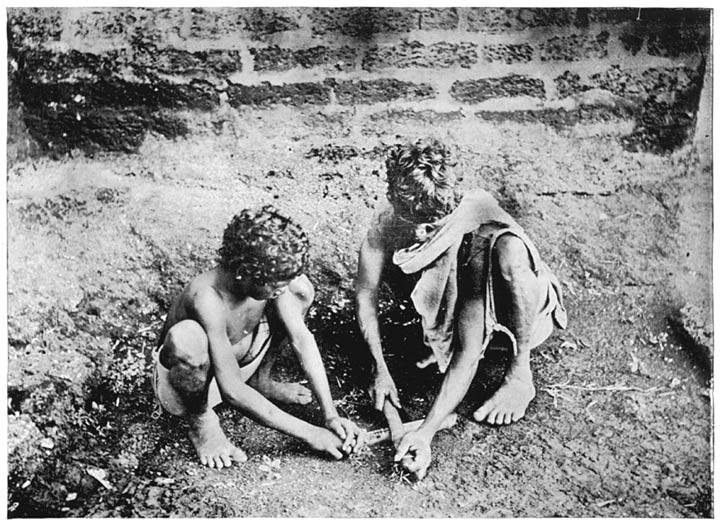
Paniyans making fire.
At Pudupādi an elephant mahout was jealously guarding a bit of bamboo stick with notches cut in it, each notch representing a day for which wages were due to him. The stick in question had six notches, representing six days’ wages.
Average height 157.4 cm. Nasal index 95 (max. 108.6). The average distance from the tip of the middle finger to the top of the patella was 4.6 cm. relative to stature = 100, which approximates very closely to the recorded results of measurement of long-limbed African negroes.
Panjai.—Recorded, in the Madras Census Report, 1901, as a sub-division of Pāndya Vellāla. The name Panjai, indicating a poverty-stricken individual, is usually applied to mendicant Pandārams.
Panjāram.—Panjāram or Panchāramkatti is the name of a sub-division of the Idaiyans, derived from the peculiar gold ornament, which the women wear. It is said that, in this division, widow marriage is commonly practiced, because Krishna used to place a similar ornament round the necks of Idaiyan widows of whom he became enamoured, and that this sub-division was the result of his amours with them.
Panjukkāra (cotton-man).—An occupational name of a sub-division of Vellālas, who are not at the present day connected with the cotton trade. They call themselves Panjukkāra Chettis. The equivalent panjāri (pinjāri) or Panjukotti occurs as a Tamil synonym for Dūdēkula (Muhammadan cotton-cleaners).
Pannādai (sheath of the cocoanut leaf).—A sub-division of Vēttuvan.
Pannaiyān.—A title of Alavan.
Pannara.—A sub-division of Māli.
Pannendu Nāl (twelve days).—A name for those Pallis who, like Brāhmans, perform the final death ceremonies on the twelfth day.
Pannirendām (twelfth) Chetti.—A section of the Chettis.
The Pānos are divided into two distinct sections, viz., the Khonda Pānos who live amidst the Khonds, and the Dēsa Pānos of the plains. The former have adopted some of the customs of the Khonds, while the latter follow the customs of the Uriya castes which dwell in the lowland. The Khond Pānos are governed by the Molikos (headmen) of the Khonds. In some cases, the fines inflicted for breach of caste rules are rather severe. For example, in the neighbourhood of Baliguda, a man who is convicted of adultery has to pay two rupees, and give two buffaloes to the council which tries the case. Further south, for a similar offence twelve buffaloes are demanded, and the culprit has to pay twice the amount of the bride-price to the injured husband. The Dēsa Pānos conform to the standard Uriya type of caste council, and have a headman called Bēhara, who is assisted by a Nāyako, and caste servants entitled Bhollobaya or Gonjāri.
The marriage ceremonies of the Dēsa Pānos are closely allied to those of the Dandāsis and Haddis, whereas those of the Khonda Pānos bear a close resemblance to the ceremonies of the Khonds. Like Khond girls, unmarried Khond Pāno girls sleep in quarters (dhangadi) specially set apart for them, and, as among the Khonds, wedding presents in the form of gontis are given. It is noted with reference to the Khonds, in the Ganjam Manual, that “the bride is looked upon as a commercial speculation, and is paid for in gontis. A gonti is one of anything, such as a buffalo, a pig, or a brass pot; for instance, a hundred gontis might consist of ten bullocks, ten buffaloes, ten sacks of corn, ten sets of brass, twenty sheep, ten pigs, and thirty fowls.” At a Khond Pāno marriage, the fingers of the contracting couple are linked together, and an important item of the ceremonial, which adds dignity thereto, is placing in front of the house at which a marriage is being celebrated a big brass vessel containing water, with which the guests wash their feet.
The Pānos pay reverence to ancestors, to whom, when a death occurs in a family, food is offered. In some Pāno villages, when a child is born, it is customary to consult a pūjāri (priest) as to whether the grandfather or great-grandfather is re-born in it. If the answer is in the affirmative, pigs are sacrificed to the ancestors. Some Pānos have adopted the worship of Tākurānis (village deities), to whom rice and turmeric are offered by placing them before the image in the form of a figure-of-eight. A fowl is sacrificed, and its blood allowed to flow on to one loop of the figure. In some places, Dharmadēvata and Gagnasuni are worshipped, a castrated goat being sacrificed annually to the former, and fowls and an entire goat to the latter.
Pāno women, who live among the Khonds, tattoo their faces in like manner, and in other respects resemble Khond women.
I am informed that, on more than one occasion, Pānos have been known to rifle the grave of a European, in the belief that buried treasure will be found.
Panta (a crop).—A sub-division of Kāpu and Yānādi. In the Gazetteer of South Arcot, Pan Reddi is recorded as a caste of Telugu-speaking ryots (Kāpus).
Pantala.—Recorded, in Travancore, as a sub-division of Sāmantan. The name is said to be derived from Bhandārattil, or belonging to the royal treasury.
Pantāri.—Recorded, in the Travancore Census Report, as synonymous with the Idacheri sub-division of Nāyar. Pantrantu Vītan is also there recorded as a sub-division of Nāyar.
Pappadam.—People calling themselves Pappadam Chetti are largely found in Malabar, living by the manufacture and sale of cakes called pappadam, which are purchased by all classes, including Nambūtiri Brāhmans.
Pappini.—A name for Brāhmanis, a class of Ambalavāsi.
Pappu (split pulse).—An exogamous sept of Balija.
Paradēsi.—Recorded, in the Madras Census Report, 1901, as a class of Malayālam beggars. The name indicates strangers (paradēsa, a foreign country), and is applied to the White Jews of Cochin, in connection with whom it occurs in Sirkar (State) accounts and royal writs granted to them.
Paraiya Tāda.—Recorded, in the North Arcot Manual, as a name for those who are considered impure Valluvans. The name literally means Paraiya Tādan or Dāsari.
Paraiyans are to be found throughout the Tamil districts from North Arcot to Tinnevelly, and in the southern extremity of the Native State of Travancore. In the Telugu country the Mālas and Mādigas and in the Canarese country the Holeyas take their place.
Some of the most common names of Paraiyan males are—
Kanni or Kanniyappan. Rāman or Rāmaswāmi. Rāju. Vēlu. Muttan. Māri. Kanagan. Subban. Nondi. Tambiran. Perumāl. Vīran. Sellan. Amāvāsi.
Among females the most common names are Tai, Parpathi, Ammai, Kanni, Muttammāl, Rājammāl, Ammani, Selli, Gangammāl. In one village, where the Paraiyans were almost all Vaishnavas, by profession not by practice, Mr. Clayton found the inhabitants all named after heroes of the Mahābhārata, and dirty naked children answered to the names of Ikshvākan, Karnan, Bhīman, and Draupadi. It is usual to give the father’s name when distinguishing one Paraiyan from another, e.g., Tamburan, son of Kannan. In legal documents the prefix Para denotes a Paraiyan, e.g., Para Kanni, the Paraiyan Kanni, but this is a purely clerical formula. The Paraiyan delights in nicknames, and men sometimes grow so accustomed to these that they have almost forgotten their real names. The following nicknames are very common :—
Nondi, lame.
Kallan, thief.
Kullan, dwarf.
Vellei, white or light complexioned.
Kannan, with eyes.
Muthalai, crocodile.
Kudiyan, drunkard.
No name, indicating virtue or merit, is given, lest the wrath of malevolent spirits should be aroused.
At the census, 1891, 348 sub-divisions were returned, of which the following were strongest in point of numbers :—Amma found chiefly in Tanjore and Madura; Katti in Salem and Trichinopoly; Kīzhakkatti (eastern) in Salem; Kōliyan (weavers) in Chingleput, Tanjore and Trichinopoly; Konga in Salem; Korava in Coimbatore; Kōttai (fort) in South Arcot; Morasu (drum) in Salem; Mottai in Madura; Pacchai (green) in Coimbatore; Sāmbān in South Arcot; Sangidum (sanku, conch, or chank shell) in Coimbatore; Sōzhia (natives of the Sōzha or Chōla country) in Tanjore and Madura; Tangalān in North and South Arcot, Chingleput, Salem, and Trichinopoly; and Valangamattu in South Arcot. The members of the various sub-divisions do not intermarry.
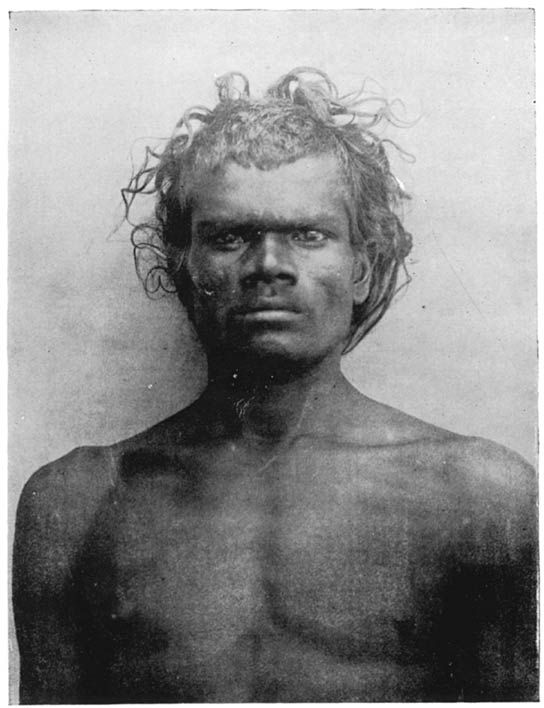
Paraiyan.
It has been suggested to me that the Morasu Paraiyans, included in the above list, are Canarese Holeyas, who have settled in the Tamil country. In the south their women, like the Kallans, wear a horsehair thread round the neck. As additional sub-divisions, the following may be noted :—
Aruththukattātha, or those who, having once cut the tāli-string, do not tie it a second time, i.e., those who do not permit remarriage of widows.
Valai (a net).—Paraiyans who hunt.
Sanku (conch-shell).—Those who act as conch-blowers at funerals.
Thātha.—Thāthan is the name given to mendicants who profess Vaishnavism. Such Paraiyans are Vaishnavites, and some are beggars.
In the Census Report, 1901, Mr. Francis notes that the term Paraiyan “is now almost a generic one, and the caste is split up into many sub-divisions, which differ in manners and ways. For example, the Kōliyans, who are weavers, and the Valluvans, who are medicine men and priests and wear the sacred thread, will not intermarry or eat with the others, and are now practically distinct castes.” As occupational titles of Paraiyans Mr. Francis gives Urumikkāran and Pambaikkāran, or those who play on drums (urumi and pambai), and Podarayan or Podara Vannān, who are washermen. The title Valangamattān, or people of the right-hand division, is assumed by some Paraiyans.
In the Census Report, 1901, Mr. Francis mentions an inscription of the Chōla King Rāja Rāja, dated about the eleventh century A.D., in which the Paraiyan caste is called by its own name. It had then two sub-divisions, the Nesavu or weavers, and Ulavu or ploughmen. The caste had even then its own hamlets, wells and burning-grounds.
In a note on the Paraiyans of the Trichinopoly district, Mr. F. R. Hemingway writes as follows. “They have a very exalted account of their lineage, saying that they are descended from the Brāhman priest Sāla Sāmbavan, who was employed in a Siva temple to worship the god with offerings of beef, but who incurred the anger of the god by one day concealing a portion of the meat, to give it to his pregnant wife, and was therefore turned into a Paraiyan. The god appointed his brother to do duty instead of him, and the Paraiyans say that Brāhman priests are their cousins. For this reason they wear a sacred thread at their marriages and funerals. At the festival of the village goddesses, they repeat an extravagant praise of their caste, which runs as follows. ‘The Paraiyans were the first creation, the first who wore the sacred thread, the uppermost in the social scale, the differentiators of castes, the winners of laurels. They have been seated on the white elephant, the Vīra Sāmbavans who beat the victorious drum.’ It is a curious fact that, at the feast of the village goddess, a Paraiyan is honoured by being invested with a sacred thread for the occasion by the pūjāri (priest) of the temple, by having a turmeric thread tied to his wrists, and being allowed to head the procession. This, the Paraiyans say, is owing to their exalted origin.”
The Paraiyans know the village boundaries better than anyone else, and are very expert in this matter, unerringly pointing out where boundaries should run, even when the Government demarcation stones are completely overgrown by prickly-pear, or have been removed. Mr. Stuart records a custom which prevails in some parts of making a Paraiyan walk the boundaries of a field with a pot of water on his head, when there is any dispute about their exact position. He thinks that the only satisfactory explanation of this is that the connection of the Paraiyans with the soil is of much longer standing than that of other castes. The admitted proprietary right which Paraiyans have in the site known as chēri-nattam, on which their huts stand, is a confirmation of this. These sites are entered as such on the official village maps. They cannot be taken from the Paraiyans, and date from time immemorial. Throughout the whole of the Tamil country it is usual to find that the land allotted for house-site (nattam) is in two portions in every village (Ūr). One part is known by the Sanskrit name grāmam (village), the inhabited place. The other is called by the Dravidian name chēri (gathering place).
The facts, taken together, seem to show that the Paraiyan priests (Valluvans), and therefore the Paraiyans as a race, are very ancient, that ten centuries ago they were a respectable community, and that many were weavers. The privileges they enjoy are relics of an exceedingly long association with the land. The institution of the parachēri points to original independence, and even to possession of much of the land. If the account of the colonisation of Tondeimandalam by Vellālans in the eighth century A.D. is historic, then it is possible that at that time the Paraiyans lost the land, and that their degradation as a race began.
The Paraiyans have long been a settled race. And, though a number of them emigrate to Ceylon, Mauritius, South Africa, the West Indies, the Straits Settlements, and even to Fiji, the vast majority live and die within a mile or two of the spot where they were born. The houses in which they live are not temporary erections, or intended for use during certain seasons of the year only. The rudest form is a hut made by tying a few leaves of the palmyra palm on to a framework of poles or bamboos. The better class of houses are a series of rooms with low mud walls and thatched roof, but generally without doors, surrounding a small courtyard, in which the family goats, buffaloes, and fowls have their homes. The cooking is done anywhere where it is convenient either indoors or out, as there is no fear of pollution from the glance or shadow of any passer-by. Very occasionally the walls of the house, especially those facing the street, are whitewashed, or decorated with variegated patterns or figures in red and white. Paraiya women, like higher caste women, are much given to tracing exceedingly intricate symmetrical designs (kōlam) with rice flour on the smooth space or pathway immediately before the doors of their houses, it is said, to prevent the entrance of evil spirits. Mr. S. P. Rice writes to me that the patterns on the floor or threshold are generally traced with white powder, e.g., chalk, as rice is too costly; and that the original object of the custom was not to drive away evil spirits, but to provide food for the lowest creatures of creation—ants, insects, etc.
Admissions to the Paraiyan caste from higher castes sometimes occur. Mr. Clayton records having met an Aiyangar Brāhman who was working as a cooly with some Paraiyan labourers at Kodaikānal on the Palni hills. He had become infatuated with a Paraiya woman, and had consequently been excommunicated, and became a Paraiyan.
In every Paraiya settlement a small number of the more important men are known as Panakkāran (money-man). The application of the term may, Mr. Clayton suggests, be due to their comparative opulence, or may have arisen from the custom of paying them a small sum (panam) for various services to the community. But Panikkar or Panakkar is usually said to be derived from pani, meaning work. They form a committee or council to decide ordinary quarrels, and to amerce the damages in cases of assault, seduction, rape, and adultery. They have power to dissolve marriages on account of the wife, or if the husband has deserted his wife. In these cases their authority is really based on the public opinion of the parachēri, and goes no further than that public opinion will enforce it. There is no headman in a Paraiya hamlet corresponding to the munsiff or village magistrate of the Hindu village (grāma). In modern practice the Paraiyans are, for police purposes, under the authority of the munsiff of the grāma, and there is a growing tendency on their part to refer all disputes and assaults to the munsiff, or even directly to the police. On the other hand, cases of a more domestic nature, such as disputes about betrothals, seduction, etc., are still dealt with, generally acutely and fairly, by the village council. It should be added that the rank of Panakkāran is hereditary, and is regarded as honourable.
Excommunicated Paraiyans are said to go to a mythical place called Vinnamangalam. In some documents signed by Paraiyans, the words “If I fail to fulfil the conditions of our agreement, I shall go to Vinnamangalam” are inserted. In all enquiries by the police, the council, or the Dēsāyi Chetti, the Paraiyan only tells what in his opinion it is expedient to tell. But evidence given after burning a piece of camphor is said to be reliable.
The attainment of puberty by girls is a subject of greedy curiosity to most of the women in a Paraiya village. This has been said to be due to the fact that “the menstrual fluid is held in horror, dire consequences being supposed to result from not merely the contact, but even the very sight of it. Hence the isolation and purification of women during the menstrual period, and the extreme care and anxiety with which the first approach of puberty in a girl is watched.” The girl at once begins to wear a covering of some sort, even it be the most pathetic rag, over her left shoulder and breast. Till this time, a bit of cotton cloth round her waist has been considered sufficient. Among the Tangalān Paraiyans, when a girl attains puberty, she is kept apart either in the house or in a separate hut. Pollution is supposed to last eight days. On the ninth day, the girl is bathed, and seated in the courtyard. Ten small lamps of flour paste (called drishti māvu vilakku), to avert the evil eye, are put on a sieve, and waved before her three times. Then coloured water (ārati or alam) and burning camphor are waved before her. Some near female relatives then stand behind her, and strike her waist and sides with puttu (flour cake) tied in a cloth. This is believed to make her strong. At the same time other women strike the ground behind the girl with a rice-pestle. Then presents are given to the girl. In some places the girl is beaten within the house by her mother-in-law or paternal aunt. The latter repeatedly asks the girl to promise that her daughter shall marry her paternal aunt’s son.
In marriages among the Paraiyans, difference in religion is of little moment. A Christian Paraiyan will marry a heathen girl, though it should be said that she is usually baptised at or about the time of the marriage. A Christian girl is sometimes married to a heathen Paraiyan. Mr. Clayton thinks that the fact that certain Paraiyans paint the nāmam of Vishnu on their foreheads, while others smear their foreheads with the ashes of Siva, prevents marriages between them.
The bridegroom must be older than the bride. Subject to this condition, it is usual for a youth to marry his father’s sister’s daughter, or his mother’s brother’s daughter. A girl should be married to her mother’s brother’s son if he is old enough, but not, as among the Konga Vellālas and some Reddis, if he is a child. In short, Paraiyans follow the usual Tamil custom, but it is often neglected.
Marriage contracts are sometimes made by parents while the parties most concerned are still infants, often while they are still children; in the majority of cases when the girl attains the marriageable age. The bridegroom may be many years older than the bride, especially when custom, as noted above, settles who shall be his bride. The bride has absolutely no choice in the matter; but, if the bridegroom is a man of some years or position, his preferences are consulted. The elder sister should be given in marriage before her younger sisters are married. The arrangements are more or less a bargain. Presents of clothes, paltry jewels, rice, vegetables, and perhaps a few rupees, are exchanged between the families of the bride and bridegroom. The household that seeks the marriage naturally gives the larger gifts. The actual marriage ceremony is very simple. The essential part is the tying of a small token or ornament (tāli), varying in value from a few annas to four or five rupees by a turmeric-stained string, round the neck of the bride. This is done by the bridegroom in the presence of a Valluvan, who mutters some kind of blessing on the marriage. A series of feasts, lasting over two or three days, is given to all the relatives of both parties by the parents of the newly-married couple. The bride and bridegroom do not live together immediately, even if the girl is old enough. The exact date at which their life together may begin is settled by the bride’s mother. The occasion, called soppana muhurtham, is celebrated by another feast and much merry-making, not always seemly.
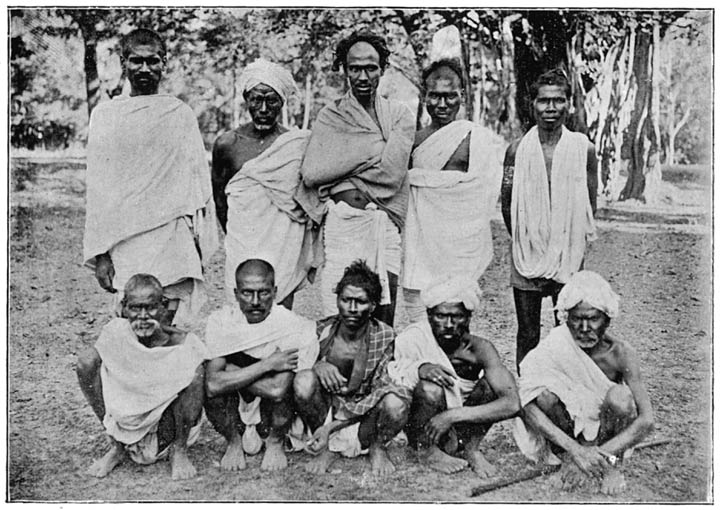
Paraiyans.
The following detailed account of the marriage ceremonies among the Tangalān Paraiyans was furnished by Mr. K. Rangachari. The parents or near relations of the contracting parties meet, and talk over the match. If an agreement is arrived at, an adjournment is made to the nearest liquor shop, and a day fixed for the formal exchange of betel leaves, which is the sign of a binding engagement. A Paraiyan, when he goes to seek the hand of a girl in marriage, will not eat at her house if her family refuse to consider the alliance, to which the consent of the girl’s maternal uncle is essential. The Paraiyan is particular in the observation of omens, and, if a cat or a valiyan (a bird) crosses his path when he sets out in quest of a bride, he will give her up. The betrothal ceremony, or pariyam, is binding as long as the contracting couple are alive. They may live together as man and wife without performing the marriage ceremony, and children born to them are considered as legitimate. But, when their offspring marry, the parents must first go through the marriage rites, and the children are then married in the same pandal on the same day. At the betrothal ceremony, the headman, father, maternal uncle, and two near relations of the bridegroom-elect, proceed to the girl’s house, where they are received, and sit on seats or mats. Drink and plantain fruits are offered to them. Some conversation takes place between the headmen of the two parties, such as “Have you seen the girl? Have you seen her house and relations? Are you disposed to recommend and arrange the match?” If he assents, the girl’s headman says “As long as stones and the Kāveri river exist, so that the sky goddess Akāsavāni and the earth goddess Bhūmadēvi may know it; so that the water-pot (used at the marriage ceremony), and the sun and moon may know it; so that this assembly may know it; I ... give this girl.” The headman of the bridegroom then says “The girl shall be received into the house by marriage. These thirty-six pieces of gold are yours, and the girl is mine.” He then hands betel leaves and areca nuts to the other headman, who returns them. The exchange of betel is carried out three times. Near the headmen is placed a tray containing betel nuts, a rupee, a turmeric-dyed cloth in which a fanam (2½ annas) is tied, a cocoanut, flowers, and the bride’s money varying in amount from seven to twenty rupees. The fanam and bride’s money are handed to the headman of the girl, and the rupee is divided between the two headmen. On the betrothal day, the relations of the girl offer flowers, cocoanuts, etc., to their ancestors, who are supposed to be without food or drink. The Paraiyans believe that the ancestors will be ill-disposed towards them, if they are not propitiated with offerings of rice and other things. For the purpose of worship, the ancestors are represented by a number of cloths kept in a box made of bamboo or other material, to which the offerings are made. On the conclusion of the ancestor worship, the two headmen go to a liquor shop, and exchange drinks of toddy. This exchange is called mel sambandham kural, or proclaiming relationship. After the lapse of a few days, the girl’s family is expected to pay a return visit, and the party should include at least seven men. Betel is again exchanged, and the guests are fed, or presented with a small gift of money. When marriage follows close on betrothal, the girl is taken to the houses of her relations, and goes through the nalugu ceremony, which consists of smearing her with turmeric paste, an oil bath, and presentation of betel and sweets. The auspicious day and hour for the marriage are fixed by the Valluvan, or priest of the Paraiyans. The ceremonial is generally carried through in a single day. On the morning of the wedding day, three male and two married female relations of the bridegroom go to the potter’s house to fetch the pots, which have been already ordered. The potter’s fee is a fowl, pumpkin, paddy, betel, and a few annas. The bride, accompanied by the headman and her relations, goes to the bridegroom’s village, bringing with her a number of articles called petti varisai or box presents. These consist of a lamp, cup, brass vessel, ear-ornament called kalāppu, twenty-five betel leaves and areca nuts, onions, and cakes, a lump of jaggery (crude sugar), grass mat, silver toe-ring, rice, a bundle of betel leaves and five cocoanuts, which are placed inside a bamboo box. The next item in the proceedings is the erection of the milk-post, which is made of a pestle of tamarind or Soymida febrifuga wood, or a green bamboo. To the post leafy twigs of the mango or pīpal (Ficus religiosa) are tied. In some places, a pole of the Odina Wodier tree is said to be set up, and afterwards planted near the house, to see if it will grow. Near the marriage dais a pit is dug, into which are thrown nine kinds of grain, and milk is poured. The milk-post is supported on a grindstone painted with turmeric stripes, washed with milk and cow’s urine, and worshipped, with the Valluvan as the celebrant priest. The post is then set up in the pit by three men and two women. A string with a bit of turmeric (kankanam) is tied to the milk-post, and to it and the dais boiled rice is offered. Kankanams are also tied round the wrists of the bride and bridegroom. The bridegroom’s party go to the temple or house where the bride is awaiting them, bringing with them a brass lamp, vessel and cup, castor and gingelly oil, combs, confectionery, turmeric, and betel leaves. The procession is headed by Paraiyans beating tom-toms, and blowing on trumpets. When their destination is reached, all take their seats on mats, and the various articles which they have brought are handed over to the headman, who returns them. The bride is then taken in procession to the marriage house, which she is the first to enter. She is then told to touch with her right hand some paddy, salt, and rice, placed in three pots inside the house. Touching them with the left hand would be an evil omen, and every mishap which might occur in the family would be traced to the new daughter-in-law. The bride and bridegroom next go through the nalugu ceremony, and some of the relations proceed with the ceremony of bringing sand (manal vāri sadangu). A cousin of the bridegroom and his wife take three pots called sāl karagam and kūresāl, and repair to a river, tank (pond) or well, accompanied by a few men and women. The pots are set on the ground, and close to them are placed a lamp, and a leaf with cakes, betel leaves and nuts set on it. Pūja (worship) is made to the pots by burning camphor and breaking cocoanuts. The Vettiyan then says “The sun, the moon, the pots, and the owner of the girl have come to the pandal. So make haste and fill the pot with water.” The woman dips a small pot in water, and, after putting some sand or mud into a big pot, pours the water therein. The pots are then again worshipped. After the performance of the nalugu, the bridal couple go through a ceremony for removing the evil eye, called “sige kazhippu.” A leaf of Ficus religiosa, with its tail downwards, is held over their foreheads, and all the close relations pour water over it, so that it trickles over their faces; or seven cakes are placed by each of the relations on the head, shoulders, knees, feet, and other parts of the body of the bridegroom. The cakes are subsequently given to a washerman. The parents of the bridal couple, accompanied by some of their relations, next proceed to an open field, taking with them the cloths, tāli, jewels, and other things which have been purchased for the wedding. A cloth is laid on the ground, and on it seven leaves are placed, and cooked rice, vegetables, etc., heaped up thereon. Pūja is done, and a goat is sacrificed to the ancestors (Tangalanmar). By some the offerings are made to the village goddess Pidāri, instead of to the ancestors. Meanwhile the bridegroom has been taken in procession round the village on horseback, and the headmen have been exchanging betel in the pandal. On the bridegroom’s return, he and the bride seat themselves on planks placed on the dais, and are garlanded by their maternal uncle with wreaths of Nerium odorum flowers. The maternal uncle of the bride presents her with a ring. In some places, the bride is carried to the dais on the shoulders or in the arms of the maternal uncle. While the couple are seated on the dais the Valluvan priest lights the sacred fire (hōmam), and, repeating some words in corrupt Sanskrit, pours gingelly oil into the fire. He then does pūja to the tāli, and passes it round, to be touched and blessed by those assembled. The bridegroom, taking up the tāli, shows it through a hole in the pandal to the sky or sun, and, on receipt of permission from those present, ties it round the neck of the bride. Thin plates of gold or silver, called pattam, are then tied on the foreheads of the contracting couple, first by the mother-in-law and sister-in-law. With Brāhman and non-Brāhman castes it is customary for the bride and bridegroom to fast until the tāli has been tied. With Paraiyans, on the contrary, the rite is performed after a good meal. Towards the close of the marriage day, fruit, flowers, and betel are placed on a tray before the couple, and all the kankanams, seven in number, are removed, and put on the tray. After burning camphor, the bridegroom hands the tray to his wife, and it is exchanged between them three times. It is then given to the washerman. The proceedings terminate by the two going with linked hands three times round the pandal. On the following day, the bride’s relatives purchase some good curds, a number of plantains, sugar and pepper, which are mixed together. All assemble at the pandal, and some of the mixture is given to the headman, the newly married couple, and all who are present. All the articles which constitute the bride’s dowry are then placed in the pandal, and examined by the headman. If they are found to be correct, he proclaims the union of the couple, and more of the mixture is doled out. This ceremony is known as sambandham kūral or sambandham piriththal (proclaiming relationship). Two or three days after the marriage, the bridegroom goes to the house of the bride, and remains there for three days. He is stopped at the entrance by his brother-in-law, who washes his feet, puts rings on the second toe, and keeps on pinching his feet until he has extracted a promise that the bridegroom will give his daughter, if one is born to him, in marriage to the son of his brother-in-law. The ring is put on the foot of the bride by her maternal uncle at the time of the marriage ceremony, after the wrist threads have been removed. In some places it is done by the mother-in-law or sister-in-law, before the tāli is tied, behind a screen.