Volume 6 — P (Continued) (continued 3)
Reading edition
It is noted by Mrs. F. E. Penny that some of the fisherfolk “adopted Xavier as their special patron saint, and, as time passed, almost deified him. In the present day, they appeal to him in times of danger, crying ‘Xavier! Xavier! Xavier!’ in storm and peril. Even if they are unfortunate in their catch when fishing, they turn to their saint for succour.”
As a numismatist, I resent the practice resorted to by some fishermen of melting old lead coins, and converting them into sinkers for their nets.
Pattapu.—Pattapu for Tulivāndlu is a name for Tamil Pattanavans, who have migrated to the Telugu country. Pattapu also occurs as a sub-division of Yerukala.
Pattar.—The Pattars are Tamil Brāhmans, who have settled in Malabar. The name is said to be derived from the Sanskrit bhatta. It is noted, in the Madras Census Report, 1901, that Pattar (teacher) has been recently assumed as a title by some Nōkkans in Tanjore. (See Brāhman.)
Pattariar.—Recorded, in the Madras Census Report, 1901, as a Tamil corruption of Pattu Sāliyan (silk-weaver). Pattariar or Pattalia is a synonym of Tamil-speaking Sāliyans.
Pattegāra (headman).—An exogamous sept of Okkiliyan.
Pattindla (silk house).—An exogamous sept of Tōta Balija.
Pattola Mēnōn.—Recorded, in the Cochin Census Report, 1901, as a sub-caste of Nāyars, who are accountants in aristocratic families.
Pāttukuruppu.—Recorded in the Travancore Census Report, 1901, as synonymous with Vātti, a sub-division of Nāyar.
Pattu Sālē.—A sub-division of Sālēs, who weave silk (pattu) fabrics.
Pattuvitan.—Recorded, in the Travancore Census Report, 1901, as a sub-division of Nāyar.
In the Mysore Census Report, 1891, the Patvēgārs are described as “silk weavers who speak a corrupt Marāthi conglomerate of Guzarāti and Hindi. They worship all the Hindu deities, especially the female energy under the name of Sākti, to which a goat is sacrificed on the night of the Dasara festival, a Musalman slaughtering the animal. After the sacrifice, the family of the Patvēgār partake of the flesh. Many of their females are naturally fair and handsome, but lose their beauty from early marriage and precocity.” A few Pattēgāras, who speak a corrupt form of Marāthi, are to be found in the Anantapur district.
Pavalamkatti (wearers of corals).—A sub-division of Konga Vellāla.
Pavini.—See Vayani.
Payyampāti.—Recorded, in the Travancore Census Report, 1901, as a sub-division of Nāyar.
Pedakanti.—Pedakanti or Pedaganti is the name of a sub-division of Kāpu. It is said by some to be derived from a place called Pedagallu. By others it is derived from peda, turned aside, and kamma, eye, indicating one who turns his eyes away from a person who speaks to him. Yet another suggestion is that it means stiff-necked.
Pedda (big).—A sub-division of Bōya, Bagata, Konda Dora, Pattapu, and Velama.
Peddammavāndlu.—A fancy name taken by some Telugu beggars.
Pedditi.—A sub-division of Golla, some members of which earn a livelihood by begging and flattery.
Pēgula (intestines).—An exogamous sept of Bōya.
Pekkan.—A division of Toda.
Pendukal (women).—A name applied to Dēva-dāsis in Travancore.
Pengu.—A sub-division of Poroja.
Pennēgāra.—Konkani-speaking rice-beaters in South Canara.
Pentiya.—The Pentiyas also call themselves Holuva and Halabā or Halbā. In the Madras Census Report, 1901, they are called Pantia as well as Pentiya, and described as Oriya betel-leaf (panno) sellers. Their occupation, in the Jeypore Agency tracts, is that of cultivators. According to Mr. C. Hayavadana Rao, to whom I am indebted for the following note, numbers of them migrated thither from Bustar, and settled at Pentikonna, and are hence called Pentikonaya or Pentiya. Their language is Halba, which is easily understood by those who speak Oriya. They are divided into two endogamous sections, called Bodo (big or genuine), and Sanno (little), of whom the latter are said to be illegitimate descendants of the former. The Bodos are further sub-divided into a series of septs, e.g., Kurum (tortoise), Bhāg (tiger), Nāg (cobra), and Sūrya (sun). The caste is highly organized, and the head of a local centre is called Bhatha Nāyako. He is assisted by a Pradhāni, an Umriya Nāyako, and Dolāyi. The caste messenger is called Cholāno, and he carries a silver baton when he summons the castemen to a meeting. An elaborate ceremony is performed when a person, who has been tried by the caste council, is to be received back into the caste. He is accompanied to the bank of a stream, where his tongue is burnt with a gold or silver wire or ornament by the Bhatha Nāyako, and some offerings from the Jagannātha temple at Pūri are given to him. He is then taken home, and provides a feast, at which the Nāyako has the privilege of eating first. He has further to make a present of cloths to the assembled elders, and the four heads of the caste receive a larger quantity than the others. The feast over, he is again taken, carrying some cooked rice, to the stream, and with it pushed therein. This ceremonial bath frees him from pollution.
Girls are married either before or after puberty. A man can claim his paternal aunt’s daughter in marriage. The bridegroom’s party proceed, with the bridegroom, to the bride’s village, and take up their abode in a separate house. They then take three cloths for the bride’s mother, three rupees for her father, and a cloth and two annas for each of her brothers, and present them together with rice, liquor, and other articles. Pandals (booths) are erected in front of the quarters of the bridal couple, that of the bridegroom being made of nine, and that of the bride of five sāl (Shorea robusta) poles, to which a pot containing myrabolams (Terminalia fruits) and rice is tied. The couple bathe, and the bridegroom proceeds to the house of the bride. The Dēsāri, who officiates, dons the sacred thread, and divides the pandal into two by means of a screen or curtain. The couple go seven times round the pandal, and the screen is removed. They then enter the pandal, and the Dēsāri links their little fingers together. The day’s ceremony concludes with a feast. On the following day, the bride is conducted to the house of the bridegroom, and they sprinkle each other with turmeric water. They then bathe in a stream or river. Another feast is held, with much drinking, and is followed by a wild dance. The remarriage of widows is permitted, and a younger brother may marry the widow of his elder brother. The dead are burnt, and death pollution is observed for ten days, during which the relatives of the deceased are fed by members of another sept. On the tenth day a caste feast takes place.
The caste title is Nāyako.
Peraka (tile).—An exogamous sept of Dēvānga.
Perike.—This word is defined, in the Madras Census Report, 1901, as meaning literally a gunny bag, and the Perikes are summed up as being a Telugu caste of gunny bag (goni) weavers, corresponding to the Janappans of the Tamil districts. Gunny bag is the popular and trading name of the coarse sacking and sacks made from the fibre of jute, much used in Indian trade. It is noted, in the Census Report, 1891, that “the Perikes claim to be a separate caste, but they seem to be in reality a sub-division, and not a very exalted sub-division, of Balijas, being in fact identical with the Uppu (salt) Balijas. Their hereditary occupation is carrying salt, grain, etc., on bullocks and donkeys in perikes or packs. Perike is found among the sub-divisions of both Kavarai and Balija. Some of them, however, have attained considerable wealth, and now claim to be Kshatriyas, saying that they are the descendants of the Kshatriyas who ran away (piriki, a coward) from the persecution of Parasurāma. Others again say they are Kshatriyas who went into retirement, and made hills (giri) their abode (puri).” These Perike ‘Kshatriyas’ are known as Puragiri Kshatriya and Giri Rāzu. The Periki Balijas are described, in the Vizagapatam Manual, as chiefly carrying on cultivation and trade, and some of them are said to hold a high position at ‘the Presidency’ (Madras) and in the Vizagapatam district.
Perike women appear to have frequently committed sati (or suttee) on the death of their husbands in former days, and the names of those who thus sacrificed their lives are still held in reverence. A peculiar custom among the Perikes is the erection of big square structures (brindāvanam), in which a tulsi (Ocimum sanctum) is planted, on the spot where the ashes of the dead are buried after cremation. I am informed that a fine series of these structures may be seen at Chīpurapalli, close to Vizianagram. As a mark of respect to the dead, passers-by usually place a lac bangle or flowers thereon. The usual titles of the Perikes are Anna and Ayya, but some style themselves Rao (= Rāya, king) or Rāyadu, in reference to their alleged Kshatriya origin.
For the following note on the Perikes of the Godāvari district, I am indebted to Mr. F. R. Hemingway. “Like some of the Kammas, they claim to be of Kshatriya stock, and say they are of the lineage of Parasu Rāma, but were driven out by him for kidnapping his sister, while pretending to be gunny-bag weavers. They say that they were brought to this country by king Nala of the Mahābhārata, in gratitude for their having taken care of his wife Damayanti when he quitted her during his misfortunes. They support the begging caste of Varugu Bhattas, who, they say, supported them during their exile, and to whom they gave a sanad (deed of grant) authorising them to demand alms. These people go round the Perike houses for their dues every year. The Pīsu Perikes, who still weave gunny-bags, are said not to belong to the caste proper, members of which style themselves Rācha Perikes.
“The Perikes say that, like the Kōmatis, they have 101 gōtras. Their marriage ceremonies are peculiar. On the day of the wedding, the bride and bridegroom are made to fast, as also are three male relatives, whom they call suribhaktas. At the marriage, the couple sit on a gunny-bag, and another gunny, on which a representation of the god Mailar is drawn or painted, is spread between them. The same god is drawn on two pots, and these, and also a third pot, are filled with rice and dhāl (Cajanus indicus), which are cooked by two married women. The food is then offered to Mailar. Next, the three suribhaktas take 101 cotton threads, fasten them together, and tie seven knots in them. The bride and bridegroom are given cloths which have been partly immersed in water coloured with turmeric and chunam (lime), and the suribhaktas are fed with the rice and dhāl cooked in the pots. The couple are then taken round the village in procession, and, on their return, the knotted cotton threads are tied round the bride’s neck instead of a tāli.
Some Perikes style themselves Sāthu vāndlu, meaning a company of merchants or travellers.
Perike Muggula is the name of a class of Telugu mendicants and exorcists.
Periya (big).—Periya or Periyanān has been recorded as a sub-division of Kāralan, Kunnuvan, Ōcchan, and Pattanavan. The equivalent Peru or Perum occurs as a sub-division of the Malayālam Kollans and Vannāns and Perim of Kānikars. Periya illom is the name of an exogamous illom of Kānikars in Travancore.
Perugadannāya (bandicoot rat sept).—An exogamous sept of Bant.
Perum Tāli (big tāli).—A sub-division of Idaiyan, and of Kaikōlans, whose women wear a big tāli (marriage badge).
Perumāl.—Perumāl is a synonym of Vishnu, and the name is taken by some Pallis who are staunch Vaishnavites. A class of mendicants, who travel about exhibiting performing bulls in the southern part of the Madras Presidency, is known as Perumāl Mādukkāran or Perumāl Erudukkāran. Perumalathillom, meaning apparently big mountain house, is an exogamous sept or illom of the Kānikars of Travancore.
Pesala (seeds of Phaseolus Mungo: green gram).—An exogamous sept of Jōgi.
Pēta (street).—A sub-division of Balija.
Pettigeyavāru (box).—A sub-division of Gangadikāra Vakkaliga.
Pichiga (sparrow).—An exogamous sept of Bōya and Dēvānga. The equivalent Pital occurs as a sept of Māla.
The Picchai or Pinchikuntar are described in the Salem Manual as “servants to the Kudiānavars or cultivators—a name commonly assumed by Vellālas and Pallis. The story goes that a certain Vellāla had a hundred and two children, of whom only one was a female. Of the males, one was lame, and his hundred brothers made a rule that one would provide him with one kolagam of grain and one fanam (a coin) each year. They got him married to a Telugu woman of a different caste, and the musicians who attended the ceremony were paid nothing, the brothers alleging that, as the bridegroom was a cripple, the musicians should officiate from charitable motives. The descendants of this married pair, having no caste of their own, became known as Picchi or Pinchikuntars (beggars, or lame). They are treated as kudipinnai (inferior) by Vellālas, and to the present day receive their prescribed miras (fee) from the Vellāla descendants of the hundred brothers, to whom, on marriage and other festivals, they do service by relating the genealogies of such Vellālas as they are acquainted with. Some serve the Vellālas in the fields, and others live by begging.”97
The caste beggars of the Tottiyans are known as Pichiga-vādu.
Pidakala (cow-dung cakes or bratties).—An exogamous sept of Dēvānga. Dried cow-dung cakes are largely used by natives as fuel, and may be seen stuck on to the walls of houses.
Pillai.—Pillai, meaning child, is in the Tamil country primarily the title of Vellālas, but has, at recent times of census, been returned as the title of a number of classes, which include Agamudaiyan, Ambalakāran, Golla, Idaiyan, Nāyar, Nōkkan, Panisavan, Panikkan, Paraiyan, Saiyakkāran, Sembadavan and Sēnaikkudaiyāns. Pilla is further used as the title of the male offspring of Dēva-dāsis. Many Paraiyan butlers of Europeans have assumed the title Pillai as an honorific suffix to their name. So, too, have some criminal Koravas, who pose as Vellālas.
Pillaikūttam.—Recorded, in the Manual of the North Arcot district, as a bastard branch of Vāniyan.
Pillaiyarpatti (Ganēsa village).—An exogamous section or kōvil of Nāttukōttai Chetti.
Pilli (cat).—An exogamous sept of Chembadi, Māla, and Mēdara.
Pindi (flour).—An exogamous sept of Māla.
Pinjāri (cotton-cleaner).—A synonym for Dūdēkula. Pinjala (cotton) occurs as an exogamous sept of Dēvānga.
Pippala (pepper: Piper longum).—An exogamous sept or gōtra of Gamalla and Kōmati.
Pishārati.—The Pishāratis or Pishārodis are summed up in the Madras Census Report, 1901, as being a sub-caste of Ambalavāsis, which makes flower garlands, and does menial service in the temples. As regards their origin, the legend runs to the effect that a Swāmiyar, or Brāhman ascetic, once had a disciple of the same caste, who wished to become a Sanyāsi or anchorite. All the ceremonies prior to shaving the head of the novice were completed, when, alarmed at the prospect of a cheerless life and the severe austerities incidental thereto, he made himself scarce. Pishāra denotes a Sanyāsi’s pupil, and as he, after running away, was called Pishārōdi, the children born to him of a Parasava woman by a subsequent marriage were called Pishāratis. In his ‘Early Sovereigns of Travancore,’ Mr. Sundaram Pillay says that the Pishārati’s “puzzling position among the Malabar castes, half monk and half layman, is far from being accounted for by the silly and fanciful modern derivation of Pishārakal plus Odi, Pishārakal being more mysterious than Pishārati itself.” It is suggested by him that Pishārati is a corruption of Bhattāraka-tiruvadi. According to the Jati-nirnaya, the Bhattārakas are a community degraded from the Brāhmans during the Trētā Yūga. As far as we are able to gather from mediæval Travancore inscriptions, an officer known as Pidara-tiruvadi was attached to every temple. It is known that he used to receive large perquisites for temple service, and that extensive rice-lands were given to the Bhattakara of Nelliyur. It is noted, in the Gazetteer of Malabar, that “the traditional etymology of the name Pishārodi refers it to a Sanyāsi novice, who, deterred by the prospects of the hardship of life on which he was about to enter, ran away (odi) at the last moment, after he had been divested of the pūnūl (thread), but before he had performed the final ceremony of plunging thrice in a tank (pond), and of plucking out, one at each plunge, the last three hairs of his kudumi (the rest of which had been shaved off). But the termination ‘Odi’ is found in other caste titles such as Adiyōdi and Vallōdi, and the definition is obviously fanciful, while it does not explain the meaning of Pishār.”
The houses of Pishāratis are called pishāram. Their primary occupation is to prepare garlands of flowers for Vaishnava temples, but they frequently undertake the talikazhakam or sweeping service in temples. Being learned men, and good Sanskrit scholars, they are employed as Sanskrit and Malayālam tutors in the families of those of high rank, and, in consequence, make free use of the title Asan. They are strict Vaishnavites, and the ashtākshara, or eight letters relating to Vishnu, as opposed to the panchākshara or five letters relating to Siva, forms their daily hymn of prayer. They act as their own caste priests, but for the punyāha or purificatory ceremony and the initiation into the ashtākshara, which are necessary on special occasions, the services of Brāhmans are engaged.
The Pishāratis celebrate the tāli-kettu ceremony before the girl reaches puberty. The most important item therein is the joining of the hands of the bride and bridegroom. The planting of a jasmine shoot is observed as an indispensable preliminary rite. The events between this and the joining of hands are the same as with other Ambalavāsis. The bride and bridegroom bathe, and wear clothes touched by each other. The girl’s mother then gives her a wedding garland and a mirror, with which she sits, her face covered with a cloth. The cherutāli, or marriage ornament, is tied by the bridegroom round the girl’s neck. If this husband dies, the tāli has to be removed, and the widow observes pollution. Her sons have to make oblations of cooked rice, and, for all social and religious purposes, the woman is regarded as a widow, though she is not debarred from contracting a sambandham (alliance) with a man of her own caste, or a Brāhman. If the wife dies, the husband has, in like manner, to observe pollution, and make oblations of cooked rice. There are cases in which the tāli-kettu is performed by a Pishārati, and sambandham contracted with a Brāhman. If the tāli-tier becomes the husband, no separate cloth-giving ceremony need be gone through by him after the girl has reached puberty.
Inheritance is in the female line, so much so that a wife and children are not entitled to compensation for the performance of a man’s funeral rites.
No particular month is fixed for the name-giving rite, as it suffices if this is performed before the annaprasana ceremony. The maternal uncle first names the child. When it is four or six months old, it is taken out to see the sun. On the occasion of the annaprasana, which usually takes place in the sixth month, the maternal uncle gives the first mouthful of cooked rice to the child by means of a golden ring. The Yatrakali serves as the night’s entertainment for the assembled guests. Nambūtiris are invited to perform the purificatory ceremony known as punyāha, but the consecrated water is only sprinkled over the roof of the house. The inmates thereof protrude their heads beneath the eaves so as to get purified, as the Brāhmans do not pour the water over them. The chaula or tonsure takes place at the third year of a child’s life. The maternal uncle first touches the boy’s head with a razor, and afterwards the Mārān and barber do the same. The initiation into the ashtākshara takes place at the age of sixteen. On an auspicious day, a Brāhman brings a pot of water, consecrated in a temple, to the pishāram, and pours its contents on the head of the lad who is to be initiated. The ceremony is called kalasam-ozhuk-kua, or letting a pot of water flow. After the teaching of the ashtākshara, the youth, dressed in religious garb, makes a ceremonial pretence of proceeding on a pilgrimage to Benares, as a Brāhman does at the termination of the Brāhmacharya stage of life. It is only after this that a Pishārati is allowed to chew betel leaf, and perform other acts, which constitute the privileges of a Grihastha.
Pīsu Perike.—Perikes who weave gunny-bags.
Pītakālu (dais, on which a priest sits).—An exogamous sept of Oddē.
Pittalavādu.—A Telugu name for Kuruvikkārans.
Podapōtula.—A class of mendicants, who beg from Gollas.
Podara Vannān.—The Podara, Podarayan or Pothora Vannāns are washermen of inferior social status, who wash clothes for Pallans, Paraiyans, and other low classes.
Podhāno.—Recorded, at times of census, as a title of Bolāsi, Gaudo, Kālingi, Kudumo, and Sāmantiya. The Sāmantiyas also frequently give it as the name of their caste.
Podala occurs as a Canarese form of Poduvāl.
Pōgandan.—A synonym of Pōndan.
Pōkanāti.—Pōkanāti or Pakanāti is a sub-division of Kāpu.
Poladava.—A synonym of Gatti.
The name Poligar is given to a South Indian breed of greyhound-like dogs in the Tinnevelly district.
Pon Chetti (gold merchant).—A synonym of Malayālam Kammālan goldsmiths.
Pon (gold) Illam.—A section of Mukkuvans.
Pondra.—Pondra, or Ponara, is a sub-division of Māli.
Ponganādu.—Ponganādu and Ponguvān have been recorded, at times of census, as a sub-division of Kāpu. A corrupt form of Pakanāti.
Ponnambalaththar.—A class of mendicants, who have attached themselves to the Kaikōlans.
Ponnara.—Recorded, in the Travancore Census Report, 1901, as a sub-division of Nāyar.
Poruvannurkāran.—A class of carpenters in Malabar.
Poroja.—The Porojas or Parjās are hill cultivators found in the Agency tracts of Ganjam and Vizagapatam. Concerning them, it is noted, in the Madras Census Report, 1871, that “there are held to be seven classes of these Parjās, which differ from each other in points of language, customs, and traditions. The term Parjā is, as Mr. Carmichael has pointed out, merely a corruption of a Sanskrit term signifying a subject, and it is understood as such by the people themselves, who use it in contradistinction to a free hill-man. ‘Formerly,’ says a tradition that runs through the whole tribe, ‘Rājas and Parjās were brothers, but the Rājas took to riding horses (or, as the Barenja Parjās put it, sitting still) and we became carriers of burdens and Parjās.’ It is quite certain, in fact, that the term Parjā is not a tribal denomination, but a class denomination, and it may be fitly rendered by the familiar epithet of ryot (cultivator). I have laid stress on this, because all native officials, and every one that has written about the country (with the above exception), always talk of the term Parjā as if it signified a caste. There is no doubt, however, that by far the greater number of these Parjās are akin to the Khonds of the Ganjam Māliahs. They are thrifty, hard-working cultivators, undisturbed by the intestine broils which their cousins in the north engage in, and they bear in their breasts an inalienable reverence for their soil, the value of which they are rapidly becoming acquainted with. The Parjā bhūmi (land) is contained almost entirely in the upper level. Parts to the south held under Pāchipenta and Mādugulu (Mādgole) are not Parjā bhūmi, nor, indeed, are some villages to the north in the possession of the Khonds. Their ancient rights to these lands are acknowledged by colonists from among the Aryans, and, when a dispute arises concerning the boundaries of a field possessed by recent arrivals, a Parjā is usually called in to point out the ancient land-marks.”
The name Poroja seems to be derived from the Oriya, Po, son, and Rāja, i.e., sons of Rājas. There is a tradition that, at the time when the Rājas of Jeypore rose into prominence at Nandapur, the country was occupied by a number of tribes, who, in return for the protection promised to them, surrendered their rights to the soil, which they had hitherto occupied absolutely. I am informed that the Porojas, when asked what their caste is, use ryot and Poroja as synonymous, saying we are Porojas; we are ryot people.
The Porojas are not a compact caste, but rather a conglomerate, made up of several endogamous sections, and speaking a language, which varies according to locality. These sections, according to Mr. C. Hayavadana Rao, to whom I am indebted for much of the present note, are—
(1) Bārang Jhodia, who eat beef and speak Oriya.
(2) Pengu Poroja, subdivided into those who eat the flesh of the buffalo, and those who do not. They speak a language, which is said to bear a close resemblance to Kondhs.
(3) Khōndi or Kōndi Poroja, who are a section of the Kondhs, eat beef and the flesh of buffaloes, and speak Kōdu or Kondh.
(4) Parengi Poroja, who are a section of the Gadabas. They are subdivided into those who eat and do not eat the flesh of buffaloes, and speak a Gadaba dialect.
(5) Bonda, Būnda, or Nanga Poroja, who are likewise a section of the Gadabas, call themselves Bonda Gadaba, and speak a dialect of Gadaba.
(6) Tagara Poroja, who are a section of the Kōyas or Kōyis, and speak Kōya, or, in some places, Telugu.
(7) Dūr Poroja, also, it is said, known as Didāyi Poroja, who speak Oriya.
Among the Bārang Jhōdias, the gidda (vulture), bāgh (tiger), and nāg (cobra) are regarded as totems. Among the Pengu, Kōndhi and Dūr divisions, the two last are apparently regarded as such, and, in addition to them, the Bonda Porojas have mandi (cow).
In the Bārang Jhodia, Pengu, and Kōndhi divisions, it is customary for a man to marry his paternal aunt’s daughter, but he cannot claim her as a matter of right, for the principle of free love is recognised among them. The dhangada and dhangadi basa system, according to which bachelors and unmarried girls sleep in separate quarters in a village, is in force among the Porojas.
When a marriage is contemplated among the Bārang Jhodias, the parents of the young man carry two pots of liquor and some rice to the parents of the girl, who accept the present, if they are favourable to the match. If it is accepted, the future bridegroom’s party renew the proposal a year later by bringing five kunchams of rice, a new female cloth, seven uddas of liquor, and a sum of money ranging from fifteen to fifty rupees. On the following evening, the bride, accompanied by her relations, goes to the village of the bridegroom. Outside his house two poles have been set up, and joined together at the top by a string, from which a gourd (Cucurbita maxima) is suspended. As soon as the contracting couple come before the house, a tall man cuts the gourd with his tangi (axe) and it falls to the ground. The pair then enter the house, and the bride is presented with a new cloth by the parents of the bridegroom. Opposite the bridegroom’s house is a square fence, forming an enclosure, from which the bride’s party watch the proceedings. They are joined by the bride and bridegroom, and the parents of the latter distribute rāgi (Eleusine Corocana) liquor and ippa (Bassia) liquor. A dance, in which both males and females take part, is kept up till the small hours, and, on the following day, a feast is held. About midday, the bride is formally handed over to the bridegroom, in the presence of the Janni and Mudili (caste elders). She remains a week at her new home, and then, even though she has reached puberty, returns to her father’s house, where she remains for a year, before finally joining her husband. In another form of marriage among the Bārang Jhodias, the bride is brought to the house of the bridegroom, in front of which a pandal (booth), made of six poles, is set up. The central pole is cut from the nērēdi chettu (Eugenia Jambolana). At the auspicious moment, which is fixed by the Disāri, the maternal uncle of the bridegroom sits with the bridegroom on his lap, and the bride at his feet. Castor-oil is then applied by the bridegroom’s father, first to the bridegroom, and then to the bride. A feast follows, at which fowls and liquor are consumed. On the following day, the newly-married couple bathe, and the ceremonies are at an end.
I am informed by Mr. H. C. Daniel that there is a custom among the Porojas, and other classes in Vizagapatam (e.g., Gadabas, Ghāsis, and Mālis), according to which a man gives his services as a goti for a specified time to another, in return for a small original loan. His master has to keep him supplied with food, and to pay him about two rupees at the Dussera festival, as well as making him a present of a cloth and a pair of sandals. The servant must do whatever he is told, and is practically a slave until the specified time is over. A man may give his son as a goti, instead of himself. It is also fairly common to find a man serving his prospective father-in-law for a specified time, in order to secure his daughter. Men from the plains, usually of the Kōmati caste, who have come to the hills for the purpose of trade, go by the local name of Sundi. They are the chief upholders of the goti system, by which they get labour cheap. Mr. Daniel has never heard of a goti refusing to do his work, the contract being by both sides considered quite inviolable. But a case was recently tried in a Munsiff’s Court, in which a goti absconded from his original master, and took service with another, thereby securing a fresh loan. The original master sued him for the balance of labour due.
In one form of marriage, as carried out by the Bondas, a young man, with some of his friends, goes to the sleeping apartment of the maidens, where each of them selects a maid for himself. The young men and maidens then indulge in a singing contest, in which impromptu allusions to physical attributes, and bantering and repartee take place. If a girl decides to accept a young man as her suitor, he takes a burning stick from the night fire, and touches her breast with it. He then withdraws, and sends one of his friends to the girl with a brass bangle, which, after some questioning as to who sent it, she accepts. Some months later, the man’s parents go to the girl’s home, and ask for her hand on behalf of their son. A feast follows, and the girl, with a couple of girls of about her own age, goes with the man’s parents to their home. They send five kunchams of rice to the parents of the girl, and present the two girls with a similar quantity. The three girls then return to their homes. Again several months elapse, and then the man’s parents go to fetch the bride, and a feast and dance take place. The pair are then man and wife.
Widow remarriage is permitted among all the divisions of the Porojas, and a younger brother usually marries his elder brother’s widow.
The Jhodia, Pengu, and Kondhi divisions worship Bhūmi Dēvata (the earth goddess), who is also known as Jākar Dēvata, once in three years. Each village offers a cow, goat, pig, and pigeon to her as a sacrifice. She is represented by a stone under a tree outside the village. A casteman acts as pūjāri (priest), and all the villagers, including the Janni and Mūdili, are present at the festival, which winds up with a feast and drink. The Bondas worship Tākurāni in the months of Chaitra and Māgho, and the festival includes the sacrifice of animals. “Their religious ceremonies,” Mr. May writes, “consist in offerings to some nameless deity, or to the memory of deceased relations. At each of the principal villages, the Bhondas congregate once a year in some spot conveniently situated for their orgies, when a chicken, a few eggs, and a pig or goat are offered, after which they retire to their houses, and next day assemble again, when the salop juice is freely imbibed till the intoxicating effects have thoroughly roused their pugnacity. The process of cudgelling one another with the branches of the salop now begins, and they apply them indiscriminately without the smallest regard for each other’s feelings. This, with the attendant drums and shrieks, would give one the impression of a host of maniacs suddenly set at liberty. This amusement is continued till bruises, contusions, and bleeding heads and backs have reduced them to a comparatively sober state, and, I imagine, old scores are paid off, when they return to their several houses.”
The dead are, as a rule, burnt. By some of the Jhodia Porojas, the ashes are subsequently buried in a pit a few feet deep, near the burning-ground, and the grave is marked by a heap of stones. A pole is set up in this heap, and water poured on it for twelve days. On the fourth day, cooked rice and fish are set on the way leading to the spot where the corpse was burned. The celebrants of the death rite then take mango bark, paint it with cow-dung, and sprinkle themselves with it. The ceremony concludes with a bath, feast, and drink. Among the Bonda Porojas, some of the jewelry of the deceased person is burnt with the corpse, and the remainder given to the daughter or daughter-in-law. They observe pollution for three days, during which they do not enter their fields. On the fourth day, they anoint themselves with castor-oil and turmeric, and bathe.
Mr. G. F. Paddison informs me that he once gave medicine to the Porojas during an epidemic of cholera in a village. They all took it eagerly, but, as he was going away, asked whether it would not be quicker cure to put the witch in the next village, who had brought on the cholera, into jail.
For the following supplementary note on the Bonda Porojas, I am indebted to Mr. C. A. Henderson.
These people live in the western portion of Malkanagiri tāluk, along the edge of the hills, probably penetrating some distance into them. The elder men are not in any way distinguishable from their neighbours. Young unmarried men, however, tie a strip of palmyra leaf round their heads in the same way as the women of their own tribe, or of the Gadabas. The women are very distinctly dressed. They all shave their heads once a month or so, and fasten a little fillet, made of beads or plaited grass, round them. The neck and chest are covered with a mass of ornaments, by which the breasts are almost concealed. These consist, for the most part, of bead necklaces, but they have also one or more very heavy brass necklaces of various designs, some being merely collections of rings on a connecting circlet, some massive hinged devices tied together at the end with string. They wear also small ear-studs of lead. Apart from these ornaments, they are naked to the waist. Round the loins, a small thick cloth is worn. This is woven from the fibre of the ringa (Oriya sītkodai gotsho). This cloth measures about two feet by eight inches, and is of thick texture like gunny, and variously coloured. Owing to its exiguity, its wearers are compelled, for decency’s sake, to sit on their heels with their knees together, instead of squatting in the ordinary native posture. This little cloth is supported round the waist by a thread, or light chain of tin and beads, but not totally confined thereby. The upper edge of the cloth behind is free from the chain, and bulges out, exposing the upper portion of the buttocks, the thread or chain lying in the small of the back. It is noted by Mr. Sandell that “the cloth at present used is of comparatively recent introduction, and seems to be a slight infringement of the tabu. The original cloth and supporting string were undoubtedly made of jungle fibre, and the modern colouring is brought about with cotton thread. Similarly, the Bonda Poroja necklaces of cheap beads, blue and white, must be modern, and most obviously so the fragments of tin that they work into their chains. The women are said to wear cloths in their houses, but to leave them off when they go outside. It seems that the tabu is directed against appearing in public fully clothed, and not against wearing decent sized cloths, as such. The party I saw were mostly unmarried girls, but one of them had been married for a year. When not posing for the camera, or dancing, she tied a small piece of cloth round her neck, so as to hang over the shoulders. This, as far as I could make out, was not because she was married, but simply because she was more shy than the rest.
“Two houses are kept in the village, for the unmarried girls and young men respectively. Apparently marriages are matters of inclination, the parents having no say in the matter. The young couple having contracted friendship (by word of mouth, and not by deed, as it was explained to me), inform their parents of it. The young man goes to make his demand of the girl’s parents, apparently without at the time making any presents to them, contrary to the custom of the Kondhs and others. Then there seem to be a series of promises on the part of the parents to give the girl. But the witnesses were rather confused on the point. I gather that the sort of final betrothal takes place in Dyali (the month after Dusserah), and the marriage in Magha. At the time of marriage, the girl’s parents are presented with a pair of bulls, a cloth, and a pot of landa (sago-palm toddy). But no return is made for them. The father gives the girl some ornaments. The married woman, whom I saw, had been given a bracelet by her husband, but it was not a conspicuously valuable one, and in no way indicative of her status.” In connection with marriage, Mr. Sandell adds that “a youth of one village does not marry a maiden of the same village, as they are regarded as brother and sister. The marriage pit is still in use, and may last all through the cold weather. A number of small villages will club together, and have one big pit.” In the case observed by Mr. Sandell, three of the local maidens were shut up in the pit at night, and five stranger youths admitted. The pit may be twelve feet across, and is covered with tatties (mats) and earth, a trap-door being left.
“After childbirth, the mother is unclean for some days. The time is, I gather, reckoned by the dropping of the navel-string, and is given as eight to sixteen days. During that period, the woman is not allowed to cook, or even touch her meals.
“These people say that they have no pūja (worship). But at the time of sowing seed, they sacrifice one egg (for the whole village) to Matēra Hundi, the goddess of harvest, who is represented by a branch of the kusi or jāmo (guava) tree planted in the village. The people have no pūjāris, and, in this case, the priest was a Mattia by caste. He plants the branch, and performs the sacrifice. At the time of Nua Khāu (new eating; first fruits) a sacrifice of an animal of some kind is also made to Matēra Hundi. Her aid is, they say, sought against the perils of the jungle, but primarily she is wanted to give them a good crop. The Bonda Porojas are quite ready to tell the old story of Sīta (whom they call Mahā Lakshmi), and her curse upon their women, whereby they shave their heads, and may not wear cloths. It is stated by Mr. May that a Government Agent once insisted on a young woman being properly clothed, and she survived the change only three days. I understand that this case has been somewhat misrepresented. The cloth is believed not to have been forced upon the girl, but offered to, and greatly appreciated by her. Her death shortly afterwards was apparently not the result of violation of the tabu, but accidental, and due, it is believed, to small-pox. The people whom I saw had not heard of this episode, but said that a woman who wore a cloth out of doors would fall sick, not die. But the possibility of any woman of theirs wearing a cloth obviously seemed to them very remote. The Bonda Porojas have a sort of belief in ghosts—not altogether devils apparently, but the spirits of the departed (sayirē). These may appear in dreams, influence life and health, and vaguely exercise a helpful influence over the crops. I did not find out if they were propitiated in any way.
“A dead body is washed, tied to a tatty (mat) hurdle, taken outside the village, and burnt. After eight days (said to be four in the case of rich men), the corpse-bearers, and the family, sit down to a funeral feast, at which drinking is not allowed. A pig, fowl, or goat, according to the circumstances of the family, forms the meal. This is done in some way for the sake of the departed, but how is not quite clear.
“The Bonda Porojas live by cultivation, keep cattle, pigs, etc., and eat beef, and even the domestic pig. They pride themselves, as against their Hindu neighbours, in that their women eat with the men, and not of their leavings, and do not leave their village. The women, however, go to shandies (markets).”
Pothoria.—Pothoria or Pothriya, meaning stone, is the name of a small class of Oriya stone-cutters in Ganjam, who are addicted to snaring antelopes by means of tame bucks, which they keep for the purpose of decoying the wild ones. They employ Brāhmans as purōhits. Marriage is infant, and remarriage of widows is permitted. The females wear glass bangles.
Pōthu.—Pōthu or Pōthula, meaning male, occurs as an exogamous sept of Dēvānga, Mēdara, and Padma Sālē; and Pōthula, in the sense of a male buffalo, as a sept of Mādiga.
Potia.—Recorded, in the Madras Census Report, 1901, as Oriya mat-makers. They are said to be immigrants from Potia in Orissa, who call themselves Doluvas. The Doluvas, however, do not recognise them, and neither eat nor intermarry with them.
Potta (abdomen).—An exogamous sept of Bōya.
Potti (Tamil, worshipful).—Stated, in the Travancore Census Report, 1901, to be the name applied to all Kērala Brāhmans, who do not come under the specific designation of Nambūtiris.
Pouzu (quail).—An exogamous sept of Dēvānga.
Powāku (tobacco).—An exogamous sept of Māla.
Poyilethānnāya (one who removes the evil eye).—An exogamous sept of Bant.
Pradhāno (chief).—A title of Aruva, Benāiyto, Odia, Kālingi, Kēvuto, and Sāmantiya.
Prānōpakāri (one who helps souls).—A name for barbers in Travancore. In the early settlement records, Pranu occurs as a corruption thereof.
Prithvi (earth).—An exogamous sept of Dēvānga.
Puchcha.—Puccha or Puchcha Kāya (fruit of Citrullus Colocynthis) is the name of a gōtra or sept of Bōyas, Kōmatis, and Vīramushtis, who are a class of mendicants attached to the Kōmatis. The same name, or picchi kāya, denoting the water-melon Citrullus vulgaris, occurs as a sept or house-name of Panta Reddis and Sēniyans (Dēvāngas), the members of which may not eat the fruit. The name Desimarada has been recently substituted by the Sēniyans for picchi kāya.
Pudamuri (pudaya, a woman’s cloth; muri, cuttings).—Defined by Mr. Wigram as a so-called ‘marriage’ ceremony performed among the Nāyars in North Malabar. (See Nāyar.)
Pudu Nāttān (new country).—A sub-division of Idaiyan.
Pū Islām.—See Pūtiya Islām.
Pula.—A sub-division of Cheruman.
Pūla (flowers).—An exogamous sept of Bōya, Padma Sālē and Yerukala.
Pūlān.—Barbers of Tamil origin, who have settled in Travancore.
Pulavar.—A title of Ōcchan and Panisavan.
Pulayan.—See Cheruman and Thanda Pulayan.
Puli (tiger).—Recorded as an exogamous sept or gōtra of Balija, Golla, Kamma, and Mēdara. The equivalent Puliattanāya occurs as an exogamous sept of Bant.
Puliakōdan.—A class of carpenters in Malabar, whose traditional occupation is to construct oil mills.
Pūliāsāri.—A division of Malabar Kammālans, the members of which do mason’s work (pūli, earth). Paravas who are engaged in a similar calling are, in like manner, called Pūli Kollan.
Pulikkal.—Recorded, in the Travancore Census Report, 1901, as a sub-division of Nāyar.
Puliyan.—A sub-division of Nāyar.
Puliyattu.—Recorded, in the Travancore Census Report, 1901, as synonymous with Pulikkappanikkan, a sub-division of Nāyar.
Pullakūra (pot-herbs).—An exogamous sept of Īdiga.
Pulluvan.—The Pulluvans of Malabar are astrologers, medicine-men, priests and singers in snake groves. The name is fancifully derived from pullu, a hawk, because the Pulluvan is clever in curing the disorders which pregnant women and babies suffer from through the evil influence of these birds. The Pulluvans are sometimes called Vaidyans (physicians).
The dwelling-houses of the Pulluvans are like those of the Izhuvans or Cherumas. They are generally mud huts, with thatched roof, and a verandah in front.
When a girl attains maturity, she is placed apart in a room. On the seventh day, she is anointed by seven young women, who give an offering to the demons, if she is possessed by any. This consists of the bark of a plantain tree made into the form of a triangle, on which small bits of tender cocoanuts and little torches are fixed. This is waved round the girl’s head, and floated away on water. As regards marriage, the Pulluvans observe both tāli-kettu and sambandham. In the vicinity of Palghat, members of the caste in the same village intermarry, and have a prejudice against contracting alliances outside it. Thus, the Pulluvans of Palghat do not intermarry with those of Mundūr and Kanghat, which are four and ten miles distant. It is said that, in former days, intercourse between brother and sister was permitted. But, when questioned on this point, the Pulluvans absolutely deny it. It is, however, possible that something of the kind was once the case, for, when a man belonging to another caste is suspected of incest, it is said that he is like the Pulluvans. Should the parents of a married woman have no objection to her being divorced, they give her husband a piece of cloth called murikotukkuka. This signifies that the cloth which he gave is returned, and divorce is effected.
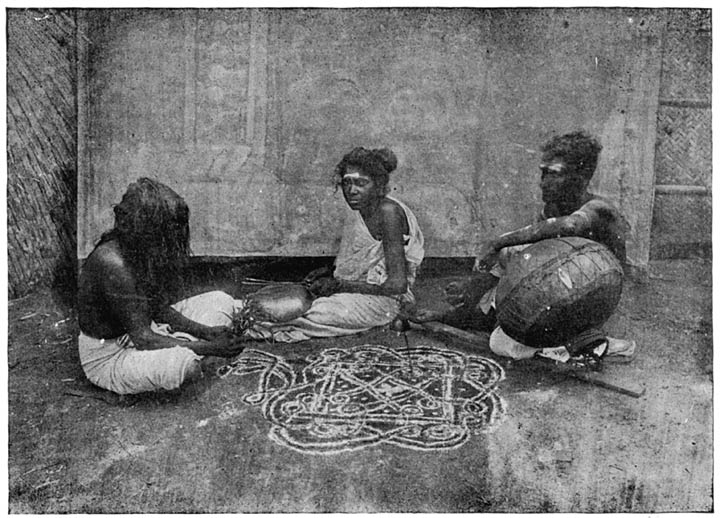
Pulluvan casting out devils.
The Pulluvans follow the makkathāyam law of inheritance (from father to son). But they seldom have any property to leave, except their hut and a few earthen pots. They have their caste assemblies (parichas), which adjudicate on adultery, theft, and other offences.
They believe firmly in magic and sorcery, and every kind of sickness is attributed to the influence of some demon. Abortion, death of a new-born baby, prolonged labour, or the death of the woman, fever, want of milk in the breasts, and other misfortunes, are attributed to malignant influences. When pregnant women, or even children, walk out alone at midday, they are possessed by them, and may fall in convulsions. Any slight dereliction, or indifference with regard to the offering of sacrifices, is attended by domestic calamities, and sacrifices of goats and fowls are requisite. More sacrifices are promised, if the demons will help them in the achievement of an object, or in the destruction of an enemy. In some cases the village astrologer is consulted, and he, by means of his calculations, divines the cause of an illness, and suggests that a particular disease or calamity is due to the provocation of the family or other god, to whom sacrifices or offerings have not been made. Under these circumstances, a Velichapād, or oracle, is consulted. After bathing, and dressing himself in a new mundu (cloth), he enters on the scene with a sword in his hand, and his legs girt with small bells. Standing in front of the deity in pious meditation, he advances with slow steps and rolling eyes, and makes a few frantic cuts on his forehead. He is already in convulsive shivers, and works himself up to a state of frenzied possession, and utters certain disconnected sentences, which are believed to be the utterances of the gods. Believing them to be the means of cure or relief from calamity, those affected reverentially bow before the Velichapād, and obey his commands. Sometimes they resort to a curious method of calculating beforehand the result of a project, in which they are engaged, by placing before the god two bouquets of flowers, one red, the other white, of which a child picks out one with its eyes closed. Selection of the white bouquet predicts auspicious results, of the red the reverse. A man, who wishes to bring a demon under his control, must bathe in the early morning for forty-one days, and cook his own meals. He should have no association with his wife, and be free from all pollution. Every night, after 10 o’clock, he should bathe in a tank (pond) or river, and stand naked up to the loins in the water, while praying to the god, whom he wishes to propitiate, in the words “I offer thee my prayers, so that thou mayst bless me with what I want.” These, with his thoughts concentrated on the deity, he should utter 101, 1,001, and 100,001 times during the period. Should he do this, in spite of all obstacles and intimidation by the demons, the god will grant his desires. It is said to be best for a man to be trained and guided by a guru (preceptor), as, if proper precautions are not adopted, the result of his labours will be that he goes mad.
A Pulluvan and his wife preside at the ceremony called Pāmban Tullal to propitiate the snake gods of the nāgāttān kāvus, or serpent shrines. For this, a pandal (booth) is erected by driving four posts into the ground, and putting over them a silk or cotton canopy. A hideous figure of a huge snake is made on the floor with powders of five colours. Five colours are essential, as they are visible on the necks of snakes. Rice is scattered over the floor. Worship is performed to Ganēsa, and cocoanuts and rice are offered. Incense is burnt, and a lamp placed on a plate. The members of the family go round the booth, and the woman, from whom the devil has to be cast out, bathes, and takes her seat on the western side, holding a bunch of palm flowers. The Pulluvan and his wife begin the music, vocal and instrumental, the woman keeping time with the pot-drum by striking on a metal vessel. As they sing songs in honour of the snake deity, the young female members of the family, who have been purified by a bath, and are seated, begin to quiver, sway their heads to and fro in time with the music, and the tresses of their hair are let loose. In their state of excitement, they beat upon the floor, and rub out the figure of the snake with palm flowers. This done, they proceed to the snake-grove, and prostrate themselves before the stone images of snakes, and recover consciousness. They take milk, water from a tender cocoanut, and plantains. The Pulluvan stops singing, and the ceremony is over. “Sometimes,” Mr. Gopal Panikkar writes, “the gods appear in the bodies of all these females, and sometimes only in those of a select few, or none at all. The refusal of the gods to enter into such persons is symbolical of some want of cleanliness in them: which contingency is looked upon as a source of anxiety to the individual.
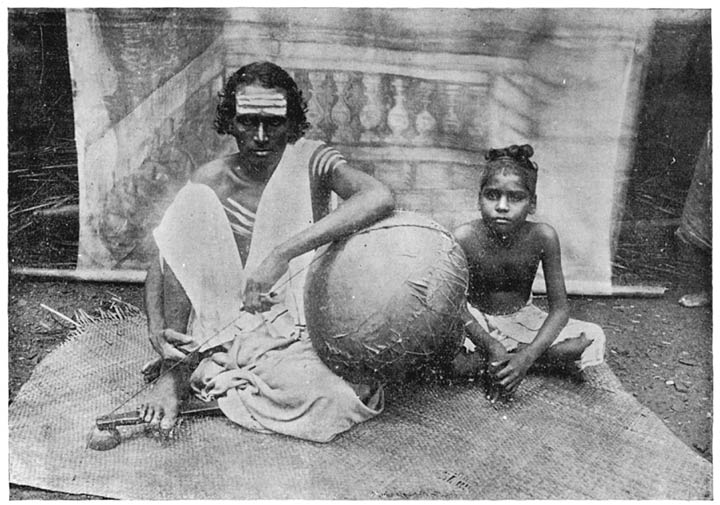
Pulluvan with pot-drum.
It may also suggest the displeasure of these gods towards the family, in respect of which the ceremony is performed. In either case, such refusal on the part of the gods is an index of their ill-will or dissatisfaction. In cases where the gods refuse to appear in any one of those seated for the purpose, the ceremony is prolonged until the gods are so properly propitiated as to constrain them to manifest themselves. Then, after the lapse of the number of days fixed for the ceremony, and, after the will of the serpent gods is duly expressed, the ceremonies close.” Sometimes, it is said, it may be considered necessary to rub away the figure as many as 101 times, in which case the ceremony is prolonged over several weeks. Each time that the snake design is destroyed, one or two men, with torches in their hands, perform a dance, keeping step to the Pulluvan’s music. The family may eventually erect a small platform or shrine in a corner of their grounds, and worship at it annually. The snake deity will not, it is believed, manifest himself if any of the persons, or articles required for the ceremony, are impure, e.g., if the pot-drum has been polluted by the touch of a menstruating female. The Pulluvan, from whom a drum was purchased for the Madras Museum, was very reluctant to part with it, lest it should be touched by an impure woman.
The Pulluvans worship the gods of the Brāhmanical temples, from a distance, and believe in spirits of all sorts and conditions. They worship Velayuthan, Ayyappa, Rāhu, Mūni, Chāthan, Mukkan, Karinkutti, Parakutti, and others. Mūni is a well-disposed deity, to whom, once a year, rice, plantains, and cocoanuts are offered. To Mukkan, Karinkutti, and others, sheep and fowls are offered. A floral device (padmam) is drawn on the floor with nine divisions in rice-flour, on each of which a piece of tender cocoanut leaf, and a lighted wick dipped in cocoanut oil, are placed. Parched rice, boiled beans, jaggery (crude sugar), cakes, plantains, and toddy are offered, and camphor and incense burnt. If a sheep has to be sacrificed, boiled rice is offered, and water sprinkled over the head of the sheep before it is killed. If it shakes itself, so that it frees itself from the water, it is considered as a favourable omen. On every new-moon day, offerings of mutton, fowls, rice-balls, toddy, and other things, served up on a plantain leaf, are made to the souls of the departed. The celebrants, who have bathed and cooked their own food on the previous day, prostrate themselves, and say “Ye dead ancestors, we offer what we can afford. May you take the gifts, and be pleased to protect us.”
The Pulluvans bury their dead. The place of burial is near a river, or in a secluded spot near the dwelling of the deceased. The corpse is covered with a cloth, and a cocoanut placed with it. Offerings of rice-balls are made by the son daily for fifteen days, when pollution ceases, and a feast is held.
The Puluvans call themselves Puluva Vellālas.
Pūnamalli.—The name of a division of Vellālas derived from Poonamallee, an old military station near Madras.
Pūni.—A sub-division of Golla.
Punjala (cock, or male).—An exogamous sept of Dēvānga.
Pūppalli.—See Unni.
Puragiri Kshatriya.—A name assumed by some Perikes.
Puramalai, Puramalainādu or Piramalainādu.—A territorial sub-division of Kallan.
Puranadi.—Barbers and priests of the Vēlans of Travancore, who are also called Vēlakkuruppu.
Purattu Charna.—A sub-division of Nāyar.
Purusha.—See Jōgi Purusha.
Pūsa (beads).—A sub-division of Balija. A sub-division of the Yerukalas is known as Pūsalavādu, or sellers of glass beads.
Pūsāli.—A title of Ōcchans, or pūjāris (priests) at temples of Grāma Dēvatas (village deities).
Puthukka Nāttār (people of the new country).—A sub-division of Idaiyan.
Pūtiya Islām.—Pu Islām or Pūtiya Islām is the name returned mostly by Mukkuvans, in reference to their new conversion to the Muhammadan faith.
Putta (ant-hill).—An exogamous sept of Kamma, Kuruba, Māla, Mēdara, and Padma Sālē. ‘White-ant’ (Termites) hills are frequently worshipped as being the abode of snakes.
Puttiya.—A sub-division of Rōna.
Puttūr.—Recorded, in the Travancore Census Report, 1901, as a sub-division of Nāyar.
Puzhi Tacchan (sand carpenter).—The name of a small section of Malabar Kammālans.