RAVENS (Coracirostres).
Thomas Rymer Jones translation
We are now about to introduce our readers to a race of Birds, so nearly related to the Passeres, that many naturalists have regarded them as constituting a subdivision of that order. We, on the contrary, following our intention of rendering our classification as simple as possible, have thought it best to assign them an entirely separate place, principally in consideration of the unmistakable peculiarity of their plumage.
The order CORACIROSTRES, according to this view, comprises a large number of species, varying in size from a Raven to a Finch, but all presenting the same characteristic structure: all have elongated yet powerful bodies, large heads, short necks, and wings of moderate size, or slightly lengthened, pointed or rounded at the tip. The tail is formed of twelve feathers, and is very various in its shape and size; the feet are strong, the toes short, armed with stout claws, and the tarsi covered with scaly plates; the beak is long, occasionally equal to or even exceeding the head in length, but sometimes much shorter; its shape is almost straight, more or less conical, sometimes arched at its roof, the upper mandible being slightly bent towards the point, but not terminated by a hook. The plumage is short in proportion to the size of the bird, and moderately compact and thick. In some cases the ornamentation is very peculiar, individual feathers being much elongated and stripped of their web. Very great diversity is observable in the coloration of these birds: black is generally predominant, but yellow and white are frequently employed, and green, brown, or red occasionally but more rarely intermingled; these various colours being often harmonised and enriched by a peculiar and splendid metallic brilliancy. The internal structure of this race bears a strong resemblance to what we have seen in the Passerine Order. The skeleton is powerful, many of its bones being filled with air. The back-bone very constantly consists of twelve cervical, eight dorsal, ten or eleven pelvic, and seven to eight caudal vertebræ. The vocal muscles of the lower larynx are well developed. The gullet does not enlarge into a crop, and the gizzard is never so muscular as in the Passerine birds; the various senses are very equally developed, and the brain is large. According to some naturalists, the Ravens must be regarded as the most perfectly constructed of the feathered tribe; and we are not inclined to dispute this opinion: certainly, few birds can compare with them either in capacity or bodily powers, for they run, fly, or climb with equal facility, and possess a remarkably flexible and copious voice; indeed, some families display such an extremely high degree of development both as regards their intelligence and strength, as to justify us in saying that they possess the attributes of the Parrots and Falcons combined. In the habits of the smaller species of this order there is much that reminds us of the Finches or Buntings; but its larger members are distinguished by many peculiarities. They are for the most part dexterous thieves, achieving their object with a boldness and cunning that is truly surprising, frequently stealing, as it were, for the mere pleasure afforded them by the act, rather than from any necessity for the object purloined. All parts of the world are inhabited by various tribes of this extensive division; some of them may perhaps be regarded as for the most part frequenting woodland districts; others are equally at home upon mountain ranges or lowlands, the sea-coast, or barren plains; and they are constantly met with either in the solitary desert, or dwelling in the immediate vicinity of man. Southern countries, however, afford the most congenial home to these birds, which, though appearing in all latitudes, are more numerous in the warmer portions of the earth than in the north. They live everywhere unmolested by man, obtaining a plentiful supply of food in any circumstances, seeing that their easily satisfied stomachs are equally ready to appropriate all kinds of nourishment. In their conduct the Ravens display an intelligence that cannot fail to interest every observer, and most curious are the means by which they seem to impart and receive hints or suggestions from each other. Some species will assemble at a given hour upon a certain tree, and enter at once, as it would seem, upon a full discussion of the events of the day, the old birds instructing the younger members of the party, who appear to profit by the lessons thus received; superior instinct or talent is sure to find promotion amongst them, the most intelligent being at once recognised as leaders of the rest of the flock. Their habits are social, but each bird may be said to lead an independent life, though ready at a moment's notice to join its companions in defence or attack. The structure of their nests is very various; some are placed apart, and separate from each other; others in close vicinity; the only interruption to the general harmony occurring during the breeding season, when the busy couples are all clamouring and struggling for favourite building places or necessary materials. At such times those who cannot take what they want by force, employ wonderful dexterity and cunning in abstracting the coveted object, should its possessor be for one moment off his guard. The brood consists of from four to six eggs. Both parents assist in the work of incubation, the male stealing occasionally from the side of his mate to pass an hour in chattering or singing with a select party of friends, perched upon some neighbouring tree. The young remain for a considerable time under the care and tuition of their parents, who rarely brood more than once during the summer.
For the most part, the Ravens must be considered as eminently useful, destroying, as they do, large quantities of noxious insects, and thus rendering great service to man. Some of the larger members of the order, on the contrary, are distinguished by a cruelty and rapacity that render them extremely destructive to the smaller quadrupeds, causing them to be regarded as deserving of human vengeance, and fit objects for relentless persecution. When caged, the Ravens are many of them extremely interesting, as they will not only learn to imitate tunes, but some of them acquire the power of repeating whole sentences with as great facility as does the Parrot, and soon become perfectly tame. The flesh of many species is well flavoured, and the feathers are employed for a variety of purposes.
We shall divide the order of Ravens into four groups, all distinctly recognisable by some marked peculiarity of structure, but resembling each other in their general mode of life and habits. These divisions we shall distinguish as the Starlings, the Birds of Paradise, the Ravens Proper, and the Plantain Eaters, assigning to the Starlings the first place, as being superior to the rest in their vocal powers.
THE STARLINGS.
The Starlings (Sturnidæ) must be ranked among the smaller birds belonging to this order, and are eminently distinguished for their high endowments. Their body is elongated, the wings of moderate size, the tail seldom of any great length, usually short and straight, the tarsus of medium height, the beak long, conical, and weak. The plumage is composed of small harsh feathers, much variegated in their hues, and frequently presenting a brilliant gloss. With the exception of Australia, the members of this family are distributed over the entire world; each continent and country possessing its peculiar species: America, more especially, is particularly rich in different races of Starlings.
The YELLOW STARLINGS (Icteri) are birds varying in size from that of a Crow to that of a Finch. Their bodies are elongated, but powerfully built, the beak conical, the wings and tail of moderate length, the tarsi strong, and the plumage soft and brilliant, black, gold, or red preponderating in its coloration; the beak is rounded and thick towards its base, and without any notch or hook at the apex, its upper portion being prolonged like a shield among the feathers of the forehead. The fourth quill of the wings is longer than the rest; the tail, which is half covered by the wings when the bird is at rest, is rounded or graduated towards its extremity; the tarsi are longer than the middle toes, and covered in front with scaly plates; the toes are of moderate length, armed with strong, bent, and pointed nails. In some species the feathers on the top of the head take the form of a tuft, and in others the cheeks are left bare. All the members of this group are social, cheerful, and active; some of them are rich in song. Their favourite haunts are in the woods, where they subsist principally upon insects, snails, fruit, or seeds. Their nests are built with care, and display considerable artistic skill.
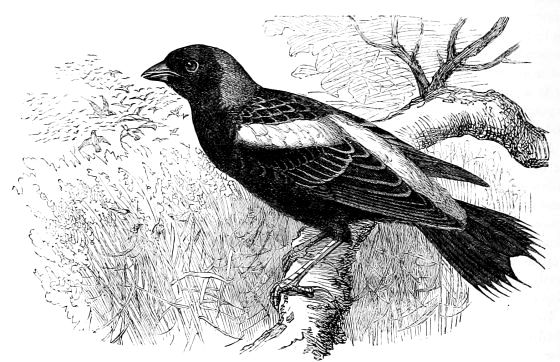
THE BOBLINK (Dolichonyx oryzivorus).
The TROOPIALS (Agelaii) include the smallest members of the last-mentioned group. In these birds the roof of the beak is quite straight, and its margins bent at an angle towards the gape; the hinder toe is furnished with a spur-like claw. The plumage of the young differs considerably from that of the parent birds, and is very various in its colours and markings.
THE RICE-BIRD.
The Boblink, or Rice Bird (Dolichonyx oryzivorus), possesses so many features in common with both Finches and Starlings as to render it difficult to decide amongst which it should really be placed. This species is very numerous in North America, where it is much detested on account of the serious damage it does to the fields of ripe grain. The principal characteristic of the group of Rice Eaters to which this bird belongs is their strong, conical beak, which is of moderate length, and much compressed towards the sides, the upper mandible being narrower than the lower portion, and lying, as it were, enclosed within its edges. The body is compact, the head large, the wings of moderate size, the second quill being longer than the rest; the tail is of great length, and each individual feather composing it terminates in a sharp point; the feet are not large, but powerful, and the plumage compact and glossy. The body of the Boblink measures seven inches, its breadth being about eleven inches, the wing three and a half, and the tail two and a half inches. The plumage varies considerably at different seasons of the year. During the period of incubation the male is black upon the head, the lower portion of the body, and the tail; the nape is brownish yellow, and the feathers upon the back black, with a broad yellow margin; the shoulders and rump are of a yellowish white; the wing-covers and quills are black, bordered with yellow. The eye is brown, the upper mandible dark brown, and the lower one blueish grey; the feet are light blue. The female is smaller than her mate, of a pale yellowish brown upon the back, the shafts of the feathers being marked with a dark tinge; the lower parts of the body are of a pale greyish yellow, the sides streaked in the same manner, as is the back; the bridles are brown, and a yellow line passes over the eyes; the quills and tail-feathers are much lighter than in the gala dress of her mate. During the winter months the male bird wears a coat closely resembling that of the female. The young are similar to the mother, but all their tints are greyer and paler.
When upon the ground, the movements of this species may be described as being more like a step than a hop; its flight is light and graceful, and its powers of climbing amongst the stubble by no means inferior to those of the Reed Sparrow. The Boblink (so called from its well-known cry) appears regularly in North America during the summer months, visiting the West Indies and the northern parts of South America in the course of its migrations. About May these birds begin to make their appearance in New York by small parties, which gradually increase in numbers until they literally swarm throughout the whole State—indeed, Audubon tells us that it would be impossible to find a field unoccupied by these destructive visitors. Even the breeding season does not interfere with their social relations, for the nests are built near together upon the ground, each pair, however, keeping possession of a distinct territory, in the centre of which the little home is made with much art, amidst the grass or stubble. The cares of the brood devolve entirely upon the females, their mates, meanwhile, disporting themselves over the neighbouring fields, and making the air resound with their endeavours to rival each other in the beauty of their song, which is so rich and varied in its tones as frequently to lead the hearer to imagine that he is listening to the voices of many singers, when in reality the sounds are produced by a solitary bird. Wilson describes the performance of the Boblink as resembling a series of notes struck upon all parts of the pianoforte in rapid succession, and tells us that the effect, though strange, is extremely pleasing. When perched, the male accompanies its song by a variety of animated gestures and movements of its wings. The eggs are laid about the end of May; they are from four to six in number, white, and thickly marked with dark blue or black spots irregularly distributed. Each couple breeds but once during the year. The young are fed upon insects: they rapidly attain their full size, and are ready to join their parents in the work of destruction about to commence. No sooner is the period of incubation over than the nature of these birds seems to undergo an entire change. The male completely loses his song, and doffs his brilliant coat, which is replaced by a comparatively quiet dress, resembling that of the female, and all exchange their hitherto harmless demeanour for a life of active and really formidable mischief. In vain are every means adopted by the inhabitants to scare the destructive flocks from their fields of young corn; hundreds of thousands are shot, but with little result beyond driving the enemy from one district to take refuge in another, and it is only when the work of devastation has been fully carried out that these enormous swarms leave the locality to carry on their terrible raids in another part of the country. It would seem as though the hatred with which the farmers regard this bird had made them entirely overlook the service it renders them during other seasons of the year by the enormous quantities of insects it consumes; even the great beauty of its song has not induced them to tame it.
The MARSH TROOPIALS (Agelaius) are quite as numerous, and almost as destructive as the members of the last-mentioned group. In these birds the beak is long, conical, very pointed, and slightly compressed, the body powerful, the wings of moderate size, their second and third quills being longer than the rest; the tail moderate, rounded at its extremity, and the plumage soft and glossy.
THE RED-WINGED TROOPIAL.
The Red-winged Troopial (Agelaius Phœniceus) is almost as abundant in North America as is the Rice Bird, and, though its plumage is extremely simple, it is remarkably beautiful. During the breeding season the coat of the male is deep black, except upon the shoulders, which are of a rich scarlet; the eyes are brown, and the feet and beak blueish black. The female is blackish brown upon the upper part of the body, the belly greyish brown, each feather being edged with yellowish grey; the throat and cheeks are light greyish yellow, streaked with a deeper shade; its body is about eight and a half inches long, its breadth thirteen and a half inches; the wing measures four and a half inches.
These birds are found extensively throughout the whole of North America, and appear regularly in the United States during the summer months, but are most numerous in the northern provinces. Audubon tells us that the "Redwings" leave the south as soon as spring appears, performing their migrations in flocks of considerable extent; the males leading the way, and singing almost without intermission, as though to induce the females to follow them; the different parties rest for the night upon the tops of high trees, and greet the morning with an animated song before again proceeding on their journey. No sooner have the females made their appearance than the work of choosing a mate commences, a proceeding attended with no small difficulty, as the males far exceed the females in number. When mated the little couple retires from the rest of the flock, and sets about the construction of the nest, which is built of dry reeds, lined with horsehair or fine grass, and placed under a bush at the edge of a pond or in a marshy field. The eggs (see Coloured Plate IV., fig. 28), from four to six in number, are of a light brown colour, spotted with a darker shade. The male bird exhibits the greatest anxiety for the welfare of its little partner, and, should they be molested, will fly close up to the intruder, as though to divert attention from the nest, or else will perch immediately above its mate, uttering such pitiful cries of distress as will sometimes deter the unwelcome visitor from approaching nearer. These birds produce two broods during the summer, the second being ready to leave the nest by the beginning of August, when they congregate in flocks, numbering many thousands, and immediately commence their depredations in the fields, destroying the crops in the most terrible manner, despite the utmost efforts used to drive them from the locality, which they only quit when the corn becomes too ripe to suit their requirements. Like most of their congeners, they usually pass the night amongst the beds of reeds, which afford them temporary protection from the attacks of the infuriated farmers, by whom incredible numbers are slaughtered, without making any apparent diminution in the flocks, which occasionally may literally be said to darken the sky. Except during the time when the corn is young and tender, the habits of the Red-wing are by no means such as to render them objects of persecution, for they may be seen hopping after the plough, and clearing the field of multitudes of noxious and destructive insects; these services, however, are entirely overlooked by the American husbandmen, who have no eyes for their beauty and no ears for their song, but pursue them with unrelenting hostility.
The COW-BIRDS (Molothrus) constitute a group of Starlings distinguished by their short, conical, sharply-pointed beaks, the upper mandible of which is almost straight, and compressed towards its edges; the wings are tolerably long, the three first feathers being of nearly equal length. The tail is of moderate size, and straight at its extremity, the individual quills becoming broader towards their tip; the tarsi are compact, but rather high, and the soft plumage, which in the young bird is brown, at a later period turns to a bright metallic blue.
THE COW STARLING.
The Cow Starling (Molothrus Icterus pecoris) is the best known, or, perhaps, we should say, the most notorious of these birds. The plumage of the male is simple in its coloration, but by no means without beauty; the head and neck are brown, the rest of the plumage brownish black, with a blueish gloss upon the breast, and a green and blue shimmer on the back; the eye is dark brown, the beak and feet brownish black. The length of this species is about seven inches, and the span of its wings eleven and a half inches; the female is rather smaller, and her colour almost entirely brown, the lower part of the body being of a lighter shade than the back.
The Cow Starlings inhabit North America, where they frequent such marshy spots as are at no great distance from pastures containing cows or horses, whose backs they relieve from many tormenting parasites. In the northern parts of the United States these birds make their appearance in small flocks about the end of March, frequently associating with parties of red-winged Troopials, and gradually increasing in numbers until their swarms become really formidable; by the end of September they have left the country in company with many of their feathered companions. Though bearing a great resemblance to their congeners, there is much that is decidedly peculiar in their habits, more especially as relates to the rearing of their young. Anything like family affection would seem to be quite unknown amongst them, both male and female having many mates, and living in such entire indifference as to each other's movements that the withdrawal of one of the party does not seem to excite the slightest attention. Their eggs, moreover, are laid, like those of the Cuckoo, in the nest of any other bird who may for a moment have left its young charge; on more than one occasion we have been much amused in following and watching a female Cow Starling as she flew anxiously about in the woods, until she succeeded in finding a nest into which she might steal and deposit her eggs during the absence of its owner. Should this, however, not be possible, force is often used to drive the weaker bird from its brood until the object is accomplished. The egg of this species is small as compared with the size of the mother; it is usually pale blueish grey, marked with dark brown spots and streaks, which are the most numerous at the broadest end (see Coloured Plate IV., fig. 3). According to Audubon, the Cow-bird never deposits more than one egg at a time; the resulting progeny, he tells us, is soon hatched, and receives every care from its foster parents, who are, however, deserted by their strange nursling as soon as it has strength enough to fly.
The YELLOW or GOLDEN STARLINGS (Icteri) are distinguished from the rest of the family by their superior size, and long, slender beaks, which are straight at the ridge and sharply pointed towards the extremity; the wings are of moderate size, the tail long, graduated at the sides, and rounded at its tip; the legs are strong, the toes powerful, and armed with sharp and crooked claws. The plumage is principally of a yellow colour, the female in this respect resembling her mate, but the young birds never exhibit the bunting-like markings that distinguish others of the family.
The "Yellow Birds," as they are usually denominated, are inhabitants of the southern portions of America, though by no means rare in its more northern countries, and must be regarded as holding the same place in the Starling family as the Weaver Birds do amongst Finches, for their nests are built with great artistic skill, and frequently hang in considerable numbers from the same tree or branch. In their habits they are extremely social, and are much prized by the Americans, either when in their favourite woods or confined in a cage, on account of their gay plumage and the beauty of their song. The food of these birds consists principally of insects and fruit, but at some seasons of the year they will also eat corn and devour large quantities of the softer kinds of maggots and larvæ, for which they search amidst the refuse scattered on the roads.
THE JAMAICA YELLOW BIRD.
The Jamaica Yellow Bird, or Soffre (Icterus Jamacaii), is one of the most beautiful members of this family, found, as its name implies, in the islands of the West Indies, but likewise abounding in Brazil and Guiana. In this species the head, throat, back, and neck are black, the nape and lower portion of the body bright orange. A portion of the hinder secondary quills is edged with white underneath, and the small wing-covers are marked with orange at the shoulder; the lower wing-covers are of a paler yellow. The beak is brilliant black, with a lead-coloured spot upon the lower mandible; the feet are of a blueish flesh colour, the eyes light yellow; the ophthalmic region is bare, and of a greenish hue; the coat of the female is lighter than that of her mate, and the young birds are of a still paler tint; the beak of the latter is brown, the feet pale yellowish brown, and the wings edged with broad grey lines. The length of this bird is about ten inches, its breadth thirteen, and the wing and tail four and a half inches.
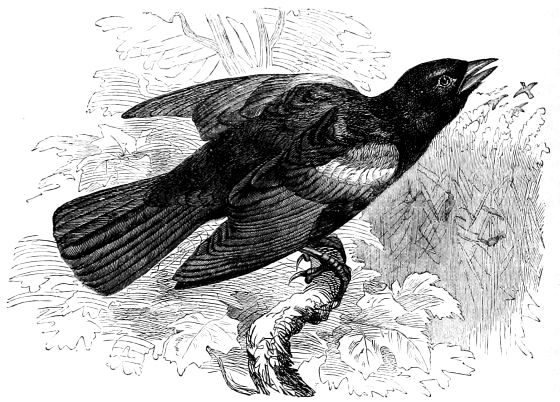
THE RED-WINGED TROOPIAL (Agelaius Phœniceus).
All observers who have seen this magnificent species in its wild state speak of it with enthusiasm. The Prince von Wied describes it as looking like a flashing flame as it darts hither and thither amongst the dark foliage; its movements are lively and elegant, and its voice so flexible as to be capable of imitating the songs of many other birds. The depths of the forests afford these brilliant creatures the shelter they prefer, and thither they resort in pairs during the period of incubation; at other seasons of the year they fly about in small parties, which subsist principally upon insects or various kinds of fruit, and do great damage to the orange and banana trees. We learn from the same author that he found the nest of a Yellow Bird woven between the branches of a tree and hanging some eight or nine feet above the ground; the little structure was formed of small twigs, and in shape resembled a ball, the entrance being through a hole in the side. Schomburghk tells us that the wooded banks of the rivers resound morning and evening with the melodious but plaintive notes of this sweet songster, and that it is sought after by the settlers for purposes of domestication, though its life in confinement is but of short duration: this writer adds that the Yellow Bird becomes so tame in Brazil, that its cage may be kept open without any danger of its returning to its native haunts; but in this statement we can by no means agree, our own observations having led us to a contrary opinion; such as we have seen in captivity have almost invariably proved themselves to be very untamable, falling upon and destroying the nest or young of other birds, and domineering over the larger species of Starlings and Thrushes with so much violence as to ensure to themselves undisputed possession of the food or sleeping perch, as none of their companions dared to approach until the wants of these tyrants of the aviary were satisfied: to the keepers alone they showed the more amiable side of their character, and were so shy before strangers as to refuse to sing if the listener was not concealed from view.
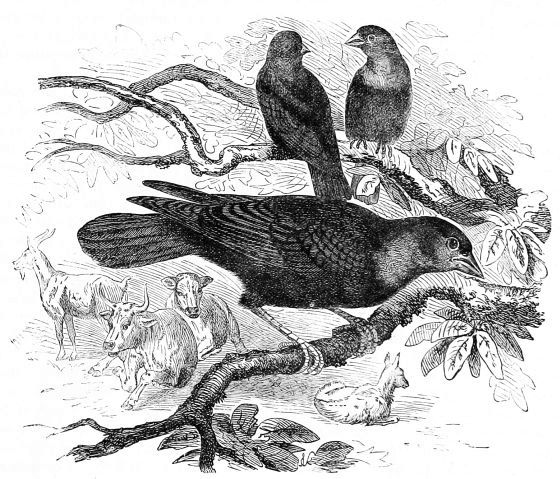
THE COW STARLING (Molothrus pecoris).
THE BALTIMORE GOLDEN STARLING.
The Baltimore Golden Starling (Hyphantes Baltimore), a North American species, is the member of this group with which we are most familiar. In the general construction of its body it closely resembles the Yellow Bird last described, but the ridge of the beak is slightly curved; also the wings are longer and the tail shorter than in that species. The plumage of the male is black upon the head, throat, and upper wing-covers, as are the quills and middle tail-feathers; the under parts of the body and small wing-covers are bright orange, the back and breast a light scarlet: the exterior tail-feathers are black from the root, but their lower half is bright orange. The large upper wing-covers are tipped with white, and the quills bordered with a white margin; the eye is orange, the beak and feet light grey. In the young male all the colours are paler: the iris is light brown, and the upper mandible brownish black. The size of this species is about seven and three-quarter inches long, its breadth twelve inches.
According to Audubon, the Baltimore Bird is met with throughout the whole of North America as far as fifty-five degrees north latitude, being very numerous in some parts, but only visiting others in the course of its migrations. Its favourite haunts are in hilly districts, to which it resorts as soon as spring appears, to discharge the duties attendant on incubation. The nest is suspended from a slender twig, and is most artistically woven, but its construction varies with the climate. In the Southern States the birds prefer the northern side of the tree, and form their little cradle of moss so loosely intertwined as to allow the air to penetrate; while those that inhabit the Northern States prefer such branches as are most exposed to the rays of the sun, and render their home warm and snug by lining it with soft and fine materials. The construction of these remarkable nests is very peculiar; the builders begin by seeking for all kinds of threads or fibres about the surrounding fields and villages, and frequently do very serious damage by their depredations among the skeins of thread or cotton laid out in the fields to bleach: all the odds and ends of cotton, silk, or thread thus collected are woven into the nest, amongst other materials, with a compactness and dexterity that is truly surprising. The female lays from four to six eggs, of a pale green colour, marked with dark spots or streaks. The young are hatched within a fortnight, and are fully fledged in about three weeks after their birth, from which period they begin to climb in and out of the nest, and hang from the outside after the manner of Woodpeckers; they then accompany their parents, by whom they are fed and tended for another fortnight, before they are capable of supporting themselves. In the more southern parts of North America these birds frequently produce two broods within the year; during the spring they subsist principally upon various insects, usually caught upon the wing; but in summer they prefer fruit of different kinds, and do great damage to the orange and banana trees. This species commences its migrations early in the autumn, flying generally alone, and high in the air, uttering loud cries and hurrying along with great rapidity; when evening approaches it seeks food and shelter upon a tree, where it passes the night; it then takes a hasty meal and resumes its onward journey. The movements of the Baltimore Bird are regular and graceful; its flight is direct and continuous; its step, when upon the ground, easy; and its adroitness in climbing amongst the branches such as to bear comparison with the activity of the Titmouse. The song is simple, but pleasing.
We select the CASSICANS (Cassici) as taking rank next in order to the Icteri, being, like them, of slender shape, with long, pointed, conical beaks, long, tapering wings, long and graduated tails, rounded at the extremity, and formed of broad feathers. The feet are strong, the toes large and armed with sharp claws. The plumage is thick, smooth, and glossy, principally black, heightened to greater richness by an intermixture of yellow. In size they resemble our Jackdaw. (See Coloured Plate VI.)
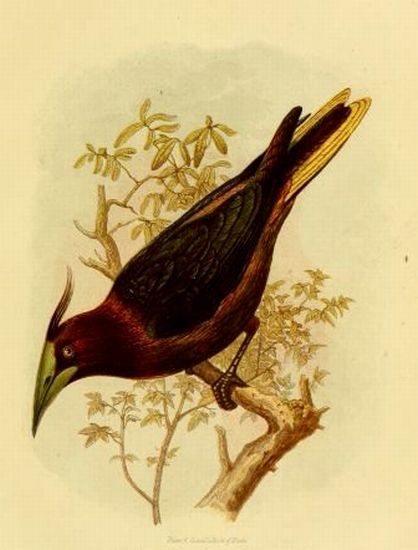
Plate 6. Cassell's Book of Birds
WAGLERS CASSICUS ____ Cassicus Wagleri
(Three-fourths Life size)
[See larger version]
The Cassicans hold pretty much the same place in America as that occupied by the Crows in European countries. In their habits they are lively and active, beautiful in appearance, and, though essentially occupants of trees, resemble the Yellow Birds in many particulars, like them frequenting fields of ripe corn, and doing considerable damage, without any apparent fear of the wrath of the proprietors. When in the woods, insects and seeds constitute their principal fare, and they will occasionally devour fruit. The voice of this species is not so pleasing as that of the Soffre, but it possesses very great flexibility—indeed, Schomburghk tells us that it can not only imitate the note of every other songster, but the cry of any animal, producing at times such a strange medley of sounds as to astound its hearers, who scarcely believe it possible that a single bird can alternately bleat like a sheep, crow like a cock, or scream like a turkey, all these various noises being accompanied by such extraordinary contortions of the whole body as cannot fail to excite laughter in those who witness this strange performance.
Scarcely less remarkable is the manner in which the Cassicans construct their nests. Like the Weaver Bird, they build regular settlements, suspending their artistically woven cradles in large numbers from the same tree, and very frequently in the immediate vicinity of other species. As with the Weaver Bird, these nests are inhabited from year to year, and repaired every season for the reception of a new family. In shape they are not unlike the large bags formerly used to carry shot, and are so lightly constructed that their walls may be seen through. Great patience and skill are exhibited in the manufacture of these abodes, some species only employing such materials as linen thread, or fibres, while others build with fine blades of grass, which they moisten with saliva in order to render them more pliable. Schomburghk tells us that this species is extraordinarily deficient in social attachment, and mentions an instance of this fact witnessed by himself. A large party of "Blackbirds" (Cassicans) had made their settlement upon the banks of a river which one day rose to an unusual height, and threatened destruction to the entire colony. Some of the nests were washed down, and others gradually filled with water. The terrified parents, unable to render any help to their young, flew about in an agonised confusion, or sought for their eggs and nestlings amongst the general débris, whilst such of the flock as were still above immediate danger sat quietly brooding, or continued their building operations without paying the slightest attention to the piteous cries of their companions. According to Audubon, these birds breed but once in the year, the nests being placed, as we have described, quite close together, thus ensuring a safety from the attacks of their numerous enemies, that could not otherwise be obtained; each family, however, leads a life quite distinct from that of its neighbours, and exhibits neither interest nor sympathy in the movements of those that live around it.
THE JAPU.
The Japu, or Tufted Cassican (Cassicus cristatus), is an inhabitant of South America, and has been selected for particular description as being one of the most remarkable species belonging to this group. In this bird the plumage is principally of a brilliant black, with the lower portion of the body of a deep reddish brown; the exterior tail-feathers are yellow, and the inner ones black. The beak is of a whitish yellow, the feet deep black, the eyes, like those of the rest of its congeners, light blue. The length of the male varies from fifteen and a half to seventeen inches, its breadth is twenty-three and a half inches, the wing measures from seven and two-third to eight inches, and the tail from six to seven inches. The female is at least three inches shorter, and the wings six or seven inches less in their span.
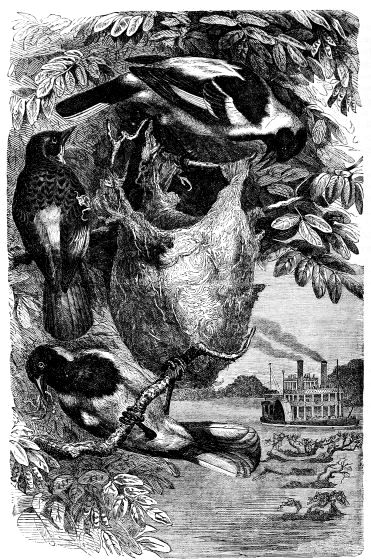
THE BALTIMORE BIRD.
We are indebted to the Prince von Wied for an exhaustive account of this species, from which we shall extract such particulars as our space will permit. This remarkable bird, he tells us, inhabits the whole of South America, but is most numerous in the northern portions, frequenting woodland districts, and such plantations or human habitations as may be in the immediate neighbourhood of forests, but avoiding barren or open parts of the country. It is social and active, flying about incessantly amongst the trees, and hanging suspended by its sharp claws from the branches, from time to time plucking a favourite fruit, and carrying it off with cries of delight to another spot where it may be eaten in safety. During the season, oranges and bananas constitute its favourite food, and large quantities of valuable fruit are thus destroyed, in spite of all the precautions taken by the planters for its preservation; but at other times the Japu contents itself with less dainty fare, and subsists principally upon insects and berries. Few scenes are more animated than that afforded by a settlement of these interesting birds, as they perch upon the branches of the forest trees, in parties of some thirty or forty couples, or fly about filling the whole air with their strange and varied song, the general effect of which, when thus heard in chorus, is far from unpleasing, though some notes are harsh, and others very shrill.
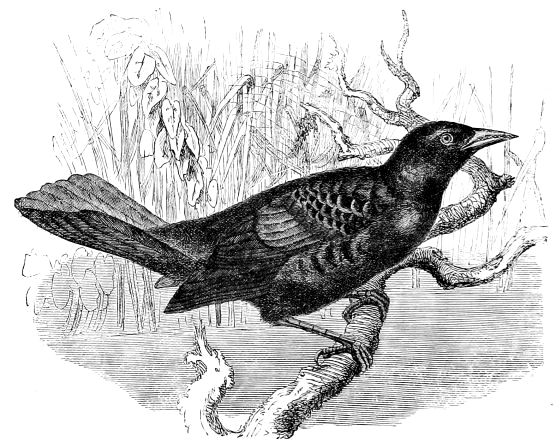
THE GREAT BOAT-TAIL (Quiscalus major).
Their nests, which are extremely curious, are suspended close together from the branches of the highest trees; in shape they are not unlike a purse, being long, narrow, and rounded at the bottom, usually three or four feet long, and not more than five or six inches wide. A bough of about the thickness of a man's finger is usually chosen for their support, and to this they are stoutly fastened, a long and narrow hole being left at the top for an entrance. Occasionally these abodes are built one upon another, each being provided with a separate opening. The Japu constructs this large and beautiful fabric with the greatest care, weaving together the various fibres of which it is formed so strongly, and with so much skill, as to render the task of tearing it to pieces a work of real difficulty. When the nest is completed a soft, warm bed of moss or leaves is made at the bottom of the bag, and upon this the eggs, one or two in number, are laid. We ourselves have never found more than one young bird in the nest, but believe we are correct in stating that two eggs are sometimes deposited: they are slightly elongated in shape, the shell being white, with reddish-violet or deep purple streaks and spots. The nestlings have loud, harsh voices, and resemble their parents in plumage very shortly after being fledged, as the yellow tail is soon acquired. Immediately after the breeding season young and old congregate in flocks, and seek for food upon their favourite fruit-trees. A more strange or beautiful sight can scarcely be imagined, says the Prince von Wied, than that of a tree laden with dozens of the curious nests, and animated by the presence of a party of Cassicans, whose glorious plumage seems to gain new beauty as they spread their tails, raise their wings, after the manner of the swan, inflate their breasts, and utter their flute-like cry, as though to attract the observation of a stranger, whose near approach they will permit without exhibiting any sign of fear. The flight of this bird is swift and light, the peculiar motion of its wings producing a whirring sound, which is distinctly audible. The natives of South America shoot the Japu for the sake of its flesh, although somewhat tough and coarse, and for its feathers, which they apply to many purposes of ornamentation, frequently forming them into a plume to wear upon the forehead.
The BOAT-TAILS (Quiscalus), so called on account of the peculiar conformation of the caudal part of their plumage, are distinguished by their long, straight, conical beaks, the upper mandible of which is slightly curved and bent at its extremity. The wings are of moderate size, the tail much rounded, and the webs of its outer feathers turned upwards, something like the sides of a boat. The legs are delicately formed, and their coat, which is black, gleams in certain lights with metallic brilliancy.
THE GREAT BOAT-TAIL.
The Great Boat-tail (Quiscalus major) is sixteen inches long, and twenty-four broad. Its entire plumage is black, but the head and neck are shaded with rich purple, and the wings and tail-feathers have a bright green shimmer. The female bird is considerably smaller than the male, rarely exceeding thirteen inches in length and eighteen in breadth; her colour is a dull, deep, greyish brown upon the upper part of the body, and reddish brown underneath. In both sexes the eye is pale yellow, and the beak and feet black.
This species inhabits the Southern States of North America, and is very numerous in marshy districts, or upon the banks of rivers; it likewise frequents the salt marshes, and may be seen on the sea coasts in large flocks during the entire year, searching in the mud for crabs and worms, upon which it principally subsists. It does not appear to feed upon insects, but is very destructive to fruit gardens, and fields of corn or rice. By the month of February the male has acquired his full beauty, and at once seeks a mate, retiring with her into the woods, where he exhibits his new plumage in every point of view, apparently to excite her admiration, its extreme brilliancy causing it to be seen glistening and shining even at some distance, as the bird expands its feathers in the full blaze of the sun. During the time employed in the selection of a companion all the quarrelsome feelings of which rivals are capable seem to be aroused, but that important business once settled, the flock subside into their usual peaceful state, and set about the construction of their nests in perfect harmony, usually preferring some marshy locality. The eggs are four or five in number, of a greyish white colour, variegated with brown and black spots. Both parents assist in rearing the young, who are supplied with all kinds of food, the nests of other species being frequently robbed in order to provide for the wants of the nestlings. The Boat-tails, in their turn, suffer considerably from the attacks of their many enemies, of whom the alligator may be considered as one of the most formidable, for being well aware what dainty morsels these fat and tender birds afford, it is ever on the watch to shake them from their nest among the reeds into the water, or by gliding quietly along in the direction from which it hears the young ones cry, secures at least a part of the brood, before the mother can warn her family of their danger. Like its congeners, the Boat-tail is extremely active; it climbs among the reeds with great rapidity, combining the boldness of the Crow with the agility of the Starling; its flight is undulating, and its song not unpleasing, though without great pretensions to melody. During autumn and winter it associates with many other birds, amongst which Herons are frequently met with.
The STARLINGS PROPER (Sturni) are birds of moderate size, compactly built, with short tails, long wings, rather long and broadly conical straight beaks, and high, strong feet; their plumage is rich, but harsh and very varied in its colouring. Like the rest of the family, they are of social habits, living together in flocks throughout the whole year, and carrying on all the business of life in common. Despite their somewhat clumsy appearance, they are extremely active, both upon the ground and in the air; their step is quick, but rather waddling; their flight light and noisy; and their movements in the trees extremely agile. All the members of the group are lively, restless, busy creatures, which may literally be said never to rest, except during the time they pass in sleep. Their food consists of insects, worms, and snails; occasionally they will eat fruit or the delicate parts of some plants, but never in such quantities as to be troublesome. The nest, which is large and irregular in its construction, is generally placed in holes of trees, rocks, or walls; the eggs are usually from four to seven in number. Few birds are more eminently adapted for domestication, their many talents rendering Starlings universal favourites when caged.
THE COMMON STARLING.
The Common Starling (Sturnus vulgaris) combines all the many peculiarities of its family, and we have therefore selected it as the most suitable representative of their principal characteristics. The plumage of this bird varies considerably with age or the season of the year; in the spring the adult male is black, shaded with purple and green, these tints seeming lighter upon the wings and tail on account of the broad grey border by which the feathers are surrounded; some of those upon the back have greyish-yellow spots at their tips. The eyes are brown, the beak black, and the feet reddish brown. No sooner has the process of moulting been fully accomplished than the appearance of the bird is entirely changed, for all the feathers upon the nape, back, and breast are then tipped with white, and thus give the plumage the effect of being spotted; the beak also becomes considerably darker. The female resembles the male, but her plumage is even more spotted than that of her mate during the spring months of the year. The young are of a dark brownish grey, the region of the face being lighter than the rest of the body; the beak is greyish black, and the feet brownish grey. The length of this species is from eight and a half to eight and three-quarter inches, its breadth fourteen to fifteen inches; the wing measures rather more than four, and the tail from two and a half to two and three-quarter inches.
The Common Starling is met with throughout almost the whole of Europe, principally frequenting its more southern portions, and preferring such wooded pastures or plains as are well watered or marshy. During its migrations it very frequently visits Northern Africa, and is an annual winter guest in Egypt and Algiers, but for the most part the flocks do not leave the Continent of Europe, and pass the colder part of the year in flying about the country in company with Ravens, Thrushes, and other similar birds. Few of the feathered tribe are endowed with so joyous and contented a disposition as is the Starling, whose cheerful voice may be heard amidst the utmost inclemencies of the weather, as it perches fully exposed to all the attacks of wind or rain, and appears philosophically indifferent to the scantiness of its supply of food. No sooner has spring commenced than the males may be seen about towns or villages, perching upon the steeples or high trees and pouring out their song, which is accompanied by a variety of animated gesticulations. We are, however, perhaps, giving our readers a wrong impression by speaking of the sounds uttered by the Starling as being a song, for it is, in fact, little more than a succession of harsh, loud, distinct sounds, uttered by the energetic vocalist with so much gaiety and expression as to render the performance quite attractive, especially when combined, as it occasionally is, with imitations of the songs of many other birds. Even such noises as the creaking of a door, the clattering of a windmill, or the crowing of a cock may often be clearly distinguished amongst its attempts at mimicry; the little singer will frequently continue its vocal exercise for many hours at a time, only pausing occasionally in order to go in search of food. The breeding season commences early in spring, when Starlings build their nests, usually in the hollows of trees, or, should these not be attainable, in holes of walls or old buildings, and many are the disputes and combats that take place among the members of a flock before all are suited with a home. The nest itself is formed of stalks of grass, thickly lined with a bed of soft feathers, collected from the neighbouring farmyards; but, should such warm materials not be procurable, the architect is equally contented to employ hay, straw, or even small twigs. The brood consists of five or six long, large eggs, having a somewhat rough but glossy shell, of a light blue colour; upon these the female alone sits, but both parents assist in obtaining the constant supply of food required by the nestlings, though the father of the family manages now and then to steal away from his duties and pass an hour in singing with a party of pleasure-seeking companions. No sooner have the young left the nest than the vocal performances to which we have alluded may be heard throughout the entire day, for they do not require attention from their parents except during the first week; after leaving their home they immediately associate themselves with others of their kindred, and fly about in companies that are often very numerous, being in time strengthened by the addition of the second families, to the rearing of which the parents almost immediately turn their attention. When the duties of incubation are terminated, the old birds at once leave their nests, and congregate in immense flocks, which pass the night either amongst the trees or in beds of reeds or osiers. These swarms, occasionally containing hundreds or rather thousands of Starlings, fly about in dense masses during the day, and retire at night to the same roosting-place, their numbers frequently occasioning the reeds upon which they settle to break beneath their great weight, thus obliging them to seek shelter elsewhere, a proceeding always accompanied by an amount of squabbling and screaming that is absolutely deafening. Before leaving the country, the parent birds revisit their nests, upon which they perch and sing every morning and evening. They only commence their migrations when compelled to seek shelter from the snow and frost, and lead as blithe and active a life in the countries to which they resort as they do in their summer haunts.
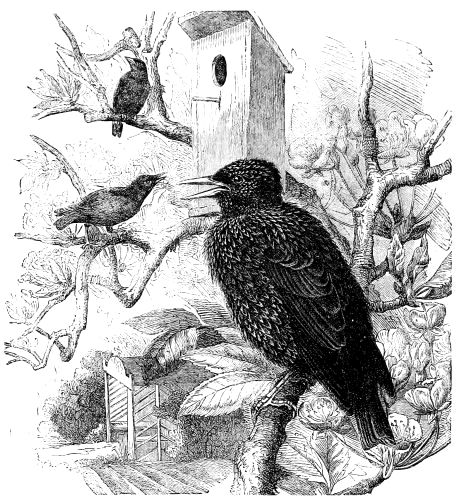
THE COMMON STARLING (Sturnus vulgaris).
Few species are so deserving of the protection of man as these most useful birds, an account of whose services in clearing the ground from snails and other hurtful creatures would sound almost incredible, were we to compute the hosts of active destroyers from whose attacks our fields and gardens are thus preserved. With characteristic patience, a German naturalist has been at the trouble of ascertaining that a single young Starling will consume 140 snails in fourteen hours out of the twenty-four, during which the young nestlings are constantly fed, only about three minutes intervening between the arrivals of the parents with fresh supplies for the hungry beaks of the little family. We cannot follow the writer through all his intricate calculations concerning a large swarm of Starlings that visited the part of Thuringia in which he lived, and must content ourselves by giving our readers the extraordinary result—namely, that the 180,000 birds of which this unusually large flock was composed could not have cleared the ground of less than 12,600,000 snails and worms daily during the time they remained in that neighbourhood. The proceedings of the Starling when in search of food are extremely amusing, as it runs hither and thither, prying into every conceivable nook with keen eyes and ready beak, so as to render it impossible for its victims to escape detection; even when search by sight is impracticable, the tongue is employed to feel amongst the grass, and accomplishes its duty with most unerring precision. When exposed to the attacks of their foes, the cunning of these birds is of the utmost service in securing their safety. It will frequently happen that when flying about in company with Crows and Jackdaws, the enjoyment of the party is interrupted by the sudden appearance of a Falcon or Sparrow-hawk; no sooner does the enemy approach than the vigilant Starlings at once take the alarm and beat a hasty and quiet retreat, leaving the bird of prey to seek a victim among their less intelligent or observant companions. From man they have little to fear, for by him their numerous services are too fully appreciated to allow of any great number being doomed to a life of confinement. Still, when caged their qualifications are such as to render them general favourites. When kept alone they are readily tamed, but, on the contrary, should they be placed with other birds, they soon become quarrelsome: and, not content with constantly squabbling with their companions, have often been known to tear the nests of the latter to pieces, and throw out not merely the eggs but the young. In our own aviary we on one occasion found a very lively Starling flying about with a piece of white paper in its beak, and chasing the terrified occupants in all directions, this sportive performance apparently affording the greatest delight to the perpetrator of the joke, who seemed to enjoy the alarm and screams thus excited. Most extraordinary are the tales told of the facility with which this species can be taught to speak or imitate almost any sound; an instance is recorded of a Starling having learnt to repeat the Lord's Prayer quite distinctly, without missing a word; the naturalist Lenz, to whose curious calculations respecting these birds we have already alluded, kept one of them tame, and tells us that this creature not only whistled two tunes, and could utter syllables, but that it understood and obeyed his words and gestures like a dog.
The following narrative, for which we are indebted to the kindness of Dr. McFarlane McBirnie, will be read with interest:—"My father," writes Dr. Birnie, "from boyhood was passionately fond of birds, when under ten years of age he travelled from Balpon to Linlithgow and back, a distance of forty miles, in order to get a canary. A few years after, having broken his leg, he was confined to the recumbent position for two months, the tedium of which was relieved by the company of his favourites. In 1845 he bought a fledgling Starling for eighteen-pence, and at once commenced its education. He spent three hours a day (not, of course, consecutively) for twelve months before he brought it to perfection. From the very first, poor 'Richard,' as it was called, showed a love of learning, he seemed actually to drink it in; he would lie with his head inclined, as a person does when he wishes to listen intently, and would lean against the wires of his cage to be as near as possible to the sound; and I would here remark that in training a bird to sing and speak, the instruction should be imparted in a subdued, semi-whispering tone, in a darkened chamber, where there is nothing to distract the attention. My father made it a point to give Richard half an hour's tuition every night after ten o'clock, in total darkness, and he says he found it more tractable then than at any other time. It would take up too much space to show the rationale of this; I may state, however, that in early morning birds are intent on procuring food, and cannot be expected to listen to instruction, and then, during the day there are so many things going on in a house, so many diverse sounds, that it is impossible for them to single out the vocables we wish, whereas, after three hours' repose, when there is no desire for food, no wish for the pleasure of muscular motion, no sounds or sights to withdraw their attention, then is the fitting time to teach. By the time Richard was able to hop from perch to perch, his master saw that his pupil was striving to imitate him; never was scholar more apt or more gratified at receiving a prize than Richard was at getting a bit of hard-boiled egg on achieving two or three additional notes, and in this way he soon became the Mario of Starlings. At the word of command—as at the down-beat of a conductor's baton—Richard started off with the 'Hills of Glenorchy.' I regretted my father had not selected a more popular tune; yet I question if one could have been got more adapted for the vocalisation of a bird: prolonged notes, such as minims or dotted crotchets, a bird is not able to maintain; a tune with quavers, and in marching time, is best adapted to their sustaining powers. After having whistled the 'Hills of Glenorchy,' Richard paused, as it were to draw breath, and said, 'That's the "Hills of Glenorchy"—that's a tune for the ladies;' 'A wee gill o' the best, here—quick, quick, make haste;' 'Richard's a pretty, pretty bird;' 'A coach and six for pretty Richard;' 'Richard's the boy for kissing the lasses;' here he imitated the sound of kissing, familiar to every one, which convulsed his audience with laughter, especially if a number of ladies were present; then added, 'Now for the "Hills of Glenorchy,"' and began de novo. I have heard many birds articulate, and am sure I shall be corroborated in the statement that, more particularly in the Parrot tribe, the words are often a mere screech—harsh and dissonant to a musical ear, and in many cases a stranger would require to be informed beforehand what the bird was going to say, ere he could properly understand it; with Richard it was quite the reverse; his whole performance was thoroughly musical, and so accurate was his vocalisation, that when at his best the tuning-fork showed that his notes had not fallen to any appreciable extent at the end of his song. Hundreds of times have I seen him roused from sleep at midnight, to gratify parties who had come from a distance to hear him; my father would bend over the cage, and say in a petting sort of way, 'Come, now, Richard, give us the "Hills of Glenorchy,"' when the poor bird would hop over to the wires, place his bill in my father's mouth, get a kiss, and then go through the whole performance as often as he was asked. Richard had, besides his chef-d'œuvre, many stray sentences, which of themselves would have rendered him famous, such as calling the dog, ordering coals, &c.; but these my father discouraged. Richard died at the patriarchal age of sixteen, deeply regretted by those who had, for so many years, looked upon and spoken to him as one of the family. While I write, he is looking down on me from his glass shrine."
THE SARDINIAN STARLING.
The Sardinian Starling (Sturnus unicolor) is a species inhabiting Southern Europe, and distinguished from the bird last described by the long and slender feathers upon its head and nape, and by the colour of its plumage, the latter being of pale slate colour, almost entirely without spot, and only enlivened by a very slight metallic lustre. The coat of the young bird is dark brown. This species inhabits Spain, Southern Italy, and a large portion of Asia; it is common in Cashmere, Scinde, and the Punjaub; its size is somewhat larger than that of our Common Starling, which it closely resembles in its habits.
THE ROSE STARLING.
The Rose Starling, or Shepherd-bird (Pastor roseus), is another European species, nearly related to those last described, but having the beak somewhat more compressed at its sides, and the upper mandible slightly curved; the wings are also larger, and the tarsi higher than in the common Starling. In the old male the feathers upon the head become elongated, and thus form a kind of tuft. The Rose Starling is from eight and a quarter to eight and three-quarter inches long, and from sixteen to eighteen and a half broad; the wings measure three inches and a quarter. The plumage of the old male is a rich black upon the head, throat, and upper breast, these parts being enlivened by a beautiful purple gloss, also visible upon the wings and tail, which are brownish black; the rest of the body is of a delicate rose colour. The plumage of the female is paler in its tints and her tuft smaller than that of her mate. The young wear the same garb as other young Starlings.
South-Eastern Europe and a great part of Central Asia afford a home to this beautiful species, which only occasionally visits other portions of our Continent, but migrates regularly to countries still further south. In its mode of life it very much resembles the Common Starling, with which it frequently associates, the various flocks at times sleeping in company upon beds of reeds, though the Rose Starling usually prefers to seek the shelter of the woods during the night. The movements of these birds when upon the ground are easier than those of their congeners; but their voice is strange and unpleasing—indeed, the song of a party of them has been well described as resembling the noises made by a number of rats when the latter are fighting and disputing amongst themselves; moreover, so peculiar is their manner of singing when any number are together, that a listener would imagine them to be engaged in shrill and noisy altercation. In some parts of the country they are known as the Grasshopper Starlings, on account of the large numbers of those insects destroyed by their agency; their appearance is consequently often regarded as an unfailing sign that the much-dreaded swarms of locusts are about to infest the land; others do great service by clearing the backs of cattle from many tormenting parasites. In India, however, the Rose Starlings are by no means regarded with favour, as the damage they do to the fields of rice is frequently extremely serious, and when this means of support is no longer obtainable, other kinds of seeds and grain are resorted to and destroyed in large quantities. Both the nest and eggs resemble those of other Starlings. The disposition of the Shepherd-bird is gentle and pleasing, but it is entirely without the amusing qualities by which the members of this family are usually characterised.
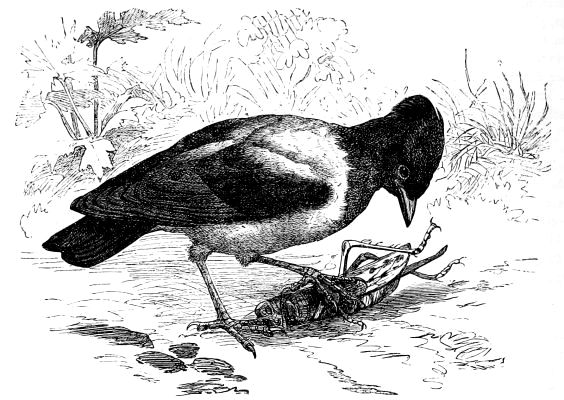
THE ROSE STARLING (Pastor roseus).
The MINA BIRDS (Acridotheres) form a distinct group of Starlings, inhabiting the continent of India. In these birds the beak is short, strong, and slightly curved at its roof; the feet are powerful, the toes long, the tail rounded at its extremity, and the head ornamented with a crest.
THE MINA BIRD.
The Mina Bird (Acridotheres tristis) is about ten inches long, three and a half of which belong to the tail; the wing measures five inches and a quarter. The feathers upon the head, nape, and breast are of a brilliant black; the rest of the coat is reddish brown, the wings and back being of a deeper shade, and the under side lighter than the rest of the body; the exterior quills are black, but white at the root, thus giving a somewhat spotted appearance to the wing; the tail is black, and tipped with patches of white, the latter becoming gradually wider towards the sides; the belly and lower wing-covers are also white.
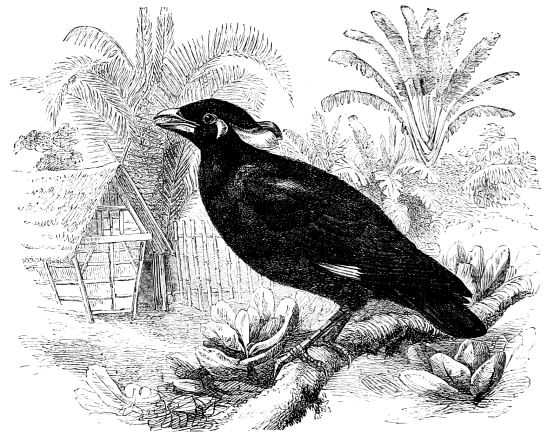
THE MUSICAL GRAKLE (Gracula musica).
The Minas are among the commonest birds in India, Assam, and Burmah, where they frequent the neighbourhood of towns and villages in preference to more wooded districts. A tree is usually selected as their sleeping-place, and from this point they fly over the country in small parties in search of food, stealing occasionally even into the huts of the natives, in order to obtain cooked rice, of which they are very fond; some follow the flocks and herds, and seize the grasshoppers as they rise from the grass when disturbed by the cattle, others seek subsistence by plundering the gardens and orchards in their vicinity. When upon the ground the Mina walks with ease, constantly bowing its head as it goes, and occasionally springing to a considerable distance; its flight is heavy, direct, and tolerably rapid, and its notes rich and varied. So little fear is exhibited by these birds that they build almost exclusively in the vicinity of houses, or even in temporary cages that are hung out for their accommodation. In Mosuri, where this species is only a summer visitor, it usually prefers making its nest within a hollow tree. Like the Starling, it easily acquires the art of speaking, and of imitating a variety of sounds. The Mina has been dedicated by the Indians to their god Ram, and is usually represented as perched upon his hand. Major Norgate has given a full description of this interesting bird, from which our space will only allow us to extract the following account of its quarrelsome propensities—regular pitched battles, he tells us, are of constant occurrence amongst these pugnacious little creatures; the two combatants, who usually belong to different flocks, coming to the ground, in order the better to carry on their struggle, which is maintained by clawing, beating with the wings, and rolling round each other, screaming loudly as the combat waxes hot; only for a very brief space, however, is the fight confined to these two champions of the rival parties; one after another the rest come down and mingle in the fray, which often rages so fiercely that broken wings or other injuries at last compel the untiring combatants to cease their strife. The same writer describes the Mina's manner of singing as being very amusing: it inflates its chest as though about to make a most tremendous effort, and then gives voice to such a variety of crowing, grunting, and squeaking sounds as cannot fail to astonish its hearer. When in flight the notes of these birds are by no means unpleasing; but if alarmed their cry rises to a loud, hoarse shriek, the rest of the party usually joining chorus until the uproar becomes general. The nest is constructed with the utmost carelessness, and is, in fact, a mere heap of straw, twigs, rags, or even shreds of paper; but in spite of the discomfort of the home thus provided for the young, the latter are tended by both parents with great affection.
The GRAKLES (Graculæ) constitute a race of Starlings that have always been regarded with great favour by mankind. These birds are of a moderate size, with thick bodies, and short wings and tails; the beak, which equals the head in length, is thick, high, and in its transverse section of a square form, the upper mandible is rounded and much vaulted at its roof. The fourth quill of the wings is longer than the rest, and the tail, which is rounded at its tip, is composed of twelve feathers; the feet are strong, and the head is furnished on each side with two moveable appendages resembling flaps of skin (which are usually brightly coloured) hanging down from behind the eyes. The plumage is soft, and of a satin-like brilliancy.
THE MUSICAL GRAKLE.
The Musical Grakle (Gracula musica, or Gracula religiosa) is about ten inches long and eighteen and a half inches in breadth; the tail measures nearly three inches, and the wing five inches and three-fifths. The plumage of this species is of a uniform rich, deep, purplish black, shaded with green upon the lower part of the back and upper wing-covers; upon the under surface of the body this beautiful green shimmer is less distinctly visible; the wings and tail are jet black, the former edged with a white band, formed by a series of patches, with which the first seven primary quills are marked; the strange fleshy flaps to which we have alluded are of a bright yellow colour, and are appended behind the eyes, passing over the ears, at which part they become considerably dilated. A naked space under the eyes is also of a brilliant yellow. The beak is orange, the feet yellow, and the eyes dark brown.
Jerdon tells us that these birds principally inhabit the woods of Eastern India, and that they are found in considerable numbers in the Rhat Mountains and other elevated regions, living at an altitude of 3,000 feet above the level of the sea, and only making their appearance in large flocks during the winter; at other seasons of the year they are usually met with in parties of six or seven. These assemblages pass the night together, generally in beds of reeds or bamboo thickets upon the banks of the mountain streamlets. Their food consists of various kinds of fruit and berries, and their visits are therefore greatly dreaded by the proprietors of fields and gardens. The Grakle is lively and active, much resembling the Common Starling in disposition: its song is cheerful and varied, but contains many unpleasing notes; its powers of imitation are so highly developed as to render it a most interesting companion when tamed; indeed, some of the admirers of this gifted bird declare it to be superior to the Parrot in the art of mimicry, and at the same time entirely without the disagreeable noisy habits that often render the latter intolerable. When caged, the Grakle not only becomes much attached to those who feed it, but soon familiarises itself with all the dogs and cats of the establishment, and will even fly fearlessly about the house in search of food. Our own experience does not allow us to speak in quite such unqualified terms of praise as the writer from whom we quote: we have seen an instance in which one of these birds was so voracious as scarcely to allow itself time to utter a sound, and so pugnacious and quarrelsome as to be an object of dread to all its feathered companions, who suffered severely from its beak and claws. This species breeds in holes of trees, but its eggs have not as yet been identified.
The OX-BITERS (Buphagæ) are very remarkable birds, differing from other Starlings in the construction of their beak and feet, but resembling them in their mode of life and general habits. Their bodies are slender and their wings long; the tail, which is composed of twelve feathers, is of moderate size; the feet are provided with short toes, armed with strong hooked claws; the very peculiar beak is round at its base, and towards its tip compressed at the sides; the upper mandible is vaulted, and the lower portion bent forward at an obtuse angle; the plumage is lax, and of a brownish-grey colour. We are only acquainted with two species: they inhabit Central and Southern Africa, and bear a strong family likeness to each other both in their appearance and demeanour.
THE AFRICAN OX-BITER.
The African Ox-biter (Buphaga Africanus) is about nine inches long and thirteen and three-quarters broad, the tail measures three and a half inches. The whole of the upper part of the body, including the throat and a portion of the breast, are of a uniform reddish brown, the belly and rump being of a light reddish yellow; the wings and tail are deep brown, the beak is of a reddish tint at its extremity and yellow towards its base; the feet are brownish grey, and the eyes bright reddish brown.
THE RED-BEAKED OX-BITER.
The Red-beaked Ox-biter (Buphaga erythrorhyncha) is about the same size as the species last described. Upon the back this bird is of a greyish brown, the lower parts of the body are pale yellow; the beak is light red, the feet greyish brown, and the eyes and eyelids of a golden colour. Both the species alluded to above are found spread over a large extent of country—the former inhabiting South Africa, whilst the home of the latter is confined to the central regions of that continent; occasionally both are found inhabiting the same district, but under no circumstances do the two species—though their mode of life has so much in common—ever join company. They are usually seen flying in little flocks of from six to eight, following herds of cattle, camels, elephants, or rhinoceroses about the country, the whole party frequently settling upon the backs of these animals in search of the flies or bots by which they are much infested. These birds are much disliked by the natives, owing to an idea very prevalent in Abyssinia, that the Ox-biter prevents the sores upon the cattle from healing; but this is far from being the case, as the beasts themselves seem to be fully aware, for they will stand with the greatest patience and allow the birds to extract the maggots from their skin or clear away the flies that have been attracted to any wounded part, never so much as attempting to frighten away their little friends, whose sharp probing beaks are rendering them efficient relief at the expense of a few moments of pain. Only such beasts as are unacquainted with the happy results attendant on this operation ever resent it, but these will occasionally testify excitement almost approaching to frenzy when they find themselves taken possession of by such unbidden guests. Ehrenberg tells us that the manner in which the Ox-biters carry on their work is most amusing, and describes their movements over the bodies of the huge beasts they favour as resembling those of the Woodpecker when climbing about the trunk and branches of a tree; no portion of the animal escapes scrutiny, and in prosecuting their search they will even hang head downwards from the ears or limbs, in order more perfectly to carry out their minute investigations. It is a strange sight to see the perfect confidence with which both quadrupeds and birds seem to regard each other, though the latter are so afraid of man that on the first sight of a stranger they scramble together upon the very top of the back of the ox or camel whose skin they are examining, and, should the traveller attempt to approach nearer, seek safety in flight, rising into the air with wings full spread, and, after describing a large circle, descend to resume their labours;—should danger still impend, they take refuge upon some high stone or piece of rock; but they never frequent trees for this purpose. Gordon Cumming tells us that the cattle are often warned of the approach of some of their numerous enemies by the acute perceptions of these watchful servants; but neither he nor any other traveller has given us any information as to the manner in which the Ox-biters build their nests, or carry on the work of incubation.
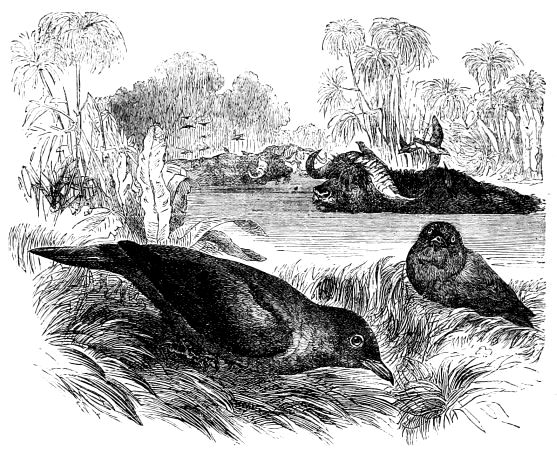
THE RED-BEAKED OX-BITER (Buphaga erythrorhyncha.)
The tropical regions of Africa, and some part of Asia, are inhabited by a group of birds which seem to form a connecting link between the Starlings and the Birds of Paradise, and are distinguished by such splendour of colour and satin-like brilliancy of plumage, as to have obtained the name of
The GLOSSY STARLINGS (Lamprotornithes). All parts of the countries to which they belong are enlivened by the presence of these brilliant creatures, but they principally take up their residence in rocky districts, wooded valleys, or even in the immediate vicinity of man, though they prefer to disport themselves amidst the woods, to which they lend an embellishment that travellers are never weary of extolling. The various members of this group are without exception lively, bold, and noisy in their demeanour; they are usually met with in large flocks, and in many cases do not withdraw from the society of their companions, even during the breeding season; this sociable disposition is, however, by no means manifested towards other birds, with many of whom they live in a constant state of active warfare. Fruit, seeds, snails, worms, and insects of various kinds constitute their principal food, but they will occasionally eat carrion, and, like the Ox-biter, they often render good service to the cattle by clearing them from various parasites. Their movements are light and active, in all respects resembling those of other Starlings, and their disposition exceedingly sagacious and intelligent. Some species have very discordant voices, while others are not without some slight pretensions to song, inasmuch as their call-note is agreeable, and often composed of more than one syllable. Such trifling peculiarities as distinguish the various members of the group are most strikingly observable in the difference of their habits during the breeding season: some species separating from the rest of the flock while busied with the cares of a family; others, on the contrary, remaining with their companions even at that period of the year. The formation of their nests varies considerably, according to the situations in which they are placed—such as are built among the rocks being nothing better than a mere heap of twigs or grass, whilst those placed in the trees are necessarily substantial, and more artistic in their construction. The brood usually consists of five or six eggs, of a green colour, and marked with either red, brown, blueish, or black spots; some species breed twice within the year. It is at present doubtful whether any of these birds ever migrate; for the most part they seem to spend their time in wandering over a limited tract of country, appearing in certain parts only for a short time, and then as suddenly taking their departure. The Glossy Starlings are seldom caught by the natives of the regions they frequent, and are, therefore, very rarely seen in our part of the world, though their great beauty, and the ease with which they may be reared, eminently point them out as adapted for life in a cage.
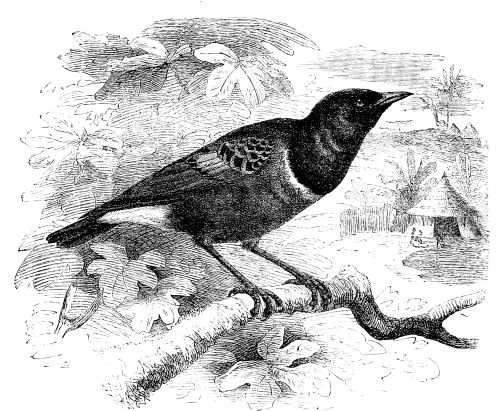
THE SUPERB GLOSSY STARLING (Notauges superbus).
We have divided this group into several divisions, the first of which contains
The TRUE GLOSSY STARLINGS (Lamprocolii). In their general conformation these birds resemble our Common Starling; the beak, which is of moderate size, slightly curves towards its tip, and the upper mandible reaches a little beyond the lower. The wings extend about half way down the rather short tail, which is straight at its extremity. The feet are short and powerful, the toes large, and the claws with which they are furnished of moderate proportions. All the members of this group are decked in the most gorgeous apparel, of which a metallic green is usually the predominating tint, and all have a more or less satin-like gloss upon their plumage.
THE BRONZE-COLOURED GLOSSY STARLING.
The Bronze-coloured Glossy Starling (Lamprocolius chalybeus), an inhabitant of North-Eastern Africa, possesses an attire of such extraordinary lustre, that words are almost inadequate to express the appearance it presents when glittering in the rays of a tropical sun. The plumage is bronze-like in tint, except upon the sides of the head, the lower part of the belly, and wings, these parts being blue, as are the tips of the feathers upon the shoulders; the dresses of the male and female are alike, but the young are of a metallic green upon the back, and underneath of a deep brownish grey, almost entirely devoid of brilliancy. This species is about ten and a quarter inches long and seventeen and a half in breadth; the wing measures five and a half, and the tail three and three-quarter inches. The Bronzed Glossy Starlings are to be met with in great numbers in their native land, more especially in the forests, which they seem to prefer to the less densely wooded districts; they also occasionally frequent the more open country, living for the most part in pairs, and only congregating in small flocks after the termination of the breeding season. They are brisk and lively, endowed with all a Starling's alacrity, both upon the ground and in the trees; their flight alone is peculiar, being distinguished by a noiselessness that plainly indicates the velvety softness of their wings. Little can be said as to their other endowments—their song is extremely insignificant, and their call-note a most unpleasing sound. To say the truth, if these birds were not so splendidly decorated they would have little to recommend them to our notice, nature seems to have been so lavish in this one particular as to have deemed any other charm unnecessary. Those who have seen the Bronze Starling in its native woods describe it as flashing upon their astonished sight like a bright and unexpected gleam of sunshine, its feathers during life reflecting every ray of light as does a looking-glass; but they lose this intense brilliancy very shortly after death. This beautiful creature has, we believe, as yet never been brought to Europe.
THE GOLDEN-BREASTED GLOSSY STARLING.
The Golden-breasted Glossy Starling (Notauges chrysogaster), another species belonging to this group, is an inhabitant of North-Eastern Africa, and is distinguishable from its congeners by the greater thickness and inferior gloss of its plumage, as well as by its slender beak, short tail, comparatively strong high tarsi, and long toes. This bird is not more than eight inches long and thirteen and a half broad; the wing measures four inches, and the tail two inches and a half. In the old male the brow and upper part of the head are of a greyish green, the mantle, neck, throat, and breast blackish green, intermingled with bright brown; the rump is brilliant steel blue, the belly and thighs rust red, but entirely devoid of lustre. The bridles are black, the eyes brown, the beak yellow, and the feet blueish black. The young are dark brownish green upon the back, and reddish brown below the region of the throat, which is rather deeper in shade than the breast.
THE SUPERB GLOSSY STARLING.
The Superb Glossy Starling (Notauges superbus) may certainly be regarded as the most magnificent member of the group. This species, which inhabits Abyssinia and the most unfrequented portions of the African continent, is of about the same size as that last mentioned; its plumage is a reddish copper colour upon the top of the head, and green upon the mantle, each feather being tipped with a brilliant silky black spot; the front of the throat, upper part of the breast, and tail are blue, with a steel-like gloss. The rest of the body is red, with the exception of a white band upon the breast.
These birds are met with in considerable numbers throughout the whole of Soudan; they may usually be seen flying about in large flocks, sometimes, but rarely, in pairs. Heuglin tells us that though they prefer to reside upon low-lying plains, they are occasionally met with at an altitude of 4,000 feet above the sea, but we ourselves have never seen them at so great an elevation. During the day multitudes of these gorgeous creatures may be observed disporting themselves with great vivacity, running in small parties over the ground in search of food, or seeking repose and shelter from the mid-day sun amongst the branches of the trees, on which they also perch morning and evening, whilst the males pour forth their matin or vesper song; should the party be alarmed, they do not seek safety in flight, but hide amongst the foliage until they can again venture from their concealment. During the whole time they are in search of food the neighbourhood is kept in a constant state of uproar: one screams to another almost without intermission, several frequently joining in with their voices, apparently for the sole purpose of rendering confusion worse confounded. As may be imagined, it is no difficult matter to trace a flock of these birds, but their capture by means of the gun is attended with much difficulty, as they are extremely shy, and resort to shelter at the first alarm of danger.
The members of the second division of this group are recognisable by their delicate, arched, and compressed beaks, short wings, tails of moderate length, weak long-toed feet, and scale-like plumage, from which they have derived their name of SCALY GLOSSY STARLINGS (Pholidauges). We are only acquainted with one species—
THE SCALY GLOSSY STARLING.
The Scaly Glossy Starling (Pholidauges leucogaster) is met with over a large portion of Africa, and also occasionally found in Arabia. The plumage of this gaily-bedizened bird is of a rich violet over the whole of the back and throat as far as the breast, these parts being pervaded by a beautiful blue reflection or shimmer; the breast and belly are white, the wings blackish brown, bordered with violet, and relieved, as are all the darker portions of the body, by a copper-coloured metallic brilliancy; the iris is light brown, and the beak and feet black. The young differ widely in appearance from the adults, the upper portion of their bodies being striped with light and dark shades of brown, while the under parts are reddish white, streaked with brown. The male is about seven inches long, and twelve and a half broad; the wing measures four inches, and the tail two inches and three-quarters.
These birds are widely distributed throughout the countries where they reside, generally, however, preferring mountainous districts; they are eminently arboreal, and but rarely pass any length of time upon the ground. In their mode of life they resemble other Starlings, but are very quiet compared with the rest of their family. When in flight their plumage is extremely striking, for, instead of its usual violet hue, its back glitters in the sunlight with a bright copper colour, and it is only when it remains stationary that the blue shades become apparent, insomuch that those who are lucky enough to bring down one of them with the gun are astonished to find how they have been deceived as to the real colours. In its movements this brilliant bird is light and elegant, flying with great rapidity high in the air; when in search of a resting-place, it selects the tops of high trees, those in the immediate vicinity of water obtaining a decided preference. Heuglin tells us that he has seen these birds living 2,000 feet above the sea, but gives us no information as to their nests, or habits during the breeding season.
The GLOSSY MAGPIES (Lamprotornithes) constitute a small group belonging to the family of the Starlings. They somewhat resemble the Jay in their form and habits, and are of larger size than the species we have been describing. They are, moreover, remarkable for the great development of their tails; the beak is small and delicate; the upper mandible is arched, and curves slightly outwards at its edges; the wings are long, and the tail so sharply graduated, that the exterior feathers are only a third of the length of those in its centre; the tarsi are high, the toes long, and armed with strong claws.
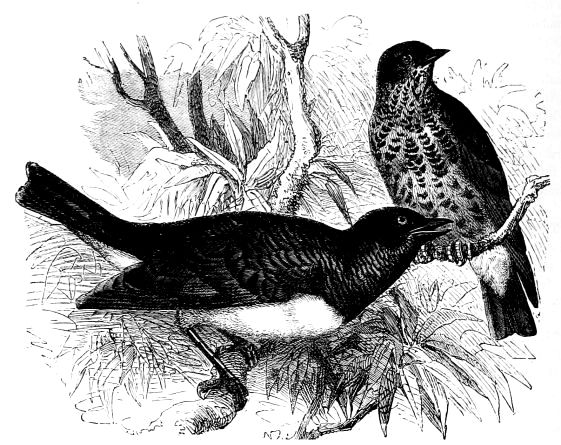
THE SCALY GLOSSY STARLING (Pholidauges leucogaster).
THE BRAZEN GLOSSY MAGPIE.
The Brazen Glossy Magpie (Lamprotornis äenea) is from eighteen to twenty inches long, ten or thirteen inches of this measurement belonging to the tail; the wing is from six and a half to seven and a half inches long. The predominating shade upon the plumage is a beautiful ever-changing blueish green; the back and lower parts of the body are brown, and the head enlivened by the copper-like brilliancy we have already alluded to as pervading this group. The feathers upon the wing-covers are spotted with black at their tips; the tail is purplish blue, marked with irregular dark spots, and gleams with metallic lustre. The eye is light yellow, and the back and feet black. These splendid birds inhabit Western and Southern Africa, and are replaced by a very similar race in the more northern portions of the continent. Le Vaillant, whom we have to thank for the discovery of this species, tells us that the Brazen Glossy Magpies congregate in large flocks, and spend their lives principally amongst the trees, from which they descend from time to time to seek for food. When running upon the ground the long tail is borne aloft, after the manner of the Jay. In disposition these birds are extremely shy, and distrustful of man, though we have occasionally seen them near such of the native huts as are built upon the borders of the forest. Heuglin mentions having seen them living both in pairs and flocks, at an altitude of 4,000 feet above the level of the sea; we learn from the same author that they will occasionally eat carrion; their voice is harsh and screaming, and so peculiar in its sound as to be quite unmistakable. Their food consists of various kinds of insects, some of which they catch with great dexterity when on the wing.
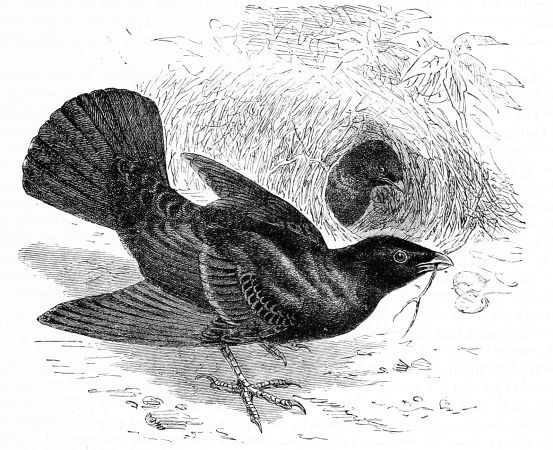
THE SATIN BOWER BIRD (Philonorhynchus holosericus).
The ROCK GLOSSY STARLINGS (Moriones) constitute the last group of this family to which we shall allude. These birds are recognisable by the inferior beauty of their plumage, which, however, is not without a certain brilliancy and gloss upon the feathers; in all the species the quills of the wings are almost or entirely brown.
THE WHITE-BEAKED ROCK GLOSSY STARLING.
The White-beaked Rock Glossy Starling (Philonorhynchus albirostris) is found in Abyssinia, where it frequents the rocky parts of the country, or lives upon high bare trees or ancient ruins. Its plumage is silky; the short beak, which is rounded at its tip, is slightly notched, and partly covered with hair-like feathers at the base of the upper mandible; the wings are rounded and moderate in size, the third quill being longer than the rest; the tail is rather long, and square at its extremity; the feet are powerful, the toes long, and armed with strong hooked claws. The plumage of the old male is principally of a blueish black, that shines with a steel-coloured lustre; the tail and large wing-covers are of a soft velvety black; their quills brownish red, tipped with a blackish shade upon the outer web. The iris is reddish brown, the beak greyish brown, and the feet black. The female and young are blueish grey upon the head, throat, and breast. The length of this bird is about eleven inches, the wing measures six and a quarter, and the tail four inches and one-third. Rüppell, who first discovered this species of Rock Starling, tells us that it lives in flocks, and subsists upon various kinds of berries and seeds; its movements are light and elegant, and its voice pleasing and rich in its tones. The capture of this bird is extremely difficult, as it is exceedingly shy, and ever on the alert against approaching danger, which it eludes by seeking shelter amongst the fastnesses of its favourite rocks.
The MOUNTAIN GLOSSY STARLINGS (Amydrus) are distinguished by their decidedly curved and delicate beaks, short rounded wings, long graduated tail, and silky plumage, which is entirely without the metallic brilliancy possessed by the birds above described; they inhabit Southern and Central Africa, and are occasionally met with in Arabia. As an example of this group we select
THE NABURUP.
The Naburup (Amydrus Naburup), is a bird about nine inches and two-thirds long; the wing measures five and a quarter inches, and the tail four inches. The colour of the plumage is a dark steel blue, except upon the six first quills, these being reddish brown upon their outer web, light brown upon their inner portion, and blackish brown at their tips; the iris is light red, the beak and feet pale black. The coat of the female resembles that of the male, but she is somewhat smaller. The young are brown, spotted with steel blue. In its habits this species is social and its song agreeable; like its congeners, it builds amongst the rocks of Abyssinia, forming in some cases small settlements, and weaving its nest with so little skill as to permit the eye to penetrate its interior. Both sexes assist in the work of incubation, but beyond this we have no knowledge of their habits.
The ORIOLES (Orioli) constitute a family of beautiful birds, regarded by some ornithologists as allied to the Thrushes, and by others classed with the Birds of Paradise, but to which we venture to assign a position in this place. They are recognisable by their elongate slender bodies, long wings, and tails of moderate size; the feet are short, the toes strong, and armed with powerful claws; the beak is long and conical; both mandibles are rather vaulted, and the upper one terminates in a slight hook. The plumage, which is soft and gay in its colours, varies considerably, according to the age or sex of the bird; and, when destitute of the brilliant gloss by which it is usually distinguished, is still more varied in its hues. Several of the most interesting species of this family inhabit Australia, and none of its members are found beyond the limits of the eastern hemisphere. All may be regarded as tree-birds, though some few spend a considerable portion of their time upon the ground, over which they hop with an extremely heavy, awkward step; amongst the branches, on the contrary, their movements are light and graceful, and their voice is both full and pleasing in its tones. Fruit and insects constitute their principal food. During the period of incubation many species separate entirely from their companions, towards whom they testify considerable animosity and jealousy; but others remain in the company of their associates even at that season of the year. The nests of all are placed upon trees, and are remarkable for the neatness and beauty of their construction.
THE SATIN BOWER BIRD.
The Satin Bower Bird (Ptilonorhynchus holosericus), a recently-discovered inhabitant of Australia, is a very celebrated member of this family. The body of this species is powerful, the wings rounded at the tip; the tail of moderate size, and cut straight at its extremity; the tarsi are high, slender, and the toes short. The beak is strongly formed, the upper mandible arched at the tip over the lower portion, which is also slightly bent. The adult male is truly a splendid creature, with rich satin-like plumage of a deep blue black; the primary quills and the secondaries are of velvety blackness, tipped with blue, as are also the wing and tail feathers; the iris light blue, surrounded by a narrow red ring; the beak is blueish grey, tipped with yellow, and the feet red. The female is green upon the upper parts of the body, and underneath of a yellowish green; the feathers are spotted here and there with brown crescent-shaped spots, that give a scale-like appearance to the lower portion of the bird; the wings and tail are deep yellowish brown. The young resemble the mother.
Gould has made us familiar with the curious habits of the Satin Birds, whose favourite haunts are found amidst the thickly-foliaged "bush" of Australia, and here they may be seen living in pairs throughout the greater part of the year, only quitting their favourite locality when tempted to short distances by the hope of obtaining some particular kind of food. In autumn they usually congregate in small flocks, and seek a home among the bushes that grow upon the banks of neighbouring rivers. Insects sometimes form a portion of their diet; they, however, prefer fruits and grain, and are fond of robbing the gigantic fig-trees of their tempting burden. When engaged in eating, these birds are so extremely shy and cautious as to render their capture almost impossible. One of the oldest members of the party is usually found perched upon the highest branch of some neighbouring tree for the purpose of warning his companions of approaching danger: this he does by a peculiar clear note, which—should the sentinel become excited—is followed by a harsh, guttural cry. Their bowers have been described by the author from whom we quote as most peculiar and beautiful in their construction. From observations made by himself, he tells us that these remarkable erections are generally placed upon the ground, under the shelter of an overhanging tree or bush, in some quiet and retired place, and vary considerably in their size. The walls are strongly formed of twigs and small branches woven together in such a manner as to bring the ends in contact at the top. An opening is left to form an entrance at both extremities of this strange arbour, which is decked with every gay or shining material that the little architects can procure; snail or mussel shells, pebbles, or white bones are laid as ornaments to grace the entrances, and Parrot-feathers or brightly-coloured rags are stuck between the twigs; indeed, so well do the natives know the passion of the Satin Bird for glittering or polished objects, that should they lose anything of that description, they at once endeavour to discover the bower that has been beautified at the expense of their property. Gould mentions having found a pretty pebble an inch and a half long lying within one of these edifices, which was also decked with a variety of blue woollen scraps that had, doubtless, been stolen from a settlement in the vicinity. Males and females alike resort to these bowers, solely, as it would appear, to disport themselves in very much the same manner as we do in a ball-room, dancing and turning about with the greatest spirit and liveliness, or chasing each other up and down their gay apartment in an untiring whirl of sportive delight. Should a female lose her mate, she at once consoles herself with another; and we have known an instance in which one of them was deprived of no less than three successive mates, without deterring her from participating in the gambols of the rest of the party. The males principally undertake the actual labours of constructing the gala chamber, whilst all the more delicate work of beautifying the interior devolves entirely upon the females; the nests are said to be built at no great distance from the bower; but the eggs, as far as we know, have never been found. A pair of Satin Birds were presented to the Zoological Gardens in the Regent's Park some few years ago, and a bower, constructed by them, may be seen in excellent preservation in the British Museum.