CLASSIFICATION OF BIRDS. (continued 2)
Thomas Rymer Jones translation
In New Guinea and the neighbouring islands, viz., Salawatti, Misool, and Waigui, we find several kinds of parrots that are included among the Cockatoos, although their resemblance to these birds is merely superficial. These are the Long-billed Parrots (Microglossus) of Le Vaillant—very large birds of a dark colour. Their resemblance to the Cockatoos consists principally in their short square tail, and the plume upon the head, although the latter is of quite a different shape to that of the true Cockatoo. Their naked cheeks, and enormous upper mandible, remind us of the Araras. The shape of the tongue is quite peculiar; this organ is of medium length, fleshy, but no broader than it is thick, the upper surface is hollow and flattened at the tip; this strangely-shaped tongue can be protruded, and employed as a spoon to convey food into the mouth, the edges being very flexible, and capable of being bent towards each other. The other distinguishing characteristics of the Long-billed Parrots are the naked tarsi (which are bare as far as the heel-joints) and the short flat soles of the feet.
THE CASMALOS.
The Casmalos (Microglossus aterrimus), the best known of these species, is an inhabitant of New Guinea, and is one of the largest of the parrot tribe, even exceeding most of the Araras in this respect. Its plumage is uniformly deep black, with somewhat of a greenish gloss; the living bird has a greyish appearance, owing to a white meal-like dust, which, as in most other parrots, is scattered over its plumage; the naked wrinkled cheeks are of a red colour. The crest is formed by a number of long slender isolated feathers, and is of a lighter grey than the rest of the plumage.
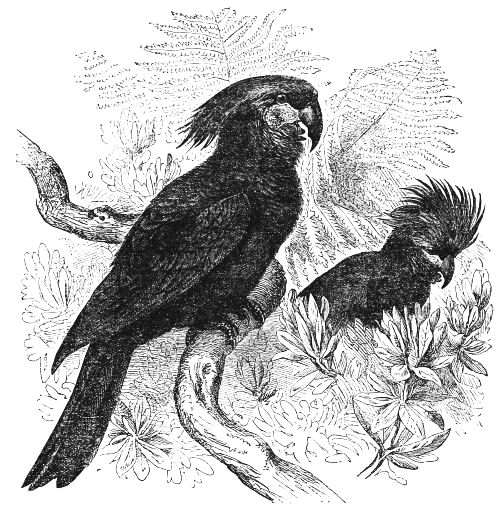
THE CASMALOS (Microglossus aterrimus).
Little is known of these birds in their natural state. "The Large-beaked Parrot," says von Rosenberg, "is not rare in the islands of Waigui, Misool, and Salawatti, and is found on the coast of New Guinea. It usually perches at the very top of the highest trees, keeping its body constantly in motion, and whilst resting, or when by powerful strokes of its wings it raises itself into the air, it utters a trumpet-like note quite different from that produced by the White Cockatoo. The natives take the young birds from the nest, and, when they have reared them, sell them to traders. In captivity they seem to prefer the fruit of the canary tree, the hard shell of which they manage to crack with the utmost facility. One of these so-called Cockatoos, belonging to a resident in Amboyna, was in the habit of flying about all over the town, but always returned home at the proper time to take its meals and to sleep." Von Marten saw a tame parrot of this kind at Mahai. "The Black Cockatoo," he observes, "when perched stiffly with its tail erect, red face, and powerful beak, has the air of an old general, and, owing to its extreme ugliness, makes a forcible impression on all who see it. It is quiet and slow in its movements, but allows strangers to approach, and utters from time to time a disagreeable, harsh, guttural shriek."
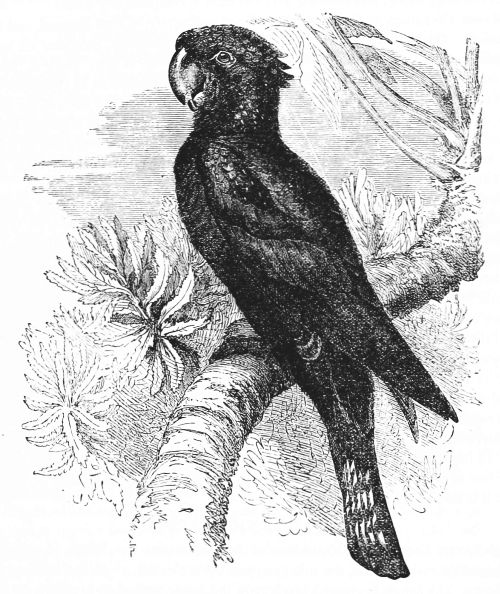
THE RAVEN COCKATOO (Calyptorhynchus Banksii).
According to Rosenberg, the Large-beaked Parrot is often seen at Amboyna, where it may be bought for about twenty or twenty-five shillings: in Europe these remarkable birds are amongst the greatest curiosities in our collections. Unlike all other parrots with which we are acquainted, the Casmalos uses its peculiarly-formed tongue in a strange manner; taking its food with its foot, it carries the morsel to its beak, tears it up, and presses the end of the tongue, which is provided with a round horn-like plate, upon the pieces, which stick to it; the tongue is then drawn in, and the food swallowed; this being a very slow process, the meal usually occupies a considerable time.
The Raven Cockatoos (Calyptorhynchus) differ very materially from all other species not only in the colour of the feathers, but in their form. The beak is short, crescent-shaped, and sloping, owing to the great breadth of the lower jaw; the wings are large and broad, reaching only over the first third of the long, strong, and rounded tail; the crest is comparatively small.
The Raven Cockatoos, or Geringeroes, are found exclusively in New Holland, and there only in certain districts. Gould, the great explorer of Australian ornithology, mentions six species in his masterly work, and gives a tolerably full account of their mode of life; there is, however, great similarity between them, and the following observations may be considered as applicable to all.
The Raven Cockatoos are truly tree-birds, feeding principally upon the seeds of the Eucalypti, and other trees indigenous to the country, but, unlike other parrots, they will occasionally eat large caterpillars. Another peculiarity is that they only congregate in small parties consisting of not more than from four to eight individuals, and never assemble in considerable flocks. Each part of Van Dieman's Land has its peculiar species.
The manner in which the Raven Cockatoos feed is also very peculiar. Some species break off the little twigs of the fruit trees while eating, apparently out of mischief; and all use their sharp beaks to draw the concealed living insects—principally larvæ—out of the wood. The large caterpillars which they obtain from the gum-trees do not always satisfy their hunger; they wage war upon the grubs that lurk deep in the wood, dextrously stripping off the bark and picking large holes in the branches until they reach their prey. Some species prefer insects to any other kind of nourishment, whilst others subsist upon seeds, principally those of the Casuarinæ and Banksias. Fruit they seem to despise, although they destroy much out of pure mischief, plucking it before it is ripe, to the great annoyance of the owners.
So far as we know, the Geringeroes breed exclusively in the holes of trees, always choosing the highest and most unapproachable trunks, and invariably such as the natives cannot climb. They prepare no regular nest in the holes which they select, or at most only collect chips of wood from the ground, wherewith to line the interior. They lay from two to five tolerably large eggs, 1-2/3 inch in length and 1-1/3 inch broad. Besides the attacks made upon them by man, the Raven Cockatoos often become victims to birds and beasts of prey. Europeans do not prize their flesh very highly, but by the natives it is esteemed a delicacy.
BANKS' RAVEN COCKATOO.
Banks' Raven Cockatoo (Calyptorhynchus Banksii) attains the length of a foot and a half. The plumage of the male is black, the only exception being the tail, which is a brilliant black with a greenish sheen. The female is greenish-black upon the head, spotted with yellow on the neck and wings, and striped with light yellow upon the breast. The male has a broad scarlet band extending along the middle of the tail, but not reaching the two middle feathers or the outer edge of the side feathers. The female has broad yellow and reddish-yellow spotted stripes similarly disposed, both upon the outer and the under side of the tail-covers.
Banks' Raven Cockatoo belongs to New South Wales, and is principally found in the district between Moreton Bay and Port Philip, though by no means rare in the immediate neighbourhood of Sydney and other large towns. Its flight is heavy; the wings are lax, and seem to move with difficulty; it seldom rises high in the air, but will, nevertheless, sometimes fly for a mile at a stretch; whilst on the wing it utters a loud cry, which is less shrill than the harsh screech of the cockatoo. When on the ground, these birds move with difficulty; upon the tops of trees their motions are less deliberate, but always slow. Most of them are shy and distrustful, owing no doubt to the manifold persecutions from which they suffer, and it is only during feeding-time that they are less upon the watch. They are much attached to their companions, and should one of them be killed or wounded, the hapless individual is seldom deserted by the others, who generally fly about him, uttering a wailing cry, and expose themselves so recklessly to the hunter, that he, knowing how to avail himself of this habit, often succeeds in capturing the whole flock.
THE KAKAPO, OR NIGHT-PARROT OF NEW ZEALAND.
For the same reason that the Owls and the Falcons are grouped as distinct families, we shall consider the Kakapo, or Night-parrot of New Zealand (Strigops habroptilus) as the type of a peculiar race. This bird, indeed, reminds us so forcibly of the Owls, that were it not for the structure of the foot, we should decidedly class it as one of them. Its scientific name of "owl-faced" (Strigops) is very well chosen. The large body of this species is covered with soft, delicate feathers, which form a rudimentary veil about the face; the wings are short and trough-shaped; the tail long and rounded; the beak long, bent like that of an owl, and nearly covered with stiff, bristle-like feathers; the feet are of middle size, the toes long. The general colour is a dark green, interspersed with tolerably regular stripes, and some irregular yellow spots; upon the breast the colour is lighter and yellower than on the back, and the stripes are indistinct; the green tail is banded with dark brown. The habitat of the Kakapo is restricted to New Zealand, and the species is now found in tolerable abundance only in the most remote Alpine valleys of the southern island. It has been nearly exterminated in the northern portion. Lyall and Haast have given us full particulars of its habits. "The Kakapo," says the first of these writers, "is still found occasionally in the northern districts of New Zealand, frequenting the dry cliffs or the low grounds near the banks of the rivers, where the high trees and woods are, to some extent, free from ferns and brushwood. The first time we met with it was upon some hills, rising 4,000 feet above the level of the sea; but we afterwards found it living with others of the same species, on open spots near the mouth of the river, and not far from the coast." "Most striking," adds Haast, "is the fact that the Kakapo (except in the valley of the Makavora, formed by the Lake Wanaka) is never seen east of the mountains, although forests abound there; apparently the absence of woodland in the intervening district is an obstacle to its farther progress in that direction. These birds are less numerous in the Wilkin valley, where I have observed traces of the wild dog; in the valley of the Hunter, which is only separated from these districts by a chain of not very high mountains and some inconsiderable hills, no trace of them is to be found, although the fine beech forests offer them a favourable retreat." "In such places," says Lyall, "the tracks of the Kakapo were visible; these are about a foot wide, very regularly worn, and often resemble in so striking a manner those made by men, that at first we really believed that the natives must have been in the neighbourhood. The Kakapo lives in holes under the roots of trees, and in the cavities of overhanging rocks."
Lyall tells us that the holes he saw had two openings, and the trees above them were for some distance hollow. The Kakapo, he says, was not visible by day, except when driven from its retreat; and he was never able to find it but with the help of dogs. When these birds were more plentiful, the natives used to catch them at night by torch-light. There is a breed of half-wild dogs in the northern part of this island continually hunting the Kakapos, which, indeed, they have almost exterminated. It is said that the spread of these dogs is arrested by a river; but it is to be feared that so soon as they succeed in crossing that barrier, the total extinction of these birds will ensue; for although they use their beak and claws very energetically, and can make a powerful resistance, still, sooner or later, they must succumb to their four-footed enemy, and ultimately share the fate of the Moa, the Dronte, and other species recently become extinct. "The Maoris assure me," says Haast, "that the Kakapo is brave, and often confronts the dogs with success; but this cannot be credited if their dogs are worth anything, for mine never had any serious battle with it. At first, the dog was attacked both with beak and claws, but it soon learnt to conquer its game by biting it through the back." An idea was formerly entertained that the Kakapos were nocturnal in their habits, but our observations lead us to believe that this is not exactly the case. We generally heard their voices about an hour after sunset, in places which were rendered dark and obscured by thick foliage, and they then began to sweep about, attracted by the light. We, however, twice saw these birds during the day feeding upon the ground, and strictly upon their guard against approaching danger. On the first occasion, about noon on a cloudy day, we were returning through an open wood from the western coast, and saw the Kakapo sitting upon an uprooted tree, not far from the Haast river; as we approached, it quickly disappeared, but was caught by the dogs. The second time, on a clear day, as we entered a deep ravine, we saw one of these birds perched ten feet high upon a fuchsia-tree, the berries of which it was eating. As soon as it saw us, it fell, as though shot, to the earth, and disappeared beneath the surrounding blocks of stone. The most astonishing thing was, that the bird made no use of its wings; indeed, did not even open them to break its fall. In order to ascertain whether it would either fly or flutter, we followed, and having with us a Kakapo that had been taken uninjured by the dogs, we set it free upon a large, open, gravelly spot, where there was plenty of room to run away, if it wished to do so, or to raise itself into the air, even should it require a large space for that purpose. We were much surprised to find that it only ran to the nearest thicket, and that much faster than we could have thought possible from the structure of its toes and the bulk of its body. Its movements resembled those of a barn-door fowl. We stood on one side of it, and it appeared to us that it kept its wings quite close to the body; but one of our companions, who was behind it, observed that the wings were slightly raised, but motionless; so that doubtless they are employed more as a means of balancing the bird than to accelerate its progress. Though its shape is not suited to running, it can progress in this manner to a considerable distance, as we often saw by its tracks, which extended sometimes for more than a mile over sand and shingle down to the bank of the river. Lyall, however, has seen this bird flying, though only for trifling distances. "During our hunt," he says, "we only saw the Kakapo fly when, having climbed a hollow tree, it wished to reach another in the neighbourhood. From the first tree it flew down to the next in height, making its way up each in turn, climbing very quickly to the top by the help of its tail; the motion of the wings was very trifling—indeed, almost imperceptible.
"The cry of the Kakapo is a hoarse croak, which changes into a discordant screech when the bird is angry or hungry. The Maoris declare that the noise these creatures make is sometimes deafening during the winter, when they congregate in great numbers, and greet each other on their arrival or departure. The stomach of a specimen we killed contained a pale or almost white homogeneous mass, without any trace of flesh, so that, doubtless, its food consists partly of roots and partly of leaves and delicate shoots of plants. We observed that at one place where the birds were very numerous, a leguminous plant, growing on the banks of the river, had all its buds nipped off; and learnt from a boatman, who had lived in that place for many years engaged in the whale fisheries, that the Kakapo was the offender. We also found its beak covered with hardened dirt. This species, he told us, requires a great deal of river water in order to dilute the pulpy mass of vegetable matter in its crop. Except in two instances, in which berries had been eaten, we found the crop always filled with half-digested moss, and so distended and heavy that it weighed many ounces; the bird, moreover, appeared much smaller when the crop was emptied. The quantity of innutritious food with which it stuffs itself explains its liking for living upon the ground, and compels it to resort to wild localities inhabited by no other parrots. Another peculiarity, also perhaps a consequence of this vegetable diet, is, that instead of the soft oily fat that other birds have under the skin, it has an abundance of solid white fat; its flesh is much whiter than that of other parrots, and has a very superior flavour. We must be forgiven for observing that it is a dainty article of food for those who are wandering in these wildernesses, and we can quite believe that the Maoris smack their lips whenever the Kakapo is mentioned."
On the subject of their propagation, Lyall makes the following statement:—"During the latter half of February and the first days of March, at which time we tarried among the dwelling-places of the Kakapos, I found young in many holes, often only one, and never more than two in each. In one instance I found a single nestling and an addled egg. Sometimes, not always, I found the parent in the hole. There is no real nest; the bird only scratches a shallow cavity in the dry mass of decayed wood. The egg is pure white, about the size of a pigeon's.
"Many young birds were brought to us on board ship, but most of them died in a few days, apparently in consequence of the unusual treatment; others lived for some months. Generally, after a few weeks, their legs were crippled by confinement, either on account of the smallness of their cage, or the want of proper food. We fed them principally with sopped bread and cooked potatoes; if we allowed them to run about in the garden, they ate the grass and cabbages, and snapped eagerly at every green leaf that came in their way. A Kakapo which we succeeded in bringing alive to within six hundred miles of the English coast, ate, while we resided in Sydney, the leaves of the Banksias and Eucalypti. It seemed to relish nuts and almonds, and during the latter part of our voyage home, lived almost entirely upon Brazil nuts. On several occasions this bird was seized with cramp for two or three days, and whilst this lasted it ate nothing, cried furiously, and hacked with its bill if any one ventured to disturb it. At such times it was not to be trusted, for it bit most fiercely, precisely when least expected. Its temper was always at the best when any one took it out of its cage. Early in the morning it would busy itself, as soon as out of confinement, with the first object that came in its way, generally with our trousers or boots. The latter it much fancied—it would squat upon them, beat its wings, and give every symptom of the greatest enjoyment; it would then rise, rub its sides against them, roll on them back downwards, and kick its feet in the most lively manner. An unlucky accident caused its death."
Another of these birds, which Captain Stoke brought ashore and transmitted to the care of Major Murray, was allowed to run about the garden freely. It showed a strong liking for the company of children, and would follow them about like a dog.
The Long-tailed Parrots are rich in species, and present considerable variety in their dimensions, their size ranging from that of the largest Parrot to that of a Finch; but they all possess in common a graduated tail, at least as long as the body, the middle feathers of which are sometimes twice the length of those at the side. The wings, which are moderately pointed, seldom reach, when folded, beyond the first third of the tail. The beak is, as a rule, strong, almost always short, and very round, but sometimes, in solitary cases, it is long and but slightly bowed.
The plumage of the Long-tailed Parrots is very varied, still it never possesses the softness and gloss observable in the coat of the Lory. A tuft-like prolongation of the feathers is rarely but occasionally met with. It is, however, impossible to describe the plumage of this group in general terms; suffice it to say, that the hues we have mentioned as employed in the coloration of other parrots, also predominate in their feathers. The Long-tailed Parrots may be considered as the type of their order, inhabiting, as they do, all the various countries in which the race is found.
THE ARARAS.
Amongst the Long-tailed Parrots, the Araras (Aræ) are easily distinguished by their unusually large beak, furnished with a smooth broad summit. The lower mandible is very short, and incised or obliquely cut, without any ridge upon the chin, and having its base entirely covered by a cere. The cheeks are broad and naked, but sometimes covered with small feathers arranged in rows; the tarsus is thick, strong, and short; the toes long, and furnished with large strongly bent claws; the wings are long and pointed, and reach far down the tail, which is longer than the body. The plumage is very thick.
The members of this very conspicuous group are almost exclusively confined to the eastern parts of South America, where they inhabit the primitive forests, far from man and the turmoil of the world. Unlike other parrots, they live in little companies, which very rarely unite to form a flock. They feed principally upon fruit, are comparatively quiet, and although they exhibit but little vivacity, are as intelligent as the rest of their race.
THE SCARLET MACAW (Ara Macao).
This species is about 2-3/4 feet long, of which more than 1 foot belongs to the tail; the stretch of its wings is about 3-3/4 feet. The plumage is magnificent and very brightly coloured. The head, neck, breast, and belly are scarlet; the feathers of the neck and upper part of the back have a greenish edge, which becomes broader lower down. The middle and lower regions of the back, the rump, and under tail-covers are a beautiful sky blue; the upper feathers of the wings are scarlet; the middle, hinder, under, and shoulder feathers green, the latter shaded with red; the front wing-covers are ultramarine on the outer web, and on the inner pale red. The same is the case with the inner wing-covers; the middle tail-feathers are more or less red, the inner web of the quills black. On the naked flesh-coloured cheeks, which look as though powdered with white flour, are five or six rows of little pencil-shaped red feathers, implanted near the nostrils, and ranged around the eyes; the beak is of a clear horn colour, black at the point and edge, as is the lower mandible; the eyes are yellowish white, the feet blackish grey, the claws brownish black. The two sexes are alike in colour, the young birds more delicately tinted than the old ones. In the variety of this bird represented in the frontispiece to Part I., the colours are somewhat different.
The principal portion of the plumage is bright scarlet, the quill-feathers of the wings fine blue, the greater wing-coverts yellow, tinged with green, the upper and under tail-coverts blue, the two middle feathers of the tail crimson, and the remainder of the tail-feathers, which gradually decrease in length towards the sides, are partly red and partly blue; the feet are dusky black, the naked skin of the cheeks wrinkled and white, the upper mandible whitish, and the lower one black or dusky.
The Macaw was formerly to be found in the immediate neighbourhood of such large cities as Rio de Janeiro, &c., but it has long since left the inhabited part of the country. Flat, well-watered, primitive forests appear to be its favourite haunts; it will not ascend mountains, but in high, parched districts, burnt up by the heat of the sun, or in the rocky, wild parts of Bahia, its cry is constantly to be heard. "Whilst we were upon the rivers that irrigate the woods upon the coast," says the Prince von Wied, "we saw this proud red bird, and recognised it at once by its voice, size, and streaming tail, as it slowly beat the air with its long large wings, and steered its course through the blue air." "The habits of this beautiful bird," continues the same author, "resemble those of other parrots. At noon we generally saw them sitting quietly upon the strong under-branches of a large tree, the neck drawn in, and the long tail hanging straight down. Except during pairing time, they fly in small companies in search of different kinds of fruits, especially those of various species of palms, on the hard shells of which they are very fond of trying their powerful beaks. Notwithstanding the noise they usually make, like other species of parrots they become at once perfectly silent so soon as they have found a tree laden with suitable produce, and when they settle upon it, their presence is only indicated by the fall of the husks, which they bite off and throw down. During the cold season of the year we often found them busily seeking out the fruit of a creeping plant called sphinha; they climb up its tangled stems very adroitly, and it is then easier to shoot them than under other circumstances. Their crops were quite full of the white seeds of this plant; at other times we found their beaks dyed blue by some species of fruit that they had eaten."
Le Vaillant says, in his "Natural History of Parrots," that the Araras are stupid birds, which do not fear the hunter's gun; but we must say from our own experience that in the unfrequented woods of Brazil, where they are very numerous, these Macaws are amongst the slyest and most cunning of their race. While sitting upon a tree feeding, the whole party are quiet, or only utter a low sound, which somewhat resembles the murmur of human conversation; but during their flight, or when disturbed, their voices are loud enough. They shriek most wildly when the hunter steals upon them unobserved, and disturbs the unsuspecting company in the middle of their meal by a shot, and on such occasions often raise a deafening uproar. Their loud scream is very harsh; it consists but of one syllable, and somewhat resembles the cry of our ravens. Like all other parrots, these birds are much attached to their mates. "In April of the year 1788," says Azara, "Manuel Palomares, who was hunting about a mile from the city of Paraguay, shot an Arara, and tied it to the saddle of his horse. The mate of the dead bird followed the hunter to his home, which was in the centre of the town, and remained for several days upon the same spot; at last it allowed itself to be taken by hand and domesticated." "In pairing time," says the Prince von Wied, "the Araras endeavour to find the breeding place they have formerly occupied. The nest is always made in some large tree, that has either an open cavity or a hollow place, which they soon enlarge to the requisite size by the help of their strong beak. In this the female lays two white eggs, resembling those of most other parrots." Schomburghk tells us that the long tail of the parrot often proves fatal to the brood, by betraying the presence of its owner, as it hangs out of the hole in which the nest is situated. Azara assures us that the couple never leave the nest, dividing the care of it between them; and should any one approach, they testify the greatest uneasiness. The young do not cry out for food, but signify their wants by tapping at the sides of the tree. Like the nestlings of other parrots they are very ugly and helpless, and for some time after leaving the nest require the protection and care of their parents. The natives prefer taking them unfledged, as they are then very easily tamed. Caged Araras always seem to have been favourites with the Indians. "We saw with great interest," says Humboldt, "large Araras flying about tame in the Indian huts, as pigeons do with us; these birds are great ornaments to the Indian poultry-yard, and do not yield in beauty to the Peacock or Golden Pheasant."
It must, however, be rather dangerous to have Araras flying about in such close vicinity, if only on account of the undesirable use they often make of their formidable beaks, and yet in some instances they become very tame. An individual in the possession of the Prince von Wied had full liberty to fly about the apartments, but preferred being near its master. It allowed him to catch it, or to carry it on his hand about the room, and would stroke his cheeks in a blandishing manner with its dangerous bill.
This species never learns to speak as well as other parrots, but is nevertheless not quite deficient in the necessary talents. "My Arara," wrote Siedhof, "has shown a great facility for speech, imitating my magpie, which can talk very well. For more than four months after it came to me it was quite dumb, not even uttering its frightful cry. I therefore hung it where the magpie, which chattered incessantly, would be near it, and it had been exactly ten days there when it began to imitate its companion. Now it can call my children by name, and learns directly whatever it is taught. It has, however, one peculiarity, namely, that it usually only speaks when alone." The Scarlet Arara can endure captivity for many years; we have heard of one that was kept forty-four years in the same family. The Scarlet Macaw is sought after with equal zeal both by white men and natives; and the European sportsman rejoices when a well-directed shot puts him in possession of one of these magnificent birds. "Carefully," says the Prince von Wied, "and concealed by thick bushes or trees, the hunter creeps towards them, and sometimes brings down several at one shot. If wounded, the bird clings to the branches by its strong beak and claws, often hanging a long time in that position. Should the pursuer obtain the desired booty, it furnishes him with most agreeable food; the flesh is very like beef; that of the old birds is tough in winter, and often very fat; but when cooked it makes excellent soup. The beautiful feathers are used in many ways; every native who has killed a macaw decorates his head-dress with the brilliant red and blue plumage. The Brazilians make pens of the quills from the tail, and many savage tribes employ the other feathers as ornaments. The dark ones from the tail are selected to feather their arrows. Even at the present time many deck themselves with these magnificent plumes. Formerly the tribe of the Lingoes manufactured ornamental articles from these feathers, which they kept, until wanted for use, in boxes closed with wax. The Tapinambes on the eastern coast, when making a feast on the death or devouring of an enemy, began it in very festal array; the slayer of the deceased was rubbed with a certain kind of gum, and then thickly covered with small Arara feathers; on his head was a crown, formed of the tail of this beautiful bird."
THE SOLDIER ARARA.
The Soldier Arara (Ara militaris), a magnificent bird, is not inferior in size to the species described above. The general colour of its plumage is bluish green; on the under side, and over the joints of the wings, this is mixed with brown; the cheeks are white, with several rows of small brown feathers; a narrow strip of blood-red feathers runs across the forehead; the wings are blue on the outer side, beneath they are of a greenish yellow, black at the edge; the prevailing colour of the tail is red, blue at the tip, and beneath greenish yellow; the outer feathers are blue on both sides; the beak and feet are black. This species is spread over the district near the upper part of the Amazon, and reaches northward as far as the United States.
THE ANAKAN.
The Anakan (Ara severa) is only 1-1/2 feet in length, its breadth 2-1/4 feet; the tail measures nine inches, and the wings ten inches. The Anakan is altogether more slenderly built than any of its congeners with which we are acquainted, and its colours are less brilliant. The plumage is usually green, shaded into blue on the top of the head; the forehead is reddish brown, the wings blue above and dull red beneath; the primaries blackish on the inner border, the secondaries green at the edge, blue at the tip, in the middle bluish crimson. The beak is black, grey at the tip; the cere and the bare cheeks, which seem to be covered with rows of small pointed black feathers, are of a yellowish flesh-colour, as are the eyes; the feet are black. The Prince von Wied found the Anakan, which is spread over all the tropical regions of America (the islands included), principally in the primitive forests, in the vicinity of rivers. It lives on the highest trees, and is often seen perched upon the branches, sometimes even in heavy storms of rain, which it willingly allows to soak its feathers. During the breeding season it lives in pairs, at other times in flocks.
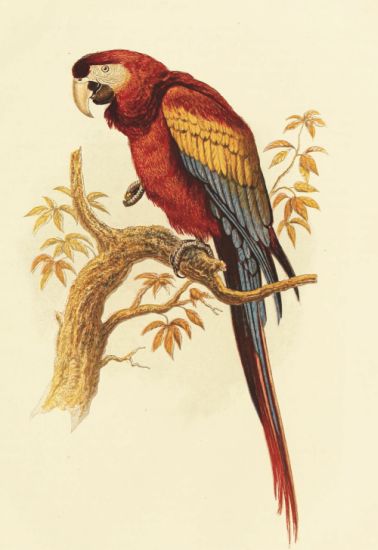
ARARA MACAO ____ SCARLET MACAW
(about one quarter Life size.)
[See larger version]
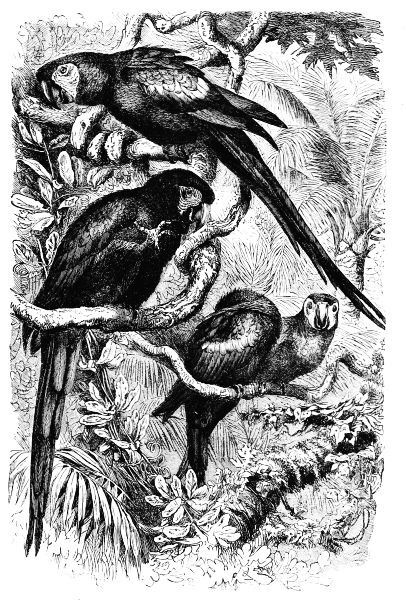
THE SCARLET MACAW (Ara Macao).
The Anakans search the woods for fruit, and very often do great damage to the maize; their flight is astonishingly rapid, and their voice loud and harsh, but shriller and weaker than that of the large Araras. When a party of these birds is perched upon a tree, they utter soft, strange notes, as though talking together, the sound resembling the murmur of conversation. The male and female often sit in pairs on the high branches. The flesh of this bird is much esteemed, both by natives and Europeans, and, indeed, is excellent.
In the Macaws we have been describing, the prevailing colour of the upper feathers is a more or less bright green; but in the following genera blue predominates.
THE ARARAUNA.
The Ararauna (Ara Sittace Ararauna) is a very well-known bird, not inferior to any of the preceding in magnificence. The body is somewhat smaller, the tail, on the contrary, longer, than in the Scarlet Macaw; it may be reckoned as thirty-seven inches long, of which quite twenty inches belong to the tail; the wing measures twenty inches from the shoulder to the tip. The eye is greenish white, the beak and shoulder black. The forehead, a great part of the tail, and also a ring round the throat, are green. This colour changes above into light blue, whilst the under side is of the colour of the yolk of an egg; the same is the case with the tail. The upper and under tail-covers are blue. The outer webs of the wings are darker, those of the inner webs almost black, but only on their upper surface, for the under side shades off into dull yellow; the same is the case with the tail-feathers. The lower part of the face is more darkly coloured than the upper throat; the chin is almost black, the bare cheeks are white, with three rows of blackish feathers.
According to the statements of travellers, the habits of the Araraunæ are very similar to those of the Scarlet Macaw. The extent of country over which they are found is not exactly known. Schomburghk saw them sitting in considerable numbers on trees upon the banks of the Rio Takutu. They are seldom found on the eastern coast, and have long been driven from the inhabited districts.
THE HYACINTH-COLOURED ARARA.
The Hyacinth-coloured Arara (Anodorhynchus hyazinthinus) has with great reason been regarded as the type of a peculiar race, for this bird differs from the rest of its family in the same way as the Nose Cockatoo differs from its fellows. The highly curved upper mandible is of considerable size, and much stronger than in other macaws, with a sloping, elongated hook at its extremity, which bends in the shape of a sickle over the under beak. The cheeks are thickly feathered, and only a small circle round the eyes and another round the under beak is bare. The plumage is of an uniform ultramarine, the crown, neck, wings, and tail are more darkly coloured than the throat, breast, and belly; in some lights it shimmers with pale sky blue. The wings on the lower side, the inner webs of the wing-feathers, and the under side of the tail, are pale black; the outermost wing-feathers sprinkled with black. The beak is of a brilliant black, the feet greyish black, and the eyes brownish black. The naked place near the eyes, and also a narrow featherless border around the beak, are dark yellow, lightly powdered. In size, this species is scarcely inferior to the Macaw; its length is thirty-eight inches, of which the tail measures twenty-two. The length of the wings is sixteen inches.
Little is known of the habits of the Hyacinth-coloured Arara; we learn that it is principally found in the river districts of Rio de Francisco, and from thence to the Amazon. These birds are not very numerous, and are constantly seen in pairs instead of flocks. In comparison with the rest of their family, they have little shyness, and their voices are seldom heard.
We may consider the PARRAKEETS, or CONICAL-TAILED PARROTS (Conurus), although much smaller, as the next relations to the Araras, from which they are easily distinguished by the circumstance that their cheeks are feathered. Some have a bare circle round the eyes, whilst in the smaller kinds the feathers reach quite to the eyelids. The beak is comparatively strong, but short and broad; the cere is thickly feathered, and the nostrils, which are placed in the middle of the forehead, are surrounded with bristle-like feathers. The plumage is generally green, and relatively simple; still there are very magnificent species among them. Such an one is
THE GARUBA.
The Garuba of Brazil (Conurus luteus) is a splendid bird, of bright egg-yellow colour, only varied by the green and black upon the wings and tail. The head and wings are usually of a brighter colour than the rest of the body; the wings are externally green, tipped and bordered with black; the beak greyish horn yellow; the foot flesh-coloured, varied with grey; the narrow bare places round the eyes whitish; the eyes are dark orange. Its length is fourteen and a half inches, six inches of which belong to the tail. The length of the wings is about the same. The north of Brazil, particularly the country near the Amazon, is the principal habitat of the Garuba, but nowhere is it found in great numbers.
THE TIRIBA.
The Tiriba (Conurus leucotis), a bird only nine inches long, four inches of which must be reckoned for the tail, is certainly the most elegant and charming of all parrakeets. The crown is brown, and shines with a metallic bluish green lustre; the rim round the forehead, the cheek-stripes, the cheeks, and the throat, are cherry colour. The part near the ear is white; the neck, rump, and wings dark green; the point of the tail and the middle of the belly, as well as the wings near the shoulder, are red; the breast is olive green; and the feathers on the upper part of the neck are indicated by a black-edged stripe, prettily marked. The wings are externally bluish green, and black within. The tail is green, the upper part touched with cherry colour, and the lower part with blood red; the horn-grey beak terminates in a white point. The feet are dark ash grey, and the eye-rings orange; the narrow bare place around the eyes is blackish. The female is somewhat smaller than the male, from whom she differs but little in colour. In the young birds the tints are paler, and the feathers only slightly marked.
The Tiriba is met with in many parts of the eastern coast of Brazil; these birds abound in forests, and particularly in such as have not been cleared; they are also found in great numbers on the sea-coast, and at no great distance from human habitations. Except in pairing time, they are always in large flocks, and if disturbed dart like arrows from the tops of the trees, shrieking loudly. They climb very dextrously, employing the beak freely, and carefully guarding their long tail from being injured by the branches. It is very difficult for the sportsman to distinguish them in their haunts, on account of their green colour, and if they fear danger they will remain perfectly motionless and quiet. It is only when flying that they raise their voices loudly and repeatedly. When there are plantations near the woods, they will, like other parrots, do considerable damage, but are less destructive to maize than to rice. After breeding time they appear more numerously on the outskirts of the woods, accompanied by their young, whom they feed out of their crops until they have nearly attained their full size.
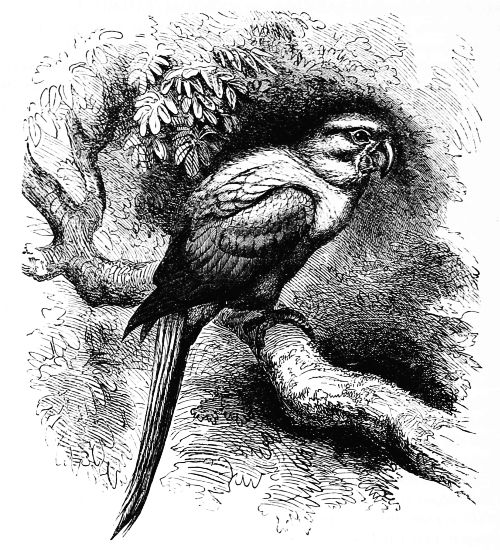
THE GARUBA (Conurus luteus).
The nest is built in the hollow of a tree, and contains from two to three white eggs. Some species, according to Schomburghk, are favourites with the Indians, so that we often find whole flocks of tame parrakeets near their settlements. The Brazilians generally place them on a stick, which they fasten to the outside of their houses, fixing one end into the plaster wall.
THE CAROLINA PARRAKEET.
The Carolina Parrakeet (Conurus Carolinensis) is the only parrot found in North America. Its length is from ten to twelve inches, and the wing seven inches; the prevailing colour of the plumage is a pleasing green, darker on the back, and somewhat yellowish on the under part; the forehead and cheeks are reddish orange, as are likewise the back of the head, shoulders, and wings. The neck is of a pure gold colour; the large wing-covers olive-green, with yellow tips; the primary quills deep purplish black; and the middle tail-covers near the shaft blue. The female is of a paler colour than the male, and in the young the forehead is of an uniform green.
The Carolina Parrakeets are found as far as forty-two degrees north latitude, and seem to be capable of enduring very severe weather, for Wilson tells us that he saw a flock of them fly screaming along the banks of the Ohio, during a snow-storm in February. Solitary individuals are sometimes met with still farther north, even as far as Albany; but these are only such as have lost their way. The favourite haunts of these birds are districts overgrown with a weed called wrinkled burdock, the seeds of which they obtain in spite of its armature of strong thorns; they often invade plantations in great numbers, and do much damage, destroying far more than they eat, and are therefore bitterly hated by the owners, and actively pursued.
We have full particulars of their life and habits from Wilson, Audubon, and the Prince von Wied. "The Carolina Parrakeet," says Audubon, "eats or destroys all kinds of fruit, and is on this account most unwelcome to the planter, the countryman, or the gardener. The stacks of corn in the fields are often visited by large flocks, which hide them so completely that they present the appearance of being covered with a brilliantly coloured carpet; the birds hang round the stacks, draw out the straws, and destroy twice as much of the corn as is necessary to satisfy their hunger. They come in crowds to assail the fruit trees in a garden, pluck the fruits, bite them open and take out the soft and milky kernel, proceeding industriously from branch to branch, until the tree that had looked so promising is entirely stripped. It is easy to understand that these attacks upon their property are avenged by the planters, and that regular war is waged against the Parrakeets. Ten or twenty of them often fall at one shot, but the survivors always come back to the same place, so that many hundreds are killed in the course of a few hours." The "Carolina Parrakeet," says Wilson, "is a very sociable creature. Should one of a flock be wounded, the rest instantly return to it, uttering loud anxious cries, as they settle on the nearest tree. After repeated shots they will not alter their behaviour, but come nearer and nearer to the fallen bird, and fly around it with plaintive screams."
It would be hard to find a greater contrast than is noticeable between the rapid flight of the Carolina Parrakeets and their lame, helpless movements when on the branches of trees, and still more when on the ground. They fly in closely-packed masses, rushing along with loud resounding cries, generally in a direct line, sometimes in graceful curves, which they seem often to vary for their own amusement. Their favourite trees are sycamores and plantains, in the hollows of which they find a resting-place, and hang to the bark like woodpeckers, clinging by the beak and claws. They sleep a good deal, retiring many times in the day to their holes to take a nap. They eat salt readily, and for this reason are always to be found in great numbers near salt works. Wilson gives us the following information concerning a Carolina Parrakeet that he tried to keep:—"As I was anxious to learn whether this parrot would allow itself to be easily tamed, I took one under my care that had been slightly wounded in the wing. I prepared for him a kind of bower at the stern of my boat, and threw him burdocks, which he continued to eat from the time he came on board. The first day was pretty equally divided between eating and sleeping, and at times he gnawed the bars of his cage. When I left the river and travelled by land I carried my prisoner with me in a silk handkerchief, disregarding all the difficulties which such an undertaking must involve. The road was bad beyond description; there were dangerous rivers and lakes to swim across, whole miles of morass and thicket to encounter, and other hindrances to overcome; many times the parrot came out of my pocket, and I was compelled to dismount to seek for it amongst the brushwood. When we encamped in forests I placed it on my little bundle near me, and took it up again in the morning, carrying it in this manner more than a thousand miles. As soon as I reached the hunting-ground of the Chickasaws I was surrounded by these people—men, women, and children—who regarded my companion with great astonishment and loud laughter, calling it in their language 'Kelinky;' indeed, Polly was ever after a bond of friendship between us. When I reached my friend Dunbar's house I procured a cage, and placed it in the verandah; from whence my captive used to call to the flights of Parrakeets that sped over the place, and day by day we had numerous troops of them hovering about, keeping up a lively conversation. One whose wing was slightly wounded I placed in Polly's cage, to the great delight of the little solitary, who approached it instantly, and whispered her sympathy at its accident, stroked its neck and head with her beak, and took it to her heart at once. The new comer died, and Polly was for many days inconsolable and restless. I then placed a looking-glass near to the place where she usually sat. My ruse succeeded, her happiness was restored, and for a time she was beside herself with joy. It was quite touching to see her, as evening approached, laying her head on the image in the glass, and testifying her happiness by a gentle note. After some time she learned her name, and answered to it; she would climb up my body, perch on my shoulder, and take bits from my mouth: there is no doubt that I could have succeeded in training her, had not an unlucky accident caused her death; she left her cage one morning before I rose, and was drowned in the Gulf of Mexico."
The Prince von Wied substantiates the preceding account; he found these Parrakeets in the early spring in enormous numbers near the Mississippi, and they have been also seen near the Lower Missouri, but never towards the upper part of that river. The Indians in the neighbourhood of Fort Union wear the skins of these birds as ornaments on their heads.
THE CHOROY.
The Choroy of the Chilians (Enicognathis leptorhynchus) is well deserving of notice, on account of the peculiar shape of its beak. There is nothing particularly striking in the plumage, which is of a nearly uniform dark green, blueish on the wings, their tips being spotted with black; the tail-feathers are brownish, and blood red at the tip. The bird is green above, with a red streak upon the brow, red cheek-stripes, and a few insignificant dark bands on the top of the head, which are visible through the points of the corresponding feathers; the lower part of the body is green, with red spots between the thighs, larger in the male than in the female. Its length is about fourteen inches, six and a half of which belong to the tail. The Choroy reminds us of the Long-beaked Cockatoo, on account of its prominent and elongated upper mandible, and we are told that its habits are similar. These birds congregate in troops of many hundreds, and the noise they make is almost deafening. They are most destructive to maize and wheat fields, and also to apple-trees, the fruit of which they gather only for the sake of the pips. This species is found over large tracts of the Pampas, and is rather a ground than a tree bird.
THE LONG-TAILED PARROTS, OR PARRAKEETS.
The Long-tailed Parrakeets (Palæornithes) inhabit the Old World, and notwithstanding the peculiarities whereby the different families are characterised, bear a common impress. All are distinguished by their very slender shape and pointed tail of the same length as the body, and by their flowing, magnificently-coloured plumage. They are distributed over the whole of Central and Southern Africa, a great part of India and Australia, and in favourable situations are met with in large flocks. The Australian type differs from the Asiatic and African principally in having a comparatively broad tail, and is on that account often referred to another group.
THE COLLARED OR ROSE-RINGED PARROT.
The Collared Parrot (Palæornis torquatus) is elegantly formed and strikingly coloured. The entire length of the male is from fourteen to sixteen inches, ten of which must be allowed for the tail; the length of wing is about six inches from the shoulder to the tip. The colour of the plumage is generally a bright grass green, brightest on the top of the head, palest underneath, and darkest on the wings: on both sides of the throat, and about the cheeks, this colour changes to a delicate sky blue, which is divided from the green of the neck by a dark blackish stripe on the throat, and a splendid band of rose red feathers; the tips of the tail-feathers are also sky blue, and the under part of the tail and wings yellowish green. The beak is bright red, with a dark tip to the upper mandible, the feet grey, the eye yellowish white. The young birds before moulting may be distinguished from the old by their paler and uniform light green colour.
The Rose-ringed Parrakeet is spread over the whole of Africa, and is found from the western coast to the eastern borders of the Abyssinian mountains, the wooded parts of which are especially favourable to its mode of life and habits; it does not always seek the extensive unbroken primitive forests, which cover the lower parts of the interior of Africa, but is often seen in limited tracts of woodland, among the thickly-foliaged evergreens, which afford a safe retreat during the entire year. In Western Africa it is seen on the coast; in Northern Africa we have found it as far southward as fifteen degrees north latitude, but did not observe it in those parts of the mountainous coast of Abyssinia through which we travelled, and only met with it in the neighbourhood of monkeys; indeed, after repeated observations we concluded that we could safely reckon upon always finding it where monkeys were to be seen, and vice versâ. It would be difficult for travellers through their haunts to overlook the Rose-ringed Parrakeets, as they announce their presence by loud, discordant cries heard above all the noises of the forest; their associated bands, after uniting and thus increasing to large flocks, often take possession of some of the thickly-leaved tamarind or other trees, and from these resting-places fly daily across a greater or less tract of country. In the early morning they are tolerably quiet, but soon after sunrise go forth screaming in search of food, and the whole flock may then be seen flying hurriedly over the woods. The African forests are comparatively poor in fruit, but the plants that grow under their shadow are prolific in seeds of all kinds, which entice the parrots to the ground; nevertheless, except when the small round fruit of the bush known as "Christ's thorn" is ripe, they seldom descend from the trees. It is probable that they will also take animal food; at any rate, we have often observed them busy near ant-hills and the dwellings of Termites. They are rarely seen in the fields bordering on the woods of Central Africa, although tame birds may be fed solely upon the Caffre millet and durrah, the corn of that country; it would seem, however, that they prefer fruits and seeds to the last-mentioned diet.
Until mid-day the flocks are busy satisfying their hunger, after which they fly to seek water, and then rest for some hours among the branches, chattering and screaming; but in spite of their noise they are difficult to find, owing to their green colour, which is scarcely distinguishable from the foliage; moreover, they are perfectly silent the instant that they observe anything unusual, or creep stealthily and quietly away if they fear pursuit. The longer you remain under a tree beneath the top of which you have just heard hundreds of voices, the stiller and quieter it becomes, until at last all is silent; one bird after the other has noiselessly crept away to a distance, from whence a joyful cry tells that their cunningly planned retreat is happily accomplished.
Towards evening they again assemble, and make (if that is possible) a louder shrieking than before; for now the question is not only which is the best branch to rest upon, but the safest sleeping-place. During the spring time, when the woods are decked in magic beauty, the parrots always sleep in holes in trees, but in the dry season they prefer the foliage; leafless trees they consider dangerous.
Although these birds fly well, their movements on the ground are clumsy, and even their climbing very awkward; their flight is extremely swift, but seems fatiguing; it requires many quick strokes with the wings, and changes into a hovering motion if the bird wishes to alight. Their gait can scarcely be called a walk, but rather a waddle; the body is swung forward, and the long tail carefully raised that it may not touch the ground. A party of Parrakeets progressing in this manner provokes involuntary laughter, as there is something most comically serious in their movements.
The Rose-ringed Parrots breed during the African rainy season, which comes with the spring; at which time the gigantic Adansonias are crowned with their thickest foliage, and the numerous holes in their trunks hidden in the most desirable manner; here the breeding birds settle in parties, and after some strife about holes, the pairs live quietly together. In those parts of Africa through which we travelled, Europeans shoot these birds, but the natives never molest them with weapons, and only capture them when they have an opportunity of disposing of them alive. Notwithstanding the numbers in which they are found, it is not very easy to procure a specimen, as their cunning deceives even a practised sportsman, and renders his efforts fruitless. After some time, however, we learned to turn their tricks to their own disadvantage; when we found a party of them in the woods, one of us would creep to the nearest and thickest tree, while another disturbed that they were on; the consequence was that the parrots, as they tried to escape, generally fell victims to the marksman who was watching their arrival.
The natives take the young unfledged birds out of the nest, or surprise the old ones at night in their holes. They are extensively captured in Senegal, and from thence come most of the Rose-ringed Parrakeets that we see in captivity. During the time we spent in Africa, we had many of these birds alive, but never succeeded in becoming very friendly with them; we gave them as much freedom as possible, allowed them to fly about a large room, fed them well, and hoped to retain the whole troop; but we were sadly deceived in our expectations, for they fell murderously upon each other, and the strong ones bit the weak to death; in most cases they broke the skulls of their victims, and ate their brains, after the manner of our Titmouse (Parus).
On the other hand, we must own that we have often seen bird-fanciers keep dozens in small cages, and learnt, in answer to our questions, that they lived together in the greatest harmony. Connoisseurs have told us that with care they can be made very tame, and will show great affection for their master, but rarely learn to speak, or only in the most imperfect manner. Their plumage forms their greatest attraction.
THE BETTET.
The Bettet (Palæornis pondicerianus), together with other allied species, is found throughout India and the neighbouring islands. In size it resembles the Rose-ringed Parrakeet, but differs from it in the markings of its more variegated plumage. Green is also here the prevailing colour, but the delicate rose red that marks the neck of the former is in this bird spread over the whole breast, and, in the male, extends over the top of the head. The whole mantle is green, the sides of the wings yellowish green, and here and there the feathers have more or less broad yellow edges; the tail-feathers are blueish green above, on the under side yellowish green; the belly is green, but much paler than the back. The head and breast contrast splendidly with these leaf-like tints; it is difficult to describe the mixture of colours they present; we can only say that the head is of a blueish or greyish rose red, while a narrow band on the forehead, and the marks on the cheeks, heighten the effect of the bright and glowing tints on the neck. A line on the forehead, which reaches to the eyes, and the streaks upon the neck, are of a dull black; the breast is of a pale brick red; all the feathers having narrow grey edges to their tips, as though suffused with a greyish vapour. The beak is black, the feet greenish yellow, the eyes yellowish grey. The two sexes are distinguished by the colour of the head, which in the one has a reddish and in the other a greenish lustre. We have one of these birds alive before us, but cannot say whether the red-headed is, as we fancy, the male, or the female; the colours of both are equally beautiful. Bernstein tells us that although this parrot is principally seen in Java, its distribution is very unequal, for whereas in some parts it is quite a common bird, in others it is not to be found without strict search. It inhabits hot low-lying districts, or sometimes promontories to the height of 4,000 feet, but never frequents mountains. It is always to be met with in the coffee-plantations, where it soon betrays its presence by its loud screaming voice, although it knows so well how to conceal itself from observation amongst the foliage, that it is much oftener heard than seen.
During the day Bettets fly in pairs or small parties through the gardens or thickets in the neighbourhood, and towards evening assemble upon their trysting-place—a large, thickly foliaged tree, or bamboo plantation—where they pass the night together. "If you happen to know such a tree," says Bernstein, "and place yourself near it towards evening, you will see a very attractive exhibition. When the sun goes down, the birds come gradually from all sides; as soon as the first has arrived, it raises its voice joyfully and commences a performance in which all new comers join, so that at last the concert increases to a perfectly deafening noise, which only ends as the last ray of sunset disappears. Then all go to roost, and are only disturbed when a solitary bird, whose little sleeping-place is not comfortable, flies about to seek another perch, or drive a companion from its place; should this happen, the general annoyance is loudly expressed, and the disturber of their repose soon settled with a few sharp pecks. With the first appearance of daylight, the flock separates until the following evening, when all seek the same tree or bush, and pass the night together as before."
During the breeding season these birds live in pairs, and the evening assemblies do not take place. The nests are made in holes of trees, and the strong beaks of the parrots are very useful in preparing them. We only succeeded in finding one nest, and that was in a hollow in a Puda tree some forty or fifty feet above the ground; it contained but one pure white egg, but the ovary of the female showed plainly that there were more eggs to lay. The Bettets we have seen in captivity were very tame, and appeared mild and gentle in their demeanour; we learnt from trustworthy sources that they may be easily taught to speak very fluently.
Among the Australian parrots the SUPERB PARROTS (Polytelis) remind us most of those just described. The only two known species are moderately large birds from fifteen to sixteen inches in length, slenderly formed, but with tolerably strong beaks, the upper mandible reaching far over the lower one.
THE SCARLET-CRESTED SUPERB PARROT.
In the Scarlet-Crested Species (Polytelis Barrabandi) the plumage upon the back of the neck, upper and lower parts of the body, is grass green; the fore part of the head, the cheeks, and the throat, king's yellow; the wings and tail deep blue, shaded with green; the neck surrounded by a crooked line of scarlet; the eyes are orange; the beak bright red; the feet ash grey. The female is distinguished by its somewhat less brilliant plumage, its dull blueish grey face, its dusky rose-red breast, and scarlet loins. The young resemble it in colour, but are less beautifully marked. This bird is not rare in New South Wales, and in the interior is tolerably numerous.
THE BLACK-TAILED SUPERB PARROT.
The Black-tailed Superb Parrot is found in numerous flocks on the banks of the Murray, and lives principally among thick shrubs and upon the gum-trees. Its food consists of seeds, buds, and the honey which it obtains from the blossoms of the Eucalypti. Its flight is very rapid; its voice a loud screaming cry, which becomes a discordant chatter when a flock settles.
We are more intimately acquainted with the so-called GRASS PARROTS (Platycerci), a beautifully marked, small-beaked, high-footed race, whose short tail is broader at the end than at the root. They are found in New Holland, distributed over the whole of that continent; and, as they keep together in flocks, are very troublesome to the settlers. In their habits they have much in common with the Sparrow Parrots and with the Finches. They run more than they climb, frequenting the country roads, like our sparrows, the fields, like our finches, or the grassy plains, like the reed sparrows, and are only found in the woods, or on solitary trees, during the time that they roost. They wander much about the country, and appear unexpectedly in great flocks in certain places, which they leave as suddenly when food becomes scarce. Most species eat seeds exclusively, preferring those of different kinds of grass. They differ remarkably from other parrots in the circumstance that the female lays from six to ten eggs, and rears a numerous family. They can generally endure captivity, but do not enjoy the company of mankind, and seldom learn to distinguish their friends from those whom they have cause to fear.
THE ROSELLA.
The Rosella (Platycercus eximius) is a truly splendid bird, thirteen inches in length. The fore part of the head, back of the neck, breast, and under tail-covers, are scarlet; the cheeks white; the feathers on the back black, bordered with yellow; the rump, upper tail-covers, and belly, with the exception of a yellow spot in the middle, are of a bright pale green; the middle of the wings bright blue; the quills dark brown, the outer border blue; the two middle tail-feathers green, changing to blueish-green; all the rest blue at the root, shading into light blue, and tipped with white; the beak is horn-coloured; the foot brown; the pupils blackish brown. The young, when they leave the nest, have a coat very similar to the old birds, without its full brilliancy; they are also recognisable by their yellow beaks. These beautiful parrots are natives of New South Wales and Tasmania, where they are very common, but only in especial districts, often bounded by a brook, over which they will not pass. They do not congregate in large flocks, but in small groups or families. Open countries are their favourite resorts, or grassy hills and plains planted with high trees or groups of bushes. From these trees, which become the central point of their movements, they fly over the little sandy plains or open country into the woods to seek their food. They are as often to be found upon the roads as our sparrows, and, like them, if startled, only fly to the nearest tree or hedge by the wayside, soon returning again to the ground. Travellers are unanimous in saying that the impression made on Europeans by the profusion of these magnificent birds surpasses description. The Rosella flies in curves, with rapid strokes of its wing, but seldom to any great distance, as it is soon fatigued; it moves with ease upon the ground, and is quite equal to our Finches in agility. The voice of this species, like that of most of its congeners, is a pleasant pipe, which might almost be called a song. Its food consists of seeds of different kinds, principally those of grasses; but it will also at times eat insects; the breeding-time is in the months of October and January, which answers to our spring. The female lays from seven to ten beautiful elongated white eggs in a hole in the branch of an Eucalyptus, or some similar tree.
THE VARIEGATED PARROT.
The Variegated Parrot (Psephotus multicolor) must be regarded as one of the most splendidly coloured of the Grass Parrots, amongst which it is numbered on account of its moderately short wings and unevenly graduated tail. It is about a foot in length, and nine to ten inches in the spread of its wings. This bird inhabits the interior of Australia, being very numerous on the banks of the rivers. The plumage is remarkable on account of the variety of its colours. In the male the forehead and shoulders are brimstone-coloured; the under tail-covers yellow; the lower part of the belly and legs scarlet; the rump striped with yellowish green, dark green, and reddish chestnut brown; the wings and lower wing-covers deep blue; the middle tail-feathers blue; the outer ones blueish green, tipped with pale blue; the beak horn brown; and the feet yellowish brown. The female, whose plumage is similarly marked, only differs from the male in the inferior brilliancy of colouring, being of a yellowish brown on the throat and breast, and only slightly striped on the back of the head and wing-covers. We have but slight knowledge of these birds either in their natural state or in captivity.
The Variegated Parrot is, undoubtedly, one of the greatest acquisitions that a connoisseur can make; it is the ornament of every aviary, and, like its congeners, pleases as much by its docility as by the splendour of its plumage. It will also breed in our own country. "My father," says Neubert, "possessed a pair of Variegated Parrots, which were always very cheerful and extremely attached to each other. One was a little larger than the other, and in colour far more beautiful, for that which in the little one was yellow and orange, was in the larger bird orange and flame colour, and so on throughout the different tints. On account of this circumstance, these birds were always supposed to be male and female, and this opinion was strengthened by observing that they showed the greatest affection for each other. After a time the lesser bird—whom for the sake of brevity we will call the female—was always busy on the ground; it seemed melancholy, and ate scarcely anything, but was constantly fed by the male out of his crop. One morning there lay a beautiful white egg in the cage, which the female watched most carefully. My father at once fastened a willow basket to the cage, filled with materials for a nest, and placed the egg upon it; the female, however, lifted it again to the bottom of the cage. On this we gave them a common wooden box, in which a hole was cut, and filled it with soft materials; both birds immediately busied themselves in turning them out, and in chipping some very fine shreds off the inside of the box, on which to lay the egg. From this time the female seldom came out of the box, but the male frequently went in to feed her. Several other eggs were laid during the next few days, some being larger than the rest. The devotion of both birds to the task of incubation increased daily, and they became so heated as to lose the feathers from the under part of their bodies. As time went on, neither of them came out, or only very rarely, to eat. At length we observed that one was dead; the other continued to sit upon the eggs, but died after a few days. The eggs were examined, and proved to be addled. It was only on the birds being stuffed, that the reason of our disappointment was discovered; both were females, and had laid unfertile eggs. Many English and Belgian collectors have succeeded in making the Variegated Parrots lay, so we may hope to see these beautiful birds more numerous amongst us."
The Australian continent would seem to be a veritable Eden for the Parrot tribes! The dazzling Cockatoos peep like gorgeous flowers from the masses of green foliage, and the Scarlet-coated Rose Parrakeet glitters amongst the yellow blossoms of the acacia, whilst Honey-birds swarm in blithe and busy parties about the various trees, and the otherwise deserted plains are animated by the presence of the little Grass Parrakeets. Parrots abound in Australia, as do the swallows in our villages and roads, and are met with everywhere in all their variegated beauty. When the farmer is about to get in his harvest, these birds appear before his barns in large flocks, seeking, like pigeons, for stray corn among the stubble. Poetical travellers have often been inspired by the ever varying spectacle presented by such gorgeous objects; but the settler hates them from the bottom of his heart, and avenges himself for their depredations by shooting them with the same indifference as that with which our country folks kill sparrows.
THE WAVED PARROT (Melopsittacus undulatus).
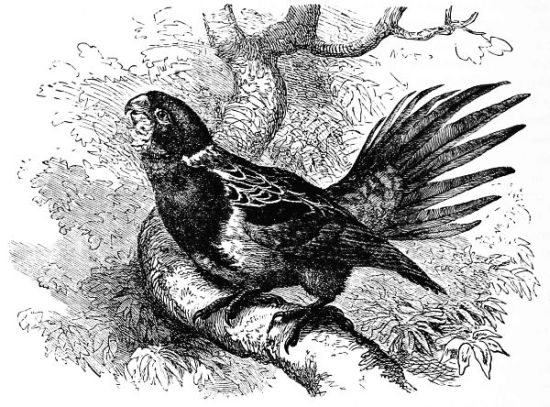
THE ROSELLA (Platycercus eximius).
This beautiful bird is of small size, though its long tail makes it seem larger than it is; its length is from eight to nine inches, and the span of its wings ten inches. The body is slender and elegantly formed, the tail long and graduated, the wings comparatively long and pointed, the beak moderately large, with a long curved point. The cere, in which the large nostrils are placed, is broad and slightly inflated; the feet long, the toes slender, the outer one being longer than the inner. The beautiful grass green that predominates in the plumage is prettily marked; the whole of the mantle—that is, the back of the head, neck, top of the back, shoulders, and wing-covers—are pale yellowish green, each feather being edged and spotted with black and brown, more finely on the neck and head than on the back; the under side is of a beautiful uniform green. The parts of the face, that is, the fore part of the head, vertex, and throat, are yellow, bordered and spotted with four bright blue spots, of which those upon the cheeks are the largest, while the others look like three little round drops. The wings are brown, the outer web of the quills dark grey, spotted with greenish yellow; the tail, with the exception of the two blue middle feathers, is green in the middle. Each feather is striped with yellow, the eye-rings yellowish white, the beak horn-coloured, the feet pale blue. The female is distinguished from her mate in being somewhat smaller, and by the different colour of the cere; with her this is greyish green, whilst in the male it is a bright blue. The young are without the deep blue spots on the throat, and the regular markings on the head, which is entirely covered with delicate stripes; when only eight months old, they assume the plumage of the parent birds.
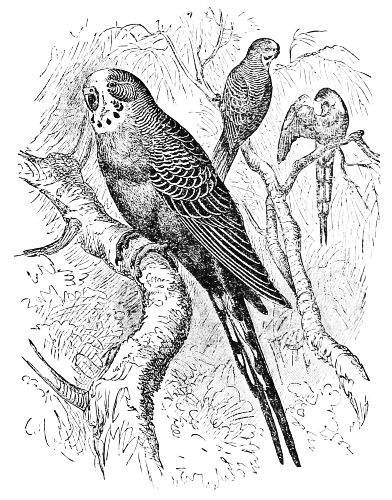
THE WAVED PARROT (Melopsittacus undulatus).
Shaw was the first naturalist who became acquainted with and described the Waved Parrot, and Gould is the only traveller who gives us any information respecting its natural state; from him we learn that these birds inhabit the whole of the interior of Australia in enormous numbers, especially where there are large tracts of grass, the seeds of which they eat.
When Gould was investigating the plains in the interior, he saw the Waved Parrots flying about, and remained for some time in the vicinity, in order to observe their habits and mode of life. They came in flocks of from twenty to one hundred to a small lake to drink, and from this locality flew at stated times over the plain in search of the seeds which are their exclusive food; they went to the water in the greatest numbers in the early morning, or as it grew dark in the evening. During the heat of the day they sat motionless under the leaves of the gum-trees, the holes of which were just then occupied by the pairs who were laying, and as long as they remained quiet, were with difficulty perceptible. When going to the stream, they alighted freely in large flocks upon the dead twigs of the Eucalypti, or on the branches that hung down to the water. Their activity is wonderful, and their flight very rapid, resembling that of the falcon or swallow; they run upon the ground with facility, but their feet are ill adapted for climbing among the branches of trees. When on the wing they utter a screaming cry; and whilst perched amuse each other with a caressing kind of twitter, which might almost be termed a song. The Waved Parrot congregates in parties, even during the breeding-time, although pairs are easily distinguished by their faithful devotion to each other. The nest is made in the holes and fissures of gum-trees, and in December contains from four to six eggs of a pure white colour and somewhat round shape. By the end of December the young have flown out and are capable of providing for themselves; they then collect in great flocks, that fly about in company with the old birds. As soon as the breeding-time is over, the flocks begin their migrations, during which they pass regularly from south to north, and only return to their breeding-place when the grass-seeds are ripe. Throughout South Australia they appear in spring, and also in autumn, with the same precision as our migratory birds. Some years ago only solitary Waved Parrots were occasionally seen amongst us; but at the present time every ship brings hundreds to Europe. Before leaving Australia, the captives are put together in wooden cages, the perches of which are placed like little flights of steps above each other, so as to hold a great number of birds in the smallest possible space. Such a travelling bower presents a most amusing appearance; the whole party sits in lines, so that one row of faces appears above the heads of another, and all eyes are fixed upon an observer, as they seem to beg to be freed from their confinement. Quarrels and strife have never been observed among them, and until breeding-time, thousands live most comfortably together, those of the same sex as happily as the little pairs do. We have seen one of the large cages of a bird merchant, that had formed part of a cargo of these birds, and contained more than a thousand pairs, all of which lived in great harmony. The Waved Parrot does not belong to the "inseparables"—that is, to those species that pine and die on the loss of their mates; but it loves the society of its own species, and prefers the company of the opposite sex. Sometimes it will associate with a small parrot of a different species, though it never shows the same attachment that it exhibits to its own. It is, however, necessary to keep these birds in pairs, as under any other circumstances they are never seen to full advantage. They require little change in their food, and can live upon millet or canary seed; they will also eat the juicy leaves of plants, cabbage, and other vegetables; but despise fruit, sugar, and dainties. In spite of their preference for dry food, they drink very little, sometimes not for weeks together, but their owner must not, on that account, neglect to give them fresh water.
Most parrots, however gentle their disposition, become quite insupportable by reason of their noise. This is, however, by no means the case with the Waved Parrots; they can produce a great variety of sounds, but never use their voice in such a degree as to become tiresome, or except to express pleasure. It is not too much to say that the male of this species should be reckoned among the singing birds, for its notes are something more than a twitter, and often become a very expressive though modest song; it may, indeed, be taught to imitate the notes of other good singers in such a manner as to deceive an expert ear. In order to rear these birds, they should be placed in a small room, which can be aired and warmed without disturbing the occupants; the floor should be strewed with sand, and the walls hung with boxes. It is advisable, but not necessary, to ornament the chamber with living and harmless plants, for these offer the best places for rest and concealment; evergreens are particularly suitable for this purpose. Holes should be made in hollow blocks of willow-trees, and divided into compartments by boards, so that many pairs may make their nests in the same block. A room of this description is by far the best for breeding purposes, but in most cases a moderately-sized cage is quite sufficient. The most important thing is to leave the birds undisturbed, and keep them well fed.
It is necessary to be personally acquainted with these lovable little creatures, and to have observed them during the performance of their parental duties, to be able to understand the enthusiasm with which they are regarded; it is only during their pairing time that we become fully conscious of their many merits. "The male," says Devon, "is a model husband, and his mate is a model mother. He devotes his whole attention to his chosen one, never heeding another female, though she be in the same place with him; he is always zealous, devoted, and ardent—indeed, shows the utmost affection towards his partner. Perched upon a twig before the opening of the nest, he sings her his best song, and while she is sitting feeds her with as much zeal as pleasure. He is neither dull, quiet, nor sleepy, like many other husbands, but always cheerful and charming."
The building of the nest is the exclusive business of the female. She works with her beak at the entrance till it satisfies her, and then, more or less, at the interior, gnawing off little shreds, on which she lays, in the space of two days, from four to eight small, round, shining white eggs. She then sits for eighteen or twenty days most assiduously, and during the whole time is fed by the male, never leaving the hole except on the most urgent necessity. The young remain some thirty or thirty-five days in the nest, and only quit it when fledged. During all this time the mother is busily occupied in keeping their home clean, and, like a good housewife, clears out her little chamber every morning, and cleanses and purifies her offspring with extraordinary care. Immediately after leaving the nest, the young go in search of food, and a few days after conduct themselves quite like the old birds. Still, care must be taken, for the before-mentioned zeal of the father is often shown in an unexpected manner; he will fall upon his brood so boisterously, and seize them with so much roughness, that he kills them by his caresses. The first brood is no sooner fledged than the parents have a second, and even a third and fourth; indeed, Schlegel, the director of the Zoological Gardens at Breslau, declares that he has known them breed all the year round. Such cases are exceptional; three broods, according to our own observations, are the usual number. The last family of young may be left with the parents without danger, and then the first brood may be brought back. These show themselves to be quite as affectionate as their parents, and feed and take care of the nestlings. Moreover, they will imitate each other in everything—in climbing, flying, eating, and chattering—so that the noise in the nursery often becomes quite deafening, and sometimes seems to be too much even for the parents, who will then remove to a distance to get out of the way.
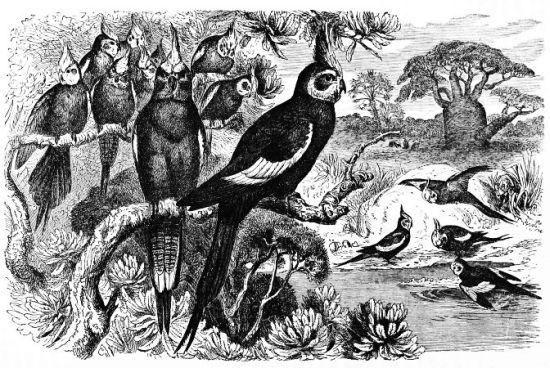
THE CORELLA (Nymphicus Novæ Hollandicæ).
A pair of Waved Parrots in our possession occupied a large cage, in which they seemed very comfortable, but perhaps the bright sun, as it laughed at them through the windows, made them sigh for freedom. One day the female cleverly made her escape, and, before we discovered it, had flown through the window. We now learned to admire this bird from another point of view, as we watched its glorious flight, and may say with truth that we forgot to feel angry at our loss. The fugitive rose high into the air, and screamed with delight as it wheeled round and round with incomparable rapidity over a neighbouring garden; it flew quite differently to any parrot we ever saw—indeed, more like a falcon or a swallow, and was soon out of sight, but in a few minutes reappeared in the garden, apparently in consequence of the anxious cry of its mate, for we had at once placed the latter near the window. The lovers of these birds know that their tone is deceptively like that of our sparrows. It was the height of summer, and all the roofs were covered with young sparrows, who exhibited the greatest agitation as soon as the beautiful stranger appeared. The parrot had placed itself upon a plum-tree near the window, and from thence conversed with its mate. The young sparrows, who thought that the enticing chirp was intended for them, ventured near in flocks, regardless of the warnings and cautions of their elders, for though the latter seemed astonished, they were far too old birds to be deceived, and would not approach; the young ones, on the contrary, surrounded it in crowds. It took not the slightest notice of them, but they were not to be repulsed; they became most pressing in their attentions, hopped quite close to it, looked at it with the greatest delight, and answered its chirp with all their little strength. When it became angry and flew off to another tree, the whole array followed, and it was only when the stranger began to exhibit its splendid powers of flight, that the sparrows were compelled to remain below abashed. This comedy lasted for about half an hour, and the whole length and breadth of the garden was filled with sparrows, when at last, love for its mate made the fugitive return to its room; on this it was seized and put into the cage, where it was most tenderly received by its companion, and the crowd outside dispersed. In this country the Waved Parrots can be kept for whole weeks out of doors. In the spring of 1861, two pairs of these birds flew from a cage to the estate of a noted collector in Belgium; they betook themselves to the tops of some high trees in a large park, and were lost during some time. While they remained at large, as it afterwards proved, they had made their nest, and reared a number of young ones. The owner of the property surprised a whole flock of from ten to twelve in a field of oats, where they were helping themselves; from that time they were enticed with proper food, and before the winter ten birds were captured. Unfortunately, it was impossible to observe those that were still at liberty, as it would have been most interesting to learn if the strangers could survive one of our winters.
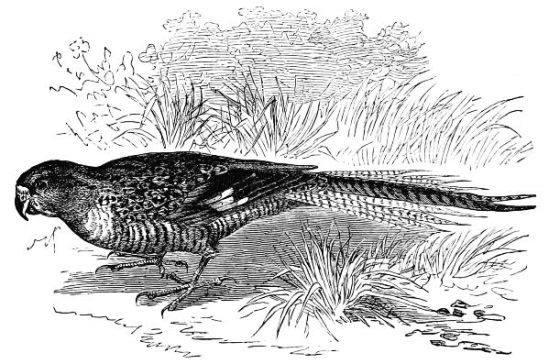
THE GROUND PARRAKEET (Pezoporinus formosus).
THE CORELLA.
The Corella (Nymphicus Novæ Hollandicæ) is closely allied to the Cockatoos, although belonging to the group of True Parrots. These birds are fully a foot long, and nearly the same in their spread of wing. The plumage is very variegated in its markings; the fore part of the head, the tuft, and cheeks, are lemon colour; the ear-coverings bright orange; the back of the neck, the two middle tail-feathers, and the outer border of the wings, brownish grey; the back, shoulders, under side, and outer tail-feathers, greyish chocolate brown. The shoulders and sides are the darkest; the upper wing-covers are white; the eyes dark brown; the beak lead colour; the feet blueish grey. The female resembles the male, except that the face and the crest are dark olive green; the feathers near the throat are brownish grey, those of the under parts of the body and upper tail-cover yellow; the four middle feathers of the tail are grey, the rest yellow, and, with the exception of the outer web, edged delicately with brown. Gould, whom we have to thank for a full description of the Corella, found this beautiful bird in great numbers in the interior of Australia. On the coast it is rare in comparison with the thousands seen on the plains of the interior, and in eastern Australia it seems to be more numerous than in the western parts of that continent.
In summer the Corellas build their nests near the Hunter and Peel rivers, and other streams running north, if they can find suitable trees. After the breeding season they assemble in innumerable flocks, which cover whole tracts of country, or alight in hundreds upon the overhanging branches of the gum-trees. In September these flocks begin to migrate to their breeding-place, and in February or March return to the north. They devour grass seed, like the rest of their congeners, but cannot live without water, and, therefore, must remain in the neighbourhood of a stream. They are very active, run with facility on the ground, and fly slowly but often to a considerable distance before they alight. They are but little afraid of man, and if startled from the ground, wend their way to the nearest tree, perch upon a branch, and, as soon as the danger is over, return to the ground; not being shy, they are easily captured. They lay five or six white eggs, about an inch long. Corellas have only lately been brought to Europe in any considerable number; at the present day they are to be met with in all large zoological gardens, and may be obtained from the principal dealers in birds. They require but little tending, and need no particular surroundings for breeding; but they should be left as much as possible to themselves. Two birds in the Hamburgh Zoological Gardens sat by turns on their eggs, the female from the noon of one day to the forenoon of the next, and the male in the intermediate hours. As far as we know, such a division of parental duties has not been observed in any other parrots.
THE GROUND PARRAKEET.
The Ground Parrakeet (Pezoporinus formosus) reminds us in many particulars of the Owl-Parrot, or Kakapo; its plumage is of similar colour, and its habits resemble those of that bird in many respects. The length of the Ground Parrakeet is about thirteen inches, the stretch of wing somewhat less; the plumage is dark green, striped with a still darker shade of the same colour; that of the upper side is dark grass green, each feather irregularly striped with black and yellow; upon the head and neck there are black lines. The neck and breast are pale yellowish green; the belly and under covers of the wings a beautiful yellowish green, with numerous curved black stripes; the brow is scarlet; the quill-feathers green on the outer web, and on the inner dark brown, spotted with pale yellow. The four middle tail-feathers are green, marked with yellow; the side tail-feathers, on the contrary, yellow, spotted with dark green; the eyes are dark brown, with delicate light blue circles; the feet and tarsi blueish flesh colour. Gould informs us that the Ground Parrakeet is spread over all parts of South Australia, including Van Dieman's Land; in the northern latitudes of that continent it has never been observed. This bird lives almost exclusively on the ground, and is seldom seen among the branches of trees. Barren sandy districts, abounding in low grass and weeds, or moors covered with rushes, constitute its favourite haunts; there it lives a retired life, either alone or in pairs, and is, therefore, almost impossible to find without the assistance of a dog; it can run among the grass with great rapidity and persistency, or lie close to the ground, like a hen or a woodcock, in the hope of being overlooked, and when flushed will rise and fly quickly over the ground, making all kinds of zig-zags in the air, like a snipe, then fall again, and run hurriedly on. The eggs, which are white, are laid on the bare ground, and both parents assist in their incubation. The young assume the plumage of the adult in the spring, and separate from their parents as soon as they are old enough to provide for themselves. The flesh of the Ground Parrakeet is considered very excellent; it is more tender than that of a snipe, and in flavour not unlike that of the quail. The example figured in our coloured illustration (Plate II.) is the Pezoporinus cornutus, which differs somewhat from the preceding, especially in having two beautiful horn-like appendages to the head.
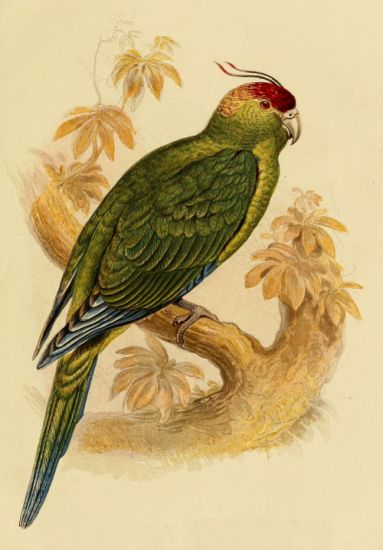
THE GROUND PARRAKEET ____ PEZOPORINUS (Life size)
[See larger version]
THE LORIES.
In India and the neighbouring islands we find some species of Short-tailed Parrots called Lories (Lorii), differing so essentially from those we have described, that modern naturalists are inclined to form them into a separate family. Amongst the points in which they are unlike other parrots, we must mention their comparatively long neck, and feeble beak, the slightly bent under-mandible, without notches at the edge, and closely compressed; the by no means fleshy tongue, divided at its tip into a bunch of horny fibres, and the streaming plumage, which is decorated with the most magnificent colours. Our knowledge of these beautiful birds in their native state is very limited; we are, however, told that the fibrous tongue is employed to lap up the sweet juices that exude from the leaves and blossoms of the trees, and that this very peculiar diet is the great hindrance to their being tamed or transported to any considerable distance; still, in spite of this, some species are occasionally brought to Europe, and will live for many years in a cage. They are docile, and may be taught to speak, but are quiet and languid when in confinement.
THE PURPLE-CAPPED LORY.
The Purple-capped Lory, or Lorikeet (Lorius domicella), the largest and best known of these birds, is a really magnificent creature, about twelve inches long and twenty inches across the wings. The plumage is of brilliant scarlet, deep purple on the top of the head, the back of the head violet, the upper wing-covers green, the legs sky-blue; over the breast runs a crescent-shaped yellow line; the tail-feathers are scarlet at the root, striped with black towards the top, and dotted with yellow at the tips; the beak is orange-coloured, and the feet dark grey.
The Purple-Capped Lory lives in parties in the woods, which it never quits; its movements are lively, and its flight very rapid. It would seem that these birds do not subsist entirely upon the nectar from plants, as they may be reared without any particular care upon bread soaked in milk, or any kind of parrot food, and will live for years upon this diet.