RAVENS (Coracirostres). (continued 3)
Thomas Rymer Jones translation
The TREE CROWS, or JAYS (Garruli), are distinguished from the Ravens by their blunt short beaks, with or without a hook at the extremity, their weak feet and very short rounded wings, long graduated tails, and rich variegated plumage, which is generally very soft and flocculent. Unlike the members of the preceding family, the various species of Jays pass the greater part of the day in flying from tree to tree in their favourite woods, seldom coming to the ground, and still more rarely congregating in large flocks. Owing to the comparative shortness of their wings, their flight is unsteady, and they are therefore incapable of attaining to any considerable height, or of hovering in or whirling through the air; still more inelegant is their mode of progression on the ground, it being nothing more than a ludicrous attempt at a hop: upon the trees, however, they are quite at their ease, and some even exhibit unusual facility in climbing. In the perfection of their senses they are in no way inferior to the family above described, but their intelligence is not nearly so great, and they must be rather considered sly than clever; indeed, in many points they resemble the Shrike, possessing all the murderous cruelty and rapacity of that bird, without any of the courage and boldness that seem to palliate the atrocities committed by Ravens. They will mercilessly destroy and plunder the nests of other birds, and eat almost any animal or vegetable food, frequently doing great damage by their raids upon orchards, fields, and gardens, thus bringing down upon themselves the vengeance of man. In their habits during the period of incubation they also differ widely from the preceding family, inasmuch as they never build associated together in large numbers, but quite apart from each other; their nests, moreover, are small, and the brood is usually composed of from five to seven eggs. When tamed, some of them are capable of imitating words, and of learning to whistle tunes, but they are extremely troublesome, owing to the numberless petty thefts and annoying tricks in which they delight.
We shall divide the Tree Crows or Jays into several groups, all more or less recognisable by the following characters:—Their bodies are slender, their Raven-like beaks are as long as the head, nearly straight, and provided at the base with a cere, instead of bristly feathers; the wings are short, and their third and fourth quills longer than the rest; the tail, which is composed of twelve feathers, is either very long and wedge-shaped, or of moderate length and rounded at the extremity. The lax and soft plumage frequently becomes flowing towards the head, thus forming a kind of crest, and is usually bright in its coloration.
THE MAGPIE.
The Magpie (Pica caudata) stands first upon our list, as being familiar to us all, and also because it presents many characteristics that associate it with the family of Ravens—indeed, it might almost be described as a Crow with a long tail, though its beak is shorter and more curved, the wings shorter and more rounded, the tarsi higher, and the plumage softer and thicker than in that bird. The lower part of the breast and the feathers upon the shoulders are white, and the rest of the coat black, with a rich and varied lustre upon its surface. The eyes are brown, the beak and feet black. This species is about one foot six inches long, its breadth one foot ten inches; the wing measures seven inches, and the tail ten inches.
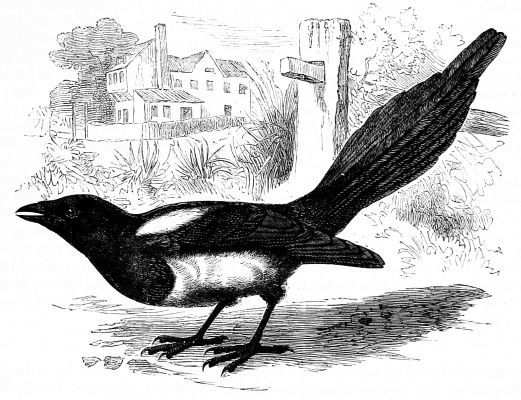
THE MAGPIE (Pica caudata).
The Magpie is met with throughout the whole extent of Europe, in Thibet, Northern Asia, and North Africa: in North America it is represented by a very similar bird: but the distribution of the Magpies is very unequal; some districts it seems carefully to avoid, and yet in a neighbouring province it may be found in large numbers. It seldom visits mountains, open plains, or thick forests, but usually inhabits lightly wooded parts of the country, such localities being preferred as are frequented by man, in whom it shows the utmost confidence. In Scandinavia, where it is regarded with the greatest favour, it seeks its food in farmyards or the courts that surround the houses, and builds beneath the roofs. It is always stationary, and never wanders to any great distance from its abode, except during the winter, invariably returning to its old haunts. The movements of the Magpie differ in many respects from those of the Ravens; its gait is similar, but the tail is borne aloft, to act as a kind of balance to the body of the bird; its flight is heavy, being effected by sweeping strokes of the wing, and should the wind be at all high is very unsteady—indeed, as a rule, it never flies, except when compelled to do so in going from one tree to another. As regards its intelligence, and the development of its senses, the Magpie will bear comparison with any of its kindred. In its intercourse with man it seems easily to distinguish between friends and enemies; towards the latter it shows itself bold, and sometimes cruel; but in its relations with its fellows it is extremely social. Its voice is harsh and monotonous. Magpies will occasionally congregate with other species in flocks of moderate size, though they more generally live in small parties; during the breeding season the conferences held between them are extremely amusing, and the sounds they produce much varied in expression, the assembly chattering with such noise and earnestness as to have given rise to sundry popular proverbs.
These birds live upon insects of all kinds, as well as fruit, seeds, and berries; they do incalculable mischief in the fields, and destroy great numbers of eggs during the spring—indeed, their murderous propensities would almost bear comparison with those of the Falcon, for they will not only attack small birds, but occasionally fall upon fowls, ducklings, or pheasants so suddenly that their victims are quite unprepared to act on the defensive. In Norway it is popularly supposed that the Magpie begins its nest on Christmas Day; with us the preparations for building are not made till the commencement of spring. The nest is placed at the summit of a tree, or in some countries, as we have said, upon the tops of houses, and is formed of twigs or dry leaves, covered with a thick layer of clay; within this is placed a bed of delicate fibres or hair, upon which the eggs are deposited; the structure is then protected from the attacks of an enemy by a roof of dry thorns or twigs, woven lightly together, but sufficiently strong to keep off intruders; the entrance to the nest is effected through a hole at the side. The brood consists of seven or eight eggs of a green colour, sprinkled with brown spots. In three weeks the young are hatched, and are fed by both parents on a great variety of insects, earthworms and snails, the greatest caution being employed to avoid discovery of the nest; and so attached are the parents to their offspring, that we have known a female continue to brood after having received a shot in her body. When taken young from the nest the Magpie becomes extremely tame, and, like others of its race, soon learns to imitate words and whistle tunes, without having been subjected to the operation of tongue slitting, popularly supposed to be necessary before these birds can be taught to speak; in spite of their docility they are, however, most troublesome creatures, and tales without number might be told of the mischief they have wrought by throwing suspicion on innocent people by their thievish propensities, for they seem to delight in abstracting any bright or glittering object that attracts their attention.
THE BLUE MAGPIE.
The Blue Magpie (Cyanopica Cookii) is frequently met with in the southern and central parts of Spain, and a very similar species (Cyanopica cyanea) inhabits the Crimea, a large portion of Siberia as far as the Amur river, and the whole of China. These birds have been separated from other members of the family on account of the great difference of the tints of their plumage, which is so extremely beautiful that the European species is pre-eminent among its feathered relatives; in both the species under consideration the back is pale brownish grey, the throat and cheeks greyish white, and the wings, quills, and tail light blueish grey; the eyes are reddish brown, and the beak and feet black. The plumage of the young birds is paler, the black upon the head and the blue of the wings being almost imperceptible; the grey of the body is very dingy, and the wings are marked with two indistinct grey lines. The length of both species is thirteen and a half to fourteen inches, their breadth sixteen inches to sixteen and a half; the wing measures five and a quarter, and the tail eleven inches; the female is not quite so large as her mate.
All such districts of Southern and Central Spain as are covered with woods of oak-trees are frequented by the Blue Magpie in great numbers, but it is rarely seen in the eastern provinces, over which the oak is but sparsely scattered. These birds are also met with in North-western Africa, living everywhere in large flocks; they sometimes settle upon the houses, and have no hesitation in constantly seeking their food amongst the refuse of the busiest streets. In most of their habits they closely resemble the Common Magpie, and when exposed to danger exhibit so much cunning in evading pursuit as to render their capture a very difficult and wearisome operation. The voice of the Blue Magpie is, however, quite unlike that of the member of its family with which we are all so familiar; its note is very prolonged, and when several pairs are chattering gaily to each other their tones rather resemble the lusty sounds produced by the Green Woodpecker than those of their congeners. In Spain this species does not commence its building operations until May, but in other countries is somewhat earlier in the preparations for its young; the nest, which resembles that of a Shrike, has an outer frame of dry branches, lined with blades of grass, shoots of plants, and similar materials, which are selected with great care. Many nests are built upon the same tree, a whole party taking up their residence at a short distance from each other, preferring under these circumstances their favourite elms or other lofty trees as affording the safest lodging for the young. The brood consists of from five to nine eggs: these are of a greenish yellow, mottled with indistinct patches of a deeper shade, and spotted or streaked with olive brown markings, which occasionally form a kind of wreath at the broad end.
The BLUE RAVENS (Cyanocorax), as they have been called, are a species of Jays which appear to form a connecting link between the Magpies and the Jackdaws. These birds inhabit South America, and are remarkable for the magnificence of their plumage; their powerful beaks are usually as long as the entire head, somewhat compressed towards the tip, slightly arched at the roof, and covered with bristles at the base; the wings, in which the fifth and sixth quills are longer than the rest, extend to the root of the long tail.
THE HOODED BLUE RAVEN.
The Hooded Blue Raven (Cyanocorax pileatus) is about fourteen inches in length, seventeen broad, with wings six inches, and tail six and a half inches long. The forehead, bridles, and upper part of the head (the feathers of which are considerably elongated), are of a rich black, so are the sides of the neck and the entire throat; the nape, back, wings, and tail, bright blue, and the entire lower part of the body white, as are also the tips of the feathers that compose the tail; above and below the eyes is a broad, crescent-shaped spot of sky blue. Schomburghk tells us that these beautiful birds frequent high trees, and subsist upon fruit or seeds; they are very shy and restless, and are easily discovered through the constant utterance of their discordant cry. The nest, which is artistically constructed, is built at the summit of a lofty tree. The eggs, two in number, are brownish white, spotted with brown. Beyond these few facts we know nothing of the Hooded Blue Raven in its native haunts.
THE CRESTED BLUE JACKDAW.
The Crested Blue Jackdaw (Cyanocitta cristata) is an American species, with which we are much better acquainted. The shape of this bird is slender, its beak short, strong, slightly arched, and pointed; the wings are short, their fourth and fifth quills longer than the rest; the tail long and decidedly rounded. The plumage is soft and brilliant, and the feathers upon the head prolonged into a crest. In the male the predominating colour upon the back is bright blue; the tail-feathers are surrounded by a narrow dark line, the wing-feathers are tipped with black; the ends of the secondary quills, the larger feathers of the wing-covers, and the exterior tail-feathers are white, or of a greyish-white shade; the sides of the head are pale blue; a line which commences at the back of the head and passes round the throat is black, as is also a streak between the eyes; the eye itself is greyish brown, the beak and feet blackish brown. This species is about eleven inches long, its breadth sixteen inches, the wing five inches and a quarter, and the tail five inches.
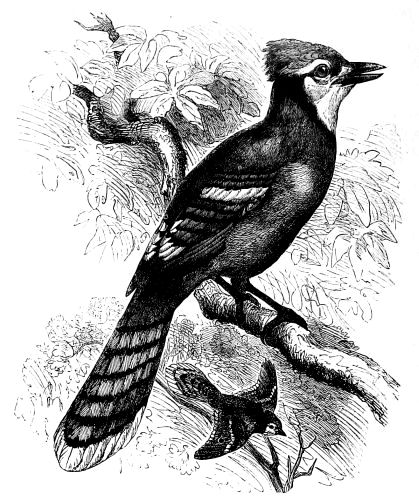
THE CRESTED BLUE JACKDAW (Cyanocitta cristata).
Notwithstanding the beauty of its appearance, the Blue Jackdaw is regarded with but little favour in America, where it is found in great numbers occupying the dense woods or groups of moderately high trees. It is only migratory from the Northern States, and is elsewhere numbered among the stationary birds. Wilson calls this species the Bird Trumpeter, from the remarkable sound that it produces when alarmed; and we learn from other writers that it can imitate the cry of the Buzzard and Sparrow Falcon to such perfection as frequently to terrify the smaller feathered denizens of the woods, and raises such an uproar on perceiving a fox or other enemy as compels the intruder to sneak quietly away. Its attacks upon the eggs and young of other birds are extremely merciless; and, indeed, it may be regarded as a most voracious and destructive bird of prey, which devours not only small quadrupeds, but will attack very large and powerful members of the feathered tribe should they be wounded, and thus for the time incapable of resistance; yet Audubon tells us that the Blue Jackdaw is a most arrant coward, and that it will often fly before an adversary no stronger than itself. It obtains its prey rather by extreme craft than by open warfare, for even Thrushes and other small birds can scare it from their nests, into which, however, it often manages to steal if left unguarded only for a moment; it will also attempt to seize young chickens, but is at once baulked of its purpose if startled by an angry cluck from the hen. Large quantities of seeds, all kinds of insects, and flesh are also eaten by these birds. During the autumn the maple, oak, and other similar trees are thickly covered by swarms of Blue Jackdaws, who not only satisfy their present wants, but carry off large quantities of seeds or acorns, storing them up as a provision for the winter, and by this means greatly assist in spreading the growth of these trees over the face of the country.
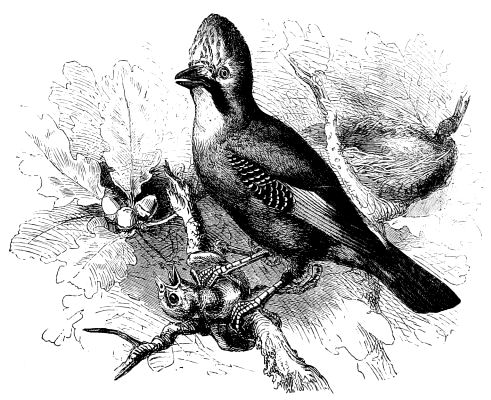
THE COMMON JAY (Garrulus glandarius).
The number of broods varies with the district in which the Jackdaws are found, some breeding but once and others twice in the year; the nest is formed of twigs and other dry materials, lined with a bed of delicate fibres, on which, in due season, four or five eggs are deposited; these latter are olive brown, marked with dark spots. During the time that the mother is sitting the male employs every precaution to prevent the discovery of his young family; he visits his mate with the utmost secrecy, and preserves the strictest silence while in her company. The young are fed principally upon insects. Nestlings may be easily reared in confinement, but it is never safe to trust the Blue Jackdaw in an aviary with other birds, as it is not uncommon, under these circumstances, for it to destroy its companions one after another. Audubon gives a most interesting account of an attempt he made to naturalise this species in Europe, but which unfortunately proved abortive; the birds, about thirty in number, destined to make the experiment were placed by him in a large cage, and at first exhibited every symptom of fear, refusing the food he proffered them, and crouching in the corners of the cage; by the next day, however, all had regained their usual spirits, and, taking up seeds of maize in their claws, hammered at them with such hearty good will that the noise they produced sounded more like a diminutive party of smiths than the efforts of birds; quarrels seldom occurred, and the party reached Europe in excellent health and spirits, but had not been long exposed to the change of climate before they began to be infested by numerous parasites, and only one survived to reach London. Since this attempt of the American naturalist many Blue Jackdaws have been brought to Europe, but in no instance have the efforts to naturalise them proved successful.
THE COMMON JAY.
The Common Jay, or Oak Jackdaw (Garrulus glandarius), is an European species, bearing no inconsiderable resemblance to the American bird above described, but its beak is stronger, and the tail shorter and less rounded. The plumage is silky, lax, and flowing, the feathers upon the head being prolonged into a crest. Its colour is principally greyish red or greyish brown, darker upon the back than on the lower parts of the body; the rump is white, the throat whitish, and marked upon its upper portion by two broad black streaks, commencing on the cheeks; the forehead is speckled with black and white; the quills are black, with the exception of a greyish-white space upon the outer web; the tail-feathers are black, occasionally edged with blue; the covers over the primary quills are striped alternately with blue, black, and white, producing a very lustrous effect. The eye is light blue, the beak black, and the feet horn colour. The length of this species is about thirteen, and its breadth twenty inches; the wing measures six and a half, and the tail five inches and three-quarters. The female is somewhat smaller than her mate.
A species closely related to this bird, but differing from it in the markings of the head, is occasionally met with in the south-eastern parts of Germany; its actual habitat, however, is North-western Asia, and members of the group to which it belongs are found in Central and Northern Asia. The Jay inhabits all the wooded districts of Europe except its northern parts, and is also met with in Central Asia and Western Africa; in Germany it is exceedingly common, but in England somewhat scarce. This bird frequents pine forests, woodland pastures, or leafy groves with equal impartiality, living during the summer in pairs, but at other seasons of the year flying over the country with its companions in small parties; it seems to avoid localities where there are no oak-trees, such districts being rarely visited. The Jay is extremely restless, and though in some respects a lively and interesting bird, is so crafty as to render it at times very troublesome, not only to its feathered associates, but to man. When excited, it places itself in a succession of strange attitudes, and imitates a great variety of sounds with amusing correctness. Whilst in a tree, its movements are light and active, and its gait upon the ground by no means awkward; but its flight is heavy, and it rarely remains for any length of time in the air, preferring to perch at short intervals upon trees or bushes, using them, however, not merely as resting-places, but as temporary shelter from the numerous feathered enemies by whom it is constantly pursued in the course of its short excursions from one wood to another. Naumann describes the dread in which many birds of prey are held by the Jays as so great, that they rarely venture to congregate in large flocks, but fly apart over the open country, living according to the advice of the old French maxim, "Chacun pour soi." The wonderful power possessed by this species of imitating the voices of other birds is noticed by many writers. Naumann heard a Jay whinny like a foal and crow like a cock; and Rosenberg tells us that late in the autumn, when seated beneath a tree, he heard one successively imitate the voices of the Magpie, the Shrike, the Thrush, and the Starling, and that on searching the branches to obtain a sight of such unseasonable vocalists, he discovered that all these various sounds were produced by a Jay, perched on a bough just above his head.
Of this bird it may be said, in the broadest sense of the word, that it will eat anything it is possible to obtain or vanquish; nothing, from a mouse to the smallest insect, escapes its voracity. During the autumn it often subsists for weeks together upon acorns and birch or hazel nuts, softening the former in the crop, and afterwards tearing off the shell with its beak; the latter it breaks by hammering upon them without any such preparatory process; Naumann also mentions having seen one of these birds in the act of killing a Thrush, and adds that they frequently work great destruction among young Partridges. The period of incubation commences early in the spring; the nest, which is by no means large, is placed in the branches of a tree at very various heights from the ground, and formed of dry stalks or small twigs, neatly lined with fibrous roots. The eggs, five to six in number, are laid about April; they are of a dirty white, thickly marked with greyish-brown streaks and spots, some of which form a wreath around the broadest end. Only one brood is produced during the year. The young nestlings leave the shell in about sixteen days, and are fed at first on caterpillars, larvæ, worms, and a variety of insects, but at a later period are reared upon the flesh of young birds. Falcons and Sparrow-hawks are among the many enemies with which the Jay has to contend; by the former it is immediately vanquished, but with the latter it will sometimes struggle long and fiercely, the combatants not unfrequently falling to the ground, exhausted by the violence of their efforts. The Horned Owl is a still more formidable assailant, destroying many birds belonging to this species; and their nests are constantly sacked by the Tree Martin, whose approach is often greeted with the most appalling cries as the parents attempt to drive the destroyer from their young. In its intercourse with man the Jay is extremely wary, and often succeeds in exasperating the sportsman, as, while in safety itself, it derides his efforts by its cries, and at the same time warns the other denizens of the wood that danger is approaching. If taken young, these birds may be trained to utter words, but their many disagreeable propensities render them even more unfit for a life of confinement than their American congeners.
In the more northern countries of Europe where the Common Jay is not met with, we find it replaced by a species whose delicate beak, decidedly rounded tail, and dusky plumage, have caused it to be regarded as the representative of a distinct group.
THE UNLUCKY JAY.
The Unlucky Jay (Perisoreus infaustus) is about twelve inches long and eighteen broad; its wing and tail measure five and a half inches. The prevailing colour of the adults is a light reddish grey, the quills and centre tail-feathers are grey, while upon the wings and the exterior tail-feathers there are patches of reddish brown; the upper part of the head is blackish brown. Young birds are known by the comparative paleness of their tints, and the indistinct markings upon the lower portions of the body. The eyes are greyish brown, the beak and feet black.
The dense fir and pine forests of Russia and Siberia are in some places numerously inhabited by this species, which has been known to fly as far as Germany, and, though rarely, is occasionally seen in Norway and Lapland. In some respects it resembles the bird we last described, but its activity and intelligence are inferior, and its mischievous propensities by no means so conspicuous as in the Common Jay. Wilson tells us that it is so bold and inquisitive that it will perch upon the cap of the woodcutter when engaged at his work, and testifies so little fear of man as to follow flocks of reindeer to their resting-place, even when accompanied by their herdsman. Its gait upon the ground resembles that of the Jackdaw, but amongst the branches it is considerably more active in its movements. When perching upon a tree it often appears to be under no anxiety to conceal itself, and seems to trust to the inconspicuous colour of its attire as a sufficient protection from the eye of an enemy. The flight of the Unlucky Jay is unsteady and struggling, and its cry, which is composed of two syllables, has been compared to that of a man in distress; Schräder speaks of it as being not unlike that of the Shrike, composed of various hoarse notes, mingled with sounds resembling the mewing of a cat. Nuts, berries, seeds, acorns, and insects of all kinds are eagerly sought after by these birds; they will climb amongst the fir and pine trees like Titmice, to obtain the contents of the cones, in very much the same manner as that practised by the Cross-bills, and as winter approaches will lay up a goodly store of these provisions; but their hoards are frequently plundered by squirrels or woodpeckers who have managed to discover the secret of their hiding-place.
This species commences its building operations in March: a nest which we obtained was a large structure, formed externally of twigs, moss, grass, and strips of pine branches; the interior was lined with an extremely thick layer of hair and Ptarmigan feathers. The eggs are usually from five to seven in number, of a greenish white, thickly covered with irregular dingy spots of greenish grey or olive green. The attachment of these birds to their young is extreme; should a sportsman approach their nest, the parent will fly down, and hobble along the ground as though lame, in order to draw his attention from the little family, and should it succeed in luring him to a safe distance from the spot, will rise suddenly into the air, and return by a circuitous flight to the place from whence it came.
When a flock of these birds is discovered, their capture is accomplished with little difficulty, for they will never desert each other in a moment of danger, so that should one member of the party be taken the rest become an easy prey. The Unlucky Jays are commonly to be met with throughout the whole of the fur districts in North America, where they may be seen hovering about the encampments of the trappers during the whole season. According to the account of Captain Blackiston, their capture is sometimes accomplished in the following manner:—A man lays himself flat down, either in a boat or upon the ground, draws a cloth over his head and shoulders, stretches out his hand, in which he holds a scrap of dry meat, and quietly awaits the result; his purpose is soon accomplished, for down come the birds to attack the meat, when, just as they are about to give the first peck at the tempting morsel, the treacherous hand seizes upon them with an irresistible grasp.
The LONG-TAILED CROWS (Glaucopes) are distinguished by their powerful and moderately long beak, which is broad at the base and compressed towards the tip. The upper mandible is slightly arched, hooked at its extremity, and covered at the base with short velvety feathers. The wings are short, their fifth quill longer than the rest; the tail is long and graduated, the feet strong, and the tarsus longer than the middle toe. The coloration of the plumage is brilliant. Like the Jackdaws, these birds almost exclusively frequent thick forests, and closely resemble the foregoing groups in their habits; the few facts we give below apply equally to them and the following species.
The TREE MAGPIES (Dendrocitta) constitute a group of Jays inhabiting India. They are large birds, with short, compressed, and very decidedly arched beaks; short, abruptly rounded wings, of which the fifth and sixth quills are longer than the others; wedge-shaped, elongated tails, the two centre feathers extending far beyond the rest; and with tolerably strong or short feet. So entirely are these Tree Magpies to be regarded as Indian, that not more than one or two of the five species mentioned by Jerdon are met with in neighbouring countries. We select for description the Kotri of the Hindoos (Dendrocitta rufa), or, as we shall call it,
THE WANDERING MAGPIE.
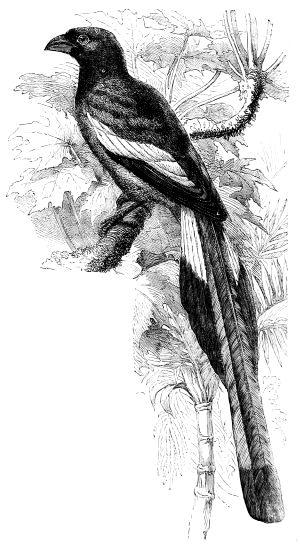
THE WANDERING MAGPIE (Dendrocitta vagabunda).
The Wandering Magpie (Dendrocitta vagabunda) is about sixteen inches in length, ten inches of which are included in the tail; the wing measures six inches. The entire head, nape, and breast are reddish brown or blackish brown, the tints being deeper upon the fore part of the head, chin, and breast, and from thence changing into a greyish shade. The feathers upon the shoulders, back, and tail-covers are deep red; the wing-covers and the exterior web of the secondary quills are light grey, almost white; the rest of the quills are black. The tail is deep grey, and all its feathers tipped with black; the lower part of the breast is red or reddish yellow, the beak black, the feet deep slate colour, and the eyes blood red.
The Kotri is met with throughout the whole of India, and is especially numerous in the wooded plains of Assam, China, and Cashmere. In the more northern parts it is seen in every group of trees and every garden, generally living in the immediate vicinity of villages; it appears to pass the day in flying in large undulating curves from tree to tree, or in roaming over a considerable tract of country, resting where it feels inclined, and never resorting to any particular spot for that purpose. It is but rarely met with in parties, but lives in pairs. Its food consists principally of fruit, or the insects found upon the trees; but it will also eat young birds, destroying them after the manner of the Shrike. Buckland tells us that another species hunts bats.
The BENTEOTS (Crypsirhina) are a group inhabiting Java. These birds are recognisable by the construction of their tail, which is formed of ten feathers, the centre ones being extremely long, whilst those at the sides are graduated. The beak is strong, of medium length; the tarsi moderately long, but weak; the toes are armed with powerful claws.
THE BENTEOT.
The Benteot of Japan, or Tenia of Le Vaillant (Crypsirhina varians), is about the size of a Thrush, though it appears much larger, owing to the extent of the long tail. Its soft plumage is principally of a jet black, and gleams with a green or purple sheen; only the forehead, bridles, and throat are pale black, and entirely without lustre; the quills are black, the four centre tail-feathers green, as are also the outer webs of the exterior feathers; the inner webs are of a dull black, the beak and feet are black. Horsfield tells us that this bird is by no means rare in Java, but frequents such very retired spots as to be but seldom met with; it avoids the inhabited parts of the country, and only appears occasionally upon the borders of its favourite thickets, to which it retreats at the first approach of danger. Its flight is unsteady and awkward, and its gait upon the ground equally clumsy. It lives principally upon insects of every description, and its powerful claws would seem to indicate that it can also plunder the nests of its feathered associates. Fruit has been found in the crop of this species.
A very similar group, TEMNURUS, is distinguished from that just described by the shape of the tail-feathers, the ends of which present the appearance of having been cut off at a right angle. The Saw-tail (Temnurus truncatus), inhabiting Cochin China, is the most perfect representative of this section. Its plumage is of an uniform black, and its length about fourteen inches.
The KITTAS (Cissa) are met with in Southern and Eastern Asia. They bear so great a resemblance to the Jays in their mode of life and general deportment, that we have no hesitation in assigning to them a place here, instead of following in the steps of some naturalists who class them with the Thrushes. The Kittas are a race of extremely beautiful birds, elegant in form and brilliant in plumage; their beaks are thick, strong, and almost as long as the head, curving from the base, and bent upwards towards the tip; the feet are large and strong, the toes powerful and of medium length, with formidable claws; the wings are round, their fourth and fifth quills being longer than the rest; the tail is either short and rounded or very long and graduated; in the latter case the central feathers extend far beyond those at the sides.
THE LONG-TAILED KITTA.
The Long-tailed Kitta (Urocissa Sinensis) is about twenty-six inches in length, seventeen to eighteen inches of this measurement belonging to the tail; the wing measures eight inches. The plumage is very splendid, the entire head, throat, and breast being deep black, shading into blue, with the exception of a white streak which passes over the head and nape; the mantle and upper tail-covers are of a light cobalt blue, the latter tipped with a broad patch of black; the wings are of the same blue tint, the inner web of the quills being black, and all the feathers tipped with white; the tail is principally blue, but its centre feathers are white, and the rest tipped with white and black; the under side of the bird is whitish, shaded with a reddish grey.
The Long-tailed Kitta is met with in the western parts of the Himalaya, and is replaced by a very similar species in the eastern provinces. Swinhoe tells us that it also inhabits the forests around Hong Kong in great numbers. In India it is found living at an altitude of 6,000 feet above the level of the sea, occasionally perching in the brushwood, but spending the greater portion of its life upon the ground, from which it obtains its principal food. In its habits it is so observant and intelligent as to be extremely useful to its feathered brethren, by warning them of the approach of an enemy; indeed, it is said that it will sometimes follow the leopard for miles, and thus prevent it from quietly stealing upon its prey. During its flight, which resembles that of the Magpie, the tail is kept in an horizontal position, but when perched it is held erect, and constantly waved as the bird utters its sharp and chattering cry. The Long-tailed Kitta builds amongst the branches of trees, at various heights from the ground, and forms its nest of twigs woven loosely together and lined with different kinds of vegetable fibre. The brood consists of from three to five eggs of a pale greenish grey, thickly strewn with brown spots, which form a kind of wreath at the broad end. Many of these birds have been brought alive to England, and in India they are occasionally kept tame in a cage.
The FEATHER-BEAKS (Cissa) are recognisable by their powerful bills, which are of medium size, slightly arched, and compressed at the sides; the wings are rounded, and the tail but slightly graduated.
THE SIRGANG.
The Sirgang of Bengal, or Green Jackdaw, as it is called by the Anglo-Indians (Cissa Sinensis), is a bird about fifteen and a half inches long, of which eight and a half belong to the tail; the wing measures six inches. The coat of this species is also remarkable for its beauty; the predominating colour is a delicate chrysophrase green, shading here and there into blue or blueish green, and changing into yellow upon the head; the black bridles are prolonged to the nape, where they unite, thus forming a kind of ring. The quills and wing-covers are of a beautiful deep red, shaded with brown (those of the old birds are greenish brown); the secondary quills are pale blueish green, with a broad border of black; the tail-feathers are white, those at the side are black, tipped with white. The feathers upon the head are elongated into a crest. The Sirgang is met with throughout the south-eastern districts of the Himalaya, with the exception of Assam, Silhet, and Tenasserim; in Sikim it is often found living at an elevation of 12,000 feet. Jerdon tells us that it wanders from tree to tree in search of delicate leaves or insects, and that it also eats grasshoppers. We learn from other sources that it will fall upon and destroy small animals after the manner of the Shrikes, and is as expert as a Falcon in pursuit of its prey. The voice of the Green Jackdaw is loud, and, compared with that of some of its congeners, not unpleasing. When caged it soon becomes tame, and is attractive in its habits.
THE PLANTAIN EATERS.
The Plantain Eaters (Amphibolæ) constitute a family of very remarkably constructed species, whose habitat is confined exclusively to Africa. Few members of the feathered tribe have given rise to so much difference of opinion as has been occasioned by the desire to assign to these birds their proper place. We have followed the classification adopted by Reichenbach, and shall introduce them here as presenting many characteristics in common with the Jackdaw. To avoid confusion, we have subdivided this very varied group into sub-families or sections.
The TRUE PLANTAIN EATERS (Musophagæ) range from the size of a Raven to that of a Jackdaw. Their body is elongated, the neck short, the head of moderate size; the upper mandible is very decidedly curved, slightly over-lapping the lower portion, and either indented or furnished at its sides with tooth-like appendages; the wings are of moderate length, and rounded, their fourth and fifth quills being longer than the rest; the tail is rather long and rounded, the tarsi strong and comparatively high. The foot is not constructed after the scansorial type—three of the toes being placed in front and one behind; it is true that they can move the exterior toes slightly backwards, but never so far as to pair with the one behind, except when under the hands of the bird-stuffer. The plumage is soft, in some species almost downy, and occasionally very brilliant in its hues.
The Plantain Eaters inhabit the dense and extensive forests of Central and Southern Africa, but are never found in the treeless districts of that continent; their habits are social, and they usually live in small parties, seldom consisting of more than fifteen birds. Some species pass the day in flying noisily about, whilst others spend their time in climbing with great activity amongst the trees, or in searching for food upon the ground. The flight of these birds is light and easy, their short wings enabling them to turn in the air with great facility; they are not very remarkable for intelligence, but in some respects exhibit considerable foresight and prudence, and though extremely timid in their intercourse with man, associate freely with their feathered brethren. They feed principally upon leaves, buds, fruit, berries, and corn, and for this reason they usually inhabit such localities as are well watered and rich in various kinds of trees. We are unacquainted with any particulars of their incubation, except that the nest is usually built in the hollow trunk of a tree, that the eggs are white, and that the young remain for a considerable time under the care of their parents.
THE BANANA EATER.
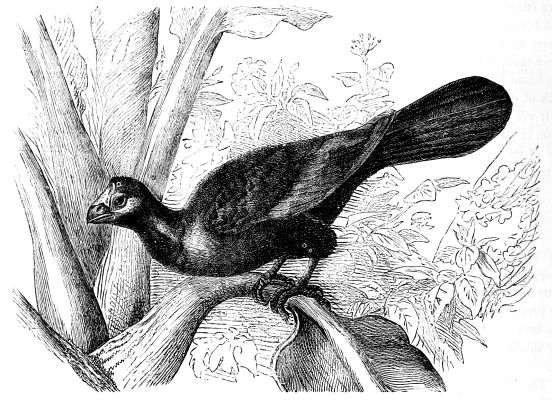
THE BANANA EATER (Musophaga violacea).
The Banana Eater (Musophaga violacea) is met with in the forests of Agra, upon the Gold Coast, and is replaced by a very similar bird in Western Africa. This species is distinct from its congeners by the peculiar formation of its beak, the upper mandible being covered for a considerable extent by a horny plate, which is also spread over a large portion of the forehead; the beak itself is very powerful, and arched broadly from the brow to the tip, where it terminates in a slight hook, projecting over the somewhat feeble inferior mandible; the edges of the bill are indented, and the nostrils are situated in the fore part of the upper beak. The bridles and a patch around the eyes are quite bare; the wings are of medium length, their secondary quills longer than the primaries; the tail is comparatively short, broad and rounded at its extremity; the feet are short but powerful. Swainson speaks in glowing terms of the beauty of this species—he regards it as truly a king among birds, and describes its plumage as being principally of a rich, lustrous, purple black, the splendour of which is enhanced by the contrast presented by its magnificent bright red wings; the beak is also very striking in appearance, being of a bright yellow, shading into brilliant red. The soft and delicate feathers which cover the top of the head resemble brilliant red velvet; the rest of the plumage is deep violet, and shines with a beautiful green light when seen in the rays of the sun; the quills are red, tipped with violet, and shaded with lilac; the bare places round the eyes are also red, and are thrown into strong relief by a dazzling white streak, which passes beneath them; the feet are black, the eyes brown. The young are without the small red velvety feathers upon the top of the head, but in other respects their plumage resembles that of the old birds. The length of this species is about twenty inches, the wings and tail measure eight inches and a half.
We are acquainted with but few particulars concerning the Banana Eater, which, until the last few years, has been numbered amongst the greatest rarities of our collections; but we learn from travellers that it inhabits the western coast from Senegambia to Lower Guinea, living in pairs, and passing nearly the whole of its life in the same locality; its movements, habits, voice, and food, seem to differ but slightly from those of its congeners with which we are more familiar.
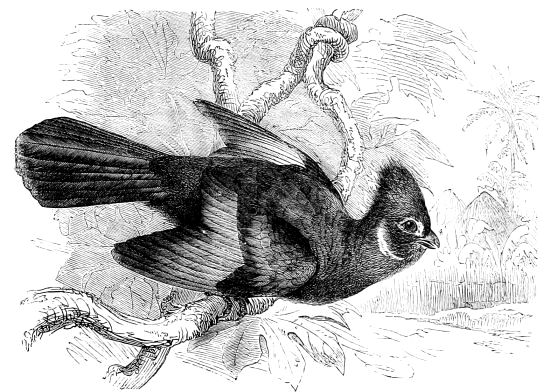
THE WHITE-CHEEKED HELMET BIRD (Corythaix leucotis).
We are much better informed as to the habits of
The HELMET BIRDS (Corythaix). These elegant and brilliantly-coloured birds are slenderly formed, with rounded wings, of which the fifth quill is longer than the rest. The tail is of medium size, the beak short and triangular, furnished with a slight hook at the extremity of the upper mandible; the nostrils are partially covered by the feathers on the brow, the plumage is rich; upon the head the feathers are prolonged so as to form a kind of helmet composed of green feathers. The wings are of an uniform purplish red, and the eyes surrounded by a bare flesh-coloured ring. All the various members of this group are remarkably alike, both in their appearance and mode of life.
THE WHITE-CHEEKED HELMET BIRD.
The White-cheeked Helmet Bird (Corythaix leucotis) is an inhabitant of Abyssinia; the colour of this species is for the most part green: the beak and wings are deep greenish violet, the tail is blackish violet, marked with dark coloured undulating lines; the belly and legs are deep grey. The helmet is dark green; a spot in front of the light brown eyes, and a streak which passes from the ear to the fore part of the throat are pure white; the wings are of a magnificent bright red, and bordered with yellowish green. The eye is surrounded by a ring of small reddish brown warts; the upper mandible is green, as far as the nostrils, and blood-red at its tip; the feet are brownish grey. The length of this species is about seventeen inches, its breadth twenty-one inches and a half; its wing measures six inches and three-quarters, and the tail eight inches and a quarter; the female is somewhat smaller than her mate, but does not differ from him in other respects. The Helmet Bird is found either at a considerable altitude in the mountains, or frequenting well-watered and thickly-wooded valleys, where it passes the greatest part of its life in flying from one tree to another in small flocks, only coming to the ground for a few moments at a time when in want of food, and immediately returning to seek shelter in the branches. When occupied in this manner the movements of this species resemble those of the Jackdaw, for the whole party does not alight at the same time, but steal down one by one, preserving the strictest silence, and after following exactly in the steps of their leader, return to the sycamore or tamarind tree that has been selected as a general rendezvous; here they assemble regularly both at night and during the mid-day heat, and when thus congregated at the summits of the branches, present a spectacle of such brilliancy and beauty as cannot fail to excite the admiration of all who see them. They hop and fly with the greatest liveliness and activity from bough to bough, and, apparently, are by no means desirous of eluding observation. Their flight is undulating, and effected by a series of violent strokes until the desired height is attained; the bird then spreads its wings as though to display itself to the utmost advantage, and sinks slowly towards the ground before again rising and continuing its course. During these evolutions the neck is outstretched, the head elevated, and the tail alternately opened and closed. The voice of the Helmet Bird is very peculiar, and has somewhat the effect of ventriloquism, often misleading the listener as to the position of the owner. We found both berries and seeds in the crops of some specimens that we killed, and observed that they were always most numerous in localities where the former abounded; we also procured a pure white egg from the ovary of the female Helmet Bird, which was not unlike the egg of a domestic pigeon, both in size and shape, but distinguishable from it by the superior delicacy and polish of the shell; the nest we could never discover, but believe it to be built in the trunk of a tree. These birds are so extremely shy and restless, as to render their capture a work of great difficulty, if the sportsman should not succeed in taking them unawares whilst disporting themselves in the crowns of their favourite trees. Verreaux mentions a very curious fact connected with this species, namely, that the magnificent purple of the tail-feathers entirely loses its beauty when exposed to moisture, and that the colour may be rubbed off with the fingers when wet; but as soon as the plumage is dry it recovers its full brilliancy of tint. A strange illustration of this peculiarity was afforded in the case of a Helmet Bird in the Amsterdam Zoological Gardens, which, having been seized with cramp, was drenched with cold water; some hours afterwards the creature died, and it was then discovered that the wing upon which it lay was still wet, and had changed from red to blue, while the upper wing had dried before death ensued, and had therefore regained its full gorgeousness of hue.
THE TURAKO.
The Turako (Corythacola cristata) may be regarded as the giant of this family. It is a very remarkable species, resembling the Helmet Birds in some respects, but differing from them in others so decidedly as to cause it to be regarded by some as the type of a distinct group. These birds are remarkable for the great size of their limbs, and also present marked peculiarities in the formation of the beak, and in the crests with which their heads are adorned. Their body is powerfully constructed, the wings of moderate size, and rather pointed, the fifth quill being longer than the rest, the fourth and sixth, however, almost equalling it in length; the tail consists of ten broad rounded feathers, slightly graduated at the sides; the tarsi are short and strong, the toes long, and armed with thick claws; the beak is powerful, and decidedly arched, somewhat rounded at the roof, and indented at its edges. The crest is formed by elongation of the feathers upon the brow and top of the head, the region of the eyes and bridles are also covered with feathers. The plumage is thick and soft, and upon the under part of the body slightly downy. In size this species will bear comparison with the Raven. Its length is about two feet two inches, the wing measures one foot, and the tail one foot and one or two inches. A bright green or Turkish blue usually predominates in the coloration of the feathers; those which form the crest are, on the contrary, black, tipped with dark blue; the breast and fore part of the belly are yellowish green, the rest of the under portion of the bird pale reddish brown, the tail greenish blue, tipped with bright blue, and marked with a broad streak of black towards its extremity. The beak is yellow, lighter in shade towards its base; the feet are of a leaden hue. The male and female resemble each other, but the young are without the crest, and have the throat bare; the beak and upper part of the head are black, and the whole coat much paler than in the adults.
The habitat of the Turako is confined to Western Africa, where it exclusively frequents such tracts as are well watered and thickly planted with trees, living in the same manner as the Helmet Birds, and rarely flying for any length of time, owing to the great difficulty it has in sustaining its heavy body, or rising to any great height in the air. Juicy fruits, such as figs or bananas, constitute its favourite food, but it will also eat grasshoppers and a variety of insects, and is said to do great mischief in plantations by the quantities that it devours. The Turako is constantly on the alert against danger, and on the slightest alarm raises its crest, which is usually laid flat, elevates its head, and turns about with every symptom of fear, previous to seeking safety in some other locality, where it conceals itself from pursuit with so much skill as to render its capture a work of difficulty, in spite of the observation it attracts by its loud, hoarse cry.
The second division of the Plantain Eaters constitutes a distinct group, called the
SPLIT-BEAKS (Schizorhis), also inhabitants of Western and Central Africa, distinguishable from the species already described by their elongated bodies and comparatively long wings, in which the fourth quill is longer than the rest, and also by the construction of their beaks, which are strong, and nearly as thick as they are broad; the upper mandible is very decidedly curved, and but slightly indented at its edges. The plumage of this group is dusky, and the crest upon the head of a peculiar shape.
THE ALARM BIRD.
The Alarm Bird (Schizorhis zonurus) measures about one foot seven inches and a half in length, and two feet four inches in breadth; the wings and tail measure nine inches and a half. The female is larger than her mate, but resembles him in other respects. In these birds the upper part of the body is of an uniform brown, and the lower portion light grey from the breast downwards. The elongated feathers which form the plume are bordered with white, those of the back, so far as they are visible, blueish grey; the quills are blackish brown, and all except the first marked upon their inner web with large, square white spots. The centre tail-feathers are light brown; the four exterior ones are brown at the tip, and from thence upwards white, broadly striped with brownish black at their roots. The eyes are greyish brown, the beak greenish yellow; the feet are dark grey.
This species appears to be spread over a considerable portion of the African continent, and travellers mention having seen it in Abyssinia, about the Blue River, and at the source of the White Nile. The cry of the Alarm Bird so closely resembles the voice of the monkey, that even experienced sportsmen are deluded into the belief that they are in the vicinity of a party of baboons, and find, to their astonishment, that the loud and peculiar noise is produced by some of these strange birds, as they sit perched together in pairs or parties on the branches of a neighbouring tree. When about to utter this cry the birds sit bolt upright upon the topmost boughs, and after agitating their tails give forth a sound that penetrates far and wide amidst the surrounding woods. Their habits are shy and cautious; they testify considerable anxiety at the approach of man, except when accustomed to his immediate vicinity, and rarely leave their refuge amongst the trees, except in the morning and evening, in search of the berries that constitute their principal food.
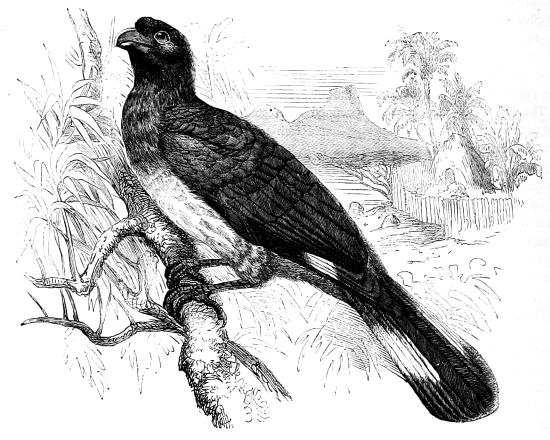
THE ALARM BIRD (Schizorhis zonurus).
The COLIES, or MOUSE BIRDS (Colii) bear a close resemblance to the Plantain Eaters, but are distinguished from them by the following striking peculiarities. All the species belonging to this group are much alike in appearance; their bodies are rather muscular, and nearly cylindrical in shape, the tail almost twice as long as the body, the wings short and almost rounded, the tarsi short, and toes long; the beak is short, thick, curved from its base downwards, and compressed at its tip; the upper mandible is furnished with a slight hook. The distinguishing characteristics of these birds consist in the construction of the foot, which has four toes all placed in front, but those at the exterior are capable of being turned either to the side or back of the foot; and, secondly, in the peculiarity of the plumage, which is so fine as to resemble the hair upon the back of a small quadruped; the long feathers which compose the tail are, on the contrary, particularly stiff, each of them having a very powerful shaft and webs of remarkable strength; the centre tail-feathers are at least four times as long as those at the sides; the wings are short and decidedly rounded, the fourth, fifth, and sixth quills being longer than the rest. The appellation of Mouse Birds has been given to this group on account of the mouse-like grey that predominates in their plumage, varied occasionally with a reddish or dark grey shade.
THE WIRIWA, AND WHITE-CHEEKED MOUSE BIRD.
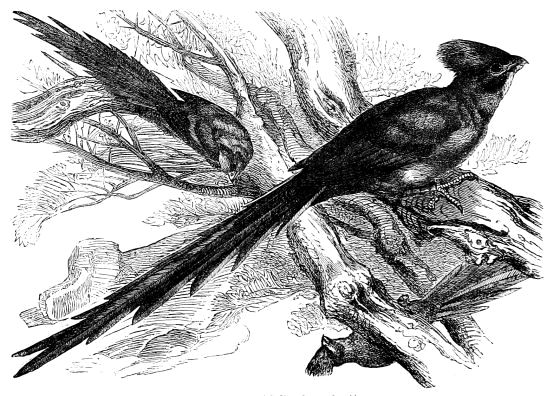
THE WIRIWA (Colius Senegalensis).
The Wiriwa (Colius Senegalensis) and the White-cheeked Mouse Bird (Colius leucotis) are both inhabitants of Africa. In the first the brow is grey, and adorned with a tuft of brownish-grey hair-like feathers; the back of the head and sides of the neck are reddish yellow, the remaining upper part of the body blueish grey, the throat light grey, the immediate front of the throat and breast greyish blue, clouded with grey; the belly is reddish brown, the beak red at its base and black at the tip; the feet are bright red, as is a bare ring around the brown eye. The plumage of the White-cheeked species is mouse grey; the lower portion of the body is yellowish grey, the throat dark grey, the brow blackish grey, the cheeks greyish yellow. The webs of the tail-feathers are broader than in those of the Wiriwa. The eye is light blue, the upper mandible of a blueish shade, the lower mandible reddish horn colour, and the feet bright red. Both species are alike in size, being about thirteen or thirteen and a half inches long, and from eleven to eleven and a half broad; the wing measures three inches and three-quarters, and the tail about nine inches. These remarkable birds are found exclusively in Central and Southern Africa, though the northern parts of that continent seem equally rich in their favourite trees. Some species appear to inhabit a very limited tract, whilst the range of others extends from the western to the eastern coast, and from sixteen degrees south latitude to the Cape of Good Hope: all frequent well wooded districts, and are as numerous in the fertile steppes as in the primitive forests. Le Vaillant was the first to give any detailed account of the remarkable habits of this group, and so many reliable naturalists have substantiated his statements that we cannot hesitate to give them a place here, though our own observations have not always furnished the same results.
The Mouse Birds, according to the writer we have just mentioned, generally live in small families, numbering about six individuals, and usually select a densely foliaged tree or thick mass of bushes as their gathering place. Only those who have visited Africa, and thus become acquainted with the remarkable characteristics of its luxuriant vegetation, can realise the actual appearance of the haunts thus selected as cities of refuge by these most strange and mouse-like creatures. Our readers must, therefore, try to picture to themselves a gigantic tree, with dense and usually thorny foliage, so interwoven with and embedded in the huge parasitical plants that grow around it as to be nearly concealed from view. In this green mass, which is impenetrable to man and beast, and even impervious to the attacks of the sportsman, the Mouse Birds make their home, creeping, like the animals whose name they bear, through such tiny and invisible crevices as to lead the spectator to imagine that they have actually vanished from his sight, when suddenly a little head appears, and the bird makes its exit through the hole by which it entered. How they manage to creep in and out of such small apertures seems quite inexplicable; Le Vaillant describes their motion whilst accomplishing this curious performance as being extraordinarily rapid. Their flight is performed with wings and tail outspread; whilst in the air the whole party constantly utter their shrill cry, which is accompanied by a very peculiar chirping sound; they but seldom rise to any great height when on the wing, and still more rarely settle upon the ground. Le Vaillant tells us that the Mouse Birds pass the night hanging in clumps upon the branches, like bees upon a hive while swarming. Perreaux, who verifies this statement, mentions having seen them clinging to each other whilst asleep, the first bird holding on to the branch with one foot, while it supports a second bird by entwining one of its legs with its own free limb; this second bird, in like manner, supporting a third, until they form a chain that often contains as many as six or seven of these living links. We ourselves have never succeeded in observing either of these curious habits, but have seen them during their sleep not only with both feet upon the branch, but lying full length upon it with the breast downwards. Whilst climbing among the foliage they will often hang like Titmice from the under part of a twig, but never retain this position for more than a very short time. The Colies are far from shy, and are easily captured if it has once been possible to penetrate their fastnesses—indeed, so little timidity do they exhibit that we have seen them caught with the hand.
Their food appears to be limited to vegetable diet, for we have never found insects in their crops, or, indeed, any substances except buds, fruit, or corn. The fruit of the plant called "Christ's Thorn" affords them their principal subsistence, but they will also devour grapes, limes, and cactus figs, getting at them after the manner of the Titmouse, by climbing over their surface. In Central Africa we heard no complaint of the mischief done to the gardens by the Mouse Birds, but in the Cape of Good Hope, owing to the large numbers in which they occur, the inhabitants regard them as formidable enemies. Nets or similar precautions are perfectly useless to prevent their incursions if they have cast their eyes upon a tempting-looking tree, for, if there be an aperture however small, their lithe, elastic bodies can penetrate it with the utmost ease. The nests, which are described as being of a conical shape, and formed of roots of various kinds, cotton-wool, grass, and leaves, are placed close together upon the most inaccessible branches. The brood consists of from six to seven eggs. Large numbers of the Mouse Birds are shot in the Cape, not only on account of the mischief they do, but for the sake of their juicy flesh.