CLASSIFICATION OF BIRDS. (continued 3)
Thomas Rymer Jones translation
We learn from the sailors who bring them to Europe that they are frequently offered for sale in India, but die in great numbers when in confinement.
THE DAPPLED LORIKEET.
The Dappled Lorikeet (Psitteuteles versicolor) is a small bird of about six and a half inches in length. The plumage is much variegated; the cheek-stripes and top of the head are dark red, with a band round the neck of deep sky blue; the back blueish green, the wings green, the upper tail-covers light yellowish green, all the upper feathers being narrowly striped with yellowish green, and the under-feathers streaked with yellow along the shaft; both sides of the belly and the inner side of the leg are spotted with purple. The primary quills are black, bordered at the edge with dark green, and surrounded by a yellowish line. The beak is scarlet, the foot a light ash grey, the cere and the bare patch around the eye are greenish white, the iris is reddish yellow, with narrow red rings around the pupil.
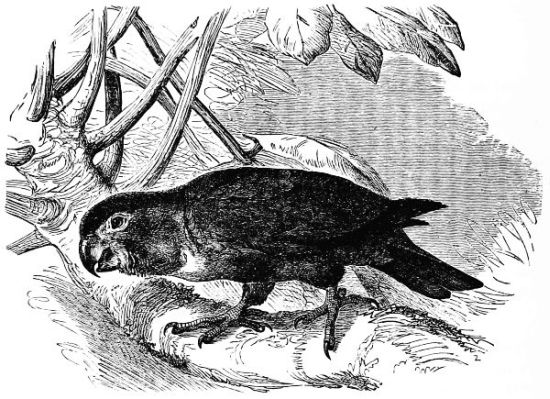
THE PURPLE-CAPPED LORY, OR LORIKEET (Lorius domicella).
We are indebted to Gilbert for a short description of the habits of this species, which is found on the northern side of Australia, more particularly near Port Essington. These birds assemble, he tells us, in innumerable hosts, and settle upon the gum-trees in order to obtain nectar from their flowers: whilst a flock is in motion, their movements are so regular and simultaneous that they might be mistaken for a passing cloud, did not their piercing cries undeceive the spectator.
SWAINSON'S LORIKEET.
A Lorikeet nearly related to the preceding, called after Swainson (Psitteuteles Swainsonii), has been described by Gould as follows:—"The South Australian woods of gum-trees, extending to Moreton's Bay and Van Dieman's Land, shelter large flocks of Swainson's Lorikeets, the flowers of these forests furnishing them with a plentiful supply of nectar and pollen; such trees as have newly blossomed being preferred to any others by these dainty little creatures. The appearance of a forest of Eucalypti covered with blossoms, upon which various species of Parrots and Honey-birds are feeding, baffles all description; three or four different kinds may often be seen busily combining to rob the same branch; nor is it easier to imagine the thousands of tones and cries uttered by a flock when rising into the air, preparatory to leaving one tree for another." These swarms must be seen and heard if we would form any adequate idea of them. During a morning's walk in the woods, near the Hunter river, Gould came upon an enormous gum-tree, about 200 feet high, in full bloom, upon which hundreds were perched in the utmost harmony; he killed specimens of all the four species of Lorikeet found in that part of the country upon one bough.
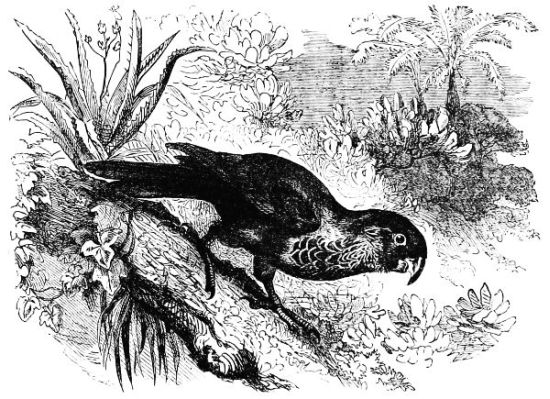
THE DAPPLED LORIKEET (Psitteuteles versicolor).
The flight of these Lorikeets is very powerful, and as straight as that of an arrow: they rise with surprising rapidity, dart through the air uttering noisy cries, and climb the trees with much adroitness, more in the manner of a Titmouse than of a Parrot. After sunrise they are so busily occupied in imbibing the nectar from the flowers, that they can scarcely be frightened from their perch, and Gould found that the firing of a gun had no other result than a loud scream, or merely caused some of the birds to quit the branch that had been aimed at, and settle on another. So successful are they in their search for nectar, that it often streams from the mouths of those that have been shot if they are held up by the feet.
Little has been learnt by travellers of the incubation of this species, but it would seem that the flocks do not divide in the breeding season; as many couples build upon one tree as can find room upon it. The nest is made in the holes of trees during the month of October, and contains from two to four white round eggs. In certain parts of Australia the Lorikeets are great favourites with the natives, who string their heads into chains, with which they deck themselves as with garlands.
THE MAIDEN LORIKEET.
The Maiden Lorikeet (Coryphilus Tahitianus), another member of this group, inhabits the islands of the Pacific Ocean, and principally Tahiti, from which it receives its name. It is a magnificent little bird, about six inches long, with a tail that measures two inches and a half. The feathers upon its head form a sort of coif or cap; the plumage is of uniform blueish purple, with the exception of the throat and upper part of the breast, which are of a dazzling white; the lower part of the wing and tail covers are dusky black. Its habits are similar to those of other Lorikeets.
THE PAPUAN LORY.
The Papuan Lory or Rasmalas (Pyrrhodes carmosine Papuensis) is one of the somewhat aberrant forms of this group. In shape it is more elongated than those we have just mentioned, and may be recognised by the two middle feathers of its tail, which are longer than the body, and make the entire length of the bird seventeen inches, of which no less than eleven inches must be allowed to these middle tail-feathers: it measures about fourteen inches across the wings. The plumage of the Rasmalas is bright and beautifully tinted, its general colour scarlet, interspersed with blue, golden, and grass-green spots; the head, neck, and top of the back, and the whole of the under portion of the body, are scarlet, except two streaks of splendid sky-blue, edged with scarlet, which run over the hinder and middle parts of the head; the sides of the breast and legs are spotted with yellow, the under tail-covers and the inner side of the legs are deep blue, the wings green, and the centre tail-feathers light grass green tipped with gold, these last colours being repeated upon the other tail-feathers, only that the latter are of a somewhat darker shade at their roots.
The Rasmalas is an inhabitant of New Guinea, and an article of traffic to the natives, who treat the dried skins as they do those of the Birds of Paradise, cutting away both the legs, before exporting them to Europe. As far as we know, this species has never been brought alive to our part of the world, and we are quite ignorant as to its habits and mode of life.
THE BLUE-STRIPED LORY.
The Blue-striped Lory (Lorius cyanostriatus), which we have selected as the subject of one of our coloured illustrations (Plate III.), may be regarded as the type of the beautiful race to which it belongs. Its small size, and comparatively feeble beak, the elevation of the tarsi, and the diminutive claws, are eminently characteristic, as also is the somewhat wedge-shaped tail. The prevailing colour of this species, like that of the Lories generally, is a brilliant crimson, which pervades the entire plumage, but is much relieved and set off by dark shadings of deep red, almost approaching blackness, which cover the hinder part of the back, overspread the extremities of the wings and tail, and vary the tints of the wing-covers, producing a very rich appearance, which is still further heightened by a row of feathers of ultramarine, wherewith the hinder part of the neck is ornamented as with a sort of cape. The eyes are surrounded by elongated patches of naked flesh-coloured skin, immediately behind which the ear-feathers, of a brilliant ultramarine blue, are rendered very conspicuous.