PASSERINE BIRDS (Passeres). (continued 4)
Thomas Rymer Jones translation
The Blue Steel Finch is found chiefly in Dongala, spread over the whole face of the country, inhabiting the steppes, or seeking its food in the native villages with equal impartiality; its favourite haunts, however, are those wells and pleasant places selected as resting-places by the many caravans of travellers passing through their domains, the débris from whose dinner or supper afford a plentiful repast, which is rapidly appropriated by these elegant and industrious little creatures, who, meantime, exhibit their graceful attitudes and attract constant attention to their varied movements. The period of incubation extends from January until March; the nest is built upon a tree, and is a mere heap of grass. We are unacquainted with the appearance of the eggs. No sooner are the young birds fledged than the whole company associate themselves with the Fire Finches, and fall in masses upon the fields of durrah, thereby drawing down upon themselves the hatred of the natives, who use every means in their power to drive them from the spot, employing for this purpose a contrivance similar to that we have already described in our account of the Rice Bird. The Blue Steel Finch is never caught for purposes of domestication, but large numbers of the Green species are captured annually on the western coast of Africa, and exported to Europe and America.
THE BUTTERFLY FINCH.
The Butterfly Finch (Mariposa phœnicotis) is a species found constantly associated with the birds above-mentioned. Its body is lengthy and slender, its tail long and wedge-shaped, and its beak, which is extremely broad and high, placed at a right angle with the forehead. The first quill of the wings exceeds the rest in length. The plumage of this bird is very thick and silky; the whole of the upper part of the body is grey, the face, breast, sides, and upper part of the centre of the tail a bright greenish blue, the belly and under tail-covers dark grey, as is the under portion of the tail. The cheeks are marked with a vivid red spot, the beak is pale red, and the feet flesh colour. Both sexes are alike in plumage, except that the female is without the red spots upon the sides of the face. This bird is four and a quarter inches in length, the breadth across the wings six and a quarter inches, the length of the wing is one inch and five-sixths, and of the tail one inch and three-quarters.
The Butterfly Finch inhabits the greater part of the continent of Africa, flying over the country in small parties, that rarely become much increased. The nest, which is seen both during the rainy and dry seasons, is placed upon a low bush, and resembles a rough bundle of hay rather than a cradle for the young. The eggs, from four to seven in number, are long and of a brilliant white. We are told that this species will occasionally steal into a Weaver Bird's nest to deposit its eggs, but cannot speak positively as to the truth of the statement. This elegant Finch, better known upon the Continent as "Cordon Bleu," is lively and restless in its habits, and the attachment testified by one little mate for the other renders them extremely attractive when caged. The only care necessary for their successful rearing is to keep them constantly in a warm atmosphere.
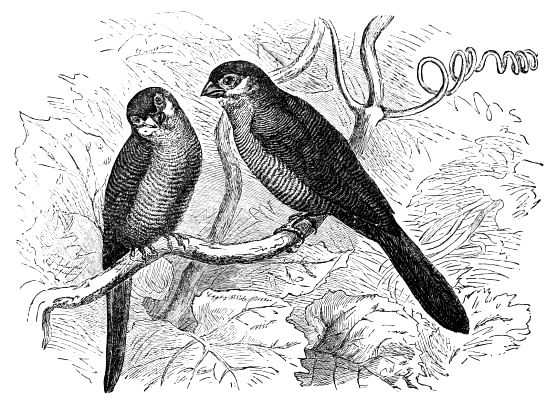
THE PHEASANT FINCH (Astrilda undulata).
Next in order to the preceding we place the ASTRILDS (Astrildæ), as closely resembling them in many particulars, the body being slender and the tail wedge-shaped; but the beak, although almost as high and broad as it is long, rises with a decided curve towards the brow. The plumage is very silky, delicately coloured, and marked with a series of undulating lines. Europeans are familiar with two species of this group—the Grey Astrild (Astrilda cinerea), and the Pheasant Finch (Astrilda undulata). The coat of the former is brownish grey, lighter upon the lower part of the body, or almost imperceptibly shaded with dark wave-like markings; the tail is white, and its exterior feathers white upon their outer web; the bridles which in this bird pass around the eyes are of a blood-red, as is the beak; the feet are grey. The plumage of the Pheasant Finch is of a brownish grey, fading upon the throat into greyish white; the lower part of the breast and sides of the belly are tinged with rose colour, and the outer web of the exterior tail-feathers are light grey, striped with a deeper shade. In other respects this bird resembles the Grey species; both are alike in their size, which does not exceed four inches.
The whole of Southern and Central Africa is graced by the presence of these beautiful creatures, the "Little Pheasants" generally occupying such parts as are thickly wooded, and flying about the country in small flocks, perching when in need of rest upon the bushes, from which they descend to seek for seeds upon the ground. These birds are extremely common in Natal, where we are told they devour great numbers of winged termite ants, pursuing them in the same manner as that practised by the Flycatchers. The nest of the Astrilds has been described as melon-shaped, and closed at the top; it is placed in beds of high grass, and built of fine leaves or stalks stoutly woven together, and hanging loose about the exterior. The eggs, four or five in number, are carefully tended by both parents, who sit alternately. As far as we can ascertain, the Pheasant Finches do not migrate, but may be found living for years in the same districts. In disposition they are very attractive, and this, combined with their beauty and rather pleasing voice, will account for the large numbers that are captured and exported to Europe.
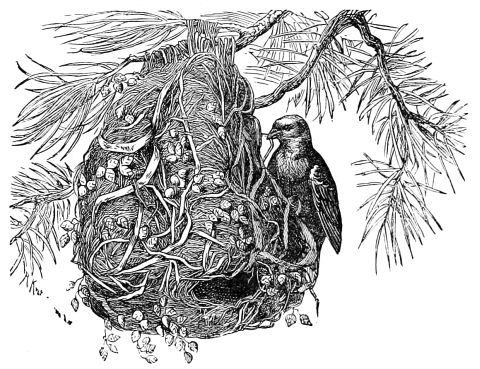
DETACHED NEST OF MALE GOLD-FRONTED WEAVER BIRD (Oriolinus icterocephalus).
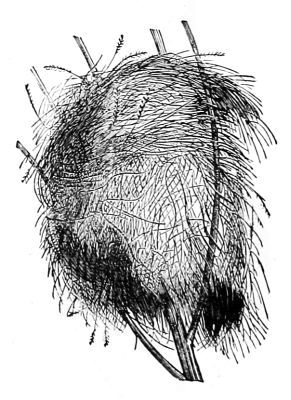
NEST OF ASTRILDA, FROM SENEGAL.
We are now about to enter upon a description of one of the most remarkable groups of African birds, the strange forms of whose very varied nests are no doubt familiar to many of our readers. It would be difficult to imagine a more beautiful sight than that presented by a settlement of these most artistic WEAVERS, their nests hanging not singly, but by dozens, from the branches of a tree, which is generally selected with a view to being in the immediate vicinity of water. So strong and firm is the work of the little architects that the rain and blasts of years will not shake their abodes from their foundations, and it is by no means uncommon to see a tree thickly covered with the consecutive labours of many generations, and literally bending under the weight of these curious and elegant constructions. The central and western parts of Africa are particularly resorted to by these birds, also long accounts are given us of their abundance in Java and Madagascar.
WEAVER BIRDS.
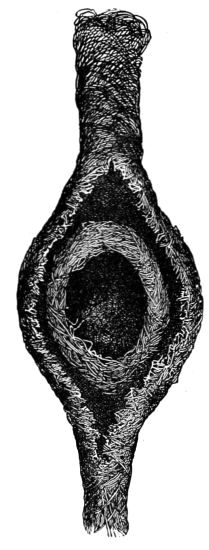
NEST OF WEAVER BIRD SLIT OPEN.
The Weaver Birds (Plocei) are large Finches, with bodies somewhat elongated, having slender, or in some cases, short broad beaks, long wings, tails of moderate length, and very bright coats, the latter often varied during the breeding season by a peculiar kind of plumage. Yellow and yellowish red are usually the principal tints in the coloration of the feathers; but species are found in which black, red, white, or grey predominate. The head and face are generally dark, the back greenish or yellowish red, the lower part of the body dark yellow, or of a light or dark red. Like other Finches, the Weaver Birds are extremely social, living, as we have said, in large settlements during the period of incubation, and flying over the country in company with thousands of their feathered brethren during the remainder of the year. Immense damage is done by these swarms to the fields over which they pass, and about which they remain until the time comes for returning to their old breeding-places. Shortly after the moulting season the work of building commences, and several months are generally occupied in diligent labour before the newly-constructed homes will suit the requirements of the fastidious owners, who frequently tear a whole nest to pieces, and entirely recommence their labours, rather than rest content with a performance that is not quite satisfactory. The nests of the various species of Weaver Birds differ considerably in their shape and general structure, some building a detached residence (see p. 165), in which the male luxuriates, whilst his spouse is busied with the cares of her family; others, again, are so large as to contain numerous compartments, the whole colony working so close together as to form, not many separate nests, but one large establishment (see p. 168). Fibres, slender twigs, or blades of grass, are the materials usually employed in the construction of these edifices, the whole being woven tightly together, after having been rendered more flexible and adhesive by an application of saliva from the little artist's beak. The greater number of such settlements are formed of nests containing merely the chamber for the young and the apartment arranged by the male for his own occupation. Some males, however, build separate nests for themselves. Both are represented in our engravings.
Many tribes of Africans tell wonderful tales about these creatures and their homes, some of which border upon the marvellous. The Malays have a saying that "He who can remove a Weaver Bird's nest without breaking it, will find a golden ball within;" and there is a popular belief in Africa that the lumps of clay so often found in these little dwellings are employed by the tenant as a kind of candlestick in which it fastens the fire-beetle it is supposed to employ to light its tiny apartment by night. The Weaver Bird lays many times during the year, and feeds its somewhat numerous family upon insects; these latter, combined with various kinds of seeds, also constitute the food of the parents. In spite of the injury done to the fields, but few precautions are taken by the natives to protect themselves against the depredations of these ingenious architects, who might live out the full term of their natural life were it not for the attacks made upon them by their numerous enemies, who are ever on the watch around their habitations. Our engraving (p. 175) represents the manner in which the monkey, one of the most formidable of their foes, obtains its prey. It is in hope of baffling the attempts of such unwelcome visitants that the Mahali Weaver Birds insert thorns with the points outwards into the walls of their nests, thus enabling the occupants to rest quietly, without fear of seeing their young carried off by snakes and other intruders. Large numbers of these curious and interesting birds are annually exported and sold at low prices, so that our readers need have no difficulty in witnessing their constructive powers, which are often displayed to great advantage in a cage. One of the most celebrated of this group is
THE SOCIAL WEAVER BIRD.
The Social Weaver Bird (Philetaërus socius) stands alone in the peculiarities that distinguish it from its congeners. This species is recognisable by its conical and elongated beak, which is somewhat compressed at the sides; its upper mandible rises into a slight arch, and is furnished at its edges with a tooth-like appendage; the wings are of moderate length, scarcely extending beyond the root of the tail: their first quill is much shorter than the succeeding four, which are of equal length; the tail is rounded at its extremity. In this species, as in the whole family of Weaver Birds, the tarsus is strong and high. The plumage is extremely simple: the top of the head, sides, and front of the neck and breast are of uniform deep grey; the upper part of the head marked with dark spots; the nape and back grey, with undulating lines of black; the wing-covers, quills, and tail-feathers deep brown, edged with light grey; the feathers on the sides of the belly are blackish, bordered with a paler shade; the region of the beak and a small spot over each eye are black; and the beak and legs horn colour. Its length is about six inches and nine lines, and the wing measures rather more than two inches and ten lines. The female is known by the paler colour of the back, and the young by the brown tints upon the head; the latter are without the black spot upon the lower mandible and sides of the body.
It is generally considered that the Social Weaver Bird never crosses the Orange river, though how far it may penetrate in a northerly direction has not as yet been ascertained. Patterson, who wrote at the end of the last century, mentions having seen mimosa forests densely inhabited by these birds, who congregate in the hope of preserving their eggs from the numerous snakes. For this purpose, hundreds of them build their nests beneath one large roof, resembling a thatched house in its appearance. This roof (see p. 168) is fixed to a large branch or portion of the tree, and under it the actual nests are placed so closely together that it would be quite impossible for a snake or any other enemy to penetrate to the interior. All day long the busy crowd of workers hurry to and fro, resembling a swarm of bees in their industry, and, like them, return laden with everything needful for the construction or improvement of their homes, while year by year the settlement increases in size, until at last the tree literally bends beneath the weight of the superincumbent colony. The entrances to the interior are very numerous, and situated underneath the massive edifice, each opening leading to a kind of corridor or street, on both sides of which are the small and very secure apartments provided for the young. These birds subsist upon the seeds of the grasses employed in the construction of their dwellings. The above account has been verified by Mr. A. Smith, a well-known traveller and naturalist, from whom we learn that each couple works at its own portion of the building, all co-operating, however, in the common endeavour to concentrate the nests under one substantial straw thatch, and thus ensure the safety of the whole flock. These aerial cities are generally built upon large branches at a considerable elevation, but the Tree Aloe is occasionally selected as affording suitable support. The brood of the Social Weaver Bird consists of three or four blueish-white eggs, marked with small brown spots at their broadest end. The young are fed entirely upon insects, which are only occasionally eaten by the parents.
THE GOLDEN WEAVER BIRD.
The Golden Weaver Bird (Ploceus galbula), the type of a numerous group, is an inhabitant of Eastern Soudan. This bird and its congeners are all slenderly formed, and of moderate dimensions, possessing a slightly curved and shallow beak, the base of which appears to join the forehead at an acute angle; the feet are strong, the wings moderately long, reaching past the tail-covers; the tail is of medium length, and abruptly rounded; the third, fourth, and fifth quill-feathers are the longest, the first being rudimentary. The adult male is a most beautiful creature, the top and sides of its head, and all the lower portion of its body, being of a bright lemon colour. The region of the eyes, and the parts around the lower mandible are bright red; the back and wing-covers a brilliant green, with darker shafts to the feathers; the quills and tail are reddish brown, bordered with yellowish green; the iris is reddish brown, the beak black, and the feet yellow. In the female the forehead is of a greenish yellow; the back of the head, nape of neck, and mantle bright green; the shafts of the feathers are of a deeper shade; the throat is a dirty white, the upper mandible deep brown, the lower one somewhat paler. The young male resembles the mother, but is distinguished by the dusky yellow upon its throat.
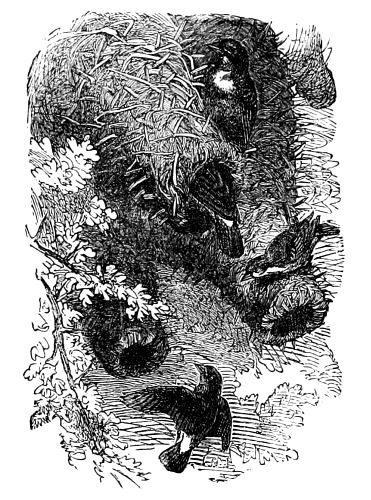
NEST OF MAHALI WEAVER BIRD.
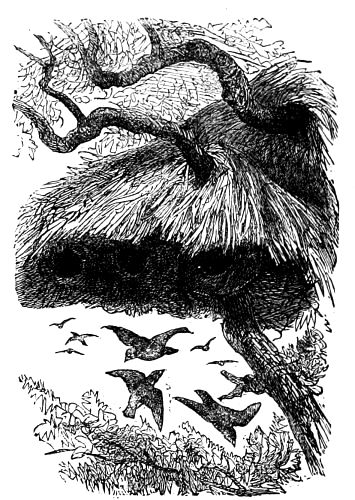
NEST OF SOCIAL WEAVER BIRD (Philetaërus socius).
The Golden Weaver Bird is common in Abyssinia and the surrounding countries, where it may be often seen flying about in company with its congener the Green Weaver Bird, but never joining with it in the construction of a settlement. In their habits these birds are closely allied to other Finches, and are lively, active, and extremely social. At such times as the work of building the nests or rearing their young is not going on, they generally congregate in large flocks, and perch on the very summits of the trees, pouring forth their song for the delight of the female part of the community, until they are inclined to go in search of food. About noon all is hushed, for at this time the cunning Weavers are going down to drink, an operation requiring the greatest circumspection and care, as their enemies the Falcons are peeping at them over the trees, and ready to pounce upon them at a moment's notice. They now assemble in the bushes near the water side, frequently to the number of some thousands, where they scream and chatter much after the manner of our Sparrows. Suddenly, with one swoop, the little creatures reach the desired stream, take a hasty draught, and are back again to the thickets before their much dreaded foes have time to recover from their surprise and follow in pursuit. This proceeding is repeated some ten or a dozen times during the hour that is devoted to quenching their thirst, before they again commence their search for food. When the labours of the afternoon are over, all again return to the favourite tree, to sing their songs, and sleep away the night. In Soudan the moulting season commences about July or August, and after that is over the flock are employed in making long excursions until the period of incubation returns. Most species breed twice in the year. The following description of the Golden Weaver Bird's nest was written some years ago upon the spot, where we were fortunate enough to have opportunities of observing the manner of its construction:—The operation is commenced by placing long blades of grass at equal distances from each other, and fastening them together with so much exactness that a kind of framework is prepared, in which the form of the edifice is plainly discernible. The next step is to make the walls, by weaving in long straws; great care being taken to lay them in a downward direction, and thus render the roof water-tight. At this stage the beautiful fabric presents the appearance of a cone, placed upon the half of a ball. An entrance to its interior is next obtained by constructing a long tubular passage, extending downwards from a hole at the side, quite to the bottom of the nest, to the exterior of which it is firmly attached. The interior is lined with soft stems of grasses, and very frequently the birds may be seen employed upon this wonderful structure, even after the eggs have been laid; these latter, from three to five in number, are at first white, then red, and only gradually acquire their green colour. From Heuglin we learn that the male undertakes the principal labour of constructing his own abode, and that he may frequently be found building it, as though in anticipation, at times when he has no especial need of a nest. As far as we could ascertain, the care of brooding devolves entirely upon the female; she is, however, assiduously tended by her mate, who likewise shares her toils when the time comes for feeding the nestlings. This latter duty is performed so diligently that scarcely a minute elapses between the arrivals of the parents bringing supplies to satisfy the gaping young; they hang upon the lower part of the nest, thrusting in their heads and placing the morsel into the outstretched beaks of their hungry progeny. At such times, when the nests are numerous and placed closely together, a settlement of Weaver Birds can be compared to nothing but a bee-hive, as the inhabitants perpetually fly backwards and forwards in one unceasing bustle and confusion. These birds are occasionally, but very rarely, brought to Europe.
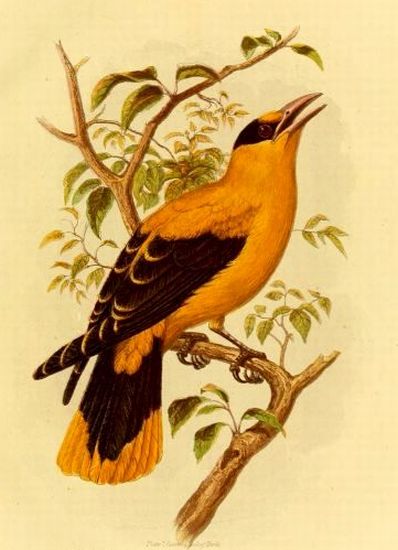
Plate 7, Cassell's Book of Birds
THE SHARP-BILLED ORIOLE ____ Oriolus acrorhyncus
(Three-fourths Life size)
[See larger version]
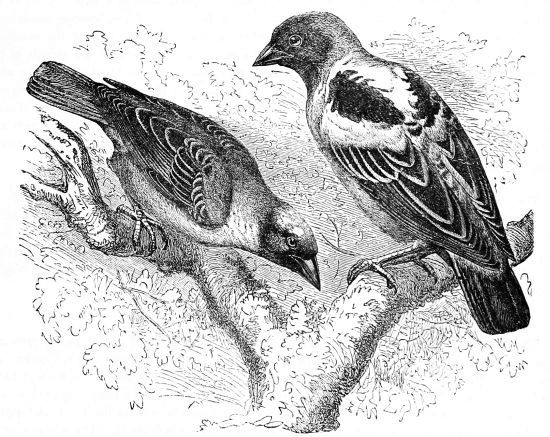
THE GOLDEN WEAVER BIRD AND THE MASKED WEAVER BIRD (Ploceus larvatus).
The BAYAS (Nelicurvius). The members of this remarkable group inhabit the whole of Southern Asia, including the neighbouring islands, and are characterised by the formation of the beak, which is somewhat prolonged, with the ridge vaulted, and joining on to the forehead almost in a straight line. The wings, of which the fourth quill is the longest, are of moderate length, the tail is short, the feathers being of equal size and sharply pointed, the tarsus strong, and of medium height; the coloration of the plumage is by no means bright.
THE BAYA.
The Baya (Nelicurvius Baya), the most celebrated of the race, is of a dark brown upon the upper portion of its body, and all the feathers, particularly those of the wing and tail covers, are bordered with yellowish white; the breast is marked with light brown, the shafts of the feathers being of a deeper shade. The face and front of the throat are black, the top of the head bright yellow, and the primary quills edged with a narrow yellow line. The female is without the black and yellow upon the head, the eyebrows are pale, the breast and chin of a whitish shade. The winter coat of the adult male is like that of the female; in the young male the breast is pale red. The beak is horn colour, the iris brown, the feet flesh coloured, the eye dark blue. The length of this bird is six inches, and its breadth nine and a half inches; the wing measures two inches and four-fifths, and the tail two inches. This species is found extensively throughout India, Assam, Burmah, and the Malayan peninsula, frequenting woodlands in large numbers; it is much more rarely met with in the highlands of the Deccan. Corn, rice, and various kinds of grass-seeds constitute its principal food, but we have never been able to ascertain from our own observation that it will eat fruit. The Bayas breed during the rainy season, which occurs between April and September, according to the locality, and associate freely with other species. Their very curious nests, which in shape resemble a retort, are models of neat and compact architecture: these structures are generally hung from the branches of palms, or other trees, and in India we have never seen them elsewhere; in Burmah, on the contrary, it is not uncommon to find them suspended from the eaves of houses, or from the huts of the natives, some twenty or thirty in a row. On one occasion we observed not fewer than a hundred of these strange appendages hanging to the roof of one house, and the little occupants living on excellent terms with their human neighbours; it is, therefore, very remarkable that this same species in some places should occupy the most quiet and isolated situations, only visiting such districts as are but little frequented by man. The walls of the Baya's nest are composed of blades of grass, gathered while still green, or of strips of leaves, frequently those of the palm-tree, woven carefully together, the shape of the little edifice varying according to circumstances or the taste of its owner. As soon as the chamber allotted to the eggs is fully completed, the bird proceeds to build a partition wall, thus forming a second apartment, supposed by some naturalists to be the especial property of the male, whilst others imagine that it is only intended to separate the entrance passage from the cradle of the nestlings. The entrance is tubular, and is very strongly and firmly constructed, being destined to serve as the favourite sitting-room of the whole family, when the young birds have acquired sufficient strength. No sooner is the second chamber of which we have spoken completed than the female, who has hitherto worked with her mate, retires into the part designed for her eggs, and occupies herself in weaving together the fine grass with which the interior is lined, the materials for the work being brought to her by the male bird, who alone continues the building of the passage and exterior portions of the nest. When this part of the work is concluded, the little artisan proceeds to carry in the lumps of clay, about the use of which so many opinions have been expressed. The natives assert that to these pieces of clay the male affixes fire-flies, to illumine the interior of the nest. Layard imagines them to be employed by the little builder as a whetstone whereon to whet its beak, whilst we ourselves are of opinion that they serve merely as a means of weighting the structure as it hangs suspended in the air, and have many times remarked that an unfinished nest contained more clay-balls than one that was completed. Very various accounts are given as to the number of eggs that form a brood; we have never found more than three, and feel sure that in cases where six or seven have been discovered two females must have occupied the nest. Young Bayas are frequently tamed, and form a most interesting and attractive addition to an aviary.
The CRIMSON-BEAKED WEAVER BIRDS constitute a separate group, distinguished by the unusual height and depth of their beak, which is nearly equal to two-thirds of its entire length; in shape it is slightly arched, and compressed towards its edges. The wings reach to the middle of the tail, which is short, but slightly graduated and rounded at its extremity; the plumage is brownish, spotted on the lower portion of the body when the bird is young, becoming at a later period of a yellowish or reddish shade.
THE CRIMSON-BEAKED WEAVER BIRD.
The Crimson-beaked Weaver Bird, or Diock (Quelea sanguinirostris), is about four inches and ten lines long, and seven inches and ten lines broad; the wing two inches, the tail rather more than one inch. The iris is brown, the beak brownish red, and the feet pale red. The plumage of this species varies considerably, according to the time of year. During the breeding season, the coat of the male is chiefly of a yellowish red; the face, forehead, cheeks, and throat black, the mantle appearing of a greenish brown, mingled with a black shade that shines through from the shafts of the feathers; these latter are edged with a red tinge; the wing and tail feathers are black; the exterior web of the quills bordered with lemon colour. The female and young birds are without the black upon the face. Very shortly after the breeding season the male dons his winter coat, in which the throat and belly are of a dirty white, and the breast and sides of a dull yellow, all the feathers having faint lines upon their shafts. The whole of the upper part of the body is a dark greenish grey, the feathers of the mantle and nape of the neck being bordered with yellow; the tail is brownish grey; the third, fourth, and fifth quills, and the five exterior tail-feathers are gold colour, the rest of a paler shade. The male is without the black face during the winter months.
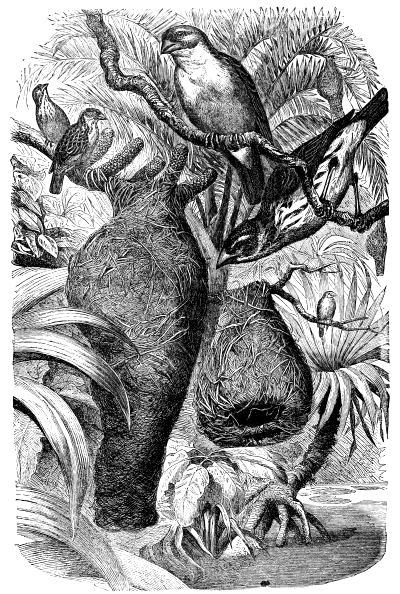
THE JAVA WEAVER BIRD (BAYA), AND NESTS.
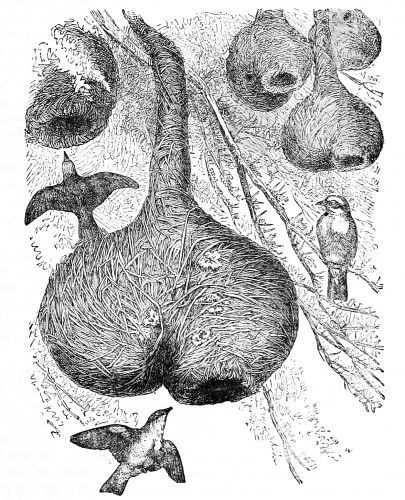
BREEDING-NEST OF THE GOLDEN-FRONTED WEAVER BIRD (Oriolinus icterocephalus).
The Queleas must be regarded as by far the most numerous of the race of Weaver Birds. In Soudan they are met with in enormous flocks, and are certainly the commonest of the feathered inhabitants of Central and Western Africa. We ourselves have seen twenty-seven brought down at a single shot. The habits of the Diocks resemble those of other Weavers, but, unlike most of them, they fly over the country, or perch upon the river banks in flocks that number several thousands, many of which are of other species. When in confinement these birds will carry on their building operations with great industry, employing coloured thread, if given to them, as a substitute for other materials. We have, moreover, been told that feathers, yarns, and worsteds of brilliant hues are much preferred for this purpose, and that the designs constructed from them are sometimes extremely beautiful, but we cannot vouch for this from our own experience. Reichenbach speaks of their manners in a way that is by no means flattering. He tells us that the Crimson Beak is a most quarrelsome, restless creature, and quite unfit to be placed in a cage with other birds of smaller size, whom it never ceases to torment in every conceivable manner; one very favourite method being to seize its companion by the tail, and hold it thus suspended in the air for several seconds, the tormentor meanwhile uttering cries expressive of its own enjoyment of this, for a bird, very original pastime. It will sometimes only relinquish its hold when the victim has successfully counterfeited death from this cruel treatment. If not quite in the humour for such active amusement, the Crimson Beak contents itself with pulling out the feathers of its playmates, who never seem to dream of opposing force to force, and quietly submit to all its persecutions. When confined with others of its own species, it is but little more conciliatory in its manners, squabbles and fighting appearing to form the principal diversion of the males, and even the females are not always exempted from the disagreeable results occasioned by the decidedly eccentric tempers of their mates. Their nests are suspended from the topmost branches of trees, and are constructed of various dry materials woven together while rendered flexible by the moisture sprinkled over them by the birds, who use their claws when fastening down the various parts, the beak at the same time doing its full share in carefully smoothing and arranging the fibres into a proper state of neatness and order. The little couple work together, apparently quarrelling the whole time; the male usually appropriates to himself the business of constructing the exterior, while the female is busy within, and the flexible stems employed being passed from one to the other. The nest when completed is round in shape, the front, where the entrance is situated, being somewhat straighter than the rest; the whole fabric resembles a nicely padded willow basket. The birds work for not more than three or four hours at a time, but so industriously that only about eight days are occupied in building their wonderfully beautiful home.
The TAHA may be selected as an example of a group of Weaver Birds distinguished by their black plumage. These birds have a few Abyssinian congeners also called Taha; in all of them the body is compact, the wings and tail small, and the beak short, strong, and conical; the upper mandible being slightly arched. The wings reach to the middle of the very short tail; the first quill is almost rudimentary, the third longest of all; the tail-feathers are of nearly equal length.
THE TAHA.
The Taha (Taha dubia) is of a beautiful bright yellow upon its head, back, shoulders, upper and lower tail-covers, and hinder part of the body. The wings and tail are a blackish brown, and all the feathers bordered with the same tint; the rest of the plumage is black; the female and young male during the winter months are blackish brown above and light grey beneath, some of the feathers having deep grey shafts, while others are edged with reddish brown. The length of this elegant little bird is about four inches, of which only one belongs to the very short tail. This species is a native of Southern Africa, and is seldom found farther north than the centre of that continent. During the breeding season it seeks refuge in the fields of corn or reeds, to the stems of which it hangs its purse-shaped nest. In its habits it resembles the Fire Finches, which we are about to describe.
The FIRE FINCHES (Euplectes) constitute one of the most brilliant of all the many beautiful groups of Weaver Birds. Few sights that meet the eye of the traveller in the regions watered by the Nile are at once so striking and so splendid as that presented by a flock of these glowing creatures, as they dart in masses over the green fields of durrah, looking, when the sun sheds his rays upon them, like a multitude of aerial flames, appearing and disappearing almost with the rapidity of lightning, as they rise into the air or take refuge among the corn. The little creatures seem quite conscious of the admiration excited by their beauty, for they open and close their wings, turn themselves in every direction, and pour forth their pleasant song, as if fully appreciating the attention of a stranger.
THE FLAME-COLOURED FIRE FINCH.
The Flame-coloured Fire Finch (Euplectes ignicolor) in the construction of its body closely resembles the Taha, from which, however, it differs entirely in the colour of its plumage. The coat of the male is extremely soft, and its whole surface, except the wing and tail feathers, of a bright black or fiery red. Except during the breeding season the male and female are alike dressed in a modest garb of brown, which is so completely changed when pairing time arrives as to differ not merely in colour, but in the softness and texture of the feathers; the wings and tail alone remaining unaltered. When clothed in all its glory the male bird is black upon the top of the head, the cheeks, breast, and belly; the other parts of the body being bright red; the wings exhibit a brownish shade, owing to the somewhat paler edges of the feathers. During this season the tail-covers become of such unusual length as almost to conceal the tail. The eye is brown, the beak black, and the feet brownish yellow. The body of the female is brown above, and of a yellowish shade beneath; a yellow line passes over the eyes, and the feet and beak are horn coloured.
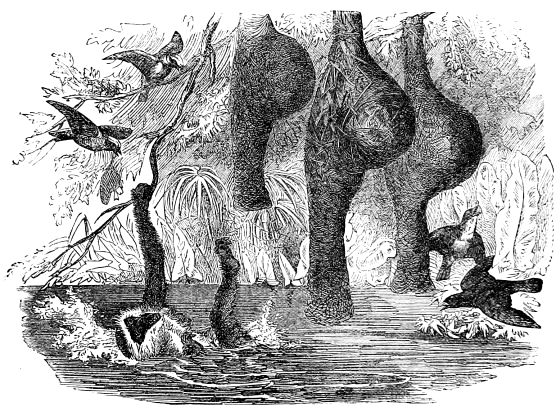
NESTS OF SOUTH AFRICAN WEAVER BIRDS.
The Fire Finch inhabits the whole country from the middle of Nubia to the interior of Central Africa, preferring such places as are in the vicinity of man, frequenting fields of corn, and only taking up its quarters in beds of grass or reeds when other accommodation is not attainable. A field of durrah is a veritable Eden to these birds, who cause much injury to the natives, often completely destroying the crops, in spite of the many devices employed to scare them away; for these bold-hearted little thieves are not to be deterred from their work of destruction either by the dancing of dolls or rattling of clappers. The Fire Finch exhibits great activity; when amongst the corn it resembles a Reed Sparrow rather than a Finch in its movements, as it climbs up and down the stalks, or hides itself among the grass. When the period of incubation is over, and the harvests are gathered in, the fields that have afforded them food are deserted, and some time is then passed in flying about the country, after the manner of their congeners. This species of Weaver Bird can scarcely be said to form settlements, each couple building somewhat apart from the rest. The nest is constructed of stalks and blades of grass woven so loosely together that the little brood are often visible through the lattice-work of their cradle, which is either placed upon the ground in a bed of grass, or fastened to the higher stalks. Considerable difference is observable in the size and shape of these nests, some being long, some round; few, however, exceed seven or eight inches in length, and five or six in breadth. Our illustration represents the Euplectes Petiti, a very similar species to that just described, except that the whole of the lower part of the bird is black.
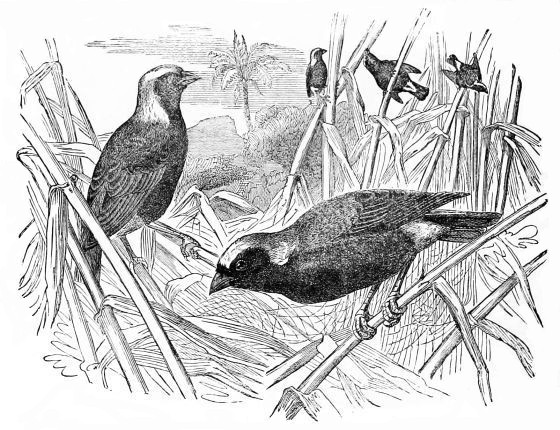
THE FIRE FINCH (Euplectes Petiti).
The BUFFALO WEAVER BIRDS (Textor) constitute a group well deserving our notice, and are distinguished by their large size, thick, conical beak, which is unusually thick at its base, long, abruptly-rounded wings, and slightly rounded tail.
THE RED-BEAKED BUFFALO WEAVER BIRD.
The Red-beaked Buffalo Weaver Bird (Textor erythrorhynchus) is the species of this group with which we are most familiar. This bird is from eight and three-quarter to nine and three-quarter inches in length. Its plumage is black, the front feathers of the upper wing-covers and quills being bordered with white; the beak is pale red, the foot light brown, and the eye dark brown.
THE ALECTO BUFFALO WEAVER BIRD.
The Alecto Buffalo Weaver Bird (Textor Alecto) resembles the last-mentioned species in the colour of its plumage, but is easily distinguishable from it by the difference in the shape of the beak. Its feathers are soft and brilliant, some of those under the wings and upon the sides being occasionally nearly white. The eyes are brown, the beak yellow, tipped with blue upon its extremity and edges, the feet are of a dirty grey. Its length is almost the same as that of the species last described.
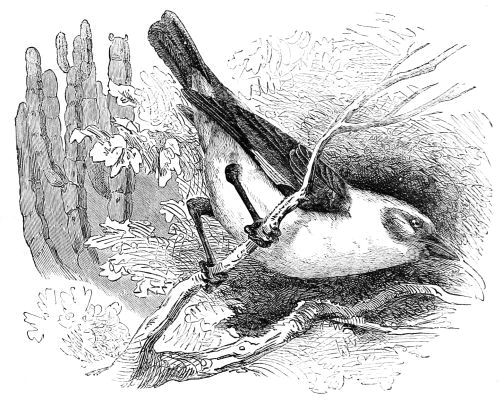
DINEMELLI'S BUFFALO WEAVER BIRD (Textor Dinemellii).
THE DINEMELLI BUFFALO WEAVER BIRD.
The Dinemelli Buffalo Weaver Bird (Textor Dinemellii), as the third member of this group has been called, is a native of Abyssinia. This species is white upon the head and lower portion of the body; the mantle, wing and tail covers are chocolate colour, each feather being edged with a lighter shade; the shoulders, rump, and tail-covers are marked with small scarlet spots; the bridles are black, the beak a dirty deep blue, the feet dark blue. The body measures about seven inches, the wing four inches, and the tail two inches.
All the foregoing varieties of Weaver Birds resemble each other in their mode of life, and must certainly be reckoned as the most remarkable members of their family, for though Finches, they have many features in common with the Thrush, and their nests resemble those built by Magpies rather than such as are made by other Weaver Birds. The three species we have mentioned alike frequent pasture land, keeping as much as possible in the immediate vicinity of the herds of buffaloes, upon whose backs they perch, to obtain the ticks that form their principal nourishment; they may constantly be seen around these huge creatures, to whom they not only render this service, but warn them of the approach of danger. Strangely enough, these birds confine their attentions entirely to the buffalo, whilst their constant companion, a species of Buphaga, renders the same service exclusively to the rhinoceros. The Black Weavers are by far the least numerous members of this trio, their settlements rarely including more than about eighteen nests, which are built upon some large tree, and are remarkable for their size, if we consider the dimensions of the bird by which they are constructed. The nests, which have a very beautiful exterior, are formed of slender branches and twigs; those of the Garat Mimosa being frequently employed, in spite of the thorns with which they are armed; these materials are woven carelessly together, and the whole fabric, some three or four feet in diameter, is so lightly constructed that the eggs are often visible through the sides of the nest. The interior is lined with delicate fibres and grass, the entrance being an opening large enough to admit a man's hand at one end, while at the other is a hole so small as to allow nothing larger than the birds themselves to pass through. We learn from travellers in Africa that the nests of this species are occasionally found of a much larger size than those described, some measuring from five to six feet in length, and four to five in breadth and height; these enormous structures, however, are not occupied as a residence by one family, but are joint property, some containing as many as from three to eight distinct nests, in each of which may be seen the three or four white eggs, spotted with brown, that constitute the brood. As may well be imagined, the noise and bustle around one of these compound nests must be heard to be appreciated; indeed, the vicinity of a settlement is unmistakably proclaimed by its busy and loud-voiced proprietors. The Black Buffalo Weaver Bird breeds at very various seasons of the year, the time depending on the part of the continent that it inhabits. Its flight is hovering, very light, and produced by a slow motion of the wings, which at each stroke are raised high towards the back. When upon the ground it runs with ease, and is most adroit in its movements among the branches of the trees to which it resorts.
THE WHYDAH OR WIDOW BIRDS.
The Whydah or Widow Birds (Viduæ) form the group to which we shall next allude, as being most nearly allied to the family of the Weavers. Whether the members of this family have had the name of Widow bird assigned to them by reason of the blackness of their plumage, is a question we shall not attempt to decide; some naturalists affirm that the word Widow is merely a corruption of Whydah, the name of the place from which they were first obtained by the Portuguese. These birds are Finches of moderately large size, remarkable from the fact that the plumage they acquire during the breeding season is distinguished by the peculiar form and great length of a portion of the tail-feathers, this decoration being laid aside as soon as the period of incubation is over, and replaced by another of less striking appearance. The other distinguishing characteristics of this family are the short, conical, and pointed beak, somewhat dilated at its base and compressed at its tip, and the wings of moderate length. The plumage of the male is black above, intermixed here and there with white and red; the lower part of the body is red, gold colour, or white. All the various species of Viduæ are to be met with throughout the entire continent of Africa, though some countries in particular might be mentioned as the actual homes of certain members of the group. In their habits the Widow Birds bear a closer resemblance to the Buntings than is usually observable in the Finch tribe; they live during the breeding season in pairs apart from the rest, or else not unfrequently in a state of polygamy, and only congregate in large flocks and fly about the country after the period of incubation and the moulting season are over. As may be easily imagined, the movements of these beautiful birds are greatly influenced by their change of plumage; the long tail necessitating a slow and stately motion, especially when upon the wing, and often causing its possessor to be driven hither and thither at the pleasure of the wind; when perched, the sweeping tail hangs straight down, but is borne aloft when on the ground; no sooner, however, has the moulting season gone by than the Widow Bird appears to be quite another being, hopping and flying over the country with the same activity that characterises the Finches. Most species of this group seek their food principally upon the ground, generally subsisting upon grass-seeds and various kinds of insects: they pass a considerable portion of the breeding season among the branches, as affording the most convenient situation for the bestowal of their streaming tails, whilst some are found almost exclusively inhabiting the reedy parts of the country, where they also carry on the work of incubation. The breeding season is in the spring time of the African continent. In Soudan the eggs are laid about the month of August, and in Abyssinia some months earlier. The nest closely resembles those of the Weavers. The Widow Bird is rarely brought alive to Europe, and though of a pleasing disposition, and well qualified to live in a cage, is almost entirely destitute of song. The first members of this group to which we shall call attention have been named
The MOURNING WIDOWS (Coliuspasser). In these birds the beak is long, compressed at its sides, slightly bent towards the tip, and appears to rise at a right angle from the forehead; the wings are of moderate length, the first quill much shorter than the four succeeding ones; the feathers of the tail are considerably broader at their extremities than at the base, the middle ones being the longest. The plumage is black, with red or yellow upon the head, breast, nape, and shoulders.
THE YELLOW-SHOULDERED MOURNING WIDOW.
The Yellow-shouldered Mourning Widow (Coliuspasser flaviscapulatus), an inhabitant of Abyssinia, is a bird about eight inches in length, of which the tail measures four and a half inches; the wing does not exceed three and one-third inches. The coat of the male is deep black, the shoulders yellow, and the wings and tail edged with yellowish white. The plumage of the female is principally of a brownish yellow, lightest on the throat and darkest upon the head, which, owing to the deep colour of the feathered shafts, has a slight appearance of being striped. The wings and tail are dark brown, and the shoulders greenish yellow. The breeding season commences about August; the nests are somewhat deep, built of large dry straws, and entered through a long tubular passage or small opening, protected by a kind of roof. The male is provided with a second nest, placed near to that containing his family, and furnished with two entrances. The eggs have a reddish-white shell, marked with rose-coloured spots and streaks, lying most thickly together at the broad end, and so minute as almost to escape notice.
THE LONG-TAILED WIDOW BIRD.
The Long-tailed Widow Bird (Chera caffra), the largest of all the South African species, is remarkable for the peculiar construction of its tail, formed of sixteen imbricated feathers of great but unequal length. The plumage is of a velvety black, scarlet upon the shoulders, the latter colour being divided from the wing by a pure white line; the wings are black, the feathers being bordered with light yellow; the beak and feet are of a pale brownish yellow. In the coat of the female all the feathers are bordered with a yellow margin, only the middle being black; the lower portion of the body is greyish yellow; the throat, eyebrows, and under tail-covers are white. The length of this large bird is not less than twenty and a half inches, the longest tail-feathers measuring fifteen and a half inches, and the wing five and a half inches.
The Long-tailed Widow Bird is social in its habits, and must certainly be reckoned amongst the races that are polygamists, as it is by no means uncommon to see flocks containing about eighty females to not more than ten or fifteen males. As with our Barn-door Fowls, some of the old females acquire the plumage of the male. Marshes and bogs afford the breeding-places preferred by this species. The nest, which is round, is generally suspended from a reed, and formed of some green plant, the entrance to the interior being effected by means of a long passage, opening on the side that is nearest to the water. Travellers assure us that the male may be caught with the hand during windy weather, as its long tail renders escape by flight impossible.
The COCK-TAILED WIDOW BIRDS (Steganura) are found throughout the whole of Central Africa, and have been described as two distinct species, resembling each other in the shape of their beak, the height of which equals its length; the ridge is arched, and joined at a sharp angle with the forehead. When in nuptial plumage the tail of the male seems to consist of only the middle feathers, which are much longer than those at the sides, and very various in their appearance; the centre feathers are bent like those in the tail of a Cock, and of great length and breadth, narrowing somewhat towards the tips.
THE PARADISE WIDOW BIRD.
The Paradise Widow Bird (Vidua paradisea) is black upon the head, back, and tail, brilliant red upon the nape and lower parts of the body. The plumage of the female is brownish yellow upon the head, the bridles and two lines upon the top of the head being black, the breast rose colour, as are the borders of the black wings. The length of the body is about five and three-quarter inches, the tail eleven and a quarter inches, its breadth nine and a half inches, and the wing two inches. The female is somewhat smaller than her mate.
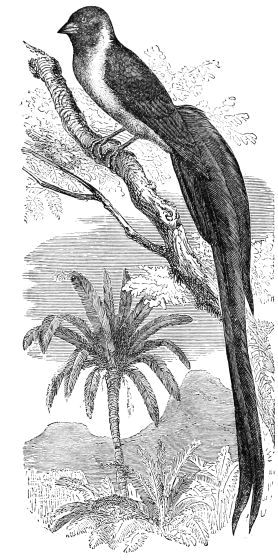
THE PARADISE WIDOW BIRD (Vidua paradisea).
The Paradise Widow Birds are found principally in the thinly-wooded forests of Africa, and appear to avoid the vicinity of man, flying about woodland districts in pairs or in small parties. Their gala dress is donned during the rainy season, and is retained for about four months. The process of moulting occupies but a very short time, and the long tail-feathers grow with great rapidity. They are often brought to Europe in considerable numbers, and are sometimes known under the name of "Birds of Paradise." The song of this species is extremely simple, but not unpleasing; it is never heard except during the period of incubation, and ceases when the beauty of the plumage has disappeared.
THE AMERICAN FINCHES.
The American Finches include a great number of species called, not inappropriately, Bunting Finches (Passerella), from the fact that the plumage presents markings very similar to those seen on our Buntings. They are characterised by a slender, conical beak, somewhat arched at its roof, and straight towards its tip; the wings are of moderate size, with the secondary quills of unusual length, the tarsus high, the toes long, and armed with large claws, those of the hind toes resembling spurs. Some species are essentially inhabitants of woodland districts, and carefully avoid the more open country; some confine themselves entirely to well-watered regions, or river banks; and others, again, frequent the sea-shore, open fields, and pastures, or replace our House Sparrows in their relation to man and his domestic life. We must, however, content ourselves with the mention of but a few principal members of this extensive group.
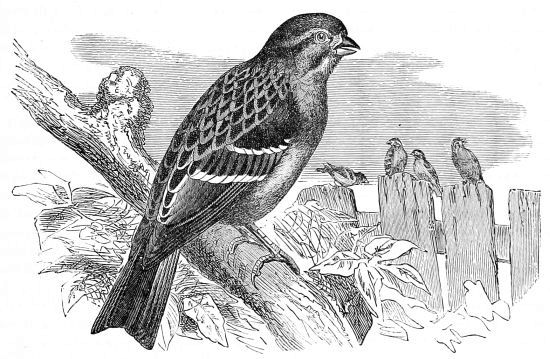
THE WHITE-THROATED OR SONG SPARROW (Zonotrichia albicollis).
The WHITE-THROATED SPARROWS are inhabitants of North America, while the MORNING FINCHES, on the contrary, occupy the southern portion of that hemisphere. Both species have been classed under the name of Zonotrichia. These birds are furnished with a slightly conical beak, the upper mandible of which is straight and somewhat pointed, the corners of the mouth bent downwards, the lower mandible almost equalling the upper one in height. The wings are of moderate length, reaching as far as the upper tail-covers; the tail itself is of middle size, and formed of small feathers; the tarsus is high, the toes long, and furnished with large claws but slightly bent. The plumage is soft and thick. Both species closely resemble the European House Sparrow in their habits, living in and about the villages, and subsisting upon various kinds of seeds, which they search for on the ground. Their nests are built in the neighbouring trees, upon which, also, they generally pass the night.
THE WHITE-THROATED SPARROW.
The White-throated or Song Sparrow (Zonotrichia albicollis) is six and a half inches long, and nine across the wings, the female somewhat smaller; the upper part of the head is of a dark brown and black brown, intermingled with a mixture of black and grey, and divided by a light greyish-brown stripe, marked with dark and light spots; a similar whitish-brown stripe passes over both eyes, towards the back of the head, and under this is a dark brown streak running in the same direction; the cheeks and lower part of the throat are ashy grey, the upper portion and chin white, divided from the dark grey tint beneath by a black line. The mantle is of a reddish grey, the feathers being marked with black streaks; the shoulders and wing-covers are blackish brown, the lower portion of their feathers bordered with reddish brown, and their end tipped with yellowish white, forming two irregular light borders to the wing. The throat of the female has less white upon it, and the wings are not so profusely marked with yellow.
The White-throat is found throughout the whole of America: Audubon tells us that it is a constant summer visitor in Louisiana and other Southern States, seldom, however, remaining longer in those parts than from March to September; but in the more central provinces it would seem to prolong its sojourn to a later period. No sooner do these welcome visitors arrive than every hedge and fence is alive with them; they form parties consisting of some forty or fifty birds, and fly down from time to time upon the surrounding district in search of food; hopping gaily about as they peck the small grass-seeds that constitute their principal nourishment, and hurrying back to their perch at the first intimation of danger. Nothing can be more amicable than the terms on which they seem to live; the time between their excursions over the field is passed, not in noisy strife, but in pouring forth a constant flow of song, so sweet as to please the ears of the most indifferent or unmusical listener. At early dawn the little community is roused by a peculiar shrill warning cry, somewhat resembling the syllable "twit;" this we have heard uttered during the night, when no doubt it is intended as an intimation that all is well. Should the day be warm, the whole flock seek shelter in the woods, and disport themselves upon the branches of the wild vine, rarely, however, flying to any great distance from their usual haunts. With the first approach of spring the States are deserted for the more northern portions of the continent. Richardson found the nest of this bird, in the month of July, under the trunk of a tree that had fallen, and tells us that it was formed of grass, with a bed of feathers and hair in its interior; on his approach the mother bird did not fly away, but ran noiselessly over the ground in the manner of a lark, thus leaving the eggs, which were green, spotted with reddish brown, fully exposed to his view. The White-throated Sparrow is a plump little fellow, and often becomes extremely fat, the latter quality adding materially to the value in which its flesh is held as an agreeable article of food, not only by man but by Sparrow-hawks and other enemies. When caged, the voice of this bird is heard in its full sweetness, and it continues during the entire spring and summer to sing, even until night has set in, as is its habit in its native land.
THE MORNING FINCH.
The Morning Finch (Zonotrichia matutina), as the Brazilian species has been called, is eminently distinguished for its powers of song. In size it is somewhat smaller than its North American brother, not exceeding five and a half inches in length: its appearance much resembles that of our Reed Bunting: the head is grey, striped with black; the nape of the neck a rusty red; the back brown; the feathers have a light tip, and their shafts broadly marked with black; the throat is white, with a streak of black at the sides.
Large numbers of these birds frequent the villages of South America, and pass the day seeking for food, like our Sparrows, from amongst the offal in the streets, perching at night and early morning upon the roofs of the houses, and pouring forth their sweet enlivening song. The nest, which is large, and usually placed in a bush in some neighbouring garden, is built of dry straw, hair, or feathers, and is generally found to contain four or five greenish-white eggs, marked very thickly with spots of a light red colour. Other species are met with in North America and in Asia.
We have selected another North American species as the type of a distinct group of Bunting Finches (Spizella), the members of which are recognisable by their conical beak, compressed at its sides, which curve slightly inwards; their wings are of moderate length, the third quill being the longest. The tail is but slightly excised, the feet large, and the legs covered with small scales; the plumage is soft, but not particularly striking in its hues.
THE TREE BUNTING FINCH.
The Tree Bunting Finch (Spizella Canadensis) is rather more than eight inches long and eight inches across, the wing and tail each measuring rather more than two inches. In the plumage of such birds as have attained their full beauty, the top of the head is of a light reddish brown; the mantle is of the same colour intermixed with black; the quills greyish brown, bordered with yellow, and the wings surrounded by two white lines; the chin, throat, and lower part of the neck are a light grey, the breast and belly greyish white, shaded upon their sides with yellowish brown, and marked with a deeper tint. A light grey stripe passes over the eyes towards the back of the head; the iris is greyish brown; the beak blackish brown upon the upper mandible and tip of lower one, the remainder of the latter being yellow; the feet are of a deep flesh colour. The female closely resembles her mate in plumage; but the young are by no means so brightly tinted as the parent birds.
The Tree Bunting Finches are met with in large numbers throughout North America, though they will not breed in every locality that they frequent, the more northern portions being, we believe, preferred for that purpose. Like most of their congeners, these birds pass the winter months in flying about the country in company with Buntings and a variety of other Finches, seeking food upon the hedges and trees, whose seeds constitute their principal nourishment, and sheltering themselves during very severe weather by creeping into such low bushes as are thickly surrounded with long grass or dry plants, thus affording a defence against the keenness of the wind. They generally arrive in the more southern States at the commencement of winter, and gradually disappear as spring returns. The breeding season is in May, and during that time they frequently attain a power of song of which they are incapable when not inspired by the wish to attract the attention of their mates, whose favour they endeavour to win by alternately chirping and singing throughout the entire evening. The day is spent in hopping about on the ground, and in the evening they disport themselves with wonderful agility upon the branches of their favourite trees. Their flight is rapid and undulating. The nest, which is usually constructed against an upright branch or stem, is formed of coarse grass, lined with slender fibres or hair. The brood consists of from four to five eggs of a uniform dark blue. Shortly after the young are fledged, the whole party attach themselves to a large flock of their congeners, in whose society some few weeks are passed preparatory to their winter migrations. The food of this species consists of a variety of seeds, berries, and insects.
THE PRAIRIE BUNTING FINCH.
The Prairie Bunting Finch (Passerculus savannus) is one of the most numerous members of this group; it is distinguished by its short conical beak, the upper mandible of which is short; by its rounded wings, having the third and fourth quills longer than the rest; short graduated tail, moderate tarsus, and soft velvety plumage. Upon the upper portion of the body the feathers are of a pale reddish brown, presenting somewhat the appearance of being spotted, owing to the darker tint upon the shafts; the lower parts are white, marked upon the breast with small deep brown spots, and the sides are streaked with the same colour. The beak is dark brown upon the upper mandible, the lower one a shade paler; the eyes are brown; the feet of a light flesh colour. The length of this bird is five and a half inches, and its breadth eight and a half inches. The female resembles the male, but her plumage is lighter in its tints.
We learn from Audubon that the Prairie Bunting Finch is one of the most beautiful and widely distributed of its kind. It is met with in the Northern States from October to April, inhabiting fields and woodland districts, and living chiefly upon the ground, where its movements are extremely nimble, and resemble those of a mouse; indeed, it only uses its wings when closely pursued, or suddenly alarmed: its flight is irregular but continuous. This species seems to prefer high grounds at no great distance from the coast, and is rarely found inhabiting the interior of woods and forests. During the winter these birds unite themselves to flocks of their congeners, generally passing the day in flying about in search of food in the fields or gardens, and sleeping at night upon the ground. The nest, which is constructed of hay, and lined with some finer materials, is usually placed in a hole upon the ground, or else under the shelter of a bush or high tuft of grass. The eggs, from four to six in number, are of a pale blue colour, marked with purplish-brown spots, which occasionally take the form of a wreath at the broader end of the shell. In the more central States these birds breed twice, whilst farther north they do not lay more than once in the year. The Prairie Bunting Finch is by no means suitable for domestication, as it is almost entirely without voice; but it affords a not unpleasing article of food, both to man and to its still more formidable enemies, the Falcon and Mink.
The SHORE FINCHES (Ammodromus) are likewise included in the family of Bunting Finches. They are recognisable by their slender, elongated, pointed beak, compressed at its edges; their wings and tail are of moderate length, with the feathers variously coloured at their extremities.
THE SEA BUNTING FINCH.
The Sea Bunting Finch (Ammodromus maritimus) is about six or seven inches long and from ten to eleven inches across the wings. The upper portion of the body is greenish brown, the breast ash grey, the throat and belly white, the bridles and a streak on the top of the head dark grey; a yellow line passes over the eyes. The wings are yellow, bordered by a broad crooked line of brown, the beak and feet are brown, the eyes dark brown.
This very remarkable species does not resemble a Finch in its mode of life, but dwells like a Sandpiper upon the sea-shore, and passes its time in running nimbly and rapidly at the water's edge, or climbing about among the reeds with the agility of a Reed Bunting. Its principal nourishment consists of shrimps, small crabs, sea snails, and little fishes, this food imparting to its flesh a flavour of train oil, so generally observable in most sea birds. Marshes producing reeds and high grass, and well covered with sea water, are the favourite resorts of these birds, and there they build their nests, care being taken to place them in some tuft of grass that is beyond the reach of the waves; the little cradle is formed of coarse grass lined with a bed of finer quality; the eggs, from four to six in number, are greyish white, spotted with brown. As far as we can learn, they breed twice in the year.
THE BUNTINGS.
The Buntings (Emberizæ) form the connecting link between the Larks and the Finches proper, and constitute a family extremely rich in species, all presenting a striking resemblance to each other. These birds are characterised by their thick bodies, their wings of moderate length, of which the second or third quills are generally the longest, and by their large tail formed of broad feathers, its termination being either straight or slightly furcated; the feet are short, the toes long, and the hinder toe furnished with a large spur-like nail. The beak, which we regard as the distinguishing feature of this family, is short, conical, and pointed, thick at the base, but much compressed towards its tip; the upper mandible is somewhat narrower than the lower, by which it is slightly overlapped, the cutting margins are strongly bowed inwards, and bent down at a sharp angle towards the gape. Implanted in the palate of the upper jaw there is, moreover, a bony protuberance, which is received into a corresponding cavity in the under jaw; the gullet is enlarged, but can scarcely be said to form a crop, and there is a muscular gizzard.
The Buntings are essentially inhabitants of the northern portions of the earth, but are replaced elsewhere by birds of very similar character. They mostly frequent low, thin brushwood, or beds of reeds, preferring such localities as are in the immediate vicinity of water, or delight in fertile pastures; some species are met with on mountains, others in valleys, but all agree in avoiding forests or thickly-wooded districts. Though we must acknowledge that these birds cannot be regarded as particularly active, or possessed of very excellent endowments, they are by no means deficient in natural gifts, and their capacity, if not remarkable, is quite equal to the position they are called upon to fulfil in the economy of nature. All the species of this family are of social disposition, associating with Finches and Larks, and living in large flocks except in the breeding season, and sometimes even during that period they keep at no great distance from each other, although every little couple has its own nesting place, the immediate neighbourhood of which no other bird is permitted to approach. They exhibit no fear of man, frequently taking up their abode in the immediate neighbourhood of his dwellings, and paying constant visits to his barns, farmyards, gardens, or stables. Most of these birds are migratory, and but few remain for any great length of time in the localities they have selected for breeding-places. Their food consists during the summer of grasshoppers, beetles, caterpillars, and other larvæ, besides flies, gnats, and similar insects; in winter they prefer farinaceous seeds, those of an oily nature being carefully avoided; they eat very largely, and soon become extremely fat. When in search of food they generally alight upon the ground, over which they hop and walk with considerable activity; their flight is undulating, and their song monotonous, the call-note consisting of one prolonged cry. The nest is generally built in a hollow, but is sometimes placed slightly above the surface of the ground, and simply formed of straws and roots lined with fine grass, hair, or feathers. The eggs are from four to six in number, spotted and veined with a dark colour; both parents assist in the work of incubation, and in providing for the little family when fledged. The Buntings were regarded in ancient times as a valuable article of food, and many species are still caught in great numbers for the table in the more southern countries, whilst in the north birds or beasts of prey are the only enemies they have to fear.
THE CRESTED BUNTING.
The Crested Bunting (Gubernatrix cristatella), which we have selected as well worthy of notice, is a South American species. This beautiful bird strongly resembles the rest of the family, differing from them, however, in the inferior elongation of the nail upon the hinder toe, and in the fact that it possesses an upright tuft of feathers at the back of its head. The plumage is thick and matted, in the manner observable in most Buntings, the male and female closely resembling each other in this respect. In both birds the back is of a greenish shade, the shoulders and exterior tail-feathers being bordered with yellow; the top of the head and throat are black. In the male the lower part of the body and a line over the eyes are yellow, whilst in the female the breast is grey, the belly and rump pale green, and the cheek white, as is a line that passes over the eyes; the beak is grey, the feet black. Azara gives the measurement of this species as eight inches in length and its breadth twelve inches, the wing four inches, and the tail three and a half inches.
We are unluckily but little acquainted with the habits of this bird when in its native land. The author just quoted, however, tells us that it chiefly frequents the countries watered by the River La Plata, and the southern portions of Brazil, living, as do its congeners, upon such bushes as are at no great height, keeping for the most part on the ground, and rarely perching upon trees or flying to any distance. During the breeding season the Crested Buntings live in pairs, and at all other times in small parties, which are very frequent visitants to the native gardens and farmyards in search of the seeds and insects upon which they principally subsist. Large numbers are frequently caught and sent to Europe, where they are known under the name of the "Green Cardinal." They are often allowed to fly about the gardens in summer, but a warm cage is necessary during winter, as, being tropical birds, they cower together and shiver at the first breath of our autumnal blasts. When caged, they may be reared upon various kinds of bird-seed, finely-chopped meat, ants' eggs, worms, and salad. In disposition they are generally social, and may be safely allowed to consort with other birds, except during the breeding season, when the males are outrageously violent and quarrelsome, fighting and tearing each other until one or both of the combatants are killed or severely wounded, the conqueror continuing to maltreat its victim long after it has been completely hors de combat, despite all the endeavours that may be used to drive it from the spot. A nest described to us was built of the stalks of heather, woven together like a basket, and without any softer lining in its interior. The voice of the Green Cardinal is both powerful and agreeable.
THE GREY BUNTING.
The Grey Bunting (Miliaria valida) is one of the largest of its family, the length of the body being seven and a half inches, the breadth across the tail twelve and a quarter inches, the wing four inches, and the tail three inches. The female is not quite so large as her mate. The plumage of this species is extremely simple in its coloration; the body is a dark grey, the lower portion, as far as the breast, being marked with white or yellowish white, and the sides with brown. The exterior tail-feathers are of uniform grey, the iris dark brown, the beak greenish yellow, and the feet horn colour. The female is exactly like her mate. The young are darker than the old birds, and the spots upon the feathers larger. The Grey Bunting is not only distinguished by the simplicity of its plumage, but by its comparatively large, strong beak, furnished with a protuberance on its roof; its feet are weak and its wings short; it is likewise remarkable for the shortness of the claw upon the hinder toe.
The Grey Buntings inhabit the greater part of Europe, either as permanent residents or as birds of passage, appearing in the largest numbers in the more southern portions of the continent: they are likewise met with both in Egypt and the Canary Isles. Fields and pastures are the localities they prefer, and they but rarely make their home in the neighbourhood of forests or in mountain districts. This bird has a clumsy and unwieldy appearance, as a glance at its stout, powerful body, combined with weak legs and short wings, will at once show; indeed, when upon the ground it looks eminently ungraceful, as it bends itself nearly double, flapping with its tail as it hops slowly from place to place. When in the air it flies with difficulty, the short, whirring strokes of its wings producing an undulating kind of motion. The song of this Bunting has nothing to recommend it, being in sound not unlike the noise produced by a stocking machine, from which fact this species is in many places known as the "Stocking Weaver." Still, however unpleasing to our ears this performance may be, the birds themselves are highly delighted with their own music, accompanying their notes by a variety of gesticulations, and thus appearing to give utterance to sentiments that their very limited gamut does not permit them otherwise to express.
The breeding season commences in April. The nest is generally placed in the grass or amongst a group of plants, and is built of straw and dry leaves, lined with hair and other elastic materials. The eggs, from four to six in number, have a delicate pale grey or dirty yellowish shell, marked with dull purple spots, veins, and lines that are very close together at the broad end. The young are fed upon insects, and are fully fledged by May, when the parent birds at once proceed to undertake the care of a second family, only joining the rest of the flock when the work of incubation is completed. The flesh of the Grey Bunting is considered excellent; it is therefore much sought after by man, whose example is followed by falcons, rats, foxes, and other animals.
THE GOLDEN BUNTING.
The Golden Bunting, or Yellow Bunting (Emberiza citrinella), is to be met with in the same parts of our continent as afford a home to the species last described, from which it is distinguished by the beauty of its plumage, and the comparative slenderness of its beak. The Yellow Bunting is about six and a half inches long, and from ten to ten and a half inches in breadth; the wing measures three and a quarter inches, and the tail two and three-quarter inches; the plumage of the male is admired for its markings and the brightness of its tints; the head and lower portion of the neck are of a bright lemon yellow, and the breast and belly streaked with reddish brown; the sides of the breast, rump, and mantle are of a vivid rust colour, the latter being streaked with dark brown; the throat is tinted with a mixture of olive green and reddish yellow, and the wings and tail are bordered by two lines, formed by the yellowish tips of the feathers; the iris is brown, the beak blueish, and the feet of a deep flesh colour. The female is by no means so handsome as her mate.
Unlike the Grey Bunting, this species is frequently found at a considerable altitude, and is very numerous upon the Swiss Alps: it generally, however, prefers woodland districts, where it hops about with an agility and grace far exceeding that of its grey brother, whom it also much surpasses in the quality of its voice. During the entire summer Golden Buntings are seen flying over the country either in pairs or small parties; but no sooner does spring approach than the little couples creep under some low bush or bushy plant, and commence their preparations for a young family, generally building their nest with fine grass or some similar material, and enlivening their work by a constant flow of song, that has been freely translated into a number of sentences appropriate to the business upon which they are employed; these jubilant sounds are uttered whilst perched upon a high branch, from which the bold songster will look down upon the approach of a man without exhibiting any alarm. The brood consists of from four to five eggs of a dirty white or reddish colour, veined and spotted with a darker shade. Both parents assist in the work of incubation, and feed the young exclusively upon insect nourishment; should the season be favourable, these birds will breed twice or thrice in the year. When the rearing of the several families is completed, young and old congregate into one large flock, and fly about the country in company with Larks, Finches, and Thrushes, for whose society they appear to feel a wonderful predilection, which is, however, not so peaceful in its nature as to prevent innumerable squabbles, though these rarely become serious. On the approach of winter, the flocks are compelled to seek their food in the neighbouring fields and farmyards, their visits being by no means welcome to the proprietors, who, nevertheless, but rarely take any means to protect themselves against such petty marauders.
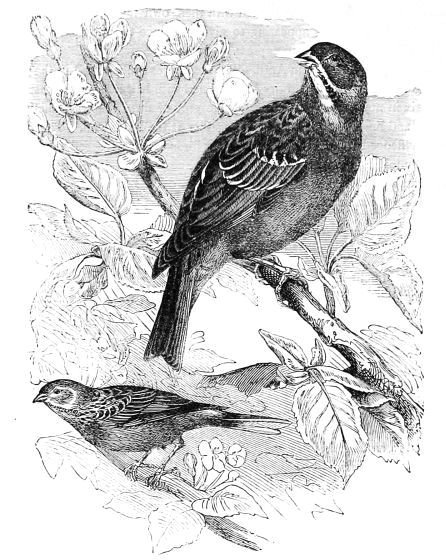
THE ORTOLAN OR GARDEN BUNTING (Emberiza-Glycyspina hortulana).
THE ORTOLAN.
The Ortolan, or Garden Bunting (Glycyspina hortulana), is a member of this family; in size it is somewhat smaller than the Golden Bunting, its body not measuring more than six inches in length; the span of its wings is about ten inches, the wings three inches, and the tail two and a half inches. The female is not quite so large as her mate. Among the Ortolans the sexes are but little distinguishable by their plumage, in which a reddish brown generally predominates. The head, nape, and front of the neck are grey, the throat, stripe upon the cheeks, and a small circle round the eyes of a straw colour. The back is marked with long dark streaks, the wing-quills are brown, the secondaries being bordered with light brown, and the rest with light red, as are also the tail-feathers; the exterior tail-feathers have a long white patch upon their inner web. The plumage of the female is spotted and duller in its tints than that of the male, which, however, resembles her in these respects during the winter months. The iris is brown, and the feet and back of a reddish grey.
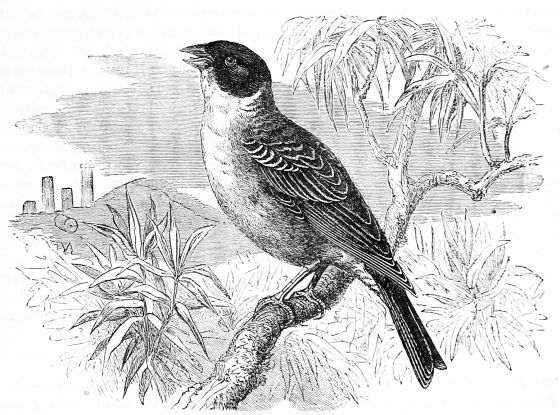
THE BLACK-HEADED BUNTING (Euspiza melanocephala).
The Ortolan is found throughout the greater portion of the European continent, and is extremely common both in South Norway and in Sweden, as also in Southern Italy and on the eastern coast of Spain. It is well known in Holland, England, France, Russia, and some parts of Germany; it inhabits Asia as far as the Altai Mountains, and, though rare, is occasionally met with in Northern Africa. In its life and habits the Garden Bunting closely resembles its golden-plumaged relative, and even surpasses it in its powers of song, although the voices of the two are very similar. The nest is built upon the lowest branches of some thickly-foliaged tree. The eggs, four or six in number, are whitish red or reddish grey, streaked and spotted with blackish blue. The Ortolan is entitled to our notice from the fact that it enjoys and always has maintained a very high reputation as a delicate and costly article of food. By the Romans these birds were always tended with the greatest care, in order that their flesh might attain its full perfection, and lamps were kept constantly burning near their cages at night, that they might eat with as little intermission as possible. This mode of fattening them is still employed in Italy and the South of France, as well as among the Greek Islands, where Ortolans are kept in great numbers. When ready for the market, their necks are wrung, the birds steeped in boiling water, and then packed by hundreds in small casks filled with highly-spiced vinegar, after which precautionary measure they are exported to foreign markets, where they always command a high price. At the present day, the gamekeepers in many parts of Germany are allowed to appropriate the proceeds of the sale of these delicate birds, whose flesh resembles that of the Snipe, but is, in the opinion of the epicure, even more delicate.
THE RED BUNTING.
The Red Bunting or Meadow Bunting (Emberiza-Glycyspina cia) is, in our opinion, a more beautiful species than the much-prized Ortolan, its plumage being as noticeable for its elegant markings as for the brilliancy of its colours. The principal tint is reddish brown; the throat, head, and upper part of the breast are of a delicate grey; the cheeks and ears are surrounded by a black ring, which is enclosed by two white lines, the back is marked by a series of spots running in stripes, and the wings are ornamented with two light borders. The markings in the plumage of the female are less distinct, and her throat lighter and more spotted than in the case of her mate. The iris is dark brown, and the beak blueish black upon the upper mandible, the lower mandible is light blue, and the feet are horn colour. The length of this bird is about six and a half inches, its breadth nine and a half inches, and the wing and tail two and three-quarter inches. The female is not quite so large. The Red Bunting is an inhabitant of the South, only frequenting such parts of Germany as are watered by the Rhine; but is numerous in Austria, Spain, Italy, and Greece, spreading from these countries over Asia, till it reaches the Himalaya Mountains, where we hear it is very constantly met with; indeed, our own observations lead us to suppose that this species prefers mountain districts, avoiding open plains, and is an inhabitant of the Swiss Alps. There can be no question that precipices abounding with large fragments of stone afford a most acceptable shelter for the purpose of incubation, and in such localities it disports itself much in the same fashion as its congeners, but is rarely seen perching elsewhere. In its flight, general habits, and song, it is a true Bunting. The nest is generally built on and about rocks, or in fissures of the walls that surround the vineyards, with which the sides of the mountains are frequently covered. The eggs, three or four in number, are greyish black surrounded with grey lines, often arranged like a girdle round the middle, thus distinguishing them from those of the Yellow Bunting. [For drawings of the eggs of this species and of the Cirl Bunting (Emberiza cirlus) see Coloured Plate IV.] The parent birds breed twice in the season, and when the period of incubation is over join the large flocks of their companions, with whom they pass the rest of the year.
THE BLACK-HEADED BUNTING.
The Black-headed Bunting (Euspiza melanocephala), an inhabitant of the south-eastern portion of Europe, and of a large portion of South-western Asia, is one of the most beautiful of the many species belonging to this extensive family. It is recognisable by its elongated beak, furnished with a long sharp protuberance under its roof, and by the more uniform coloration of its plumage, which differs widely in the two sexes. The Black-headed Bunting is seven inches long, and eleven and a half across the wings, the wings and tail measuring about three inches in length. The head of the male is jet-black, the back rust-red, the whole of the under part of the body of a golden colour, and the wings and tail dark brown. The female is without the black hood, the bridles are greyish brown, the back reddish grey, each feather being bordered with a lighter shade, and having a dark shaft; the under part of the body is pale yellow, and the throat of a whitish hue; the quills, wings, and tail-covers are dark brown, edged with a lighter tint, or with brownish white; the beak is light blue, and the feet of a deep flesh colour.
The Black-headed Buntings commence their migrations about the month of November, and very shortly after leaving Europe make their appearance in the Deccan, and upper provinces of Hindostan, assembling there in large flocks, and making terrible havoc in the corn-fields, until the time returns for carrying on their work of destruction in our part of the world, where, on their arrival, they may be seen perching in crowds upon the sea shore, as they alight to rest after their long and arduous flight. We are told by Von Mühle that these birds are so extremely dull and stupid in their disposition that the male when singing will allow himself to be approached and killed with a stick, but in other respects they resemble the rest of their congeners. The nest is usually built upon a hill side, the female burying herself as far as possible among the surrounding plants or grass, whilst her mate perches upon a neighbouring shrub or tree and cheers her with a constant flow of song. The little cradle is formed without art of the stalks of plants and leaves loosely woven together, and lined with delicate fibres of hair or fine grass. The eggs, which are laid about the middle of June, are of a pale blueish green, marked with more or less distinct green, red, or grey spots.
THE REED BUNTING.
The Reed Bunting (Cynchramus Schœniclus) has been separated from the other members of its family on account of the peculiar formation of its beak, and though closely resembling them in many particulars, certainly differs from them in its habits. The Reed Bunting is about six inches long and twenty-nine broad, the wings and the tail measuring rather more than two inches. The female is not quite so large. The head and entire throat of the male are deep black, a white stripe passes from the corner of the beak towards the shoulder, uniting itself with a band of the same hue that encircles the neck; the back is brown, each feather being edged with a lighter shade, and having a dark shaft, giving to this part of the plumage a somewhat sparrow-like appearance; the rump is ash grey, the belly white, and the sides grey, marked with dark longitudinal streaks. In the female the head is brown, with markings of a darker shade, the throat dirty white, and encircled by a spotted band; the nestlings and young males resemble the mother. The eye is brown, the beak blue, darker upon the upper mandible, and light beneath; the feet are reddish grey.
This species is found throughout Europe, inhabiting every country even as far north as Lapland. It is, however, generally met with in such districts only as are near to water, or in marshy land, rich in water-plants, reeds, or willows, on or near which it makes its nest. The nest itself is frequently built on some small patch of ground, encircled by water; it is constructed of grass or roots woven neatly together and lined with cotton down taken from seeds or willows. This little dwelling is placed upon the ground in such a manner as to be hidden by the surrounding vegetation, and (about May) is generally found to contain from four to six pretty eggs, differing considerably from each other in appearance, but for the most part of a brownish or reddish tinge, with a profusion of dark brown or grey spots and veins. These birds are much attached to their young, and the mother will actually permit herself to be removed from the nest by force rather than desert her offspring. In its general attributes the Reed Bunting certainly stands superior to most of its fellows, far exceeding them in the activity it displays either when hopping on the ground or jumping from twig to twig: its flight is rapid and undulating, occasionally varied by more energetic efforts as the light and elegant bird rises swiftly into the air, where it performs a variety of evolutions, and then as speedily descends. Its song is monotonous, but far from unpleasing; its call a more prolonged note than is usually produced by a Bunting. During the summer, the food of this species consists principally of such insects as it obtains from the reeds growing in the immediate vicinity of the water, and in winter it subsists upon the seeds that abound in its favourite haunts; it is only after the breeding season that it is tempted to join company with others of its kind, and make short excursions to pilfer the neighbouring corn-fields, very much after the manner of Sparrows. On the approach of winter, it seeks refuge in a more congenial climate, visiting Spain and other southern countries in large flocks.
The SPUR BUNTINGS or LARK BUNTINGS (Centrophanes) constitute an extensive group that comprises many beautifully plumaged species, distinguished by the remarkable elongation of the nail upon their hinder toe. They are all recognisable by their small beaks, with only a slight excrescence in the upper portion, by their long, pointed wings, tail of moderate length, strong feet, and the aforesaid spur, which is much bent, in some cases nearly equalling, and in others exceeding the toe in length.
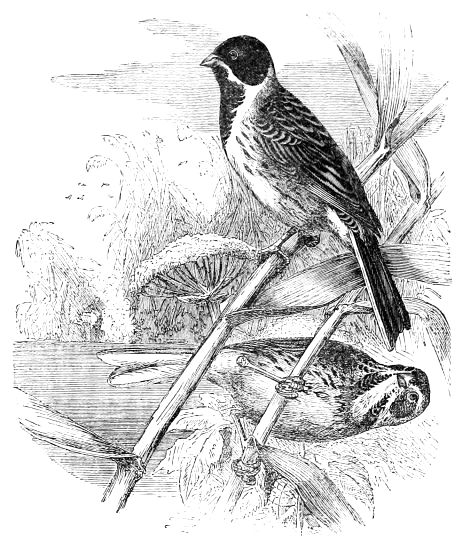
THE REED BUNTING (Cynchramus Schœniclus).
THE LARK BUNTING.
In the Spur Bunting or Lark Bunting (Centrophanes lapponicus) the characteristic nail is longer than the toe itself. The plumage of the male is black upon the top of the head, and beneath the throat; the nape is a bright rust-red, marked with a reddish-white line that passes over the eyes, and lower down takes the form of the letter S; the back is brown, streaked with a deeper shade; the wings brownish black, with light borders to the small covers and individual quills; the lower part of the body is greyish white, marked upon the sides with large black streaks and spots. The female is without the black upon the head, throat, and sides, and her plumage is of a paler tint than that of the male. During the winter the black markings are frequently almost concealed under the white edges that the feathers acquire at that season. The young resemble the mother, but have long dark streaks upon the lower portion of the body. The iris is dark brown, the beak blueish black at its tip, and the feet a greyish brown. The length of this species is about six inches, and the breadth ten inches; the wing measures three and a half inches, and the tail two and a half inches. The female is smaller than her mate.
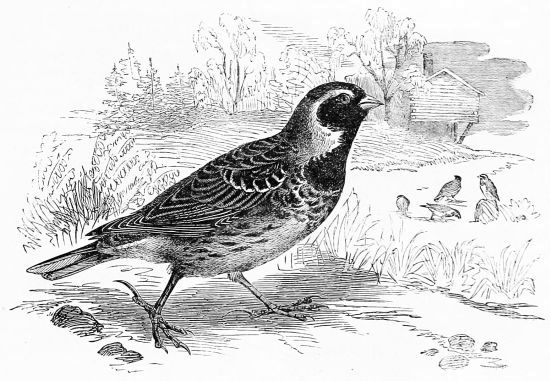
THE LARK BUNTING (Centrophanes lapponicus).
The Lark Bunting is to be found in all the northern countries of Europe, and is extremely numerous in Lapland, its favourite haunts being mountains, barren highlands, or birch forests. Its habits are a curious mixture of those of the Lark and Reed Bunting; it runs on the ground after the manner of the former, and perches like the latter, while its flight bears a resemblance to that of both birds. The call-note is melancholy, and its sound well suited to the localities where it is heard: the song is very simple, and is, we believe, only uttered whilst on the wing. Schräder tells us that this species visits Lapland about April, and at once proceeds to make its nest, which is safely concealed under the roots of a birch tree, or hidden amongst the surrounding plants; exteriorly it is formed of coarse, thick grass, and lined with soft feathers. The eggs, five or six in number, are laid about the middle of June; in shape they are elongated, and of a grey or yellowish colour, marked more or less with dark spots or lines, which are, however, occasionally wanting. As soon as the duties of incubation are concluded the little pairs unite themselves into parties, and appear during their journeyings over the country to be almost entirely without fear of man, and quite ignorant of his dangerous powers. The food of these birds during the summer months consists principally of gnats and other insects, and in winter of various kinds of seeds. The migrations of Lark Buntings rarely extend beyond the southern parts of Scandinavia, such as have visited Germany being, no doubt, stragglers that have wandered involuntarily from the rest. Naumann tells us that they constantly seek the society of Larks, and that their flesh is frequently eaten.
THE SNOW BUNTING.
The Snow Bunting (Plectrophanes nivalis), the last member of this family to which we shall call our readers' attention, is distinguished by the remarkable thickness of its plumage, and in several other respects differs from its congeners. The beak resembles that of the Lark Bunting, but the wings are comparatively long, and the tail short; the spur-like nail is likewise bent, and not quite so large as in that bird. The male is from six to seven inches long, its breadth about twelve inches; the wing four and a quarter inches, and the tail two and a half inches. Simple as are the colours in the plumage of the young male, its beauty cannot fail to excite admiration. The middle of the back and tips of the quills are black, as is the upper portion of the middle tail-feathers, and a spot upon the carpal portion of the wing; the lower parts of the tail-feathers are bordered with brownish grey, gradually shading into black towards their roots, and the whole of the remainder of the plumage is of a pure white. The iris is light brown, the beak blue at its base and black at the tip; the feet are of a brownish black colour. The head of the female is of a blackish shade, that of the young bird grey; but during the winter the head and neck are brownish grey, marked with a black crescent-shaped spot; at that season the breast is of a quieter tint, only the wings and tail retaining colours similar to those they exhibit in summer. The plumage of the young birds is a dull reddish brown, the back brown with dark markings; the wings are striped with two white bands.
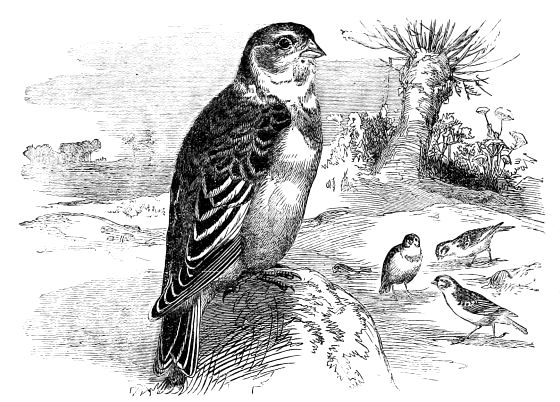
THE SNOW BUNTING (Plectrophanes nivalis).
This species is an inhabitant of the same countries as those frequented by the Lark Bunting, but is often found living in much higher latitudes than that bird, even breeding so far north as the islands of Spitzbergen and of Novaja Zemlja. We ourselves have met with it during the summer in Scandinavia, in the northern part of Lapland, and upon the highest of the Dovrefeld Mountains. Rocky passes seem to afford it the localities it prefers when about to breed; the nest, which is formed of moss and grass, lined with down and feathers, is placed in a cleft of rock, or under a large stone, the entrance to this secret retreat being made of the very smallest proportions consistent with the possibility of the parent birds slipping in and out of the nest. The brood consists of from five to six eggs, so extremely various in their colour and markings as to render any attempt at description useless. The young are fed almost exclusively with insects, upon which their parents also subsist in the breeding season, seeds of various kinds affording them nourishment during the winter.
The flocks of these beautiful creatures are remarkably numerous; they pour in dense masses over the country, and drop like snow-flakes upon such spots as seem to offer them the food of which they are in search—indeed, so strong is the resemblance of these swarms to a snow-storm, when thus seen congregated in large numbers, that the birds are popularly called "Snowflakes" in St. Petersburg, where they are met with in much greater multitudes than in other parts of Europe. Many tales are told of these flocks settling down, during their migrations, on the decks of ships, in order to enjoy a short repose; upon such occasions, however, they rise again into the air almost immediately, and continue their long and weary journey, even should they have to encounter the full violence of a contrary wind.