RAVENS (Coracirostres). (continued 2)
Thomas Rymer Jones translation
The COLLAR BIRDS (Chlamydera) are nearly allied to the group last described, and are addicted to the same remarkable habit of bower-building. In these species the beak is compressed at its sides and notched towards its tip; the upper mandible is slightly vaulted; the wings are long and pointed, their third and fourth quills being of greater length than the rest; the tail is long and slightly rounded; the tarsi are covered in front with broad scales; the toes are large, and furnished with sharp-pointed claws.
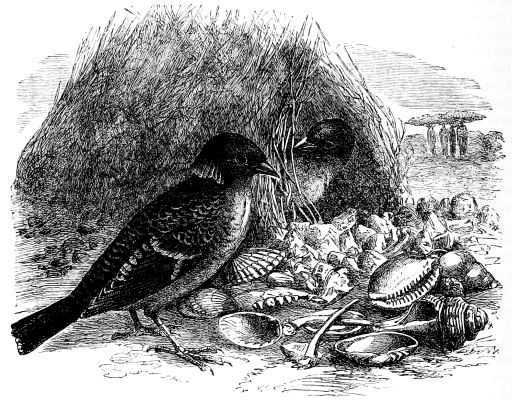
THE SPOTTED COLLAR BIRD (Chlamydera maculata).
THE SPOTTED COLLAR BIRD.
The Spotted Collar Bird (Chlamydera maculata) is about ten inches long; the feathers upon the top of the head and region of the throat are of a beautiful brown, surrounded by a narrow black line, those upon the head being tipped with silver grey; the neck is surrounded by an elegant collar or plume of long feathers, of the colour of a peach blossom; the entire back, wings, and tail are covered with deep brown feathers, marked at their extremities with a round, brownish-yellow spot; the lower parts of the body are greyish white, the feathers upon the sides streaked with a zig-zag, pale brown line; the eye is deep brown, the beak and feet of a lighter shade. The young are without the feathery collar round the neck.
These interesting birds are inhabitants of Central Australia, where they make their nests and spend the greater part of their lives upon the numerous low bushes with which the plains are covered, hiding themselves in the thickest branches at the very tops of trees at the first approach of a stranger, and thus rendering the observation of their habits a work of considerable difficulty; those who are desirous of obtaining a specimen are therefore compelled to watch the tree on which they perch until thirst compels them to come down in search of water. Gould informs us that the bowers built by the Collar Birds are even more artistically constructed and elaborately decorated than those of the Satin Bird, and though erected in similar situations, are more arched and of greater size, some being as much as three feet long; like those we have described, the sides are formed of twigs woven together, but these birds are not content with so rough a screen, and cover their ball-room with a layer of fine and beautiful grass, large stones being employed by the clever little architects for the purpose of keeping all the materials firmly in the proper place. The interior is decorated in the most elaborate manner with various kinds of shells, gay scraps, bleached bones, or even the skulls of small animals; some of them being placed in such a manner as to form a sort of approach to the bower, whilst a goodly number are heaped up by way of ornament upon each side of the entrance. Instances have been known in which these energetic and persevering little creatures have collected as much as half a bushel of materials, rejecting everything as unsuitable for their purpose that is not quite white or very gay in colour, and actually going to search for shells upon the banks of rivers some miles distant from the spot on which they build. Gould tells us that these tasteful bowers are so firmly constructed as to serve as a pleasure apartment for several seasons in succession.
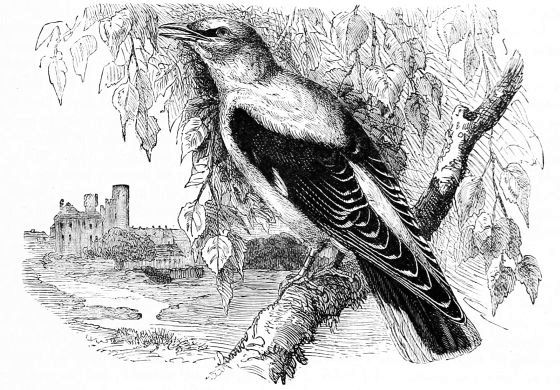
THE PIROL, OR GOLDEN ORIOLE (Oriolus galbula).
The birds constituting the second group of this family are recognisable by their elongated beaks, short feet, and rather long wings; in the plumage of the male, black and yellow predominate; but the prevailing colour of the female is a greenish grey.
THE PIROL.
The Pirol, Golden Oriole, or Cherry Bird (Oriolus galbula), is about nine and three-quarter inches long and eighteen broad; the wing measures about six inches, and the tail four inches. The female is a trifle smaller than her mate. The plumage of the male is principally of a splendid light yellow, only the bridles, wings, and tail being black; the roots of the quills and the tips of the tail-feathers are ornamented with a yellow spot. The colour of the female, as well as that of the one-year old male and young birds, is green above and white beneath; the front of the throat is of a light ash grey, marked with long greyish-black streaks; the tail is tipped with yellow, and the wing-feathers edged with a light border; the eyes are bright carmine, the beak a dull red, that of the female and young being greyish black, and their feet lead colour.
In Germany this beautiful species has received the name of the Whitsuntide Bird, from the fact that in most parts of Europe, except the extreme north, it usually makes its appearance at that season of the year. Central Asia, however, must be regarded as the actual habitat of the Pirol; there, as elsewhere, it frequents wooded districts, generally avoiding mountain tracts, and only tarrying for a short time amongst the forests of fir or pine trees passed over in journeying to another locality. Birch or oak trees afford it a favourite retreat, and upon these it will establish its head-quarters, only leaving them to fly about the gardens or orchards in the immediate neighbourhood in search of food, and thus becoming very troublesome to the inhabitants at the season when the cherries ripen. During the course of its migrations, the Pirol visits the very centre of Africa; we ourselves have seen it as far south as eleven degrees north latitude, and it is constantly met with in the western parts of the continent. In its habits this bird is distinguished by many peculiarities; although living in the immediate vicinity of man, it is extremely shy, and constantly endeavours to conceal itself from his view. In disposition it is always mild and restless, flying and fluttering about incessantly from one tree or branch to another, only coming down to perch upon a bush, or searching the ground when desirous of procuring insect food. Its gait is so extremely awkward, that it may be said to progress by means of a series of short clumsy jumps, rather than by hopping in the usual manner. Its flight is heavy, noisy, rapid, and, like that of the Starling, very undulating. Amongst themselves these birds are extremely quarrelsome, often pecking and hunting each other about for a quarter of an hour at a time upon the slightest provocation—indeed, they exhibit a most pugnacious disposition towards all their feathered companions. Their voice is very loud, full, and agreeable, and they would seem never to be weary of exhibiting their vocal powers; a pair of them is sufficient to enliven the whole wood in which they take up their abode.
The nest, which is most artistically constructed, is usually suspended from a forked and slender branch; in shape it is like a deep basin. The walls are formed of blades of grass, vine-tendrils, wool, cobwebs, and a great variety of similar materials, the interior being snugly lined with a thick bed of wool, feathers, or fine grass; this beautiful structure is most skilfully fastened in its place by means of long threads or twigs, moistened with saliva from the beak of the bird, and then wound several times round the branch, their ends being woven into the body of the nest. Both parents assist in the formation of the outer wall of this pretty fabric, but the female alone undertakes the preparation of the warm bed upon which the brood are to be deposited. The eggs, five in number, are laid about June; they are smooth, white, and marked with dark grey or reddish spots. Passler tells us that the affection of these birds for their young progeny is very great, and that they show considerable courage and determination in defending their little family if any attempt is made to touch their nest. At noon the female is relieved from her watch by her mate, who remains upon the nest whilst she flies away hurriedly to snatch a hasty meal from the neighbouring fields. The young are hatched within a fortnight; they grow with great rapidity, and moult their feathers before leaving the nest. Should a pair of Pirols be driven from their home whilst brooding, they will at once set about their preparation for another family, but will never recommence if disturbed a second time. Various kinds of insects, caterpillars, butterflies, or worms are consumed by these birds in great numbers, and they also eat cherries and other descriptions of fruit in abundance. Notwithstanding its usual timidity, the Pirol has been known to become so tame when caged as to feed from its keeper's hand or mouth; and in one instance that came under our notice, would pull its master by the hair if he omitted to pay it the attention desired.
Africa and Southern Asia possess many species of Orioles; these it is needless to enumerate, as they closely resemble those that inhabit Europe. We find, however, in Australia another group of these birds, which we must mention, inasmuch as they form a connecting link between the Pirols and the Birds of Paradise.
THE GOLDEN-CRESTED ORIOLE.
The Royal or Golden-crested Oriole (Sericulus chrysocephalus), one of the most beautiful creatures inhabiting that fertile and highly-favoured continent, is distinguished by its short and feeble bill, the upper mandible of which is very distinctly notched, its straightly cut, or very slightly rounded tail, and the peculiar nature of its feathers. The head, back of the neck, and an arched line which passes from the nape over the breast, are bright yellow, while the rest of the plumage is velvety black. The first quill is black, the rest of the primaries yellow in the middle and black at the root and tip; the secondaries are yellow, if we except a narrow border to the outer web. The eye is pale yellow, the beak of a deeper shade, and the feet black. In the female the head and throat are brownish white, the top of the head being marked with a large black spot; the upper portions of the wings and tail are olive brown, the feathers of the back tipped with triangular brownish-white spots; the belly is olive brown, and marked with similar but still more distinct spots. The eyes are brown, and the feet black. The young resemble their mother. The full-sized birds are about eight inches and three-quarters in length.
We learn from Gould that this splendid species is confined to Eastern Australia, and is very numerous in the bush about Moreton Bay, as also upon the neighbouring islands. In its habits it resembles the Pirol, but is much quieter. It has no fear of man, and delights to perch in full view upon the highest and most conspicuous branches of the trees; it would, however, seem as if the old males learnt by experience the danger to which they expose themselves by this lavish display of their gorgeous plumage, for they are much more prudent in this respect than the females and young males. As regards their mode of incubation Gould was unable to obtain any trustworthy intelligence.
But few years have passed away since Europeans first became acquainted with the living forms of the magnificent creatures we are now about to describe. Their glowing feathers, it is true, had long been familiar to every eye, but the natives of New Guinea, in preparing their skins for exportation, had removed all trace of legs, thus giving rise to most extravagant tales about the life they led in their native lands. The Birds of Paradise, as they were called on account of their apparent want of feet and great beauty, retained, it was popularly supposed, the forms they had borne in the Garden of Eden, and lived upon no more substantial nourishment than dew, or the ether through which it was imagined that they perpetually floated by the aid of their long, cloud-like plumage, only seeking an occasional change of position in suspending themselves for a few minutes from the branches of a tree by some of the tendril-like feathers of their tail. In vain naturalists endeavoured to prove the absurdity of these and many other fables; the public mind would not be convinced, and for centuries retained and cherished these most poetical notions. Since those days many travellers in New Guinea and its islands have seen and described the Birds of Paradise, and we are indebted to Bennett, Wallace, and Rosenberg for many very interesting but by no means exhaustive particulars as to their habits and mode of life.
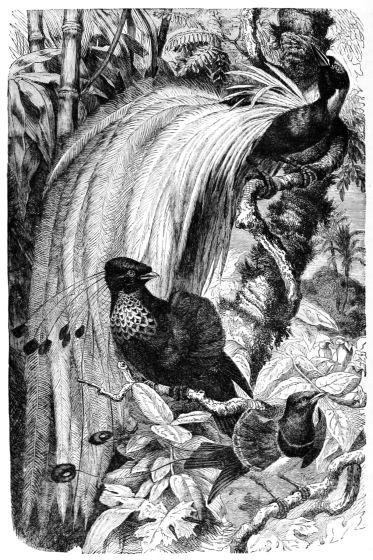
BIRDS OF PARADISE.
THE BIRDS OF PARADISE.
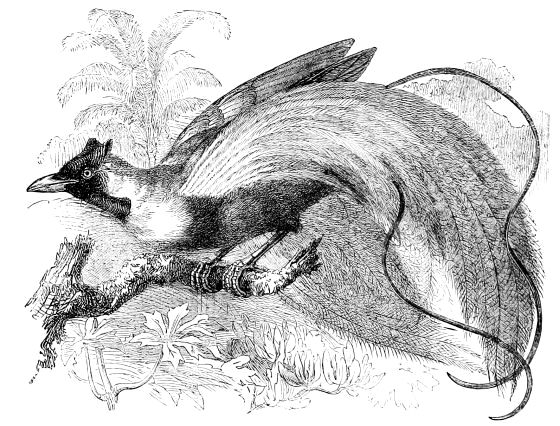
THE RED BIRD OF PARADISE (Paradisea rubra).
The Birds of Paradise (Paradiseæ) are magnificent Ravens, varying in their size from that of a Jay to that of a Lark, and are distinguished not only by the exquisite beauty of their feathers, but by the elegance of their shape. In this family the beak is of moderate size, straight, or slightly curved, compressed at its sides, and covered at the base with a feathered skin, by which the nostrils are concealed; the wings are of moderate length, and very decidedly rounded, as the sixth and seventh quills are much longer than the rest; the tail is either composed of twelve rather long feathers, combined with many thread-like feathery appendages of great length, or is extremely long, simple in form, and sharply graduated; the feet are powerful, the toes long, and armed with sharp, crooked claws. In some species the plumage upon the sides is most peculiar in its appearance, the feathers growing to a great length, and splitting, as it were, into several light and delicate portions. These peculiarities are only observable in the male, both the female and young being much more simply clad. The Birds of Paradise are found exclusively in New Guinea and the neighbouring islands, Arnisland, Salawati, Meisol, and Waigiou, each of these localities possessing one or more distinct species.
Rosenberg has given us the following description of the manner in which the natives prepare these valuable creatures for the European and other markets:—The Papuans shoot the Bird of Paradise with arrows, and then strip the body of its skin, cut away the feet and a portion of the tail-feathers; they then insert a stick through the beak, and thus supported, the skin is hung to dry in the smoke of a wood fire in order to preserve it from the attacks of vermin. The natives of Meisol, on the contrary, do not remove the feet or any portion of the tail, as they have learnt by experience that the unmutilated skins command the highest price. These skins are bought by merchants from Madagascar, Teimate, and Eastern Seram, and conveyed to Singapore, from whence they are forwarded to Europe or China. According to information received from these merchants the finest birds come from the northern coast of New Guinea, the Sultan of Tidore receiving annually a certain number of the skins obtained within his territory as tribute.
The TRUE BIRDS OF PARADISE (Paradiseæ) possess a plume of long split feathers, placed at the first joint of the wings, growing from a portion of skin about an inch in length, which can be spread out or folded up at pleasure. The females are without this appendage. The two middle tail-feathers are usually extremely long, and become enlarged at the tip.
THE FOOTLESS BIRD OF PARADISE.
The Footless Bird of Paradise (Paradisea apoda), as it has been called, to perpetuate the memory of the fables to which we have alluded, is a species about thirteen inches long. The predominant colour of the plumage is a beautiful chestnut brown, the forehead a rich black, shaded with emerald green; the top of the head and upper part of the neck are lemon coloured, the throat greenish gold, the upper throat violet brown; the long, feathery plumes at the sides are a brilliant orange, spotted with purple at their tips, but these soon lose their freshness and beauty when long exposed to the rays of the sun. The eye is pale yellow, the beak and feet blueish grey. The colour of the female is brownish grey upon the upper part of the body, the throat is greyish violet, and the belly reddish yellow. This bird appears exclusively to inhabit the island of Aru.
THE WUMBI.
The Wumbi (Paradisea Papuana) is somewhat smaller than the species last described, not exceeding twelve inches in length. The back of this bird is chestnut coloured; the lower parts of the body a deep reddish brown; the top of the head, nape, and upper part of the throat and sides are pale yellow; the feathers upon the brow and beak black, with a green gloss; the throat emerald green; the eye is of a whitish yellow, the beak and feet deep blue. The young bird, on first leaving the nest, is entirely brown; the upper portions of the body being of a deeper shade than the rest; the tail-feathers are of equal length, the two centre ones terminating in a slight tuft; after the first moulting, the head and nape of the neck are pale yellow, and the brow and throat gleam with metallic green; the two centre tail-feathers are a few inches longer than those in the first plumage. After the third change, these feathers are prolonged into mere bare shafts, measuring about fifteen inches; and the beautiful plumes begin to sprout from the sides, growing until at last they attain the enormous length of fifty or sixty inches, and in very old birds have been known even to exceed that size. Rosenberg tells us that this species is found upon the islands of Meisol and Salawati in considerable numbers; upon the eastern coast of New Guinea it is more scarce.
THE RUBY OR RED BIRD OF PARADISE. (See Coloured Plate VIII.)
The Ruby or Red Bird of Paradise (Paradisea rubra) is distinguished from the preceding species by a golden green plume, with which the front of its head is decked. The back is russet yellow, a streak of this colour passing like a broad band over the breast and under side of the body; the breast and the wings are reddish brown, the base of the beak and a patch behind the eyes are velvety black; the throat emerald green. The plumes upon the sides are of a magnificent red, each feather terminating in a circular tip; the tail-feathers have long shafts, which curl outwards; the eye is light yellow; the back and feet greyish blue. In the female the forehead and throat are of a rich brown; the upper part of the body and belly reddish brown, the back of the head, throat, and breast bright red.
The Red Bird of Paradise is extremely rare, as it is only found, and that in small numbers, upon the island of Waigiou. The three species we have mentioned closely resemble each other in their habits: all are lively and intelligent, exhibiting (if we may so term it) a certain amount of coquetry in the manner in which they display their glorious plumage. Travellers who have seen these splendid creatures hovering in their native element speak with rapture of their beauty; and Lesson tells us that on one occasion he quite forgot to fire at a magnificent specimen as he watched his intended victim float away—
"Upon its waving feathers poised in air— Feathers, or rather clouds of golden down, With streamers thrown luxuriantly out In all the wantonness of wingèd wealth."
According to Rosenberg, the Birds of Paradise are migratory, living partly upon the coast and partly in the interior of the country, which they visit as soon as the fruit is quite ripe. We have seen a flock of these beautiful creatures winging their way to a tree, that after having been fired upon, returned almost immediately to the same spot; but this is by no means usual—on the contrary, as a rule they are extremely shy, and very difficult to obtain with the gun. Their cry is hoarse, and often followed by a scraping kind of sound; it may be heard both in the morning and evening, but rarely during the day. Lesson tells us that whilst creeping amongst the branches in search of the insects that constitute their favourite food, they utter a soft clucking note, entirely unlike their call, which is only heard when the bird is perched high upon the tops of the trees. During the entire day their graceful forms may be seen flying incessantly from one tree to another, never remaining perched for more than a few minutes upon the same branch, and concealing themselves among the foliage at the first suspicion of danger. Before sunrise they are already on the alert, and busied in their search for the fruit and insects upon which they subsist; in the evening all the various members of the party congregate at the summit of a high tree, where they pass the night. Lesson informs us that the Bird of Paradise is often seen flying in parties of some forty or fifty, under the guidance of a leader, who soars considerably above the flock he is conducting; their cries as they struggle with the wind are not unlike those of the Starling; when much incommoded by a strong breeze their note resembles the call of the Raven. Should a storm arise, they will at once soar high into the air, as though to escape the power of the blast; but in spite of all their efforts they are often rendered completely helpless, as the wind blows aside and entangles their long tails and waving plumes, and not unfrequently forces them to fall heavily to the earth, or into the sea; many are thus drowned, and others are obliged to lie upon the ground until they have recovered sufficiently from the shock to arrange their disordered and matted feathers. On the eastern and northern coast of North Guinea and in Meisol, the breeding season commences in May, but upon the western coast and in Salawati the eggs are not laid till November. Lesson is of opinion that the Bird of Paradise lives in a state of polygamy, and tells us that the males are most active in their endeavours to show their glorious apparel to full advantage when desirous of attracting the attention of the females. We learn from Rosenberg that in order to obtain the Bird of Paradise, the natives, during the dry season, build little huts of twigs and leaves amongst the branches in one of the trees usually selected as a sleeping-place. About an hour before sunset this leafy bower is occupied by a man who is considered to be a practised shot; silently he crouches until the flock begins to arrive, and then one after another he marks them out and strikes them to the ground, with an arrow armed with a conical wooden cap as large as a teacup, so arranged as not to injure the plumage of the bird. In some places limed twigs are employed for this purpose, and in others snares are laid upon the branches of the fruit-trees in such a manner as to entangle the foot of the unsuspecting victim, who, when thus caught, is at once drawn down by means of a long string.
Mr. Wallace gives the following interesting account of his experience among these beautiful creatures in their native haunts:—"When I first arrived" (at Waigiou) "I was surprised at being told there were no Birds of Paradise at Muka, although there were plenty at Bessir, a place where the natives caught them and prepared the skins. I assured the people I had heard the cry of these birds close to the village, but they would not believe that I could know their voice. However, the first time I went into the forest I not only heard but saw them, and was convinced there were plenty about; but they were very shy, and it was some time before we got any. My hunter first shot a female, and I one day got close to a very fine male. He was, as I expected, the rare red species, Paradisea rubra, which alone inhabits the island, and is found nowhere else. He was quite low down, running along a bough searching for insects, almost like a Woodpecker, and the long, black, ribbon-like filaments in his tail hung down in the most graceful double curve imaginable. I covered him with my gun, and was going to use the barrel, which had a very small charge of powder and number eight shot, so as not to injure his plumage, but the gun missed fire, and he was off in an instant among the thickest jungle." After describing other unsuccessful attempts, Mr. Wallace proceeds:—"At length the fruit ripened on the fig-tree close by my house, and many birds came to feed upon it; and one morning, as I was taking my coffee, a male Paradise Bird was seen to settle on its top. I seized my gun, ran under the tree, and gazing up, could see it flying across from branch to branch, picking a fruit here, and another there, and then, before I could get a sufficient aim to shoot to such a height (for it was one of the loftiest trees of the tropics), it was away into the forest. They now visited the tree every morning, but stayed so short a time, their motions were so rapid, and it was so difficult to see them, owing to the lower trees which impeded the view, that it was only after several days' watching, and two or three misses, that I brought down my bird—a male in the most magnificent plumage."
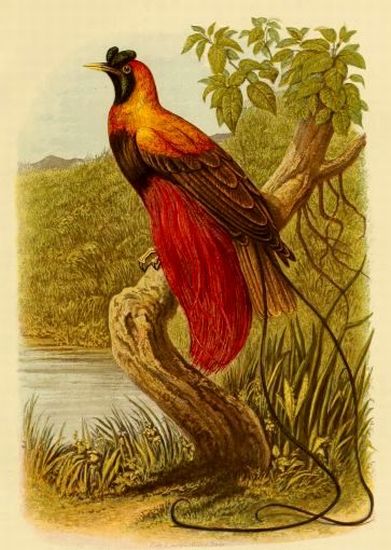
Plate 8. Cassell's Book of Birds
RUBY BIRD OF PARADISE ____ Paradisea rubra
(Three-fourths Life size)
[See larger version]
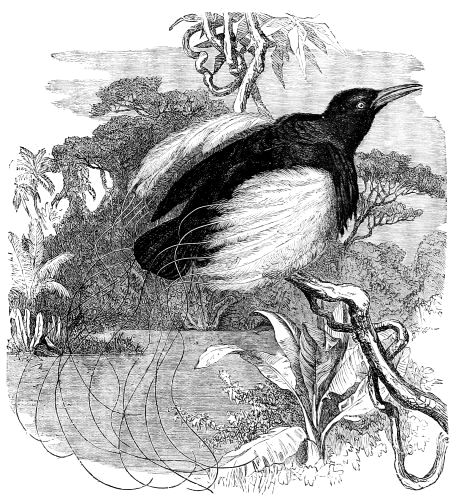
THE RESPLENDENT EPIMACHUS (Seleucides resplendens).
We are indebted to Dr. Bennett for the following graphic account of a Bird of Paradise, which lived for nine years in the aviary of Mr. Beale of Macao:—"This elegant creature has a light, playful, and graceful manner, with an arch and impudent look; dances about when a visitor approaches the cage, and seems delighted at being made an object of admiration; its notes are very peculiar, resembling the cawing of the Raven, but its tones are by far more varied. During four months of the year, from May to August, it moults. It washes itself regularly twice daily, and after having performed its ablutions throws its delicate feathers up nearly over the head, the quills of these feathers having a peculiar structure, so as to enable the bird to effect this object. Its food is boiled rice mixed up with soft egg, together with plantains, and living insects of the grasshopper tribe; these insects, when thrown to him, the bird contrives to catch in its beak with great celerity; it will eat insects in a living state, but will not touch them when dead. I observed the bird, previously to eating a grasshopper, place the insect upon the perch, keep it firmly fixed with the claws, and divesting it of the legs, wings, &c., devour it, with the head always placed first. It rarely alights upon the ground, and so proud is the creature of its elegant dress that it never permits a soil to remain upon it, and it may frequently be seen spreading out its wings and feathers, and regarding its splendid self in every direction, to observe whether the whole plumage is in an unsullied condition. The sounds uttered by this bird are very peculiar; that which appears to be a note of congratulation resembles somewhat the cawing of a Raven, but changes to a varied scale in musical gradations—a he, hi, ho, how, repeated frequently and rapidly, as briskly and playfully he hops round and along his perch, descending to the second perch to be admired, and congratulate the stranger who has made a visit to inspect him. He frequently raises his voice, sending forth notes of such power as to be heard at a long distance, and as it would scarcely be supposed such a delicate bird could utter. These notes are whack, whack, whack, uttered in a barking tone, the last being in a low note as conclusion. A drawing of the bird of the natural size was made by a Chinese artist. This was taken one morning to the original, who paid a compliment to the artist by considering it one of his own species. The bird advanced towards the picture, uttering at the same time its cawing, congratulatory notes; it did not appear excited by rage, but pecked gently at the representation, jumping about the perch, knocking its mandibles together with a chattering noise, and cleaning them against the perch, as if welcoming the arrival of a companion. After the trial with the picture a looking-glass was brought, to see what effect it would produce upon the bird, and the result was nearly the same; he regarded the reflection of himself most steadfastly in the mirror, never quitting it during the time it remained before him. When the glass was removed to the lower from the upper perch he instantly followed, but would not descend upon the floor of the cage when it was placed so low. It seemed impatient, hopping about without withdrawing its gaze from the mirror, uttering the usual cawing notes, but with evident surprise that the reflected figure (or, as he seemed to regard it, his opponent) imitated so closely all his actions, and was as watchful as himself. There was, however, on his part no indication of combativeness by any elevation of his feathers, nor was any irritation displayed at not being able to approach nearer to the supposed new comer from his own native land. His attention was directed to the mirror during the time it remained before him, but when removed he went quietly and composed himself upon the upper perch as if nothing had excited him. One of the best opportunities of seeing this bird in all its beauty of action as well as display of plumage is early in the morning, when he makes his toilet; the beautiful sub-alar plumage is then thrown out and cleaned from any spot that may sully its purity by being gently passed through the bill; the short, chocolate-coloured wings are extended to the utmost, and he keeps them in a steady flapping motion, as if in imitation of their use in flight, at the same time raising up the delicate long feathers over the back, which are spread in a chaste and elegant manner, floating like films in the ambient air. When it has picked and thoroughly cleaned its feathers, elevating its tail and long shaft feathers, it raises the delicate plumage of a similar character to the sub-alar, forming a beautiful crest, and throwing up its feathers with much grace, appears as proud as a lady in her full ball dress. His prehensile power in the feet is very strong, and, still retaining his hold, the bird will turn himself round on his perch. He delights to be sheltered from the glare of the sun, as that luminary is a great source of annoyance to him if permitted to dart its fervid rays directly upon the cage. This bird is not at all ravenous, but eats rice leisurely, almost grain by grain."
THE KING OF THE BIRDS OF PARADISE.
The King of the Birds of Paradise (Cincinnurus regius) may be selected as representing the SPIRAL TAILS (Cincinnurus), as the various species composing the second group of this family have been called. In size it is inferior to any of its congeners as yet described; it is, moreover, distinguished from them by the delicacy of its beak and by the less remarkable development of the plumes with which its sides are adorned. The two centre tail-feathers twine like the tendrils of a vine, and are entirely without a web, except at their extremity, which is furnished with a wheel-like feathery expansion. The male of this species is of a ruby red upon the upper portions of the body; the brow and top of the head are orange, the throat yellow, and the belly greyish white; the eyes are surmounted by a small black spot, and a band of metallic green divides the dark-coloured breast from the shades upon the belly; the feathers upon the sides are grey, marked with irregular white and red lines, and terminate in a bright emerald green tip. The female is reddish brown upon the upper part of the body, and below of a reddish yellow streaked with brown; the wings are gold colour, the beak is dark brown, and the feet light blue.
This species is found over a larger extent of country than any other member of its family, occupying not only a large portion of North Guinea, but most of the surrounding islands, where it frequents the bushes growing upon the sea-coast. Its movements are extremely restless, and, like other Birds of Paradise, it seems to revel in its own beauty as it spreads its plumage and raises the golden collar round its throat, meanwhile demonstrating its satisfaction by uttering a soft noise not unlike the mewing of a kitten. Writers of former days inform us that these beautiful creatures fly about in parties under the guidance of a male bird distinguished from the rest by the superior development of the tail, and that the flock are inconsolable if they lose their leader; but more modern naturalists do not mention this supposed peculiarity, which we must therefore regard as a fable.
THE COLLARED BIRD OF PARADISE.
The Collared Bird of Paradise (Lophorina superba) is an extremely rare species, inhabiting Northern New Guinea. It is distinguished by the long feathers by which the upper part of its back and the nape of its neck are surmounted, the latter even extending over the breast, and thus forming a kind of collar; but there are no elongated feathers upon the sides, and it wants the webless stems found on the tail of some species; the plumage in general is black, the long feathers upon the breast are of a brilliant metallic green; the flowing feathers of the shoulder fall like a mantle over the body, and can be raised when the bird is desirous of appearing in all its beauty.
The Six-feathered Bird of Paradise (Parotia sex-pennis) represents a race of extremely beautiful and rare creatures, which, owing to the peculiarities of their plumage, have been classed as a separate tribe under the name of PAROTIA. In these birds the side feathers are much elongated, but not disintegrated, as in the species described above; the tail is graduated, and none of its feathers are destitute of a web. Upon the head and behind the ear are placed six long shafts, from which the members of this group have derived their name, each terminating in a feathery web. The plumage is of a deep black, except upon the breast, which is golden green.
The gorgeously attired EPIMACHI resemble the Birds of Paradise in the peculiar elongation of the side and tail feathers and in the construction of their feet; the beak alone differs in its formation, being long, thin, and delicately curved.
THE RESPLENDENT EPIMACHUS.
The Resplendent Epimachus (Seleucides resplendens, or Seleucides alba) is recognisable by the tufts upon the breast, formed of large, rounded, and brightly bordered feathers, and by the graceful plumes that adorn its sides; these latter are downy in their upper portions, and terminate in very long and webless shafts. According to Rosenberg, this extraordinary bird is about thirty-two and a half inches in length. The velvet-like feathers of the head, neck, and breast are black, but gleam with a deep green or violet shade; the tufts upon the sides of the breast are also black and edged with dazzling emerald green; the plumes upon the sides are of a splendid golden yellow, but soon lose their brilliancy after death, changing to a dirty white; the wings and tail are glossy violet, and appear in some lights to be marked with stripes. The plumes for which this species is so celebrated are most remarkable; the longest of them reach to the tail, and there terminate in long, horsehair-like threads of a bright yellow towards their root, and for the rest of their length of a brown colour. The eyes are scarlet, the beak black, and the feet of a yellowish flesh tint. In the female the top of the head and lower part of the throat are black, the velvety feathers upon the head shining with a bright purple lustre; the lower part of the back, the wings, and tail are reddish brown, the large quills being black upon their inner web; the whole of the lower parts of the body are greyish white or a dirty yellowish brown, marked with small undulating black streaks. The young males at first resemble their mother, but after the first moulting the throat is grey, after the second the belly acquires its yellow tint, and the tufts upon the sides begin to make their appearance.
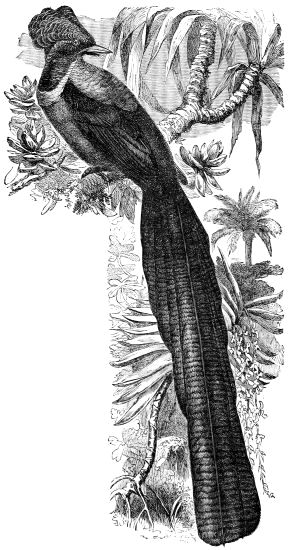
THE COLLARED EPIMACHUS (Epimachus magnus).
The Resplendent Epimachus is found exclusively upon the island of Salawati, frequenting rocky districts in considerable numbers, and subsisting, we believe, upon insects and various kinds of fruit. They usually congregate in small parties, and fly together in search of food, seeming, when upon the wing, to glide through the air with great facility.
THE COLLARED EPIMACHUS.
The Collared Epimachus (Epimachus magnus) represents another group of the same family. The beak of this bird is long, arched, and slightly rounded at the ridge; the wings are moderate, the tail long and graduated, the foot powerful, but of no great size; the breast only is adorned with tufts of feathers. This species is about three and a quarter feet long, two feet of which measurement are included in the tail. The head is decked with small, round, scale-like feathers of a bronze green colour, but gleaming with a blue and golden light; the long feathers growing upon the nape are black and velvety; the back is of similar colour, but varied by the blueish green gloss of many long, broad feathers. The lower part of the body is of a blackish violet, and the long and graceful plumes that sprout from the sides shine with a glossy splendour as they hang negligently over the wings; the beak and feet are black. In the female the top of the head and nape are of a cinnamon colour; the rest of her plumage resembles the male, but is rather paler.
This splendid creature is so mutilated during its preparation for sale by the natives, that we believe no perfect specimen has as yet been brought to Europe. Rosenberg tells us that it inhabits New Guinea, but is never seen upon the surrounding islands.
Some naturalists place among the Birds of Paradise two species, of which we know very little, that have been named the
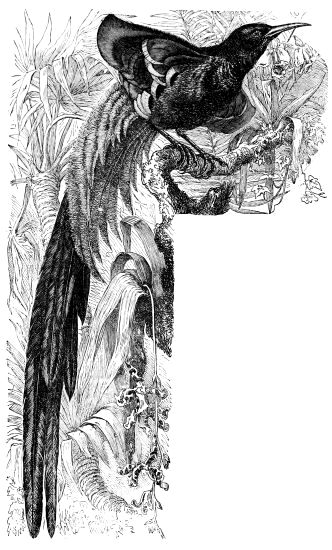
MAGPIE BIRDS OF PARADISE (Astrapiœ); others regard them as belonging to the Thrushes, as they resemble these latter birds in the construction of their beak, which is straight, and slightly flattened in front of its apex; its base, moreover, is unfurnished either with bristles or velvety feathers; the tail is long, and distinctly graduated; the wings are of moderate size, and the legs powerful; both sides of the head are adorned with a tuft of feathers which incline outwards. Lesson and other naturalists say that it is impossible to describe the beauty and brilliancy of these glorious creatures by any selection of words. The plumage, which is purple black on the upper part of the body, gleams with metallic splendour. The plumes upon the head are blueish red, tipped with emerald green; the whole of the lower parts of the body are malachite green; a reddish violet streak passes from the corner of the eyes in a semicircle down to the throat; the legs and beak are black. When seen in the full sunlight these gorgeous birds appear to gleam with every conceivable effect and variety of the most brilliant colours; their length is about two feet and a quarter. We learn from Rosenberg that the Paradise Magpie is found exclusively upon the tolerably large island of Obi, near Gilwick Bay, but he gives us no particulars as to its life and habits, as he was unable either to observe it in the wild state or to obtain a living specimen.
THE MAGPIE BIRD OF PARADISE (Astrapia gularis).
THE RAVENS PROPER (Coraces).
This family comprehends some of the largest members of the order. In these birds the beak is large, strong, curved towards the point, and toothed on its cutting edge, the upper mandible being only occasionally slightly hooked; the wings are of moderate size, and rounded at their extremities, the fourth quill being larger than the rest; the tail is formed by twelve feathers, which are either graduated or straight at the extremity. The plumage is rich, and its feathers large, those at the base of the beak usually resembling hairs or bristles; the rest are extremely glossy. Both sexes are alike in colour, and the young differ but little from the parent birds.
The Ravens inhabit every part of the globe, their mode of life and appearance varying slightly, according to the climate in which they live. Warm countries, however, appear more congenial to them than the northern parts of the earth, where they are met with in comparatively small numbers. By far the greater number are stationary, rarely, if ever, leaving the place that gave them birth, except to make short excursions in the neighbourhood, whilst others migrate to countries at no great distance from their native land. If we except the power of song, the Ravens combine in themselves every gift possessed by any members of the order to which they belong. They move with ease upon the ground, fly rapidly and lightly, and are remarkable for the very equal development of all their faculties, including the sense of smell.
This family has been divided into many groups, all of which present very marked peculiarities.
The MOUNTAIN CROWS, or CHOUGHS (Fregili) are recognised by their long, slender bodies, long wings, and short tails; their beaks are slender and pointed, slightly arched, and, like their feet, brightly coloured. Their plumage is black and glossy. Europe has two species of these birds, and several others inhabit India and Australia.
THE CHOUGH.
The Chough, or Mountain Crow (Fregilus graculus) is distinguished by the peculiar formation of its long, thin, arched beak, which, like its short-toed foot, is of a brilliant scarlet colour. The eyes are dark brown, and the plumage of an uniform glossy blueish black. This species is about fifteen inches long and thirty-one inches across; the wing measures ten and a half inches, and the tail five and a half inches. The female is scarcely distinguishable from her mate, but the young are known by their black feet and beak; after the first moulting, however, they resemble the older birds.
Almost all the mountains of Europe afford a home to these Crows, which are met with in considerable numbers in Scotland, in Cornwall, and in Wales: in Spain they are very abundant, but are comparatively rare among the Swiss Alps. In most of the mountains that they frequent they occasionally ascend to the summits of the loftiest peaks, and are usually found as high as the snow-line, descending to the valleys in severe winters. Travellers in these mountain regions often hear the voices of thousands of these birds from amongst the rocks, and those who take the trouble to observe their movements soon perceive that they appear with a certain kind of regularity in the same localities, generally leaving their sleeping-place early in the morning to search for food, and returning about nine o'clock to their perch; before noon they again leave, and again return to pass the mid-day hours in the holes with which their favourite haunts abound, keeping, however, a vigilant watch against intruders, even when enjoying their noontide rest, and giving warning of any approaching danger with loud and piercing cries; nor are these precautions by any means superfluous, seeing that Hawks and others of their enemies are always on the alert to seize an unwary straggler, which, on such occasions, usually endeavours to hide itself by creeping into the depths of some adjacent hole. In the afternoon the whole party again goes several times in search of food, and returns at night to sleep upon the usual perch. According to Bolle, this species is rarely seen in the Canary Islands; and, indeed, many other spots which would appear to offer it a most desirable home, are, most unaccountably, never visited by this shy and unenterprising bird. It is only when we learn upon what food the Chough subsists that we appreciate the full value of its many services; for it lives principally upon insects, grasshoppers, spiders, and, in Spain, it also devours scorpions in large numbers, raising the stones under which such creatures live by the aid of its beak, or digging up the ground in search of them.
The breeding season commences early in spring; the nest, which is often very difficult to find, being placed in holes in the rock, is constructed of dry stalks or hay, well lined with moss: the eggs, four or five in number, are whitish or dirty yellow, marked with dark brown spots and streaks. The female broods alone, but both parents assist in the heavy task of feeding the young, an operation which is carried on amidst an indescribable amount of noise and general confusion. So extremely social are these birds that they remain in company even during the period of incubation. Though, like other Ravens, they have doubtless little respect for property, still, on the whole they live peacefully, even when in large flocks, and courageously assist their companions when in danger. Should one of the party be injured the rest immediately surround it with every indication of sympathy, and we have known a case in which a Chough that had broken its wing was fed by its companions until it could fly about and obtain its own food. When tamed these birds frequently become extremely interesting, and may be allowed to leave the cage, without any danger of their flying away.
THE ALPINE CHOUGH.
The Snow Crow, or Alpine Chough (Pyrrhocorax alpinus) possesses a comparatively strong, yellow beak, of about the length of its head, and its plumage more nearly resembles that of a Blackbird than that of a Crow. The attire of the adult is of a rich velvety black, the feet are red. Whilst young the feathers are of a paler tint, and the feet yellow.
In size and habits the Alpine Chough closely resembles the species last described—indeed, it may be regarded as holding the same place among the pinnacles of Alpine ranges as that occupied by the Lark in our corn-fields, or the Seagull on our coasts. Tschudi tells us that two of these birds were seen by Meyer during his ascent of the Finsteraarhorn, at an altitude of more than 13,000 feet above the level of the sea, and they are frequently known to inhabit regions that are entirely uninhabitable by man, or even by the quadrupeds that occasionally are found at very considerable altitudes. Travellers who attempt the most precipitous and apparently desolate passes are astonished to find that they are greeted by a noise which they could never have supposed to have existed amongst the lofty peaks of the solemn and majestic Alps, and soon find themselves beset by swarms of Snow Crows, who scream and quarrel among themselves as they hover over the heads of their unusual visitors, or perch upon a neighbouring pinnacle the better to observe their movements. The utmost severity of the winter will not drive them to seek a home in the country that lies beneath, upon which they, however, occasionally descend in large flocks, making the air resound with hoarse caws, or shrill cries, as they search for berries in the bushes that abound in Alpine valleys. Almost any kind of food is consumed by them with avidity, but they manifest a decided preference for snails of various kinds—indeed, upon one occasion we found no less than thirteen of these destructive molluscs in the crop of a Snow Crow that we had killed: like birds of prey, they will occasionally follow living animals, and devour dead carcases with the greatest eagerness. The author from whom we quote tells us that he has known these birds to rush down from their retreats at the first report of a gun, and join in the pursuit of the intended victim with the utmost excitement, and mentions an instance in which a flock of Alpine Choughs hovered for months over a precipice, beneath which lay the whitened bones of a hunter who had met his death in pursuit of a chamois, and whose flesh they had eaten. Most noisy are the altercations while these creatures are at their disgusting meals, which are enlivened by a constant succession of vicious attempts to drive their companions from their prey. When devouring the smaller birds or quadrupeds the head is first attacked in order to obtain the brains.
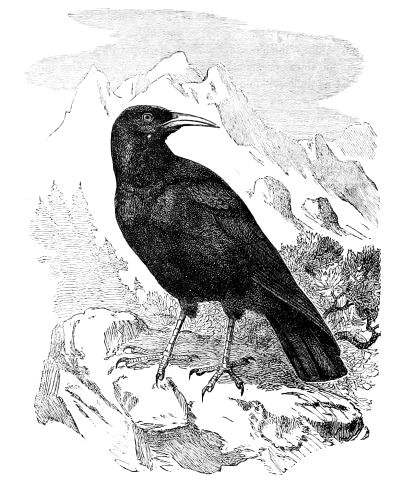
THE CHOUGH (Fregilus graculus).
The nest of the Snow Crow is but rarely found, being built in clefts or fissures of the steep rocks in which they live; it is large and flat, and is usually constructed of blades of grass. The eggs, five in number, in size resemble those of the Common Crow; the shell is light grey, marked with spots of a deeper shade. Successive generations often build upon the same place, which in time becomes so thickly covered with the excreta of its numerous occupants as to form beds of guano, which are largely employed as a valuable manure. When domesticated, says Savi, the Snow Crow exhibits great attachment to its owner, and becomes so tame as to fly quite freely about the house. It will consume almost anything eaten by the family, and prefers milk or wine to water. While eating, it seizes the morsel and tears it with the claws before swallowing it, and should the supply prove too large for present need the remainder is carefully put away, and hidden under scraps of paper or any available covering, its owner keeping a very sharp look-out to prevent the discovery of his concealed treasure. So remarkable is its liking for fire, that we might imagine it to be the Avis incendiaria of the ancients; it has been known to pluck the burning wick from a lamp and swallow it, or to draw small live coals from the hearth for this purpose, without any apparent ill effect, and so to delight in smoke as to take every opportunity of throwing a scrap of rag, wood, or paper into the grate, for the pleasure of seeing the light clouds ascend as it is consumed by the flames. The affection of this bird for those by whom it is tamed is remarkably demonstrative; it seems to observe their absence, and greets them on their return with every expression of delight; to some persons, on the contrary, it occasionally takes a most unaccountable aversion, and pecks and screams at them whenever they approach. The song of the Snow Crow is varied, and it has been known to whistle a simple air that it had been taught.
The TRUE RAVENS are distinguished by their large but rather short beak, which is more or less curved, and covered at its base with a number of black bristles; the wings are of moderate size, and reach, when closed, to the end of the tail; the feet are powerful, and the plumage a rich black, more or less glossy.
THE RAVEN.
The Raven (Corax nobilis), as the principal member of this group is called par excellence, is recognisable by its lengthy body, broad, long, and pointed wings, the third quill of which considerably exceeds the rest in length; the tail is of moderate dimensions, and graduated. Its plumage is short, glossy, and uniformly black; the eyes of the old birds are brown, those of the young blueish black, and those of the nestlings pale grey. The length of this species is about two feet, its breadth four and a quarter; the wing measures seventeen inches, and the tail nine and three-quarters.
This Raven is spread over a much larger portion of the world than any of its congeners; it inhabits the whole of Europe, as well as a great part of Asia, and is met with in the countries extending from the Altai Mountains to Japan. It is at present uncertain whether the very large Raven met with in North America is the same or only a similar species. Throughout some parts of Europe these birds dwell comparatively apart from man, preferring to inhabit such localities as mountains, dense forests, or rocky coasts, while others, that frequent the northern, southern, or eastern coasts of our continent, live on comparatively friendly terms with the lord of the soil, from whom their many objectionable habits do not meet with the same retribution as in the more central or western lands. Ravens usually live in pairs, and remain constantly together throughout their lives, passing their time principally in flying in company with each other over the surrounding country. When on the wing, their movements are extremely beautiful, they alternate between a rapid and direct flight, produced by a powerful stroke of the wings, these, like the tail, being kept outspread, and a hovering motion, that takes the form of a series of gracefully described circles, seeming to be produced without the slightest effort on the part of the birds, who occasionally amuse themselves by dropping suddenly to a distance of some feet, and then continuing their way as before. Upon the ground their gait is distinguished by a most absurd assumption of dignity, the upper portion of the body being held considerably raised, whilst they gesticulate with the head in a most laughable attempt to keep time with the movements of the feet. While perched the feathers are generally kept quite close, those only upon the head or neck being spread or ruffled when the creature is under the influence of strong emotion: the wings are always kept slightly raised from the body.
By the rest of its congeners the Raven would seem to be regarded with abhorrence, for they will fall upon and attack it with the utmost animosity: and should it attempt to join a party of other species of its family, they greet it with as noisy demonstrations of terror, as if the intruder were a Hawk or a Buzzard, and compel it at once to retire from amongst them. In its relations with man nothing can exceed the prudence and wariness of the Raven, its fear of molestation being so strong as to compel it even to desert its nestlings should an enemy approach, although its attachment to its offspring is usually both warm and constant. The voice of this bird is varied, and its manner of chattering to its mate during the period of incubation even more peculiar and incessant than that of the Magpie.
In voracity the Raven has but few equals, for not only will it eat almost all kinds of food, including fruit, corn, and every description of insect, but it will seize upon and devour creatures exceeding itself in size, and attack not only almost any quadruped from a hare to a mouse, but boldly engage the Seagulls in combat, when those birds seem inclined to dispute its right to invade their nests and despoil them of their young. Boldness and cunning, strength and dexterity, all seem to be united in the character of this daring marauder; it will attack domestic fowls, ducks, or young geese, and chase and destroy not only partridges, but hares and pheasants. In some parts of Ireland the Raven may be seen picking up its food in the vicinity of houses in company with dogs and cats, or prowling about on the sea-shore in search of fish. During the spring it destroys numbers of young lambs, or amuses itself by driving Eider Ducks from their nests to devour their eggs, and when it has satiated itself will conceal those that remain beneath the sand; even horses are not free from the attacks of these birds, which will settle upon the back of any wounded or suffering animal, and can only be dislodged after long and violent efforts. Eagles they do not venture to contend with, but follow in their wake in the hope of obtaining the remnants of their prey; in short, nothing that can be overcome by their strength, craft, or audacity is spared; they will even, it is said, devour the aged or nestlings belonging to their own species. We are assured that mussels form a part of the Raven's diet, the bird having first carried them into the air, and let them fall from a considerable height, to break their shells upon the rocks or stones beneath; they will also eat the hermit crab, which is obtained by rapping its shell until the unsuspecting creature creeps out to ascertain the cause of the disturbance. Despite the cruel and rapacious disposition of these birds, their deeds are not always deeds of evil; on the contrary, great and valuable are some of the services they often render to man, insomuch that by some nations they are regarded with the utmost favour—the Arabs, indeed, look upon them with such superstitious reverence as to imagine them to be immortal, and in Greenland and Iceland they are allowed to run tame about the houses. On the other hand, in the Canary Islands they are held in the utmost detestation by the shepherds, who maintain that they constantly peck out the eyes of young goats and lambs, and on this account wage an exterminating war against them.
The eyrie of the Raven is generally situated in the hole of a rock, or the summit of a high and inaccessible tree; it is usually about one foot deep, and from two to three feet wide; the exterior is formed of small branches, lined with a layer of twigs, and the interior, which is about nine inches in diameter, and four or five inches in depth, bedded with wool, fine grass, and similar materials, the utmost caution being employed by these birds, both when seeking materials and when building the large and strong cradle which year after year is resorted to for the purposes of incubation. The eggs, usually four or five in number, are large, and of a green colour, marked with brown and grey spots. Ravens are by no means deficient in care for their young, and labour incessantly to satisfy their ever-craving beaks with all kinds of animal food; should fear compel them to quit their charge, they perch as near the little family as safety will permit, and testify by plaintive cries and anxious flutterings their desire to return to their brood. When fully fledged, the young do not entirely leave the nest, but return every evening for some weeks, in order to pass the night in the snug warmth that it affords them, and perhaps to receive instruction during the day, as to the means to be employed in obtaining food; they probably leave their protectors only when the autumn approaches. When tamed the Raven may be taught to speak with facility. It will likewise imitate a great variety of sounds, and those who can overlook its thievish propensities and tiresome habits will often derive considerable pleasure from watching its amusing tricks, and cultivating its really high capacities.
The VULTURE RAVENS (Corvultur), as two African members of this group have been called, are birds exceeding the Common Raven in rapacity as well as in size. Both these species have unusually thick beaks, compressed at their sides, the upper mandible being so decidedly bent as closely to resemble that of a Vulture; the third and forth quills are longer than the rest; the tail is rather large, and slightly graduated.
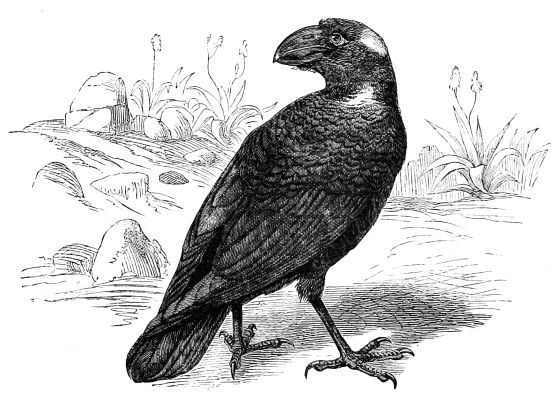
THE WHITE-NECKED VULTURE RAVEN (Corvultur albicollis).
The White-necked Vulture Raven (Corvultur albicollis) and the Thick-billed Vulture Raven (Corvultur crassirostris), the former a native of the Cape of Good Hope, and the latter an inhabitant of Abyssinia, are much alike in their general appearance; both are of a glossy coal black, except upon the nape, which is white. In the Abyssinian species the sides of the neck gleam with a rich purple, and the rest of the coat is lighted up with a blue refulgence; the small feathers upon the wing-covers near the shoulder are a mixture of chestnut and black; and the white marks upon the nape extend upwards till they reach the top of the head; the eye is reddish brown, the feet and beak black, the latter being tipped with white. The length of this species is about three feet two inches, the length of wing one foot five inches, and of the tail nine inches. According to Rüppell, this bird inhabits the Abyssinian highlands, and is often found at an altitude of 5,000 feet above the level of the sea. Le Vaillant tells us that the Vulture Raven is voracious, daring, extremely noisy, and very filthy in its habits, subsists principally upon carrion, and destroys large numbers of sheep and gazelles, tearing out their eyes and tongue and then devouring them. Were it possible, it would readily contend with buffaloes, elephants, cattle, or horses, but is compelled to rest content with following them and relieving such as are tormented with various parasites to which they are liable, the poor creatures often allowing the Vulture Raven to peck their hides till the blood flows rather than endure the perpetual irritation from which they suffer so severely. The nest of the Vulture Raven is built in October, and placed upon the branches of a tree; it is formed of twigs, lined with some soft material. The four eggs of which a brood is composed are green, spotted with brown. This species never migrates, but remains from one year's end to another near the same locality; occasionally it associates with its congeners, but never partakes of the food on which they subsist.
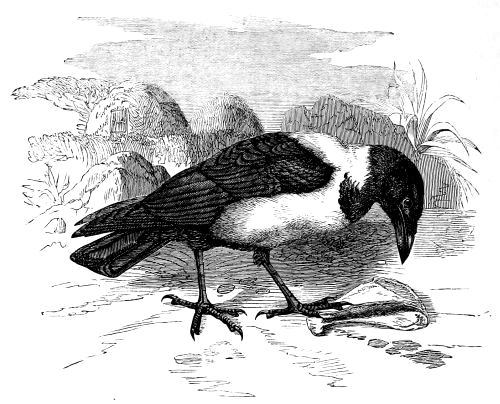
THE SCAPULATED RAVEN (Pterocorax scapulatus).
THE SCAPULATED RAVEN.
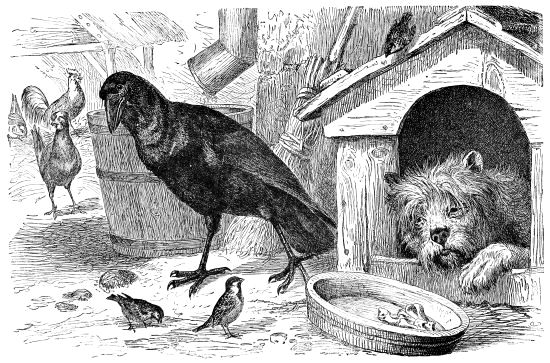
THE RAVEN (Corax nobilis).
The Scapulated Raven (Pterocorax scapulatus) is a small species inhabiting Africa from eighteen degrees north latitude, distinguished by its peculiar plumage and moderate sized beak. The feathers are of a rich glossy black, except upon the upper part of the breast, which is of a dazzling white, as is also a broad patch over the scapular region; these lighter portions gleam like satin, and the deeper tints are brightened by a metallic lustre; the eye is light brown, the beak and feet black. The length of this bird is about eighteen inches, the wing measures thirteen inches, and the tail six inches. Throughout the whole of Soudan and the lower parts of Abyssinia the Scapulated Raven is found living in pairs, which rarely assemble in small parties, and appear to avoid mountain districts. In its general appearance this species is not unlike the Magpie; its flight is light, rapid, and hovering, and as it rises in the air with pointed wings and rounded tail fully displayed, after the manner of a Falcon, its elegance cannot fail to please the eye of the beholder, who may trace its course for a considerable distance as its snowy breast sparkles and gleams in the direct rays of the sun. When upon the ground its gait is very easy and dignified; its voice resembles that of the Raven. Wherever these birds make their abode they are soon on excellent terms with the human inhabitants, and rarely exhibit any fear of man, except when entirely unaccustomed to his appearance; they are regular visitors to some of the villages upon the coast, and will sometimes perch upon the straw huts of the natives. The eyrie of the Scapulated Raven is usually placed upon a tree. The eggs, four or five in number, are laid during the first month of the rainy season; in appearance they resemble those of the rest of the family. The parents are much attached to their young, and will dart like Falcons upon any stranger who may approach the nest. These birds are disliked by the natives, on account of their unclean habits, and their flesh is never employed as food.
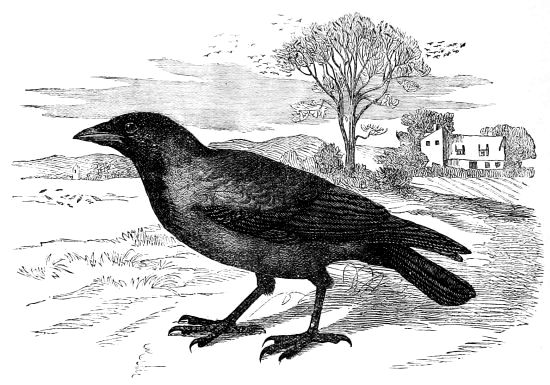
THE CARRION CROW (Corvus corona).
The CROWS (Corvus) are distinguished from the Ravens by the comparative smallness of their beaks, by their rounded tails, and their lax and dull plumage. Two species are common in Europe—
THE CARRION CROW AND THE HOODED CROW.
The Carrion Crow (Corvus corona) and the Hooded Crow (Corvus cornix), are so alike in size and general formation, that if they were denuded of feathers it would be difficult to distinguish between them. They will frequently pair together, and both have been the subject of endless disputes as to whether they are slight varieties of the same species, or quite distinct from each other.
The Carrion Crow is entirely black, with a violet or purple lustre on its feathers, and brown eyes. The young are pale black, and their eyes grey. The plumage of the Hooded Crow, on the contrary, is only black upon the head, front of throat, wings, and tail; the rest of the body is ash colour. The young are of a dirty deep grey. The length of both these birds is from eighteen to nineteen inches, their breadth is from thirty-eight to forty inches, the wing measures from twelve and a half to thirteen inches, and the tail seven to eight inches. These two species usually pass their lives in one limited district, or only leave their native haunts to make short excursions into the surrounding country. Wooded pastures are their favourite resorts, such situations being preferred as are in the immediate neighbourhood of man, whose orchards they are fond of visiting, though forests or even thick woods seem to be avoided by these social and intelligent creatures. Their senses are highly and equally developed; their sight, smell, and hearing are remarkably perfect, and their movements both in the air and upon the ground are light and rapid. Like the Raven, they render immense service to mankind by clearing great numbers of noxious insects from the fields and gardens; and though, like that bird, they attack wounded animals, or such as are smaller than themselves, and frequently rob nests of their contents, their troublesome propensities are far outweighed by the benefits they confer. At the first dawn of day they congregate in large numbers upon some tree or building preparatory to going in search of food, and from thence they wing their flight over the neighbouring fields and gardens in company with many of their congeners, examining every nook or furrow in search of their insect fare, robbing nests of their eggs, or pouncing upon mice as they run from their holes; so courageous are they that nobler birds of prey are often disappointed of their victims by the efforts of these comparatively feeble interlopers, who will pursue and dash round the tyrants of the air in such numbers and with so much energy as to compel them to relinquish their prey and retire from the field. At noon the parties of Crows retire to the pleasant shelter of some thickly-foliaged tree, there to sleep away the mid-day heat, going again in search of food during the afternoon, and re-assembling towards evening on their favourite perch to chatter to each other, and (apparently) discuss the events of the day in a manner with which all are familiar. The night is passed in some retired group of trees, the birds only taking possession of their roosting-place after it has been cautiously examined by several of their party, and entering it with so much wariness that no sound is audible beyond the soft fluttering of their wings. The period of incubation commences about February or March, and during this time the attachment of the male bird to its mare seems redoubled; his whole time appears to be occupied in rendering himself attractive in her eyes. The eyrie, which is built at the summit of a lofty tree, is not more than four inches deep, and is constructed of dry twigs, roots, or couch-grass, the interior being lined with wool, feathers, bristles, hair, or even with bits of rag. The nests are usually about two feet broad, and old nests are often repaired for the reception of the brood. The eggs, three to five, and occasionally six in number, are laid in April, and in colour are blueish green, marked with olive green, dark grey, or black spots and streaks. The female broods alone, but receives the most unremitting attention from her mate, who only quits her when compelled to go in search of food; both assist in the nourishment and care of their young, who are protected and defended from their numerous enemies with the utmost courage and devotion.
As we have already said, it is by no means uncommon for the Carrion Crow and the Hooded Crow to pair with each other; in such cases the plumage of the offspring combines the hues of both parents, and should these hybrid birds mate among themselves, their young, strangely enough, will often appear in the perfect plumage of one or other of the pure breed from which they are descended. Both species will live for a long time in confinement, but though capable of learning to imitate the human voice, they possess so many disagreeable tricks as to render their training a work of much labour and but little enjoyment; their bodies have an odour that makes it impossible to keep them in a dwelling room, and if permitted to run at large about the yard or garden they become so troublesome by their thievish propensities, and love of every bright or glittering object they may see, as to cause them to be regarded with little favour by their owners. Many are the enemies against which these birds have to contend, but none of them is so formidable an antagonist as the Horned Owl, whose attacks are the more fatal from the circumstance that they always occur during the night, and thus render the possibility of eluding them almost hopeless; the Crows, however, take every opportunity of avenging themselves during the day, and fall upon their dreaded foe with the utmost ferocity; indeed, so strong is the hatred with which they regard their arch-enemy that those engaged in Crow shooting often fasten an owl immediately in front of the small huts under which they lie concealed, and fire upon the flocks of Crows as they come down in furious crowds to mob and worry their helpless persecutor.
THE ROOK.
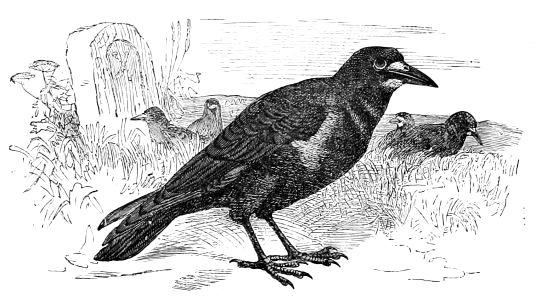
THE ROOK (Corvus frugilegus).
The Rook, or Field Crow (Corvus frugilegus, or Frugilegus segetum), is a most useful species, inhabiting all the plains of the south of Europe and the southern portion of Siberia, even as far as Afghanistan and Cashmere. These birds are distinguished by their slim appearance, the decided elongation of their beaks, their long wings, abruptly rounded tails, close, glossy plumage, and by the bareness of the face observable in the old birds, occasioned, probably, by continually rubbing it upon the ground when in search of food. Their length is from about eighteen to nineteen inches, the breadth thirty-seven to thirty-nine inches, the wing measures thirteen to fourteen inches, and the tail ten and a half inches. The plumage of the adults of both sexes is an uniform purplish black, and that of the young birds pale black; the faces of the latter are covered with feathers. Unlike the members of the family described above, the Rooks migrate regularly, and in enormous swarms, towards Southern Europe and the north of Africa, everywhere preferring well-wooded and fruitful plains, and never settling upon mountains except whilst occupied in journeying from one country to another. Like their congeners, they assemble in flocks, usually choosing a clump of trees as a gathering point, from which they fly over the neighbourhood, and upon these they build their nests. In their habits they are more social than other Crows, freely associating with birds that are weaker than themselves, but exhibiting such fear of the Raven that they will vacate a favourite resort on its first appearance, even although they may be so attached to the locality as to refuse to quit it when men attempt to drive them from the spot. In bodily endowments and intelligence they are inferior to none of their family, but are far more timid and harmless in their disposition. Their voice is deep and hoarse, and though they are capable of imitating sounds, they never attain the power of pronouncing words. In spite of the comparative amiability of disposition exhibited by the Rooks, they render themselves extremely troublesome in a variety of ways, almost deafening their hearers by their incessant cawing, and frequently doing considerable mischief by stealing fruit from the gardens or seed from the fields, and even giving proof of still more voracious propensities by strangling young hares or partridges. For the most part, however, the food of this species consists of cockchafers and their destructive larvæ or slugs; whilst in pursuit of these, their acute sense of smell would seem to guide them to the exact spot under which they lie concealed, and so enormous are the numbers they dig up, that, as we have said, the hungry Rooks actually rub the feathers from their faces by constantly burrowing in the ground with their beaks. In the breeding season, numerous pairs build close together, quarrelling the whole time, and robbing each other incessantly of the materials collected. The female alone broods upon the eggs, which are usually four or five in number, of a pale green, spotted with dark brown. During the time of incubation comparative peace reigns in the colony; but no sooner are the nestlings hatched than the uproar is redoubled tenfold, as the hungry little ones clamour for food in most discordant tones from daybreak till the sun goes down.
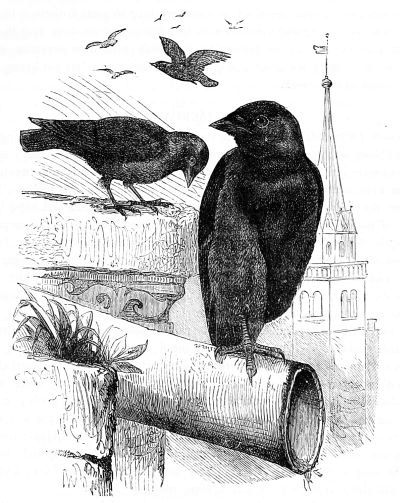
THE JACKDAW (Monedula turrium).
Large numbers of Rooks are destroyed during their migrations, which are made in flocks of incredible magnitude; whilst flying in this manner from place to place they may sometimes be seen to delay their course for half an hour at a time, merely to enjoy the pleasure of hovering or performing a variety of evolutions on the wing, descending somewhat in their flight as they pass over mountains, and soaring high into the air when about to cross lowland districts; sometimes, as though again wishing to alight, they plunge directly earthwards, falling like a lifeless mass from two hundred feet above the ground, and then fly gently onwards for a short distance before again ascending to continue their journey. In the southern part of Europe, and in the north of Africa, the flocks are seldom met with of the enormous size above described, as before reaching so great a distance these large bodies have separated, and gone to spread themselves in less destructive numbers over the countries they select as winter quarters; despite this precaution, thousands perish from starvation, and we ourselves have seen hundreds covering the ground near Suez, the weary travellers not having found the food which they had come so far to seek.
THE JACKDAW.
The Jackdaw (Monedula turrium) is a very small species of Raven, distinguished from its congeners by its short, strong, straight beak, which is but slightly curved. The length of this bird does not exceed twelve inches, or twelve and three-quarters, its breadth is from twenty-four to twenty-five inches, the wing measures eight and a half inches, and the tail five inches. The plumage is deep black upon the forehead and top of the head, the back of the head and nape being dark grey; the upper part of the body is blue black, and the lower portions slate colour or pale black. The young are recognisable by their lighter tints and the grey colour of the eye. The Jackdaw is found throughout most of the countries of Europe and in many parts of Asia, occupying some places in large numbers, and entirely avoiding other districts with a fastidiousness for which we are unable to account: steeples, towers, or old buildings are the situations it prefers for building purposes, but it will also make its nests upon high trees or even shrubs. The disposition of this species is lively and its habits extremely social; indeed, it may be said to possess the gifts of the Crow, with but few of its disagreeable qualities. When upon the wing the flight of the Jackdaw is not unlike that of a Pigeon, and its mode of rising, falling, or performing a variety of evolutions remarkably graceful and easy. Its voice is capable of considerable development, and, like many other members of this family, it has but little difficulty in imitating human speech and other sounds; it chatters almost incessantly during the breeding season, but not offensively, for its tones are soft and very varied. Large quantities of insects, snails, and worms are devoured by these useful birds: they will seek their food in the streets or follow in the wake of the ploughman as he turns up the clods and lays the concealed grubs bare to their hungry beaks; they hunt for mice, young birds, and eggs with great dexterity, and will also feed upon roots, leaves, corn, and fruit.
Late in the autumn the Jackdaws leave us for warmer regions in company with the Rook, though but rarely journeying as far as that bird. The spring is usually far advanced before they return to their native haunts and commence their work of building or repairing their nests, which are extremely rude, being roughly formed of twigs or straw, and lined with hair, feathers, or hay. During these building operations the settlement is a constant scene of quarrelling, one bird stealing from another with the greatest audacity and cunning, and taking possession not only of the materials but of the places selected by their neighbours as snug and desirable localities. The young are fed upon insects and tended with great affection by their parents, who will also defend them from an enemy with much courage. Should an Owl or Buzzard venture to approach the colony, it is received with loud cries and immediately driven off by the infuriated Jackdaws, who often pursue the intruder to the distance of some miles. Cats, Martens, Falcons, and Hawks are numbered amongst the most formidable of the enemies with which they have often to contend; the two first of these marauders plundering their nests, while the latter attack both old and young birds. Of all the members of the family, none are so well fitted for domestication; large numbers are caught annually for this purpose, as their great intelligence and pleasing disposition render them favourites with all lovers of the feathered tribes.
THE GLOSSY CROW.
The Glossy Crow (Anomalocorax splendens) is an inhabitant of the East Indies, and one of the most elegant of the many representatives of the family met with in that part of the world. In this bird the wings are so short as scarcely to reach the end of the long tail, and it has for this reason been classed as forming a distinct subdivision of the group to which it belongs. The length of the Glossy Crow is from fifteen to eighteen inches, seven inches of which are included in the tail; and the wing measures about eleven inches. The plumage upon the front of the head is a brilliant black, the back of the head, nape, and upper part of the throat are lively grey; the back, wings, and tail black, lighted up by a rich violet tint like tempered steel; the chin, breast, and sides of the neck are black, with a metallic lustre; the breast is dark grey, and the middle of the belly a dusky black, lightly marked with steel blue.
Jerdon tells us that the name given to this species has been entirely misapplied, as many of its congeners rival it in the brilliant gloss upon their coats. Every part of India affords a home to this beautiful bird, which is met with in all the towns and villages from Ceylon to the Himalaya Mountains, living upon the most friendly terms with man during the day, and passing the night in company with not merely its own kind, but with large parties of Parrots and Minas, amongst whom, as may be easily imagined, disputes and fights are of constant occurrence, and anything like quiet or harmony impossible. At dawn the whole party are awake, and at once commence their preparations for the business of the day by carefully preening their feathers, chattering with the utmost vivacity among themselves. The flock then divides into small parties of from twenty to forty birds, and fly over the surrounding country often to a distance of ten miles from the place where they slept. It may literally be said of the Glossy Crows that they live upon the crumbs that fall from man's table, for many of the natives take their meals outside their huts, and at such times are generally surrounded by these birds, who seize every morsel as it drops; indeed, so well do they understand what the lighting of a fire indicates, that the first appearance of smoke will attract them, and keep them hovering about the spot until the expected food is ready to be eaten. Others, again, will seek for crabs, fish, frogs, or insects, which they consume in large quantities, or follow Gulls and Sea Swallows in order to share their prey; some will search the fields for grubs, or relieve the cattle from the parasites by which they are tormented; others spend the day in robbing the banana-trees of their fruit, or hunt the winged Termites in company with Bee-eaters, Kites, or even Bats. During the heat of the summer they may be seen sheltering themselves under some thickly-foliaged branch from the power of the sun, and with beak wide open, seem to pant for a breath of cool fresh air. The breeding season extends from April to June; and the nests, which are placed upon trees or the corners of a house, are formed of twigs, lined with a bed of some soft material. The brood consists of four greenish-blue eggs (spotted and marked with brown), this number being frequently increased by the addition of a Cuckoo's egg, that bird seeming to have a decided preference for their nests when in search of a home for her offspring.
The flight of these Crows is light and tolerably rapid. When pursued by an enemy they are very dexterous in eluding its attacks—indeed, their courage, intelligence, and cunning are so highly developed as to render them most interesting. Blyth tells us that they disport themselves about the houses with great confidence, running hither and thither in a constant bustle, as though each moment was of value and could not be wasted in idle loitering, at the same time uttering their cry, which is unbearably noisy. The inhabitants of Ceylon observe these birds with great attention, and have many superstitions based upon the course of their flight, the kind of trees on which they settle, or the numbers in which they appear—indeed, the proceedings of the Glossy Crow would seem to be regarded with the same attention and anxiety as was the flight of ominous birds amongst the Greeks and Romans. The Dutch, during the time that they possessed Ceylon, also showed considerable favour to this species, and decreed heavy punishments for those who killed them, believing them of great service in promoting the growth of cinnamon by devouring the ripe fruit and scattering the undigested seeds over the surrounding country.
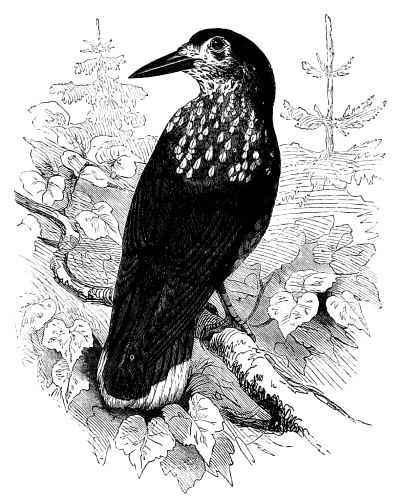
THE NUTCRACKER (Nucifraga caryocatactes).
Endless are the annoyances to which the inhabitants of Ceylon are exposed by the thievish propensities of these daring pilferers, who will watch the windows of the houses, to steal every article that it is in their power to remove, and not unfrequently open packets, or even unknot a cloth, if they fancy that anything eatable is contained within its folds. On one occasion a party of people seated in a garden were much startled by the sudden appearance of a clasp-knife covered with blood, which fell amongst them as if coming from the clouds, and, on instituting inquiries, at last ascertained that the formidable missile had been stolen from the cook, who, in an unlucky moment, had turned his head aside, and thus given one of these expert thieves the opportunity for which it was waiting. A still more amusing anecdote is told by Tennent of a Glossy Crow, who, having long attempted by every conceivable device to divert the attention of a dog from a bone that it wished to secure, and its efforts proving fruitless, retired in search of a friend, who at once perched upon a tree, and endeavoured to attract the attention of the dog, but all in vain; at length, rendered desperate by repeated failures, the new comer darted down with great violence upon the owner of the coveted bone; the dog, to revenge itself, sprang upon the intruder, while the cunning instigator of the commotion crept quietly to the spot, and secured the prize.
THE NUTCRACKER.
The Nutcracker (Nucifraga caryocatactes) belongs to a group of Ravens met with in most various and distant parts of the globe, some of its members inhabiting the whole of the north of Europe and a large portion of Asia, while others are found both in America and on the Himalaya Mountains. The body of this bird is slender, the neck long, the head large and flat, with a long, slender, and rounded beak, the upper mandible being straight, or only very slightly curved. The wings are of moderate size, blunt, and graduated, the fourth quill being longer than the rest; the tail is short, and rounded at its extremity; the feet are strong, and furnished with powerful toes, armed with strong hooked claws. The plumage is thick and soft; its predominating colour is a dark brown, without spots upon the top of the head and nape, although elsewhere each individual feather is tipped with an oval mark of a pure white; the wings and tail-feathers are of a brilliant black, the latter being tipped with white at their extremities; the under tail-covers are likewise white; the legs are brown, and the beak and feet black. It is from thirteen to fourteen inches long, and from twenty-two to twenty-three and a half inches broad; the tail measures about five inches.
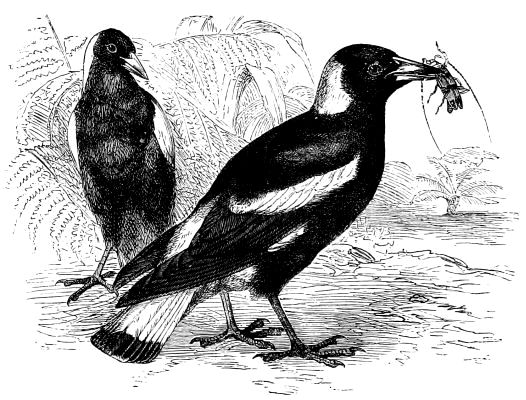
THE FLUTE BIRD (Gymnorhina tibicen).
This species frequents thickly-wooded mountains, and the wide-spread forests of Northern Europe and Asia, showing a decided preference for districts covered with Siberian pines, and may be met with in considerable numbers in certain localities, while in others, in the immediate vicinity, it will be entirely wanting: in Sweden it is exceedingly common, but is seldom seen in Norway. In appearance the Nutcracker is awkward and clumsy, but in reality it is extremely active and adroit, walking upon the ground with ease, and climbing, or suspending itself from the branches with the dexterity of a Titmouse; its flight is light but slow, and is produced by powerful strokes and broad extensions of the wings. The voice is a loud, screeching, resounding cry, and though most of its senses appear to be very equally developed, its intelligence will not bear comparison with that of most other members of the family.
But little is known about the habits of these birds during the breeding season, for their nests are usually built in the inmost recesses of some thicket almost inaccessible to man. March, we are told, is the month in which they lay their eggs, and, if this be the case, they must in many places undertake the cares of a family whilst snow still lies deep upon the ground. The nest, as we learn from Schütt, is neatly formed of dried fir twigs, woven together with the green leaves of the same tree, probably for the purpose of decorating the exterior; it is lined with a layer of moss or young bark, beautifully worked in, which gives a round and finished appearance to the interior. The eggs are pale blueish green, marked here and there with light brown spots. Like other Ravens, the Nutcracker subsists principally upon insects, seeds, and fruit, but displays many of the propensities of birds of prey; it attacks a great variety of animals weaker than itself, and after biting them in the neck, breaks open their head and devours the brains. We have heard of an instance in which one of these birds ate a squirrel that was laid before it. Hard nuts are among the favourite articles of their food, and it is most curious to see them seize one in their claws and dexterously crack it, always keeping the broad end carefully uppermost during the process: in this manner they will rapidly dispose of a large supply.
The PIPING CROWS (Phonygamæ) are short-tailed Ravens, with very long conical beaks; the upper mandible is hooked, and armed with teeth-like appendages near the tip; the wings are pointed, and the tail slightly rounded. These birds are distinguished from the rest of their family by many peculiarities; they live much upon the ground, and, though they do not avoid dry parts of the country, prefer marshy districts near the sea-coast. Upon the ground their movements are remarkably active, and they exhibit considerable agility among the branches of trees, but their powers of flight are very inferior to those possessed by their congeners, and, unlike them, they never mount into the air or perform any remarkable evolutions. They feed upon insects of all kinds, but more especially upon locusts and grasshoppers, and sometimes rob nests of other birds to devour the eggs and young; they will also eat seeds, fruit, or corn in such quantities as to render them extremely troublesome to the settlers. We learn from Gould that the Piping Crows lend a great charm to the places they frequent, as they hop nimbly and gracefully about, uttering their clear flute-like cry, which is constantly heard when they are resting on the trees in small parties of from four to six birds. The nests are formed of twigs, lined with grass or other suitable material, and resemble those built by European Crows. The brood consists of from three to four eggs; the young are fed by both parents, who display great courage in defence of their little family; their growth is rapid, and, after the first moulting, they acquire the same plumage as the adults. As an example of this musical race we may select
THE FLUTE BIRD.
The Flute Bird (Gymnorhina tibicen) is a species of Crow, about sixteen and a half inches in length. Its plumage is principally black, but the nape, lower part of the back, lower tail-covers, and the undermost row of the upper wing-covers are white; the eyes are reddish brown, the beak brownish grey, and the feet black. According to Gould, these birds are very numerous in New South Wales, where they form a most attractive feature in the fields and gardens, enlivening the landscape with their variegated plumage, and delighting the ear with their peculiar tones as they pour forth their song of greeting to the rising sun. They seem to prefer clear open country, planted with groups of trees, as their usual residence, and for this reason they are but seldom seen upon the coast. Their food consists principally of grasshoppers, which they devour in enormous quantities. The period of incubation, in accordance with the inverted seasons of the southern hemisphere, commences in August, and lasts until January, each pair breeding twice in the year: the nest is round and open, formed of twigs, and lined with some softer material. The eggs of the Flute Bird are unknown, but Gould describes those of a very similar species, which he tells us are of a dirty blueish white, often shaded with green, and marked with zig-zag brown streaks of various shades. When in confinement these birds are extremely violent and revengeful; should anything annoy them they will erect their feathers and spread their wings and tail after the fashion of a Game-cock, and are so quarrelsome that they frequently engage in furious combats with much larger birds. Some species are eminently distinguished by the flexibility of their voice, and all are capable of imitating any tunes they may happen to hear.
The BELL MAGPIES (Strepera) differ from the Flute Birds in the formation of their beaks, which are much longer, slenderer, and more delicately arched; the upper mandible is armed with a powerful hook at the tip, and furnished with conspicuous teeth on its margins.
THE BELL BIRD OR BELL MAGPIE.
The Bell Bird (Strepera graculina) is of a beautiful blue black; the roots of the primary wing-quills, from the fourth to the eighth, the tip of the tail, and the lower tail-covers, are white, thus giving their plumage the effect of being piebald, the tail appearing entirely white, with the exception of a regular patch of black across its terminal margin; the eyes are of a beautiful yellow, the beak and legs black. In length this species does not exceed seventeen inches. The Bell Bird, like the Flute Bird, is an inhabitant of New South Wales, where it is distributed widely over the face of the country, occasionally appearing upon the coast, but preferring, at least during the breeding season, well watered valleys, abounding in trees; in such localities it also finds its principal supply of food, which consists of berries, fruits, and seeds. When either upon the ground or amongst the branches, these birds are usually seen in very small parties, and but rarely in pairs or large flocks: they live principally in trees, and, though quite at their ease upon the ground, seldom come down to disport themselves upon its surface. Their flight is quite unlike that of our Crows; when in the air their movements are extremely sweeping and majestic, but cannot be sustained for any length of time. Whilst on the wing they utter a most peculiar resounding cry, from which they derive their name. The nest is large, round, and very open, formed of twigs and lined with moss and grass. With the appearance of the three or four eggs that constitute their brood, we are entirely unacquainted. The settlers of New South Wales hunt the Bell Magpie, as they do the Flute Bird, on account of its flesh, which is regarded as a great delicacy. Very few of this species have as yet reached Europe alive.
THE BALD-HEADED CROW.
The Bald-headed Crow (Picathartes gymnocephalus) is an extremely peculiar and very rare member of this family, inhabiting Sierra Leone, and we believe entirely confined to that country, but we cannot speak with any certainty on this point, as naturalists are still quite unacquainted with its habits. This species would seem to form a connecting link between the Ravens and the Vultures, birds between which there is usually but little similarity. The beak of the Bald-headed Crow is comparatively weak, but slightly curved, and covered at its base with a cere in place of the bristles that are generally so characteristic of the Raven tribe. The wings are powerful and rounded, the tail long and graduated, and the feet high and furnished with strong toes. The head is entirely bare, and the throat, like that of the Vulture, overspread with bristly or down-like feathers. The plumage is of a brownish grey above and white beneath; the wings and tail are reddish brown, the bare or sparingly covered neck red, the beak black, and the feet yellow. According to Gray, this bird is about fifteen inches long, the wing measures rather more than six inches, and the tail six inches and ten lines.