PASSERINE BIRDS (Passeres). (continued 5)
Thomas Rymer Jones translation
In its demeanour this species bears quite as close a resemblance to the Lark as to its more immediate relations. Its movements upon the ground are easy, its flight rapid and extremely light, the bird rising high into the air when about to fly to a distance, but keeping near the ground during its ordinary daily excursions. Naumann tells us that the evolutions of a flock of Snow Buntings are extremely curious, the whole party appearing to revolve around each other whilst on the wing, much after the fashion of waltzers in a ball-room—indeed, under every circumstance of their active lives they never lose their restless and unwearying activity, which even great cold or want of food seems unable to abate or restrain. The fields afford them sustenance during the winter, and over these they hover, scarcely ceasing from their flight even when occupied in obtaining food; but should the supply from this source prove insufficient for the wants of the party, they are, as a last resource, driven into towns and villages, in order to obtain from thence provisions not to be found elsewhere. Their song is not unlike that of the Lark, and their call a shrill piping note, generally uttered whilst on the wing; when singing, on the contrary, they prefer to perch upon a stone or bed of snow, as near as possible to the mate for whose delectation their music is intended.
THE LARKS.
The Larks (Alaudæ) differ widely in their habits from the rest of the Passerine Order, inasmuch as they reside so exclusively upon the ground, that we should feel very much surprised to see a Lark perching in a tree, or disporting itself amongst the branches.
All the various members of this family are stoutly built, with large heads, beaks of short or moderate length, long and very broad wings, short tails, and rather flat feet, furnished with toes of middle size, armed in some species with a spur-like nail: the tail, which is by no means large, is composed of twelve feathers evenly cut off at their extremity. The plumage is of a brownish shade, nearly alike in the two sexes, but varying considerably as the birds increase in age. The internal structure of the body differs in no essential particulars from that of other Passeres. The skeleton is powerful; the bones for the most part filled with air, and without marrow; the singing apparatus is well developed; the lungs are large and the gizzard muscular; there is no crop. These birds inhabit the open country, whether cultivated or not, and are most numerously met with in temperate latitudes, some preferring fields, whilst others are restricted to steppes or desert plains. Most species must be considered as migratory, that is to say, such as are found in the more northern countries seek for sunnier climes when winter approaches, whilst those that inhabit the South may be regarded as stationary; but in no case do these migratory excursions extend to any great distance; and though the Larks are amongst our first visitors, their stay with us is never protracted beyond the autumn. The behaviour of all the members of this group is characterised by many peculiarities that distinguish them from other Passeres. When upon the ground they do not hop, but step with surprising rapidity, and their flight is remarkable for the variety of the evolutions by which it is accomplished. Should the bird be eager to reach its destination it flies in large undulating curves, produced by alternately opening and closing the wings; but if, on the contrary, the little warbler is about to pour forth its glorious song, it darts straight into the sky, like an arrow from a bow, or else rises rapidly, but more leisurely, in a series of spiral circles until it is quite out of sight. When about to descend, it hovers for a short space in one spot, and then by a sudden plunge reaches the ground, with body contracted and wings completely closed. At other times it may be seen skimming close to the earth, or over the surface of a sheet of water, occasionally varying these several kinds of exercise or amusement by chasing its companions in buoyant and sportive flights through the air. As regards their capabilities, the Larks have certainly been highly favoured by Nature, but their intelligence is by no means equal to their other endowments. Most of the members of this family are good singers, some of them very highly gifted in that respect, and capable not only of uttering a great variety of notes, but of imitating many of the sounds they hear. All are of a cheerful and restless disposition, associating but little with other birds, and exhibiting no fear of man or his snares, except after experience of his tyranny. We have already said that Larks are rarely found on trees, but pass their lives principally upon the ground from which they procure the seeds and insects that constitute their principal food. During the summer they consume large quantities of small beetles, butterflies, grasshoppers, spiders, and larvæ; these, with seeds of various kinds, and young shoots from the budding corn, constitute their daily fare; at other seasons different kinds of grain, large and small, are eaten when still in the husk, thus necessitating the swallowing of sand and little pebbles in order to assist the gizzard in the labour of digestion. Water seems to be held in actual aversion by these birds; they cleanse themselves, as do the domestic fowls, by scratching about in the dust or sand; snow is also frequently used during the winter for the same purpose. The Larks build their nests upon the ground, or in small hollows scooped out for the reception of the little structure, which is not remarkable for beauty; the principal object in the choice of materials being to select such as are not easily distinguishable from the ground upon which the nest stands; dry blades of grass and leaves are generally employed for the purpose, and these are woven together with but slight attention to comfort or compactness. The brood consists of from four to six eggs, and as each pair breeds twice in the course of the year, the increase of these birds is extremely rapid; indeed, if this were not the case, their extermination would be speedily accomplished, for their enemies are terribly numerous, those inhabiting southern countries being particularly unfortunate in this respect, as snakes and lizards are there added to the already large number of destroyers, from whose teeth and claws so many of their northern congeners are unable to escape. Man himself, however, is, after all, by far the most redoubtable of their foes; for hundreds of thousands of these little songsters are captured annually in order to add to the list of delicacies supplied to his already over-stocked table.
The CALANDRA LARKS (Melanocorypha) are distinguished by their strong beaks, vaulted both above and below, and slightly compressed at the sides; by their long wings, short tails, and the cheerful coloration of their plumage.
THE CALANDRA LARK.
The Calandra Lark (Melanocorypha Calandra), which we select as the type of this group, is the most celebrated of all the species inhabiting Southern Europe. It exceeds most of its congeners in size, the length of its body being from seven to eight inches, its breadth fifteen to seventeen inches, the wing five and a quarter inches, and the tail two and a half inches. The plumage is of a reddish brown, marked with black along its upper portion; the feathers on the wing-covers are tipped with white, thus producing the effect of two distinct white lines; the shoulder-feathers are bordered with white, and the exterior tail-feathers entirely of that hue. The under parts of the body are whitish yellow, streaked with brown along the upper portion of the breast, and the sides of the neck are marked with an irregular black spot; the eyes are light brown, the beak and feet horn colour. The coat of the young bird is of a reddish yellow upon the back, the individual feathers being edged with a paler shade. The head is marked with round spots, and with one irregular, pale black patch.
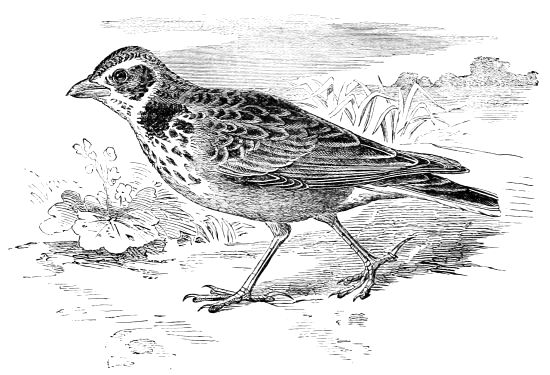
THE CALANDRA LARK (Melanocorypha Calandra).
These birds abound in Southern Europe, and occasionally in the south-eastern parts of our continent; they are also met with in Central Asia, North America, Northern Africa, India, and China, being very numerous in the latter country. In Asia the Calandra Lark almost exclusively inhabits the boundless steppes, whilst in other parts of the world it shows no particular preference as to situation, frequenting agricultural districts or barren tracts with equal impartiality. Though usually of a social disposition, it separates itself from the rest of its companions during the breeding season, and watches over its little partner with most jealous care; as soon, however, as the labours of incubation are accomplished the various couples again congregate, and form large flocks. Its general habits resemble those described as common to the whole family, the principal difference being that the Calandra Lark, unlike its congeners, frees the seed or corn from the husk before swallowing it. The nest is built of dry stalks or fine roots carelessly woven together, and placed either behind a clod of earth or under a small bush, sometimes amongst corn, a small hollow being always prepared for its reception. The brood usually consists of four or five large, round, white or yellowish white eggs, thickly covered with light brown or grey spots.
Much has been said and written in praise of the song of the Calandra Lark, but words are quite inadequate to describe the effect it is capable of producing upon the minds of all who listen as it pours forth an almost unceasing flow of sweet sounds, combining in the most surprising manner, not merely the great variety of tones constituting its own peculiar song, but the notes and music uttered by almost every other kind of bird, the whole being exquisitely adorned and blended by the little vocalist, who thus produces an ever-changeful strain, which must be heard under the wide canopy of heaven before its full beauty can be appreciated. When in a room, the whole performance is too loud to permit the hearer adequately to appreciate the versatile powers of the little songster, who not unfrequently gives utterance to a surprising flow of varied cadences, without any visible exertion of the throat, the sounds appearing, strangely enough, to proceed entirely from the beak. With us these Larks are not much esteemed as household pets, owing, as we have said, to the loudness of their voice; but in Spain great numbers are caught for domestication, the capture being generally achieved at night with the aid of sheep-bells and dark lanterns, the birds thus deluded remaining stationary, under the impression that only a flock of sheep is approaching, and thus their pursuers are enabled to enclose multitudes of them in their nets before the unsuspecting victims can escape.
THE SHORT-TOED LARK.
The Short-toed Lark, or Calandrelle (Calandritis brachydactyla), is a well-known species, inhabiting Spain and Italy, and differs from that above described in the comparative smallness of its beak and very short spurs. The upper portion of the body is of a light clay colour, with a reddish tint upon the head, and a grey shade here and there upon the back; the under parts are pale greyish yellow; the wings are bordered with a darker shade than those of the Calandra Lark, and the spots on the neck are smaller and fainter than in that bird. Its length is about five and a half inches, its breadth from ten to eleven inches; the wing measures three and a half inches, and the tail from two to two and a half inches.
The Calandrelle is found in considerable numbers, inhabiting all the plains of Southern Europe, Central Asia, and Western Africa, where it frequents alike the barren wastes or cultivated districts. The Asiatic steppes and desert tracts of the South must, however, be regarded as its actual habitat, and in such localities the resemblance between the parched herbage or dry ground and the attire of the bird is so deceptive, that the little creature need but lower its head to become completely unrecognisable at the distance of a few paces from the spot upon which it stands. Such of this species as frequent Spain, commence their wanderings in the early spring, keeping together in enormous flocks until the breeding season, when they separate into pairs, each couple choosing a convenient nesting-place, which is not left until the end of summer. The flight and habits of these birds have some few peculiarities, but in most respects they closely resemble the rest of the Lark family. When upon the wing they fly in irregular curves, ascending into the sky, if we may so describe it, by a kind of climbing motion, and descending at once with the direct impetus and closed wings usually seen in the earthward course of their congeners. Their song has been humorously described as "patchwork," and so it actually is, for the performance is never consecutive, each long, shrill note being followed by an entirely distinct and unconnected sound, the effect of which is far from pleasing, especially as their notes are often repeated some twenty times in succession without the slightest variation beyond an occasional change of key. Yet, despite the poverty of its own song, this bird is capable of imitating the voice of its feathered companions with considerable skill, and may be heard pouring forth its disjointed notes almost during the whole day, both when upon the ground, or while mounting upwards to the sky.
The nest of the Calandrelle is carelessly constructed, but very safely concealed from view; the eggs are grey or pale yellow, marked more or less distinctly and very variously with reddish brown. At the commencement of September the annual migrations of these Larks have fully commenced, and flocks of them may be seen winging their way in immense masses towards the wooded steppes of Central Africa, literally forming clouds that obscure the sky, or when they alight covering the entire ground, very frequently for half an hour at a time. Jerdon mentions their appearance in India in very similar terms, and tells us that on one occasion he brought down no fewer than twelve dozen of these birds with two shots from a double-barrelled gun—a statement for the truth of which we can fully vouch after our own experiences in Central Africa. Thousands are also destroyed in Spain, but the increase is so large as to prevent any serious diminution of their numbers.
The BLACK LARKS (Saxilauda) form a group very closely resembling the Calandra Larks, but recognisable by the peculiarity of their plumage and the Finch-like form of their beaks.
THE BLACK LARK.
The Black Lark, or Moor Lark (Saxilauda Tatarica), is about seven and a half to eight inches long, the wings five and a half, and the tail three inches. The coat of the old male bird is coal-black, shaded, after moulting, with white, both upon the back and lower portion of the body; indeed, at that time the plumage may almost be described as chequered, each feather having a white border, which gradually wears away as the season advances. The beak is yellow, tipped with a dark shade, the feet brown, and the eyes light brown. The coat of the female is brown, marked with a deeper tint, the under portion of the body being white: the young resemble the mother. Swarms of these Moor Larks are found inhabiting the steppes of Central Asia, where they frequently linger from year's end to year's end, never leaving except to wander to somewhat higher ground, in search of a spot upon which they can escape the snow that drives them from the lower parts of the country. Eversmann tells us that he saw them in large flocks upon the Asiatic steppes during the winter, but with the particulars of their summer life in Asia we are entirely unacquainted, except that the seeds of various plants and insects constitute their favourite food. As to its general habits, this species closely resembles the Calandra Lark, with which it frequently associates. The brood consists of from four to six pale blue eggs, marked with reddish spots; the nest exhibits but small trace of care in its construction.
We must here again call our readers' attention to the admirable manner in which the colours of the feathered tribes are adapted to the particular situations in which their life is to be passed. Seeing that the Black Larks could only exist where the soil is of a similarly dark character, another race of these birds has been appointed to cheer the barren desert with their presence, coloured so as to harmonise and blend with the light and sandy plains that they frequent; such are—
The SAND LARKS (Ammomanes), easily recognisable by their strong beaks, very powerful, broad, long, and pointed wings, comparatively large and excised tail, and sand-coloured plumage; all the various species closely resemble each other in these particulars.
THE DESERT LARK.
The Desert Lark (Ammomanes deserti) is one of the smallest members of this group, not being more than five and a half inches long, and eight and a half broad. The upper part of the body is of a sandy yellow or grey, marked upon the throat by fine dark lines; the black tail and wing feathers are edged with reddish brown.
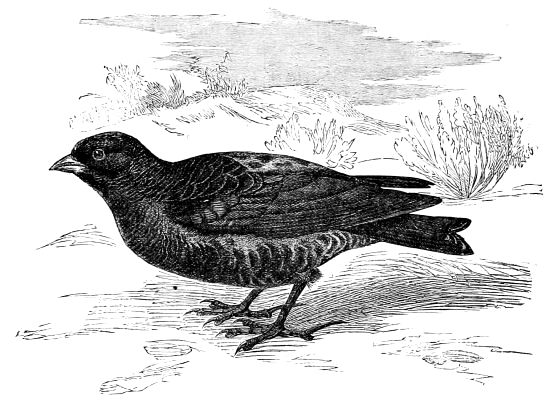
THE MOOR LARK (Saxilauda Tatarica).
We ourselves have met with these birds in all parts of the African Desert, even in the sandy plains called by the Arabs Hammadas, or Red Lot; indeed, such spots as these are selected by preference, the little creatures seeming carefully to avoid the oases, or any districts that bear the impress of cultivation, only leaving the burning wastes to wander unmolested through the ruined temples of the Pharaohs, to which their dismal cry seems to lend an additional shade of gloom. In their movements the Desert Larks exhibit an activity and adroitness that enables them to travel over the loose sand upon which they live with surprising rapidity. Their disposition is quiet, and so extremely engaging, as to cause them to be regarded by the Arabs with peculiar favour; as to their requirements, they must certainly be numbered amongst the most easily satisfied of living creatures; a little sand and a few stones are all they need to form a home, and should the locality selected by a pair of Desert Larks afford them a few blades of coarse grass, their utmost desires are fulfilled. Day after day you may visit the spot, and there they will be found perching upon the same stone, apparently as happy and contented as birds can be. Early in the year they commence the labours attendant upon incubation, concealing their nests with so much care amongst the stones, that all our attempts to discover them have proved fruitless. Nothing can exceed the fearlessness with which man is regarded by the Desert Lark; it will frequently allow the approach of a stranger without the slightest demonstration of alarm, having learned by experience that their attractive manners render them safe at least from the pursuit of the Arab, if not of the naturalist.
The BUNTING LARKS (Pyrrhulauda) may be regarded as the dwarfs of the Lark family. They inhabit a large portion of Africa, including the eastern coast, and are remarkable not merely for the smallness of their size, but for their short thick beak and very large wings.
THE BLACK-HEADED BUNTING LARK.
The Black-headed Bunting Lark (Pyrrhulauda leucotis) is black upon the head and lower portion of the body; the back is reddish brown, the cheeks white, as is a line that passes over the nape; the hips are dirty white, the wing-feathers brown, whilst those of the tail are half white and half brown; the eyes are light brown, and the beak and feet light yellow. Its length is five inches, the breadth nine and a quarter inches; the wing measures nearly three, and the tail about two inches.
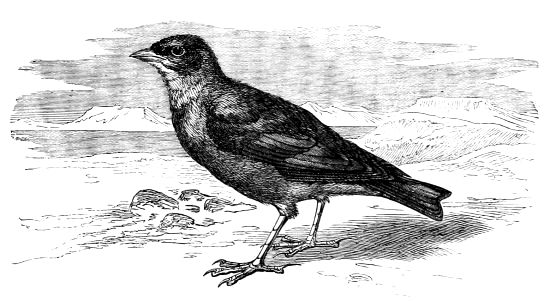
THE DESERT LARK (Ammomanes deserti).
This lively, elegant little bird is found extensively in all the African lowlands, beyond sixteen degrees north latitude, flying about freely in the immediate vicinity of man, and only avoiding such localities as high mountains or dense forests. In its habits it is by no means so brisk and alert as the Desert Lark, and its appearance anything but trim, as it runs or sits with drooping head, and wings hanging loosely from its side; but its flight is easy, and its movements when upon the ground far from clumsy, and very rapid. Its song is extremely simple, consisting generally of a monotonous repetition of the syllables tit-tit, and is uttered both when perched and when upon the wing. Our knowledge respecting the incubation of this species is extremely scanty, and we can only say that the little mates are much attached to each other, keep themselves separate from their kindred during the breeding season, and rejoin them when their parental duties are accomplished, forming parties which occasionally become very numerous. The plumage of the young differs considerably from that of the adult birds.
THE ALPINE LARK.
The Alpine Lark, or Shore Lark (Phileremos alpestris), is one of the liveliest members of its family, both as relates to its plumage and disposition, and may be regarded as forming, with a few other species, a distinct group remarkable for the elongation of the body, and two appendages resembling feathery horns, with which the back of the head is furnished. The beak is straight, weak, and of moderate size; the wings long, with the second, third, and fourth primaries almost of equal length; the feet are strong, the toes of moderate size, and the hinder toe armed with a slightly curved, spur-like claw. The plumage of this bird is variegated in its tints; the length of its body is about seven inches, the breadth thirteen; the wings measure four, and the tail three inches. The Alpine Lark is an inhabitant of Northern Europe, and is easily recognisable by its elegant and striking appearance. Upon the back the feathers are of a reddish grey; the wings and tail black, bordered with dark brown; the breast and belly of a very pale yellowish grey, so light as to be nearly white. The markings upon the head are extremely beautiful: the brow is of a dull yellow, the region of the ear yellowish grey, enlivened by a bright brimstone-coloured line, which passes over the eyes, and gradually spreads till the throat and sides of the neck are of the same colour. The upper part of the breast is decorated with a triangular patch of velvety black, the cheeks, base of the beak, a streak upon the head, and the tufts being of the same rich deep shade. The eye is light brown, the beak and feet of a blueish tint. The coat of the nestlings is of a pale brownish grey upon the back, all the feathers edged with light yellow; the belly is white, and the individual feathers furnished with a pale yellow border; the wing and tail feathers are brown.
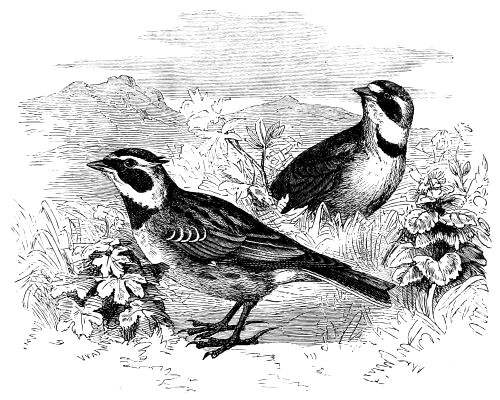
THE ALPINE LARK (Phileremos alpestris).
The name of the Alpine Lark is derived, not from the Swiss Alps, but from the mountains of Siberia, and the rest of Northern Europe, where, at the present day, it is met with in large numbers, though until within the last fifty years it was considered to be one of the rarest birds in our continent. According to our own observations, this species is not found at a greater elevation than 400 or 500 feet above the level of the sea. In Lapland it lives near the coast. These Larks quit the more northern countries at the end of October, and return about April, when they at once commence preparations for their young. The nest is most carefully constructed, and neatly lined with fine blades of grass, cotton wool, and other delicate materials, a slight hollow being prepared in the ground for its reception; in this the little cradle is so well concealed as to be only discoverable by a practised eye. The brood consists of from four to five eggs, of about the same size as those of the common Field Lark; they are usually yellow, and covered with very fine markings of a deeper shade, which take the form of a wreath around the broadest end; varieties are, however, occasionally found exhibiting grey streaks, or brown hair-like lines. In its habits this species closely resembles the Field Lark; indeed, the movements of the two are so exactly similar as to render it almost impossible to distinguish between them, either when on the ground or in the air: the Alpine Lark, however, sings either when perched or sitting upon a stone, and not, like its more southern representative the Field Lark, only when soaring in the air. It subsists chiefly upon seeds and insects, feeding its young principally upon the gnats and larvæ abounding in its favourite resorts.
The LARKS PROPER (Alauda) are distinguished from the birds just described by their more slender beaks, short wings, and simple plumage, but closely resemble them in other particulars.
THE TUFTED LARK.
The Tufted Lark (Galerita cristata) may be regarded as holding an intermediate position, by reason of the comparative strength of its beak, the shape of which, however, points it out as belonging to the Larks Proper; it is, moreover, easily recognisable by its compact body and tolerably strong feet, furnished with an almost straight claw upon the hinder toe, also by its large head and blunt wings, lax plumage, and, above all, by the crest it bears upon the vertex. The plumage is extremely various, and we are as yet unable to decide whether this diversity indicates distinct species, or is to be attributed to other causes; suffice it to say that these alterations in the colouring are usually accompanied by very observable differences both in the song and manners of the birds. We shall not here attempt to enter into a discussion on this point, but shall only observe that in one part of Egypt, where the soil is very dark, a species of Lark is found which, from the depths of its hues, has been called Galerita nigricans, whilst in the desert, not a mile from the same spot, a similar bird is met with almost of a golden colour. We mention this to show that in such a case the climate can in no way be the cause for so great a dissimilarity. In this group, therefore, every variety of tint, from deep yellowish grey to pale whitish yellow, may frequently be seen in birds apparently belonging to the same species. The Tufted Lark, so frequently met with in Germany, is usually reddish grey upon the upper part of its body; the throat is pale yellowish white, the rest of the under portion is brownish yellow, every feather being marked with a black line upon its shaft, except those upon the throat, wings, and a streak which passes over the eyes; the wings and tail-feathers are black or dark brown, bordered with rusty red. In the young birds, all the feathers upon the upper part of the coat are edged with white, and spotted at the tip with a dark shade; the eye is brown, the upper mandible deep grey, the lower one light grey, and the feet red. The length of this species is about six and three quarter inches, its breadth twelve and a half inches, the wing three and three quarter inches, and the tail two and a half inches. The female is not quite so large as her mate. We shall speak of this group collectively, as relates to their habits and mode of life, for what applies to one applies to all. The Tufted Larks are spread extensively over the whole of Europe, Central and Southern Asia, and Africa, being most numerous in the southern parts, where they not only inhabit the villages, but also frequent mountains and barren plains; whilst, as we have already mentioned, those of Africa are as constantly seen in the desert as in the cultivated districts. In Europe they may be considered as constant winter visitors to our barns and houses, hopping about them in company with Sparrows and Finches in the hope of obtaining food. Except during the period of incubation, all are quiet, unobtrusive birds, easily distinguished from our Field Lark by their crest, which is always held erect upon the head, but closely resembling their congeners in their flight and movements upon the ground. Their song is sweet and silvery in its tone, and though somewhat melancholy, is much admired; many esteem the species found in the desert as the most gifted in this respect, but we imagine this merely to proceed from the fact that any pleasing sounds have a double charm when heard amidst the gloom of those dreary and usually silent wastes. Seeds, tender shoots, and insects constitute their principal food, the latter also forming the principal nourishment of the young birds. The nest, which is built in fields, vineyards, or gardens, is placed upon the ground, and so well concealed as to be not easily found, though often situated in localities much frequented by man. The eggs are yellow or reddish white, marked with numerous grey or yellow brown spots; the first brood consists of from four to six eggs, the second seldom of more than three or four. Both sexes assist in the work of incubation, taking their place upon the eggs by turns; the young are hatched in about a fortnight, and are carefully tended by both parents; they remain close to the nest until they can fly with ease, taking refuge within it in case of danger. Compared with many members of the Lark family, the birds belonging to this group may be said to live in safety from the pursuit of man, as their flesh is not much esteemed as an article of food.
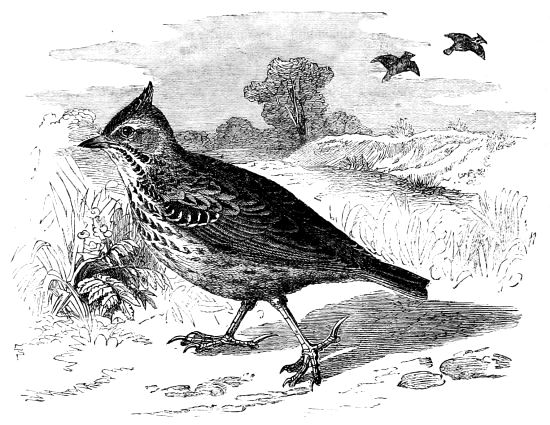
THE TUFTED LARK (Galerita cristata).
THE WOOD LARK.
The Wood Lark (Corys alauda arborea) is distinguished by its inferior size, small wings, large, broad, and rounded tail, and scarcely perceptible tuft upon its head. Its length never exceeds six inches, its breadth is eleven and three-quarter inches, the wing measures three and a half inches, and the tail two inches. The female is smaller than her mate. The plumage is brownish yellow, shaded with rusty red; the belly white, striped with black as far as the breast; the four exterior tail-feathers are white, or of a yellowish shade; a light blue line passes over the head at the base of the upper mandible, running above the eyes, and around the crest. The feathers on the back of the young have a dark border.
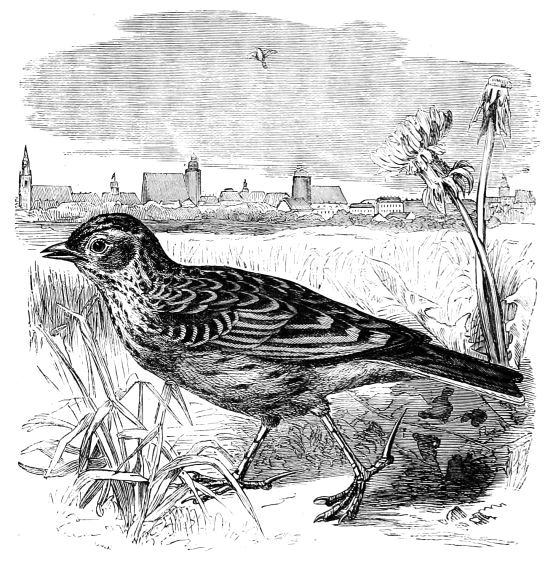
THE SKYLARK (Alauda arvensis).
This beautiful bird is found extensively throughout Southern and Central Europe, and a large portion of Central Asia; its favourite haunts are, however, restricted to such barren plains and bare mountainous tracts as would offer few attractions to other members of the family. In its movements the Wood Lark is extremely vivacious and active; it runs with short steps over the ground, carrying its body and crest so erect as to give it an air of great self-importance and trimness. Should its promenade be disturbed by the appearance of a Hawk or other bird of prey, the little creature instantly lays itself flat upon the ground, if possible in a small hollow, and in this attitude will remain so still and motionless until the danger is past, as frequently to escape even the keen scrutiny of its formidable pursuer. Unlike its congeners, this species passes a considerable portion of its life perched amongst the branches of trees, from which peculiarity it derives its distinguishing name of Wood Lark. The breeding season commences with the spring, and numerous and violent are the battles between the male birds during this period of the year, for as their numbers usually exceed those of the females, it is a matter of no slight difficulty for each to find a mate. This important point, however, once settled, the males regain all their wonted gentleness, and confine their activity entirely to rendering themselves agreeable to the partner they have obtained with so much courage and perseverance. The nest, which is very compact and elaborate in its construction, is usually built in the grass, often under the shelter of a pine or juniper tree, and is composed of dry blades of fine grass. In shape, the little fabric resembles the half of a ball; its interior is warmly and neatly lined with soft materials for the reception of the eggs; these are usually four or five in number, white, and thickly strewn with grey or light brown markings (see Coloured Plate X., fig. 37). The female alone broods, but she is carefully tended during her seclusion by her mate, who also assists in taking care of the young, which are very soon capable of leaving the nest. No sooner is it vacated than another brood replaces the first, and it is only when the work of incubation is fully accomplished that the whole family unites to form a small flock, and fly about the country in search of food. During these expeditions many visits are paid to newly ploughed or stubble fields; and even during their autumnal migration, which commences about the end of October, entire days are often spent in exploring such spots in search of the precarious supply of seeds and insects, upon which they rely for food. These migratory excursions frequently extend as far as Africa, but by February the birds are with us again, and may be sometimes seen flying and singing cheerfully upon our mountains before the snow has fully disappeared from the surface of the ground. The song of the Wood Lark is extremely beautiful, and has inspired many eloquent writers with a theme; indeed, the impression made upon the mind of a traveller passing through the dreary plains inhabited by these birds, may well be of a most enthusiastic description, when, amidst the deep silence that surrounds him, this glorious little songster suddenly rises into the air, and commences pouring out an uninterrupted flow of exquisite music as it soars above him for half an hour at a time. Those who have been fortunate enough to listen to the Wood Lark in the stillness of the night, speak still more warmly of the effect its voice is capable of producing. We would, however, by no means lead our readers to suppose that the song of this bird can bear comparison with that of the Nightingale; nevertheless, whilst the latter is only heard during two months of the year, the former enlivens its native haunts from March to October, and, when caged, sings with such unflagging zeal and spirit as to render it a great favourite with all who have kept it in their aviaries. Large numbers of Wood Larks are captured by the mountaineers during the night by means of nets spread over the ground; few, however, survive captivity for more than two or three years.
THE SKYLARK.
The Skylark, or Field Lark (Alauda arvensis), is distinguished from its congeners by the slender formation of its body, its weak short conical beak, and its somewhat pointed wings, the third quill of which is longer than the rest; its tail, of moderate length, is slightly excised at the extremity, and its delicate feet are furnished with somewhat short toes. The length of this species is about six inches and three-quarters, its breadth twelve inches and a quarter; the wing measures from three to four inches, and the tail from two inches and a half to two and three-quarters. The colour of the plumage is reddish brown upon the back, the under part of the body being white, the head distinctly spotted with brown, and the sides marked with dark streaks; the bridles and sides of the neck are of a lighter colour than the rest of the feathers; the exterior tail quills are white, as is the outer web of the second quill; the eye is reddish brown, the beak blueish grey, and the feet reddish grey.
The Skylark abounds over the whole continent of Europe and its contiguous islands; in Asia it is met with as far north as Kamschatka, and we think that it may now be numbered amongst North American birds, Audubon having introduced many species into that country, in the hope of their becoming naturalised. Though somewhat rarely seen, Field Larks have been known to reach Egypt in the course of their migrations. We ourselves have seen large flocks inhabiting the Castilian highlands, and they are said to be plentiful in Algiers and Greece during the colder parts of the year. In England the Lark is always regarded as the harbinger of spring, as with us it has usually returned and selected its home by the end of April. In its behaviour this species closely resembles its congeners, but, unlike some of them, it is extremely restless, running or flying from one spot to another with a constant change of flight or step, at one moment walking slowly, repeatedly ducking its head as it goes, and the next instant darting along with the rapidity of a plover. When in the air its evolutions are most varied. While singing it usually hovers gently, or rises rapidly with regular strokes of its wings, as it carols forth its well-known lay, which may be frequently heard at intervals from early morning until after sunset, the little songster appearing quite regardless of all other pleasures or desires, as it rises higher and higher towards the clouds, which sometimes seem to hide it from our view. The night is passed upon the ground, but at the first dawn of day, this "herald of the morn," as it has been aptly called, is amongst the first to greet the rising sun, its matin song being uttered whilst still perched upon the spot that has afforded it a shelter for the night. Like the bird we last described, the Skylark lives at peace with its brotherhood until the time for choosing a mate, at which season regular pitched battles are of constant occurrence between the males, who pull and tear each other in the air until the whole party fall struggling to the ground, usually, however, without any serious injury, and quite ready to renew the combat at the first sound of their antagonist's voice; the females, meanwhile, not only seem to enjoy the scene, but sometimes assist the mate they would prefer.
The nest is constructed about the beginning of May, the birds generally selecting a corn-field as most suitable for building purposes. They choose a piece of ground some two or three hundred paces in extent, and on this they settle, the whole party being as near together as the required space will allow, so that they thus form a kind of little colony. Male and female both assist in excavating the small cavity necessary for the safe deposit of the nest, which is built of stubble, blades of grass, or fibrous roots, the interior being occasionally lined with horsehair. In this humble retreat the female lays five or six eggs of a greenish yellow or reddish white tinge, covered with brown or grey spots (see Coloured Plate X., fig. 37). Both parents assist in the work of incubation, but the largest share devolves upon the female. The young leave the nest very shortly after being hatched, and seek shelter in the neighbouring fields, the old birds being immediately busied with the cares of a second family. Of all the numerous enemies by which the Skylarks are surrounded, man himself stands pre-eminent; hundreds of thousands are annually destroyed, merely to furnish a dainty food; and we learn from a continental writer, Elzholz, that they are so much sought after in Germany, that on one special occasion to which he refers 403,455 dead Larks were sold in the town of Leipsic alone, although, he tells us, by far the greater number caught in that part of the country were disposed of in the villages before they could reach the markets in the city. These birds are attracted by any light of unusual brightness, and are sometimes allured to their destruction by a rapidly revolving mirror. Amongst their feathered enemies the hawk known as the "Hobby" is the most formidable—indeed, so extreme is the terror evinced by the little songsters on its appearance, that, if escape by other means is impossible, they will seek refuge in a passing wagon or similar hiding-place; we ourselves knew an instance in which a Skylark, driven to desperation, sought protection from its dreaded foe upon the pommel of a horseman's saddle.
The STILTED LARKS (Certhilaudæ) are a group inhabiting Africa, remarkable for their elongated bodies, small heads, and large beaks, the upper mandible of which terminates in a slight hook; they are likewise distinguished by their comparatively short wings, long, rounded tail, and very high tarsi, furnished with toes and nails of moderate length.
The SPUR LARKS (Macronyx) are distinguished by their straight, short, and powerful beaks, elevated tarsi and feet, furnished with large toes, and by their variegated plumage. The large, somewhat curved nail upon the hinder toe must, however, be regarded as the peculiar characteristic of these birds.
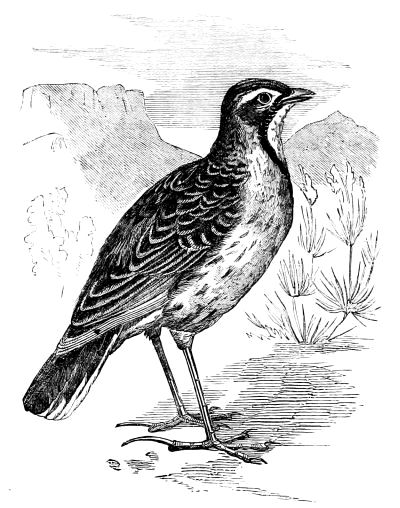
THE SENTRY LARK (Macronyx capensis).
THE SENTRY LARK.
The Sentry Lark (Macronyx capensis) has received its name from the peculiar cry that it utters when disturbed, which sounds exactly like the Qui vive! employed as a challenge by French soldiers on guard. The plumage of this species is more variegated than that of almost any other Lark, the feathers upon the back being deep grey, edged with a lighter tint, and the exterior tail-feathers of a whitish shade half way up the inner web; the lower part of the body is of almost uniform reddish brown; a streak over the eyes is deep orange, as is the throat, the latter being surrounded by a black line; the eye is reddish brown, the beak dark grey, and the feet of a yellowish shade. The plumage of the female is paler, and the spur upon the foot smaller than in the male. The length of this bird is about seven inches, the wing four, and the tail two and three-quarter inches.
We learn from Le Vaillant that the Spur Lark is found abundantly throughout the whole of Southern Africa, where it principally frequents grassy plains, or the immediate vicinity of streams or brooks. The nest, which is formed of fine roots or similar materials, is concealed under a bush, and the brood consists of three or four blueish-white eggs, marked with reddish-brown spots, most thickly strewn over the broad end. The flesh of this species of Lark is much esteemed as an article of food by the settlers in South Africa.
The COURSER LARKS (Alæmon) may be regarded as the connecting link between the Larks and the Cursorial birds. Their bodies are much elongated, the beak remarkably long, weak, and perceptibly curved; the tarsus is double the length of the middle toe and nail; the tail is long, and straight at its extremity, and the wing comparatively short, the second, third, fourth, and fifth quills being longer than the rest.
THE DESERT COURSER LARK.
The Desert Courser Lark (Alæmon desertorum) is one of the members of this group with which we are most familiar, as it is frequently seen in Europe. In this bird the head and neck are of a greyish cream colour, the back and wing-covers being somewhat yellower; the belly is white, and the breast marked with a few blackish-brown primary streaks; the quills are white at their roots, and black at the tip, whilst the secondaries are entirely white, striped near the middle with black, thus producing a double white border to the wing; the centre feathers upon the tail-covers are of the same colour as the back, but black at the shaft, the exterior feathers having the outer web white, and the rest black, with a yellowish edge. The eye is light brown, the beak and feet pale grey. Both sexes are alike in plumage, but the female is not quite so large as her mate. The length of this species is about eight inches, the wing four and a half, and the tail two inches.
According to our own observation, this very remarkable bird is met with extensively between Cairo and Suez, but is by no means numerous in the desert, and quite unknown in the region of the steppes; we occasionally saw it in small parties, but usually living in pairs, which appeared to associate peacefully with each other. As we have said, the Desert Courser Lark much resembles the Cursorial birds in many particulars. It runs with great rapidity, in the same manner as the Isabella Courser (Cursorius Isabellinus), and when in flight hovers or rises into the air with a bold stroke of the wings. When about to alight it poises itself for some moments, and then, closing its wings, comes rapidly to the ground, repeating this form of ascent and descent several times in quick succession, apparently solely for the purpose of affording pleasure to its admiring mate. The song of these birds is loud and twittering. The nest we have never seen, and our information as to the food upon which they subsist is very slight. Insects, we believe, constitute their principal diet, and they probably eat some kinds of seed. They exhibit no fear of man, and may often be seen running almost tame about the streets and court-yards of Suez and Cairo.