PASSERINE BIRDS (Passeres).
Thomas Rymer Jones translation
The Passerine order we understand to include the Finches and their nearest relations, as also the Sparrows, and other families of similar structure. These birds have been usually grouped together under the name of Conirostres, but as the adoption of this term would oblige us to include the Ravens (Coracirostres), we shall avoid it, considering that the many peculiarities of the latter entitle them to be regarded as forming an order by themselves.
The Passeres, according to our definition, are rather small birds, the largest among them not exceeding the size of a Starling. Their shape is compact, the body strong, the neck short, the head thick, and the wings of moderate length, with nine or ten quills upon the primary, and the same number upon the secondary region of the wing. The tail is generally long, and contains twelve feathers; the foot small, and what is termed a perching foot, three of the toes being in front and one behind. The beak is thick and usually conical, occasionally hooked, and still more rarely crossed. The plumage is generally thick, and the feathers comparatively large and soft; their colouring is usually quiet; but this is by no means invariably the case; all are, however, devoid of metallic lustre, or possess it in a very trifling degree. There is a difference observable between the male and female, not always dependent on the plumage, the male being the finer bird; the young resemble the mother. Many species moult twice in the year, so that at certain times their plumage exhibits a more brilliant appearance than at others, owing to the rubbing off of the outer edge of the feathers. The internal structure of the body presents nothing unusual. Although the Passerine Birds are unquestionably far below the parrots in capacity, they are intelligent, acute, susceptible of being taught, and keen of perception.
Their flight is not so rapid as that of the smaller parrots, and consists of a succession of undulating movements, which change into a hovering motion when the birds are excited or about to alight. They can walk upon the ground, but generally hop; and though the latter mode of progression gives an air of awkwardness to some species, it contrasts favourably with the waddling gait of the parrots. Many species are able to hop nimbly among the twigs and branches of trees, but few can climb, and still fewer possess the peculiar clinging powers of the woodpecker and other really climbing birds. They prefer the neighbourhood of water, but none of them are capable of swimming or diving.
The Passerine Birds are citizens of the world; they can endure the climate of icy mountains and northern snows, and are met with in the glowing regions of the tropics. Hills and valleys, woods or fields, the reed-covered swamps or treeless plains, are equally tenanted by various races, as is the crowded city or the barren desert. In all these localities they will build their nests and educate their young. Turn where we will, we see them—indeed, they are as much a part of the landscape as the earth and sky. Notwithstanding the fondness they exhibit for wooded countries, we can by no means venture to call them tree-birds, as many species live exclusively upon the ground, and all frequent it more constantly than even the parrots. Open country near a wood is their favourite resort, and from thence they visit the surrounding gardens and brushwood. They are found but in small numbers either in deep forests, or on barren plains and mountains. Seeds, fruits, birds, and insects form their usual nourishment, and but few appear to be dainty in their selection. The Passeres are, almost without exception, of a social disposition, and solitary birds are seldom seen; they live in pairs during the breeding season, and keep together in parties throughout the remainder of the year, these parties occasionally increasing until they become large flocks. It is usual to find several different species living together in this manner, and associating for many months; the cleverest become the leaders of the rest, and are obeyed, perhaps we should say imitated, by their little followers. Such are the flocks that settle on our fields in autumn, after they have reared their young and moulted their feathers. In the winter they generally establish themselves in our farmyards and streets. Many species leave their homes annually, and go southwards at the commencement of the winter; others only wander or take occasional journeys, whilst some are stationary. Our part of the world yearly receives a large number of guests from colder latitudes, in exchange for the native birds that have left us to winter farther south. During very severe weather, we are often visited by species from the far north, that perhaps have not been amongst us for years, driven from their home by a deficiency of the food that they generally find in their own country. Some amongst them seem to pay so little regard to the change of season that they will breed at any time of the year, and will carry on the work of incubation exposed to the icy cold of a northern winter, or the exhausting heat of the tropics. For the most part, however, they recognise the arrival of spring, and, like the poets, are inspired with their tenderest feelings during the month of May. At that season the large flocks have dispersed, and each pair is intent upon the duties inseparable from incubation to a degree that is seldom equalled by other birds. Their beaks are then as frequently employed in doing battle with jealous rivals, as in pouring out their songs of joy; their days are divided between singing and fighting; they eat with haste, exhibiting the greatest excitement in all they do. Each pair seeks a separate spot for its own nest, driving away all other birds, so that breeding settlements, such as we have elsewhere described, are rarely seen amongst them. The nests of the Passeres are of different forms, and exhibit very various degrees of skill in their construction. Sometimes they may be seen hanging from, or placed upon, waving twigs or thick branches; sometimes they are hidden among the foliage, or in holes of trees or fissures of rocks, and they may often be found concealed under bushes, among reeds, corn, grass, and even upon the ground. Their exterior is carefully formed of twigs, grass, hay, lichens, moss, plant-cotton, and such like materials, and is lined with softer fibres, moss, scraps of wool, hair, and feathers. The brood commonly consists of from three to eight eggs of various shape and colour, usually light blue or green, or yellowish grey, with markings of various kinds. In most cases only the female sits upon the eggs, and during the period of incubation she is fed by her mate, but sometimes the two sexes share this duty and sit in turn, appearing to rival each other in taking care of their little family. The young early attain their full growth, and seldom need the attention of the parents after they have left the nest, as they soon learn to seek their own food and associate together in flocks, flying about over a limited extent of country until the season for moulting arrives. The parents meanwhile rear another brood, sitting sometimes thrice in the year, whilst others breed but once in the twelve months. Many enemies pursue these small and feeble creatures—indeed, some falcons feed entirely upon them; those and their nightly pursuers, the owls, must be considered as their most formidable foes, though monkeys, lemurs, cats, weasels, bears, and shrew-mice, the tree-frequenting rodents, and some kinds of snakes, are dangerous enemies; indeed, man himself cannot always be numbered among their friends. On the whole, the damage done by Passerine birds is not very serious, and some of them are inexpressibly useful by reason of the enormous quantities of insects and seeds of noxious plants which they devour; still, there is no denying that many species become very troublesome, especially when they congregate in large flocks, and descend upon ripe corn or fruit-trees, and we readily acknowledge that it cannot be agreeable to have to entertain hundreds of thousands of these little destroyers for weeks together.
Amongst the very numerous Passerine races, we find some that might be called the Parrot-Finches, for the same reason that we call the little "Love Birds" Sparrow Parrots; indeed, the resemblance they bear to the parrots is very striking, as is seen not only in the contour of their body, but in its structure, as well as in their demeanour and peculiar habits. Such, for example, are—
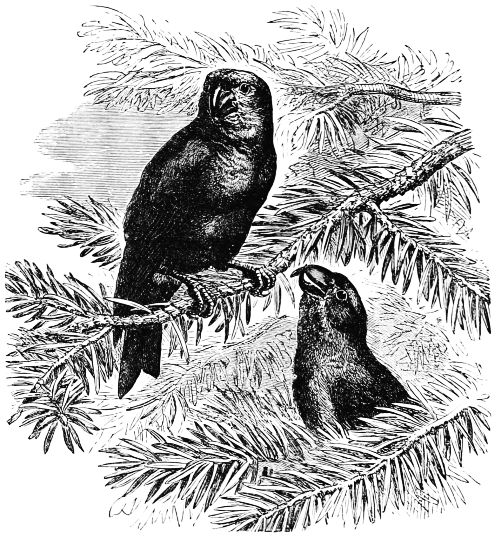
THE LARGE-BEAKED CROSS-BILL (Loxia pityopsittacus).
The CROSS-BILLS (Loxiæ), which, although but few species are known, may be said to form a separate family. They not only differ from other Passeres, but from all other birds, in the formation of their beak. This very remarkable instrument is thick and strongly arched, its ridge or culmen is high and rounded, the mandibles are broad at their origin, but suddenly separate, and terminate in sharp points that are bent across each other, the under-jaw being inclined sometimes to the right side, sometimes to the left, without any general rule being observable in this respect; there are, indeed, as many that have their beaks twisted to the right as in the opposite direction. It is, moreover, specially noticeable that the muscles moving the lower jaw are unequally developed on the two sides of the head, an arrangement which must be considered as a necessary consequence of the sidelong movements of the jaw. The head is large in comparison with that of other finches, the body short, but slender and high; the keel of the breast-bone is long and arched, resembling that of the woodpeckers. The plumage is thick and soft, the wings of middle length, narrow, and pointed; the tail-feathers strong, narrow, and short, those at the side being considerably longer than those in the middle. The tarsi and bones of the leg are bowed inwards, and are short and strong; the toes long, with stout, curved, pointed claws. The eyes are small and prominent; the nostrils round, placed close to the forehead, and almost or entirely covered with hair-like feathers. The internal construction of the body does not differ from that of other birds of this order.
Like most other species belonging to the Passeres, the Cross-bills live in society, seldom leaving the woods, wherein they find fir-trees adapted to their support. They cannot be said to have any fixed residence, but are the gipsies of the feathered race; their home is anywhere and nowhere. It is by no means easy to discriminate between the different species of these birds, seeing that every extensive collection shows us many varieties, strongly resembling each other. We may, however, safely mention four different species belonging to Europe, and in the mountainous districts of Asia and America we also find about that number; all these, however, present not only the same general structure, but a similar colouring of the feathers. The plumage of the old male bird is of a beautiful vermilion or red-currant tint, while that of the young male is of either a reddish yellow, gold, greenish gold, or red chalk colour. The coat of the female is green, shaded into yellow or grey. The plumage of the birds before moulting is a light grey, streaked with a darker shade; the wings and tail-feathers are of a greyish black. The large head and strong beak, bulky feet, and short tail, make them appear very stout and clumsy, nevertheless they are really agile and rapid, flying quickly and lightly, hovering before they perch, climbing nimbly about among the branches, and are only awkward and out of place upon the ground.
THE LARGE-BEAKED CROSS-BILL.
The Large-beaked Cross-bill (Loxia pityopsittacus), the largest of all the Cross-bills with which we are acquainted, is from seven to seven and a half inches in length, and eleven and a half to twelve inches across the wings. The beak strongly resembles that of a parrot, and is very thick and high, bent into a crescent, each mandible terminating in a short hook. The prevailing colour in the plumage of the old male is either a dark or light vermilion; the wing and tail covers greyish black, edged with greyish red; the belly greyish white. The young male is recognised by its light-reddish tints, which upon the back are mingled with greenish yellow, and upon the rump with yellow. The female is dark grey on the upper part of the body, and the feathers have a more or less clearly defined edge of green or yellowish green. The under part of the body is light grey, the feathers being edged with greenish yellow; the wing and tail feathers are greyish black, dotted with greenish grey.
THE PINE-TREE CROSS-BILL.
The Pine-tree Cross-bill (Loxia curvirostra), or Fir-Parrot, is a somewhat weaker and more slender bird than the preceding. Its length is from six to six and a half inches; its width across the wings ten and a half to eleven and a half inches. This species is distinguished from the foregoing by its longer and more delicate beak; the plumage of both birds being similarly coloured.
THE BANDED CROSS-BILL.
Next to these we must mention the Banded Cross-bill (Loxia tænioptera), a much rarer species, smaller than the Pine-tree Cross-bill, and having a still more delicate beak. It is distinguished by two white lines upon the wings. We think it very probable that many other Cross-bills usually mentioned as varieties ought really to be considered as constituting distinct species.
The American and some of the Indian Cross-bills differ considerably from such as are found with us. Those in America are remarkable for the smallness of their size, and may be considered as the dwarfs of the family. The Cross-bills always inhabit pine-forests, as their food consists entirely of the seeds of the pine, fir, and larch; they are consequently more numerous in the north than in the south, seeing that in northern latitudes these trees are met with over a far wider extent of country than elsewhere. They are seen almost annually in Germany, but only when the seeds of the above-mentioned trees are ripe. When the cones are abundant they visit in great numbers many places where they have not been for years, appearing at irregular intervals, and not confining themselves to any particular localities. Should the situation be suitable, they will proceed at once to breed, otherwise they merely tarry for a short time, and then pass on to a more desirable resting-place. The most favourable spots in the woods are soon taken possession of to serve as their head-quarters, from whence they fly over the surrounding country, returning to settle upon the same trees in the evening. They are very social, living in pairs in the breeding season, but even during that period will sometimes associate in considerable numbers. Their nests are made among the branches of fir-trees, and there they disport themselves gaily, climbing nimbly, and assisting their movements, as parrots do, with their beaks. They will hang for minutes together head downwards, clinging to a twig or cone, seeming to enjoy this apparently uncomfortable position. Their movements, when on the wing, are undulating and rapid, but they never fly to any great distance. The pleasure they experience in the society of their mate is often testified by fluttering over the tops of the trees as they sing, after which they hover for a time, and then sink slowly to their perch. In the daytime they are generally in motion, with the exception of a short time at noon. During the spring, summer, and autumn, they pass their time in flying from one plantation or mountain to another. In winter, if the cold is extreme, they remain much longer in their sleeping-place, only coming abroad after the sun has warmed the earth, though they commence their song early in the morning. At this season they make their first appearance about ten o'clock, and are soon busily employed in search of food; about two o'clock they become quieter, seek food again at four o'clock, and then go to roost. The Cross-bill troubles itself but little about the other inhabitants of the woods, and is almost fearless of man, whom it is very evident it has not learnt to regard as an enemy. Should a female be shot, its mate will remain sorrowfully perched upon the branch from which his little companion has fallen; or again and again visit the spot where she was killed in the hope of finding her; indeed, it is only after repeated proofs of the treachery of mankind that he begins to testify any symptom of shyness. When placed in a cage, the Cross-bills become exceedingly tame, appearing entirely to forget the loss of their freedom, and grow so fond of those they are with as to obey them in everything, allowing themselves to be touched, or even carried about the room on the hand, and demonstrating their confidence in a variety of ways, so that the inhabitants of mountainous districts are usually much attached to these gentle little creatures.
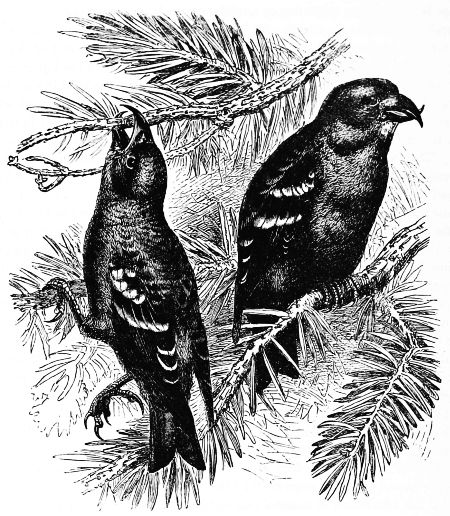
THE BANDED CROSS-BILL (Loxia tænioptera).
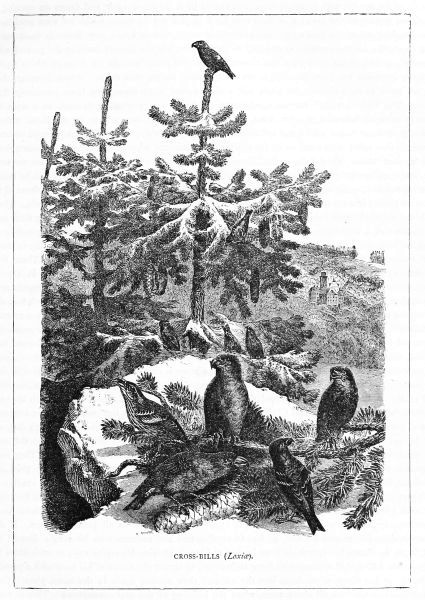
CROSS-BILLS (Loxiæ).
The call-note of the Pine-tree Cross-bill, common to both sexes, is "Gop, gop," "Gip, gip," "Yock, yock." This is uttered either whilst flying or when at rest; and so gentle is its sound, that the listener must be quite close to the tree in order to hear it; indeed, he might imagine the bird to be at a considerable distance, till, on glancing upwards, he beholds it perched just above his head. The cry of the Fir Cross-bill is shriller and weaker than that of the Large-beak. Those who have heard both species can scarcely mistake them. No sooner does one of them utter the sound of "Gip, gip," than all the rest become attentive, and generally fly away together, if the first bird sets the example; and if, whilst they are eating, other birds pass by, their cry of "Gip, gip," is intended as an invitation to join the party and partake of the meal. Should one be at a distance from the rest, the almost incessant cry of "Gop" will bring it back; it is also the signal for the whole flock to settle. This last note is never uttered during flight. Whilst brooding, the Cross-bill employs a gentle sound, not unlike the piping of a little chicken whilst under the wing of the hen, and the young have a similar cry, mingled with the call-note of the parent bird. The song of the male is very pleasing, particularly that of the Pine Cross-bill; it consists of a cadence formed of a variety of weak twittering low notes. These birds are to be heard at their best when the weather is fine and warm, and are quite silent if the day is windy or stormy; whilst singing, they perch on the summit of the trees. The female has the same song as her mate, but it is somewhat gentler and more confused. In captivity they sing throughout the year, except during the moulting season. The food of the Cross-bill consists almost exclusively of the seeds of the forest trees, in obtaining which its strong crossed beak is of the greatest service, as it requires considerable strength and much skill to break open the cones of the fir and pine, in order to obtain the hidden seed. The bird perches upon a cone with its head downwards, or lays it upon a branch, and stands upon it, holding it fast with its sharp, strong, pointed claws. Sometimes it will bite off the cone and carry it to a neighbouring bough, or fly with great difficulty some ten or twenty paces to another tree where it can be opened, for a suitable spot is not to be found on every branch. If the cone is large, the little creature tears its way through the middle of the outside with its upper mandible, inserts its half-opened beak, and forces an opening by a sideway motion of the jaws; it is then easy for it to pick out the seeds, which are soon swallowed. The breaking up of the husks produces a cracking sound, that is heard very distinctly from below. The cones are seldom completely emptied of their seeds, but are thrown down to the ground when scarcely touched, or not more than half cleared, so that the grass beneath the trees on which a party of these creatures has been perched is often completely strewn with them. When, however, there are no more to be gathered, the birds will seek and feed upon those they have previously flung away. The Pine Cross-bill seldom touches the far harder cones of other fir-trees, as it does not possess strength sufficient to open them, though the Large-beaked species breaks them without difficulty, and can at one stroke tear off all the husks into the midst of which it has plunged its beak. A cone is thus rifled of its contents in the space of two minutes, when it is immediately thrown down and another taken. Should the Cross-bill not be disturbed, it will remain for hours upon the same tree, and continue for weeks together in one part of the country. As long as fir-cones can be found, it seems not to care for other food; but if driven by hunger it will eat oily seeds such as those of the hemp or thistle, or even insects, seeking for them in the neighbouring gardens and orchards. These birds are cleanly in their habits, preening themselves carefully after every meal, and rubbing their beak for minutes at a time upon the branches, in order to cleanse it. Still, it is not always possible for them to keep their plumage trim, and their feathers are frequently covered with a coating of resin. The feeding of the Cross-bills on the fir-cones has another very remarkable result. Their flesh becomes so penetrated with resin that it will resist putrefaction for a lengthened period. It acquires by exposure a peculiar smell, but cannot be said to decay. We have made many experiments upon this subject, and always with the same result; there is a specimen now lying before us, which was shot during the extreme heat of last summer, and still retains its feathers. We have even seen a mummy of this bird which was twenty years old. That the resin imbibed is the only cause of this peculiarity is proved by the fact that specimens which have lived upon other diet for some time before their deaths, share the ordinary fate of dead birds. The Cross-bills are at all times a great ornament to our woods; but it is only in the winter, when the snow is on the ground, that we appreciate their full beauty. At such times their brilliant red forms may be seen perched on the dark green branches, and as the white, snow-covered ground throws them into strong relief, the fir upon which they rest presents the appearance of a vast Christmas tree. Their appearance is rendered still more attractive by the circumstance that they usually assemble to breed during the winter season; though they will also lay eggs during other months of the year—as readily in the height of summer as when the snow lies thick upon the branches, and all other living inhabitants of the woods are silent. They seem to trouble themselves but little about the change of seasons. At the breeding time the pairs into which the flock separates, choose the finest trees in the woods, whereon they make the cradles for their young, as near together as possible. The male then perches himself upon the highest branch of the most lofty tree, singing energetically, calling to his mate incessantly, and turning himself in all directions, seeming to wish to exhibit himself and his beauty to her in all points of view. If she, however, does not answer his call, he flies to another tree and recommences his song. Should she still linger, he chases her sportively from branch to branch, uttering his piping cry; at such times the Large-beaked Cross-bill accompanies these endeavours to attract the notice of his mate with a peculiar fluttering of his wings, often rising into the air and then settling again in the same place; these demonstrations continue till about noon, when the building of the nest commences. This is made upon some widely-projecting or forked branch, and is always situated so as to be well covered by the twigs that hang over it, partly to guard the little family from any snow that might fall, and partly for the sake of concealment. The nest is most artistically constructed. It is formed externally of pine twigs, and lined with feathers, soft grass, and the needle-like leaves of the fir-tree. The walls are about an inch thick, and strongly woven together, the interior being tolerably deep. All the nests that we see in this country are thus constructed, and therefore it is rather surprising to hear from Eckström, one of the first Swedish naturalists, that in Sweden "the Large-beaked Cross-bill builds a round nest, formed of twigs, interwoven with other materials, and of such a large size that it is at least an ell in diameter; the entrance being perfectly round, and so small that the bird can only pass in and out with difficulty; while the interior is large enough to hold a man's fist. The winter nests," as he tells us, "are built in this manner; those for summer use are smaller, and have thinner walls." We mention this statement, though we are by no means sure that it applies to the species with which we are familiar. We had once an opportunity of observing a female Cross-bill whilst building. She commenced by breaking off dry twigs, and carrying them to the spot she had chosen for the nest, and then flew in search of such scraps as she could find, carrying away a whole beakful at a time, and laying them in their proper place. As soon as the rounding of the exterior nest was accomplished, the bird got inside and spent some time in pushing it with her breast and pulling until it was somewhat in order. She took all the materials from a neighbouring tree, and was so industrious that she continued her work during the afternoon, only requiring from two to three minutes to prepare and carry each load. The brood consists of from three to four rather small eggs, of a greyish or blueish white colour, streaked with faint blood red, reddish brown, or blackish brown spots; sometimes these spots take the form of a wreath round the broad end of the egg, and sometimes cover the whole of its surface.
The careful mother nurses her young with the greatest attention, whilst the male fulfils his task of tending her and supplying all her wants. The nestlings are fed from the first day of their life on the seeds of the fir or pine, softened in the crop of the old birds and half digested, but after a short time they are able to take them without this preparation. They rapidly attain their full size, and are active and lively, but require parental attention for the lengthened period during which their mandibles are not crossed, as until they are so the young are incapable of opening cones for themselves. After leaving the nest, they seek shelter in the thickest trees, in the vicinity of their parents, and while the latter are procuring fir-cones, as above described, will cry uninterruptedly, like naughty children, following the old birds hastily should they leave the tree, or calling long and dismally until their return. After a time they are taught to work, their parents commencing by giving them half opened cones to practise upon, and afterwards such as have only been bitten from the trees. When the young are quite independent in this respect, they form fresh flocks, or associate themselves with that of their parents.
It is easy to ensnare the Cross-bill if it is enticed to the ground by the help of a tame bird. In some parts of Germany high poles are prepared, covered with pine branches, in which limed twigs are concealed; these are then placed in the upper parts of the woods, and a decoy-bird fastened beneath them, which contrives to attract the attention of all that fly over it, so that many perch upon the bushes and limed twigs; in this manner numbers may be caught in the course of a morning.
We must leave it undecided whether a most remarkable species found in the Sandwich Islands be reckoned among the Cross-bills or not. Many naturalists have no hesitation in so placing it, though Reichenbach believes it to be more nearly allied to the Honey-eaters, with whom our readers will shortly be made acquainted, than to the Finches. This bird, which we shall call the Parrot-Greenfinch (Psittirostra psittacca), appears to be even more of a connecting link between the Parrots and the Finches than the Cross-bill or the Parrot-Bullfinch, as its two names clearly express. In size it resembles our bullfinch, its length being about six and three-quarter inches, and the length of the wings three and a half inches. The plumage is of a beautiful parrot-green, intermixed with grey upon the breast. The head and breast are of gamboge yellow, the wings and tail-feathers edged with green, and the back and legs of a black colour. We are entirely ignorant of such particulars of its life and habits as might give us any assistance in decisively assigning this bird to its proper place; it still may be numbered amongst our greatest rarities, as but very few collections can boast of a specimen.
THE BULLFINCHES (Pyrrhulæ).
The Bullfinches are known by their short thick beak, arched in all directions, while the upper mandible terminates in a small hook. Their other characteristics are their short moderately strong legs and somewhat soft plumage, the nature and colour of which vary considerably in the different members of the family. These birds are found throughout the whole world, with the exception of Australia; but they principally frequent the temperate and frigid zones. They inhabit woods and bushes, as well as mountains and deserts, and pass as much of their time upon trees as upon the ground. Their food consists principally of corn, seeds of various kinds, and green leaves and buds. Being eminently social, they mingle freely with their congeners, and very soon become attached to man. In their movements they are somewhat clumsy, and much behind the Cross-bills in agility and beauty. Their song is very simple and pleasing, and to this some add the gift of being able to learn and imitate with great accuracy the notes of other birds. The nest is always carefully hidden in trees or the clefts of rocks. The number of eggs is from four to six.
THE PARROT-BULLFINCH.
The Parrot-Bullfinch (Paradoxornis flavirostris) should, as its name testifies, be assigned the first place in this family. This is a very rare bird, and of striking appearance, inhabiting Southern Asia; it has not the beak of the true Bullfinch, the upper mandible not rising noticeably above the lower one, but curving outwards towards the sides, as in some species of parrots. The wings are somewhat feeble and decidedly rounded, the sixth quill being longer than the rest; the tail is long, graduated, and strong; the legs and feet very powerful, the toes of middle length, and the claws much bent. Its soft and flowing plumage is of a greyish brown, somewhat lighter on the under parts of the body, reddish brown on the back of the head and neck; the mantle olive-coloured, with a band of deep black round the throat and over the ear-covers; the face, skull, cheeks, and throat are white, spotted or striped with a darker colour, and there are tawny tints upon the belly, becoming redder upon the sides. The beak is of a brilliant yellow; the feet leaden coloured, the eye reddish brown. In size this bird resembles our common bullfinch, its length being about eight inches, three of which belong to the tail. The wing measures three inches from the shoulder to the tip.
All the varieties of Parrot-Bullfinch with which we are acquainted are inhabitants of the Himalayas. Jerdon tells us that the species we have just mentioned was seen by him in the Khana Mountains, at a height of about 5,000 feet above the level of the sea; and it has been observed by other travellers in Nepaul and Assam. "I found," he continues, "that they feed upon a variety of seeds, and saw a female with two or three young ones that strongly resembled her in colour; they were somewhat shy, but did not hide themselves, merely flying from tree to tree." Another species was found by the above-mentioned naturalist in the bamboo woods of the hilly districts of Nepaul, Sikkim, and Butan, where they feed upon all kinds of seeds. They flew about in small parties, and appeared to be somewhat timid, allowing themselves to be watched, but seeking shelter when pursued. We learn from Tickell that they readily devour corn, maize, and rice. "After eating," says this writer, "they perch upon the branches of the trees and bushes, and have no appearance of living a retired life, as is the case with the Timalias. In some respects they resemble other bullfinches."
We are happily much better acquainted with the second tribe of the same family, the European species of which is named
THE PINE GROSBEAK.
The Pine Grosbeak (Pinicola enucleator) deserves our notice, as being the largest of the Bullfinches. Its beak is vaulted on all sides, and the upper mandible somewhat hooked, in this respect differing from other finches; the margin is slightly curved, and the extreme tip of the under mandible rather blunted. The legs are short and strong, the toes powerful, the claws large, and the wings, when closed, seldom reach beyond the first third of the tail; the latter is graduated to the centre. The Pine Grosbeak resembles the Singing Thrush in size, its length being from eight to nine inches, from three to three and a half of which belong to the tail; the breadth across the wings varies from thirteen to fourteen inches, and the wing measures four and a half inches from the shoulder to the tip. The plumage is rich, and somewhat straggling. In the old male birds, a pretty red shade predominates, whilst those of a year old are somewhat yellower; the throat is of a paler colour, and the wings marked with two crooked lines. The individual feathers are ash-grey, blackish along the shaft, tipped at the end with a red or reddish yellow, and dotted here and there in the middle with a darker shade; the edges, on the contrary, are somewhat lighter, thus producing a cloudy kind of marking. The wing and tail feathers are black, bordered with a light shade, these borders being much more distinct upon the shoulder-feathers. The beak is of a dirty brown, blackish at the tip, the legs greyish brown, and the eyes dark brown. This bird inhabits the northern countries of Europe and Asia, and in America there is a very similar species. As far as we can ascertain, the Pine Grosbeaks live during the summer alone, or in pairs, and only assemble during the winter in flocks, that may be seen flying over the northern woods or frequenting the solitary farms, returning at the commencement of spring to their retreats in the forests. Should a heavy fall of snow occur and compel them to migrate to more southern parts, the flocks will join each other, and that often in very considerable multitudes.
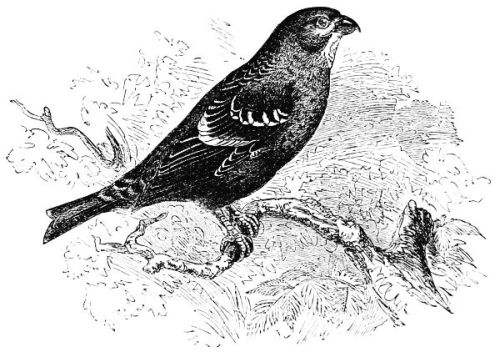
THE PINE GROSBEAK (Pinicola enucleator).
In the years 1790-93-98, and 1803, such enormous swarms of these birds appeared in the islands of the Baltic, that in the country about Riga some thousands of pairs were caught weekly for a considerable time. They were also very numerous in Russia during the winter of 1821, and have been more recently seen in great numbers in various parts of Germany. We have to thank these involuntary wanderers for nearly all the information we possess concerning their habits, for we are but little acquainted with their mode of life in their native wilds. Whilst with us, they fly about in flocks during the day, eat in company, and settle in the evening all together upon the same sleeping-place, their favourite haunts being the pine forests, and they seem to prefer those in which the underwood is composed of young juniper-trees. They do not frequent thick foliage, but fly over barren plains as rapidly as possible.
When these birds first come amongst us they are harmless, confiding creatures, who have not yet experienced the artifices of man, never offering to stir if a stranger or hunter approach the trees on which they are perched, and will stare at the gun destined for their destruction without thinking of flight, even should one of their companions be shot down from the same branch. Persons have tried successfully to catch them by means of snares fastened to the end of poles, by the aid of which they could be thrown over the heads of the birds; indeed, the clumsiest kind of trap is all that is required to catch these unsuspicious little wanderers. The most touching tales are told of the attachment of the Pine Grosbeak to its mate. On one occasion, three out of a party of four had been captured, when, to the astonishment of all, the fourth crept into the net in order to share the fate of its companions. It must not be imagined, however, that these birds are really foolish, for experience soon teaches them its lessons, and they become distrustful, shy, and cautious. In its habits the Pine Grosbeak often reminds us of the Cross-bill; it is essentially a tree-bird, being quite at home upon a branch, but uneasy and out of place upon the ground. It can climb skilfully from one bough to another, hopping with ease to tolerably distant branches. Its flight is rapid, and, like that of most finches, rather undulating, and it hovers before perching. Its voice is flute-like and expressive, resembling that of the bullfinch, and its song, which may be heard throughout the whole of the winter, is very varied and pleasing on account of its soft clear notes. In winter we do not hear it in perfection, as it is then low and disjointed; but in spring, when the male rouses all his energies to cheer his little mate, his tones would satisfy the most fastidious critic; it sings during the clear light summer nights of its native land, and is there called on that account "the Watchman." This bird has many other good qualities, and, owing to its gentle, confiding temperament, may be easily tamed if properly treated. It becomes, in a few days, accustomed to confinement, taking its food readily from the hand, and will allow itself to be stroked, or even carried about the room, all the time testifying its happiness and content. It is an interesting sight to see a male and female bird in one cage, for their tenderness towards each other is extreme; but, alas! in one point they are deficient—they do not survive the loss of their freedom for any considerable length of time, and pine away rapidly, especially when their keepers forget that these children of the north must have fresh cold air, and foolishly confine them in hot rooms. The birds that come to us prove themselves almost entirely insensible to cold, and are lively and cheerful in the most severe winter weather. If shut up in a warm, close chamber, they will climb uneasily around their cage, open their beaks and pant, thereby showing how unbearable and injurious they find the heat of such an unwonted climate. Under favourable circumstances they will live for a year in confinement; but their plumage does not retain its beauty after the first six months, turning yellow and losing its brilliancy. It is best to keep them, even during the winter, in an unwarmed room, or still better in a cage hung outside the house. In its native state the Pine Grosbeak feeds upon the seeds of the fir-trees, which it picks out of the open cones or gleans from the ground. It will also eat many kinds of seeds or berries, and looks upon green weeds and the buds of trees as dainties. Tame birds are fed with linseed, rapeseed, and juniper or mountain-ash berries; they require a considerable quantity of food, as they are large eaters. It would seem that in summer they live extensively upon insects, especially flies, and with these they probably feed their young.
We have but scanty knowledge of their manner of breeding. In one instance that came under our notice, the nest was made in a privet-bush about four feet high. It was very lightly built, and scarcely thicker than that of a hedge-sparrow, the outer wall being formed of dry stalks of plants, and the interior lined with horsehair. The brood consisted of four eggs of a beautiful bright blue, tinted at the broad end with reddish brown, and having a few chestnut-brown spots. In colour and marking they much resemble those of the Cherry Hawfinch. Only the female sits upon the eggs, but during her seclusion she is cheered by the song of her mate.
THE CARMINE GROSBEAK.
The Carmine Grosbeaks (Erythrothorax) differ from the preceding principally by reason of the smaller size, and consequently inferior strength of the beak, which is short, thick, somewhat bowed, vaulted, and elevated slightly at the ridge, with a scarcely perceptible hook at the tip. The feet are of moderate length and strong, the tail is tolerably strong and excised, the wings somewhat long in proportion to the body, the third and fourth quills being the longest. The magnificent crimson which forms the principal feature in the plumage of the adult male, distinguishes it from the female and from the young birds, whose colour is a greyish brown, or brownish grey; the males may be numbered among the most beautiful birds of the Passerine order.
THE ROSE BULLFINCH.
The Rose Bullfinch, or Rose Finch (Erythrothorax roseus) is seven inches long and ten and a half broad. Its forehead is of a dazzling whiteness, and the rest of a brilliant carmine red; the wings are of the same colour, with two lighter stripes running over them; the under part of the body is also of a bright red. In the young male bird the plumage is of a reddish brownish grey, with dark streaks, and upon the wings there are two clear reddish yellow stripes. The female resembles that of the linnet. Rose Bullfinches were often seen by Radde upon the Bareja Mountains. During the month of September they lived in small parties of from six to twelve birds, but in winter they only flew about in pairs, and towards the spring disappeared entirely. Plantations of oaks or black birch-trees are generally preferred by these birds to any other localities, though they are fond of frequenting well-wooded valleys. About noon they separate and repose lazily and carelessly upon the branches; but during the forenoon, whilst seeking food, they are always active and on their guard against danger.
THE CARMINE BULLFINCH.
The Carmine Bullfinch, or Riband Finch (Erythrothorax erythrinus) is six inches long and ten inches across the wings. The wing and tail feathers are deep brown, the upper part of the neck bright carmine, and the breast white, marked with carmine red. The male of a year old and the female resemble the female linnet. The Carmine Bullfinches inhabit woods and districts covered with reeds in the north of Europe and Asia, and are found in great numbers in Sweden, Finland, and Russia. According to Jerdon, this species is also met with as a winter guest throughout India, being seen very frequently in the north, but more rarely in the southern parts of that country, principally inhabiting mountainous districts. "I have," he says, "generally found this bird in the bamboo plantations; indeed, it is called in the Telegu dialect the Bamboo Sparrow; it also frequents gardens and thickets, and lives almost exclusively upon the seeds of the bamboo and of various other plants." The Carmine Bullfinch is often captured on account of its agreeable song: Radde met with it on the Steppes and at Baikal, but more frequently on the banks of rivers, and sometimes saw solitary individuals even at an altitude of 8,000 feet above the level of the sea. We are not much acquainted with the habits of this bird, but know that it prefers well-watered or boggy plantations, and feeds upon various kinds of seeds, amongst which we must no doubt include those of reeds, as it is principally met with where beds of the latter are to be found. In its demeanour it reminds us as much of a linnet as of a bullfinch. Its movements are light, its flight undulating, and its call a clear piping note. Blyth tell us that the "Tuti," as this species is called in India, has a weak, twittering, but gentle and expressive voice, the sound of which is something between that of a goldfinch and a linnet, while its call resembles that of the canary. In Kamschatka its notes have been imagined to sound like the Russian sentence, "Tschewitschu widal—I have seen the Tschewitschu," the Tschewitschu being a large kind of salmon, which is the most highly-prized fish of that country, forming, as it does, a valued article of food; so that the song of the Carmine Bullfinch is not only looked upon as a herald of spring, but as announcing the blessings that she brings in her train. The nest is built in clumps of willows or canes, and always in the vicinity of water; it is formed of the stalks of plants, straw, or fibrous roots, and is lined with wool or horsehair. The eggs are larger than those of the linnet, and of a green colour, with red spots spread most thickly over the broad end. Tame Carmine Bullfinches are considered great curiosities; whilst writing, however, we are so fortunate as to have a male of this species before us. When it first came into our possession, the autumnal moulting was just commencing, and continued until December, leaving the once beautiful creature with a dull coat. Towards the middle of February it began to sing so charmingly as quite to exceed all our expectations. Naturalists who have described the notes of this bird have not by any means done it justice, for its song may bear comparison with that of the most gifted Finches; its voice is as melodious as it is copious. The call is uttered loudly, the actual song, on the contrary, being very soft, reminds us of the tones of the goldfinch, linnet, and canary. The habits of our tame bird are very entertaining; it is constantly in motion, hops about its cage with much alacrity, and will hang like a titmouse from the wires at the top. The shyness it at first exhibited has quite disappeared, and it now greets its acquaintance with a cry of recognition. It eats millet, canary-seed, and ants' eggs, taking but few of the latter; nor does it seem partial to green food. The Carmine Bullfinch is replaced in America by a similar bird, and a species very closely allied to it is found in Arabia Petræa.
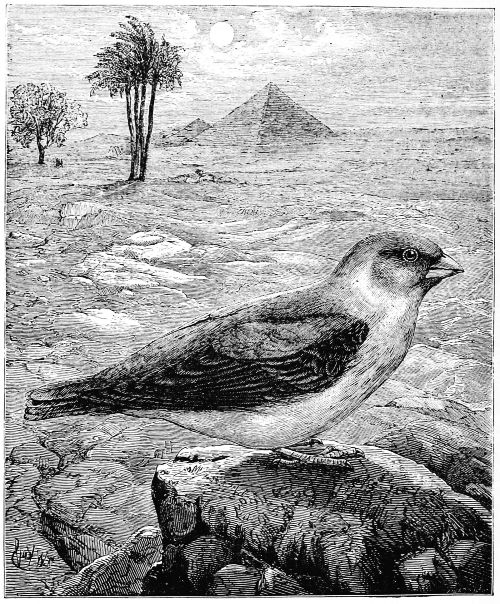
THE DESERT TRUMPETER (Bucanetes githogeneus).
THE SIBERIAN BULLFINCH.
The Siberian Bullfinch (Uragus Sibericus) is remarkable from the circumstance that, unlike most bullfinches, its tail is as long as its whole body; the fourth tail-feather on each side being the longest, the others graduating gently to the middle. The beak is of moderate size, and the upper mandible slightly bent over the lower. The fourth quill of the wing is longer than the rest. In colour the Siberian Bullfinch resembles the Rosefinch; the plumage of the old male is almost entirely of a rose colour, darker on the back, owing to the prominent marking of the shafts of the feathers. The head and throat are whitish, and of satin-like brilliancy, particularly after the moulting season. The lower part of the body is very brilliant, being of a bright carmine-red, and the beak is surrounded by a line of the same hue. The individual feathers are dark grey, lightly edged with pale carmine, and the wings and tail are also vividly tinted with the latter colour. The small upper wing-covers and shoulder-feathers are white upon the tip and outer web, or bordered with white, giving the closed wing the appearance of being white, marked with a crooked line of grey. The three external tail-feathers are also white as far as their dark shaft, and a dark border on the inner web, which becomes broader towards the middle of the tail, the feathers in the centre being merely edged with white. The female is of an olive or greyish green. The Siberian Bullfinches inhabit the marshy, reed-covered districts of Northern Asia. In the autumn they congregate in parties of from ten to thirty, and fly about uttering a monotonous piping note. In Irkutsck these birds assemble in great numbers during the month of September, and many are captured by bird-fanciers; but they entirely lose their vivacity when in a cage, and do not long survive. In Oron the Siberian Bullfinch is found in company with the Bohemian Chatterer; large flocks are also seen in the Bareja Mountains about the end of September. The flight of this species is somewhat undulating, and produces a buzzing sound.
We are far better acquainted with the next bird that we shall describe—a most splendid and interesting member of the family of Bullfinches. It inhabits Africa, but frequently makes its way into Central Europe.
THE VINOUS GROSBEAK.
The Vinous Grosbeak, or, as it is sometimes called the Desert Trumpeter (Bucanetes gilhagincus), is met with both in Egypt and Nubia, where we have killed many specimens; but for all this we cannot pretend to as intimate an acquaintance with it as Bolle, who has made it the subject of one of his most animated descriptions. We much regret that our space does not admit of its insertion at full length, and we must, therefore, present it to our readers much curtailed, and intermixed with such observations of our own as are likely to add force to his statements. "Far beyond the fruitful coast of North-eastern Africa, and far beyond the Atlas Mountains, we find a new kingdom lying in the desert occupied by few but strange inhabitants. All is not dead and silent in this dreary waste, nor are its waves of sand for ever untouched except by the breath of the death-bearing simoom. It has its wells, where the feet of the caravan have made their path, its little oases, sheltered by the clustering palm, and its valleys rich in brooklets filled with water collected from the winter rains. Within the heart of the Sahara, and not merely on its borders, we occasionally find deep glens planted with the tamarind and mimosa, and the most unlikely places, at certain seasons of the year, produce plants peculiar to the desert. Even in these dreary regions, where vegetation struggles with difficulty through the sun-burnt soil, we need not seek in vain for animal life. This immense expanse, extending, as it does, from the Euphrates to the Senegal, has been branded by nature as an unfruitful wilderness, and all its living inhabitants are formed to harmonise with the desolate plains that they inhabit." We will not follow Bolle through all his illustrations of the suitability of the creatures found in the desert to the localities in which they are placed, but will proceed at once to his description of the Desert Trumpeter. "The Desert Trumpeter, the 'Stone Bird' of the Arabs, the 'Moros' of the inhabitants of the Canary Islands, is a lively and beautiful bullfinch, of about the size of our canary bird. Its body is compact, and its scarlet beak, owing to its parrot-like shape, appears somewhat thick, but not sufficiently so to interfere with the elegance of its form. The feet are remarkably delicate for a creature that passes so much of its time upon the stony ground. The plumage is comparatively rich, the bridal attire of the old male bird being a mixture of rose-red and satin-like white feathers, the former colour increasing in extent and depth of hue as the bird becomes older; it is darkest in the spring, when the plumage is of a deep rich crimson. These colours, however, become much paler towards the autumn, at which season the tints of the male closely resemble those of the female, whose coat is of a dull yellowish red. Many varieties of shade are seen in this species, some males presenting the appearance of having been dipped in blood, whilst others are of a greyish hue. The red colour is not confined to the plumage, but spreads over the whole body, so that a Desert Trumpeter, when plucked, might properly be termed a little Red-skin! During the spring the top of the head and neck are a pale ash-grey, with a brilliant gloss, the shoulders and neck being a brownish ash-grey, with a reddish tinge produced by the red-coloured borders of the feathers. The large wing-covers are pale brown, edged with bright rose colour, and carmine red on the outer web. The female is of a brownish grey over the whole of the upper part of the body, and on the lower parts light grey marked with red; the belly is of a dirty white." Those who would become acquainted with the home of this species must wander into the desert to which it properly belongs. Bolle found it breeding on the Canary Islands, principally upon the most eastern, namely Lanzarote, Fuerta-ventura, and the Great Canary. We ourselves have met with it all over the greater part of Upper Egypt and Nubia, as far even as the Steppes, where it entirely disappears. We also found it in the desert parts of Arabia. From these regions this bird has been known to reach the Greek Islands, and even Provence and Tuscany. In Malta it may frequently be seen during the winter. The places frequented by the Desert Trumpeter are barren spots exposed to the hottest rays of the sun; it prefers arid and stony places, where scorching heat blazes down upon the burning rock, and seems to luxuriate in glare and dazzling brightness that are perfectly blinding to the traveller upon these treeless wastes. The favourite haunts of the Desert Trumpeter yield but few blades of parched, dry grass, and the stunted shrubs to please its taste must be few and far between. On such a spot it delights to dwell, hopping from stone to stone, or gliding along near the ground on noiseless wings. It is seldom possible to follow the course of this bird to any distance, for the reddish grey of its plumage blends as perfectly with the surrounding stones and leafless shrubs as do the paler tints of the young with the colour of the sand, tufa, or chalk. To this difficulty is added that of the dazzling and deceptive play of light so common in these deserts, which teaches us to appreciate the delightful relief that grass and foliage afford to the weary eye. We should soon lose the object of our pursuit were it not for its voice, which constitutes its most remarkable feature, and will prove our best guide in this search. Hark! a sound like that of a tiny trumpet is ringing through the air; it swells and trembles, and if our ear is acute enough we shall find that this strange clang is preluded or followed by a few light silvery tones, which fall, bell-like, upon the desert silence, much resembling almost inaudible notes struck upon a musical glass by an invisible hand. At other times the sound it produces is extraordinarily deep, and not unlike that made by the tree-frog of the Canary Islands, consisting of a few harsh notes rapidly repeated, and which, strangely enough, are answered by the little creature itself, the second sound being produced by a sort of ventriloquism, and appearing to come from some distance. Few things are more difficult than to attempt to render the note of a bird through the medium of our alphabet, and in this case it would be particularly so, for the voice of the Desert Trumpeter consists of tones entirely different from those to which we are accustomed, and must be heard before it can be imagined. No one would expect to find a singing bird in such localities as those above described, and the fantastic voice of this creature appears well suited to the places it inhabits. The cry mentioned above is often followed by a succession of crowing, rattling sounds, which, like its trumpet-call, seem by their strangeness so completely in unison with the surrounding scenery, that we always stood to listen to them with pleasure, and wished to hear them recommence. In such places as are entirely covered with moving sands the Desert Trumpeter is never met with, as it is not fitted like a Curlew or Courser to run with ease over loose ground; it frequents the barren lava streams upon which not a blade of grass could grow, and in such fissures and holes as these places offer it finds a hiding or resting place, but is never seen upon a shrub or tree. In inhabited districts the Desert Trumpeter is very shy, only seeming to have full confidence when surrounded by silence and solitude; but in its native haunts the young may be often seen perched close beside their parents, and when a traveller approaches them they only acknowledge his presence by staring calmly in his face with their bright little black eyes. These birds may generally be met with all along the rocky shores of the Nile, and from the valley of that river as far as the desert. In the northern and middle parts of Nubia they alight upon the ground in parties consisting of fifty to sixty, or fly over and about the rocks; indeed, the steeper and more rugged these latter are the more attractive they appear to be.
The food of the Desert Trumpeter consists almost exclusively of different kinds of seeds, with probably a small quantity of leaves or buds. Water is an indispensable requisite. However troubled, scanty, or lukewarm the spring may be, these birds will visit it at least once in the day, so that their appearance is ever a welcome sight to thirsty travellers. They are always seen at the spring, both morning and evening, drinking much and in long draughts, and frequently bathing in shallow water. The breeding season commences in March, at which time the male has donned his gala dress, and, with his chosen mate, has separated himself from the flock; the little couples may very frequently be found perched sociably near the clefts of the rocks, whilst through the air rises the protracted trumpet-like call of the male, and the lark-like note of the female. We saw a pair of these birds upon the banks of the Nile, busily carrying away materials for their nest, but were unable to discover what they consisted of, as the rocks on both sides of the stream offered far too secure a brooding-place to allow us any chance of finding them; we learned, however, from the goat-herds that the Desert Trumpeter builds in the clefts and fissures of the blocks of lava, or under large overhanging stones. The nest, we were told, is artistically constructed of large blades of grass found in the desert, and lined with wool or feathers; in this the three eggs that constitute the brood are laid. It is probable that these birds breed twice in the year, and that they only again join the flocks amongst which their young ones are already numbered, when their parental duties are accomplished. During the autumn and winter they wander to a considerable distance, appearing even in the Canary Isles, and some instances have been known of their falling exhausted upon the deck of ships, that were passing in that neighbourhood. They are never molested by man, and were there no such creatures as Wild Cats and Ichneumons, Falcons or Kites (the latter being very destructive to them in their winter flight through the desert), these remarkable birds might live an undisturbed and happy life. The naturalist may, with care, capture them while drinking, and as many as heart can desire may be obtained from among the stones. It is, however, difficult to take them alive, as a decoy of the same species is indispensable for the purpose. The latter should be fastened in some desert place, or on the borders of a stubble-field, as far from trees or bushes as possible, in such localities as they are known to frequent. The decoy-bird instantly commences uttering its incessant call, and soon attracts large numbers of its wild companions, who alight and hop, as though dancing from one stone to another; they will linger for a moment at a distance, but come near enough to be recognised by their plumage and the brightness of their eyes; next they begin to peck up the food that is strewn about, and a few hours later behold them captives in the net. At first the little prisoners are wild and defiant, but soon become tractable, and eat the canary-seed laid before them. The sport of catching these birds is one that we have fully enjoyed, and may boast our skill in this respect. What could be more exhilarating than an expedition, net in hand, during the early morning, through those boundless plains, when, after a short concealment behind a mass of rock, we emerge to find our labours so richly rewarded? We brought ten Desert Trumpeters with us to Germany, and feel fully entitled to speak as to their qualifications as domestic pets. On their passage home we had a terrible storm, that lasted for many days, and during the whole of that time the birds, in defiance of the cold, continued to pour out their song.
The fact above recorded shows the Moros to be hardy, much-enduring birds, which, though they love to seek shelter in a warm corner, can endure a considerable degree of cold. Even in this severe climate they may be kept in the open air from April to October, although they should not be exposed to frost. Our own are very social, and fond of expressing their confidence by the cheerfulness of their song—indeed, that of the male may be heard late into the autumn and winter. Unlike other birds kept in a room, they are most lively in the evening; no sooner is the lamp lighted than the little captives begin to trumpet forth their cry. The concerts with which we are entertained at these times are most amusing. The performance begins with their loud and clear trumpet-call, changing gradually into the protracted droning sound that mainly constitutes their song; after which they give utterance to a variety of noises, some of which are not unlike the mewing of a cat. At another time they will commence with light clear notes, resembling those of a little silver bell, and these are succeeded by an entirely different cry, which we might compare to the song of a Bunting. Their quavering call is usually followed by one much deeper and rapidly uttered, and their changes of temper are expressed by various tones, which are poured forth with great point and expression. The Moros are rarely heard to chatter amongst themselves, as do the smaller kinds of parrots, but merely employ a sound not unlike the cackling of a hen three or four times repeated, and their cry when alarmed or surprised is quite peculiar. Should any one attempt to catch them, they quaver forth a piteous sound, so full and expressive that we are astonished that it can be produced by so small a creature. The sound to which we allude is uttered with the head laid back and the beak wide open, while the gentler notes, on the contrary, are produced with the beak closed. During their song, and particularly in the breeding season, these birds accompany themselves with a variety of the most comical movements, dancing about their companions, and chasing each other with great zeal. It is not unusual to see the male bird, with its body erect and outspread wings, looking like the strange figures we employ as armorial bearings.
When caged, the Moros still appear to prefer living upon the ground, over which they hop rather than walk, and here they usually pass the night. They will often conceal themselves, but never creep into holes that have a narrow entrance. When a party of them is engaged in preening and expanding their feathers in the sun, the spectacle they afford is very striking and beautiful. Unfortunately, in captivity their plumage soon loses its magnificent red colour, but, despite its loss, they always present a pleasing appearance. The Desert Trumpeter should be fed, like others of its species, upon seeds, in the choice of which it is far from dainty, though it prefers hemp or millet, and will also eat the green heads of the dandelion, the seeds of which it picks out most dexterously; neither does it refuse ears of corn nor the leaves of some plants, such as lettuce, cabbage, &c.; but it will not eat insects, with the exception of the pupæ of ants. In fact, it is by no means particular as respects diet, and is very easily reared. The Moro will frequently breed in captivity, and with a little care and patience may be completely tamed; it does not require any artificial warmth, for the scorching days and icy cold nights of the Sahara seem to render it indifferent to any change of temperature.
Should the Moro be separated from its species it will seek the society of other birds, and we have known a case in which a Desert Trumpeter mated with a small pigeon (Columba passerina) of twice its own size. For the construction of the nest it prefers a cage that is hung up at some height, the bars of which are rather wide apart, and will only build with straw, which they collect by beakfuls at a time, but utterly reject hay or moss as unfit for the purpose. The interior is lined with feathers. The male bird carries some of the materials to the nest, but it is constructed almost entirely by the female. The pair we observed spent some time inside, one entering as the other left, and they appeared occasionally to have considerable difficulty in managing the conveyance of some of the long straws, with which they grappled. Our birds laid their first egg in April, and another was daily added till there were four. The mother, who but rarely left the nest, would probably have sat upon her brood, had we not determined to sacrifice half her stock on the altar of science. The remaining two eggs we placed in the care of a canary that was an excellent sitter, and brought her young charges out of the shell within a fortnight of their being placed under her. The nestlings were by no means so unsightly as those of singing birds usually are, and were covered with a thick, fine, white down, which formed a sort of crest upon the head; the bare places on the neck, &c., were of a flesh colour. In spite of the care taken of these young birds they died when but a week old, and that without having grown much larger. Our Desert Trumpeters soon proceeded to lay a second supply of eggs, and from the third to the fifth of May were employed in the construction of another nest, which, however, was not completed, as the little couple preferred returning to their old home, after having put it thoroughly into repair. On the ninth of May the first of three eggs was laid, but the female became sickly, and, though we left her in quiet possession of her stock, would not brood, but flew about the room with streaming plumage, as though in search of some remedy that was suggested by her instinct, but unattainable in captivity. During this time the male bird kept faithfully by the side of his little mate, and after her death was inconsolable for many days. The eggs are somewhat large considering the size of the parent bird, and of a light sea-green, or even paler shade, sprinkled over with a few reddish-brown spots or streaks, which sometimes form a kind of wreath round the broadest end. This marking is occasionally varied by delicate streaks, zig-zag lines, or large spots arranged in a somewhat undulating manner, and placed principally over the most uniformly tinted portion of the egg. It is much to be regretted that the excellent capabilities of the Moro have not yet attained for it the place it merits among our domestic pets, and that no European traveller has as yet given particular attention to supplying us with living birds.
The Bullfinches we are next about to describe differ from those already mentioned in the inferior richness of their plumage, which is neither so varied nor so bright in its hues, although beautifully marked. Amongst them we number
THE BULLFINCH.
The Bullfinch (Pyrrhula vulgaris) is called also by the names of Blood, Red, Gold, Flame, and Leaf-finch, Red-fighter, Red-bird, and others too numerous to mention, for its titles would really occupy more space than we could afford for their enumeration, many being descriptive of its habits, others derived from the markings and colours of its plumage. This species is from six to seven inches long, and from ten and a half to eleven inches across. The length of the wing is three and a half inches, and the tail measures two and a half inches. The old male is of a rich deep black upon the throat, wings, and tail, and ash-grey upon the back; the rump is white, and the rest of the lower part of the body a bright red. The female differs from the male in the greyish colour of the lower part of the body, and the smaller proportion in which bright tints are found among her feathers. The young ones are without the black mark upon the head. The wing is at all ages striped with two greyish-white bands that run in the direction of the carpal joint. Some varieties are white, black, or speckled. Bullfinches are found throughout all the countries of Europe, though during the winter they usually frequent the most southern parts of the continent, preferring such places as abound in woodlands, and never visiting the more open districts except during their passage to another locality—indeed, these birds never quit the woods except compelled to do so in search of food, and it is only when the snow appears that they leave their shelter to visit the orchards, fields, or gardens of the surrounding villages, and seek such berries and seeds as have escaped the observation of the rest of their feathered relations. For the greater part of the year, these little songsters live in pairs, but during their short excursions they congregate in small flocks, which fly about the neighbourhood on the most amicable terms. At the commencement of their raids upon the country none but male birds are of the party, but these are afterwards joined by the female portion of the community. It is only under peculiar circumstances that they travel beyond their native land, and are therefore but rarely seen in the south of Spain or Greece. They pass their time in flying from one tree to another, only alighting upon the ground when driven to do so by dire necessity. Their habits are very cheerful, and calculated to render them favourites with all who observe them attentively. One of the most distinguishing characteristics of these creatures is their attachment to each other. Should one of them be killed they cannot endure to leave their companion on the ground, and make every effort to take the body with them. This habit is the more striking when the party consists of only a few birds, and has frequently quite touched our heart. On one occasion in particular, we had shot one of two males that were perched upon a hedge; the other immediately flew away to a considerable distance, but very shortly afterwards we saw it return to the spot upon which its little associate had fallen.
The Bullfinch hops over the ground in a somewhat ungainly manner, but is most adroit in its movements upon trees. Sometimes it will rest upon a branch with its body in a horizontal position and its feet stretched out, and at others will perch bolt upright, or hang head downwards from the twigs. Its long and fleecy feathers are but rarely laid close down upon its sides, thus causing it to seem much larger than it really is. Whilst eating or flying it presents a somewhat more compact appearance, but when in a cage always allows its plumage to droop about its body. A tree full of these birds is a very pretty sight, the red colour on their breasts being seen to great advantage among the green foliage, and in winter their bright plumage contrasts prettily with the snow. The Bullfinch does not exhibit much sensibility to cold, and is lively and cheerful even during our most severe winters, always of course supposing that it can find sufficient food; such powers of endurance are easily explained if we consider the thickness of its feathers, and this density of plumage has considerable influence upon its flight, which is slow and undulating, much resembling that of the Chaffinch, owing to its habit of alternately extending and shutting its wings; it will sometimes hover in the air, and then plunge suddenly with closed pinions upon the selected spot. The call-note is a plaintive cry, employed by both sexes, generally uttered when flying, or about to perch or quit their resting-place, and is capable of a considerable variety of expressions—another proof of the delicate organisation possessed by these interesting birds; for sounds which to our grosser ears appear almost identical, have to them innumerable significations. The song of the male is in no way peculiar, and somewhat harsh; it may be heard almost throughout the entire year. Seeds of trees and grasses constitute the principal food of this species, and it will also devour the kernels of fruit. The seeds of fir and pine trees are obtained by picking them from the ground, as the little creature is unable to rob the cone of its contents, though it can extract the stones from fruit with great dexterity, throwing away the outer part as unfit for food. Its presence upon a tree is often indicated during the winter by the quantities of refuse thus disposed of. Grains of sand are always necessary to this bird, in order to assist digestion; the young are fed principally upon insects. In Europe the Bullfinch makes its nest by preference in such retired spots as are well covered with trees, though it will occasionally settle in parks or large gardens, and we have heard of an instance in which a little pair built in the ivy that surrounded the lodge of a gentleman's seat. The nest is usually placed at no great distance from the earth, either in the forked branch of a low bush, or on the ground, snugly supported against the trunk of a tree; indeed, so invariably do they choose these situations, that their nests have never been found at any considerable height. In its general construction the little dwelling resembles that of the Greenfinch, being formed externally of small portions of fir, birch, or pine twigs, upon which a second layer, composed of fibres from various roots, is placed, and this again is lined with the hair of the deer or horse; sometimes a little wool is mixed with the horsehair. In May, from three to four small, round, smooth eggs are deposited in the nest; they are of a light green, or greenish-blue colour, covered with pale violet or black spots, and reddish-brown dottings that form streaks or lines. The female sits upon her brood for about a fortnight, and is tended by her mate during that time; both parents combine in the care of their offspring. The nestlings are fed at first upon insects, then with seeds that have been softened in the crop, and afterwards with the same in their natural state. Should there not be a second brood, the young remain for a long time under parental tuition.
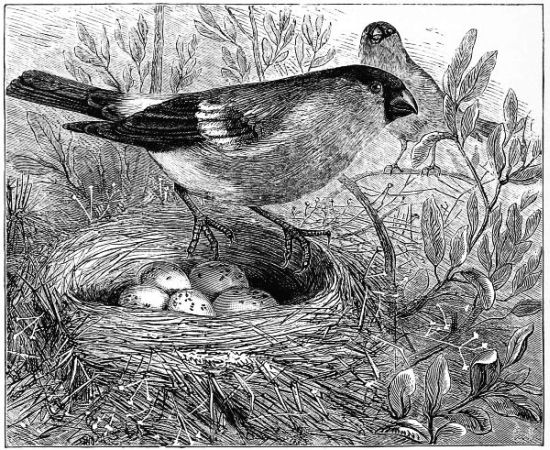
FEMALE BULLFINCH AND NEST.
Those who wish to rear these birds should take them from the nest while still unfledged, and the sooner their education commences the more profitable it is likely to be. In the woods around Thüringen hundreds of young Bullfinches are caught annually, and sent, when properly educated, to the principal capitals of Europe, and even to America. The course of instruction begins from the first day of their capture, and the principal thing that is necessary is that their instructor should be able to whistle the air he is teaching them with great clearness and precision. Persons have tried to teach these little birds to sing with a hand-organ, but with little success, for even the flute cannot produce a sound so delicate as that uttered by the lips of a good whistler. Some Bullfinches can learn to sing two or three tunes without any great difficulty, whilst others never acquire precision. Some will retain a tune during their whole life, and others again forget it entirely during the moulting season. The voice of the female is much inferior to that of her mate. We have often heard the Redpoll and the Blackbird pipe extremely well, but these do not approach the Bullfinch in the purity, flexibility, and fulness of its notes. It whistles in such flute-like tones that the listener's ear is never weary. A friend of ours possessed a bird of this species, which he had reared and trained himself. The cage was hung quite low, so that visitors could approach. When its owner wished it to sing a tune that it had learnt with great exactness, he went to the cage, called his favourite by name, bowed three times, and each time was answered by the bird with great liveliness and joy. After the third salute the little creature commenced its exquisite song, singing it perfectly, and then pausing to receive its master's bow of satisfaction, exhibiting at the same time signs of much delight if praised for its efforts. One circumstance in this performance was remarkable: it would respond to and perform, after receiving the necessary salutes from any man, but utterly refused to obey the signs or commands of a lady. A female relation of its owner tried to entrap the bird, by putting on its master's hat before approaching the cage; but this device was useless, the ungallant little songster proved as obstinate as ever. To such a point of cultivation as this the Bullfinch seldom attains, except taken very early from the nest, and placed where no other sounds are heard until the desired air is acquired, as it can imitate many noises with facility. We ourselves have heard one whose song was compounded of a portion of a tune, the chirp of a sparrow, and the crowing of a cock.
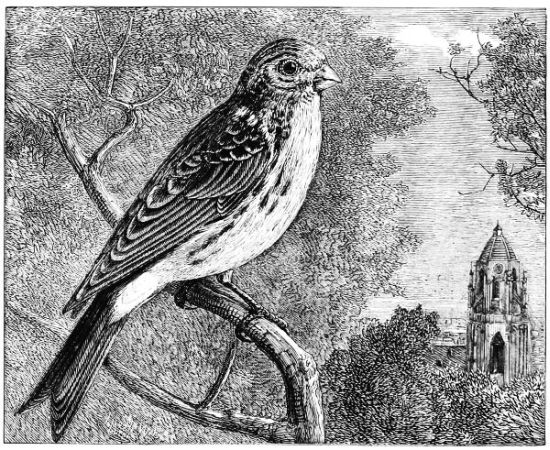
THE GIRLITZ (Serinus hortulanus).
Few birds are to be found so suitable for our drawing-rooms as the Bullfinch; it shows great attachment to those whom it likes, and is evidently conscious of either reproof or praise. Leury mentions a Bullfinch of his own, that testified great pleasure whenever a poor man out of the neighbouring village where it had lived entered the room, and was quite uneasy if it heard a voice at the door which it knew and recognised; indeed, we have known instances where these birds have died in consequence of too much excitement. A lady friend of ours had a Bullfinch so tame that she allowed it to fly about the room, and was in the habit of lavishing caresses upon it. One afternoon, being somewhat busy, her little companion did not receive the customary attention, for which he clamoured so loudly that his mistress at length hastily caught him, replaced him in the cage, and covered it with a cloth; the poor little creature was no sooner treated in this manner than he uttered a few plaintive notes, as though imploring for notice and freedom, and then, hanging his head, fell dead from his perch upon the floor of the cage. An exactly opposite case was related by a gentleman of our acquaintance. The narrator took a journey, and, during his absence, his Bullfinch appeared very mournfully silent; on the master's return, however, the bird was overwhelmed with delight, flapped its wings, and fluttered up and down, bowed its tiny head repeatedly, as it had been taught to do, at the same time pouring forth a song of welcome; suddenly all was silent—the little favourite lay at the bottom of its cage dead with joy. If trained while young, the Bullfinch may be allowed to fly in and out at will, and Leury gives us an interesting example of this fact. During the spring he let a female Bullfinch, that he had had for a year under his care, out into his garden, and for many days afterwards the bird would fly about, returning occasionally to the house, but at last disappeared entirely until the following autumn; when lo! one morning she flew into the sitting-room, as tame as ever. The following year she was again set at liberty, and returned in the month of June with four of her young ones, apparently as confiding as before, and most desirous to persuade the little brood to consider her late master as a friend; but these endeavours proving fruitless, she again left, and in September once more made her appearance with three of her second family. She remained for a short time, and then departed; but positively came back late in the autumn without her little flock to pass the winter in her old home. The following spring she was set at liberty for a third time, and was observed not long after to enter her cage, peck up some of the food it contained, whilst her mate lingered upon a neighbouring tree, and then flew away and was seen no more.
These various little anecdotes will, we think, justify our assertion that the Bullfinch is well worthy of our regard and attention. As to the care it requires, give it a nicely-kept, roomy cage, water to bathe in, and a little rapeseed, and all its wants are satisfied. A small quantity of green-stuff may also be added, and on this fare a little couple of Bullfinches may even be persuaded to undertake the cares of a family.
The capture of this species is attended with no difficulty, as its social habits render it an easy prey. Naumann tells us that any one who can tolerably imitate its call-note may entice it to the spot upon which a snare is awaiting it; indeed, a live decoy-bird is scarcely needed, as a stuffed specimen placed near the traps or limed twigs will answer every purpose, attracting the unsuspecting creatures in great numbers. In our opinion, to shoot a Bullfinch would be a crime; although it is true that it occasionally becomes somewhat troublesome by picking off the buds from the trees, yet, in spite of this, we hope that our readers will allow that its many pleasing qualities make ample amends for any of its troublesome propensities. Besides, in pleading for mercy, we must not forget that its enemies are already sufficiently numerous; martens and weasels, squirrels and dormice, hawks, sparrow-hawks, and falcons, crows and jackdaws, destroy both old and young, and materially limit their increase; many likewise perish during severe winters.
THE GIRLITZ.
The Girlitz (Serinus hortulanus) may be regarded as the type of a peculiar group of the Bullfinch family, allied on the one hand to the South African or Carmine Bullfinch, and on the other to the Canary, with which we are all familiar. The beak of the Girlitz is very short and small, less spherically vaulted than that of the Bullfinch, and moreover blunt, instead of being sharp-pointed at the tip; the legs are short and weak, the wings comparatively long and pointed, the tail graduated, and the prevailing colour of the plumage yellowish or green. The male is a magnificent little creature, of about the size of a Siskin, three or three and three-quarter inches in length and eight in width, the tail measuring two inches, and the wing two and a half inches. The female is a trifling degree smaller. In the male, the fore part of the head, throat, and middle of the breast are of a bright yellowish green, the under part of the body light yellow, while the upper part and the back of the head and neck are of an olive green. The under parts are uniform in shade, but marked at the sides with two large, deep black streaks, the back is dotted with some very faint spots, running from the head to the tail; over the wings pass two yellow lines, the wing and tail feathers are plain black, edged with a greenish shade. During the autumn the feathers upon the middle of the back and wings are of an olive brown or reddish grey. The female is paler in colour, and more strongly marked than her mate; the young ones are of a dirty or pale greenish yellow, marked along the body with greyish-yellow streaks.
In Germany the Girlitz is numbered amongst the migratory birds, appearing there about the last day of March or first of April, and remaining until late in the autumn; indeed, it spreads in a similar manner over the whole of Southern Europe, but in spite of this fact we can scarcely designate its wanderings as true migrations. This bird is particularly numerous in Spain, and is to be met with in all parts of its highlands and lowlands, if we except the country about Castile. In Catalonia it is as commonly met with as is the Sparrow with us; every garden, every vineyard is enlivened by its presence, it abounds in every grove—even the summits of Montserrat affording it a welcome residence. Some few years ago the Girlitz was unknown in the interior of Germany, and was only found about the south-eastern and south-western portions of that country; but at the present time it is met with in considerable numbers around Dresden, and we ourselves have captured a little pair in the neighbourhood of Jena. The love of this species for certain districts is quite remarkable. Orchards situated near vegetable gardens form its favourite retreat; all such places as present these attractions are much frequented, whilst in districts that are deficient in gardens and fruit-trees the Girlitz is but rarely seen. We have observed that it rapidly increases and multiplies in any locality where it settles. According to Hoffmann, this bird does not inhabit the hilly parts around Stuttgard, although often met with in the fields or plains; while Homeyer tells us that it makes no distinction between high-lying and low-lying districts. The Girlitz is a spruce, brisk, lively little creature, with a moderately good voice, and considerable peculiarity in its habits, particularly during the breeding season. Strangely enough, the male birds are the first to come amongst us, and are afterwards followed by the females. The former, when they begin to arrive, attract attention by their loud notes and careless movements, perching upon the highest trees, raising their tails, and turning themselves in all directions, as they busily pour forth their song; but should the spring be wet or cold, they keep well under shelter of the trees, and only occasionally steal out to snatch a morsel from the ground, while their notes during such times are faint, few, and far between. As the breeding season approaches the song of the little strangers becomes more animated, and their gestures more extraordinary. The male, not content with exhausting itself to please its mate with its voice, stretches itself like a cuckoo upon the branches, erects the feathers upon its throat, spreads its tail as it balances and turns its body in all directions, then rises suddenly into the air, fluttering in a most curious manner, with somewhat of the motion of the bat; it next settles upon the tree, throwing itself from one side to the other, after which it will return to its first perch, and recommence its song. Should another male appear, nothing can exceed the rage of the jealous occupant, who pursues the intruder from one tree to another with furious indignation, and only leaves him after having inflicted a considerable amount of very severe chastisement for the liberty he has taken. The song of this species is somewhat peculiar, though we cannot exactly say that its tones are musical, being rather monotonous and shrill, yet still, to our mind, far from unpleasing. The nest, which may really be called a work of art, is formed of the fine roots of plants or blades of grass, and bits of hay. The interior is lined very delicately with hair or feathers, and the little structure is generally buried in the thick foliage of a tree or shrub. According to Hoffmann, pear-trees are preferred, but it will build upon apple, cherry, and, we believe, pine trees, while in Spain it is most fond of settling upon the boughs of the orange and citron. The brood consists of from four to five small, blunt-shaped eggs, of a dirty-white or greenish colour, marked principally at the broadest end with pale brown, red, reddish-grey, or purplish-black spots, dots, or streaks. In Spain we have found newly-laid eggs from April to July. It is probable that these birds breed twice in the year.
The nest of the Girlitz is not always very easily to be found, but if sought for carefully its situation will be betrayed by the female; the latter is fed by her mate during the whole period of incubation, and when hungry expresses her wants by calling to her little companion, so that any one wishing to discover their retreat needs only to stand under the tree and watch for the return of the male bird. The mother is very faithful to her little charges, and sits for about ten days upon her eggs. As soon as the young leave the shell they also call for food with a chirping kind of sound, and soon becoming weary of the nest, frequently leave it before they are really strong enough to do so. The parents feed them for a considerable time, and will even bring them food if they are confined in a cage placed near the tree—indeed, the latter is a very convenient plan by which to secure proper nourishment for the little prisoners until they have attained their full strength. The Girlitz feeds chiefly on all kinds of seeds, and may be kept when tame upon rapeseed, poppy-seed, or millet; water is indispensable. These birds are well adapted for a cage, and are very social. In Spain, when the breeding season is over, they assemble in large flocks at the commencement of autumn, and during such times associate in some degree with Goldfinches, Sparrows, and Fieldfinches. They are eagerly pursued by most of the smaller birds and beasts of prey, and the young not unfrequently fall victims to these marauders. They are caught by the Spaniards in great numbers and brought to market, where they are purchased both for the cage and the kitchen. In Germany the Girlitz is but little molested. In Spain it is trapped by means of the "esparto," a long, rush-like kind of grass that grows in great abundance on the Spanish plains. The blades of this grass, smeared with bird-lime, are placed in considerable quantities on the tops of the trees, their summits being thus converted into one large trap. The numbers so caught are most astonishing, for it will often happen that not one-fourth part of a large flock escapes in safety from the treacherous branches, even birds of considerable size being sometimes taken in this manner.
THE CANARY.
The Canary (Dryospiza Canaria). Three centuries have elapsed since the Canary-bird first left its native isles to become a citizen of the world, and now who could recognise in our beautiful golden little favourite the wild green species from which it is descended? The change reminds us of the difference sometimes observable between two brothers, one of whom has experienced all the advantages of society and cultivation, while the other has remained in his rustic but perhaps happier position. It is to Bolle we are indebted for the first reliable history of the Canary in its wild state, as until his time we were only acquainted with the tamed species. The writers of former times have given us many examples of this bird, but their accounts have bordered somewhat upon the marvellous. They were even mistaken as to its original haunts. The naturalists of the last century were somewhat better informed, but even Buffon has assisted in the spread of erroneous ideas concerning its history. "Goldfinches and Citronfinches," says Bolle, "must be contented to descend from the position they have hitherto occupied as supposed progenitors of the Canary. Buffon tells us that the Canary belongs to the same species as the two above-mentioned birds, and has only changed in colour from difference of climate. Humboldt was the first who could speak with any authority as having seen the Canary in its wild state, having become acquainted with it in 1799, during his residence in Teneriffe." More modern ornithologists have been far from giving this bird the praise it deserves, and we have to thank Bolle alone for so beautiful and exhaustive a description of its life and habits, that nothing more remains to be desired. The following account is drawn from his work.
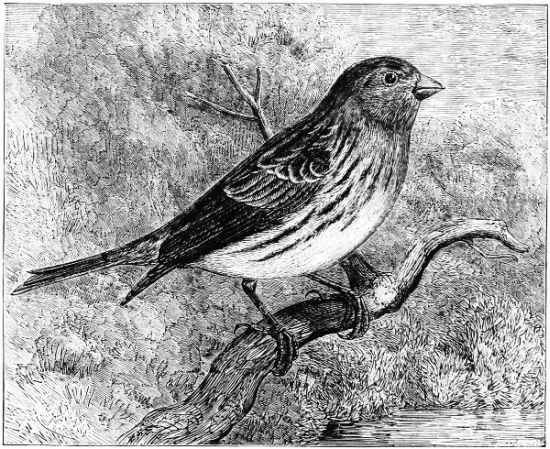
THE WILD CANARY.
The writer we quote found this species occupying the seven wooded islands called the Canaries, and even some parts of Madeira, the latter fact leading him to suppose that this bird may have lived upon all these islands before their trees were cut down. It is principally to be met with in such places as are covered with wood or shrubs, and are situated near springs of water in the interior, which in summer form brooks, margined during the entire year by a border of delicate plants; it is also found in the gardens and houses of the inhabitants, and is quite as numerous in crowded towns as in the quietest nooks—indeed, it is seen in all parts, even at an altitude of 5,000 or 6,000 feet above the level of the sea, except in the thick damp forests formed by laurel and holly trees, beyond the borders of which Bolle never observed it to settle. It may be also frequently met with in the vineyards, or in fir plantations that cover rocky declivities. It is at present uncertain whether this bird occupies the high ground during the winter, but it has been found at an altitude of 4,000 feet late in the autumn. The wild Canary, which, even in its native woods, is called "Canario" both by the Spaniards and Portuguese, is considerably smaller, and usually more slender than these we see tamed in Europe. Those, on the contrary, which are kept in a state of captivity in the Canary Islands have completely retained their original dimensions by mating with birds newly taken from their wild state. The adult male wild Canary is greenish yellow upon the back, with blackish streaks upon the shafts of the feathers, which are so broadly bordered with bright ashy grey, that the latter might almost be described as the principal colour. The hinder part of the body is yellowish green, the upper tail-covers excepted, which are green, edged with ash-grey; the head and neck feathers are yellowish green with narrow grey borders; the forehead and two long stripes which run in a circular form over the eyes to the neck are of a greenish-gold colour, and the throat, upper part of the breast, and sides of the neck are, on the contrary, of an ash-grey. The lower portion of the breast is of a paler yellowish tint, the belly and under tail-covers whitish, the shoulders a beautiful siskin-green, bordered with pale black and green, the blackish wing quill-feathers are edged with green, and the blackish-grey tail-feathers sprinkled with white; the eyes are brown, the beak and feet a brownish flesh colour.