CLASSIFICATION OF BIRDS.
Thomas Rymer Jones translation
Those who are familiar with modern works on ornithology will have observed that it is usual to commence the history of the feathered tribes by a description of the vultures—the most disagreeable and least intelligent of the race. Some writers, however, consider the singing birds as entitled to the first place, the remaining members of the heterogeneous multitude being arranged according to the pleasure of individual naturalists more or less acquainted with their subject. For our own part, we recognise in the parrots the qualifications most fitted to entitle them to take the precedence, and it is, consequently, with these that we shall commence our history. Ornithologists, moreover, differ widely among themselves as regards the relation that exists between the parrots and other members of the class to which they belong, either placing them in a group by themselves, in a manner never intended by Nature, or associating them with toucans, woodpeckers, and cuckoos, with which they possess but few characteristics in common. Under these circumstances, we have considered ourselves at liberty to adopt our own views upon the subject, and have, accordingly, constituted for the parrots a distinct order, under the quaint but expressive name of
CRACKERS (Enucleatores),
in allusion to the facility with which, owing to the construction of their beaks, they are enabled to crack nuts, and other hard seeds, that form the usual staple of their food.
The order that we have thus thought it advisable to establish is, however, by no means limited to the parrots; it includes various other seed-eating birds, chiefly belonging to the passerine tribes, the resemblance of which to parrots has been in some cases generally acknowledged in selecting the names ordinarily conferred upon them. Thus, the Cross-bills have long been known in Germany as the Fir-tree Parrots, and, on the other hand, the epithet of Sparrow-parrots, applied to some races of climbing-birds, clearly shows the relationship that exists between these generally dissevered groups.
The birds thus associated will be found to present many features in common. They live chiefly upon vegetable substances, and their strong beaks enable them to break up hard kinds of food, such as nuts, seeds, and grain. They will also eat fruit and leaf-buds, or the tender shoots of plants; many will devour insects; and a few do not altogether reject the flesh of other animals. They are all clever, lively, and active, much attached to the society of birds of their own species, though they do not often cultivate acquaintance with those belonging to a different family. Their great intelligence enables them to live comfortably even under disadvantageous circumstances, and their temperament allows them to fight the "battle of life" very cheerfully. Owing to the diversity of their habits, they are necessarily widely distributed, and some of them are to be met with in every climate; the parrots only are restricted to the torrid zones, the remaining members of the order being citizens of the world. As to the localities they frequent, much depends upon the absence or presence of the trees to which they usually resort, by far the greater number being strictly arboreal, passing their whole lives in flying from tree to tree, and confining their excursions to a very limited district. Only such as live in cold countries migrate; indeed, regular migrations—that is to say, such as take place at stated periods—or journeys to any considerable distance, are quite exceptional among them. They are, in general, very affectionate and docile; the male has frequently but one mate during his whole life, and nearly all of them brood more than once in the year.
The nests of this order of birds are of very various construction, and the number of eggs never large. The task of incubation usually devolves upon the female, who is cheered and tended by her mate during the period of her seclusion, but he also occasionally shares her labours, and both parents co-operate in feeding and taking care of their young. Many species are considered inimical to mankind, on account of their marauding attacks upon property; and yet the benefits they confer far outweigh any injuries of which they may be guilty. They clear away the seeds of noxious weeds, free the plants from insects; and their lively and cheering presence in the woods, their beauty, their song, and the ease with which they are tamed, together with other good qualities, fully entitle them to our admiration and regard. The flesh of most of them affords an appetising and healthy food, and the plumage of some species forms a beautiful and admired decoration.
PARROTS (Psittacini).
If it is ever permissible to compare animals of one class with those of another, we would state our opinion that the parrots hold among birds much the same position as that occupied by monkeys among quadrupeds. The truth of this remark will become obvious as we proceed with their history. Most systematists have considered parrots as entitled to take but an inferior place in the zoological series, founding this opinion upon a single characteristic which they share with many other birds of far humbler endowments; we allude to the prehensile structure of the foot. Parrots, Woodpeckers, Pepper-eaters, Curacus, Barbets, and Jacamars, are all climbing birds; that is to say, they all have two toes placed in front and two directed backwards; and, immaterial as this structure of the foot may appear, it has been deemed a sufficient reason for forming an order embracing several races of most dissimilar form, which present only this one feature in common. Little stress should, in reality, be laid upon this disposition of the toes, from whatever point of view it is regarded, seeing that Woodpeckers, Tree-creepers, and a great number of others that do not possess the scansorial foot, vie with the so-called climbing birds in the facility with which they climb. The three-toed Woodpecker is not inferior in the dexterity with which it can use its claws to any four-toed scansorial species; and we shall, we believe, be giving this climbing foot its proper appreciation if we compare it to and rank it with the flexible tail of some mammalia, the possession of which is not confined to any particular race, but bestowed alike upon arboreal species of the most various kinds. A foot of this description is by no means of such uniform structure as is usually supposed, and, in truth, is scarcely less varied than are the birds themselves; the foot of the parrot, in particular, differs essentially from the pair-toed foot of other Scansores, in the development of the central part, which renders it in its functions comparable to a hand. The parrots, in fact, constitute a distinct and very clearly defined race, their most distinguishing characteristic being found in the structure of their beak, which can never be mistaken for that of any other bird. At the first glance, indeed, the beak of the parrot would appear to resemble that of the birds of prey; but it is, in reality, much thicker and stronger, and also comparatively higher and more symmetrical in its form. The legs are thick, strong, and fleshy, but never long; the tarsus much shorter than the middle toe, and always covered with small scaly plates; the toes are moderately long, and have a thick sole, but this exists only on certain peculiar ball-like elevations; upon their upper surface the feet are covered with minute scales, resembling those of the tarsus; and these scales, as they approach the ends of the toes, become gradually larger, and project beyond the base of the claw upon the terminal joint in the shape of short tubular or band-like plates; the claws are not long, but much bent and tolerably sharp, never very powerful. The structure of the wings is in exact correspondence with that of the feet; the bones are of moderate length, but strong; the pinion feathers tolerably numerous—twenty to twenty-four. The compactly formed primary quills are seldom long, but so disposed that the outspread wing is generally pointed; the tail-feathers vary considerably in different species, both as regards length and shape. The general plumage is remarkable on account of its compactness; it consists of few feathers, but these are usually of large size, with the exception of those covering the head, which are small. The eye is in many instances surrounded by a naked patch of skin, which during life is usually powdered over with white dust. The body feathers are each furnished on the under side with a large downy appendage. The coloration of the plumage, notwithstanding its great diversity, will require notice, as presenting a feature very distinctive of the different races of parrots. The prevailing tint is a more or less vivid leaf-green; but we also meet with hyacinth, blue, purple, red, golden yellow, and at times darker hues; their distribution is also characteristic, more especially the frequent occurrence of complementary colours upon the upper and under sides of the same feather—blue-violet, dark blue, light blue or green above, with light yellow, orange-yellow, cinnabar red, or purple underneath. Not less peculiar is the frequent concealment of glowing tints among others which are less conspicuous, as, for example, in the case of some Cockatoos in which we meet with feathers having their lower portion and their downy roots of a deep cinnabar red or brilliant yellow, and yet this portion is seldom visible, on account of the length of the white feathers among which it is hidden.
The extraordinary intelligence exhibited by some parrots is particularly remarkable; it is, indeed, their sensible behaviour, not their form, that makes us regard these creatures as representatives of the Quadrumana. The parrot has, superadded to the form of a bird, all the qualifications and troublesome propensities of the monkey—humoursome and fickle at one moment, gentle and agreeable at the next; it is intelligent, active and circumspect, provident and crafty, very quick in discernment, and possessed of an excellent memory; on this account it is eminently susceptible of instruction, and may be taught almost anything. On the other hand, it is choleric, malicious, spiteful, and deceitful; it forgets injuries as little as it does kindnesses; it is cruel and inconsiderate to creatures weaker than itself, tyrannically ill-treating the helpless and unfortunate, as does the monkey. It has been the fashion to rank parrots as inferior to many other birds, because they do not exhibit such conspicuous capabilities of locomotion; they are, nevertheless, very well endowed, even in this respect. The larger species fly with apparent heaviness, but with considerable rapidity; the smaller, wonderfully well—so well, indeed, that we have been almost consoled for the loss of a favourite bird whilst watching the beauty of its flight. Very many appear to be quite out of their element when upon the ground, they seem to hobble rather than to walk, but there are some Ground Parrots that run swiftly and with much facility; and Gould makes mention of a Grass Parrot that he saw running upon the ground like a plover. The capability of hopping from bough to bough is an accomplishment in which parrots are deficient, nevertheless they have their own mode of progression among the branches; any considerable space they fly over, but smaller distances they pass by climbing, and that with considerable rapidity, unwieldy as some of them appear; helping themselves along by means of their beak, as well as their feet, while other birds use their feet only. Parrots are unable to swim, and are quite incapable of diving. The bill is far more movable than that of any other bird, and is useful for many purposes. Their voice is harsh and screaming, but yet not entirely destitute of an agreeable sound when heard in their native haunts. Some species will learn to whistle tunes with remarkable clearness and accuracy; the faculty which they possess of imitating the human voice and speech is well known—their performance, indeed, is wonderful; they do not babble, they speak, and seem to know the meaning of the words they use.
With the exception of Europe, parrots are to be met with in all parts of the world, more especially in tropical regions; one American species ranges as far north as 42°, and another is found in the southern hemisphere, as far as the inhospitable wastes of Tierra del Fuego, in 53° south latitude. Cockatoos are known to inhabit New Zealand and Macquarrie's island, 52° south. In Asia and Africa, the parrots are principally confined to the limits of the torrid zone; in China, they rarely pass 27° north latitude, and in India, at furthest, only extend to the foot of the Himalaya mountains. In Western Africa, they rarely go beyond 16° north, and in Eastern Africa, according to our information, not further than 15°; but towards the southern hemisphere they probably are to be met with at a greater distance from the equator.
Generally speaking, the woods are their favourite haunts; but this is by no means universally the case. There are certain species, for example, which only frequent treeless plains or wide steppes; in the Andes some are to be found living far beyond the region of trees, even at an altitude of 11,000 feet above the level of the sea.
In the north-east of Africa, according to our own experience, they almost exclusively reside in places frequented by monkeys, insomuch that apes and monkeys seem to be their inseparable companions. The more extensive the forests—that is, the richer they are in vegetation—the more these birds abound; indeed, in the tropical forests, they constitute a large—we might almost say, the largest—proportion of the feathered inhabitants. The same remark applies to Australia, as well as to many localities in India, and in part also to Africa; in these countries parrots are as numerous as crows are in Europe, and as common as sparrows.
They would seem to understand how to make themselves conspicuous; and while they deafen the ear with their discordant cries, enliven the dark shades of tropical forests with their lavishly-coloured plumage. "It is impossible," says Gould, "to describe the enchanting scene afforded by certain parrots, more especially by those adorned with feathers of glowing red, as they wheel their varied flight among the silver-leaved gum-trees of Australia, their gorgeous plumage standing out amid the surrounding scenery with wonderful effect."
"Morning and evening," writes Schomburgk, "countless multitudes may be seen at a considerable height, making an insufferable noise; one afternoon I saw such a prodigious flight descend upon the trees by the river-side, that the branches bent low under the weight of the birds." "It is necessary to have lived in these countries, more especially in the hot valleys of the Andes," says Humboldt, "to believe it possible that the shrieking of the parrots actually drowns the roar of the mountain torrents as the waters leap from rock to rock. What would those wondrous tropical forests be without parrots? Lifeless gardens of enchantment, a wilderness of silence, a solitary desert; by these birds they are awakened and kept alive, for the parrots know equally well how to find occupation both for the ear and eye of the traveller."
Except in the breeding season, parrots live in society, or, we might rather say, in great flocks; they select a locality in the forest as their settlement, and thence make daily excursions to considerable distances. Early in the morning they simultaneously quit their roosting-place, to invade the same tree or the same field in search of food, stationing sentinels, whose duty it is to protect the community from a sudden surprise. They pay instant attention to any voice of warning, and when alarmed, immediately take flight, either all together or shortly after each other.
"At the first glimmering of the clear morning sun of the tropics," says the Prince von Wied, "the parrots rouse themselves from their sleeping-places, dry their wings, which have become wetted with the dews of night, and playfully call aloud to each other; then, after describing many sweeping circles above the high woods, they quickly depart in search of the morning's meal. In the evening they invariably come back again to their usual roost."
Le Vaillant tells us that in south-eastern Africa the native parrots fly in little flocks in search of food, bathe about noon, and hide themselves among the foliage during the overpowering heat of the sun. Towards evening they disperse themselves, after which they again bathe, and then fly back to the same roosting-place from which they had departed in the morning. These roosting-places are very various—sometimes the thickly-leaved top of a tree, sometimes a rock full of holes, often a hollow tree trunk; the situation last mentioned seems to be especially sought after. "Their sleeping-place," says Audubon, speaking of the American parrakeets, "is a hollow tree, or the hole chiselled out in some tree's trunk, to be the nestling-place of the larger woodpeckers, that is, in case these are not occupied by their true owners. In the gloaming large flocks of parrots assemble around old hollow sycamores, or other trees of similar character; and may be seen immediately in front of the entrance clinging to the bark, until one after another they disappear through the hole that leads into the interior, in order to pass the night. When a hollow of this description is not sufficiently large to accommodate the numbers that are assembled, those that come last are content to suspend themselves by their bill and claws from the bark before the entrance.
"We have ourselves, in the primitive forests around the Blue River, in Africa, repeatedly watched the parrots at twilight, slipping one after another into their hole, and have observed them ranged with great regularity around the many perforations in the trunk of some old Adansonia.
"In India, the Collared Parrot, as Layard informs us, sleeps among the thickets of bamboos. "All Parrots, Bee-eaters, Grakles, and Crows from districts extending for many miles around, pass the night in flocks among the great bamboo plantations, where the dull rushing sound caused by their flutterings, constantly heard from sundown till dark, and from the first grey dawning in the east until long after sunrise, might almost be supposed by the observer to proceed from numerous steam-engines in full work. Many of these flocks returning late in the evening from their excursions, fly so near to the ground that they scarcely clear the obstacles to their course; indeed, they do not always succeed in doing so; for, several nights together, we have picked up parrots which had flown against walls or similar obstructions, and had been killed in consequence."
Layard gives a very lively account of the behaviour and doings of the Alexander parrot (a species commonly met with in Ceylon), at one of their sleeping-places.
In Chilau, he relates, that he has seen such massive flights of these birds winging their way to their roosting-places among the cocoa-nut trees that overshadow the market-place, that their cries completely drowned the Babel-like confusion of tongues heard among the buyers and sellers in the streets. He had previously been told of the flocks which thus pay their nightly visits, and placed himself, accordingly, towards evening, upon one of the neighbouring bridges, in order to form a calculation of the numbers that might make their appearance in a certain given direction. At about four o'clock in the afternoon they began to arrive; scattered swarms were seen wending their way homewards, to these there succeeded others still more numerous, and in the course of half an hour the homeward stream was apparently in full flow. He very soon found that it was impossible even to count the flocks, which seemed gradually to unite into one great living, roaring torrent. Some flew high in the air, until they were immediately over their roosting-place, and then suddenly plunged down, wheeling round and round towards the tree-tops, of which they were in search. Others crowded onwards, flying close to the ground—indeed, so closely that some of them nearly grazed his face. They swept along with the rapidity of thought, and their dazzling plumage seemed to be lit up with gorgeous brilliancy, as it glanced in the rays of the sun. He waited at his post of observation until the evening closed in, and he could see no longer, but even then the flight of the birds as they made towards their nests was audible. When he fired off a gun, they rose with a sound like that of a furiously rushing wind; soon, however, they again settled down, and commenced an indescribable hubbub. The shrill screams of the birds, the noise caused by the fluttering of their wings, and the rattling of the leaves of the palm-trees was so deafening, that he was heartily glad when he escaped from such a turmoil, and took refuge in his own house.
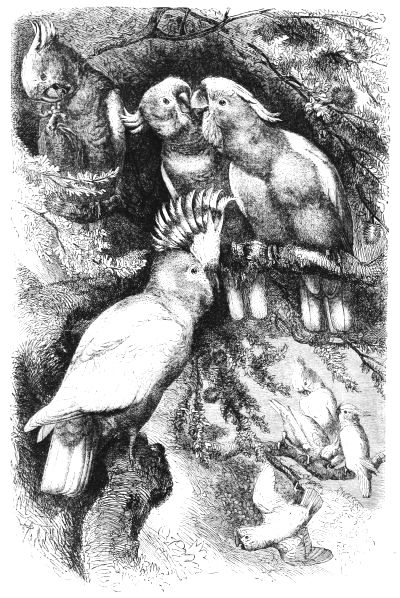
COCKATOOS (Cacatua).
Next to a safe sleeping-place, the presence of trees thickly crowned with foliage is an essential requisite for the comfortable lodgment of parrots; this they require, not so much as a protection against the weather, as for a secure hiding-place. Of all things they like warmth, nevertheless they do not absolutely avoid a cool temperature, and still less are they afraid of wet, at least for a time.
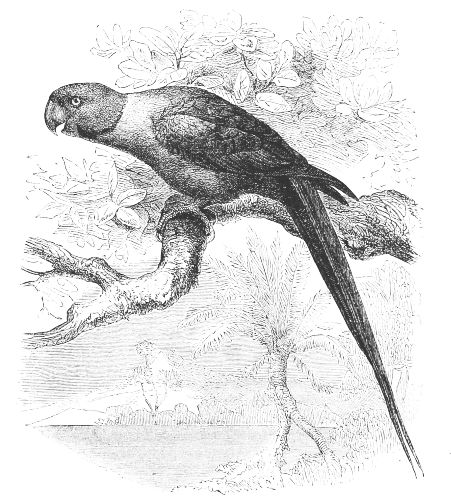
COLLARED PARROT (Palæornis torquatus).
"During the heavy tropical rain-storms that sometimes darken the air," says the Prince von Wied, "it is not uncommon to see parrots sitting motionless upon the dead branches at the very top of a tree, uttering cheerful screams, as the water streams off from their plumage; there may be dense foliage, and thick boughs immediately beneath, under which they might easily find shelter, but they prefer the warm shower, and seem to enjoy the wetting. No sooner, however, has the rain ceased, than they appear equally desirous to dry themselves, and to rid their plumage of the moisture."
In fine weather it is quite otherwise; they then decidedly prefer the shelter of the thickest trees, either as a protection from the burning heat of the sun, or for the purpose of concealment, and hasten to them at once on the slightest alarm. They know what an excellent protection to them, clothed as they are in leafy green, the verdant bower offers; and, truly, when thus ensconced, they are tolerably secure from observation; a man may know that there are fifty of them in a tree, and not see one. In playing their game of hide and seek, both the colour of their feathers, and the cunning so peculiar to all parrots, contribute to their safety;—they do not want to be seen. One of their company has just at the right time observed the approach of an enemy; he gives a sign, they are all at once silent, and withdraw themselves towards the centre of the tree; noiselessly, they climb to that side of the summit opposite to the spot where the enemy has appeared, they then fly off, and it is only when they are a hundred yards away that they seem to recover their voice, and scream to their hearts' content, apparently rather out of bravado, after having thus outwitted their pursuers, than for the sake of calling upon their companions. This clever game they play more especially when they have settled on some tree for the purpose of enjoying the fruit, as it is then that their thievish design is carried out with the greatest cunning. "Whilst on the wing," says Pöppig, "the large golden green Araras of the Andes will arrest their flight to come down upon the scarlet Coral trees (Erythrinæ) and the yellow Tachiæ, the heads of which they eagerly devour. Their cry is positively fearful; nevertheless, they are quite clever enough to understand that it would be dangerous to give utterance to it when they are just about to plunder some ripening field of Indian corn. At such a time, every one of them will repress its inclination to make a noise, giving utterance to no sound except a sort of murmur, with which it accompanies its proceedings, as it prosecutes its work of destruction with surprising quickness. The sportsman, or even the exasperated Indian, finds it by no means an easy task to surprise the thieves, seeing that two of the oldest birds are always set as watchmen upon the highest trees in the neighbourhood. The first note of alarm is immediately answered by a general, half-uttered cry from the assembled pilferers; the second is responded to by deafening screams, raised by the whole flock as they fly away, and it is only when their enemy has departed that they begin anew their destructive raid."
The presence of a numerous flock of parrots is generally only betrayed by the empty husks that rattle as they fall against the broad leaves of the bushes, producing a sound that can be heard from some distance.
Le Vaillant has noticed the silence of these birds at the approach of a suspicious-looking visitor, on the occasion of their mid-day assemblages. They will keep themselves so still that not the slightest sound can be heard to proceed from among them, even though thousands should be congregated together. On the discharge of a gun, the whole multitude will immediately take wing, and rise into the air with deafening cries, as though rendered furious by the interruption.
Far different is their conduct when they have become aware that the good-nature of man leaves them unmolested. In India, as Jerdan informs us, they not only come boldly into the towns, but will settle down, without the slightest shyness, upon the tops of the houses, and from this elevation descend to plunder the gardens and fields in the neighbourhood. Incredibly great, and justifying the most efficient means of defence on the part of man, is the destruction caused by parrots; nothing is safe that is not constantly guarded. Like the monkeys, they waste a great deal more than they eat.
The multitudes which assemble upon the fields or fruit trees devour all they can upon the spot, bite off still more, and carry a few ears of corn up into the trees, in order peaceably to fill their much craving stomachs. When they make their appearance in the orchard, they search every tree that is in fruit, and pluck such as may be ripe; bite a bit off, and if it does not exactly suit their very refined taste, throw it down upon the ground and take another instead. While feeding they generally climb the branches from below upwards, and as soon as they get to the top fly away to another tree, sweeping over the ground without ever moving their wings. Arrived at this second tree they recommence the work of destruction just as before.
In North America and in Chili they attack the fruit before it is ripe, in search of the as yet milky pippins, and we may imagine the damage thus caused. According to Audubon, the cornstacks in the fields are sometimes the objects of their attack; they will hang upon them, and draw the ears out of the sheaves, thus sparing the owner the trouble of threshing. Some prefer one kind of seed and some another; but all agree in spoiling everything that man sows or plants for his own use; and on this account anything like friendship between the farmer and the parrots is quite out of the question.
After having satisfied their hunger in this manner they go in search of water to drink; and, according to Audubon and Schomburgk, do not refuse salt, or at any rate brackish water. Besides occasional rain-baths, they will bathe in lakes, washing themselves, Le Vaillant tells us, until they are soaked through, as with a heavy rain. We also learn from Audubon that they enjoy playing in the sand like fowls, covering their plumage with dust, and will creep into king-fishers' holes, in order to find it. They are fond of salt ground, and are always to be found near the saltworks in the forests.
The incubation of these birds takes place during the months that correspond in their native lands to our spring. The larger kinds appear to lay but once in the year, and then only two eggs; though the Australian Grass Parrot and some others are exceptions to this rule, inasmuch as they will lay regularly from three to four eggs, and in some cases from six to nine, twice or even three times during the year. The eggs are always white, smooth, and round. Holes in trees are the favourite nesting-places of these birds, but not exclusively so; some American kinds will lay in holes in the rocks, and the Indian parrots in crevices in old buildings, pagodas, monuments, or houses.
Audubon assures us that several females will lay in one hole; but we consider this as very doubtful, though it is true that parrots prefer breeding in society, sometimes even associated in immense flocks.
Molina speaks of a large settlement of these breeding birds in Chili, and Pöppig of another, probably of the same species. "These several settlements," says the last-mentioned naturalist, "must be very astonishing to those to whom they are new. Fancy yourself, about mid-day, wearily approaching a precipice, believing yourself to be perfectly alone, that deep silence reigning around you that always indicates noon in these tropical regions, when all animals seek repose in sleep; a kind of growling strikes your ear, but you look in vain for any creature that could produce it; suddenly you hear the parrots' cry of warning, answered by many others, and before you are awake to your true position, are surrounded by swarms of these quarrelsome birds, flying about in a close circle, and in evident anger, threatening to strike you. From all the innumerable holes upon the face of the rocks little round heads are protruding, looking comical enough; and those that do not come out unite their screams to the general uproar. Every opening indicates a breeding hole, that has been excavated by its owner in the clay met with between the strata of the rocks. At times many hundreds may be counted."
These colonies are always so cunningly situated, that it is impossible for a beast of prey to approach them. Such settlements could not be made in the woods, as the trees would not afford a foundation strong enough to sustain their weight.
In general, it is in old trees that parrots make their nests; in Central Africa the Adansonia is preferred, more especially should it grow on the outskirts of a forest. We once saw a group of monkey-bread trees in the Kordofanian steppes inhabited in this manner, although not yet covered with their leaves.
As it is not always possible to find a trunk whose interior has been hollowed by some friendly woodpecker, the parrots are often forced to excavate their own nesting-places, and then it is that they show what an available instrument their beak can be. It is the female who almost, but not exclusively, makes the hole; at this work she shows herself most skilful; she hangs, like a woodpecker, from the bark, and gnaws, rather than cuts away, one shred after another, until the dwelling is completed; this labour often occupies several weeks, but with patience the end is at length attained. The hole is the principal matter, the nest does not need much making; a few chips picked from the ground are all that is required as a bed on which to deposit the eggs; even a hole that leaves much to be desired in the way of convenience will content these very easily satisfied parents. "From the white stem of a Trimi-palm," says Pöppig, "I once saw a brilliant light blue tail depending; it betrayed the Yellow Arara, who was busy with her strong beak enlarging a woodpecker's hole, out of which her ell-long tail hangs whilst brooding." The female generally sits alone, and is fed and entertained by her mate during the whole time of incubation.
Among the smaller kinds of these birds, the brooding season lasts from eighteen to twenty, and with others nineteen, twenty-three, or twenty-five days.
The young are perfectly helpless when they leave the egg, but their growth and development is rapid. At first they are very imperfectly fledged, but in from five to six days the feathers begin to sprout, and they open their eyes within eight or ten days of their birth. The warbling Grass Parrakeet leaves the nest thirty-three days after being hatched, and may be seen flying about two days later. Both parents feed the young and tend them for some time after they have left the nest.
The food, if corn, is softened in the parent's crop before it is put into the beak of the young bird. Schomburgk tells us that a pair of parrots which had settled near his encampment in the wood, only fed their young twice in the day, once at eleven in the forenoon and again about five in the evening. As soon as they arrived they perched upon a branch near the hole, and if they fancied themselves watched would sit quite still, until they thought that a favourable opportunity occurred for stealing in unobserved.
The parents are by no means deficient in tender care for their progeny, and will shield their offspring from danger with most self-sacrificing courage. Some species will attach themselves with great tenderness to deserted birds; not merely to those of their own family, but to any helpless orphan, even although belonging to another species.
Cunningham tells us that the surgeon of the Triton—a ship plying between England and Australia—had a Blue Mountain Parrot, and a very beautiful smaller one, that he had taken from its nest so young that it was unable to feed itself. Under these circumstances the elder bird undertook to give it food, and watched over it with the greatest anxiety. The mutual friendship of these creatures seemed to increase as time went on; most part of the day was spent in caresses; they trimmed each other's feathers, and the old bird would spread her wings over her little charge with every indication of solicitude. Indeed, their affectionate demonstrations soon became so noisy that they had to be separated, in order that the passengers might not be annoyed, and the young one was placed in a cabin with several others.
After a two months' separation the elder parrot succeeded in escaping, and was guided to the cabin by the voice of its young protégé, to whose cage it clung. From this time the friends were not parted, but a fortnight later the young one died, in consequence of a wound caused by a fall. Its friend was silent from that hour, and did not long survive its little charge.
Parrots attain their full beauty of plumage, and commence laying by the time they are two years old; some of the smaller kinds breed within the first twelve months, but, notwithstanding this, live for many years, and have been known to long survive the family in which they passed their youth.
In countries where parrots abound they are destroyed with unrelenting perseverance, and this simply for the protection of property. "People must not imagine," says Audubon, "that all the injuries they are guilty of meet with no reprisals; on the contrary, these birds are slaughtered in great numbers during their predatory visits to the farmers. Armed with his loaded gun, the exasperated proprietor creeps amongst them, and brings down eight or ten at the first shot; the survivors rise screaming into the air, fly about in circles for three or four minutes, but return, and surround the bodies of their fallen companions, uttering loud cries, and this is repeated again and again, until so few remain that the farmer does not think it worth while to waste his powder and shot upon them. Hundreds are thus destroyed in the course of a few hours, and baskets filled with the spoils."
Various are the expedients adopted for their destruction in different parts of the world. The Chilians rush out with all speed when they see the parrots settling, and attack them with sticks. The Australians rouse them from their sleeping-place, and then throw their boomerangs amongst the retreating flock. Adventurous men let themselves down the rocks in which the South American species breed, to draw the young out of their holes with hooks; or shooting parties and hunters endeavour to steal upon them unawares. When it is found impossible to climb the trees on which they breed, these are cut down, and nets and limed twigs placed around to catch the young. The flesh of the slaughtered birds is often eaten, although hard and tough, or is made into excellent soup.
Very frequently they are sought for on account of their splendid plumage. "There is nothing more natural," says the Prince von Wied, "than this most simple and pleasing decoration, to the use of which savages are much addicted; and very beautiful are the articles made from feathers by entirely untaught tribes; many of the aborigines of Brazil particularly excelled in this kind of work." The love for parrot feathers is very ancient. "In long forgotten times," says Pöppig, "the inhabitants of the tropical forests brought arara feathers as tribute to the Incas, for the decoration of their palaces, and early historians inform us that these feathers and the 'Koka' were the only produce which led to the peopling and cultivation of the formidably hot districts in which they abound."
It is said that Alexander the Great brought tame parrots from India, and in later times these birds were taken in great numbers to Rome, where the favour in which they were held was carried to such excess that it was often reproved in the open forum. "Oh, unhappy Rome!" cried that severe censor Marcus Portius Cato; "have we lived to see the day when our women nurse dogs upon their laps, and our men go about with parrots on their hands?" The Romans kept them in cages made of silver, tortoise-shell, and ivory, and had tutors who particularly taught them to utter the word Cæsar; in those days the price of a parrot that could speak exceeded that of a slave. Ovid did not consider it beneath him to sing their praises, and Heliogabalus thought he could not set anything more delicate than parrots' heads before his guests. In Nero's reign, it would seem, only Indian species were known; but probably at a later period African parrots were introduced.
During the Crusades these birds adorned the houses of the rich, and the first discoverers of America found tame parrots in the huts of the natives. Von Schomburghk tells us, that in their native lands, when tame, they are allowed to fly about, without having their wings clipped. "I saw many," he writes, "which joined the flocks that were living over the village during the day, and returned to their master's hut at night."
In comparison with such a life as this the parrots brought to Europe have a sad fate; but they suffer most before their destination is reached. The Indians inhabiting the primitive forests capture them in order to exchange them for European articles, and hand them over to some sailor in the nearest harbour, who knows nothing either of the necessary food or of the care they require; not more than half the number that are shipped survive the long sea voyage, and many of those that reach Europe in safety perish in the dark, dirty, pestiferous shops of the dealers. It is only when the bird receives especial attention that its fate is ameliorated; but by that time it has often become distrustful, violent, and ill-behaved, and only loses these rude ways after long care and kind treatment; it is, however, very quick, soon learns to adapt itself to its altered position, and becomes accustomed to all kinds of diet. At first hemp or canary seed is acceptable, but after a time the parrot grows more dainty, and if supplied with sweets becomes such an epicure that any less delicate food is distasteful; it is easily habituated to almost anything that man enjoys, even to tea, coffee, wine, or beer, and will quite intoxicate itself with strong drink. These remarks do not apply to the little Australian Ground parrot, which refuses everything except grass seeds and the leaves of plants. Most of the larger kinds enjoy hemp-seed, hard-boiled rice, ants, maize, lettuce, cabbage, fruit, small kinds of millet, canary-seed, and the leaves of plants; such food as this keeps them well and thriving. Bitter almonds and parsley, according to Küle, are poisonous to these birds.
Many degrees of intelligence are observable among the members of the Parrot tribe, and the same species often contains individuals of very varied capabilities; but the memory of all is generally excellent. As regards teaching them to speak, the most important point to be attended to is that they should at first be kept closely confined and constantly instructed; any extent of freedom may, however, be accorded when their education is nearly completed. On the contrary, should the owner desire the parrot to breed, a certain amount of liberty is needful. For this purpose the first requisites are space, quiet, and a suitable tree for the nest. A tolerably roomy chamber in which they may live throughout the year, and the trunk of a hollow tree with convenient holes, the wood being of a soft kind, afford all that is necessary in these respects.
The classification of parrots is particularly difficult, on account of the great number of species, and it is almost impossible to indicate distinct boundaries between the different families. It will, however, answer our present purpose to arrange them under the general titles of True Parrots (Psittacinæ), Macaws (Arainæ), Lories (Lorinæ), Cockatoos (Cacatuinæ), and Ground Parrots (Pezoporinæ), all of which differ from each other more or less in their habits and modes of life.
THE TRUE PARROTS (Psittacinæ)
are inhabitants of the woods, only leaving them to linger on their outskirts, and from thence to contemplate the tempting fields of fruit, upon which from time to time they make a raid. Many of them never quit their dense forests, whilst others of the smaller kinds prefer the less shady trees or open country.
These birds belong to Africa and the neighbouring islands, and also to various islands in the Pacific Ocean; they are likewise met with in great numbers in South America. The family is very rich in species; we shall, however, only select a few from the many, seeing that the mere description of their plumage would be wearisome, and we scarcely possess any information with regard to their mode of life in their native haunts. There can be no hesitation in placing the "Jako," the Grey, or Red-tailed Parrot (Psittacus erithacus) first upon the list, for it may be considered as the type of the race; it is true that it has neither the quickest flight nor the gayest plumage, but it combines in itself that equal excellence of all the attributes of a parrot which gives and will retain for it a pre-eminence among its congeners.
THE JAKO.
The Grey Parrot exhibits only two colours in its plumage. The tail is of a deep Cinnabar red, and all the other feathers are ash-grey or greyish blue, bordered with a lighter shade; near the head and neck the light borders of the feathers are somewhat wider than elsewhere. The beak is black, the eyes light brown, the bare places round the latter of a whitish colour. The male and female do not differ in hue, and but little in size, the male being the largest; its average measurement is twelve inches in length and twenty-five inches across the wings, the tail three inches and a half, the wing from shoulder to tip eight inches and a half; when folded, the wing extends some lines beyond the tail.
Very little is known of these birds in their wild state, although they are brought to Europe in far greater numbers than any other species. We learn from Heuglin that the habitat of the Jako extends from the western coast of Africa, deep into the heart of that continent, and reliable naturalists have seen it in great numbers in Wan and Bongo, up to 8° north latitude. It does not appear to penetrate further east, and is quite unknown in eastern Soudan; how far north and south it is found is at present doubtful. It is worthy of remark that these birds were not many years ago imported from Guinea to Madagascar, where they became naturalised and increased so rapidly, that at the commencement of the eighteenth century their numbers rendered them a perfect scourge to the inhabitants of the island of Bourbon and the Mauritius. The Grey parrot is one of the most highly-prized of our domestic favourites, and well merits the esteem in which it is held. Its praises have been sung in all languages, and every work on natural history relates some anecdotes of its surprising cleverness.
Perhaps the most celebrated of the species is one which lived for many years in Vienna and Salzburg, and luckily found an exact and industrious observer of its performances.
The Count Courcy Droitaumont was the first who, in the year 1835, in Oken's "Isis," gave us such particulars of its attainments as awakened astonishment in all quarters. This account has been attested by the late possessor of the parrot, President Kleimayrn, at the wish of Lenz, who afterwards published the following narrative:—"Jako noticed and criticised everything that passed before him, gave the proper answer to a question, did as he was bidden, saluted people who entered the room, and made his adieux to those who were taking leave; he wished you good morning and good night at the proper times, and asked for food when he was hungry.
"He called all the members of the family by name, and preferred some of them to others; if he wanted me (his master), he called out 'Papa, come here,' and whatever he said, sang, or whistled, was done as a human being would do it. There were times when he seemed inspired like an improvisatore; his voice then sounded like that of a speaker heard from a distance, when too far off to enable you to understand the words.
"Sometimes he would be marvellously polite—'Good morning, reverend sir!' 'An almond, if you please, reverend sir!' 'Do you want an almond?' 'Should you like a nut?' 'Shall I have some food soon?' 'Have you got something?' Occasionally he would threaten—'Be off, you rascal; are you going home or not?' 'Be off, you thief, or wait till I come!' 'You idiot!' 'You clown!' At times he was self-complacent—'Good little prattler!' 'You are an excellent little parrot!' 'Take time, neighbour, take time!' &c. If any one knocked at the door he would call very loudly and distinctly (just like a man) 'Come in! Come in, Herr B.!' 'What orders have you?' 'I am your humble servant!' 'I am delighted to have the honour! quite delighted to have the honour!' Or he would tap on his cage and say the above to himself.
"He could imitate the cuckoo excellently. Occasionally his conversation was rather discursive. 'Look out!' 'Come out!' 'Come up!' 'My dear little parrot!' 'Bravo, bravissimo!' 'Are we not going to dinner?' 'Let us go to the window!' 'Hieronymus, stand up!' 'I am going!' 'Long live the Emperor!' 'Where have you been?' 'Will you kindly excuse me, but I thought you were a bird?' Whenever he bit or spoiled anything, he would say, 'Don't bite!' 'Be quiet, do!' 'What have you been doing?' 'Wait a minute, you rascal; what have you been doing?' 'I am coming after you!' 'How are you, you little chatterer?' 'Have you got something to eat?' 'I hope you will enjoy it!' 'Hush, hush, good night!' 'Pretty Poll may go out; so come, come shoot, Poll, shoot!' and then he would shoot, calling loudly 'Puff!' 'There, there, there!' 'Go home, come march, go home directly!' 'I'm coming after you!' He would ring a bell that was placed in his house, and say, 'Who's that ringing? who's that ringing?' 'Why, here's a little dog! a pretty little dog!' Then he would whistle to the dog and say, 'Whistle, little dog!' and ask, 'What does the little dog say?' and then bark. If told to fire, he would say 'Puff!' and give the word of command, 'Halt; right about face; make ready; present; fire! Bravo, bravo!' He never said 'Bravo!' in connection with his faults.
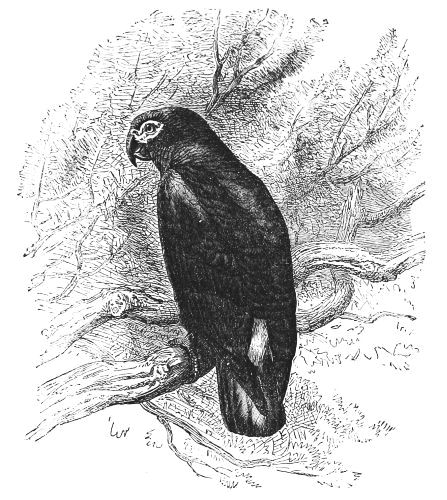
THE JAKO (Psittacus erithacus).
"Sometimes he would cry out, 'What are you shaking me for? What are you doing to me?' and scream for help, as though being shaken, and call out again, 'Don't shake me, you rascal! Ah! that's the way of the world! alas! alas! Don't shake me, you rascal!' and then laugh with great distinctness. If anything ailed him, he would exclaim mournfully, 'Poor Poll is ill; poor little parrot!' If annoyed, his tone became defiant—'Wait a minute; I'll come and punish you!' If ever he saw the cloth being laid, or heard from a distance that preparations were making for a meal, he would immediately call out, 'Let's go to dinner!' When the family were at breakfast he would ask, 'Am I to have anything? I should like some chocolate!' He would remain quiet as long as his master slept; but if in another room would begin singing and whistling at break of day. In order to see if it would be possible to teach Jako to sing, we selected such words as he could say, and he was soon able to sing a verse of a song; he could put in harmonies, and readily run up and down the scales, and learnt to whistle many scraps and shakes. He never kept to the same key, but would take the air half a tone higher or lower, and yet never utter a false note. Whilst at Vienna he was taught an air from 'Martha,' and on being shown a dance, tried to imitate it by raising one foot after another, and putting his body into dancing attitudes. Kleimayrn died in 1853, and Jako fell ill, as it would seem, from pining after his beloved master. In 1854 he was so weak that he had to be laid in a little bed and carefully tended; he continued, however, to talk incessantly, and after saying, 'Your poor little parrot is ill!'—died."
A young lady has given us the following particulars about another "Jako:"—"The parrot of which I am about to speak was given me by a man who had lived for many years in the East Indies. The bird at first knew nothing but Dutch, but soon learnt German and French, and after a time spoke as clearly as a human being in all three languages; he was so observant that he often used phrases which had never been taught him, applying them on fitting occasions in the most astonishing manner. He said a number of disjointed Dutch words and sentences, intermixing German quite correctly when the phrase was not forthcoming in the former language. He could ask, answer, and request you to give him something, and thank you for it, varying the use of the words according to the time, place, or person. 'The little parrot wants something to eat!' If he did not get what he wanted, he would immediately scream out, 'I must and will have something to eat!' And if still kept waiting would begin throwing everything about to vent his anger. He said 'bon jour' in the morning, and 'bon soir' in the evening; asked permission to retire, and took his leave of us. When he was carried out, he would say, 'Bon soir, bon soir.'
"This bird was particularly attached to his mistress, from whom he received his food, and would press his beak on her hand, and say, 'Kiss the lady's hand.' He took great interest in all she did, and whilst she was busied with something would often ask, with most comic earnestness, 'What is the lady doing?' After her death, he evinced great sorrow, and it was only with difficulty that he could be persuaded to take food, or that his life could be preserved. He whistled wonderfully well, particularly the tune, 'Ich dank dir schon durch deiner Sohn,' and sang most beautifully. He would say to himself, 'Polly must sing a little,' and then begin—
"'Perroquet mignon, Dis moi sans façon, Qu'a-t-on fait dans ma maison Pendant mon absence.'
Or—
"'Ohne Lieb und ohne Wein Können wir doch leben?'
Then he would sometimes say—
"'Ohne Lieb und ohne maison Können wir doch leben.'
Or—
"'Ein Kuss—sans façon.'
The latter version seemed to amuse him so much that he would burst into loud laughter. 'Polly, what does Lottie say?' he would sometimes ask himself, and answer immediately, as though some one else had put the question, 'Oh, my beautiful, beautiful little parrot; come and kiss me.' And this he would utter with the exact tone of endearment used by Lottie. He expressed his conceit by saying, 'Ah, how beautiful I am!' at the same time stroking his beak with his foot, though he was by no means handsome, for he had the ugly trick of pulling out his feathers. On this account he was ordered wine baths, which were administered to him by the help of a watering can. These baths were most disagreeable to him, and as soon as he saw preparations being made he would beg imploringly, 'Please don't make me wet! Poor little parrot! Please don't wet me!'
"He could not bear strangers, and those who came to see him, and wanted to hear him speak, only attained their wishes by hiding themselves. In their presence he was as quiet as a mouse, but chattered incessantly when visitors were out of sight, as though he wanted to indemnify himself for the restraint he had been under. There were people, however, who managed to gain his affections, and he would talk with them when they came, and used even to crack his jokes about them. A fat major, with whom he was well acquainted, was trying one day to teach him a new trick. 'Get upon the stick, parrot; get upon the stick!' commanded the soldier. But Polly seemed sulky. All at once, the bird burst into a loud laugh, and said, 'Get upon the stick, major; get upon the stick!' Another friend of his had not come to the house for some time. The visitor had been talked about, and it was expected that 'Roth,' as he was called, would make his appearance on a certain day. 'Here comes Roth,' said the bird, suddenly, as he saw him approaching through the window, and recognised him from some distance.
"This poor parrot came to an unlucky end; it was given as a present to a relation of its master, who had become superannuated, and had taken a childish fancy to the bird. But it could not endure the parting from all it loved, and died in the course of a few days."
We could tell of many grey parrots that have been brought to great perfection in the art of speaking, but the preceding anecdotes combine all that these birds have been known to do, so we will only observe that their wonderful memory and powers of mimicry have sometimes their disadvantages. Their first teachers are usually sailors, and it may, therefore, be easily imagined that their vocabulary is neither choice nor elegant; unluckily, the best educated birds will often remember these old lessons, and intermix the lowest and commonest words with their pretty phrases and speeches. The parrot can reproduce any peculiar sound with as much ease as it learns words, and will imitate the creaking of a neighbouring door, the barking of a dog, the mewing of a cat, or even an old man's cough.
Mr. Wood tells us that a friend of his had a parrot of this species, which proved herself a most tender and affectionate guardian. In a hedge of roses near its owner's house, a pair of finches had built their nest, and were regularly fed by the family, who were much attached to all kinds of pet animals. The numerous visitors to the rose hedge attracted Polly's attention, and, seeing the food they gave strewed around, she determined to emulate their good example. Being allowed to fly about, she left her cage, imitated the cry of the old finches, and gave the nestlings a part of her food; but these expressions of sympathy did not please the parent birds, who at once deserted their young from fear of the large stranger, so that Polly saw the little ones thus become orphans, and a fine field opened for her fostering care. From that hour she refused to return to her cage, and remained day and night near her adopted children, whom she fed with the greatest assiduity, and had the pleasure of rearing successfully. When the little ones were fledged they used to perch upon the head and neck of their foster-mother, who bore the burden with exemplary care; the parrot, however, received but small thanks, for her young charges had no sooner wings strong enough to bear them than they flew away. Poor Polly was for some time in bitter distress, but at length found consolation for her motherly feelings in the discovery of some deserted hedge sparrows; these she conveyed to her cage, where they were soon on the best terms with their adopted parent.
Many American varieties of the Short-tails, usually called GREEN PARROTS (Chrysotis), differ from their African congeners, the Jakos, in their prevailing green colour, and in the small size of the bare parts around the eyes. Their body is compact, the beak strongly bent, the tail short, broad, and somewhat rounded; the wings broad, and strongly formed, reaching nearly to the middle of the tail; the legs are strong, thick, and fleshy; the feet powerful, and armed with strong claws, the plumage lies close and thick, the feathers being small and imbricated. Two species of this family are especially well known to us, the Green and the Amazon. They are both large birds, of fourteen inches long, and about twenty-one to twenty-three across the wings; the tail measures from four inches to four inches and two-thirds; and the wing, from the shoulder to the tip, seven inches.
THE AMAZON PARROT.
The Amazon Parrot (Chrysotis Amazonicus) is of a brilliant green colour, sky blue on the brow and top of the head, yellow on its cheeks and throat, and red on the shoulders; the side tail-feathers are blood-red beneath, the beak deep horn grey, the cere blackish, the feet ash grey, powdered with white, and the iris externally bordered with orange, and internally with pale yellow. The Green parrot (Chrysotis æstivus), on the contrary, has its forehead and cheek stripes of a sky blue colour. The shoulders are green, and the red side-feathers of the tail edged with green.
From the observations made by the Prince von Wied, Speke, Schomburghk, and Burmeister, we learn that both kinds are widely spread over South America.
The Amazon parrot avoids the forests near the coast, but frequents the woods and bushes of the higher lands, while the Green parrot prefers the primitive forests. Both kinds are much alike in their habits and mode of life. Early in the morning they leave their roosting-places, and fly screaming through the air, beating violently with their wings, until they reach the woods or plantations where they can find fruit; at noon they rest, after which they set out in search of food; and in the evening, except in breeding time, assemble in great numbers, making a terrible noise until a roosting-place is found for the night.
The Prince von Wied gives the following account of the Green parrot, which is called the Kuriche by the Brazilians:—"In all the eastern coasts of Brazil that I travelled through this bird was very common; I found it in numbers wherever there were thick forests, and on the borders of mango swamps at the mouths of rivers; it breeds equally well in all such places, but seems to prefer localities where it can obtain the fruit of the mango. Great flocks inhabit the wooded country around Rio de Janeiro, Parahiba, Espirito Santo, and Belmonte, and their loud voices may be heard morning and evening in the bushes of the bog-like country, which is watered by the floods from the rivers. These bushes stand in the same relation to the Brazilian rivers as willows do to European streams; but the trees are higher, and the parrots can often make their homes on their strong stems or branches. In the breeding season they usually fly up into the air in pairs, calling and screaming loudly, but except at that time are met with in very numerous flocks. We ourselves have seen such enormous swarms of short-tailed parrots in the Mucuri forests and other places, that the whole woodland was filled with their extraordinary cry. On these occasions many different species seemed to be combined in one flock; their united screams were deafening, and as one party drove another from the trees, excitement gave new vigour to their shrieks. Should they alight upon a lofty, thickly-foliaged tree, it is often very difficult to see them, as their green hue is a great protection, and their presence is only indicated by the fall of the shells and stones of the fruit they devour. Whilst eating they remain quiet, but if alarmed will utter loud cries. They are shot in great numbers, as they are excellent food, and the soup made from their flesh is much esteemed both in Brazil and Surinam. These parrots lay two white eggs in holes of trees, upon a bed of shreds of wood, chipped out in preparing the nest; they breed but once in the year, and that in the spring time of their native land."
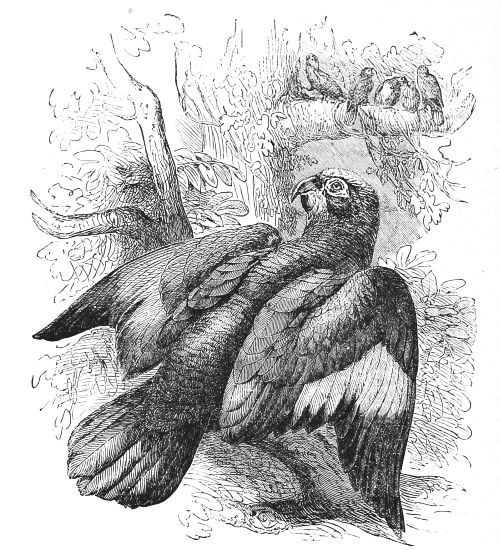
THE AMAZON PARROT (Chrysotis Amazonicus).
"The young, if taken from the nest, are soon tamed, and learn to speak distinctly; on this account they are frequently found in the Brazilian houses, and are brought in great numbers into the towns, and sold to sailors, who bring them to Europe; they do not learn to speak so readily as the grey parrot, but prove teachable, tolerably gentle, and amiable towards those that feed them."
Under the generic name of PIONUS, Wagner unites many small parrots, which we will call the BLUNT-TAILED PARROTS. Their bodies are compact, the tail very short, the wings on the contrary being slender, pointed, and so long that they reach at least as far as the middle of the tail; the beak is compressed at the sides, and the upper mandible generally terminates in a long pointed hook. The legs are strong and powerful, the plumage usually harsh, and the feathers cordiform and particularly small. Those on the head and neck are thick and strikingly coloured. We are familiar with many varieties of these birds, most of them from South America, and with others from Africa, which have lately been placed in a different tribe.
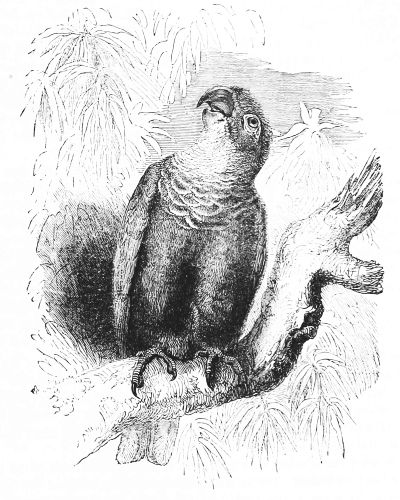
THE MAITAKKA (Pionus menstruus).
THE MAITAKKA.
Of all the blunt-tailed parrots, none is brought to Europe in greater numbers than the Brazilian Maitakka (Pionus menstruus). This bird is of middle size, ten and a half inches long and twenty inches across; the tail is three inches long, and the wing six inches in length from the shoulder to the tip. The plumage on the head, neck, throat, and upper part of the breast, is ultramarine, through which the black ground colour is visible: the neck feathers are of a copperish green, edged with blue. The back, lower part of belly, breast, and wings are copper green, the feathers on the back being edged with a darker shade; those upon the breast are shaded with light blue. The upper wing-covers are of a yellowish olive green, the under covers the colour of verdigris; the quill-feathers are green, bordered with black, the wing-feathers blood-red, yellow at the tip, and the shafts blue. The two middle tail-feathers are green, the tip and outer web are blue, and near the root of a light blood-red. The beak is horn grey at the tip and paler at the base, with a rose-coloured spot on both sides beneath the nostrils; the legs are of a greyish slate colour, the eye-rings bluish grey, and the eyes greyish brown. The female resembles the male, but is somewhat paler. In the young, grey is generally the prevailing hue; in old birds blue predominates.
According to the testimony of travellers, particularly the Prince von Wied, Schomburghk, and Burmeister, the Maitakka inhabits all the country near the coast in Brazil and Guiana, where these birds are met with in great numbers. They live in pairs in the dry season, and assemble in large flocks during the rainy part of the year, flying with loud cries from tree to tree, and settling upon those most heavily laden with fruit, to which they often do great damage, returning in the evening to their usual resting-places. Their movements depend upon the time when the different fruits are ripe, and to enjoy these they fly about the country in various directions, during the rainy season approaching nearer to the plantations on the coast and open country, but in the hotter part of the year keeping more immediately in the neighbourhood of the principal forests.
The flocks of these birds are very noisy; but when pairing they only utter their call-note, which is a shrill, harsh cry. They breed during the dry season, and their preparations for sitting do not differ from those of other parrots. The Maitakka is hunted zealously throughout the whole of Brazil, partly in order to drive it from the plantations, and partly for the sake of its flesh. It is often tamed, and though not so teachable as other parrots, soon becomes accustomed to captivity, and can be taught to utter disjointed words. Great numbers are brought to the coast, and eagerly purchased by sailors, for though very numerous in Europe, these birds always command a high price. With care they can endure confinement for many years.
THE CRESTED HAWK PARROT.
One of the American parrots which we include in this family reminds us of the cockatoos, and must be considered as the type of a peculiar tribe (Deroptyus). Linnæus, who was acquainted with it, gave it two distinct names, the one on account of its sparrow-hawk-like plumage (Deroptyus accipitrinus), the other, because of its frill of elongated feathers (Deroptyus coronatus). We will call it the Crested Hawk-Parrot, seeing that the long feathers on the nape of the neck, which can be raised at pleasure, distinguish it from other South American species.
The beak is large, strongly but bluntly toothed, and having the ridge of the upper mandible powerfully hooked and projecting. The cere is short, and its margin curved like the letter S. The eyes are surrounded by a broad bare circle; the bluntly-pointed wings reach to the middle of the tail, the latter being of tolerable length and formed of rounded feathers, of which the three exterior on both sides are shortly graduated; the legs are weak, and the toes long. The plumage is on the whole extremely rich, of a pale yellowish-grey upon the head; the exterior margin of the forehead is of a brown colour; the crest is composed of dull blood-red feathers, edged with sky blue. The plumage on the back is light green, somewhat darker in the middle than on the sides, and the feathers on the lower part of the body are, as far as they are visible, blood-red. The sides of the cheeks and the throat are of a brownish tint; the primaries quite black, and the secondaries similarly coloured on both sides. The tail is bluish on its upper surface, and black underneath. Burmeister gives the length of this rare and beautiful species as being fourteen inches, five and a half of which belong to the tail; the wing measures seven inches from the shoulder to the tip.
As far as we know at present, this bird prefers dwelling in the wooded district near Guiana and the River Amazon. Spix found it at Villa Nova, on the river above-mentioned. Schomburghk mentions it but twice. He says that he met with it on the Rupununi, and also in the huts of the Warrau Indians; but though he saw numerous flocks of these magnificent birds enlivening the palm-trees of Sawari, and greeting passers-by with piercing cries, and thus had abundant opportunities for making observations, he tells us extremely little about them. "When angry," he informs us, "this bird is without doubt one of the most beautiful of the parrot race, as it then raises the brilliantly tinted feathers on the back of the neck, until they stand up perpendicularly, thus forming a flowing circle round the head." The settlers call it "Hia," which word is supposed to resemble its cry. From the same writer we learn that this species inhabits the lower woods, approaching the settlements with confidence, and although easily tamed, is weakly and unteachable. It makes its nest in the holes of trees, and lays from two to four eggs.
THE DWARF PARROTS.
Among the most vivacious and docile members of this family, the Dwarf Parrots (Psittacula) deserve our particular notice, for their behaviour is quite in harmony with their beautiful exterior. "The poets," says Schomburghk, "could not have been aware of the tender love that exists between a little pair of Dwarf Parrots, or they would never have selected doves as their models of ideal tenderness; indeed, it is impossible to compare the latter with the former in this respect. Between these "Love birds," as we generally call them, there exists the most perfect harmony in all their acts and wishes. They eat together, share the same bath, and if the male bird utters his cry his mate will instantly join her voice to his. Should one fall ill, the other feeds it, and, however many may be assembled on a tree, the little couples never leave each other. It is well known that these elegant little creatures can only be reared in pairs, or, at any rate, they must be allowed the society of some of their race. If taken young out of the nest, before they have chosen a mate, it may happen that solitary individuals can be reared; but the older birds never survive the death of their little companions, and soon pine themselves to death. More need not be said in favour of these 'inseparable birds.'"
The "Dwarf Parrots" are not larger than Finches or Larks, and are distinguished by their short, bluntly-hooked beaks, and strikingly short small tails, the feathers of which are tolerably equal in size and pointed. The quills of their wings are short, and when the latter are closed reach to the end of the tail; their legs are likewise short and feeble. The plumage is soft, long, and large-feathered; the individual feathers are, usually, not bright, but strikingly coloured and marked. We are acquainted with many species, which are spread over Africa, Asia, and South America, and resemble each other in their habits and mode of life. All are true parrots, climbing the branches with the greatest dexterity, flying rapidly, and feeding upon fruit and corn; the nests are made in the holes of trees, and their eggs are small, rounded, and white.
SWINDER'S LOVE-BIRD.
Swinder's Love-Bird (Agapornis Swinderiana), one of the prettiest members of this group, is a tiny creature, at most five inches in length, of which more than one inch belongs to the tail: it is about nine inches broad, and each wing measures three inches from the shoulder to the tip. The prevailing colour of the plumage is green; the under part of the body, wings, and upper tail-covers are a beautiful azure blue; the short, scarcely rounded tail is, with the exception of the two middle feathers, green, but bright red at the root and towards the end, with a black line dividing the two colours. The face, belly, and tail-covers are yellowish green, and the upper part of the throat is surrounded by a black band. These beautiful birds inhabit the western and interior parts of Africa, but information as to their habits in their native land is entirely wanting.
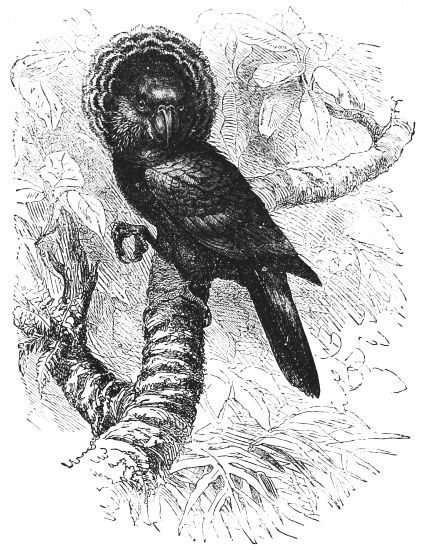
THE CRESTED HAWK PARROT (Deroptyus accipitrinus coronatus).
THE SPARROW PARROT.
The Sparrow Parrot (Psittacula passerina) is one of the smallest of the Brazilian parrots, being scarcely or not at all larger than the species we have just described. The colour of the plumage is a bright green, shaded into yellow upon the brow, face, and lower parts. The under-side of the tail and tail-covers are of a pale bright bluish green; the anterior border of the wing, the large wing-covers, the back, and secondary quill-feathers, as well as the inner wing-covers and the under part of the body, are of a bright ultramarine; the primary quills are blackish brown, with a green anterior edge. The beak is a bluish ashy green; the cere somewhat darker; the feet ash grey, with green, scale-like plates; the eyes brown.
The Sparrow Parrot is very common in Brazil, and inhabits both the woodlands near the sea-coast and the bushes in dry districts, to which it is an admirable ornament. These birds come in troops into the gardens of the settlers like our sparrows, which they also resemble in the fact that when in company with others of their kind they scream and chatter in a very confused manner, the united flock producing a shrill twittering sound. They settle in great numbers upon a tree or shrub to nibble the fruit, during which time the whole swarm is in unceasing confusion, climbing nimbly up and down the branches, and whistling briskly. In other respects the Sparrow Parrot lives after the same manner as the rest of its relatives, making the same kind of nest, sometimes using the deserted oven-shaped abode of the Crested Parrot, and laying from three to four white eggs upon the shreds of wood that cover the bottom of the hole. Both young and old are often captured by the Brazilians, and seem soon to forget the loss of their freedom, if they are not separated from their mates. They are but short lived, and for that reason seldom reach Europe; still, it occasionally happens that, with great care, they will survive some years, and even breed in a state of captivity.
THE SISKIN PARROT.
The Siskin Parrot (Nasiterna pygmæa), the dwarf among the dwarfs belonging to this order, lives in New Guinea and the Papuan Islands. Its green plumage is varied by a yellowish shade on the head, and the face is light golden brown; the middle tail-feathers are blue, the rest are black, with yellow tips; the beak is extraordinarily high and strong. As far as we know, this bird is not rare upon the high trees on the coast of New Guinea and in the forests of Salawatis and Misool, but no observer has as yet given us particulars of its habits.
COCKATOOS.
Amongst the different species of parrots with which Australia is enriched the Cockatoos (Plyctolophus) take high rank. The members of this group are distinguished by their compact body, short tail, and wings of middle size; their large, short, broad beak toothed at the margin, the upper mandible of which terminates in a strong hook. The tongue is usually fleshy and smooth, the region of the eye bare, and the head decked with an upright tuft of bright and beautiful feathers. The plumage is generally very striking, either by reason of its pure white or delicate rose colour, or (for a parrot) the unusually dark tints that predominate. Cockatoos are found not only in Australia, but in the Moluccas, New Guinea, and the Philippine Islands, where most kinds establish themselves in enormous flocks in the woods, and fly from thence over the fields and plains, presenting an appearance that is enchantingly beautiful. "Perched under the shadow of the dark foliage," says Mitchell, "their bright wings and glowing crests transform the heights upon which they live into regions of the most exquisite beauty." In their habits and mode of life Cockatoos resemble other parrots, and must be reckoned among the most pleasing of the whole race. It is quite true that when living together in large flocks their cries frequently become a deafening noise intolerable to ordinary ears, but a solitary bird is very engaging; indeed, there is something so extremely tender in the tone in which it utters the word "cockatoo" (whence is derived the name), that it attracts us involuntarily, for the cry of "cockatoo" is always intended to express a kindly feeling, and changes when angry into a most fearful shriek. The Cockatoo soon learns to make friends with mankind, plays fewer tricks than other parrots, appears grateful for any kindness that is shown to it, and seems eager to make a fitting return; unkindness alone makes it ill-tempered or mischievous, and its excellent memory enables it to avenge an injury after the lapse of years. Its disposition in general is mild and gentle, and its good qualities numerous. It learns to speak with tolerable ease and fluency, forming the words into phrases, as though it understood them, and applies whole sentences at a fitting opportunity. In their wild state, Cockatoos assemble in large flocks, which remain more or less united even during the breeding season; they pass the night buried in the leafy shelter of the trees, and at break of day make the woods resound with their noisy screams as they rise into the air with light strokes of the wing, hovering and gliding till they reach a field yielding suitable food. Fruit, corn, and seeds constitute their principal nourishment, and they will also devour buds and bulbs, obtaining the latter very dextrously by the help of their long beaks. Every fresh occurrence in their daily life is greeted with loud cries; and should a second flock pass over the place where they have settled, their combined shrieks are perfectly appalling, and can only be imagined by those who have heard the yells a few captive cockatoos are capable of producing. As soon as hunger is appeased these flocks retire to rest beneath the shelter of the branches, where they remain some hours in comparative quiet; they then again go in search of a meal, returning to pass the night on their accustomed trees. Thus they live till the breeding season, when they pair, and each couple sets out to find a suitable home, preferring holes in trees, but also resorting to fissures in the rocks. Certain precipices near the South Australian rivers are yearly visited by thousands of Cockatoos, just as the cliffs of the north seas are infested by huge flocks of sea-gulls. We are told that some of these rocks are completely honeycombed by them, and the strength and firmness of their beaks renders this assertion easily credible. They lay two white, pointed eggs, about the size of those of a bantam fowl; but in what manner incubation is carried on we are not aware. We are told by travellers that they soon become timid if they suspect danger, and, like other kinds of parrots, carry on their depredations with so much cunning that it is very difficult, or indeed impossible, to drive them from the fields. The natives hunt them in a very peculiar manner. "Perhaps," says Captain Grey, "it would be impossible to imagine a more exciting spectacle than that of seeing the Australians hunt the Cockatoo. They employ for this purpose a very remarkable weapon called a boomerang; this is a sickle-shaped flat instrument made of wood, which can be thrown by the hand to a distance of 100 feet, and flies in small circles with many windings from the direct path. An Australian will follow a flock either into the fields or woods, preferring, however, places where large trees are situated near water, such spots as these being the favourite resort of the Cockatoos. Here they are to be found in innumerable hosts, climbing on the branches or flying from tree to tree; here they also sleep, and here the wily native comes, most watchfully observing all necessary precautions. He goes from one tree to another, and creeps from bush to bush, taking the greatest care not to disturb the wary birds, but in vain, for, however quiet his movements may be, he is soon discovered, and his near approach greeted with a hideous cry. The birds have already perceived that danger is at hand, though they do not know what the next step may be. At length their pursuer reaches the water, and discloses his dark form to their view; amidst piercing shrieks the white cloud of birds rises into the air, and at the same instant the Australian throws his weapon amongst them. The boomerang, which is thrown with great force, dances and springs in the most wonderful manner over the water, and then, rising higher and higher in its wayward flight, is soon careering in the midst of the frightened multitude. A second, a third, and a fourth weapon is discharged; in vain the terrified creatures try to escape, the apparently aimless course of the missile bewilders them and delays their flight. One after the other is struck by the boomerang, and comes to the ground, having probably either lost its head or broken its wing; they fall screaming with pain and terror, and it is only when the dusky hunter has attained his end that the remainder of the terrified flock hide themselves in the foliage of the trees." The flesh of the Cockatoo is tolerably good, and the soup made from it excellent. The number of these birds that find a home with us prove that they are easily captured, and, like all other parrots, they will live a long time if nourished with simple food.
THE LEMON-CRESTED COCKATOO.
The Lemon-Crested Cockatoo (Cacatua galerita) is known by its white colour (which in some specimens presents the appearance of having had a delicate red breathed upon it), and by its perfectly shaped tuft, formed of two rows of long and slender feathers, that can be raised or lowered at pleasure. This long tuft or crest, the wings, and the inner web of the tail-feathers are of a pale brimstone colour at the root. The eye is deep brown, the beak black, and the foot greyish brown. The length of this species is about one foot four inches.
We are at present uncertain whether this bird is spread over Van Diemen's Land, as well as over the whole of Australia and New Holland, or whether those countries are inhabited by different species of very similar plumage. A careful examination of the Cockatoos most abounding in those three regions has shown a decided difference in the construction of the beak, and justifies the last-mentioned opinion. According to Gould, the Lemon-crested Cockatoo is common to all the Australian settlements except those to the west. These birds live in flocks of hundreds and thousands, much preferring open plains, or slightly wooded districts, to the forests near the coast.
LEADBEATER'S COCKATOO.
The Inca, or Leadbeater's Cockatoo (Cacatua Leadbeateri), another species found on the continent of Australia, differs from the bird we have just described in the arrangement of its colours. Its plumage is white, but the forehead, sides of the neck, the middle and under surface of the wings, are of a beautiful rose tint. The crest is magnificent; the individual feathers of which it is composed are bright red at the root, spotted with yellow in the middle, and tipped with white. When this plume is laid back, nothing but the white tips can be seen, but it is no sooner raised than the blazing red appears, and the yellow spots unite themselves into a stripe that renders its appearance still more striking. The spaces around the eyes are light brown; the beak light horn colour; the foot dark brown. The female is somewhat paler on the lower part of the body, and has large yellow spots upon the crest.
Gould tells us that these splendid birds are spread over the whole of South Australia, living principally upon the high gum-trees and brushwood near the rivers of the interior. They are found principally near the Darling and Murray rivers, and do not extend as far as the north-western coast. During the breeding season they appear in great numbers in certain localities, and animate the otherwise monotonous forests of the interior. The voice of the Inca cockatoo is more plaintive than that of its congeners, and its scream not so harsh.
THE HELMET COCKATOO.
The Helmet Cockatoo (Callicephalus galeatus) also deserves notice as being the type of a tribe that forms the connecting link between the True Cockatoos and the Geringeroes or Raven Cockatoos of New Holland. This bird is known by its short vaulted beak, which has a slightly projecting hook on the upper mandible, and by its tolerably strong and rounded tail. The plumage is beautiful and richly marked; the upper part of the body is a dark slate blue, the forehead, cheeks, and crest scarlet; all the feathers, except the primary and secondary quills and the tail-feathers, are slender, and edged with whitish grey more deeply on the upper than on the under part of the body. The female is darker, and almost of a slate colour, the upper surface of the neck and back sprinkled with pale grey, and the rest of the body marked with irregular greyish white stripes. The feathers on the under parts of the body are of a brimstone colour, edged with dusky red. The spaces round the eyes are blackish brown, the beak light horn colour, the feet black and sprinkled with a greyish kind of dust. We have no knowledge whatever of these birds in their native state. Gould tells us that they are found in the woods on the southern coast of Australia, and on some of the neighbouring islands, as also in the northern parts of Van Diemen's Land, where they inhabit the highest trees, and luxuriate upon the seeds of the different kinds of Eucalyptus.
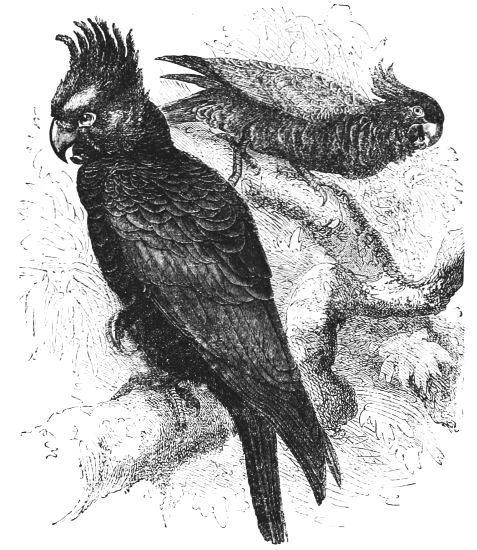
THE HELMET COCKATOO (Callicephalus galeatus).
Many species of Cockatoos are remarkable for the peculiar formation of their beaks, the upper part of which is unusually prolonged. These birds form a distinct group, but much resemble the true Cockatoos, and have therefore been placed among them. Such, for example, is
THE NOSE COCKATOO.
The Nose Cockatoo (Licmetis nasicus) is from sixteen to seventeen inches in length; the beak measures along the ridge about two inches. Both sexes are of the same colour, the whole plumage being white, the under-wing and tail-covers mottled with pale brimstone yellow. All the feathers on the head and neck as far as the upper part of the breast, are vermilion red, white at the tip; a vermilion stripe runs across the forehead, reaching to the back, and passes like a pair of eyebrows over the eyes. There is also a crooked line of red upon the breast. The beak is light horn colour, the feet ash grey. Some of the feathers near the cheeks can be raised at will. Gould considers that there are two species of this bird, one of which is found in Western Australia or New South Wales, the other is confined to Port Philip and Southern Australia.
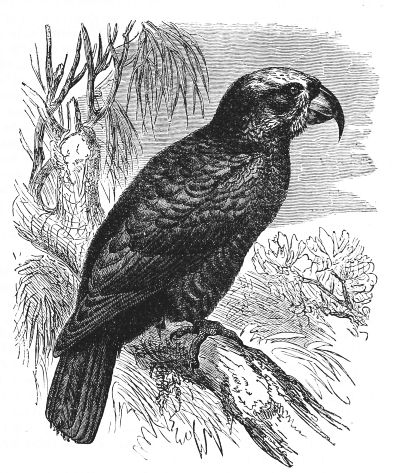
THE NESTOR COCKATOO (Nestor productus).
The Nose Cockatoos seem rather to inhabit the interior than the neighbourhood of the sea-coast. They assemble in large flocks, and spend the night and noon-day upon the summits of the forest trees; passing, however, a considerable portion of their time on the ground, where they run, or rather hop, somewhat slowly; their flight, on the contrary, is very rapid, and much lighter than that of their congeners. Their food consists of corn and seeds, but principally of buds and the bulbs of different plants, more especially of orchids, which they obtain by the help of their long and curiously shaped beak. The breeding of these birds offers nothing unusual; their two white eggs, which resemble those of the Tufted Cockatoos, are generally laid on a bed of decayed wood upon the ground, or in some hole in a large gum-tree. This species can endure captivity for many years, and has lately been brought to Europe in great numbers, but, notwithstanding this, it is not often met with in our collections. Gould has observed that a caged Nose Cockatoo is much more sullen, gloomy, and irritable than others of its race, and this we can fully confirm, having had for a year one of these birds in our possession, that has never become reconciled to its keeper, but threatens with its beak all who approach; it cannot endure to be stroked or touched, and everything unusual excites its rage; at such times it erects the small horseshoe-shaped crest upon its brow, so that the splendid red feathers are displayed, wags its head violently, repeatedly snaps its beak, and screams most furiously. The word "cockatoo" is mingled with its cries, but uttered in quite another tone to that employed by its congeners; the latter generally utter it in a soft drawling manner, whilst the Nose Cockatoo on the contrary pronounces the two first syllables hurriedly, and lays a strong emphasis on the last. The facility with which this parrot can move its beak in any direction is very remarkable, and no other species that we are acquainted with has such suppleness and command of the joints of its jaws. The beak of the Nose Cockatoo is, indeed, the most extraordinary pair of pincers that ever was constructed. In justice to this bird, we must add to the foregoing remarks that it may occasionally be made very tame, and not only learns to speak, but is able to apply its language very intelligently. There is one in the Zoological Gardens at Antwerp that is an universal favourite with the visitors, with whom it converses freely, greeting its acquaintances as soon as they appear, without the slightest ill-humour or sullenness.
THE NESTOR COCKATOO.
The Nestor Cockatoo (Nestor productus) represents a very remarkable tribe of parrots, recognisable by their extraordinarily elongated beak and sickle-shaped upper mandible, which projects far beyond the lower. The tail is of middle size, the points of the tail-feathers being in some places denuded of their web, and the wings, when closed, reach nearly to the middle of the tail. The tarsus is decidedly higher, and the plumage harsher and more imbricated than in other Cockatoos. In our specimen it is much variegated, the upper part of the body is brown, the head and back of the neck mottled with grey, each of the feathers covering these parts being bordered with a darker shade. The under part of the body and tail-covers are of a deep red; the breast, throat, and cheeks, are yellow, the latter having a reddish tint; the tail-feathers are orange at the root, and striped with brown: the inner web of the quills is dark red and brown; the bare place round the eyes, the legs, and the cere, are of an olive brown; the beak is brown; and the eye a very dark brown. Both sexes are similarly coloured, but the young are of a dark olive brown on the breast, instead of being adorned with the red and gold that decks their parents.
The Nestor Cockatoos are not only striking in their appearance, but lead a somewhat remarkable life; they are confined to a very limited district, only inhabiting New Zealand and the neighbouring islands. The bird we have just described is only found on Philip's Island, the circumference of which does not exceed five miles; and Gould informs us that people living for many years on Norfolk Island, at about four or five miles distance, have never seen it. The extremely limited extent of the habitat of this species is very unpromising as regards its preservation, and it will doubtless soon share the fate of the Dronte; since the cultivation of the island, it has been periodically hunted, and its days are numbered; probably it is already extinct, as we have seen nothing of it for several years. The rocky parts of the island, partially covered with trees, form, or rather did form, its favourite resort; here it passes its time, principally upon the ground, seeking for roots, which it digs up with its beak, at least, so we imagine, as the bill is often found covered with earth, and, indeed, we can well believe that so remarkable an instrument may be employed for this purpose. According to some naturalists it sucks nectar, although its tongue does not, like that of the Lory, end in a tuft, but has only a nail-like horny plate at the tip, closely resembling the nail upon a human finger. The hard nuts that other parrots enjoy are avoided by the Nestor, whose beak is not strong enough to break the shell. Gould saw one of these birds in the possession of Major Andrews, in Sydney; it was a cheerful, lively companion, and seemed fully inclined to attract the attention of strangers. Its habits differed considerably from those of other parrots, and its owner did not keep it in a cage, but allowed it to fly about the entrance-hall. We are told of another tame Nestor that it had a great fondness for green food, and would pick the leaves of lettuce and other juicy plants. The voice of this bird has a harsh, quavering, snarling sound, much reminding us of the barking of a dog. As regards its propagation, we only know that it is said to lay four eggs in some hole in a tree.
THE EAGLE COCKATOO.
The Eagle Cockatoo (Dasyptilus Pequetii) belongs to the same division as the last-named species, and is remarkable for its shape and plumage, reminding us, in some respects, of the birds of prey. Nothing positive can be said as to its native land; Gould tells us that it lives on the island of Formosa, where no other parrots are known, but it would rather appear to be an inhabitant of New Guinea or Salawatti; indeed, Rosenberg speaks decidedly as to the first-named island being its home. The Eagle Cockatoo is about twenty inches long, ten of which are included in the tail; the wings are ten and a half inches in length. This species is recognised by its beak, the upper portion of which does not rise so high above the lower mandible as in the Nestor; and by the plumage of the head, consisting of a few stiff bristles and slender upright feathers, with very stiff hard shafts. The cheeks and cheek-stripes appear almost bare, the wings and tail are shaped like those of the last-mentioned bird, though the tail is somewhat longer and more rounded. The plumage is of a brilliant black, shading into grey on the throat, head, and breast, the feathers on these parts being sprinkled with pale brown. The wing-covers along the carpus, the first wing-covers of the secondary quills, the under wing-covers, the five first feathers of the secondary quills on their outer web, the feathers of the axilla, belly, and rump, are of a beautiful scarlet, which is somewhat darker on the under tail-covers; the upper tail-covers are edged with dark red, the beak is black, and the feet dark brown. Notwithstanding the extreme rarity of this creature, we have been able to take our description from a living bird which was for some time in the Earl of Derby's celebrated collection.