EDWIN ELIOTT WILLOUGHBY Printers' Marks
Reading edition


From Fifty Printers' Marks by Edwin E. Willoughby. Copyright 1947 by the author and reprinted by his permission. Published by the University of California Press.
A printer's mark is a trade-mark. Printers used them in the fifteenth, sixteenth and seventeenth centuries for the same purpose that printers employ them today—to ornament their books and to make each volume readily recognizable as the product of the printing establishment which produced it.
The printer's mark was but one of the many types of marks which, largely because of the widespread illiteracy of the people, were used throughout all phases of medieval life. The ownership of objects, for example, was often shown by means of a regularly used mark. Two examples of this type of mark, the seal and the cattle brand, go back to the dawn of history and have continued in use to the present time. Merchants in the Middle Ages often identified their property by placing on it their merchants' marks.
The mark of a merchant was legally recognized as his by his guild or by the town government. Often it was a representation of the tools of the man's trade or a replica of his house sign. Sometimes it was an animal or object which formed a pun on the merchant's name. Frequently, simple geometric designs were used. Toward the latter part of the Middle Ages, as merchants grew richer and more powerful, they aped the upper class by making their marks resemble, as closely as they dared, the heraldic devices of the knights and nobles. These marks enabled employees or hired porters to recognize at a glance a merchant's property.
Places, as well as objects, were identified by means of marks. Inns, shops and similar public places in those days before houses were numbered were designated by house signs. The Tabard, the inn from which Chaucer's pilgrims started for Canterbury under the leadership of its host, Harry Baillie, took its name from its sign—a representation of a short outer jacket. An equally famous tavern, patronized by Shakespeare, Ben Jonson and other "sirenical gentlemen," bore the "Sign of the Mermaid." And over the door of the Globe, Shakespeare's theater, hung a picture of Atlas bearing the world on his shoulders.
Printing houses, like other business establishments, were known by house signs. The printer's mark of Adrien van Berghen supplies an illustration. [Page 48.]
Not only were objects and places designated by marks in the Middle Ages, but under certain conditions people were recognized by them also. A knight, his face obscured by his helmet, made his identity known by wearing on his helmet, shield and tabard simple pictures or symbols by which he could be recognized. As it was usual for members of the same family to wear the same emblems, these simple pictures, many of which became conventionalized, descended from father to son, indicated relationships, and finally developed under the control of officers of the king into the elaborate system of heraldry.
Marks, then, were widely used in the Middle Ages. It was inevitable that they should be used to identify the makers of manufactured goods. Craftsmen with pride in their work naturally desired others to recognize their products. As a result, the use of trade-marks became common. Craftsmen of every trade were frequently compelled either by law or by guild regulations, to affix a mark to their products as a guarantee of their honesty and good workmanship. Such marks were required especially of goldsmiths, silversmiths and other artisans who were under unusual temptation to misrepresent the quality of their goods. In England, to take another example, arrowheads, the quality of which might determine the issue of a battle, were ordered, by a statute of Henry IV, to be "marked with the mark of him who made the same."
These trade-marks performed much the same function as the house mark or the merchant's mark; indeed, the three were often the same. They enabled a purchaser, literate or illiterate, to identify the maker of a product and to buy thereafter according as he had been satisfied or displeased with the first article purchased.
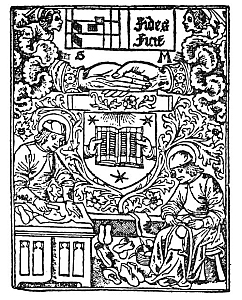
GUY MARCHANT printed his first book at Paris in 1483. His motto, Sola fides sufficit (Faith alone suffices) appears above the clasped hands, with the first word represented by the musical notation, sol and la.
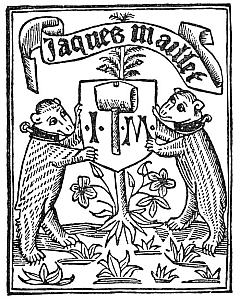
JACQUES MAILLET began publishing at Lyons in 1482, and probably began printing at the same time. His mark represents a shield, supported by two dogs, which bears his initials and a mallet (maillet in French), hanging from a tree.
The printer, to be sure, was under few of the compulsions to use a trade-mark that beset his fellow craftsmen. His patrons were literate; they could read his name and address—when he chose to set them down—either in the colophon at the end of the book or on the title page. But the example of other craftsmen was not to be resisted. Besides, a well-made printer's mark, or a publisher's device, could be both useful and ornamental. Put at the end of the book, it could give it a fitting close. Used in the middle of a book, it could set off chapters and parts. Above all, especially when it was printed in red, it could give life and balance to a title page.
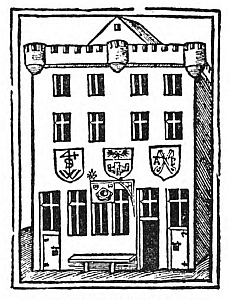
ADRIEN VAN BERGHEN in his mark pictures his printing house "at the Sign of the Great Golden Mortar in the market place" at Antwerp, where he started in 1500.
By the printer's mark, also, a prospective purchaser could recognize at a glance the product of a press. It could prevent a careful purchaser from being deceived by a false imprint. "Look at my sign," warns Benedictus Hector of Bologna, "which is represented on the title page and you can never be mistaken." It was harder to counterfeit a printer's mark than to filch his name.
Even a mark, however, was not infallible protection. The "prince of printers," Aldus Manutius, complains that his Florentine competitors "have affixed our well known sign of the dolphin wound around an anchor. But," he adds, "they have so managed that any person who is in the least acquainted with the books of our production cannot fail to observe that this is an impudent fraud; for the head of the dolphin is turned to the left, whereas that of ours is well known to be turned toward the right."
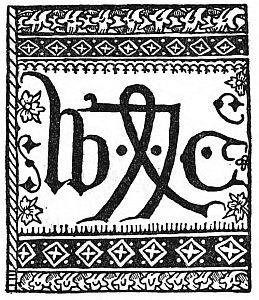
WILLIAM CAXTON, the first English printer, printed his own translation of a French romance, Recuyell of the Histories of Troy, in 1474. At his press at Westminster he completed nearly eighty books between 1477 and 1491, many of which he also translated from the French.
In one country only, and there for but a brief period, was the use of a mark made compulsory. In 1539, François I, in an act intended to suppress both the piracy of copyrighted works and the printing of heretical books, ordered every printer and book-seller in France to have his own device so that purchasers might easily ascertain where books were printed and sold.
Although (with this exception) the use of marks was voluntary with printers, they were early adopted. In 1457 Fust and Schöffer, the successors of Gutenberg, first employed one in the Mainz Psalter, the first book to contain the name of the printer and the place and date of printing. [Page 39.] The device consisted of two shields resembling coats of arms. Other printers quickly followed their example. As the fifteenth century saw the rise of the mercantile class, it is not surprising that printers used in their marks heraldic devices, if they had the right to bear arms, or shields displaying their merchant's marks in a manner often resembling armorial bearings.
Frequently, printers used as the central part of their marks the signs which served to designate their places of business. Pierre LeRouge, for example, used a red rosebush for his sign and in his device. The London printer, Berthelet, used in like manner the figure of Lucrece.
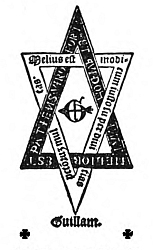
WILLIAM FAQUES began printing in London about 1503. His mark represents a hexagram of interlocking triangles bearing biblical quotations, which enclose his monogram pierced by an arrow. The initials "GF" are those of the French form of his name.
If the printer's name could be punned on, it was common to use for a mark an object the name of which sounded like the printer's own. Jacques Maillet's surname means mallet. He made it easy to remember by displaying a mallet in his device. [Page 47.] A few printers, among them Aldus Manutius, John Day, John Wight and Willem Vorsterman, even used their own portraits in their marks.
Many other signs and emblems were employed. In an age fond of symbolism it is not surprising to find that many marks had symbolic and mystical meanings—not only in the earlier period, when ecclesiastical symbols were often used, but in the later period also, when devices were frequently copied from emblem books. Sometimes a printer would use a woodcut to illustrate a book and then, because it struck his fancy, adopt it as his mark. Thomas Gardiner and Thomas Dawson, partners, on the other hand, had a block which contained, around a central open square, figures forming a rebus of their names: a gardener, a daw and the sun. With their initials in the open square, it served as a mark; with the appropriate display letter, it was a factotum bearing the initial letter of the first word of a chapter.
Printers' marks, in fact, took a multitude of forms during the fifteenth, sixteenth and seventeenth centuries. In the late seventeenth, eighteenth and early nineteenth centuries, they became conventionalized and were used infrequently; but they did not die out altogether. The Oxford and Cambridge University presses, for example, continued to put them on the title pages of their books.
The revival of printing late in the nineteenth century saw an increased use of the printer's mark. This was almost inevitable, for when the craftsmen strove to do fine printing, they desired, just as did the craftsmen of the fifteenth century, to have their work easily recognized. Today, private presses which specialize in fine printing, some university presses, and many publishing firms, frequently use marks which both ornament their title pages and identify for the reader the creator of the volume.
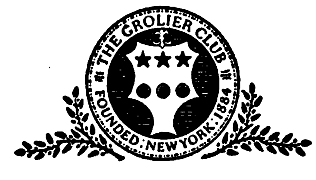
THE GROLIER CLUB. A rendering of the Club's familiar mark by Rudolph Ruzicka.