Colophons. Ruth S. Granniss
Reading edition

Copyright 1930 by The Colophon. Reprinted by permission of the author.
The late printer-scholar, Theodore Low De Vinne, was wont to exclaim with regret over a puzzling bookish question, "Alas, bibliography is not an exact science!" Since his day, what with the learned publications of bibliographical societies (first and foremost—that of England), with such scholarly independent productions as Ronald B. McKerrow's Introduction to Bibliography and some of its followers, and with such undertakings as the Gesamtkatalog der Wiegendrucke—not to speak of the many masterly library catalogues and bibliographies which these late years have brought us—we are almost tempted to reverse his dictum. We have all these, added to the wealth of pioneer writings of book-lovers like Richard de Bury, Gabriel Naude, Guillaume François De Bure, Gabriel Peignot, Thomas Frognall Dibdin, and the more scientific but no more (nor less) book-loving Panzer, Hain, Brunet, Renouard, Bradshaw, Haebler, Proctor, Claudin, and our own Wilberforce Eames. We pause for breath, but have only picked a few random names from the long roll of those who have loved and worked for the arts that go into the making, and the science that goes into the understanding of a printed book—the vehicle which must continue to preserve and to carry down through the ages the results of men's thoughts and the records of their deeds.
All this is as it should be, but of late, and especially in connection with the present vogue for collecting the works of living authors, a certain quality (shall we call it self-consciousness) has crept in, an undue stressing of small technicalities, and we blush to confess a confused feeling of sympathy for the modern book-hunter, who is having so much of his fun taken away from him by neat little textbooks and articles, bristling with allusions to "points," "right copies," "firsts" and the like (with the inevitable quotation marks) and filled with weighty questions of dollars and pounds—the seemingly all-important matter of the investment value of our treasures. This surely is not the fine frenzy which possessed Charles Lamb when he wrote: "Do you remember the brown suit which you made to hang upon you, till all your friends cried 'Shame upon you!' It grew so threadbare—and all because of that folio 'Beaumont and Fletcher,' which you dragged home late at night from Barker's in Covent Garden. Do you remember how we eyed it for weeks before we could make up our minds to the purchase, and had not come to a determination till it was near ten o'clock of the Saturday night, when you set off from Islington, fearing you should be too late. And when the old book-seller with some grumbling opened his shop, and by the twinkling taper (for he was setting bedwards), lighted out the relic from his dusty treasures, and when you lugged it home, wishing it were twice as cumbersome, and when you presented it to me, and when we were exploring the perfectness of it (collating you called it), and while I was repairing some of the loose leaves with paste, which your impatience would not suffer to be left till daybreak—was there no pleasure in being a poor man!"
Where there is much smoke, however, there is fire, and it is assuredly good that this interest in bibliographical things should have swept the country, and incidentally that the joys of the bibliomaniac and the bibliophile are being experienced today by many more than the elect few of the past, on whom we love to dwell. But if we moderns are doomed to buy our first editions ready labelled and to have our equations worked out in advance, if a fine copy must be termed immaculate and the back of a book must be its spine, etc., etc., ad infinitum, let us start with the right premises, and hold on to the terms which were proverbial before we were born. Which brings us to our point—What is a Colophon?
The question would seem a reflection upon the intelligence of the average book-lover, at this late day, were it not that there seems to be a growing tendency, shared (even instigated) by lexicographers, to mis-define the word, or to use it out of its truly bibliographical and philological meaning. To book-lovers and collectors of even the preceding generation, acquainted as they were with the niceties of their vocation, or avocation, the suggestion of more than one signification would have seemed well-nigh an insult. Perhaps it is even because we are living in this late day that heresies have crept in. After all, it is nearly a quarter of a century since the Caxton Club of Chicago brought out An Essay on Colophons, by Dr. Alfred W. Pollard, later Keeper of Printed Books at the British Museum, whose word on all bibliographical matters carries the highest authority—the Club thereby performing one of those great services to students of bibliography for which it and similar institutions are acclaimed by an appreciative, if limited, circle. Perhaps the very limits of the circle are accountable for lack of knowledge, and it may be that a book, printed nearly twenty-five years ago in an edition of some two hundred and fifty copies, may never have come within the ken of a writer on bookish things today—even of an earnest one. But that is just where our quarrel begins—ought anyone to write on colophons, or on anything else, without some knowledge of at least the chief literature of the subject, and should the next man, and the next, be allowed to hand on an error, or perhaps a misconception, without a thought of the original sources of information? For that is just what has been happening in America in this matter, and what it seems must also be occurring in greater ones. There is plenty of thorough scholarship here, scholarship that shrinks from no drudgery—then why is it that so much hasty, slipshod work is allowed to pass?
But we were speaking of colophons—a word which, to many people who trouble with it at all, seems to mean almost anything,—for instance the mark or device of a printer or publishing firm, placed anywhere at random in a book, possibly bearing a motto or a name. Indeed, this is the signification which has frequently been given to it of late in print and in common speech by people who should have known better, and whom a little thought or a little more research would have taught better. For instance, a publisher's assistant suggested that a given place upon the title page is the proper location for the colophon; a librarian wrote to request a copy of the "colophon of the Grolier Club" to add to a collection; a book-trade magazine issued an article on devices or trade-marks of publishers of today, appearing on the title pages of their publications, and dubbed them all colophons; a college professor used the term in like manner; and all this occurred within a period of a few months.
The only protest to be raised in print seems to be that of Leonard L. Mackall, in his dependable "Notes for Bibliophiles," a department of the Herald Tribune's Sunday magazine, Books. In the issue of March 17, 1929, he wrote: "Right here we must call special attention to the fact that, some modern ignorant or careless misuse to the contrary, notwithstanding, a colophon is not really a colophon at all unless it appears at the end of the book. Most certainly the word does not properly mean merely a publisher's device wherever used, as stated in a [recent] anonymous illustrated article."
No one has heeded him, however, and my own like-minded objections were met with the advice to look in the dictionary, and then the blow fell! It is true that some dictionaries, but by no means all, countenance this usage of colophon as a device upon a title page. Before quoting their definitions, let us look at the Oxford English Dictionary, where we find:
1. "Finishing stroke"; "crowning touch," obs.
2. The inscription or device, sometimes pictorial or emblematic, formerly placed at the end of a book or manuscript, and containing the title, the scribe's or printer's name, date and place of printing, etc. Hence, from title page to colophon.
It may be noted that, of the various examples (1774-1874) quoted by the Oxford English Dictionary, not one refers to the colophon as placed elsewhere than at the end of the book.
Our Century Dictionary is sound on the subject, but we have in Funk & Wagnalls' Standard Dictionary:
1. An inscription or other device formerly placed at the end of books and writings, often showing the title, writer's or printer's name and date and place of printing.
2. An emblematic device adopted by a publisher and impressed on his books, usually on the title page of each volume (accompanied by an illustration of the printer's mark of Nicolas Jenson, inscribed: "Colophon of Nicolas Jenson" [1481]).
The phrase "usually on the title page" (not in the Oxford English Dictionary) seems to us absolutely wrong, and not to be countenanced for a moment by bookmen who have proper regard for the correct usage of words.
The corresponding definition in late editions of Webster's Dictionary is:
An emblem, usually a device assumed by the publishing-house, placed either on the title page, or at the end of a book.
In what subtle way this secondary and inadequate definition has crept into American usage we do not know, and we plead earnestly for its abandonment.
In the encyclopedias consulted, there is nothing disturbing, the definition of the Encyclopaedia Britannica, written by Dr. Pollard, being especially clear and concise. It runs in part as follows:
... a final paragraph in some manuscripts and many early printed books, giving particulars as to authorship, date and place of production, and sometimes expressing the thankfulness of the author, scribe or printer on the completion of his task ... the importance of these final paragraphs slowly diminished, and the information they gave was gradually transferred to the title page. Complete title pages bearing the date and name of the publishers are found in most books printed after 1520, and the final paragraph, if retained at all, was gradually reduced to information as to the printer and date. From the use of the word in the sense of a "finishing stroke" (from the story that the final charge of the cavalry of Colophon was always decisive) such a final paragraph as has been described is called by bibliographers a "colophon," but this name for it is quite possibly not earlier than the eighteenth century.
Let us turn from general works to those specifically bibliographical. In his Introduction to Bibliography,[2] Dr. McKerrow writes: "In the early days of printing, the end of the book was the normal place for the printer's name and the place and date of printing to appear. The history of the colophon is merely that of the gradual transference of this information to the title page. When this was complete the colophon was as a rule of no use and it was abandoned."
Later, among his cataloguing instructions we find: "A colophon should always be noticed, if there is one. It is also, I think, desirable to record the occurrence of a printer's device (even without a verbal imprint) at the end of a book, as this often appears to take the place of a colophon."
Iolo Williams' Elements of Book-Collecting[3] contains this paragraph: "In the earliest printed books the title page's functions were performed by the colophon, a word which is a transliteration of the Greek, a summit or finishing stroke. The colophon is put, not near the beginning of the book, like the title page, but at the end, and it usually takes the form of a statement that here ends such-and-such a book, written by so-and-so, printed by so-and-so at such-and-such a place and date. The use of the colophon has been revived in certain finely-printed modern books, but such modern volumes usually contain both a title page and a colophon."
Though not quite as satisfying, the following allusion in Van Hoesen and Walter's Bibliography[4] should be quoted, as occurring in a modern American treatise on the subject: "The early printers used the colophon at the end of the book instead of a title page, and the colophon is still used to indicate the printing firm in cases where it is not part of the publishing firm given on the title page."
These are the latest printed words that we have noticed. Suffice it to say that we have nowhere found in earlier important manuals anything but the (to us) proper explanation of the term. In other words, we gather from important sources that, while a colophon may include or even take the form of a printer's mark or device, such a mark, placed upon a title page, is not a colophon.
Aroused by the dictionary findings, and discovering those American students of bibliography whom I consulted to be in agreement with me, I wrote to Dr. Pollard, as to a court of final appeal, to inquire if he considered it meticulous to object to the intrusion of this illogical trade definition which some dictionaries and many people are giving us. His answer, which I am allowed to quote, seems definite and wise enough to carry conviction, coming as it does from the admitted authority on the subject: "If a sufficient number of people misuse a word, Dictionaries have to record the wrong use as well as the right, as in the case of hectic and crowds of other words. But the misuse of the word colophon as a synonym for the printer's mark or device, without regard to position, has not yet gone as far as this and should be strenuously resisted. By standard use as well as by etymology, the word means the crowning stroke, or finishing touch, to a book or part of a book, and it must come at the end of the book, or part of a book, rightly to be given this title.
"In cataloguing early books it would not in my judgment be incorrect to enter the printer's device at the end of a book, under the heading colophon."
And now, the unpleasantly controversial side of the matter having been disposed of (if so large an adjective as controversial may be applied to so small a paper), let us devote our little remaining space to the colophons themselves, first turning our attention to Dr. Pollard's book,[5] with his own rendering into English of the unwieldy fifteenth-century Latin.
In the introduction, Dr. Richard Garnett gives a brief sketch of the derivation and earliest uses of the term. He quotes the Greek word colophon, the head or summit of anything, usually used in a figurative sense, the position on a crest of the City of Colophon (whence its name), the first appearance of the word in the seventeenth century, with its secondary classical sense of a "finishing stroke" or a "crowning touch," and goes on to say: "Of the use of the word colophon in the particular significance elucidated in this essay—the end or ultimate paragraph of a book or manuscript—the earliest example quoted in the New English Dictionary is from Warton's History of English Poetry published in 1774. A quarter of a century before this it is found as a term needing no explanation in the first edition of the Typographical Antiquities of Joseph Ames, published in 1749. How much older it is than this cannot lightly be determined. The bibliographical use appears to be unknown to the Greek and Latin lexicographers, medieval as well as classical. Pending further investigation, it seems not unlikely that it may have been developed out of the secondary classical sense already mentioned sometime during the seventeenth century, when the interest in bibliography which was then beginning to be felt would naturally call into existence new terms of art."
While acknowledging the great interest that many authors have found in individual colophons, Dr. Pollard states that his task is the more ambitious, if less entertaining one of making a special study of this feature in fifteenth century books with the object of ascertaining what light it throws on the history of printing, and on the habits of the early printers and publishers. His first conclusion being that colophons are the sign and evidence of the printer's pride in his work, he draws attention to the utter lack of such information as they give in the very earliest books of all, as contrasted with the self-glorification of Fust and Schöffer when, printing independently, they affixed the first known printed colophon to their Psalter of 1457 (in at least one copy accompanied by their device):
The present copy of the Psalms, adorned with beauty of capital letters, and sufficiently marked out with rubrics, has been thus fashioned by an ingenious invention of printing, and stamping without any driving of the pen. And to the worship of God has been diligently brought to completion by Johann Fust, a citizen of Mainz, and Peter Schöffer of Gernsheim, in the year of the Lord 1457, on the vigil of the Feast of the Assumption.
Of Peter Schöffer's later allusion to the shields of his device Dr. Pollard writes: "Needless discussions have been raised as to what was the use and import of printers' devices, and it has even been attempted to connect them with literary copyright, with which they had nothing whatever to do, literary copyright in this decade depending solely on the precarious courtesy of rival firms, or possibly on the rules of their trade-guilds. But here, on the authority of the printer who first used one, we have a clear indication of the reason which made him put his mark on a book—the simple reason that he was proud of his craftsmanship and wished it to be recognized as his. 'By signing it with his shields Peter Schöffer has brought the book to a happy completion.'"
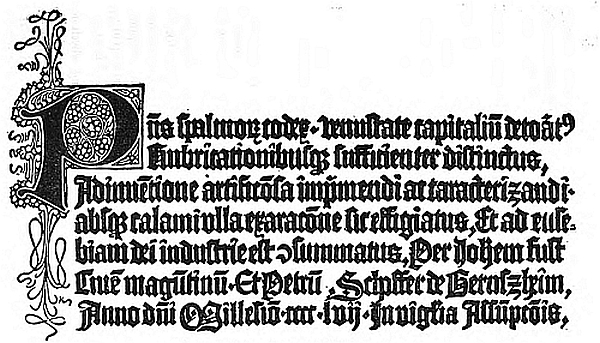
Psalter. Mainz, Fust and Schöffer, 1457. THE FIRST PRINTED COLOPHON.
Again he calls attention to the boast of John of Speier at Venice, "primus in Adriaca formis impressit aenis," by which he asserts his individual priority over any other firm in that city. And here is the rhyming colophon used by the same John, in which he boasts with some ambiguity of the number of copies of Cicero which he has printed in his two editions:
From Italy once each German brought a book. A German now will give more than they took. For John, a man whom few in skill surpass, Has shown that books may best be writ with brass. Speier befriends Venice; twice in four months has he Printed this Cicero, in hundreds three.[6]
In wording their colophons, the early printers were only following the constant practice of medieval scribes, of whose many colophons a selection of examples is given in Bradley's Dictionary of Miniaturists.
The moving of printers from one town to another, transference of their stocks, their quarrels, their boastings and pleas for favor with those in high places, all are followed, and much information gathered in the Essay. There is simple pathos in the colophon of the Chronicles of the londe of England printed at Antwerp in 1493, which records the death of its famous printer, Gerard Leeu,
a man of grete wysedom in all manner of kunnyng; whych nowe is come from lyfe unto the deth, which is grete harme for many of poure man. On whos sowle God almyghty for hys hygh grace haue mercy. Amen.
"A man whose death is great harm for many a poor man must needs have been a good master, and a king need want no finer epitaph," writes Dr. Pollard.
The days when we find the book trade highly organized and the functions of printers and publishers clearly separated, are pictured in the following colophon:
Here you have, most honest reader, six works, etc. It remains, therefore, for you to make grateful acknowledgement to those who have produced them: in the first place to that eminent man Master Simon Radin, who saw to their being brought to light from the obscurity in which they were buried; next to F. Cyprian Beneti for his editorial care; then to Jean Petit, best of book-sellers, who caused them to be printed at his expense; nor less than these to Andrieu Bocard, the skilful chalcographer, who printed them so elegantly and with scrupulous correctness, June 28, 1500. Praise and glory to God.[7]
Here are men making aspersions on the editions of rival publishers, with warnings against them:
Here end the Decretals, most correctly printed in the bounteous city of Rome, queen of the whole world, by those excellent men Master Ulrich Han, a German, and Simon di Niccolo of Lucca: with the ordinary glosses of Bernard of Parma and his additions, which are found in few copies; both printed and corrected with the greatest diligence. Purchase these, book-buyer, with a light heart, for you will find such excellence in this volume that you will be right in easily reckoning other editions as worth no more than a straw.[8]
We find that the Nuremberg Chronicle is the only book which Dr. Pollard can call to mind that gives explicit information as to its illustrators, Michael Wolgemut and Wilhelm Pleydenworff; and finally we come to books where the author takes a hand, and we sometimes have a double colophon, as in the case of the Morte d'Arthur. Here we have Sir Thomas Malory's colophon, requesting the reader's prayer for his deliverance, and for the repose of his soul, and William Caxton's business-like statement as editor, printer and publisher.
The author's struggle with the printer, to obtain his own way, is no new thing, as proved by this late colophon of the musician, Johann von Cleve, affixed to his Cantiones, 1580:
As I come to the end of my task it seems worth while to inform students and amateurs of music that this collection of Motets was in the first place entrusted to Philip Ulhard, citizen and printer of Augsburg, to be printed, and that he (as often happens), being made unreasonably capricious by bodily ill-health, often did not carry out our intention, and compelled me, by leaving out some motets (which however, if life bears me company and God helps, will shortly be published), to abridge the work, and more especially as the same printer, when the work was not yet finished, came to an end of his days, and there upon the work was entrusted to Andreas Reinheckel to be completed, if anything, therefore, is found which might disturb a connoisseur, I pray musicians to bear with it with equanimity. Farewell. In the year of the Lord 1580, in the month of January.
We have noted one rhyming colophon, a mannerism much affected by Italian printers. Another fanciful custom by which the early printers called attention to their colophons was the use of eccentric arrangements of types, by which these final paragraphs appeared in the shape of wedges, funnels, diamonds, drinking glasses and the like.
The earliest known title page is in a Bull of Pius IX, printed in Mainz by Fust and Schöffer in 1463, but it was some twenty years before the custom became common. At first the title only, taking the form of a single sentence, appeared at the top of a title page, but it was not long before, either in the interests of decoration or of advertising, a simple woodcut or the device of the printer appeared below the title. In his A Treatise on Title-pages, 1902, Mr. De Vinne proposes the following ingenious explanation of the evolution of the printer's mark: "It was hoped that the distinctiveness of a peculiar device would be remembered by the book-buyer who had forgotten the name of his preferred printer.
"In the beginning the device was put at the end of the book, above or below the colophon. It was at first a small and simple design ... but the eagerness to have a device that should be striking led to its enlargement and afterward to an entire change of position. When the greater part of the last page was preoccupied by the last paragraph of the text, the device required a separate page. This led to making full-page devices and afterward to the putting of the device on the first page."
As time went on it was only natural that the remaining space at the foot of the title pages should be utilized for brief details of printing and publishing, but the transition was gradual and unsystematic. Indeed, some printers continued to use colophons alone well into the sixteenth century, and there are frequent instances during that century of books containing both title pages and colophons, the latter being a repetition, at the end of the book, of the imprint, as the few business-like lines at the foot of the title page had come to be named.
By the time that title pages were firmly established, publishing had become a separate business, and the publisher was not long in assuming the ascendency, often pushing the printer altogether into the background and appearing alone in the imprint. For a long time the printer modestly tucked in his name wherever he could, sometimes on the verso of the title page, and sometimes at the bottom of the last page, but in a formal manner, without the naive and often delightful and useful details which make the early colophons so interesting.
With the nineteenth-century revival of interest in typography, the printer came to the fore again and we see his name appearing in a new place, the certificate, preceding the title page—an entire leaf, moreover, on which are set forth the details in which he is interested, the paper, number of copies, and so on. This use seems to have been introduced by the finely printed volumes of the French book clubs, with their "Justification du tirage," and it was followed through the later decades of the nineteenth century, in the publications of book clubs and many other privately and finely printed volumes. Simultaneously with these came the publications of the Kelmscott and other private presses, which revived the use of colophons in the early manner. The separate page, placed at the end of the finely printed book of today, giving details of the making of the volume, is the result of this modern impetus in book-making[9]—the interest in fine production of the person for whom the book is made, added to the desire of the modern printer for recognition of himself as the producer.
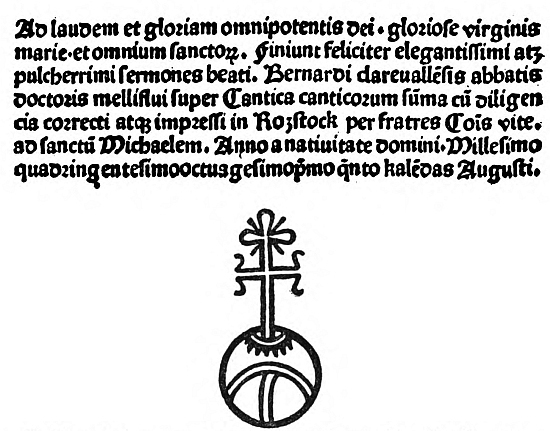
St. Bernard. Sermones. Rostock, Fratres Domus Horti Viridis, 1481. COLOPHON WITH PRINTER'S MARK.
This is but the very logical expression in the books themselves of the modern trend, so assiduously cultivated, toward the making of good books, and the return to prominence of the printer after the long period of his subservience to the publisher. In the present-day notice of its makers, on the final page of a book, the colophon is revived, and once more the printer has the last word!
COMPOSED IN GARAMOND TYPES
FOOTNOTES: