ALFRED W. POLLARD The Trained Printer and the Amateur: and The Pleasure of Small Books
Reading edition


From the Centaur announcement booklet, Lanston Monotype Corporation, Ltd., London, 1929.
Printers, as a class, like all other craftsmen, can only thrive by supplying their customers with what they want at prices which they are willing to pay. Here and there an exceptionally gifted and courageous craftsman may rely on being able to obtain a better price for better work, and be rewarded for his confidence, but success will always depend not only on himself but also on two external factors over which he has very little control; the existence of enough customers, or potential customers, able to recognise better work than that which they have been getting, and the ability and willingness of these customers to pay a higher price for it as long as a higher price is necessary for its production. But occasionally the discriminating customer (or potential customer) may not find a master-craftsman able and willing to do for him what he wants, and if so, if he cares enough about it to be an enterprising amateur, he starts a press of his own to print the books he wants as he thinks they ought to be printed. Very often he fails; almost always he finds that he must engage at least one skilled journeyman to help him through. But occasionally he succeeds, and when he succeeds he brings new life into the craft of printing.
Definitions of what constitutes an "amateur" have always proved difficult. The two characteristics of the class of which I am thinking are that they have been readers and lovers of books before they have become printers and that they will not knowingly print any book badly for the sake of making a profit off it. As a rule they will only print the books they like, and they will print them according to their own standards. That some of them have made a good living by their work, does not alter their status.
In the early days of printing amateurs abounded, but not at the very first. When printing was invented it was applied first of all to multiplying a few much-used Latin grammars and calendars for which there was a large and steady sale, because the production of manuscript copies had been too slow and too expensive. These early efforts, which have come down to us mainly in fragments found in binding, are rude and ugly enough. There is no evidence of any effort to make them beautiful for the sake of making them beautiful, and there was no need to do so. Fifteenth-century schoolmasters did not cosset their pupils with pretty school-books; they beat them. Their standard in printing was strictly utilitarian. But when the adventure was once undertaken, whether it was by Gutenberg, or by Fust and Schöffer, of printing large Bibles for use in church, there was at once admitted a standard of dignity, and this the Church for centuries did more than any other body to maintain. Furthermore when the goldsmith Fust and the scribe Peter Schöffer, greatly daring, set themselves to produce psalters for use in choir which, by red printing and by large and small capitals in red and blue, should rival the beauty of the hand-written and hand-painted psalters then in use, to the dignity of the first Bibles there was added beauty and charm, and in a few years bookmen all over Europe were eager to apply the new craft to multiplying the books in which they were specially interested. A few secular highbrows stood aloof. As some old ladies still drive out in their carriage and pair (a very pleasant and dignified way of getting about) and abjure motor-cars, so there were a few great bookmen who clung to manuscripts and would not have a printed book in their libraries. In the same way for some twenty years bishops looked askance at presses and types, and it was not until 1474 that a printed missal was placed upon an altar, and not until 1479 that more than two editions were printed in any year, or anywhere outside Italy. But when Milan and Rome had continued to set the example, German bishops were content to follow it, and when they decided to print they found a vigorous way of maintaining a high standard. They commissioned the best printer they could get to do the work; they allowed him to charge an agreed price for it, and they obliged every Church in their province or diocese to provide itself with a copy before a specified date.[33]
In France in several instances a Bishop, or the Canons of a Cathedral, arranged with a printer to come to the Cathedral town and print a missal or breviary under their supervision. These good men were perhaps rather amateur publishers than amateur printers working private presses with a hired man to do the heavy work. But if we choose to think of them only as customers, they were customers who knew what they wanted and brought the printer under their roof as the best means of seeing that they got it.
As regards the printing of secular books in the fifteenth century, since the craft was a new one, it was necessarily run in the first instance by men who had been brought up in other occupations. In this sense nearly every native printer outside Germany was an amateur. At the outset the newcomers were largely clerks in minor orders and professional scribes; but merchants, professors and men of letters generally were attracted to the new craft, many of them doubtless only to make money, others to print books in which they were specially interested. Even more than in the case of the bishops or canons who commissioned missals and breviaries, we must think of this motley crowd of recruits rather as amateur publishers than amateur printers. It may be doubted whether even Caxton (who was by trade a mercer) in all his fifteen years in the business, set up the equivalent of one of his small folios with his own hands. He started his press because he wanted to get his books into print as the easiest way of circulating them; but there are no signs that he took any special interest in fine printing for its own sake, or took any joy in producing a handsome book. His standards were those of a competent but unenterprising scribe, who only wanted to set his words down accurately on the page so that they could be easily read. The master printers all over the Continent of Europe, when they had the courage to stand out against the pressure to cut prices or increase profits by using cheaper and cheaper paper, and crowding more on to it, were doing much better work than Caxton, and when they found customers who encouraged them to do their best, their work altogether outclassed his.
When we turn to the scholar-printers of the sixteenth century I think it would be hard to deny the claim of Aldus and the Estiennes to a disinterested love of good printing, as well as a desire to get the books in which they were interested into print. It is true that the rich scholars of Italy and France were used to a high standard of excellence in the books, manuscript or printed, which they put on their shelves, but it is to the credit of Aldus and the Estiennes and Simon Colines and Geoffroy Tory that they catered also for the needs of less wealthy scholars, not by cheapening paper or crowding more old types on a page, but by designing, or causing to be designed, new fonts, with which they could print more economically without loss of beauty. Moreover, more especially at Lyons, the new ideals of compact printing, of the small book beautiful, were applied to printing not only in Greek and Latin, but in the vernacular, and these sixteenth century models can still be imitated without archaism or ostentation, which, when fifteenth century masterpieces are followed, are often difficult to avoid.
"A penny, I trow, is enough for books," said one of Robert Copland's customers to him, somewhere about 1530, and the spirit of that remark haunted the vernacular English book trade for nearly a century and a half. Amid all the outpouring of the wonderful Elizabethan and Jacobean literature, though no printing was allowed in the provinces except at Oxford and Cambridge, there was not a sufficient demand for books in all England to provide work for more than about five and twenty master printers many of whom had only a single press, with a couple of journeymen and an apprentice. The Privy Council was always trying to keep down the number, both of printers and presses, and its action in so doing is usually represented as solely dictated by the fear of their being employed in producing seditious or schismatic pamphlets. No doubt this fear was the main cause of the Council's action. But if there had been enough lawful work for twice as many printers and presses, the number might have been doubled with no increase of risk. The risk lay solely in the fact that a man who owned and could use a press, if he could not get enough lawful work to give him a living, might be tempted to take secret work. Unless they were desperate, men would not risk hanging to earn a few shillings, or a few pounds, but there is ample evidence that in Shakespeare's day some of the small master printers really were desperate, and it was only natural that they should do bad work—as indeed they did. All over Europe printing at the beginning of the seventeenth century was bad; in England it was very bad indeed.
During the second half of the seventeenth century and the whole of the eighteenth, the wealth of England steadily increased, and with its wealth the standard of education. There was a much greater demand for books, and though printing was permitted after 1693 in the provinces without restrictions, there was clearly more work to do in London. Printing became neat, and on occasion elaborate, and throughout the eighteenth century, both in England and Scotland, there were constant experiments and efforts to improve it, to which full justice has not yet been done. Among these efforts to improve it there is no reason to include Horace Walpole's private press at Strawberry Hill, or any of the other private presses which, possibly in imitation of his example, subsequently sprang up, except perhaps that at Lee Priory. The Strawberry Hill books were handsomely printed according to the taste of the day, but they showed no originality, such as was displayed by Baskerville or even the Foulises, and they certainly started no style. The other private presses of the eighteenth and early nineteenth centuries were purely literary in their aims, and many of the books produced at them are below the average good commercial work of the day.
In the middle of the nineteenth century the great spread of education caused a demand for very cheap books, both for amusement and instruction, which led to some lowering of standard. More dangerous still were the very gaudy ideals of decorative work which found favour during the era inaugurated by the Great Exhibition of 1851. There was an epidemic of bad taste among book buyers and publishers, and therefore printers responded to it, as they always will, whether gladly or reluctantly, respond to any popular demand which brings grist to their mill. Meanwhile much quite good work was being done by the Chiswick Press and other firms, but the influence of the amateur on the professional printing of that period is not much in evidence, either for good or for evil.
The Daniel Press, worked as an amusement by the Rev. C. H. O. Daniel, Provost of Worcester College, Oxford, for a good many years, beginning about 1874, seems to me one of the best examples of a really amateur press that can be adduced. The interest of its books is mainly literary, but it is also typographical, and though the performance is usually slight, and even thin, Dr. Daniel showed real flair in his revival of the old Fell types, his uses of italics, and the happy knack with which the work was put on the page. I think that Dr. Daniel's influence may possibly be traced, though only quite slightly, in some of the pretty books (often a little spoilt by the weakness of the ink) published by Kegan Paul, Trench & Co., in the eighties, most of them printed by Messrs. Ballantyne. If this is true, it is so much more to Dr. Daniel's credit.
We come now to the movement of which William Morris was the leader, which placed to the credit of English typography some of the finest books the world has ever seen. Morris must be classed as an amateur, and his press as a private press, because he printed to please himself, and no offer of money, however great, would have induced him to print anything he really disliked. We must not, however, allow the private income which enabled Morris to carry out his ideas without worrying over cash-returns, or the fact that he sold most of his books by means of circulars from a private house instead of over a counter, or any other consideration, to blind us to the fact that he was one of the world's greatest craftsmen, and certainly, if we consider his versatility, his sureness of touch and his imagination, the finest that the British Isles have ever produced. If he had had the largest printing house in London, and had printed the Kelmscott books in a special department of it to advertise the rest, it could not have made him more of a craftsman than he was. He stands in a very real sense alone by virtue of his unique and splendid personality.
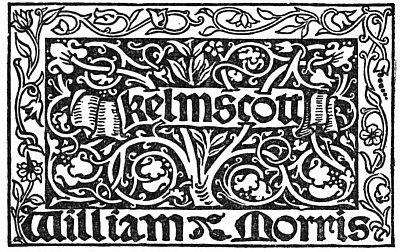
Admiration for Morris led to the setting up of several private or amateur presses, which did excellent work in his spirit: notably the Doves Press, conducted at first by Mr. Cobden-Sanderson, an ex-barrister, who had produced some real masterpieces as a bookbinder, and Mr. Emery Walker, the photo-engraver, who had ever been ready to help anyone trying to promote good printing; afterwards by Mr. Cobden-Sanderson alone. There was also the Ashendene Press of Mr. St. John Hornby, one of the partners in Messrs. W. H. Smith & Son, who, I fancy, has done rather more of the work with his own hands than most other private printers. Robert Proctor's Greek type, again, was brought into existence by love of Morris, but Proctor, like Messrs. Ricketts and Shannon, who were responsible for the Vale Press books, had no press of his own.
The beauty of all these books reinforced the influence of the Kelmscott Press ones, by proving that what Morris had done on his own lines could be done by lesser men with the variations suggested by their individual tastes. They reinforced also the proof which Morris had given, that so long as it is regarded as a hobby (or in a commercial house as an advertisement) the production of really fine specimens of printing is not an impossibly expensive one. Morris made no profit from the Kelmscott books as a publisher; could allot himself no payment for all the magnificent decorative work which he put into them with his own hands. He got nothing from his venture save the joy of achievement and pleasure of giving copies to his friends. But he proved the existence of a public willing to pay for the cost of print and paper, even when both print and paper were the best which money could buy; and I believe that most venturers in the same field have been supported to about the same extent. From our present point of view, this is one of the most important results which Morris achieved. The direct influence of his work on men like Mr. Updike and Mr. Bruce Rogers can only be reckoned very slight. But if the Kelmscott books had not made the success they did, neither Mr. Updike nor Mr. Bruce Rogers would have been given his chance, and to make it possible for younger men to get their chance is one of the finest things a master craftsman can do.
Private presses have multiplied greatly in the last thirty years, and some of them have done fine work. But the influence which they are exercising on the commercial printing of the present day is not in any way comparable to that which the Kelmscott and Doves books exercised a generation ago. There is no virtue in a book being printed in a small edition or in a private house, and no virtue in producing endless specimens of printing rather than books. Mr. Meynell and the Nonesuch Press (whose achievements I should admire much more joyously if it had not been called a "press") have shown what a diversity of interesting work can be obtained from commercial printers by a man who has good taste and knows how to get what he wants. When fine work can be obtained in this way private presses seem of little use save as an amusement to their owners. But no one is as yet making full use of the revolution (a much greater revolution than that inaugurated by the Aldine italics) which the "Monotype" machine has effected in modern printing just at the moment when (owing to the economic conditions, compositors having at last secured a fair wage) it was most needed. Thanks to the wonderful facility with which small types can now be cut and the greater quickness of machine-setting there is now only one obstacle to a new triumph of the Small Book Beautiful; and that is the obsession of the paymaster, the Customer, that it is unreasonable to expect him to pay anything approaching the same price for compact books in small clear type with no needless expanse of blank paper around the type page, as for the same number of words printed in larger type and with much more blank paper. The obsession is fostered by the fact that the reprints of popular books which have passed out of copyright and which often are produced in very pretty forms, are sold in large quantities at small prices, because no author has to make a livelihood out of them. But if a book does not appeal to a large public and yet has to earn money for its author it cannot be sold at a low price, and it is childish for the customer to insist that this fact should be concealed from him by books being made needlessly large in order that he may persuade himself that he is still getting plenty for his money. Publishers and Printers and Authors should unite to educate their paymaster the Customer on this point, and it is much to their interest to do so, for the book space which is now occupied by a couple of hundred volumes might easily hold two or three times as many if all books were printed with pleasant compactness. If an Amateur would arise who would help to train Customers to pay high prices for beautiful compact books he would be doing good service. At present most of the finely printed books are needlessly and inconveniently large.
FOOTNOTES: