Chapter IX · ERZERUM
Reading edition
We rode through empty spaces, littered with ruin and refuse, haunted by miserable and filthy dogs, to a street of some width, bordered by substantial stone houses, down the incline of which we checked the pace of our mounts. It leads to the north-eastern quarter of the city—a quarter which is numerously inhabited by Christians, and where are situated the Consulates of the European Powers, notably those of Great Britain, France and Russia. The British Consulate is housed in a small but comfortable residence at the northerly extremity of the street. There we were received with emotion by the principal dragoman—an Armenian with a handsome, frank and engaging face, whose curly black hair had become tinged with grey. I had not seen the excellent Yusuf for many a long year, not since the time when he used to delight the fancy of childhood with dainty boxes, or the figures of various animals, which he would fashion with exquisite skill in a kind of silver wire—an art practised by the silversmiths of the East. What tales he would tell us in England of this distant Erzerum! We used, as children, to try and realise the features of the scenes of which he spoke—the great Mesopotamian deserts, the encampments of the Arabs, the khans on the roads to the highlands in which the traveller rested, the mountains and the snow-clad plains. Alas! for the powers of description; how different it all looked, when after many years these various landscapes were successively unfolded before the eyes! Yet they spoke to the very soul of the child grown to manhood, perhaps reviving hidden germs in the lengthy process of heredity, or recalling those early efforts to make pictures of them, or appealing in virtue of none of these causes, but by the magnetic power inherent in themselves. And here at last was Erzerum, with Yusuf standing before the door and running forward with open arms! My reader will, I feel, pardon this little personal digression, embodying, as it does, one of my most permanent memories of the northern capital.
Another link of a not less personal nature must be mentioned in order to explain the length of the sojourn which the present writer made in Erzerum. It extended from the commencement of the really cold weather to the approach of spring. Wesson and Rudolph were committed to the kind offices of the Russian Consul, M. Maximoff, who furnished them with the necessary facilities for returning home through Russian territory by way of Sarikamish and Batum. The Swiss had been experiencing the discomforts of home-sickness; and the resourceful Wesson, who would make a most excellent campaigner, was obliged for private reasons to abandon a nomad life and resume his habits as a Londoner. It was my intention to work up my material in Erzerum, and to devote a fortnight or more to this end. Our Consul, Mr. R. W. Graves, most kindly placed two rooms at my disposal, and insisted upon my being his guest. A friendship sprang up between us, born of similar age and many common tastes; and, speaking for myself, I may say that our solitude à deux in this corner of Asia formed one of the most agreeable experiences of my life. I do not remember having spent a single dull hour. His conversation, charm of manner and kindliness of disposition were a resource which was never wanting to revive one’s intelligence after long hours devoted to writing and to books. I was so happy and he so hospitable that the weeks had become months before all the excuses which waved away the round of duties in England had one by one become exhausted, and I tore myself from his side.
This lengthy stay, followed as it was by two subsequent visits, has made me feel quite at home with the subject of this chapter. And the fact that I have approached Erzerum from the three directions in which it is most accessible, from the east, from the west and from the south, enables me to speak, in so far as a civilian traveller may judge such a question, of the strategical importance of a city which is probably destined to play a leading part in any future struggle between the Russian and the Ottoman Empires. For an Englishman this side of the subject has a special interest; since the possession by Russia of this strong place would mean her control of the head waters of the Euphrates, which issues in the Persian Gulf. It is a maxim of peculiar appropriateness to such a country as Asia that he who is master of the sources of a river is master of the lands through which it flows. On the other hand, such an event would closely affect all Europe; for there would then exist no important barrier between the Asiatic provinces of Russia and the shores of the Bosphorus. Indeed Erzerum resumes in herself the importance of Turkish Armenia as a factor in the world movements of the near future. Mistress of this spot of ground, Russia is mistress of these vast provinces. It is plainly the duty of a writer who has enjoyed the advantages which I have mentioned, not indeed to pander to the feeling of blind animosity against Russia, but to place his readers in possession of the essential facts, in the hope that at least they may not be taken unawares by any advance of the northern empire in this direction.
Our large map will, I hope, make clear and preclude the necessity of minutely describing the topography of the site with its surroundings far and near. What the basin of Lake Van and the plain of Mush are to the southern districts of Turkish Armenia, that are the plains of Pasin and Erzerum to those on the north. They represent depressions of the surface of the tableland and constitute arteries of communication between east and west. The northerly is separated from the southern string of depressions by a block of elevated plateau country, which is most compact and continuous on a line between Mush and Erzerum, and more broken into irregular lines of heights with intervening plains between the northern shore of Lake Van and Pasin. An invader coming from the east and desirous of forcing his way westwards will find all his roads converging on either one or other of the two strings of depressions. The block of lofty tableland, seared by the action of ice and water, and covered for the greater part of the year with snow, causes them to be deflected as by an impassable obstacle, though it is in fact by no means impervious to an army during summer, when the principal difficulty would be the absence of supplies. The geographical position of Russia is decisively in favour of an advance by the most northerly of the two main avenues. She might detach a column to move upon Bitlis; but the objective of this force would be the lowlands of Mesopotamia rather than Asia Minor west of the Euphrates. There can be little doubt that the weight of her onset would be thrown into the northerly channel; and Pasin would fall without a blow being struck. At that moment she would be confronted by the defences of the Deveh Boyun—an impregnable barrier if only held by a sufficient force.
We have seen at the close of the last chapter that the Deveh Boyun consists of a composite ridge, thrown across a narrow portion of the northerly depression, and dividing it into two. It is due to an outbreak of lava—a hard trachyte—which has pursued a direction almost at right angles to the general structure of the country, its elevation being nearly meridional. Similar outbreaks are readily recognisable in the northern border heights of the plain of Pasin; but those ridges are of little geographical importance, losing themselves on the confines of the plain. On the other hand the Deveh Boyun, the most westerly of the series, determines the drainage of the great basin. From its eastern slopes the waters flow to the Araxes, and from those on the west to the Euphrates. On the one hand lies Pasin, and on the other the plain of Erzerum. The height of the pass over the parapet is not more than some 500 to 800 feet above the level of the adjacent plains. But the ridge is defended by a line of modern forts; and, if these were captured, the invading army would find itself enclosed within a space which, while it can scarcely exceed a width of about four miles, can be swept by the fire from heights on the north and heights on the south. These positions, which have all been fortified since the last Russo-Turkish war, rest against the slopes of the parallel walls of mountain, confining the depression on either side.
There does exist, I believe, a narrow passage through an irregular valley between the Deveh Boyun main ridge and the northern wall. But this approach by the flank is commanded by some of the forts already mentioned. Nor would the fate of Erzerum be necessarily determined if both the ridge and the works which protect it had been occupied by the enemy after a series of frontal attacks and great loss of life. There would remain the defences of the Top Dagh, a hill mass, or, as they would say in South Africa, a series of kopjes, separated from the Deveh Boyun by the valley of a small tributary to the Euphrates derived from the wall of mountain on the south. The Top Dagh bristles with forts, of which the most conspicuous are Forts Mejidieh and Azizieh. It immediately abuts on the enceinte of the city which it screens from attack from the east. The city lies with its head upon the talus or accumulated rubble which fans out from the heights on the south. Its feet touch the floor of the plain.
Under modern conditions Erzerum is by far the most important strategical position throughout the length and breadth of the country described in this work. The heights confining the plain on the south are in fact the edge of the great block of tableland interposed between the plain of Mush and the northern capital. Although the ground mass of that lofty stage is composed of stratified and old igneous rocks, yet more recent eruptive volcanic action has played an important part in its configuration. To this agency are due the bold mountains along its northern edge which constitute such a noble background to the town. The most conspicuous peak is that of the Eyerli Dagh, or saddle mountain, so called from the shape of its summit. The loftiest is situated a few miles further east, and stands a little back from the line of heights. It has an elevation of 10,690 feet above the sea, or of 4500 feet above the city. It bears the same name as that of the steep ascent to the plateau, and is known as the Palandöken, or saddle shifter. Between these two commanding peaks is placed a cirque or huge basin from which the detritus is emptied into the plain. It has been supposed that the peaks are only the upstanding sides of a huge broken-down crater represented by the cirque. It seems more probable, however, that this great hollow is due to erosive agencies, and it may originally have been commenced by glacial action.
Standing on the roof of your house in Erzerum, you can scarcely conceive the approach of an invader by a turning movement across those heights. It is, indeed, no easy matter to discover any natural passage; but there are in fact four. The most easterly is Aghzi Achik (his mouth is open—though I cannot agree that such is the case.) It leads over to some villages in Tekman. Further west is the valley called Abdurrahman Gazi after a holy man, reputed to have been the standard-bearer of the prophet, whose tomb is a favourite resort in summer. Next comes the Palandöken, grazing the peak upon its western slopes after finding a way along the eastern declivities of the cirque. The fourth and most westerly is that of Kirk Deïrmen, or the forty mills. Of these the only approach of any importance is that of Palandöken. It constitutes the summer route to the districts on the south. The pass, just west of the peak, has an elevation of 9780 feet, and is commanded on either side by two modern forts. A metalled road, constructed during recent years, at once connects these important outposts with the city and affords tolerable gradients to caravans. As you examine the ground in this direction you observe a fortified hill on the south-west of the enceinte; it is called the Keremitlu Dagh.
Erzerum, it will have been seen, is almost as difficult to get round as it should be impossible to take by direct assault from the east. If only Turkey were a naval power, able to cope with her adversary by sea, it would be a long time before this bulwark of her Asiatic empire could be broken down by a Russian attack. Herein lies the value to Turkey of help from a first-rate naval Power and the hopelessness of her position should it not be forthcoming. With her fleet in undisputed possession of the Black Sea, Russia might laugh at the irresistible defences of Erzerum. It would only be necessary to hold the garrison by an advance on the side of Pasin; and the real attack, if it were ever made, would come from the west, the vulnerable side, delivered by a column which should have been landed at the port of Trebizond, and which there would be nothing to prevent marching to Erzerum along the chaussée. Sevastopol and Odessa rather than Kars and Erivan are the storm centres from which will be let loose the forces that will sweep the Ottoman Empire out of Asia, when we shall be confronted with a brand-new set of barriers, precluding for the second time in history the entrance of commerce and enlightenment into these magnificent territories. In taking leave of this part of the subject, I must not omit to mention the route which a Russian army might be expected to follow in its progress westwards after the fall of Erzerum. As far as Erzinjan the course of the Euphrates would in general be followed, when the northern border heights would be crossed and the entry to Asia Minor effected by way of Karahisar. There are no difficulties to traffic along this avenue. On the other hand, an advance from Mush, the side of the southern depression, could only be undertaken by mountain paths above the course of the Murad, which have never been touched by an engineer. It is therefore probable that the tide of war would be diverted for some time to the lowlands, when it might threaten the south-eastern districts of Asia Minor from the side of Diarbekr.
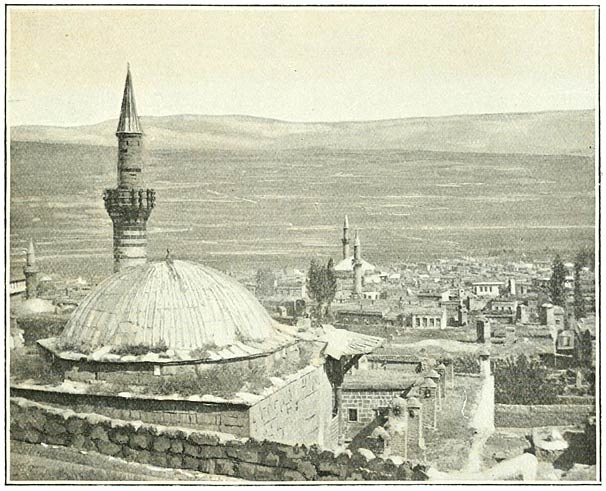
Fig. 164. Erzerum and its Plain from the South.
The aspect of Erzerum, when seen from without, is sombre and unattractive. This impression is principally due to the colour of the stone of which it is built and to the scarcity of trees. I am tempted to offer my reader two illustrations of the place, the one taken from the higher ground on the south, and displaying the features of the great plain with the city in the foreground and in the distance the lofty outline of the northern heights (Fig. 164); the other looking south-west from the roof of the British Consulate, with the castle in relief against the slopes of the Eyerli Dagh on the right of the picture (Fig. 165). This view does not comprise the peak of Palandöken, situated a little further to the left. The eminence in the centre is a nameless mass, intermediate between the two greater mountains and screening the cirque from the plain. A curious feature in the landscape of the city, when seen from very near, are the chimneys, which look like rows of dove-cots. The smoke escapes at the sides. It is strange that the inhabitants display so little love of verdure, for the sun is always brilliant and productive of glaring lights, while during two or three months of the year its rays are fierce. The few gardens that there are grow quantities of lilac, of a perfection of bloom and colouring and perfume which surpasses any examples I have seen elsewhere. Abundance of delicious water flows down from the heights on the north; and under happier circumstances the slopes and the plain outside the city would be dotted with dwellings embowered in trees. At the present day, when once you have passed outside the enceinte, you feel like a ship which has taken to the open sea. Not a hedgerow, no oasis of foliage diversifies and softens the naked and vast expanse. You steer your course whither you will. For at least five months in the year the ground is covered with snow—an unbroken sheet spread over mountain and plain. Little specks in the landscape are recognised as villages; and now and again a gliding object—it might be a boat on the ocean—moves swiftly towards the city and, approaching nearer, is seen to be a sledge. The climate of Erzerum has been compared to that of St. Petersburg, but the comparison is most unhappy and in many respects fallacious. Sun and sky belong essentially to the South. It is only the great altitude of over 6000 feet above sea-level that produces the rigour of winter and the crispness of the summer nights. My daily observations of temperature during the months of December and January supply the following results. In December the highest reading at 9 A.M. was 37° Fahrenheit, or 5° above freezing-point; and the lowest at the same time of the day was 8°, or 24° of frost. During January the maximum at 10 A.M. was 30° Fahrenheit, and the minimum at the same hour was -19½° centigrade, or 3° below zero of Fahrenheit. Double windows and German stoves are necessaries in such a climate; and, as you take your ride of an afternoon and gallop over the powdery snow, it is necessary to protect the ears against frost-bite. On the other hand, it is not easy to realise the severity of the weather, so brilliant are the rays of the sun. And the warmth of walking exercise completes the illusion of a snowfall in summer, while your spaniel ranges widely over the endless white surface, intent upon his forbidden pursuit of the larks.
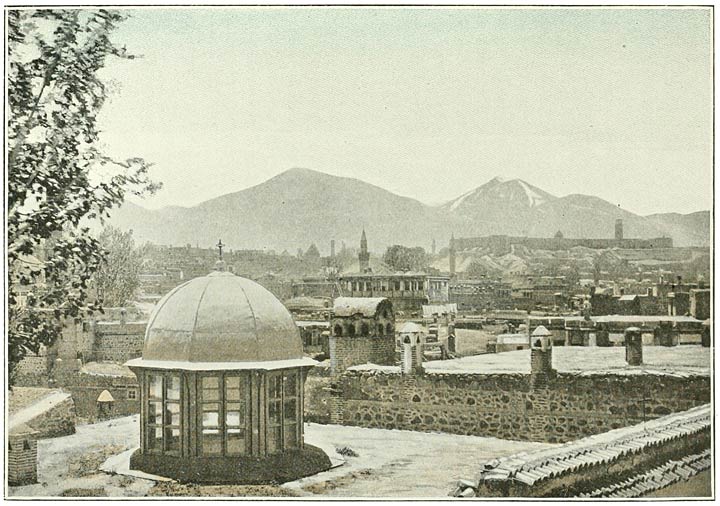
Fig. 165. Erzerum from the Roof of the British Consulate: the Citadel in the middle distance and Eyerli Dagh in the background.
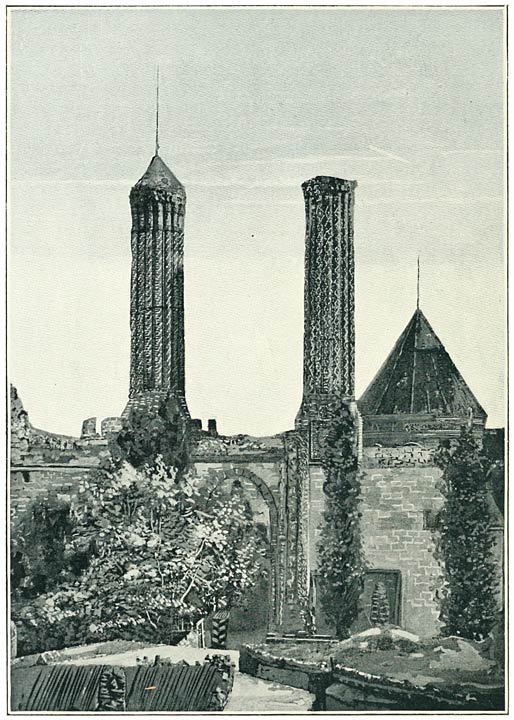
Fig. 166. Erzerum: Chifteh Minareh.
Ulu Jami.The large mosque of Ulu Jami is not more than a few steps distant from the entrance to Chifteh Minareh. It has rather a vast interior with several vaulted aisles; but it is devoid of architectural pretensions. I was shown an ancient paper belonging to this mosque, in which it was stated that it had been built by the Head of the Government and Religion, Mohammed el-Fateh, in A.H. 575 or A.D. 1179.
Sanasarean school.The popular basis of the Armenian Church is one of its most remarkable features, and, with the rapid spread of education which is now in process among the community, ought before long to be productive of far-reaching reforms. This lay council consists of notables chosen by the people; and, in a vacancy of the see, the patriarch at Constantinople submits to them the names of candidates among whom to choose a successor to their late bishop. In Erzerum this lay body is an operative factor in the life of the community; but I doubt whether its counterpart could be discovered in such centres as Bitlis or Mush. It exercises considerable influence in the government of the Sanasarean school, to a brief account of which I now proceed.
The origin of this institution—designed to dispense a higher standard of education than that which obtains in other Armenian schools in Turkish Armenia—goes back to 1881. In that year Mr. Madatean, one of the three existing Directors, visited the provincial centres at the invitation of a wealthy Armenian gentleman, the late Mr. Sanasarean. He returned to Erzerum with several pupils, chosen among the poorer class. In 1883 the school entered upon its present premises, which have been considerably enlarged since. Its patron, Mr. Sanasarean, died in 1890, bequeathing a sum of about £30,000 to his foundation and directing his executors to draw up a constitution. This charge has now been fulfilled. Two councils have been appointed—one at Constantinople under the presidency of the patriarch, and the other at Erzerum under that of the bishop. Thus the college is under the protection of the Church; and it is with the patriarch or the bishop that Government deals. Three Directors were chosen to preside over the teaching staff, and to dispense instruction themselves. The council of Erzerum consists of this triumvirate, who hold office for life, and of three notables, one of whom vacates his charge every year. It has also been provided that, upon the decease of any member of the triumvirate, his colleagues shall take his place until the number shall have been reduced to one, so that eventually there may be only a single Director. Of the two councils that at Constantinople is supreme. They administer the revenues, which have been increased since the death of the founder by the receipt of at least one substantial legacy. The institution has been launched with every promise of success, although it seems likely to be destined to undergo vicissitudes before attaining a full measure of usefulness.
The Sanasarean college is essentially a boarding college, and day pupils are not encouraged. It has a roll of not more than about eighty inmates, of whom nearly half are the sons of parents in narrow circumstances, and pay nothing for maintenance. About fifteen youths are natives of Erzerum, and the rest are derived from the provinces. A few will have journeyed hither all the way from Constantinople. It is expected of the gratuitous scholars that they shall all become teachers in the various Armenian schools throughout Turkey. Of the sixty members who had already completed the course at the time of my visit one-half had adopted the scholastic profession. I went carefully over the school, and was delighted with the arrangements. The dormitories are large and kept scrupulously clean, and the same may be said of the classrooms. There are a hospital attached and a playground. The technical school is well provided with lathes and all kinds of implements, and some excellent work is forthcoming from the young handicraftsmen. Boys enter the college in about their tenth year, and leave at the age of seventeen or eighteen.
The course comprises a preparatory class and six higher classes. The subjects taught are in the first place the Armenian and the Turkish languages, the former comprising both the ancient and the modern speech. Of foreign tongues French and German are included, but neither Latin nor Greek. The history of the Armenian Church and nation is imparted under great difficulties and without the aid of books. These would be confiscated by the Censor. In mathematics the curriculum provides for algebra and geometry; and in natural science for geography, geology, botany, zoology, astronomy, anatomy, chemistry, and physics. Commercial book-keeping can also be learnt. Music is studied and practised with much appreciation, and there are several tolerable performers on the violin. The prospectus of studies must by law be submitted to Government; but the Mudir or local director of public instruction confines his energies to an occasional and friendly visit. Most of the text-books are German. The teaching staff numbers twelve members, including the Directors; the French master had recently arrived from France. It is desired that the teachers should have passed through this school, and then have completed their studies in Europe. A certain portion of the funds have been set aside to meet the expenses of one or two students during their residence abroad. Two have already proceeded to St. Petersburg, and two more are about to leave for Reichenberg in Bohemia in order to study in a technical school.
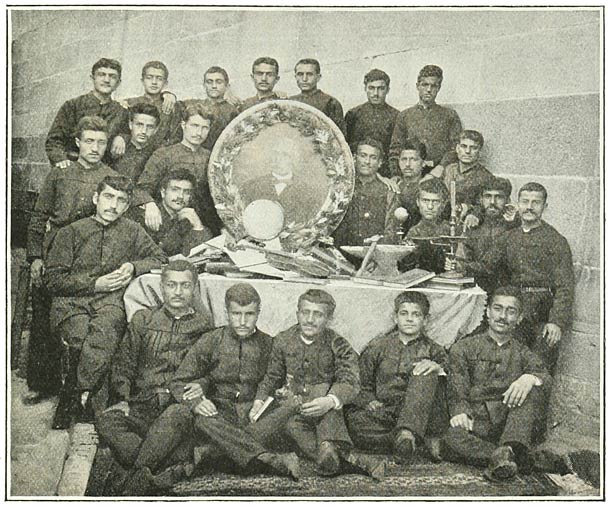
Fig. 167. Armenian Youths.
I offer my reader a group of the scholars of this institution, with a picture of the founder in their midst (Fig. 167). The faces are full of character and determination. Nor should I wish to omit a similar group of the comely maidens of Armenia, taken at Edgmiatsin and showing the national dress (Fig. 168). I received the impression that there was something wanting to the vitality of the school, that the pupils were not using their talents to the best advantage. For instance, when I asked them for the result of x + y × x - y, they were obliged to make the sum and could not supply the result offhand. Personally the Directors are charming men, neither self-assertive nor obsequious. All three have studied in Germany; but not one of them has taken his doctor’s degree. They told me that they had in this obeyed the expressed desire of their patron, M. Sanasarean. But, although there can be little doubt that they made excellent use of their opportunities, it is most pernicious to the interests of the school that their example should be made a precedent. By what means can the Council ensure that the young men sent abroad to study have really penetrated into the inner circle of European scholarship? Only by requiring that they should not return without obtaining its badge. It also seemed to me strange that the pupils passed from class to class by length of residence rather than by merit. Other drawbacks, the first of which might be easily remedied, were the absence of sports and games as a prominent feature of school life, the want of touch with the Armenian schools in the Russian provinces, and the unreality of the diplomas granted by the institution, which have not as yet become the key to a variety of careers. The fact, too, that the minds of the Directors have been filled with the pedagogic lore of Germany militates against success. That so-called science betrays the weaknesses of the powerful German intellect. In Germany its pedantic influence is counteracted by military service; but this wholesome corrective is wanting to the Armenian youth of Erzerum.
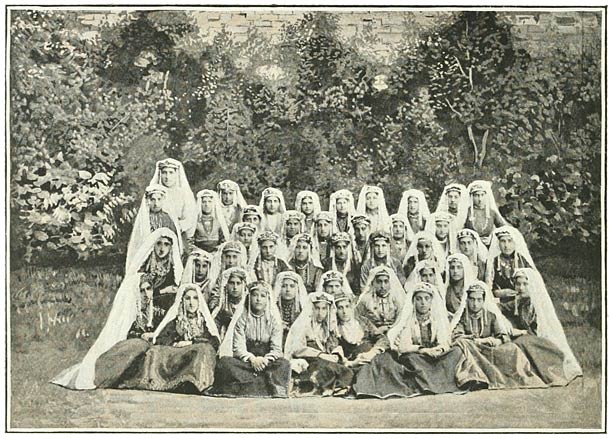
Fig. 168. Armenian Maidens.
Armenian Catholics of Erzerum.In addition to the Sanasarean college, the Gregorian community possess no less than six ordinary schools. Of these the principal is attached to the cathedral and is named Artsenean. It is attended by about 200 day scholars, and corresponds to an Armenian school of two classes in Russia. The school for girls, called Ripsimean, appeared to be well administered; it has a roll of 350 maidens. The Armenian Catholics of Erzerum province number several thousands of souls; and the city is the seat of one of their bishops. Their school, which is conducted by four French priests, is considered one of the best in the town. It is attended by over 100 pupils, of whom nearly one-third are Gregorians. A little boy of three did the honours of his class, when I availed myself of the kind invitation of the frères. He addressed me in the following speech, delivered with the most graceful gestures:—”Monsieur! Soyez le bienvenu; que le ciel vous protège, cher Monsieur!”
American missionaries.The American missionaries have a large establishment with schools in Erzerum. Their mission was founded in 1839. It was presided over during my residence by the Rev. W. N. Chambers, a man in the prime of life with fine physique and a face of great beauty, which corresponds to the nobility and sweetness of his character. His wife and worthy companion—one of the most charming and refined of women—was perpetually busy with her girls’ school. One reflected upon the value to the womanhood of the Armenian race of such an example as hers. In taking leave of the American missions, it is pleasant to dwell upon this memory, which, indeed, illustrates the kind of benefits which they confer upon the country better than all the figures in their reports. They raise the standard of life, and diffuse an atmosphere of wholesome living. I ought to add that their missions are conducted by quite exceptional men and women—of a type and perhaps of a class far higher than one would expect. One admires in them a broad tolerance and entire absence of all cant. One says farewell from the depth of the heart.
Rushdiyeh. Idadiyeh.Education is provided for the Mussulman population by a single but well-appointed institution. It combines the courses of a Rushdiyeh, or High School, with that of an Idadiyeh or lycée. It is housed in a spacious new building in the centre of the town, and I found it occupied by 130 pupils, of whom 45 were boarders. Youths enter the school between their eleventh and fifteenth years, and stay seven years. Of this period three years are spent in the lower and four in the higher course. There are about eight teachers. The majority of the scholars were attired in a quasi-military uniform; the rest were in civil dress. All looked in excellent health. The dormitories were provided with brass bedsteads; and I noticed that the linen was scrupulously clean. Shining napkins were spread out upon the table of the dining-room, which was lined with a row of chairs and provided with crockery. Adjoining the school is a small hospital. The course comprises the same subjects as those in the curricula of the Van schools; and, although this school professes to dispense a much higher standard, it is in fact less advanced than the so-called military school at Van. This is the only Idadiyeh in Turkish Armenia; and the admirable official who acts as coadjutor to an invisible Director of Public Instruction informed me that in the year preceding my visit a Government order had been issued, to the effect that all candidates for subordinate posts in the civil service should be required to produce a diploma from an Idadiyeh. I learnt on the same authority that there existed a Rushdiyeh in each caza of the vilayet of Erzerum with the exception of the caza of Terjan.
We found Erzerum in a condition verging upon famine. During my residence several people died of inanition, and the poorer classes were only just alive. I was informed that there was no lack of grain in the place; but it was all in the hands of merchants, and they refused to sell except at famine prices. A short harvest in 1892 had been followed by insufficient sowing, owing to the consumption of the seed for food. Grain was said to be lying at Trebizond on Government account; but the officials pleaded that they were unable to obtain transport. Some of them, if not all, were no doubt confederates of the Corn Ring. The same state of things was prevalent at Van; and throughout our journey we had great difficulty in obtaining barley for our horses, even when offering exorbitant prices. One may present some conception of the acuteness of the sufferings of the townspeople by recording some particulars of prices and wages. Wheat was selling at 50 piasters a kilé, or about 2½ piasters an oke (2¾ lbs.). The price of bread was 2 piasters an oke. A healthy man requires at least three-quarters of an oke of bread a day, in addition to his ration of sheep’s tail or meat sausage, of which the working classes lay in a provision in the autumn. The wages of a carpenter or skilled labourer are in good times 8 piasters a day. But hundreds of workmen were seeking employment at 1½ piasters, and the best paid among the makers of cigarettes for the régie were receiving a daily wage of 2 piasters. Rice at Erzerum is quite a luxury, and potatoes are so little grown that they may be left out of account. How was a man to pay for his lodging, provide food for his family and himself, and obtain tezek, or cow-dung cakes, for his fire upon the current wages? I was shown the kind of bread upon which the majority were living; it looked like a thin pancake, and its staple consisted of a black grain or seed. But the principal ingredient was mud and chopped straw. The cruelty of the situation was accentuated by the fact that all kinds of comestibles were spread out upon the booths of the bazar. One regretted the absence of the glass windows of our shops. Here the temptation might be touched as well as seen. There is no poor-law, and no poor-houses. People starve in the streets. A Mussulman girl of great beauty came to our house, and begged piteously for food, showing her face. We endeavoured to obtain for her a place as servant in the residence of some Turkish ladies. But it was well known that there was many a brute in Erzerum who, like the Spectre of Hunger in the pregnant lines of Alfred de Musset, demanded kisses as the price of a piece of bread.
The economical condition of the surrounding country is woeful in the extreme. The great plains from Pasin to Lake Van were being raided by bands of Kurds. I shall describe in a future chapter how this predatory people came to be established in the agricultural centres. Erzerum was full of accounts of their open attacks upon the industrious peasantry; and even the Mussulmans, as, for instance, at Hasan Kala in Pasin, were petitioning Government for protection. It is true they did not dare to call their assailants to book as Kurds, but described them merely as brigands. It was well known that these bands were led by officers in Hamidiyeh regiments—tenekelis, or tin-plate men, as they are called by the populace, from the brass badges they wear in their caps. The frightened officials, obliged to report such occurrences, take refuge behind the amusing euphemism of such a phrase as “brigands, disguised as soldiers.” The scourge had almost exhausted the Armenian population, and was now commencing to sit heavy upon the Mussulmans. The Armenians were emigrating as fast as they could. The Russian Consul informed me that he had been obliged to issue no less than 3500 passports to Armenians during the current year. The Russians did not want them; but what were they to do? I learnt from another source that in the caza of Khinis alone 1000 Armenians had left their homes, the majority in abject poverty, and had taken refuge across the frontier.
With a famine in the provincial capital and the adjacent territory stripped by marauders, the inhabitants of any other country would have risen in revolt against the Government. But the population of Asiatic Turkey, in spite of religious differences, are the most easily governed in the world. All the talk about Mussulmans and Christians flying at each other’s throat is talk, and moreover very idle talk. During my subsequent visits to Erzerum it was admitted to me by Turkish officials that the massacres of 1898 were perpetrated in these districts by bands of imported ruffians. The still unavenged guilt of these abominable orgies does not lie upon the Mussulman population. Only on one occasion during my residence did the famished townspeople of the dominant religion come near to measures of insubordination. They sent their women—a method of petition which is neither usual nor lightly to be dismissed—in a body to Government House. Thence the petitioners proceeded to the residence of an official of the Treasury at Constantinople, who had been despatched to Erzerum to make enquiries into the scarcity. The indignant matrons assailed his ears with the pertinent question: neye geldin, whereto didst thou come? Dissatisfied with the answer they received, they smashed the windows of the functionary; but nothing came of the demonstration.
All through that anxious time the civil government was in abeyance; and nothing was set up in its place. The Vali was recently dead; his successor had not been chosen; the deputy Governor was at once a puppet and an imbecile. An honest man with a few policemen at his back could restore not only order but prosperity. There is only one essential of any importance: to reorganise the territorial boundaries of the provinces, select good governors and invest them with extensive powers. If my reader be inclined to smile at the choice of my epithet when applied to a Turkish official, I can only say that I much regret my inability to introduce him personally to the present holder of the office of Vali of Erzerum. I was privileged to make the acquaintance of Raouf Pasha on the occasion of my second visit. His career through a long life has been one of much distinction; he is honest, just, capable, humane. If such a man could only be freed from the leading-strings of the capital, he would go far towards a happy settlement of the Armenian question, and of the still more important question, the continuance of the Ottoman Empire.
The Armenian inhabitants of the provincial capital are undergoing a state of transition from their ancestral customs to the less straitened manners of the West. But these customs die a hard death, and the emancipated Armenian who has studied in Europe must feel their fetters upon his return to his native land. Let us suppose that he wishes to marry; he must have recourse to his mother, or, if she be dead, to a female relation. A bride is chosen for him, whom, as likely as not, he does not see until the marriage ceremony has been performed. If the parents of the bridegroom be still alive, the newly-married couple reside with them; and it is the custom that, while sons and daughters are permitted to speak to their parents, a similar license is not usually accorded to the sons’ wives. Thus a maiden quits a home where freedom of intercourse and speech is allowed her to enter one where she is not permitted to open her mouth. A son may not smoke in the presence of his father; and great are the agonies endured by the younger generation in this respect alone. The earnings of the sons are handed over to the father, who rules the family quite in the patriarchal style.
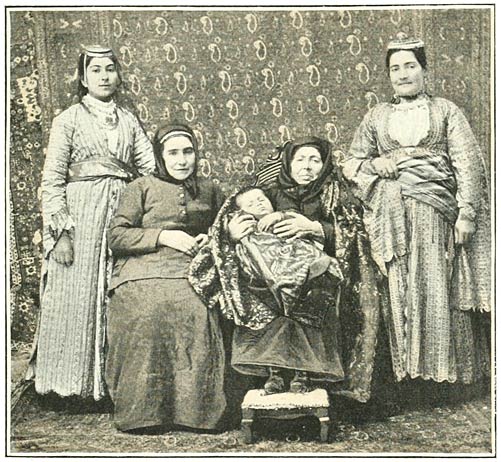
Fig. 169. Five Generations of an Armenian Family.
A single family comprises a very large number of members, all living in the same house. In one house in which I visited there were not less than thirty. I photographed a group of five generations in this family, each person being in direct lineal descent. The infant is the son of the pretty young lady on the left of the picture, and it reposes on the lap of her great-grandmother (Fig. 169).