Chapter VI · BITLIS
Reading edition
Not far south of the line of junction of the volcanic plateau west of Lake Van with the first outworks of the main Taurus range, where the level spaces of the elevated tableland of Armenia break away to the crest and trough of Kurdistan, there, within the threshold of the chain but at the very head of the mountainous country, lies the picturesque town of Bitlis. Coming from the north, the traveller is impressed by a change of scene which is at once sudden and complete. In place of the great plains, divided by irregular mountain masses of eruptive volcanic origin, he is introduced to the regular sequence of ridge upon ridge and valley after valley, which are in fact the steps, or succession of mountain terraces with stratified formation, leading down to the burning lowlands of Mesopotamia. The clouds no longer float in tranquil, feathery beds, but sail across the sky, grazing the peaks. The rivers hiss in the gorges and are white with foam instead of winding with sluggish current over the flats. The glare of the open and treeless landscape is succeeded by the gloom of overhanging parapets; and, while the margin of the streams will be overgrown by willows and poplars, the forest trees, among which the walnut and the elm are conspicuous, flourish upon each oasis of deeper soil. Even the Kurdish shepherds have failed to destroy a vegetation favoured by moisture and shade.
It is a place of beginning and ending, of ways radiating outwards, of ways closing in. South of the town the valleys collect together; slope approaches slope, increasing in acclivity and holding the united waters as in a vice. About the site itself the walls of mountain recede, forming an amphitheatre of commanding heights upon the north. Passages thread their way within the folds of that landscape, following side valleys of which the pleasant spaces caress the eye until they are lost to view in a turn of the fold. The sense of imprisonment, which soon outweighs the romance of a sojourn among the mountains, is a feeling foreign to the genius of these surroundings. Far rather is one diverted by the variety of the expanses which preclude the palling of this essentially alpine scene.
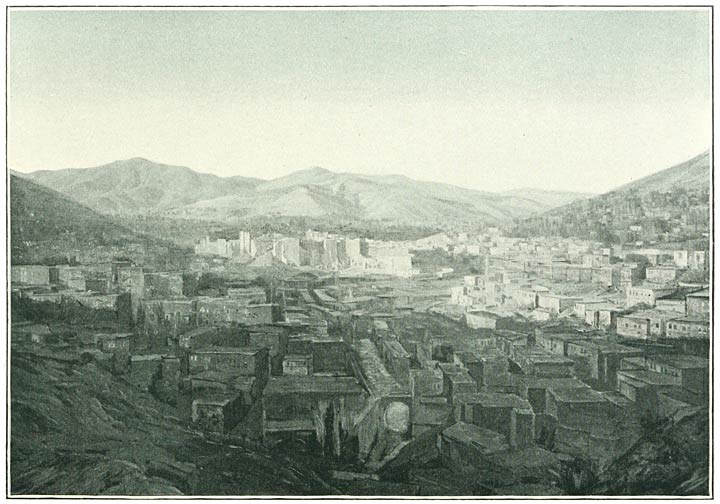
Fig. 146. Bitlis from Avel Meidan.
Yet, in spite of the comparative openness of such a situation, you do not see Bitlis until you are well within her precincts. The body of the town—the mediæval castle, the minarets and the bazars—lies in the trough of a deep gorge. The river which threads the valley is composed by the union of two main streams, the one coming from the north through a direct passage from the plains of the tableland, the other from the east, the direction of the Güzel Dere and the road to Van. The waters meet at some little distance above the settlement, to bury themselves on a south-westerly course in a ravine or cañon with a depth of about 100 feet. From either side of the ravine rise the slopes of the mountains, leaving no great interval of level ground. The road is taken along the right bank upon the summit of the cliff; and after a few winds reaches the commencement of the houses. They cluster on the cliffs on both sides of the stream and mount the first acclivities of the mountain walls. Of a sudden the valley opens and the river changes direction, settling down to a southerly course. Two side valleys with confluent streams enlarge the views. Tier upon tier the flat-roofed dwellings are terraced up the slopes, and are seen extending into the recesses of the hills. It will be about a quarter of a mile from where you reached the first buildings; and still the castle and the bazars are hidden from sight. It is not until that venerable pile is already passed that the banks of the river flatten. It grazes the eastern side of the platform of rock supporting the battlements, and is soon joined by the tributary to the right bank. These are the most densely-built quarters. Stone bridges with a single span of arched masonry present the most charming prospects up the labyrinth of houses to the castled rock of which the figure is that of a wedge with the broad side facing south. The water bubbles over the boulders in its bed, which is not more than thirty or forty feet wide. From its margin rise the slender stems of willows or poplars. A little lower down the second tributary rustles in, this one to the left bank. But the river soon resumes its burrowing and boring tendency, and compels the houses again to take refuge up the slopes on either side. The expanse narrows and assumes the form of a single trough in the mountains, threaded by a thin line of foam. The most comprehensive view of the city may be obtained from these southern limits, just before the entrance of the affluent from the east. It forms the subject of my illustration, which was taken from a position in the Avel Meidan (Fig. 146)—the quarter in which is situated the American Mission, and where, since the date of my visit, has been established the British consulate, the pioneer of the political and commercial intercourse of the states of the West with this remote Oriental town.
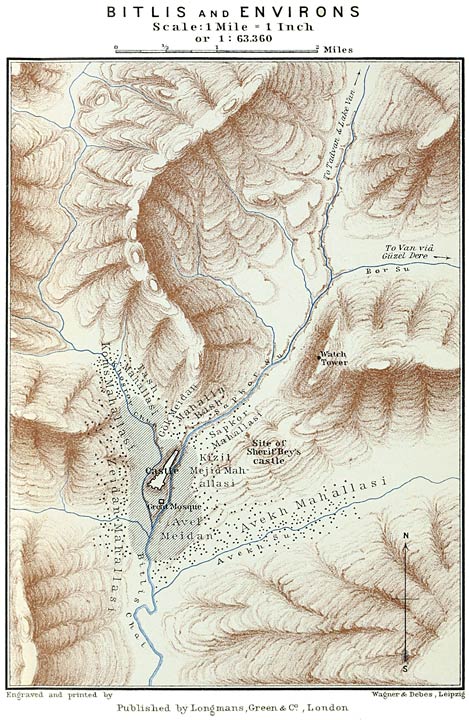
BITLIS AND ENVIRONS
Scale: 1 Mile = 1 Inch or 1 : 63.360
Engraved and printed by Wagner & Debes, Leipzig
Published by Longmans, Green & Co., London
The importance of the situation can readily be appreciated when we reflect upon the geographical conditions. The entire section of the Tauric barrier between the Great Zab on the east and this valley of the Bitlis Su upon the west is composed of quite a network of lofty mountains, extremely difficult to cross. To these natural obstacles, which have played an important part in the history of these countries, are added dangers to traffic arising out of the lawlessness of regions which it has never been easy to police. Bitlis commands the approach to the first important natural passage between the districts about Lake Van and the Mesopotamian plains. The avenue of communication is taken down the valley of the Bitlis Su, and, crossing thence into that of the Keser Su, to the town of Sert, a distance of about forty miles. Although this route has not as yet been rendered passable to wheeled traffic, it is well adapted to caravans. At Sert you are already upon the fringe of the lowlands and in a different climate. On your one hand lies Diarbekr, with its ready access to the Mediterranean, and on the other Mosul, upon the navigable waterway of the Tigris, whence in any other country but Asiatic Turkey a service of first-rate steamers would afford quick access to the Persian Gulf. West of Bitlis there are several passages, the routes converging upon Diarbekr; but they are for the most part less accessible to the great plains of the tableland. It is therefore towards this avenue that the traffic is directed between widely distant centres of the plateau country and Aleppo or Baghdad.
I would now invite my reader to accompany me in a ride through the town. Our starting-point will be a fine house on the heights of Bash Mahalla, immediately adjoining the road from Van. A stone bridge crosses the road from the precincts of the mansion to the dwelling of the ladies of the family, surrounded by a pleasant garden. The best rooms of the salamlik or larger residence had been placed at our disposal by one of the notables of Bitlis, by name Shemseddin Bey. Adjoining this quarter are the open spaces of the Gök Meidan, where you may admire an old medresseh, now used as a military store—a fine square building in hewn stone with four turrets at the corners, and a rich façade in the Arab style on the south side. The place is overgrown with weeds. Ancient elm trees spread their shade over the ruins of a mosque not many feet away. Adjacent is a cemetery with numerous headstones and two considerable mausolea. In this same district, not far from the residence of the Pasha, is situated the small mosque called Meidan Jamisi. A mollah dispenses instruction to some twenty little boys in a small den of a room close by. Descending the cliff-side to the main valley by a paved way, we pass the little mosque of Dort Sanduk, and the Armenian church of Karmirak. The latter, although presided over by the bishop of Bitlis, is an unpretentious building of four plain stone walls, with two rows of three stone pillars in the interior and crowned by a small dome. The bishop—poor fellow—will probably be in prison; that was his residence on the occasion of our sojourn. Attached to the church is a school with four teachers and over a hundred pupils, who certainly impressed us as better-to-do than at Van. Quite a number were wearing cloth clothes.
The Syrian church is situated in the same quarter—that of Kizil Mejid, or the red Mejid. Mejid is said to be a proper name. A plain little whitewashed chapel nestles under the cliff, and here the service is read in the Syriac language, and a Syriac Bible lies upon the desk. Not that any of the congregation understand that tongue; they speak Armenian and are familiar with Turkish. The Bible is expounded to them in Armenian, which may be said to be their native tongue. When we reflect that the services of the early Armenian Church were celebrated in the Syriac or the Greek languages, this transformation in the old order of things is not without interest. The attendant priest, a charming man who had come from Diarbekr, seemed half aware of the irony of the situation. He went so far as to say that the Armenians had usurped the Syrian religion and then set up a separate Church. But the differences between the Churches amounts to little more than a divergence in the preparation of the consecrated bread. The Syrians use leavened bread. There was sadness in his voice when he related the fortunes of the Jacobite community. In old days he maintained that they had been much more numerous; and he believed that the principal mosque in Bitlis had originally been a Syrian church. Some had emigrated; the greater number had become Armenians. A Jacobite marries an Armenian wife whom he leaves a widow; the woman brings up the children in the Armenian faith. I enquired why the faithful remnant spoke Armenian to the exclusion of any Syrian dialect. He replied, “Because this earth is Hayasdan (Armenia).” He added that there were some 1500 Syrians in the sanjak of Sert, mostly in the districts of Sert and Shirvan. Their spiritual ruler is the patriarch of Mardin.
Very different is the attitude of the American Protestant missionaries, whose flourishing establishment is situated in the Avel Meidan within the angle formed by the confluence of the stream from the eastern valley with the main Bitlis river. If their conversions excite the jealousy of the Gregorian hierarchy, their proselytes display no tendency to divest themselves of their nationality, but, on the contrary, remain Armenians to the core. This fact does not increase the goodwill of the Turkish official classes towards the Americans. Founded in 1858, their Mission encountered the same opposition on the part of the Armenian clergy as had formerly been experienced by the Catholics. It was not until after the lapse of seven years that a nucleus of five professed Protestants was formed; and, once a start had been made, progress was rapid. Of late years the labours of the missionaries have been wisely directed to the extension of their schools rather than to the propagation of Protestant doctrine. Debarred from working among the Mussulmans, they have supplied the Armenians with priceless advantages in the shape of a college in the provincial capital, and no less than fifteen schools in the smaller towns and villages comprised within the limits of the vilayet. About one-half of the attendants are and remain Gregorian. The college dispenses three grades of education: the High School, the intermediate and the primary grades. At the time of our visit twenty scholars were included in the first of these categories, fifty in the second, and about sixty in the third. There were fifteen boarders living on the premises. The teachers numbered four, besides the missionaries, the principal teacher having graduated at the important American institution in Kharput. Some eighty girls, some of them boarders, were receiving instruction. Of these the residents were in most cases inhabitants of Bitlis, parents preferring that their daughters should avoid passing to and fro in the streets. The majority pay for their maintenance in kind. They impressed me as being very neat and clean. The Mission was under the direction of Messrs. G. C. Knapp, R. M. Cole, and George Knapp—all zealous, experienced, and amiable men. Their Board have constructed a large church in the quarter, the community supplying a small portion of the funds. There are about 100 professed Protestants in Bitlis, and about three times this number of attendants at service. The Protestants of the whole vilayet may be counted at 1200, including those who have made no public profession.
The valley which stretches eastwards from the quarter of the missionaries is only sparsely built over. The houses belong to the Avekh ward. Fields of cabbage occupy a considerable portion of the level area, which is dotted over by poplars and other trees. At a distance of about two miles from the confluence of the stream is situated among lonely surroundings the Armenian monastery of Astvatsatsin and an adjacent church which belongs to the Jacobite community. The buildings of the cloister have fallen into ruin, and are tenanted by a single priest wearing the dress of a peasant and not distinguishable in other respects from the lowest of the peasant class. When we alighted at the entrance, a figure stepped forth to hold our horses, whose full, round face, large eyes and sturdy limbs, clad in loose trousers, impressed us as belonging to a good-looking youth. But the shirt, happening to open, displayed the bosom of a maiden. The church was so little lighted, one could scarcely discern the architecture; but one may say in general of the monastic churches on the outskirts of Bitlis that they are well-built stone structures, with four plain walls on the exterior, unbroken by any projection on the side of the apse. The interiors display features typical of Armenian architecture—the lofty dome, supported upon arches rising from detached pillars, and the stone daïs at the eastern end in front of the apse upon which the altar is reared. Their peculiarity is a partiality for Arab stalactite ornament, as seen in the capitals of the pillars and in the altar pieces. The most remarkable is Surb Joannes, belonging to the monastery of Amelort in the western valley, or Koms Mahalla. Other examples are Astvatsatsin, in the village of Koms at the head of that valley, and the church of the fortified cloister of this same name among the hills bordering the main stream upon the east. A track from Van and the Güzel Dere, leaving the village of Bor on the north, comes in over the hills at the extremity of the eastern valley.
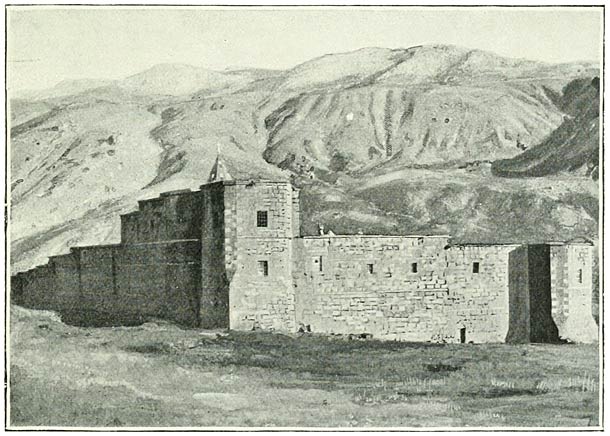
Fig. 147. Bitlis: Fortified Monastery.
Issuing again from this minor trough and regaining the principal artery, we may extend our ride to the fortress enclosure of the monastery last mentioned—a curious receptacle for a sanctuary dedicated to the mother of Christ (Fig. 147). In spite of its massive walls, it was rifled by Kurds during the last Russo-Turkish war; and you may still see the imprints of the large stones which they hurled at the door communicating with the treasury adjoining the apse of the church. The ignorant peasant who was priest in charge informed us that the cloister had been in possession of charms wherewith to raise the dead to life; with these, too, the marauders had made off. A sheep was bleating in the yard; his fat tail had been bitten off by a wolf, while he grazed upon the sward outside. Wolves enter the streets of the town during winter and have been known to carry away the dogs.
Returning by the right bank of the Bitlis river, we may thread our way through the crowded bazars. They are nothing better than roofed passages, narrow and low. An old Khan with a fine doorway in the Arab style, adorned with the figures of two snarling lions, varies the monotony of the shabby booths. The Arab façade with inlays of marble of the Sherifieh mosque adjoins the masonry of the bridge over the western confluent. We were unable to penetrate within the walls of the principal mosque, at the foot of the castle; but it did not appear to offer interesting features. There is a persistent tradition that several of the mosques in Bitlis were formerly Christian churches. A question of still greater interest, but which I regret I have failed to elucidate, attaches to the age of the various edifices. One cannot help remarking a strong family resemblance between them, all being markedly under the influence of the Arab style. They are evidently the outcome of a period or periods of building activity, which I have been unable to locate in the history of the city.
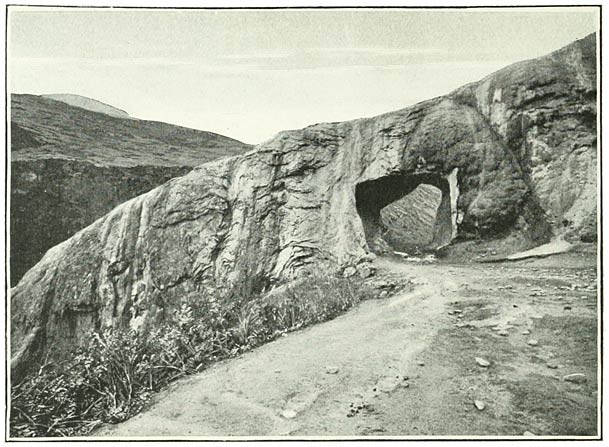
Fig. 148. Tunnel of Semiramis.
Not the least interesting among the experiences of a sojourn at Bitlis will be the excursion to the so-called tunnel of Semiramis. You follow the course of the river for a distance of some four miles below the castle along the avenue of communication with Sert. A metalled road has been constructed for some portion of the way, representing the abortive attempts to connect the two centres by a carriageable chaussée. It breaks off within 1½ miles of the tunnel, to be succeeded by sporadic patches of levelled inclines. These fitful reminders of the puny civilisation of the present day struggle forward for no great space into the alpine scene. Limestones on the heights above, dark lavas in the trough below accompany your course. Mineral springs well up in abundance along the path. The tunnel is an artificial work, attributed to the Assyrian queen, which pierces a wall of rock blocking the narrow valley and completely cutting off the path (Fig. 148). The barrier has been formed by deposits of lime and other ingredients left by a spring bubbling in a basin some 150 feet above the track and over 300 feet above the right bank of the river. The water in the pool is clear as crystal to the eye, but it tastes strongly of iron. Iron rust reddens portions of the surface of the rock, and is conspicuous on the huge boulders in the bed of the river, detached by the hissing torrent from the base of the parapet. The tunnel has a depth of 22 feet and a height of about 18 feet. It seemed to constitute the only egress from the gorge. The view from this standpoint, looking down the passage of the mountains, is in the sternest vein of alpine landscapes (Fig. 149).
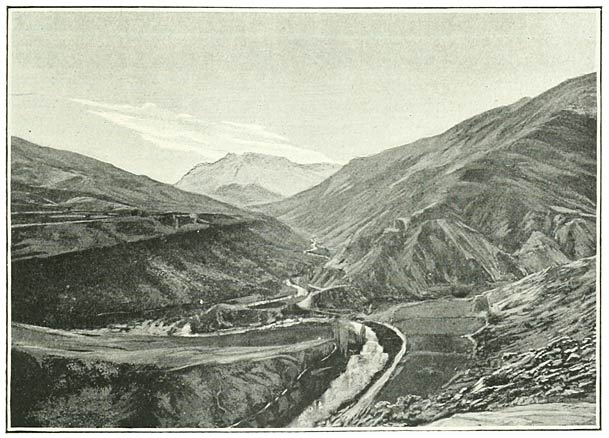
Fig. 149. Looking down Valley of Bitlis Chai.
Bitlis, like Van, was in the throes of a Reign of Terror when we were guests within her precincts. The storm was then brewing which was to burst in the Sasun massacre, the forerunner of the whole series of butcheries. The town was full of tales relating to a notorious Armenian conspirator, who not many months ago had been captured in the Sasun region, some said by treachery and others at the hands of a Kurd disguised as an Armenian. His name is Damadean, and he was lodged in the jail at the time of our visit. Sasun is comprised within a section of the same zone of mountains as those which rise about the site of Bitlis. In other words, it is a district of the southern peripheral ranges of the Armenian tableland, and it lies to the south of the plain and town of Mush. The Armenians who inhabit it are on terms of subjection to the Kurdish chiefs, to whom they pay sums fixed by custom for protection against other Kurdish tribes. Each chief has his own Armenian dependants, who are in possession of arms. Being a race of mountaineers they are noted for their courage and stubbornness; and there can be little doubt that Armenian political agitators, such as Damadean, fixed upon them as suitable material for a conflagration. The object of these men is to keep the Armenian cause alive by lighting a flame here and there and calling: Fire! The cry is taken up in the European press; and when people run to look there are sure to be some Turkish officials drawn into the trap and committing abominations. On this occasion the scene of the trouble had been the village of Talori or Talvorik—the same village which played a part in the later tragedies. Its inhabitants earn a livelihood by the primitive exploitation of mines of iron, and there is sufficient wood in the neighbourhood for smelting purposes. Damadean had for some time been busy in the district, and he had endeavoured to effect a coalition between Kurds and Armenians to resist the levy of taxes for Government. At the same time the Vali of Bitlis, Tahsin Pasha, happened to be on bad terms with the authorities at Constantinople. It was said in Bitlis that he was delighted to be afforded an opportunity of recovering favour by suppressing a so-called rebellion. The result of these opposite tendencies was a little piece of warfare, in which Turkish troops, accompanied by the Vali in person, appeared before Talori. Taxes were demanded and refused. The villagers, who had fled to a strong place in the vicinity—where they had already successfully resisted two tribes of Kurds friendly to the Government—stated to the official envoy with much reason that they could not afford to pay a double set of taxes, one to Government and the other to Kurds. If they yielded to the present demand, was it likely that the chiefs would forego payment when the Turkish force had turned their backs upon Sasun? The Vali appears so far to have acted with good sense, that he avoided bloodshed. He recovered the cattle which had been carried off by his Kurdish allies and liquidated his claims from the proceeds of their sale. His services were rewarded by a decoration from Constantinople; and he was able to pose as the restorer of the authority of Government, the ringleader being in his hands. These events occurred in the month of June.
Damadean is a good type of the Armenian revolutionary. He received a sound education in the school of the Mekhitarists at Venice, and he is said to speak both the French and the English languages. Some ten years before our visit he came to Mush as a teacher in one of the Armenian schools. The real miseries attendant upon the social and political lot of his countrymen are nowhere more eloquent than in that remote town. They spoke to the soul of an Armenian who had tasted the liberties of Europe without succumbing to the vices on the surface of European life. The actions of such a neophyte are in so far misguided that they operate upon much too low a plane. They produce disturbance rather than wholesome change. The despairing usher shook off the dust of Mush from his feet; and, when he returned after a protracted absence to pursue his old vocation, the profession was only a cloak to the designs he had matured in Constantinople as a petty conspirator and correspondent of European newspapers. When his plans were sufficiently ripe, he exchanged the dress of his office for that of a peasant in Sasun; and the disguise enabled him to pass to and fro between the town and the adjacent mountains in the capacity of a seller of firewood. Disposing of his logs in the houses of the principal officials, he had ready access to their confidential servants. No move was made of which he had not been apprised. His career was cut short in the doubtful manner already indicated; but it was not calculated to accomplish abiding results.