Chapter III · ACROSS LAKE VAN
Reading edition
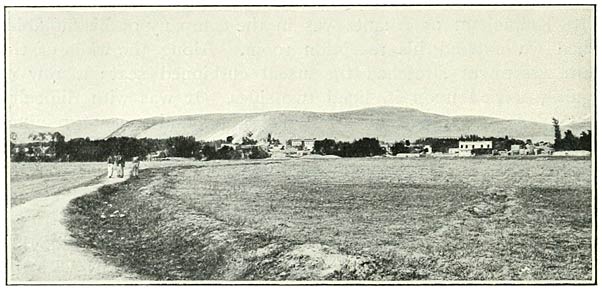
Fig. 117. Akantz.
The morning of the next day was devoted to preparations, and the whole afternoon was occupied by our excursion to Arjish. The site bears a few points west of a line due south from Akantz, at a distance of several miles. But the track across the plain is obstructed by channels of water which compel you to deviate. Leaving the town by the south side, we paused to admire the cluster of houses, embowered in trees, and backed by the high cliff (Fig. 117). A continuation of the same ridge rises behind the gardens and orchards, which are about a mile away, upon the east. Between us and the lake lay a broad zone of alluvial land, of sandy surface broken by green oases. We rode through two considerable villages, Hargin and Igmal. They are almost buried beneath the foliage of tall poplars and forest trees which are supported by a network of irrigation. The last of these two settlements can scarcely be less distant than an hour’s walk from the shore. Beyond them the ground is patched with cultivation, which in turn gives place to a desert, cut by dikes. The ruins adjoin the lake, and accentuate the loneliness of the bleak waste from which they rise (Fig. 118 from the north, and Fig. 119 from the south).
Little is left above ground of the once important borough of mediæval repute. The crumbling walls of a castle, a ruined chapel, a minaret are the principal monuments still erect. The method of building is that of a more cultured age. A recent fire had converted the brushwood into black patches. We looked across the silvery waters to the opposite shore of the lake, from which a range of hills rise. Behind this barrier towers a rocky ridge of serrated outline, which, commencing at a point about east of the ruins, extends westwards and groups together with the magnificent chain on the southern margin of the sea. The arm beside which we stood stretched away by a succession of promontories, to spread towards those distant and snowy peaks in the south.
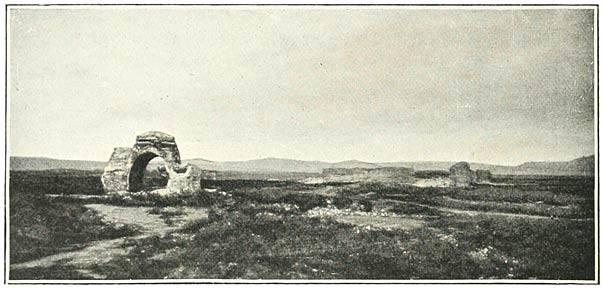
Fig. 118. Ruins of Arjish from the North.
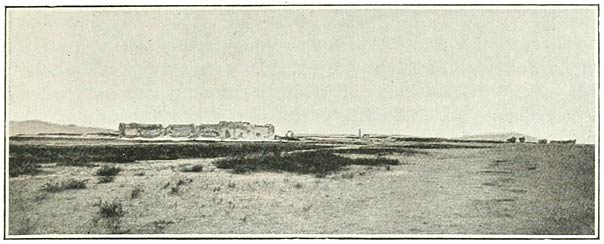
Fig. 119. Ruins of Arjish from the South.
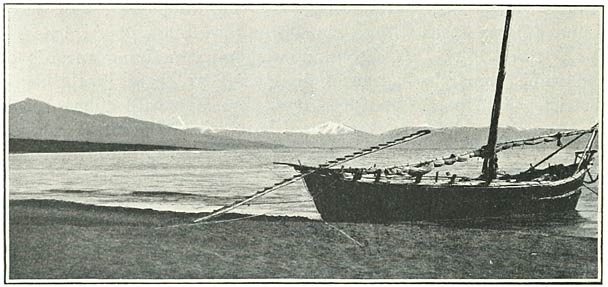
Fig. 120. Our Boat on Lake Van.
We had been warned not to linger too long upon the site; the district is inhabited by some Kurds of ill repute. One of them had been sighted making off to apprise his friends of our presence. Yet darkness had fallen before we were clear of the intricate dikes, among which it would have been easy for an armed man or two to cut off our retreat. The villages lay before us—a mass of gloom in the dimly lighted scene. We were glad to pass within the fringe of their orchards; and a little later we were again in safety at Akantz. Meanwhile the necessary preparations had been completed, and we were informed that a vessel would be ready to receive us after we had partaken of a meal. We set out at nine o’clock; yet not a single light flickered among the houses of the silent town. The boats station at a point about south-east of the settlement, along the margin of the sandy shore. It was after ten o’clock by the time we reached the lake and our craft, from which the long stage was dropped upon the sand to let us in (Fig. 120). The vessel was not decked, and we could spread our carpets within the hollow of her lofty sides. Scarcely a breath of air was stirring; but the breeze was expected, and it was decided to await its approach. We composed ourselves to sleep beneath the stars.
At midnight we set sail. When I awoke at half-past seven, the sky was blue in the zenith above my eyes. Set within that field of brightness, the pale crescent of the moon marked the boundary of a sheet of cirrus cloud. The gauzy tissues deepened as they neared the horizon, and gathered into long banks of heavy vapour, suspended about the summits of the chain of inky mountains which borders the lake upon the south. In that distant and gloomy range I at once recognised the features of the mountains of Kurdistan. It was the same chain that I had followed for weeks upon the waters of the Tigris, threading the vast plains between Diarbekr and the Persian Gulf. Day by day those steep parapets, sharp peaks, and gleaming snows had accompanied the peaceful voyage of my little raft.
How well I now recalled the longing I had then experienced to explore the famous lake on their further side! What a thrill of pleasure I now felt to be floating upon its waters, expanding towards those mountains with the proportions of a sea! The reflection of the blue vault above us paled and whitened as the flood approached that long black line. Bank upon bank, the clouds were serried upon the peaks, shot by the lights from the snows. Here and there the fretted outline of a pearly bed of vapour was drawn across the background of dull opal in the region of the middle slopes; or wreathing forms, like smoke, clinging to the sides of some loftier eminence, broke the horizontal layers.
The scene behind us contrasted the softness of a southern landscape with the stern grandeur of the coast above our prow. The northern shores of the lake were bathed in light; and the hummock convexities of the Ala Dagh, streaked with snow towards the summits, rose against a sky of transparent turquoise, and sank to a surface of more solid substance, but not less pure and not less blue. From these heights, across the long sheet of azure water to dazzling snow in the heaven above our heads, the fabric of Sipan mounted slowly to the flat rim of the central crater, and, sweeping past us, declined, with equal majesty of outline, to low ground in the west. The great volcano composes one whole side of the lake, and faces full south. I observed that the snow-line was perceptibly higher than on the occasion when we had approached the mountain from the north. The western limits of the lake were vague, and, in places, invisible; the mass of Nimrud, dim and cloud-streaked, had the appearance of a long island, rising on the horizon between the sunny slopes of Sipan and the nebulous barrier of the Kurdish chain.
It is this contrast—no chance effect of light and atmosphere—between the more northerly and the more southerly coasts of the vast basin that gives to the lake of Van its own peculiar character and a beauty quite its own. On the one hand, length of sweep in the form, and brilliancy of tone in the colouring—as seen in the curves of the bays, in the profiles of the mountains, in the texture of the soil; on the other, startling steepness, black rocks and deep shadows—one long serration, made more vivid by the snows. Here a scene which recalls the luxuriance of the bay of Naples; there the features, the austere features, of a Norwegian fiord.
A fresh north-easterly breeze filled our huge lateen sail; in the hollow of the white fold were painted large in a russet brown the emblems of a crescent and a star. The ship was heading for a low promontory which showed up yellow against the shades of the distance, and ended in a little island rock. That cape conceals the site of the city of Van, as you approach it from the east. The answering horn of a wide bay rose from the waters in our wake; we were skirting the eastern shore of the sea, with its gentle hills and delicate hues. On the slopes we could just discern a single small village, the only sign of the presence of man.
On we glide, and are soon almost abreast of the promontory, opening the expanse on the further side. The line of the shore curves inwards, and describes a wide half-circle, meeting the base of the stupendous barrier in the south. The whole long range is exposed to view, from foot to cloud-swept summit, from the waters in the west to beyond the waters in the east. The eye is arrested by a strange vision in the middle distance—a bold, black rock, starting from a bed of white mist on the surface of the sea. We learn from the sailors that it is the castled rock of Van. When the mist clears, and the object appears in its true proportions, it becomes a speck against the parapet of the great chain.
We approach the little island; I decide to land upon it; the water shallows, and assumes a hue of pure cobalt. Then the bed of soft white rock shines through the crystal element, and the vessel takes the ground. One steps ashore with the feelings of a Greek mariner, come from afar to a strange land. Gulls circle round us or rest tamely on the rocks; surely we have sailed across the bosom of the high seas.
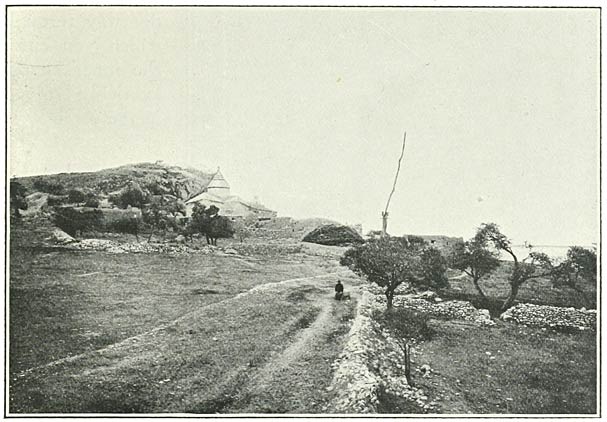
Fig. 121. Scene on the Island of Ktutz.
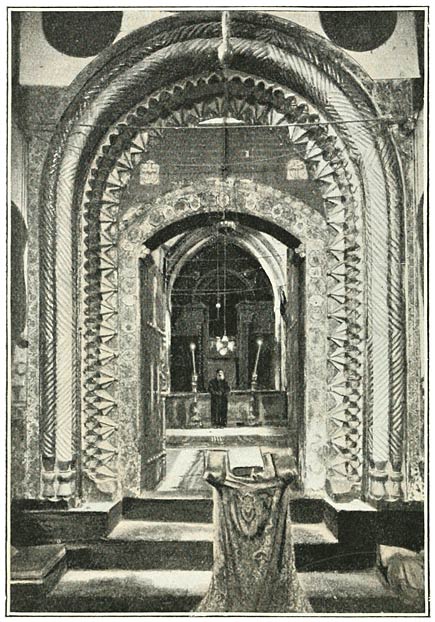
Fig. 122. Doorway of the Church at Ktutz.
He was a pleasant individual, quite young, extremely ignorant and without ambition to learn. He was called the monk Peter, or Petros vardapet. Eight monks were on the foundation of the cloister; of these only four were in residence on the island. We found them each in his cell, sharing the group of little buildings which cluster at the foot of the church. All appeared to be without work or occupation of any kind. They seemed to have passed their lives upon the cushions of their couches, looking across the tremulous shade of the almond trees to the Italian sea and the soaring fabric of Sipan.
It was half-past twelve when we put off; the wind had dropped, and scarcely enabled us to forge ahead. For several hours we lay becalmed on the bosom of the lake, here at its widest, in full face of the murky chain on the horizon, which was reflected in hues of burnished steel. Banks of mist shrouded the landscape, especially in the west, where the mass of Nimrud seemed encircled by the sea. A pest of little midges covered our clothes and blackened our papers; then a shower fell, and yet another, and they disappeared. About four o’clock a nice breeze freshened, coming from the shore of low hills upon our left. It brought with it rain; but a little later the sun triumphed, and burst the canopy of clouds in the south and west. A double rainbow of great brilliancy rose from that near shore, revealing the site of a little village. Our head was pointed to the rock of Van, which, at this distance, shows like an island, even without the assistance of mirage. The long barrier of the Kurdish range declines in that direction, and gives way to a less steep and less gloomy ridge; but that outline again rises on the further side of the city, to culminate in a lofty parapet of saw-shaped edge. Varag—such is the name of this mass—commands the bay in which Van lies from behind a spacious interval of garden and field. In the landscape it strikes the last note of the tumultuous theme which is suggested by the mountains in the south—a final trumpet blast by which the procession marches onwards to the Persian plains.
In the opposite quarter, across the lake, and against the declining slope of Sipan the gardens of Adeljivas might just be seen in shades of grey. Those of Artemid were more distinct—a stretch of softness and verdure along the summit of a low cliff of yellow substance near the foot of the black range. A fragment of rock thrown seawards from those mountains was identified as the isle of Akhtamar. But the site of Van engrossed us, surpassing our expectations, high as these were. The rock, which had appeared at a distance to be an island, projected almost into the waters from a background of plain and without visible connection on any side. Battlements crowned its horizontal outline; while at its foot and along the shore luscious foliage, touched by autumn, covered all the inequalities of the ground. From rock and garden, and from the vague detail of the middle distance the eye was led upwards to the stony slopes of Varag; a bed of cloud lay captive upon them; but the jagged parapet stood out from a clear sky. Here and there, stray fragments of vapour, flushed by the evening, floated outwards from the dense canopy over the mountains in the south. The veiled snowfields of the range were revealed in fitful glimpses of yellow, unnatural light.... We moored our vessel by the side of a cluster of similar craft at the so-called harbour, and took the direction in which the town was said to lie. It is surrounded by a walled enclosure, and nestles at the foot of the rock. Darkness had fallen as we passed down its silent streets, made more gloomy by the shadows from the cliff. The bark of dogs, the sad refrain of an Eastern song were the only sounds which broke the stillness of the night. Then we entered a broad chaussée which stretches inland to the suburb of gardens which usurps the importance of the fortified town. There are situated the Consulates of the European Powers, and the residences of the principal citizens. Poplars of great height rose from the irrigated ground on either side of the road. Side lanes led away from this broad avenue into the park of trees. After a walk which seemed interminable, and which occupied no less than three hours, we arrived at the British Consulate at half-past nine o’clock.