Chapter IV · VAN
Reading edition
Of the various sites which one might select upon the shores of the lake of Van, none would present as great advantages for a populous and self-contained settlement as that of the city from which it derives its name. The great range along the southern coast leaves little respite of even land between the waves and the parapet of rock. The opposite margin of the bosom of waters is filled with the fabrics of those huge volcanoes, Nimrud and Sipan. Sipan, indeed, upon nearer acquaintance, is robbed of some of his apparent extension; and the low outlines on the west and east of the dome-shaped mass upon the horizon will be recognised to belong to a belt of limestone with intrusive igneous rocks which the traveller follows all the way from Akhlat to Adeljivas, and upon which the volcano has built itself up. But those hills, which from the neighbourhood of Van seem to constitute the train of Sipan, are at once rugged and approach closely to the shore. Arjish alone is backed by a zone of fairly even and fertile country; while, as regards the coast between Van and the mouth of the Bendimahi Chai, I do not know that it has ever harboured a considerable city. On the other hand, the alluvial plain which is confined by Mount Varag upon the east, and which may be said to extend from a headland near the village of Kalajik on the north to the high ground just north of Artemid upon the south, affords a considerable area of rich soil, capable under irrigation of producing the choicest fruits of the earth.
Of the beauty of the site it would not be possible to speak too highly; but I tremble to provoke in my English reader a nausea of descriptive writing. The Armenians have a proverb which is often quoted: Van in this world and paradise in the next. The comparison might be justified under happier human circumstances, the perversity of man having converted this heaven into a little hell. Its aptness may be recognised during the course of a walk in the neighbourhood, or from the standpoint of the rock which supports the citadel. In the north across the waters is outspread an Italian landscape—a Vesuvius or an Etna, with their sinuous surroundings, on an Asiatic scale. Nearer at hand and fully exposed, the long barrier of the Kurdish mountains recalls the wildest scenery of the Norwegian coast. From the city herself as from the extremities of the wide basin, the short, sharp ridge of Varag is seen with pleasure to the eye, lifted some 4500 feet above the waters, and, at evening, reflecting the sunset in the most varied hues. The lake is not sufficiently large to separate these various objects by distances which preclude under ordinary conditions the simultaneous enjoyment of the beauty of all from a single shore. And it is large enough to spread at their feet with all the qualities of the ocean—the depth and vastness and changing surface of the high seas.
I.—The Lake of Van
It is about six times as large as the lake of Geneva, having an area of some 1300 square miles. Its western shore is erroneously laid down in existing maps; and this necessitated a particular survey of that region during my second journey, the result of which has been to invest the lake with a shape of greater symmetry—a central body with two arms, one on the north-east, the other on the south-west. The remainder of the outline I have borrowed from the best available sources, adapting them to the position of Van, of which the latitude and longitude are approximately known, and correcting them as well as possible by sketches, and readings to the principal points from the summit of Sipan. If my reader will turn to the map which accompanies this work he will, I think, be able to transfer, with the aid of a few illustrations, the features which are there conventionally delineated into a picture visible by the mind’s eye.
“Meet also and convenient it is to say somewhat of the river Tigris. It begins in the land of Armenia the greater, issuing out of a great source; and evident to be seen in the very plaine (fonte conspicuo in planitie). The place beareth the name of Elongosine (or Elegosine, Elosine, Elegos). The river it selfe so long as it runs slow and softly is named Diglito; but when it begins once to carry a more forcible streame it is called Tigris, for the swiftnesse thereof; which in the Median language betokens a shaft (sagitta). It runs into the lake Arethusa; which beareth up aflote all that is cast into it, suffering nothing to sinke; and the vapors that arise out of it carry the sent of nitre. In this lake there is but one kind of fish, and that entreth not into the chanell of Tigris as it passeth through, nor more than any fishes swim out of Tigris into the water of the lake. In his course and colour both he is unlike, and as he goes may be discerned from the other: and being once past the lake, and incountreth the great mountain Taurus, he loseth himself in a certain cave or hole in the ground, and so runs under the hill, untill on the other side thereof he breaketh forth again, and appeares in his likenesse, in a place called Zoroanda. That it is the same river it is evident by this, that he carrieth through with him, and showeth in Zoroanda, whatsoever was cast into him before he hid himselfe in the cave aforesaid. After this second spring and rising of his he enters into another lake, and runneth through it likewise, named Thospites; and once again takes his way under the earth through certain blind gutters, and 25 miles beyond he putteth forth his head about Nymphæum. Claudius Cæsar reporteth, that in the country Arrhene, the river Tigris runs so neere the river Arsania, that when they both swell, and their waters are out, they joyne both their streams together, yet so, as the water is not mingled: for Arsanias being the lighter of the twain, swimmeth and floteth over the other for the space wel-neere of 4 miles: but soon after they part asunder, and Arsania turneth his course toward the river Euphrates, into which he entreth.”
We need not discuss in this place the phenomenon last mentioned, except to remark that the story may well have been suggested by the propinquity of the sources of the Diarbekr branch of the Tigris to the stream of the Murad, the ancient Arsanias. The country of Arrhene is probably the same as that better known as Arzanene, which is comprised within the present vilayet of Diarbekr. Our present interest in the passage lies in the statements relative to the Tigris, that it flows through two lakes called Arethusa and Thospites. Strabo, in speaking of the same phenomenon, attributes it to one lake only, namely that of Arsene or Thopitis. The river, according to him, rises in the Niphates mountains, by which name he seems to be referring to the Nepat of Armenian writers, the modern Ala Dagh. After flowing through Lake Thopitis it disappears in a chasm at the corner of the lake. It comes to light again in the province of Chalonitis; and, although later on he attributes that province to the Zagros, I cannot help thinking that the sense which his informants wished to convey was that it came to light in the mountains of the peripheral region. The mention of two lakes by Pliny need not perplex us over-much; for his Arethusa no doubt denotes the Arjish arm of Lake Van, and his Thospites the principal body of water with the city of Van, the Dhuspas of the cuneiform inscriptions, upon its eastern shore. Ptolemy, on the other hand, entangles the subject still further by separating the lakes of Areesa—no doubt the Arethusa of Pliny—and Thospitis by four degrees of longitude. This geographer does not give us any indications as to the properties of the lake waters; but he tells us that the Tigris is partly a river of Armenia and that its sources constitute Lake Thospitis. The position which he assigns to the town of Artemita—which is probably the modern Artemid—is further evidence that in speaking of Lake Areesa or Arsissa he was in fact referring to Lake Van. One cannot help concluding that his Thospitis with the town of Thospia was actually the self-same sheet of water. The discrepancy in longitude finds a parallel in the degrees assigned by this writer to Lakes Sevan and Urmi. They are really upon the same degree. Yet Ptolemy, under the names of Lychnitis and Martianes, assigns to them the difference of over four degrees.
I think it is plain that the names Thopitis, Thospites, Arsene, Arethusa, and Areesa or Arsissa, are all applied to the great basin with the two immemorial cities, Dhuspas—the modern Van—and Arjish. Moreover, I should be surprised to learn that any lake exhibiting the same properties had been discovered in the belt of mountains south of Lake Van in which the present sources of the Tigris are found. Put together, the scraps of information retailed by the classical geographers go to show that in their days there existed a widely spread belief that the Tigris drew its waters from the tableland of Armenia, flowed through a lake strongly impregnated with soda, and disappeared in a chasm at its further and narrow extremity (μυχός) to come to light again on the further side of the barrier of Taurus or, in other words, of the parapet of mountains which are aligned upon the south coast of Lake Van. The mention of two lakes by Pliny and Ptolemy may point to a former isolation of the Arjish arm. I have taken the trouble to set forth these accounts—though not with all the care that I should desire—because they have an important bearing upon the subject to which I now proceed—a brief notice of some of the peculiarities which distinguish Lake Van.
Only one kind of fish is found in Lake Van, resembling a large bleak. But, often as I have bathed, I have never seen one gliding through the water, or surprised a shoal while following the shore. It is possible that they adhere to the estuaries of the rivers, up which they make their way in large numbers to spawn during the season of spring freshets. It is then that they are caught in great quantities by means of barriers placed at the mouth of the streams with baskets resting against one side. The fish leap the barrier and fall into the baskets, after which they are dried and salted. Seagulls and cormorants haunt the lake, but are not very numerous; nor have I observed a pelican, although these birds are conspicuous on the adjacent lake of Nazik together with many varieties of smaller waterfowl. The main body of the sea never freezes over in winter, rigorous as that season is at this high altitude.
TABULAR STATEMENT OF THE EVIDENCE OF TRAVELLERS IN RESPECT OF THE FLUCTUATIONS IN LEVEL OF THE THREE GREAT LAKES.
Year. Lake Van. Year. Lake Urmi. Year. Lake Gökcheh.
1806 Jaubert attests a gradual rise in the waters, threatening Arjish and the suburbs of Van (Voyage en Arménie, etc., p. 139). 1811 Morier attests a relapse. The former island of Shahi has become joined to the mainland by a swampy isthmus during the last two or three years (Second Journey, p. 287, seq.).
1812 to 1829 Progressive relapse of about 10 feet during this period attested by Monteith (J.R.G.S. 1833, vol. iii. p. 56).
1838 Brant attests a relapse which, according to the natives, has effected a gain of one mile in ten years to the plain on which Arjish stands (Journal R.G.S. 1840, x. p. 403). 1834 Relapse attested by Fraser since his last visit in 1822 (Travels in Kurdistan, pp. 47 seq., and Narrative of Khorassan, p. 321).
1830 A low level, perhaps a minimum, is attested by Monteith. The canal to the Zanga is an insignificant runnel, supplying the river with the smallest portion of its waters (J.R.G.S. 1833, vol. iii. p. 43).
1838 Loftus records a rise on native authority, commencing during the winter. In twelve months, viz., by the winter of 1839, the lake is said to have risen nearly 6 feet. In the next two years, viz., by 1841, it is said to have risen altogether 10 to 12 feet, necessitating the evacuation of Arjish by the inhabitants, the place becoming an island (Quarterly Journal Geol. Soc. 1855, p. 318). 1838 Autumn. Rise attested in general terms by Rawlinson (J.R.G.S. 1840, vol. x. p. 8) and more precisely in 1839, by Perkins on native testimony (Residence in Persia, Andover, 1843, p. 394). Rise has been gradual.
1856 Lieut. Owerin of the topographical staff of the Caucasus, estimates that nearly ⅛th of the waters of the lake find an egress through the canal to the Zanga (Petermann’s Mitt. 1858, p. 471). Other evidence goes to show that in the forties and fifties the lake was certainly higher than in Monteith’s time.
1847 Hommaire de Hell attests a relapse (Voyage en Turquie, etc., quoted by Sieger, Schwankungen, p. 6).
1850 Layard attests a rise “during the last few years.” Many villages on the margin are partly submerged. Iskele, the port of Van, is still in- habited; but the greater part of the village is under water (Nineveh and Babylon, p. 408). [Layard was perhaps only witnessing the effects of the rise which commenced 1838.]
1859 to 1879 Relapse during this period is assigned to the lake by Brandt (Zoologischer Anzeiger, ii. 523 seq.), from whose observations we may infer a minimum about 1879. Islands had formed; these again had become a peninsula. The canal to the Zanga seems to have been scarcely operative at all.
1852 Loftus attests a considerable relapse during recent years, said by the natives to have commenced in 1850. Arjish is connected by a passable isthmus to the mainland for eight months in the year (op. cit. p. 318). 1852 A relapse is attested by Perkins to Loftus (Quarterly Journal Geol. Soc. 1855, p. 307).
1856 Rise may be deduced from N. von Seidlitz who seems from a distance to have seen Shahi, an island in October (Petermann’s Mitt. 1858, pp. 228, 230).
1863 Strecker records a continuous rise during the years preceding his writing, as evidenced by Turkish officials of his acquaintance (Petermann’s Mitt. 1863, pp. 259 seq.) 1891 Relapse has continued. Trees planted thirty years ago on the margin of the water at the island of Sevan are now standing some 50 feet away, and some 7 to 10 feet above the lake level. (Belck in Globus, vol. lxv. p. 302).
1875 A maximum at about this period may be inferred from the accounts given by Bishop Poghos of Lim to Dr. Belck (Globus, vol. lxiv. p. 157), and by the Rev. Mr. Cole of Bitlis to Dr. Butyka (Globus vol. lxv. p. 73). From this period there appears to have been a gradual relapse until 1892, and possibly later.
1898 Rise dating back several years is attested by Belck and Lehmann. The trees alluded to above are now standing in the water (Zeitschrift für Ethnologie, 1898 p. 414).
1898 Günther chronicles a rise during the last two years on native evidence (J.R.G.S. November 1899, p. 510).
1898 Evidence of Oswald and myself infers a rise during the last few years.
The same phenomenon of a rise in level was apparent on the margin of the large lake in the crater on Nimrud. There the brushwood, representing the growth of many years, was submerged; and much had already perished from want of sustenance. All the evidence points to the fact that such changes are of a temporary nature, and that a period of increase is followed by one of decline. The most probable explanation is that they are due to climatic conditions, which, it is well known, are variously operative over cycles of years. In the absence of any observatory in these countries this question is largely a matter of surmise or, at best, of inference. The existence of such periodical fluctuations may be regarded as having been established; it remains to consider the changes of a more permanent order.
II.—The Ancient Empire of Van
Deep in the curve of the bay, which with minor indentations extends from the promontory and island of Ktutz to Artemid, lies the isolated rock with the mediæval city at its southern foot and the long line of gardens stretching eastwards across the plain towards the slopes of Mount Varag. These various features are disclosed or suggested in my illustration (Fig. 123), which was taken from those distant slopes. But before I invite my reader to explore the ancient township, something must be said upon a topic which here fascinates the traveller’s interest equally with the characteristics of the strange lake beside which he sojourns. I have already on several occasions remarked upon the insignificance of the human element in these Armenian landscapes. At Van for the first time we become sensible of a different impression, derived, not indeed from the peoples who now inhabit the country, but from the monuments of a remote civilisation which abound in the neighbourhood, and of which the spirit is wafted towards us across the ages. Here the massive substructures of an aqueduct, there the Cyclopean masonry of the fragment of a wall tell the tale of man’s mastery over Nature, and insensibly conjure the vision of the plains crossed by great roads, the rivers spanned by bridges, the fertilising waters brought from afar. Our curiosity is enhanced by the inscriptions in the cuneiform character which are deeply incised in the hard stone of the various works. But it rises to the degree of fervour when we survey the rock of Van, clearly recognised as the very navel of this old polity. Its precipitous sides are quite a library of inscriptions, carved upon their face in spaces polished by human hands. Square-cut shadows disclose the entrances of chambers hewn into the calcareous mass at a considerable height above the level of the plain. And something in the spirit of the works and in the choice of situation at once distinguishes them from the rock dwellings, such as those at Vardzia near Akhalkalaki, with which we have become familiar during the course of our journey south. It is evident that in their original purpose they were only a feature of a large design which mocks the scale of the existing fortifications.
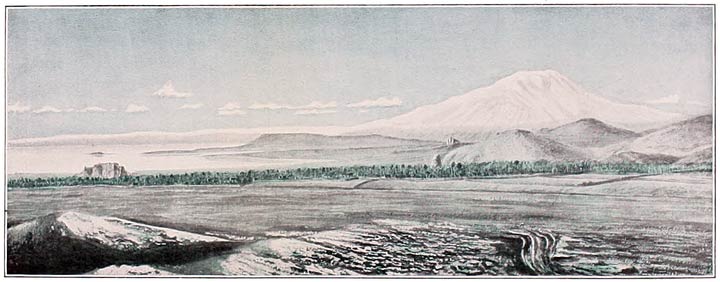
Fig. 123. Van from the Slopes of Mount Varag.
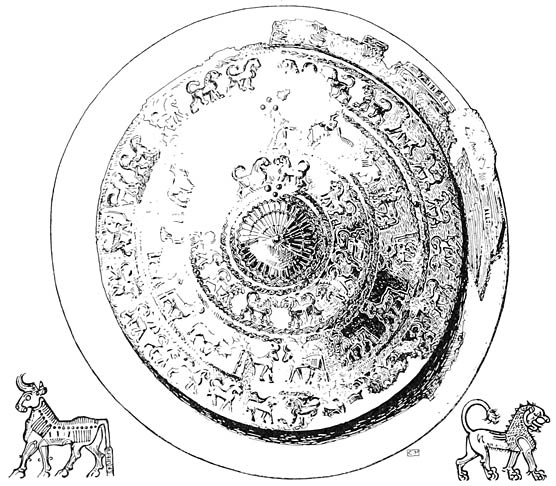
Fig. 124. Bronze Shield from Toprak Kala (British Museum).
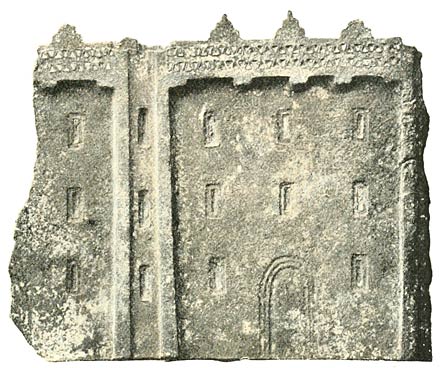
Fig. 125. Bronze Fragment from Toprak Kala (British Museum).
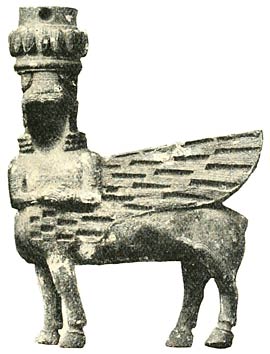
Fig. 126. Ornament from Toprak Kala (British Museum).
1. Sarduris I.—Son of Lutipris. Three inscriptions (Zeitschrift für Assyriologie, 1899, p. 315) on massive blocks of stone, forming part of a wall which extended from the western extremity of the rock of Van roughly in a northerly direction towards the harbour across the plain (Verhandlungen der Berliner Gesellschaft für Anthropologie, etc., 1897, p. 305). Appears to have been the initiator of the fortifications of the rock of Van. Bore the title: “king of the world (Šar Kiššati), king of Nairi.” Attacked about 833 B.C. by the general of Shalmaneser II.; styled king of Urardhu in the Assyrian inscriptions.
3. Menuas.—His son, associated with his father in the government, and afterwards with his own son, Inuspuas. To this king belong the largest number of the inscriptions yet discovered, ranging from the Kelishin Pass and the rock of Tashtepe, near the southern shore of Lake Urmi (Sayce, J.R.A.S. vol. xiv. p. 386; Belck, Z. Assyr. 1899, p. 313), the latter of which commemorates his conquests in the kingdom of Minni (V. Anth. 1894, p. 481) in the east, to Palu on the Lower Murad in the west; and from Van and the Van regions in the south to Hasan-Kala, near Erzerum, in the north. Perhaps his most important conquest was that of a great portion of the valley of the Araxes on the northern side of the Ararat system. Menuas may be regarded as the founder of the original garden city of Van, which probably occupied a somewhat different position than at the present day, and extended to the borders of the lake, where it received the waters of the canal since called the Shamiram Su, coming through Artemid—a work on a great scale, which we now know to have been constructed principally by this monarch, and which provided the volume of irrigation necessary for an extensive settlement. Records his conquests. Extensively restored Melazkert (Z. Assyr. 1892, p. 262; V. Anth. 1898, pp. 569 seq.) and founded Arzwapert, north-east of Arjish. His title is: the great king, the king of Biaina, inhabiting the city of Dhuspas.
4. Argistis I.—His son. Numerous inscriptions which show that he extended the conquests of Menuas, especially towards the north. These inscriptions are found as far north as Kanlija, near Alexandropol, and Sarikamish, on the road from Kars to Erzerum, by which route he probably advanced or retired from the districts north of the Ararat system. From those at Van, which are in fact detailed annals of his conquests, we learn that he met and overcame the armies of Assyria on more than one occasion in the regions south-east of Lake Urmi. His reign represents the culminating point of Vannic empire. He ascribes to himself works upon the rock and in the city of Van; and he was the founder of the city of Armavir in the valley of the Araxes (V. Anth. 1896, p. 313). He bore the title of: the great king, the king of Biaina, inhabiting the city of Dhuspas.
6. Rusas I.—His son. The author of at least two important extant inscriptions, that of Kölani-Girlan (Alutshalu), on the face of a rock overlooking Lake Gökcheh, and that of Topsanä (Sidikan), in the district of Rowanduz in Kurdistan, discovered by Rawlinson and recently examined by Dr. Belck (Zeitschrift für Ethnologie, Berlin, 1899, pp. 99–132). The first records conquests and the restoration of a palace; the second, which has, however, not yet been published, conveys noteworthy facts bearing upon the relations with Assyria. We know from the Assyrian inscriptions that the Vannic kingdom was by no means crushed by the campaign of Tiglath-Pileser; for the son of Sarduris, this Rusas the First, displayed great activity in inciting the neighbouring principalities against the successor of the conqueror, Sargon (722–705 B.C.), among which may be specially mentioned the kingdom of Minni, south-east of Lake Urmi, and the almost impregnable territory of Mutsatsir or Ardinis near Rowanduz. Sargon tells us how, in 714 B.C., he penetrated into Mutsatsir, which contained a temple of the god Khaldis, the god of the Vannic kingdom; how its king Urzana fled, and how he plundered and burnt the city, rifled the temple and carried off the statues of the gods. He relates that Ursa, king of Urardhu (i.e. Rusas I.), upon hearing of this disaster to his ally and of the carrying off of the god, committed suicide. The contents of the inscription of Topsanä throw doubt upon this latter statement. They are to the effect that Rusas restored Urzana to his kingdom, led his armies as far as “the mountains of Assyria,” and restored the offerings to Khaldis in Mutsatsir.
If, as seems probable, the Rusas of the shattered stele of Keshish Göl near Van be this first king of that name, then we must ascribe to this monarch the various works which are mentioned in that inscription (Sayce, No. lxxix.), and which, as Messrs. Belck and Lehmann have conclusively shown, should be referred to Toprak Kala, an eminence from the plain some little distance east of the rock of Van and close to the present garden town. These works appear to have been: the constitution of the Keshish Göl into a reservoir, the conduct of its waters to the Rusahina, or city of Rusas, as distinct from Dhuspas; the laying out of this new city, with numerous vineyards and gardens, and the building of a palace there. Rusas I. may therefore be regarded as the author of the transference of the site of the garden town from the south to the east of the rock of Van, where it was protected by the heights of Toprak Kala. The necessary irrigation was drawn from the Keshish Göl instead of or in addition to that derived from the canal of Menuas. The change was probably made in consequence of the destruction by Tiglath-Pileser of the old town, although he was unable to effect the capture of the citadel or rock of Van (Z. Ethnologie, 1892, pp. 141 seq.; V. Anth. 1893, p. 220; Z. Assyr. 1894, pp. 349 seq.; Deutsche Rundschau, Christmas 1894, pp. 411 seq.; V. Anth. 1898, p. 576; Z. Assyr. 1899, p. 320). Rusas I. is styled Ursa, king of Urardhu, in the Assyrian inscriptions. Those of the Vannic Monarchy, hitherto published, do not furnish a title.
7. Argistis II.—His son. The mention of this ruler in a Vannic text was discovered by Messrs. Belck and Lehmann in an inscription on a shield from the temple at Toprak Kala, now in the British Museum (Z. Assyr. 1894, pp. 82–99; cp. Z. Assyr. 1892, pp. 263 seq.; V. Anth. 1895, p. 595); and two of his own inscriptions have recently been found by these investigators in the neighbourhood of Arjish (V. Anth. 1898, p. 573). They have not yet been published. This prince is alluded to in the Assyrian annals. He appears to have endeavoured to repeat the tactics of Sarduris III. against Tiglath-Pileser III., and to have succeeded in inciting the king of Kummukh (Kommagene) against Sargon. But his efforts only resulted in the subjugation of Kummukh by the Assyrian monarch in 708 B.C. (Smith’s Assyria, 1897, p. 116).
8. Rusas II.—His son. So known to us from the inscription on the shield above mentioned (Z. Assyr. 1894, pp. 82–99, and 339 seq.; V. Anth. 1895, p. 596). Two new inscriptions of this king have been found by Dr. Belck at Adeljivas (V. Anth. 1898, p. 573), in which he is stated to have conquered the Hittites and Moschians. He is also mentioned on a clay tablet discovered by Messrs. Belck and Lehmann at Toprak Kala (Van). He was the contemporary of Esarhaddon of Assyria (681–668 B.C.), and is mentioned in an Assyrian inscription of that reign (H. Winckler, Altorientalische Forschungen, 2nd ser. vol. i. 1898, p. 41; and see Z. Assyr. 1894, p. 341).
9. Erimenas.—Known only from an inscription on a shield from the temple at Toprak Kala, now in the British Museum, as being the father of Rusas III.
10. Rusas III.—His son. Rebuilt the temple of Khaldis on Toprak Kala (shield inscriptions in the British Museum published by Prof. Sayce, No. lii. in J.R.A.S. 1882, pp. 653 seq. For Tuprak Kilissa read Toprak Kala, Van, and cp. Z. Assyr. 1892, p. 266; Z. Assyr. 1894, p. 97 and pp. 339 seq.; V. Anth. 1895, p. 595). An inscription of this king has been found at Armavir (Sayce, lxxxv.). Sent an embassy to Ashur-bani-pal of Assyria about 655 B.C. (Z. Assyr. 1894, p. 342). Bore the title: the great king, inhabiting the city of Dhuspas.
11. Sarduris III.—Known through the Assyrian inscriptions as having sent an embassy to Ashur-bani-pal about 644 B.C. (Z. Assyr. 1894, p. 342).
III.—Van towards the Close of the Nineteenth Century
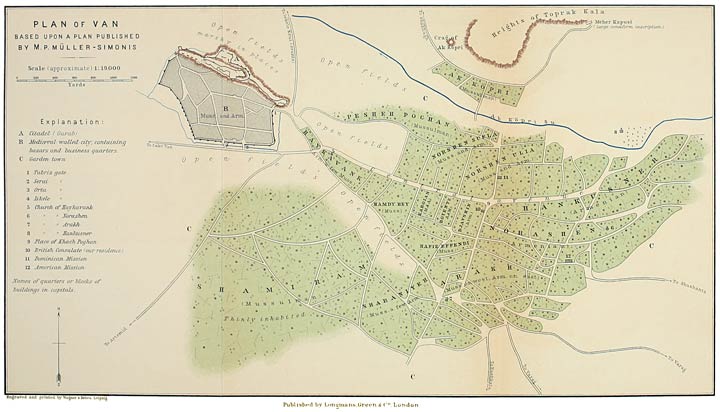
PLAN of VAN
Engraved and printed by Wagner & Debes, Leipzig
Published by Longmans, Green & Co., London
The tall poplars and luxuriant undergrowth hide the houses of the suburbs as you approach Van from the plain in the south. But penetrate within the foliage and you will find clusters of habitations which grow in frequency and importance as the central avenue is reached. Along that well-trodden thoroughfare—filled at morning or in the evening by a stream of pedestrians and riders, wearing the fez and more rarely the turban, some in flowing Oriental robes, others attired in European dress—a number of stately residences abut on the road with their gardens around them, and dissemble the squalor which for the most part reigns within. Extremely picturesque are some of these lofty houses, with verandahs disposed in various and fanciful manners, as may be seen in my illustration of the dwelling of a wealthy Armenian inside the precincts of the walled city (Fig. 127). The fact that a large number of the inhabitants of the garden town proceed daily to their different places of business in the city partly accounts for the paradoxical smallness of the population, which ebbs and flows between the two. Here in the gardens are the private residences of the Vali or Governor of Van and of the principal officials. Most of the rich Armenian merchants have their dwellings among these quarters, where are also situated the various European Consulates. It is here that are housed the principal schools, and are located the most considerable of the churches. It is therefore scarcely correct to speak of the garden town as a suburb; far rather does it bear to the narrow and crowded streets at the base of the citadel a relation analogous to that of the West End of London towards the City and the Strand.
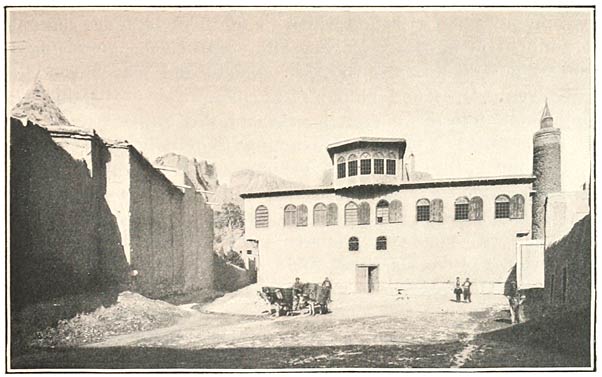
Fig. 127. House of an Armenian Merchant at Van.
Among these groves we spent a pleasant and fairly restful fortnight, housed in the empty apartments of the British Consulate near the cross-roads of Khach-poghan. There, in the great room containing the safe, and the scroll enumerating the consular fees payable by the only two subjects of Her Britannic Majesty who, besides the Consul, are resident at Van, my companions erected their camp beds. Mine was placed in a little chamber on the further side of the spacious landing, which was open to the air. Here I could receive visits and read and write. My windows, paned with glass, looked out upon a sylvan scene of fairy-like character. All this verdure is produced by irrigation; and it is the peculiar quality of such artificial sustenance that plants and trees preserve the perfection which in northern latitudes can only be admired in a conservatory. The storm clouds, dissolving in rain, do not disturb this southern climate and play havoc with the leaves. Moss and mildew are unknown beneath this dry, continental atmosphere and the rays of this brilliant sun. The air is saturated with light, streaming from a heaven which is always blue. Into the liquid canopy start the needle forms of the poplars, forced from the soaking earth with wand-like stems. Apples and peaches and pomegranates—all the hardier fruits which can withstand cold winters—attain a beauty of form and an excellence of flavour which would do credit to better gardeners. Here at Van they grow much as they please. Melons and cucumbers find just the conditions under which they thrive. All this pulsing and exuberance extends unchecked through the long summer; and when the autumn is at length at hand, towards the end of October, the change is only marked by the gradual passing over of shades of green into shades of gold. The leaves remain on their branches until the withered stalks can hold no longer; but of violence there is rarely a trace. The sky becomes black and rumbles; some showers fall, and Sipan is clothed in white to his lower slopes. But the passing darkness of the day only enhances the goldness of a foliage which awaits the first coming of the snows. Such were the phases of the year, which, towards the middle of November, were silently being accomplished before our windows.
These cross-roads, Khach-poghan, are situated almost in the centre of the most thickly-populated districts of the garden town. On the whole it is a painful impression which one receives from daily intercourse with one’s fellow-creatures at Van. The salient feature of the situation is the war between two opposite elements—the one of restless energy, measured almost by a European standard; the other passive, suspicious, fitfully aflame. Neither is endowed with the capacity of government; and the least numerous and least capable rule. The Armenian subject majority spend lives which are certainly laborious and create whatever wealth the city possesses. The Mussulman dominant minority grow fat in the mostly highly-paid sinecures, or employ the most keen-witted among the Christians to devise ingenious schemes for robbing the public or the public funds. Over all presides an imported official of little ability and no education; and a few troops, under the orders of an independent commander, who is a centre for intrigue, redress the balance in favour of the least enlightened and most corrupt.
Things are in the habit of going on in this haphazard manner, jolting and creaking along. But within the last decade or two a new spirit has been born, which my reader knows under the name of the Armenian movement. Here at Van, no less than elsewhere, it has been a clumsy birth, as might be expected from its parentage. It springs from the two elements above indicated, and flourishes most in the circumstances described. In its ultimate origin it is at once a product of economical conditions and a reflection of the spirit of the times. It causes the old elements to ferment beyond recognition and to assume the most incongruous shapes.
The phenomenon is most remarkable in the case of the Turks. One may remark, by way of parenthesis, that there does not appear to be any evidence of an actual settlement of Turks in Van or the neighbourhood. Among the Mussulman inhabitants of the town about six families or clans, comprising each on the average some fifty persons, may be classed as of Turkish descent. Of these the most prominent are the Timur Oglu; then the Jamusji Oglu, or sons of the buffalo driver, and the Topchi Oglu, or sons of the artilleryman. From their ranks was formed a kind of oligarchy, which ruled the city in former times, and, as was natural, developed a fine taste for faction and had its counterparts of Guelphs and Ghibellines. The passion for intrigue has survived among them longer than the ability to indulge it in methods of their own choosing. Their power has been much curtailed by the progressive centralisation of all government at Constantinople. But they still maintain their hold upon much of the machinery of the administration, filling the offices which are not under the direct patronage of the imperial authorities, such as the presidencies of the municipality, the administrative council, and the judicial courts. With the exception of these families there are very few real Turks in Van; and in the country districts the Mussulman population are probably for the most part of Kurdish origin. They speak both Turkish and Kurdish. The more peaceable among them, who are accustomed to settled pursuits, disown the name of Kurds and affect that of Osmanli, or Turks of the ruling race. They do not belong to any Kurdish tribe. Their sympathies are on the whole on the side of law and order; and their aversion to the turbulence of the tribal Kurds counteracts and perhaps outweighs their jealousy of their Christian neighbours.
An enlightened Government would seize upon these points of union and forge from them strong links to connect society in defence of common interests against the excesses of the Kurds. Van is situated upon the threshold of the Kurdish mountains, close to the immemorial strongholds of Kurdish chieftains, whence they descend with their motley followers into the plains. No sooner had the centralising tendencies in the Ottoman Empire come near to establishing upon a permanent basis the unquestioned supremacy of Ottoman rule in these remote districts, than the Armenian movement commenced to make itself felt. The truth is that those tendencies were of impure origin. The officials at Constantinople were concerned with nothing less than the extension of good government. But they were clever enough to perceive that such modern inventions, as, for instance, the telegraph, gave them the means of controlling for their own purposes distant territories which in former times had been left more or less to themselves. The telegraph substituted the authority of a clique in the Palace at Constantinople for the rough-and-ready but often honest and, on the whole, well-meaning methods of a Turkish pasha of the old school. It is quite possible that the good old pashas would have brought about the ruin of the country, which, indeed, was in effect ruined long before they appeared on the scene. But things might have gone on longer; their rule could not have cost one quarter the existing misery; and the travelled person would at least have preferred spending his life in their shadow than within reach of the wings of the eagle of Russia and the quills of her bureaucrats.
From one cause or another the whole character of Mussulman government has undergone a marked change within recent years. It is scarcely possible to recognise in the ruling circles of such a city as Van the Turkey of our fathers. Fear and suspicion are written upon every face. These passions are transmitted to the rank and file of their co-religionists; the air is full of rumours of Armenian plots. In the old days there would have been a riot and quite possibly a massacre; and everything would settle down. At present a swarm of spies, under the direction of emissaries from the Palace, keep the old sores open and daily discover new opportunities for inflicting wounds. All the vices of the Russian bureaucracy have been copied by willing disciples in the capital, and sent down to the provinces to serve as a model. One may assert without exaggeration that life is quite intolerable for an inhabitant of this paradise of Van.
The spies smell out a so-called plot and denounce its authors to the Governor, who, poor man, is tired to death with their reports. If he fail to follow it up, he is accused at Constantinople, and runs the risk of losing his post. If he interfere, his action may quite well lead to bloodshed at a time when his efforts at pacification were commencing to bear fruit. I gathered that a certain Vali of Bitlis had discovered a working solution of the difficulty. His principle was to go one better than the informers, and himself to organise a huge plot against himself. When this sedition had been quelled by his soldiers just at the time that suited him best, his zeal would be rewarded by the despatch of a decoration from the Palace, and he would be left in peace for some time.
Of course the power of the Kurds is daily on the increase in such circumstances as these. The Palace leans towards them; their petty leaders are taken to the capital and invested with high orders. The wretched puppet of a Governor does not dare to overawe them, as even his slender resources would well enable him to do. On the other hand, the former docile, cringing spirit of the Armenians has given place to a different temper. Partly they are goaded by the spies into so-called rebellion; and, in part, they have been aroused to a consciousness of their own real miseries by the persecution of the most respected of their clerical leaders and by the spread of education.
The Armenian movement has had the effect of resolving their community at Van into two distinct parties. The one is animated by the spirit of the present Katholikos, His Holiness Mekertich Khrimean. The memory of his noble life, spent so largely among them, outlives his long absence from their midst. The evidence of his work and example is spread over the city, and may readily be recognised in the demeanour of those who have shared his thoughts and aims. His last period of residence in this, his native place, would appear to have come to an end in 1885. At that time he was bishop of Van as well as abbot of Varag. His labours were directed to the education of his countrymen; “educate, educate”—the girls no less than the boys—may be said to have been his watchword. His personal influence and the power of the pulpit, when occupied by such a preacher, were thrown into the endeavour to awake those dormant feelings which few human beings, however much their spirit may have been broken, are entirely without. To realise their manhood, and what they owed to themselves and their race was the constant exhortation which ran through his sermons and penetrated to the inmost selves of his flock. Schools sprang up in abundance beneath the magic of his individuality, and teachers were imbued with that enthusiasm for their high calling without which their profession savours of drudgery and tends to produce a similar impression upon their pupils. But the spirit of truth is too often akin to the spirit of revolution, and there are bonds from without as well as from within. When the scales fell from the eyes of this downtrodden people, the naked ugliness of their lot as helots was revealed. Their native energies were transferred from the domain of money-making to that of social improvement and political emancipation. The craft of their minds, abnormally quickened by the long habit of oblique methods, exchanged the sphere of commerce for that of politics. What wonder if they infused their politics with a character at which your superior European would sometimes frown and more often smile? He has been trained by a long spell of comparatively pure government; while the Armenians have been a subject race for over nine centuries, are honeycombed with the little vices inherent in such a status, and are quite unused and as yet unfit to govern themselves.
So the old Armenian nature underwent and is still experiencing a process of fermentation and change. At the same time it threw off some of the characteristics which had been hitherto among the most pronounced. Rashness and contempt for calculation took the place of the old qualities of servility and time-serving. In the domain of the community these discarded qualities were represented by individuals and by a party. The watchword of this party has been submission to the powers that are, and the solid argument which underlies the counsels of those who inspire it is based upon the apparent hopelessness of resistance and the tragic failures which such resistance has already involved. But the sympathy of the impartial spectator can scarcely be enlisted on their side, even if his judgment incline to their views. They are not the new Armenians, chastened by sorrow and sobered by reflection, but, for the most part, the very dregs of the old. Their leader in Van is the bishop of Lim, commonly known as Bishop Poghos. This prelate has long been resident in the city. His talents have been employed to counteract the influence of the present Katholikos; and he has stood at the head of his opponents. When Khrimean departed from his see he named Bishop Poghos his vekil or deputy, it would seem in the hope of promoting peace. But the inhabitants do not appear to have favoured this solution, and the bishop has not held the office for the last several years. He did me the honour of coming to see me—a man of great bulk of body and in advanced years. His features are of the blunt order characteristic of so many Armenians; and one might doubt whether he could ever have understood the personality of such a man as Khrimean.
Such, perhaps, is not an unfair analysis of society at Van and of the transformation which the principal elements have been undergoing. Several massacres of the Armenians have done less to exasperate them than the importation of Russian methods into their daily life. The place swarms with secret police. Should a Mussulman harbour a grudge against an Armenian, he endeavours to excite the suspicions of one of these agents; the house is entered and searched from roof to cellar. Perhaps some harmless effusion of patriotic sentiment is found in the desk of a son of the house, a student. The poem is seized and the youth thrown into prison. Arms are said to be concealed, and a pistol may be discovered. The whole family is at once rendered suspect. One might multiply these instances almost to any extent; but my object is not to excite resentment against the Turkish authorities, only to show the folly of their procedure. If they would only return to their old traditions and try to govern less, the situation would be immensely improved.
I feel sure that such counsel would be appreciated and even tendered by the Pasha if he were consulted by those from whom he takes his orders. But it would have been in doubtful taste to speak one’s mind out to him, the intercourse between us having been confined to the courtesy of an exchange of visits. Nor was he the man to enter usefully into a discussion of the subject. He had come to Van in the pursuit of his profession of Governor some twenty months ago. A Mussulman Georgian of good family, whose ancestral estates lie in Russian territory, not far from the coast of the Black Sea, he could probably lay better claim to a preference for straight over crooked dealing than to any of the more special qualities of a statesman. The Mohammedans who emigrate from the Russian provinces into the dominions of the Sultan are most often those who are unable to sustain competition with stronger elements, given fuller economical play under Russian rule. The Vali of Van, notwithstanding his name and a certain dignity of presence, could scarcely hope to occupy a position of equal importance in the empire of the Tsar. I found in him a man of little or no education, about fifty years of age. Tall and of large frame, his features were almost handsome, except, perhaps, the mouth. He habitually wore a smile upon his face. There he would sit in his long, bare room from morning until evening, sipping coffee with his visitors and puffing cigarettes. He appeared to encounter all kinds of difficulties in the vicarious management of his property in Russia; but one could not doubt that the comely beard would grow white in the Turkish service, and the groves of Kolchis know him no more.
We spoke of the Kurds and of the redoubtable Hamidiyeh regiments, of which, he assured me, no less than twenty had been instituted in his vilayet, including the mountainous region of Hakkiari. He stated that their horses had already been branded, and that the prescribed strength of each regiment was from 600 to 700 men. Passing from this magnificent topic to the sphere of prose and of reality, he lamented the want of communications in the country, ascribing most of the troubles of the time to this cause. But when I enquired whether it would be permissible to organise a service of transport on the lake, bringing out a steamer or two and the necessary craft, he replied, as I expected, that one must apply at Constantinople, and that he had no authority to sanction the possession even of a pleasure launch. He had himself embarked upon the enterprise of constructing a road to Bitlis along the southern shore of the lake. But it did not appear to have yet got further than the village of Artemid, less than a half day’s stage. The Vali called my attention to the peculiar hardness of the walls in Van, although built of nothing better than mud. They remain intact for years and years. He also sang the praises of a coal mine, a short way distant, which he hoped would be exploited some day.
Commerce and industry find in the Armenian population of Van a soil in which they would flourish to imposing proportions under better circumstances. The city is not situated upon any artery of through traffic, and a trade with the Russian provinces can scarcely be said to exist. The imports from abroad are carried in bullock carts or on the backs of pack horses by stages of almost endless number. Perhaps the bulk of them are derived from the port of Trebizond, travelling through Erzerum. From that provincial capital there are two main tracks, the one, which is used in summer, by way of Tekman or the plain of Pasin, passing through Kulli and Melazkert; the other, frequented in winter, making the detour along the plain of Alashkert and crossing the Murad at Tutakh. The journey from that township is not without danger as far as Akantz on Lake Van. The caravans are accompanied by armed men, and are constantly on the alert against attack by bands of Kurds. Communications with Persia are conducted principally through the town of Kotur, and, more rarely, through Bashkala. On the south the territory of Van is separated by almost impenetrable mountains from the lowlands of Mesopotamia. But some cotton goods find their way up from the Mediterranean and through Aleppo and Diarbekr along the passage of Bitlis and the southern shore of the lake. I was informed of a more direct route which, after leaving Bashkala, passes by way of Gever, Shemzinar (Shemdinan?) and Rowanduz to Erbil and so to Baghdad. But it was represented as encountering considerable natural difficulties between Shemzinar and Rowanduz.
Native industries, such as the production of various kinds of textiles, as well as a number of small handicrafts, are necessarily confined within very humble limits, owing to the poverty of the country. Wages are low, and the price of bread is apt to become high under a system of commercial rings which involves the Government officials in the artificial production of a famine. At the time of my visit wheat stood at an almost prohibitive figure; yet large quantities of the cereal were reputed to be stored, and no additional supplies were encouraged to come in. Many of my readers will be familiar with the circular wafers, resembling pancakes, which take the place of our loaves of bread throughout the East. Never very palatable, as I think, they are really unwholesome, besides being nasty, in the paradise of Van. They appeared to be compounded of a gritty mud with an admixture of dough. We endeavoured in vain to procure some white bread; the bakeries were said to be forbidden to supply such a luxury to any but the Vali’s table. The wretched bakers are a class subject to constant persecution; the officials have the right and even the duty of inspection; and this is tantamount to asserting that the bread is sure to be bad and its producers at their wits’ end to squeeze from the staple the necessary bribes.
Corruption has wormed its way into every department of the administration. I enquired of a prominent citizen, who impressed me as a man of parts, and to whose house I was obliged to wade through mud which lay ankle deep upon the central avenue of the garden town, whether a municipality were an institution unknown to Van. He replied that, on the contrary, they possessed an elaborate machinery for the regulation of municipal affairs. Were Christians excluded from the body?—By no manner of means.—Then what prevented him and those of equal calibre with him from attending to such important affairs? The answer came that those Armenians who served upon the Board were mere robbers or abettors of robbery. No honest man with a reputation to lose could consent to co-operate; should he make the endeavour he would rapidly be edged out. Such is the manner in which the paper reforms which tickle Europe are in practice transferred to the category of grave abuses.
There must exist a trace of light in every gloomy picture; and at Van the ray falls upon a little band of artisans and craftsmen as well as upon a few of the tradesmen and merchants. These elect are without exception Armenians. Our money matters were adjusted with a promptitude and a spirit of honesty which revealed capacities that came as a surprise after our experiences in Russian territory. Yet there is here no bank in the proper sense of the term. We were in want of warm overcoats, and gave a light cape as a model; it was repeated in a thick cloth imported from European Turkey with a skill which would not disgrace a West-End tailor. My Van coat has since that day been my constant companion; no wet has ever penetrated the coarse but cunning texture, and not a stitch has given way. Work in metal is produced with a sleight of hand and sureness of eye which are nothing less than extraordinary. The jewellers bring you objects which, although fanciful rather than artistic, are little wonders in their way. And from the background of such brighter memories shine the eyes of the great Van cats—as large as terriers, with magnificent tails and long fur, with the gait and fearlessness of dogs.
If you could only forget the shadows or wipe them away like a picture-restorer, there would not be absent other elements of light and hope. But a very long vision would be necessary for their discernment, and senses in other respects keen. For one thing—in spite of the spies, and all the miserable stories of Armenian brides carried off by Kurds who go scot-free—a larger atmosphere seems to surround the immediate political environment, disclosing vistas into freedom. There is none of that feeling of quite irremovable pressure, which in the Russian provinces is already sealing the springs of human activity as a noxious climate sits upon the lungs. Freaks there are, and wicked freaks on the part of Government; nor does there exist any security for life and property. Officials and public bodies are woefully ignorant and hopelessly corrupt. In spite of these real miseries I should not hesitate to consent to endure them, were the alternative the lot of an Armenian in Russia. But this is, perhaps, a purely personal impression which I need not expect my readers to share.
Some acquaintance with the outside world is derived by the citizens as a result of the immemorial custom among the male Armenian inhabitants of migrating for a number of years to Constantinople and returning home when they have amassed a certain competence. Married men leave their families behind. Visits from Europeans are naturally few and far between; but two or three political consuls are generally in residence, and there is a fairly numerous American Mission. The Americans are under the protection of the British Consul; and it is pleasant to recognise these two elements working silently and unseen together in the van of humanity and civilisation. The British Consul deserves a special measure of esteem and sympathy. He fights the same battles as the devoted missionaries; but he has no public, however much limited, to applaud his efforts and stimulate him with their enthusiasm upon his return home. He corresponds with an Ambassador entirely ignorant of the local conditions; his reports moulder in the pigeon-holes of an impalpable Foreign Office; and the least show of zeal is often rewarded by one of those snubs which your British official, and especially the younger diplomatists, have a natural talent for inflicting. The quality lacking to the average Englishman of a heart permeating manners is possessed in a marked degree by the Americans. Their Mission on the extreme eastern outskirts of the garden town is an oasis of human kindliness and light and love. It was presided over by Mr. Greene, assisted by Mr. Allen and by Dr. Raynolds, who was on leave of absence at the time of our visit. The lady workers included Dr. Grace Kimball, with a large medical practice, and Miss Fraser, a young and charming Canadian lady, who was at the head of a staff of Armenian teachers in the school for girls attached to the institution. In their society it was my privilege to spend several pleasant and profitable evenings, making drafts upon the varied experiences of Dr. Kimball, and realising what a blank is presented by social life in Mussulman countries, where freedom of intercourse with women would be regarded as a crime and where cultured women in the true sense are almost unknown.
I received abundant testimony to the morality of Armenian women, even under circumstances which may be regarded as distinctly unfair. Although husbands leave their brides behind when they migrate to Constantinople, infidelity is uncommon. Were it otherwise, the fact could scarcely escape the observation of a lady practitioner. It often happens that a widow, about to marry again, will bring her young child to the feet of the missionaries, beseeching them to bring it up and educate it in her place, as their monument—for so she puts it—before God. But it never occurs that they are offered illegitimate offspring. For this reason, if for no other, they are disinclined to believe the aspersions which are usually cast by the authorities upon the character of Armenian women abducted by the Kurds. A less bright side of the Armenian character was, they said, their inveterate treachery towards members of their own race. In this respect, as well as in the domain of personal chastity, there appears to exist a rough analogy between the Armenians and the Celtic population of Ireland. But one must be careful not to press the resemblance too closely, the two peoples being fundamentally unlike.
The gruesome stories, which we find it difficult to credit in Europe, of the miseries endured by the inmates of Turkish prisons were abundantly confirmed upon unimpeachable evidence. The most ordinary sanitary precautions are neglected, until the cells attain an unspeakable condition. Mussulmans are often able to obtain certain relaxations in the rigidity of their confinement. They plead that it is impossible for them to worship Allah upon floors which are in this state. Perhaps they will be accorded permission to emerge for a time into the open air. Christians are seldom favoured with similar indulgences; and it often happens that an unhappy youth, immured upon mere suspicion, will be sent home in a dying condition, suffering from poisoning of the blood.
The American Mission at Van is only one of the many establishments which have been spread over the face of Asiatic Turkey by the pious enterprise of the Protestant inhabitants of the New World. It is an established etiquette between the various Societies of the same faith, although not necessarily of the same nation, to avoid overlapping into one another’s spheres; and from an early date in the present century the Americans entered this field and made it their own, working their way into Asia Minor and thence into Mesopotamia. Their Society is supported by the Congregational Church of America; and this particular Mission was founded as late as 1871. Their activities are practically confined to the Armenian population professing the Gregorian religion. But I understand that the making of proselytes is no special or paramount object of the teaching which they dispense. If, perchance, these lines should reach an American public, I would venture to entreat the supporters of the Mission to emphasise rather than to check this wholesome spirit of abnegation among the devoted men and women who serve their interests so well. The Church is at the present day the only stable institution which the Armenian people possess. No Armenian of education—whether priest or layman—doubts that it is in need of reform. Reform will come from within as the result of the growing enlightenment which the Church herself is engaged in propagating under extraordinary difficulties among her scattered communities. To wean her children from her, while she is still in the stress of a noble purpose, would be to promote that cruel spirit which lurks in all religions when they are assailed in their instincts of maternity from without. Such an endeavour would be at once in a high degree impolitic, and alien to the highest principles of Christianity—mutual tolerance, humility, love.
The circumstances are not the same as when Luther reared the standard of rebellion; nor are Americans sons of the Armenian Church. Their true mission is to compose rather than to accentuate the internal differences which the strong wine of their personality can scarcely fail to elicit among the congregations with whom they are brought in touch. The Armenians are scarcely less Protestant than themselves in their attitude towards the Church of Rome. I should hesitate to expound such arguments in a manner so didactic were I not convinced that they are recognised in their full force by the thinking minds who influence the aims of the Mission. Throughout the extensive field which is worked from this centre only seventy-five adults have been received into the Protestant Church. But the standard of wholesome living has been incalculably raised both in the material and in the moral sphere. The sick receive skilled treatment; schools are opened in the most needy villages; the alms of Europe, as well as of America, are distributed among the necessitous poor. The effect of a massacre is somewhat softened by the institution of numerous orphanages. Such are some of the results of over twenty years of labour, upon which the Society may look back with unmixed pride. In the eyes of the traveller they are likely to outvalue the long roll of converts which some of the constituents of the Mission might desire to possess. There is always a certain element of selfishness in proselytism which is peculiarly repugnant to the ordinary visitor to distant lands.
Indeed, one of the greatest difficulties under which they labour within recent years consists in the enforced mimicry of Russian methods by the little Turkish officials. Their books are stopped on the road or sent back. Restrictions are placed upon the choice of books; and both Milton and Shakespeare are suspect. The Bible comes through; and a very handsome Bible it is, printed by the Society in modern Armenian. They sell it for a small sum. The Armenian clergy prefer the old, classical Bible, which, however, few of their flock quite understand. The enterprise of the missionaries has also produced a Testament in the Kurdish language, which they dispense to those Armenians living in the recesses of the peripheral region who have forgotten their native tongue.
Mr. Greene was of opinion that the sons of parents who possess some education are not inferior in natural abilities to the average American boy. In the English class I listened to some very fair reading, certainly as good as in the Russian seminary at Erivan. Some very practical theses were expounded; why, for instance, should one sleep in a bed and not on the floor? For four reasons: a floor is cold, dirt collects upon the floor, gases hang to the floor, damp affects the floor. There can be little doubt that the Armenian schools are greatly benefited by competition with the less fashionable American institutions. They at least receive a certain stimulus and some new ideas. This is notably the case in respect of their schools for girls, which owe their development to the American example.
The ecclesiastical schools are housed in buildings adjoining the several churches to which they are attached. But they do not necessarily bear the same name as the church. Coming from Russia, it is curious to hear the loud grumblings which are called forth among the Armenians by their obligation to pay to Government a tax of two per cent upon their incomes towards the expenses of education. Government pockets the money but fails to provide a Christian school. In Russia they do not complain of the imposition of the corresponding tax, but would be eager to throw away at least double the amount in consideration of being permitted to retain and develop their own unassisted schools. What the Armenians would desire above all things both in Russia and in Turkey is the refund by Government under certain conditions of the tax levied upon them for education. Taking into account the efficiency of their schools, the purely political nature of the opposition they encounter, and all the peculiar circumstances of the case, one is inclined to come to the conclusion that both Empires would be well advised to accede to the wishes of their Armenian subjects upon this point. At least those wishes are likely to enlist the sympathies of impartial men.
Except for the protection which is afforded in their relations with Government by the close connection with the ecclesiastical organisation, the Armenian schools display a detachment from hierarchical influences which no friend of true education can fail to admire. The teachers are almost without exception laymen; and knowledge is allowed to pursue its own salvation. Formerly there existed in Van an institution for preparing teachers; but it was closed by Government for political reasons some years ago. Its place might probably be taken by the Sanasarean college at Erzerum; yet I only met one master who had been equipped by that wealthy foundation, and the fact deserves remark. The rest had been chosen from the ranks of the best-educated citizens; and, in the absence of any other but a commercial career for young men thus qualified, the teaching staff attracts a fairly high class. No limits are placed by Government upon the standard of instruction—the sentence sounds strange; and one requires to have come from Russia to appreciate the magnanimity of the concession. But Russian methods have crept in within recent years, and the private schools have already been regulated. In all schools gymnastics are rigidly prohibited, on the ground that the boys might be drilled and might rebel! Such puerilities are balanced on the other side by the comparative latitude which on the whole the schools enjoy.
Text-books, translated or compiled from European sources, are supplied by the printing presses of the Mekhitarist order in Venice and Vienna. I enquired why the Bible had not been issued in modern Armenian by the organisers of the Church schools. The reply came that the difference between the ancient and modern tongues was not so great as between Latin and Italian; and that it was desirable that Armenians should be familiar with their best literature, written in the same classical speech. The curriculum comprises, besides the Armenian language, religion and literature, a fairly thorough study of the Turkish tongue, both written and spoken. French is also taught; and two of the masters at Yisusean conversed in fluent French. The natural science course includes astronomy and physical geography; while mathematics, anatomy, geography and general history figure in the routine of one or other of the grades. Leaving out of account the primary course, most of the schools have a higher as well as an intermediary grade. In both a pupil remains some three to four years. He might complete the course in about his sixteenth year. But the majority are much too poor to be able to remain more than half this term; and in the school of Arakh, the largest in Van, I counted only sixteen youths attending classes in the highest grade. Only five were in the last year. About one-half were competent to contribute a small payment, the highest sum being a couple of mejidiehs or 40 piastres a year.
The oldest of these schools are Yisusean and Arakh, both founded nearly fifty years ago. The latter may perhaps serve as a typical example of the scholastic institutions attached to the churches. Its proper name is the somewhat cacophonous one of Thargmanchatz, or the school of the translators—Sahak, Mesrop and their companions. It is situated in the Arakh quarter of the gardens and in the same enclosure with the church. You are shown into a reception-room of moderate proportions with a coarse divan at one end and a few chairs. Upon the walls are suspended a photograph or two, displaying the features of well-known ecclesiastics. A single priest and a bevy of lay teachers will be assembled to do the honours. On the occasion of our visit there were not less than twenty people present, and we were addressed in passable English by one of the teachers who had come from the American school. Coffee was served and cigarettes. No matter what the subject of conversation might happen to be, a certain middle-aged and sour-faced individual who sat in a corner would always insist upon putting in his say. To the remonstrances of his companions he would retort with much vehemence that his only privilege left in life was freedom of speech. In that cause he had withered in prison, from which he had only just been set free, and to which he was likely soon to return. Then he proceeded to heap curses upon the Turks and their government, until I was obliged to say that one of us two must leave the room. As a guest in a Turkish city, it would ill become me to listen to treason against hospitable and considerate hosts. The strange thing about this incident was the fact that these teachers should be willing to harbour such a suspicious character. He did not belong to the school. The reputation of the place was jeopardised by his presence. What children—so one reflected—these people are!
The younger pupils in the primary class will be collected in one vast room, seated on benches or on the floor. They are attired in nondescript and ragged cotton garments; and few even of the older scholars are possessed of suits in cloth. A number of smaller classrooms, with forms and blackboards, are approached from a long passage. Although the windows are all open, an unpleasant odour pervades the air; this is a characteristic which we deplored to our cost in every school at Van. It was evident that not even the American missionaries had yet succeeded in inculcating personal cleanliness. Perhaps some of the young people display the Jewish type—a relic probably of the colony settled in Van by the Arsakid king and said to have been removed into Persia by Shapur. These are by far the most favoured. The vast majority, however, have the less pronounced and more irregular features common among the youth of Europe. But their eyes are all very dark and very bright, shining like big beads. They look extremely intelligent. The little girls did not impress me as being very attractive; though, again, among the older maidens some beautiful Biblical types may be seen. These betray Semitic blood. The teachers in the girls’ schools were all very plain—broad as galleons, with round faces, straight hair and crooked eyes; what was wanting in their busts seemed to have been added below the waist.
Van, at the time of our visit, was the proud possessor of no less a dignitary than a Director of Public Instruction. Whatever may have been his full Turkish title, he was always addressed by the less ornate style of Mudir. By origin he was an Albanian, by religion a Mussulman; he spoke French well, and impressed me strongly as a zealous and capable man. It is a pity, and indeed a shame, that such material is not employed to fill the higher administrative posts. Although the Turkish schools fell more particularly within his province, to him was assigned the regulation of the Armenian private schools. They were constrained to submit their syllabus for his approval, and also their text-books. Changes or additions to their teaching staff were subject to the same sanction. I am not quite sure that these rules did not equally apply to the Church schools; but, however that may have been, they were in practice mildly enforced. The Turkish scholastic system, as it is operative in Van, comprises three grades. There is first the primary; then the secondary, which is termed Rushdiyeh; and last the college or lycée, called Idadiyeh. Of official primary schools not one existed prior to the arrival of the Mudir, only a few months before ourselves. The Mussulmans were in the habit of sending their children to small schools attached to the mosques. This practice had only partially been discontinued since the institution by the new functionary of six primary schools, numbering altogether some 240 boys. Of these fresh foundations I was only invited to visit one. Secondary education was dispensed in three institutions of the Rushdiyeh class to about 350 students in all. The Mudir was in hopes of opening an Idadiyeh during the following summer; and it was also his ambition that Christians as well as Mussulmans should attend the course. The bringing together of the two elements would certainly work to their mutual advantage; and the experiment might succeed if it were tried on social and educational grounds, and not as a political thrust against the Armenian schools.
Of the three secondary institutions only two deserve remark, the third being apparently in an inchoate state. Both are situated on the great avenue leading from the walled town and forming the artery of the gardens. So far as I could ascertain, neither dated more than a few years back. The spacious buildings in which they are housed, the fine classrooms, the dress of the pupils—everything contrasts to their advantage in external matters with the comparative squalor of the Armenian schools. We did not see a single untidy youth; the air was sweet, the floors scrupulously clean. Scholars and teachers, with the exception of a mollah or two, were attired in a distinctive uniform. Such, indeed, was the case in both institutions; but it was a more noticeable feature in the more numerously attended of the two, popularly known as the military school. The Mudir was careful to explain that it was not in fact a military school; that it so appeared was due to the circumstance that they had been unable to obtain good civilian teachers, and had been obliged to have recourse to the military academy at Constantinople. I was the more inclined to give implicit credit to this statement after making the acquaintance of the staff of the purely civilian school. It was evident, however, that the instructors in the companion establishment had not abandoned any of their military methods. They wore their uniforms, and all their pupils, even the youngest, had been drilled. Here again we were introduced to a copy of Russian institutions; and we might almost have been visiting the Russian High School at Erivan. The curriculum included the French, Persian and Arabic languages. The boys had evidently learnt by rote, but had learned well. They could draw maps of the countries of Europe on the blackboard. One of their number stood up and answered all geographical questions with an accuracy which no German boy could excel. The outline of England was rapidly sketched in from memory; and, when I enquired the situations of even Greenwich and Gravesend, they were each assigned their proper place. The population of London was correctly given. Most of the faces one saw around one were extremely intelligent; and only in a few instances were those dull, stupid features conspicuous which are not rare among the settled Mussulman population. All, without exception, were Mohammedans, and the majority the sons of officials. Unlike the Armenian boys, most of whom wear a shapeless cap, every youth had a clean fez with tassel upon his head. In the evening they would canter off on richly caparisoned horses; but, to sum up the relative merits of the Armenian and the Turkish schools, while the first contemplate Knowledge, the second pursue her image, heedless of the resentment which the sensitive goddess keeps in store.
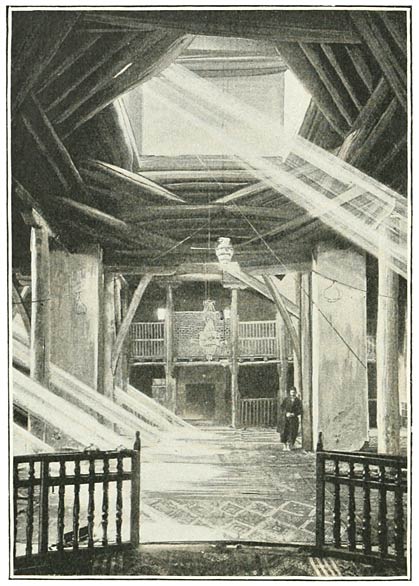
Fig. 128. Interior of Haykavank from the East.
While one is walking through the gardens, paying visits to the various schools, the attention will often be distracted to the very interesting churches, of a type which I have not seen in any other Armenian town. It might not be inappropriate to call them log churches, although the outer walls are built of stone. The oldest is no doubt that of Haykavank, situated in the quarter of the same name. I was unable to ascertain its age. But it represents a transition form from the usual stone edifice to the style of the other four churches in the gardens, in which the columns of the nave, the roofs and the interior fittings are exclusively of wood. The exteriors of all are featureless and plain. In Haykavank the nave is separated from the aisles by four stone piers as well as by sixteen wooden shafts, eight on each side. The face of the daïs supporting the altar is also of stone. Light is thrown upon the interior through three box-shaped structures in the roof, each containing four windows (Fig. 128). The shafts are in every church mere trunks of trees with the bark lopped off them; and at the west end, seen in the background of my illustration, will always be situated a wooden gallery for the women. The floors are carpeted. The most attractive of the five is Norashen, remarkable for its two octagonal domes in wood. The largest is Arakh, with a length inside of 135 feet and a breadth of a little over 56 feet. It appears to have been built as late as 1884 on the site of a smaller edifice. Nor is Norashen said to have been constructed more than about fifty years ago. It is remarkable that of these five churches of the gardens—the remainder are known respectively as Hankusner and Yakob—all, with the exception of the last, are dedicated to the Virgin. The same may be said of two out of six in the walled town. The fact would seem to point to something approaching a cult of the Virgin, though plainly not for the reason for which, according to Voltaire, she was worshipped in old France.
One may be disposed to linger awhile in two of these churches—Haykavank and Hankusner. The first is filled with the musty memories of the dark ages, and the second with the vivid magnetism of a personality which has not yet been removed from our midst. The ancient stone crosses inlaid into the daïs of Haykavank, the painted reliefs of angels in the screen of the altar, and a most barbarous carved panel of the Last Supper are so many survivals of pure mediævalism. The dingy logs and the rickety boxes in the roof, through the little windows of which the sweet light falls, are in harmony with the stiff figures, overlaid with gaudy but faded colours, which turn towards one from the shrine. From an adjoining apartment comes the sound of a chant by the choir at practice—a graceless music, sung through the nose. During a respite from this discord you hear the tick of an old standard clock; and, moving towards it, read the name of its English maker years ago—Markwick Markham of the city of London. It has a companion of its own kind in this same church. Here they have stood and ticked in company for, I wonder, how many years! The colleague is by Michael Paieff of Vienna, and has a song chime, so sweet and clear and pure.... Hankusner, on the other hand, if devoid of any antiquities, is associated with a name which should always be honoured in Armenian history, and with a spirit which calls to the Church to throw off her mediæval fetters and look into the light of the day. It was in that humble structure across the river, beneath the cliff of Toprak Kala, that Mekertich Khrimean was for many years accustomed to address his countrymen, standing upon the low daïs by the altar beneath the roof of logs. His humble residence is situated on the Van side of the stream. You knock, and a man in the garb of a peasant steps forth and holds your reins as you dismount. Yet he is the nephew of the supreme pontiff of the Armenians. He informs you that this was the house in which the Hayrik was born. It is now tenanted by the girls’ school. The rooms are neatly maintained, but their walls of mud are neither plastered nor papered. That which used to serve as his sleeping apartment contains a couple of wooden divans, used as seats by day and couches by night. Two pictures, one in oil and the other a crayon, portray the familiar face in youth as well as in age. What a handsome type, with the magnificent features and silky black beard! The remaining frames, most, no doubt, due to the piety of his relations, display by the side of Armenian texts the title page of a journal upon which figures in all his splendour the eagle of Vaspurakan.
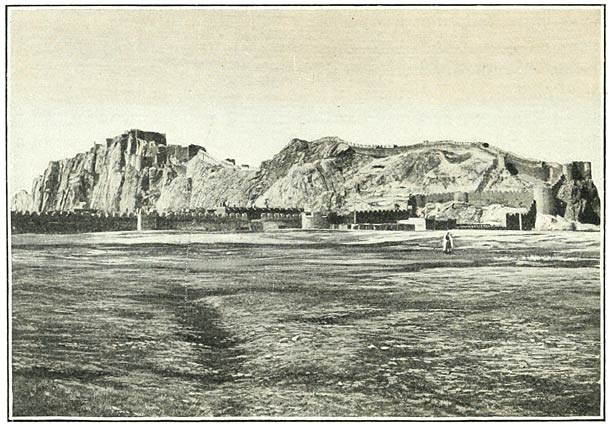
Fig. 129. The Rock and Walled City of Van.
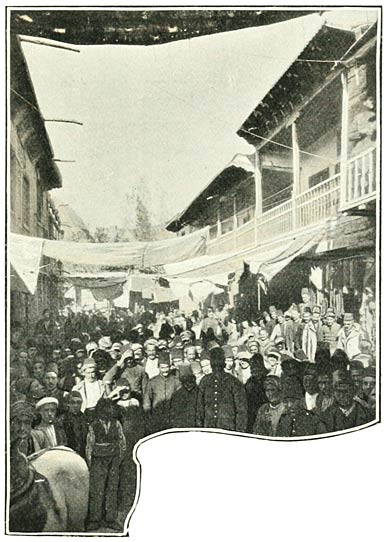
Fig. 130. Street in the Walled City.
But there exists in the city a ruined mosque which mocks these Turkish edifices and is really a noteworthy example of Arab art. It is strange that it does not appear to have been mentioned by any traveller. The Ulu Jami, or great mosque, is situated in the western quarter, under the precipice of the citadel rock, which is here at its highest, and of which the sheer escarpments tower into the sky. The rareness and humility of the adjoining houses permit the view to wander from the remains of this beautiful building along the face of the upstanding limestone to the great tablet with the inscription of Xerxes some little distance east of where you stand. Two great periods of world history are embodied in these two monuments; and, as we gazed upon them, the rock and tablet were bathed in the yellow light of evening, while the mosque was in shade. No one could tell us by whom it had been constructed, nor when it fell into decay. The pigeons build their nests in the crannies of the kiln-burnt bricks of which it is composed. In the centre rises a pillar, seen on the left of my illustration; the angles are filled with the stalactite architecture dear to the Arabs (Fig. 131). The clay traceries upon the walls are as hard as stone and as delicate as ivory (Fig. 132).
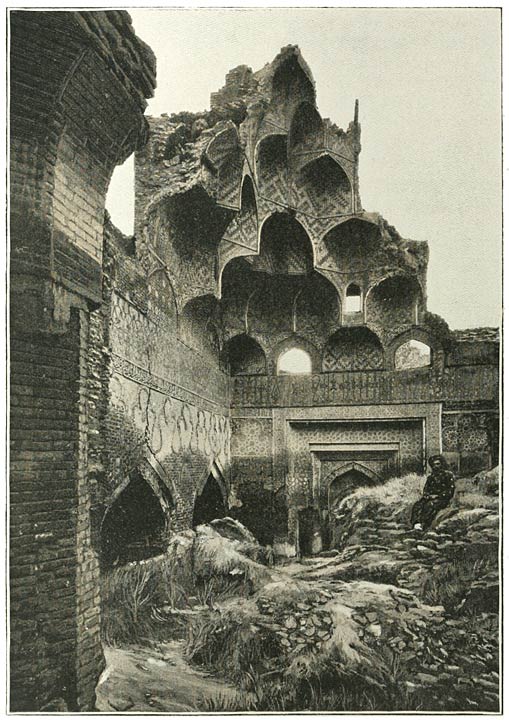
Fig. 131. Van: Interior of the Mosque of Ulu Jami.
The Armenian churches are in general situated in the close vicinity of the overhanging parapet from which the works of the citadel frown. Although for the most part of considerable antiquity, none has any claim to architectural pretensions, such as one might expect in the capital of the mediæval kingdom of Vaspurakan. Indeed in their original form they are small and quite plain stone chapels; and the church proper has probably been added at a much later period, being furnished with the log pillars and plank boxes in the roof characteristic of the churches in the gardens. Access to the chapel is gained through an opening in the daïs at the east end of the church. The entrance will usually be closed by a door with double folds. In some churches or on some occasions this door will be thrown open when service is being held. The priest will then stand with his back to the congregation upon the step on the threshold of the chapel. On the other hand, I have also attended when one would scarcely divine the existence of such an inner sanctuary. The priest performed his functions upon the daïs of the church before an altar of the usual gaudy order. It is therefore evident that the uses of the larger building oscillate between those of a mere pronaos and a church in the proper sense.
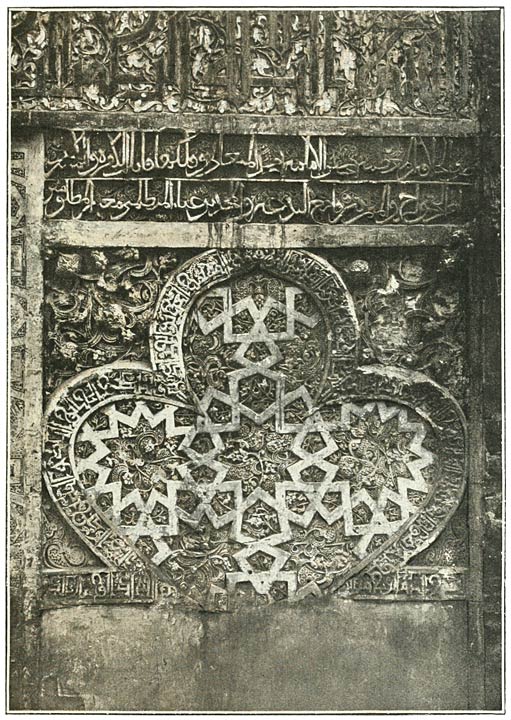
Fig. 132. Van: Frieze in Ulu Jami.
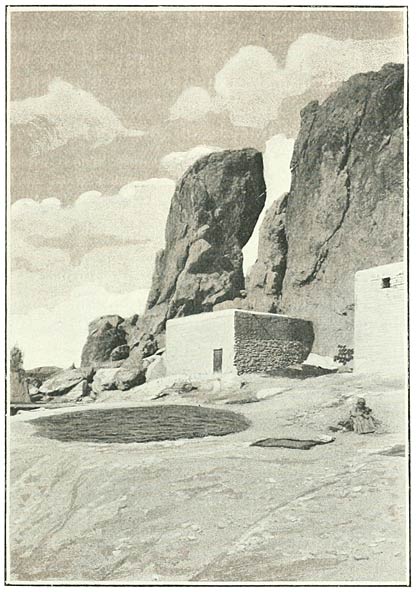
Fig. 133. The crag of Ak Köpri.
The stream itself is also called Ak Köpri; and, coming from Van gardens, we crossed it by a little bridge. Standing close to the crag, which we reached after a short ride, the view ranged widely in all directions except that of the cliffs at our back. Looking west and south we had the great plain before us, bounded only at an interval of many miles by low hills circling from Varag into the lake in front of the distant barrier of the Kurdish mountains. Turning round, we commanded a view of uncultivated flats, extending several miles to another line of bare hills ending on the west in a crag, called Kalajik. The only trace of verdure in that landscape were the gardens of the village of Shahbagh. But the outlines of the promontories, the blue lake, the distant fabrics of Nimrud and Sipan, composed into a picture it would be difficult to forget.
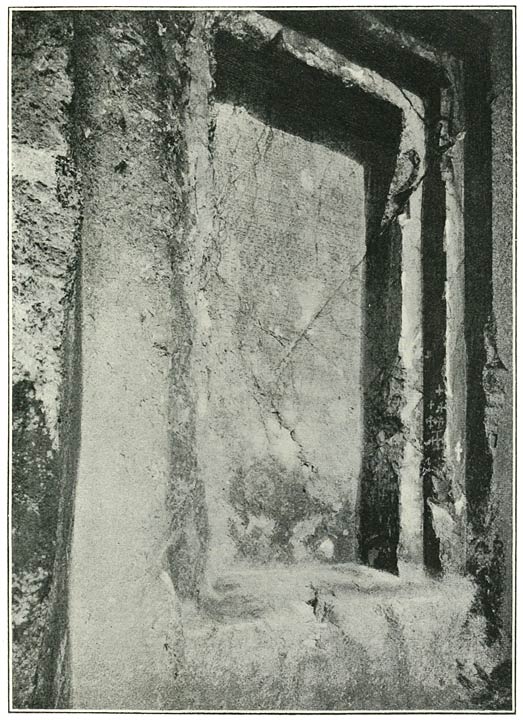
Fig. 134. Van: Cuneiform Inscription of Meher or Choban Kapusi.
After continuing our direction for no great space we mounted to the summit of the cliff. It may be some 200 feet high. But the flat top rises at its southerly extremity to a level of about double that altitude above the gardens of Van. These are the heights of Toprak Kala. From a cleft in the mass we opened out the upper valley of the Ak Köpri Su, the second of the extensions of the plain of Van of which I have spoken (Fig. 135). The mountain in the background of my photograph is Varag.
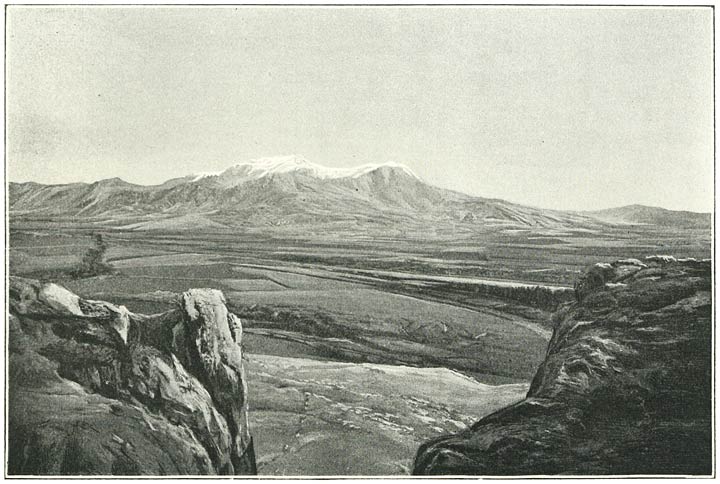
Fig. 135. Van: Mount Varag from the Heights of Toprak Kala.
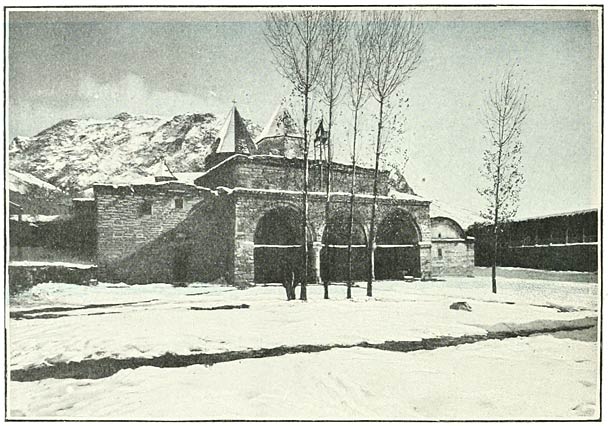
Fig. 136. Monastery of Yedi Kilisa (Varag).
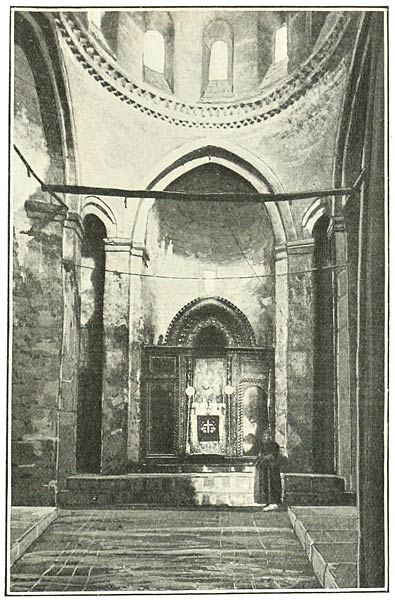
Fig. 137. Interior of the Church at Yedi Kilisa.
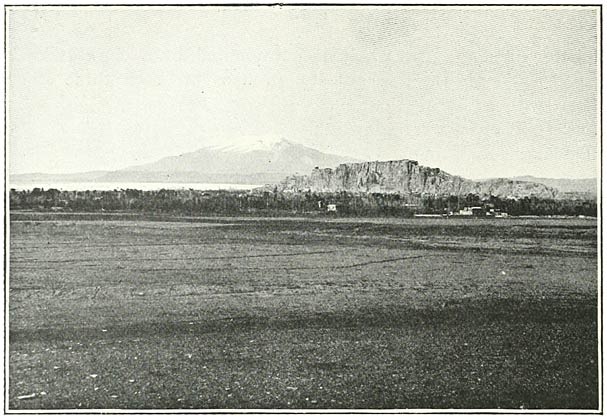
Fig. 138. Van on the Road to Bitlis.
Name of School. No. of Male Pupils No. of Female Pupils Where situated.
1. Arakh 450 150 Arakh quarter of the gardens.
2. Norashen 300 ... Norashen quarter of the gardens.
3. Yisusean 200 100 Walled city.
4. Hankusner ... 250 Hankusner quarter of the gardens.
5. Sandukhtean ... 150 Norashen quarter ,, of ,, the ,, gardens. ,,
6. Khach-poghan 155 ... Central avenue of gardens.
7. Lusavorchean P. 90 30 Central ,, avenue ,, of ,, gardens. ,,
8. Haykavank 85 15 Haykavank quarter.
9. Paragamean P. 50 25 Norashen quarter of gardens.
10. Pusantean P. ... 75 Norashen ,, quarter ,, of ,, gardens. ,,
11. Lukasean 45 10 Norshen-Sufla quarter of gardens.
1375 805
↑