RUINS IN TUSAYAN (continued 3)
Reading edition
If, on emerging from the first fire, the soul is still unpurified, or not sufficiently so to be accepted, it is taken to the second fire pit and cast into it. If it emerges from this thoroughly purified, in the opinion of the judge, it is immediately transformed into a ho-ho-ya-üh, or prayer-beetle. All the beetles we now see in the valleys or among the mesas were once evil Hopi. If, on coming out of the second fire pit, the breath-body is still considered bad by the chief, he takes it to the third fire, and, if there be no evil in it when it emerges from this pit, it is metamorphosed into an ant, but if unpurified by these three fires—that is, if the chief still finds evil left in the breath-body—he takes it to a fourth fire and again casts it into the flames, where it is utterly consumed, the only residue being soot on the side of the pit.
I have not recorded this as a universal or an aboriginal belief among the Hopi, but rather to show certain current ideas which may have been brought to Tusayan by missionaries or others. The details of the purification of the evil soul are characteristic.
The western cemetery of Sikyatki is situated among the hillocks covered with surface rubble below a house occupied in summer by a Hopi and his family. From the nature of the soil the excavation of this cemetery was very difficult, although the mortuary objects were more numerous. Repeated attempts to make the Indians work in a systematic manner failed, partly on account of the hard soil and partly from other reasons. Although the lower we went the more numerous and beautiful were the objects exhumed, the Indians soon tired of deep digging, preferring to confine their work to within two or three feet of the surface. At many places we found graves under and between the huge bowlders, which are numerous in this cemetery.
The southern cemetery lies between the outer edge of the ruin on that side and the decline to the plain, a few hundred feet from the southern row of houses. Two conspicuous bowlders mark the site of most of the excavations in that direction. The mortuary objects from this cemetery are not inferior in character or number to those from the other burial places. All attempts to discover a cemetery on the eastern side of the pueblo failed, although a single food basin was brought to the camp by an Indian who claimed he had dug it out of the deep sand on the eastern side of the ruins. Another bowl was found in the sand drift near the trail over the mesa to Kanelba, but careful investigation failed to reveal any systematic deposit of mortuary vessels east of the ruin.[111]
The method of excavation pursued in the cemeteries was not so scientific as I had wished, but it was the only practicable one to be followed with native workmen. Having found the location of the graves by means of small prospecting holes sunk at random, the workmen were aligned and directed to excavate a single long, deep trench, removing all the earth as they advanced. It was with great difficulty that the Indians were taught the importance of excavating to a sufficient depth, and even to the end of the work they refused to be taught not to burrow. In their enthusiasm to get the buried treasures they worked very well so long as objects were found, but became at once discouraged when relics were not so readily forthcoming and went off prospecting in other places when our backs were turned. A shout that anyone had discovered a new grave in the trench was a signal for the others to stop work, gather around the place, light cigarettes, and watch me or my collaborators dig out the specimens with knives. This we always insisted on doing, for the reason that in their haste the Indians at first often broke fragile pottery after they had discovered it, and in spite of all precautions several fine jars and bowls were thus badly damaged by them. It is therefore not too much to say that most of the vessels which are now entire were dug out of the impacted sand by Mr Hodge or myself.
No rule could be formulated in regard to the place where the pottery would occur, and often the first indication of its presence was the stroke of a shovel on the fragile edge of a vase or bowl. Having once found a skeleton, or discolored sand which indicated the former presence of human remains, the probability that burial objects were near by was almost a certainty, although in several instances even these signs failed.
A considerable number of the pottery objects had been broken when the soil and stones were thrown on the corpse at interment. So many were entire, however, that I do not believe any considerable number were purposely broken at that time, and none were found with holes made in them to "kill" or otherwise destroy their utility.
No evidences of cremation—no charred bones of man or animal in or near the mortuary vessels—were found. From the character of the objects obtained from neighboring graves, rich and poor were apparently buried side by side in the same soil. Absolutely no evidence of Spanish influence was encountered in all the excavations at Sikyatki—no trace of metal, glass, or other object of Caucasian manufacture such as I have mentioned as having been taken from the ruins of Awatobi—thus confirming the native tradition that the catastrophe of Sikyatki antedated the middle of the sixteenth century, when the first Spaniards entered the country.
It is remarkable that in Sikyatki we found no fragments of basketry or cloth, the fame of which among the Pueblo Indians was known to Coronado before he left Mexico. That the people of Sikyatki wore cotton kilts no one can doubt, but these fabrics, if they were buried with the dead, had long since decayed. Specimens of strings and ropes of yucca, which were comparatively abundant at Awatobi, were not found at Sikyatki; yet their absence by no means proves that they were not used, for the marks of the strings used to bind feathers to the mortuary pahos, on the green paint with which the wood was covered, may still be readily seen.
The insight into ancient beliefs and practices afforded by the numerous objects found at Sikyatki is very instructive, and while it shows the antiquity of some of the modern symbols, it betrays a still more important group of conventionalized figures, the meaning of which may always remain in doubt. This is particularly true of the decoration on many specimens of the large collection of highly ornamented pottery found in the Sikyatki cemeteries.
If we consider the typical designs on modern Hopi pottery and compare them with the ancient, as illustrated by the collections from Awatobi and Sikyatki, it is noted, in the first place, how different they are, and secondly, how much better executed the ancient objects are than the modern. Nor is it always clear how the modern symbols are derived from the ancient, so widely do they depart from them in all their essential characters.
POTTERY
Characteristics—Mortuary Pottery
The pottery exhumed from the burial places of Sikyatki falls in the divisions known as—
I—Coiled and indented ware. II—Smooth undecorated ware. III—Polished decorated ware. a. Yellow. b. Red. c. Black-and-white.
By far the largest number of ancient pottery objects from this locality belong to the yellow-ware group in the above classification. This is the characteristic pottery of Tusayan, although coiled and indented ware is well represented in the collection. The few pieces of red ware are different from that found in the ruins of the Little Colorado, while the black-and-white pottery closely resembles the archaic ware of northern cliff houses. Although the Sikyatki pottery bears resemblance to that of Awatobi, it can be distinguished from it without difficulty. The paste of both is of the finest character and was most carefully prepared. Some of the ancient specimens are much superior to those at present made, and are acknowledged by the finest potters of East Mesa to be beyond their power of ceramic production. The coloration is generally in red, brown, yellow, and black. Decorative treatment by spattering is common in the food basins, and this was no doubt performed, Chinese fashion, by means of the mouth. The same method is still employed by the Hopi priests in painting their masks.
The Sikyatki collection of pottery shows little or no duplication in decorative design, and every ornamented food basin bears practically different symbols. The decoration of the food basins is mainly on the interior, but there is almost invariably a geometrical design of some kind on the outside, near the rim. The ladles, likewise, are ornamented on their interior, and their handles also are generally decorated. When the specimens were removed from the graves their colors, as a rule, were apparently as well preserved as at the time of their burial; nor, indeed, do they appear to have faded since their deposit in the National Museum.
The best examples of ceramic art from the graves of Sikyatki, in texture, finish, and decoration, are, in my judgment, superior to any pottery made by ancient or modern Indians north of Mexico. Indeed, in these respects the old Tusayan pottery will bear favorable comparison even with Central American ware. It is far superior to the rude pottery of the eastern pueblos, and is also considerably better than that of the great villages of the Gila and Salado. Among the Hopi themselves the ceramic art has degenerated, as the few remaining potters confess. These objects can hardly be looked upon as products of a savage people destitute of artistic feeling, but of a race which has developed in this line of work, through the plane of savagery, to a high stage of barbarism. While, as a whole, we can hardly regard the modern Hopi as a degenerate people with a more cultured ancestry, certainly the entire Pueblo culture in the Southwest, judged by the character of their pottery manufacture, has greatly deteriorated since the middle of the sixteenth century.
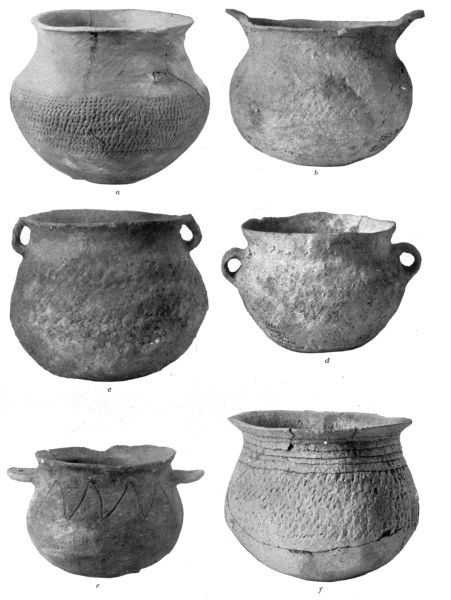
BUREAU OF AMERICAN ETHNOLOGY—— SEVENTEENTH ANNUAL REPORT PL. CXIX COILED AND INDENTED POTTERY FROM SIKYATKI
Coiled and Indented Ware
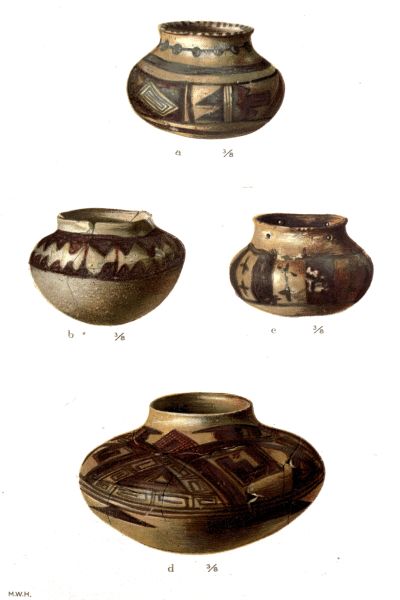
The rudest type of pottery from Sikyatki has been classed as coiled and indented ware. It is coarse in texture, not polished, and usually not decorated. Although the outer surface of the pottery of this class is rough, the general form of the ware is not less symmetrical than that of the finer vessels. The objects belonging to this group are mostly jars and moccasin-shape vessels, there being no bowls of this type. As a rule, the vessels are blackened with soot, although some of the specimens are light-brown in color. The former variety were undoubtedly once used in cooking; the latter apparently for containing water or food. In the accompanying illustration (plate cxix, a) is shown one of the best specimens of indented ware, the pits forming an equatorial zone about the vessel. All traces of the coil of clay with which the jar was built up have been obliterated save on the bottom. The vessel is symmetrical and the indentations regular, as if made with a pointed stone, bone, or stick.
In another form of coarse pottery (plate cxix, b) the rim merges into two ears or rudimentary handles on opposite sides. Traces of the original coiling are readily observable on the sides of this vessel.
Another illustration (plate cxix, c) shows an amphora or jar with diametrically opposite handles extending from the rim to the side of the bowl. The surface of this rude jar is rough and without decoration, but the form is regular and symmetrical. In another amphora (plate cxix, d) the opposite handles appear below the neck of the vessel; they are broader and apparently more serviceable.
The jar shown in plate cxix, e, has two ear-like extensions or projections from the neck of the jar, which are perforated for suspension. This vessel is decorated with an incised zigzag line, which surrounds it just above its equator. This is a fair example of ornamented rough ware.
Several of the vessels made of coarse clay mixed with sand, the grains of which make the surface very rough, are of slipper or moccasin shape. These are covered with soot or blackened by fire, indicating their former use as cooking pots. By adopting this form the ancients were practically enabled to use the principle of the dutch-oven, the coals being piled about the vessels containing the food to be cooked much more advantageously than in the vase-like forms.
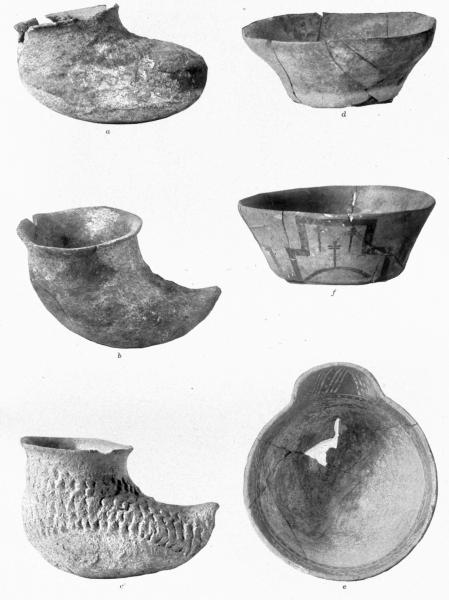
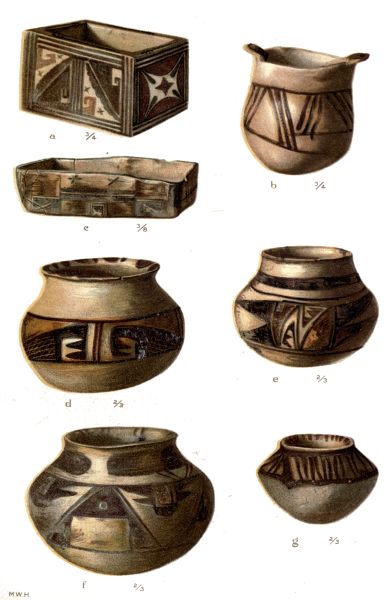
The variations in slipper-shape cooking pots are few and simple. The blind end is sometimes of globular form, as in the example illustrated in plate cxx, a, and sometimes pointed as in figures b and c of the same plate. One of the specimens of this type has a handle on the rim and another has a flaring lip. Slipper-form vessels are always of coarse ware for the obvious reason that, being somewhat more porous, they are more readily heated than polished utensils. They are not decorated for equally obvious reasons.
Smooth Undecorated Ware
There are many specimens of undecorated ware of all shapes and sizes, a type of which is shown in plate cxx, d. These include food bowls, saucers, ladles, and jars, and were taken from many graves. These utensils differ from the coarse-ware vessels not only in the character of the clay from which they are made, but also in their superficial polish, which, in some instances, is as fine as that of vessels with painted designs. Several very good spoons of half-gourd shape were found, and there are many undecorated food bowls and vases. The first attempts at ornamentation appear to have been a simple spattering of the surface with liquid pigment or a drawing of simple encircling bands. In one instance (plate cxx, d) a blackening of the surface by exposure to smoke was detected, but no superficial gloss, as in the Santa Clara ware, was noted.
Polished Decorated Ware
By far the greater number of specimens of mortuary pottery from Sikyatki are highly polished and decorated with more or less complicated designs. Of these there are at least three different groups, based on the color of the ware. Most of the vessels are light yellow or of cream color; the next group in point of color is the red ware, the few remaining specimens being white with black decorations in geometric patterns. These types naturally fall into divisions consisting of vases, jars, bowls, square boxes, cups, ladles, and spoons.
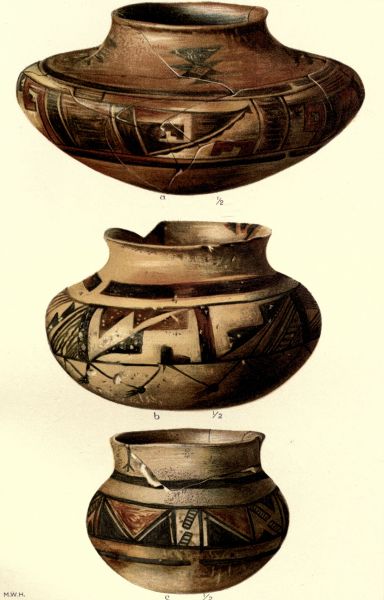
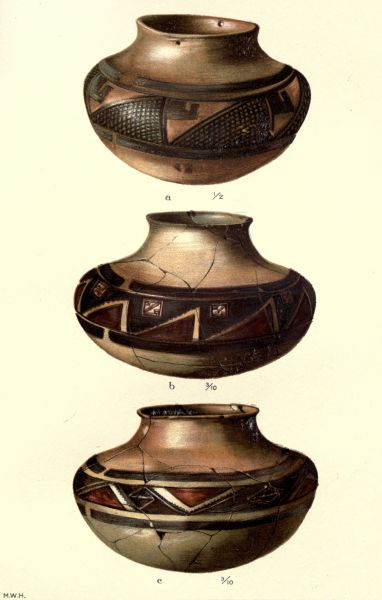
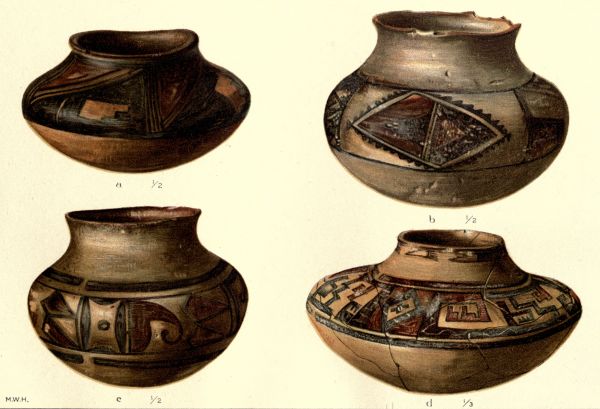
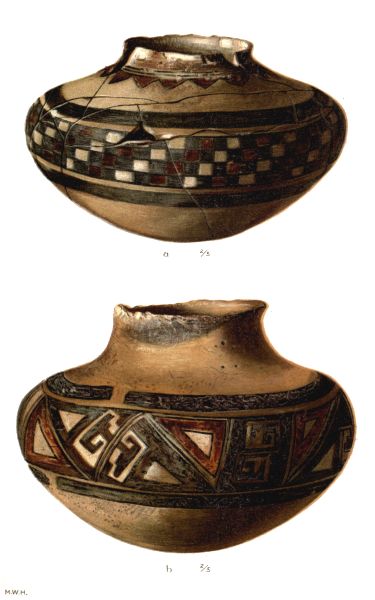
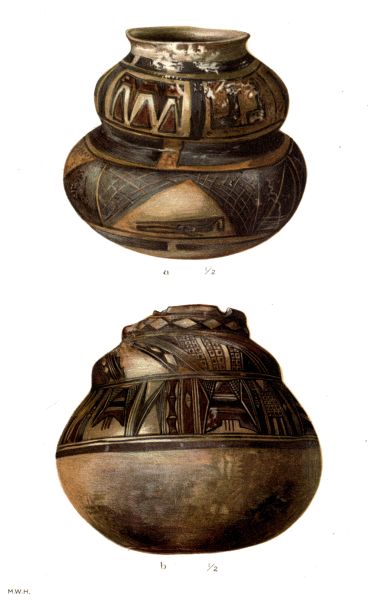
In the group called vases (plates cxxi, cxxii) many varieties are found; some of these are double, with an equatorial constriction; others are rounded below, flat above, with an elevated neck and a recurved lip. It is noteworthy that these jars or vases are destitute of handles, and that their decoration is always confined to the equatorial and upper sections about the opening. In the specimens of this group which were found at Sikyatki there is no basal rim and no depression on the pole opposite the opening. No decoration is found on the interior of the vases, although in several instances the inside of the lip bears lines or markings of various kinds. The opening is always circular, sometimes small, often large; the neck of a vessel is occasionally missing, although the specimens bear evidence of use after having been thus broken. In one or two instances the equatorial constriction is so deep that the jar is practically double; in other cases the constriction is so shallow that it is hardly perceptible (plate cxxvi, a, b). The size varies from a simple globular vessel not larger than a walnut to a jar of considerable size. Many show marks of previous use; others are as fresh as if made but yesterday.
BUREAU OF AMERICAN ETHNOLOGY—— SEVENTEENTH ANNUAL REPORT PL. CXX SAUCERS AND SLIPPER BOWLS FROM SIKYATKI
One of the most fragile of all the globular vessels is a specimen of very thin black-and-white ware, perforated near the rim for suspension (plate cxxxii). This form, although rare at Sikyatki, is represented by several specimens, and in mode of decoration is very similar to the cliff-house pottery. From its scarcity in Tusayan I am inclined to believe that this and related specimens were not made of clay found in the immediate vicinity of Sikyatki, but that the vessels were brought to the ancient pueblo from distant places. As at least some of the cliff houses were doubtless inhabited contemporaneously with and long after the destruction of Sikyatki, I do not hesitate to say that the potters of that pueblo were familiar with the cliff-dweller type of pottery and acquainted with the technic which gave the black-and-white ware its distinctive colors.
By far the largest number of specimens of smooth decorated pottery from Sikyatki graves are food bowls or basins, evidently the dishes in which food was placed on the floor before the members of a family at their meals. As the mortuary offerings were intended as food for the deceased it is quite natural that this form of pottery should far outnumber any and all the others. In no instance do the food bowls exhibit marks of smoke blackening, an indication that they had not been used in the cooking of food, but merely as receptacles of the same.
The beautiful decoration of these vessels speaks highly for the artistic taste of the Sikyatki women, and a feast in which they were used must have been a delight to the native eye so far as dishes were concerned. When filled with food, however, much of the decoration of the bowls must have been concealed, a condition avoided in the mode of ornamentation adopted by modern Tusayan potters; but there is no doubt that when not in use the decoration of the vessels was effectually exhibited in their arrangement on the floor or convenient shelves.
The forms of these food bowls are hemispherical, gracefully rounded below, and always without an attached ring of clay on which to stand to prevent rocking. Their rims are seldom flaring, but sometimes have a slight constriction, and while the rims of the majority are perfectly circular, oblong variations are not wanting. Many of the bowls are of saucer shape, with almost vertical sides and flat bases; several are double, with rounded or flat base.
The surface, inside and out, is polished to a fine gloss, and when exteriorly decorated, the design is generally limited to one side just below the rim, which is often ornamented with double or triple parallel lines, drawn in equidistant, quaternary, and other forms. Most of the bowls show signs of former use, either wear on the inner surface or on the base where they rested on the floor in former feasts.
These mortuary vessels were discovered generally at one side of the chest or neck of the person whose remains they were intended to accompany, and a single specimen was found inverted over the head of the deceased. The number of vessels in each grave was not constant, and as many as ten were found with one skeleton, while in other graves only one or two were found. In one instance a nest of six of these basins, one inside another, was exhumed. While many of these mortuary offerings were broken and others chipped, there were still a large number as perfect as when made. Some of the bowls had been mended before burial, as holes drilled on each side of a crack clearly indicate. Fragments of various vessels, which evidently had been broken before they were thrown into the graves, were common.
There is a general similarity in the artistic decoration of bowls found in the same grave, as if they were made by the same potter; and persons of distinction, as shown by other mortuary objects, were, as a rule, more honored than some of their kindred in the character and number of pottery objects deposited with their remains. There were also a number of skeletons without ceramic offerings of any kind.
In one or two interments two or more small jars were found placed inside of a food bowl, and in many instances votive offerings, like turquois, beads, stones, and arrowpoints, had been deposited with the dead. The bowls likewise contained, in some instances, prayer-sticks and other objects, which will later be described.
One of the most interesting modifications in the form of the rim of one of these food bowls is shown in plate cxx, e, which illustrates a variation from the circular shape, forming a kind of handle or support for the thumb in lifting the vessel. The utility of this projection in handling a bowl of hot food is apparent. This form of vessel is very rare, it being the only one of its kind in the collection.
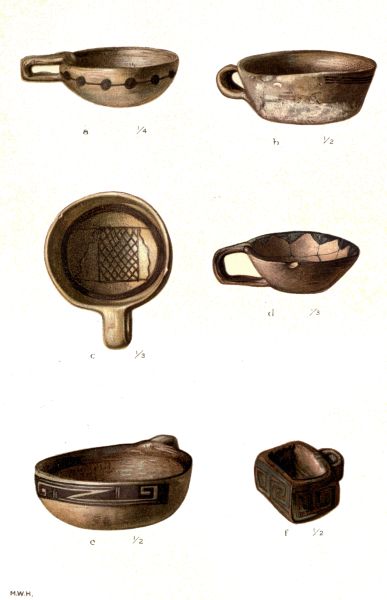
A considerable number of cups were found at Sikyatki; these vary in size and shape from a flat-bottom saucer like specimen to a mug-shape variety, always with a single handle (plate cxxv). Many of these resemble small bowls with rounded sides, but there are others in which the sides are vertical, and still others the sides of which incline at an angle to the flattened base.
The handles of these cups are generally smooth, and in one instance adorned with a figure in relief. The rims of these dippers are never flaring, either inward or outward. As a rule they are decorated on the exterior; indeed there is only one instance of interior decoration. The handles of the dippers are generally attached at both ends, but sometimes the handle is free at the end near the body of the utensil and attached at the tip. These handles are usually flat, but sometimes they are round, and often are decorated. Traces of imitations of the braiding of two coils of clay are seen in a single specimen.[112]
BUREAU OF AMERICAN ETHNOLOGY—— SEVENTEENTH ANNUAL REPORT PL. CXXI DECORATED POTTERY FROM SIKYATKI
BUREAU OF AMERICAN ETHNOLOGY—— SEVENTEENTH ANNUAL REPORT PL. CXXII DECORATED POTTERY FROM SIKYATKI
Small and large ladles, with long handles, occurred in large numbers in Sikyatki graves, but there was little variation among them except in the forms of their handles. Many of these utensils were much worn by use, especially on the rim opposite the attachment of the handle, and in some specimens the handle itself had evidently been broken and the end rounded off by rubbing long before it was placed in the grave. From the comparatively solid character of the bowls of these dippers they were rarely fractured, and were commonly found to contain smaller mortuary objects, such as paint, arrowheads, or polishing stones.
The ladles, unlike most of the cups, are generally decorated on the interior as well as on the exterior. Their handles vary in size and shape, are usually hollow, and sometimes are perforated at the end. In certain specimens the extremity is prolonged into a pointed, recurved tip, and sometimes is coiled in a spiral. A groove in the upper surface of one example is an unusual variation, and a right-angle bend of the tip is a unique feature of another specimen. The Sikyatki potters, like their modern descendants,[113] sometimes ornamented the tip of a single handle with the head of an animal and painted the upper surface of the shaft with alternate parallel bars, zigzags, terraces, and frets.
Several spoons or scoops of earthenware, which evidently had been used in much the same way as similar objects in the modern pueblos, were found. Some of these have the shape of a half gourd—a natural object which no doubt furnished the pattern. These spoons, as a rule, were not decorated, but on a single specimen bars and parallel lines may be detected. In the innovations of modern times pewter spoons serve the same purpose, and their form is sometimes imitated in earthenware. More often, in modern and probably also in ancient usage, a roll of paper-bread or piki served the same purpose, being dipped into the stew and then eaten with the fingers. Possibly the Sikyatkian drank from the hollow handle of a gourd ladle, as is frequently done in Walpi today, but he generally slaked his thirst by means of a clay substitute.[114]
Several box-like articles of pottery of both cream and red ware were found in the Sikyatki graves, some of them having handles, others being without them (plate cxxv). They are ornamented on the exterior and on the rim, and the handle, when not lacking, is attached to the longer side of the rectangular vessel. Not a single bowl was found with a terraced rim, a feature so common in the medicine bowls of Tusayan at the present time.[115]
In addition to the various forms of pottery which have been mentioned, there are also pieces made in the form of birds, one of the most typical of which is figured in plate cxii, c. In these objects the wings are represented by elevations in the form of ridges on the sides, and the tail and head by prolongations, which unfortunately were broken off.
Toys or miniature reproductions of all the above-mentioned ceramic specimens occurred in several graves. These are often very roughly made, and in some cases contained pigments of different colors. The finding of a few fragments of clay in the form of animal heads, and one or two rude images of quadrupeds, would seem to indicate that sometimes such objects were likewise deposited with the dead. A clay object resembling the flaring end of a flageolet and ornamented with a zigzag decoration is unique in the collections from Sikyatki, although in the western cemetery there was found a fragment of an earthenware tube, possibly a part of a flute.
In order to show more clearly the association of mortuary objects in single graves a few examples of the grouping of these deposits will be given.
In a grave in the western cemetery the following specimens were found: 1, ladle; 2, paint grinder; 3, paint slab; 4, arrowpoints; 5, fragments of a marine shell (Pectunculus); 6, pipe, with fragments of a second pipe, and 7, red paint (sesquioxide of iron).
In the grave which contained the square medicine bowl shown in plate cxxviii, a, a ladle containing food was also unearthed.
The bowl decorated with a picture of a girl's head was associated with fragments of another bowl and four ladles.
Another single grave contained four large and small cooking pots and a broken metate.
In a grave 8 feet below the surface in the western cemetery we found: 1, decorated food vessel; 2, black shoe-shape cooking pot resting in a food bowl and containing a small rude ladle; 3, coarse undecorated basin.
A typical assemblage of mortuary objects comprised: 1, small decorated bowl containing polishing stones; 2, miniature cooking pot blackened by soot; 3, two small food bowls.
In modern Hopi burials the food bowls with the food for the dead are not buried with the deceased, but are placed on the mound of soil and stones which covers the remains. From the position of the mortuary pottery as regards the skeletons in the Sikyatki interments, it is probable that this custom is of modern origin. Whether in former times food bowls were placed on the burial mounds as well as in the grave I am not able to say. The number of food bowls in ancient graves exceeds those placed on modern burials.
The Sikyatki dead were apparently wrapped in coarse fabrics, possibly matting.
BUREAU OF AMERICAN ETHNOLOGY—— SEVENTEENTH ANNUAL REPORT PL. CXXIII DECORATED POTTERY FROM SIKYATKI
PALEOGRAPHY OF THE POTTERY
General Features
The pottery from Sikyatki is especially rich in picture writing, and imperfect as these designs are as a means of transmitting a knowledge of manners, customs, and religious conceptions, they can be interpreted with good results.
One of the most important lessons drawn from the pottery is to be had from a study of the symbols used in its decoration, as indicative of current beliefs and practices when it was made. The ancient inhabitants of Sikyatki have left no written records, for, unlike the more cultured people of Central America, they had no codices; but they have left on their old mortuary pottery a large body of picture writings or paleography which reveals many instructive phases of their former culture. The decipherment of these symbols is in part made possible by the aid of a knowledge of modern survivals, and when interpreted rightly they open a view of ancient Tusayan myths, and in some cases of prehistoric practices.[116]
Students of Pueblo mythology and ritual are accumulating a considerable body of literature bearing on modern beliefs and practices. This is believed to be the right method of determining their aboriginal status, and is therefore necessary as a basis of our knowledge of their customs and beliefs. It is reasonable to suppose that what is now practiced in Pueblo ritual contains more or less of what has survived from prehistoric times, but from Taos to Tusayan there is no pueblo which does not show modifications in mythology and ritual due to European contact. Modern Pueblo life resembles the ancient, but is not a facsimile of it, and until we have rightly measured the effects of incorporated elements, we are more or less inexact in our estimation of the character of prehistoric culture. The vein of similarity in the old and the new can be used in an interpretation of ancient paleography, but we overstep natural limitations if by so doing we ascribe to prehistoric culture every concept which we find current among the modern survivors. To show how much the paleography of Tusayan has changed since Sikyatki was destroyed, I need only say that most of the characteristic figures of deities which are used today in the decoration of pottery are not found on the Sikyatki ware. Perhaps the most common figures on modern food bowls is the head of a mythologic being, the Corn-maid, Calako-mana, but this picture, or any which resembles it, is not found on the bowls from Sikyatki. A knowledge of the cult of the Corn-maid possibly came into Tusayan, through foreign influences, after the fall of Sikyatki, and there is no doubt that the picture decoration of modern Tusayan pottery, made within a league of Sikyatki, is so different from the ancient that it indicates a modification of the culture of the Hopi in historic times, and implies how deceptive it may be to present modern beliefs and practices as facsimiles of ancient culture.
The main subjects chosen by the native women for the decoration of their pottery are symbolic, and the most abundant objects which bear these decorations are food bowls and water vases. Many mythic concepts are depicted, among which may be mentioned the Plumed Snake, various birds, reptiles, frogs, tadpoles, and insects. Plants or leaves are seldom employed as decorative motives, but the flower is sometimes used. The feather was perhaps the most common object utilized, and it may likewise be said the most highly conventionalized.
An examination of the decorations of modern food basins used in the villages of East Mesa shows that the mythologic personages most commonly chosen for the ornamentation of their interiors are the Corn or Germ goddesses.[117] These assume a number of forms, yet all are reducible to one type, although known by very different names, as Hewüqti, "Old Woman," Kokle, and the like.
Figures of reptiles, birds, the antelope, and like animals do not occur on any of the food bowls from the large collection of modern Tusayan pottery which I have studied, and as these figures are well represented in the decorations on Sikyatki food bowls, we may suppose their use has been abandoned or replaced by figures of the Corn-maids.[118] This fact, like so many others drawn from a study of the Tusayan ritual, indicates that the cult of the Corn-maids is more vigorous today than it was when Sikyatki was in its prime.
Many pictures of masks on modern Tusayan bowls are identified as Tacab or Navaho katcinas.[119] Their symbolism is well characterized by chevrons on the cheeks or curved markings for eyes. None of these figures, however, have yet been found on ancient Tusayan ceramics. Taken in connection with facts adduced by Hodge indicative of a recent advent of this vigorous Athapascan tribe into Tusayan, it would seem that the use of the Tacab katcina pictures was of recent date, and is therefore not to be expected on the prehistoric pottery of the age of that found in Sikyatki.
In the decoration of ancient pottery I find no trace of figures of the clown-priests, or tcukuwympkiya, who are so prominent in modern Tusayan katcina celebrations. These personages, especially the Tatcukti, often called by a corruption of the Zuñi name Kóyimse (Kóyomäshi), are very common on modern bowls, especially at the extremities of ladles or smaller objects of pottery.
Many handles of ladles made at Hano in late times are modeled in the form of the Paiakyamu,[120] a glutton priesthood peculiar to that Tanoan pueblo. From the data at hand we may legitimately conclude that the conception of the clown-priest is modern in Tusayan, so far as the ornamentation of pottery is concerned.
The large collections of so-called modern Hopi pottery in our museums is modified Tanoan ware, made in Tusayan. Most of the component specimens were made by Hano potters, who painted upon them figures of katcinas, a cult which they and their kindred introduced.
Several of the food bowls had evidently cracked during their firing or while in use, and had been mended before they were buried in the graves. This repairing was accomplished either by filling the crack with gum or by boring a hole on each side of the fracture for tying. In one specimen of black-and-white ware a perfectly round hole was made in the bottom, as if purposely to destroy the usefulness of the bowl before burial. This hole had been covered inside with a rounded disk of old pottery, neatly ground on the edge. It was not observed that any considerable number of mortuary pottery objects were "killed" before burial, although a large number were chipped on the edges. It is a great wonder that any of these fragile objects were found entire, the stones and soil covering the corpse evidently having been thrown into the grave without regard to care.
The majority of the ancient symbols are incomprehensible to the present Hopi priests whom I have been able to consult, although they are ready to suggest many interpretations, sometimes widely divergent. The only reasonable method that can be pursued in determining the meaning of the conventional signs with which the modern Tusayan Indians are unfamiliar seems, therefore, to be a comparative one. This method I have attempted to follow so far as possible.
There is a closer similarity between the symbolism of the Sikyatki pottery and that of the Awatobi ware than there is between the ceramics of either of these two pueblos and that of Walpi, and the same likewise may be said of the other Tusayan ruins so far as known. It is desirable, however, that excavations be made at the site of Old Walpi in order to determine, if possible, how widely different the ceramics of that village are from the towns whose ruins were studied in 1895. There are certain practical difficulties in regard to work at Old Walpi, one of the greatest of which is its proximity to modern burial places and shrines still used. Moreover, it is probable—indeed, quite certain—that most of the portable objects were carried from the abandoned pueblo to the present village when the latter was founded; but the old cemeteries of Walpi contain many ancient mortuary bowls which, when exhumed, will doubtless contribute a most interesting chapter to the history of modern Tusayan decorative art.
One of the largest, and, so far as form goes, one of the most unique vessels, is shown in plate cxxvi, b. This was not exhumed from Sikyatki, but was said to have been found in the vicinity of that ruin. While the ware is very old, I do not believe it is ancient, and it is introduced in order to show how cleverly ancient patterns maybe simulated by more modern potters. The sole way in which modern imitations of ancient vessels may be distinguished is by the peculiar crackled or crazed surface which the former always has. This is due, I believe, to the method of firing and the unequal contraction or expansion of the slip employed. All modern imitations are covered with a white slip which, after firing, becomes crackled, a characteristic unknown to ancient ware. The most expert modern potter at East Mesa is Nampéo, a Tanoan woman who is a thorough artist in her line of work. Finding a better market for ancient than for modern ware, she cleverly copies old decorations, and imitates the Sikyatki ware almost perfectly. She knows where the Sikyatki potters obtained their clay, and uses it in her work. Almost any Hopi who has a bowl to sell will say that it is ancient, and care must always be exercised in accepting such claims.
An examination of the ornamentation of the jar above referred to shows a series of birds drawn in the fashion common to early pottery decoration. This has led me to place this large vessel among the old ware, although the character of the pottery is different from that of the best examples found at Sikyatki. I believe this vessel was exhumed from a ruin of more modern date than Sikyatki. The woman who sold it to me has farming interests near Awatobi, which leads me to conjecture that she or possibly one of her ancestors found it at or near that ruin. She admitted that it had been in the possession of her family for some time, but that the story she had heard concerning it attributed its origin to Sikyatki.
Human Figures
Very few figures of men or women are found on the pottery, and these are confined to the interior of food basins (plate cxxix).[121] They are ordinarily very roughly drawn, apparently with less care and with much less detail than are the figures of animals. From their character I am led to the belief that the drawing of human figures on pottery was a late development in Tusayan art, and postdates the use of animal figures on their earthenware. There are, however, a few decorations in which human figures appear, and these afford an interesting although meager contribution to our knowledge of ancient Tusayan art and custom.
BUREAU OF AMERICAN ETHNOLOGY—— SEVENTEENTH ANNUAL REPORT PL. CXXIV DECORATED POTTERY FROM SIKYATKI
As is well known, the Hopi maidens wear their hair in two whorls, one over each ear, and that on their marriage it is tied in two coils falling on the breast. The whorl is arranged on a U-shape stick called a gñela; it is commonly done up by a sister, the mother, or some friend of the maiden, and is stiffened with an oil pressed from squash seeds. The curved stick is then withdrawn and the two puffs held in place by a string tightly wound between them and the head. The habit of dressing the hair in whorls is adopted after certain puberty ceremonials, which have elsewhere been described. When on betrothal a Hopi maid takes her gifts of finely ground cornmeal to the house of her future mother-in-law, her hair is dressed in this fashion for the last time, because on her return she is attacked by the women of the pueblo, drawn hither and thither, her hair torn down, and her body smeared with dirt. If her gifts are accepted she immediately becomes the wife of her lover, and her hair is thenceforth dressed in the fashion common to matrons.
The symbolic meaning of the whorls of hair worn by the maidens is said to be the squash-flower, or, perhaps more accurately speaking, the potential power of fructification. There is legendary and other evidence that this custom is very ancient among the Tusayan Indians, and the data obtainable from their ritual point the same way. In the personification of ancestral "breath-bodies," or spirits by men, called katcinas, the female performers are termed katcina-manas (katcina-virgins), and it is their custom to wear the hair in the characteristic coiffure of maidens. In the personification of the Corn-maid by symbolic figures, such as graven images,[122] pictures, and the like, in secret rites, the style of coiffure worn by the maidens is common, as I have elsewhere shown in the descriptions of the ceremonials known as the Flute, Lalakonti, Mamzrauti, Palülükoñti, and others. The same symbol is found in images used as dolls of Calako-mana, the equivalent, as the others, of the same Corn-maid. From the nature of these images there can hardly be a doubt of the great antiquity of this practice, and that it has been brought down, through their ritual, to the present day. This style of hair dressing was mentioned by the early Spanish explorers, and is represented in pictographs of ancient date; but if all these evidences of its antiquity are insufficient the testimony afforded by the pictures on certain food-basins from Sikyatki leaves no doubt on this point.[123]
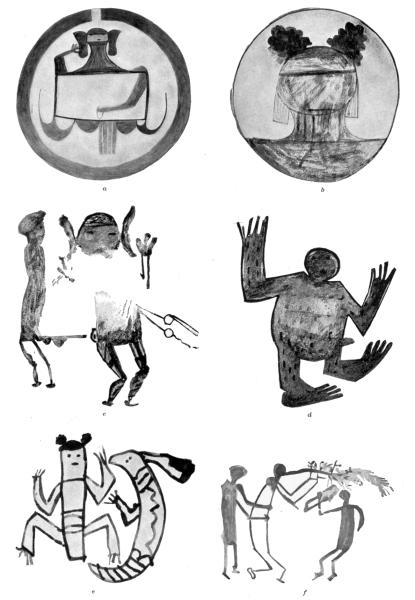
Plate cxxix, b, represents a food-basin, on the inside of which is drawn, in brown, the head and shoulders of a woman. On either side the hair is done up in coils which bear some likeness to the whorls worn by the present Hopi maidens. It must be borne in mind, however, that similar coils are sometimes made after ceremonial head-washing, and certain other rites, when the hair is tied with corn husks. The face is painted reddish, and the ears have square pendants similar to the turquois mosaics worn by Hopi women at the present day. Although there is other evidence than this of the use of square ear-pendants, set with mosaic, among the ancient people—and traditions point the same way—this figure of the head of a woman from Sikyatki leaves no doubt of the existence of this form of ornament in that ancient pueblo.
However indecisive the last-mentioned picture may be in regard to the coiffure of the ancient Sikyatki women, plate cxxix, a, affords still more conclusive evidence. This picture represents a woman of remarkable form which, from likenesses to figures at present made in sand on an altar in the Lalakonti ceremony,[124] I have no hesitation in ascribing to the Corn-maid. The head has the two whorls of hair very similar to those made in that rite on the picture of the Goddess of Germs, and the square body is likewise paralleled in the same figure. The peculiar form is employed to represent the outstretched blanket, a style of art which is common in Mayan codices.[125] On each lower corner representations of feathered strings, called in the modern ritual nakwákwoci,[126] are appended. The figure is represented as kneeling, and the four parallel lines are possibly comparable with the prayer-sticks placed in the belt of the Germ goddess on the Lalakonti altar. In her left hand (which, among the Hopi, is the ceremonial hand or that in which sacred objects are always carried) she holds an ear of corn, symbolic of germs, of which she is the deity. The many coincidences between this figure and that used in the ceremonials of the September moon, called Lalakonti, would seem to show that in both instances it was intended to represent the same mythic being.
There is, however, another aspect of this question which is of interest. In modern times there is a survival among the Hopi of the custom of decorating the inside of a food basin with a figure of the Corn-maid, and this is, therefore, a direct inheritance of ancient methods represented by the specimen under consideration. A large majority of modern food bowls are ornamented with an elaborate figure of Calako-mana, the Corn-maid, very elaborately worked out, but still retaining the essential symbolism figured in the Sikyatki bowl.[127]
BUREAU OF AMERICAN ETHNOLOGY—— SEVENTEENTH ANNUAL REPORT PL. CXXV FLAT DIPPERS AND MEDICINE BOX FROM SIKYATKI
While one of the two figures shown in plate cxxix, e, is valuable as affording additional and corroborative evidence of the character of the ancient coiffure of the women, its main interest is of a somewhat different kind. Two figures are rudely drawn on the inside of the basin, one of which represents a woman, the other, judging from the character of the posterior extremity of the body, a reptilian conception in which a single foreleg is depicted, and the tail is articulated at the end, recalling a rattlesnake. Upon the head is a single feather;[128] the two eyes are represented on one side of the head, and the line of the alimentary tract is roughly drawn. The figure is represented as standing before that of the woman.
With these few lines the potter no doubt intended to depict one of those many legends, still current, of the cultus hero and heroine of her particular family or priesthood. Supposing the reptilian figure to be a totemic one, our minds naturally recall the legend of the Snake-hero and the Corn-mist-maid[129] whom he brought from a mythic land to dwell with his people.
The peculiar hairdress is likewise represented in the figures on the food basin illustrated in plate cxxix, c, which represent a man and a woman. Although the figures are partly obliterated, it can easily be deciphered that the latter figure wears a garment similar to the kwaca or dark-blue blanket for which Tusayan is still famous, and that this blanket was bound by a girdle, the ends of which hang from the woman's left hip. While the figure of the man is likewise indistinct (the vessel evidently having been long in use), the nature of the act in which he is engaged is not left in doubt.[130]
Among the numerous deities of the modern Hopi Olympus there is one called Kokopeli,[131] often represented in wooden dolls and clay images. From the obscurity of the symbolism, these dolls are never figured in works on Tusayan images. The figure in plate cxxix, d, bears a resemblance to Kokopeli. It represents a man with arms raised in the act of dancing, and the head is destitute of hair as if covered by one of the peculiar helmets, used by the clowns in modern ceremonials. As many of the acts of these priests may be regarded as obscene from our point of view, it is not improbable that this figure may represent an ancient member of this archaic priesthood.
The three human figures on the food basin illustrated in plate cxxix, f, are highly instructive as showing the antiquity of a curious and revolting practice almost extinct in Tusayan.
As an accompaniment of certain religious ceremonials among the Pueblo and the Navaho Indians, it was customary for certain priests to insert sticks into the esophagus. These sticks are still used to some extent and may be obtained by the collector. The ceremony of stick-swallowing has led to serious results, so that now in the decline of this cult a deceptive method is often adopted.
In Tusayan the stick-swallowing ceremony has been practically abandoned at the East Mesa, but I have been informed by reliable persons that it has not wholly been given up at Oraibi. The illustration above referred to indicates its former existence in Sikyatki. The middle figure represents the stick-swallower forcing the stick down his esophagus, while a second figure holds before him an unknown object. The principal performer is held by a third figure, an attendant, who stands behind him. This instructive pictograph thus illustrates the antiquity of this custom in Tusayan, and would seem to indicate that it was once a part of the Pueblo ritual.[132] It is possible that the Navaho, who have a similar practice, derived it from the Pueblos, but there are not enough data at hand to demonstrate this beyond question.
Regarding the pose of the three figures in this picture, I have been reminded by Dr Walter Hough of the performers who carry the wad of cornstalks in the Antelope dance. In this interpretation we have the "carrier," "hugger," and possibly an Antelope priest with the unknown object in his hand. This interpretation appears more likely to be a correct one than that which I have suggested; and yet Kopeli, the Snake chief, declares that the Snake family was not represented at Sikyatki. Possibly a dance similar to the Antelope performance on the eighth day of the Snake dance may have been celebrated at that pueblo, and the discovery of a rattlesnake's rattle in a Sikyatki grave is yet to be explained.
One of the most prominent of all the deities in the modern Tusayan Olympus is the cultus-hero called Püükoñhoya, the Little War God. Hopi mythology teems with legends of this god and his deeds in killing monsters and aiding the people in many ways. He is reputed to have been one of twins, children of the Sun and a maid by parthenogenetic conception. His adventures are told with many variants and he reappears with many aliases.
BUREAU OF AMERICAN ETHNOLOGY—— SEVENTEENTH ANNUAL REPORT PL. CXXVI DOUBLE-LOBE VASES FROM SIKYATKI
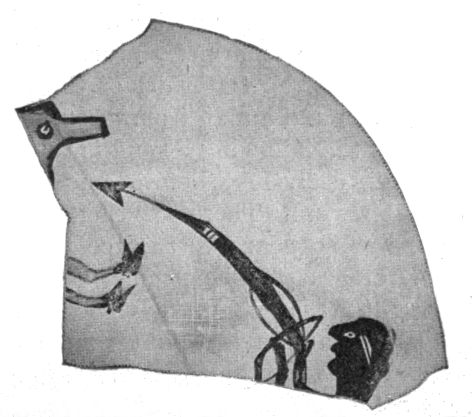
The symbolism of Püükoñhoya at the present day consists of parallel marks on the face or body, and when personated by a man the figure is always represented as carrying weapons of war, such as a bow and arrows. Images of the same hero are used in ceremonies, and are sometimes found as household gods or penates, which are fed as if human beings. A fragment of pottery represented in the accompanying illustration (figure 263), shows enough of the head of a personage to indicate that Püükoñhoya was intended, for it bears on the cheek the two parallel marks symbolic of that deity, while in his hands he holds a bow and a jointed arrow as if shooting an unknown animal. All of these features are in harmony with the identification of the figure with that of the cultus-hero mentioned, and seem to indicate the truth of the current legend that as a mythologic conception he is of great antiquity in Tusayan.
Fig. 263—War god shooting an animal. (Fragment of food bowl.)
In this connection it may be instructive to call attention to two figures on a food bowl collected by Mr H. R. Voth from a ruin near Oraibi. It represents a man and a woman, the former with two horns, a crescent on the forehead, and holding in his outstretched hand a staff. The woman has a curious gorget, similar to some which I have found in ruins near Tusayan, and a belt like those still worn by Pueblo Indians. This smaller figure likewise has a crescent on its face and three strange appendages on each side of the head.
Another food basin in Mr Voth's collection is also instructive, and is different in its decoration from any which I have found. The character of the ware is ancient, but the figure is decidedly modern. If, however, it should prove to be an ancient vessel it would carry back to the time of its manufacture the existence of the katcina cult in Tusayan, no actual proof of the existence of which, at a time when Sikyatki was in its prime, has yet been discovered.
The three figures represent Hahaiwüqti, Hewüqti, and Natacka exactly as these supernatural beings are now personated at Walpi in the Powamû, as described and figured in a former memoir.[133]
It is unfortunate that the antiquity of this specimen, suggestive as it is, must be regarded as doubtful, for it was not exhumed from the ruin by an archeologist, and the exact locality in which it was found is not known.
The Human Hand
Excepting the figure of the maid's head above described, the human hand, for some unknown reason, is the only part of the body chosen by the ancient Hopi for representation in the decoration of their pottery. Among the present Tusayan Indians the human hand is rarely used, but oftentimes the beams of the kivas are marked by the girls who have plastered them with impressions of their muddy hands, and there is a katcina mask which has a hand painted in white on the face. As in the case of the decoration of all similar sacred paraphernalia, there is a legend which accounts for the origin of the katcina with the imprint of the hand on its mask. The following tale, collected by the late A. M. Stephen, from whose manuscript I quote, is interesting in this connection:
"The figure of a hand with extended fingers is very common, in the vicinity of ruins, as a rock etching, and is also frequently seen daubed on the rocks with colored pigments or white clay. These are vestiges of a test formerly practiced by the young men who aspired for admission to the fraternity of the Calako. The Calako is a trinity of two women and a man from whom the Hopi obtained the first corn, and of whom the following legend is told:
"In the early days, before houses were built, the earth was devastated by a whirlwind. There was then neither springs nor streams, although water was so near the surface that it could be found by pulling up a tuft of grass. The people had but little food, however, and they besought Masauwûh to help them, but he could not.
"There came a little old man, a dwarf, who said that he had two sisters who were the wives of Calako, and it might be well to petition them. So they prepared an altar, every man making a paho, and these were set in the ground so as to encircle a sand hillock, for this occurred before houses were known.
"Masauwûh's brother came and told them that when Calako came to the earth's surface wherever he placed his foot a deep chasm was made; then they brought to the altar a huge rock, on which Calako might stand, and they set it between the two pahos placed for his wives.
"Then the people got their rattles and stood around the altar, each man in front of his own paho; but they stood in silence, for they knew no song with which to invoke this strange god. They stood there for a long while, for they were afraid to begin the ceremonies until a young lad, selecting the largest rattle, began to shake it and sing. Presently a sound like rushing water was heard, but no water was seen; a sound also like great winds, but the air was perfectly still, and it was seen that the rock was pierced with a great hole through the center. The people were frightened and ran away, all save the young lad who had sung the invocation.
BUREAU OF AMERICAN ETHNOLOGY—— SEVENTEENTH ANNUAL REPORT PL. CXXVII UNUSUAL FORMS OF VASES FROM SIKYATKI
"The lad soon afterward rejoined them, and they saw that his back was cut and bleeding and covered with splinters of yucca and willow. The flagellation, he told them, had been administered by Calako, who told him that he must endure this laceration before he could look upon the beings he had invoked; that only to those who passed through his ordeals could Calako become visible; and, as the lad had braved the test so well, he should thenceforth be chief of the Calako altar. The lad could not describe Calako, but said that his two wives were exceedingly beautiful and arrayed with all manner of fine garments. They wore great headdresses of clouds and every kind of corn which they were to give to the Hopi to plant for food. There were white, red, yellow, blue, black, blue-and-white speckled, and red-and-yellow speckled corn, and a seeded grass (kwapi).
"The lad returned to the altar and shook his rattle over the hole in the rock, and from its interior Calako conversed with him and gave him instructions. In accordance with these he gathered all the Hopi youths and brought them to the rock, that Calako might select certain of them to be his priests. The first test was that of putting their hands in the mud and impressing them upon the rock. Only those were chosen as novices the imprints of whose hands had dried on the instant.
"The selected youths then moved within the altar and underwent the test of flagellation. Calako lashed them with yucca and willow. Those who made no outcry were told to remain in the altar, to abstain from salt and flesh for ten days, when Calako would return and instruct them concerning the rites to be performed when they sought his aid.
"Calako and his two wives appeared at the appointed time, and after many ceremonials gave to each of the initiated five grains of each of the different kinds of corn. The Hopi women had been instructed to place baskets woven of grass at the foot of the rock, and in these Calako's wives placed the seeds of squashes, melons, beans, and all the other vegetables which the Hopi have since possessed.
"Calako and his wives, after announcing that they would again return, took off their masks and garments, and laying them on the rock disappeared within it.
"Some time after this, when the initiated were assembled in the altar, the Great Plumed Snake appeared to them and said that Calako could not return unless one of them was brave enough to take the mask and garments down into the hole and give them to him. They were all afraid, but the oldest man of the Hopi took them down and was deputed to return and represent Calako.
"Shortly afterward Masauwûh stole the paraphernalia, and with his two brothers masqueraded as Calako and his wives. This led the Hopi into great trouble, and they incurred the wrath of Muiyinwûh, who withered all their grain and corn.
"One of the Hopi finally discovered that the supposed Calako carried a cedar bough in his hand, when it should have been willow; then they knew that it was Masauwûh who had been misleading them.
"The boy hero one day found Masauwûh asleep, and so regained possession of the mask. Muiyinwûh then withdrew his punishments and sent Palülükoñ (the Plumed Snake) to tell the Hopi that Calako would never return to them, but that the boy hero should wear his mask and represent him, and his festival should be celebrated when they had a proper number of novices to be initiated."[134]
Several food basins from Sikyatki have a human hand depicted upon them, and in one of these both hands are represented. On the most perfect of these hand figures (plate cxxxvii, c) a wristlet is well represented, with two triangular figures, which impart to it an unusual form. From between the index and second finger there arises a triangular appendage, which joins a graceful curve, extending on one side to the base of the thumb and continued on the other side to the arm. The whole inside of the basin, except the figure of the hand and its appendage, is decorated with spattering,[135] and on the outside there is a second figure, evidently a hand or the paw of some animal. This external decoration also has a triangular figure in which are two terraces, recalling rain-cloud symbols.
One of the most interesting representations of the human hand (figure 354) is found on the exterior of a beautiful bowl. The four fingers and the thumb are shown with representations of nails, a unique feature in such decorations. From between the index finger and the next, or rather from the tip of the former, arises an appendage comparable with that before mentioned, but of much simpler form. The palm of the hand is crossed by a number of parallel lines, which recall a custom of using the palm lines in measuring ceremonial prayer sticks, as I have described in a memoir on the Snake dance. In place of the arm this hand has many parallel lines, the three medial ones being continued far beyond the others, as shown in the figure.
Quadrupeds
Figures of quadrupeds are sparingly used in the decoration of food bowls or basins, but the collection shows several fine specimens on which appear some of the mammalia with which the Hopi are familiar. Most of these are so well drawn that there appears to be no question as to their identification.
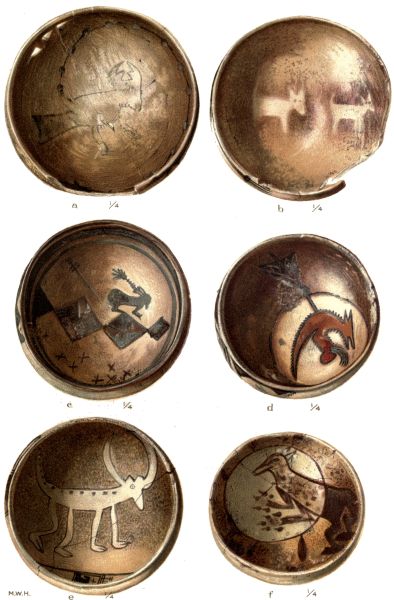
One of the most instructive of these figures is shown in plate cxxx, a, which is much worn, and indistinct in detail, although from what can be traced it was probably intended to represent a mythic creature known as the Giant Elk. The head bears two branched horns, drawn without perspective, and the neck has a number of short parallel marks similar to those occurring on the figure of an antelope on the walls of one of the kivas at Walpi. The hoofs are bifid, and from a short stunted tail there arises a curved line which encircles the whole figure, connecting a series of round spots and terminating in a triangular figure with three parallel lines representing feathers. Perhaps the strangest of all appendages to this animal is at the tail, which is forked, recalling the tail of certain birds. Its meaning is unknown to me.
BUREAU OF AMERICAN ETHNOLOGY—— SEVENTEENTH ANNUAL REPORT PL. CXXVIII MEDICINE BOX AND PIGMENT POTS FROM SIKYATKI
There can be no doubt that the delineator sought to represent in this figure one of the numerous horned Cervidæ with which the ancient Hopi were familiar, but the drawing is so incomplete that to choose between the antelope, deer, and elk seems impossible. It may be mentioned, however, that the Horn people are reputed to have been early arrivals in Tusayan, and it is not improbable that representatives of the Horn clans lived in Sikyatki previous to its overthrow.
Two faintly drawn animals, evidently intended for quadrupeds, appear on the interior of the food bowl shown in plate cxxx, b. These are interesting from the method in which they were drawn. They are not outlined with defined lines, but are of the original color of the bowl, and appear as two ghost-like figures surrounded by a dense spattering of red spots, similar in technic to the figure of the human hand. I am unable to identify these animals, but provisionally refer them to the rabbit. They have no distinctive symbolism, however, and are destitute of the characteristic spots which members of the Rabbit clan now invariably place on their totemic signatures.
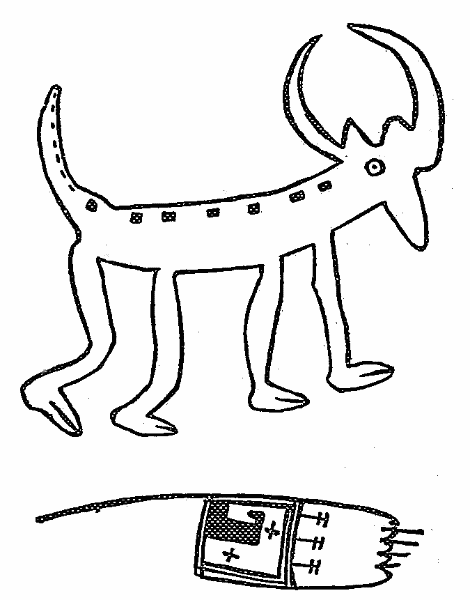
Fig. 264—Mountain sheep
The animal design on the bowl illustrated in plate cxxx, c, probably represents a rabbit or hare, quite well drawn in profile, with a feathered appendage from the head. Behind it is the ordinary symbol of the dragon-fly. Several crosses are found in an opposite hemisphere, separated from that occupied by the two animal pictures by a series of geometric figures ornamented with crooks and other designs.
The interior of the food bowl shown in plate cxxx, d, as well as the inner sides of the two ladles represented in plate cxxxi, b, d, are decorated with peculiar figures which suggest the porcupine. The body is crescentic and covered with spines, and only a single leg, with claws, is represented. It is worthy of mention that so many of these animal forms have only one leg, representative, no doubt, of a single pair, and that many of these have plantigrade paws like those of the bear and badger. The appendages to the head in this figure remind one of those of certain forms regarded as reptiles, with which this may be identical.
Fig. 265—Mountain lion
In another decoration we have what is apparently the same animal furnished with both fore and hind legs, the tail curving upward like that of a cottontail rabbit, which it resembles in other particulars as well. This figure also hangs by a band from a geometric design formed of two crescents and bearing four parallel marks representing feathers. The single crescent depicted on the inside of the ladle shown in plate cxxxi, b, is believed to represent the same conception, or the moon; and in this connection the very close phonetic resemblance between the Hopi name for moon[136] and that for the mammal may be mentioned. In the decoration last described the same crescentic figure is elaborated into its zoömorphic equivalent.
BUREAU OF AMERICAN ETHNOLOGY SEVENTEENTH ANNUAL REPORT PL. CXXIX DESIGNS ON FOOD BOWLS FROM SIKYATKI
An enumeration of the pictographic representations of mammalia includes the beautiful food bowl shown in plate cxxx, e, which is made of fine clay spattered with brown pigment. This design (reproduced in figure 264) represents probably some ruminant, as the mountain sheep or possibly the antelope, both of which gave names to clans said to have resided at Sikyatki. The hoofs are characteristic, and the markings on the back suggest a fawn or spotted deer. There is a close similarity between the design below this animal and that of the exterior decorations of certain vases and square medicine bowls.
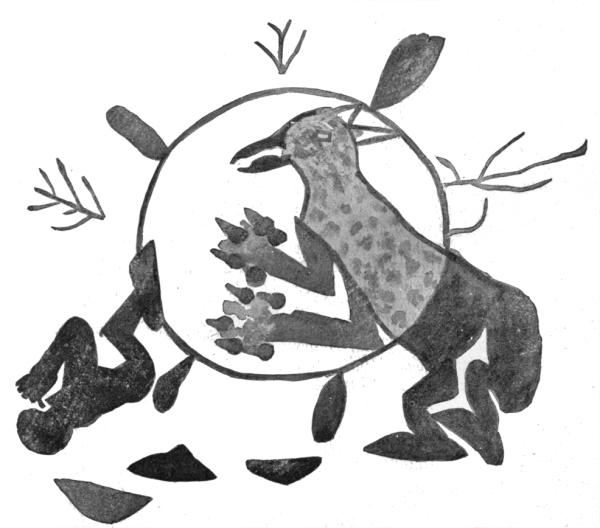
Among the pictures of quadrupedal animals depicted on ancient food bowls there is none more striking than that illustrated in plate cxxx, f, which has been identified as the mountain lion. While this identification is more or less problematical, it is highly possible. The claws of the forelegs (figure 265) are evidently those of one of the carnivora of the cat family, of which the mountain lion is the most prominent in Tusayan. The anterior part of the body is spotted; the posterior and the hind legs are black. The snout bears little resemblance to that of the puma.
The entire inner surface of the bowl, save a central circle in which the head, fore-limbs, and anterior part of the body are represented, is decorated by spattering. Within this spattered area there are highly interesting figures, prominent among which is a squatting figure of a man, with the hand raised to the mouth and holding a ceremonial cigarette, as if engaged in smoking. The seven patches in black might well be regarded as either footprints or leaves, four of which appear to be attached to the band inclosing the central area. In the intervals between three of these there are branched bodies representing plants or bushes.
Reptiles
Snakes and other reptilian forms were represented by the ancient potters in the decoration of food bowls, and it is remarkable how closely some of these correspond in symbolism with conceptions still current in Tusayan. Of all reptilian monsters the worship of which forms a prominent element in Hopi ritual, that of the Great Plumed Snake is perhaps the most important. Effigies of this monster exist in all the larger Hopi villages, and they are used in at least two great rites—the Soyaluña in December and the Palülükonti in March, as I have already described. The symbolic markings and appendages of the Plumed Snake effigy are distinctive, and are found in all modern representations of this mystic being. While several pictographs of snakes are found on Sikyatki pottery, there is not a single instance in which these modern markings appear; consequently there is considerable doubt in regard to the identification of many of the Sikyatki serpents with modern mythologic representatives.
Fig. 266—Plumed serpent
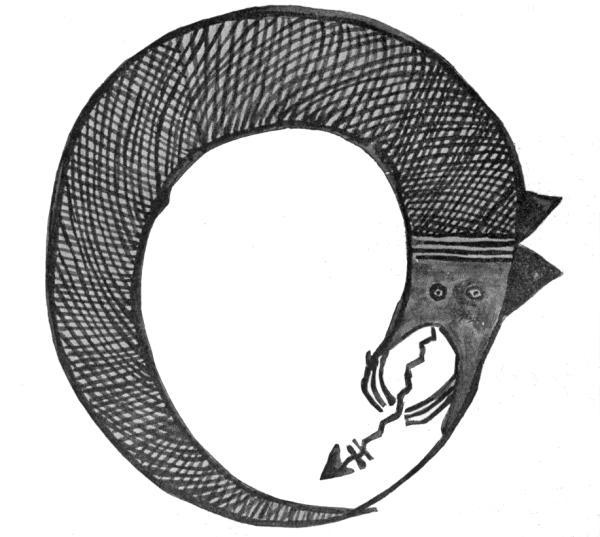
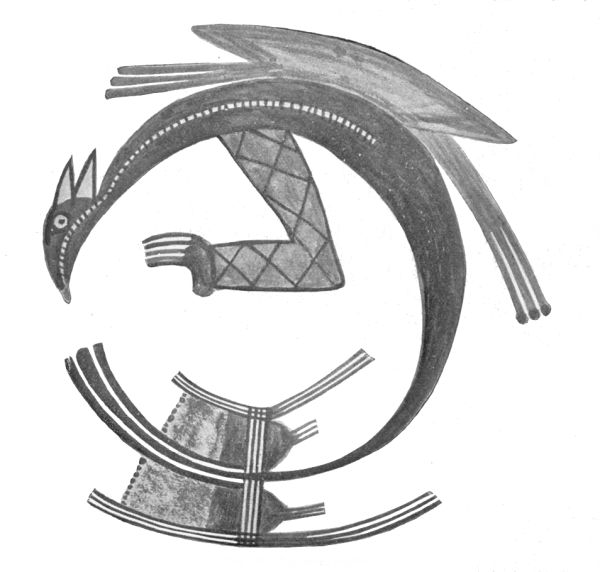
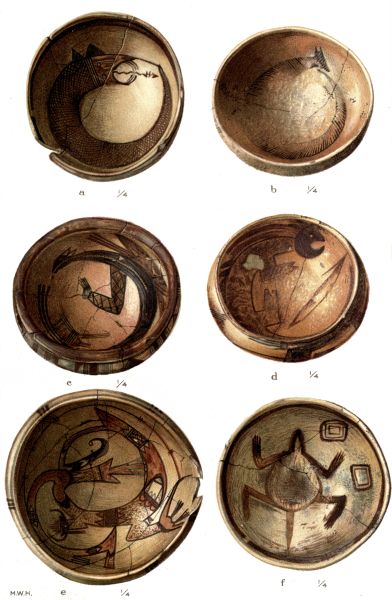
In questioning the priests in regard to the derivation of the Plumed Serpent cult in Tusayan, I have found that they declare that this cultus was brought into Tusayan from a mythic land in the south, called Palatkwabi, and that the effigies and fetiches pertaining to it were introduced by the Patki or Water-house people. From good evidence, I suspect that the arrival of this phratry was comparatively late in Tusayan history, and it is possible that Sikyatki was destroyed before their advent, for in all the legends which I have been able to gather no one ascribes to Sikyatki any clan belonging to the phratries which are said to have migrated from the far south. I believe we must look toward the east, whence the ancestors of the Kokop or Firewood people are reputed to have come, for the origin of the symbolic markings of the snakes represented on Sikyatki ceramics. Figures of apodal reptiles, with feathers represented on their heads, occur in Sikyatki pictography, although there is no resemblance in the markings of their bodies to those of modern pictures. One of the most striking of these occurs on the inside of the food basin shown in plate cxxxii, a. It represents a serpent with curved body, the tail being connected with the head, like an ancient symbol of eternity. The body (figure 266) is destitute of any distinctive markings, but is covered with a crosshatching of black lines. The head bears two triangular markings, which are regarded as feather symbols. The position of the eyes would seem to indicate that the top of the head is represented, but this conclusion is not borne out by comparative studies, for it was often the custom of ancient Tusayan potters, like other primitive artists, to represent both eyes on one side of the head.
BUREAU OF AMERICAN ETHNOLOGY—— SEVENTEENTH ANNUAL REPORT PL. CXXX FOOD BOWLS WITH FIGURES OF QUADRUPEDS FROM SIKYATKI
The zigzag line occupying the position of the tongue and terminating in a triangle is a lightning symbol, with which the serpent is still associated. While striving not to strain the symbolism of this figure, it is suggested that the three curved marks on the lower and upper jaws represent fangs. It is highly probable that conceptions not greatly unlike those which cluster about the Great Plumed Serpent were associated with this mythic snake, the figure of which is devoid of some of the most essential elements of modern symbolism.
While from the worn character of the middle of the food bowl illustrated in plate cxxxii, b, it is not possible to discover whether the animal was apodal or not from the crosshatching of the body and the resemblance of the appendages of the head to those of the figure last considered, it appears probable that this pictograph likewise was intended to represent a snake of mystic character. Like the previous figure, this also is coiled, with the tail near the head, its body crosshatched, and with two triangular appendages to the head. There is, however, but one eye, and the two jaws are elongated and provided with teeth,[137] as in the case of certain reptiles.
The similarity of the head and its appendages to the snake figure last described would lead me to regard the figure shown in plate cxxxii, c, as representing a like animal, but the latter picture is more elaborately worked out in details, and one of the legs is well represented. I have shown in the discussion of a former figure how the decorator, recognizing the existence of two eyes, represented them both on one side of the head of a profile figure, although only one is visible, and we see in this picture (figure 267) a somewhat similar tendency, which is very common in modern Tusayan figures of animals. The breath line is drawn from the extremity of the snout halfway down the length of the body. In modern pictography a representation of the heart is often depicted at the blind extremity of this line, as if, in fact, there was a connection with this organ and the tubes through which the breath passes. In the Sikyatki pottery, however, I find only this one specimen of drawing in which an attempt to represent internal organs is made.
The tail of this singular picture of a reptile is highly conventionalized, bearing appendages of unknown import, but recalling feathers, while on the back are other appendages which might be compared with wings. Both of these we might expect, considering the association of bird and serpent in the Hopi conception of the Plumed Snake.
Exact identifications of these pictures with the animals by which the Hopi are or were surrounded, is, of course, impossible, for they are not realistic representations, but symbolic figures of mythic beings unknown save to the imagination of the primitive mythologist.
Fig. 267—Unknown reptile
BUREAU OF AMERICAN ETHNOLOGY—— SEVENTEENTH ANNUAL REPORT PL. CXXXI ORNAMENTED LADLES FROM SIKYATKI
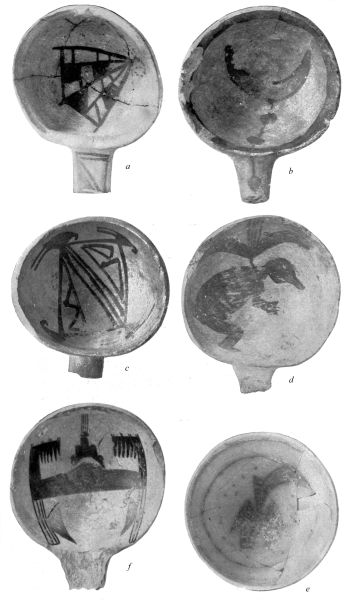
Fig. 268—Unknown reptile
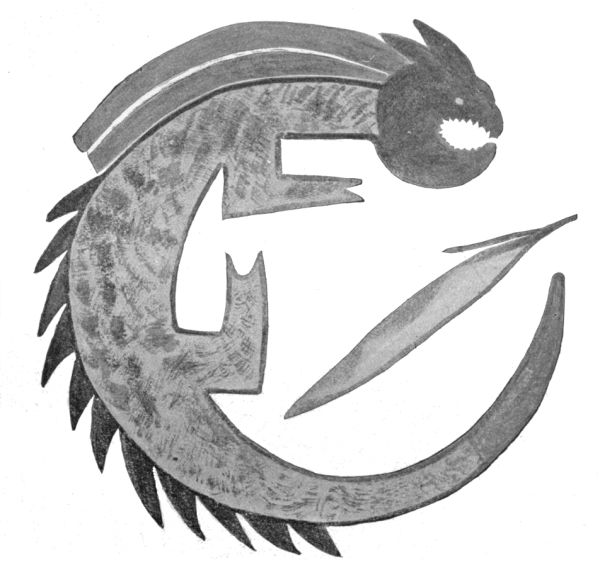
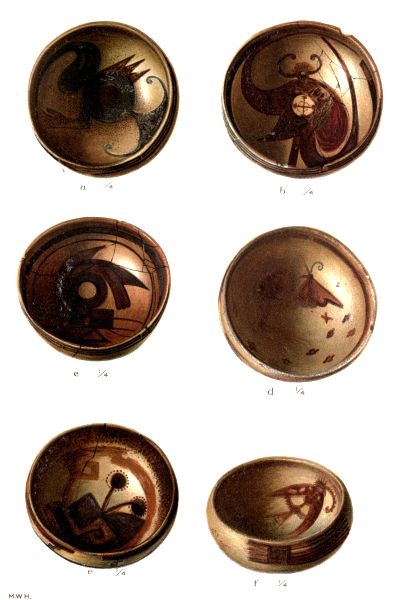
A similar reptile is pictured on the food bowl shown in plate cxxxii, d, in which design, however, there are important modifications, the most striking of which are: (1) The animal (figure 268) has both fore and hind legs represented; (2) the head is round; (3) the mouth is provided with teeth; and (4) there are four instead of two feather appendages on the head, two of which are much longer than the others. Were it not that ears are not represented in reptiles, one would be tempted to regard the smaller appendages as representations of these organs. Their similarity to the row of spines on the back and the existence of spines on the head of the "horned toad" suggests this reptile, with which both ancient and modern Hopi are very familiar. On a fragment of a vessel found at Awatobi there is depicted the head of a reptile evidently identical with this, since the drawing is an almost perfect reproduction. There is a like figure, also from Sikyatki, in the collection of pottery made at that ruin by Dr Miller, of Prescott, the year following my work there. The most elaborate of all the pictures of reptiles found on ancient Tusayan pottery is shown in plate cxxxii, e, in which the symbolism is complicated and the details carefully worked out. A few of these symbols I am able to decipher; others elude present analysis. There is no doubt as to the meaning of the appendage to the head (figure 269), for it well portrays an elaborate feathered headdress on which the markings that distinguish tail-feathers, three in number, are prominent. The extension of the snout is without homologue elsewhere in Hopi pictography, and, while decorative in part, is likewise highly conventionalized. On the body semicircular rain cloud symbols and markings similar to those of the bodies of certain birds are distinguishable. The feet likewise are more avian than reptilian, but of a form quite unusual in structure. It is interesting to note the similarity in the carved line with six sets of parallel bars to the band surrounding the figure of the human hand shown in plate cxxxvii, c. In attempting to identify the pictograph on the bowl reproduced in plate cxxxiv, a, there is little to guide me, and the nearest I can come to its significance is to ascribe it to a reptile of some kind. Highly symbolic, greatly conventionalized as this figure is, there is practically nothing on which to base the absolute identification of the figure save the serrated appendage to the body and the leg, which resembles that of the lizard as it is sometimes drawn. The two eyes indicate that the enlargement in which these were placed is the head, and the extended curved snout a beak. All else is incomprehensible to me, and my identification is therefore provisional and largely speculative.
Fig. 269—Unknown reptile
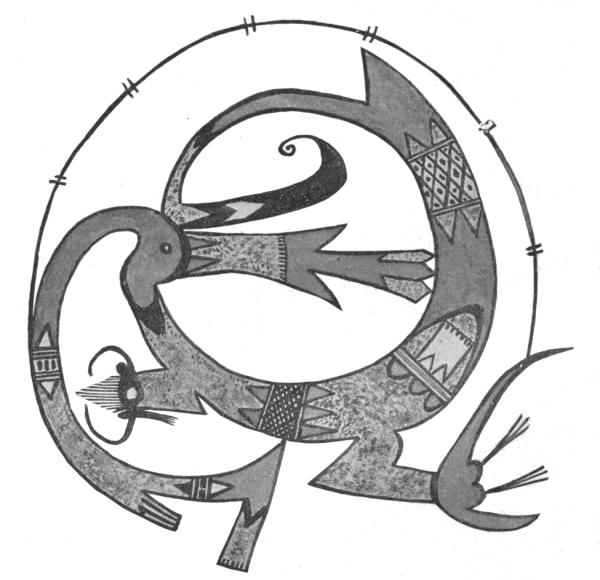
I wish, however, in leaving the description of this beautiful bowl, to invite attention to the brilliancy and the characteristics of the coloring, which differ from the majority of the decorated ware from Sikyatki.
BUREAU OF AMERICAN ETHNOLOGY—— SEVENTEENTH ANNUAL REPORT PL. CXXXII FOOD BOWLS WITH FIGURES OF REPTILES FROM SIKYATKI
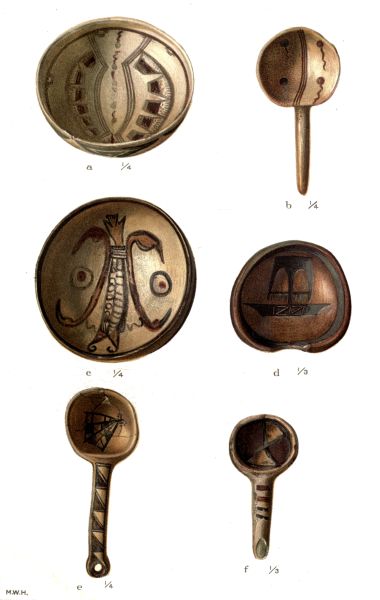
BUREAU OF AMERICAN ETHNOLOGY—— SEVENTEENTH ANNUAL REPORT PL. CXXXIII BOWLS AND DIPPERS WITH FIGURES OF TADPOLES, BIRDS, ETC. FROM SIKYATKI
BUREAU OF AMERICAN ETHNOLOGY—— SEVENTEENTH ANNUAL REPORT PL. CXXXIV FOOD BOWLS WITH FIGURES OF SUN, BUTTERFLY, AND FLOWER FROM SIKYATKI
Among the fragments of pottery found in the Sikyatki graves there was one which, had it been entire, would doubtless have thrown considerable light on ancient pictography. This fragment has depicted upon it portions of the body and the whole head and neck of a reptilian animal. We find on that part of the body which is represented, three parallel marks which recall those on the modern pictures of the Great Plumed Serpent. On the back there were apparently the representations of wings, a feather of which is shown above the head. The head likewise bears a crest of three feathers, and there are three reptilian like toes. Whether this represents a reptile or a bird it is impossible for me to say, but enough has already been recorded to indicate how close the symbolism of these two groups sometimes is in ancient pictography. It would almost appear as if the profound anatomical discovery of the close kinship of birds and reptiles was unconsciously recognized by a people destitute of the rudiments of the knowledge of morphology.
Tadpoles
Among the inhabitants of an arid region, where rain-making forms a dominant element in their ritual, water animals are eagerly adopted as symbols. Among these the tadpole occupies a foremost position. The figures of this batrachian are very simple, and are among the most common of those used on ceremonial paraphernalia in Tusayan at the present time. In none of these is anything more than a globular head and a zigzag tail represented, and, as in nature, these are colored black. The tadpole appears on several pieces of painted pottery from Sikyatki, one of the best of which is the food bowl illustrated in plate cxxxiii, a. The design represents a number of these aquatic animals drawn in line across the diameter of the inner surface of the bowl, while on each side there is a row of rectangular blocks representing rain clouds. These blocks are separated from the tadpole figures by crescentic lines, and above them are short parallel lines recalling the symbol of falling rain.
One of the most beautiful forms of ladles from Sikyatki is figured in plate cxxxiii, b, a specimen in which the art of decoration by spattering is effectively displayed. The interior of the bowl of this dipper is divided by parallel lines into two zones, in each of which two tadpoles are represented. The handle is pointed at the end and is decorated. This specimen is considered one of the best from Sikyatki.
The rudely drawn picture on the bowl figured in plate cxxxii, f, would be identified as a frog, save for the presence of a tail which would seem to refer it to the lizard kind. But in the evolution of the tadpole into the frog a tailed stage persists in the metamorphosis after the legs develop. In modern pictures[138] of the frog with which I am familiar, this batrachian is always represented dorsally or ventrally with the legs outstretched, while in the lizards, as we have seen, a lateral view is always adopted. As the sole picture found on ancient pottery where the former method is employed, this fact may be of value in the identification of this rude outline as a frog rather than as a true reptile.
Butterflies or Moths
One of the most characteristic modern decorations employed by the Hopi, especially as a symbol of fecundity, is the butterfly or moth. It is a constant device on the beautiful white or cotton blankets woven by the men as wedding gifts, where it is embroidered on the margin in the forms of triangles or even in more realistic patterns. This symbol is a simple triangle, which becomes quite realistic when a line is drawn bisecting one of the angles. This double triangle is not only a constant symbol on wedding blankets, but also is found on the dadoes of houses, resembling in design the arrangement of tiles in the Alhambra and other Moorish buildings. This custom of decorating the walls of a building with triangles placed at intervals on the upper edge of a dado is a feature of cliff-house kivas, as shown in Nordenskiöld's beautiful memoir on the cliff villages of Mesa Verde. While an isosceles triangle represents the simplest form of the butterfly symbol, and is common on ancient pottery, a few vessels from Sikyatki show a much more realistic figure. In plate cxxxiv, f, is shown a moth with extended proboscis and articulated antennæ, and in d of the same plate another form, with the proboscis inserted in a flower, is given. As an associate with summer, the butterfly is regarded as a beneficent being aside from its fecundity, and one of the ancient Hopi clans regarded it as their totem. Perhaps the most striking, and I may say the most inexplicable, use of the symbol of the butterfly is the so-called Hokona or Butterfly virgin slab used in the Antelope ceremonies of the Snake dance at Walpi, where it is associated with the tadpole water symbol.
Fig. 270—Outline of plate CXXXV, b
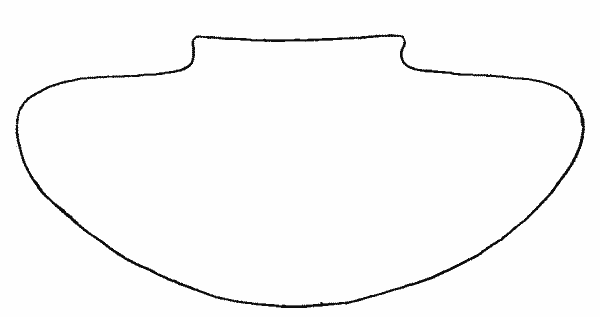
The most beautiful of all the butterfly designs are the six figures on the vase reproduced in plate cxxxv, b. From the number of these pictures it would seem that they bore some relationship to the six world-quarters—north, west, south, east, zenith, and nadir. The vase has a flattened shoulder, and the six butterfly figures are represented as flying toward the orifice. These insect figures closely resemble one another, and are divided into two groups readily distinguished by the symbolism of the heads. Three have each a cross with a single dot in each quadrant, and each of the other three has a dotted head without the cross. These two kinds alternate with each other, and the former probably indicate females, since the same symbols on the heads of the snakes in the sand picture of the Antelope altar in the Snake dance are used to designate the female.[139]
BUREAU OF AMERICAN ETHNOLOGY—— SEVENTEENTH ANNUAL REPORT PL. CXXXV VASES WITH FIGURES OF BUTTERFLIES FROM SIKYATKI
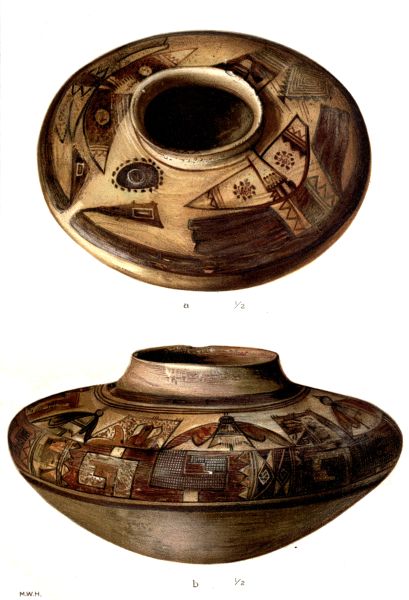
BUREAU OF AMERICAN ETHNOLOGY—— SEVENTEENTH ANNUAL REPORT PL. CXXXVI VASES WITH FIGURES OF BIRDS AND FEATHERS FROM SIKYATKI
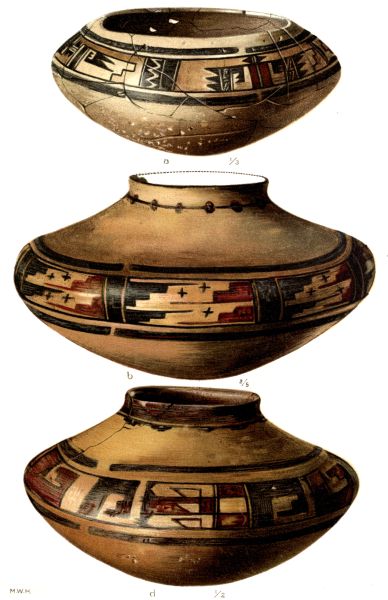
Two antennæ and a double curved proboscis are indicated in all the figures of butterflies on the vase under consideration. The zones above and below are both cut by a "line of life," the opening through which is situated on opposite equatorial poles in the upper and under rim.
Fig. 271—Butterfly design on upper surface of plate CXXXV, b
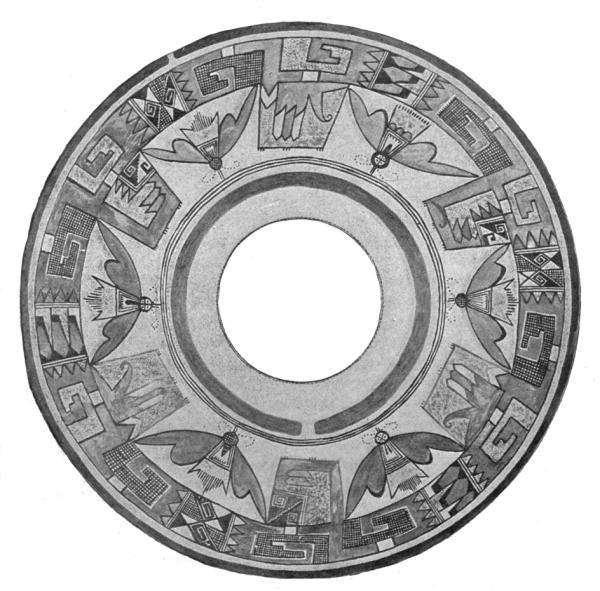
The rectangular figures associated with the butterflies on this elaborately decorated vase are of two patterns alternating with each other. The rectangles forming one of these patterns incloses three vertical feathers, with a triangle on the right side and a crook on the left. The remaining three rectangles also have three feathers, but they are arranged longitudinally on the surface of the vase.
The elaborate decoration of the zone outside the six butterflies is made up of feathers arranged in three clusters of three each, alternating with key patterns, crosshatched crooks, triangles, and frets. The wealth of ornament on this part of the vase is noteworthy, and its interpretation very baffling. This vase may well be considered the most elaborately decorated in the whole collection from Sikyatki.
There are several figures of butterflies, like those shown in plate cxxxi, a, in which the modifications of wings and body have proceeded still further, and the only features which refer them to insects are the jointed antennæ. The passage from this highly conventionalized design into a triangular figure is not very great. There are still others where the head, with attached appendages, arises not from an angle of a triangle, but from the middle of one side. This gives us a very common form of butterfly symbol, which is found, variously modified, on many ancient vessels. In such designs there is commonly a row of dots on each side, which may be represented by a sinuous line, a series of triangles, bars, or parallel bars.
The design reproduced in plate cxxxiv, d, represents a moth or butterfly associated with a flower, and several star symbols. It is evidently similar to that figured in a of the same plate, and has representations of antennæ and extended proboscis, the latter organ placed as if extracting honey from the flower. The conventional flower is likewise shown in e of this plate. The two crescentic designs in plate cxxxv, a, are regarded as butterflies.
The jar illustrated in plate cxlv, b, is ornamented with highly conventionalized figures on four sides, and is the only one taken from the Sikyatki cemeteries in which the designs are limited to the equatorial surface. The most striking figure, which is likewise found on the base of the paint saucer shown in plate cxlvi, f, is a diamond-shape design with a triangle at each corner (figure 276). The pictures drawn on alternating quadrants have very different forms, which are difficult to classify, and I have therefore provisionally associated this beautiful vessel with those bearing the butterfly and the triangle. The form of this vessel closely approaches that of the graceful cooking pots made of coiled and coarse indented ware, but the vessel was evidently not used for cooking purposes, as it bears no marks of soot.[140]
Dragon-flies
Among the most constant designs used in the decoration of Sikyatki pottery are figures of the dragon-fly. These decorations consist of a line, sometimes enlarged into a bulb at one end, with two parallel bars drawn at right angles across the end, below the enlargement. Like the tadpole, the dragon-fly is a symbol of water, and with it are associated many legends connected with the miraculous sprouting of corn in early times. It is a constant symbol on modern ceremonial paraphernalia, as masks, tablets, and pahos, and it occurs also on several ancient vessels (plates cxl, b; clxiii, a), where it always has the same simple linear form, with few essential modifications.
BUREAU OF AMERICAN ETHNOLOGY—— SEVENTEENTH ANNUAL REPORT PL. CXXXVII VESSELS WITH FIGURES OF HUMAN HAND, BIRDS, TURTLE, ETC. FROM SIKYATKI
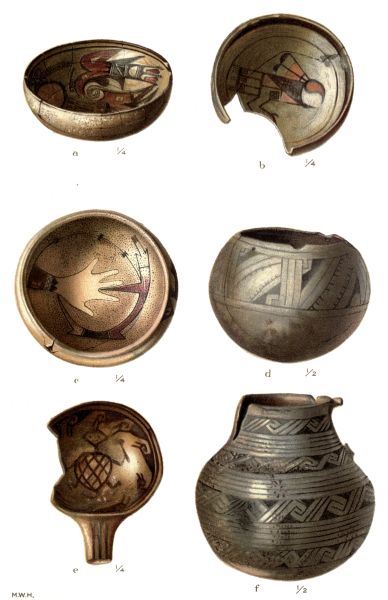
The symbols of four dragon-flies are well shown on the rim of the square box represented in plate cxxviii, a. This box, which was probably for charm liquid, or possibly for feathers used in ceremonials, is unique in form and is one of the most beautiful specimens from the Sikyatki cemeteries. It is elaborately decorated on the four sides with rain-cloud and other symbols, and is painted in colors which retain their original brilliancy. The interior is not decorated.
The four dragon-flies on the rim of this object are placed in such a way as to represent insects flying about the box in a dextral circuit, or with the heads turned to the right. This position indicates a ceremonial circuit, which is exceptional among the Tusayan people, although common in Navaho ceremonies. In the sand picture of the Snake society, for instance, where four snakes are represented in a border surrounding a mountain lion, these reptiles are represented as crawling about the picture from right to left. This sequence is prescribed in Tusayan ceremonials, and has elsewhere been designated by me as the sinistral circuit, or a circuit with the center on the left hand. The circuit used by the decorator of this box is dextral or sunwise.
Several rectangular receptacles of earthenware, some with handles and others without them, were obtained in the excavations at Sikyatki. The variations in their forms may be seen in plates cxxviii, a, c, and cxxv, f. These are regarded as medicine bowls, and are supposed to have been used in ancient ceremonials where asperging was performed. In many Tusayan ceremonials square medicine bowls, some of them without handles, are still used,[141] but a more common and evidently more modern variety are round and have handles. The rim of these modern sacred vessels commonly bears, in its four quadrants, terraced elevations representing rain-clouds of the cardinal points, and the outer surface of the bowl is decorated with the same symbols, accompanied with tadpole or dragon-fly designs.
One of the best figures of the dragon-fly is seen on the saucer shown in plate cxx, f. The exterior of this vessel is decorated with four rectangular terraced rain-cloud symbols, one in each quadrant, and within each there are three well-drawn figures of the dragon-fly. The curved line below represents a rainbow. The terrace form of rain-cloud symbol is very ancient in Tusayan and antedates the well-known semicircular symbol which was introduced into the country by the Patki people. It is still preserved in the form of tablets[142] worn on the head and in sand paintings and various other decorations on altars and religious paraphernalia.
Birds
The bird and the feather far exceed all other motives in the decoration of ancient Tusayan pottery, and the former design was probably the first animal figure employed for that purpose when the art passed out of the stage where simple geometric designs were used exclusively. A somewhat similar predominance is found in the part which the bird and the feather play in the modern Hopi ceremonial system. As one of the oldest elements in the decoration of Tusayan ceramics, figures of birds have in many instances become highly conventionalized; so much so, in fact, that their avian form has been lost, and it is one of the most instructive problems in the study of Hopi decoration to trace the modifications of these designs from the realistic to the more conventionalized. The large series of food bowls from Sikyatki afford abundant material for that purpose, and it may incidentally be said that by this study I have been able to interpret the meaning of certain decorations on Sikyatki bowls of which the best Hopi traditionalists are ignorant.[143] In order to show the method of reasoning in this case I have taken a series illustrating the general form of an unknown bird.
There can be no reasonable doubt that the decoration of the food basin shown in plate cxxxvii, a, represents a bird, and analogy would indicate that it is the picture of some mythologic personage. It has a round head (figure 272), to which is attached a headdress, which we shall later show is a highly modified feather ornament. On each side of the body from the region of the neck there arise organs which are undoubtedly wings, with feathers continued into arrowpoints. The details of these wings are very carefully and, I may add, prescriptively worked out, so that almost every line, curve, or zigzag is important. The tail is composed of three large feathers, which project beyond two triangular extensions, marking the end of the body.
The technic of this figure is exceedingly complicated and the colors very beautiful. Although this bowl was quite badly broken when exhumed, it has been so cleverly mended by Mr Henry Walther that no part of the symbolism is lost.
While it is quite apparent that this figure represents a bird, and while this identification is confirmed by Hopi testimony, it is far from a realistic picture of any known bird with which the ancients could have been familiar. It is highly conventionalized and idealized with significant symbolism, which is highly suggestive.
BUREAU OF AMERICAN ETHNOLOGY—— SEVENTEENTH ANNUAL REPORT PL. CXXXVIII FOOD BOWLS WITH FIGURES OF BIRDS FROM SIKYATKI
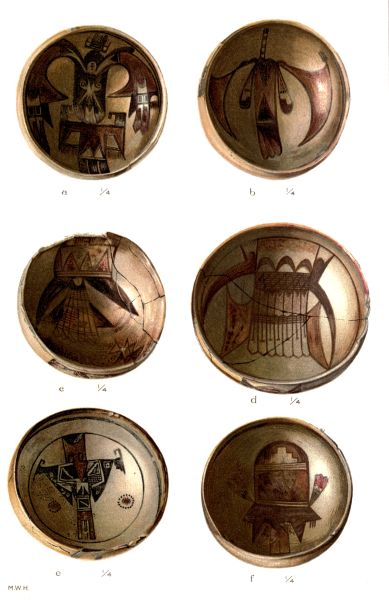
Bearing in mind the picture of this bird, we pass to a second form (plate cxxxviii, a), in which we can trace the same parts without difficulty. On a round head is placed a feathered headdress. The different parts of the outstretched wings are readily homologized even in details in the two figures. There are, for instance, two terminal wing feathers in each wing; the appendages to the shoulder exist in both, and the lateral spurs, exteriorly and interiorly, are represented with slight modifications.
Fig. 272—Man-eagle
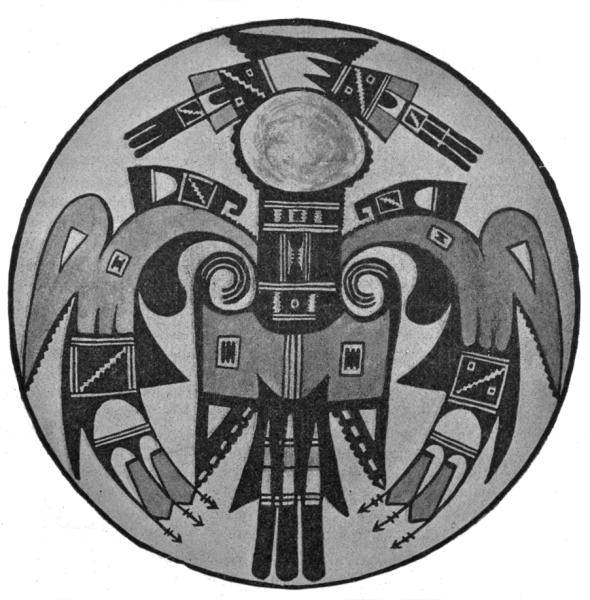
The body is ornamented in the same way in both figures. It is continued posteriorly on each side into triangular extensions, and the same is true of its anterior, which in one figure has three curved lines, and in the other a simple crook. There are three tail-feathers in each figure. I believe there can be no doubt that both these designs represent the same idea, and that a mythologic bird was intended in each instance.
The step in conventionalism from the last-mentioned figure of a bird to the next (plate cxlvii, a) is even greater than in the former. The head in this picture is square or rectangular, and the wings likewise simple, ending in three incurved triangles without appendages. The tail has five feathers instead of three, in which, however, the same symbolic markings which distinguish tail-feathers are indicated.
The conventionalized wings of this figure are repeated again and again in ancient Tusayan pottery decorations, as one may see by an examination of the various birds shown in the plates. In many instances, however, all the other parts of the bird are lost and nothing but the triangular feathers remain; but as these have the same form, whatever organs are missing, the presumption is that their meaning has not changed.
In passing to the figure of the bird shown in plate cxxxviii, b, we find features homologous with those already considered, but also detect considerable modification. The head is elongated, tipped with three parallel lines, but decorated with markings similar to those of the preceding figure. The outstretched wings have a crescentic form, on the anterior horn of which are round spots with parallel lines arising from them. This is a favorite figure in pottery decoration, and is found very abundantly on the exterior of food bowls; it represents highly conventionalized feathers, and should be so interpreted wherever found. The figure of the body of the bird depicted is simple, and the tail is continued into three tail-feathers, as is ordinarily the case in highly conventionalized bird figures.
The most instructive of all the appendages to the body are the club-shape bodies, one on each side, rising from the point of union of the wings and the breast. These are spatulate in form, with a terraced terminal marking. They, like other appendages, represent feathers, but that peculiar kind which is found under the wing is called the breath feather.[144] This feather is still used in certain ceremonials, and is tied to certain prayer offerings. Its ancient symbolism is very clearly indicated in this picture, and is markedly different from that of either the wing or tail feathers, which have a totally different ceremonial use at the present time.