RUINS IN VERDE VALLEY (continued 2)
Reading edition
In studying the specimens found in cliff-houses due attention has not always been given to the fact that occupants have oftentimes camped in them subsequently to their abandonment by the original builders. As a consequence of this temporary habitation objects owned by unrelated Indians have frequently been confused with those of the cliff-dwellers proper. We found evidences that both Honanki and Palatki had been occupied by Apache Mohave people for longer or shorter periods of time, and some of the specimens were probably left there by these inhabitants.
The ancient pottery found in the rooms, although fragmentary, is sufficiently complete to render a comparison with known ceramics from the Verde ruins. Had we discovered the cemeteries, for which we zealously searched in vain, no doubt entire vessels, deposited as mortuary offerings, would have been found; but the kind of ware of which they were made would undoubtedly have been the same as that of the fragments.
No pottery distinctively different from that which has already been reported from the Verde valley ruins was found, and the majority resembled so closely in texture and symbolism that of the cliff houses of the San Juan, in northern New Mexico and southern Utah, that they may be regarded as practically identical.
The following varieties of pottery were found at Honanki:
I. Coiled ware. II. Indented ware. III. Smooth ware. IV. Smooth ware painted white, with black geometric figures. V. Smooth red ware, with black decoration.
By far the largest number of fragments belong to the first division, and these, as a rule, are blackened by soot, as if used in cooking. The majority are parts of large open-mouth jars with flaring rims, corrugated or often indented with the thumb-nail or some hard substance, the coil becoming obscure on the lower surface. The inside of these jars is smooth, but never polished, and in one instance the potter used the corrugations of the coil as an ornamental motive. The paste of which this coiled ware was composed is coarse, with argillaceous grains scattered through it; but it was well fired and is still hard and durable. When taken in connection with its tenuity, these features show a highly developed potter's technique. A single fragment is ornamented with an S-shape coil of clay fastened to the corrugations in much the same way as in similar ware from the ruins near the Colorado Chiquito.
The fragments of smooth ware show that they, too, had been made originally in the same way as coiled ware, and that their outer as well as their inner surface had been rubbed smooth before firing. As a rule, however, they are coarse in texture and have little symmetry of form. Fragments identified as parts of bowls, vases, jars, and dippers are classed under this variety. As a rule they are badly or unevenly fired, although evidently submitted to great heat. There was seldom an effort made to smooth the outer surface to a polish, and no attempt at pictorial ornamentation was made.
The fragments represented in classes iv and v were made of a much finer clay, and the surface bears a gloss, almost a glaze. The ornamentation on the few fragments which were found is composed of geometric patterns, and is identical with the sherds from other ruins of Verde valley. A fragment each of a dipper and a ladle, portions of a red bowl, and a rim of a large vase of the same color were picked up near the ruin. Most of the fragments, however, belong to the first classes—the coiled and indented wares.
There was no evidence that the former inhabitants of these buildings were acquainted with metals. The ends of the beams had been hacked off evidently with blunt stone axes, aided by fire, and the lintels of the houses were of split logs which showed no evidence that any metal implement was used in fashioning them. We found, however, several stone tools, which exhibit considerable skill in the art of stone working. These include a single ax, blunt at one end, sharpened at the other, and girt by a single groove. The variety of stone from which the ax was made does not occur in the immediate vicinity of the ruin. There were one or two stone hammers, grooved for hafting, like the ax. A third stone maul, being grooveless, was evidently a hand tool for breaking other stones or for grinding pigments.
Fig. 251—Stone implement from Honanki
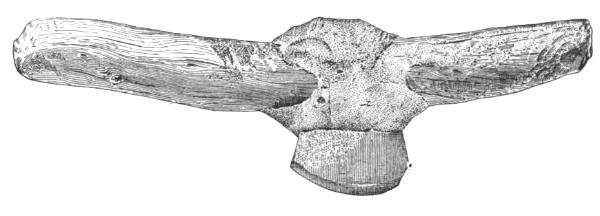
Perhaps the most interesting stone implement which was found was uncovered in the excavation of one of the middle rooms of the western part of the ruin, about three feet below the surface. It consists of a wooden handle rounded at each end and slightly curved, with a sharpened stone inserted midway of its length and cemented to the wood with pitch or asphaltum. The stone of this implement would hardly bear rough usage, or sustain, without fracture, a heavy blow. The edge is tolerably sharp, and it therefore may have been used in skinning animals. Judging from the form of the handle, the implement is better suited for use as a scraper than for any other purpose which has occurred to me (figure 251).
The inhabitants of the two ruins of the Red-rocks used obsidian arrowpoints with shafts of reeds, and evidently highly regarded fragments of the former material for knives, spearheads, and one or two other purposes.
The stone metates from these ruins are in no respect characteristic, and several fine specimens were found in place on the floors of the rooms. One of these was a well-worn specimen of lava, which must have been brought from a considerable distance, since none of that material occurs in the neighborhood. The existence of these grinding stones implies the use of maize as food, and this evidence was much strengthened by the finding of corncobs, kernels of corn, and charred fragments at several points below the surface of the débris in the chambers of Honanki. One of these grinding stones was found set in the floor of one of the rooms in the same way that similar metates may be seen in Walpi today.
Of bone implements, our limited excavations revealed only a few fragments. Leg bones of the turkey were used for awls, bodkins, needles, and similar objects. In general character the implements of this kind which were found are almost identical in form with the bone implements from Awatobi and Sikyatki, which are later figured and described. Although the bone implements unearthed were not numerous, we were well repaid for our excavations by finding an ancient fireboard, identical with those now used at Tusayan in the ceremony of kindling "new fire," and probably universally used for that purpose in former times. The only shell was a fragment of a bracelet made from a Pectunculus, a Pacific coast mollusk highly esteemed in ancient times among prehistoric Pueblos. The majority of the wooden objects found showed marks of fire, which were especially evident on the ends of the roof and floor beams projecting from the walls.
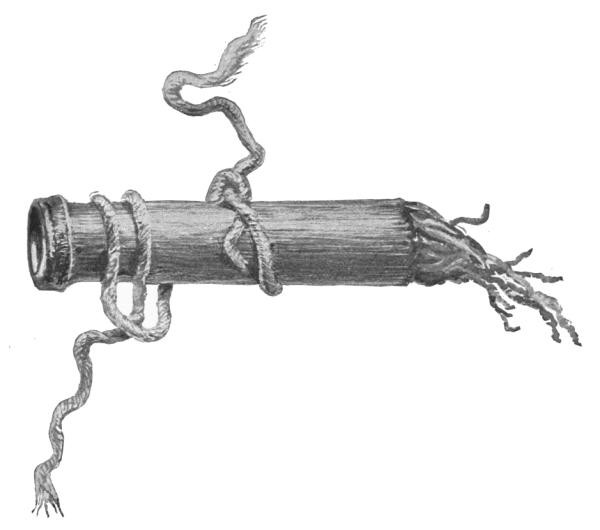
Fig. 252—Tinder tube from Honanki
A considerable collection of objects made of wickerwork and woven vegetal fiber was found in the alkaline dust and ashes of the Red-rock cliff houses, and while there is some difficulty here as elsewhere, in deciding whether certain specimens belonged to the original builders or to later temporary occupants, there is little doubt that most of them were the property of the latter.
There were many specimens of basketry found on the surface of the rubbish of the floors which, from the position of their occurrence and from their resemblance to the wickerwork still used by the Apache, seem without doubt to have been left there by temporary occupants of the rooms. There were likewise many wisps of yucca fiber tied in knots which must probably be regarded as of identical origin. The Yucca baccata affords the favorite fiber used by the natives at the present time, and it appears to have been popular for that purpose among the ancients.
Several specimens of sandals, some of which are very much worn on the soles, were found buried at the floor level. These are all of the same kind, and are made of yucca leaves plaited in narrow strips. The mode of attachment to the foot was evidently by a loop passing over the toes. Hide and cloth sandals have as yet not been reported from the Red-rock ruins of Verde valley. These sandals belonged to the original occupants of the cliff houses.
Fabrics made of cotton are common in the ruins of the Red-rocks, and at times this fiber was combined with yucca. Some of the specimens of cotton cloth were finely woven and are still quite strong, although stained dark or almost black. Specimens of netting are also common, and an open-mesh legging, similar to the kind manufactured in ancient times by the Hopi and still worn by certain personators in their sacred dances, were taken from the western room of Honanki. There were also many fragments of rope, string, cord, and loosely twisted bands, resembling head bands for carrying burdens.
A reed (figure 252) in which was inserted a fragment of cotton fiber was unlike anything yet reported from cliff houses, and as the end of the cotton which projected beyond the cavity of the reed was charred, it possibly was used as a slow-match or tinder-box.
Several shell and turquois beads were found, but my limited studies of the cliff-houses revealed only a few other ornaments, among them being beads of turkey-bone and a single wristlet fashioned from a Pectunculus. One or two fragments of prayer-sticks were discovered in a rock inclosure in a cleft to the west of the ruin.
Conclusions Regarding the Verde Valley Ruins
The ruins of the Verde region closely resemble those of Tusayan, and seem to support the claim of the Hopi that some of their ancestors formerly lived in that region. This is true more especially of the villages of the plains and mesa tops, for neither cave-houses nor cavate dwellings are found in the immediate vicinity of the inhabited Tusayan pueblos. The objects taken from the ruins are similar to those found universally over the pueblo area, and from them alone we can not say more than that they probably indicate the same substratum of culture as that from which modern pueblo life with its many modifications has sprung.
The symbolism of the decorations on the fragments of pottery found in the Verde ruins is the same as that of the ancient pueblos of the Colorado Chiquito, and it remains to be shown whether the ancestors of these were Hopi or Zuñi. I believe it will be found that they were both, or that when the villages along the Colorado Chiquito[29] were abandoned part of the inhabitants went to the mesas of Tusayan and others migrated farther up the river to the Zuñi villages.
Two centers of distribution of cliff houses occur in our Southwest: those of the upper tributaries of the Colorado in the north and the cliff houses of the affluents of the Salt and the Gila in the south. The watershed of the Rio Grande is, so far as is known, destitute of this kind of aboriginal dwellings. Between the two centers of distribution lie the pueblos of the Little Colorado and its tributaries, the home of the ancestors of the Hopi and the Zuñi. The many resemblances between the cliff houses of the north and those of the south indicate that the stage of culture of both was uniform, and probably the same conditions of environment led both peoples to build similar dwellings. All those likenesses which can be found between the modern Zuñi and the Hopi to the former cliff peoples of the San Juan region in the north, apply equally to those of the upper Salado and the Gila and their tributaries to the south; and so far as arguments of a northern origin of either, built on architectural or technological resemblances, are concerned, they are not conclusive, since they are also applicable to the cliff peoples of the south. The one important difference between the northern and the southern tier of cliff houses is the occurrence of the circular kiva, which has never been reported south of the divide between the Little Colorado and the Gila-Salado drainage. If a kiva was a feature in southern cliff houses, which I doubt, it appears to have been a rectangular chamber similar to a dwelling room. The circular kiva exists in neither the modern Hopi nor the Zuñi pueblos, and it has not been found in adjacent Tusayan ruins; therefore, if these habitations were profoundly influenced by settlers from the north, it is strange that such a radical change in the form of this room resulted. The arguments advanced that one of the two component stocks of the Zuñi, and that the aboriginal, came from the cliff peoples of the San Juan, are not conclusive, although I have no doubt that the Zuñi may have received increment from that direction.
Cushing has, I believe, furnished good evidence that some of the ancestors of the Zuñi population came from the south and southwest; and that some of these came from pueblos now in ruins on the Little Colorado is indicated by the great similarity in the antiquities of ancient Zuñi and the Colorado Chiquito ruins. Part of the Patki people of the Hopi went to Zuñi and part to Tusayan, from the same abandoned pueblo, and the descendants of this family in Walpi still recognize this ancient kinship; but I do not know, and so far as can be seen there is no way of determining, the relative antiquity of the pueblos in Zuñi valley and those on the lower Colorado.
The approximate date of the immigration of the Patki people to Tusayan is as yet a matter of conjecture. It may have been in prehistoric times, or more likely at a comparatively late period in the history of the people. It seems well substantiated, however, that when this Water-house people joined the other Hopi, the latter inhabited pueblos and were to all intents a pueblo people. If this hypothesis be a correct one, the Snake, Horn, and Bear peoples, whom the southern colonists found in Tusayan, had a culture of their own similar to that of the people from the south. Whence that culture came must be determined by studies of the component clans of the Hopi before the arrival of the Patki people.[30]
The origin of the round shape of the estufa, according to Nordenskiöld (p. 168), is most easily explained on the hypothesis that it is a reminiscence of the cliff-dwellers' nomadic period. "There must be some very cogent reason for the employment of this shape," he says, "for the construction of a cylindrical chamber within a block of rectangular rooms involves no small amount of labor. We know how obstinately primitive nations cling to everything connected with their religious ideas. Then what is more natural than the retention, for the room where religious ceremonies were performed, of the round shape characteristic of the original dwelling place, the nomadic hut? This assumption is further corroborated by the situation of the hearth and the structure of the roof of the estufa, when we find points of analogy to the method employed by certain nomadic Indians in the erection of their huts." This theory of the origin of the round form of dwelling and its retention in the architecture of the kiva, advanced by Nordenskiöld in 1893, has much in its favor, but the rectangular form, which, so far as known, is the only shape of these sacred rooms in the Tusayan region, is still unexplained. From Castañeda's narrative of the Coronado expedition it appears that in the middle of the sixteenth century the eastern pueblos had both square and round estufas or kivas, and that these kivas belonged to the men while the rooms of the pueblo were in the possession of the women. The apparent reason why we find no round rooms or kivas in the southern cliff houses and in Tusayan may be due to several causes. Local conditions, including the character of the building sites on the Hopi mesa, made square rooms more practical, or the nomadic stage was so far removed that the form of the inclosure in which the ancients held their rites had not been preserved. Moreover, some of the most ancient and secret observances at Walpi, as the Flute ceremony, are not performed in special kivas, but take place in ordinary living rooms.
As in all the other ruins of Verde valley, circular kivas are absent in the Red-rock country, and this fact, which has attracted the attention of several observers, is, I believe, very significant. Although as yet our knowledge of the cliff houses of the upper Gila and Salado and their numerous tributaries is very fragmentary, and generalization on that account unsafe, it may be stated provisionally that no circular kivas have yet been found in any ruins of the Gila-Salado watershed. This form of kiva, however, is an essential feature of the cliff dwellings of Rio Colorado, especially of those along its affluents in southern Colorado and northern New Mexico. Roughly speaking, then, the circular kiva is characteristic of the ruins of this region and of certain others in the valley of the Rio Grande, where they still survive in inhabited pueblos.
Circular ruins likewise are limited in their distribution in the Southwest, and it is an interesting fact that the geographic distribution of ancient pueblos of this form is in a general way the same as that of circular kivas. There are, of course, many exceptions, but so far as I know these can readily be explained. No ruins of circular dwellings occur in the Gila-Salado drainage area, where likewise no circular kivas have been observed. Moreover, the circular form of dwelling and kiva is distinctively characteristic of prehistoric peoples east of Tusayan, and the few instances of their occurrence on its eastern border can readily be explained as extra-Hopi.
The explanation of these circular kivas advanced by Nordenskiöld and the Mindeleffs, that they are survivals of round habitations of nomads, has much to commend it; but whether sufficient or not, the geographic limitation of these structures tells in favor of the absence of any considerable migration of the prehistoric peoples of the upper Colorado and Rio Grande watersheds southward into the drainage area of the Gila-Salado. Had the migration been in that direction it may readily be believed that the round kiva and the circular form of dwelling would have been brought with it.
The round kiva has been regarded as a survival of the form of the original homes of the nomad, when he became a sedentary agriculturist by conquest and marriage.
The presence of rectangular kivas in the same areas in which round kivas occur does not necessarily militate against this theory, nor does it oblige us to offer an explanation of a necessarily radical change in architecture if we would derive it from a circular form. It would indeed be very unusual to find such a change in a structure devoted to religious purposes where conservatism is so strong. The rectangular kiva is the ancient form, or rather the original form; the round kiva is not a development from it, but an introduction from an alien people. It never penetrated southward of the Colorado and upper Rio Grande drainage areas because the element which introduced it in the north was never strong enough to influence the house builders of the Gila-Salado and tributary valleys.