RUINS IN TUSAYAN (continued 5)
Reading edition
BUREAU OF AMERICAN ETHNOLOGY—— SEVENTEENTH ANNUAL REPORT PL. CLXVIII GEOMETRIC ORNAMENTATION FROM AWATOBI
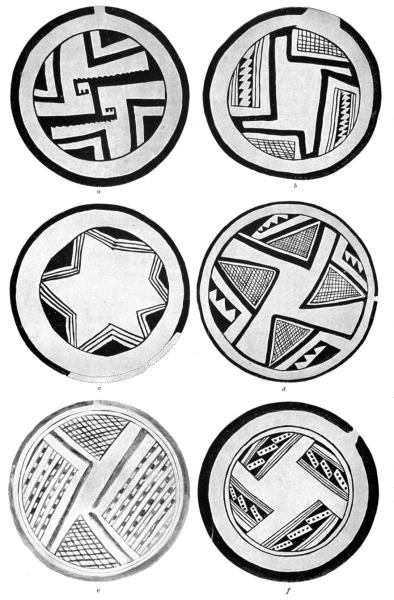
Fig. 351—Bifurcated rectangular design

Fig. 352—Lines of life and triangles

Fig. 353—Infolded triangles

The material at hand adds nothing new to the theory of the evolution of the terraced ornament from basketry or textile productions, so ably discussed by Holmes, Nordenskiöld, and others. When the Sikyatki potters decorated their ware the ornamentation of pottery had reached a high development, and figures both simple and complicated were used contemporaneously. While, therefore, we can so arrange them as to make a series, tracing modifications from simple to complex designs, thus forming a supposed line of evolution, it is evident that there is no proof that the simplest figures are the oldest. The great number of terraced figures and their use in the representation of animals seem to me to indicate that they antedate all others, and I see no reason why they should not have been derived from basketry patterns. We must, however, look to pottery with decorations less highly developed for evidence bearing on this point. The Sikyatki artists had advanced beyond simple geometric figures, and had so highly modified these that it is impossible to determine the primitive form.
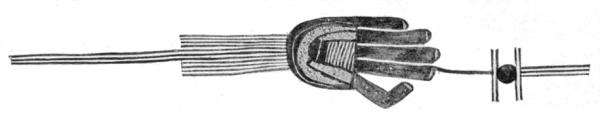
As I have shown elsewhere, the human hand is used as a decorative element in the ornamentation of the interior of several food bowls. It is likewise in one instance chosen to adorn the exterior. It is the only part of the human limbs thus used. Figure 354 shows the hand with marks on the palm probably intended to represent the lines which are used in the measurement of the length of pahos or prayer-sticks. From between the index and the middle finger rises a line which recalls that spoken of in the account of the hand on the interior of the food bowl shown in plate cxxxvii.
Fig. 354—Human hand
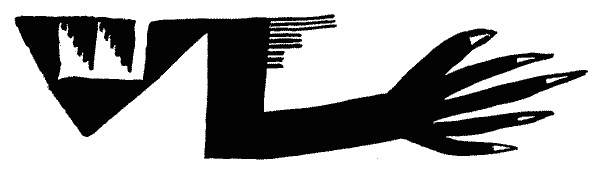
The limb of an animal with a paw, or possibly a human arm and hand, appears as a decoration on the outside of another food bowl, where it is combined with the ever-constant stepped figure, as shown in figure 355.
Fig. 355—Animal paw, limb, and triangle
PIGMENTS
The ancient Sikyatki people were accustomed to deposit in their mortuary vessels fragments of minerals or ground oxides and carbonates, of different colors, used as paints. It thus appears evident that these substances were highly prized in ancient as in modern times, and it may be mentioned that the present native priests regard the pigments found in the graves as so particularly efficacious in coloring their ceremonial paraphernalia that they begged me to give them fragments for that purpose. The green color, which was the most common, is an impure carbonate of copper, the same as that with which pahos are painted for ceremonial use today. Several shallow, saucer-like vessels contained yellow ocher, and others sesquioxide of iron, which afforded both the ancients and the moderns the red pigment called cuta, an especial favorite of the warrior societies. The inner surface of some of the bowls is stained with the pigments which they had formerly contained, and it was not uncommon to find several small paint pots deposited in a single grave. The white used was an impure kaolin, which was found both in masses and in powdered form, and there were unearthed several disks of this material which had been cut into definite shape as if for a special purpose.
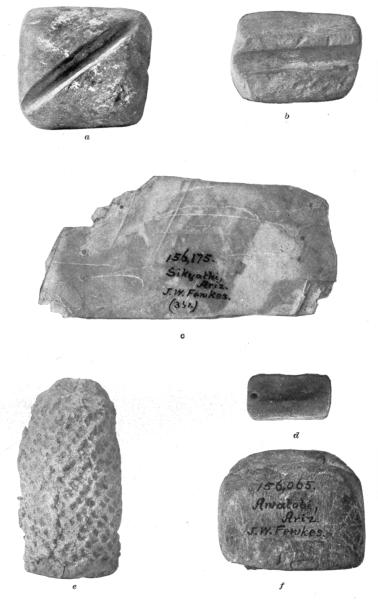
BUREAU OF AMERICAN ETHNOLOGY—— SEVENTEENTH ANNUAL REPORT PL. CLXIX ARROWSHAFT SMOOTHERS, SELENITE, AND SYMBOLIC CORN FROM SIKYATKI
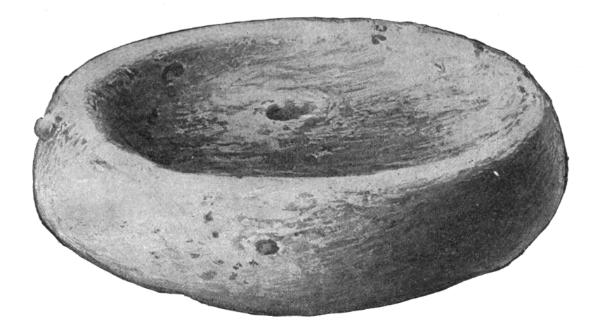
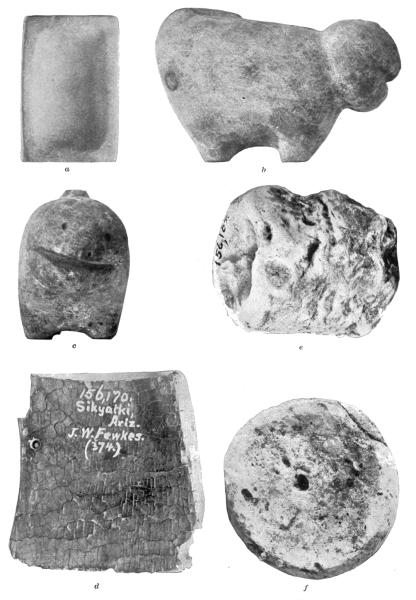
One of these disks or circular plates (figure 356) was found on the head of a skeleton. The rim is rounded, and the opposite faces are concave, with a perforation in the middle. Other forms of this worked kaolin are spherical, oblong, or lamellar, sometimes more or less decorated on the outer surface, as shown in plate clxxii, e. Another, shown in f, of the same plate, is cylindrical, and other fragments of irregular shapes were found. A pigment made of micaceous hematite was found in one of the Sikyatki paint jars. This material is still used as coloring matter by the Tusayan Indians, by whom it is called yayala, and is highly prized by the members of the warrior societies.
Fig. 356—Kaolin disk (natural size)
STONE OBJECTS
Almost every grave at Sikyatki contained stone objects which were found either in the bowls or in the soil in the immediate neighborhood of the skeletons. Some of these implements are pecked or chipped, others are smooth—pebbles apparently chosen for their botryoidal shape, polished surface, or fancied resemblance to some animal or other form.
Many of the smooth stones were probably simply polishing stones, used by the women in rubbing pottery to a gloss before it was fired. Others were charm stones such as are still employed in making medicine, as elsewhere described. There were still other stones which, from their resemblance to animals, may have been personal fetishes. Among the unusual forms of stones found in this association is a quartz crystal. As I have shown in describing several ceremonies still observed, a quartz crystal is used to deflect a ray of sunlight into the medicine bowl, and is placed in the center of a sand picture of the sun in certain rites called Powalawû; the crystal is also used in divining, and for other purposes, and is highly prized by modern Tusayan priests.
A botryoidal fragment of hematite found in a grave reminds me that in the so-called Antelope rock[154] at Walpi, around which the Snake dancers biennially carry reptiles in their mouths, there is in one side a niche in which is placed a much larger mass of that material, to which prayers are addressed on certain ceremonial occasions, and upon which sacred meal and prayer emblems are placed.
One or two mortuary bowls contained fragments of stalactites apparently from the Grand canyon of the Colorado or from some other locality where water is or has been abundant.
The loose shaly deposit which underlies the Tusayan mesas contains many cephalopod fossils, a collection of which was made in former years and deposited in the National Museum. Among these the most beautiful are small cephalopods called by the Hopi, koaitcoko. Among the many sacred objects in the tiponi baskets of the Lalakonti society, as described in my account[155] of the unwrapping of that fetish, there was a specimen of this ammonite; that the shell was preserved in this sacred bundle is sufficient proof that it is highly venerated. As a natural object with a definite form it is regarded as a fetish which is looked upon with reverence by the knowing ones and pronounced bad by the uninitiated. The occurrence of this fossil in one of the mortuary bowls is in harmony with the same idea and shows that it was regarded in a similar light by the ancient occupants of Sikyatki.
But the resemblance of these and other stones to animal fossils[156] is not always so remote as in the instances above mentioned. There was in one grave a single large fetish of a mountain lion, made of sandstone (plate clxxii, b, c), in which legs, ears, tail, and eyes are represented, and the mouth still retains the red pigment with which it was colored, although there was no sign of paint on other parts of the body. This fetish is very similar to the one found at Awatobi, and is identical in form with those made by the Hopi at the present time.
It was customary to bury in Sikyatki graves plates or fragments of selenite or mica, some of which are perforated as if for suspension, while others are in plain sheets (plate clxix, c).
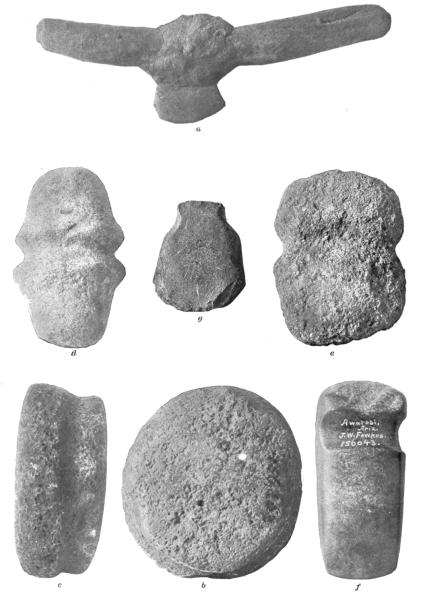
Among the stone implements used as mortuary offerings which were found in the cemeteries, was one made of the same fine lithographic limestone as the so-called tcamahia (plate clxxi, g) which occur on the Antelope altar in the Snake ceremonies. The exceptional character of this fragment is instructive, and its resemblance to the finely polished stone hoes found in other ruins is very suggestive.
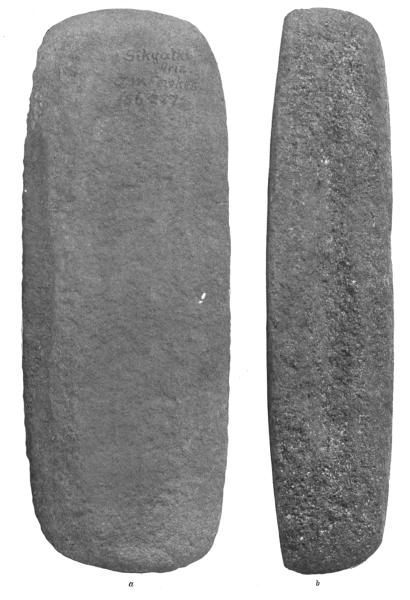
BUREAU OF AMERICAN ETHNOLOGY—— SEVENTEENTH ANNUAL REPORT PL. CLXX CORN GRINDER FROM SIKYATKI
There were found many disk-shape stones, pecked on the periphery as if used in grinding pigment or in bruising seeds, and spheroidal stones with a facet worn at one pole as if used for the same or a similar purpose (plate clxxi, b, c). A few stone axes and hatchets were also taken from the graves; most of these are rude specimens of stone working, although one of them can hardly be excelled in any other collection. Many arrowpoints were found, but these are in no respect peculiar. They are made of many different kinds of stone, but those of obsidian are the most numerous. They were generally found in numbers, sometimes in bowls. Evidently they had not been attached to shafts when buried, for no sign of the reeds remained. Arrowheads sewed into a bandoleer are still worn as insignia of rank by warriors, and it is probable that such was also true in the past, so that on interment these arrowpoints might have been placed in the mortuary basin deposited by the side of the warrior, as indicative of his standing or rank, and the bandoleer or leather strap to which they were attached decayed during its long burial in the earth. Spearpoints of much coarser make and larger in size than the arrowheads were also found in the graves, and a rare knife, made of chalcedony, showed that the ancient, like the modern Hopi, prized a sharp cutting instrument.
Among the many large stones picked up on the mounds of Sikyatki there was one the use of which has long puzzled me. This is a rough stone, not worked save in an equatorial groove. The object is too heavy to have been carried about, except with the utmost difficulty, and the probability of the former existence of a handle is out of the question. It has been suggested that this and similar but larger grooved stones might have been used as tethers for some domesticated animal, as the eagle or the turkey, which is about the only explanation I can suggest. Both of these creatures, and (if we may trust early accounts) a quadruped about the size of a dog, were domesticated by the ancient Pueblo people, but I have found no survival of tethering in use today. Eagles, however, are tied by the legs and not confined in corrals as at Zuñi, while sheep are kept in stone inclosures. It is probable that this latter custom came with the introduction of sheep, and that these stones were weights to which the Sikyatki people tied by the legs the eagles and turkeys, the feathers of which play an important part in their sacred observances.
Certain small rectangular slabs of stone have been found, with a groove extending across one surface diagonally from one angle to another (plate clxix, a, b.) These are generally called arrowshaft polishers, and were used to rub down the surface of arrowshafts or prayer-sticks. Several of these polishers were taken from Sikyatki graves, and one or two were of such regular form that considerable care must have been used in their manufacture. A specimen from Awatobi is decorated with a bow and an arrow scratched on one side, and one of dark basaltic rock evidently came from a distance. A number of metates and mullers were found in the graves at Sikyatki. One of the best of the latter is shown in plate clxx. These stones are of different degrees of fineness, and vary from simple triangular slabs of fine sandstone to very coarse lava. The specimen figured has depressions on the sides to facilitate handling.[157]
Perhaps the most significant of all the worked stones found in the Sikyatki cemeteries were the flat slabs the edges of which near the surface of the soil marked the presence of the graves. These slabs may be termed headstones, but they have a far different meaning from those that bear the name of the deceased with which we are most familiar, for when they have any marking on their faces, it is not a totem of the dead, but a symbol of the rain-cloud, which is connected with ancestor worship.
One of the best of these mortuary slabs has its edge cut in such a way as to give it a terraced outline, and on one face a similar terrace is drawn in black pigment. These figures are symbols of rain-clouds, and the interpretation of the use of this design in graves is as follows:
The dead, according to current Tusayan thought, become rain-cloud gods, or powerful intercessors with those deities which cause or send the rains. Hence, the religious society to which the deceased belonged, and the members of the clan who survive, place in the mortuary bowls, or in the left hand of their friend, the paho or prayer emblem for rain; hence, also, in prayers at interment they address the breath body of the dead as a katcina, or rain god. These katcinas, as divinized ancestors, are supposed to return to the villages and receive prayers for rain. In strict accord with this conception the rain-cloud symbol is placed, in some instances, on the slab of rock in the graves of the dead at Sikyatki. It proves to me that the cult of ancestor worship, and the conception that the dead have power to bring needed rain, were recognized in Sikyatki when the pueblo was in its prime. One of these slabs is perforated by a small hole, an important fact, but one for which I have only a fanciful explanation, namely, to allow the escape of the breath body. Elsewhere I have found many instances of perforated mortuary stone slabs, which will be considered in a report of my excavations in 1896.
OBSIDIAN
Many fragments of obsidian, varying in size, are found strewn over the surface of the majority of ancient ruins in Tusayan, and the quantity of this material on some mounds indicates its abundance in those early habitations. This material must have been highly prized for knives, arrowpoints, and weapons of various kinds, as several of the graves contained large fragments of it, some more or less chipped, others in natural forms. The fact of its being deemed worthy of deposit in the graves of the Sikyatkians would indicate that it was greatly esteemed. I know of no natural deposit of obsidian near Sikyatki or in the province of Tusayan, so that the probability is that these fragments had been brought a considerable distance before they were buried in the earth that now covers the dead of the ancient pueblos.
BUREAU OF AMERICAN ETHNOLOGY—— SEVENTEENTH ANNUAL REPORT PL. CLXXI STONE IMPLEMENTS FROM PALATKI, AWATOBI, AND SIKYATKI
NECKLACES, GORGETS, AND OTHER ORNAMENTS
The Sikyatki people buried their dead adorned with necklaces and other ornaments as when living. The materials most highly prized for necklaces were turquois and shell which were fashioned into beads, some of which were finely made. These necklaces did not differ from those now worn, and the shells employed were mostly marine varieties of the genus Pectunculus. The turquois beads are often as finely cut as any now worn, and their presence in the graves led to the only serious trouble which I had with my native workmen, as they undoubtedly appropriated many which were found. Some of these turquois beads are simply flat fragments, perforated at one end, others are well formed. Many skeletons had a single turquois near the mastoid process of the skull, showing that they had been worn as ear pendants. On the neck of one skeleton we found a necklace of many strands, composed of segments of the leg bones of the turkey, stained green. There were other specimens of necklaces made of turkey bones, which were smoothly finished and apparently had not been stained.
Necklaces of perforated cedar berries were likewise found, some of them still hanging about the necks of the dead, and in one instance, a small saucer like vessel (plate cxx, d) was filled with beads of this kind, as if the necklace had thus been deposited in the grave as a votive offering.
For gorgets the Sikyatki people apparently prized slabs of lignite (plate clxxii, d) and plates of selenite. It was likewise customary to make small clay imitations of birds and shells for this and for other ornamental purposes; these, for the most part, however, were not found in the graves, but were picked up on the surface or in the débris within the rooms.
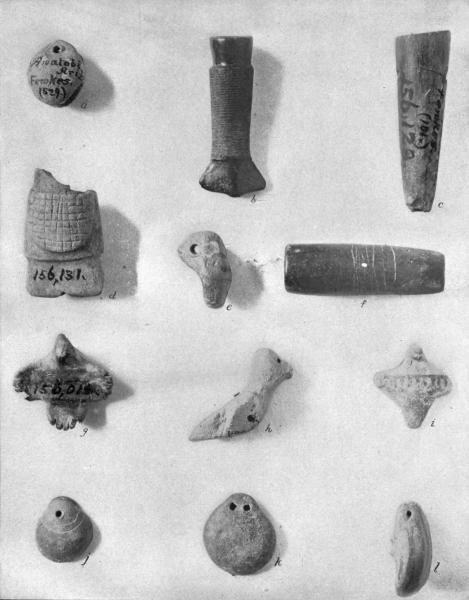
The three forms imitating birds shown in plate clxxiii, g, h, i, are rude in character, and one of them is crossed by a black line from which depend parallel lines, representing falling rain; all of these specimens have a perforated knot on the under side for suspension, as shown in the figure between them.
The forms of imitations of shells, in clay, of which examples are shown in plate clxxiii, j, k, l, are rude in character; they are often painted with longitudinal or vertical black lines, and have a single or double perforation for suspension. The shell imitated is probably the young Pectunculus, a Pacific-coast mollusk, with which the ancient Hopi were familiar.
TOBACCO PIPES
I have elsewhere mentioned that every modern Tusayan ceremony opens and closes with a ceremonial smoke, and it is apparent that pipes were highly prized by the ancient Sikyatkians.
The form of pipe used in most ceremonials today has a bowl with its axis at right angles to the stem, but so far as I have studied ancient Pueblo pipes this form appears to be a modern innovation.[158] To determine the probable ancient form of pipe, as indicated by the ritual, I will invite attention to one of the most archaic portions of the ceremonies about the altar of the Antelope priesthood, at the time of the Snake dance at Walpi:[159]
"The songs then ceased, and Wí-ki sent Ká-tci to bring him a light. Ká-tci went out, and soon returned with a burning corncob, while all sat silently awaiting Wí-ki's preparation for the great Ó-mow-ûh smoke, which was one of the most sacred acts performed by the Antelope priests in these ceremonials.
"The wu-kó-tco-ño is a huge, stemless pipe, which has a large opening in the blunt end, and a smaller one in the pointed. It is five inches long, one inch in diameter at the large aperture, and its greatest circumference is seven and a half inches. The pipe is made of some black material, possibly stone, and as far as could be seen was not ornamented. The bowl had previously been filled with leaves carefully gathered from such places as are designated by tradition. In the subsequent smokes the ashes, "dottle," were saved, being placed in a small depression in the floor, but were not again put in the pipe.
"Wí-ki took the live ember from Ká-tci and placed it in the large opening of the pipe, on the leaves which filled its cavity. He then knelt down and placed the pipe between the two tí-po-nis, so that the pointed end rested on the head of the large fetish, between the ears. Every one remained silent, and Wí-ki blew several dense clouds of smoke upon the sand altar, one after another, so that the picture was concealed. The smoke was made by blowing through the pipe, the fire being placed in the bowl next the mouth, and the whole larger end of the pipe was taken into the mouth at each exhalation.
"At the San Juan pueblo, near Santa Fé, where I stopped on my way to Tusayan, I purchased a ceremonial headdress upon which several spruce twigs were tied. Wí-ki received some fragments of these with gratitude, and they formed one of the ingredients which were smoked in the great ó-mow-ûh pipe. The scent of the mixture was very fragrant, and filled the room, like incense. The production of this great smoke-cloud, which is supposed to rise to the sky, and later bring the rain, ended the first series of eight songs.
BUREAU OF AMERICAN ETHNOLOGY—— SEVENTEENTH ANNUAL REPORT PL. CLXXII PAINT GRINDER, FETISH, KAOLIN DISKS, AND LIGNITE FROM SIKYATKI
"Immediately after this event, Há-ha-we filled one of the small-stemmed pipes lying near the fireplace with native tobacco, and after lighting it puffed smoke on the altar. He passed the pipe to Wí-ki, holding it near the floor, bowl foremost, as he did so, and exchanging the customary terms of relationship. Wí-ki then blew dense clouds of smoke over the two tí-po-nis and on the sand picture. Há-ha-we, meanwhile, lit a second pipe, and passed it to Kó-pe-li, the Snake chief, who enjoyed it in silence, indiscriminately puffing smoke on the altar, to the cardinal points, and in other directions. Kó-pe-li later gave his pipe to Ká-kap-ti, who sat at his right, and Wí-ki passed his to Na-syuñ-'we-ve, who, after smoking, handed the pipe to Kwá-a, who in turn passed it to Ká-tci, by whom it was given to Há-ha-we. Ká-tci, the last priest to receive it before it was returned to the pipe-lighter, smoked for a long time, and repeatedly puffed clouds of smoke upon the sand picture. Meanwhile Ká-kap-ti had handed his pipe to Há-ha-we, both exchanging terms of relationship and carefully observing the accompanying ceremonial etiquette. Há-ha-we, as was his unvarying custom, carefully cleaned the two pipes, and laid them on the floor by the side of the fireplace."
The form of pipe used in the above ceremony is typical of ancient Pueblo pipes, several of which were found at Sikyatki. One of these, much smaller than the ó-mow-ûh pipe, was made of lava, and bore evidence of use before burial. It is evident, however, that these straight pipes were not always smoked as above described. The most interesting pipes found at Sikyatki were more elongated than that above mentioned and were made of clay. Their forms are shown in plate clxxiii, b, c, d, f. One of these (b) is very smooth, almost glazed, and enlarged into two lateral wings near the mouth end, which is perforated with a small hole. The cavity at the opposite end is large enough to hold sufficient for a good smoke, and shows evidence of former use. The whole median region of the exterior is formed by a collar incised with lines, as if formerly wrapped with fiber. In some of the modern ceremonials, as that of the Bear-Puma dramatization in the Snake dance, a reed cigarette is used, ancient forms of which have been found in sacrificial caves, and there seems no doubt that this pipe is simply a clay form of those reeds. The markings on the collar would by this interpretation indicate the former existence of a small fabric wrapped about it. The two pipes shown, in plate clxxiii, b, f, are tubular in shape,[160] highly polished, and on one of them (f) we see scratches representing the same feature as the collar of b, and probably made with the same intent.
The fragment of a pipe shown in plate clxxiii, d, is interesting in the same connection. The end of this pipe is broken, but the stem is intact, and on two sides of the bowl there are elevations covered with crosshatching. The pipe is of clay and has a rough external surface.
It is improbable that these pipes were always smoked as the wu-kó-tco-ño of the Snake ceremony, but the smaller end was placed to the mouth, and smoke taken into the mouth and exhaled. It is customary in ceremonials now practiced, to wind a wisp of yucca about the stem of a short pipe, that it may not become too hot to hold in the hand. This may be a possible explanation[161] of the scratches on the sides of the ancient tube pipes from Sikyatki.
PRAYER-STICKS
One of the most important objects made in the secret ceremonials of the modern Pueblos is sacrificial in nature, and is called a paho or "water wood," which is used as an offering to the gods (figure 357). These pahos are made of a prescribed wood, of length determined by tradition, and to them are tied appendages of symbolic meaning. They are consecrated by songs, about an altar, upon which they are laid, and afterward deposited in certain shrines by a special courier.
Fig. 357—Mortuary prayer-stick (natural size)
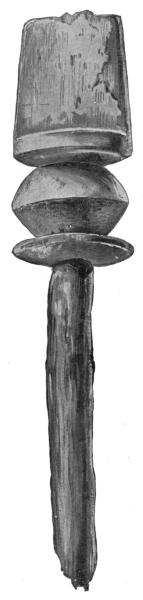
In modern times the forms of these pahos differ very greatly, the shape depending on the society which makes them, the god addressed, and the purpose for which they are used, as understood by the initiated. Among many other uses they are sometimes mortuary in character, and are deposited in the graves of chiefs, as offerings either to the God of Death, or to other deities, to whom they may be presented by the shade or breath body of the deceased. This use of pahos is of ancient origin in Tusayan, as shown by the excavations at Sikyatki, where they were found in mortuary bowls or vases deposited by the relatives or surviving members of the sacerdotal societies to which the deceased had belonged.
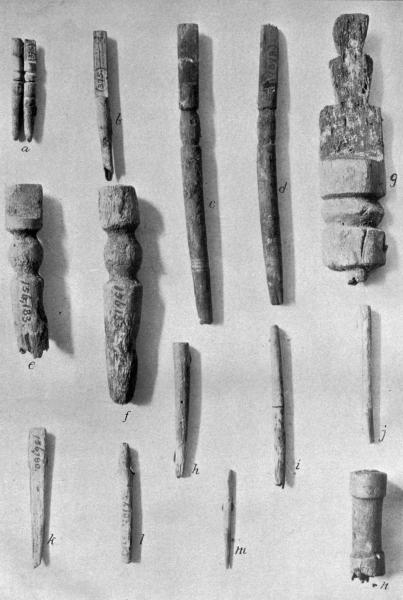
This pre-Spanish custom in Tusayan was discovered in my excavations at Awatobi, but the prayer-sticks from that place were fragmentary as compared with the almost perfect pahos from Sikyatki. These pahos are of many forms;[162] some of them are of considerable size, and the majority are of distinctive forms (plates clxxiv-clxxv). There are also many fragments, the former shapes of which could not be determined. When it is considered that these wooden objects with their neat carvings were fashioned with stone implements, the high character of the work is very remarkable. They show, in several instances, the imprint of attached strings and feathers, portions of which still remain; also, in one instance, fragments of a pine needle. They are painted with green and black mineral pigments, the former of which had undoubtedly done much to preserve the soft wood of which they were manufactured. As at the present day, cottonwood and willow were the favorite prescribed woods for pahos, and some of the best were made of pine. The forms of these ancient prayer offerings, as mentioned hereafter, differ somewhat from those of modern make, although in certain instances there is a significant resemblance between the two kinds.
BUREAU OF AMERICAN ETHNOLOGY—— SEVENTEENTH ANNUAL REPORT PL. CLXXIII PIPES, BELL, AND CLAY BIRDS AND SHELLS FROM AWATOBI AND SIKYATKI
One of the most striking instances of resemblance between the old and the new is the likeness of some of these ancient pahos to those now made by the Flute society, and if this resemblance is more than a coincidence, the conclusion that the present flute paho is a survival of the ancient form may be accepted. As adding weight to this theory it may be mentioned that traditionally the Flute people claim to be the ancient people of Tusayan, and possibly contemporaries, in that province, with the ancient inhabitants of Sikyatki. There is likewise a most suggestive resemblance between these pahos and certain similar sticks from cliff dwellings, and it is a belief, which I can not yet demonstrate as true, that kindred people, or the same sacerdotal societies represented in cliff houses and in Sikyatki, manufactured ceremonial prayer offerings which are identical in design. Plate clxxiv, a, represents a double stick paho, which closely resembles the prayer offering of the modern Flute society. The two rods were found together and originally had been attached, as indicated by the arrangement of the impression of the string midway of their length. The stick of the left has a facet cut on one side, upon which originally three dots were depicted to represent the eyes and the mouth. This member of the paho was the female; the remaining stick was the male. There are two deep grooves, or ferules, cut midway of their length, a distinctive characteristic of the modern flute paho. Both components are painted green, as is still customary in prayer-sticks of this fraternity. The pahos shown in b, c, and d, are likewise ascribed to the same society, and differ from the first only in length. They represent female sticks of double flute pahos. The length of these prayer-sticks varies on different ceremonial days, and is determined by the distance of the shrines for which they are intended. The unit of measurement is the length of certain joints of the finger, and the space between the tip of longest digit to certain creases in the palm of the hand. The length of the ancient Sikyatki pahos, ascribed to the Flute society, follows the same rule.
Plate clxxiv, e, f, have the same ferules referred to in the description above, but are of greater diameter. They are unlike any modern paho except in this particular. In g is depicted a still larger prayer-stick, with two serrate incisions on each side of the continuation of the flattened facet.
Specimens h to m are forms of pahos which I can not identify. They are painted green, generally with black tips, round, flattened, and of small size. Figure n is a part of a paho which closely resembles prayer-sticks found in the cliff houses of Mesa Verde and San Juan valley of northern New Mexico.
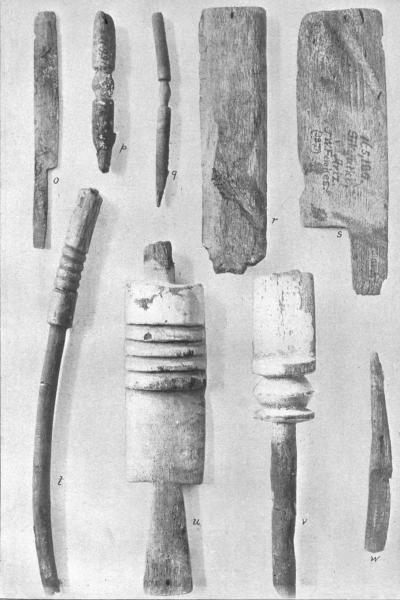
Numerous specimens of a peculiar razor-shape paho were found, two of which are shown in plate clxxv, o, s. The paho shown in figure d is flat on one side and rounded on the other, narrowing at one end, where it was probably continued in a shaft, and a hole is punctured at the opposite extremity, as if for suspension. It is barely possible that this may have been a whizzer or bull-roarer, such as are used at the present day to imitate the wind, and commonly carried by the performer in a public dance who personifies the warrior. Figure t differs from the ordinary flute paho in having five constrictions in the upper part, and in being continued into a very long shank.
The best preserved of all the pahos from the Sikyatki graves are represented in u and v, both of which were found in the same mortuary bowl. They are painted with a thick layer of green pigment, and have shafts, which are blackened and placed in opposite directions in the two figures. Their general form may be seen at a glance. The lower surface of the object shown in u is perfectly flat, and the part represented at the upper end is evidently broken off. This is likewise true of both extremities of the object shown in v; it is also probable that it had originally a serrated end, comparable with that shown in c. A similar terraced extremity survives in the corn paho carried by the so-called Flute girls in the biennial celebrations of the Flute ceremonies in the modern Tusayan pueblos.
I refer the paho to the second group of sacrifices mentioned by Tylor,[163] that of homage, "a doctrine that the gist of sacrifice is rather in the worshiper giving something precious to himself than in the deity receiving benefit. This may be called the abnegation theory, and its origin may be fairly explained by considering it as derived from the original gift theory."
While it is probably true that the Hopi barters his paho with the idea of receiving in return some desired gift, the main element is probably homage, but there is involved in it the third and highest element of sacrifice, abnegation. It is a sacrifice by symbolism, a part for the whole.
On this theory the query naturally is, what does a paho represent? While it is difficult to answer this question, I think a plausible suggestion can be made. It is a sacrifice by symbolic methods of that which the Hopi most prize, corn or its meal.
BUREAU OF AMERICAN ETHNOLOGY—— SEVENTEENTH ANNUAL REPORT PL. CLXXIV PAHOS OR PRAYER-STICKS FROM SIKYATKI
BUREAU OF AMERICAN ETHNOLOGY—— SEVENTEENTH ANNUAL REPORT PL. CLXXV PAHOS OR PRAYER-STICKS FROM SIKYATKI
In a simple prayer the sacrifice is a pinch of meal thrown on the fetish or toward it. This is an individual method of prayer, and the pinch of meal, his prayer bearer, the sacrifice.
When a society made its prayers this meal, symbolic of a gift of corn, is tied in a packet and attached to two sticks, one male, the other female, with prescribed herbs and feathers. Here we have the ordinary prayer-stick, varying in details but essentially the same, a sacrifice to the gods appropriately designated by prescribed accessories.
Frequently this packet of meal may be replaced by a picture of an ear of corn drawn on a flat slat, the so-called "corn paho" of the Flute maidens,[164] or we may have an ear of corn tied to the wooden slat. In the Mamzrau ceremony the women carry these painted slats in their hands, as I have elsewhere described.[165] It appears as if, in all these instances, there exists a sacrificial object, a symbolic offering of corn or meal.
The constant appearance of the feather on the paho has suggested an interpretation of the prayer-plumes as symbolic sacrifices of birds on the theory of a part for the whole; we know that among the Nahua sacrifices of birds were common in many ceremonials. The idea of animal sacrifice, and, if we judge from legends, of human sacrifice, was not an unknown conception among the Pueblos. While it is possible that the omnipresence of the feather on the prayer-sticks may admit of that interpretation, to which it must be confessed the male and the female components in double pahos lend some evidence,[166] I believe the main object was, as above stated, an offering of meal, which constituted the special wealth of an agricultural people.
MARINE SHELLS AND OTHER OBJECTS
The excavations at Sikyatki did not reveal a large number of marine shells, although some of the more common genera used in the ancient pueblos were found.
There were several fragments of Pectunculus cut into the form of wristlets, like those from the ruins on the Little Colorado which I have described. Two beautiful specimens of Oliva angulata, truncated at each pole, which occurred in one of the mortuary bowls, and a few conical rattles, made of the spires of Conus, were taken from the graves; there were also a few fragments of an unknown Haliotis. All of the above genera are common to the Pacific, and no doubt were obtained by barter or brought by migratory clans to Tusayan from the far south. One of the most interesting objects in Sikyatki food basins from the necropolis was a comparatively well preserved rattle of a rattlesnake. The Walpi Snake chief, who was employed by me when this was found and was present at the time it was removed from the earth, declared that, according to the legends, there were no Snake people living at Sikyatki when it was destroyed, but the discovery of the snake rattle shows that the rattler was not without reverence there, even if not in the house of his friends, and some other explanation may be suggested to account for this discovery. There are evidences that the ancient Hopi, like certain Yuman tribes, wore a snake's rattle as an ornament for the neck, in which case the rattle found in the Sikyatki food basin may have been simply a votive offering, and in no way connected with ceremonial symbolism.
Among many other mortuary offerings was one which was particularly suggestive. This specimen represented in plate clxix, e, is made of unbaked clay, and has a reticulated surface, as if once incrusted with foreign objects. The Hopi who were at work for me declared that this incrustation had been composed of seeds, and that the pits over the surface of the clay cone were evidence of their former existence. They identified this object as a "corn mound," and reminded me that a similar object is now used in the Powamu, Lalakonti, and certain other ceremonies. I have elsewhere mentioned the clay corn mound incrusted with seeds of various kinds in a description of the altar of the last-mentioned ceremony. These corn mountains (ká-ü-tü'-kwi) are made in the November ceremony called the Nā-ác-nai-ya, as described in my account of those rites from which I quote[167]—
"The Tá-tau-kya-mû were very busy in their kib-va. Every member was shelling corn of the different colors as if on a wager. Each man made a figure of moist clay, about four or five inches across the base. Some of these were in the form of two mammæ, and there were also many wedge and cone forms, in all of which were embedded corn kernels, forming the cloud and other of the simpler conventional figures in different colors, but the whole surface was studded as full as possible with the kernels. Each man brought down his own pó-o-tas (tray), on which he sprinkled prayer-meal, and set his ká-ü-tü'-kwi (corn mountain) upon it. He also placed ears of corn on the tray."
These corn mountains were carried by the Tá-tau-kya-mû priesthood during an interesting ceremony which I have thus described:[168]
"The whole line then passed slowly along the front of the village sideways, facing the north, and singing, and all the women came out and helped themselves to the clay molds and the ears of corn borne by the Tá-tau-kya-mû, bestowing many thanks upon the priests."
The fragment of polished stone shown in plate clxix, d, is perforated near the edge for suspension, and was found near the aural orifice of a skull, apparently indicating that it had been used as a pendant. With this object, many rude arrowpoints, concretions of stone, and the kaolin disk mentioned above were also found. Small round disks of pottery, with a median perforation, were not common, although sometimes present. They are identified as parts of primitive drills.
No object made of metal was found at Sikyatki, nor is there any evidence that the ancient people of that pueblo ever saw the Spaniards or used any implement of their manufacture. While negative evidence can hardly be regarded as a safe guide to follow, so far as knowledge of copper is concerned, it is possible that the people of ancient Tusayan pueblos, in their trading expeditions to southern Arizona, may have met races who owned small copper bells and trinkets of metal. I can hardly believe, however, that the Tusayan Indians were familiar with the art of tempering copper, and even if objects showing this treatment shall be found hereafter in the ruins of this province it will have to be proved that they were made in that region, and not brought from the far south.
No glazed pottery showing Spanish influence was found at Sikyatki, but there can hardly be a doubt that the art of glazing pottery was practiced by the ancestors of the Tusayan people. The modern potters of the East Mesa never glaze their pottery, and no fragment of glazed ware was obtained from the necropolis of Sikyatki.
PERISHABLE CONTENTS OF MORTUARY FOOD BOWLS
It is the habit of the modern Tusayan Indians to deposit food of various kinds on the graves of their dead. The basins used for that purpose are heaped up with paper-bread, stews, and various delicacies for the breath-body of the deceased. Naturally from its exposed position much of this food is devoured by animals or disappears in other ways. There appears excellent evidence, however, that the mortuary food offerings of the ancient Sikyatkians were deposited with the body and covered with soil and sometimes stones.
The lapse of time since these burials took place has of course caused the destruction of the perishable food substances, which are found to be simple where any sign of their former presence remains. Thin films of interlacing rootlets often formed a delicate network over the whole inner surface of the bowl. Certain of the contents of these basins in the shape of seeds still remain; but these seeds have not germinated, possibly on account of previous high temperatures to which they have been submitted. A considerable quantity of these contents of mortuary bowls were collected and submitted to an expert, the result of whose examination is set forth in the accompanying letter:
U. S. Department of Agriculture, Division of Botony, Washington, D. C., March 25, 1896.
Dear Dr Fewkes: Having made a cursory examination of the samples of supposed vegetable material sent by you day before yesterday, collected at Sikyatki, Arizona, in supposed prehistoric burial places, I have the following preliminary report to make:
No. 156247. A green resinous substance. I am unable to say whether or not this is of vegetable origin.
No. 156248. A mass of fibrous material intermixed with sand, the fibers consisting in part of slender roots, in part of the hair of some animal.
No. 156249. This consists of a mixture of seed with a small amount of sand present. The seeds are, in about the relative order of their abundance, (a) a leguminous shiny seed of a dirty olive color, possibly of the genus Parosela (usually known as Dalea); (b) the black seed shells, flat on one side and almost invariably broken, of a plant apparently belonging to the family Malvaceae; (c) large, flat, nearly black achenia, possibly of a Coreopsis, bordered with a narrow-toothed wing; (d) the thin lenticular utricles of a Carex; (e) the minute black, bluntly trihedral seeds of some plant of the family Polygonaceae, probably an Eriogonum. The majority of these seeds have a coating of fine sand, as if their surface had originally been viscous; (f) a dried chrysalis bearing a slight resemblance to a seed.
No. 156250. This bottle contains the same material as No. 156249, except that no larvæ are found, but a large, plump, brownish, lenticular seed 4 mm. in diameter, doubtless the seed of a Croton.
No. 156251. A thin fragment of matter consisting of minute roots of plants partially intermixed on one surface with sand.
No. 156252. This consists almost wholly of plant rootlets and contains a very slight amount of sand.
No. 156254. This consists of pieces of rotten wood through which had grown the rootlets of plants. The wood, upon a microscopical examination, is shown to be that of some dicotyledonous tree of a very loose and light texture. The plant rootlets in most cases followed the large ducts that run lengthwise through the pieces of wood and take up the greater part of the space.
No. 156255. The mass contained in this bottle is made up of (a) grains, contained in their glumes or husks, of some grass, probably Oryzopsis membranacea; (b) what appears to be the minute spherical spore cases of some microscopical fungus. The spore cases have a wall with a shiny brown covering, or apparently with this covering worn off and exhibiting an interior white shell. Within this is a very large number of spherical spore-like bodies of a uniform size; (c) a few plant rootlets.
No. 156256. The material in this bottle is similar to that in 156255 except that the amount of rootlets is greater, the grass seeds are of a darker color, seemingly somewhat more disorganized, and somewhat more slender in form, and that the spore cases seem to be entirely wanting.
No. 156257. The material in this bottle is similar to that in No. 156249, containing the seeds numbered a, b, c, and d mentioned under that number, besides a greater amount of plant rootlets and some fragments of corncob.
No. 156258. This consists almost entirely of plant rootlets and sand.
No. 156259. This consists chiefly of the leaves of some coniferous tree, either an Abies or a Pseudotsuga.
All the seeds with the exception of those of the leguminous plant are dead and their seed-coats rotten. The leguminous seeds are still hard and will be subjected to a germination test.[169]
For a specific and positive identification of these seeds it will be necessary either for a botanist to visit the region from which they came or to have at his disposal a complete collection of the plants of the vicinity. Under such conditions he could by process of exclusion identify the seeds with an amount of labor almost infinitely less than would be required in their identification by other means.
Very sincerely yours, Frederick V. Coville, Botanist.