RUINS IN TUSAYAN (continued 4)
Reading edition
For convenience of comparison, a number of pictures which undoubtedly refer to different birds in ancient interpretations will be grouped in a single series.
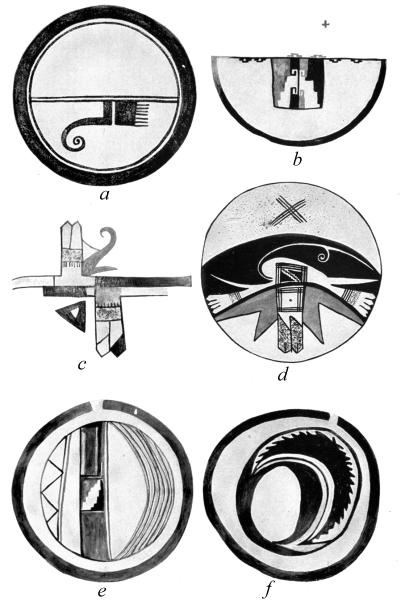
Plate cxxxviii, d, represents a figure of a bird showing great relative modification of organs when compared with those previously discussed. The head is very much broadened, but the semicircular markings, which occur also on the heads of previously described bird figures, are well drawn. The wings are mere curved appendages, destitute of feather symbols, but are provided with lateral spurs and have knobs at their bases. The body is rectangular; the tail-feathers are numerous, with well-marked symbolism. Perhaps the most striking appendages to the body are the two well-defined extensions of parts of the body itself, which, although represented in other pictures of birds, nowhere reach such relatively large size.
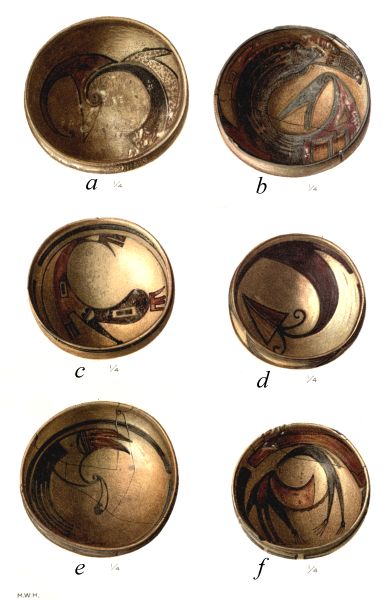
BUREAU OF AMERICAN ETHNOLOGY—— SEVENTEENTH ANNUAL REPORT PL. CXXXIX FOOD BOWLS WITH FIGURES OF BIRDS FROM SIKYATKI
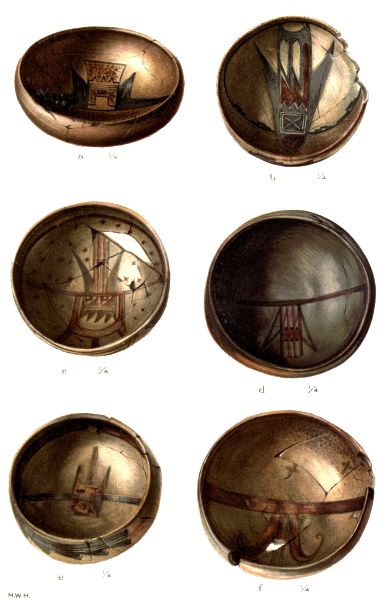
The figure of a bird shown in plate cxxxviii, c, is similar in many respects to that last described. The semicircular markings on the head of the former are here replaced by triangles, but both are symbolic of rain-clouds. The wings are curved projections, without any suggestion of feathers or basal spurs and knobs. The tail-feathers show nothing exceptional, and the body is bounded posteriorly by triangular extensions, as in figures of birds already described.
The representation of the bird in plate cxxxviii, e, has a triangular body continued into two points on the posterior end, between which the tail-feathers are situated. The body is covered with terraced and triangular designs, and the head is rectangular in form. On each side of the bird figure there is a symbol of a flower, possibly the sunflower or an aster.
In the figures of birds already considered the relative sizes of the heads and bodies are not overdrawn, but in the picture of a bird on the food bowl shown in plate cxxxviii, f, the head is very much enlarged. It bears a well-marked terraced rain-cloud symbol above triangles of the same meaning. The wings are represented as diminutive appendages, each consisting of two feathers. The body has a triangular extension on each side, and the tail is composed of two comparatively short rectangular feathers. The figure itself could hardly be identified as a representation of a bird were it not for the correspondence, part for part, with figures which are undoubtedly those of birds or flying animals.
A more highly conventionalized figure of a bird than any thus far described is painted on the food bowl reproduced in plate cxl, b. The head is represented by a terraced figure similar to those which appear as decorations on some of the other vessels; the wings are simply extended crescents, the tips of which are connected by a band which encircles the body and tail; the body is continued at the posterior end into two triangular appendages, between which is a tail, the feathers of which are not differentiated. On each side of the body, in the space inclosed by the band connecting the tips of the wings, a figure of a dragon-fly appears.
The figure on the food bowl illustrated in plate cxxxix, c, may also be reduced to a conventionalized bird symbol. The two pointed objects on the lower rim represent tail-feathers, and the triangular appendages, one on each side above them, the body, as in the designs which have already been described. Above the triangles is a rectangular figure with terraced rain-cloud emblems, a constant feature on the body and head of the bird, and on each side, near the rim of the bowl, occur the primary feathers of the wings. The cross, so frequently associated with designs representing birds, is replaced by the triple intersecting lines in the remaining area. The resemblance of this figure to those already considered is clearly evident after a little study.
The decoration on the food basin presented in plate cxxxix, a, is interesting in the study of the evolution of bird designs into conventional forms. In this figure those parts which are identified as homologues of the wings extend wholly across the interior of the food bowl, and have the forms of triangles with smaller triangular spurs at their bases. The wings are extended at right angles to the axis of the body, and taper uniformly to the rim of the bowl. The smaller spurs near the union of the wings and body represent the posterior part of the latter, and between them are the tail-feathers, their number being indicated by three triangles.
There is no representation of a head, although the terraced rain-cloud figure is drawn on the anterior of the body between the wings.
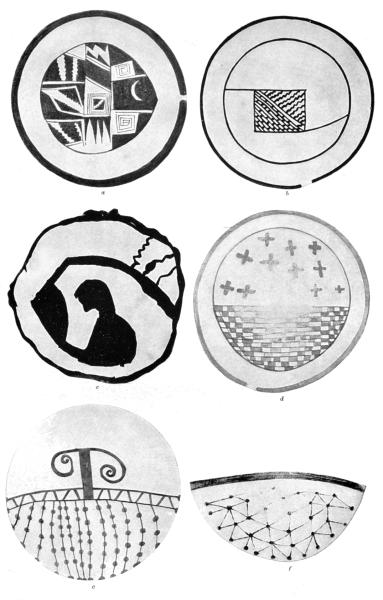
The reduction of the triangular wings of the last figure to a simple band drawn diametrically across the inner surface of the bowl is accomplished in the design shown in plate cxxxix, b. At intervals along this line there are arranged groups of blocks, three in each group, representing stars, as will later be shown. The semicircular head has lost all appendages and is reduced to a rain-cloud symbol. The posterior angles of the body are much prolonged, and the tail still bears the markings representing three tail-feathers.
The association of a cross with the bird figure is both appropriate and common; its modified form in this decoration is not exceptional, but why it is appended to the wings is not wholly clear. We shall see its reappearance on other bowls decorated with more highly conventionalized bird figures.
In the peculiar decoration used in the treatment of the food bowl shown in plate cxxxix, c, we have almost a return to geometric figures in a conventional representation of a bird. In this case the semblance to wings is wholly lost in the line drawn diametrically across the interior of the bowl. On one side of it there are many crosses representing stars, and on the other the body and tail of a bird. The posterior triangular extensions of the former are continued to a bounding line of the bowl, and no attempt is made to represent feathers in the tail. The rectangular figure, with serrated lower edge and inclosed terraced figures, finds, however, a homologue in the heads and bodies of most of the representations of birds which have been described.
This gradual reduction in semblance to a bird has gone still further in the figure represented in plate cxxxix, d, where the posterior end of the body is represented by two spurs, and the tail by three feathers, the triangular rain-clouds still persisting in the rectangular body. In fact, it can hardly be seen how a more conventionalized figure of a bird were possible did we not find in e of the same plate this reduction still greater. Here the tail is represented by three parallel lines, the posterior of the body by two dentate appendages, and the body itself by a square.
BUREAU OF AMERICAN ETHNOLOGY—— SEVENTEENTH ANNUAL REPORT PL. CXL FIGURES OF BIRDS FROM SIKYATKI
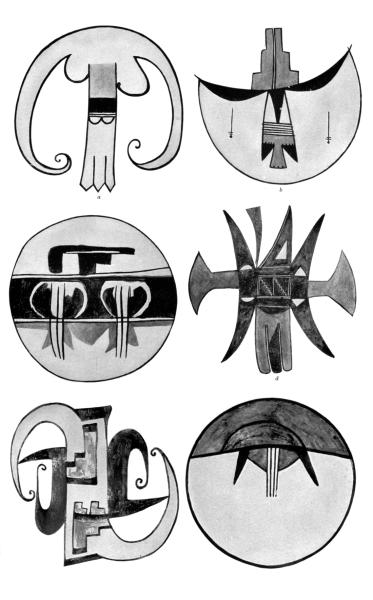
In plate cxl, c, we have a similar conventional bird symbol where two birds, instead of one, are represented. In both these instances it would appear that the diametric band, originally homologous to wings, had lost its former significance.
It must also be pointed out that there is a close likeness between some of these so-called conventionalized figures of birds and those of moths or butterflies. If, for instance, they are compared with the figures of the six designs of the upper surface of the vase shown in plate cxxxv, b, we note especially this resemblance. While, therefore, it can hardly be said there is absolute proof that these highly conventionalized figures always represent birds, we may, I think, be sure that either the bird or the moth or butterfly is generally intended.
There are several modifications of these highly conventionalized figures of birds which may be mentioned, one of the most interesting of which is figured in plate cxxxix, f. In this representation the two posterior triangular extensions of the body are modified into graceful curves, and the tail-feathers are simply parallel lines. The figure in this instance is little more than a trifid appendage to a broad band across the inner surface of the food bowl. In addition to this highly conventionalized bird figure, however, there are two crosses which represent stars. In this decoration all resemblance to a bird is lost, and it is only by following the reduction of parts that one is able to identify this geometric design with the more elaborate pictures of mythic birds. When questioned in regard to the meaning of this symbol, the best informed Hopi priests had no suggestion to offer.
In all the figures of birds thus far considered, the head, with one or two exceptions, is represented or indicated by symbolic markings. In that which decorates the vessel shown in plate cxl, a, we find a new modification; the wings, instead of being attenuated into a diametric line or band, are in this case curved to form a loose spiral. Between them is the figure of a body and the three tail-feathers, while the triangular extensions which generally indicate the posterior of the body are simply two rounded knobs at the point of union of the wings and tail. There is no indication of a head.
The modifications in the figure of the bird shown in the last mentioned pictograph, and the highly conventionalized forms which the wings and other parts assume, give me confidence to venture an interpretation of a strange figure shown in plate cxli, a. This picture I regard as a representation of a bird, and I do so for the following resemblances to figures already studied. The head of the bird, as has been shown, is often replaced by a terraced rain-cloud symbol. Such a figure occurs in the pictograph under consideration, where it occupies the position of the head. On either side of what might be regarded as a body we find, at the anterior end, two curved appendages which so closely resemble similarly placed bodies in the pictograph last discussed that they are regarded as representations of wings. These extensions at the posterior end of the body are readily comparable with prolongations in that part on which we have already commented. The tail, although different from that in figures of birds thus far discussed, has many points of resemblance to them. The two circles, one on each side of the bird figure, are important additions which are treated in following pages.[145]
From the study of the conventionalized forms of birds which I have outlined above it is possible to venture the suggestion that the star-shape figure shown in plate clxvii, b, may be referred to the same group, but in this specimen we appear to have duplication, or a representation of the bird symbol repeated in both semicircles of the interior of the bowl. Examining one of these we readily detect the two tail-feathers in the middle, with the triangular end of the body on each side. The lateral appendages duplicated on each side correspond with the band across the middle of the bowl in other specimens, and represent highly conventionalized wings. The middle of this compound figure is decorated with a cross, and in each quadrant there is a row of the same emblems, equidistant from one another.
It would be but a short step from this figure to the ancient sun symbol with which the eagle and other raptorial birds are intimately associated. The figure represented in plate cxxxiii, c, is a symbolic bird in which the different parts are directly comparable with the other bird pictographs already described. One may easily detect in it the two wings, the semicircular rain-cloud figures, and the three tail-feathers. As in the picture last considered, we see the two circles, each with a concentric smaller circle, one on each side of the mythic bird represented. Similar circular figures are likewise found in the zone surrounding the centrally placed bird picture.
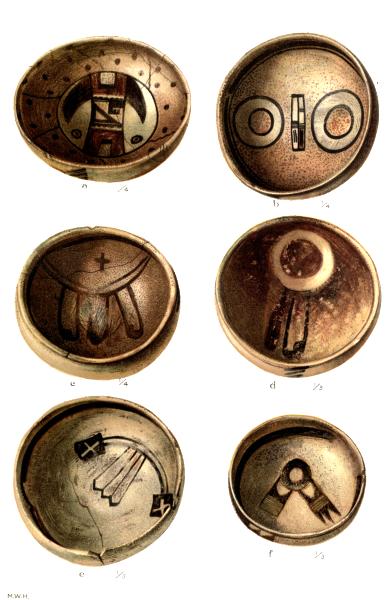
In the food bowl illustrated in plate cxli, b, we find the two circles shown, and between them a rectangular pictograph the meaning of which is not clear. The only suggestion which I have in regard to the significance of this object is that it is an example of substitution—the substitution of a prayer offering to the mythic bird represented in the other bowls for a figure of the bird itself. This interpretation, however, is highly speculative, and should be accepted only with limitations. I have sometimes thought that the prayer-stick or paho may originally have represented a bird, and the use of it is an instance of the substitution[146] of a symbolic effigy of a bird, a direct survival of the time when a bird was sacrificed to the deity addressed.
BUREAU OF AMERICAN ETHNOLOGY—— SEVENTEENTH ANNUAL REPORT PL. CXLI FOOD BOWLS WITH FIGURES OF BIRDS AND FEATHERS FROM SIKYATKI
BUREAU OF AMERICAN ETHNOLOGY—— SEVENTEENTH ANNUAL REPORT PL. CXLII VASES, BOWL, AND LADLE, WITH FIGURES OF FEATHERS, FROM SIKYATKI
The studies of the conventional bird figures which are developed in the preceding pages make it possible to interpret one of the two pictures on the food bowl represented in plate clii, while the realistic character of the smaller figure leaves no question that we can rightly identify this also as a bird. In the larger figure the wings are of unequal size and are tipped with appendages of a more or less decorative nature. The posterior part of the body is formed of two triangular extensions, to which feathers are suspended, and the tail is composed of three large pointed feathers. The head bears the terraced rain-cloud designs almost universal in pictographs of birds.
It is hardly necessary for me to indicate the head, body, wings, and legs of the smaller figure, for they are evidently avian, while the character of the beak would indicate that a parrot or raptorial genus was intended. The same beak is found in the decoration of a vase with a bird design, which will later be considered.
From an examination of the various figures of birds on the Sikyatki pottery, and an analysis of the appendages to the wings, body, and legs, it is possible to determine the symbolic markings characteristic of two different kinds of feathers, the large wing or tail feathers and the so-called breath or body feathers. There is therefore no hesitation, when we find an object of pottery ornamented with these symbols, in interpreting them as feathers. Such a bowl is that shown in plate cxli, c, in which we find a curved line to which are appended three breast feathers. This curved band from which they hang may take the form of a circle with two pendent feathers as in plate cxli, d.
In the design on the bowl figured in plate cxli, e, tail-feathers hang from a curved band, at each extremity of which is a square design in which the cross is represented. It has been suggested that this represents the feathered rainbow, a peculiar conception of both the Pueblo and the Navaho Indians. The design appearing on the small food bowl represented in plate cxli, f, is no doubt connected in some way with that last mentioned, although the likeness between the appendages to the ring and feathers is remote. It is one of those conventionalized pictures, the interpretation of which, with the scanty data at hand, must be largely theoretical.
Figures of feathers are most important features in the decoration of ancient Sikyatki pottery, and their many modifications may readily be seen by an examination of the plates. In modern Tusayan ceremonials the feather is appended to almost all the different objects used in worship; it is essential in the structure of the tiponi or badge of the chief, without which no elaborate ceremony can be performed or altar erected; it adorns the images on the altars, decorates the heads of participants, is prescribed for the prayer-sticks, and is always appended to aspergills, rattles, and whistles.
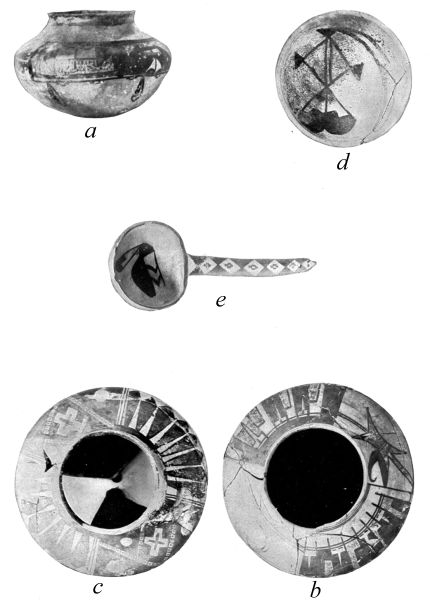
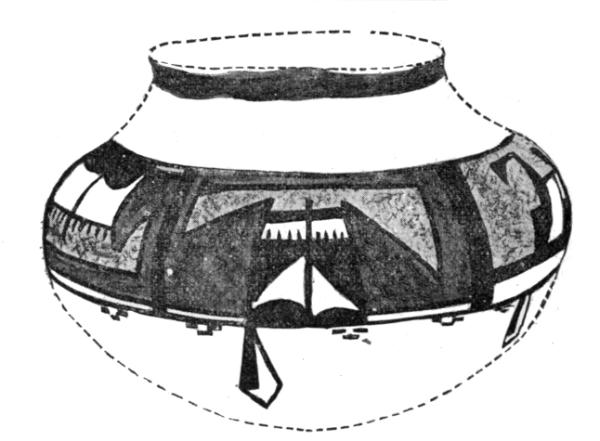
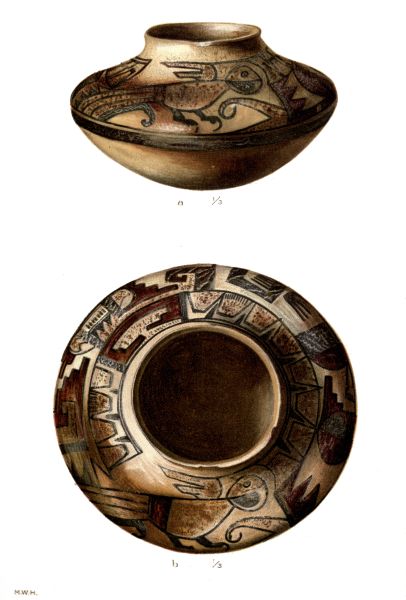
In the performance of certain ceremonials water from sacred springs is used, and this water, sometimes brought from great distances, is kept in small gourd or clay vases, around the necks of which a string with attached feathers is tied. Such a vase is the so-called patne which has been described in a memoir on the Snake ceremonies at Walpi.[147] The artistic tendency of the ancient people of Sikyatki apparently exhibited itself in painting these feathers on the outside of similar small vases. Plate cxlii, a, shows one of these vessels, decorated with an elaborate design with four breath-feathers suspended from the equator. (See also figure 273.) On the vases shown in plate cxlii, b, c, are found figures of tail-feathers arranged in two groups on opposite sides of the rim or orifice. One of these groups has eight, the other seven, figures of these feathers, and on the two remaining quadrants are the star emblems so constantly seen in pottery decorated with bird figures. The upper surface of the vase (figure 274) shows a similar arrangement, although the feathers here are conventionalized into triangular dentations, seven on one side and three on the other, individual dentations alternating with rectangular designs which suggest rain-clouds. This vase (plate cxliii, a, b) is also striking in having a well-drawn figure of a bird in profile, the head, wings, tail, and legs suggesting a parrot. The zone of decoration of this vessel, which surrounds the rows of feathers, is strikingly complicated, and comprises rain-cloud, feather, and other designs.
Fig. 273—Pendent feather ornaments on a vase.
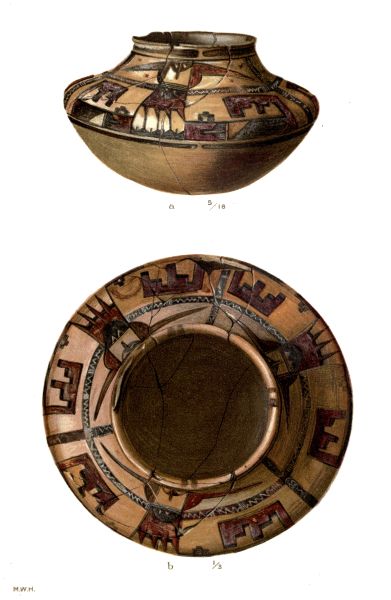
In a discussion of the significance of the design on the food bowl represented in plate cxxxix, a, b, I have shown ample reason for regarding it a figure of a highly conventionalized bird. On the upper surface of the vase (plate cxliv, a, b) are four similar designs, representing birds of the four cardinal points, one on each quadrant. The wings are represented by triangular extensions, destitute of appendages but with a rounded body at their point of juncture with the trunk. Each bird has four tail-feathers and rain-cloud symbols on the anterior end of the body. As is the case with the figures on the food basins, there are crosses representing stars near the extended wings. A broad band connects all these birds, and terraced rain-cloud symbols, six in number and arranged in pairs, fill the peripheral sections between them. This vase, although broken, is one of the most beautiful and instructive in the rich collection of Sikyatki ceramics.
BUREAU OF AMERICAN ETHNOLOGY—— SEVENTEENTH ANNUAL REPORT PL. CXLIII VASE WITH FIGURES OF BIRDS FROM SIKYATKI
BUREAU OF AMERICAN ETHNOLOGY—— SEVENTEENTH ANNUAL REPORT PL. CXLIV VASE WITH FIGURES OF BIRDS FROM SIKYATKI
BUREAU OF AMERICAN ETHNOLOGY—— SEVENTEENTH ANNUAL REPORT PL. CXLV VASES WITH FIGURES OF BIRDS FROM SIKYATKI
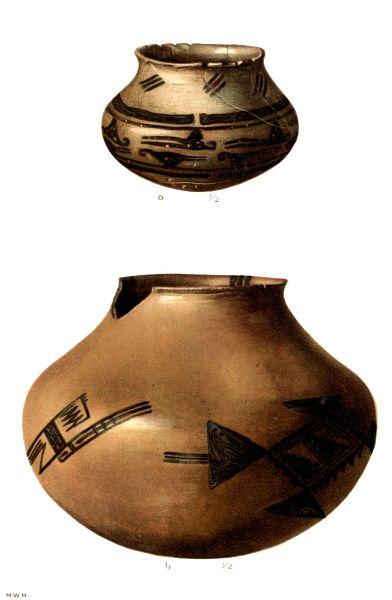
Fig. 274—Upper surface of vase with bird decoration
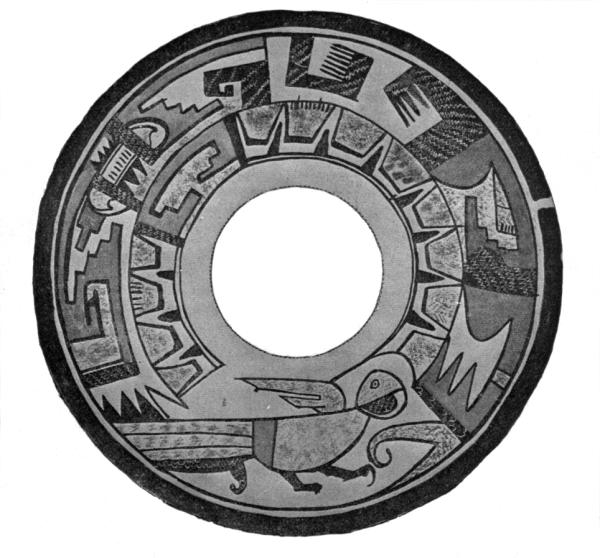
I have not ventured, in the consideration of the manifold pictures of birds on ancient pottery, to offer an interpretation of their probable generic identification. There is no doubt, however, that they represent mythic conceptions, and are emblematic of birds which figured conspicuously in the ancient Hopi Olympus. The modern legends of Tusayan are replete with references to such bird-like beings which play important rôles and which bear evidence of archaic origins. There is, however, one fragment of a food bowl which is adorned with a pictograph so realistic and so true to modern legends of a harpy that I have not hesitated to affix to it the name current in modern Tusayan folklore. This fragment is shown in figure 275.
Fig. 275—Kwataka eating an animal
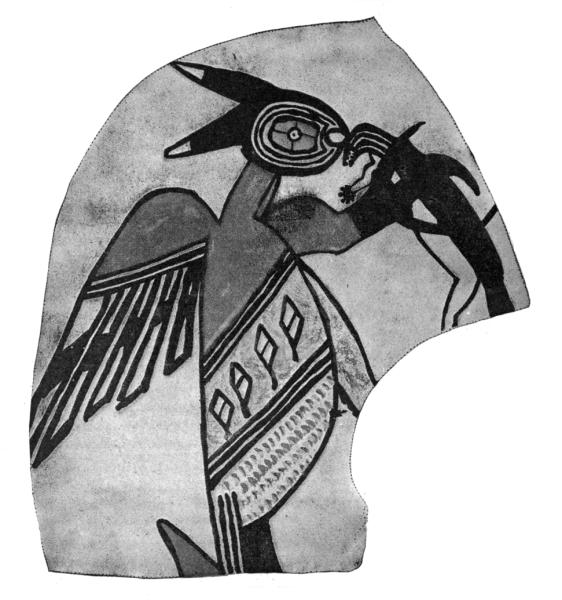
According to modern folklore there once lived in the sky a winged being called Kwataka, or Man-eagle, who sorely troubled the ancients. He was ultimately slain by their War god, the legends of which have elsewhere been published. There is a pictograph of this monster near Walpi,[148] and pictures of him, as he exists in modern conceptions, have been drawn for me by the priests. These agree so closely with the pictograph and with the representation on the potsherd from Sikyatki, that I regard it well-nigh proven that they represent the same personage. The head is round and bears two feathers, while the star emblem appears in the eye. The wing and the stump of a tail are well represented, while the leg has three talons, which can only be those of this monster. He holds in his grasp some animal form which he is represented as eating. Across the body is a kilt, or ancient blanket, with four diagonal figures which are said to represent flint arrowheads. It is a remarkable fact that these latter symbols are practically the same as those used by Nahuatl people for obsidian arrow- or spearpoints. In Hopi lore Kwataka wore a garment of arrowpoints, or, according to some legends, a flint garment, and his wings are said to have been composed of feathers of the same material.
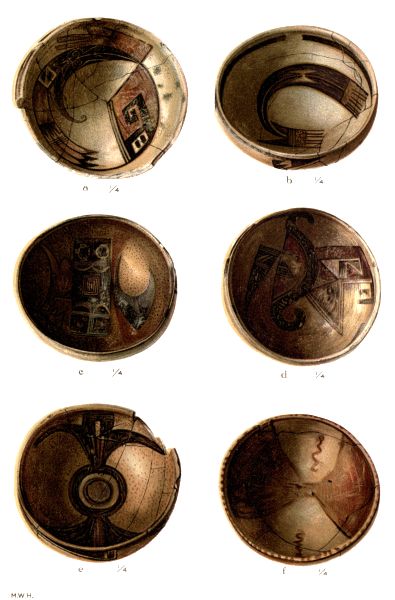
BUREAU OF AMERICAN ETHNOLOGY—— SEVENTEENTH ANNUAL REPORT PL. CXLVI BOWLS AND POTSHERD WITH FIGURES OF BIRDS FROM SIKYATKI
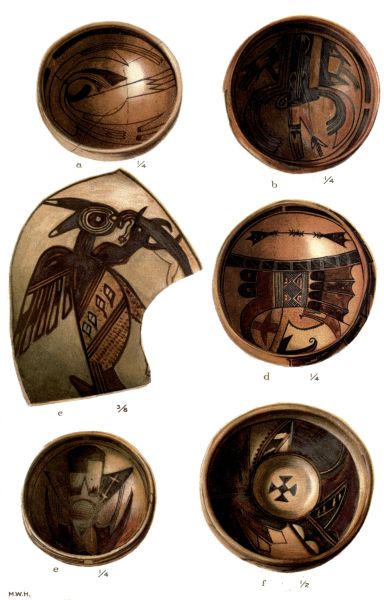
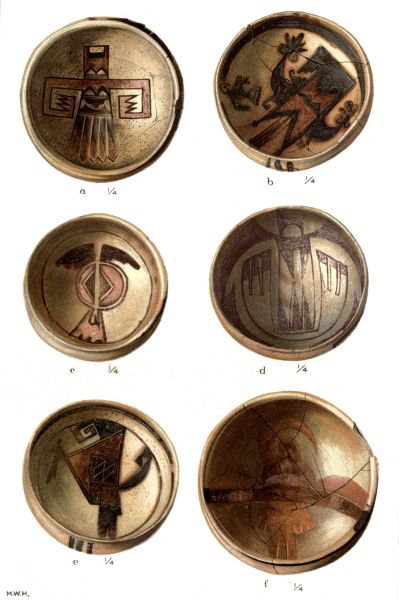
BUREAU OF AMERICAN ETHNOLOGY—— SEVENTEENTH ANNUAL REPORT PL. CXLVII FOOD BOWLS WITH FIGURES OF BIRDS, FROM SIKYATKI
From the pose of the figure and the various details of its symbolism there can be little doubt that the ancient Sikyatki artists intended to represent this monster, of which the modern Hopi rarely speak, and then only in awe. Probably several other bird figures likewise represent Kwataka, but in none of these do the symbols conform so closely to legends of this monster which are still repeated in the Tusayan villages. The home of Kwataka is reputed to be in the sky, and consequently figures of him are commonly associated with star and cloud emblems; he is a god of luck or chance, hence it is not exceptional to find figures of gaming implements[149] in certain elaborate figures of this monster.
By far the most beautiful of the many food bowls from Sikyatki, and, I believe, the finest piece of prehistoric aboriginal pottery from the United States, is that figured in plate cxlvi, d. This remarkable object, found with others in the sands of the necropolis of this pueblo, several feet below the surface, is decorated with a highly conventional figure of a bird in profile, but so modified that it is difficult to determine the different parts. The four appendages to the left represent the tail; the two knobs at the right the head, but the remaining parts are not comprehensible. The delicacy of the detailed crosshatching on the body is astonishing, considering that it was drawn freehand and without pattern. The coloring is bright and the surface glossy.
The curved band from which this strange figure hangs is divided into sections by perpendicular incised lines, which are connected by zigzag diagonals. The signification of the figure in the upper part of the bowl is unknown. While this vessel is unique in the character of its decoration, there are others of equal fineness but less perfect in design. Competent students of ceramics have greatly admired this specimen, and so fresh are the colors that some have found it difficult to believe it of ancient aboriginal manufacture. The specimen itself, now on exhibition in the National Museum, gives a better idea of its excellence than any figure which could be made. This specimen, like all the others, is in exactly the same condition as when exhumed, save that it has been wiped with a moist cloth to clean the traces of food from its inner surface. All the pottery found in the same grave is of the finest character, and although no two specimens are alike in decoration, their general resemblances point to the same maker. This fact has been noticed in several instances, although there were many exceptional cases where the coarsest and most rudely painted vessels were associated with the finest and most elaborately decorated ware.
The ladle illustrated in plate cxlii, e, is one of the most beautiful in the collection. It is decorated with a picture of an unknown animal with a single feather on the head. The eyes are double and the snout continued into a long stick or tube, on which the animal stands. While the appendage to the head is undoubtedly a feather and the animal recalls a bird, I am in doubt as to its true identification. The star emblems on the handle of the ladle are in harmony with known pictures of birds.
The feather decoration on the broken ladle shown in plate cxxxi, f, is of more than usual interest, although it is not wholly comprehensible. The representations include rain-cloud symbols, birds, feathers, and falling rain. The medially placed design, with four parallel lines arising from a round spot, is interpreted as a feather design, and the two triangular figures, one on each side, are believed to represent birds.
The design on the food bowl depicted in plate cxxxi, e, is obscure, but in it feather and star symbols predominate. On the inside of the ladle shown in plate cxxxi, c, there is a rectangular design with a conventionalized bird at each angle. The reduction of the figure of a bird to head, body, and two or more tail-feathers occurs very constantly in decorations, and in many instances nothing remains save a crook with appended parallel lines representing feathers. Examples of this kind occur on several vessels, of which that shown in plate cxlv, a, is an example.
Fig. 276—Decoration on the bottom of plate CXLVI, f
There are many pictures of birds and feathers where the design has become so conventionalized that it is very difficult to recognize the intention of the decorator. Plate cxlvii, f, shows one of these in which the feather motive is prominent and an approximation to a bird form evident. The wings are shown with a symmetric arrangement on the sides of the tail, while the latter member has the three feathers which form so constant a feature in many bird symbols. In b of the same plate there is shown a more elaborated bird figure, also highly modified, yet preserving many of the parts which have been identified in the design last described.
The beautiful design shown in plate cxlvi, e, represents a large breath feather with triangular appendages on the sides, recalling the posterior end of the body of the bird figures above discussed.
The interior of the saucer illustrated in plate clxvi, f, is decorated with feather symbols and four triangles. The remaining figures of this plate have already been considered.
BUREAU OF AMERICAN ETHNOLOGY—— SEVENTEENTH ANNUAL REPORT PL. CXLVIII FOOD BOWLS WITH SYMBOLS OF FEATHERS FROM SIKYATKI
BUREAU OF AMERICAN ETHNOLOGY—— SEVENTEENTH ANNUAL REPORT PL. CXLIX FOOD BOWLS WITH SYMBOLS OF FEATHERS FROM SIKYATKI
The figures on the vessel shown in plate clxvii are so arranged that there can be little question of their homologies, and from comparisons it is clear that they should all be regarded as representations of birds. There appears no necessity of discussing figures a and b of the plate in this interpretation. In figure c the center of the design becomes circular, recalling certain sun symbols, and the tail-feathers are readily recognized on one side. I am by no means sure, however, that the lateral terraced appendages at the opposite pole are representations of wings, but such an interpretation can not be regarded as a forced one. Figure d shows the three tail-feathers, lateral appendages suggestive of wings, and a square body with the usual decorations of the body and head of a bird. The design shown in figure f suggests in many ways a sun-bird, and is comparable with those previously studied and illustrated. There is no question of the homologues of tail, head, and wings. The meridional band across the bowl is similar to those already discussed, and its relationship to the head and tail of the bird identical. This design is interpreted as that of one of the numerous birds associated with the sun. The crescentic extension above what is apparently the head occurs in many bird figures and may represent a beak.
Many food bowls from Sikyatki are ornamented on their interior with highly conventionalized figures, generally of curved form, in which the feather is predominant. Many of these are shown in plates cxlviii to clvii, inclusive, and in studying them I have found it very difficult to interpret the symbolism, although the figures of feathers are easy to find in many of them. While my attempt at decipherment is not regarded as final, it is hoped that it may at least reveal the important place which the feather plays in Tusayan ceramic decoration.
Plate cxlviii, a, shows the spiral ornament worn down to its lowest terms, with no hint of the feather appendage, but its likeness in outline to those designs where the feather occurs leads me to introduce it in connection with those in which the feather is more prominent. Figure b of the same plate represents a spiral figure with a bird form at the inner end, and a bundle of tail-feathers at the outer extremity. On this design there is likewise a figure of the dragon-fly and several unknown emblems. Figure c has at one extremity a trifid appendage, recalling a feather ornament on the head of a bird shown in plate cxxxviii, a. Figure d has no conventionalized feather decoration, but the curved line terminates with a triangle. Its signification is unknown to me. For several reasons the design in e reminds me of a bird; it is accompanied by three crosses, which are almost invariably found in connection with bird figures, and at the inner end there is attached a breath feather. This end of the figure is supposed to be the head, as will appear by later comparative studies. The bird form is masked in f, but the feather designs are prominent. This bowl is exceptional in having an encircling band broken at two points, one of the components of which is red, the other black.
Feather designs are conspicuous in plate cxlix, a, b, in the former of which curved incised lines are successfully used. In c, however, is found the best example of the use of incised work as an aid in pottery decoration, for in this specimen there are semicircles, and rings with four triangles, straight lines, and circles. The symbolism of the whole figure has eluded analysis. Figure d has no feather symbols, but e may later be reduced to a circle with feathers. The only symbols in the design shown in f which are at all recognizable are the two zigzag figures which may have been intended to represent snakes, lightning, or tadpoles.
When the design in plate cl, a, is compared with the beautiful bowl shown in plate cxlvi, d, a treatment of somewhat similar nature is found. It is believed that both represent birds drawn in profile; the four bands (a) are tail-feathers, while the rectangle represents the body and the curved appendage a part of the head. From a similarity to modern figures of a turkey feather, it is possible that the triangle at the end of the curved appendage is the feather of this bird. An examination of b leads to the conclusion that the inner end of the spiral represents a bird's head. Two eyes are represented therein, and from it feathers are appended. The parallel marks on the body are suggestive of similar decorations on the figure of the Plumed Snake painted on the kilts of the Snake priests of Walpi. The star emblems are constant accompaniments of bird designs. Figure c has, in addition to the spiral, the star symbols and what appears to be a flower. The design shown in d is so exceptional that it is here represented with the circular forms. It will be seen that there are well-marked feathers in its composition. Figure f is made up of several bird forms, feathers, rectangles, and triangles, combined in a complicated design, the parts of which may readily be interpreted in the light of what has already been recorded.
The significance of the spiral in the design on plate cli, a, is unknown. It is found in several pictures, in some of which it appears to have avian relationship. Figure b of the same plate is a square terraced design appended to the median line, on which symbolic stars are depicted. As in many bird figures, a star is found on the opposite semicircle. There is a remote likeness between this figure and that of the head of the bird shown in plate cxlv, d. Plate cli, c, is a compound figure, with four feathers arranged in two pairs at right angles to a median band. The triangular figure associated with them is sometimes found in symbols of the sun. Figure d is undoubtedly a bird symbol, as may be seen by a comparison of it with the bird figures shown in plate cxxxviii, a-f. There are two tail-feathers, two outstretched wings, and a head which is rectangular, with terraced designs. The cross is triple, and occupies the opposite segment, which is finely spattered with pigment. This trifid cross represents a game played by the Hopi with reeds and is depicted on many objects of pottery. As representations of it sometimes accompany those of birds I am led to interpret the figure (plate clvii, c) as that of a bird, which it somewhat resembles. The two designs shown in plate cli, e, f, are believed to be decorative, or, if symbolic, they have been so worn by the constant use of the vessel that it is impossible to determine their meaning by comparative methods. Both of these figures show the "line of life" in a somewhat better way than any yet considered.
BUREAU OF AMERICAN ETHNOLOGY—— SEVENTEENTH ANNUAL REPORT PL. CL FIGURES OF BIRDS AND FEATHERS FROM SIKYATKI
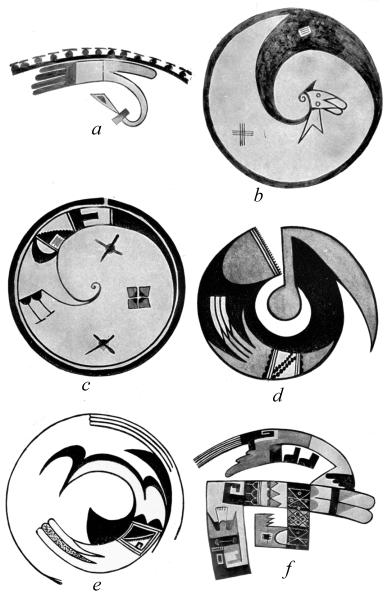
BUREAU OF AMERICAN ETHNOLOGY—— SEVENTEENTH ANNUAL REPORT PL. CLI FIGURES OF BIRDS AND FEATHERS FROM SIKYATKI
In plate clii, a, is shown a compound figure of doubtful significance, made up of a series of crescents, triangles, and spirals, which, in c, are more compactly joined together, and accompanied by three parallel lines crossing three other lines. The curved figure shown in b represents three feathers; a large one on each side, inclosing a medially smaller member. In d is shown the spiral bird form with appended feathers, triangles, and terraced figures. Figure f of this plate is decorated with a design which bears many resemblances to a flower, the peripheral appendages resembling bracts of a sunflower. A somewhat similar design is painted on the side of the helmets of some katcina dancers, where the bracts or petals are colored in sequence, with the pigments corresponding to the six directions—north, west, south, east, above, and below. In the decoration on the ancient Sikyatki bowl we find seven peripheral bracts, one of which is speckled. The six groups of stamens(?) are represented between the triangular bracts.
The designs shown in plates cliii to clv, inclusive, still preserve the spiral form with attached feathers, some of them being greatly conventionalized or differentiated. In the first of these plates (figure b) is represented a bird form with triangular head with four feathers arranged in fan shape. These feathers are different from any which I have been able to find attached to the bodies of birds, and are thus identified from morphological rather than from other reasons.
The body of the conventionalized bird is decorated with terraced figures, spirals, flowers, and other designs arranged in a highly complicated manner. From a bar connecting the spiral with the encircling line there arises a tuft of feathers. Figure a of the same plate is characterized by a medially placed triangle and a graceful pendant from which hangs seven feathers. In this instance these structures take the form of triangles and pairs of lines. The relation of these structures to feathers would appear highly speculative, but they have been so interpreted for the following reason: If we compare them with the appendages represented in the design on the vase shown in cxliii, b, we find them the same in number, form, and arrangement; the triangles in the design on this vase are directly comparable with the figures in plate cxliii, b, in the same position, which are undoubtedly feathers, as has been shown in the discussion of this figure. Consequently, although the triangles on the pendant in plate cliii, a, appear at first glance to have no relation to the prescribed feather symbol, morphology shows their true interpretation. The reduction of the wing feather to a simple triangular figure is likewise shown in several other pictures on food vessels, notably in the figure, undoubtedly of a bird, represented in plate cxlvi, a.
In the two figures forming plate cliv are found simple bird symbols and feather designs very much conventionalized. The same is true of the two figures given in plate clv.
The vessels illustrated in plate clvi, a, b, are decorated with designs of unknown meaning, save that the latter recalls the modification of the feather into long triangular forms. On the outer surface this bowl has a row of tadpoles encircling it in a sinistral direction, or with the center of the bowl on the left. The design of figure c shows a bird's head in profile, with a crest of feathers and with the two eyes on one side of the head and a necklace. The triangular figure bears the symbolism of the turkey feather, as at present designated in Tusayan altar paraphernalia. As with other bird figures, there is a representation in red of the triple star.
Figure d is the only specimen of a vessel in the conventional form of a bird which was found at Sikyatki; it evidently formerly had a handle. The vessel itself is globular, and the form of the bird is intensified by the designs on its surface. The bird's head is turned to the observer, and the row of triangles represent wing feathers. The signification of the designs on e and f is unknown to me.
Figures e and f of plate clvi are avian decorations, reduced in the case of the former to geometric forms. The triangular figure is a marked feature in the latter design.
The designs represented in plate clvii are aberrant bird forms. Of these a and b are the simplest and c one of the most complicated. Figure d is interpreted as a double bird, or twins with a common head and tails pointing in opposite directions. Figure e shows a bird in profile with one wing, furnished with triangular feathers, extended. There is some doubt about the identification of f as a bird, but there is no question that the wing, tail, and breath feathers are represented in it. Of the last mentioned there are three, shown by the notch, colored black at their extremities.
Vegetal Designs
Inasmuch as they so readily lend themselves as a motive of decoration, it is remarkable that the ancient Hopi seem to have used plants and their various organs so sparingly in their pottery painting. Elsewhere, especially among modern Pueblos, this is not the case, and while plants, flowers, and leaves are not among the common designs on modern Tusayan ware, they are often employed. It would appear that the corn plant or fruit would be found among other designs, especially as corn plays a highly symbolic part in mythic conceptions, but we fail to find it used as a decoration on any ancient vessel.
BUREAU OF AMERICAN ETHNOLOGY—— SEVENTEENTH ANNUAL REPORT PL. CLII FOOD BOWLS WITH BIRD, FEATHER, AND FLOWER SYMBOLS FROM SIKYATKI
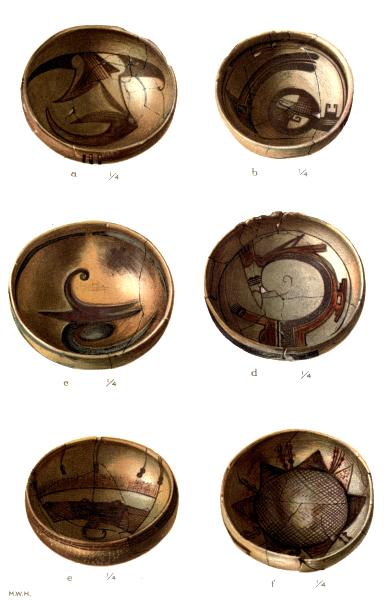
BUREAU OF AMERICAN ETHNOLOGY—— SEVENTEENTH ANNUAL REPORT PL. CLIII FOOD BOWLS WITH FIGURES OF BIRDS AND FEATHERS FROM SIKYATKI
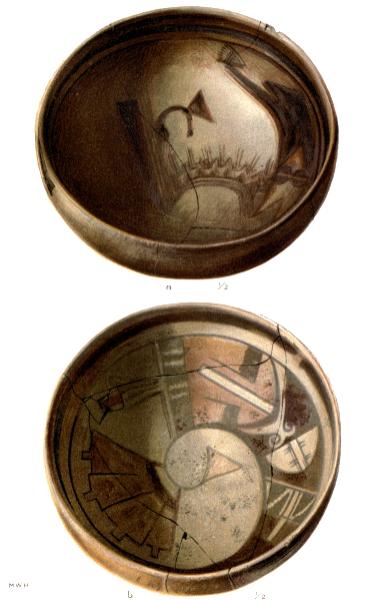
In a figure previously described, a flower, evidently an aster or sunflower, appears with a butterfly, and in the bowl shown in plate cxxxiv, e, we have a similar design. This figure evidently represents the sunflower, the seeds of which were ground and eaten in ancient times. The plant apparently is represented as growing from the earth and is surrounded by a broad band of red in rudely circular form. The totem of the earth today among the Hopi is a circle; possibly it was the same among the ancients, in which case the horizon may have been represented by the red encircling band, which is accompanied by the crook and the emblem of rain. The petals are represented by a row of dots and no leaves are shown. From the kinship of the ancient accolents of Sikyatki with the Flute people, it is to be expected that in their designs figures of asters or sunflowers would appear, for these plants play a not inconspicuous rôle in the ritual of this society which has survived to modern times.
The Sun
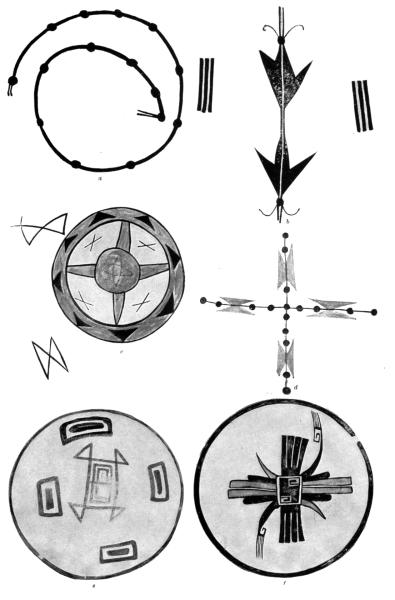
Sun worship plays a most important part in modern Tusayan ritual, and the symbol of the sun in modern pictography can not be mistaken for any other. It is a circle with radiating feathers on the periphery and ordinarily with four lines arranged in quaternary groups. The face of the sun is indicated by triangles on the forehead, two slits for eyes, and a double triangle for the mouth. This symbol, however, is not always used as that of the sun, for in the Oraibi Powalawû there is an altar in which a sand picture of the sun has the form of a four-pointed star. The former of these sun symbols is not found on Sikyatki pottery, but there is one picture which closely resembles the latter. This occurs on the bowl illustrated in plate clxi, c. The main design is a four-pointed star, alternating with crosses and surrounded by a zone in which are rectangular blocks. While the identification may be fanciful, its resemblances are highly suggestive. The existence of a double triangle adjacent to this figure on the same bowl, and its likeness to the modern mouth-design of sun pictures, appears to be more than a coincidence, and is so regarded in this identification.
In the design shown in plate clviii, a, one of the elaborate ancient sun figures is represented. As in modern symbols, the tail-feathers of the periphery of the disk are arranged in the four quadrants, and in addition there are appended to the same points curved figures which recall the objects, identified as stringed feathers, attached to the blanket of the maid (plate cxxix, a). The design on the disk is different from that of any sun emblem known to me, and escapes my interpretation. I have used the distribution of the feathers on the four quadrants as an indication that this figure is a sun symbol, although it must be confessed this evidence is not so strong as might be wished. The triangles at the sides of two feathers indicate that a tail-feather is intended, and for the correlated facts supporting this conclusion the reader is referred to the description of the vessels shown in plate cxxxviii.
It would appear that there is even more probability that the picture on the bowl illustrated in plate clviii, b, is a sun symbol. It represents a disk with tail and wing feathers arranged on the periphery in four groups. This recalls the sun emblems used in Tusayan at the present time, although the face of the sun is not represented on this specimen. There is a still closer approximation to the modern symbol of the sun on a bowl in a private collection from Sikyatki.
In plate clviii, c, the sun's disk is represented with the four clusters of feathers replaced by the extremities of the bodies of four birds, the tail-feathers, for some unknown reason, being omitted. The design on the disk is highly symbolic, and the only modern sun symbol found in it are the triangles, which form the mouth of the face of the sun in modern Hopi symbolism.
One of the most aberrant pictures of the sun, which I think can be identified with probability, is shown in the design on the specimen illustrated in plate cxxxiv, b. The reasons which have led me to this identification may briefly be stated as follows:
Among the many supernaturals with which modern Hopi mythology is replete is one called Calako-taka, or the male Calako. In legends he is the husband of the two Corn-maids of like name. The ceremonials connected with this being occur in Sichomovi in July, when four giant personifications enter the village as have been described in a former memoir. The heads of these giants are provided with two curved horns, between which is a crest of eagle tail-feathers.
Two of these giants, under another name, but with the same symbolism, are depicted on the altars of the katcinas at Walpi and Mishoñinovi, where they represent the sun. A chief personifying the same supernatural flogs children when they are initiated into the knowledge of the katcinas.
The figure on the bowl under discussion has many points of resemblance to the symbolism of this personage as depicted on the altars mentioned. The head has two horns, one on each side, with a crest, apparently of feathers, between them. The eyes and mouth are represented, and on the body there is a four-pointed cross. The meaning of the remaining appendages is unknown, but the likenesses to Calako-taka[150] symbolism are noteworthy and important. The figure on the food bowl illustrated in plate cxxxiv, c, is likewise regarded as a sun emblem. The disk is represented by a ring in the center, to which feathers are appended. The triangle, which is still a sun symbol, is shown below a band across the bowl. This band is decorated with highly conventionalized feathers.
BUREAU OF AMERICAN ETHNOLOGY—— SEVENTEENTH ANNUAL REPORT PL. CLIV FOOD BOWLS WITH FIGURES OF BIRDS AND FEATHERS FROM SIKYATKI
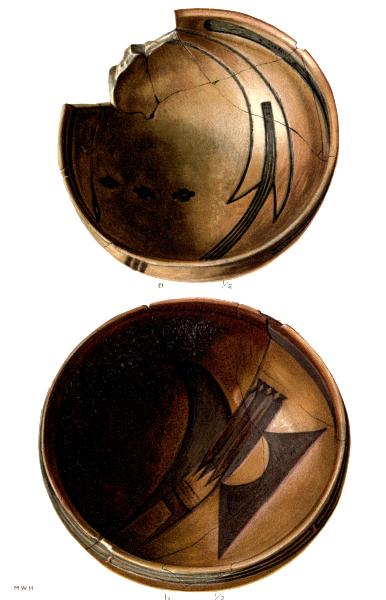
BUREAU OF AMERICAN ETHNOLOGY—— SEVENTEENTH ANNUAL REPORT PL. CLV FOOD BOWLS WITH FIGURES OF BIRDS AND FEATHERS FROM SIKYATKI
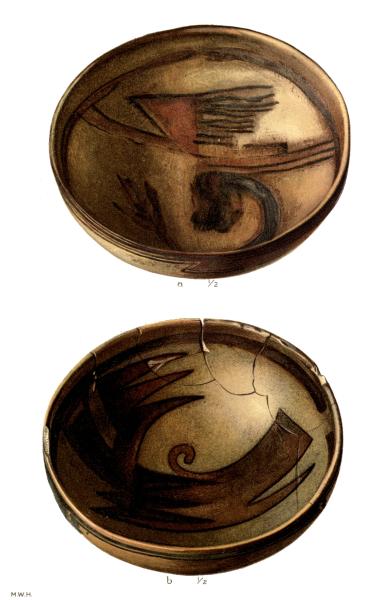
BUREAU OF AMERICAN ETHNOLOGY—— SEVENTEENTH ANNUAL REPORT PL. CLVI FOOD BOWLS WITH FIGURES OF BIRDS AND FEATHERS FROM SIKYATKI
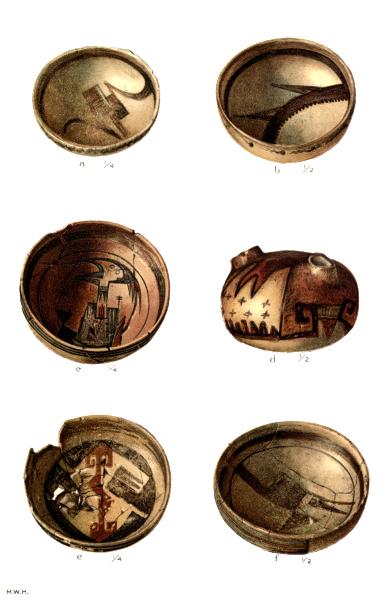
It may be added that in this figure we have probably the most aberrant sun-symbol yet recognized, and on that account there is a possibility that the validity of my identification is more or less doubtful.
The three designs shown in plate clviii, c, d, e, evidently belong in association with sun or star symbols, but it is hardly legitimate to definitely declare that such an interpretation can be demonstrated. The modern Tusayan Indians declare that the equal-arm cross is a symbol of the "Heart of the Sky" god, which, from my studies of the effigies of this personage on various altars, I have good reason to identify with the lightning.
Geometric Figures
INTERPRETATION OF THE FIGURES
Most of the pottery from Sikyatki is ornamented with geometric designs and linear figures, the import of many of which are unknown.
Two extreme views are current in regard to the significance of these designs. To one school everything is symbolic of something or some religious conception; to the other the majority are meaningless save as decorations. I find the middle path the more conservative, and while regarding many of the designs as highly conventionalized symbols, believe that there are also many where the decorator had no thought of symbolism. I have ventured an explanation of a few of the former.
Terraced figures are among the most common rectangular elements in Pueblo ceramic decorations. These designs bear so close a likeness to the modern rain-cloud symbol that they probably may all be referred to this category. Their arrangement on a bowl or jar is often of such a nature as to impart very different patterns. Thus terraced figures placed in opposition to each other may leave zigzag spaces suggesting lightning, but such forms can hardly be regarded as designed for symbols.
Rectangular patterns (plates clxii-clxv) are more ancient in the evolution of designs on Tusayan pottery than curved geometric figures, and far outnumber them in the most ancient specimens; but there has been no epoch in the development reaching to modern times when they have been superseded. While there are many specimens of Sikyatki pottery of the type decorated with geometric figures, which bear ornamentations of simple and complex terraced forms, the majority placed in this type are not reducible to stepped or terraced designs, but are modified straight lines, bars, crosshatching, and the like. In older Pueblo pottery the relative proportion of terraced figures is even less, which would appear to indicate that basket-ware patterns were secondary rather than primary decorative forms.
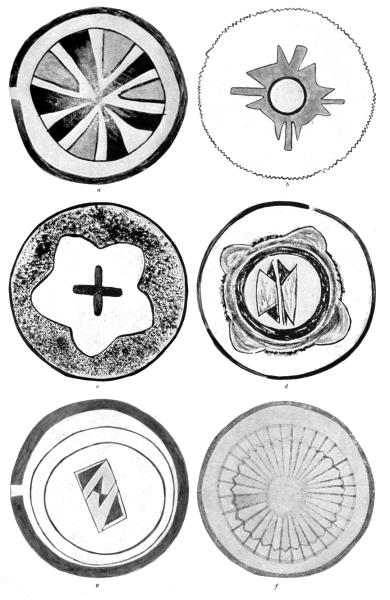
By far the largest element in ancient Tusayan pottery decoration must be regarded as simple geometric lines, triangles, spirals, curves, crosshatching, and the like, some of which are no doubt symbolic, others purely decorative (plate clxvi). In the evolution of design I am inclined to believe that this was the simplest form, and I find it the most constant in the oldest ware. Rectangular figures are regarded as older than circular figures, and they possibly preceded the latter in evolution, but in many instances both are forms of reversion, highly conventionalized representations of more elaborate figures. Circles and crosses are sometimes combined, the former modified into a wavy line surrounding the latter, as in plate clix, c, d, where there is a suggestion (d) of a sun emblem.
CROSSES
A large number of food bowls are decorated with simple or elaborate crosses, stars, and like patterns. Simple crosses with arms of equal length appear on the vessels shown in plate clix, c, d. There are many similar crosses, subordinate to the main design, in various bowls, especially those decorated with figures of birds and sky deities.
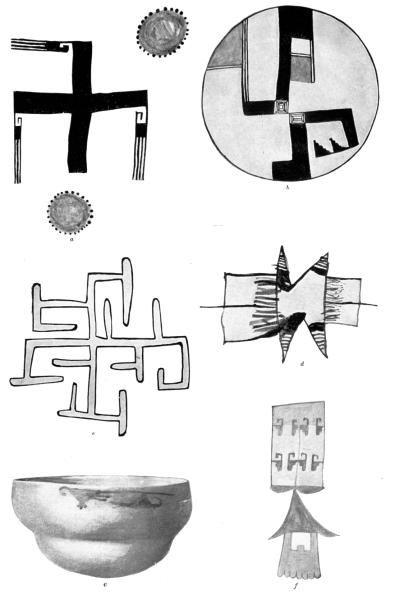
Plate clx, a, exhibits a cruciform design, to the extremities of three arms of which bird figures are attached. In this design there are likewise two sunflower symbols. The modified cross figure in b of the same plate, like that just mentioned, suggests a swastica, but fails to be one, and unless the complicated design in figure c may be so interpreted, no swastica was found at Sikyatki or Awatobi. Plate clx, d, shows another form of cross, two arms of which are modified into triangles.
On the opening of the great ceremony called Powamû or "Bean-planting," which occurs in February in the modern Tusayan villages, there occurs a ceremony about a sand picture of the sun which is called Powalawû. The object of this rite is the fructification of all seeds known to the Hopi. The sand picture of the sun which is made at that time is in its essentials identical with the design on the food bowl illustrated in plate clxi, c; consequently it is possible that this star emblem represents the sun, and the occurrence of the eight triangles in the rim, replaced in the modern altar by four concentric bands of differently colored sands, adds weight to this conclusion. The twin triangles outside the main figure are identical with those in the mouth of modern sun emblems. These same twin triangles are arranged in lines which cross at right angles in plate clxi, d, but from their resemblance to figure b they possibly have a different meaning.
The most complicated of all the star-shape figures, like the simplest, takes us to sun emblems, and it seems probable that there is a relationship between the two. Plate clxi, f, represents four bundles of feathers arranged in quadrants about a rectangular center. These feathers vary in form and arrangement, and the angles between them are occupied by horn-shape bodies, two of which have highly complicated extremities recalling conventionalized birds.
BUREAU Of AMERICAN ETHNOLOGY—— SEVENTEENTH ANNUAL REPORT PL. CLVII FIGURES OF BIRDS AND FEATHERS FROM SIKYATKI
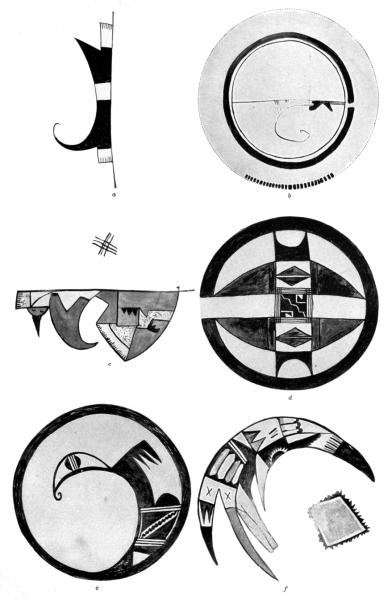
BUREAU OF AMERICAN ETHNOLOGY—— SEVENTEENTH ANNUAL REPORT PL. CLVIII FOOD BOWLS WITH FIGURES OF SUN AND RELATED SYMBOLS FROM SIKYATKI
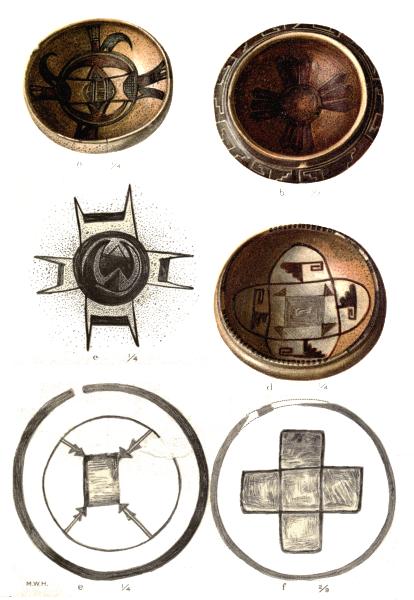
A large number of crosses are represented in plate clxii, d, in which the remaining semicircle is filled with a tessellated pattern. A spiral line with round spots at intervals adorns the specimen shown in plate clxi, a. Parallel lines with similar spots appear on the vessel illustrated in plate clxii, e, and a network of the same is shown in f of the same plate. Plate clxvii, b, represents a compound star.
While simple swasticas are not found on any of the Sikyatki pottery, modified and compound forms are well represented. There are several specimens of figures of the Maltese cross, and one closely approximating the Saint Andrew's cross. It is scarcely necessary to say that the presence of the various kinds of crosses do not necessarily indicate the influence of Semitic or Aryan races, for I have already shown[151] that even cross-shape prayer-sticks were in use among the Pueblos when Coronado first visited them.
TERRACED FIGURES
Among the most common of all geometric designs on ancient Tusayan pottery none excel in variety or number those which I place in the above group. They form the major part of all decoration, and there is hardly a score of ornamented vessels in which they can not be detected. In a typical form they appear as stepped designs, rectangular figures with diagonals continuous, or as triangular designs with steps represented along their sides.
While it is probable that in some instances these figures are simply decorative, with no attempt at symbolism, in other cases without doubt they symbolize rain-clouds, and the same figures are still used with similar intent in modern ceremonial paraphernalia—altars, mask-tablets, and the like. Decorative modifications of this figure were no doubt adopted by artistic potters, thus giving varieties where the essential meaning has been much obscured or lost.
THE CROOK
Among the forms of geometric designs on ancient Tusayan pottery there are many jars, bowls, and other objects on which a crook, variously modified, is the essential type. This figure is so constant that it must have had a symbolic as well as a decorative meaning. The crook plays an important part in the modern ritual, and is prominent on many Tusayan altars. Around the sand picture of the rain-cloud, for example, we find a row of wooden rods with curved ends, and in the public Snake dance these are carried by participants called the Antelopes. A crook in the form of a staff to which an ear of corn and several feathers are attached is borne by katcinas or masked participants in certain rain dances. It is held in the hand by a personage who flogs the children when they are initiated into certain religious societies. Many other instances might be mentioned in which this crozier-like object is carried by important personages. While it is not entirely clear to me that in all instances this crook is a badge of authority, in some cases it undoubtedly represents the standing of the bearer. There are, likewise, prayer offerings in the form of crooks, and even common forms of prayer-sticks have miniature curved sticks attached to them.
Some of the warrior societies are said to make offerings in the form of a crook, and a stick of similar form is associated with the gods of war. There is little doubt that some of the crook-form decorations on ancient vessels may have been used as symbols with the same intent as the sticks referred to above. The majority of the figures of this shape elude interpretation. Many of them have probably no definite meaning, but are simply an effective motive of decoration.
In some instances the figure of the crook on old pottery is a symbol of a prayer offering of a warrior society, made in the form of an ancient weapon, allied to a bow.
THE GERMINATIVE SYMBOL
The ordinary symbol of germination, a median projection with lateral extensions at the base (plate cxlix, e), occurs among the figures on this ancient pottery. In its simplest form, a median line with a triangle on each side attached to one end, it is a phallic emblem. When this median line becomes oval, and the triangles elongated and curved at the ends, it represents the ordinary squash symbol,[152] also used as an emblem of fertility.
The triangle is also an emblem of germination and of fecundity—the female, as the previously mentioned principle represents the male. The geometric designs on the ancient Sikyatki ware abundantly illustrate both these forms.
BROKEN LINES
In examining the simple encircling bands of many of the food bowls, jars, and other ceramic objects, it will be noticed that they are not continuous, but that there is a break at one point, and this break is usually limited to one point in all the specimens. Various explanations of the meaning of this failure to complete the band have been suggested, and it is a remarkable fact that it is one of the most widely extended characteristics of ancient pottery decoration in the whole Pueblo area, including the Salado and Gila basins. While in the specimens from Sikyatki the break is simple and confined to one point, in those from other regions we find two or three similar failures in the continuity of encircling lines, and in some instances the lines at the point of separation are modified into spirals, terraces, and other forms of geometric figures. In the more complex figures we find the most intricate variations, which depart so widely from the simple forms that their resemblances are somewhat difficult to follow. A brief consideration of these modifications may aid toward an understanding of the character of certain geometric ornamental motives.
BUREAU OF AMERICAN ETHNOLOGY—— SEVENTEENTH ANNUAL REPORT PL. CLIX CROSS AND RELATED DESIGNS FROM SIKYATKI
BUREAU OF AMERICAN ETHNOLOGY—— SEVENTEENTH ANNUAL REPORT PL. CLX CROSS AND OTHER SYMBOLS FROM SIKYATKI
BUREAU OF AMERICAN ETHNOLOGY—— SEVENTEENTH ANNUAL REPORT PL. CLXI STAR, SUN, AND RELATED SYMBOLS FROM SIKYATKI
If any of the interlocking spirals on bowls or vases are traced, it is found that they do not join at the center of the figure. The same is true when these spirals become frets. There is always a break in the network which they form. This break is comparable with the hiatus on encircling bands and probably admits of the same interpretation. In a simple form this motive appears as two crescents or two key patterns with the ends overlapping. This simple ornament, called the friendship sign, is commonly used in the decoration of the bodies of katcinas, and has been likened to the interlocking of fingers or hands of the participants in certain dances, the fingers half retracted with inner surfaces approximated, the palms of the hands facing in opposite directions and the wrists at opposite points. If the points be extended into an elaborate key pattern or curved into extended spirals, a complicated figure is produced in which the separation is less conspicuous although always present.
The same points may be modified into terraced figures, the separation then appearing as a zigzag line drawn across the figure, or they may have interlocking dentate or serrate prolongations imparting a variety of forms to the interval between them.[153] In order to trace out these modifications it would be necessary to specify each individual case, but I think that is unnecessary. In other words, the broken line appears to be a characteristic not only of simple encircling bands, but also of all geometric figures in which highly complicated designs extend about the periphery of a utensil.
Decorations on the Exterior of Food Bowls
The decorations on the exterior of the ancient food bowls are in most instances very characteristic and sometimes artistic. Generally they reproduce patterns which are found on the outside of vases and jars and sometimes have a distant relationship to the designs in the interior of the bowl upon which they occur. Usually these external decorations are found only on one side, and in that respect they differ from the modern food bowls, in which nothing similar to them appears.
The characteristics of the external decorations of food bowls are symbolic, mostly geometric, square or rectangular, triangular or stepped figures; curved lines and spirals rarely if ever occur, and human or animal figures are unknown in this position in Sikyatki pottery; the geometric figures can be reduced to a few patterns of marked simplicity.
It is apparent that I can best discuss the variety of geometric designs by considering these external decorations of food vessels at length. From the fact that they are limited to one side, the design is less complicated by repetition and seems practically the same as the more typical forms. It is rarely that two of these designs are found to be exactly the same, and as there appears to be no duplication a classification of them is difficult. Each potter seems to have decorated her ware without regard to the work of her contemporaries, using simple designs but combining them in original ways. Hence the great variety found even in the grave of the same woman, whose handiwork was buried with her. As, however, the art of the potter degenerated, as it has in later times, the patterns became more alike, so that modern Tusayan decorated earthenware has little variety in ornamentation and no originality in design. Every potter uses the same figures.
Fig. 277—Oblique parallel line decoration

Fig. 278—Parallel lines fused at one point

Fig. 279—Parallel lines with zigzag arrangement
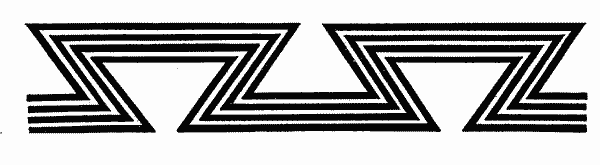
The simplest form of decoration on the exterior of a food bowl is a band encircling it. This line may be complete or it may be broken at one point. The next more complicated geometric decoration is a double or multiple band, which, however, does not occur in any of the specimens from Sikyatki. The breaking up of this multiple band into parallel bars is shown in figure 277. These bars generally have a quadruple arrangement, and are horizontal, vertical, or, as in the illustration, inclined at an angle. They are often found on the lips of the bowls and in a similar position on jars, dippers, and vases. The parallel lines shown in figure 278 are seven in number, and do not encircle the bowl. They are joined by a broad connecting band near one extremity. The number of parallel bands in this decoration is highly suggestive.
BUREAU OF AMERICAN ETHNOLOGY—— SEVENTEENTH ANNUAL REPORT PL. CLXII GEOMETRIC ORNAMENTATION FROM SIKYATKI
Four parallel bands encircle the bowl shown in figure 279, but they are so modified in their course as to form a number of trapezoidal figures placed with alternating sides parallel. This interesting pattern is found only on one vessel.
The use of simple parallel bars, arranged at equal intervals on the outside of food bowls, is not confined to these vessels, for they occur on the margin of vases, cups, and dippers. They likewise occur on ladle handles, where they are arranged in alternate transverse and longitudinal clusters.
Fig. 280—Parallel lines connected by middle bar.
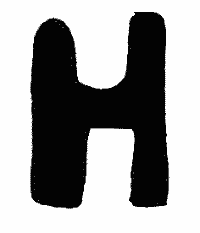
The combination of two vertical bands connected by a horizontal band, forming the letter H, is an ornamental design frequently occurring on the finest Hopi ware. Figure 280 shows such an H form, which is ordinarily repeated four times about the bowl.
Fig. 281—Parallel lines of different width; serrate margin

The interval between the parallel bands around the vessel may be very much reduced in size, and some of the bands may be of different width, or otherwise modified. Such a deviation is seen in figure 281, which has three bands, one of which is broad with straight edges, the other with serrate margin and hook-like appendages.
Fig. 282—Parallel lines of different width; median serrate
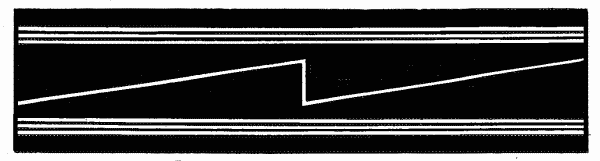
Fig. 283—Parallel lines of different width; marginal serrate
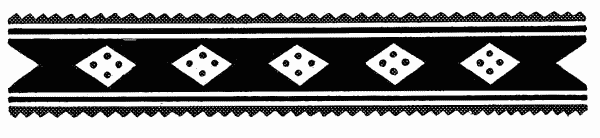
In figure 282 eight bands are shown, the marginal broad with edges entire, and the median pair serrated, the long teeth fitting each other in such a way as to impart a zigzag effect to the space which separates them. The remaining four lines, two on each side, appear as black bands on a white ground. It will be noticed that an attempt was made to relieve the monotony of the middle band of figure 282 by the introduction of a white line in zigzag form. A similar result was accomplished in the design shown in figure 283 by rectangles and dots.
Fig. 284—Parallel lines and triangles

The modification of the multiple bands in figure 283 has produced a very different decorative form. This design is composed of five bands, the marginal on each side serrate, and the middle band relatively very broad, with diagonals, each containing four round dots regularly arranged. In figure 284 there are many parallel, noncontinuous bands of different breadth, arranged in groups separated by triangles with sides parallel, and the whole united by bounding lines. This is the most complicated form of design where straight lines only are used.
Fig. 285—Line with alternate triangles
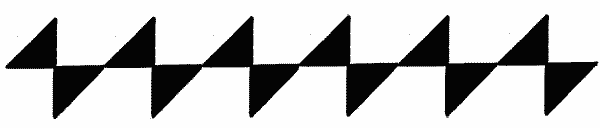
We have thus far considered modifications brought about by fusion and other changes in simple parallel lines. They may be confined to one side of the food bowl, may repeat each other at intervals, or surround the whole vessel. Ordinarily, however, they are confined to one side of the bowls from Sikyatki.
Fig. 286—Single line with alternate spurs

Fig. 287—Single line with hourglass figures

Returning to the single encircling band, it is found, in figure 285, broken up into alternating equilateral triangles, each pair united at their right angles. This modification is carried still further in figure 286, where the triangles on each side of the single line are prolonged into oblique spurs, the pairs separated a short distance from each other. In figure 287 there is shown still another arrangement of these triangular decorations, the pairs forming hourglass-shape figures connected by an encircling line passing through their points of junction.
BUREAU OF AMERICAN ETHNOLOGY—— SEVENTEENTH ANNUAL REPORT PL. CLXIII FOOD BOWLS WITH GEOMETRIC ORNAMENTATION FROM SIKYATKI
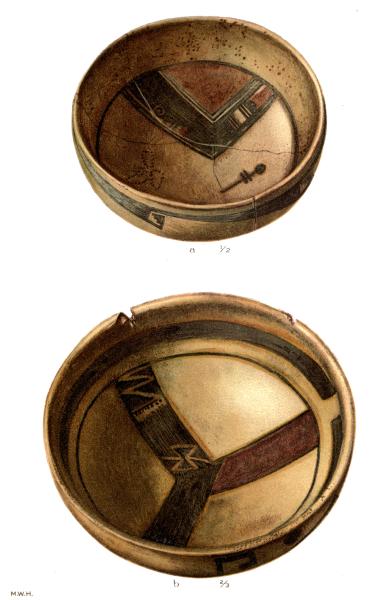
Fig. 288—Single line with triangles

Fig. 289—Single line with alternate triangles and ovals

Fig. 290—Triangles and quadrilaterals

Fig. 291—Triangle with spurs

In figure 288 the double triangles, one on each side of the encircling band, are so placed that their line of separation is lost, and a single triangle replaces the pair. These are connected by the line surrounding the bowl and there is a dot at the smallest angle. In figure 289 there is a similar design, except that alternating with each triangle, which bears more decoration than that shown in figure 288, there are hourglass figures composed of ovals and triangles. The dots at the apex of that design are replaced by short parallel lines of varying width. The triangles and ovals last considered are arranged symmetrically in relation to a simple band. By a reduction in the intervening spaces these triangles may be brought together and the line disappears. I have found no specimen of design illustrating the simplest form of the resultant motive, but that shown in figure 290 is a new combination comparable with it.
The simple triangular decorative design reaches a high degree of complication in figure 290, where a connecting line is absent, and two triangles having their smallest angles facing each other are separated by a lozenge shape figure made up of many parallel lines placed obliquely to the axis of the design. The central part is composed of seven parallel lines, the marginal of which, on two opposite sides, is minutely dentate. The median band is very broad and is relieved by two wavy white lines. The axis of the design on each side is continued into two triangular spurs, rising from a rectangle in the middle of each triangle. This complicated design is the highest development reached by the use of simple triangles. In figure 291, however, we have a simpler form of triangular decoration, in which no element other than the rectangle is employed. In the chaste decoration seen in figure 292 the use of the rectangle is shown combined with the triangle on a simple encircling band. This design is reducible to that shown in figure 290, but is simpler, yet not less effective. In figure 293 there is an aberrant form of design in which the triangle is used in combination with parallel and oblique bands. This form, while one of the simplest in its elements, is effective and characteristic. The triangle predominates in figure 294, but the details are worked out in rectangular patterns, producing the terraced designs so common in all Pueblo decorations. Rectangular figures are more commonly used than the triangular in the decoration of the exterior of the bowls, and their many combinations are often very perplexing to analyze.
Fig. 292—Rectangle with single line

Fig. 293—Double triangle; multiple lines
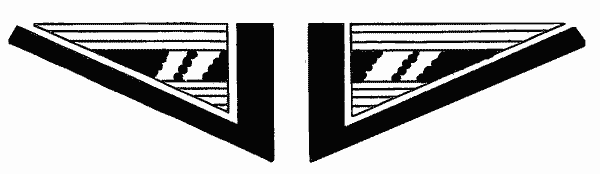
Fig. 294—Double triangle; terraced edges
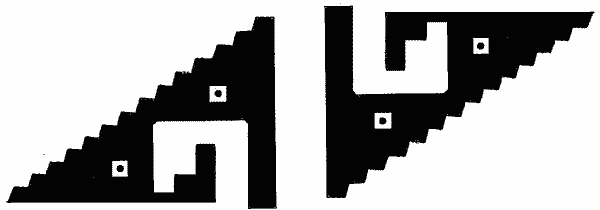
Fig. 295—Single line; closed fret

BUREAU OF AMERICAN ETHNOLOGY—— SEVENTEENTH ANNUAL REPORT PL. CLXIV FOOD BOWLS WITH GEOMETRIC ORNAMENTATION FROM SIKYATKI
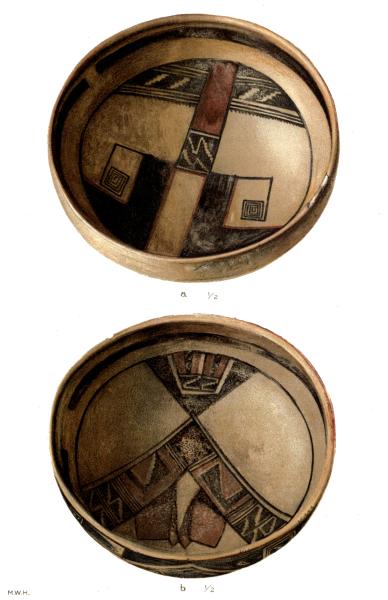
Fig. 296—Single line; open fret

Fig. 297—Single line; broken fret

Fig. 298—Single line; parts displaced

In figure 295, starting with the simple encircling band, it is found divided into alternating rectangles. The line is continuous, and hence one side of each rectangle is not complete. Both this design and its modification in figure 296 consist of an unbroken line of equal breadth throughout. In the latter figure, however, the openings in the sides are larger or the approach to a straight line closer. The forms are strictly rectangular, with no additional elements. Figure 297 introduces an important modification of the rectangular motive, consisting of a succession of lines broken at intervals, but when joined are always arranged at right angles.
Fig. 299—Open fret; attachment displaced

Fig. 300—Simple rectangular design
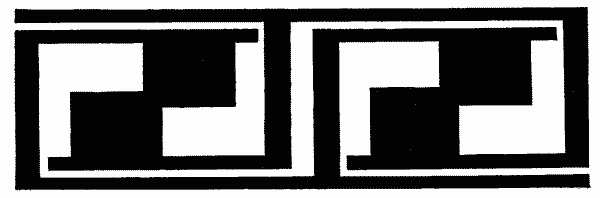
Possibly the least complex form of rectangular ornamentation, next to a simple bar or square, is the combination shown in figure 298, a type in which many changes are made in interior as well as in exterior decorations of Pueblo ware. One of these is shown in figure 299, where the figure about the vessel is continuous. An analysis of the elements in figure 300 shows squares united at their angles, like the last, but that in addition to parallel bands connecting adjacent figures there are two marginal lines uniting the series. Each of the inner parallel lines is bound to a marginal on the opposite side by a band at right angles to it. The marginal lines are unbroken through the length of the figure. Like the last, this motive also may be regarded as developed from a single line.
Fig. 301—Rectangular reversed S-form

Fig. 302—Rectangular S-form with crooks

Figures 301 and 302 are even simpler than the design shown in figure 300, with appended square key patterns, all preserving rectangular forms and destitute of all others. They are of S-form, and differ more especially in the character of their appendages.
Fig. 303—Rectangular S-form with triangles
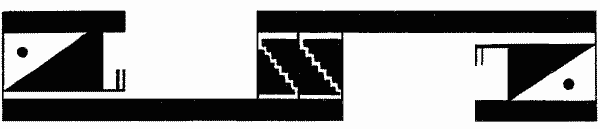
Fig. 304—Rectangular S-form with terraced triangles
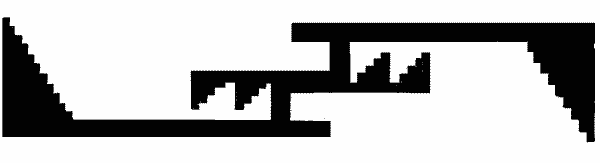
While the same rectangular idea predominates in figure 303, it is worked out with the introduction of triangles and quadrilateral designs. This fairly compound pattern, however, is still classified among rectangular forms. A combination of rectangular and triangular geometric designs, in which, however, the former predominate, is shown in figure 304, which can readily be reduced to certain of those forms already mentioned. The triangles appear to be subordinated to the rectangles, and even they are fringed on their longer sides with terraced forms. It may be said that there are but two elements involved, the rectangle and the triangle.
Fig. 305—S-form with interdigitating spurs

The decoration in figure 305 consists of rectangular and triangular figures, the latter so closely approximated as to leave zigzag lines in white. These lines are simply highly modified breaks in bands which join in other designs, and lead by comparison to the so-called "line of life" which many of these figures illustrate.
Fig. 306—Square with rectangles and parallel lines
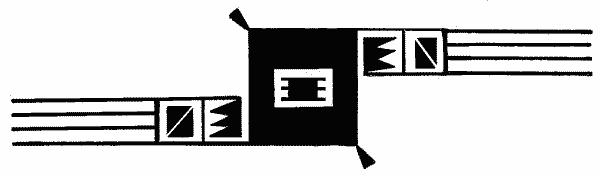
Fig. 307—Rectangles, triangles, stars, and feathers

The distinctive feature of figure 306 is the square, with rectangular designs appended to diagonally opposite angles and small triangles at intermediate corners. These designs have a distant resemblance to figures later referred to as highly conventionalized birds, although they may be merely simple geometrical patterns which have lost their symbolic meaning.
Fig. 308—Crook, feathers, and parallel lines

Figure 307 shows a complicated design, introducing at least two elements in addition to rectangles and triangles. One of these is a curved crook etched on a black ground. In no other exterior decoration have curved lines been found except in the form of circles, and it is worthy of note how large a proportion of the figures are drawn in straight lines. The circular figures with three parallel lines extending from them are found so constantly in exterior decorations, and are so strikingly like some of the figures elsewhere discussed, that I have ventured a suggestion in regard to their meaning. I believe they represent feathers, because the tail-feathers of certain birds are symbolized in that manner, and their number corresponds with those generally depicted in the highly conventionalized tails of birds. With this thought in mind, it may be interesting to compare the two projections, one on each side of the three tail-feathers of this figure, with the extremity of the body of a bird shown in plate cxli, e. On the supposition that a bird figure was intended in this design, it is interesting also to note the rectangular decorations of the body and the association with stars made of three blocks in several bird figures, as already described. It is instructive also to note the fact that the figure of a maid represented in plate cxxix, a, has two of the round designs with appended parallel lines hanging to her garment, and four parallel marks drawn from her blanket. It is still customary in Hopi ceremonials to tie feathers to the garments of those who personate certain mythic beings, and it is possible that such was also the custom at Sikyatki. If so, it affords additional evidence that the parallel lines are representations of feathers.
Fig. 309—Crooks and feathers

Fig. 310—Rectangle, triangles, and feathers

Fig. 311—Terraced crook, triangle, and feathers
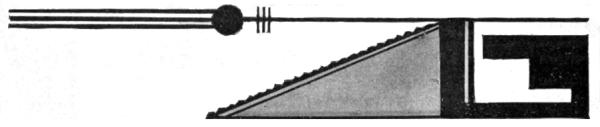
BUREAU OF AMERICAN ETHNOLOGY—— SEVENTEENTH ANNUAL REPORT PL. CLXV FOOD BOWLS WITH GEOMETRIC ORNAMENTATION FROM SIKYATKI
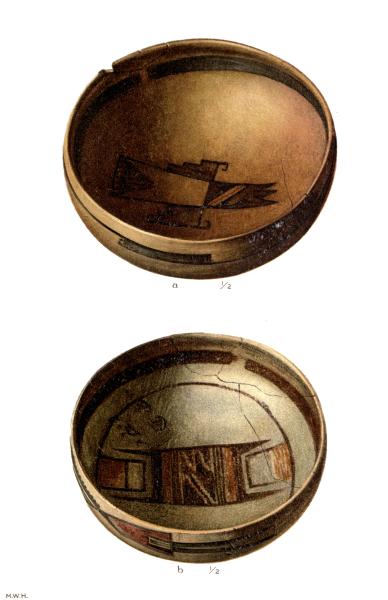
In figure 308 a number of these parallel lines are represented, and the general character of the design is rectangular. In figure 309 is shown a combination of rectangular and triangular figures with three tapering points and circles with lines at their tips radiating instead of parallel. Another modification is shown in figure 310 in which the triangle predominates, and figure 311 evidently represents one-half of a similar device with modifications.
Fig. 312—Double key

Fig. 313—Triangular terrace
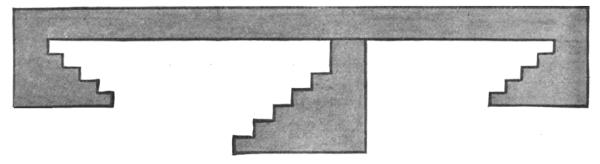
One of the most common designs on ancient pottery is the stepped figure, a rectangular ornamentation, modifications of which are shown in figures 312-314. This is a very common design on the interior of food vessels, where it is commonly interpreted as a rain-cloud symbol.
Fig. 314—Crook, serrate end

Of all patterns on ancient Tusayan ware, that of the terrace figures most closely resemble the geometrical ornamentation of cliff-house pottery, and there seems every reason to suppose that this form of design admits of a like interpretation. The evolution of this pattern from plaited basketry has been ably discussed by Holmes and Nordenskiöld, whose works have already been quoted in this memoir. The terraced forms from the exterior of food bowls here considered are highly aberrent; they may be forms of survivals, motives of decoration which have persisted from very early times. Whatever the origin of the stepped figure in Pueblo art was, it is well to remember, as shown by Holmes, that it is "impossible to show that any particular design of the highly constituted kind was desired through a certain identifiable series of progressive steps."
Fig. 315—Key pattern; rectangle and triangles

Fig. 316—Rectangle and crook
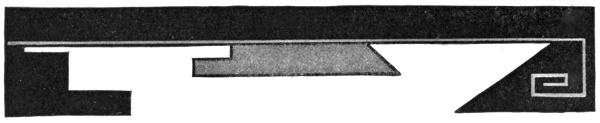
For some unknown reason the majority of the simple designs on the exterior of food bowls from Tusayan are rectangular, triangular, or linear in their character. Many can be reduced to simple or multiple lines. Others were suggested by plaited ware.
Fig. 317—Crook and tail feathers
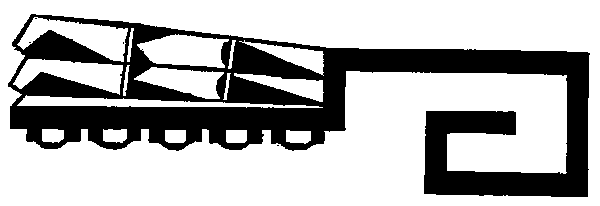
In figure 312 is found one of the simplest of rectangular designs, a simple band, key pattern in form, at one end, with a reentrant square depression at the opposite extremity. In figure 313 is an equally simple terrace pattern with stepped figures at the ends and in the middle. These forms are common decorative elements on the exterior of jars and vases, where they occur in many combinations, all of which are reducible to these types. The simplest form of the key pattern is shown in figure 314, and in figure 315 there is a second modification of the same design a little more complicated. This becomes somewhat changed in figure 316, not only by the modifications of the two extremities, but also by the addition of a median geometric figure.
Fig. 318—Rectangle, triangle, and serrate spurs

Fig. 319—W-pattern; terminal crooks

Fig. 320—W-pattern; terminal rectangles
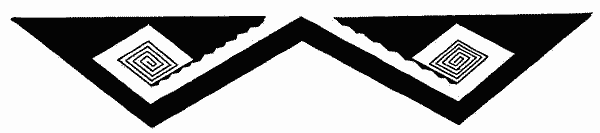
The design in figure 317 is rectangular, showing a key pattern at one end, with two long feathers at the opposite extremity. The five bodies on the same end of the figure are unique and comparable with conventionalized star emblems. The series of designs in the upper left-hand end of this figure are unlike any which have yet been found on the exterior of food bowls, but are similar to designs which have elsewhere been interpreted as feathers. On the hypothesis that these two parts of the figure are tail-feathers, we find in the crook the analogue of the head of a bird. Thus the designs on the equator of the vase (plate cxlv, a), which are birds, have the same crook for the head, and two simple tail-feathers, rudely drawn but comparable with the two in figure 317. The five dentate bodies on the lower left-hand end of the figure also tell in favor of the avian character of the design, for the following reason: These bodies are often found accompanying figures of conventionalized birds (plates cxliv, cliv, and others). They are regarded as modified crosses of equal arms, which are all but universally present in combinations with birds and feathers (plates cxliv, a, b; cliv, a), from the fact that in a line of crosses depicted on a bowl one of the crosses is replaced by a design of similar character. The arms of the cross are represented; their intersection is left in white. The interpretation of figure 317 as a highly conventionalized bird design is also in accord with the same interpretation of a number of similar, although less complicated, figures which appear with crosses. Thus the three arms of plate clx, a, have highly conventionalized bird symbols attached to their extremities. In the cross figure shown in plate clviii, d, we find four bird figures with short, stumpy tail-feathers. These highly conventionalized birds, with the head in the form of a crook and the tail-feathers as parallel lines, are illustrated on many pottery objects, nowhere better, however, than in those shown in plates cxxvi, a, and clx, e. Figure 318 may be compared with figure 317.
Fig. 321—W-pattern; terminal terraces and crooks.
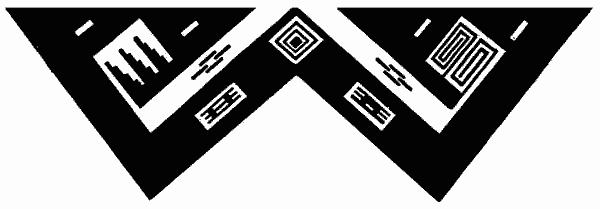
Fig. 322—W-pattern; terminal spurs
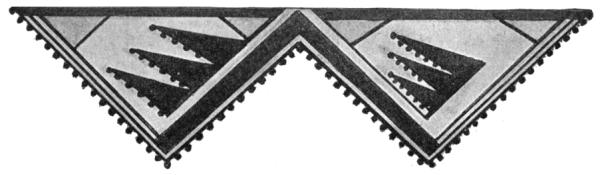
Numerous modifications of a key pattern, often assuming a double triangular form, but with rectangular elements, are found on the exterior of many food bowls. These are variations of a pattern the simplest form of which is shown in figure 319. Resolving this figure into two parts by drawing a median line, we find the arrangement is bilaterally symmetrical, the two sides exactly corresponding. Each side consists of a simple key pattern with the shank inclined to the rim of the bowl and a bird emblem at its junction with the other member.
In figure 320 there is a greater development of this pattern by an elaboration of the key, which is continued in a line resembling a square spiral. There are also dentations on a section of the edge of the lines.
BUREAU OF AMERICAN ETHNOLOGY—— SEVENTEENTH ANNUAL REPORT PL. CLXVI LINEAR FIGURES ON FOOD BOWLS FROM SIKYATKI
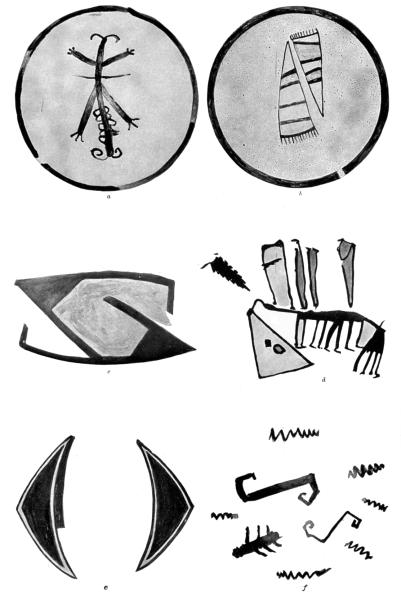
In figure 321 there is a still further development of the same design and a lack of symmetry on the two sides. The square spirals are replaced on the left by three stepped figures, and white spaces with parallel lines are introduced in the arms of a W-shape figure.
Fig. 323—W-pattern; bird form
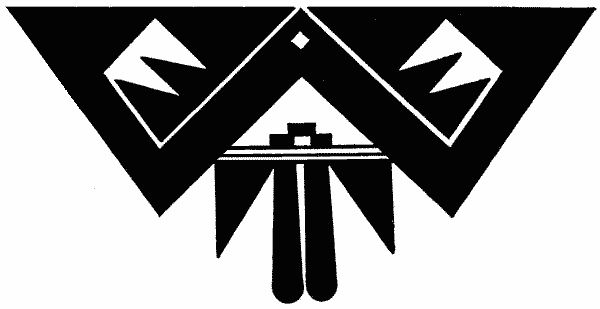
In figure 322 the same design is again somewhat changed by modification of the spirals into three triangles rimmed on one side with a row of dots, which are also found on the outer lines surrounding the lower part of the design.
Fig. 324—W-pattern; median triangle

In figure 323 the same W shape design is preserved, but the space in the lower reentrant angle is occupied by a symmetrical figure resembling two tail-feathers and the extremity of the body of a bird. When this figure is compared with the design on plate cxlvi, a, resemblances are found in the two lateral appendages or wings. The star emblem is also present in the design. The median figure in that design which I have compared to the tail of a bird is replaced in figure 324 by a triangular ornament. The two wings are not symmetrical, but no new decorative element is introduced. It, however, will be noticed that there is a want of symmetry on the two sides of a vertical line in the figure last mentioned. The right-hand upper side is continued into five pointed projections, which fail on the left-hand side. There is likewise a difference in the arrangement of the terraced figures in the two parts. The sides of the median triangles are formed of alternating black and white blocks, and the quadrate figure which it incloses is etched with a diagonal and cross.
Fig. 325—Double triangle; two breath feathers
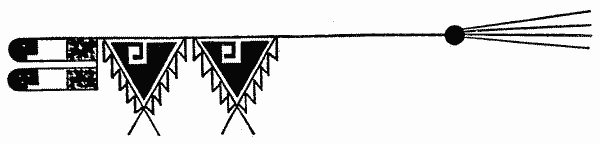
Fig. 326—Double triangle; median trapezoid
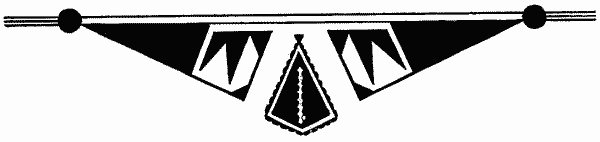
The decoration in figure 325 consists of two triangles side by side, each having marginal serrations, and a median square key pattern. One side of these triangles is continued into a line from which hang two breath feathers, while the other end of the same line ends in a round dot with four radiating, straight lines. The triangles recall the butterfly symbol, the key pattern representing the head.
Fig. 327—Double triangle; median rectangle
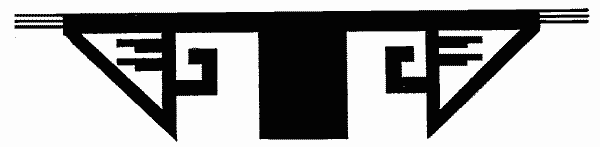
Fig. 328—Double compound triangle; median rectangle

In figure 326 there is a still more aberrant form of the W-shape design. The wings are folded, ending in triangles, and prolonged at their angles into projections to which are appended round dots with three parallel lines. The median portion, or that in the reentrant angle of the W, is a four-sided figure in which the triangle predominates with notched edges. Figure 327 shows the same design with the median portion replaced by a rectangle, and in which the key pattern has wholly disappeared from the wings. In figure 328 there are still greater modifications, but the symmetry about a median axis remains. The ends of the wings instead of being folded are expanded, and the three triangles formerly inclosed are now free and extended. The simple median rectangle is ornamented with a terrace pattern on its lower angles.
Fig. 329—Double triangle; median triangle

Fig. 330—Double compound triangle

Figure 329 shows a design in which the extended triangles are even more regular and simple, with triangular terraced figures on their inner edge. The median figure is a triangle instead of a rectangle.
Fig. 331—Double rectangle; median rectangle
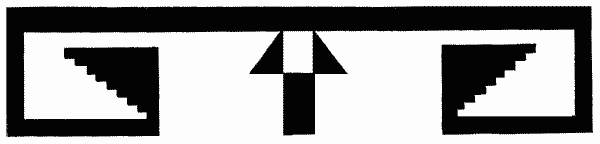
Figure 330 shows the same design with modification in the position of the median figure, and a slight curvature in two of its sides.
Fig. 332—Double rectangle; median triangle

Fig. 333—Double triangle with crooks

Somewhat similar designs, readily reduced to the same type as the last three or four which have been mentioned, are shown in figures 331 and 332. The resemblances are so close that I need not refer to them in detail. The W form is wholly lost, and there is no resemblance to a bird, even in its most highly conventionalized forms. The median design in figure 331 consists of a rectangle and two triangles so arranged as to leave a rectangular white space between them. In figure 332 the median triangle is crossed by parallel and vertical zigzag lines.
Fig. 334—W-shape figure; single line with feathers

In the design represented in figure 333 there are two triangular figures, one on each side of a median line, in relation to which they are symmetrical. Each triangle has a simple key pattern in the middle, and the line from which they appear to hang is blocked off with alternating black and white rectangles. At either extremity of this line there is a circular dot from which extend four parallel lines.
Fig. 335—Compound rectangle, triangles, and feathers

A somewhat simpler form of the same design is found in figure 334, showing a straight line above terminating with dots, from which extend parallel lines, and two triangular figures below, symmetrically placed in reference to an hypothetical upright line between them.
Fig. 336—Double triangle

Figure 335 bears a similarity to the last mentioned only so far as the lower half of the design is concerned. The upper part is not symmetrical, but no new decorative element is introduced. Triangles, frets, and terraced figures are inserted between two parallel lines which terminate in round dots with parallel lines.
BUREAU OF AMERICAN ETHNOLOGY—— SEVENTEENTH ANNUAL REPORT PL. CLXVII GEOMETRIC ORNAMENTATION FROM AWATOBI
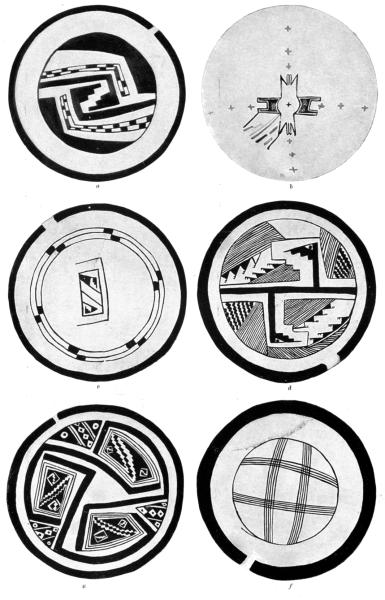
Fig. 337—Double triangle and feathers

The design in figure 336 is likewise unsymmetrical, but it has two lateral triangles with incurved terrace and dentate patterns. The same general form is exhibited in figure 337, with the introduction of two pointed appendages facing the hypothetical middle line. From the general form of these pointed designs, each of which is double, they have been interpreted as feathers. They closely resemble the tail-feathers of bird figures on several bowls in the collection, as will be seen in several of the illustrations.
Fig. 338—Twin triangles
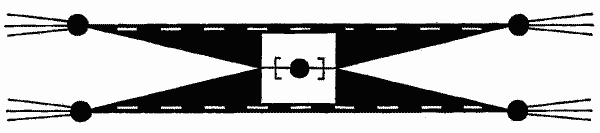
Fig. 339—Triangle with terraced appendages
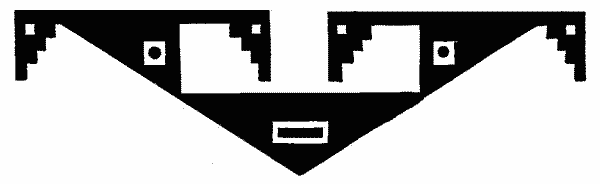
Fig. 340—Mosaic pattern

Figure 338 is composed of two triangular designs fused at the greatest angles. The regularity of these triangles is broken by a square space at the fusion. At each of the acute angles of the two triangles there are circular designs with radiating lines, a common motive on the exterior of food bowls. Although no new elements appear in figure 338, with the exception of bracket marks, one on each side of a circle, the arrangement of the two parts symmetrically about a line parallel with the rim of the bowl imparts to the design a unique form. The motive in figure 339 is reducible to triangular and rectangular forms, and while exceptional as to their arrangement, no new decorative feature is introduced.
The specimen represented in figure 340 has as its decorative elements, rectangles, triangles, parallel lines, and birds' tails, to which may be added star and crosshatch motives. It is therefore the most complicated of all the exterior decorations which have thus far been considered. There is no symmetry in the arrangement of figures about a central axis, but rather a repetition of similar designs.
Fig. 341—Rectangles, stars, crooks, and parallel lines

The use of crosshatching is very common on the most ancient Pueblo ware, and is very common in designs on cliff-house pottery. This style of decoration is only sparingly used on Sikyatki ware. The crosshatching is provisionally interpreted as a mosaic pattern, and reminds one of those beautiful forms of turquois mosaic on shell, bone, or wood found in ancient pueblos, and best known in modern times in the square ear pendants of Hopi women. Figure 340 is one of the few designs having terraced figures with short parallel lines depending from them. These figures vividly recall the rain-cloud symbol with falling rain represented by the parallel lines. Figure 341 is a perfectly symmetrical design with figures of stars, rectangles, and parallel lines. It may be compared with that shown in figure 340 in order to demonstrate how wide the difference in design may become by the absence of symmetrical relationship. It has been shown in some of the previous motives that the crook sometimes represents a bird's head, and parallel lines appended to it the tail-feathers. Possibly the same interpretation may be given to these designs in the following figures, and the presence of stars adjacent to them lends weight to this hypothesis.
Fig. 342—Continuous crooks

Fig. 343—Rectangular terrace pattern
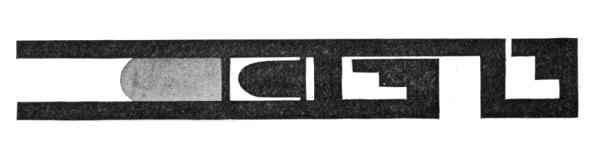
An indefinite repetition of the same pattern of rectangular design is shown in figure 342. This highly decorative motive may be varied indefinitely by extension or concentration, and while it is modified in that manner in many of the decorations of vases, it is not so changed on the exterior of food bowls.
There are a number of forms which I am unable to classify with the foregoing, none of which show any new decorative design. All possible changes have been made in them without abandoning the elemental ornamental motives already considered. The tendency to step or terrace patterns predominates, as exemplified in simple form in figure 343. In figure 344 there is a different arrangement of the same terrace pattern, and the design is helped out with parallel bands of different length at the ends of a rectangular figure. A variation in the depth of color of these lines adds to the effectiveness of the design. This style of ornamentation is successfully used in the designs represented in figures 345 and 346, in the body of which a crescentic figure in the black serves to add variety to a design otherwise monotonous. The two appendages to the right of figure 346 are interpreted as feathers, although their depart forms widely from that usually assumed by these designs. The terraced patterns are replaced by dentate margins in this figure, and there is a successful use of most of the rectangular and triangular designs.
Fig. 344—Terrace pattern with parallel lines
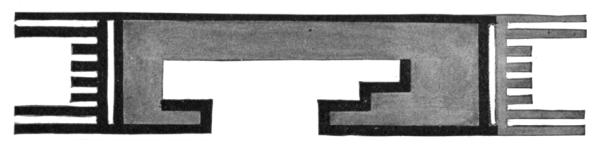
Fig. 345—Terrace pattern

Fig. 346—Triangular pattern with feathers
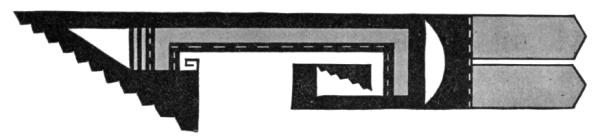
In the specimens represented in figures 347 and 348 marginal dentations are used. I have called the design referred to an S-form, which, however, owing to its elongation is somewhat masked. The oblique bar in the middle of the figure represents the body of the letter, the two extremities taking the forms of triangles.
Fig. 347—S-pattern

Fig. 348—Triangular and terrace figures
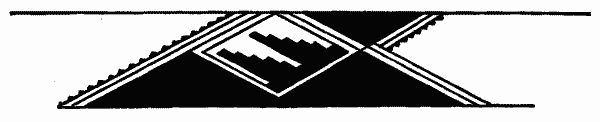
So far as decorative elements are concerned the design in figure 349 can be compared with some of those preceding, but it differs from them in combination. The motive in figure 350 is not unlike the ornamentation of certain oriental vases, except from the presence of the terraced figures. In figure 351 there are two designs separated by an inclined break the edge of which is dentate. This figure is introduced to show the method of treatment of alternating triangles of varying depth of color and the breaks in the marginal bands or "lines of life." One of the simplest combinations of triangular and rectangular figures is shown in figure 353, proving how effectually the original design may be obscured by concentration.
Fig. 349—Crook, terrace, and parallel lines

Fig. 350—Triangles, squares, and terraces

In the foregoing descriptions I have endeavored to demonstrate that, notwithstanding the great variety of designs considered, the types used are very limited in number. The geometrical forms are rarely curved lines, and it may be said that spirals, which appear so constantly on pottery from other (and possibly equally ancient or older) pueblos than Sikyatki, are absent in the external decorations of specimens found in the ruins of the latter village.
Every student of ancient and modern Pueblo pottery has been impressed by the predominance of terraced figures in its ornamentation, and the meaning of these terraces has elsewhere been spoken of at some length. It would, I believe, be going too far to say that these step designs always represent clouds, as in some instances they are produced by such an arrangement of rectangular figures that no other forms could result.