Chapter LXX
Reading edition
BEGINNING OF THE NEW YEAR. — ANOMALOUS RISING OF THE NIGER. — COMMERCIAL RELATIONS OF TIMBÚKTU.
I had long cherished the hope that the beginning of 1854 would have found me far advanced on my homeward journey; but greatly disappointed in this expectation, I began the year with a fervent prayer for a safe return home in the course of it.
El Médani, my friend from Swéra, or Mogadore, whom I used to call my political thermometer, or rather my politico-meter, on account of his exhibiting towards me friendly feelings only at times when he saw everything quiet, sent me his compliments in the morning of the first of January; nay, even the two leaders of the hostile factions,—Hammádi, the rival of my protector, and Táleb Mohammed, the wealthiest merchant in the town, and the leader of the intriguing merchants from Morocco,—gave me to understand that they wanted to enter into friendly relations with me. My health as yet was very precarious; but I felt so much recovered in mind and body that, preparatory to my longed for departure, I began arranging the remainder of my baggage, which, with the exception of my small library, had been very much reduced. To my great astonishment and delight, while searching through my lumber, I found another thermometer in good repair. From the remainder of my broken instruments I picked up a good deal of quicksilver, which I gave to the Sheikh, who himself, as well as his other unsophisticated friends, derived a great deal of amusement from observing the qualities of this metal. Meanwhile, my protector endeavoured to make me fully acquainted with the political relation in which he stood to his brothers, Sídi Mohammed and Zén el ʿAbidín, whom he expected soon to arrive, and of whose different views in politics he gave me some slight hints; and I lamented greatly that the power of this noble family, instead of being strengthened by the number of its conspicuous scions, was only rent and split by the divergency of their views.
The course of my material existence went on very uniformly, with only slight variations. My daily food, when I was in the town, consisted of some milk and bread in the morning, a little kuskus, which the Sheikh used to send, about two in the afternoon, and a dish of negro millet, containing a little meat, or seasoned with the sauce of the kobéwa, or Cucurbita Melopepo, after sunset. The meat of Timbúktu, at least during the cold season, agreed with me infinitely better than that of any other part of Negroland; but this was not the case with the Melopepo, although it is an excellent and palatable vegetable. In the beginning of my stay I had consumed a great many young pigeons, which form a favourite dainty in this city. They are sold at the almost incredibly cheap rate of ten shells each, or at the rate of three hundred for a dollar; but the poor little things were used for culinary purposes so soon after breaking the shell as to be almost tasteless. A very rare dainty was formed by an ostrich egg, which was one day brought to me. This article is more easily to be obtained in the desert than in the towns, and such strong food, moreover, is not well adapted to the stomach of a resident. The Sheikh used also to send me a dish late at night, sometimes long after midnight; but, on account of the late hour, I never touched it, and left it to my servants.
It had been arranged that we should make another excursion to Kábara, but our visit was put off from day to day, although I was extremely anxious to witness the features of the country, in the present high level of the river, at the place where I had first landed on my arrival. Thus I was reduced, for entertainment, to my intercourse with the Sheikh, his kinsfolk, and followers; and as religious topics were always brought forward more prominently by my enemies, but especially in the learned letters which the emír of Hamda-Alláhi sent in reply to the Sheikh[1], my conversation with the former now began to turn more and more upon religious subjects, such as the return of the Messiah, and on the meaning of the name “Paraclete” given in the New Testament to the Holy Spirit, who was to descend upon the apostles, but which by the Mohammedans in more recent times is applied to Mohammed, whose coming, they say, is predicted in this instance by the Holy Book of the Christians.
One day when I visited the Sheikh, the two brothers were engaged in an animated discussion respecting the relation of ʿAísa (Jesus Christ) to Mohammed, and a warm dispute arose on the sophistical question, whether it would be allowed, after the return of ʿAísa upon earth, to eat camel’s flesh. The Sheikh himself was anxious to prove how difficult it would be for themselves to change any part of their creed after the return of ʿAísa, owing to the difference which existed between the precepts of the two prophets, and thus intended to excuse the Christians for not embracing the creed of Mohammed, after having once adopted that of ʿAísa. The two learned men, in the heat of their dispute, had overlooked the fact that the camel was a prohibited animal to the Jews, but not to the Christians, and hence that the return of ʿAísa would not interfere with their favourite repast. It was by cheerfully entering into these discussions that I obtained for myself the esteem even of those who were most anxious to extort from me as much as possible of my remaining property.
The arrival of another small caravan of the Tawáti was very near causing me a serious embarrassment. Some of the merchants from Morocco, excited by commercial jealousy, had spread the report that the calico brought by that caravan was Christian property, belonging to the English agent in Ghadámes: and I had some difficulty in making the people understand, that, even if that article had originally belonged to the agent, it was now the property of the Tawáti merchants. The presence of those people, also, caused the road to the north, by way of Tawát, to be again brought under discussion, as the route most suitable for my home-journey. My departure was now discussed almost daily; the arrival of our lively and talkative, but indiscreet messenger, Áhmed el Wádáwi, who had at length returned from his errand to the Awelímmeden, holding out the hope that my departure was in reality not far distant; but the fact that none of the Tawárek had come with him, notwithstanding his assertion that they were soon to follow, convinced me that my prospect of departure was put off for an indefinite period.
Towards the end of January the waters of the river reached their highest level, exhibiting that marvellous anomaly, in comparison with the period of the rising of other African rivers north of the equator, which is calculated to awaken astonishment in any man acquainted with the subject. For when he knows that the rising of these rivers is due to the fall of the tropical rains, he will naturally expect that the Niger, like its eastern branch, the Tsádda or Bénuwé, or the Nile, should reach its highest level in August or September. The fact can only be partly explained with the means at our disposal, and in the present state of our knowledge of this part of Africa, although it is illustrated by similar cases, if we compare it with the anomalous rising of some South-African rivers; especially the grand discovery of Dr. Livingstone, the Liambézi, which, forming in its upper course an immense shallow sheet of water, collects here the greatest amount of water at a time (July and August) when its lower course, the Zambézi, separated from it and withdrawn from the immediate effects of the waters collected above by the marvellous narrowing of the river-bed from the Falls of Victoria[2] downwards, is in its lowest state, and, through the influence of the water by which it is joined in its lower course, reaches here its highest level at quite a different season, February and March. We have before us exactly the same phenomenon in the case of the Niger, the great West-African river, which, according to the most accurate information which I was able to gather on the spot, every year continues to rise till the end of December or the beginning of January, and does not begin to decrease before February; while its eastern branch, the Bénuwé, as well as the lower course of the Niger, where it is called Kwára, exactly as is the case with the Nile, reaches its highest level by the end of August and begins to decrease steadily in the course of October.
To explain the difference and anomaly of these phenomena we must attend to the different character of these rivers. For while the Bénuwé after having once assumed a westerly direction follows it up with but very little deviation, the great western branch describes three quarters of an immense circle, and having but very little fall in the greater part of its extraordinary winding course, the waters which flow towards it from the more distant quarters require a long time to reach its middle course, so that the rain which falls in the course of September and October in the country of the Wangaráwa, or the South-eastern Mandigoes, will certainly continue to swell the river at Timbúktu till the end of November or even December; for that rain falls in those quarters behind the coast of Sierra Leone and Cape Palmas till the end of September, and perhaps even in October, we may conclude with some degree of certainty from the fact that such is the case on the coast[3]; and this is confirmed as regards Kakóndi and Tímbo by Caillié’s observations.[4] In the mountainous southern provinces of Abessinia, too, whose latitude corresponds exactly with that of the regions from whence the feeders of the Niger take their rise, the most constant fall of rain has been observed in September. Now while the whole region between Jenne and Timbúktu is of a very flat and level character, so that the river, running along at a very slow rate and with a very meandering course, not only fills a very broad stream spreading out over the neighbouring low lands, but forms also a great many backwaters and basins or lakes of which the Débo is only one although perhaps the largest in size, the river lower down beyond Bamba, and especially in the district called Tin-sherífen which we shall visit on our return journey, is shut in and reduced to the width of a few hundred yards, so that the water, having expanded over such an immense tract and not exercising therefore the same pressure which such a volume of water would do under other circumstances if it were kept together in a narrower channel, preserves its level or even still increases in extent and depth, while the surplus produced by the fall of rain in the country higher up has already diminished.
This is my mode of accounting for a phenomenon which seems to contradict in so great a measure the whole of the phenomena which have come under our observation with regard to the effects of rain and the rising of the rivers north and south of the equator, and imparts to the upper course of the Niger the same character as the Gabún and other rivers of the equatorial line which reach their highest level in the course of February.
Of course this state of the upper river, although it does not reach always the same level, cannot fail to exercise an influence also upon the lower part, where it is called Kwára, and where it has been visited repeatedly by Englishmen. But although, on account of their being unaware of this character of the river, they have not paid much attention to its features at the beginning of the hot season, and have even rarely visited it at that period, nevertheless Mr. Laird, who spent several months in the Kwára, has not failed to observe a phenomenon which exactly corresponds to the state of the river which I have just described. For he records[5] the surprising fact, which formerly must have been quite unintelligible, but which now receives its full illustration, namely, that the river at Iddá began to rise on the 22nd of March. This, in my opinion, he erroneously attributes to the rains up the country, as there are no rains whatever during the whole of March, and only a few drops in April; but it is evidently the effect of the waters in the upper and wide part of the river at length beginning to decrease about the middle of February, if we take the current at from 2½ to 3 miles, as the windings of the river extend to not much less than 2000 miles between Kábara and Iddá. The elevation of Timbúktu above the level of the sea I assume to be about 900 feet.
It was on the 4th of January that the first boat from Kábara approached close to the walls of the town of Timbúktu; and, as the immediate result of such a greater facility of intercourse, the supply of corn became more plentiful, and, in consequence, much cheaper: the sʿaa of millet being sold for 40 shells, and the suníye, that is to say, more than two hundred pounds’ weight, for 3000, or one Spanish dollar, certainly a very low rate; while I myself, as a foreigner and a stranger, had to pay 3750. The high state of the waters was naturally of the greatest interest to me; and, in order to satisfy my curiosity, the Sheikh took me out on the 9th. Emerging from the town at about the middle of the western wall, where formerly the báb el gibleh[6] was situated, we went first to the nearest creek of the river, but found here no boats; and then crossing an extremely barren and stony level reached another branch of the creek, where eight or ten smaller boats, without a covering or cabin, were lying; the innermost corner of this creek not being more than four or five hundred yards distant from the Great Mosque, or Jíngeré-bér. All the people asserted that the river, at Kábara, had now reached its highest level, and even affirmed that it had begun to fall here on the 7th; but, nevertheless, it became evident that the waters were still rising during the whole of the month,—almost endangering the safety of the town. On this occasion I learned that a great inundation in 1640 had flooded a considerable part of the town, and converted into a lake the central and lowest quarter, which is called Bagíndi, a name derived, as is asserted, from the tank thus formed having been enlivened by hippopotami.[7]
Interesting as was that day’s excursion it cost me dear; for being obliged, not only to be armed myself, but also to have an armed servant with me, I greatly excited the hostile feelings of the merchants from Morocco, and especially of that proud nobleman, ʿAbd e’ Salám, who went about among the great men of the town, saying, that in Morocco we, the Europeans, or rather the English, were not allowed to wear arms. But to show the absurdity of this assertion, I stated that while travelling in Morocco we received armed horsemen for an escort, while here, where there was no settled form of government, we had to protect ourselves. He then spread the rumour that an armed English vessel had ascended the river as far as Gógó; and this curious report was backed with such strong assertions that my own servant, ʿAlí el Ágeren, felt convinced of its truth, and thought it strange when I attempted to prove its absurdity.
But notwithstanding this hostile feeling, ʿAbd e’ Salám deemed it prudent to send, next day, his friend, Múláy el Méhedí, in order to excuse himself for the expressions which he had used a few days before with regard to me. It was this man, Múláy el Méhedí, with whom I should have liked to be able to converse on friendly terms, as he was a person of intelligence, and even possessed some little knowledge of astronomy. Indeed, I was not a little astonished when, conversing with him one day about the situation of Timbúktu, he came out with the statement that the town was situated about 18° N. lat., without my having thrown out the slightest hint in this respect.
All this time the whole of the surrounding country was in a most disturbed state, owing to several expeditions, or forays, which were going on, especially by the restless tribe of the Welád ʿAlúsh. They had lately taken 600 camels from the Welád Mebárek, and had now turned their predatory incursions into another direction.
On the 12th of January we again went to the tents, which had now been pitched in another spot, called Ingómaren, at a distance of about six miles a little S. from E.; but this time our stay in the encampment was very unlucky for me in several respects. On the 13th I felt tolerably well, and had a cheerful conversation with my protector about my approaching departure, when he sent me several presents, such as a large cover for the top of the tent[8], called “sarámmu” by the Songhay, “e’ béni erréga” by the Moors hereabout, and several leather pillows; but on the 14th, a little after noon, I was seized with such a sudden and severe attack of fever as I had never experienced before, accompanied by violent shivering fits, which made my kind host fear that I had been poisoned. I had drunk, a short time before, some sour milk brought me by a Berbúshi, that is to say, a man who, although intimately attached to the family of the Sheikh, originally belonged to the tribe of the Berabísh, whose chief murdered Major Laing. Although I myself had no suspicion that the milk which I had drunk had in any way contributed to my sudden attack of illness, yet as that man had some private animosity against me, and did not seem content with a present which I had made him in return for his small gift, I became so irritated, that I ordered him away in a very unceremonious manner, which caused a most unpleasant scene; for, at this conjuncture, all the people, including my own servants and even my very best friends amongst the Sheikh’s people, without paying any regard to my feeble state, gave vent to their feelings against me as a Christian.
But the Sheikh himself did not for a moment change his kind disposition, sending me tea repeatedly, and calling frequently to see how I was getting on. Fortunately, a tranquil night’s repose restored me again to health, and the following morning my friends came to me, one after the other, in order to beg my pardon for their neglect. While we were conversing on the preparations for my journey, a messenger brought the news of the arrival of a very intimate friend of the Sheikh,—Mohammed ben ʿAbd-Alláhi el Fútáwi,—who had come, with a numerous suite, in order to stay some time with the Sheikh, and, if possible, to be cured by me of some serious disease: and the prospect of soon leaving this quarter was greatly darkened by this circumstance.
January 15th.This was one of those rainy days which are said not to be unusual towards the end of January and the beginning of February in this quarter along the river, though, in the other parts of Negroland that I had visited, I had never beheld anything of the kind. But the quantity of rain that fell even here was very little, for the sky, which had been cloudy in the morning, cleared up about noon; and although in the afternoon it became again overcast, with thunder in the distance followed by lightning towards evening, yet there fell only a few drops of rain in the course of the night.
On the 16th, having made a good breakfast on a goat roasted whole before the fire, we returned again into the town, where I was desired to cure a man of a disease over which I had no power. The character and position of the person would have rendered it a circumstance of the highest importance to me if I had been able to do so. The chronic disease under which Mohammed ben ʿAbd-Alláhi, for this is the person of whom I speak, was labouring, cast a melancholy gloom over him. I admired his manners, and the fine expression of his features; but I was disappointed to find that, although well versed in his religious books, he did not possess any historical knowledge as to the former state of these countries, which formed an object of the highest interest to me. The arrival of this person made my protector forget all the thoughts of my immediate departure.
Besides this circumstance, nothing of interest happened for some days, all the people exhorting me to patience; and, my departure being again put off, fresh attempts were made to convert me, even by my friends, who from sheer friendship could not bear to see me adhere to a creed which they thought erroneous. But I withstood all their attacks, and at times even ventured to ridicule freely some of their superstitious notions. I was far from laughing at the chief principles of their doctrine; but, as they always recurred in their arguments to their belief in sorcery and demons, I declared one day that, as for us, we had made all the demons our “khóddemán.” This is an expression with which these people are wont to denote the degraded and servile tribes; and I represented the Europeans as having obtained a victory over the spirits, by ascending in balloons into the higher regions, and from thence firing at them with rifles. The idea that the Christians must have subjected to their will the demoniacal powers, occurs very easily to the mind of the Mohammedan, who does not understand how the former are able to manufacture all the nice things which issue from their hands.
Meanwhile I was glad to break off my relations with my former friend the Waláti, who had recently returned from a journey to Áribínda, and who came to ask me officially whether he was to accompany me on my home journey or not; but although I told him plainly, that after all that had happened he could no longer be my companion, I treated him with more generosity than he deserved.
At the same time, I thought it also prudent to cultivate the good will of my servant ʿAlí el Ágeren, although he had almost entirely separated himself from me, and left me to my fate, since he had become fully aware of the dangerous nature of my position. I demanded from him no sort of service, though his salary of nine dollars a month went on all the time. However, being rather short of cash, and not being able to procure a loan from the people to whom I had been recommended, I was glad to obtain from a friendly Ghadámsi merchant, of the name of Mohammed ben ʿAlí ben Táleb, about 50,000 shells, equal to 13⅓ mithkál, reckoned at 3800 shells each, and I afterwards was obliged to add another small sum, making the whole 25 mithkáls.
In this place I think it well to give a short sketch of the commercial relations of Timbúktu, though it cannot make the slightest pretension to completeness, as I did not enter into such free intercourse with the natives as would have enabled me to combine a sufficient number of facts into a graphic view of the commercial life of the city. The people with whom I had most intercourse could offer little or no information on the subject. My situation in Kanó had been very different.
The great feature which distinguishes the market of Timbúktu from that of Kanó is the fact, that Timbúktu is not at all a manufacturing town, while the emporium of Háusa fully deserves to be classed as such. Almost the whole life of the city is based upon foreign commerce, which, owing to the great northerly bend of the Niger, finds here the most favoured spot for intercourse, while at the same time that splendid river enables the inhabitants to supply all their wants from without; for native corn is not raised here in sufficient quantities to feed even a very small proportion of the population, and almost all the victuals are imported by water-carriage from Sansándi and the neighbourhood.
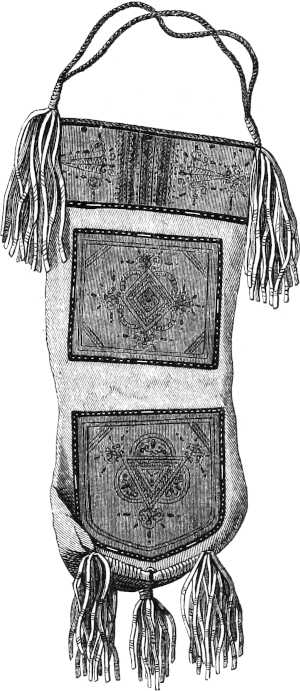
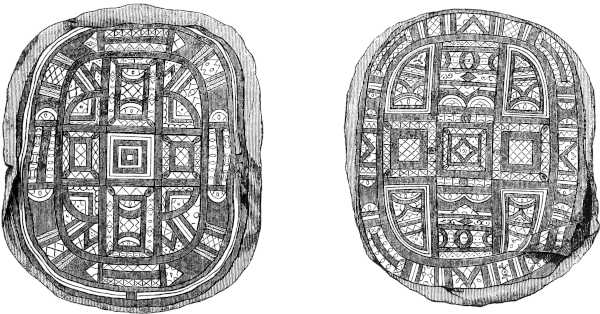
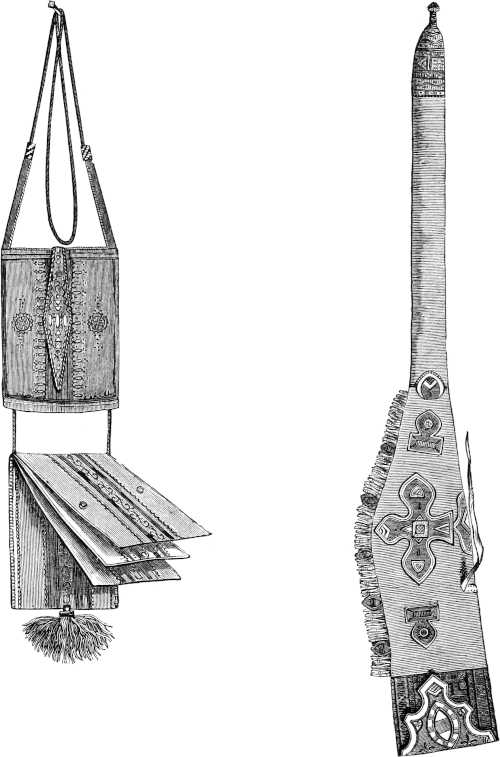
The only manufactures carried on in the city, as far as fell under my observation, are confined to the art of the blacksmith, and to a little leatherwork. Some of these articles, such as provision or luggage bags, cushions, small leather pouches for tobacco, and gun-cloths, especially the leather bags, are very neat, as shown in the accompanying wood-cuts; but even these are mostly manufactured by Tawárek, and especially females, so that the industry of the city is hardly of any account. It was formerly supposed that Timbúktu was distinguished on account of its weaving[9], and that the export of dyed shirts from hence was considerable; but I have already had an opportunity of showing that this was entirely a mistake, almost the whole clothing of the natives themselves, especially that of the wealthier classes, being imported either from Kanó[10] or from Sansándi, besides the calico imported from England. The export of the produce of Kanó, especially by way of Árawán, extends to the very border of the Atlantic, where it comes into contact with the considerable import of Malabar cloth by way of St. Louis, or Ndér, on the Senegal, while the dyed shirts from Sansándi, which, as far as I had an opportunity of observing, seem to be made of foreign or English calico, and not of native cotton, do not appear to be exported to a greater distance. These shirts are generally distinguished by their rich ornament of coloured silk, and look very pretty; and I am sorry that I was obliged to give away, as, a present a specimen which I intended to bring home with me. The people of Timbúktu are very experienced in the art of adorning their clothing with a fine stitching of silk, but this is done on a very small scale, and even these shirts are only used at home. There is, however, a very considerable degree of industry exercised by the natives of some of the neighbouring districts, especially Fermágha, who produce very excellent woollen blankets, and carpets of various colours, which form a most extensive article of consumption with the natives.
The foreign commerce has especially three great high-roads: that along the river from the south-west (for lower down the river there is at present scarcely any commerce at all), which comprises the trade proceeding from various points; and two roads from the north, that from Morocco on the one hand, and that from Ghadámes on the other. In all this commerce, gold forms the chief staple, although the whole amount of the precious metal exported from this city appears to be exceedingly small, if compared with a European standard. It probably does not exceed an average of 20,000l. sterling per year.[11] The gold is brought either from Bambúk or from Búre, but from the former place in a larger quantity. The gold from the country of the Wángaráwa does not reach this market, but, as it seems, at present is directly exported to that part of the southern coast which on this account is called the Gold Coast. The species of gold from Bambúk is of a more yellow colour; that from Búre is rather whitish; and that from Wángara has a greenish hue. Most of this gold, I think, is brought into the town in rings. I do not remember to have seen or heard of gold dust, or “tibber,” being brought to market in small leathern bags, such as Shabíni and other people describe, containing about one ounce, equal to twenty-five dollars in value. But, nevertheless, a considerable amount of this article must come into market, as most of the gold dust which comes to Ghadámes and Tripoli passes through Timbúktu, while another portion goes directly from Sansándi to Árawán.[12]
It was evidently in consequence of the influence of the Arabs, that the scale of the mithkál[13] was introduced in the trade in gold; but it is a very general term, which may signify very different quantities, and thus we find various kinds of mithkáls used in Negroland, especially those of Ágades, Timbúktu, and Mango, the Mandingo place between Yendí and the Niger, the former of which is the smallest, and equal, as I have stated in the proper place, to 1000 shells of Háusa standard, although in the present decayed state of the town of Ágades, where all the gold trade has ceased, it possesses rather an imaginary value. The mithkál of Timbúktu contains the weight of 24 grains of the kharúb tree, or 96 of wheat, and is worth from 3000 to 4000 shells.[14] The mithkál of Mango is equal to 1¼ of that of Timbúktu. Besides rings, very handsome ornaments are worked of gold; but, as far as I could learn, most of this workmanship comes from Waláta, which is still celebrated on this account.[15]
The next article that forms one of the chief staples in Timbúktu, and in some respects even more so than gold, is salt, which, together with gold, formed articles of exchange all along the Niger from the most ancient times.[16] It is brought from Taödénni, a place whose situation has been tolerably well established by M. Caillié’s journey[17], and the mines of which have been worked, as we know from Áhmed Bábá, since the year 1596, when the former mines of Tegháza, situated some seventy miles further to the north, were given up. These salt mines of Tegháza appear to have been worked from very remote times, or at least before the eleventh century; and there can be little doubt that the mines of Tátentál, described by the excellent geographer El Bekrí as situated twenty days’ journey from Sijilmésa, and two from the beginning of the desert, are identical with Tegháza. Even at that time both Sigilmésa and Ghánata were provided from here, while at least the eastern and original portion of Songhay was supplied at that early period from the mines of Taútek, six days from Tademékka.[18]
In Taödénni the salt, which covers a very extensive tract of ground in the district “El-Jóf,” is formed in five layers, or “úje,” the uppermost of which is called el-wára; the second, el-bentí; the third, el-hammamíye; the fourth, el-káhela, or the black one; and the lowest, which is embedded in the water, el-kámera, or el-bédha. The upper of these layers are of little value, and the most in request is the fourth layer, or el-káhela, the colour of which is a most beautiful intermixture of black and white, like a species of marble. The ground is let out by the “káíd,” who resides here, and whose name at the present time is Zén, in small portions, where the diggings are made, and he levies a tribute called the khomús from each hofra, or hole, the rest being sold by the workmen.
The largest pieces of salt which are dug out here measure 3 feet 5 inches in length, 13 inches in height, and 2⅓ inches in thickness, but they are of very unequal size, varying from 50 to 65 lb. in weight; this, however, is only half of one layer, each layer being sawn into two slabs. The price of these slabs of course varies greatly at different times, but, as far as I became aware, in general does not reach such an exorbitant price as has been mentioned by Leo Africanus, Mr. Jackson, General Daumas, and others. When lowest, the price of each middle-sized slab does not exceed 3000 shells; and the highest price which was paid during my residence in the town was 6000, the price always rising towards spring, when the salt caravans become scarce on account of the number of blood-flies which infest the town and the neighbourhood of the river. Of course, when this great highroad is shut up for a long period, in consequence of feuds between the various tribes, the price may for a time rise much higher, but such cases must be quite exceptional.
The trade in salt on a large scale, as far as regards Timbúktu, is entirely carried on by means of the túrkedí, or the cloth for female apparel, manufactured in Kanó; the merchants of Ghadámes bartering in the market of Árawán six túrkedí, or “mélhafa,” for nine slabs, or “hajra,” of salt, on condition that the Arabs bring the salt ready to market; or twelve, including the carriage to Taödénni. If they themselves then carry the salt to Timbúktu, they sell there eight slabs of salt for six mithkál of gold; but if they carry it to Sansándi, each slab of salt fetches two mithkál.
But the expense of this journey up the river is very great, on account of the boats being obliged to unship their merchandise at the islands of Jafarábe, whence it is taken to Sansándi on the backs of asses, and on account of the ʿashúr, which is levied by the Fúlbe, the expense is equal to about thirty-three per cent; so that, out of every six slabs of salt transported to Sansándi, two are required for covering the expense of transport. Thus, each túrkedí bought in Kanó for about 1800 shells fetches two mithkál of gold when sold in Sansándi, while in Timbúktu it fetches from one to one and one sixth. This certainly, when we take into account the price of gold in Ghadámes and Tripoli, is a considerable profit: but the road which this merchandise takes from Kanó to Ghát, thence to Tawát, and from that place to Timbúktu, is very circuitous and expensive, and requires the agency and cooperation of several persons, no single merchant undertaking the whole of the traffic.
I have already remarked, in the proper place, that Libtáko, or rather Dóre, forms the market-place for the salt for supplying the provinces to the south-east of Timbúktu. It is transported thither by a direct road by way of Tósaye or Gógó, without touching at Timbúktu; while, with regard to the region to the south-west, Sansándi is the great entrepôt for this commerce. The trade in this article, which, in countries where it is wanting entirely, becomes so precious, and the more so the greater its bulk, is, as I said before, of very ancient date in this western part of Negroland. But the salt was brought at that period, not from Taödénni, but from the neighbouring salt mines of Tegháza; and, in the former period, found its entrepôt in Ghánata and Waláta.
The gúro, or kóla nut, which constitutes one of the greatest luxuries of Negroland, is also a most important article of trade. Possessing this, the natives do not feel the want of coffee, which they might so easily cultivate to any extent, the coffee plant seeming to be indigenous in many parts of Negroland. The gúro which is brought to the market of Timbúktu is imported from the provinces of Tangréra, the town which was touched at by M. Caillié on his journey from Sierra Leone to Morocco, and of Teuté and Káni, to the south of Timé; while the gúro which is brought to the market of Kanó is imported from the northern province of Asanti; and the trees which furnish these different kinds of kóla nuts do not belong to the same species, being distinguished as Sterculia acuminata, or the red kóla nut, and Sterculia macrocarpa, or the white kóla nut; although the variety appears merely to apply to the seed, the fruit of the latter kind being generally of larger size, while both flower and leaf are quite identical.
But there is a good deal of variety in the character of the gúro nut of each of these two species; and in Kanó four different kinds are distinguished, according to the size of the fruit; namely, the guríye, the largest fruit, which often measures an inch and a half, and sometimes even nearly two inches in diameter, and is sold at a very high price; secondly, the marsakátu; in the third place, the sára-n-wága; and fourth, the ménu. But this is not all. There is a further distinction of three kinds, according to the season when the fruit is gathered: first, the já-n-karágu, the first gúro, which is collected about the end of February, but spoils easily, like the takdúf among the dates; secondly, the gammagári, collected at a later season, when the greater part of the fruit is ripe, and remaining from three to four months on the tree, being regarded by the Arabs as corresponding to those kind of dates called tásfirt; and lastly, there is the náta, the rest of the gúro, and of small size, which does not spoil.
As for the gúro sold in Timbúktu, I had no opportunity of observing so many different varieties, but only became aware of three distinctions being made, viz. the tinóro, or Tíno-úro, “úro” being the corresponding Songhay name for gúro, and Tíno, or Tína, the name of a district; then the kind called síga; and thirdly, that called fára-fára.
As regards Selga, the district to which the Háusa traders go for their supply of this article, three points are considered essential to the business of the kóla trade; first, that the people of Mósi bring their asses; secondly, that the Tonáwa, or natives of Asanti, bring the nut in sufficient quantities; and thirdly, that the state of the road is such as not to prevent the Háusa people from arriving. If one of these conditions is wanting, the trade is not flourishing. The price of the asses rises with the cheapness of the gúro. The average price of an ass in the market of Selga is 15,000 shells; while in Háusa the general price does not exceed 5000. But the fatáki, or native traders, take only as many asses with them from Háusa as are necessary for transporting their luggage, as the toll, or fitto, levied upon each ass by the petty chiefs on the road, is very considerable. From 5000 to 6000 gúro, or kóla nuts, constitute an ass load.
Selga, the market-place for this important article, being, it appears, a most miserable town, where even water is very scarce and can only be purchased at an exorbitant price, the merchants always manage to make their stay here as short as possible, awaiting the proper season in Yendi, a town said to be as large as Timbúktu, or in Kulféla, the great market-place of Mósi; and they are especially obliged to wait in case they arrive at the beginning of the rainy season, there being no kóla nuts before the latter part of the kharíf. The price of this nut in Timbúktu varies from 10 to 100 shells each, and always constitutes a luxury, so that, even on great festivals, alms consisting of this article are distributed by the rich people of the town.
So much for three of the most important articles of trade in Timbúktu,—gold, salt, and the kóla nut; the salt trade comprising also the dealings in the native cloth manufactured in Kanó, which forms the general medium of exchange for this article, and about which I have already spoken in detailing the commerce of the great entrepôt of Háusa. I will only add here, that, as Kanó is not a very old place, this want must have been supplied before from some other quarter. It is probable that, as long as Songhay was flourishing, such an import was not needed at all; and we find from several remarks made by El Bekrí, and other ancient geographers, that the art of weaving was very flourishing on the Upper Niger, but especially in the town of Silla, from very ancient times.[19] It is highly interesting to learn from these accounts that even in the eleventh century the cotton cloth was called in this region by the same name which it still bears at the present day, namely, “shigge.”
The price of the articles brought to this market from the region of the Upper Niger, especially from Sansándi, varies greatly, depending as it does upon the supply of the moment. Provisions, during my stay, were, generally speaking, very cheap, while Caillié complains of the high prices which prevailed in his time.[20] But it must also be taken into account that the French traveller proceeded from those very countries on the Upper Niger from which Timbúktu is supplied, and where, in consequence, provisions are infinitely cheaper, while I came from countries which, owing to the state of insecurity and warfare into which they have been plunged for a long series of years, were suffering from dearth and famine.
The chief produce brought to the market of Timbúktu consists of rice and negro corn; but I am quite unable to state the quantities imported. Besides these articles, one of the chief products is vegetable butter, or mai-kadéña, which, besides being employed for lighting the dwellings, is used most extensively in cookery as a substitute for animal butter, at least by the poorer class of the inhabitants. Smaller articles, such as pepper, ginger, which is consumed in very great quantities, and sundry other articles, are imported. A small quantity of cotton is also brought into the market, not from Sansándi, I think, but rather from Jimbálla and some of the neighbouring provinces, no cotton being cultivated in the neighbourhood of the town: but the natives do not seem to practise much weaving at home, even for their own private use.
At the time of my visit, the caravan trade with Morocco, which is by far the most important, was almost interrupted by the feuds raging among the tribes along that road, especially between the Érgebát and Tájakánt on the one side, and the various sections of the Tájakánt on the other. This is the reason why in that year there were no large caravans at all, which in general arrive about the beginning of November, and leave in December or January.
These caravans from the north are designated, by the Arabs in this region, by the curious name ʿakabár (in the plural, ʿakwabír); the origin of which I have not been able to make out, but it is evidently to be ranked among that class of hybrid words used by the people hereabouts, which belong neither to the Arabic nor to the Berber language. The same term is even used in Morocco to denote a very large caravan or an aggregate of many small caravans; but in Timbúktu the term kafla is quite unusual for small parties, the name in use being “réfega.”
In former times these caravans, at least those from Morocco by way of Téfilélet, and from the wádí Darʿa by way of the territory of the ʿAríb, seem to have been numerous, although they never amounted to the number mentioned in Mr. Jackson’s account of Morocco[21], and in various other works.
The small caravans of Tájakánt which arrived during my stay in the town, the largest of which did not number more than seventy or eighty camels, are rather an exception to the rule, and can therefore furnish no data with regard to the average, although I am quite sure that they very rarely exceed 1000 camels. The consequence of this state of things was, that, especially during the first part of my residence, the merchandise from the north fetched a very high price, and sugar was scarcely to be had at all.
With regard to European manufactures, the road from Morocco is still the most important for some articles, such as red cloth, coarse coverings, sashes, looking-glasses, cutlery, tobacco; while calico especially, bleached as well as unbleached, is also imported by way of Ghadámes, and in such quantities of late, that it has greatly excited the jealousy of the Morocco merchants. The inhabitants of Ghadámes are certainly the chief agents in spreading this manufacture over the whole north-western part of Africa, and, in consequence, several of the wealthier Ghadámsi merchants employ agents here. The most respectable among the foreign merchants in Timbúktu is Táleb Mohammed, who exercises at the same time a very considerable political influence; and the wealthiest merchants from Morocco besides him, during the time of my stay, were El Méhedi, the astronomer, Múlʿa ʿAbd e’ Salám, the nobleman, and my friend the Swéri: while among the Ghadámsi merchants, Mohammed ben Táleb, Snúsi ben Kyári, Mohammed Lebbe-Lebbe, Haj ʿAlí ben Sháwa, and Mohammed Weled el Kádhi, were those most worth mentioning.
But to apply even to these first-rate merchants a European standard of wealth would be quite erroneous, the actual property of none of them exceeding probably 10,000 dollars, and even that being rather an exceptional case. Scarcely any of them transact business on a large scale, the greater part of them being merely agents for other merchants residing in Ghadámes, Swéra (Mogador), Merákesh (Morocco), and Fás.
The greater part of the European merchandise comes by way of Swéra, where several European merchants reside, and from this quarter proceeds especially the common red cloth, which, together with calico, forms one of the chief articles of European trade brought into the market. All the calico which I saw bore the name of one and the same Manchester firm, printed upon it in Arabic letters. But I am quite unable, either with respect to this article or any other, to give an account of the quantity brought into market. All the cutlery in Timbúktu is of English workmanship. Tea forms a standard article of consumption with the Arabs settled in and around the town; for the natives it is rather too expensive a luxury.
A feature which greatly distinguishes the market of Timbúktu from that of Kanó, is the almost entire absence of that miserable kind of silk, or rather refuse, “twáni” and “kundra,” which forms the staple article in the market of Kanó. Other articles also of the delicate Nüremberg manufacture are entirely wanting in this market: such as the small round looking-glasses, called “lemmʿa,” which some time ago had almost a general currency in Kanó. The market of Timbúktu, therefore, though not so rich in quantity, surpasses the rival market of Kanó in the quality of the merchandise. Bernúses, or Arab cloaks, furnished with a hood, also seem to be disposed of here to a considerable extent, although they must form too costly a dress for most of the officers at the courts of the petty chiefs, in the reduced state of all the kingdoms hereabouts; and at all events they are much more rarely seen here than in the eastern part of Negroland. These bernúses of course are prepared by the Arabs and Moors in the north, but the cloth is of European manufacture. The calico imported constitutes a very important article. It is carried from here up the country as far as Sansándi, although in the latter place it comes into competition with the same article which is brought from the western and south-western coasts.
Among the Arab merchandise tobacco forms a considerable article of consumption, especially that produced in Wádí Nún, and called, par excellence, “el warga,” “the leaf,” as it is not only smoked by the Arabs and natives in the country, as far as they are not exposed to the censure of the ruling race of the Fúlbe, but is even exported to Sansándi. I have already observed that tobacco constitutes a contraband article in all the towns where the Fúlbe of Hamda-Alláhi exercise dominion, and in Timbúktu especially, where one can only indulge in this luxury in a clandestine manner.
Tobacco, together with dates, forms also the chief article of import from Tawát, the species from that place being called “el wargat,” the leaves indicating its inferior character to the first-rate article from Wadí Nún. Dates and tobacco form articles of trade among the people of Tawát, the poor tradesmen of that country possessing very little of themselves besides. But the quantity of these articles imported has also been greatly overrated by those who have spoken of the commercial relations of these regions from a distance. At least I am sure that the whole of the time I was staying in the town only about twenty camel-loads of these two articles together were imported.
With regard to exports, they consisted, at the time of my stay in the place, of very little besides gold and a moderate quantity of gum and wax, while ivory and slaves, as far as I was able to ascertain, seemed not to be exported to any considerable amount. However, a tolerable proportion of the entire export from these regions proceeds by way of Árawán, without touching at Timbúktu. At any rate, those gentlemen who estimate the annual export of slaves from Negroland to Morocco at about 4000[22] are certainly mistaken, although in this, as well as in other respects, the exceptional and anarchical state of the whole country at the time of my residence, and my own most critical situation, did not allow me to arrive at any positive results. Thus much is certain, that an immense field is here opened to European energy, to revive the trade which, under a stable government, formerly animated this quarter of the globe, and which might again flourish to great extent. For the situation of Timbúktu is of the highest commercial importance, lying as it does at the point where the great river of Western Africa, in a serpentlike winding, approaches most closely to that outlying and most extensive oasis of “the far West,”—Mághreb el Aksa, of the Mohammedan world,—I mean Tawát, which forms the natural medium between the commercial life of this fertile and populous region and the north; and whether it be Timbúktu, Waláta, or Ghánata, there will always be in this neighbourhood a great commercial entrepôt, as long as mankind retain their tendency to international intercourse and exchange of produce.