CHAP. LXXVIII.
Reading edition
THE ANCIENT CAPITAL OF SONGHAY AND ITS NEIGHBOURHOOD.
Tuesday, June 20th.As soon as I had made out that Gógó was the place which for several centuries had been the capital of a strong and mighty empire in this region, I felt a more ardent desire to visit it than I had to reach Timbúktu. The latter, no doubt, had become celebrated throughout the whole of Europe, on account of the commerce which centred in it; nevertheless I was fully aware that Timbúktu had never been more than a provincial town, although it exercised considerable influence upon the neighbouring regions from its being the seat of Mohammedan learning. But Gʿawó, or Gógó, had been the centre of a great national movement, from whence powerful and successful princes, such as the great Mohammed el Háj Áskia, spread their conquests from Kebbi, or rather Háusa, in the east, as far as Fúta in the west; and from Tawát in the north, as far as Wángara and Mósi towards the south.
Cheered at having reached this spot, I passed a tranquil night, and rising early in the morning, lay down outside my tent, quietly enjoying the prospect over this once busy locality, which, according to the unanimous statements of former writers, was the most splendid city of Negroland, though it is now the desolate abode of a small and miserable population. Just opposite to my tent, towards the south, lay the ruined massive tower, the last remains of the principal mosque, or jíngeré-bér, of the capital, the sepulchre of the great conqueror Mohammed. All around the wide open area where we were encamped, was woven a rich corona of vegetation, among which, in the clear light of the morning, I discovered different species of trees that I had long ago lost sight of; such as date palms, tamarind trees, ngáboré or sycamores, and even the silk-cotton tree, although the specimens of the latter plant were rather poor and of small growth.
Having enjoyed the scenery for some time, I went with my young Shúwa lad, in order to obtain a sight of the river, of which as yet I had seen nothing here. Emerging from the fine group of trees, I found that only a very small creek without an outlet at the present season, closely approached the town, while an extensive swampy lowland extended far into the river. But for several months in the year this lowland is inundated, with the exception, perhaps, of a few spots which rise to a greater height, and are adorned with talha trees.
At present the name of Gʿawó is given not only to the site of the former capital, but also to the island, and even to the opposite shore of Áribínda; and I once supposed, that the chief part of the town was situated on the island, but this does not appear to have been the case; neither does it appear to have stood on the western bank. The fact is that in former times there were two distinct quarters of Gógó, the quarter of the idolaters on the western bank towards Gúrma, and the royal and Mohammedan quarter on the eastern bank towards Egypt, whence Islám, with its accompanying civilization, had been introduced. In the course of time the latter quarter would gain over the former, which from the beginning, when pagan worship was prevalent, was no doubt the more considerable.
Even at present, when all this ground was left dry by the retiring waters and formed a rich grassy island, only a few huts were seen on the island, as well as on the shore of Áribínda. But the present inhabitants appear scarcely to be in want of the river, for only a single seaworthy boat was to be seen, and four others out of repair were lying on the shore. The natives, when I expressed my astonishment at the miserable state of their craft, complained that they had no wood for building boats. Between the huts and the little creek, which by means of a northerly branch serves to irrigate the rice-fields, there is a tobacco plantation. It is here that the finest trees are grouped together, and I now observed, that besides from twenty to twenty-five date palms, which were just full of fruit, bordering upon ripeness, there were two or three dúm-palms.
Having thus surveyed the river, I took a turn round the hamlet, which altogether consists of about 300 huts, grouped in separate clusters, and surrounded by heaps of rubbish, which seemed to indicate the site of some larger buildings of the former city. While walking round the huts, the women came out from their “búge,” or matting huts, and gathered cheerfully round us, exclaiming one above the other, “Nasára, nasára, Allah aákbar!” “A Christian, a Christian: God is great!” but they seemed to take a greater interest in my younger Shúwa lad than in myself, dancing round him in a very cheerful and fascinating manner. Some of them had tolerably regular features, and were tall and of good proportions. They were all dressed in the same style, very different from the dress of the women in Timbúktu, having a broad wrapper of thick woollen cloth of different coloured stripes fastened below the breast, so that it came down almost to their ankles, and many of them had even fastened this dress over their shoulders by a pair of short braces, in the same way as men wear their trowsers in Europe, and others had simply fastened it from behind.
While I was thus walking round the village, I met an old man who greeted me in the most cheerful manner, and attached himself to me. From what he intimated, I could not but conclude, that he had come into close contact with the Christian who so many years ago navigated this river in such a mysterious manner; but, unfortunately, he was of weak understanding, and I could not make out half of what he said to me. I regretted this the more as he conducted me through the heaps of rubbish to a long narrow clay building at a short distance west from the mosque, where he wanted to show me something of interest, but the owner of the house refused me admittance.
Leaving then the furthermost huts on my right, I turned my steps towards the jíngeré-bér, and endeavoured to make out as well as I could the plan of this building.
According to all appearance, the mosque consisted originally of a low building, flanked on the east and west side by a large tower, the whole courtyard being surrounded by a wall about eight feet in height. The eastern tower is in ruins, but the western one is still tolerably well preserved, though its proportions are extremely heavy. It rises in seven terraces, which gradually decrease in diameter, so that while the lowest measures from forty to fifty feet on each side, the highest does not appear to exceed fifteen. The inhabitants still offer their prayers in this sacred place, where their great conqueror, Háj Mohammed, is interred, although they have not sufficient energy to repair the whole. The east quarter of the mosque evidently was formerly the most frequented and best inhabited part of the town, and is entirely girded with a thick grove of siwák bushes, which covers all the uninhabited part of the former city. The town, in its most flourishing period, seems to have had a circumference of about six miles. According to the statement of Leo[37], it appears never to have been surrounded by a wall. The dwellings in general do not seem to have been distinguished by their style of architecture, with the exception of the residence of the king, although even that was of such a description that the Bashá Jódar, on conquering the town, wrote to inform his master, Múláy e’ Dhéhebi, that the house of the Sheikh el Harám, in Morocco, was much better than the palace of the Áskia.[38]
When I returned to my tent from this my first excursion, I found a great crowd of men assembled there, but was unable to make the acquaintance of any one who might give me some information about the place, and, on the whole, I did not succeed in entering into any amicable relations with the inhabitants of Gógó. Their sullen behaviour seems to be accounted for by the fact, as I shall mention further on, that they had behaved rather treacherously towards the Christian who had visited this place some fifty years before.
I endeavoured also, although in vain, to buy Indian corn, from the inhabitants, although it was perhaps the fear of the Tawárek which made them deny that they had any. Thus I found myself reduced to the necessity of providing myself with a supply of úzak, or eníti, that is to say, the seeds of the Pennisetum distichum, which is generally used as an article of food by the Tawárek, my horses having fared very badly for some time.
It was not until the second day of our arrival, that my protector, accompanied by Hanna, Khozématen, Hammalába, and the other chief men of the Kél e’ Súk, who had come to have an interview with him, joined us. These people were mounted partly on camels, partly on horseback, and the large open area which spread out between the mosque and our tents thus became greatly enlivened; and it was not long before the messengers who had been sent to Alkúttabu returned with the answer, that he would meet the Sheikh in this place in three days. It almost appeared as if Gógó was again to acquire some slight historical importance, as the place of meeting between the native chiefs of these disturbed regions and a European, anxious to inspire the natives of these countries with fresh energy, and to establish a regular intercourse along the high-road which nature herself has prepared.
When all these people arrived, I was just busy laying down, as well as circumstances allowed, my route from Timbúktu to Gógó, which I was very anxious to finish, and to send off from here, and thus to secure the results of my exploration, in case of any mischance befalling myself. At that time, the legs of my table being broken, I was obliged to finish this map on a board placed upon my knees, and sitting on my mat, as I had at that period neither chair nor box. Having finished this business, I went with the Sheikh, in order to pay my compliments to the Kél e’ Súk, who had just concluded their prayers. The two chiefs, Khozématen and Hanna, principally claimed my attention. But, although they were very respectable men, it was a rather curious circumstance that both were blind, or nearly so; Hanna, who was the elder by two years, had only one eye, and Khozématen was totally blind; notwithstanding which, he felt confident that I was able to cure him.
Besides the transactions with these people, the preparations for my home journey were going on, although slowly; and the Sheikh addressed a letter in my favour to the chiefs on the road along which I had to pass. It was couched in flattering terms, and could not fail to be of the greatest service to me after my separation from him.[39] Notwithstanding that a tolerable variety of business was on hand, the locality soon became loathsome to me on account of the great heat which prevailed. The shade which was afforded by the fine sycamores near the river, was at too great a distance from my tent, and too much frequented by birds, to be of any avail. I was therefore glad that the visit of some other people induced my host to interrupt our stay here by a small excursion.
These people were the Gá-béro, as they are generally called, or, according to their original nomenclature, Súdu-kámil, a numerous tribe of Fúlbe, who have been settled in these regions for several hundred years, and from fear of the persecution of the Áskíá, or Síkkíá, have exchanged their own native language for that of the inhabitants of the country. They had formerly enjoyed almost undisturbed liberty, in a state of nominal dependence on the governor of Say; but some time previously they had been forced to acknowledge the supremacy of Hómbori, the governor of which place had made an expedition against them, and killed some thirty of their number. They therefore desired the Sheikh to come and extend his protection over them and to impart blessing to them. However, we did not leave this place till the afternoon of the 25th.
Having left behind us the area of the ancient town, and then traversed a plain clad with small talha-trees and dúm-bush, we reached, after a march of about four miles, the grassy border of the river, and boldly entered the swampy grounds; for in the midst of these lowlands, from whence the river had retired, there were several clusters of matting-huts, inhabited by Gá-béro and Rumá. Not having taken any tents with us, sheds were erected both for El Bakáy and myself, but they were in a miserable condition, and it was fortunate that a thunder-storm, which had hovered over our heads almost the whole of the afternoon, was moving northwards, where a great deal of rain fell, and left us tolerably free from wet and wind.
Monday, June 26th.The inhabitants of the hamlet treated us rather inhospitably; and we set out at an early hour to pursue our march in the swampy vale. After proceeding for about a mile, we passed a small hamlet, situated on a rising ground, adorned with dúm-palms. Crossing several small channels, where the people were busy renewing the dykes encompassing the rice-fields, we reached the firm shore, which was adorned with dúm-bush, fernán, kalgo, tursha, and damankádda. The river, which forms here a tolerably open sheet, is bordered on the side of Áribínda by a steep bank, which, a little further on, is succeeded by sandy downs. However, after a short time, we were again obliged to enter the low swampy ground, which at present formed a wide grassy gulf enclosed by hills.
The plain was cultivated with a good deal of sorghum, the blades of which were just starting forth, but the grain does not ripen before the period when the inundation covers this spot, and transforms it into a lake-like widening of the river. Winding along between several channels which had not yet dried up, we were glad when we again reached the firm shore, where the rocky slope, from 80 to 100 feet elevation, closely approaches the open river. A party of Kél e’ Súk were just pitching their tents here.
Keeping along the narrow slip of level shore, which gradually became more and more compressed, from which circumstance the locality is called Tin-shéran, we found ourselves, after a march of about a mile, opposite an encampment of the Gá-béro, spreading out on a flat sandy beach, which at present formed the border of a very extensive grassy plain, but which, when the river rises to a greater height, forms a sort of sandbank, till it is overwhelmed, in its turn, by the rising waters of the Niger. These being the people who had invited us to come and pay them a visit, we chose our camping-ground on the high sandhills forming the offshoots of the rocky slope, which here rose to the height of 200 or 300 feet. It was a beautiful open place, and the Gá-béro[40], as soon as they observed us, began to beat their drum, or tobl, and prepared to cross over to us. To accomplish this, however, it was first necessary for them to borrow some boats, as they themselves did not possess any, from fear of the Tawárek, who might easily cross over to them, and annoy them.
Having sent three oxen swimming across the river as a first token of hospitality, they began to raise a very neat matting-dwelling for the Sheikh; but my noble friend, with great courtesy, gave it up to me, and ordered another for himself. These people exhibited great superiority both in carriage and intelligence over the Songhay inhabitants, although their dress is not very different from that of the Fúlbe, being only a little fuller and less shabby. A few, such as their chief, Hanna, and his people, wear black tobes, with pockets of red cloth, like the Tawárek. Their wives dress like the Songhay women, wrapping a woollen shawl round the lower part of the body, below the breast, and fastening it over the shoulder.
They derive their descent partly from Fúta, and partly from the tribe of the Úrube settled in Másina. Some sherífs are also stated to have intermarried with them: and it was with considerable interest that I beheld among them several individuals with real Púllo features. They are greatly afraid, not less of the Fúlbe of Hómbori (the place mentioned in my outward journey, which is only four good days’ march distant from here), than of the Kortíta, a division of the Songhay settled further down the river. They were therefore most anxious to possess a double talisman against this twofold danger which threatened them, and received a blessing from me as well as from the Sheikh; for although I told them repeatedly that the blessing of the Sheikh was quite sufficient for them, they insisted upon receiving my own benediction likewise. I now learned that several of them had made my personal acquaintance on a former occasion, having been among the troop of natives who assisted me in crossing the dangerous swamp a few miles from Áribínda.
In this place, which is called Borno, or Barno, we remained the four following days; and I might have enjoyed the fine air and the charming view over the river, notwithstanding my eager desire to continue my journey without any longer delay, if it had not been that I was badly off for food, the rice with which we were supplied not being seasoned with salt, and there being an entire lack of milk. The communication with the opposite shore was rendered rather difficult by the great breadth of the open river, which, moreover, became repeatedly agitated by a thunder-storm, and was infested by several hippopotami, which at times were furiously snorting about in the river, as if in anger at our having disturbed their quiet retreat. The day of our arrival they had thrown the whole of our horses into disorder, and put them to flight while they were pasturing near the shore. They even at times interrupted the intercourse between the two banks, and altogether exhibited a very noisy character, especially during the evening and in the course of the night, when they wanted to come out for their usual food. Two white “ar,” a rather rare species of antelope in these quarters, were seen by some of my companions on the rocky heights above.
Drawn by J. M. Bernatz, from a Sketch by Dr. Barth. M. & N. Hanhart, lith. et impt. BORNO ON THE NIGER. June 26th. 1854.
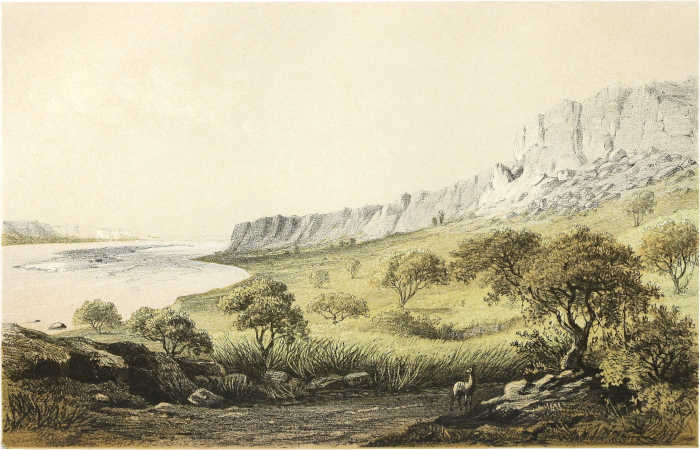
At times I was roaming about in the recesses of the rocky slope, which offered very charming views, one of which is represented in the plate opposite, or I had some conversation with people who were passing by. Among the latter were especially a troop of Sherífen, a section of the Kél e’ Súk, but very different from the general character of that tribe, whose distinguishing features are humility and harmlessness. All of them came in full armour, and many were well dressed, and their general bearing bore testimony to an independent mind. It was curious, however, that the chief of these people mistook me for El Bakáy, and therefore paid his compliments to me first, probably in consequence of my beard being longer.
Saturday, July 1st.The herd of cattle, which the Gá-béro were to make a present of to the Sheikh, having at length successfully regained their native shore, we set out on our return march to Gógó late in the afternoon, and keeping along the rocky slope, where it recedes inland, behind Tin-shéran, we halted for the night in an encampment of the Kél-gúnhan, which was very considerable, consisting of more than 100 leathern tents. The encampment was full of young slaves, such as I had rarely seen with any of these Tawárek; but as I have observed on a former occasion, the Kél e’ Súk do not seem as yet to have entirely forgotten their former residence in a large, luxurious place, and even at the present time indulge greatly in the traffic of slaves. Here, also, the slaves, male and female, were entirely clad in leather, but on the whole, they were good-looking, and appeared cheerful.
Sunday, July 2nd.I again reached Gógó, while the Sheikh remained behind in the encampment of another body of Kél e’ Súk, situated on a sort of promontory, projecting into the swampy plain, which we reached about five miles after setting out from the place where we had passed the night. Our march lay along the foot of the rocky slope full of caverns and ravines, and enlivened with trees and bush, the swampy ground on our left being laid out in rice-fields, which the people were busy cultivating, and interrupted here and there by insulated rising ground clad with dúm-bush.
On my arrival in my tent I was glad, after my long abstinence from palatable food, to indulge in an excellent rejíre, the favourite drink made with cheese and dates, which is very acceptable in the desert country, but rather difficult to digest in the feverish regions of Negroland. Thus I began to prepare myself for my home journey, which from henceforward I might confidently expect to pursue with more steadiness. I then went to pay a visit to my friends the Kél e’ Súk, who, during our long absence, had grown very impatient, and, as it would seem, not without good reason. They received me very cheerfully, and in their excess of friendly feeling, made an endeavour to convert me to their creed; but having received a direct refusal, they entreated me very earnestly to return to them as soon as possible, but this time by way of Tawát. However, I was obliged to tell them, that it was very unlikely I should ever return, and more improbable still by way of Tawát, that road being extremely dangerous for us; but I informed them, that I entertained no doubt, that if it were possible to get over the rapids which obstructed the lower course of the river, the English would not be long in paying them a visit.
All my friends who now saw my departure near at hand, began to evince their attachment to me more strongly than ever, and in the evening, after I had dismissed El Munír and Inésa, the sons of Khozématen, both of them worthy young men, I had a very animated conversation with my friend Mohammed el Khottár over our tea, and I promised him a considerable number of Arabic books, in the event of his paying a visit to England.[41]
The following morning, when I was lying outside my tent, as was my custom, enjoying the fresh air, all my friends gathered round me, and I had to read to them passages from various European books, including the Greek text of the Evangelists. The German principally attracted the attention of these people, the full heavy words of that language appearing to them somewhat like their own idiom, and they became highly elated, when I recited to them from memory some verses of a favourite German poem.
All my people were so full of enthusiasm, on account of a fair prospect of a speedy departure on our home-journey being held out to them, that they gave the Sheikh El Bakáy, when he joined us, in the course of the morning, in Gógó, a most hearty reception, and fired away a good deal of powder in honour of him. I afterwards went with him to distribute some presents amongst the chiefs of the Kél e’ Súk and some great men of the Awelímmiden, who had arrived in the company of the Sheikh. Khozématen received a fine black Núpe tobe and a black lithám; Hanna, a túrkedí and a lithám; the four Awelímmiden, viz., Bodhál, Ríwa, Alíso, and Sábet, each a lithám, besides some smaller articles; and each of the sons of Khozématen and Hanna, the half of a lithám. Every one was content, although some of them would have liked to receive articles of greater value.
There being no prospect that Alkúttabu would join us here, as we were told that he had gone to drive back a predatory expedition of the Kél-fadáye, I returned the fine black horse which the Sheikh had made me a present of, and which I had destined for the chief of the Awelímmiden, to the former, who was going to visit that chief, in order that he might present it to him in my name. I also made ready the present which I intended to make to Thákkefi, the son of the former chief, and El Ágwi, a near relation of his.
The Sheikh himself showed his consciousness of our approaching separation by assuming a lively air. In the evening I had a very animated conversation with him and Sídi Áhmed el Wádáwi, the most learned of his pupils, with regard to the shape of the earth, and succeeded, at length, in clearly demonstrating to him its globular shape and the circular motion of the whole system of the planets. He was not a little struck when, speaking of what was above the earth and under it, I told him that, with regard to the Omnipresent Being, such as we and they recognise the Almighty Creator of the universe to be, the idea of an above and below was not to be entertained; but that such expressions had only reference to human speculation. But, although as a Mohammedan he could not entirely concur in such a doctrine, being overawed by the authority of the Kurán, yet, having before his eyes the beautiful panorama of the hemisphere, he became quite convinced that on the whole I was right; although, shut up within the narrow walls of his room in the town, he had always thought it both absurd and profane to assert such a thing.
Wednesday, July 5th.All was ready for our departure, when Thákkefi, the cousin of the present ruler of the Awelímmiden, and son of the late powerful chief E’ Nábegha, joined us with a few of his companions, among whom Sohéb was the most conspicuous. The arrival of this important personage caused us fresh delay, which, however, on the whole, was agreeable to me, as he was authorized by Alkúttabu to grant me full franchise and perfect security for all Englishmen travelling or trading in their territory; and in the course of conversation he even made the remarkable proposal to me, that the English should endeavour, by means of a strong expedition up the river, to establish regular intercourse with them.
Meanwhile, the chiefs of the Kél e’ Súk departed for their respective homes, holding forth the prospect that I myself might soon follow. Thákkefi stayed with me almost the whole of the day, inspecting my effects with the greatest curiosity and attention. He was a fine tall man, possessed of great strength and remarkable intelligence, and had the most ardent wish to see more of our ingenious manufactures. I was very sorry that I was able to show him so little, as almost the whole of my supplies were exhausted. A spear had been thrust through his neck from behind, in the sudden attack by the Kél-gerés at Tin-taláit, where his father was slain, and he was very anxious to obtain some efficacious plaister for his wound. Everything went on so well in my intercourse with this chief, that in the afternoon of the day following his arrival the letter of franchise was written by Daniél, the secretary of Alkúttabu, and the day after Thákkefi himself called upon me in my tent. He appeared to have some particular object in view, and, having carefully secured the entrance of the tent, in order to prevent other people from overhearing our conversation, he expressed his desire and that of his uncle, that the English might send three well-armed boats up the river, in order to establish intercourse with them. I took care to point out to him, that however anxious the English were to establish commerce and an exchange of produce with this region, yet the success of their endeavours was dependent on the circumstance whether they would be able to cross the rapids and the rocky passage which obstructed the river lower down, between Búsa and Rába, and that therefore I was unable to promise him anything with certainty. I gave to this chief, who, besides being possessed of great vigour, had a good deal of good-nature about him, one tobe shaharíye, two black tobes, two black shawls, three túrkedís, a silk cord of Fás manufacture for suspending the sword, and several other smaller articles.
During our stay in this place I had laid down the course of the river between Timbúktu and Gógó on a tolerably large scale, as far as it was possible to do so, written a despatch to government, and several letters to members of the Royal Geographical Society and other private friends, and having sealed the parcel, I delivered it to the Sheikh in order that he might forward it without delay upon his return to Timbúktu. I am sorry to say, however, that this parcel only arrived a few months ago, having been laid up in Ghadámes for more than two years.
Before leaving Gógó, I was anxious to ascertain exactly the nature of the river along this shore, as on our march both to and from the Gá-béro, we had kept at some distance from its bank, and I arranged with the Sheikh’s nephew to survey the shores of the river for some distance downwards. When I was about to mount on horseback, Thákkefi requested that I would put on my European dress, as he was anxious to see how it looked; but, unfortunately, instead of an officer’s dress, which would certainly have pleased them very much, I had no European clothes with me except a black dress suit, which could only impress them with a rather unfavourable idea of our style of clothing, and although they approved of the trowsers, they could scarcely fail to think the shape of the coat highly absurd. But having never before seen fine black cloth, they were surprised at its appearance, and, at a distance, all the people mistook it for a coat of mail, as most of them had been accustomed to see only red cloth.
Pursuing then, my proposed excursion, I observed also, below the village, some fine groups of date-palms. I also assured myself that the creek of Gógó, at least at this season of the year, is quite unnavigable, although I could not understand why the modern capital of the Songhay empire was not built on the open river, the only advantage derived from its actual situation being that the small creek forms a kind of close harbour, which affords protection to the boats, and may easily be defended in case of need. As for the site of the former capital Kúkiya, or Kúgha, I am sorry I did not arrive at a distinct conclusion respecting it.
Having followed the bank, as far as the point where the creek joins the principal branch of the river, I felt myself induced, by the precarious state of my companion’s health to retrace my steps. This indisposition of the Sheikh’s nephew influenced the choice of my companions on my return journey; as it had been originally the Sheikh’s intention to send his nephew along with me as far as Sókoto. In his place another, but more distant relation of the Sheikh, Mohammed ben Mukhtár, an energetic, and intelligent young man, but of a less noble turn of mind, was appointed; and besides him, there was the Hartáni Málek, son of a freed slave, who was to return with the lastnamed messenger from Támkala; then Mústafa, and Mohammed Dáddeb, the latter a native of Timbúktu, who were to return from Sókoto, and Áhmed el Wádáwi, and Háj Áhmed, who were to return from Bórnu.
In the evening preceding our departure, our camp exhibited a busy scene, as we were engaged in finishing our preparations for the journey, the Sheikh undertaking the outfit of one half the messengers and I the other; but the presents, also, which the latter destined for the chiefs of Negroland, were delivered to me, in order that I might take them under my care. He had, besides, the goodness to supply me with some native cotton and tobacco, to distribute as presents to the Tawárek and Songhay on our road: he also gave a dress to each of my companions, I doing the same to those among his pupils who had been most attached to me. I even felt induced to make a present of a very handsome tobe from Sansándi, richly ornamented with silk, which I had intended to take with me as a specimen of that very interesting manufacture, to Sídi Mohammed, a son of the Sheikh, who had accompanied us, and who, on account of our long absence from the town, was rather shabbily dressed at the time.