CHAP. LXXIX.
Reading edition
SEPARATION FROM THE SHEIKH. — CROSS THE RIVER TO THE SOUTH-WESTERN SIDE. — VARIOUS ENCAMPMENTS. — RIVER STUDDED WITH ISLANDS. — ANSÓNGHO.
Saturday, July 8th.At length the day dawned when I was, in reality, to begin my home-journey, for all our former movements along the river had rather resembled the wanderings of the natives themselves than the direct march of a European traveller, and, although I felt sincerely attached to my protector, and under other circumstances might still have found a great many objects worthy of my investigation and research in this region, I could not but feel greatly satisfied at being at length enabled to retrace my steps homeward, with a tolerable guarantee as to my safety. It was highly gratifying to me that when I left this place a great many people wished me a hearty farewell and a prosperous journey; nay, Thákkefi even commissioned me to offer his special regards to Queen Victoria, with whose name I had made him acquainted.
Having then pursued our march through the level tract along the river, which here forms a great north-southerly reach, and which, from having been full of life, is now empty and desolate, we reached the site of the encampment of the Kél e’ Súk on the sandy eminence which we had passed a few days before, but which was now deserted. From thence we descended into the swampy ground towards the river, and here passed by a Songhay hamlet, the inhabitants of which received us with their usual inhospitality, and even refused us a little water,—an unkind feeling which displeased me most from a young newly married lady, who, standing in front of her neat hut of matting, with her fine figure and varied ornaments of all sorts of beads, presented quite an attractive appearance. Turning then round a creek filled with water, we reached an encampment of Kél e’ Súk, and pitched our tent. For, although it was our intention to cross the river as soon as possible, yet no boats having as yet arrived, we were so long delayed that evening came on before we could carry out our design; and obstinately refusing to be separated from my luggage, I preferred crossing the river together with my people and effects the next morning. Our hosts possessing a great number of cattle, we were well treated, and I was able to indulge in plenty of milk. The Tawárek have a common name for the whole north-easterly bank of the river. They call the whole of it to the north-west of Gógó, Táramt, and to the south-east, Ághelé.
Sunday, July 9th.This was the day when I had to separate from the person who, among all the people with whom I had come in contact in the course of my long journey, I esteemed the most highly, and whom, in all but his dilatory habits and phlegmatic indifference, I had found a most excellent and trustworthy man. I had lived with him for so long a time in daily intercourse, and in the most turbulent circumstances, sharing all his perplexities and anxieties, that I could not but feel the parting very severely. Having exhorted the messengers whom he was to send along with me, never to quarrel, and to follow my advice implicitly in all cases, but especially with regard to the rate of progress in the journey, as he knew that I was impatiently looking forward to my home journey, he gave me his blessing, and assured me that I should certainly reach home in safety. Mohammed ben Khottár, who in consequence of his serious indisposition was prevented from accompanying me any further, and the Sheikh’s eldest son, Sídi Mohammed, did not take leave of me until I was in the boat. When I had safely landed on the opposite shore, I fired twice a farewell, in conformity with the request of the Sheikh.
The river here, at present, was studded with sandbanks, which greatly facilitated the crossing of my camels and horses, although between the sandbanks and the south-westerly shore there was a deep channel of considerable breadth. The locality where I touched the south-western bank of the river is called Góna, a name identical with that of a place of great celebrity for its learning and its schools, in the countries of the Mohammedan Mandingoes to the south. The sandy downs were lined with a fine belt of trees. Three different paths lead over these downs into the interior, the most important being the track leading straight to Dóre, the chief place of the province of Libtáko, and joining, at a very extensive lake or backwater, called Khalébleb, the road leading to the same place from Burre to the south of the island Ansóngho, lower down the river. At present, a broad swampy lowland spread out between the downs and the brink of the river.
The chief of my companions, Áhmed el Wádáwi, being once more called beyond the river into the presence of the Sheikh, we did not leave this place till a late hour in the afternoon, keeping along the low swampy shore. After a while, an open branch approached us from the river on our left, forming an island of the name of Berta. Here an animated scene presented itself to our eyes. An immense female hippopotamus was driving her calf before her, and protecting it from behind, her body half out of the water, while a great number of “agamba” and “zangway,” crocodiles and alligators, were basking in the sun on the low sandbanks, and glided into the water with great celerity at the noise of our approach.
Here the swampy shore presented some cultivation of rice, while, on the opposite side, the river was bounded by the rocky cliffs of Tin-shéran, but the sandy beach, which a week previously had been animated by the numerous encampments of the Gá-béro, was now desolate and deserted, and we continued our march in order to find out their new camping-ground.
While ascending a spur of rising ground called Gúndam, a fierce poisonous snake made a spring at my mounted servant, who was close behind me, but was killed by the men, who fortunately followed him at a short distance. It was about four feet and a half long; and its body did not exceed an inch and a half in diameter.
Having then kept along the slope for a little more than a mile, we again descended into the grassy plain, and reached a considerable creek, forming a series of rapids gushing over a low ledge of rocks, and encompassing the island of Bornu-Gungu, where the Gá-béro were at present encamped. The creek being too considerable to allow of our crossing it with all our effects, we encamped between it and the swamp, in a locality called Júna-bária; and I here distributed amongst my companions the articles which I had promised them.
The river, at this point, was frequented by several hippopotami, one of which, in its pursuit of good pasturage in the dusk of the evening, left the shore far behind it, and was pursued by my companions, who fired at it, without however hurting it or preventing its reaching the water.
Monday, July 10th.It was a beautiful morning; and while the Wádáwi crossed over to the island in order to fetch a supply of rice, I had sufficient leisure to look around me. The shore on this side presented little of interest, and was only scantily adorned with trees, but the island was richly clothed with vegetation. The only interesting feature in the scenery was the opposite shore, with the imposing cliffs of Bornu, where we had been encamped some time before. When at length we started, we were soon obliged to leave the shore in order to avoid an extensive swamp, and approached the hills, at the foot of which we had to cross a small creek, which during a great part of the year forms the border of the river itself, and then continued along the downs. Numbers of people, who had their temporary abode in the swampy plain, came to pay me their compliments.
These people are called Gá-bíbi, a name which is said to have reference to their black tents, which distinguish them from the matting dwellings of the Gá-béro. I was here not a little surprised at the swarms of locusts which the wind drove into our faces, and which certainly indicated our approach to more fertile regions. Proceeding in this manner, we reached a fine camping-ground in an opening of the slope of the downs, through which a path led to the interior, thus giving to the herds of cattle access to the river, and therefore called Dúniyáme, “the watering-place of the cattle.” A fine hájilíj afforded a cool shade, the vegetation in general consisting only of fernán, retem, and bú-rékkeba, and we at once decided to halt here, in order to await our guide, Hamma-Hamma, one of the Gá-béro, who had gone to visit his family, but had promised to rejoin us at this spot. The situation of our camping-ground afforded us an interesting prospect over the valley; and numbers of the inhabitants of the neighbouring hamlets and camps visited us in the course of the evening, and even supplied us with a tolerable provision of milk late at night.
Tuesday, July 11th.The guide who was to accompany us as far as Say not having arrived, I had great difficulty in inducing my companions to set off without him: and we started at an early hour, keeping along the sandy downs, which a little further on became adorned with the rich bush called “indérren,” or “kólkoli,” while ledges of rock obstructed the river. Gradually the downs decreased in height, and the melancholy-looking fernán succeeded to the fresh indérren, but its place was supplied for a while by the richer tabórak. The locality was called Alákke, and further on, Dérgimi; but fixed settlements of any kind are, at present, looked for in vain in these districts. In Áussa, however, on the north-eastern side of the river, we left, first a hamlet called Dergónne, and, further on, a place called Ághadór, which, as the name indicates, must have been formerly a walled place. West from Dergónne is probably the halting place Shínjeri, and Ághadór is most likely identical with a place called Eben-efó-ghan, said to be hereabouts. The opposite bank, gradually sloping down and being clad with large trees, bore the appearance of a pleasant, cultivable country, while the shore on this side the river likewise improved; altogether it seemed as if we had left the desert far behind us. I am not sure how the country here is called; but I think that the district called Ázawágh may reach down to the eastern border of the river. The Niger was for a moment entirely free from rocks, forming a magnificent open sheet of water; but further on it again became obstructed by isolated cliffs.
Meanwhile, as we pursued our march steadily onwards, at a short distance from the bank, in a S.S.E. direction, the Kél e’ Súki, Mohammed e’ Telmúdi, entertained me, from the back of his tall méhari, with a description of the power of the Tárki chief, El Khadír, the southern verge of whose territory we had passed on our outward journey, and now again turned round the northern side of it. The chief, at this time, was encamped about three days from here, towards the west, collecting, as we were told, an expedition against the principality of Hómbori, the governor of which claims dominion over the whole district. There are even here several settlements of Fúlbe, a troop of whom we fell in with, and recognized in them young noble people, who in their countenances bore evident traces of a pure descent. Their idiom was closely related to the dialect of Másina. During the spring, however, the Tárki chief generally frequents the banks of the river, which then afford the richest pasturage.
Gradually the green shore widened, and formed a swampy ground of more than half a mile in breadth, adorned by a line of trees which, during the inundation, likewise becomes annually submerged by the water. The valley is bordered on this side by steep banks of considerable elevation. As soon as I became aware of the swampy character of the plain, which greatly retarded the progress of my camels, I endeavoured to strike across the swampy ground, and to reach the firm bank again; but had considerable difficulty in doing so.
The bank was adorned by a growth of the finest trees, which gave to the river scenery a peculiar character, and invited us to halt during the hot hours of the day. We therefore encamped opposite Tongi, a hamlet lying on a low swampy island, separated from us by a considerable open creek, and ruled over by a man of the name of Sálah, who was a brother of Hamma-Hamma, the very man who was to serve us as a guide, but who had broken his word. The people, who seemed to be called Dekíten, behaved very hospitably, sending us immediately upon our arrival cows’ and goats’ milk as a refreshment, and giving us in the course of the afternoon a bullock for our further entertainment. I have already mentioned, I think, on a former occasion, how cruelly the inhabitants of these regions treat oxen which have been destined for slaughter, although in general they are rather mildly disposed towards animals. In conformity with their barbarous custom, my companions broke the hind legs of the animal which had been given us as a present, and allowed it to drag itself about in this state until they found it convenient to slaughter it.
While detained here the remainder of the day, I had the pleasure of meeting, among the people who crossed over to us from the island, an old man who had a very lively remembrance of Mungo Park, and who gave me an accurate description of his tall commanding figure, and his large boat. He related, besides, the manner in which the Tawárek of the tribe of the Íde-Músa, the name of whose present chief is El Getéga, attacked that mysterious voyager near Ansóngho, where the river is hemmed in by rapids, but without being able to inflict any harm upon him, while the intrepid Scotchman shot one of his pursuers, and caused two to be drowned in the river.
It was altogether a fine camping-ground, the talha and siwák being thickly interwoven with creeping plants; but a heavy thunder-storm, accompanied with rain, which lasted almost the whole of the night, rendered us rather uncomfortable. Besides this circumstance, the fact that the people of the Sheikh could only with difficulty be induced to forego the companionship of our guide, lost us here the best half of the day. But I collected a good deal of valuable information, especially with regard to the chief settlements of the independent Songhay, as, the famous towns of Dárgol, Téra, and Kúlman, situated between the river and our former route through Yágha and Libtáko, which I shall give in the Appendix.[42]
At length I succeeded, at a rather late hour in the afternoon, in stirring up my companions; and, leading the way, we crossed from this advanced headland a swampy creek which separated us from the main, and then kept along the rising ground, which was richly clad with vegetation, and from time to time formed recesses, as the one called Tennel, the river being now more open. But further on it became obstructed by cliffs and rocks, till at length, after a march of about seven miles, the river, which here formed a fine bend, assuming a south-easterly direction, exhibited an open undivided sheet of water, and on this account forms the general place of embarkation, called Ádar-andúrren, properly “the small branch,” meaning evidently here a narrowing of the river; for people going from Kúlman to this part of Áussa generally cross here. A little higher up there is a hamlet called Tabáliat, inhabited by sherífs, with a chief named Mohammed. Just at that moment some people were crossing over, but, when we horsemen hurried in advance, they immediately took to flight with their boats, leaving behind them some slaves and four or five pack-oxen, and all our shouting was not able to convince these native travellers of our peaceable intentions. Here, owing to a small creek which runs closely at the foot of the hills, we were obliged to ascend the rising ground, and, rather against the advice of our more prudent Kél e’ Súki guide, encamped on the heights, which were clad with rich herbage, but covered with great quantities of the feathery bristle. This spot afforded a commanding view over the surrounding country, but on this very account appeared less secure for a small party; and notwithstanding the elevation, the camping-ground was greatly infested by mosquitoes, which almost drove our camels to distraction, and troubled our own night’s rest not a little.
But the view which I here enjoyed over the northern end of the island, round which the river divided into four branches, was highly interesting to me, as being one of the places along the river best known to the natives as scenes where that heroic voyager from the north had to struggle with nature as well as with hostile men. Our fires having given to those poor lads who had been left behind by their frightened masters an opportunity of discovering what kind of people we were, they took courage and came to us, when we learned that they were Kél e’ Súk, who had paid a visit to Kúlman, and were now returning home. They also informed us, that the crocodiles had devoured one of the pack-oxen, upon their attempting to swim them across the river.
Thursday, July 13th.Breaking up our encampment at an early hour, we descended, when the branch nearest to us again assumed an open character tolerably free from rocks; but after a short time we were again forced by a ridge of sandstone about twenty feet high, which here formed the bank of the river, to ascend the higher ground. We thus obtained a clearer prospect over the whole valley, which at this spot attains a breadth of from four to six miles, the ground being open, and the view only for a short time shut in by a dense grove of gerredh and talha trees.
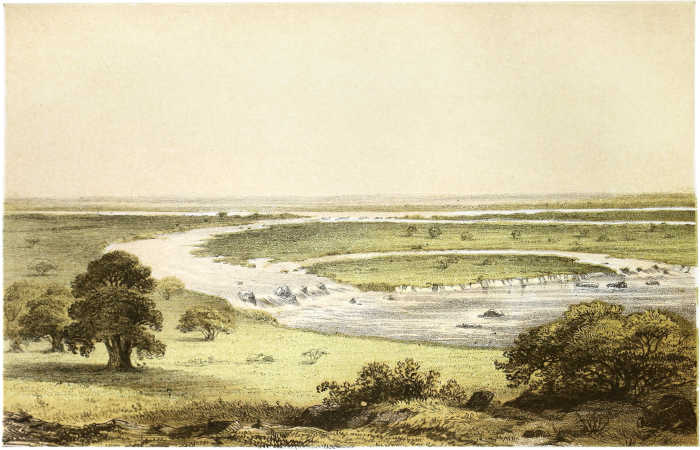
Drawn by J. M. Bernatz, from a Sketch by Dr. Barth. M. & N. Hanhart, lith. et impt. ANSONGO. July 18th. 1854.
Further on the river afforded a very wild spectacle, a sketch of which is represented in the plate opposite. In the distance before us, the iron gates of Akarámbay became visible, bordered by the high sandy downs of Tidejitíten; a grand mass of rock, like an immense artificial wall, with a strong northerly dip, started up from the creek; and from the extensive grassy island of Ansóngho similar masses appeared, which rose to an elevation of from seventy to eighty feet. Gradually the shore became more stony and barren, forming a plain called Erárar-n-tésawel, by the Tawárek, and Farri, by the Songhay. We passed a deserted hamlet which had formerly been inhabited by the Íde-Músa, and here the river again approached nearer on our left, but after a short time it again receded and became obstructed by ledges of rocks, especially at the place called Tazóri, where an uninterrupted ridge of cliffs breaks through the surface of the water. Even at this season of the year, it leaves a small channel beyond the grassy shore, which evidently connects the open water above and below the rapids.
About 1500 yards below this ledge, in a south-easterly direction, we reached the iron gates of Akarámbay, where the river, or at least this westerly branch of it, is forced through between two considerable masses of rock, at present from thirty-five to forty feet high, and about as many yards distant from each other. On the right, the sandy downs rise to a considerable elevation opposite a large hamlet, situated on the island Ansóngho, and adorned with dúm-palms.
Following a south-easterly direction, in a short time we reached the place where the several branches into which the river had divided at Ádar-andúrren again join; but being full of ledges and rocks, at least in the present low state of the water, they exhibited a wild and sombre aspect. The river, however, does not long retain this character, and a little more than half a mile below, it widens to a broad and tolerably open sheet of water, the shore, which hitherto had been clothed only with the gloomy fernán, being now beautifully adorned with an isolated tamarind tree, which (together with the dúm-palms on the island of Ansóngho), might well serve as a landmark to people who would attempt to ascend this river. But the hills, which ascended to a height of 300 feet, approached so closely the bank of the river, that we were obliged to ascend the steep slope, which was thickly clothed with fernán, and being torn by many small watercourses, scarcely afforded a passage for the camels.
Descending from the slope, we reached the Teauwent, or place of embarkation of Burre, a hamlet lying on the opposite shore, but at present deserted, where the river forms only a single branch, from 800 to 900 yards wide, and a little further on about 1000, and on the whole unobstructed, with the exception of a few rocks near the shore. Having here passed a rocky cone, projecting into the river, we encamped near a cluster of anthills, formed by and adorned with the bushes of the Capparis sodata; but it was a very inauspicious place, as the camels, not finding food enough in the neighbourhood, were, through the negligence of Ábbega, lost in the evening, and it cost us the whole forenoon of the following day to find them again. When we at length started, I was obliged to yield to the wishes of my companions, who, in order to obtain some supplies for their journey, were most anxious to halt near a small farming village of a Púllo settler, Mohammed-Sídi, a distant relation of Mohammed-Jebbo, who had settled here several years before amongst Tawárek and Songhay; and my friends, having been informed that this person was a pious and liberal man, felt little inclination to forego such an opportunity of receiving a few alms.
Having encamped on a high ground rising to considerable elevation, we had an extensive view over the river, which was here again broken by rocky islets and intersected by ledges, so that, seen from this distance, in several places it appeared almost lost. Beyond, on the other shore, across this labyrinth of rapids and divided creeks, filling a breadth of two to three miles, were seen the two mountains of Ayóla and Tikanáziten, where, in the time of the chief Káwa, a bloody and decisive battle was fought between the Dinnik and the Awelímmiden. Towards the south, on the contrary, a fertile and well cultivated plain, bordered by low hills, where the crops of native millet were just shooting forth, stretched out, nothing but retem and fernán, breaking the monotonous level.
The hamlet of our host consisted of only six huts; but the district did not seem to be uninhabited, and in the course of the day a considerable number of Fúlbe and Songhay collected around us, and troubled me greatly, begging me to impart my blessing to them by laying my hand upon their head, or spitting into a handful of sand, and thus imbuing it with full efficacy for curing sickness, or for other purposes. Even the river did not seem quite destitute of life and animation, and the previous evening, while I was enjoying the scenery, seated on the cliffs at some distance from our camping-ground, two boats filled with natives passed by, and procured me an interesting intermezzo.
Saturday, July 15th.The good treatment that we received here seemed to please my companions so much, that they tried to detain me another day by hiding one of their camels behind a bush and pretending it was lost. When at length I had found it, and was on the point of setting out to pursue my journey, a very heavy thunderstorm broke out; and, although I persisted in proceeding, the rain became so violent that I was obliged to halt for fully an hour, near some bushes that protected us a little from the heavy gale which accompanied the torrents of rain. Here, also, the river was obstructed by a great number of rocks, while the adjacent grounds were partly cultivated, but only sparingly clad with trees, till, after a march of a couple of miles, rich talha trees and gerredh began to appear; but even here groups of rocks cropped out from the surface. Thus keeping along at some little distance from the river, we encamped shortly after noon at the foot of a sandy eminence, and were very glad when we were enabled to dry our wet clothes and recruit our strength with a dish of mohamsa.
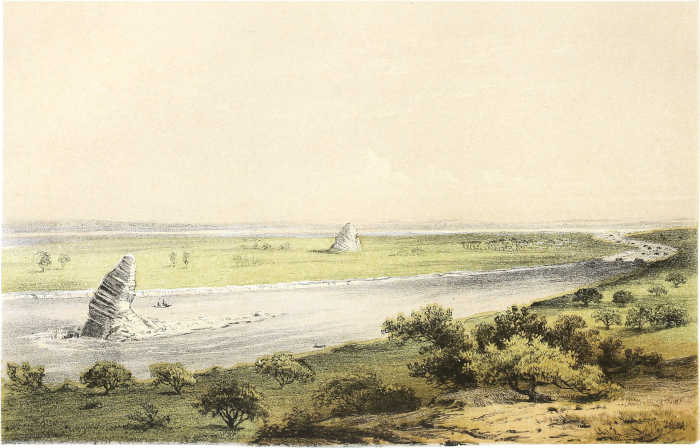
Drawn by J. M. Bernatz, from a Sketch by Dr. Barth. M. & N. Hanhart, lith. et impt. THE NIGER AT TIBORÁWEN. July 15th. 1854.
Having ascended the rising ground in order to obtain a view of the mountains on the opposite shore, I went down to the river and enjoyed the wild scenery of the rapids, which here also obstructed its course, forcing this westerly branch to a velocity of perhaps six miles an hour, intersected by flat cliffs, which at present were only a few feet out of the water. A fine belt of trees lined the bank at a short distance from the edge of the river, the islands also being clad with rich vegetation, and, altogether, the locality seemed to me worthy of a slight sketch, which has been represented in the plate opposite. I had hitherto looked in vain all along the shore for traces of the elephant, but I discovered that this part is visited by them in great numbers. The place is called Tiboráwen. Having indulged in quiet repose for several hours, we were joined by our companions, who, seeing that I was not to be detained by their tergiversations, were anxious to come up with us.
Sunday, July 16th.Keeping a short distance from the river, first in a more winding and then in a south-westerly direction, we entered, after a march of three miles, more undulating and fresher pasture-grounds; but stony ground soon began to prevail, although without entirely excluding vegetation. Here, before we reached the cape called Immánan, meaning the fish-cape, the several branches of the river united, while a grassy lowland was attached to the higher bank which bounds the river during the period of its inundation. This fresh grassy tract, full of herbage and trees, was awhile interrupted by the high ground attached to the cape; but as soon as we had left the naked hills behind us, we descended into a lovely little valley or ravine, which in a winding course led us to the beach of the river, which here formed a magnificent reach; but a little further on, at a place called Ekeziríden, it was broken by a ledge of rocks, which stretched almost across its whole breadth, and, at this season at least, made it totally unnavigable. A short distance beyond, a second ledge set across the river, while a little further on a rocky islet, overgrown with rich vegetation, caused the stream to divide. The bank itself now became stony, micaslate protruding everywhere, and we ascended a small ridge, which formed a higher cone at some distance on our right, while on our left it formed a promontory jutting out into the river. The whole district is called Béting.
Having descended from this small ridge, we approached nearer the river, which was here tolerably free from rocks, and then entered a dense but short tract of forest, full of the dung of the elephant, and traces of the footsteps of the banga or hippopotamus. Here we had to cross several watercourses, at present dry, one of which is called Galíndu, and is said to be identical with the Búggoma, which we had crossed with so much difficulty before reaching the town of Áribínda. But rocky ground soon prevailed again; and another promontory jutted out into the water, the river, which on the whole has here a south-south-westerly direction, being once more broken by cliffs.
A little further on we encamped opposite a hamlet called Waigun, which was just building, while another one of the same name was lying a little higher up the river. However we derived no advantage from the neighbourhood of this little centre of life, for having no boat at our disposal we were not able to communicate with those people ourselves, and they, on their part, felt little inclination to make our acquaintance, as they could not expect that we should be of much use to them, except in lightening their stores. My companion, the Kél e’ Súki, with shouts endeavoured to intimate to the people that their sovereign lord Bozéri was himself present; but this artifice did not succeed. The Ímelíggizen, or their slaves, who dominate both shores, are ill-famed on account of their thievish propensities; and we protected ourselves by firing a good many shots in the course of the night.
Monday, July 17th.Pursuing our course at an early hour, generally in a south-westerly direction, we reached, after a march of about four miles, a fine running stream, about twenty-five feet broad and fifteen inches deep, traversing a beautifully fresh vale, the slopes of which exhibited traces of several former encampments of the Tawárek. It joins the river at a spot where it forms an open and unbroken sheet of water, and greatly contributes to enhance the whole character of the scenery, although, about 1200 yards below, it was again broken by a ledge of rocks crossing almost the whole breadth of the river, but mostly covered by the water, even at the present season. About 500 yards below this ledge a small island lies in the midst of the river, occupied almost entirely by a village called Kátubu, consisting of about 200 snug-looking huts, which were most pleasantly adorned by two beautiful tamarind trees. But the peace of the inhabitants appeared to have been disturbed, as they had probably heard our firing during the night, and were therefore on their guard. Five or six boats, filled with men, lay around the island at various distances, most probably spying out our proceedings, although some of our party thought that they were fishing.
We here left the beach for awhile, and ascended the higher ground, which rose to a greater height, cutting off a curve of the shore. The river, further on, was again broken by a ledge of rocks, but so that a passage remained open on the side of Áussa: and shortly afterwards the various branches joined, and formed a fine noble reach. The country now became more hilly and better wooded, being clad with retem, besides kórna and hájilíj. Numerous ponds of water were formed in the hollows, and antelopes of various species, including that called “dádarít,” were observed. Leaving then a path leading to a place called Tákala, situated at a distance of about fifty miles inland, in a south-easterly direction, we reached, about a quarter past ten o’clock, the highest point of this undulating ground, from whence we obtained a view over a wild and gloomy-looking forest-region, behind which the river disappeared, after having enclosed a well-wooded island called Sakkenéwen.
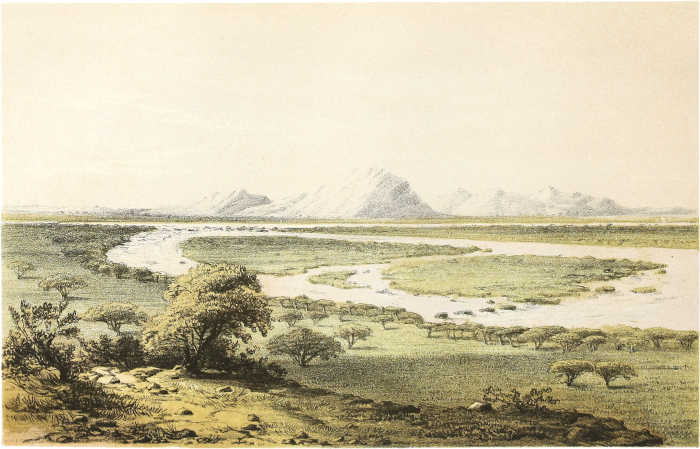
From this higher ground we descended into a fine rich vale, the vegetation of which was distinguished by a few busúsu, ághanát, or tamarind trees. Emerging from this richly-clad valley, we again obtained a sight of the river—if river it can be called—for seen from hence it looks almost like an archipelago or network of islands and rocky cliffs in the wildest confusion, the river foaming along through these obstructed passages. For just as it turns round a cape, which juts far out to the N.N.W., and is continued under water towards the opposite shore in a long reef of rocks, forming a sort of semicircle, it is broken into several branches by a number of islands, through which it makes its way, as well as it is able, over cliffs and rocks, in such a manner, that along this south-westerly shore there is no idea of navigation even during the highest state of the river, but on the Áussa side it is more open, and renders navigation possible, although even there caution is evidently necessary. I have no doubt that this is one of the most difficult passages of the river. The name of the cape is Ém-n-íshib, or rather Ém-n-áshid, “the cape of the ass.”
Having passed a place where the most westerly branch forms a small waterfall of about eighteen inches elevation, foaming along with great violence, we encamped on the slope of the green bank, adorned with fine herbage and luxuriant hájilíj, in full view of this wild scenery. I made a sketch of it from the highest ground near our halting-place, which is occupied by a small cemetery, the locality having been formerly enlivened by a hamlet of the Ímelíggizen, of the name of Lebbezéya. This encampment was also important to me, as I here had to take leave of our guide, Mohammed Kél e’ Súki, whom I had vainly endeavoured to persuade to accompany me as far as Say, although he would have had no objection to have fulfilled his promise, if our other guide, Hamma-hamma, had not broken his word, and stayed behind, for, alone, he was afraid to trust himself to the Fúlbe. It was, moreover, his intention to proceed from here on a visit to his friends, the Událen. Convinced, therefore, of the justice of his arguments, I gave him his present, although I missed him very much, as he was an intelligent man, and had given me some valuable information.
Drawn by J. M. Bernatz, from a Sketch by Dr. Barth. M. & N. Hanhart, lith. et impt. RAPIDS OF THE NIGER AT ÉM-N-ÍSHIB. July 17th. 1854.