CHAP. LXXIV.
Reading edition
RETROGRADE MOVEMENT TOWARDS TIMBÚKTU.
The locality of Izéberen, where we had encamped, was not at all inviting, as it was but scantily provided with trees. Here we gave up our journey eastward, and again commenced our retrograde movement towards Timbúktu. I was now filled with the saddest forebodings; for after three or four days spent in vain dispute between the Sheikh and Ákhbi, the chief of the Igwádaren, who was encamped here, the latter persisted in his rebellious conduct against his liege lord Alkúttabu; and, instead of restoring what he had taken from the tribes placed under the protection of the latter, he made up his mind to follow the instigations of the Sheikh’s enemy and rival, Hammádi, and to throw himself into the arms of the Fúlbe and of the chief of Hamda-Alláhi. He thus caused an immense disturbance in this whole region; and in fact a bloody war broke out soon after my safe departure.
The encampment at Izéberen, to which this sad remembrance attaches, was tolerably enlivened with some interesting people, including as well some kinsmen of Ákhbi, as more especially the sons of Ég el Henne, Wóghdugu, and his brethren, Mohammed, Aníti, and Míni, all of whom are of a very cheerful disposition, and (as far as it is possible for a Tárki to be so) even amiable men. Among the former there was a boy named Kúngu, whose arrogance at first was a little troublesome, but eventually he became one of my best friends, and even now occupies a foremost place in my remembrance. He was a nephew of Ákhbi’s, and his father had been distinguished for his valour and warlike enterprise, but had been killed in battle at an early age, like most of the kinsfolk of this chief, so that the boy was brought up and educated by his mother, Tatináta, who was a daughter of Áwáb, the chief of the Tademékket whom I have repeatedly mentioned on former occasions.
Ákhbi himself was a man of about forty years of age, good-looking, but of an overbearing character. His father, Sálem, who had died a few months before at a very advanced age, had been distinguished by his intelligence, while Ákhbi, as soon as he acceded to power, had broken his allegiance to his liege lord, and entered into open hostilities with him. He had allowed his own small tribe, which scarcely numbered more than two hundred fighting men, to be divided into two hostile encampments, and in consequence of that feud had sustained a very heavy loss amongst his own followers. His quarrel with Alkúttabu was evidently a consequence of the intrigues of the Fúlbe and Hammádi, who, seeing that the political power of the Sheikh El Bakáy was based upon his friendship with the chief of the Awelímmiden, used all his endeavours to raise up an adversary to the latter; and the progress of this struggle, of which I did not see the end, may have been productive of great changes in the political relations of Timbúktu.
The endeavour to preserve the unity of the whole tribe of the Awelímmiden, which my protector had sincerely at heart, and thus to keep up the friendly relation of this tribe with that of the Igwádaren, induced him to postpone my interests, and to return once more westward, in order to exert his utmost to settle this serious affair. For the very tribe of the Igwádaren, from the first, when they were settled in Ázawád, had been the protectors of the Kunta, the tribe to which the family of Mukhtár belonged, and had especially defended them against the hostilities of the Ígelád, by whose subjection the former had founded their power. El Bakáy could not but see with the most heartfelt sorrow his former supporters likely to become the auxiliaries of his enemies; and his brother, Sídi Mohammed, whom he had left to fill his place in Timbúktu during his absence, had sent an express messenger from the town, requesting him to come, in order that he might consult with him upon the state of affairs.
As for myself, being anxious about my own interest, and fearing even for my life, which I was convinced was seriously threatened by another return towards Timbúktu, I employed every means in my power to persuade my friend to allow me to pursue my journey eastward, in the company of those pupils and followers of his whom he had promised to send along with me. But he would not consent to this, and I felt extremely dejected at the time, and could not but regard this retrograde journey to Timbúktu as a most unfortunate event.
Just at this time the news was brought, by way of Ghadámes, of the French having completely vanquished the Shaamba, and made an expedition to Wárgelá and Metlíli. In consequence of this report, the fear of the progress of these foreign and hated intruders into the interior of these regions became very general, and caused suspicion to attach to me, as these people could not but think that my journey to their country had some connection with the expedition of the French. But, taking all the circumstances into account, I found afterwards that my friend was altogether right in postponing for the time my journey eastward.
Sunday, April 30th.This was the sad day when, with the most gloomy forebodings, I began my return journey towards the west. There had been the most evident signs of the approach of the rainy season, which in the zone further to the south had already set in, when, after so many reiterated delays, I was obliged once more to return towards that very place which I had felt so happy in having at length left behind me.
My protector was well aware of the state of my feelings, and while the people were loading the camels he came to me, and once more excused himself on account of this retrograde movement. There were, besides myself, some Arabs of the tribe of Gwanín, who wanted to go on to Ghérgo, in order to buy tobacco, and who now likewise were obliged to return once more to the westward, as they had no guarantee for their security in making the journey alone.
The splendid river along the banks of which lay our road, and which here was about half a mile across, afforded the only consolation in my cheerless mood. The junction of the two branches, as seen from this spot, presented a very fine spectacle. The gerredh trees also, which were in full blossom, attracted my attention.
Keeping a little nearer to the sandy downs, we soon reached the place of our former encampment in Taútilt. Having then passed along the small backwater of Barkánge, the volume of which had greatly decreased in these few days, we encamped about four miles beyond, in the open swampy ground which we had had such difficulty in crossing on our outward journey. It is called Erásar. In this low ground, between two swamps and about 800 yards from the bank of the river, without the shade of the smallest tree, the Igwádaren had encamped. It was owing to these swampy sites that I was afflicted with those severe rheumatic pains, from which I afterwards suffered so much in Bórnu, and which I occasionally feel even now.
The place was the more disagreeable, as we remained here the three following days, El Bakáy endeavouring all the time to persuade the chief Ákhbi to restore the property which he had taken from the subjects of his liege lord. I was in the mean time, anxious to keep up a friendly intercourse with the people with whom I was thus brought into contact, although most of the Igwádaren had already gone on in advance to their new retreat, and at that time were collected at Ernésse; while the straightforward and fearless chief Wóghdugu, and his friend Shamuwél, were still behind. I took a great interest in the name of the latter; for I thought that the names of Shamuwél, Sául, and Daniél—all being of frequent occurrence among this tribe, while, as far as I am aware, none of them is found among the Arabs,—tend to confirm the closer relation which these Berbers keep up with the Canaanitic tribes than with the Arabs. There was, in particular, a man of the name of Sáma, who was very friendly with me. On reading with him some writing in “Tefínaghen,” or the native Berber character, I became aware that this word signifies nothing more than tokens or alphabet. For as soon as the people beheld my books, and observed that they all consisted of letters, they exclaimed repeatedly, “Tefínaghen—ay—Tefínaghen!” and my little friend Kúngu, who had just learned the Arabic alphabet, was very anxious to know something about the value of the letters. I here also had proof of the great dislike which the Tawárek have to the name of their father being mentioned, for when the little Haibálla, the companion of the son of the Sheikh, mentioned the death of Kúngu’s father, the little fellow flew into a great rage, and was ready to kill him on the spot.
I received, besides, a great deal of information from a young man who had lately come from the north, in order to study under the Sheikh. He belonged to the Welád Yoʿaza, a section of the tribe of the Méshedúf, which originally appears to have been of pure Berber extraction, being identical with the celebrated tribe of the Masúfa, but who, at present, have become Arabicised. He was evidently a man of a good family; but being now rather scantily supplied with food, he took refuge with me, in order to enjoy my hospitality. On this occasion I learned from him a great deal with regard to some districts of the desert, with which I had been unacquainted.
In the same encampment, we received full confirmation of the news with regard to the progress of the French towards the south, and of their having taken possession of Wárgelá. The excitement produced in consequence was very great, and made my situation extremely difficult and dangerous. The Sheikh El Bakáy came twice in the same afternoon to me, expressing his intention of uniting the strength of the Tawátíye and the Awelímmiden in a common attack upon the French. But I endeavoured to show him the absurdity of such a proceeding, telling him that they themselves would gain nothing by such inconsiderate conduct, and would only furnish a fresh pretext to the French for penetrating farther into the interior. Moreover, I gave it as my opinion, that the latter, unless instigated, would not undertake such a thing as a military expedition to these distant regions, but would endeavour to open commercial intercourse with them in a peaceful manner. There the matter stopped for the moment.
Thursday, May 4th.All the exertions of the Sheikh to persuade Ákhbi to return the property which he had taken by force from the tribes placed under the protection of the Awelímmiden being in vain, the latter broke up his encampment, in order to pursue his journey westward in search of new protectors and allies. To prevent the mischief which might result from this course, my friend followed, and I was obliged reluctantly to accompany him. The river had fallen considerably since I had last visited this district, and the scanty foliage of the lower part of the trees in the swampy tract which we traversed in the beginning of our march, bore evident testimony to the higher state of the water some time before.
Leaving then our former camping-ground in Tens-aróri on one side, we encamped after a march of a little more than six miles, on ground which was still so extremely damp that almost all my luggage was spoiled, while it likewise exercised a most unfavourable effect upon my health. We had previously had evident signs of the approach of the rainy season; but, to-day, we had the first regular shower accompanied by a thunderstorm, and rain fell round about us in a much more considerable quantity. The Tawárek were well aware that this was the real beginning of the rainy season, giving vent to their feelings in the words “ákase yúse”—“the rainy season has set in;” but my Arab companions, who repeatedly assured me that long before the setting in of the rainy season I should certainly reach Sókoto, would not acknowledge this as a regular rain, but qualified it as quite an exceptional phenomenon connected with the setting of the “Pleiads,” and calling it in sequence, “mághreb el thrayá.”
There was a great dread of lions in our encampment. I especially was warned to be on my guard, as my camping-ground, which I had surrounded with a fence, closely approached a jungle of rank grass; but we passed the night unmolested.
Friday, May 5th.Although I had been promised that we should certainly not pass this place on our return westward, nevertheless, in the morning the order was suddenly given to decamp; and on we went, Ákhbi in the van and we in the rear, passing many small temporary encampments of the Igwádaren, who were exiling themselves from their own country. Having thus made a short march of about four miles, through a country now rising in sandy downs, covered with siwák and dúm-bush, at other times spreading out in low swampy meadow-grounds, and leaving Índikuway on our left, we encamped again in the midst of a swamp, at a short distance from the bank of the river. Fortunately, there was some rising ground, opening a fine view over the river, which here formed an arm of about 600 yards in breadth, while the opposite shore of Áribínda exhibited a very pleasant background. Cautiously I pitched my tent as high as possible, with the door looking towards the river, in order to console myself with the aspect of the stream. A beautiful jéja or caoutchouc tree, here called énderen, which I scarcely remember to have seen anywhere else in the whole of this district, gave life and animation to the encampment. A few miles towards the west, the high sandy downs of Úle Tehárge formed also an object of great interest.
It was extremely fortunate that the ground of this encampment did not present such a uniform level as in our last day’s ámazágh, for in the afternoon we were visited by a violent tempest, which threw back the fence that we had erected around our camping-ground, upon ourselves and our horses, and threatened to tear the tent to pieces: then, having made the round of the whole horizon, it returned once more from the north and discharged itself in a terrific shower, which lasted more than two hours, and changed the whole of the lower part of the plain into a large lake.
This thunderstorm afforded evident proofs of the full power of the rainy season; and as I had not yet even begun my long journey eastward, through districts so full of large rivers and of swampy valleys, my feelings may be more easily imagined than described. I felt very dissatisfied with the Sheikh El Bakáy, and he, on his part, was well aware of it. His own trustworthy and amiable character inspired me with the confidence that I should at length get safely out of all my trouble; but an immense amount of Job-like patience was required, for we staid in this encampment the five following days.
But we had a little intercourse with some remarkable persons which gave me some occupation. The most interesting of the passers by were three noble ladies of the tribe of the Kél-hekíkan, well mounted on camels in an open cage, or jakhfa, of rather simple structure, with the exception of the rich ornament on the head of the animal, as is represented in the accompanying woodcut. But the ladies themselves afforded an interesting sight, being well formed, of rather full proportions, though very plainly dressed. Then the whole of the Igwádaren, male and female, passed by close to my tent. There were, besides, the Kél-terárart and the Kél-tamuláit, or, as the Arabs call them, Áhel e’ Sául; and I had a long conversation with a troop of eight horsemen of the latter, who, in the evening, came to my tent in order to pay their respects to me. I reciprocated fully their protestations of friendship, and requested one of the two kinsmen of the chief Sául, who were among this troop, to accompany me on my journey eastward, promising to see him safe to Mekka. But, although he greatly valued my offer, he was afraid of the Aréwan or Kél-gerés, and of the inhabitants of Áír.
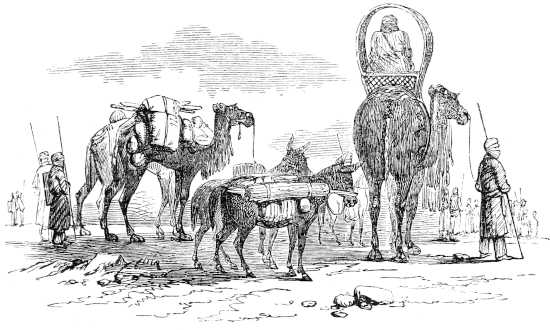
There was a great congregation of different chiefs with the Sheikh El Bakáy, and he flattered himself that he had made peace between inveterate enemies, such as E’ Téni and Wóghdugu; but the sequel showed that he was greatly mistaken, for these petty tribes cannot remain quiet for a moment. Great numbers of the Shémman-Ámmas were hovering round us, all of them begging for food. But my spirits were too much embittered to exercise great hospitality from the small stock of my provisions, which were fast dwindling away. Indeed, the stores which I had laid in, in the hope that they would last me until I reached Say, were almost consumed, and I was very glad to obtain a small supply of milk, which I usually bought with looking-glasses, or rather rewarded the gifts of the people by the acknowledgment of such a present. But these people were really very miserably off, and almost in a starving condition, all their property having been taken from them. They informed me that the Igwádaren had plundered twelve villages along the Eghírrëu, among others, those of Bámba, Égedesh, Aslíman, and Zómgoy.
The river was enlivened the whole day long with boats going up and down, and some of the people asserted that these boats belonged to the Fúlbe, who were looking out for an opportunity of striking a blow. The whole world seemed to be in a state of revolution. The news from the north of the advance of the French, the particulars of which, of course, could not but become greatly exaggerated, as the report was carried from tribe to tribe, excited my friend greatly, and the several letters, written by the people of Tawát, who were resident in Timbúktu, having reference to the same event, with which the messenger whom he had sent to that place returned, did not fail to increase his anxiety.
All these people seemed to be inspired with the same fear, that the French might without any further delay march from el Goléa, which they were said to have occupied, upon Timbúktu, or at least upon Tawát. On the whole it was very fortunate indeed that I was not in the town at this conjuncture, as in the first excitement these very people from Tawát, who previously had taken me under their especial protection, and defended me repeatedly, would have contributed to my ruin, as, from their general prejudice against a Christian, they lost all distinction between English and French, and represented me as a spy whose proceedings were connected with that expedition from the north.
They now urgently requested the Sheikh to write a letter to the whole community of Tawát, and to stimulate them to make an attack upon Wárgelá conjointly with the Hogár and Ázgar; but I did all in my power to prevent him from acceding to such a proposal, although he thought that I was greatly underrating the military strength of the people of Tawát. However, although I succeeded in preventing such a bold stroke of policy, I could not prevent his writing a letter to the French, in which he interdicted them from penetrating further into the interior, or entering the desert, under any pretext whatever, except as single travellers. He also wanted me to write immediately to Tripoli, to request that an Englishman should go as consul to Tawát; but I told him that this was not so easily done, and that he must first be able to offer full guarantee that the agent should be respected.
In my opinion it would be better if the French would leave the inhabitants of Tawát to themselves, merely obliging them to respect Europeans, and keep open the road to the interior; but although at that time I was not fully aware of the intimate alliance which had been entered into between the French and the English, I was persuaded that the latter neither could nor would protect the people of Tawát against any aggressive policy of the French, except by peaceable means, as Tawát is pre-eminently situated within the range of their own commerce. If both the English and French could agree on a certain line of policy with regard to the tribes of the interior, those extensive regions might, I think, be easily opened to peaceful intercourse. Be this as it may, under the pressure of circumstances, I found myself obliged to affix my name to the letter written by the Sheikh, as having been present at the time, and candour imposed upon me the duty of not signing a wrong name.
All this excitement, which was disagreeable enough, had, however, one great advantage for me, as I was now informed that letters had reached my address, and that I should have them; but I was astonished to hear that these letters had arrived in Ázawád some months previously. I expostulated very strongly with my friend upon this circumstance, telling him that if they wanted friendship and “imána,” or security of intercourse with us, they ought to be far more strict in observing the conditions consequent upon such a relation. I then received the promise that I should have the letters in a few days.
Wednesday, May 10th.Our hosts the Kél-gógi removed their encampment, and we followed them, although my protector had repeatedly assured me that in our retrograde movement we should certainly not have to pass the fine caoutchouc-tree that adorned our encampment. Leaving the high sandy downs of Úle-Tehárge, on the banks of the river, we kept around the extensive swampy meadow-ground which spreads out behind them, several small encampments of the wandering Tawárek enlivening the green border of the swamp. Crossing, then, some rising ground beyond the reach of the wide expanse of shallow backwaters connected with the river, we came to the well-known creek of Amalélle, and followed its northerly shore till we reached its source or head, where our friend Ákhbi had taken up his encampment in the midst of a swampy meadow-ground, which afforded rich pasture to his numerous herds of cattle; for, as I have had occasion repeatedly to state, the Tawárek think nothing of encamping in the midst of a swamp.
As for ourselves, we were obliged to look out for some better-protected and drier spot, and therefore ascended the sandy downs, which rise to a considerable elevation, and are well adorned with talha-trees and siwák, or Capparis sodata. Having pitched my tent in the midst of an old fence, or zeríba, I stretched myself out in the cool shade, and forgetting for a moment the unpleasant character of my situation, enjoyed the interesting scenery of the landscape, which was highly characteristic of the labyrinth of backwaters and creeks which are connected with this large river of Western Central Africa.
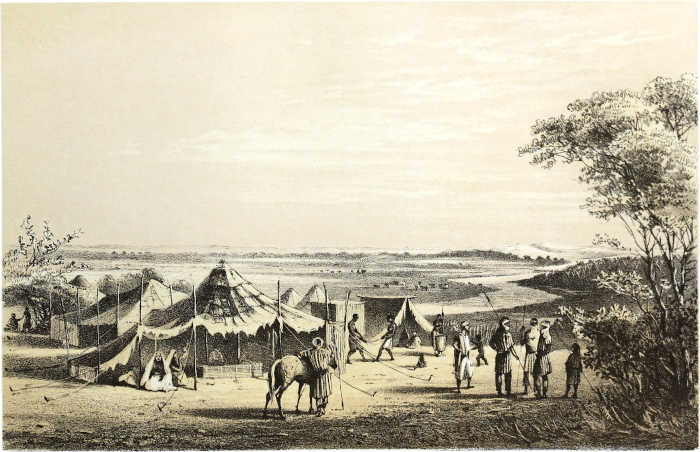
At the foot of the downs was the encampment of our friends the Tawárek, with its larger and smaller leathern tents, some of them open and presenting the interior of these simple movable dwellings; beyond, the swampy creek, enlivened by a numerous herd of cattle half-immersed in the water; then a dense border of vegetation, and beyond in the distance, the white sandy downs of Ernésse, with a small strip of the river. I made a sketch of this pleasant and animated locality, which is represented in the plate opposite. The scenery was particularly beautiful in the moonlight when I ascended the ridge of the downs, which rise to about 150 feet in height. In the evening I received a little milk from the wife of one of the chiefs of the Kél-gógi of the name of Lámmege, who was a good-looking woman, and to whom I made a present of a looking-glass and a few needles in return. The Tawárek, while they are fond of their wives, and almost entirely abstain from polygamy, are not at all jealous; and the degree of liberty which the women enjoy is astonishing; but, according to all that I have heard, instances of faithlessness are very rare among the nobler tribes. Among the degraded sections, however, and especially among the Kél e’ Súk, female chastity appears to be less highly esteemed, as we find to be the case also among many Berber tribes at the time when El Bekrí wrote his interesting account of Africa.[26]
Drawn by J. M. Bernatz, from a Sketch by Dr. Barth. M. & N. Hanhart, lith. et impt. AMMALÉLLE. May 10th, 1854.
Meanwhile my good and benevolent protector was in a most unpleasant dilemma, between his regard for his own interest and his respect for myself. He severely rebuked the Tárki chief for having disturbed the friendly relation which had formerly existed between himself and me; for since our retrograde movement, in order to incite my friend to a greater degree of energy, I never went to his tent, although he repeatedly paid me a visit. At length, after mature consideration, the Sheikh had decided that I, together with the greater part of his followers, should go to Ernésse, there to await his return, while he himself intended to approach still nearer to Timbúktu, although he affirmed that he would not enter the town under any condition.
Thus we separated the next morning, and I took leave of the friends whom I had made among the tribe of the Igwádaren. These people were leaving their former homes and their former allies, in order to seek new dwelling-places and new friends. There was especially, the little Kúngu, who, early in the morning, came on his white horse to bid me farewell. We had become very good friends, and he used to call daily to talk with me about distant countries, and the different varieties of nations as far as he had any idea of such things. He was an intelligent and chivalrous lad, and with his long black hair, his large expressive eyes, and his melancholy turn of mind, I liked him much. When I told him that he would yet become one of the great chiefs of the Tawárek, and a celebrated warrior, he expressed his fear that it would be his destiny to die young like his brothers, who had all fallen in battle at an early age; but I consoled him, and promised that if any friend of mine should visit these regions after me, I would not fail to send him a present for himself. He regretted having left the neighbourhood of Bámba, which he extolled very highly on account of its fine trees and rich pasture-grounds; but he spoke enthusiastically of the Ráfar-n-áman, or, as the Arabs call it, the Rás el má, with the rich grassy backwaters and creeks which surround it, especially the valley called Tisórmaten, the reminiscences of which filled his boyish mind with the highest delight.
Thus I took leave of this young Tárki lad, after having given him such little presents as I could spare. Swinging himself upon his horse by means of his iron spear, he rode off with a martial air, probably never to hear of me again. I took the opposite direction, along the shore of the creek Amalélle, accompanied by a guide whom Áhmed el Wadáwi had brought from Ernésse, and followed by Mohammed ben Khottár the Sheikh’s nephew, Sídi-Mohammed the Sheikh’s son, and almost the whole of his followers. However, the company of all these people did not inspire me with so much confidence that my friend and protector would not tarry long behind, as the fact of the presence of his favourite female cook Díko who accompanied us, and whose services my friend could scarcely dispense with; and I thus agreed in the opinion of his confidential pupil Mohammed el Ámín, who, knowing well the character of his teacher, disputed with energy with those amongst my companions who thought that the Sheikh would send us word to join him in the town.
I therefore cheerfully enjoyed once more the very peculiar character of this river district, with its many creeks, small necks of land, and extensive swamps. Since we had last visited this place the waters had retired considerably, and the extensive swampy lowlands between Temáharót and Ernésse had become quite dry, so that we had to cross only a narrow channel-like strip of water. Following then the sandy downs, we soon reached the well known encampment of the Kél-n-nokúnder, where I was hospitably entertained with a bowl of ghussub water. I was disposed to enjoy in privacy the view over the river, while lying in the shade of a siwák, but the number of Tawárek who were passing by did not allow me much leisure, for the tents of Sául, as well as those of El Wóghdugu, were at a short distance. But these people, conscious of their having deserved punishment at the hand of their liege lord, were frightened away by the rising of a simúm, as it is popularly believed in the country that this wind is the sign of the approach of the great army, or tábu, of the Awelímmiden, and they all started off the next morning.
The river, which is here very broad, forms a large low island called Banga-gúngu, the “hippopotamus island,” while a smaller one, distinguished by a fine tamarind tree, is called Búre. I endeavoured in the afternoon to reach the bank of the river itself; but it is beset with a peculiar kind of grass of great height, armed with such offensive bristles that it is almost impossible to penetrate through it. In the latter part of the cold and during the hot season, a path leads along this low grassy shore, but, during some months of the year, the water reaches the very downs. It is a fine spot for an encampment, the air being good. But the whole site consists only of a narrow sandy ridge, backed towards the north by an extensive swamp, the border of which is girt with the richest profusion of vegetation, interwoven with creeping plants, and interspersed with dúm-bush. This place is called “úggada,” and forms a haunt for numbers of wild beasts, especially lions, and the inhabitants gave an animated description of a nocturnal combat which, two days previously, had raged between two lions on account of a lioness.
It had been decided that we should await here the return of the Sheikh; but, after we had passed the following day in this place, our friends the Kél-n-nokúnder, already satisfied with the honour of entertaining so many guests for one day, endeavoured to escape from our hands, and, without having given us the slightest warning, on the morning of Saturday suddenly removed their encampment. Fortunately they went eastward, in which direction I would have followed them to the end of the world. Thus my companions, the télamíd, rushed after them like hungry vultures after their prey. I had my things packed in a moment, and we followed them along the same narrow neck of downs on which our route had lain in coming from Amalélle; but, instead of traversing the swamp by the ford northward, we kept along it towards the east, where the downs gradually decrease in height, being overgrown with colocynths, and, further on, with túrsha, or Asclepias gigantea, and the blue Crucifera or daman-kádda. Further on they cease entirely, and give way to a low shore, which, during the highest state of the inundation, forms a connection between the river and the swampy background stretching out behind the downs.
Here, where the river takes a fine sweep to the south-east, and forms several islands, was situated in former times a town of the name of Belesáro, but, at present, nothing but groups of a beautiful species of wild fig-tree, called here duwé, mark this spot as the former scene of human industry.
Crossing then a low swampy ground, overgrown with rich býrgu and rank reed grass, we reached the high sandy downs of Úle-Tehárge, which had already attracted my attention from our encampment in Tehárge. On the highest part of these downs the Kél-n-nokúnder chose the place for their new encampment, and I fixed upon a former fence, wherein I pitched my tent, which from this elevated position was visible over a great part of the river. But my young friend, the Sheikh’s nephew, imbued with the superstitious prejudices of his mother, always greatly objected to my using the former dwelling-places of other people, as if they were haunted by spirits.
It was a beautiful camping-ground, elevated about 150 feet above the surface of the river, over which it afforded a magnificent prospect, the river here forming a very noble sheet of water. It is asserted, however, that in summer it is fordable at the place called Énsowéd. A little beyond the end of the downs, where it formed another reach towards the south, the river presented the appearance of an extensive lake. Nearer the opposite shore a low grassy island called Rábara stretched out, and another narrow strip of ground called Wáraka was separated from the shore, on our side, by a narrow channel, and overgrown with the finest býrgu. Towards the south, the steep sandy downs were bordered by a strip of rich vegetation, behind which a green swampy plain stretched out, intersected by an open channel, which separated us from the main, where another village of the Kél-n-nokúnder was lying, the barking of whose dogs was distinctly heard.
The small creek which separated the island of Wáraka from our shore was full of crocodiles, some of which measured as much as eighteen feet, the greatest length which I have ever seen this animal attain in Central Africa; and swimming just below the surface of the water, with the head occasionally peeping forth, they greatly threatened the security of the cattle, who were grazing on the fine rank grass growing on the border of the creek. In the course of the day these voracious and most dangerous animals succeeded in seizing two cows belonging to our hosts, and inflicted a very severe wound upon a man who was busy cutting grass for my horses.
This man had attached himself to my party in order to return to Háusa, which was originally his home. But there was a great difference of opinion as to whether he was at liberty to go, although he was a liberated slave, and I was given to understand that his company might involve me in disputes with his former masters; for, in general, even liberated slaves are supposed to observe some sort of duty to their former employers. Nevertheless, I had allowed him to stay, but was now obliged to send him back to Timbúktu, as almost the whole of his foot had been carried away by the monster, so that he was entirely unfit for the journey, and required immediate relief.
The view of the river was the more interesting, as a strong north-east wind, or, as the Tawárek say, “erífe,” ruffled its surface so considerably, that it crested the waves with white foam, and presented a very animated appearance, the magnificent sheet of water, the green island and shore, and the high ridge of the wide sandy downs, forming a most pleasing contrast.
There was, also, no lack of intercourse. Sometimes it was some fishermen of the Songhay who solicited my hospitality in the evening; at others, it was a troop of Tawárek horsemen, who came to see the Christian stranger of whom they had heard so much. The most remarkable among them were the horsemen of the Kél-tabórit, and the Kél-támuláit[27], with whom I had a long conversation, in the course of which I endeavoured to make them understand that the whole of this extensive region, of which they knew only a small part, was “nothing but a large island, or gúngu” (“gúngu ghás”), in the great salt sea, just as the island of Rábara, opposite to us, was with regard to the Niger, or the Eghírrëu, the only name by which this river is known to all the Berber tribes. They thus became aware that the dominion of the sea was of some importance, as it gave access to all these countries, whereas before they had only looked with a sort of contempt upon people living only, as they thought, in vessels on the sea; and they were not a little surprised when I told them that we were able to come up this river from the sea. They likewise had heard, and some of them perhaps had even seen, something of that adventurous Christian who, fifty years ago, had navigated this river, and who, even after this lapse of time, remains a mysterious and insoluble enigma to them, as to the place from whence he so suddenly appeared, and whither he was going.
The influence of conversation is great among these simple dwellers of the desert, and the more we talked the more friendly became the behaviour of my visitors, till at last they asked me why I did not marry one of their daughters and settle among them. On the other side of the river there were encampments of the Imedíddiren and Terféntik, and some of the latter paid our hosts a rather abrupt visit, taking away from them a head of cattle, so that the Sheikh’s nephew, Mohammed ben Khottár, was obliged to cross the river in order to obtain damages from them. The Kél-n-nokúnder, who in former times had been greatly ill-used by the free Imóshagh, have been imbued by their protectors the Kunta with such a feeling of independence, that they are now not inclined to bear even the slightest injustice, and they had certainly some right to demand that, at the very moment while they were treating so large a party belonging to their protector, they should not themselves suffer any violence. However, I heard to my great surprise, that they likewise pay zekʿa to the Fúlbe, or Fullán. My friend, who had some trouble in persuading the freebooters from beyond the river to restore the property, represented them to me as fine tall men, kinsfolk of the Tarabanása, but very poor. It is really surprising that a family of peaceable men should exercise such an influence over these wild hordes, who are continually waging war against each other, merely from their supposed sanctity and their purity of manners.
The interesting character of the locality did not suffice, however, for our material welfare, and my companions made serious complaints on account of the scanty supply of food which they received from our hosts; and for this reason they were almost as eager to hear some news of the Sheikh as I myself.
From our former encampment in Ernésse, I had sent my servant, Mohammed el Gatróni, into the town in order to procure me a supply of the most necessary provisions, as my former stock was entirely consumed; and it was fortunate, on this account, that I had saved 5000 shells, which I was able to give him for this purpose. He now joined us again in this place on the 14th, and, of course, every one hastened to learn what news he had brought from the town and from the camp of the Sheikh. He had arrived in Timbúktu a little before sunset, and, having finished, without delay, his purchases of the articles wanted by me, immediately hurried away to the camp of my protector; for, as soon as the news of the arrival of my servant had got abroad in the town in conjunction with the return of the Sheikh to his camp, the utmost excitement prevailed amongst the townspeople, who fancied that I myself was returning, and, in consequence, the alarm drum was beaten. My servant also informed me that the Tawátíye themselves were greatly excited against me, as if I had had anything to do with the proceedings of the French against Wárgelá; and he assured me, that, if I had still been in the town, they would have been the first to have threatened my life. He had only slept one night in the camp, and then left early the following morning, and therefore knew nothing about our protector’s coming, but he confirmed the fact that there were letters for me. Fortunately, on returning, he had been informed that we had changed our camping-ground, and finding a guide, he had been able to join us without delay. The suníye of negro-millet fetched at the time, in the market of Timbúktu, 4500; a large block of salt of about 60 lb. weight, 5000; and kóla nuts, from 80 to 100 shells each. With my limited supply of means, it was fortunate that I never became accustomed to the latter luxury.