CHAP. LXXXII.
Reading edition
SECOND STAY IN GANDO, SÓKOTO, AND WURNÓ.
The quarters which had been allotted to me this time, were at least a little more airy than my former ones. My former guide, Dahóme, here paid me a visit. Upon asking him whether he had faithfully delivered to the mʿallem ʿAbd el Káder, in Sókoto, the parcel I had given him on his taking leave of me at Dóre, he put on a rather sullen look, took from his cap a small leather case, opened it, and drawing forth a dirty piece of paper, to my utmost surprise and disappointment, exclaimed, “Here is your letter!” I then learned, that in consequence of the violent rains through which he had had to make his way, and the many rivers and swamps which he had to cross, the whole envelope of the letter, containing the lines addressed to my friend in Sókoto, had been destroyed, so that the latter, receiving only the English letter, and not knowing what to do with this hieroglyphic, at length returned it to the bearer, who had since used it as a charm. Besides this mishap, which had delayed this letter so long, instead of its being forwarded directly to Europe in order to inform my friends of my proceedings, there was another disagreeable piece of information for me here; viz., that nearly the half of the huts composing the town had been consumed during my absence by a conflagration, and that all my books which I had left behind had in consequence been destroyed.
I stayed four days in Gando, endeavouring once more, in vain, to obtain an audience from the prince, and to persuade my companions, the télamíd, to give up their hopes of a handsome present from this niggardly man, who sent me, if I may attribute the proceedings of his slaves to himself, in return for all the presents I had made him, a common black tobe and 3000 shells, although my supplies were totally exhausted, and the two camels which I still possessed were more or less worn out, so that I stood greatly in need of generous aid. But not wanting anything besides from the governor, I was thankful that I had passed unmolested through his extensive dominions, on my outward as well as on my home journey, and even protected, as far as his feeble power was able to grant protection.
The town was no better off now than it had been a year before, the expedition against Argúngo, of which I had heard on the road as being undertaken by ʿAlíyu, having turned out a mere sham, and in consequence the pagan rebels being stronger and more daring than ever; and, just as was the case during my former residence, there was an expedition on a small scale every Tuesday and Thursday, made by the old people and the women, in order to collect wood with some degree of security. On the whole, there was nothing of interest to record, except the remarkable quantity of rain which fell during my stay, and which was said to have fallen before my arrival, confirming the impression already previously received in my mind, that Gando was one of those places most abundantly supplied with the watery element; and it was highly interesting for me to learn from the people on this occasion, that, as a general rule, they reckon upon ninety-two rainy days annually. I am quite sure that the average rain-fall in this place is certainly not less than sixty inches; but it is probably more than eighty, and perhaps even one hundred.
Wednesday, August 23rd.I was heartily glad when I left this town, where I had experienced a great deal of trouble, although I could not but acknowledge, that if I had not succeeded in some degree in securing the friendship of the ruling men in this place, it would not have fallen to my lot to have reached even the banks of the Niger.
It is to be hoped that Khalílu will soon be succeeded by a more energetic prince, who will restore peace and security to the extensive dominions of which Gando is the capital. Under such circumstances, this town, on account of its mercantile connections with the provinces along the Niger, could hardly fail to become a place of the greatest interest.
A great many sweet potatoes, or dánkali, were cultivated in the district through which I passed, although the aspect of the crops was far from being satisfactory. The monkey-bread, or baobab trees, on the other hand, were now in the full exuberance of their foliage. Leaving our former route a little to the north, we took the southerly road to the town of Dógo-n-dáji, which was enlivened by passengers proceeding to visit the market held at that place, which proved to be much more important than that of Gando, cattle, sheep, salt, and beads constituting the chief articles for sale. But, just at the moment we arrived, a thunder-storm broke out, which dispersed all the customers in the market, and left us in a difficult position to supply our wants. The town itself, although the clay wall was in a state of great decay, presented an interesting aspect, being full of gonda, or Erica Papaya, and date trees, which were just loaded with fruit, a rather rare sight in Negroland.
Thursday, August 24th.When we left the town of Dógo-n-dáji, we crossed the market-place, which is adorned by five monkey-bread trees, but being empty at the time, it looked somewhat desolate.
At the present day, at the outskirts of almost all the larger towns of Negroland, Fúlbe families are established, who rear cattle for the express purpose of supplying milk for the daily wants of the inhabitants; and these people gladly provide travellers with that most desirable article when they are well paid for it; but having degenerated to mere tradesmen, they, of course, possess little hospitable feeling. Leaving, then the town of Sála at about two miles distance to the north, and passing through a populous district, rich in pastures and the cultivation of rice and sórghum, and exhibiting near the town of Kusáda a good many dúm- and deléb-palms, we ascended at length along a difficult passage, rendered almost impassable by the quantity of rain which had fallen, until we reached Shagári, the place where we had slept on our outward journey, and where a market was just being held. We were fortunate enough, this time, to obtain tolerable quarters, and to be well treated.
The whole country which we traversed on our next day’s march, was clothed with the richest vegetation, the crops being almost ripe, but cattle and horses being very scanty. Thus, after a good march, we reached the town of Bodínga, having lost another of our camels on the road, which, in crossing one of the swampy valleys in which this part of Negroland abounds, had fallen backwards with his load, and died on the spot. But the quantity of water that we had to sustain from above and below, was not only destructive to animals, but likewise to men, and I myself felt most cheerless, weak, and without appetite, bearing already within me the germs of dysentery, which soon were to develop themselves, and undermine my health in the most serious way. My companions were not much better off, and of the messengers of the Sheikh El Bakáy, none but Sídi Áhmed was able to keep up with us.
A large and well-frequented market was held before the western gate of the town of Bodínga, exhibiting a great number of horned cattle and asses; but the more desolate appeared the extensive and at present useless area of the town itself, which was now covered with rank grass, or laid out in kitchen gardens, while only a few straggling cottages were to be seen. Although I again preferred taking up my quarters outside in my old place, I entered the town expressly in order to pay my compliments to the governor, and was here most hospitably treated by my friend, who manifested the greatest delight at my safe return to his province from my dangerous journey westward. But I had great need of the assistance of a powerful friend, as my camels were not able to carry my little luggage any further; and the good-tempered son of my old friend Módibo ʿAlí, not only assisted me with camels, but also himself mounted the following morning on a stately charger, and escorted me several miles on my road to Sókoto.
I reached the old residence of the Áhel Fódíye in a very exhausted state, having been delayed on the road by falling in, in the midst of a swampy fáddama, with a numerous caravan of asses, which entirely obstructed the winding watery path. But notwithstanding my sickness, I took extreme delight in the varied aspect which the country at present exhibited, in comparison with the almost total nakedness which it had displayed, when I set out from Sókoto sixteen months previously; and I felt extremely grateful when I again found myself in this town, having accomplished more than I ever thought I should be able to do.
The whole town, suburbs, wall, cottages, and gardens, were now enveloped in one dense mass of vegetation, through which it was difficult to make one’s way, and recognise places well known from former visits. Scarcely had I been quartered in a comfortable hut, when my friend ʿAbd el Káder Dan-Taffa, sent his compliments to me, and shortly after made his appearance himself, expressing the liveliest satisfaction at seeing me again, and sincere compassion for the reduced state of my health. Not less encouraging was the reception I met with from my old friend Módibo ʿAlí. When I made him a small present, regretting that after the long time I had been without supplies I was not able to make him a better one, he was so kind as to express his astonishment that I had anything left at all. He also begged me not to go on at once to Wurnó, but to stay a day in this place, and to write to ʿAlíyu, informing him of my safe return, and how much I stood in need of his aid. I made use of this opportunity of at once requesting the emír El Múmenín to forward me with as little delay as possible on my journey, hinting, at the same time, that I should feel very grateful to him, if he would assist me with horses and camels. I intimated also, that as I myself, on account of the reduced state of my health, was anxious to reach home by the most direct road, I had to beg for permission for a countryman of mine, who had just come to Bórnu, meaning Mr. Vogel, to visit the south-eastern provinces of his kingdom. The following evening, a messenger arrived from the vizier ʿAbdú, son of Gedádo, informing me that we were to start on the succeeding day, and that we should find camels on the other side of the river. The river, as I had already learned, was very much swollen, and extremely difficult to cross.
While my Mohammedan and black friends thus behaved towards me in the kindest and most hospitable manner, the way in which I felt myself treated by my friends in Europe, was not at all encouraging, and little adapted to raise my failing spirits; for it was only by accident, through a liberated female slave from Stambúl, who called upon me soon after my arrival, that I obtained information of the important fact, that five Christians had arrived in Kúkawa, with a train of forty camels. While I endeavoured to identify the individuals of whom this person gave me some account from a very selfish point of view, with the particulars contained in Lord Russell’s despatch, which I had received near Timbúktu, about the members of an auxiliary expedition to be sent out to join me, I was greatly astonished that, for myself, there was not a single line from those gentlemen, although I felt still authorized to consider myself the director of the African Expedition; and I could only conclude from all this, that something was wrong. I had not yet any direct intimation of the rumour which was spread abroad with regard to my death: and taking everything into consideration, it was certainly a want of circumspection in Mr. Vogel, notwithstanding the rumours which were current in Bórnu, not to endeavour to place himself in communication with me in the event of my being still alive.
Drawn by J. M. Bernatz, from a Sketch by Dr. Barth. M. & N. Hanhart, lith. et impt. GULBIN SÓKOTO. August 30th. 1854.
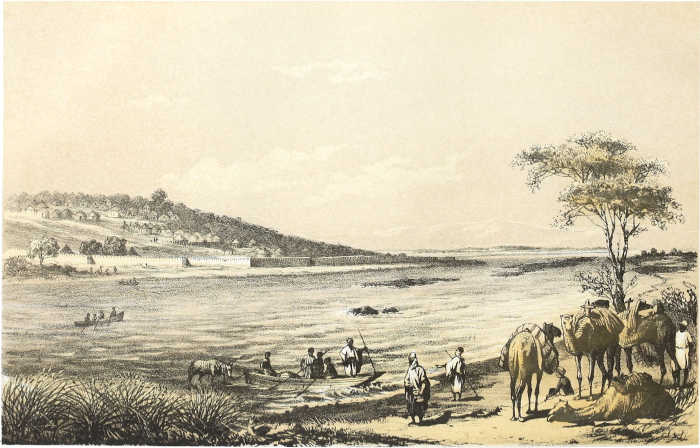
Tuesday, August 29th.Having arranged my luggage at an early hour, and waited some time for my people to get ready, I set out. Winding down the slope of the hill on which Sókoto is situated, and which was now covered with crops, we reached the border of the stream, which, from having been an insignificant brook at the time of my first arrival in the place, was now changed into a powerful torrent, about 200 yards broad, and rushing along with the most impetuous violence, undermining the banks, and leaving in its course small patches of grassy islands, which made the passage extremely difficult. The view opposite will give an idea of the scenery. Having at length crossed this stream in frail barks, dragging our horses and beasts of burden alongside of them, we had to wait a good while on the opposite shore till the camels sent from Sókoto came to meet us, when we proceeded about eight miles, and having been caught in a heavy shower, took up our quarters in Áchi-da-láfia, a large straggling farming village. Here I felt extremely weak and exhausted, my case assuming more distinctly the character of dysentery.
Wednesday, August 30th.After an agreeable march of about six miles, it being a fine clear day, we reached Wurnó, the residence of ʿAlíyu. Here we were lodged in our old quarters, where, however, the frail building of the hut had disappeared, and nothing remained but the clay house. I was received by the court of the emír El Múmenín also with great kindness, and, curious as it may appear to Europeans, my hostile relation with the Fúlbe of Hamda-Alláhi seemed only to have increased my esteem in the eyes of these people. ʿAlíyu had even heard of the ungenerous conduct of the Sheikh el Bakáy’s younger brother towards me; and while he greatly praised the straightforward behaviour of the former he did not fail to reproach Sídi Álawáte with meanness. He treated me very hospitably, although I was not able to enjoy greatly the more luxurious kind of food which was here offered to me, for luxurious it seemed after my poor diet in the famished and distracted region near the Niger. It was only by the strictest diet, especially by keeping to sour milk, together with repose, that I succeeded, after a great deal of suffering, in keeping under the disease. However, my recovery in the beginning was only temporary, and on the 13th of the following month dysentery broke out with considerable violence, and caused me a total loss of strength; but, after a severe crisis, it was overcome by the use of Dover’s powders, although even then a simple diet was the most effectual remedy, my food consisting of nothing but pounded rice, mixed with curdled milk, and the seeds of the Mimosa Nilotica. At length, on the 22nd of September, I was again enabled to move about a little on horseback, and from that day forward, my health continued to improve.
Finding that my segífa excluded every draught of air, I built myself a shed of matting in front of the door of the clay house, where I spent my time pleasantly enough, until the great humidity of the ground, in consequence of the rains that began to fall, drove me back into my hall. The whole breadth of the valley to the very foot of the rocky border was now under water to a considerable depth, and covered with water-lilies. Scarcely a small footpath remained. A great deal of rice was to be seen in the low ground, while the cultivation on the higher ground consisted entirely of sorghum. But the richness of the country around was scarcely of any avail, for greater insecurity prevailed than on my former visit, even at the distance of a few miles from the capital. A small host of the enemy had succeeded in carrying into slavery from a distance of less than ten miles from the capital, a considerable number of people and cattle.[47] Another predatory expedition of the Búgaje from Alakkos, a few days later, drove away two herds of cattle from the very village of Giyáwa; and on the 2nd of October a small foray of Tagáma plundered the village of Saláme together with a neighbouring hamlet, carrying away a good number of people.
A great dearth of provisions prevailed, not only with regard to meat, but even corn, which was the more surprising to us, as we had been accustomed in Timbúktu to very low prices, although provisions are there brought from so great a distance. We were able in that town to buy a sheep for 500 or 600 kurdí, but we could here find none under 3000, the best fetching as much as 5000; and as for corn, the suníye, which we bought in Timbúktu for 3000 to 4000, we should have been glad to buy here with 10,000, if such large quantities had been brought into the market at all. It was, besides, extremely difficult for me to find shells. I was thus obliged to sell five dollars for 11,000 shells, while in Timbúktu they would have fetched 15,000. I also sold the corals which I had left at a low price, in order to be enabled to keep up my establishment. Cotton strips, which are liked better in the country places, were still dearer in proportion than shells.
The horse which I rode myself being incapable of any further exertion, and my camels having either died or become totally exhausted, I was thus thrown, much against my inclination, upon the generosity of the prince, and in order to stimulate his good will, besides the present which I offered to him at my first interview, I gave him in a second audience ten dollars, silver being always an article much esteemed by these people. I had made it a point of reserving the last bernús I possessed for the governor of Kanó, who, in the present state of anarchy into which Bórnu seemed to be plunged, might be a person of great importance to me. But, nevertheless, I could not induce this not very high-spirited and noble-minded prince to make a sacrifice of a handsome horse, and he gave me an animal which, although it did not prove to be a bad travelling horse, was of small size, had a very bad walk, was not able to gallop at all, and altogether, was more like an ass than a horse. Besides a horse, ʿAlíyu was kind enough to send me a large loaf of English sugar,—a rather uncommon article in this country. I felt very grateful for this present, as I was entirely destitute of sugar.
I had a good deal of trouble with my companions, who did not like to leave this place so soon as it was my intention to do. This extended not only to the messengers of the Sheikh, all of whom suffered a great deal from illness, but still more to my headman, ʿAlí el Ágeren, whom I would have sent away long before if I had been able to pay him off; for this man, who found it very convenient to trade at my expense, while he had nothing to do except to receive a good salary, entered into all sorts of intrigues to keep me in this place, just as he had done in Timbúktu.
Notwithstanding the reiterated delays, I succeeded in fixing my departure for the 7th October, and as I afterwards convinced myself from my own experience, the state of the roads which we had to cross would scarcely have allowed us to commence our journey before that time; but the rainy season was now almost over, and while the noxious insect called tumúnragaye, which towards the end of the rainy season infests the whole ground, increased in numbers, the quantity of rain decreased. Being now rather better and feeling stronger, I began again to move about a little on horseback, although the swampy character of the valley which surrounds Wurnó on almost every side, together with the rocky character of the remaining part of the district, prevented me from making long excursions.
During this my second stay in the capital of this extensive empire, I had again full opportunity of observing the extreme weakness and want of energy which prevails in its very centre; although I could not but acknowledge the feeling of justice which animates the ruler himself, notwithstanding his want of spirit. In proof of this I may relate that being informed one day that five young sons of his had committed acts of injustice in the market, he became greatly enraged, and immediately sent his two chief courtiers, ʿAbdu and the ghaladíma, with positive orders to seize and imprison the offenders; and when the young outlaws succeeded in escaping and hiding themselves for a day or two, he had the chief slave, who had been with them, executed. But the cowardice of his people, and their oppression of the weak and unprotected, became fully apparent. A most disgraceful affair happened at this time. A caravan of inoffensive traders who had encamped in Gáwasú, were surprised by them, and after considerable havoc had been made among them, were deprived of almost all their property. These people had been reported to be hostile pagans, or Ázena, from the district of Sáje in Góber, and dependent on the protection of the Kél-gerés and the Awelímmiden-wuén-Bodhál, and were represented as having been trading with the inhabitants of Tléta, which was hostile to the Féllani; but after this cruel act of injustice had been committed, it was ascertained that they were peaceable traders on their way to Kanó, and that among them there were even several inhabitants of Wurnó.
But it almost seemed as if the prospects of this part of Negroland were to darken more and more, for the rumours which I had heard on the Niger of the ancient feud between the Kél-owí and Kél-gerés having again broken out in a sanguinary struggle, were entirely confirmed here. The Kél-owí had undertaken this year an expedition on a large scale, consisting of 5000 men mounted on horses and camels, and, according to report, with as many as 1000 muskets, against the Kél-gerés and the Awelímmiden, and had penetrated almost as far as Sáje, which place they destroyed by fire. The Kél-gerés having taken part in the expedition of the Góberáwa against the empire of Sókoto, the relation of the Kél-owí with the latter had assumed a much more friendly character, and our old friend Ánnur had paid a visit to the town of Kátsena. My friend ʿAbd el Káder, the Sultan of Ágades, who, as I have mentioned on my outward journey, had been deposed, and had been succeeded by Hámed e’ Rufáy, had now turned merchant on a grand scale, endeavouring at the same time to attach the Fúlbe to his cause. His usual residence was now in Kátsena, but he had paid a visit the previous year, in company with the governor of that place, to the emír El Múmenín, taking him, besides a quantity of bernúses and other valuable articles, a present of thirteen horses of Tawárek breed, and receiving from the latter, besides a number of tobes, 3,000,000 shells, and 260 slaves. Having remained about two months in Wurnó, and having been treated altogether in the most distinguished manner, the ex-king of Ágades had been forwarded with a numerous escort; for, notwithstanding the extreme weakness of this empire, if viewed from a European point of view, it even now is not quite destitute of means. During my stay, the messengers arrived from Záriya, with a bi-monthly tribute of 300,000 shells, 85 slaves and 100 tobes.
Having at length overcome the laziness of my companions, I had the satisfaction of seeing my departure finally arranged for the 5th October. The ghaladíma, in whose company on my outward journey I had come from Kátsena, was again to be my fellow traveller on my return eastward. I therefore completed my preparations, and, on the 4th October, I had my final leave-taking, or, as the Háusa people say, the babankwána, when I took the opportunity of excusing myself to ʿAlíyu for having been this year a little troublesome, after the fashion of those Arab sherífs who used to visit him, stating at the same time, that if my means had not been almost exhausted, I should have preferred buying a horse for myself. Having made this prelude, I endeavoured to impress upon him the dangerous state of the road, when he made use of the expression common in Háusa, “Alla shibúdeta!” (“God may open it!”); but I protested against such an excess of reliance upon the Divine intervention, and exhorted him to employ his own strength and power for such a purpose, for without security of roads, I assured him there could be no intercourse nor traffic. He either was, or seemed to be, very desirous that the English should open trading relations with him; and I even touched on the circumstance, that in order to facilitate such an intercourse, it would be best to blow up certain rocks, which most obstructed the navigation between Yáuri and Búsa, but of such an undertaking I convinced myself that it was better not to say too much at once, as that ought to be an affair of time.
Altogether, ʿAlíyu had entered into the most cheerful conversation with me on all occasions, and had questioned me upon every subject without reserve. He also furnished me with four letters of recommendation, one to the governor of Kanó, one to that of Bauchi, one to that of Ádamáwa, and one in a more general sense, addressed to all the governors of the different provinces in his empire. Thus I took leave of him and his court, probably never to see that region again, and lamenting that this extensive empire, which is so advantageously situated for a steady intercourse with Europeans, was not in the hands of an energetic chieftain, who would be able to give stability to conquest, and to organise the government of these provinces, so richly endowed by nature, with a strong hand.
Thursday, October 5th.It was about three o’clock in the afternoon when I took my final leave of Wurnó. I had twice resided in this capital for some length of time, experiencing, on the whole, much kindness. On my outward journey I had been furnished on my dangerous undertaking with a strong and powerful recommendation; and on my return, although I had come into hostile contact with another section of the same tribe to which the inhabitants of this country belong, I had been again received without the least suspicion, had been treated with great regard, notwithstanding the exhausted state of my finances, and allowed to pursue my home journey as soon as the season reopened the communication with the neighbouring province.
Following now quite a different and more southerly road from that which we had pursued on our outward journey, we encamped this day in Dan-Sháura[48], a walled town, strengthened by three moats, tolerably well inhabited, and adorned with fine groups of trees, among which some large gonda trees, or Erica Papaya, were distinguished. The town belongs to the district of Rába, which forms the title of its governor, who is called Serkí-n-Rába. He was a decent sort of man, and treated us hospitably, a dish of fish proving a great luxury to me in this inland region, and bearing testimony to the considerable size of a large pond which borders the town on the east side, being apparently in connection with the gulbi-n-Rába, or Bugga. The evening was clear, and I enjoyed for a long time the scenery of the place in the fine moonlight, but the governor would not honour me with his company, being greatly afraid of the bad influence of the moon, the effect of which he thought far more injurious than that of the sun.
Friday, October 6th.After a night greatly disturbed first by mosquitoes, and then by a heavy gale, we pursued our journey, entering a fine open country, which was intersected further on by a broad fáddama, and beyond that, presented several ponds half-dried up. But, after a march of about ten miles, we had a larger valley full of water on our right; and three miles further on, had to cross it at a spot where the sheet of water was at present narrowed to about 100 yards in width and 3 feet in depth, and notwithstanding a considerable current afforded an easier passage than the other part of the rainy season bed, which at present exhibited swampy ground, partly overgrown with rank grass, but was very difficult to cross, and a few days previously had been totally impracticable for horses or camels.
Four miles and a half beyond this river, through a country adorned with fine trees, but without any traces of cultivation, we reached a large river about 250 yards broad, and more than 5 feet deep, running here in a north-easterly direction, and no doubt identical with the river which we had lately crossed. How it is that the river here contains so much more water than it does lower down, I cannot state with certainty; but my opinion is, that a great portion of it is withdrawn towards the north, where the forest seems gradually to slope down towards the desert region of the centre of Gúndumi, where, in a sort of mould, or hollow, a large lake-like pond is formed. It is rather unfortunate that I had not an opportunity of asking information on this subject from one of the followers of the ghaladíma, who, instead of crossing the first sheet of water, kept along its northern bank, and thus with a longer circuit, but without the necessity of embarking in a boat, reached the town of Gandi. Having then crossed another small fáddama in a wide open country, where sorghum and cotton were cultivated together in the same fields, we reached the town of Gandi. It is surrounded by a wall (in a state of decay), and by two moats, and is of considerable size, but half-deserted.
We traversed with some difficulty the entrance of the town, which was adorned on the outside with three very tall bombax, or silk-cotton trees, and was almost entirely obstructed by a wooden gate, and then made our way through the desolate area of the town, overgrown with tall herbage, dúm-palms, and kórna, until we reached the house of the mágaji, who is one of the five rulers of this vast and desolate place. But we had a great deal of trouble in procuring quarters in an empty courtyard, where we were glad to obtain some rest, as, owing to my long illness, and my entire want of any strengthening food, I felt extremely exhausted by our day’s march. I had, moreover, the dissatisfaction to find that one of my people, a liberated slave from Núpe, had remained behind and could not be found. As for myself, I was not able to stir much about to inquire after him, for I wanted rest the more, as we had a long day’s march before us[49], and had to rise at a very early hour.
It was three o’clock the following morning when we all assembled round the courtyard of the ghaladíma, but on account of the guide who had promised to conduct us through the wilderness not daring to trust himself with these people without receiving his reward beforehand, we did not get off till half-past five o’clock, after we were quite tired out and ill prepared for a long march. The forest was overgrown with rank grass, and in the beginning exhibited some large ponds. The dorówa formed the principal tree, only now and then a dúm-palm giving some variety to the vegetation. Through this dense forest we marched at such a rate, that it rather resembled a flight than anything else, rendering it impossible for me to lay down this road with the same degree of accuracy to which I had adhered with the greatest perseverance throughout the whole extent of my long wanderings. At length, after a march of more than twenty miles, we reached the beginning of the large pond Subúbu, which, however, at present was almost dried up, presenting nothing but small pools of water; but I was sadly disappointed in my hopes of obtaining here some rest, the locality being regarded as too insecure to make a long halt, although on account of this sheet of water we had evidently given to our course a direction greatly diverging from that of our main route, which was to the north-east. I felt so much exhausted, that I was obliged shortly after to remain secretly behind, protected only by my faithful servant El Gatróni, when I lay down flat on the ground for a few moments, and then, refreshed a little, hastily followed the troop. Thus we proceeded onward, and the day passed by without there appearing any vestige of a town. After many disappointments, dragging myself along in the most desperate state of exhaustion, about an hour after midnight we at length reached cultivated fields and encamped at some distance from the town of Danfáwa or Dan-Fáwa, on an open piece of ground. Not being able to wait till the tent was pitched, I fell fast asleep as soon as I dismounted. A very heavy dew fell during the night.
Sunday, October 8th.Having obtained some water and a couple of fowls from some farming people in our neighbourhood, we succeeded in finding our camels (which on account of the exhausted condition of my people had wandered away), and set out a little after noon, passing close by the town, where a tolerable market was held, and where I provided myself with corn for the next few days. The town of Dan-Fáwa is tolerably populous, and there are even a good many huts outside the walls; but I was astonished at observing the filthy condition of the pond from which the inhabitants procure their supply of water. It could not fail to confirm my former conjecture, that most of the diseases of the inhabitants, especially the guinea-worm, are due to this dirt and filth, which they swallow at certain seasons of the year in this sort of water.
Having lost some time in the market, I overtook my people as they were winding along the steep bank of a considerable river, which, taking a northerly course, and evidently identical with the watercourse at Katúru, joins the great valley of Góber, a few miles to the north-west of Sansánne ʿAísa. At the place where we crossed, it was about 200 yards broad, but very shallow at the time, being only a foot deep and full of sandbanks; but I was not a little astonished to find that it contained a very great quantity of fish, numbers of people being employed in catching them by the beating of drums. Although the bank was so steep, there were evident signs that a short time before, it had been covered by the water, and part of the crops, even beyond its border, had been damaged by the inundation.
The country appeared to be well inhabited. A little further on we passed on our left a populous walled town called Dóle, and an apparently larger place became visible on the other side, the pasture-grounds being covered with extremely fine cattle. After we had crossed the river, I found that the highest stalks of Indian corn, which was fast ripening, measured not less than twenty-eight feet. Besides sorghum, sweet potatoes, or dánkali, were also cultivated here to a great extent. Having then crossed a stony tract, we again reached the town of Moríki, where the river approaches to within a few hundred yards.[50] On the high ground close to the border of the town, a market-place spreads out. Having observed the narrowness of the lanes, I preferred encamping a considerable distance beyond the town near a hamlet, surrounded by a thick fence, and inhabited by Fúlbe, of the tribes of the Jakabáwa and Kukodáwa. The neighbourhood of Moríki was said to be infested by the inhabitants of the town of Tléta, who were reported to make nightly forays, carrying away horses and cattle; but notwithstanding this information, we had an undisturbed night’s rest, although I thought it prudent to fire several shots.
Monday, October 9th.Having dried our tent a little from the extremely heavy dew which had fallen during the night, we set out to join our companions. Traversing the same rocky district through which we had passed on our outward journey, we reached again the well-known place of Dúchi, and entering with difficulty the obstructed lanes of the village where we lost another of our camels, pitched our tent on a small open square opposite the house where the ghaladíma had taken up his quarters. Some tamarind trees on the slope of a rocky eminence, which rose close behind our resting place, afforded us a tolerable shelter during the hot hours of the day.
Tuesday, October 10th.Our day’s march carried us as far as Búnka, with the loss of another of our camels, and we encamped this time inside the town in a tolerably spacious courtyard, the surrounding fields being now covered with tall crops, and not affording sufficient ground for encamping. Altogether the country presented a very different aspect from what it had done on our outward journey, and the watercourse near Zýrmi with its steep banks, offered a difficult passage, although the water was not more than a foot and a half deep. My camels being either knocked up or having entirely succumbed, I endeavoured in vain to procure a good ox of burden, the principal reason of my difficulty being, that I was not provided with shells, and, in consequence, I had some trouble the next day in reaching the town of Kámmané, where the ghaladíma took up his quarters. Already on the road, I had observed a good deal of indigo and cotton cultivated between the sorghum. Even here close to the town, we found the grounds divided between the cultivation of rice and indigo; and I soon learnt that the whole industry of the inhabitants consisted in weaving and dyeing. They have very little millet of any kind, so that their food is chiefly limited to ground-nuts or kolche. They have no cattle, but their cotton is celebrated on account of its strength, and the shirts which they dye here, are distinguished for the peculiar lustre which they know how to give to them. Although the inhabitants have only about twenty horses, they are able, according to their own statement, to bring into the field not less than 5000 archers. However exaggerated this statement may be, they had not found it very difficult, the preceding year, to drive back the expedition of the Góberáwa; for they keep their wall in excellent repair, and even at present only one gate was passable at all for laden animals, the others being only accessible by a kadárku or narrow drawbridge. The whole interior of the town presented an interesting aspect, tall dúm-palms shooting up between the several granite mounds which rise to a considerable elevation[51], while the courtyards exhibited a great deal of industry, the people being busy with their labours till late in the evening. The proprietor of the courtyard where I had taken up my quarters treated me with the favourite drink of furá soon after my arrival, and with túwo in the evening. I was also fortunate enough to obtain some milk from the villagers outside.
Thursday, October 12th.It was rather late when we left this place for another long forced march, a dense fog enveloping the country; but it was still much too early for my noble friend the ghaladíma, who was busy installing a new governor, for which he received a present of a horse and large heaps of shells, so that it was almost ten o’clock before we had fairly entered upon our march. This district being very dangerous, we proceeded on with great haste, and I really conjectured that it was in truth the unsafe state of the road which had caused the delay of our departure, the people being anxious to disappoint the enemy, who, if they had heard the news of our arrival in this place, would of course expect that we should set out in the morning. Having made our way for about six hours through a dense forest, we left a granite mound and the ivy-mantled wall of Rúbo on one side, with a fine rími and abundance of fresh grass of tall growth. The forest then became clearer, and we reached a considerable tebki, or pond, which being regarded as the end of the dangerous tract, my companions came to congratulate me upon having now at length escaped the dangers of the road. However, our day’s march was still tolerably long, extending altogether to twelve hours; and being rather unwell that day, I had considerable difficulty in keeping up with the troop. In consequence of our late departure, we had to traverse the most difficult part of our route, that nearest to Úmmadaw, which is intersected by granite blocks, in the dark, so that our march was frequently obstructed, especially at a spot where two mighty granitic masses left only a narrow passage. A good deal of indigo is here cultivated between the millet; and the town itself is very spacious; but arriving at so late an hour, we had great difficulty in obtaining quarters, all the open grounds being covered with corn, and we were glad to find at length an open square where we might pitch our tent.
Friday, October 13th.Here my route separated from that of the ghaladíma, as I was going to Kanó, while he, again, along this roundabout way (the direct route having been almost entirely broken up by the enemy), directed his steps towards Kátsena. After satisfying our appetites, for which we had not been able to provide the preceding night, I took a small present with me, and went to bid farewell to the ghaladíma and those of his suite who had been particularly kind to me; and I hope that they will long remember me. Having fulfilled this duty, I proceeded with my people, in order to continue my march alone. The country was tolerably open, broken only here and there by granite rocks, while the vegetation was enlivened now and then by dúm-palms. Cultivation was limited to certain tracts; but, notwithstanding the unsafe state of the country, the pasture-grounds were not quite destitute of cattle; and being at length able to travel according to my own inclinations, I enjoyed the scenery extremely. It had been my original intention to pursue the road to Korófi; but, by mistake, after leaving Wurmó, I had got into the track leading to Birchi. I reached this latter town after a march of altogether about twelve miles, having crossed my former route from Kúrayé to Kúrrefi. I found that almost all the male inhabitants of the place had joined the expedition against Káura; and I pitched my tent in front of the house of the ghaladíma, but was invited by the people who were left as guardians to pass the hot hours of the day in the cool entrance-hall of his courtyard. Although the place does not exhibit any great signs of wealth or comfort, I was glad to find that the corn here was much cheaper than in Úmmadaw. I was also enabled to buy some butter. Moreover, the absence of the governor exercised no unfavourable influence upon my treatment, which was very kind: an old mʿallem especially evinced a friendly disposition towards me.
Saturday, October 14th.After a march of about fourteen miles, passing by the town of Rawëó, where a small market was held, and traversing the suburb of Sakássar, with its beautiful “ngáboré,” or fig-trees, we reached the town of Máje, which had been represented to us as rich in cattle and milk, but which I found half deserted; the town having greatly declined about twelve years previously, when the whole country, including the places Takabáwa, Matázu, Korófi, and Kúrkojángo, revolted, and gave free passage to an army of the Góberáwa. I was glad to buy a good sheep for 1500 shells. The governor of the place was absent in Kátsena, where he generally resides. We had pitched our tent in the shade of a beautiful fig-tree, and passed the afternoon very pleasantly; but were greatly troubled during the night by the numbers of mosquitoes.
Rising at an early hour, and traversing a fine country, I reached the large town of Kusáda in the afternoon, and encamped here, outside, not far from the market-place, which at the time of my arrival was quite untenanted; but the following night it became well frequented by a number of travellers who sought quarters there. On this march I observed a specimen of industry on a small scale, exercised by the inhabitants of the town of Máje, who buy sour milk in a place called Kánkia, at a considerable distance, and supply the town of Korófi with it. Numerous villages were lying on either side of our path, cultivated and uncultivated ground succeeding alternately; Indian millet being here the chief product besides cotton. The pasture-grounds also were enlivened by a good number of horses.
Pursuing from this point my old road through the fine province of Kanó, rich in all kinds of produce, and well stocked with cattle, and encamping the next night close beyond the town of Bíchi, I reached the town of Kanó in the afternoon of the 17th, having sent one of my people in advance.