Front matter (continued 8)
Reading edition
At length the other men came with Abdul Kerim riding at their head. Our coats and turbans were of the same colour, so that any Tibetans who happened to be watching could not tell if it were Abdul Kerim or I that was riding. I now took my horse and went on in front with my usual companions. At eleven o’clock the storm rose to a furious pitch and dashed in our faces. Driftsand swept over the ground in dense masses; we were nearly suffocated, and we seemed to stand still while the country moved past us at a giddy pace. We crossed the valley in order to follow its western flank. The clouds of dust obscured the sun; nothing could be seen beyond a distance of 20 yards; chaos surrounded us. We stopped to get our breath, and lest we should miss the others, but as soon as they appeared like phantoms in the mist we set off again. I have experienced many sandstorms in Takla-makan and the Lob-nor desert, but hardly any so bad as this was. In Turkestan one simply encamps when a storm comes on, but what is the use of encamping to await the end of a storm which lasts thirty days? We strayed among small dunes, and, though the valley fell in the direction we were travelling, we seemed as though we were mounting to a lofty pass in consequence of the pressure of the storm. The driftsand rattled against my dry, hard coat, which, from the constant friction, became heavily charged with electricity. About every other minute there was a discharge, and I felt uncomfortable and often painful prickings, especially in the soles of the feet, the hands, and knees. At every such discharge the horse also pulled up and became nervous. At last, when my grey Tikze horse refused to go further, and we had quite lost sight of the others, and could not see where we were going, we came to a halt and huddled together with our backs to the wind. The electrical discharges continued even now, but were weaker. If I placed the tip of a finger near Gulam’s or Kutus’ hand a small electric spark was felt and seen, and both of us felt the shock. The men were exceedingly astonished, and hoped it was not witchcraft.
We sat waiting for three hours, and were prepared for an uncomfortable night. But Kutus came upon the other men just when they were giving up all attempt to find us before night. We encamped among the dunes, and before long all articles which were set out in my tent vanished under a thick layer of sand.
On the morning of the 11th the storm had somewhat abated; and, wearied and stiff after our experiences of the previous night, we continued our journey southwards and encamped at a deserted sheepfold. By nine o’clock compact sandspouts twisted slowly over the plain like spectres, so the storm was again at its usual height. We had tsamba for only one day, but it did not count for much as long as we had such a good supply of meat. We were glad to get out of reach of the Gertse Pun; in this drifting sand it was impossible to find our trail—yes, even for our own dogs. Little Puppy did not miss his mother, but felt very important at being sole master on the ground, and barked at our sober sheep. It was, however, a serious matter for us that we were deprived of our night-watch in districts where we had most need of them. We must try to procure fresh dogs as soon as possible.
On March the 12th we marched the usual weary 6½ miles to the east-south-east through a fine, broad, longitudinal valley, and pitched our camp in a hollow full of rubbish. Our three tents were now always placed close together, so that, if any stranger came unexpectedly to my tent, I could crawl into Abdul Kerim’s without being seen from outside. My Ladak chapkan began to assume a more satisfactory colour, but we still did all we could to defile it and make it sooty and greasy. Little Puppy lent me his assistance by biting and tearing the sleeves so that they hung in rags. It would not be long before I had the appearance of a regular ruffian.
It snowed heavily all night, and in the morning the snow lay so deep, and the country was so thickly covered, that we thought it best to remain stationary. We were still farther removed from Brown Puppy, and it was vain for her to seek our trail. Perhaps it was providential that both she and the white horse were lost before they could betray us. Tibetans have wonderfully sharp eyes for animals, and recognize them again when they have seen them only once. Now the danger was over, for all the veterans had gone. Perhaps Puppy sacrificed herself that I might be successful! All the same, I seemed to see her wandering disconsolate and distressed about the desolate wastes in the north.

CHAPTER LXIII
THROUGH THE HIGHLANDS OF BONGBA
When I awake to another day of uncertain fortune and adventures life seems gloomy and solitary, and the longer the time the more I long for an end of my difficulties. When Gulam awoke me on the 14th, he complained that Abdul Kerim did not keep the watch I had given him in order; either the watch or the caravan leader was at fault, but he believed it was the latter, for the watch could not be blamed if it were wound up only every other day. Gulam affirmed that when Abdul Kerim was asked what o’clock it was, he always answered seven, whatever time it might be in the twenty-four hours.
The thermometer fell to −11° in the night, but the day was fine. The wind blew as usual, but the sun came out and we thought of spring again. Three shepherds were taking some hundreds of sheep to the west, which had been driven off from their pasturage by the recent snow and were looking for uncovered land. We were only a day’s journey from the Tong-tso (14,800 feet), they said, and the Tong-tso was the point from which we were to start southwards to traverse unknown country. If I succeeded in crossing it only by a single route, all the troubles of the past winter would not have been in vain. The shepherds’ information was correct, for the next day we bivouacked on the western shore of the Tong-tso, which we found exactly at the place where the immortal pundit, Nain Sing, inserted it on his map. To the south-east towered the huge massive Sha-kangsham, along the northern foot of which I had ridden in 1901.
Now we had to find a convenient pass over the mountain which barred our way to the south. A gap was seen to the south-east, and we directed our steps towards it. On our right, two tents stood at the foot of a hill, and Abdul Kerim was sent to them while we encamped in a deep narrow ravine, at the bottom of which we found a large quantity of wind-driven kiang dung and dry tufts of grass. On his return, our good leader reported that he was rudely received by two men, named Nakchu Tundup and Nakchu Hlundup, who came from the district Nakchu, three days’ journey distant to the south, and had a wife in common. They first asked how many we were and how many guns we had, just as though they wished to know whether they and their neighbours might venture to attack us. They then said that they had seen a man riding at the head of our party, while all the rest, Abdul Kerim included, went on foot, and that it was not hard to guess that the mounted man was a European. When Abdul Kerim replied that no Europeans travel in winter, for they are too much afraid of the cold, and that we were only wool-buyers from Ladak, the Tibetans shook their heads and answered that they had never heard of Ladakis travelling in this country in winter. But, nevertheless, Abdul succeeded in gaining their confidence, and when he had paid double the market price for two yaks and six sheep, the Tibetans forgot their suspicions, all for the sake of filthy lucre. The purchase was to be completed the following morning. Then the new animals were fetched, and their carrying power was a welcome assistance to our animals. Fortunately, the nomads had in general the greatest respect for our tents. It was important for us to make liberal bargains with men who at first had been hostile to us. On the other hand, they often abstained from betraying us, even if they had suspicions, for if it were known that they had been well paid, the nearest chief would confiscate their receipts and would also punish the unfortunate men who had dared to traffic with suspected individuals.
During the day’s march I rode in front as usual, with my two companions on foot. A tent lay concealed behind a cliff, and we did not notice it until we were some way past it, and then it was too late to dismount. Two fellows were outside and looked after us, and if they compared notes with their neighbours they would have good cause for suspicion. At our camp that day we had a visit from an old man and two young people, who had their tent near and came to see what kind of men we were. They said that they were very poor, and begged for some coppers. We were on the border of the district Bongba-changma, which contains 300 tents, and, like the whole province of Bongba, is subject to the governor Karma Puntso, whose tent stood at a distance of six days’ journey to the south. He was a man of twenty-five years of age, lived in a large tent, and had been in office only a year, since his father died. It was assuring to know that he could have no experience of Europeans and their crafty ways. After the strangers had received a couple of tengas from Abdul Kerim, they went home again in the rays of the evening sun, delighted to find that we were not robbers.
Then the temperature fell to −16°; the winter was remarkably trying, but the day, March 18, was still fine, and I travelled all the way on foot, driving the sheep while we were passing several tents. Among them was that of our old man of the day before, and he proved to be a man of property, who sold us various much-needed articles of food. On the way Tubges shot seven partridges, whereupon two Tibetans came forward and protested, saying that only Europeans shot partridges. Abdul Kerim assured them that he preferred partridges to mutton. Again there was talk of Karma Puntso. Perhaps it would be better to choose another way. No; then the governor would be still more suspicious. We encamped on the northern side of a small pass, where we had no troublesome neighbours.
March 19. Breakfast, a delicate partridge and a cup of tea, was just over when it was announced that three Tibetans were coming up to our tents. But they stopped at a respectful distance, and Abdul Kerim went up to them. My tent was opened in this direction, but was closed again just in time. The Tibetans’ errand was to ask if we had any medicine suitable for a man who had a pain in the foot. In reality, their object was to spy upon us when we set out, for they stayed all the time and looked about. After my hands and face had been coloured black, I stole by the secret passage into Abdul Kerim’s tent, while Kutus and Gulam crawled by the same way into mine to pack up. Then I went with Lobsang and Kutus, and drove the sheep up the track leading to the pass (16,135 feet). We had not gone far when Abdul Kerim came riding on my horse and made frantic gestures to us to stop. A Tibetan horseman, followed by a big dog, would meet us in a few moments on the path. We therefore took a roundabout way among hillocks, while the caravan encountered the Tibetan. In this way we escaped the danger. Soon came Kunchuk and Sedik, leading the dog with a rope on either side—a savage brute, which barked till he foamed at the mouth, and tried to bite those who were taking him away from his master. He was of the species called takkar, and Takkar was his name. He reminded me of a St. Bernard; he was coal black, with a white patch on the chest and neck, and was as savage as a wolf. They had bought him for 2 rupees.
Moreover, Abdul Kerim had also bought the rider’s horse for 86 rupees, and he came jogging cheerfully after us as we rode down from the summit of the pass to a longitudinal valley abounding in tents and herds of sheep and yaks, and at two spots were seen mounted men, who looked uncomfortably like a levy. The new horse was eleven years old, the owner said, and if he passed well over his fifteenth year, he would live to thirty—but we did not want him so long. He was a new member of our troop and excited general interest, and Takkar became quieter when he saw an old friend and comrade in misfortune.
At the camp we had to be careful, for nomads dwelt near and shepherds wandered with their flocks on the slopes around. To prevent Takkar from running away he was tied by the neck to a tent pole, an operation by no means easy. He was tied fast with ropes, his legs were fettered, and a felt mat was thrown over him, on which four men sat while the others made him fast to the pole. Immediately he was let loose he rushed at those nearest him, but was held back by the pole. It was a sin to drag him from home against his will; he was another Uncle Tom who suffered for our sake, but I hoped that we should soon understand each other. To console him in his captivity he was given the blood and entrails of the slaughtered sheep.
We crossed another small pass (19,537 feet) on the 20th, and the insignificant lake Shar-tso, where a fine spring bubbles up out of the ground by the shore. From a couple of tents to the west we bought tea, butter, and tsamba sufficient for several days, and heard again about Karma Puntso. This time it was said that he lived three days to the west, and we hoped to slip past without any disturbance. The country about camp 359 is called Luma-shar, and we stayed on the northern bank of the large river Kangsham-tsangpo, which comes from the northern flank of Sha-kangsham, the huge massive which I left to the south of my route in 1901, and which showed us a magnificent view of its western side. The mountain lay about a couple of days’ journey to the south-east.
The next day we were to cross the river, an exceedingly unpleasant business; for though there had been 32 degrees of frost in the night the ice, except close to the bank, would not bear. Abdul made an attempt with his horse, but the animal came down on his nose in the middle of the river. Then Lobsang took off his boots and went across the river barefooted, and came back again to help in conducting our pack animals gently and firmly across. To get the sheep over was the worst difficulty; they had to be pushed and pulled by the horns, one at a time. Almost all the men of the caravan got a refreshing bath in the stream (Illust. 363).
On the other side we ascended to a small pass where there was a splendid view over the ridge, which seemed to run west-south-west from Sha-kangsham and which barred our way to the south. Abdul Kerim, Kunchuk, and Sedik went with an exhausted mule to a few tents standing to the right of our route, with the object of bartering the worn-out beast for a couple of sheep, but the nomads said they would not take it as a gift. Instead, our men bought rice, sour milk, butter, salt, and a sheep, so that we were provided for some days. From the camp also Abdul Kerim took a long walk to some tents in the neighbourhood. Now poor Abdul Kerim had to do penance for his sins, and if he had erred in taking too little barley from Ladak, he made up for it by his conduct on this adventurous journey.
From camp 360 the highest peak of Sha-kangsham lay south, 73° E. (Illust. 317).
Takkar is still irreconcilable, and heartily detests Kunchuk who bought him. But he also barks at us as soon as we show ourselves outside the tents. On the march he is resigned as long as he is near our new horse, but at other times he is savage. The only one that dares go near him is Little Puppy, who teases and sports with him and bites his ears. Takkar treats Little Puppy with supreme contempt, and only when the young one presumes to snatch his new uncle’s food he growls angrily, but then Little Puppy pricks up his ears, puts his head on one side, and looks at him. He little thought that the new dog could have bitten off his head like a chicken’s if he had wished. In reality, Takkar was glad to have a playfellow in his captivity, though at first he held himself aloof to maintain his dignity.
The next morning Lobsang and Tubges went back to the nomads’ tent and returned with three more sheep, a lump of butter, and a bag of tobacco. Their appetites were wonderful to behold. The others had left for them half a pot of tea mixed with butter, thick and red. One cup disappeared after another, and they emptied the pot to the last drop. Then they took some meat out, which they ate up like wild beasts. What was left they stuffed into their waistbelts, to have it handy in case they were hungry before we reached the next camp.
We continued on our way to the south, passing on our left hand an open plain which extended up to the foot of the skirts of Sha-kangsham. We passed tents and flocks at one or two places, and encamped on a hill of loose material beside a spring. The nomads around had nothing to sell, but gave Abdul Kerim much valuable information. On such occasions Kunchuk used to sit and secretly note down all the geographical names. Among other details we now heard that if we held on our journey to the south for seven days we should fall in with a rich merchant from Lhasa, named Tsongpun Tashi, who was wont to take up his quarters in winter in the heart of the Bongba province to sell tea to the nomads. We might be certain that if we came into the neighbourhood of his camp we should again be in a critical situation.
Now Lobsang and two weather-beaten Ladakis complained that they slept badly, because it was too warm in the tent. The former wore a set of underclothes, and above only a garment of thin woollen material. In this costume he had travelled all the way from Drugub, and slept in 72 degrees of frost with only a couple of sacks over him, for he had sold his skin coat to one of his comrades at the commencement of the journey. Only a Tibetan can survive such an experience.
On March 23 we struggled up to the Chaklam-la, which we also heard called Amchen-la. The path up to it is steep, and we moved exceedingly slowly up the ascent. The sheep and the two yaks beat us hollow. From the last tent the path was visible all the way up to the pass, so I was obliged to travel on foot, and I might have collapsed from palpitation of the heart and loss of breath if Lobsang had not gone behind and pushed me. The lives of two mules had been ebbing away during the previous days, so the animals were left where nomads could take possession of them. A black horse was also giving in, and the newly bought one had to take over his load. My grey horse was no longer worth much. Chaklam-la, with its 17,339 feet, was a heavy trial to us, and I was not delighted with the view which unrolled itself to the south—a labyrinth of mountains, where it was plain to see that the ranges all stretched from east to west. From the pass there is a steep descent to the river Sangchen-chu, which flows westwards. We encamped on its bank. Now Takkar was becoming resigned to his fate. He was certainly annoyed at being tied to the pole, but he found that he got good and plentiful food and that we were kind to him. He barked only at Kunchuk, whom he could never forgive.
When we broke up our camp on March 24, we hesitated whether we should make for the south-west or south-east, for high mountains rose to the south. If we went south-westwards we should come too near to Karma Puntso, and so we chose the south-easterly route. We had first to cross the ice of the river, 130 yards broad, where a path was sanded. The sheep had to be dragged over one by one by the horns, and the yaks would not venture on the ice till they saw that it bore the horses and mules. Gulam went first on foot, and had the usual order to give a sign if he saw a tent or shepherds. We had not gone far when he stretched out his left hand, which meant that I must dismount and go on foot while Abdul Kerim rode my horse. It was only a shepherd with his flock. As soon as the danger was past I exchanged places with the caravan leader.
A little farther on I found that I had lost my cigarette case, which also contained some unmounted family portraits and one or two pieces of sticking-plaster. It would be terrible if a Tibetan found it. Only a European could own such a thing. Lobsang and Kutus went back and searched along the track while I lay and waited on a bank. They found the case, and each received a cigarette as a reward, and we sat and smoked while Abdul Kerim with Kunchuk and Tubges went down to a tent, where there were only women, and bought some provisions. At the camp in the evening snow fell, and at night the thermometer sank to zero. Now we had only 21 sheep left, and we must try to increase our flock, or, still better, buy a dozen horses. In this region, and in Bongba generally, it was difficult to buy sheep. Everywhere the nomads complained that their flocks had been decimated by the cold, wind, and snow, and the pasturage was unusually poor, because the rains had failed at the end of the preceding summer. Sheep-breeding is their means of subsistence, and if they lose their flocks they are impoverished and can do nothing but wander about begging from more fortunate people. They have therefore a decided objection to diminish their flocks by artificial means, as we may say; the flocks must fluctuate, increasing in good times and diminishing in bad, but they must not be reduced by sale. Therefore they often refuse to sell even at double the proper price. Still harder was it to buy horses in Bongba.
In the night our animals wandered back to the former camp. While Lobsang and Kutus went after them most of the day slipped by, and therefore we remained at camp 363. Kunchuk and Tubges spied a tent in a valley to the south, where they bought rice, barley, tsamba, milk, and chura—a kind of cheese, so that we had food for several days. Thus we got our livelihood in small portions, bit by bit and from tent to tent. Our own flock had now shrunk to 21 head, all carrying burdens.
A solitary wild-goose flew screaming over our camp. Had he got lost, or was he a scout sent out to see if the ice were broken up on the lakes to the north? Doubtless he would soon return to his tribe and make his report. It seemed to me that he had been despatched too soon.
From February 24 to March 24 we had traversed only 190 miles, owing to the cutting storm, loss of animals, and now at length the difficult country. We now seldom made a day’s march of as much as 7 miles.
It is most irritating that a tent, like a sentinel-box or a spying eye, always stands at the northern foot of a pass, so that I have to walk all the way. This day also, when we crept up to the Sanchen-la, a small shelter stood on the saddle, 17,572 feet high. Southwards there were still more mountains. At a distance of 20 to 25 miles north, 60° E., rose the highest peak of Sha-kangsham, a fine sight in the beautiful weather, when not a cloud obstructed the view. Five Ovis Ammons careered in nimble and elastic springs over the heights, and small agile Goa antelopes leaped along the southern slope, where we scrambled down among detritus. The Pantholops antelope is not seen in this region.
Close to where we encamped at Nema-tok was a tent, and the inmates sold us a sheep’s load of rice. An old man, whom my fellows called familiarly ava or father, came to look at our black horse which we wished to sell, as it could evidently not travel much farther. But the old man said he would not give a rap for the horse. He informed us that in nine days nomads from all quarters would repair to the place where Karma Puntso dwelt, to buy tea and pay their taxes to the Government. Tsongpun Tashi was a powerful and influential man, he said. We drew near to this potentate with a feeling of uneasiness and growing respect. He enjoys peculiar privileges from the Devashung. He sells tea to the nomads on credit. When they sell their sheep’s wool in summer at the tasam they pay their debts to him in tengas or in goods. Tsongpun Tashi makes a good profit on these transactions, and therefore it is to his interest to stand well with the Devashung. If he, who must have the reputation of being more intelligent and sensible than the simple nomads, were to let us pass by with impunity, he would have to answer for it to the Devashung and would lose his privileges. We were therefore evidently coming to a most critical moment.
Nothing venture, nothing have! If I would explore the blank space in the heart of which I now found myself, I must expose myself to various annoyances and run great risks. For a moderately intelligent man it could be no particular pleasure to go on foot through desolate wastes like a vagabond, and drive a flock of refractory sheep. I was already thoroughly weary of this work, for I had no talent or training to perform it properly. I had to paint myself black every morning like a negro, and I sat with a brush before the looking-glass, smearing my face three times over to produce an evenly dark complexion. My eyes were concealed with a pair of large round Tibetan spectacles with my own polished glasses fixed inside. This time I was much more carefully disguised than in 1901, when I tried to get through to Lhasa as a Mongol, but was held fast in the strong claws of Kamba Bombo. My turban was too white, so it was dipped in a dye of boiled butter and ashes, and became at once quite shabby. My soft leather boots were in holes, so that the toes came out. It was well that I ran no risk of meeting acquaintances from Stockholm or London.
This journey was painful and trying to the nerves. Day and night I lived in the greatest anxiety lest I should be discovered and ignominiously unmasked. The farther we advanced southwards the more I was troubled by this apprehension. Should we succeed, or should we be forced back when we had traversed only half the distance across the blank space? Should I never cross the Trans-Himalaya again? At every stage our watchfulness and cautiousness increased, and also the tension of our nerves. I must always be on my guard and never hold a cigarette in my hand when we were on the march. My map sheets and compass I thrust into my bosom to be near at hand. When I collected a rock specimen, took a bearing with the compass, or made a drawing near a tent, Lobsang had to screen me, and he became astonishingly adept at this game. The sun I could observe only when we were quite sure that no Tibetan could see the instrument. Sometimes I sat and drew a panorama through a peephole in the tent cloth. The sheep were my refuge, and with them I set out first, and had not to take part in the packing and loading, and I was spared from watching the animals at night, as in 1901. In both cases I was practically a prisoner in my tent, where the evening hours seemed very long. Nothing is so trying and irritating to the mind as this anxiety in which I lived, travelling in disguise, and expecting any moment to come to a crisis in my fate.
CHAPTER LXIV
TSONGPUN TASHI
March 27. Nearly −4° in the night—still winter. But at one o’clock the temperature rose to 46½°—spring was coming.
An old man sold us four sheep in the morning, and then prowled about our tents. He could not at all understand why we had come hither, especially at this season, but Abdul Kerim told him that when we left Tok-jalung the most severe cold was over. This was a new story we had invented, because it was more probable than the former, and would pass better in the southern parts of the country.
Here, also, stood the usual tent with a view up to the pass, and I was obliged to go on foot up to the summit of the Ladung-la with its 17,395 feet. But here the view was encouraging; we had level or declining ground before us for four days. The descent from the pass to the south was precipitous, and we stumbled and slid through the rubbish, which rattled down behind us, and I had the satisfaction of ruining my boots and clothes more than ever. The valley turned off to the right, south-west, and in the Janglung district, where we encamped, a young shepherd informed us that we should come to Tsongpun Tashi’s tent next day.
Numerous springs bubbled up from the valley bottom and formed a little clear brook full of fish between grassy swards. Here some of us halted and used Kutus’s girdle as a net. At the first haul we caught 18 fish, and we did not cease till we had 160—not large ones, but quite sufficient to feed all thirteen of us. It was amusing to see Little Puppy as he stood watching attentively and regarding the sprawling fishes, barking and shaking his head. He had never in his life seen running water before, and must have supposed that he could walk upon it as safely as on clear ice. Quite unsuspiciously he jumped down from the grass, where the brook was 2 feet deep, and entirely disappeared under the water. When he had, with much difficulty, struggled up again, he was much amazed and disconcerted, and prowled about growling with displeasure at the cold bath. After that he kept far away from the deceitful brook.
March 28. Now we saw that we could trust Takkar, so we let him loose. He did not run away, but was in the best of tempers, and flew like an arrow over the slopes, enjoying his freedom, and played with Little Puppy, who became furious when the huge brute came racing down on him with playful leaps, so that he rolled over and over on the ground.
Abdul Kerim was to go on the new horse with the Ladaki saddle, accompanied by two men, to look out for Tsongpun Tashi. He had plenty of money to buy anything he might find, and in reply to searching questions he was to say that we had orders from Gulam Razul to meet one of his caravans in Raga-tasam, which in about ten days was to leave Lhasa, and then accompany it to Ladak.
I had to ride my grey horse barebacked, but I had not got far before we passed two tents, where four Tibetans came out to look at us. Two of our men went and talked to them while the rest of us followed the brook through the valley. A little further and we had to be careful again, for there were three more tents and two large flocks, the owner of which possessed 3000 sheep. Sheepfolds, old camping-places, and manis were all around, for we were on a great highway, and therefore I kept close to the sheep, and whistled and shouted at them. At the mouth of a side valley, on the left, stood a large white tent with blue borders, which was said to belong to the chief of the district, the Gova Chykying. A man came out of the tent, hurried after us, and asked whence we came and whither we were going. Two women came out of a tent inhabited by beggars, and put the same questions. A mile or so farther we were out of sight of tents, and I jumped on my grey horse, but I could not ride far, for more tents appeared farther down the valley. We encamped by the side of the brook in the Kung-sherya country, where the valley is very broad and open, and tents are seen in many directions. From one of these, which stood below ours, a man came and made inquiries. He said that one of the tents, which looked large and important, belonged to Takyung Lama, abbot of Mendong-gompa, a monastery three days’ journey to the south-east. Now we were in a warm corner, with the district chief, a high lama, and Tsongpun Tashi as near neighbours, and the Governor of the great province of Bongba not far off. It would be a marvel if we succeeded in making our way out of this wasps’ nest. One thing was certain, that we must make off next morning, before news of our arrival had spread about.
After we had waited several hours Abdul Kerim came. We could see at a long distance that he had bought a horse, which was laden with sacks and bags containing rice, barley, butter, and tsamba. Tsongpun Tashi proved to be an old man of a poverty-stricken and mean appearance, but his large tent was full of goods, sacks, and packets of tea, and his movable shop was very well stocked. Naturally he was much surprised at the visit, but he swallowed the story that Abdul Kerim dished up for him. He had even given him the names of all the places where we ought to camp on the way to Saka-dzong and Raga-tasam, and advised us to be well on our guard in a district he called Bupgo-lathit, where there were always robbers. He related that a band of robbers had, a few weeks before, attacked and plundered Targyaling-gompa, the monastery where we had met with such a hostile reception in June of the preceding year. Forty men with horses and guns had been levied to chase the band, but Tsongpun Tashi said that these forty men were little better than robbers themselves, and that we ought to inquire about them, so as to avoid them as they returned. Abdul Kerim promised Tsongpun Tashi to barter our sick black horse for some provisions, but Abdul Kerim did not know that Abdullah had already exchanged the horse at the beggars’ tent for two sheep and a goat. There the faithful horse would see happy days again when the grass grew up.
After Abdul Kerim had drunk tea he went on to visit the Gova Chykying, who came out of his tent and said that Takyung Lama had that very day imposed on him eight days’ yangguk—that means that he must not transact any kind of business, but must devote himself entirely, on account of his sins, to contemplation in his own house. That was fine for us; the Gova was reduced to a negligible quantity.
March 29. Temperature 13° in the night, and 55° at seven o’clock—this is spring. Welcome mild salubrious breezes, come to thaw our frozen joints!
Early in the morning came a couple of our men tramping along with another dog, light yellow, dirty, and loathsome. He was inhospitably received by Takkar, who immediately gave him a sharp pinch in the neck, and seemed to think that the new member of the caravan was quite superfluous as long as he kept watch himself.
Far in the north a solitary Tibetan appeared, and approached our camp. I was sitting at breakfast, and was hoping that we should soon leave this dangerous place. I went out and looked through the field-glass; the stranger was making straight for our tents. Soon Abdul Kerim came and said that it was Tsongpun Tashi himself. He stopped at some distance and called to us to tie up our dogs, for Takkar had rushed at the old man, who defended himself with stones. The men were purposely slow in fastening up the dogs, in order to give me time to put the interior of my tent in order. On such occasions my note-books and instruments were crammed into a rice sack, which always stood ready. There was no other furniture, for we had burned all European articles and boxes long before.
Meanwhile, Abdul Kerim conducted Tsongpun Tashi into his tent, which stood close against mine, and I listened to their conversation at a distance of little more than a yard. By degrees the talk became, to say the least of it, lively. Tsongpun Tashi raised his voice more and more, and Abdul Kerim was evidently in a serious dilemma.
“Did you not promise to give me the black horse in exchange for butter? Bring the horse immediately. If you do not keep your word, I will detain the whole pack of you here. We do not let men that break their word escape in Bongba. I thought yesterday that you were honest men, but now I see what you are up to. Now I shall begin by searching your tents.”
With that he got up as angry as a wasp and went out. But Gulam, who was always alert and never lost a word of a conversation, had let Takkar loose again. As soon as Tsongpun Tashi showed himself at the tent door the dog flew at him again. He backed, and Abdul seized the opportunity to call out in a gruff voice: “Kutus, take Hajji Baba with you and go and look for the lost horse.”
“What horse is that?” asked Tsongpun.
“It is one of our horses which has run away up the mountain, and we cannot set out till we have found him.”
“What colour is he?” asked Tsongpun with uncomfortable inquisitiveness.
“Grey,” replied Abdul Kerim, who had difficulty in concealing his uneasiness, for it was he who had pledged the black steed without knowing whether it was still in our possession.
“Very well, I shall stay here till you have found the grey horse.”
During the minute this conversation lasted Tsongpun Tashi had walked towards the opening of my tent, when Kutus came running up from the other side, seized me by the collar, and whispered “Come.” We hurried off to a crag on the north-east, and so just escaped the clutches of Tsongpun.
“What man is that?” the old man asked, pointing at me, as I was making off with clumsy waddling steps.
“Hajji Baba, one of my servants,” answered Abdul Kerim, without moving a muscle.
We did not look round as we went off to the point, and were glad when at length we were hidden by a projecting rock. Then we scrambled up a fissure whence we could see all around. Here we lay a weary time with our hearts in our mouths, while Tsongpun Tashi waited for the runaway horse, which had not run away at all, for all our animals stood ready laden before our tents. But he must have lost patience. After Gaffar had gone to the tent to try and get back the black horse, but met with a refusal, for the horse had been fed with barley and was getting on splendidly, Tsongpun Tashi seemed to make in that direction himself, accompanied by Gaffar. But he changed his mind, for he turned back half-way, and soon we saw him going to the fine tent of the soul-doctor, which stood about 300 yards farther down the valley. He was attended by one of our men, who helped him to carry the sacks in which the goods acquired the previous day were packed.
We remained quiet in our hiding-place of much-weathered green schist, full of quartz veins, from which we could peep out without being seen. We were supposed to be looking for the lost horse. But now the caravan was ready, and began to move down the valley past the abbot’s tent. Tsongpun Tashi’s errand had been to take farewell of the prelate, who was setting out this day for Mendong-gompa, absolutely unknown in all the maps in the world, and his yaks stood tethered and surrounded by a troop of servants. Abdul Kerim was shrewd enough to send no messenger after us, but leave us to take care of ourselves. And so we did when we had had enough of the green schist—we could not lie still till doomsday. But we had to pass the abbot’s tent, and there sat Tsongpun Tashi, unless he were among the men outside. We sneaked on. Kutus walked next the tent to screen me. My disguise was perfect, and I had a black face. We passed with some trepidation quite close to the tent; two savage dogs rushed at us and we threw stones at them, thereby deranging our order of march and making a change of front. Confounded dogs! We had passed the tent, and, so far, had done well. But if Tsongpun Tashi noticed us—and he could scarcely fail to do so, for the dogs barked so furiously—he would certainly wonder in which direction the grey horse had made off. If he had no suspicion of us he must be, beyond comparison, the greatest ass that I had ever fallen in with.
We made haste and soon overtook the others, and were lost among them. The valley sloped down—a fortunate thing for me, as I had to travel on foot where so many pitfalls surrounded me on all sides. Abdul Kerim rode grandly on my horse at the head of the party. On the left were a white-and-blue and a black tent with twenty yaks. Two men hurried up to us, and Abdul Kerim met and spoke to them. We marched along the ice belt of the brook, and passed five more tents, and, at all, the men came out to look at us. I walked with the sheep farther from the tents than the caravan. We passed twenty tents that day; it was a dangerous stretch of country, and it was strange that we came through safely.
A woman, carrying a load of wool on her back, overtook us. She was so bold as to join herself to the caravan and ask to be allowed to put her wool on one of the yaks. Never have I so heartily wished a woman at the devil. Abdul Rasak took the woman in hand and offered to carry half her load to her tent, and so they jogged along the road far ahead, and freed us from her suspicious company.
We took it for granted that she was a spy. When we encamped below a sheepfold, there she was again, established herself inside the fold, lighted a fire and fetched water. She must drink tea before she went on homewards, she said; but fortunately she toddled off before dusk.
I sat in the setting sun and noted down the varied incidents of the day. I sat in the opening of my tent enjoying the soothing rustle of the spring, when what should I see but Takkar himself, who came up to me anxiously and humbly, made the most expressive gestures, put his head on one side and began to paw my arm. I looked at him and he looked at me, and at last we understood each other.
“I could not know,” he said, “that you were nice men when you tied me by the neck to this horrible tent pole. I thought that you would tease and torment and starve me, and throw stones and dirt at me, as the Tibetans have done ever since I can remember. But I see that you are well disposed towards me, and give me two good meals of mutton every day. I know that you, in spite of your rags, are a bombo-chimbo, and that Abdul Kerim is only a servant. Be at ease, I will not let any one come near your tent; I will watch over you at night, I will never betray you, I will follow you everywhere; you may trust in me. But now come and play with me a little; take away this useless tent pole, and let us be no longer strangers.”
His shrewd brown eyes showed plainly that this was what he meant to say, word for word. I took his shaggy head in my arms and squeezed it. Then he jumped up on me and began to dance and yelp with joy, and enticed me out of my tent. Then I took hold of him again, untied the knots, and released him from his pole, to the great astonishment of my men, who were sitting in the open around a fire. No one had ever ventured so near to Takkar, except Little Puppy, and without the slightest jealousy the little cub joined in the game, which henceforth whiled away daily a couple of hours of my weary captivity.
CHAPTER LXV
BUPTSANG-TSANGPO, ONE OF THE LARGEST RIVERS OF THE HEART OF TIBET
It was with a feeling of relief that we broke up our camp on March 30, after we had succeeded in extricating ourselves from the net which had so nearly held us fast in its meshes. Through here runs the so-called Serpun-lam, or gold-inspectors’ road, which extends through the interior of Tibet from Lhasa to Tok-jalung, and is one of the greatest high-roads of the country. We did not yet feel quite safe, but we had heard some assuring news: Karma Puntso had taken a journey of several days northwards to a place in Chang-tang where he owned large flocks of sheep. Most of the nomads in Bongba had sent their sheep to the north, where the grazing was much better. This was of great advantage to us, for now only women, old men, and children remained in the tents of Bongba, while most of the men were following the sheep. It was part of the trial of my patience that I could not have the slightest dealings with Tibetans, for I should have betrayed myself at once by my defective utterance of the language. I never talked with them, but pulled the strings of my marionettes from my place of concealment.
The wild-geese had now commenced their migrations, and we constantly heard their cries above our tents. On March 30 we found an excellent path along the river in which we had caught fish just below Ladung-la. The country was very open and flat, and we passed at some distance from twelve tents. Near the last we pitched camp 368, and bought a black horse. We had now four horses, of which one was a veteran from Ladak; now I rode the first horse we had bought—a brown one. The last three mules and the two yaks from the Tsong-tso were in good condition. When we encamped near natives, Takkar was tied up outside the entrance to my tent to keep off inquisitive visitors. He had been bred and reared among Tibetans, and had never seen any other people in his life till lately, and yet now he became mad with rage if he saw a Tibetan only at a distance. I had often to pay various sums in rupees to those of his two-legged fellow-countrymen whose unprotected legs he had bitten, and he was never contented without a slight effusion of blood.
We followed the river south-south-westwards for another day’s journey to camp 369, where some poor nomads were encamping by a sheet of snow. Sha-kangsham’s summit came into sight again, this time to the north, 30° E., rising like a gigantic beacon above the mountains. Five days’ journey to the west-north-west was pointed out the salt lake, Tabie-tsaka, the position of which I had sought in vain to ascertain from the tasam. In the afternoon when I sat outside to draw a panorama, nomads were strolling and peering about, so that I had to post watchmen. In the evening all around was pitch-dark: there was no moon, only dense clouds. Our animals had disappeared, and as there was good reason to fear wolves and horse-stealers, eight men were sent out to look for them. They had revolvers, and fired a few shots to let any possible disturbers of the peace know that we were armed. The animals would not freeze, for the temperature fell in the night only to 18°, and in the morning they had come back again all right. The only one missing was the greyish-yellow dog; thinking, perhaps, that he had fallen into bad company, he had gnawed through his rope and run home in the night to his miserable tent.
Now the path runs south-south-west up to the little easy pass Satsot-la (15,932 feet), in red porphyry and with a way-mark. In the wide valley in front of us lies the lake Chunit-tso, and on its farther side rises a red mountain of regular form. We pass several manis, and on the right hand a miniature lake called Chabuk-tso, where Tubges shot two wild-geese. The honorary huntsman often supplied me with game; he was called by his comrades simply Shyok, after his home, just as we call one of our acquaintances Jönköping or Falsterbo.
We crossed a great road running to the north-west; hundreds of yaks had recently passed—no doubt a salt caravan on the way to Tabie-tsaka. Then we passed a circular wall, where a solitary man came out and looked at us, but retired behind the wall when he found that we would have nothing to do with him. A fine mani decorated with horns stood on a terrace, and just below it we halted for the night by a sheet of ice produced by springs. We had scarcely set up the tents when a caravan of several hundred sheep, laden with salt, came along from the north-west. Only two armed guides were with it; they had been to Tabie-tsaka, and were now going home to Yangchut-tanga, twenty days’ journey to the south-east. In the same direction 400 yaks were grazing, which were said to belong to the Gova of the district. In the evening we had a visit from a traveller who was going home to his tent farther south. He promised to sell us three sheep in the morning. Would he keep his word?
Yes, certainly; he met us with the sheep next day as we were passing along the western shore of the Chunit-tso (15,574 feet) southwards. At the northern extremity of the lake a warm sulphurous spring burst forth. We were told that if a man drinks of it he becomes ill, but if he mixes the water with some from an adjacent cold spring he is cured of any complaint he may suffer from. Sick sheep and goats are dipped in the warm water and become well again at once. The spring is holy, and a mani heap is set up near it. The lake is slightly salt and frozen. Two small brooks enter it from the mountains on the west; a third brook, Lungnak-bupchu, formed a large sheet of ice, and in the mouth of its valley stood a couple of tents, and their dogs came down on us like a whirlwind, but received such a thrashing from Takkar that they showed themselves no more that evening.
April 3. We left the southern end of the lake behind us and ascended a small valley leading up to the low pass Nima-lung-la, near which we encamped in a barren spot between granite crags. An eagle-owl sat in a cleft and at twilight uttered its shrill piercing cry. Lobsang said that this bird was thought much of in Tibet, because it warns honest men of thieves and robbers. When the eagle-owls sit and scream, robbers are certain to be in the neighbourhood.
On April 4 we had only half an hour’s march to the threshold of the Nima-lung-la (16,017 feet), from which there is a magnificent view over the Trans-Himalaya—a series of dark rocks with black, snow-crowned peaks. Between us and the range extended a wide, perfectly level plain, full of pools, marshes, and rivulets. At one of them sat two Tibetans cutting up a yak which had died. They confirmed the information we had received before, that we were now in the district Bongba-kemar, a day’s journey from Bongba-kebyang, and that we must follow the river Buptsang-tsangpo for several days upwards to reach Saka-dzong by the pass Samye-la. I had still a very dim and indistinct notion of the geographical configuration of this region. Was the range in front of us to the south a continuation of Nien-chen-tang-la, which I had crossed at the Sela-la, Chang-la-Pod-la, and Angden-la; or was it another range disconnected from the former? During the following days we should obtain an answer to this question. Should we be successful, and be able to complete this exceedingly important meridional traverse through an unknown part of Tibet? It would be more than provoking to be stopped just at the northern foot of the Trans-Himalaya.
Camp 374 was pitched below the opening of a valley where there were two tents. The nomads warned us against the water in the pools of the plain: our horses would lose their hair if they drank of it. “Snoring” Kunchuk complained of toothache, but was cured at once by two resolute comrades. The operation was performed with pincers properly intended for horse-shoe nails. To get at the tooth better, they put a stone in the patient’s mouth. “Do not kill me,” he shrieked when the tooth jumped out.
On April 5 we travelled altogether 10¼ miles to the south. The country was perfectly barren, and the ground was entirely covered with red porphyry detritus. A small spring surrounded by grass seemed to us quite an oasis, and there we encamped near a sheepfold and a mani heap.
Another day’s march and we came to the Buptsang-tsangpo, “the deeply excavated river,” and followed it to the south. The river is divided into several arms, and already contained a deal of water, though for the most part it was frozen. This valley is about 3 miles broad and has a very gentle slope. The locality where we encamped after passing fourteen tents was called Monlam-gongma (15,820 feet). Hence the river was said to flow five days’ journey to the north-north-west and pour into a large lake, called the Tarok-tso. We might have attempted to make an excursion in that direction, but it was more important to complete the meridional line while the country was still open to us. Two huge snowy peaks which the nomads here, as on the tasam, called Lunpo-gangri, or “the great ice mountain,” were said to lie to the right of the route we ought to follow to Saka-dzong. This information was exceedingly puzzling, and I saw that Lunpo-gangri with the summits triangulated by Ryder and Wood could not be a prolongation of the mighty range I had crossed by three passes, and which, farther east, bears the name Nien-chen-tang-la.
After a vain attempt to get rid of our enfeebled yaks, we continued up the great river along its right or eastern bank terrace. A south-westerly storm which commenced some days before still continued. In the Amchung country (camp 376) we had a neighbour called Kamba Dramdul, who could not give much information, but what he said was of deep interest. We had still some days’ journey to the Samye-la—all up the Buptsang-tsangpo valley, with gangris or snowy heights on both the right and left sides. On the pass we should be quite close to the peaks of Lunpo-gangri. I already suspected that the great range we had on our left—that is, towards the east—was a continuation of Nien-chen-tang-la, while Lunpo-gangri was a quite independent chain without the least connection with the former.
The eastern range increased in magnitude on the following day’s march, and among its dark ramifications rose some rather flat summits capped with eternal snow. We kept for the most part to the top of the terrace on the right bank, which was 50 to 65 feet above the river, and fell steeply to the even valley bottom where the stream meandered. Here the valley was about 2 miles broad. The ice mantle of the river became wider and thicker the higher we mounted, but the rise was very gradual. From camp 377 the culminating peak of Lunpo-gangri lay south, 23° E. Every day’s journey we accomplished without adventures strengthened our position. The nomads must think: If these men travel right through the whole of Bongba without being stopped, they cannot be impostors.
On April 10 we travelled 8½ miles up the Buptsang-tsangpo, and we were astonished to find so voluminous a river up on the isolated plateau country. On its banks ducks and geese cackled in large numbers. Tubges shot several of them; it was a sin to disturb their dreams of spring and love. No human being was seen this day. I had a feeling of repose when we could see no black tents, and for the sake of peace I would readily abstain from sour milk. The view to the south-south-east was magnificent; the peaks of Lunpo-gangri stood out against the pure blue sky in dazzling white, with shades of light blue indicating ice. On the east also of our route appeared a whole world of mountains. Most unexpectedly the summits of Lunpo-gangri have a much grander and more imposing appearance from the northern side, towards the plateau country, than from the south side, the valley of the Brahmaputra, most probably because on the southern side they are too near. Up in the north we saw them at all distances, and for several days we had them right in front of us.
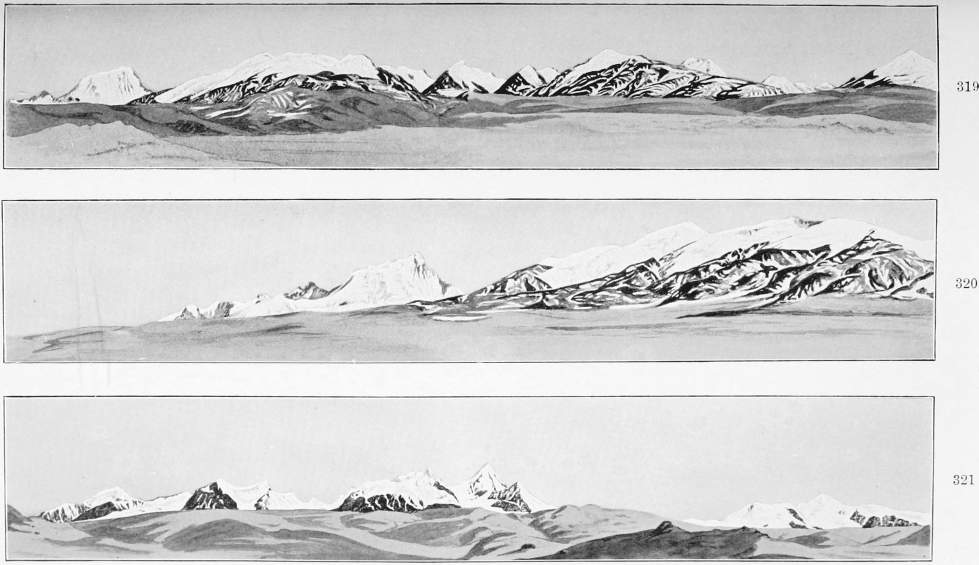
319, 320, 321. The Summits of Lunpo-gangri from Camps 379, 381, and 383. From Water-Colours by the Author.
In the night of April 11 the temperature sank to −1.7°, and on the preceding nights to 3.7°, 13.5°, and 17.2°. The cold increased as we mounted higher. We came to an expansion in the valley where three glacier streams unite to form the Buptsang-tsangpo, just as in the case of the Brahmaputra, and also on the northern flank of one of the world’s mightiest mountain systems. Our camp 379 (16,112 feet) was pitched close to the river in Bupyung-ring. The eastern headwater comes partly from the Samye-la, partly from mountains adjoining on the south-west. The middle one descends from a massive called Yallak-mallak, and the western from Chomo-gangri; south-east of this mountain is Lunpo-gangri, which is drained to the sea, both from its northern and its southern flank (Illusts. 319, 320, 321).
Bupyung-ring is one of the finest and most beautiful regions I have seen in Tibet. The flat wide valley, surrounded by mountains with ice and snow, is clothed with abundant grass and traversed by numerous water-courses. Everywhere are seen traces of camping-places. At the time we passed through only a few tent villages remained, but the valley is full of life in summer when the nomads come down from the north. When the melting of the snows properly sets in during summer, and afterwards in the rainy season, the Buptsang-tsangpo swells up so tremendously that the river cannot be crossed for three months, and communication between the banks is interrupted. From its source to its outlet in the Tarok-tso the river is probably nearly 100 miles long, and is possibly the largest river in Tibet which does not flow to the sea. The only rivers that can vie with it are the Sachu-tsangpo, which flows into the Zilling-tso, and the Soma-tsangpo, which falls into the Teri-nam-tso. The Sachu-tsangpo was far larger than the Buptsang when I crossed it in the rainy season in 1901. But the Buptsang is also a large river in spring, and in the rainy season must swell as much as the Sachu. The Buptsang-tsangpo has hitherto been unknown to Europeans, but we find the Tarok-tso on D’Anville’s map, and a river entering the lake from the south, which no doubt is identical with the Buptsang-tsangpo. The Jesuits who resided in Pekin two hundred years ago, and were ordered by the Emperor Kang Hi to compile a map of the whole Chinese Empire, procured information even about this remote region from Chinese and Tibetan sources.
During the past days our two yaks had become so wearied and footsore that we had to get rid of them at any price. We therefore stayed a day in Bupyung and bartered them for nine sheep, which took over the loads of the yaks. Now we had again thirty-one sheep and some goats.
On the 13th we came to the foot of the mountain where commenced the actual steep ascent to the pass itself. Here were four tents inhabited exclusively by women and children. The men had gone a couple of days before to Gova Tsepten’s tent. It is incumbent on this chief to collect a certain number of men and yaks, which for about three months are posted on the tasam ready to transport goods on behalf of the Devashung without compensation. This is a kind of corvée which is exacted not only all along the road between Lhasa and Ladak, but on all other great high-roads in Tibet. Naturally this injudicious system is a great annoyance to the nomads, who have to leave their flocks in the meantime to the care of women and children. If any one wishes to escape this compulsory service he must supply a substitute, pay him, and furnish him with yaks and provisions. The year before, when we travelled with hired horses from Shigatse, the poor nomads served us, but we always paid them honourably and gave them handsome gratuities as well.
After a night temperature of −0.8° we rode up to the pass on the 14th, over and between hills and across the brook which brings its tribute from the Samye-la to the Buptsang-tsangpo. Solid rock could not be found, but all the detritus and boulders were of grey granite; seldom was a piece of porphyry noticed. The usual observations were made on the pass, and the boiling-point thermometer was read off. The view of Lunpo-gangri was grander than ever, now that its peaks were quite near. The distinctly marked valley of the Buptsang-tsangpo disappeared in the distance to the north-north-west, while to the south-east nothing could be seen but a flat saddle, whence I concluded that we were not yet on the actual water-parting pass. We had not followed the track of the caravan far, before we saw a brook coming from the south-east, which also belonged to the Buptsang-tsangpo. On its bank, where we also halted, was encamped a caravan of 8 men and 350 yaks, which was carrying salt to Saka-dzong, six days’ march farther. These men could not understand why we, merchants from Ladak, chose such a way, and asked how we found it out. They were treated to the usual story about the wool-trade in summer, and they regretted that they could not serve us with their yaks, as they were called out for Government transport on the great high-roads. Now we wondered whether they would let the Governor of Saka-dzong know that they had met with a party of Ladakis on byways, and if this news would injure us. Perhaps, after all, it would be best to avoid Saka-dzong altogether.
On April 15 it was our chief desire to get in advance of the yak caravan. Before they had begun to load up their animals I started off with the sheep, and came in good time to the summit of the Samye-la with its streamer-decked poles. Though we were all the way in sight of the yak-men’s camp, I must, at any cost, determine the height of the pass, and the distance was so great that they could not see what we were doing. After boiling the thermometer, whence we obtained a height of 18,133 feet, I also drew a panorama. To the south and south-east was a world of mountains belonging to the Lunpo-gangri range, which lay to the south, and to Nien-chen-tang-la on the north. We were therefore standing on the actual watershed between two gigantic ranges, which are both members of the Trans-Himalayan family. And this pass, the Samye-la, occupies the highest and most important rank from a hydrographic and orographical point of view that any pass in Asia can lay claim to, for it is a divide between the isolated drainage area of the plateau on the north and the boundless ocean, on the south. It ranks, then, with the Sela-la, Chang-la-Pod-la, and Angden-la, and is much more important than the Tseti-lachen-la, which is only a watershed between the Sutlej and the Indus, and than the Jukti-la, which parts the waters between the two arms of the Indus. At the Samye-la I attained my chief desire, to cross the Trans-Himalaya between the Tseti-lachen-la and the Ang-den-la, and gain another point on the immense boundary line on the north of the basins of the great Indian rivers, and I succeeded in proving the unbroken continuance of the Trans-Himalaya for 118 miles west of Angden-la. A most extraordinarily interesting discovery also was that the Angden-la and the Samye-la, though of exactly the same value as watersheds, do not lie on the same chain. The Angden-la is situated on the western prolongation of the chain which stands on the southern shore of Tengri-nor and is known by the name of Nien-chen-tang-la, but the Samye-la lies in a longitudinal valley between this chain and Lunpo-gangri. Accordingly, I could strike out once and for all the continuous mountain range which Hodgson and Saunders constructed at their writing-table, and represented as running north of the upper Brahmaputra. Here also I considered what name I should give to the colossal mountain system which runs in the north parallel to the Himalayas. The name Lunpo-gangri had at least as much claim as Nien-chen-tang-la, but both were unsuitable, as they only denoted certain ranges in a whole system, and therefore had only local significance. Then it came to me like a flash—Trans-Himalaya is the name which I will attach to this gigantic mountain system.
While I sat and pondered over the great idea which had come to me this day without any merit of my own, I was recalled to the business of the moment by Lobsang, who informed me that the yaks were moving in a black line up to the pass. Then we got up and went on foot down the slopes bestrewn with troublesome rubbish and granite boulders. Soon trickling rivulets collected into a small brook. I regarded with pleasure this little stream leaping among the stones, and listened to its purling song. It was the old melody, and we had recently heard it from the brooks of the Buptsang-tsangpo. And yet I seemed to hear an undertone of another kind, a sound in the water which suggested a new aim. The Buptsang-tsangpo is doomed to final annihilation in the Tarok-tso and Tabie-tsaka, where the water is evaporated and dispersed to the four winds of heaven. But the brook we now followed debouches into the Chaktak-tsangpo and Brahmaputra, and its destiny is the Indian Ocean, over which runs the way to my home.
We had just set up our tents before the yaks came tramping up in close order, followed by their whistling and singing drivers. They went round, not to come too near us. Were they afraid of us or were they suspicious? Were they a cloud, no larger than a man’s hand, from which, in due time, a destructive tornado was to burst over our little band, which now for the second time crossed the forbidden land without leave?
CHAPTER LXVI
IN THE ROBBERS’ PARADISE
In former times the glacier tongues of Lunpo-gangri ran down into the valley, and traces of them were very conspicuous as we descended to lower country on April 16. The valley is quite full of old moraines, consisting exclusively of granite, and some of them are superficially concealed under fine matter and moss. We passed the large yak caravan again, which was encamping after a very short march. Evidently the men intended to stay over the next day, for the loads were taken off the yaks and piled up. When they mean to set out again the next day they leave the loads on the yaks, for they think it too much trouble to load and unload 350 yaks for a single night. They might stay for us as long as they liked; we should get in advance and pass by Saka-dzong before we were denounced. But no, it would be wiser to avoid Saka-dzong altogether; not to escape the sight of Muhamed Isa’s grave, but not to needlessly expose ourselves to suspicion. It was perfectly evident that the authorities would wonder why a small party of Ladakis went along byways instead of following the great tasam, and they would hold an inquiry over us.
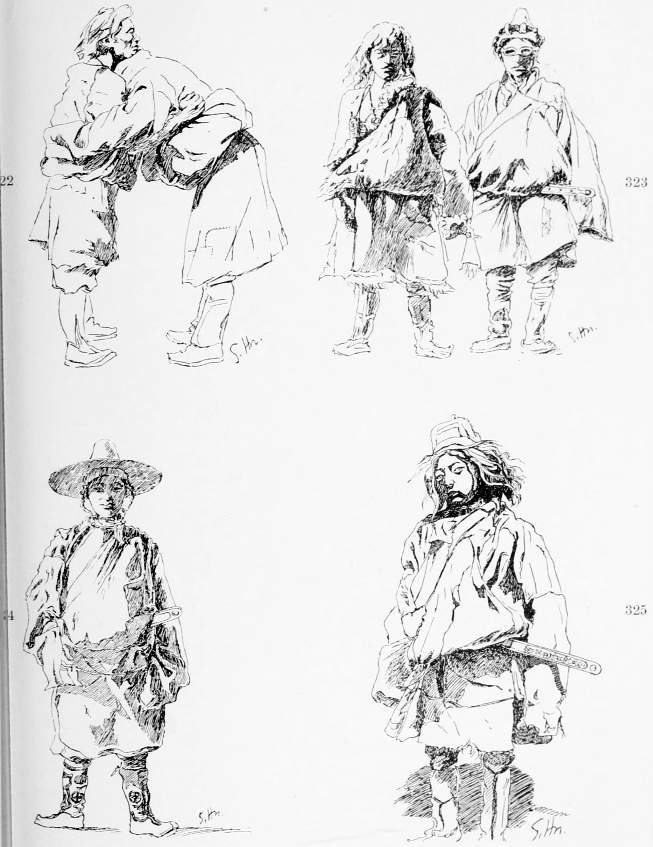
322. Wrestling. 323. Two Guides. 324. Boy with Hat. 325. Shepherd Boy. (Inhabitants of the Province of Bongba.) Sketches by the Author.
After the moraines came to an end we traversed a more open expansion of the valley, with luxuriant grass and millions of detestable mouse-holes. We were right glad when Takkar pinched the necks of one or two of these obnoxious rodents. Tubges supplied me with partridges, and one of our goats yielded me a drop of milk. From camp 383 Lunpo-gangri’s summits are seen foreshortened, and one of them is as small as an umbrella. Several peaks are seen to the east-south-east, the continuation of the range, and it is not difficult to infer that Chomo-uchong, the isolated mountain beside the tasam, lies in the eastern prolongation of Lunpo-gangri. I took bearings of the higher summits in the neighbourhood from every camp, and shall hereafter make known the results.
The other men make the “Snorer’s” life miserable. At eight o’clock he crawls into his lair beside the sheep, and immediately begins his wood-sawing. Some one yells at him, and he wakes up and makes some witty remark, which makes the men laugh, and he never loses his temper. In two minutes he is asleep again and sawing as hard as ever, and is roused by another shout. Only when the others have fallen asleep is he left in peace, and can saw as hard as he likes.
Little Puppy behaves splendidly, is lively, playful, and affectionate. At night he sleeps on the rugs at my feet and helps Takkar to keep watch. They are my companions, and it will be hard to part from them.
April 17. 0.7°. How long this winter has been! Now Lobsang has come to the conclusion that the yak drivers will not denounce us, for fear lest they should be called to account for not spying upon us better. We continue our way down the valley. How delightful only to go for some days to lower country. In some places we see summer camping-grounds; now the country is desolate and deserted.
The river carries down about 70 cubic feet of clear water per second; it has open water only in the middle, and elsewhere is covered with margins of ice 2 feet thick, and icicles hang from their edges. On the banks, field-mice dart about between their holes. The valley contracts and the river often skirts steep cliffs of schist. Most of the tributaries, and the largest of them, come from the chain which is the immediate continuation of Nien-chen-tang-la. The ice becomes thicker the more the valley contracts and the longer it is in shadow. We often cross it from one bank to the other, where it forms a bridge. Stags’ horns are set up on a mani heap; where do they come from? This valley runs between the two ranges like the Buptsang-tsangpo. On this day we never see a man or a tent.
In the evening a night owl again sat screeching above the camp, and the Ladakis were convinced that it meant to warn us against robbers. If these knew that a European with European weapons was in the caravan they would not attack it; but we were only Ladakis, and the Tibetans despise Ladakis and look upon them as cowards.
On the 18th we travelled southwards to the place (15,407 feet) where our valley enters the Rukyok valley, running down from the west-north-west, at the bottom of which some of the Lunpo-gangri summits were again visible. Still no men were to be seen, only numerous summer camping-places. Two horsemen rode past our camp on the other, right, side of the valley. What did they want? Were they spies? We had every reason to suspect a spy in every human being. No; they were kiang hunters from Gertse, who had left their home and were seeking new dwellings in another province, because of some unpleasantness with the Gertse Pun, the potentate whom we were carefully making away from. They informed us that we were a day’s journey from Pasa-guk, where I had encamped the year before, and three short marches from Saka-dzong. It was hazardous to pass so near a governor’s residence. Abdul Kerim bought one of the riders’ horses for 100 rupees.
This day I put on for the first time a new Ladaki costume. The other was too warm, and, being red, was conspicuous among the others. The new coat was made of worn, tattered sackcloth, and was stained with ashes and soot. In this I looked just like the other men. Now I painted my face regularly every day, and he must be a very smart fellow who could find out that I was not a genuine Ladaki. We had hitherto got on remarkably well, and had only a day’s journey to a place where I had been the year before. But the nervous tension increased more and more, and I wondered every morning what surprises the new day had in store for us.
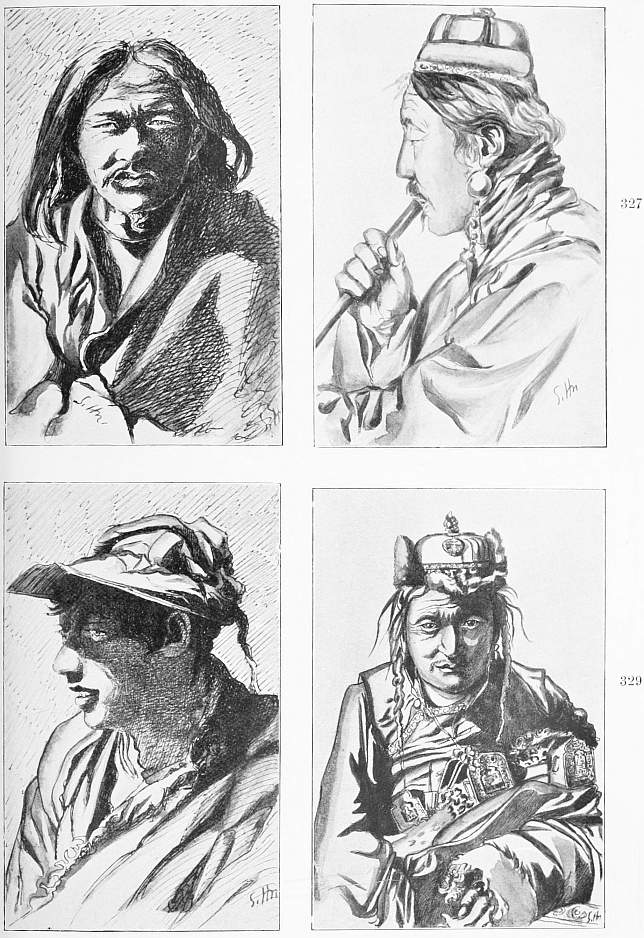
326. Sonam Ngurbu, Chief of the Chokchu Province. 327. Dorche Tsuen, Governor of the Saka Province. 328. Man with a Singular Cap, in Sonam Ngurbu’s Escort. 329. Tagla Tsering, the Chief who refused to let me go to the Dangra-yum-tso. Sketches by the Author.
April 19. As we were starting, two men passed on foot, driving before them 200 sheep laden with salt. Our way was the same as theirs and we had to pass them. While I drove our own sheep down the road, Abdul Kerim stopped and talked with the men, to draw off their attention; but we could see that they were interested in our strange party, and looked closely at us. I limped, thinking that the Tibetans had never seen a lame European, if they had seen any European at all. But the people had seen me in Pasa-guk and Saka-dzong the year before, and then I did not halt. I had come off well from our troublesome neighbours and also past the large yak caravan, which a couple of days ago had turned off another way but had now come into ours again. We met a large sheep caravan with a mounted party; a woman was said to be the wife of the Gova of Rukyok. The people we had just met were not so dangerous as those that followed.
We left the Rukyok river farther and farther to the right, and directly to the south appeared quite close the lofty summit which rises above Pasa-guk. We had left the salt-laden sheep and the yaks behind us, and we came at length to the bank of our old friend the Chaktak-tsangpo, which was considerably smaller than at the end of May and beginning of June the year before. Here we left the high-road to the south, and marched northwards along the Chaktak-tsangpo’s right, or western bank, where we soon encamped on a meadow (15,203 feet).
When Abdul Kerim came back he was very solemn. He had had great difficulty in answering questions why we followed a byway along the Chaktak-tsangpo instead of taking the highway to Saka-dzong as all other travellers did. He had replied that we were sent to find out how much sheep’s wool would be for sale in the country next summer. Then the men of the salt caravan had said: “You cannot be afraid of robbers; they frequent the mountains up here. Are you well armed?”
“Yes, we have two guns and some revolvers.”
“You will want them. We see that you are peaceful people, so we warn you. Six days ago a robber band, eighteen men strong, each with his horse and gun, attacked a tent village here in the neighbourhood. They pillaged 3 tents, took 400 sheep and about 200 yaks, and made off by the road you intend to follow. Men were collected and sent after them, but two were killed and the others ran away. No one knows where the band is now. If you value your lives, keep a sharp watch at night. If they attack you, let them plunder you; you are only thirteen, and cannot defend yourselves.”
This was why Abdul Kerim looked so anxious, and it was not to be wondered at. Now we also ran the risk of a night attack, as if it were not trying enough to travel in disguise by byways through the forbidden land. As long as there was daylight the animals were allowed to wander about and graze, but at dusk they were driven up near to the tents. In the evening the men could talk of nothing but robbers. Lobsang, who was a Tibetan himself, took the matter quietly. He said that there were organized bands of as many as a hundred men with a chief at their head, who ordered where raids should be made. But at this season of the year they sat round their fires and tried to look innocent. In his opinion the air must be warmer before they would move. If a robber was caught in the neighbourhood of Gartok, his head and one arm must be sent as a proof to Lhasa, he added. In the principal towns punishment is very severe. For theft an eye is taken out and a hand cut off. A Gova or other magistrate who catches a robber receives a reward or promotion, but one who neglects his duty is punished. We heard that the district near Geddo by the upper Raga-tsangpo is notorious as a regular nest of robbers, and is visited by professional freebooters from Nakchu.
In the twilight the Mohammedans among my Ladakis sang the same melodious hymn I had first heard at Kizil-unkur. “Allahu ekber” echoed among the rocky cliffs; “and it is very effective in protecting true believers against the wiles of the heathen.” They had all at once become deeply religious again in the robbers’ paradise. “Allahu ekber,” God is great.
The night passed peacefully, and early the next morning it was reported that five horsemen were approaching our tents from the north. The field-glass reduced them to two men, a woman, and some yaks. They made a circuit as though they were afraid of us, but Abdul Kerim hailed them to get information about the road. Then we marched on directly eastwards along the northern bank of the Chaktak-tsangpo. The ascent was very gradual, the valley fairly broad and with abundant pasture. No tent was seen, but summer camps were numerous. A cairn marks the place where the Chaktak-tsangpo, coming from the north, 10° W., unites with its tributary the Gebuk-chu from the east. To the north-north-east rise two snowy peaks of medium height with small glaciers. It was evident that the Chaktak-tsangpo flows from the country to the north of them, for the deeply excavated transverse valley of the river could be clearly traced. The main river may carry down about 250 cubic feet in a second, and the affluent about 70. In this district the river is called Kamchung-chu; the name Chaktak-tsangpo (Charta-tsangpo, as it is incorrectly called by Nain Sing) is not applied to it above Pasa-guk. We encamped in the angle between the two rivers near a meadow where three horses were feeding. Their owners, who were bivouacking behind a projection near at hand, were from Rukyok and had lost many of their sheep in winter from disease, and had been to a warm spring to dip and save the remainder. We were here about due north of Saka-dzong and about two days’ journey from it. But between us and the Governor’s residence rose a ridge which is a link in the chain of Lunpo-gangri. In the evening and at night our watchmen fired, as usual, some revolver shots, to inform any chance robbers that we were on our guard.
April 21. As the tents were being taken down, our neighbours went by with 200 sheep. I turned my back to them and busied myself with loading a mule. Then I travelled with the sheep, for there were several more tents farther up, and I could not ride till we came to an uninhabited part of the valley. Several side valleys opened on the left, and at their ends could sometimes be seen a part of the main crest. We know absolutely nothing of the country to the north of it, but that it cannot be the watershed between the plateau and the sea is evident, and was shown by the Kamchung transverse valley.
After crossing the river twice over bridges of porous ice we encamped near a sheepfold where dry dung was plentiful. The last nomads had told us that next day we should come to a large tent, the property of an influential old man named Kamba Tsenam, who owned 1000 yaks and 5000 sheep. He would evidently be our next difficulty, and if we slipped past him the country would be open to us as far as Raga-tasam. We are satisfied when, as on this day, we have again gained nearly 9 miles without being interfered with; but how shall we fare to-morrow?—this is the standing question we ask ourselves every evening. It is certainly an advantage to travel along out-of-the-way paths where we escape notice, but if any sharp gova or governor hears us spoken of, he cannot help being suspicious of our strange proceedings, and institute a close inquiry. Now the salt caravan which we passed has already arrived at Saka-dzong; we are, indeed, to the east of that place, but we travel so slowly that we can never escape pursuit. Our excitement grows daily. I am tired and weary of this self-imposed confinement, and long for it to come to an end. What shall we do then? That I know not. We have penetrated so far that a crisis must come. I have managed to travel through Bongba, but my plans for the immediate future are very indefinite and depend on circumstances. We will get on as far as we can.
April 22 was a day when we knew that the definite crisis was coming very much nearer. Abdul Kerim, Kunchuk, and Gaffar set out first to pay a visit to Kamba Tsenam and keep his attention riveted on the sale of food and horses. We followed after, and crossed the river twice on cracking bridges of ice, kept along the northern bank, and passed a side valley, at the mouth of which stood three tents, where our men were in the midst of a group of Tibetans who were showing their horses. Gulam had warned me in time, so I dismounted and went and looked after our last mules. As soon as we were concealed by a bank terrace I could ride again. The pleasure did not last long, for at the next side valley on the north I had to dismount again before another tent, where a pack of savage dogs were encountered by Takkar and Little Puppy, who, save the mark, would help to defend us, but received a nip in the neck and had to be rescued. Here we lost Kutus and Tubges, who remained at the tent, while our diminished party continued on its way eastwards.
At a spur on the northern side of the valley a couple of elegant mani heaps were erected, and by one of them a streamer pole was set up. It had snowed thickly ever since eight o’clock, but the valley was so narrow that we could not pass all the tents unseen. Just at the projecting point a large valley ran in from the north: we only guessed at it, for everything was hidden in the snowstorm. Gulam went a little way ahead and gave me the sign to dismount. Immediately in front of the point stood four tents and a small stone cabin, where a man stood watching us, and also a chief’s tent of such huge dimensions that I never saw its like; it was as large as a house. Here we left Lobsang and Abdul Rasak, and went on eastwards with a much diminished party. The chief volume of the Gebuk-chu comes from the northern valley; in our valley, which we knew led to the Gebuk-la, only a brook was left. We set up our tents on the terrace at the mouth of a northern side valley. All the country was white, and not a shadow could be seen of the surroundings.
Our three tents stood as usual close together, mine with its opening up the valley, that is, eastwards. After a while the men left behind came up and gave their reports in turn. They had bought provisions for two days, and had learned that the district was called Gebuk-yung. The next day we should go over the Gebuk-la and encamp at the foot of the Kinchen-la, from the top of which we should see Raga-tasam the following day. Of course it was risky for three parties of our men to visit three tents near together, for the Tibetans always asked about the routes we had followed and our plans, and our men might in their haste give discordant answers. In the large tent Lobsang had been cross-examined, and had answered that we came from the Gertse Pun, who had advised us to take this byroad because we should reach Raga-tasam two days sooner than if we went through Saka-dzong. “Quite true,” the Tibetans answered, but also warned us against robbers, for thirteen Ladakis would be but a mouthful for an ordinary robber band, and the country was very unsafe. “It is well for you that you have good weapons,” they said.
Lastly, Abdul Kerim turned up with his purchases. He had learned that all the tents we had seen in the day belonged to Kamba Tsenam, who lived himself in the largest, but he happened to be in Saka-dzong, where an assembly had been convened in anticipation of an impending visit from a high Chinese official, and the question what present should be made to him had to be decided. Kamba Tsenam owned thirty-five horses, which were grazing beyond Gebuk-la, and if the rich nomad returned in the evening we should certainly be able to buy some from him.
“You say,” declared an elderly man in Kamba Tsenam’s service, “that you are a tsongpun (merchant) from Ladak. Why then do you travel by this dangerous side route? Here you can drive no trade. How have you found the way? Why have you travelled in winter? Why do you ask the names of the valleys?”
“I have to write down all the names,” he answered, “that we may find the way again in summer, for I am commissioned to make large purchases of wool.”
“That is well, you shall have several hundred bales of sheep’s wool from us. I will give you a guide in the morning; you will pay him a rupee for two days. Without him you cannot find your way over the Gebuk-la, especially when the ground is covered with snow.”
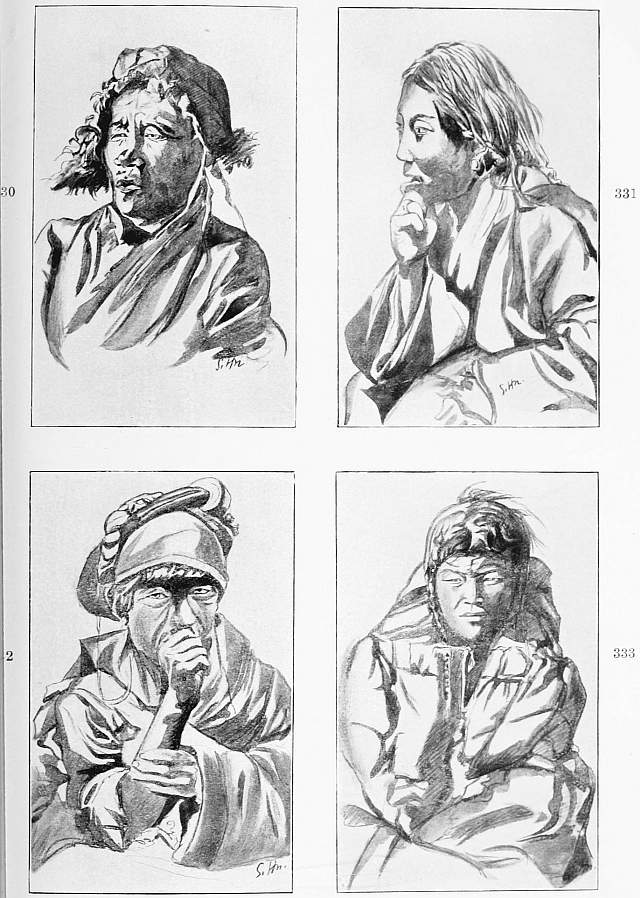
330. Travelling Ladaki Merchant in West Tibet. 331. Oang Gye, Son of the Governor of Saka. 332. Panchor, the Yak-slayer, my Guide on the Journey to the Teri-nam-tso. 333. Woman of Yumba-matsen. Sketches by the Author.
Abdul Kerim had thanked him for his kindness and then had come to look for us. We were sitting and deliberating when two riders armed with guns came up to our tents. They were close upon us when they appeared out of the snowstorm. We just managed to close my tent and fasten up Takkar before the entrance. The elder man was Abdul Kerim’s friend from the large tent, the other the youth who was offered to us as a guide. They tied up their horses and went nonchalantly into Abdul Kerim’s tent. Here they sat and gossiped for an hour, and offered a large handsome white horse for sale at the price of 127 rupees. Abdul Kerim bought it, whereupon they asked how much money he had with him, and whether he was not afraid of being attacked. Afterwards they went about the tents and looked around, and I drew a breath of relief when they at last vanished in the snow with the other horse.
Now we considered the situation. To refuse the guide would seem extremely suspicious, for the snow already lay a foot deep, and the path—all we had to depend on—was covered up. But to have a stranger, a spy, in the caravan for two days and a night was still more dangerous. When Kutus and Sedik went back a little later to the large tent to fetch a bowl of sour milk, they were told to say that our tsongpun did not want a guide, for we should remain quiet a day, either here or at the next camp. “Your tsongpun speaks with two tongues, he does not know what he wants,” the men answered.
We left this dangerous place on April 23 before the sun was up, and I went first with the sheep in case our neighbours paid a morning visit. The weather cleared and the sun came out, and then the snow quickly evaporated. Farther up all the valley floor was covered with a continuous sheet of ice. In front of us was seen the pass Gebuk-la. Here a little old man was following ten mares. He pretended not to see us, but he was soon overtaken by Abdul Kerim and Kunchuk, who kept him company most of the day. With Lobsang I rested half an hour on the pass, at a height of 16,978 feet. To the east and south-east of us lay an entanglement of mountains and valleys, and without the horse-tender we had so fortunately found it would have been quite impossible to find our way over the succession of small saddles which followed. To the south-south-east the snowy massive of Chomo-uchong rose in radiant sunshine; to the north was a huge crest, which I, like Ryder, took for the main range of the Trans-Himalaya and the watershed, but this turned out afterwards to be a mistake.
The horse-driver took us up a secondary saddle, at the eastern foot of which runs a deeply eroded valley, which, coming from the north, 10° E., is the upper section of the valley we followed last year, and which runs down to Basang, where I saw Muhamed Isa for the last time among the number of the living. Here was the driver’s tent, and to escape his company during the night we continued our march after the stranger had given us instructions about the way. Our camp 390 was situated in the mouth of a small valley on the ascent to the Kinchen-la, where we were overwhelmed in a terribly dense and violent snowstorm.
The guide, who had so fortunately appeared at the right moment, had said in the presence of our men that he was Kamba Tsenam’s brother and a great yak-slayer. The year before he had seen in Saka-dzong a European whose caravan leader, a big strong fellow, had inspired respect wherever he showed himself. But he had died suddenly in Saka, and his comrades had digged a long hole in the ground where they had laid him. He thought it strange that Ladakis, who were of the same faith as the Tibetans, would travel with and serve the hated Europeans.
For the future we determined to observe yet greater caution. Two or three Ladakis should always wear dark eye-glasses, so that mine might not seem so peculiar. As soon as we could buy woollen material all the men should have new clothes, so that I in my rags would seem the poorest and meanest of the party.
CHAPTER LXVII
APRIL 24
In these days our life was dismal and lonesome, and our future uncertain. We went as in the dark, feeling with our hands lest we should fall. Every day which passed without any untoward event came upon me as a complete surprise. We had now only two days’ journey to Raga-tasam on the great highway, where caravans and travellers fare to and fro, and Government officials are responsible that no unauthorized person slips past. I was thoroughly sick of my disguise and the constant uncertainty, and longed for a crisis to free me from my embarrassment. But to deliver ourselves, of our own free will, into the hands of the Tibetans was out of the question. They must detect us themselves, and till then the strain on our nerves must continue.