Front matter (continued 10)
Reading edition
Our Tibetans know excellently well how to look after themselves on the journey. On the march they twist string, talk, sing and whistle, and shout at their yaks. In pitching their camp they set up their black tent in a moment, first stretching out the ropes and fastening them into the ground with wooden pegs, and then throwing the cloth over the poles. The animals are unloaded and sent off to feed, and the men gather fuel and make a fire in the tent, where all assemble to drink tea and sleep. After a couple of hours they come out again, wrestle, play and laugh. In the dusk one may be heard singing a monotonous ballad, which must, however, be amusing, for the others laugh heartily at every verse. Morning and evening they gabble their prayers, all together, murmuring like bees in a hive. An old man, whom I knew the year before, has a riding yak of his own, and brandishes the escort’s prayer-mill. He is never seen without this ingenious instrument. The men are always good-natured and polite, help us to collect fuel, set up the tents and load the animals, and frequently pay us a visit. We know them all by name and are the best of friends.
The temperature sank in the night only a few degrees below freezing-point, and yet a snowstorm raged almost all day long on June 3. We rode past a large marsh in the valley and up to the flat saddle Merke-sang, with a view over the plain we crossed exactly two months before on the way to the Buptsang-tsangpo. Camp 419 lay therefore in the Bongba-kebyang district again. To the south-east is the pass Chiptu-la, with the pilgrim route from Nakchu to Kang-rinpoche. To the south, 27° W., rises a snowy summit, at the foot of which a road leads over the Dsalung-la to Tradum. As a watershed this pass is of the first rank, and it sends off a voluminous tributary to the Buptsang-tsangpo. The escort sent off a messenger in advance to this river to look out for Abdul Kerim’s party.
June 4. It had snowed all night long, and we set out in the wildest snowstorm. It was half dark, with heavy leaden clouds; not a glimpse could be seen of the surrounding mountains; all was wet, muddy, and evil-smelling; pools of melting snow lay on the ground, and seven pilgrims from Kang-rinpoche were close upon us before they emerged from the mist. We splashed through the soaked soil, but when we encamped on the shore of the Buptsang-tsangpo the weather was much clearer.
Before I proceed further I will mention that the great province of Bongba is divided into twelve tso or districts, namely: Parryang, Laktsang, Buptö, Tsaruk, Yeke, Tarok, Kebyang, Kemar, Parma, Changma, Kyangrang, and Chushar. To each of these district names is usually prefixed the name of the province, as, for instance, Bongba-parryang, Bongba-laktsang, etc. We were now in Bongba-kebyang.
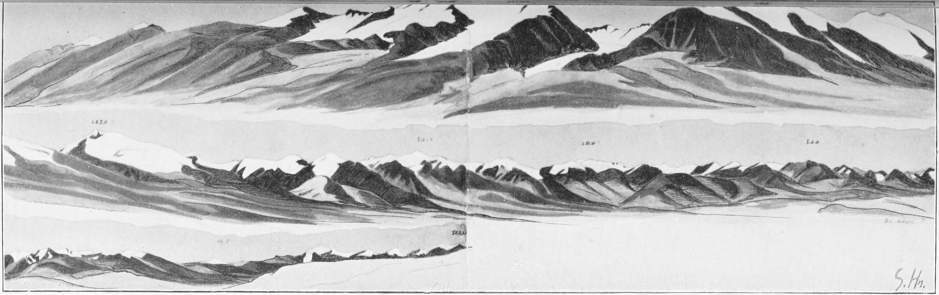
370. The Trans-Himalaya from Abuk-la. (The three parts in the illustration form a continuous panorama from East to S.S.W.)
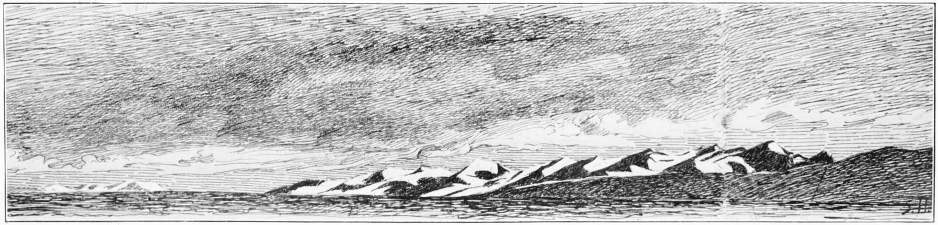
371. Storm over the Trans-Himalaya. (To the left the way up to Samye-la; valley of Buptsang-tsangpo.) Sketches by the Author.
Some tents stood on the river bank. The nomads reported that Abdul Kerim had gone a week before by a cross-cut over the mountain on the right, down towards the Tarok-tso. There was no Gova here, but two natives were ready to let us on hire the five yaks we required. They were shy and timorous, but Panchor, the rogue, spoke well of us, and it was agreed that they should accompany us to the boundary of Tarok-tso. On the morning of June 5 we took farewell of Nima Tashi and his soldiers and of Panchor, and rode between the hills on the left side of the valley down the course of the Buptsang-tsangpo. Soon the valley contracted to a ditch, but before long expanded again. On our left hand we had the main range of the Trans-Himalaya, which, however, did not present an imposing appearance, for we were always close to its foot. At times we were enveloped in a snowstorm, and at Mabie-tangsam-angmo, where we camped, we made haste to get a cover over our heads. When Little Puppy heard the thunder rumble for the first time in his life, he was very disturbed and barked with all his might, but he could not make out whence the noise came, and he found it safest to fly into the tent and hide himself behind my bed-head.
June 6. Hail and snow! The whole country is hidden under newly-fallen snow, as far as we can see. Is June to be reckoned among the winter months? We have already had nine of them. It seems as though summer were missed out this year and we were approaching another winter. But the precipitation is welcome to the nomads, for it promotes the growth of fresh grass. We march sometimes on the top, sometimes at the foot of a lofty erosion terrace 80 to 100 feet high, which is a characteristic feature in this large valley. Geese, wild asses, Goa antelopes, and foxes are everywhere. A sharp bend in the river forces us to the north-north-east for a time, and the valley is again narrow and picturesque. At Tuta, which belongs to Bongba-tsaruk, we encamp close by the Buptsang-tsangpo, where the wild-geese swim with their yellow chicks in the clear water.
Eighteen degrees of frost on the night of June 7. Yet the day was fine, and flies, gnats, and other insects were more numerous than before. As on the two preceding days we crossed several small affluents from the Trans-Himalaya. The Buptsang valley expanded more and more, and at length became 13 miles broad. We encamped in sight of the Tarok-tso, on a level plain about 16 feet above the surface of the lake, and with two nomad tents as our nearest neighbours. The height here was 15,197 feet.
Our guides were the pleasantest and most complacent we had ever had, our movements were not controlled by chiefs and soldiers, and Karma Puntso’s camp was far away—we might have travelled wherever we liked. But the Buptsang-tsangpo and the Tarok-tso were the most interesting geographical features in Bongba, and now we saw the lake close in front of us.
Our plan was to make on June 8 for Lunkar-gompa, which was seen perched on its hill with a view over the lake. But it was not to be, for at six o’clock Gova Pensa arrived on horseback accompanied by two servants. He was dressed in a handsome blue cloak, looked about fifty-five years old, and greeted us in a kind and friendly manner. After a while came half a dozen more horsemen—evidently we were held up again. Gova Pensa asked us to remain where we were for the day, for Gova Parvang, the district chief of Tarok-shung, would come in the afternoon. He said it was impossible to see Lunkar-gompa, for both the head lamas, with most of the other twenty monks, were gone two days before to Kang-rinpoche, and had left the temple gates locked. Only four nuns and two monks had been left behind. Of Abdul Kerim’s party he only knew that they had met Gova Parvang, but did not know where they were now.
Gova Parvang did not put in an appearance, but sent instead his lieutenant, old Yamba, and seventeen other unarmed men to my tent. Yamba had orders not to let us go to Tabie-tsaka if he valued his head. But he added that if we went there of our own accord and with our own horses he could not stop us, but yaks and provisions would not be supplied, and the nomads had orders to avoid us like the plague. Would we, on the other hand, go up a valley which opened out to the south-south-west by which we could reach Tuksum in seven days over the Lungnak-la, he would let us hire yaks, would sell us provisions, and provide us with guides. Or if we would go over the Lunkar-la north-westwards to Selipuk, he would also do his best to serve us. He advised us to take the latter route, for he had been present when Gova Parvang forced Abdul Kerim to take the direct road to Selipuk between the Tarok-tso and Tabie-tsaka. We had, then, three different routes to choose from, which led over the blank space on the map of Tibet, where there are no other black lines but the meridians and parallels and the word “Unexplored.” I did not take a minute to choose; the middle road over the Lunkar-la was naturally the most desirable, for I knew that it would yield me most details to complete my knowledge of the intricate orography of the Trans-Himalaya. On the morning of June 9 we hastily concluded our business, obtained yaks and guides, bought barley, rice, and tsamba, took farewell of the chiefs of Bongba-tarok, and steered our course direct to the temple. We passed several tent villages, for the country is densely peopled. At the foot of the mountain, on the left, a warm spring rises out of the ground. Below the monastery hill stand twenty small white stone cabins, each with a red frieze under the eaves and a small quadrangular yard. In front of the village are two chhortens (Illusts. 359, 366). behind which two women with their children were hiding. While the caravan continued up the Lunkar valley, I, with Lobsang and Kutus, ascended the porphyry hill to the temple, which is surrounded by a quadrangular wall. Some savage dogs rushed upon us and snapped at Little Puppy, but there was no other sign of life. We went into the court and found the temple door closed, and fastened with a great iron lock. As I was sketching a panorama of the great beautiful lake and its wreath of mountains, six men came up and told us in an angry voice to go away. I rose up, went straight to the nearest of them, and, pointing to the path down to the village, told them that if they did not immediately make off they must put up with the consequences. They turned round meekly without saying a word.
The lake stretches from north, 26° W., to north, 57° E., but extends further eastwards hidden behind a mountain. To the north-north-east two rocky islets are seen near the northern shore. To the north-east the Buptsang-tsangpo enters a bay, and in the far distance in the same direction our old Sha-kangsham appears. The water of the Tarok-tso is said to be sweet, but I had no opportunity of confirming this statement. If it is correct, the lake must have a subterranean outlet to the Tabie-tsaka lying to the north, though a small mountain offshoot lies between the two lakes.
We left the small inhospitable monastery and a couple of small white and red houses, where the nuns have their cells, and soon rejoined our men in the Lunkar valley.
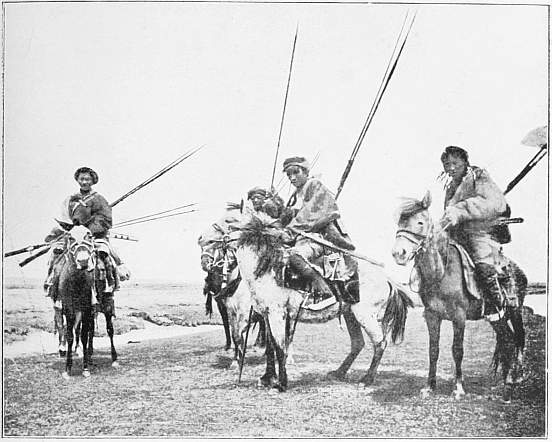
372. Sonam Ngurbu and his Followers on Horseback.
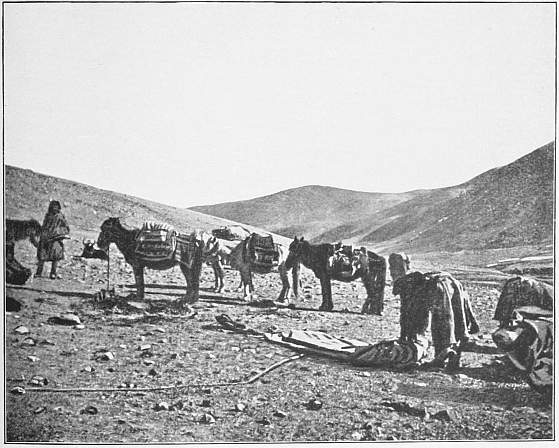
373. Some of our Horses on the Way to Kamba Tsenam’s Tent.
In the night the temperature was above freezing-point for the first time. Our path ascended steeply to the south-west and south, and in three hours we were at the streamer-decked cairn on the Lunkar-la, where the height was 18,274 feet. From a height to the north-east of the pass the Tarok-tso lies below the spectator as on a map, and in the north from 20° to 26° E. is seen the white and yellow saline depression of Tabie-tsaka, renowned throughout Tibet. At Goang-shung we got three new guides with four yaks, who took us to the bank of the Gyenor- or Goang-tsangpo—a small river which, coming from the mountain Kapta in the south-east, falls into the Poru-tso. To the west rises a chain of mighty snowy peaks. On the morning of June 12, after 8.8 degrees of frost, the stream was covered with a third of an inch of ice, and I missed the pleasant rippling sound of the evening. But the ice broke up in the sunshine and rattled down in large flakes. We were conducted still to the south-west; on the next day when we encamped on the lake shore the direction was nearer west. From camp 428 (17,067 feet) we had a fine view over the small lake Poru-tso, also called Yeke-tso because it is situated in the district Bongba-yeke, the westernmost in the large province of Bongba, which is under the control of Karma Puntso. To the west of it follows Rigi-hloma or Rigi-changmo, which is subject to Ngari-karpun, as the Garpun of Gartok is called here. Puru-tso is drying up; the highest shore-line lies 354 feet above the present level of the lake. The water is not fit for drinking, but, curiously enough, it still contains fish. An extremely disagreeable odour rises from the beach. The lake stretches from north-east to south-west.
On June 14 we rode westwards and crossed the broad valley watered by the Nyapchu-tsangpo, which, descending from the Men-la due south, falls into the Poru-tso. The Men-la, a day’s journey off, is a pass in a longitudinal valley between two of the ranges of the Trans-Himalaya. Over its threshold a road runs to Shamsang on the upper Tsangpo. A day was spent on the bank of the Surle-tsangpo, which also flows to the Poru-tso, and in the evening carried quite 210 cubic feet of water per second.
Here I was waited on by Gova Pundar of Rigi-hloma, an elderly man, who gave me a kadakh, butter, meal, and milk, and sold us all the provisions we required for several days, and his goodwill knew no bounds. The people in this part of Tibet were always very friendly disposed. In the Lob country the natives called me Padishahim or “Your Majesty,” a title that more than satisfied my ambition; but in Bongba and Rigi I was often called Rinpoche or “Your Holiness,” which I thought a little too strong. But they meant well, and I accepted their civilities as the most natural thing in the world. Gova Pundar knew every inch of his country, and I pumped him thoroughly. Among other interesting details, he informed me that thirteen days’ journey to the north, near the Lakkor-tso, was a monastery Marmik-gompa, a dependency of Sera, with twenty-five monks and four nuns. In the year 1901 I had been at the Lakkor-tso, and had heard the blast of the shell-horn at the other side of a ridge, but I did not enjoy the same freedom as now, and could not visit the monastery.
We rode on the 16th in a snowstorm, with fresh men and yaks, through the picturesque Surle valley, and on the 17th over stony moss-grown slopes to the pass Sur-la or Sur-la-Kemi-la, 19,134 feet high, which, like the Lunkar-la, is of the second order, for it is a divide between the Poru-tso and the Shovo-tso. Before reaching the actual pass we had a striking view west-south-west over a world of firn-fields, peaks clothed with eternal snow, and glaciers, one of which, of large dimensions and bluish green in front, with numerous moraines and rivulets, descends to the Surle river. Here grey granite predominates; wild yaks are everywhere; the country is barren and of a high alpine character. On the other side of the Sur-la the ground descends rapidly among quantities of medium-sized granite boulders.
At camp 431 we were, then, in the district Rigi-changma. When we went on farther down the valley from the pass on June 18, we suddenly heard wild yells from a whole choir of four large and six small wolves, which were strolling along a slope immediately to the left of the path. They were greyish yellow, and seemed hungry and in a very vicious humour. Takkar rushed heedlessly at them, but they faced him, and he thought it better to turn back. They showed no signs of fear, but held their ground even when we threw stones at them. At that moment two horsemen with weapons and red hats came down from the Sur-la. They were pursuivants sent out in advance to Selipuk to make preparations for the arrival of the serpuns, or gold commissioners. These gentlemen are sent annually from Lhasa to Tok-jalung, and their journey is burdensome to the nomads, for they exact pack animals and food without payment. They take the road north of the Teri-nam-tso and Tabie-tsaka, which is one of Tibet’s great arteries. It is called the Ser-lam, or the “gold road.”
Over a small saddle we came to the Pedang-tsangpo’s valley, 6½ miles broad, which starts from the Trans-Himalayan pass Pedang-la, and runs almost due north. Camp 432 was pitched on the river bank in a place quite devoid of life. Our guides wished to turn back with their yaks, but were persuaded to accompany us to the nearest tent village. What could the Tibetans be thinking of? They left us without the slightest supervision, and we enjoyed more freedom than ever before. We could now have travelled anywhere we liked, eastwards to Tabie-tsaka or southwards over the Trans-Himalaya; but the lakes in the north had most attraction for me, and we should have to cross the lofty mountains in the south at some time.

CHAPTER LXXII
THE LAST DAYS IN UNKNOWN COUNTRY
On June 19 we proceeded north-north-east down the Pedang-tsangpo’s gently declining valley, sometimes near, sometimes at a distance from, the fairly large river. On the right was the ridge of the Sur-la with its snowy summits and small glacier tongues, and far in the north was seen a huge crest called Ganglung-gangri, a prolongation of the Sur-la. We found that this colossal range, like its eastern and western neighbours, runs from north-north-west to south-south-east, and that the orographical configuration is totally unlike the scheme set forth by Hodgson, Atkinson, Saunders, and Burrard, for these gentlemen, quite hypothetically, inserted a single chain parallel to the upper Brahmaputra. In reality one wanders here in a labyrinth of mountain ranges, one and all only parts of the gigantic system of the Trans-Himalaya.
The road was excellent, and after a long ride we set up our two tents on the bank of a glacier stream while snow squalls and showers of pelting rain came down alternately. Here we had to stay a day, that the genial nomads of the neighbourhood might send for the district chief; for we had nothing to eat, but had to buy whatever we could get. He came, and we bought provisions for 50 rupees, and gave him 20 for his kindness. Our treasury was almost empty, and I looked forward with trembling to the time when we should be obliged, like wandering Jews, to sell watches, revolvers, and horses to gain a livelihood. For here, in Rigi-changma, no one had heard of Abdul Kerim and his men. We could not tell what had happened. Had he gone quite off his head? He had 2500 rupees with him; had he decamped, or had he been robbed? A letter was despatched to Gova Parvang saying that if he did not get news of them in a week he would have all the Devashung and the Mandarins about his ears. At any rate we had made a splendid journey through unknown country, and now we must make our way to the Shovo-tso we had long heard spoken of. Properly we ought to have gone over the Pedang range on the west direct to Selipuk, but it was not difficult to talk over the Gova, and on June 21 he had fresh yaks and guides ready. The latter were a young man and a boy ten years old in a blue sheepskin. With these we could have gone off anywhere, but I was tired and longed to get home. The valley of the Pedang-tsangpo took us further to the north. It is unusual to find in Tibet such a great longitudinal valley running north and south, for they lie almost always east and west, and produce the peculiar parallelism so characteristic of the country. We passed sixteen tents, and near the last we crossed the Pedang-tsangpo, which runs to the Shovo-tso by a more easterly course. Lobsang caused great amusement when he was attacked by a furious dog, and, having no stones, threw his bright sheath-knife at him; he missed, but the dog took the knife in his teeth and ran off to his master’s tent.
Then we rode up to the Abuk-la pass, with a view both magnificent and instructive. The bluish-green Shovo-tso is, like Poru-tso, longest from north-east to south-west, and is surrounded by huge mountains, some of them with eternal snow. To the north, 30° E., we see the pass Ka-la, over which the “gold road” runs. The name Ka-la occurs on a map of one of Montgomerie’s pundits by a single isolated mountain summit. In reality the Ka-la is the very opposite of a mountain summit, namely, a depression or saddle in a mountain range. We encamped on the southern shore of the Shovo-tso, which lies at an absolute height of 15,696 feet. The water is salt, and round the shore are seen old shore-lines of about the same height as at Poru-tso.
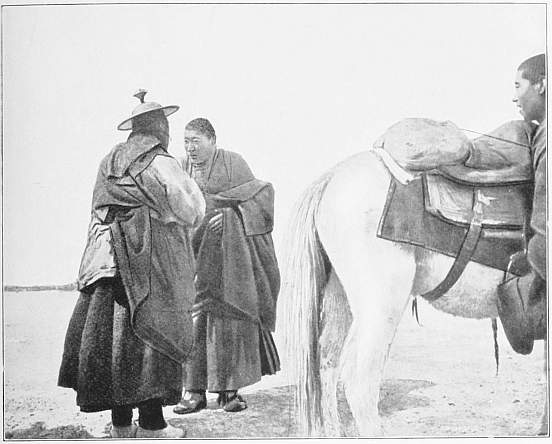
374. Lama of Chokchu taking Leave of the Prior of Selipuk.
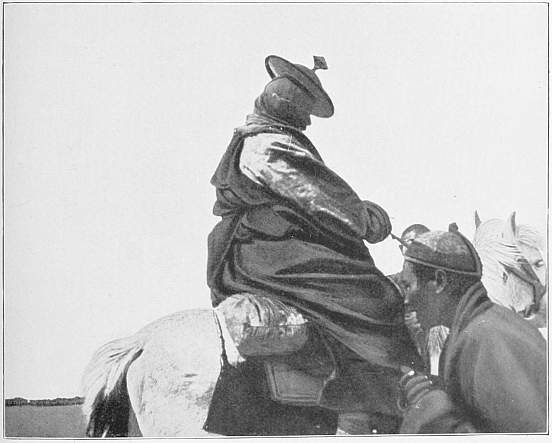
375. Lama of Chokchu on Horseback.
June 22. When we left the western extremity of the Shovo-tso we saw a large caravan of yaks and sheep which seemed to have the same destination as ourselves. Lobsang found out that the people were nekoras or pilgrims on the way to Kang-rinpoche, and that the owner of the caravan was the Governor of Chokchu, Sonam Ngurbu (Illust. 372). We left them behind and rode up to the pass Tela-mata-la. A horseman approached us at a gallop, and made signs to us to halt. We waited for him, all on the tiptoe of expectation, for we made sure that he brought us a message from Abdul Kerim. Bah! it was only one of Sonam Ngurbu’s soldiers who wanted to ask our guides if a spring on the way to Selipuk had any water in it this year. Sonam Ngurbu’s caravan had come from Tabie-tsaka and had not heard a word of our men. It seemed as though the earth had swallowed them up. My orders had been that, whatever else they did, they should wait for us on the Buptsang-tsangpo. Doubtless they had been plundered by robbers; and we had only 80 rupees left. I blessed the hour when I decided to keep myself all the maps, notes, sketches, and rock specimens when we parted at Kamba Tsenam’s tent. We could obtain money by selling some valuables, and from Selipuk I could send a courier to Thakur Jai Chand in Gartok.
From Tela-mata-la we have again a striking view over almost all the Sur-la range and over the mountainous region of Lavar-gangri to the south of Selipuk. With every day’s march the orographical configuration becomes clearer, and soon the leading features of the blank space will be nearly all ascertained.
The temperature again sank at the midsummer season below freezing-point, the reading on June 23 being 25.9°. We rode through a small steep valley up to the Tayep-parva-la (17,887 feet). The ground was so honeycombed with mouse-holes that the horses trod on two or three at once. Little Puppy caught a couple of field-mice by the neck, and we did not pity them. A marmot which had ventured too far from its hole almost fell into Takkar’s clutches, but just saved himself in time. At the pass we made the usual halt for observations, and I drew a panorama of the surroundings. Between north and north-west the horizon is far distant and the country level; only to the north, 5° W., appears a small snow-capped dome, but not another gangri. The view over Nganglaring-tso, just below, is grand, all the mountains in shades of pink, and the water of a deep ultramarine. A large part of its eastern half is occupied by a large island, a mountain mass rising out of the water with a contour as irregular as that of the lake itself, all promontories, bays, and capes. To the north-west lie three small islands. No European had ever seen Nganglaring-tso before, nor any pundit. But the pundit sent by Montgomerie in 1867 to Tok-jalung obtained some hazy information about the district “Shellifuk” and the great lake “Ghalaring-tso,” which was afterwards inserted in maps of Tibet. The form given by the pundit to the lake, namely, an egg-shape with the longer axis from north to south, does not at all correspond to the reality; for the lake stretches east and west, and its contour could not be more irregular than it is. The pundit places a small island in the northern half, and adds the legend “Monastery on Island.” In reality Nganglaring-tso has at least four islands, but not a single monastery.
On Midsummer Day we encamped by the roaring surf (15,577 feet), and on the 25th we crossed the last hilly mountain spur which still separated us from the extensive plain of Selipuk. From its height we again saw the great chain of Sur-la, and to the south the Trans-Himalaya with sixty-three snowy peaks, regular as the teeth of a saw. On the 26th we rode over level country to the west-north-west. On the plain two mounted Tibetans were pursuing a wild ass, which was wounded in the near foreleg and had four dogs at his heels. The dogs did not bite him, but tried to chase the animal in a certain direction. Time after time the men were close on the game and dismounted; they did not shoot, but threw up dust with their hands to frighten the wild ass and drive him as near as possible to their tent, that they might not have to carry the meat far (Illust. 356).
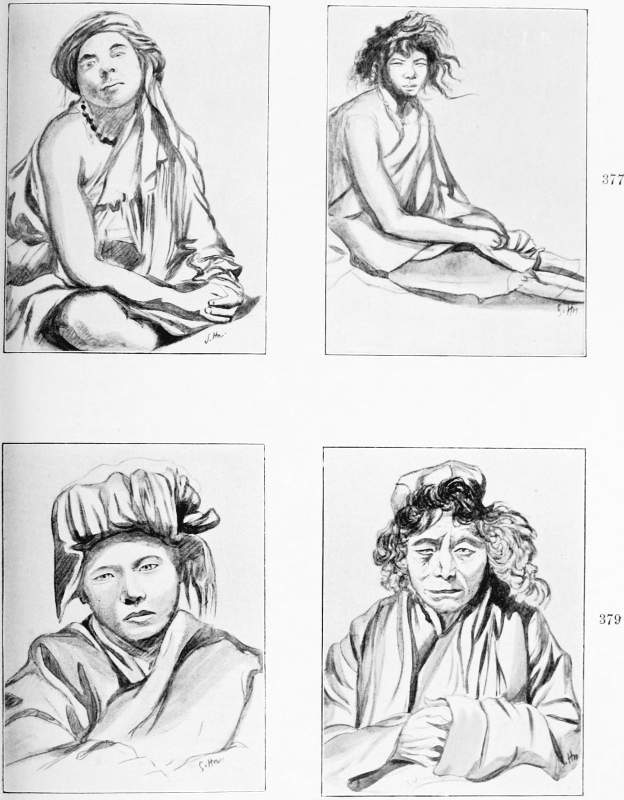
376, 377. Boys sitting. 378. Young Lama. 379. Old Woman. Sketches by the Author.
Camp 439 was pitched on the bank of the river Sumdang-tsangpo, which flows into the Nganglaring-tso without joining the rivers Lavar-tsangpo and Aong-tsangpo, farther west, which unite and enter the lake’s most western bounds. Here Lobsang caught a wolf cub, a small wild rogue, which much interested Takkar. But Takkar had a great respect for his hereditary enemy and ventured to bite only his tail. Afterwards he became bolder, and when the little creature found himself in a desperate situation, he threw himself into the river to swim over to the other side. Then Takkar gave a yell, jumped in and caught the cub, thrust him down with his paws, seized him with his teeth and brought him to land, where he ate every bit of him.
We followed the river upwards on June 27 and encamped again on its bank opposite the monastery Selipuk-gompa (15,696 feet), the abbot of which, a Kanpo-lama, Jamtse Singe, was also chief of the district in secular affairs (Illusts. 356, 374, 369, 341). Neither he nor any one else had heard anything of Abdul Kerim, but he was so good as to search in his holy books to find out where our men were, and he came to the conclusion that they were somewhere to the south, and that in twenty days we should either meet them or hear some reliable news of them.
On June 28, at half-past nine in the evening, the country was shaken by an earthquake—the only one I ever experienced in Tibet. However, it had no effect on the good relations between me and the monks and Sonam Ngurbu, the Governor (Illusts. 326, 375), who was also a guest in the monastery, and had a high lama from Chokchu (Illust. 355) in his party. The Governor gave us as much tsamba, rice, and sugar as would at a pinch last us till we came to Tokchen, and he received a watch in exchange. Of money we had only a few rupees left. I had never been in such straits before. If I ever meet Abdul Kerim again, I thought, he shall get what he deserves and a little more.
When we set up our tents on the last day of June on the Rartse plain, south of Selipuk, Lobsang announced at dusk that four men and four mules were coming to the camp. They were Abdul Kerim, Sedik, Gaffar, and a Tibetan. Our caravan bashi came frightened and confused to my tent, and I thought it better that he should give an account of his stewardship before I passed sentence on him. He reported that they had come to the appointed rendezvous at the proper time, but there he had been hard pressed by six Govas—Gova Parvang among them, who took the lead, and ordered them to leave the place at once and go on to the Tarok-tso. As they had no passport from Lhasa, they could expect no mercy, he said. So they betook themselves to the northern shore of the Tarok-tso, where they waited fourteen days, as the grazing was good and no one interfered with them. They heard contradictory reports about us. At length a nomad died on the lake shore, and a monk from Lunkar-gompa was summoned to his tent to read the prayers for the dead. They met this man, and he said that we had passed the monastery nine days previously. Then they packed up all their belongings, intending to hurry after us next morning. But horse-stealers had come in the night and stolen my grey Tikze horse and a mule from Saka-dzong. This event cost them three days, but they never recovered the stolen animals. While Suen, Abdullah, Abdul Rasak, and Sonam Kunchuk followed slowly, the three others made forced marches westwards, and now at last they were here and had all our cash with them. Abdul Kerim escaped with a slight reprimand, but I afterwards heard the other men badgering him. We found the others in Kyangrang, and so the whole strength of the company, thirteen men, was complete when, on July 8, we crossed the pass Ding-la (Illust. 213), 19,308 feet high, the loftiest pass we had crossed in all this journey in Tibet, and on past the small lake Argok-tso, which lies in the basin of the Aong-tsangpo; and on July 12 we crossed the Surnge-la (17,310 feet). Two days later we came to Tokchen, where another political entanglement detained us nine days. But I cannot stay to give an account of it, for I reached the limit of the space allowed me at Chapter LXIV., and my publisher is impatient.
CHAPTER LXXIII
THE TRANS-HIMALAYA
On the map of the Jesuits, now two hundred years old (D’Anville, 1733) (Map 2), a series of mountains runs on the north side of the upper Brahmaputra, bearing from east to west the following names: Youc, Larkin, Tchimouran Coïran, Tchompa, Lop, Tchour, Takra concla, Kentaisse (Kailas) Latatsi, etc. These mountains and ranges have never been transferred to modern maps of Tibet, probably because geographers regarded the material collected by trained Tibetans as too unreliable and indefinite. Yet these chains of mountains are nothing else but the Trans-Himalaya, though the representation is confused and inexact.
When Brian Hodgson in his map of southern Tibet (Selections from the Records of the Government of Bengal, No. xxvii.), here reproduced in facsimile (Map 3), drew a huge unbroken chain north of, and parallel to, the Tsangpo, he took a step which could only be based on the Jesuits’ map and the data he received in the year 1843 from the Maharaja of Nepal. No doubt lofty mountains existed to the north of the Tsangpo—that was known to the Jesuits even in the time of Kang Hi. But Hodgson’s hypothetical Nyenchhen-thangla (Trans-Himalaya), which he looks upon as a prolongation of the Karakorum, and the natural boundary between northern and southern Tibet, is by no means an original conception, and is no advance on previous knowledge, or, more correctly, theory. For already, in the year 1840, Dufour had inserted a similar huge uninterrupted chain north of, and parallel to, the Tsangpo, on the map which illustrates the famous description of the travels of the Lazarist missionary, Father Huc (Illust. 381)—Souvenirs d’un Voyage dans la Tartarie, le Thibet et la Chine, 1844-46. Dufour’s map is even better than Hodgson’s, for he has adopted from the Jesuits’ map a northern affluent to the Tsangpo, passing through the great range, which, like the Jesuits, he calls Mts. Koïran.
Huc and Gabet were probably the first Europeans to cross the Trans-Himalaya, and one wonders where they made the passage. Probably by the Shang-shung-la along the Mongolian pilgrim road from Kuku-nor and Tsaidam to Lhasa. It is vain to seek any information on the subject in Huc’s famous book. During the two years Huc stayed in Macao he worked up the scanty notes he had made on his journey. He mentions Burkhan Bota, Shuga, and Tang-la, and also the large village Nakchu, where the caravans exchange their camels for yaks, but he says not a word about the pass by which he crossed one of the mightiest mountain systems of the world. He says, indeed, that he went over a colossal mountain range, and as its position agreed with that of the Mts. Koïran of Dufour and the Jesuits, he adopts this name, which he certainly had never heard on his journey, and which probably was changed on its way from Tibet to the Jesuits’ note-books in Pekin. All he has to say of his journey over the Trans-Himalaya is contained in the following sentences: “La route qui conduit de Na-Ptchu à Lha-Ssa est, en général, rocailleuse et très-fatigante. Quand on arrive à la chaîne des monts Koïran, elle est d’une difficulté extrême” (ii. p. 241).
Another attempt to represent the course of the Trans-Himalaya was made by Trelawney Saunders in his map of Tibet (Map 6), which is found in Markham’s Narratives of the Mission of George Bogle to Tibet, and of the Journey of Thomas Manning to Lhasa (London, 1879), and in Edwin T. Atkinson’s The Himalayan Districts of the North-Western Provinces of India (Allahabad, 1882). Like Dufour and Hodgson, Saunders draws a huge continuous chain all through Tibet. For the western parts, north of Manasarowar, and for the eastern, south of Tengri-nor, he has relied on the cartography of the pundits; the rest, between 82° and 89½° E. long., is partly a reproduction of the Jesuits’ map, partly pure fancy, and has not the remotest resemblance to the reality, as will be apparent from a comparison of Saunders’ map with mine. I will only point out that the Trans-Himalaya consists not of one chain but of many, and that the source of the Chaktak-tsangpo lies to the south, not to the north of the principal one. All the central and largest part of the system, which I explored, is therefore quite incorrect on Saunders’ map.
In the year 1867 Colonel Montgomerie (Illust. 380) sent out three pundits for the purpose of compiling a map of the country north of Manasarowar. One of them was the incomparable and wonderful Nain Sing, another was the man who was at Yiachan prevented from discovering the source of the Indus. On their way to Tok-jalung they crossed the Trans-Himalaya at the Jukti-la, which they called Gugti-la, assigning to it a height of 19,500 feet: I found its height was 19,070 feet. Mr. Calvert crossed the same pass a year before me. On their return they crossed the Trans-Himalaya by following the eastern branch of the Indus down to where it breaks through the range and unites with the Gartok branch.
A pundit also went between Manasarowar and Tok-jalung, past the Ruldap-tso—a name and lake I sought for east and west in vain, but I will not therefore deny its existence. Moreover, of this pundit’s route I have no precise details. It seems likely that he crossed the Trans-Himalaya by a pass called Sar-lung.
On January 8, 1872, one of Montgomerie’s explorers, a young trained Tibetan, travelled over the Trans-Himalaya by the Khalamba-la, 17,200 feet high. In Markham’s account of this journey it is said that he returned across the mountains by the Dhok-la, though the actual water-parting pass he came to was much more probably the Dam-largen-la. This pass was crossed the following year (1873) by Nain Sing on his famous journey from Leh to Lhasa, which is described so conscientiously by Colonel Sir Henry Trotter. Nain Sing assigns to Dam-langren-la a height of 16,900 feet.
The great pundit A. K., or Krishna, who contends with Nain Sing for the foremost place, crossed the most easterly parts of the Trans-Himalaya on his journey in 1881, and more probably by the pass Shiar-gang-la than the Nub-kong-la, as I have already suggested; but from his map it is difficult to decide whether the Shiar-gang-la is a dividing pass of the first rank or not. In any case, it is situated on the chain which forms the watershed between the Salwin and the Brahmaputra, and is undoubtedly an immediate continuation of the Nien-chen-tang-la, or Trans-Himalaya. A similar assumption is also made by Colonel S. G. Burrard in his and Hayden’s admirable work, A Sketch of the Geography and Geology of the Himalaya Mountains and Tibet (Calcutta, 1907). On map xvii. in this work Burrard has, quite rightly in my opinion, inserted the prolongation of the range, though we have no sure data about its course.
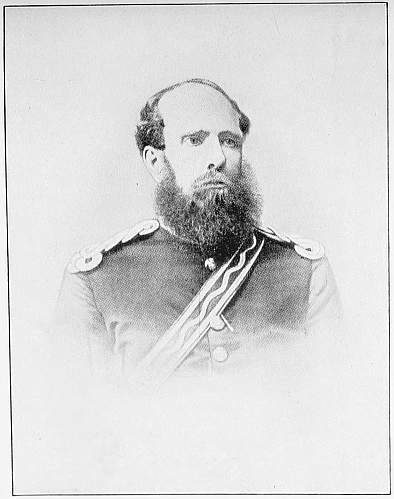
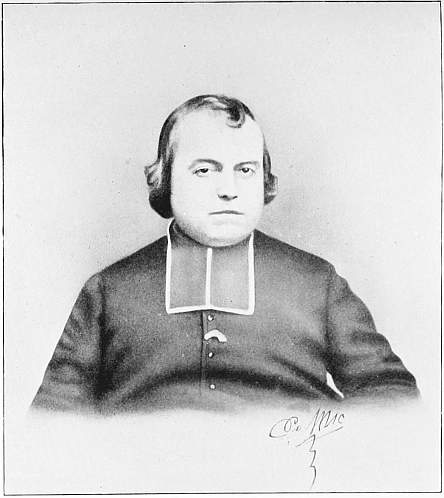
380. Colonel T. G. Montgomerie. 381. Abbé Huc.
For the portrait of T. G. Montgomerie my thanks are due to the Colonel’s widow, and for that of Père Huc, probably not published before, to Mr. E. Schwartz, Paris.
Thus we find that after Father Huc several of Montgomerie’s and Trotter’s pundits, as well as Mr. Calvert in the year 1906, crossed the Trans-Himalaya in Tibet. So far as I know, there are only two more names to be added to these—namely, Littledale, who on his bold journey in 1894-95 passed over the system by the pass Guring-la (19,587 feet), and Count de Lesdain, who crossed it by the Khalamba-la in 1905. Both describe the magnificent spectacle Nien-chen-tang-la presents from Tengri-nor, but the latter added nothing to our knowledge of the Trans-Himalaya, for he made use of the same pass, the Khalamba-la, as Montgomerie’s pundit. In his narrative, Voyage au Thibet, par la Mongolie de Pékin aux Indes, he mentions not a single pass, much less its name. But he followed the western shore of Tengri-nor, and he says (p. 340): “Des massifs de montagnes très durs et absolument enchevêtrés formaient un obstacle insurmontable. En conséquence, je résolus de suivre le premier cours d’eau, dont la direction ferait présumer qu’il se dirigeait vers le Brahmapoutra. C’est ainsi que nous cheminâmes plusieurs jours en suivant les bords d’une rivière sans cesse grossissante, appelée Chang-chu....” This river is the Shang-chu, which comes from the Khalamba-la.
Two Frenchmen and two Englishmen have, then, crossed the Trans-Himalaya before me, besides half a dozen pundits. Farther west in English territory innumerable Europeans have passed over the system, especially by the Chang-la, where I surmounted it three times. Between the Indus and the Panggong-tso I travelled over the system on November 22, 1907, by the easy pass Tsake-la.
An extraordinarily valuable contribution to the knowledge of the Trans-Himalaya was afforded us by Ryder and Wood on their remarkable journey up the Brahmaputra in the year 1904. They had no opportunity of crossing the system, or even of penetrating a day’s journey into the southern transverse valleys, but they took bearings of all the summits visible from their route. And some of these, particularly Lunpo-gangri, are among the very highest which, under a mantle of eternal snow, rise up from the Trans-Himalaya. The absolutely highest is, according to Ryder, 23,255 feet, and is therefore little inferior to Nien-chen-tang-la with its 23,900 feet. Ryder and Burrard took it for granted that these summits stood on a single continuous range, which they represent on their map as the northern watershed of the Brahmaputra. In his text (p. 95), however, Burrard rightly points out that this chain, which he calls “the Kailas Range,” is not the watershed, for in some places it is broken through by affluents from the north. Burrard commits the same mistake as Dufour, Hodgson, Saunders, and Atkinson, in assuming the existence of a single continuous range to the north of the Tsangpo. I pondered much myself over this problem, and on a general map of the ranges of Tibet (1905) I inserted two ranges north of the Tsangpo, a conception in accordance with F. Grenard’s in his Carte de l’Asie Centrale of the year 1899.
A history of geographical exploration in a region so little known as the Trans-Himalaya must naturally be exceeding short and meagre. With all my researches I have not been able to discover any other predecessors than those already mentioned—that is, in those parts of the system which lie within the bounds of Tibet—and not a single one in the central regions of the Trans-Himalaya. That such an extensive region as southern Tibet has been quite unknown till now, though it lies close to the Indian frontier, has given rise to much reasonable astonishment, and in many circles arguments and proofs, based on more or less apocryphal records and vague hypotheses, have been laboriously sought out to prove that my discoveries have not the priority claimed for them. The maps I have reproduced in facsimile, when carefully compared with my own maps, render any discussion on my part quite superfluous.
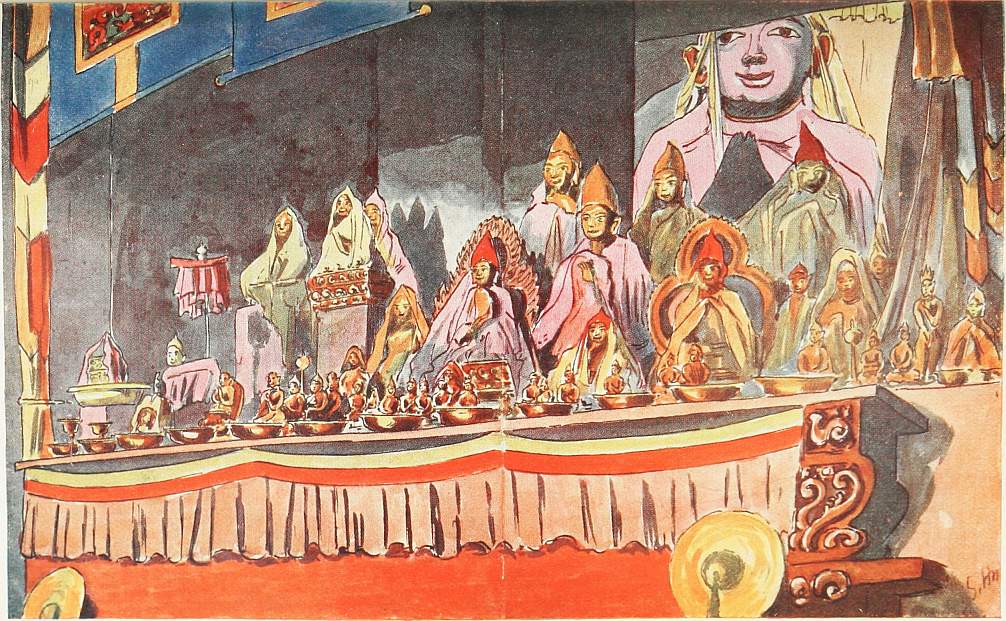
382. Altar Table with Images of Gods in Mangnang-gompa. Water-colour Sketch by the Author.
I cannot, however, pass over in silence an insinuation that the discoveries I have made are to be found indicated on the famous wall-maps in the Doge’s Palace at Venice. The Chief Librarian of the Royal Library in Stockholm, Dr. E. W. Dahlgren, writes in a letter to me: “Only the grossest ignorance and silliness can find on these maps traces of any discoveries previous to yours.” Before my return home Professor Mittag-Leffler, Director of the mathematical school in the University of Stockholm, had sent for photographs of these maps with a very detailed description, and he has kindly placed this material at my disposal. This book is not the place in which to publish it, and, besides, the following statement which Dr. Dahlgren has obligingly drawn up at my request makes all further comment unnecessary:
The Wall-Maps in the Sala dello Scudo, in the Doge’s Palace at Venice
These maps, four in number, were constructed by the noted cartographer Giacomo Gastaldi in the middle of the sixteenth century, to take the place of older maps which were destroyed by fire in the year 1483; at least, it may be safely assumed that two of them, those of East Asia and Africa, are the work of Gastaldi.
The maps represent:
1. Asia from the mouth of the Indus eastwards to China and Japan, as well as the Pacific Ocean and part of America.
2. Asia from Asia Minor to India (Kashmir).
3. Africa.
4. Italy.
Only maps Nos. 1 and 2 have any interest for Sven Hedin. They correspond completely with the photographs procured by Professor Mittag-Leffler.
All the maps were restored by Francisco Grisellini about the middle of the eighteenth century. In map No. 2 great alterations seem to have been made in geographical details as well as in the text and in the decoration. As the map extends no farther east than Kashmir it has, of course, no connection with Sven Hedin’s discoveries.
Map No. 1, on the other hand, has in many essential respects preserved its original character. We can undoubtedly form a good notion of its original appearance by comparing it with the maps in Ramusio’s work Delle Navigazioni e Viaggi (2nd Edition, Venice, 1554) and with Gastaldi’s Tercia Parte dell’ Asia (Venice, 1561). The resemblance to the former is very striking. In these maps, as in the wall-maps, the south is to the top.
On all these maps there is very great confusion in the representation of the river systems of the Ganges and the Brahmaputra. The mountains are drawn in at random, and even the Himalayas cannot be identified with complete certainty, much less the ranges of Central Asia. As the map was chiefly designed to illustrate the travels of Marco Polo, it naturally gives no information about countries he did not visit.
E. W. Dahlgren.
Father Huc concludes the account of his journey with the following remarkable words: “Mais il ne suffit pas toujours du zèle de l’écrivain pour faire connaître des contrées où il n’a jamais mis le pied. Écrire un Voyage en Chine après quelques promenades aux factories de Canton et aux environs de Macao, c’est peut-être s’exposer beaucoup à parler de chose qu’on ne connaît pas suffisamment ... il est en général assez difficile de faire des découvertes dans un pays sans y avoir pénétré.”
It was with such truths in my mind that I began the journey described in this book, the object of which was that set forth by Sir Clements Markham, when in connection with Littledale’s last journey he made the following statement (Geographical Journal, vol. vii. p. 482): “In the whole length from Tengri-nor to the Mariam-la pass no one has crossed them (the Trans-Himalaya), so far as we know ... and I believe nothing in Asia is of greater geographical importance than the exploration of this range of mountains.”
It is not for me to decide how far I have achieved my aim, but when I passed over the Trans-Himalaya for the eighth time at the Surnge-la, I had at least the satisfaction of seeing all the old hypotheses fall down like a house of cards, and a new ground-plan laid down on the map of Asia, where before the blank patch yawned with its alluring “Unexplored.”
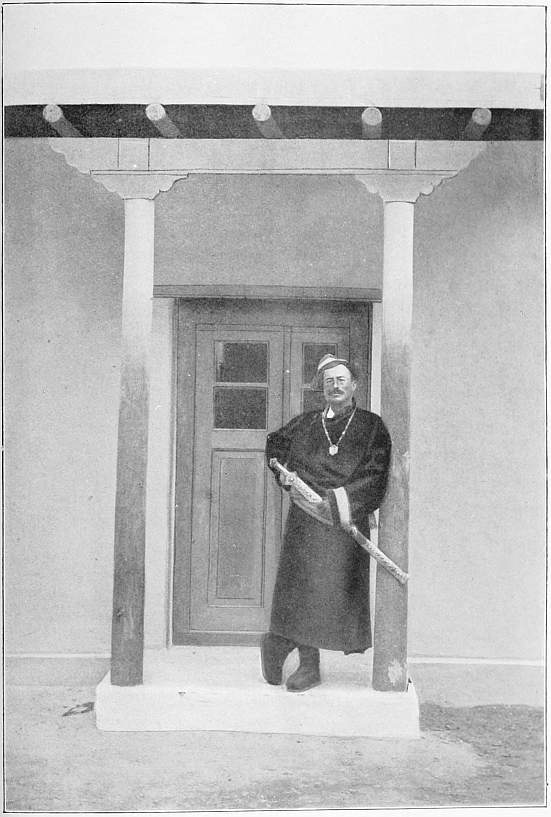
383. The Author in Tibetan Costume at the Mission Station in Poo. Photograph by the Rev. Mr. Marx.
I have no space here for a complete monograph of the Trans-Himalaya, or, indeed, the material for it, until the bearings and heights of the peaks have been worked out, the rock specimens identified, and a detailed map constructed from the sheets I drew. It will take a couple of years to work up the material. I will here only communicate some general facts, and will begin by citing the passes of first rank as watersheds, appending the names of the travellers who have crossed some of them:
Shiar-gang-la Krishna, 1881
Shang-shung-la Huc, 1845
Dam-largen-la Nain Sing, 1873 16,903 feet.
Guring-la Littledale, 1895 19,587 ”
Tsebo-la
Shugu-la
Khalamba-la Pundit, 1872 17,200 ”
Do. de Lesdain, 1905
Sela-la Hedin, 1907 18,064 ”
Chang-la-Pod-la Hedin, 1907 18,284 ”
Sha-la
Angden-la Hedin, 1907 18,514 ”
Tsalam-nakta-la
Dombe-la
Nakbo-kongdo-la
Sangmo-bertik-la Hedin, 1908 19,095 ”
Saggo-la
Dicha-la
Samye-la Hedin, 1908 18,133 ”
Dsalung-la
Lungmar-la
Pechen-la
Lungnak-la
Yor-la
Ganglung-la
Men-la
Pedang-la
Gebbyi-la
Yilung-la
Tarkyang-la
Surnge-la Pundit? Hedin, 1908 17,310 feet
Tseti-lachen-la Hedin, 1907 17,933 ”
Jukti-la Nain Sing, 1867
Do. Calvert, 1906
Do. Hedin, 1907 19,070 ”
It has, then, been my lot to cross eight Trans-Himalayan passes, while seven have been crossed by other travellers. Seven of my passes were unknown before. Of the others I have seen the Dicha-la and Men-la, while of the remainder I have only gathered oral information. The Jukti-la is the watershed between the two headwaters of the Indus, the Tseti-lachen-la between the Sutlej and the Indus, the Surnge-la between the Sutlej and the Nganglaring-tso. Shiar-gang-la and Shang-shung-la lie on the watershed between the Salwin and the Brahmaputra. All the others lie on the great continental watershed between the ocean and the isolated drainage of the plateau. It appears from the list that all the passes crossed before by Europeans and pundits belong to the eastern and western parts of the system. Between the Khalamba-la and the Surnge-la the Trans-Himalaya had not been crossed in a single line, and it was exactly between these two passes that the great white space was situated. All that was known of it was the peaks fixed by Ryder and Wood, and some summits seen by Nain Sing from the north. If the Pundit’s journey between Manasarowar and Ruldap-tso be disregarded, of which I have no information, the interval between the Khalamba-la and the Jukti-la measures 590 miles, or about as far as from Linköping to Haparanda, or from London to Dornoch Firth. And between these limits lie all the passes by crossing which I was able to trace the course of the Trans-Himalaya, and prove that its known eastern and western sections are connected and belong to the same mountain system, and that this system is one of the loftiest and mightiest in the world, only to be compared with the Himalayas, the Karakorum, Arka-tag, and Kuen-lun. Between the Shiar-gang-la and Yasin, not far from the sharp bend of the Indus, its length amounts to 1400 miles, but if it can be shown that the Trans-Himalaya merges into the Hindu-Kush and continues along the Salwin, its length extends to 2500 miles. On the north and south its boundaries are sharp and clearly defined; the northern is formed by the central lakes discovered by Nain Sing and myself, and the southern by the unheard-of Indus-tsangpo valley. In breadth it is inferior to the Himalayas, and its peaks are lower, but the heights of the Trans-Himalayan passes are considerably greater than those of the Himalayas. The average height of the five following Himalayan passes—Shar-khalep-la, Man-da-la, She-ru-la, No-la and Kore- or Photu-la—is 16,736 feet, while the average height of my first five Trans-Himalayan passes is 18,400 feet. It may be said generally that the dividing passes in the Trans-Himalaya of the first rank are 1600 feet higher than in the Himalayas. But the highest peak of the Himalayas, Mount Everest, with its 29,000, is 5100 feet higher than the Nien-chen-tang-la, the culminating point, as far as we know. Herewith are connected the different forms of relief predominating in the two systems; the crests of the Trans-Himalaya are flatter, its valleys shallower and broader, while the crests of the Himalayas are sharp and pointed, its valleys deep and much eroded. The former system is more compact and massive than the latter, as we may expect if we remember that the Himalayas are deluged by the precipitation of the south-west monsoon, and that its waters have for untold thousands of years degraded its valleys, while the Trans-Himalaya on the dry plateau country receives a comparatively insignificant share of the monsoon rain. Were it possible to compare the volumes of the two systems, we should no doubt find that the northern is much more massive than the southern, for such a comparison must proceed from sea-level, and though the Trans-Himalaya is the narrower of the two, its ascent begins from heights of 10,000 to 16,000 feet, from the Tsangpo valley, while the Himalayas rise from sea-level or a few hundred feet above it. As a watershed the Trans-Himalaya occupies a higher and more important place than the Himalayas. In the west the Himalayas parts the waters between the Indus and some of its tributaries, and in the east the system is a divide between the Brahmaputra and the Ganges. But every drop of water which falls on the Himalayas goes down to the Indian Ocean. On the other hand, all the central Trans-Himalaya is a watershed between the Indian Ocean on the south and the enclosed drainage area of the plateau depression on the north. Only in its western section is the Trans-Himalaya also a watershed between the Indus and some of its right-hand tributaries, and in its eastern between the Salwin and Brahmaputra. Within the boundaries of Tibet there is only one river which takes its rise from the northern flank of the Trans-Himalaya and breaks through the system by a transverse valley; but this river is a lion, and is called by the Tibetans the Lion river, the Singi-kamba or Indus. The Salwin also springs from the northern flank of the system, but finds its way to the ocean without passing through the mountains. All the other rivers rising on the northern slopes, of which the Buptsang-tsangpo and the Soma-tsangpo are the largest, flow into the undrained salt lakes on the north. Only in the central parts of the Trans-Himalaya, stretching, however, over a distance of nearly 600 miles, does the continental watershed coincide with the main axis of the system, for to the west the watershed runs northwards from the source of the Indus, and then westwards, so as to leave the Panggong-tso within the isolated drainage basin of Tibet, and in the east runs northwards from the region between the source streams of the Salwin and Tengri-nor.
I have called this book Trans-Himalaya, because the incidents and adventures described in these two volumes occurred in this huge mountain system lying to the north of the Tsangpo and in the country to the north and south of it. When I first crossed the dividing range at the Sela-la I thought of retaining the name Hodgson had assigned to it, that is, Nien-chen-tang-la, and I did not change my mind after crossing the Chang-la-Pod-la and Angden-la, for these three passes lie on one and the same range, which on the southern shore of Tengri-nor is called Nien-chen-tang-la. After crossing the Tseti-lachen-la and the Jukti-la I supposed that these passes lay on the western prolongation of the Nien-chen-tang-la, and that the conception of Hodgson, Saunders, Atkinson, Burrard, and Ryder was correct. But after the second journey right through Tibet, and after I had crossed Bongba in several directions and found that there was no question of a single continuous range, but that a whole collection of ranges quite independent of one another existed, I perceived that the name Nien-chen-tang-la, which only denotes one of all these ranges, could not be given to the whole system. Equally inappropriate would be the names Lunpo-gangri, Kamchung-gangri, Targo-gangri, or any other local name. Saunders’ “Gangri Mountains” I consider still more unsuitable, for every mountain in Tibet clothed with eternal snow is called a gangri, and the name in this connection would have a meaningless sound. Neither could I accept Burrard’s “The Kailas Range.” A name must be found suited to the whole of this intimately connected association of mountain ranges, a geographical conception which would leave no room for misunderstanding, and I decided to call the whole system, the connection and continuity of which I had succeeded in proving, the Trans-Himalaya.
Among English geographers many have approved of this name and an equal number have disapproved. To the latter category belongs Colonel Burrard, who points out that for some years back all the regions lying beyond the Himalayas have been called Trans-Himalayan. And in a letter he has lately written to me he says:
Pupils of Montgomerie naturally ask why an old word should be given a new meaning when it is possible to invent any number of new names for newly discovered mountains. I do not see that it is necessary to give an important name to newly discovered mountains. A new name will become important because of the mountains to which it is attached, and your mountains would have rendered any new name important.
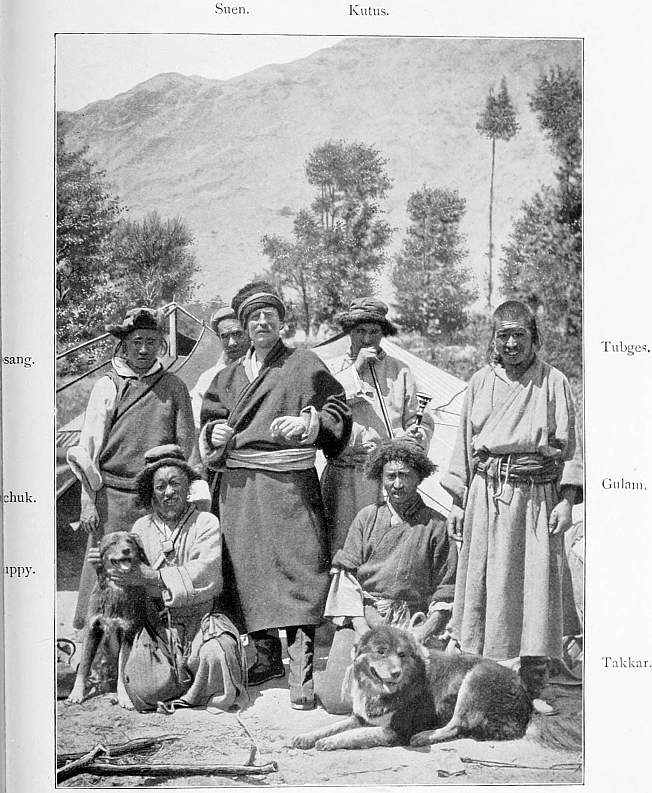
384. The Last Members of the Last Expedition in Poo.
I cannot share Colonel Burrard’s view, for I answer that just because of the circumstance that Montgomerie’s pupils, officials of the Survey of India and pundits, have for fifty years and more called the country north of the Himalayas “The Trans-Himalayan regions,” it was incumbent on me not to reject this name for the mountain system which can be nothing else but the Trans-Himalaya par excellence.
To give a quotation from the other side, I will here reproduce an expression of opinion from Lord Curzon, formerly Viceroy of India, whose knowledge of Asia is unsurpassed. In the Geographical Journal, April 1909, he says:
Alongside of this great discovery (Bongba and Chokchu) I would place the tracing for hundreds of miles and the assurance of a definite orographical existence to the mighty mountain palisade or series of palisades to which he has, in my opinion very appropriately, given the title of the Trans-Himalaya. This range has been surmised to exist in its entire length for many years; it has been crossed at its extremities by Littledale and by native surveyors. But it was reserved for Dr. Hedin to trace it on the spot and to place it upon the map in its long, unbroken, and massive significance.... It is no mean addition to human knowledge that we should realize the assured existence of one of the greatest mountain masses in the world. As regards the name which Dr. Hedin has given to it, I will only say that the desiderata for the title of a new and momentous geographical discovery appear to be these: (1) that the name should if possible be given by the principal discoverer; (2) that it should not be unpronounceable, unwriteable, over-recondite, or obscure; (3) that it should if possible possess some descriptive value; and (4) should not violate any acknowledged canons of geographical nomenclature. The name Trans-Himalaya combines all these advantages, and it has a direct Central Asian analogy in the Trans-Alai, which is a range of mountains standing in the same relation to the Alai that Trans-Himalaya will do to Himalaya. I am not in the least impressed by the fact that the name was once given to another range, where its unsuitability secured its early extinction. Any attempts to substitute another title on the present occasion will, in my opinion, be foredoomed to failure.
My long journey backwards and forwards over the Trans-Himalaya cannot be regarded as more than a cursory and defective reconnaissance of a country hitherto unknown. It is easier to go to Lhasa with a force armed to the teeth, and shoot down the Tibetans like pheasants if they stand in the way, than to cross Tibet in all directions for two long years with four Governments and all the authorities of the land as opponents, twelve poor Ladakis as companions, and not a single man as escort. It is no merit of mine that I was long able to maintain a position which from the first seemed untenable. The same lucky star looked down, as often before, on my lonely course through vast Asia, and it is twenty-four years since I first took up my pilgrim staff. I have been able to follow and lay down only the chief geographical lines; between my routes many blank spaces are still left, and there is sufficient detailed work for generations of explorers and travellers more thoroughly prepared and better equipped than myself.
Go, then, out into the world, thou ringing and sonorous name for one of the world’s mightiest mountain systems, and find thy way into geographical text-books, and remind children in the schools of the snow-crowned summits on the Roof of the World, among which the monsoon storms have sung their deafening chorus since the beginning. As long as I live, my proudest memories, like royal eagles, will soar round the cold desolate crags of the Trans-Himalaya.
CHAPTER LXXIV
SIMLA
Like a troop of beggars and knights of the road my twelve servants and I left Tokchen on July 24. We had stayed there nine days with nothing to do but watch the monsoon rain, which I had incautiously promised the natives, pelting down on the hills. The authorities of the place insisted this time that, as we were not furnished with a passport from Lhasa, we had no right to make use of the great high-road to Ladak, but must turn back to the interior of Tibet whence we had come. If I had not already had enough of the great blank, I would have agreed to their demand with pleasure, but I was now weary and longed for home, and as they refused the assistance and the transport facilities we required, we set out on foot with the baggage on our last ten horses and mules. I had still the white horse from Kamba Tsenam’s tent at my disposal. We had no escort, for the authorities wished to be quite clear of blame in case they were called to account. By the holy lake, where we followed the northern shore by known ways, we at length found a tramp who offered to show us the way to the Totling monastery.
In Langbo-nan I visited hastily the young abbot, as sympathetic and good-natured as the year before, and at Chiu-gompa we met our old friend Tundup Lama, fretful, melancholy, and weary of his lonely cloister life. Large streams now emptied their water into both lakes, and with a feeling of regret I left again the scene of so many precious memories.
Before we came to the monastery of Tirtapuri we had to cross several of the rivers which bring their tribute from the Trans-Himalaya to the Sutlej. Three of them were enormously swollen after the continuous rains, and rolled their volumes of greyish-brown foaming water over treacherous blocks. It boiled and seethed between the cliffs, and it carried along and overturned the slippery boulders. How I trembled in mortal anxiety lest the harvest so laboriously gathered in the last long winter should all be lost by a single false step.
We came to the temple of Tirtapuri in pouring rain. Lobsang, Gulam, Kutus, Tubges, Suen, and Kunchuk were to accompany me hence to Simla, but Abdul Kerim and the other five received their pay and gratuities, and took their way home to Leh through Gartok. I did not know the road to Simla, but on the map it seemed to be nearer than to Ladak, and therefore I expected that my party would arrive first at its destination. But this road is very wild and romantic, and the land is deeply excavated by the affluents of the Sutlej, and one might imagine that one had suddenly been transported to the cañons of the Colorado. One day we marched rapidly up an ascent of 3000 feet, and the next we went down as far, so that the distance was at least double as great as it appeared on the map, and Abdul Kerim reached Leh long before I was near Simla. Therefore the first news of us came from him, and not from myself, and in some quarters the worst fears were entertained for my safety. It seemed strange that my servants reached their home safe and sound while I myself was still missing.
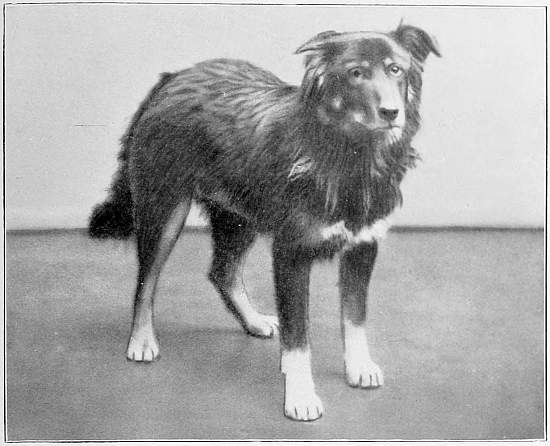
385. My Puppy.
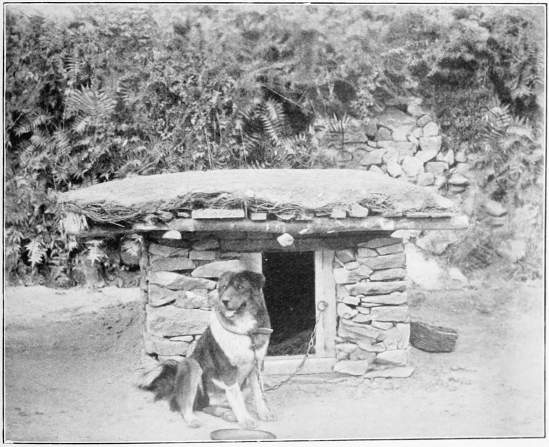
386. Takkar in his New Home with the Missionaries in Poo.
We parted with floods of tears on August 1, and my party travelled past the three monasteries, Dongbo, Dava, and Mangnang (Illust. 382), and came to Totling-gompa on the 13th, near which Father Andrade, three hundred years ago, lodged in the now decayed town of Tsaparang. Here I met the Hindu doctor Mohanlal, who gave me the first news of the outer world. Through him I heard, with deep regret, of the death of King Oscar, which had occurred more than eight months before. Mohanlal also informed me of the growing unrest in India and of the anxiety my friends felt on my account. Thakur Jai Chand had been instructed by the Indian Government to spare no efforts to find out whether I was still living or not. He had sent out some Tibetan freebooters in various directions, and promised 50 rupees to any one who could furnish any certain information of my fate—this is the price he valued me at. Abdul Kerim had reached Gartok in the best of health, and was summoned to the Garpun, who exclaimed: “Your Sahib is a dreadful man; he will not be satisfied until I lose my head!” Old Hajji Nazer Shah, who had so conscientiously equipped my last caravan, had died the preceding winter.
When we left Tokchen on July 24 we were delighted at the thought that we should at every step be nearer to lower country and a denser and warmer atmosphere. A month later we were at a greater height than at Tokchen, and saw the country covered with snow, and heard the hail patter on our dilapidated tents. But at Shipki we again set them up in a garden dressed in the rich beauty of summer, and heard the wind murmur in the spreading crowns of the apricot trees. Shipki is the last village in Tibet. From this garden oasis begins the steep ascent to the Shipki-la, which is reached after attaining a height of six Eiffel Towers one upon another. Here we stood on the frontier between Tibet and India. I turned and let my eyes roam once more over these awfully desolate and barren mountains where my dreams had been realized, and my lucky star had shed a clearer and more friendly light than ever before. Farewell, home of wild asses and antelopes, holy land of the Tashi Lama, of Tso-mavang and the Tsangpo, into whose mysterious valleys the stranger has found his way only by enduring two Arctic winters and by driving a flock of refractory sheep! I seemed to take farewell of the best of my youth and the finest chapter in the story of my life.
On August 28 we encamped in the village of Poo (Illusts. 383, 384), and I spent two memorable days in the hospitable house of the Moravian missionaries. Messrs. Marx and Schnabel and their amiable families overwhelmed me with kindness, and now I was deluged with news from the outer world—it was like listening to the breakers on the coast of the ocean. I had not seen a European for more than two years, and I looked myself like a Tibetan footpad. But the missionaries rigged me out at once in European summer clothes and set an Indian helmet on my head.
A few days later we came to Kanam-gompa, where Alexander Csoma Körösi eighty years ago studied Lamaist learning as a monk, and more than any one else communicated to the scholars of the West the occult mysteries of this religion. How silent and quiet our life had been up on the expanse of Chang-tang! Now the dizzy depths of the valley are filled with the roar of the falling stream, and the thunder of the water is re-echoed from the precipitous cliffs. How bare and scanty was the soil of Tibet, and now we listen daily to the whisper of mild breezes in the deep dark coniferous forests that clothe the slopes of the Himalayas.
Still lower runs the road, still warmer is the air. My trusty friend, big shaggy Takkar, looks at me with questioning eyes. He loves not the summer’s perfumed garlands nor the variegated zone of meadows. He remembers the free life on the open plains, he misses the fights with the wolves of the wilderness, and he dreams of the land of everlasting snowstorms. One day we saw him drink of a spring which poured its water across the path, and then lie down in the cool shade of the forest. He had done so many times before, but we should never see him repeat it. He turned and galloped up towards lonely Tibet. He parted with sorrow in his heart from his old master, I knew; but he thought he would ask the missionaries in Poo to send me a greeting. One morning he was found lying outside the gate to the court of the Mission-house, and, true to his old habit, he would let no one go in or out. He was hospitably received, and started a new life with a chain round his neck. I still receive from time to time, through Mr. Marx, greetings from old Takkar, who so faithfully defended my tent when I travelled in disguise through his own country (Illust. 386).
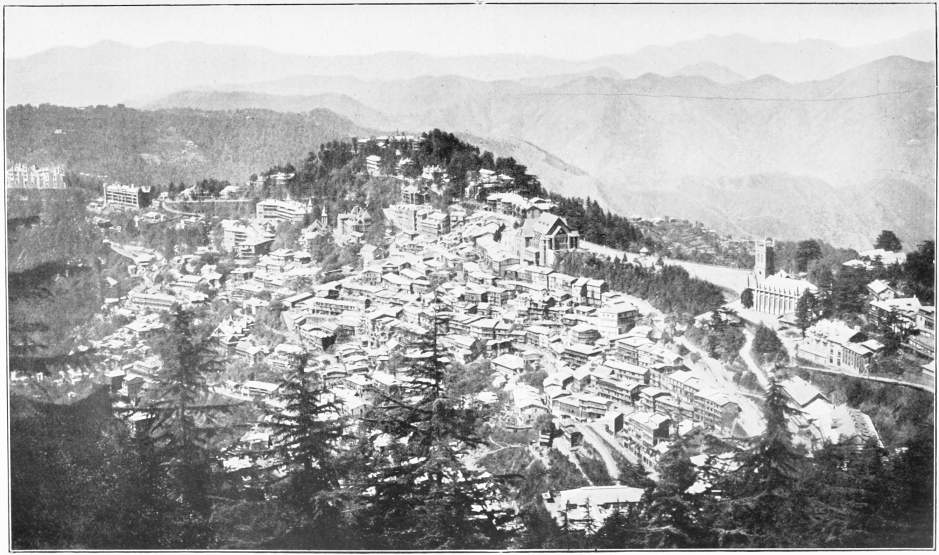
387. Simla.
In the Club des Asiatiques in Paris I once dined with Madame Massieu, who has accomplished so many wonderful journeys in Asia. Roland Bonaparte and Henry of Orléans were present, as I vividly remembered when on September 7 I met the far-travelled Parisian lady in the station-house of Taranda. We had much to talk about when we contributed to the cost of a common dinner. Untouched by years, youthful and enthusiastic, Madame Massieu afterwards undertook a bold journey to Khatmandu.
With growing uneasiness I approached the hour when, after nearly a year’s complete silence, I was again to receive letters from home, and I wondered whether I should break them open and read them without any cause for sorrow. The post met me at Gaura on September 9. I read all the evening, all night, and all the following day, and I was able to take the last days’ journey to Simla in comfort, for I was spared any untoward news and knew that all was well at home. Now the wind whispered more gently than ever in the Himalayan cedars, and the roar of the Sutlej sounded like the roll of drums in a triumphal march.
In Kotgar I was present at evensong in the missionaries’ church. How strange to hear again the soft soothing tones of the organ, and as an unworthy Christian pilgrim in a Christian temple remember the solitude of the past years.
The following day I marched along the road in the company of my men for the last time, for near Narkanda a rickshaw met me, sent by Colonel Dunlop Smith. I left them, to hurry on without delay, while they were to follow in the usual order of march. How pleasant to lean against the back of the little two-wheeled vehicle and roll away at a rapid pace under the shady canopy of the deodars!
September 15 was a great day for me. I stayed at the bungalow of Fagu, and this camp, where I was quite alone, was No. 499. Simla, therefore, would be 500. It felt very strange to stand on the boundary between the wilderness and the most refined civilization. At the breastwork of the excellent carriage-road sat a gentleman in his rickshaw; it was my friend Mr. Edward Buck, Reuter’s correspondent. This is the beginning, I thought; and on I went on this last day’s journey. The fine imposing town appears in the distance on the slopes of its hills and the white houses peep out from among the trees (Illust. 387). A young maiden takes a snap of us with her camera, but it is early in the morning, and without further adventures we take refuge at a gentleman’s outfitters, for in spite of the clothes from Poo I must undergo a complete renovation before I can present myself before the doors of the Viceregal Lodge.
What a total contrast to the lonely life I had led for two long years! On September 16 a State ball took place, and I heard again the crunching sound on the sand of the court as innumerable rickshaws bore guests to the ball. Rustling silk, glittering jewels, brilliant uniforms—in an unbroken line the élite of Simla pass between satellites with their tall turbans and shining lances. God save the King! Followed by their staff Their Excellencies enter, and open the dance to the notes of a waltz of Strauss. It was just as in May 1906, and the twenty-eight months that had intervened seemed to me like a strange fantastic dream.
The first days I stayed in the house of my noble old friend Colonel Dunlop Smith, and had now an opportunity of thanking him and his amiable ladies for the trouble they had taken in connection with the consignment to Gartok the year before. Then I moved over to the Viceregal Lodge, and again enjoyed the same boundless hospitality of Lord and Lady Minto. From my window I saw again, sharp and clear, the crests of the Himalayas, and beyond the mountains and valleys of Tibet stretched out in a boundless sea. What wealth and luxury! I lived like a prince, walked on soft rugs and meditated, lay and read Swedish journals in a deep soft bed, by electric light, and bathed in a porcelain bath, attended by Hindus in the viceregal livery—I who had lately gone in rags and tended sheep.
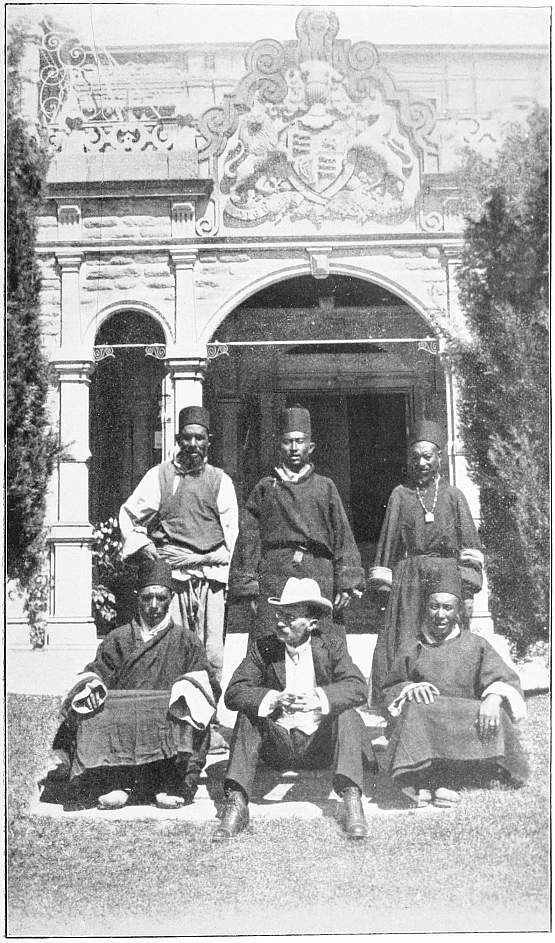
388. The Last Members of the Expedition at the Entrance of the Viceregal Lodge in Simla.
On September 24 a hundred and fifty ladies and gentlemen in full dress were assembled in the State room in the Viceregal Lodge. The occasion was a lecture, and on the dais hung with gold-embroidered brocade, where the thrones usually stand, was set up a large map of Tibet. The front seats were occupied by the Commander-in-Chief of the Indian Army, Lord Kitchener of Khartum, the Governor of the Panjab, the Maharajas of Alwar and Gwalior; and among the guests might be seen generals and superior officers, State secretaries, men of science, and members of the diplomatic corps then present in Simla. The Military Secretary, Colonel Victor Brooke, came forward and announced the arrival of the Viceroy and Lady Minto. I was trembling with stage fright, but before I knew anything about it, my opening words, “Your Excellencies, Ladies and Gentlemen,” sounded through the brilliant saloon, and then followed an account of my last journey. It was one o’clock in the morning before I concluded, and after a most flattering speech from Lord Minto the guests withdrew to the late supper.
My six Ladakis and our seven remaining animals stayed in a serai below the palace. I often went and talked to them, and played a while with my old travelling companion Little Puppy. But the time passed quickly, and soon the last day came. I embraced and squeezed Little Puppy, stroked his head, and found it hard to tear myself away. He was put out by his master’s elegant costume, and had a melancholy questioning expression, as though he suspected that the bond between us was loosed, and that we should never see each other again. We had shared everything in common from the time he was born below the snowy Karakorum pass, and to part from dogs is the hardest trial of all; to bid men farewell is not so distressing.
At our arrival in Simla I had given them 60 rupees each for new clothing, and in the bazaar they had found some old cast-off uniforms with bright metal buttons, which they thought grand and becoming. On the neck lappets were the words “Guard, London S.W. Railway,” and how they found their way to India I do not know. But in these uniforms and in red fezzes my men assembled in the palace court on the last day of September (Illust. 388). They were allowed to keep our seven horses and mules, saddles, tents, skin coats, bed furniture, and everything. My white horse they were to sell in Leh and divide the price. Gulam took charge of Little Puppy, and undertook to see that he did not suffer want in the future—it was like breaking up an old home. Besides his pay, every man received a present of 100 rupees, and their expenses to Leh four times over. Lord and Lady Minto were present at the last farewell, and the Viceroy made them a short, cheery speech. It was a sad parting, and even the calm Lobsang, who was amazed at the wealth and splendour of Simla, wept like a child as with heavy step he followed his comrades down to their waiting animals. “What faithfulness! what devotion!” exclaimed Lady Minto with feeling; “their tears are more expressive than words.”
At the beginning of October the Viceroy and Lady Minto set out on an excursion into the mountains, and after a hearty farewell and warm thanks for all the kindness they had showered on me, I remained lonely and forlorn in the great palace. My steamer would not leave Bombay for a week, and I was delighted to be the guest of Lord Kitchener in his residence, Snowdon, during the five days I was yet to stay in Simla. I shall never forget these days. My room was decorated with flowers, and on a table stood fourteen books on Tibet, chosen from the General’s library to supply me with entertaining reading. With the aides-de-camp Captains Wyllie and Basset, merry fellows and good comrades, we lived like four bachelors, took breakfast, lunch, and dinner together, and spent the evening in the billiard-room, on the mantelpiece of which was the appropriate motto, “Strike, and fear not.”
In the afternoon the General took me out along the road leading to Tibet. We then talked of the future of Europe in Asia and Africa, and I gained a greater insight than I had ever done before into Lord Kitchener’s life and work in Egypt.
But the days at Snowdon also came to an end, and on October 11, when the people were flocking to church, I was driven by the victor of Africa to the station, where I took a last farewell of the man for whose exploits I have always felt a boundless admiration. At Summerhill station, below the Viceregal Lodge, I exchanged a last shake of the hand with my dear friend Dunlop Smith, and then the white houses of Simla vanished in the distance, and the train rolled down to the heat of India and the great lonely sea.
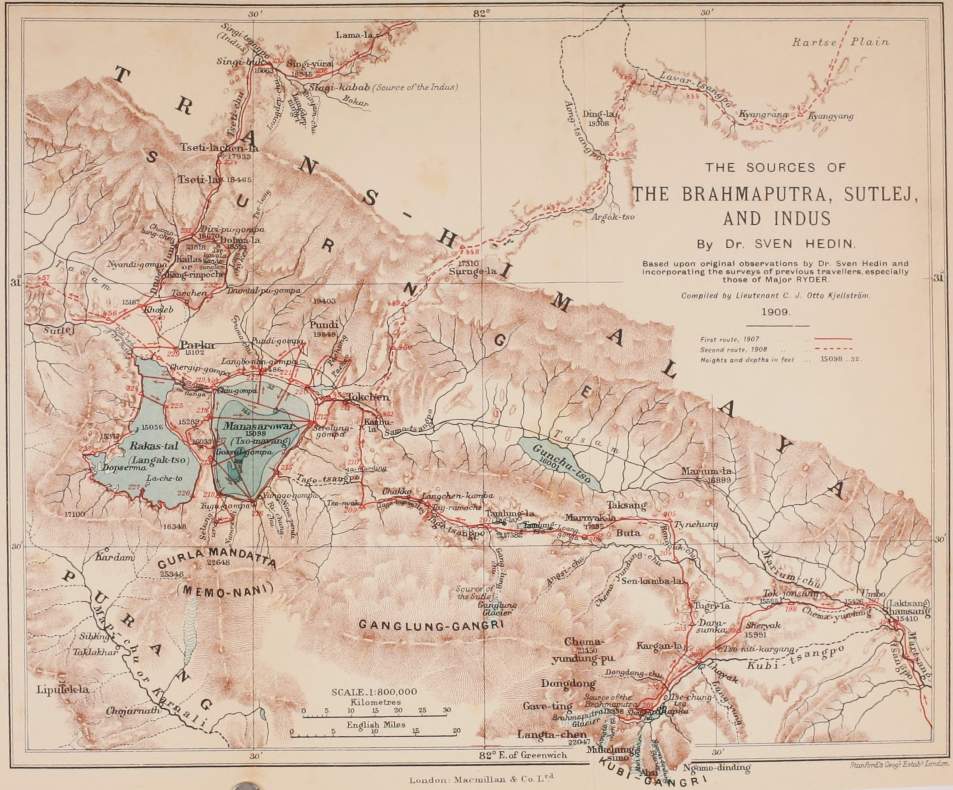
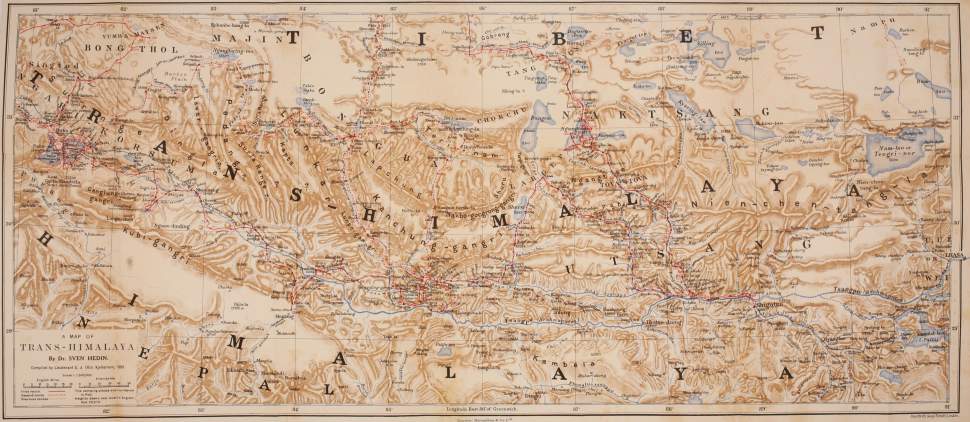
(Click to enlarge.)
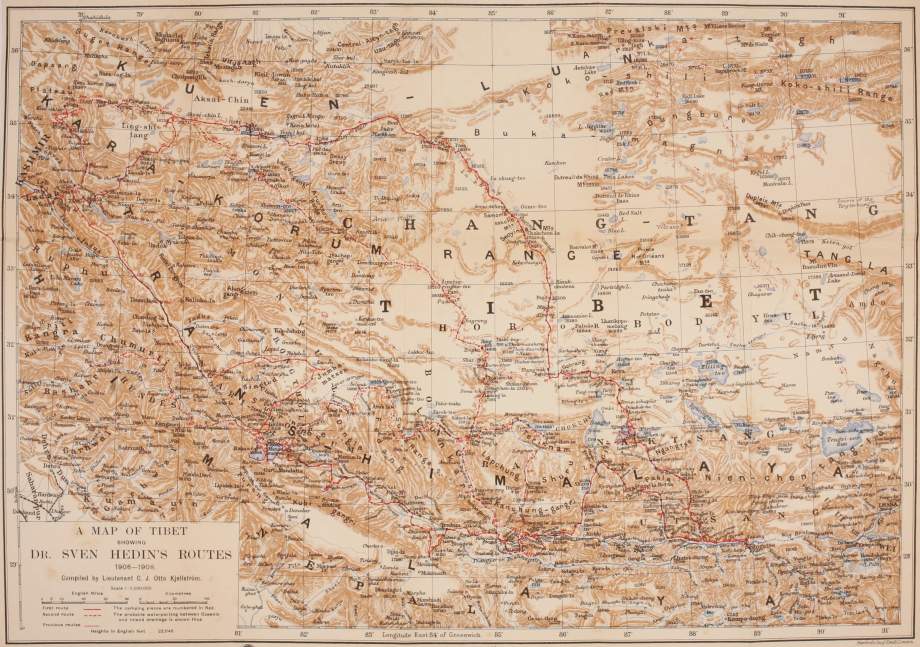
(Click to enlarge.)
INDEX
Abbot, a twelve-year-old, ii. 163
Abdul Kerim, my caravan leader, ii. 226; error of, as to forage, 241; assumes rôle of master of caravan, 291, 344; ideas as to the time of day, 302; despatched in charge of second division of caravan to the Tarok-tso, 371; anxiety as to whereabouts of, 396; arrives at our camp at Ratse, 399; bid farewell to, with other five of my followers, 416
Absi, peak of the Kubi-gangri, ii. 102
Abuk-la pass, ii. 396
Adam, Colonel, military secretary to the Viceroy, i. 16
Age, average, of caravan, i. 53
“Aid,” Mohammedan festival celebrated in camp, i. 191
Aksai-chin, lake, unannexed region of, i. 93, 95, 98; ii. 258
Alchi, dangerous bridge at, i. 44
Alexander the Great, i. 3; ii. 213
Amban Lien Yü, of Lhasa, i. 393, 400
Amchen-la pass, ii. 396
Amchi-lama (monk-doctor), tent-temple of, ii. 296
Amchok-tang, plain, ii. 36
Amchok-tso, lake, ii. 36; camp at, 37; shallowness of, 38; soundings on, 39
Amchok-yung, village of, ii. 36
Amchung country, interesting information acquired in, ii. 325
Amitabha, the Tashi Lama the incarnation of, i. 326
Amusements, Tibetan, i. 341
Anchar, lake, i. 32
Angden-la pass, cairn with prayer-streamers on, ii. 34; panoramic view from, 35; not situated on same range as the Samye-la, 330
Angsi-chu, river, ii. 104
“Antelope Plain,” name given by Captain Deasy, i. 142
Antelopes, i. 92, 114, 175, 186; ii. 36, 262, 282; method of snaring, i. 119; ii. 274
Aong-tsangpo, river, ii. 399
Archery and shooting competitions on horseback, i. 343
Argok-tso, lake, ii. 400
Arnold, The Light of Asia, quotation from, ii. 206
Arport-tso, lake, crossing of ice of, ii. 263
Arung-kampa, deserted village of, i. 280
Asses, wild, upright position of frozen, ii. 95; great herds met with, 285
Atkinson, Mr. E. T., work by, cited, ii. 402
Bailey, Lieutenant, Acting Resident at Gyangtse, i. 255
Balls, State, in Simla, i. 17; ii. 420
Baltal, i. 38
Bando, camp at, ii. 83
Barley, roasted, a delicacy, ii. 14
Barong-la pass, ii. 30
Basang valley, camp in, ii. 46
Basgho-gompa, monastery, i. 44
Bed, method of making my, i. 150
Ben-la pass, storm on, ii. 34
Besant, Mrs. Annie, i. 30
Bibles, the Tibetan, in library of Tashi-lunpo, i. 333; in Tashi-gembe, 412
Biographical details of caravan, i. 151-153
Birch bark, dream suggested by, ii. 95
Boat, our portable, i. 28; successful trip of, 107; description of Tibetan, 288
Bogtsang-tsangpo, the, camp at, i. 205; interview with chief of district, 205; geographical information obtained, 206; erratic course of, 207
Bokar valley, ii. 212
Bombo, or district chief, i. 262
Bongba, province of, ii. 304; tension of journey through the, 312; names of the twelve districts of, 388
Bongba-changma, district of, ii. 304
Bongba-chushar, district of, ii. 379
Bongba-kebyang, district of, ii. 388
Bongba-kemar, district of, ii. 324, 389
Bongba-kyangrang, high-road to Lapchung through, ii. 387
Brahmaputra, the, valley of, i. 281; welcome news received at, 282; monasteries of, 282; confluence of the Chaktak-tsangpo with, ii. 48; measurements and ratios, 49; junction of the Tsa-chu-tsangpo with, and measurements, 74; possible diversion of, 78; varying volume of, 88; Nain Sing on its sources, 89; Webber’s confusing statement as to the origin of, 89; Ryder’s map of valley of upper, 90; source-streams of, 90-95; author’s determination of its source in Kubi-gangri, 96, 101; we bid farewell to, 105
British Government, change of, i. 4; refuse permission to enter Tibet from India, 7, 388; cautious policy of, 10, 395
Buck, Mr. Edward, ii. 219, 419
Buddha, stone figures of, at Dras, i. 39; posture of, in statues and pictures, ii. 10
Buddhism, introduced into Tibet, i. 312; preservation of life a fundamental principle of, 312
Buka-magna, mountain system, i. 164
Bumnak-chu, river, ii. 22
Bup-chu-tsangpo, river, sources of, i. 276
Buptsang-tsangpo, river, ii. 325; scenery of, 326; its headwaters, 327; camp by the, 389
Bupyung-ring valley, beauty of, ii. 327
Burrard, Colonel S. G., on drainage area of the Sutlej, ii. 187; book by Hayden and, mentioned, 404; disapproves of author’s use of the name Trans-Himalaya, 412
Burroughs & Wellcome, London, medicine-chest presented by, i. 29, 172; my offering to the Tashi Lama, 316; ii. 40
Buser-tsangpo, river, ii. 261
“Call of the wilderness,” the, i. 1
Calvert, Mr., crosses Jukti-la pass, ii. 215, 403
Camp, our first, i. 33
Camp life, routine of our, i. 150; Tibetan, ii. 387
Campbell-Bannerman, Sir Henry, i. 4; telegrams sent by author to, 8, 390
Candles, Christmas-tree of, i. 219
Caravan, our, equipment of, i. 28, 53; troublesome members, 38; biographical details, 151-153; rearrangement of, 166; home-sickness in, ii. 62, 67; three members dismissed, 69; their reinstatement, 73; reduction at Tokchen, 107; reorganization of, 110; preparation of new, for fresh expedition, 211, 226, 228; heavy baggage sent back to Leh, 229; parting with Robert and Rub Das, 229; Mohammedan festival, 260; losses and sickness, 265; superfluous baggage sacrificed, 269, 279, 282; directions to, 274; my hiding-place in, 345; festivities in honour of Governor of Saka, 368; divided into two parties, 371; combined again, 400; parting with my caravan leader and companions, 416; farewell to remainder of followers in Simla, 422
Cassels, Mr., present of tea from, ii. 179
Chabuk-tso, lake, ii. 322
Chak-chom-la pass, i. 191
Chakko, holy spring, miraculous powers attributed to, ii. 106
Chaklam-la pass, ii. 308
Chaktak-tsangpo, river, ii. 45; preparations for excursion to, 47; confluence with the Brahmaputra, 48; measurements and ratios, 49, 65; journey northwards along, 65; camp again on, 335; eastward march along north bank of, 337; return to, 374
Chamo-lung-chen valley, ii. 193
Chang, or native beer, i. 68
Changa, village of, i. 63
Chang-chenmo valley, bivouac at, i. 79; ii. 233
Chang-la pass, i. 64; altar with prayer-streamers on summit of, 66
Chang-la-Pod-la pass, meaning of the term, ii. 19; camp on, 20
Chang-lung-barma valley, i. 81
Chang-lung-yogma valley, i. 81, 84; difficulties in, 82; camp and rest in, 82; sunshine and snow, 83; magnificent landscape of, 85
Changpas, Tibetan nomads, i. 119; friendliness of, 182, 188; habits and tastes, 184; skill in hunting, 185; hard life of, 186; disposal of their dead, 187
Chang-shung, a headwater of the Raga-tsangpo, ii. 41
Chang-tang, the, desperate situation in, i. 163; our successful crossing of, 210
Chang Yin Tang, Chinese Commissioner in Tibet, correspondence with, i. 393, 397; ii. 42, 70
Chapka-la pass, i. 259
Charvak, camp at, ii. 234
Chega-gompa temple, i. 280
Chema-yundung, river, ii. 90, 103; measurement of discharge, 91
Chema-yundung-pu, heights of, ii. 92
Chenmo, kotidar of Tankse, i. 73, 87
Chergip-gompa monastery, its single monk, ii. 165
Cherok, district of, ii. 88
Chesang-la pass, intense cold on, i. 274
Chhorten, or stone monument, i. 42
Chi Chao Nan, translation of passage from his work on source of the Sutlej, ii. 183; accuracy of his statements, 183
Chikum, view from camp at, ii. 83
Chimre monastery, i. 64
Chinese Government, messages from, i. 389, 391; importance of supremacy in Tibet to the, 396; specimen of diplomatic correspondence, 397; courtesy of officials to author, 400
Chinese passport, efficacy of my, i. 299
Chini-chikang, nuns’ temporary quarters, Tashi-lunpo, i. 357
Chiptu-la pass, pilgrim route over, ii. 388
Chiu-gompa monastery, visits to, ii. 159, 415
Chockar-shung-chu valley, ii. 75
Chokchu, caravan bound for, met with, i. 270; the Governor of, ii. 399
Choma-taka, cave of, ii. 18
Chomo-sumdo valley, camp in, ii. 16
Chomo-uchong, “High Nun,” ridge of, ii. 41, 333, 344, 362
Chong-yangal, camp at, ii. 232
Christmas, our celebration of, i. 219; Ladaki hymn and dances at, 220; translation of hymn sung at, 221; comparison of different years, ii. 248
Chugge-lung valley, i. 271
Chungsang, a tributary of the Tsangpo, ii. 45
Chunit-tso, lake, ii. 322, 387; warm sulphur spring at, 323
Church festivals, Lamaist, i. 301
Churu pool, camp at, ii. 67
Chuta district, sulphurous springs in, i. 82
Chykying, the Gova of, ii. 314, 316
Cleanliness, Ladakis’ contempt for, i. 150
Cockburn’s Agency, assistance in furnishing and transport, i. 28
Consul of Nepal, the, i. 304, 375
Correspondence, arrangements for forwarding, i. 72, 83, 87, 103; welcome arrival of, at the Ngangtse-tso, 254; and at Shigatse, 377
Corvée, system of, exacted on Tibetan high-roads, ii. 328
“Cripple,” our faithful canine follower, i. 263
Crosby, expedition of, referred to, i. 98
Curzon, Lord, encouraging letter from, i. 3; leaves India, 4; on author’s use of name Trans-Himalaya, ii. 413
Dagtse-tso, i. 217
Dahlgren, Dr. E. W., statement by, as to wall-maps in Venice, ii. 406
Dalai Lama (Gyalpo Rinpoche), cowardly flight of, i. 244, 306; his sphere compared with that of the Tashi Lama, 323; disastrous policy of, 323
Dal-dervaseh, canal journey from, i. 32
Dalgleish, Mr., monument to, in Leh, i. 59
Dambak-rong, valley junction, ii. 70; letter from the Tang Darin received at, 70
Dam-chu, river, ii. 181
Damm valley, ii. 79
Dandy, or average man’s load, i. 166
Dane, Sir Louis, interview with, i. 7, 11
Dangbe-chu, river, i. 276
Dangbe-la pass, i. 277
Dangra-yum-tso, lake, permission to visit, refused, i. 247, 251; reputed salinity of, ii. 29; shape and extent of, 29; pilgrim routes round, 29; Nain Sing’s nomenclature of district, 30; proposed dash for, 382
D’Anville, maps by, referred to, ii. 185, 186, 337, 401
Dapsang, on the heights of, ii. 248; Christmas box for the animals at, 251
Daya Kishen Kaul, private secretary to Maharaja of Kashmir, assistance rendered by, i. 24, 28
Dead, barbarous disposal of the, i. 370
Deane, Sir Harold, i. 15
Deasy, Captain, “Fever Camp” of, i. 120; baggage and provisions left by, at Yeshil-kul, 128
“Deasy Group,” mountain mass, i. 131, 138
Dena-lhakang temple, Tashi-lunpo, i. 364
Dentistry, drastic form of, ii. 324
Devashung. See Tibetan Government
Devotional exercises of pilgrims, Tashi-lunpo, i. 357
Dicha-la pass, importance of watershed, ii. 375
Dikpa-karnak, or test-stone for sinners, ii. 195
Ding-la, the highest pass crossed in our journey, ii. 400
Dinner, State, at Simla, i. 12
Diri-pu monastery, my tent pitched on roof of, ii. 193
Disguise, assumed by author, ii. 277
Dogs: puppies taken with party, i. 34; frolics of, 37, 62, 69, 74, 143, 154; ii. 34, 41; from Pobrang added to caravan, i. 74; deserted by one of our, 78; a splendid feast, 108; loss of two, 259; two new followers, 263; an interesting event, 399; illness and deaths of, ii. 65, 67, 73, 251; another happy event, 238; loss of Brown Puppy, 293, 301; purchase of Takkar, 305; Little Puppy’s first experience of running water, 314; Takkar’s avowal of affection, 319; a sorrowful parting, 419
Dojas-chimbo, court in Tashi-lunpo, i. 308
Dokang valley, camp in, i. 279; Tibetan politeness in, 280
Dok-chu (Raga-tsangpo), river, voyage through rapids of, i. 418; its confluence with the Brahmaputra, 419; rock-drawings in valley of, 422; junction with the My-chu, 422; head sources of, ii. 41
Dölchu-gompa monastery, mentioned, ii. 182, 187
Döle-gompa nunnery, i. 429
Dolma-la pass, pilgrim offerings on, ii. 200
Dongchen-la pass, wild sheep on the, ii. 380
Dongdong, glaciers of the, ii. 92; peaks of the, 103
Dongmo-chu, river, ii. 39
Dopserma, island of the Langak-tso, ii. 178
Dorab-la pass, ii. 75
Dorche, or emblem of thunderbolt, i. 318
Dorche Tsuen, Governor of Saka-dzong, discussion of my return route with, ii. 355-359, 364; camp festivities in honour of, 368; bid farewell to, 370
Do-tsengkan, mountain, ii. 33
Dras, river, i. 39; stone figures of Buddha near, i. 39; junction with the Wakkha, 40
Drugub, i. 67; our new caravan at, ii. 226; salt-caravan at, 228
Dsabo, title of official in Chagha, i. 416
Dsalung-la pass, importance of, ii. 388
Duan Suen, Chinese official in Shigatse, i. 298, 388
Duff, General Sir Beauchamp, i. 16
Dufour, map by, ii. 406
Dumbok-tso, lake, i. 219
Dunglung valley, ii. 193
Dunglung-do, valley junction, ii. 193
Dungtsa-tso, lake, our camp visited by Tibetans at, i. 192
Dung-yeilak, oasis of, ii. 233
Dunka-la pass, view of the Shuru-tso from, ii. 34
Dunlop Smith, Colonel J. R., private secretary to Viceroy, i. 11; arranges as to my correspondence, 103; letter to, from Tokchen, ii. 107; consignment from, reaches Gartok, 223; hospitality in Simla, 420; good-bye to, 423
Dupkang, or hermitage, ii. 2
Dutreuil de Rhins, French explorer, i. 46, 47, 199
Dzong, or town with resident governor, i. 245
Dzundi village, medicinal springs at, i. 283
Eagles, i. 209
Earthquake at Selipuk, ii. 399
Eclipse of the sun, incidents of the, i. 252
Electricity, generation of, by driftsand, ii. 300
Elephant, a unique, i. 336
Emir Sing, brother of Maharaja of Kashmir, i. 26
Equipment of caravan, i. 28, 53; ii. 211
Escort, our Pathan and Rajput, i. 28; our Tibetan, 404, 424; inspection of, ii. 16; fresh, from Kyangdam, 21; route discussed with, 21; the Governor of Saka-dzong supplies military, 365
Espionage, system of, i. 379
Europeans, Tibetan distrust of, i. 201; iron statues of, in Tashi-gembe monastery, 413; increased stringency of regulations regarding, ii. 356
Fagu, bungalow of, ii. 419
Family ties, looseness of Tibetan, i. 373
Field-mice, treacherous holes of, i. 92, 96, 147, 215, 223; ii. 332, 397
Fireworks, display of, at Srinagar, i. 27
Food supplies, calculations and estimates of, i. 73
Fox, surprise of a, i. 148
Francke, Pastor A. H., i. 54
Frithiof’s Saga, quotation from, ii. 11
Fröding, quotation from, ii. 6
Frost-bite, heartless desertion of victim of, ii. 240
Funeral customs, gruesome, i. 369
Game, abundance of, i. 177, 205; ii. 50
Gandän-chöding, nunnery of, i. 410
Gandarbal, first camp at, i. 33; departure of caravan from, 35
Gang-lung, mountain, ii. 109, 129
Gang-lung-chu, river, ii. 105, 129
Ganglung-gangri range, direction of, ii. 395
Ganjevan, i. 36
Ganju-gompa monastery, ii. 86
Ganju-la pass, ii. 86
Gao, or small case with figure of Buddha, i. 247
Gara-la pass, ii. 366
Gar-gunsa, arrival at, ii. 219; misleading reports intentionally spread at, 219; plans formed at, 222; arrival of consignment from India, 233; leave for Tankse, 224
Gartok, men and baggage sent to, from Tokchen, ii. 107; main caravan sent to, from Khaleb, 208; letters received at, 215; visit to the Garpuns of, 215; friendly letter from Lien Darin at, 216; consultation with Gulam Razul at, 217; plans considered, and return to Ladak resolved on, 218; leave for Gar-gunsa, 219
Gaura, letters from home received at, ii. 419
Gave-ting, massive of Kubi-gangri, ii. 101, 103
Gaw Daloi, Chinese Agent at Gyangtse, i. 388; correspondence with, 390, 392
Gazelles, Goa, i. 240
Gebuk-chu, confluence of, with the Chak-tak-tsangpo, ii. 337
Gebuk-la pass, ii. 341
Gebuk-yung, district of, ii. 339
Geese, wild, flock of, i. 166; habits of, 167, 168; migrations of, ii. 321; Tibetan reverence for, 362
Gelong, order of priesthood, i. 351
“Gelugpa,” monastic sect founded by Tsong Kapa, i. 335
Gertse, nomads from, i. 179, 184, 192; ii. 285; their distrust of each other, i. 193; house of chief of, ii. 296
Getsa-rung, gold placer of, ii. 276
Getsul, order of priesthood, i. 351
Ghe, bivouac at, and escort changed, i. 424
Goa-la pass, ii. 387
Goa-lung valley, ii. 387
Goang-shung, guides obtained at, ii. 392
Goang-tso, lake, i. 217
Goats, taken with caravan for milk, i. 74
Gobrang, ridge of, i. 206
Gogra, camp at, i. 81
Gold, traces of search for, i. 174, 188; placers, ii. 276, 284
Gomo-selung country, i. 179
Gompa-sarpa, cemetery of Shigatse, i. 369
Gossul-gompa monastery, ii. 122, 135; novices in, 145; lhakang of, 146; Somchung, apartment in, 146; view from roof, 148
Gova, or district chief, i. 205
Governors, dual, Tibetan system of, ii. 354
Govo, village of, ii. 14
Govo-tsangpo, river, ii. 13
Grünwedel, work on Buddhistic mythology by, i. 329 n.
Gubuk-gompa monastery, ii. 80
Guffaru, old, i. 52, 72, 81, 215; ii. 40; appointed caravan leader on Muhamed Isa’s death, 59; returns home with thirteen members of caravan, 107; safe arrival at Gartok, 144
Guide, vagaries of our, i. 428
Gulam Kadir, son of Nazer Shah, assistance rendered in Shigatse by, i. 377, 384
Gulam Razul, son of Nazer Shah, valuable services of, i. 56; ii. 217-221; honours conferred on, i. 56; ii. 221
Gunda-tammo, nunnery of, i. 423
Gunsang Ngurbu, a centenarian hermit, ii. 18
Gunt, camp at, i. 37
Gurkang-pu valley, ii. 80
Gurla Mandatta, mountain group, ii. 104, 106, 111, 112; varying aspects of, 114 ff.; denudation cones, 157
Gyalpo Rinpoche, “the Precious King.” See Dalai Lama
Gyang-chu, river, ii. 88
Gyangtse, letters despatched to, i. 260; message from Chinese Agent at, 388; Muhamed Isa’s mission to, 391, 396
Gyebuk-la pass, important trade route, ii. 47; view from, 48
Gyegong valley, camp in, ii. 371
Gyegong-la pass, ii. 372
Gye-la pass, ii. 361
Gyenor-tsangpo, river, ii. 392
Gyuma-chu, river, ii. 162
Hajji Baba, name assumed by author, ii. 275
Hamdung, wandering lamas’ quarters in Tashi-lunpo, i. 357
Hastings, Warren, embassies to the Tashi Lama from, i. 321, 334
Hawkes, General, i. 16
Hemis, temple of, near Changa, i. 63
Hermit, cell of, near Linga-gompa, ii. 2; his heroic vow, 3; his prayers for the sick, 4; ceremony of seclusion, 5; quotation from Fröding, 6; living death of, 7, 10; caves of, at Nyang-tö-ki-pu, 8; Waddell on practice of seclusion for life, 9; last offices, 10; a centenarian, 18
Himalayas, the, view of, from the Ta-la, i. 278; from the Angden-la, ii. 35; from the Serchung-la, 69
Hiraman, an old friend, i. 67, 73, 75
Hlabsen Dorche Barva, god of Tso-mavang, ii. 131
Hlaje Tsering. See Naktsang, Governor of
Hle-lungpa valley, ii. 193
Hlindug-ling, i. 289
Hodgson, map by, ii. 401
Home-sickness in caravan, ii. 62, 67
“Horse years,” periods in Tibetan cycle of time, ii. 190
Horses, purchase and numbering of, i. 49; qualities of different breeds, 49; auxiliary caravan of, hired from Tankse, 50, 67; trouble with, on leaving Leh, 61; first loss of, 75; field-mice holes dangerous for, 92, 96; ii. 397; Ladaki consideration for dying, i. 93; stampede of, 99, 139, 178; ii. 30; mortality among, i. 101-103, 135, 138, 149, 162, 181; ii. 265; diet of Tibetan, i. 190; mules compared with, 198; death of my dapple-grey, 218; splendid condition of our Tibetan, 265; survivors at Shigatse, 297; our veterans, ii. 220, 229; my white Ladaki, 229, 265, 273; enormous wastage of, 240; Christmas box for our, 251; death of brown Shigatse, 264; and of my faithful white Ladaki, 279