Front matter (continued 4)
Reading edition
Crack! Shukkur Ali’s oar broke off in the middle with a bang, and the boat drew rapidly away from the blade end, which had to be picked up. The good man was so dumbfoundered and bewildered that he stammered, “That does not matter,” and went on rowing with the shaft in the air. Now, when the tents were so near, he had developed too much strength. “It is well that the old man does not burst himself,” I thought. We tied the parts together with a piece of string. There was a stir on the shore when we landed. The waiting men showed by word and gesture how glad they were to have us back again after giving way to all kinds of dismal forebodings about our sad fate. Just as they caught sight of the boat out on the lake, Robert was about to send out patrols up and down the shore. All was well in the camp, except that the Tibetans were troubled because their provisions were at an end. I gave them money to buy tsamba at the monastery. In the evening I discussed with Robert a plan of rowing southwards to investigate the lake bit by bit. We bought a plank and two staves in Serolung, and on the first leisure day Shukkur Ali cut out with an axe two excellent oars, after a pattern I had cut for him from the lid of a cigarette box.
On the next day, the anniversary of my arrival in Leh, a new month began. Every time I write in my diary “the first,” I wonder what the new month holds in its lap—new discoveries or new disappointments? But I hope always, and believe that all will come right at last. Rabsang and Tundup Sonam rowed, and Robert steered along the three-feet line about 55 yards from the land, while I sat in the bow, compass in hand, and drew a map of the shore-line, the hills and valleys, and all the details that are characteristic of a lake. Charles A. Sherring states in his book on western Tibet that Mr. Drummond, Commissioner of Bareilly, sailed in 1855 in a boat on Manasarowar, but no result has come to my knowledge; on the contrary, I find that the very latest map of the lake needs a thorough correction. Soundings had never been taken before, and the object of my boating expeditions was to collect material for a detailed isobathic map. When we left behind us the basin of the Brahmaputra at the pass Tamlung, I had already suspected that Manasarowar was a member of the hydrographic system of the Sutlej, and I wished to try if I could not make a contribution towards the solution of this problem. I knew that my investigations could only be inadequate, but they yielded a number of facts hitherto unknown. Among these are the systematic sounding of the bed, by means of which conclusions may be drawn as to the origin and formation of the lake. I soon convinced myself that the lake depression had been excavated by old glaciers from the southern mountains, as I at first conjectured, and was not dammed up by moraine walls across the broad valley. But want of space forbids me to enter fully into a discussion of this interesting question.
We glide in a flat curve to the south-west, and have to increase our distance from the shore that we may not run aground on the sandy bottom. The water at this season of the year has a fairly constant temperature of about 50°. Then we approach the mouth of the Tage-tsangpo. For about two-thirds of a mile the river flows parallel to the shore of the lake, being separated from it by an embankment 13 feet high, which has been cast up by the waves and the pressure of the ice. Here we encamped among driftsand and bushes, and measured the Tage-tsangpo. Its breadth was 56.8 feet, its maximum depth 3.4 feet, and its discharge 397.6 cubic feet a second, or 106 cubic feet more than where we last gauged it above the Na-marden affluent. I have already related how we first came in contact with this river at the pass Tam-lung-la; its source stream, the Gang-lung-chu or “water of the ice valley,” comes from the Gang-lung mountain in the south, and so there is a glacier or “ice valley” in this mountain which is the origin of the Tage-tsangpo. It is seen from the Tam-lung-la, and is the glacier which I venture to call the Sutlej’s genetic source or the real original source. We shall return to this attractive problem.
From every camp on the lake Robert rowed out with two men at right angles to the beach, sounding the depth every five minutes. By means of these radiating lines we discovered the saucer-shaped form of the lake, for, as I have already remarked, the lake bottom is on the whole very even. Now, from camp No. 215, Robert rowed out to a depth of 121 feet.
On August 2 we continued our boating excursion, while the caravan marched along the shore. All went excellently well, we heard not a word of any officials in pursuit of us, and the Tibetans placed yaks and mules at our disposal with the greatest willingness. A couple of showers fell, loud thunder rolled in Gurla Mandatta, and a violent south-westerly breeze forced us to come to a halt and wait at a place on the shore where the brook from the Nima-pendi valley debouches, forming a delta within a broken mole. Fish are plentiful in the brook, but here also the Tibetans asked us not to catch them, and we respected their wishes—only stupid and uncouth men wound the religious feelings of others. By this brook the lake receives a tribute of 49.4 cubic feet per second, while the Richung-chu entering farther to the west-south-west contributes 63.6 cubic feet.
We passed Yanggo-gompa under sail at a rather short distance, and steered straight for Tugu-gompa, picturesquely situated on a strand terrace. Here begin the long lagoons and mud embankment we had seen from the western beach, and we were carried comfortably ashore and greeted politely by a band of Hindus consisting of pilgrims and traders. A number of Tibetan shepherds from the north were staying here, where a not unimportant wool market is held every summer. A group of monks stood on the roof. Our camp was pitched close to the foot of the monastery, on the shore road, and had a fine view over the lake and Kailas behind it. At the southern wall of the convent is a yard enclosed by a stone wall, where 500 sheep were packed like herrings in a barrel, to be shorn in turn by Hindus and Botias who come from Almora and the border country in the south. The nomads receive eight annas (8d.) for every sheep, good interest on their live capital. The wool from 500 sheep is said to amount to 16 yak-loads (Illust. 249).
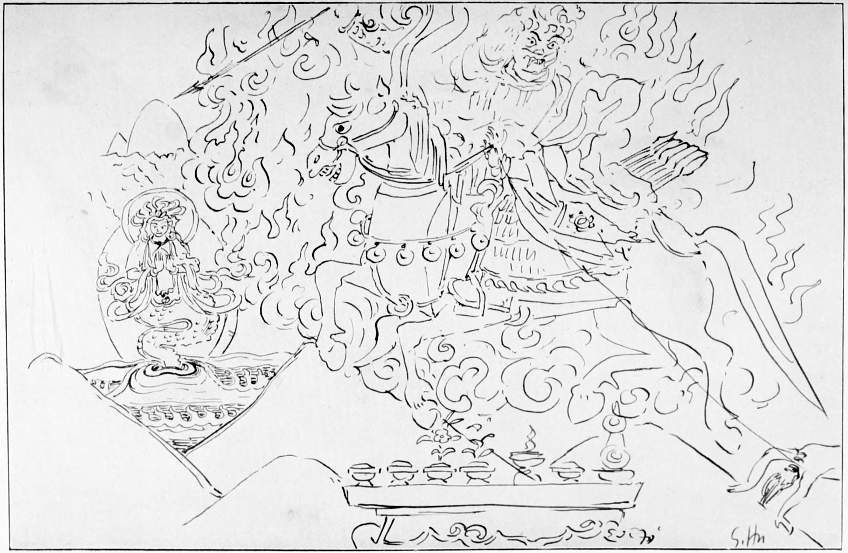
250. The God of the Lake rising from Tso-mavang. Sketch by the Author.
We paid at once a visit to the monastery, where the thirteen monks and their abbot, Tabga Rinchen, received us with the greatest kindness and politeness, showed us everything, and explained to us the various temple halls. They had heard of my voyages on the lake, and had now seen with their own eyes my boat sailing before a favourable wind, and they expressed their sincere conviction that I must possess occult powers to defy with impunity the god of the holy lake. But they understood that this was owing to my friendship with the Tashi Lama, who had given me his holy blessing. The monastery Tugu-gompa is a dependency of Shibeling-gompa in Purang, and most of the monks come from there to spend three years on the lake. They own herds in Chang-tang, trade, and seem to be in good circumstances; at any rate, they help the poor pilgrims who have nothing to eat on their wanderings round Tso-mavang. They receive gifts from well-to-do pilgrims. The temple halls are picturesque, handsome and in very good order. You enter from an upper balcony into an outer hall with wall paintings, among which is a picture of Tso-mavang with the fish-god, Madö Gemo, rising from the waves (Illust. 250). He has seven water-snakes in his hair, and the lower part of his body is like a green dolphin. The lake is as deep as it is broad, and concentric rings encircle the rising god. The abbot said that the fish-god comes up to greet the god of Tso-mavang, Hlabsen Dorche Barva, who gallops in a cloud of grey fiery tongues and smoke on a pink horse, and is armed with spear, bow and quiver. In the background stands Kang-rinpoche, the holy mountain. The whole picture is wanting in perspective and proportion, but it is curious and interesting, and the Lamaist artist has done his best to idealize the holy lake by his drawing and colouring. I made a copy of this work of art, which has some relationship with our old country paintings.
From the entrance hall a small door gives access to the holiest shrine in all Tugu-gompa, namely, the hall of the lake god. He is represented only as a mask, surrounded by kadakhs, and seems to peep out from between curtains. A couple of flames burn before him and the usual bowls are placed on a stool table. No man but the monks themselves may enter this little alcove, but I obtained permission to sit on the threshold and draw a sketch of it (Illust. 251). I regarded this unknown Hlabsen Dorche Barva almost with reverence, for he ruled over my beloved lake and had been so gracious to me.
But the finest sight of all was the view from the monastery roof. The highest parts of Gurla Mandatta, here called Mama-nani or Mamo-nani, were concealed by the lower flanks, for we were too near to it, but the surface of the lake stretched out northwards to an immense distance. A lama, who had served at several different times in the convent, asserted that the lake rose 24 to 28 inches in rainy summers, and declared that eighteen years before the water had reached to the foot of the red façade of the monastery. This seemed improbable, for the distance between the lake and the monastery was 323 feet, and the foot of the convent façade (the right corner looking from the strand) lay 20.67 feet above the level of the lake. I quote these figures to enable a future explorer to determine whether the lake has risen or fallen since August 2, 1907.
I passed the next days in the monastery, sketched the lamas at their various temple services, and fell in love with this pleasant, handsome Tugu-gompa. Punso Lama, a young monk, was my particular friend, and showed me everything with the inexhaustible knowledge of a trained museum attendant. Three officials of the Devashung had established themselves in the entrance hall in the company of the four ghostly kings, and mattresses, bundles, tables, swords and guns lay or stood in profane disorder at the entrance to the dwelling of the high gods (Illusts. 252, 253, 257).
Meanwhile Robert rowed out from the southern shore, and sounded the depths down to the contour of 207 feet. On August 5, we paid a visit to Yanggo-gompa, which contains ten monks and a nun. They told me that they came from the Hor country in the north of central Tibet, and therefore call themselves Horpa, but also Dokpa; the Changpa are the nomads of Chang-tang. The abbot is from Sekiya-gompa. In the monastery’s gunkang, a dark subterranean crypt, hang masks, kadakhs, drums, spears and guns. I asked for what purpose the monks wanted the firearms, as one of their fundamental dogmas forbids them to extinguish the light of life, and they answered that with these guns many wild yaks had been killed, whose flesh had been used for human food, and that therefore the guns had been installed in a place of honour in the monastery. Yamba Tsering, a monk twenty-two years old, sat with his head against a wooden pillar, and gazed in silence at the dim light which fell into the crypt through an impluvium; he looked like a dreamer, a searcher after hidden truth (Illust. 256). Beside him sat the wrinkled nun. Both found their way into my sketch-book (Illusts. 258, 259). The foot of the monastery façade lies exactly 14¾ feet above the level of the lake, and the river Richen-chu, entering the lake behind the convent, discharges 62.15 cubic feet of water.
Yanggo-gompa was the third of the eight monasteries of the holy lake which I had visited, and I wished to see them all without exception. And I also wished to gauge all the streams falling into the lake. It fluctuates from day to day, according as there is rain or sunshine, but only by exact measurements could I arrive at the volume which is poured into the clear basin of Tso-mavang during a day of summer.

CHAPTER XLVI
A STORMY VOYAGE OVER THE HOLY LAKE
On August 6 we stayed at Tugu-gompa, one of the most interesting monasteries I have seen in Tibet. I was engaged all day long, with Robert and Rabsang to assist me, in measuring with a tape the dimensions of the three storeys, and drawing plans of them. The third, however, is little more than a roof balcony. I have no space to give the results here. As we were on the roof, eight monks were sitting in the inner court counting their receipts, which were duly entered in a cash-book. Their rupees and tengas lay in heaps on a short-legged table. I gave a handful of rupees, throwing them among the piles, and disturbing the calculations of the monks. However, they were very thankful for this unexpected contribution, which seemed to fall from heaven.
About thirty Hindu pilgrims set up their shabby tents near us. In the evening they lighted a fire on a flat metal dish, which was pushed out on to the water, and shone like a beacon fire by the bank. This floating pyre was meant as a homage to the lake.
On August 7 I was awakened early when the sun was pouring fresh gold over the blue lake, and a lama on the convent roof was blowing long-drawn heavy notes from his shell horn over the surface. I hastened to the shore where the boat lay ready with its usual equipment, Shukkur Ali and Tundup Sonam put the sounding-line in order and stowed our baggage. The Hindus lined the bank like the wild-geese, left their clothing on land, and waded, with only a cloth round their loins, to bathe in the holy beatifying water of the lake. It must be very refreshing to people from the close jungles of India to wash in such a cool morning in water at only a few degrees above freezing-point. Most of them, however, go in no farther than up to their knees. There they squat down, or scoop up the water in their joined hands, and throw it over them. They make symbolical signs, fill their mouth with water and send it out in a stream, hold their hands flat against their faces and look at the rising sun, and perform all kinds of absurd, complicated manipulations, which I remember seeing at the ghâts of Benares. They are sunburnt, thin and miserable, and they are too thinly clad—I did not see a single sheepskin—and they complain of the severity of the climate, catch chills, and come to my tent for medicine. Some stood about an hour in the water before they returned to the beach to put on their clothing, and then they sat in groups talking. But they return to the valleys of India convinced that they have performed an action well-pleasing to the gods, and they take with them small metal-bottles filled with holy water from Manasarowar to give to their relations. They believe that one of the ways of salvation runs past Manasarowar. They are always hopeful, and that is a fine thing for poor pilgrims on the face of the earth.
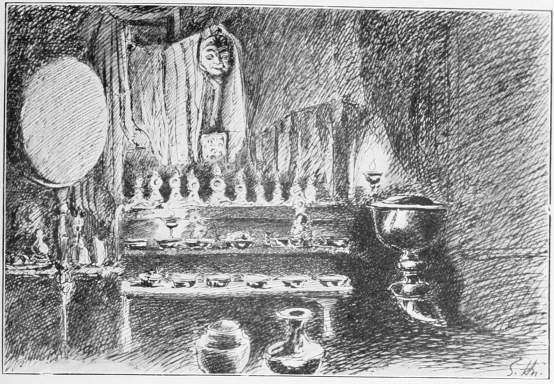
251. Temple Hall of the Lake-God of Tso-mavang.
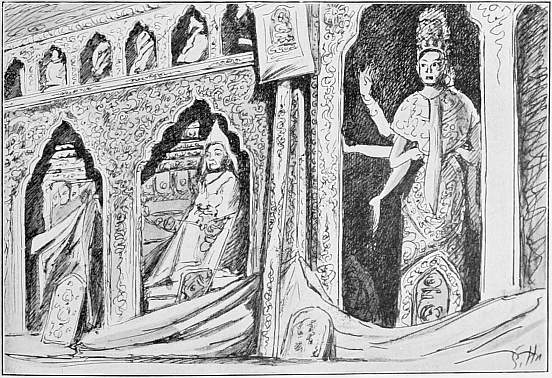
252. Chenresi’s Image in Tugu-gompa. Sketches by the Author.
They stared with astonishment at our boat, which was driven out from the shore by powerful strokes, perhaps with envious eyes, for many asked me afterwards to let them go with me, that they might for the rest of their lives look back to the time when they floated on the sacred waves. The lake lay smooth and still, but at the first sounding-station (115 feet), the lake god shook himself, a north-westerly breeze sprang up, and the waves splashed and danced briskly against our bow, for our third line of soundings was carried north, 27° W., towards camp No. 214. We sounded 174, 207, 226, 236, 236, 246, and 253 feet, while the waves increased, and the boat rode well but with diminished speed. Gurla Mandatta was almost clear, but Kailas was buried in clouds. The wind fell and the sun glowed, and everything foretold a fine day. At the ninth point the depth was less, 246 feet; we had passed the line of soundings made in the night and its great depths. Afterwards the depths were 223, 197, 187, 194, and 200 feet.
The north-westerly breeze began to blow again, and at mid-day clouds gathered in the north. A heavy bluish-grey layer of clouds sank down slowly on the mountain flanks, and from its under side rain fringes hung down, greyish-purple on a compact dark background. All the mountains and the whole strand disappeared, and the masses of cloud seemed as though they would fall on the lake. We passed the fifteenth station, which showed a depth of 200 feet, and kept a steady course towards the red promontory. The rowers put forth all their strength when I had pointed out to them that we were drawing near to the shelter of the bank, and that the waves were becoming smaller the farther we advanced. We had left Gossul-gompa a good distance to the left; I could not see the monastery myself, but the men saw it as a small white speck in the distance.
Just before one o’clock yellow swirls of dust and sand appeared near the landspit which we were making for. They became denser and larger, and looked yellow and dismal on the dark purple background of gathering clouds. It was not the first time I had seen such storm warnings.
“We are in for a storm,” I said quietly.
“God is with us,” replied Shukkur Ali quite as calmly.
“Row on and we shall get in before the waves are high.”
“If we turn straight to the shore, it will be nearer,” suggested Shukkur Ali.
“No, we will not alter the course, we will make straight for our goal, and we shall soon be in the shelter of the hills on the shore; there are only three soundings to be taken, and they can be left for another time.”
The wind fell again, and it began to rain in a few large drops, which on reaching the surface of the water remained an instant as separate round beads, as though they were covered with a film of oil. Then followed an extremely heavy shower of hail which lashed the water as it streamed down, enveloped us in semi-darkness, caused the lake to leap up in millions of tiny fountains, and in two minutes made the inside of the boat white. Nothing was visible but ourselves and the boat, only water and hail, which scourged the lake like rods and produced a hissing gurgle. Now and then the clouds were lighted up by quivering lightning, and the thunder growled heavily and threateningly in the north. Then the men turned round, but could see nothing in the mist; they were uneasy and we all felt that there was danger ahead.
The hail was followed by pelting rain, a downpour of such furious impetuosity that I could not imagine any more tremendous. It fell in such quantities and with such force that we were bowed down by it. I had on three shirts and a leather vest, but after a short time I felt that the water was streaming down my bare skin, which had this advantage that all the future douches that awaited us could make no further impression. I had my fur coat on my knees with the skin side up, and in all its hollows the water collected in small pools. A quantity of water fell into the boat and washed about with the stroke of the oars. The shore was not visible, and I steered by the compass.
“Row on, we have not much farther to go.”
At length the rain became finer, but at four minutes after one o’clock, we heard a deafening roar in the north-east, a sound such as only a storm of the greatest violence can produce. Hail and rain were nothing to it; now that the heavy sheets of water were withdrawn the storm had a free course and swept suddenly and furiously over the lake. Why had we not started an hour earlier, instead of watching the religious ablutions of the Hindus? No, the god of Tso-mavang was angry and would teach us once for all not to treat so lightly the lake which splashes his dolphin’s tail with its green water. How we envied the monks in Gossul-gompa, and our men down in the south under the peaceful walls of the Tugu monastery! What would they say, what would they do, if we were drowned like cats in this raging lake?
For a minute we struggled frantically to keep our course in spite of the waves which swept upon us from the right. They swelled up with astonishing rapidity, and every wave which dashed against the taut canvas of the boat and dissolved into spray, made a cracking sound as though the little vessel were about to burst. The next was still larger; I warded it off with my Indian helmet, and Tundup Sonam received a cold buffet which disconcerted him for a moment. After the third, which threw its foaming crest over the gunwale, the water stood 4 inches deep in the boat, the little nutshell with the weight of three men lay far too deep in the water, and the water we had shipped gurgled, lapped, and splashed hither and thither with the roll of the boat.
Now I perceived that the attempt to hold our course was hopeless. We must fall off with the wind and waves. We had Gossul-gompa to the south, 50° W., and the storm was from the north-east; we could find refuge in the monastery, if we could get so far. The difficulty was to turn at right angles without capsizing. Twice I failed, and we shipped more water, but the third time I succeeded, and now, if we had any care for our lives we must prevent the boat from veering up into the wind; the storm came a little from the right. Tundup Sonam, who rowed the starboard oar in the bow, had all the work, while Shukkur Ali had only to dip in his oar occasionally at my command, but though outwardly calm he was too excited and eager, and when my voice could not be heard amid the howling of the storm, I put my hand on his knuckles to make him leave the oar alone.
Now began a voyage such as I had never experienced in all my journeys in Tibet. The storm increased to a hurricane, and under its pressure the waves became as high as the billows of the Baltic in stormy weather; a steamer would have rolled in such a sea, and we in the little canvas boat had to negotiate the unexpected cross rolls following one another. Lashed, hunted, and persecuted by the raging force of the wind, we swept over the lake. Every new wave that lifted us up seemed bigger than the last. Some had sharp smooth crests, as though moulded out of mountain crystal, and reflected the dark clouds in the north. It seemed as though a bottomless, watery grave yawned in front of us which might at any moment swallow up our boat. Others came rolling up foam-capped, hissing and thundering behind us, and we shuddered at the thought that they might fill the boat in an instant and send it to the bottom, but it rose bravely over the crests. The view was open on all sides, the sun was visible in the south, Gurla Mandatta was clear and sharp, to the south, 50° W., even the terrace on which Gossul-gompa stands could be seen, and it was black and threatening only in the north. During the second when the boat was balanced quivering on the crest of the wave, we might fancy ourselves transplanted to a lofty pass in Chang-tang with a world of mountain ranges all round us, while the foam of the waves had an illusive resemblance to the fields of eternal snow.
But this wave also passes on and the boat sinks into a hollow, we fall into a water grotto, the nearest waves conceal the view, the walls of the grotto are of the purest malachite behind us and like emerald in front. Now we are lifted up again—“At it, Tundup Sonam, or the huge foaming crest will thrust us down!”—he puts forth all his strength and the wave passes us. It is irregular and reminds us of the pyramidal summit of Kubi-gangri; two such crests tower up in front of us, and their edges are shattered into spray by the wind. They are as transparent as glass, and through one of them the image of Gurla Mandatta’s bright white snowfields is refracted as in a magnifying glass. We have a watery portal in front of us and the tips of the waves are gilded with the faint reflexion of the sun in the south.
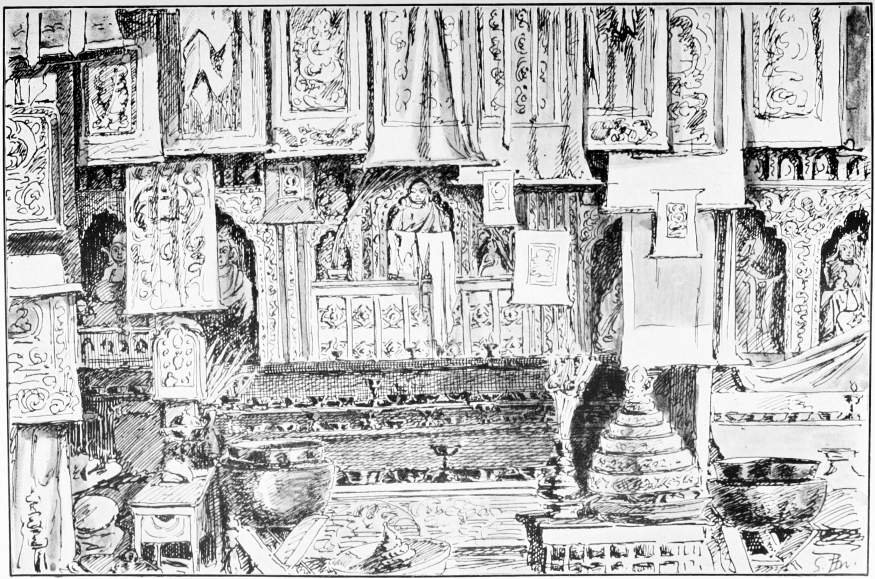
253. The Lhakang Hall in Tugu-gompa. Sketch by the Author.
We struggle bravely and I sit on the bottom of the boat pushing the rudder with all my strength to keep the boat in the right direction, while the spray, lashed by the wind, spurts over us as from a fire-hose. Frequently a broken crest slips over the gunwale, but we have not a hand free to bale out the water. We see the boat filling slowly—shall we reach the bank before it sinks? The mast and sail lie with two reserve oars tied fast across the middle of the boat. If we could set a sail the boat would be easier to handle, but it is not to be thought of now, when we can hardly keep our balance sitting down and stiffening ourselves with our feet, with the heavy blows and the unexpected positions the boat assumes according to the form of the waves, their slopes, curves and curls. And, besides, in such a storm the mast would break like glass.
We had turned at right angles to our line of soundings for now we thought only of saving our lives, if that were possible—to reach the land before the boat sank. Then, in the most critical moment, when an irregular wave threatened the boat, I called on Tundup Sonam to put forth all his strength, and he did it too well, so that the oar broke with a crack. Now all hung by a hair, we could not manage the boat and it must inevitably capsize and be swamped under this foaming crest. But Tundup Sonam realized the danger, and with a quick grasp tore loose a reserve oar, while Shukkur Ali backed with the leeward oar; after another douche we trimmed the boat again.
The longer the storm lasts and the larger the expanse of lake left behind us in the north-east, the higher rise the waves; we are swept forwards, we rock up and down on the lumpy lake, and fresh cold douches are constantly poured over us from the crests as they split into spray like plumes of feathers. How small and helpless we feel in the presence of these roused infuriated forces of Nature, how imposing and awful, and yet how grand and splendid is this spectacle! The two men had never in their lives seen anything to equal it. I sit with my back to the pursuing billows, but the men have them before their faces, and I know when large waves are approaching by their muttered “Ya Allah!” Tundup is as pale as he can be with a sun-tanned skin; Shukkur Ali seems composed, but he does not sing to-day as he dips in his oar. Tundup afterwards confided to me that he was quite convinced that we should perish.
It is impossible to keep my eye-glasses dry and clear, and I have not for a long time had a dry thread on me. Shukkur Ali turns round and says that the monastery is in sight, but it is too far for my eyes. “Look at the wave yonder,” I call out. “Is it not beautiful?” He smiles and murmurs his “Ya Allah.” Its crest breaks close to us like a waterfall, and, air being forced into the water, it rises again in bubbling foam and the lake seems to boil and seethe. Hitherto there has been drizzling rain, but now the air is clear. The lake assumes a different hue, the waves are dark and bright, close to us black as ink, but lighter towards their tips, and the horizon of the lake is often seen through the next wave as through a sheet of ice.
Thus we are driven on, and the time seems endless. For five quarters of an hour we have striven with the freaks of the lake god, and every minute has seemed to us an hour. At last the monastery Gossul appears and grows larger, the details becoming distinguishable, and I see the white façade with its upper border of red, its windows and roof streamers, and some monks behind a balustrade with their eyes fixed on the boat. And below the cloister terrace there is wild foaming surf. How we are to land I cannot imagine; I have experienced such adventures before, but never anything as furious as to-day. We envy the monks up above with firm ground under their feet, and should like to be beside them. The log has been out all the time, and now I draw it in with a quick pull and call out to the men to be ready to jump overboard when I give the sign. I place the note-book and the map I have sketched to-day, all dripping with water, into the front of my leather vest, that at any rate I may not lose the figures I have obtained.
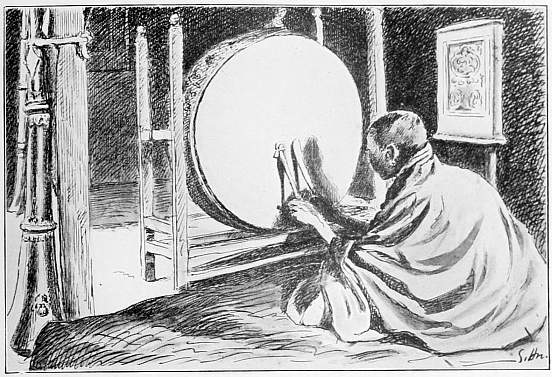
254. Lama with Prayer-Drum.
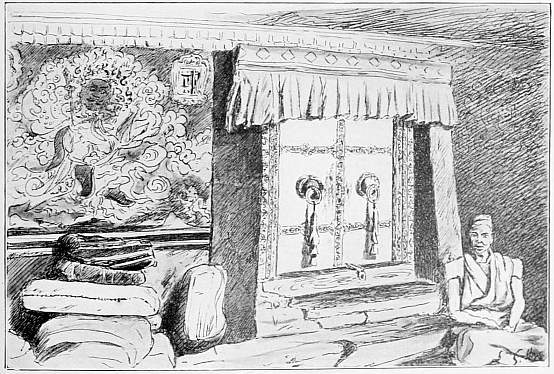
255. Lama before the Temple Door in Tugu-gompa. Sketches by the Author.
We have only a few minutes more. With the help of Shukkur Ali I manage to get out of my heavy soaked boots, and have scarcely done so when the boat is pitched violently into the breakers on the shore. Here the water is as brown as oatmeal, and the undertow sucks out the boat again. Now Tundup Sonam wishes to jump out of the boat but I advise him to try first with the oar if he can reach the bottom; he feels no ground and has to wait patiently. The boat receives a blow from behind and threatens to capsize; the oarsmen work as if they were possessed to fight against the undertow, and before I am aware Tundup has jumped out, and, up to his breast in water, draws the boat shorewards with all his might. Now we two follow his example, and with our united strength succeed at last in drawing the boat up the beach before the raging surf can dash it to pieces. One more hard pull and we have drawn it up over the mud embankment into the lagoon, which the waves cannot reach.
Now we had had enough, and we threw ourselves down on the sand, quite tired out. The fearful excitement and tension of body and mind during an hour and a half was followed by stupor and weariness; we had nothing to say to one another, and I gave no orders for the night. We were shipwrecked men, and had every reason to be pleased and thankful that we had firm ground under our feet again, and had escaped safely from the green graves which had yawned below us, threatening to engulf us if we had not been on the alert in critical moments.
We had only dozed a few minutes when two monks and three young novices came gently over the sand and approached us cautiously, as if they were not quite certain whether we were alive or dead. When we got up they greeted us kindly, and inquired how we were and whether we needed help. They were deeply interested, and told us how they had seen from their balcony the boat tossing on the waves, and had been convinced that it must founder in the unusually violent storm that had swept over the lake. They had been frightened to death, and said that it was fearful to see the boat sink in the trough of the waves, and every moment they expected that it would not appear again. On landing we were immediately below them, and the sight was too terrible. Were we hurt at all, and would we come up into the monastery and spend the night in their warm rooms? But I thanked them for their kind offers and preferred to sleep as usual in the open air. If they could get us fuel and food we should be much obliged.
They bowed and disappeared in their maze of staircases, and presently came back with sacks full of dung, brushwood, and billets, and soon a grand fire was burning on the terrace. They kindled it themselves, for our matches and tinder were quite useless. Then they went off to fetch some eatables, for the contents of our packet of provisions were turned into paste by the water.
Meanwhile we made ourselves comfortable on the narrow strip of ground below the monastery. Two large caves opened into the terrace, their vaults black with smoke, for pilgrims and herdsmen spend the night in them. They would have sheltered us from the wind, but they were so dirty that we preferred to pitch our camp at the edge of the bank. It was wet with rain, but we scraped out dry sand with our hands. The boat was taken to pieces and emptied—it was half full of water—and then it was set up by the fire as a screen.
When the fire had burned up and was glowing hot, we stripped ourselves stark naked, wrung out one garment after another, and crouched by the fire to dry our under-clothing and ourselves. Each had to look after himself, for we were all in the same plight. I spread out my things as near as possible to the fire and hung them over the oars and life-buoys to expose them to the wind and heat. Meanwhile I dried my woollen vest bit by bit, turned it inside out, held it to the fire on this side and that, out and inside, and when it was quite dry put it on again. Then came the turn of my unmentionables, then of my stockings, and so on. Nothing could be done with the leather waistcoat and the fur coat; they would not be dry by night, but what did it matter? It was at any rate better here than in the crystal halls of the lake king.
It is still broad daylight, but the storm rages, Gurla Mandatta and all the country to the south has disappeared, for the gale is passing off in that direction. There is fine close rain again. Falcons scream in the holes of the pebbly slopes—dangerous neighbours for the bluish-grey pigeons cooing on the rocks.
The monks came down again with sweet and sour milk and tsamba, tea we had ourselves, and the simple dinner tasted delicious. Then we sat a couple of hours by the fire while the storm continued. I dried my diary and entered the notes which form the contents of this chapter. Between whiles Shukkur Ali entertained me with stories of his adventures during his travels in the service of Younghusband and Wellby. Now that he had escaped death by the skin of his teeth, the past returned more vividly to his memory, and when once he was started on his reminiscences he could not be stopped, good old Shukkur Ali. I listened with one ear and wrote with the other—I had almost said—not to appear uninterested; and, after all, the chief thing to Shukkur Ali was that he could prattle.
At last the northern sky becomes clear, and all the mountains are white with snow; before only Kailas and its next neighbours were distinguished by white caps, but now all is white. We are certainly past the early days of August, but is it possible that autumn is already beginning? The summer has been so short that we have hardly had time to get accustomed to it.
Another night falls on the earth. Impenetrable darkness surrounds us, and only in the zenith a few stars sparkle. The swell still roars against the strand, but Tso-mavang is gently falling asleep. Above us towers the monastery on its steep wall like a fortress, and the monks have retired to rest. The falcons are heard no more, and the pigeons have sought their nests.
CHAPTER XLVII
ON THE ROOF OF THE GOSSUL MONASTERY
In the middle of the night I was awaked by a terrible row; a dog from the monastery had crept under my men’s half of the boat to see what it could find, but chanced to fall into the hands of Shukkur Ali, and got a good thrashing. The temperature fell to 37.4°. Rabsang came riding up at sunrise. The men had feared that we must have perished in the waves. He brought provisions and a packet of letters from Thakur Jai Chand, the British commercial agent in Gartok, who was at the time in Gyanima, where the fair was being held. He wrote that Colonel Dunlop Smith had directed him on June 27 to try to obtain news of me. Guffaru had performed his task satisfactorily, and all my baggage was safely deposited in Gartok, and my voluminous correspondence had been forwarded to Simla. From Mr. Sherring, who had made a journey to Manasarowar some years previously, I received a very kind letter; he had also had the kindness to send me his interesting book on western Tibet, while his wife had added a whole packet of English and French newspapers, literature the more acceptable that the extensive library presented to me by O’Connor had long been read through and dispersed to the four winds of heaven. It was a singular coincidence that where I had suffered shipwreck I was so unexpectedly brought again into contact with the outer world.
I was deeply moved by Rabsang’s information that the monks in Tugu-gompa, when they saw the storm burst over our frail boat, had burnt incense before the images of the lake-god and implored him to deliver us from the waves. They had done it of their own accord, and not at the request of any one. They said it would be deplorable if we were lost; they had a heart, and were not so unfeeling as might be supposed. Few proofs of sympathy have touched me like this.
Accompanied by Rabsang, I ascended in the early morning the winding path up to the monastery. At the turns and projections stand cubical chhortens and votive cairns, and here and there a streamer flutters on a mast. A samkang, a hermit’s dwelling, hangs over a cavern produced by the fall of a huge mass from the slope of the pebble terrace eleven years ago. I told the monks that they should not put too much confidence in the ground on which their monastery stands. They reckon millions of years for the soul’s wanderings, but their earthly dwellings are not built for eternity. They answered calmly that the monastery had already stood for one hundred years, and that it would certainly stand as long as they were living there; for in general the monks are changed every three years, and they come here from the monastery Shibeling in Purang, by which they are maintained. There are only three of them, but I saw also four novices, seven, nine, ten, and eleven years old respectively, running about as actively as mice, and waiting on the monks. Their mother, a nun from Purang, also lives in the monastery. She had been married before she “took the veil,” and when her husband died she dedicated herself and all her children to the Church. I afterwards learned that one of the “boys” was a girl; they were so like one another that I could not distinguish between them. At first they were shy and timid, but after I had given them a few silver coins they were soon at ease with me. They appeared small and stunted for their age, but the abbot told me that they had mourned so much at the death of their father that their growth was checked. Almost all the day they were bringing water from the lake in clay jugs, which they carried in a basket suspended by a strap round their forehead; they carry therefore with the muscles of the head and neck, which are consequently so much developed that they seem too large for the body. But they also receive instruction and take their first uncertain steps in the domain of wisdom; the eldest is said to have already acquired considerable knowledge.
I went into the temple and studied it thoroughly. I remained there twelve hours, drew, took measurements, made all kinds of inquiries, and took notes. Every part is handsome, interesting, and well-kept. The lhakang is like an old armoury, a museum of fine, rare articles, which show great artistic skill, and have been designed, carved, modelled, and painted with unwearied patience and real taste. The hall, supported by eight pillars, has two red divans; a statue of Buddha in gilded bronze, and a number of other idols; drums hanging in stands, lacquered tables with the usual religious objects, and a large quantity of votive bowls in the brightest brass and of uncommon, tasteful forms. On both sides of the pillars hang tankas in four rows, which are as long as standards and triumphal banners, and are so arranged that they do not prevent the light from playing on the faces of the gods. In a corner surely waves a Swedish flag? Ah, it is only a blue and yellow tanka, but it reminds me of the golden period of our fame and victories.
The lhakang of Gossul is not built on the usual plan; the skylight is wanting, and instead there are three windows in the façade facing the lake. But the gods do not see the lake, for the windows are pasted over with paper on a trellis-work of laths. Why is the beautiful view concealed and the daylight excluded? To enhance the mystical gloom within and excite the greater wonder and reverence in the minds of the pilgrims who come in half-blinded from the daylight, and that they may not see that the gold is only gilded brass, and that the marks of the brush and the chisel may not be too profanely evident. The poorer a monastery, the darker are its temple halls; the darkness hides their poverty and helps the monks to impose on the faithful.
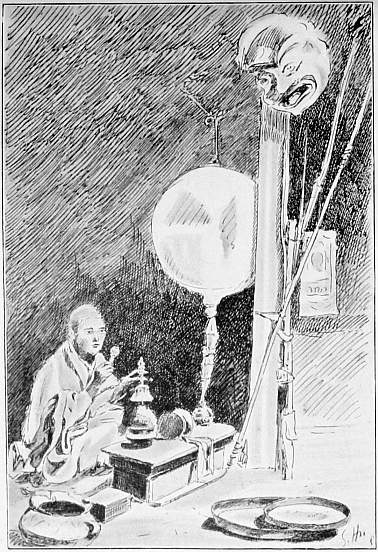
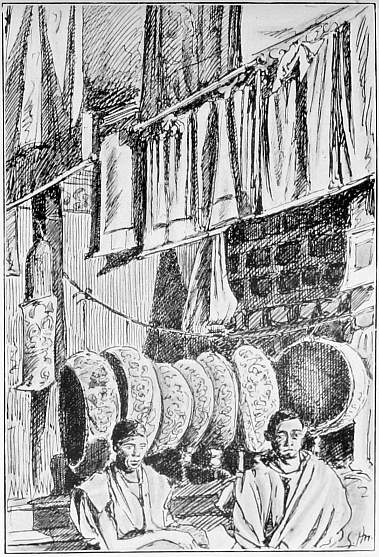
256. Yanggo-gompa. 257. Interior of the Temple, Tugu.
Sketches by the Author.
Somchung is the name of a small compartment no larger than a cabin. On its divan are cushions and pieces of cloth arranged in circles to form two nests, in which two monks sit during the night service. On the altar table before Sakya-muni’s image stand forty bowls filled with water, and on another table some peacock’s feathers in a silver vase, with which the gods are sprinkled with holy water to the cry “Om a hum.”
In former times robbers and footpads harboured here, and had their hiding-places in the caves below the monastery. From these they fell upon the pilgrims and killed many of them. Then the god of Tso-mavang appeared to Jimpa Ngurbu, a noble lama, and ordered him to build the monastery, that it might be a sure stronghold for the protection of pilgrims, and for the honour of the gods. Even now the country is not safe. Last year two scoundrels, who had plundered the nomads, were taken and executed; and we ourselves saw ten Gurkhas, armed with guns, who rode past us in search of a robber band which had stolen their horses and sheep.
The monks said that the lake usually freezes in January; in stormy weather the ice breaks up, but when the weather is calm and the frost is sharp, the whole lake freezes over in a single day, and breaks up again in a single day when it is stormy. Unfortunately the statements made about the level of the water and the discharge are contradictory and untrustworthy. A lama, thirty-five years of age, now staying here, had lived on Tso-mavang as a child. He said that he well remembered the time when the water flowed out of the lake to Rakas-tal in such quantities that a horseman could not cross the channel, which is called Ganga, without danger. But now this channel had ceased to carry water for nine years. I was shown where the shore line ran last autumn, five fathoms farther inland, so that the lake must then have been 22½ inches higher. I was also shown a yellow block of stone, to which the water was said to have reached twelve years ago, and this point lay 101⁄3 feet above the present level of the lake. Such a rate of fall is improbable, though this statement accorded fairly well with the information I had received at Tugu-gompa. The threshold of the one cave lay now 22.57 feet, and that of the other 120.4 feet from the shore, 18.86 feet above the water. I was told that when the monastery was built, one hundred years ago, the lake had reached both these caves, and that only a small path was left along the strand by which the caves could be approached. However, the dates of the Tibetans are exceedingly uncertain, and to arrive at safe conclusions we must resort to the statements of European travellers. I will make a few remarks on them later. When I asked one of the monks what became of all the water poured into Tso-mavang by all the rivers and brooks, he replied:
“However much it rains, and though all the tributaries are full to overflowing, no change is noticeable in the lake, for as much water is evaporated as flows in. In our holy books it is written that if all the tributaries failed, the lake would not sink and disappear, for it is eternal and is the abode of high gods. But now we see with our own eyes that it is always falling, and we do not know what this means.”
The following records may be useful to future explorers: the lower edge of the massive threshold of the main gateway in the façade of Gossul-gompa lay on August 8, 1907, exactly 122.7 feet above the surface of the lake, as I ascertained by the help of a reflecting level.
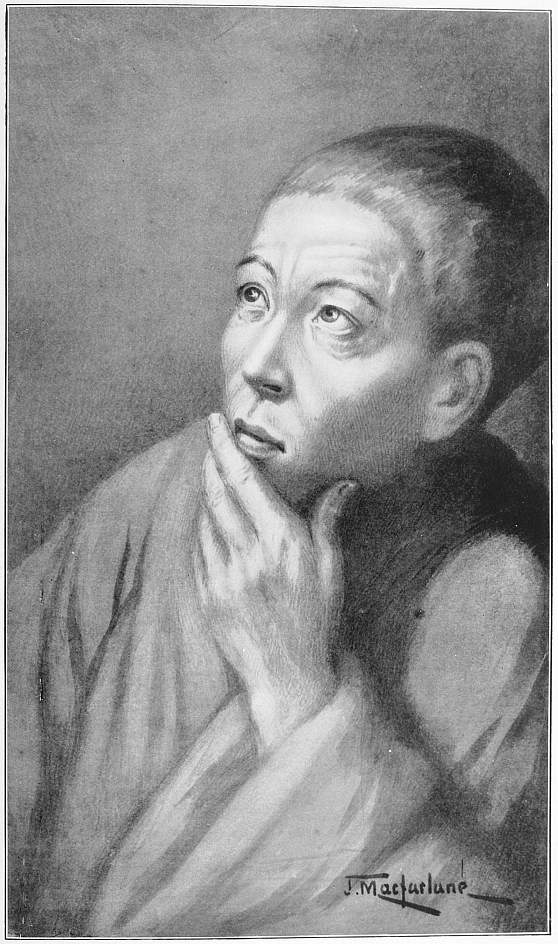
258. A Dreamer. Lama in Yanggo-gompa on Manasarowar. Drawn by T. Macfarlane from a Sketch by the Author.
We ascended to the roof of Gossul-gompa. It is flat, as usual, with a chimney, parapet, and streamers. No language on earth contains words forcible enough to describe the view from it over the lake. It was, indeed, much the same as we had seen from various points on the shore, but the light and shade was so enchanting and the colouring so wonderful that I was amazed, and felt my heart beat more strongly than usual as I stepped out of the dark temple halls on to the open platform. Tundup Sonam said in his simple way that the lake with its encircling mountains seemed like the sky with its light clouds. I, too, was the victim of an illusion which almost made me catch at the parapet for support. I wondered whether it was a fit of giddiness. I took, to wit, the border of mountains on the eastern shore for a belt of light clouds, and the surface of the sea for part of the sky. The day was perfectly calm and the lake like a mirror, in which the sky was reflected; both looked exactly the same, and were of the same colour, and the mountains, which in consequence of the distance were all blended into a dark shadow, were like a girdle of clouds. The air was not clear, everything was of a dull subdued tone, there was no colour to speak of, but all was grey—sky, land, and water, with a tinge of blue, a fairy scene of glass, with decorations of white gauze seen through a thin blue veil of incense rising from the altar of the mighty god of the lake.
What has become of the earth, if all is sky and clouds? We are not totally bewitched, for we are standing on the roof of the monastery leaning against the parapet. A dream-picture in the most ethereal transitory tones floats before us. We seem to stand on a promontory jutting out into endless space, which yawns around us and in front. And where is now the holy lake, which yesterday nearly robbed us of life, and on which the storm was so furious that I still seem to feel the ground quaking under my feet? Has the Gossul monastery been changed by some whim of the gods into an air-ship which is bearing us away to another planet? Its streamers hang motionless on their poles, and nothing can be seen of the mountains, country, and ground.
“Oh yes, if you lean a little over the parapet,” says a monk, smiling. True! Then the illusion vanishes, to my great chagrin. I should have liked to remain a while under its enchantment. Just below us runs the narrow margin on the bank, with its black dam of clay and water-weeds, and its elongated lagoons. Through the crystal-clear water we see the yellowish-grey mud on the lake bottom, the dark fringe of weeds, and the dark depths beyond. It is like a huge aquarium covered with plate-glass. Two flocks of geese are swimming on the water, producing diverging ripples. All is so indescribably quiet; so ethereal, transparent, and transitory, so subtile and sensitive, that I scarcely dare breathe. Never has a church service, a wedding march, a hymn of victory, or a funeral made a more powerful impression on me.
Did fate compel me to pass my life in a monastery in Tibet, I would without hesitation choose Gossul-gompa. There I would observe the fluctuations of the lake and the annual curves of the temperature. I would sit up there like a watchman, gaze over the lake, and watch how its aspect changed every hour during the twelve months of the year. I would listen to the howling of the autumn storms, and would notice on calm November days how the belt of ice along the shore broadened from day to day, if only to melt again in the course of a day. The ring of ice would creep on ever nearer to the middle of the lake, be destroyed again and again by new gales, and then begin again to enchain the waters. And at length, on a day in January, when the layers of water were cooled through and through and no wind disturbed the air, I should see the god of Tso-mavang stretch a ringing roof of glass over his green palace, and the winter storms bestrew it with white powder and drive the whirling snow in dense clouds over the ice, with its smooth, dark-green surface peeping out here and there. And on calm days the lake would lie a white plain, lifeless and lonely under its white shroud, and I should sit by the bier of my friend longing for the spring. In vain would the first storms of spring contend with the solidity of the ice and its brave resistance, but at last the sun would come to help the wind, and would make the ice brittle and rotten. Leads and fissures would start up in all directions, and the next storm that swept over the ice would overcome all resistance, flinging about the ice blocks and piling them up one on another, driving them to the shore, and sweeping breakers over them so that they would be crushed, splintered, pulverized, and melted in the rolling surf. Then I should rejoice at the victory of the storm, the release of Tso-mavang and its restoration to life, and would listen to the song of the waves and the screaming of the wild geese.
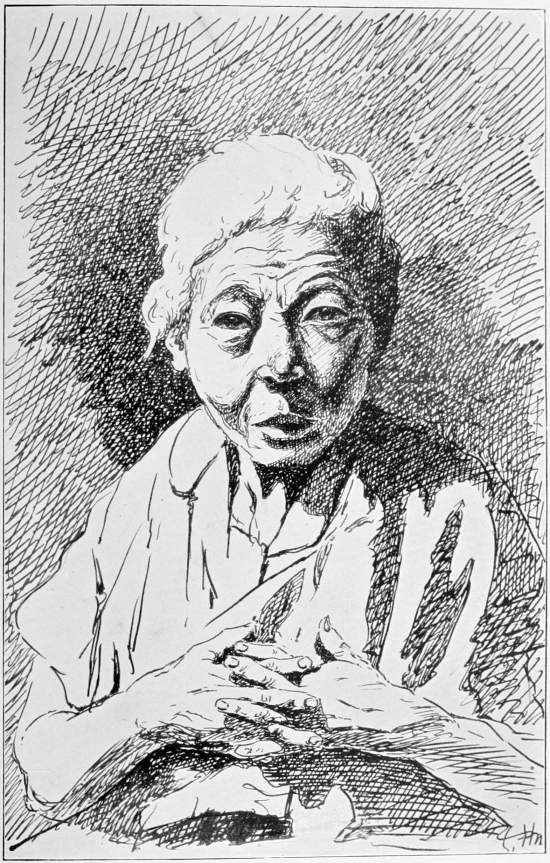
259. The Old Nun in Yanggo-gompa. Sketch by the Author.
Perhaps an hour such as I spent at the parapet of Gossul comes only once a year. The effect is the result of a certain temperature, a certain percentage of humidity, calm air, preceded by rain and a north-easterly storm. How seldom are all these conditions fulfilled? At most once a year, and just at this hour, this hour of all hours, I stood on the roof and saw the blue lake at rest after its play.
Wonderful, attractive, enchanting lake! Theme of story and legend, playground of storms and changes of colour, apple of the eye of gods and men, goal of weary, yearning pilgrims, holiest of the holiest of all the lakes of the world, art thou, Tso-mavang, lake of all lakes. Navel of old Asia, where four of the most famous rivers of the world, the Brahmaputra, the Indus, the Sutlej, and the Ganges, rise among gigantic peaks, surrounded by a world of mountains, among which is Kailas, the most famous in the world; for it is sacred in the eyes of hundreds of millions of Hindus, and is the centre of a wreath of monasteries where every morning blasts of conches sound out from the roofs over the lake. Axle and hub of the wheel, which is an image of life, and round which the pilgrims wander along the way of salvation towards the land of perfection. That is Manasarowar, the pearl of all the lakes of the world. Hoary with age when the books of the Veda were written, its blue billows have in the course of centuries seen innumerable troops of faithful Hindus and Tibetans arrive at its banks, there to drink, bathe, and find rest for their souls. There are certainly more beautiful lakes in the world. Its western neighbour, for instance, Langak-tso, is more picturesque. But there is none which unites with natural beauty such an influence on the faith and souls of men. That is why the roar of its waves is so attractive, and a sojourn on its shore so fascinating. Standing up on the convent roof, while silence reigns around, one fancies one hears innumerable wanderers approaching, and the echo of their stumbling feet on the holy path around the lake. And one casts a glance into the night of past centuries, which have left no trace of their aspirations and vain search after an imaginary blessedness. But Tso-mavang remains the same as it was then, and its azure-blue eye sees new generations treading in the footsteps of the old.
After such an hour everything else seems commonplace. Not till the blush of evening flooded the lake with a purple tinge could I tear myself away and go down to my camp on the shore. Once more I turned to Tso-mavang and called out a loud prolonged “Om a hum.” Rabsang said nothing, but I could see that he was wondering whether I had become the latest convert of the Lamaistic church, and with the more reason because I had insisted on travelling round the lake in the orthodox direction—southwards by the east bank and northwards by the west bank.
The tracks of 120 yaks were discernible in the sand, which had passed northwards in the morning laden with brick tea. An old Hindu, who was performing the circuit of the lake in the same direction as the Tibetans, begged to be allowed to camp beside us, because he was afraid of robbers; we regaled him with tea, bread, and tobacco, and he asked us to accept a handful of rice. It is singular that the Hindu pilgrims seem to hold the Lamaistic monasteries in veneration; at least I saw them bow before the Lamaistic gods in Tugu-gompa, and place a handful of rice in the bowl which a monk held out to them.
After a temperature of 43.9° in the night the morning air seemed quite warm. A fresh easterly breeze ruffled the surface of the lake, and the foam-tipped waves shone in the sun, but the day was beautiful and I was full of life, and eager to go out upon the lake. The old Hindu said that he had resolved to postpone his pilgrimage and go with us in the boat, but I assured him that we would take no unnecessary ballast. But he followed us on the bank as we rowed through the surf to Camp No. 213, easily recognizable by its old fire-place, and when we steered thence seawards straight towards Tugu-gompa, visible as a white speck in the south-east, he was so eager to go with us that he ran into the water and did not turn back till it reached to his middle. He was certainly a little silly; he had talked nonsense all the evening, though no one had listened to him.
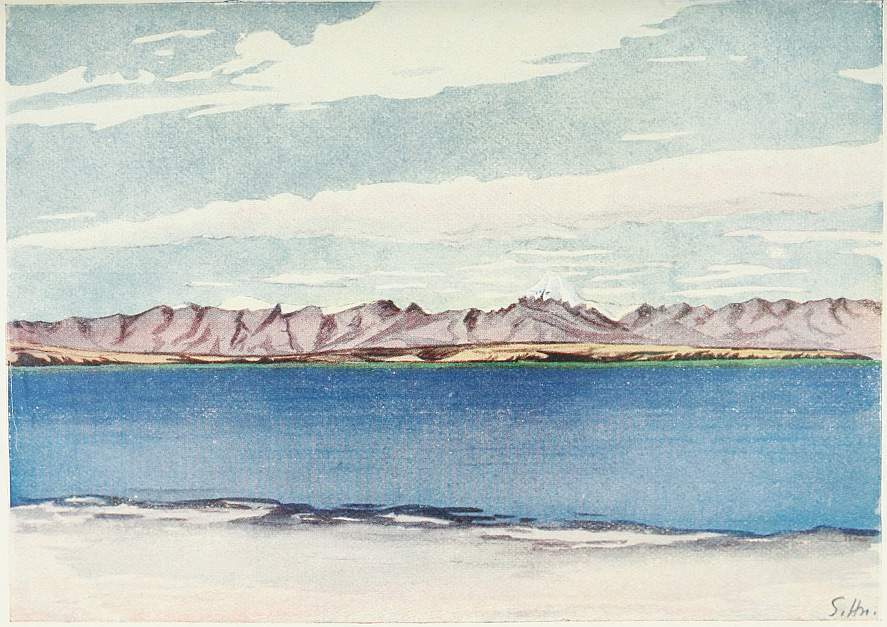
260. The Holy Lake Manasarowar from Tugu-gompa, with Kailas in the background. Water-colour Sketch by the Author.
The new line of soundings was marked No. 4 on my map of the lake. Its greatest depth was 249 feet. At the ninth sounding-station the red metal disc of the current-meter became entangled in the sounding-line. It was torn away from its screws and twisted like a boomerang in mad gyrations down through the crystal-clear water to a depth of 207 feet, there to sleep in the mud of Tso-mavang till the day of judgment. Fortunately it could easily be replaced.
When we landed at the monastery, all our men, and the monks and the pilgrims on the shore, were there to receive us. The first we caught sight of was the old crazy Hindu. His fellow-countrymen had taken it for granted that we must have perished in the storm, and therefore were very astonished to see us come back alive. But as I was now here again, they thought that they might take advantage of it, and asked me to present them one and all with new trousers, a request that I considered very importunate.
On August 10 I sat in my tent door and painted Kailas in different lights (Illust. 260). Its white summit stood out cold and bare against a bright blue cloudless sky, and the lake was of a deep, dazzling ultramarine. When a breeze swept over the surface it was in the distance like clear green malachite. After sunset the sky was orange-coloured, and the lake, of just the same colour, reflected the outlines of the mountains in quivering serpentine lines. The evening before, the whole western horizon had glowed with bright red flames.
CHAPTER XLVIII
OUR LAST DAYS ON TSO-MAVANG
At this time Robert had perfected himself more than I in the Tibetan language, and he talked it almost fluently. Therefore, while my whole time was taken up with other work, he was able to obtain information about the country and people, and perform certain tasks I set him. On the left, shorter wall of the vestibule of Tugu-gompa was an inscription for the enlightenment of pilgrims, and this Robert now translated into Hindustani and English. Freely rendered it runs as follows:
Tso-mavang is the holiest place in the world. In its centre dwells a god in human form, who inhabits a tent composed of turquoise and all kinds of precious stones. In the midst of it grows a tree with a thousand branches, and every branch contains a thousand cells in which a thousand lamas live. The lake tree has a double crown, one rising like a sunshade and shading Kang-rinpoche, the other overshadowing the whole world. Each of the 1022 branches bears an image of a god, and all these images turn their faces towards Gossul-gompa, and in former times all the gods gathered together here. Once golden water was fetched from the lake, and with it the face of Hlobun Rinpoche in Chiu-gompa was gilded, and what was left was used to gild the temple roofs of Tashi-lunpo. In old times the water of the lake flowed over a pass named Pakchu-la to the Ganga-chimbo. Water flows into the lake from all sides, cold, warm, hot, and cool. Water passes from the lake to the Ganga-shei and comes back again. Vapour rises annually from the lake and hovers over it once in the year, and then sinks down into the centre, and the next year the process is repeated. If any one brings up clay from the middle of the lake, that clay is really gold. The lake is the property of the lake-god. The lake is the central point of the whole world. Sambu Tashi grew out of the lake tree. Sochim Pema Dabge is of very holy, clear, and pure water. The Gyagar Shilki chhorten stands in the lake. The palace of the lake-god is in the lake. All the lamas there recite their prayers with one voice. All the gods assemble together in the lake and sit there among chhortens of all kinds, embellished with gold and precious stones. The spirit king of the southern land resides here in a golden house, and is not angry when any one comes to wash and purify himself. If we pray to the spirit king of the southern land, we shall be very wealthy and fortunate. Four large rivers and four small flow out of the lake by underground channels. The four large ones are one warm, one cold, one hot, and one cool. (The Karnali, Brahmaputra, Indus, and Sutlej.) If any one washes in the lake he is cleansed from sin and all impurities. If any one washes once in the lake, the sins of his forefathers are forgiven, and their souls are relieved from purgatorial fires. Datping Ngacha came with 500 pilgrims from Kang-rinpoche to wash in the lake. Lo Mato Gyamo met him and begged him to come to Tso-mavang. Dachung Ngacha and the pilgrims came with heaps of flowers and strewed them in the lake. Dachung Ngacha went three times round the lake and then ascended into heaven.
Of particular interest is the suggestion made here that the four large rivers stream out of Tso-mavang by subterranean passages. As regards the Sutlej this belief is, in my opinion, quite correct. I was told that the fifth Tashi Lama, whose mausoleum we had seen in Tashi-lunpo, once made the pilgrimage to Tso-mavang and went down to the shore at Tugu-gompa to offer a kadakh to the lake-god. The kadakh remained suspended in the air, that is, it was actually hanging on one of the branches of the holy tree, but as the tree is only visible to Rinpoches and genuine incarnations, the kadakh seemed to ordinary mortals to hang alone in the air.
On August 11 we bade a long farewell to the amiable monks of Tugu-gompa, and gave them liberal presents. They accompanied us down to the shore, when we put off on our voyage westwards. Into a large lagoon of the shore, brown and dirty owing to the numerous gulls and wild geese which here wallow in the mud, a brook from Gurla Mandatta runs, and now discharges 37.8 cubic feet of water in a second. All the way along runs a rubbish heap, the continuation of the pebble terrace on which Tugu-gompa stands. The lake bed consists sometimes of sand, sometimes of detritus—offshoots of the detritus cone of Gurla Mandatta. Large collections of weeds form dark patches. Up above, at the mouths of two valleys of Gurla, are seen foaming streams, and it is strange that they do not debouch into the lake. But the explanation is easy. Twenty to fifty yards from the bank numerous small holes in the sand of the lake bed open and close like the valves of an artery, and the surface of the lake above them bubbles. These are springs. The streams disappear in the detritus cone, and the water runs below over impermeable layers of glacial clay. At the edge of the cone the water comes up again under the surface of the lake. I perceived, then, that I must gauge the rivers at the points where they emerge from the mountain valleys, if I would ascertain the exact amount of the tribute Tso-mavang receives.
Near camp 218, quite close to the shore, a spring came to the surface, and where it welled up it had a temperature of 38.1°, and therefore brought down the cold of the glaciers to the lake. As the melted water of the Gurla glaciers retains its low temperature on its subterranean course, it probably assists in keeping the water of the lake cool during the summer. Whole shoals of fish sported at the surface of the water, and snapped at plumed gnats, which were gathered in thick clouds.
On August 12 I rode with Rabsang and a Tibetan up to the foot of Gurla Mandatta. We crossed the great highway between Tugu-gompa and Purang. A wolf took to flight; occasionally a hare leapt up out of the steppe grass, and locusts flew about noisily. We rode into the mouth of the Namreldi valley, a resort of robbers, and its crystal stream, between walls of solid rock, carried 101 cubic feet of water, as compared to the 37.8 cubic feet at the place where it enters the lake. The rest of the water, therefore, pours into the lake under the detritus. A few miles farther west we halted at the mouth of the Selung-urdu valley, which has a glacier in its upper part. At half-past nine o’clock the bed was dry, but at half-past one a river with rapids and waterfalls poured down a volume of 63.9 cubic feet of exceedingly muddy water, which reached the lake in the subterranean springs. The view from this elevated spot is magnificent. We have a bird’s-eye view of Tso-mavang, and in the west gleams the bright blue Langak-tso. The survey we can here take of the country is very instructive. The denudation cones of Gurla Mandatta, consisting of sand, rubbish, and boulders, extend northwards like inverted spoons; their extremities dip under the surface of the lake, and cause the fluctuating depths sounded on lines 1 and 2. From camp 218 Robert executed a line of soundings at right angles to the bank down to a depth of 190 feet.
Every day with its observations brought me nearer to the solution of the problem I had proposed to myself. As we rode northwards on the 13th along the western shore we dug wells at some places 10 yards from the bank. The ground consisted of alternate layers of sand and clay: on the top, sand; then a layer of decaying vegetable remains; then a foot and a half of sand which rested on clay. A pit 2 feet deep slowly filled with water up to the same level as the surface of the lake. The water permeates the sand and rests on the clay. If this layer of clay stretches, as seems likely, across the narrow isthmus to the shore of Langak-tso, it is evident that the water of Tso-mavang filters through the beds of sand and pebbles to the western lake. I was already convinced that even now when the old canal has ceased to act, an underground connection must exist between the two lakes. But the fact that the water of Tso-mavang is quite sweet is no proof that the lake has an outlet, seeing that it is only a few years since the canal was silted up.
Again we encamped below the hospitable monastery Gossul. On August 15 I rode with Rabsang and a Tibetan across the hilly isthmus between the two lakes in order to get a look at the country on this side also. We ascended sharply to the highest point of the ridge, where there is a fine view over Langak-tso with its picturesque rocky shores and projecting points and capes, its bays and islands, and its frame of steep mountains. In form it is very different from its neighbour, which is round and has no islands. We stood at a height of 16,033 feet, and therefore were 935 feet above the surface of Manasarowar. Then we rode down a valley clothed with brushwood, which emerges on to the flat, irregularly curved shore belt. Here are old, very plainly marked, shore lines, the highest 67.9 feet above the level of the lake. When the Langak-tso stood so high it had an outlet to the Sutlej, and the old bed of this river may be seen leading off from the north-eastern corner of the lake.
A strong south wind blew, and rolled the waves to the shore, where I sat a good hour, drawing and making observations. Then we rode again over the isthmus, at its lowest (15,289 feet) and broadest place. A salt swamp, begirt by hills, lies on its eastern half, quite close to the shore of Tso-mavang, with its surface 7.7 feet above that of the lake. In the sand and rubbish between the two are abundant streams of water, passing from the lake to the swamp. The swamp lies in a flat hollow of clay, in which the water evaporates, and the trifling quantities of salt contained in the lake water accumulate. At this place, then, the water of the eastern lake is prevented from seeping through to the western.
The following day we sailed with a favourable wind to the north-western corner of Tso-mavang, where Chiu-gompa stands on a pyramid of rock. This spot, camp No. 219, was to be our headquarters for several days. The outline of Tso-mavang is like that of a skull seen from the front, and we had now to explore the very top. A day of rest was devoted to a preliminary investigation of the channel where several cold and hot springs rise up; two of the latter had temperatures of 117° and 122° respectively, while in testing the third a thermometer graduated up to 150° did not suffice, and the tube burst. A spring of 117° in a walled basin is said to be used as a medical bath, but one must be a Tibetan to stew in water so hot. A small stone cabin beside it serves as a dressing-room. A little farther down the channel is spanned by a bridge constructed of four beams resting on two stone piers; it is in extraordinarily good condition, and is another proof that the canal contained water not so very long ago. On the piers of the bridge watermarks are still conspicuous 18½ inches above the present stagnant pools, smelling of sulphur and full of slimy weeds, which are fed by springs. Young wild-geese were swimming in one of them, and had great difficulty in protecting themselves from the brown puppy.
Chiu-gompa, the fifth of the eight monasteries of the lake which I visited, is small, and contains fifteen lamas who enter it for life, while the abbot is changed every three years. It owns some yaks, 500 goats, and 100 sheep, which are employed in transporting salt to Purang, where the monks barter it for barley. One monk, a youth twenty years of age, named Tsering Tundup, is one of the Tibetans whom I think of with particularly kind and warm feeling. His mother also lived in the monastery, and looked after the sheep and goats when they were driven in the evening into the penfolds. He was unusually handsome, refined, amiable and obliging, and showed me everything with full explanations. From his small bare cell he could dream and gaze at the holy lake in the east, and could see on the west Langak-tso, despised by the gods; but yet he was melancholy, and on that account we were sympathetic. He acknowledged openly that he was weary of the monotonous life in Chiu-gompa; every day was like the last, and the monks had hard work to procure a scanty subsistence, and must always be prepared for the attacks of robbers. It must be pleasanter to live as we did, and roam about freely among the mountains. He asked me if he might come with us, and I replied that I would willingly take him to Ladak. Then his face brightened, but he begged to be allowed to think over the matter until I returned from my next trip on the lake.
It rained all night, and in the morning everything was wet—even the things in my wind-beaten and torn tent, where little puddles had been formed. But Tsering came with the linen, so I was not so badly off. We had a long voyage before us, to camp No. 212, the first place we had encamped at on the holy lake. The programme of the excursion also included visits to the three other monasteries, the gauging of the volumes of water in the streams from the north, and the drawing of a map of the northern shore. We therefore took provisions for four days, which Rabsang and Adul were to transport along the bank on horses’ backs. We were to meet them at the entrance to the valley Serolung, at Serolung-gompa. This last voyage was to complete my investigation of the lake, but precisely because it was the last it was looked forward to with fear by my men. They thought that I had so long defied the god of the lake that now my time was come, and that he would avenge himself and keep me for ever.
But the morning was beautiful, and when at half-past five we rowed out over the smooth lake, the temperature was 48.6°. The cloud cap of Gurla extended down to the water, and nothing could be seen of the country to the south. The Pundi mountain was covered with snow and had a wintry appearance. At the first sounding-station (66 feet) the tents were seen as white specks hovering above the lake. Chiu-gompa stands proudly on its rocky point, and is a landmark visible from all parts of the lake shore except from the west. At the second station the sounding was more than 130 feet. Shukkur Ali and Tundup Sonam row like galley-slaves, for they hope to finish this line, and then the work will be at an end. Sometimes the boat passes through belts of foam and weed. At the fifth station (161 feet) the tents can still be seen with the glass, but after that they disappear. Gossul’s memorable monastery can also be dimly descried on its rock.
“Now we have traversed a third of the way,” I said.
“Thank God!” replied Shukkur Ali. “I hope the weather will hold up to-day.”
A large fish floated on the water, belly up; fish washed ashore are used by the people as medicine. The depths remain the same; the lake bed is very even. But at the thirteenth point we found 108 feet, and at the fourteenth 180 feet, which indicated a ridge in the lake bed or a cone of detritus from the foot of the northern mountains. At about an hour’s sail from the eastern shore we saw Rabsang and Adul coming up, and they waited for us at the rendezvous. They proposed we should pass the night in a stone cabin at the right side of the mouth of the Serolung valley, but I refused, for pilgrims and tramps are wont to harbour there. Six monks from the convent, old friends of ours, paid me a visit, and four happy, laughing women, black and dirty, came rushing like a whirlwind down the slopes with baskets of fuel on their backs. Puppy had followed Rabsang, and had found at a monastery on the way an elegant little cavalier with a red collar and bells. With a feeling of satisfaction at having completed this last line of soundings, I went to sleep on the sandy shore under the light of the everlasting stars.
Next day I rode with Rabsang 17 miles to the north, in order to measure the volumes of water in the Pachen and Pachung valleys. We arranged to meet the others on the northern shore, whither they were to row with the baggage. Were we long away they were to light a beacon fire on a hill for our guidance. We followed for a time the shore with its banks of mud, small projections, and lagoons, and then we rode through the Samo-tsangpo from the Tokchen valley, and passed on the left hand two small lakes in the midst of rich pasturage, where a number of kiangs grazed, glared at us, pricked up their ears, and ran away at a slow gallop; then we crossed the tasam, or the great trunk-road, and rode up the sharply sculptured Pachen valley, with a foaming river carrying 69.9 cubic feet of water. Then we rode westwards, up and down hills, and enjoyed a new view of the holy lake with Gurla Mandatta in the background. The Pachung river carried 83.3 cubic feet of water. When our work was done we rode south-westwards. Wild asses were on the meadows; they are nearly tame, for no one puts an end to life on the shores of the holy lake. Thirty mares stood on a mound guarded by a stallion; the sun was sinking, and perhaps this is how these animals prepare for the dangers of the night. Now and again a mare left the group and made a circuit about her sisters, but the stallion ran after her immediately and forced her to return to the others. This game was frequently repeated, and it seemed to me that the mares were making sport of the stallion.
We ride over swampy meadows and small sandhills; nothing can be seen of the lake; we should like to hear its waves roaring under the south-west breeze, but new hills always crop up in front of us. At last we catch sight of the smoke of the camp-fire. Adul had caught a kiang foal four months old, which was ill and kept always turning round. The mother came to look after it in the night, but gave it up for lost, and it died soon after.
August 20 was spent in surveying a map of a part of the northern shore which is very slightly curved, and in a sounding excursion on the lake out to a depth of 154 feet. While the surface water had a temperature 55.6° everywhere, with an air temperature about constant, the temperature at the bottom sank from 56.1° to 46° at the depth of 154 feet.
We gradually began to suffer want. The collops which Adul tried to pass off on me on the morning of the 21st were decidedly bad, and therefore landed in Puppy’s stomach. As Rabsang and I rode northwards to Pundi-gompa, the temperature was 56° and really too warm, so that a shower of rain was not unpleasant. Pundi lies on a rocky ledge in a ravine; its abbot is eighty years old, and has eight monks under him. One was a Chinaman from Pekin, who had lived forty years in the convent and had become a thorough Tibetan, though he had not forgotten his mother tongue. From there, too, there is a splendid view over the lake. As we were about to ride down to camp No. 222 on the shore, a messenger came from Robert with the news that the authorities in Parka had refused to provide us with transport animals or assist us in any way, for they had never heard that we were permitted to spend a whole month on the lake. He also said that our Ladakis were much frightened by all kinds of stories of robbers which were current in the neighbourhood, so that every one was anxious for my presence.
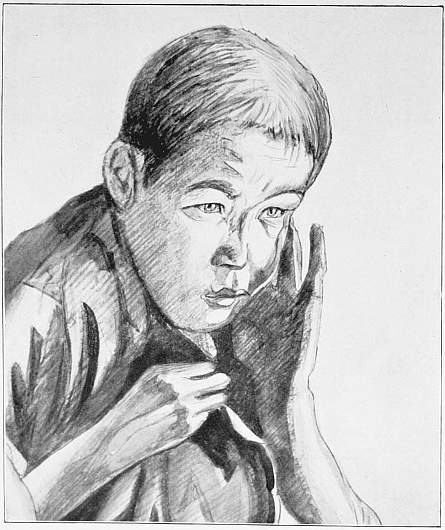
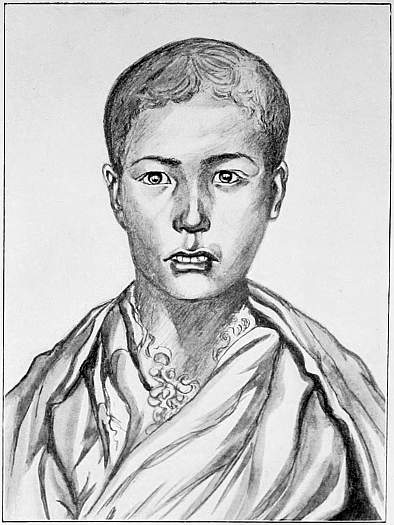
261. Boy on the Upper Tsangpo. 262. The Young Prior of Langbo-nan.
Sketches by the Author.
The camp was quite close to the monastery Langbo-nan, at the mouth of the Gyuma-chu. After we had measured this river and ascertained that it discharged 73.8 cubic feet of water, we had tracked up all the waters pouring into Manasarowar on the surface, and we found that the whole volume was 1094.8 cubic feet in a second, or 94,590,000 cubic feet in twenty-four hours, which would make a cube measuring nearly 456 feet each way. But how much water flows to the lake by underground passages which we could not measure? Probably a volume considerably in excess of the surface water; for Manasarowar lies in a trough between huge mountains which are constantly feeding the subterranean springs. At any rate the surplus water, so far as it is not lost by evaporation, filtrates through subterranean passages to the Langak-tso, which lies lower.
On the 22nd we again rowed straight out from the bank into the lake till we reached a place where the depth was 135 feet, and then sailed back with a favourable wind to the starting-point. It was the last time that I sank my lead in the holy water, and I was quite convinced that I should never do it again, for I had now 138 soundings, evenly distributed over the lake and affording ample material for the construction of an isobathic map. It was comical to hear Shukkur Ali when I remarked to him that this was our last voyage on Tso-mavang. He held his hands before his face as if he were about to pray, and said solemnly that in spite of all dangers “we had had the good fortune to bring our work to a successful conclusion by the favour of Allah, the favour of the Sahib, the favour of the papa and the mamma of the Sahib, and the favour of all his relations.” I ventured to remark that he had forgotten the favour of the lake god, but he dismissed the suggestion with a wave of the hand, and said he had no more faith in the god.
Afterwards I rode with Rabsang up to the monastery Langbo-nan, while the others went on to Chiu-gompa. I shall omit here a description of this convent, where the most remarkable sight was the twelve-year-old abbot Tsering, an intelligent, frank, and lively boy, with sharp bright eyes, white teeth, a fresh, healthy complexion, and an attractive appearance (Illust. 262). He sat on a divan before a lacquered table in his library, called tsemchung, and showed a great interest in all my plans, glanced into my sketch-book, tried my field-glass, and asked me for a couple of pencils. During the hour I spent in his cell we became good friends, and when at length I bade him farewell we little thought that we should meet again only a year later.
As we made the round of the monastery we came in the gallery of the court upon a poor fellow who lay ill and seemed to be suffering. I asked him how he was, and he told me that on August 18, the day when Rabsang and Adul came to meet us, he was taking eleven mules and two horses laden with tsamba and barley to Parka, the Gova of which was the owner of the caravan. Where the Pachung river enters the eastern lagoon he was attacked at eleven o’clock in the morning by twelve robbers, who rushed down from the direction of the Pachung valley. They were all mounted, and armed with guns, swords, and spears, had two spare horses for provisions, and wore masks on their faces. They dismounted in a moment, threw a mantle over his head, tied his hands behind his back, and cleared him out, taking among other things 400 rupees, and then they rode off again to the Pachung valley, which Rabsang and I had hurriedly visited the next day. He then summoned help by shouting, and in a very pitiable condition found refuge in Langbo-nan. He showed us some deep stabs in his legs, his skin coat, and the saddle, which had suffered severely when he made a desperate attempt to defend himself. This was the incident which had so alarmed our Ladakis.
The way from here to Chiu-gompa is charming. Perpendicular, sometimes overhanging rocks of green and red schist fall to the shore, which here has a shingly beach only 20 yards broad. Two gigantic boulders stand like monuments on the shore, and on the rocky walls we see black caves and hermits’ dwellings, and we often pass the usual three stones on which tea-kettles of pilgrims have boiled. Farther to the west the projections form a series of recesses in lighter tones; at one of these cliffs a new and fascinating view is displayed. A water mark lying 5½ feet above the present level of the lake is very easily recognized. On the rocky pinnacles eagles sit motionless as statues, watching for prey.
Chergip-gompa is built on a terrace in the broad mouth of a valley. It is a small, poor monastery, but it has its lhakang and its vestibule with a large bronze bell, in which the six holy characters are cast. When the bell is rung at morning and evening the unfathomable truth is borne on the waves of sound over the lake, which, with its blue surface and its background of the snowfields of Gurla Mandatta, forms a charming landscape as seen from the court of the monastery. But its sound is heard by no one but Chergip’s single monk. Poor man, what must be his feelings in winter evenings when storms sweep the drifting snow over the ice of Tso-mavang!
I remained with him fully two hours, for he had much to tell. He had travelled far, had been at Selipuk and the Nganglaring-tso, and offered to conduct me thence in twenty days to the Dangra-yum-tso; he had no suspicion that I was roaming about in the forbidden land under a political ban. But he revived my desire to visit the great unknown country to the north of the holy river. I was full of thoughts, full of plans, and full of an insatiable desiderium incogniti which never left me in peace, when at length I departed from the eighth and last monastery of Tso-mavang as the evening spread its dark veil over the lake I had conquered.
We had still a long way to go to the camp. At the last mountain spur stands a chhorten, from which our fire was visible. Soon we sat again among our companions. Late at night two horsemen rode past our camp; the watchmen called out “Who’s there?” but they made no answer. Then Rabsang awoke and thoughtlessly sent a bullet after the unknown men, being convinced that they were robbers. My men had reached such a pitch of nervousness that they saw robbers everywhere.
This was our last night on the shore of the Tso-rinpoche, the “holy lake,” and I listened sadly to the song of the surf dying away as the wind fell.
CHAPTER XLIX
ADVENTURES ON LANGAK-TSO
I have not interrupted the description of my life on the revered lake with notices of our political troubles. Suffice it to say that we succeeded in staying there a whole month. Mounted and other messengers often came to make complaints, and then my men simply replied: “The Sahib is out on the lake, catch him if you can; he is a friend of the lake god, and can stay as long as he likes among the branches of the holy tree.” And when I came back again they had gone off. In consequence of the boat trips they could not control my movements, but when we encamped by Chiu-gompa they became more energetic. During my absence came messenger after messenger with orders that I must at once betake myself to Parka and continue my journey thence to Ladak. On August 23 I sent Robert and Rabsang to Parka to make terms with the authorities, but they would not under any circumstances allow me to visit Langak-tso, my next stage. If I liked to stay a month or a year at Chiu-gompa it was nothing to them, for the monastery was not in their district, but the western lake was in their jurisdiction. They advised that I should come as soon as possible to Parka for my own sake, and would send in the morning fifteen yaks to carry my luggage.
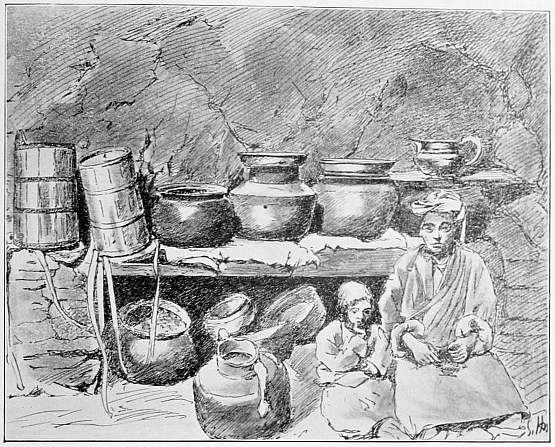
263. Temple Vessels in Chiu-gompa.
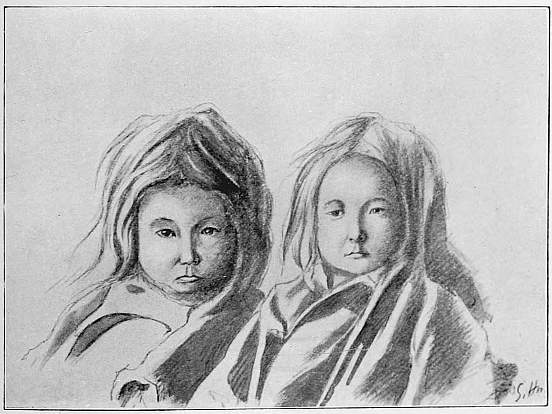
264. Two Children in Shigatse. Sketches by the Author.
But I wished to see Langak-tso at any cost. So when the fifteen yaks arrived next morning, I quickly made up my mind to send Tsering, Rabsang, and four men with the baggage to Parka, while Robert and the other six men would go with me to Langak-tso. Our own six horses and the last mule from Poonch could easily carry the boat and our bit of luggage. The yaks were laden and my men disappeared behind the hills. My own small caravan had orders to camp on the shore of Langak-tso where the old channel enters. I went with Robert and two men on foot and executed a series of exact levellings over the isthmus separating the two lakes. At the same time I drew a map of the course of the channel. The measuring tape was nailed fast to an oar which Robert carried; the theodolite I carried myself. The distance between the pole and the instrument amounted to 55 yards, and was measured with tapes by our two assistants. The pole was placed on an iron dish that it might not sink into the soft ground.
The lakes were visited in 1812 by Moorcroft, who found no connecting channel. In October 1846 Henry Strachey found there an arm of the lake 100 feet broad and 3 feet deep. Landor declared that any connection was inconceivable, for, according to him, the isthmus was 300 feet high at its lowest part. Ryder found in the late autumn of 1904 no water running out of Manasarowar, but he heard from the natives that a little water passed through the channel during the rainy season. Sherring also saw no running water, but he thought it probable that the lake overflowed after rainy summers. As for me, I followed the bed of the channel from one lake to the other and found that in the year 1907 no water flowed from the eastern into the western lake, and in 1908 the condition was the same, though both my visits occurred in the rainy season. There must be very heavy falls of rain before Manasarowar can overflow, for the highest point of the channel bed lies more than 6½ feet above the level of the eastern lake.
The circumstance that different travellers in different years have given different accounts is, however, very easily explained. All depends on the precipitation: if it is abundant, the surface of Manasarowar rises; if it is very abundant its water drains off to the Langak-tso (Rakas-tal). If the summer is dry, as in the year 1907, the Langak-tso receives no water through the channel, but certainly by subterranean passages. On the whole, both these lakes are falling like the other lakes of Tibet, and the time is approaching when the subterranean outlet will be cut off and both lakes will be salt.
As we deliberately measured the channel and came to its highest point from which its bed dips towards the west, I threw a farewell glance at Tso-mavang, and experienced a feeling of bereavement at the thought that I must now leave its shores, and in all probability for ever. For I had known this gem of lakes in the light of the morning red and in the purple of sunset, in storms, in howling hurricanes when the waves rose mountain high, in fresh southerly breezes when the waves sparkled like emeralds, in full sunshine when the lake was smooth as a mirror, in the silver beams of the moon when the mountains stood out like white spectres after the dull yellow light of evening was extinguished, and in peaceful nights when the stars twinkled as clearly on the smooth surface of the lake as above in the vault of heaven. I had passed a memorable month of my life on this lake, and had made friends with the waves and become intimately acquainted with its depths. To this day I can hear the melodious splash of the raging surf, and still Tso-mavang lingers in my memory like a fairy tale, a legend, a song.
We went on westwards along narrow creeks and pools of stagnant water, but when the evening had become so dusky that I could no longer read the figures on the measuring pole, we gave up work, marked the last fixed point, and made for the camp, which we reached in complete darkness.
In the morning the work was continued. We had had a minimum of 22.6° in the night, and a violent south-west storm rendered it difficult to read the instruments. The hundred-and-fourth point was fixed at length at the edge of the water of Langak-tso. I have no space here to analyse the results. The channel runs west-north-west, and the line measured is 10,243 yards long, or twice as long as represented on the most recent maps. The surface of Langak-tso lay 44 feet below that of Tso-mavang, which agrees very well with the difference of height on Ryder’s map, namely 50 feet. There is no water beyond the ninety-fourth fixed point in the bed, The Tibetans related a legend concerning the origin of the channel. Two large fishes in Tso-mavang were deadly enemies and chased each other. One was beaten, and in order to escape he darted right through the isthmus, and the windings of the channel bed show the course of the flying fish.
The morning of August 26 was dull, damp, and cold. Heavy clouds floated over the earth, heralds of the monsoon rains, and Langak-tso looked anything but inviting for a sail. But we had the whole day before us, and any moment horsemen might come from Parka, take us by the neck and lead us back, whether we liked it or not, to the path of duty. Langak-tso has a very irregular outline. Its chief basin in the south is begirt by rocks, in the north there is a smaller expansion, and between the two runs a contracted channel. All we could venture to do was to row over the small basin westwards and then to the south-east, to a place on the eastern shore whither our camp could be moved. It could be done in a few hours, so we took nothing but the mast and sail.