Front matter (continued 3)
Reading edition
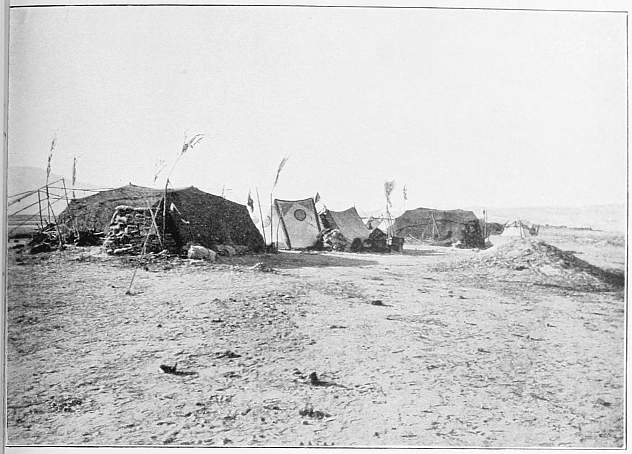
234. Gulam Razul’s Tents in Gartok.
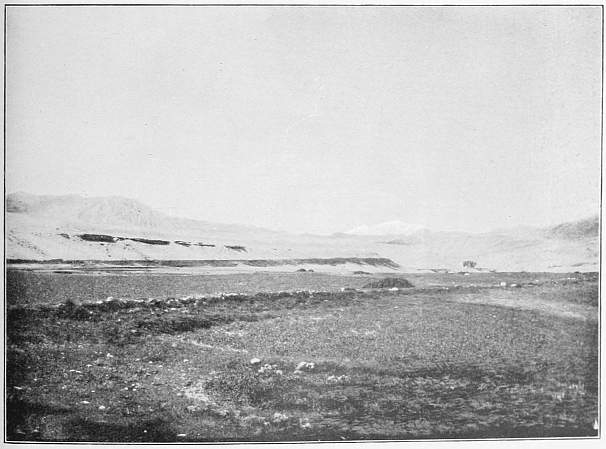
235. Landscape in Upper Nepal. View looking South from Camp 182, Nepal.
We passed encampments with large herds; wild asses grazed along with tame yaks. All the men we met halted and saluted us. The Gova of Tradum came to meet us; he pulled a very solemn face, and wondered whether Lo Gapu would be angry at our visit to Nepal. We reached Bando, near the small lake Tsotot-karpo, over the small saddle Tasang-la, and found Guffaru waiting for us with the caravan.
On the 25th we made a short march up to Chikum, whence the Tsotot-karpo is still visible. We had only provisions for one day, but the Gova of Tradum offered to procure more if we would pay well for the horses we had to hire. He had no fear, he said, of the Chinese who were coming; if they scolded him for allowing us to travel on the south bank of the Tsangpo, he would reply that it was easier to supply us with provisions there than on the north side. He had formerly been a lama in Tashi-gembe, but had lost his heart to a lady. To hush up the affair he had started on a pilgrimage to Kang-rinpoche, but was caught and forbidden to return. Then he had gradually worked his way up, and was now chief of Tradum, and was just as great a rascal in secular life as he had been in the religious life. However, he rendered us good service.
The view from our elevated camp was magnificent. When the full moon had risen up in the sky the small lake shone like a silver blade. The sun had left only an afterglow on the western horizon, but the whole plain of the Brahmaputra and the mountains of Chang-tang in the north were clearly defined in dull clear shades, which left all the finer details indistinguishable. A cloud with bright, silvery, white margins floated before the moon. A little to the right another cloud caught a reflexion of the sun, and showed golden margins. They were the angels of night and day fighting for supremacy. Soon night had won the victory, and now the moon cast a bright path over the lake, while all around was involved in a general mist.
When day had resumed its sway we rode in the morning air through swarms of flies, stinging gnats, and horseflies up over the Tagu-la and down the Tambak valley. To the west the most northerly chain of the Himalayas made a magnificent display, and to the north-west lay the broad open valley of the Brahmaputra, the river winding along the middle like a blue riband. This evening, too, the return of night called forth a brilliant play of colours and tone-effects. Light, restless, motionless to the eye, but riven by the upper winds like old prayer-streamers on a pass, the clouds sailed at sunset in the vault of heaven. The moon, the friend of all nocturnal wanderers and sleepers in the open air, illumines the surroundings of our tents, among which the blue smoke of the camp-fires lies like a veil over the ground. The yaks stand still as shadows, and now and then their teeth are heard grinding against the cartilaginous process of the upper jaw. The Tradum Gova and his servants hum their evening prayer and rattle their prayer-mills.
In the morning comes a quickly passing shower and another before noon. We notice all the signs of the sky, and wish for rain as much as the Tibetans, not on our own account, but for the light-footed antelopes, the wild asses, and the mountain sheep. The clouds are blue-black over the mountains to the south, and from them hang down elegantly curved fringes and draperies heavy with rain. One can hear in imagination the drops splashing on the stones, and new-born torrents rushing down the valleys. The trifling rain that has fallen in our neighbourhood can only moisten the ground for a short time. The drops made a pleasant sound as they pelted on the Tradum Gova’s umbrella and on my Curzon hat. Thunder rolled heavily and solemnly round about in the mountains, like an echo of the trumpet of the last judgment.
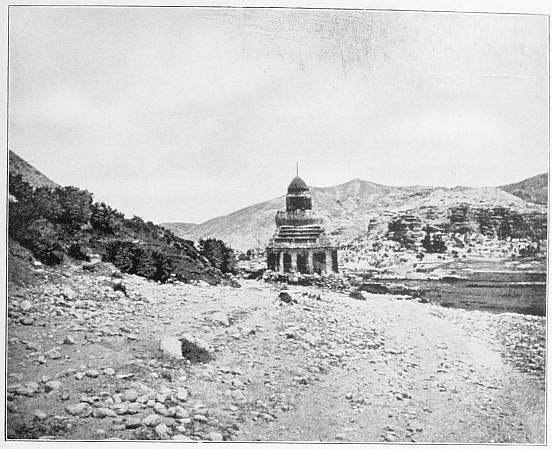
236. A Chhorten in Nepal.
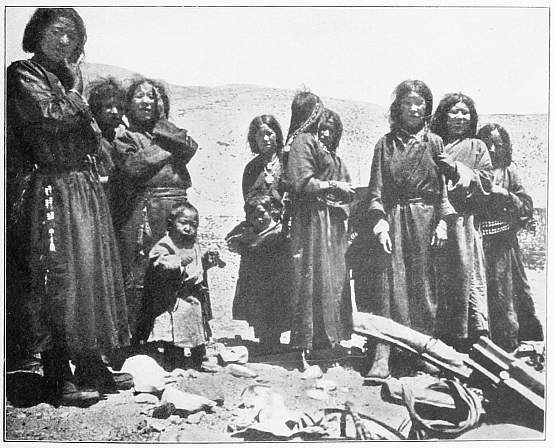
237. Group of Tibetan Women.
Then we cross the Nerung-tsangpo, come out into the great valley plain of the Brahmaputra, and encamp in a country inhabited by numbers of nomads. The Gova of Nagor was a tall, agreeable man, who procured us tsamba, chang, and goose eggs—a pleasant change from our perpetual diet of mutton. Robert and Shukkur Ali caught fish. The Gova told me that his parents, who belonged to Kham, had made a pilgrimage to the Kang-rinpoche and had left their little son behind, either by mistake or on purpose. The youngster had grown up in the tents of the wild nomads, and now, though a stranger, had become the chief of the district.
On the morning of the 28th we rode up to Namla-gompa, on a rocky prominence, where the view was extensive and instructive. At the eastern foot of the projecting mountain lies the village Namla, a few poor stone cabins, and here the river Pung-chu, flowing out of the lake Ujam-tso, enters the plain. The monastery contains some images of gilded bronze, and seven monks, of whom one, a man of sixty-six, has lived fifty years within its walls. They are poor and have to beg, but they receive freewill offerings from the nomads living in the neighbourhood.
Across a plain of cracked loamy soil, which is flooded at high water, we gain our camp on the bank of the Tsangpo; the river looks like a lake, and that this is also the case in late autumn is shown in Ryder’s remarkably conscientiously drawn and accurate map. The breadth here is 973 yards broad, and the maximum depth only 2.4 feet. It may, therefore, be easily waded, and the yak caravan marches quietly through the water. How different it is farther east, where the river, hemmed in between steep mountains, is deep and tumultuous! In late summer it cannot be waded here, and even a boat dare not venture over because of the treacherous, shifting sand-banks. During our measurements the Ladakis went across the river, measuring the breadth with poles and ropes, and held the boat still while I investigated the velocity of the current. When the work was finished, Rehim Ali began to carry Robert to the bank, but he slipped on the smooth, clayey bottom, and both took an involuntary bath, causing all the rest of us to laugh heartily.
Next day the fragile baggage was conveyed across in a boat, and the rest on hired yaks, which tramped through the turbid dirty-grey water. On the northern bank we ride through peculiar country. Here are lakes and swamps, caused by arms of the river, and lying amid a collection of sandhills as much as 26 feet high. We try all directions to avoid sandhills and deep creeks, and frequently ride straight through basins with yielding ground; in some there is a slight current, while others are stagnant. Here and there islets of sand rise out of the water, some barren, others with grass and stalks. It is a thoroughly disintegrated country, but full of pleasing variety. Gnats pursue us in regular clouds. Some men go in front to pilot us. We often get into deep water and have to turn back. The high water washes away the greater part of the driftsand, and deposits it on the banks of the Brahmaputra lower down. But when the river falls, fresh sand accumulates and forms new dunes. The driftsand therefore finds a resting-place here on its way to the east. We encamped by the last lagoon, and heard the fishes splashing in the water. The whole country reminds me of Lob, the swampy region in Eastern Turkestan, and the continual struggle there between driftsand and flowing water. The district is named Dongbo, and here the Gova of Tuksum and other chiefs awaited us. The first-named had heard that the Chinamen, of whose coming we had been informed, had left Saka-dzong and were on their way hither. He expected that they would arrive before evening.
On June 30 we made most of our march along the tasam, on which Nain Sing and the English expedition had travelled; for I durst not pass round Tuksum, which was mentioned on my passport. The greater part of the way runs among fine, regular, crescent-shaped dunes, which move eastwards over the plain before the prevailing wind. They are ephemeral phenomena: they live and die, but are always replaced by others. The horns of the crescent protrude far in the direction of the wind, and the slope is very steep on the windward side, as much as 17 degrees, while on the sheltered side it is as steep as the falling sand will allow.
Ganju-gompa stands on an isolated hill to the west of the Ganju-la. It is subordinate to the Brebung monastery, and has a lhakang with twelve pillars and four rows of divans, as well as four large drums. The statues of the gods look down with gentle smiles on the homage paid to them by nomads and travellers. Only five monks and as many dogs live in Ganju.
The whole population of Tuksum came out to meet us before their village. It was agreed with the Gova that Guffaru and the main caravan should proceed to Shamsang, while I with a couple of attendants travelled by forbidden roads on the south side of the river. In the evening a deputation of Ladakis came to wait on me with the request that they should be allowed to give a feast in honour of Muhamed Isa, to be paid for out of his outstanding pay. But I thought this a little too cool, seeing that the money belonged to the widow of the deceased. They might have a feast, however, at my own expense, but there would be nothing but mutton, chang, and tea.
On the morning of July 1 I had another application, this time from five young beggar girls, ragged and black, with bundles in frames of wood on their backs, and large pilgrims’ staves in their hands. They had been, like so many others, at the Kang-rinpoche, and reckoned it a year’s journey to their home in Kham. They beg their way from tent to tent. It must be a serious burden to the nomads to maintain the numerous pilgrims that pass along this road.
We said good-bye to Guffaru and his followers on July 2, and riding in a south-westerly direction over the plain, set up our camp 191 on the left bank of the Brahmaputra, which here carried down 1978 cubic feet of water. Next morning the baggage was taken over, and we had also the honour of helping over the river a high lama, whose acquaintance I had made in Tashi-lunpo. He wore a yellow robe with a red mantle, and had a small yellow wooden hat as bright as metal. His servants were armed with guns and swords, and took all their baggage over the river on yaks. But, unfortunately, the yaks got into deep water and began to swim, so that, of course, all their baggage was thoroughly soaked. We also helped a shepherd with some lambs over to the other side, and if we had waited longer we might have done a ferryman’s work all day with our boat (Illusts. 240, 241).
Then we crossed over two other arms, and the total discharge of the Brahmaputra at this place proved to be 3249 cubic feet. The figures, however, obtained on gauging the river so near its source, are of inferior value, especially when the melting of the snow has quite set in, partly because the source streams rise towards evening, carrying the water from the day’s thaw down to the main valley, partly because the volume of water depends to a great extent on the weather. At the first downpour of rain the rivers are little affected, for the water is absorbed by the dry soil; but when this is soaked through, the water runs off, and the rivers swell enormously after a single rainy day. When the sky is overcast without rain they fall, but in quite clear weather the sun thaws the snow and causes the rivers to rise again.
It was a long day’s journey, for in many of the tents the people refused to give us the help we wanted, and therefore we passed on to the great tributary Gyang-chu, which comes from the south and receives many streams from the northernmost range of the Himalayas.
I have no time to give an account of the geography of this region on the south side of the Brahmaputra. I will only say that during the following days we were cut off from the main river by low mountains, and that we did not encamp again on its bank till July 6, when we came to the Cherok district. We had left several tributaries behind us, and the main stream carried only 1554 cubic feet of water.
After another short day’s march we rejoined Guffaru’s party in Shamsang (15,410 feet) on the great high-road, where twenty-one tents were now standing. The chiefs of the neighbourhood were very attentive, and did not say a word against my proposal to go up to Kubi-gangri, which shows its snowy peaks to the south-west, and in which the sources of the Brahmaputra were said to lie. They procured us provisions for twelve days, and we had not had so free a hand for some time. Here nothing had been heard of Chinese or Tibetan pursuers from Lhasa.
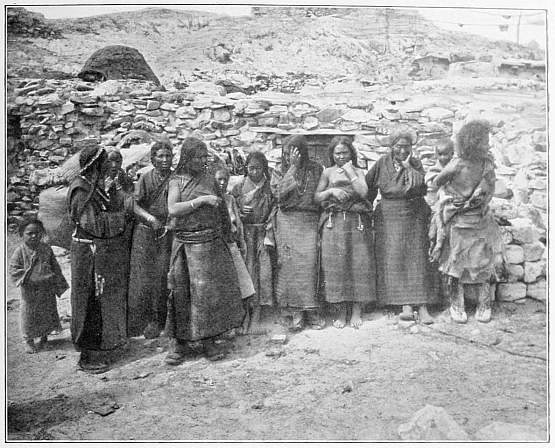
238. Women in the Village of Namla.
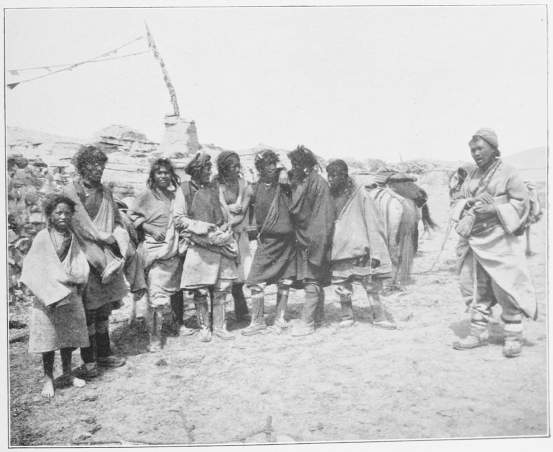
239. Inhabitants of the Village of Namla.

CHAPTER XLII
IN SEARCH OF THE SOURCE OF THE BRAHMAPUTRA
Now we were already far to the west; the force of circumstances had forced us to leave behind us step by step ever larger areas of unknown country to the north. I was vexed, but I would, at any rate, endeavour to do all that was possible in my hampered condition. At Shamsang, Ryder’s Lahtsang, we were at the place where the actual source streams of the Brahmaputra converged from various directions. I had long determined to push on to the unknown source, unless the Tibetans placed unsurmountable obstacles in my way.
The learned and clear-sighted Colonel Montgomerie had sent Nain Sing in the year 1865 up the valley of the upper Brahmaputra (Illust. 380). From our Shamsang the Pundit crossed the Marium-la, and said in his report that the sources of the river were certainly in the huge chain seen in the south, and were fed by its glaciers. He did not, however, go to look for the actual sources, but continued his journey westwards.
The next year, 1866, Thomas Webber made an excursion into Tibetan territory, and his route lay a little to the south of Nain Sing’s. On his sketch-map it may be seen that he crossed some of the source streams of the Tsangpo, but of the tract in which the sources are situated he gives no further indication than “Snowy ranges unexplored.” And when he says in his text that here are the sources of the great Brahmaputra, which have their origin in the Gurla glaciers, the confusion is hopeless; for the sources of the river lie 60 miles from Gurla, a mountain which has nothing whatever to do with the Brahmaputra.
The political expedition which, under the command of Rawling in the close of the year 1904, had Gartok for its destination, and the chief result of which was the admirable map of the upper Brahmaputra valley surveyed by Ryder and his assistants (Map 7), travelled from Shamsang over the Marium-la and north of the Gunchu-tso to Manasarowar. It was therefore of the greatest importance to me to travel to the south of their route through country they had not touched on. They travelled by the same road as Nain Sing, and left the source of the river at a distance of 40 miles to the south. From Ryder’s report it might be supposed that he considered the Marium-la to be the cradle of the Brahmaputra; but in a letter I have recently received from him, he states that such is not the case, but that he always recognized that the actual source must lie among the mountains in the south-west, which he has set down on his map from bearings taken of their peaks. Ryder also remarks in his report that the principal headwaters come from there.
Instead of entering into a diffuse discussion of the problem, I introduce in this book small sketches of the maps of my three predecessors, Nain Sing, Webber, and Ryder. No other traveller had ever been in this region, and I would on no account miss the opportunity of penetrating to the actual source of the Brahmaputra and fixing its position definitely.
How was this to be done? At Shamsang the source streams meet, and below this point the united river bears the name Martsang-tsangpo. First of all, I must, of course, gauge the quantities of water in the source streams, and, if they were nearly equal, we must be content to say that the Brahmaputra has several sources.
With ten men, the boat, and the necessary measuring apparatus, I betook myself first, on July 8, to the point on the southern side of the valley where two streams run together, the Kubi-tsangpo from the south-west and the Chema-yundung from the west. A short day’s march farther west the Chema-yundung receives the Marium-chu, which comes from the Marium-la. First the united stream was gauged, and found to discharge 1554 cubic feet of water per second, and immediately after the Chema-yundung, which discharged almost 353 cubic feet. Subtracting this from the volume of the united river, we get 1201 cubic feet as the discharge of the Kubi-tsangpo. This river is then three and a half times as large as the Chema, and it should be remembered that the Chema also receives the water of the Marium-chu, so that its 353 cubic feet represent the united volumes of two tributaries.
When we encamped in the evening with the main caravan in the Umbo district (15,427 feet), where the Chema-yundung and the Marium-chu unite, the rivers were very considerably swollen, and the water, which had been clear in the morning, had become turbid. Therefore only the two measurements taken at the same time were directly comparable, and I will pass over all the subsequent measurements. To arrive at the source we had only to know that the Kubi-tsangpo is far larger than the two others, so we had to follow its course up into the mountains, which none of my predecessors had done. The Tibetans also said that the Kubi was the upper course of the Martsang-tsangpo.
On July 9 we parted from Guffaru and the main caravan, which was to keep to the great high-road and cross the Marium-la to Tokchen, while Robert and I with three Ladakis and three armed Tibetans followed the Kubi-tsangpo up to its source. Our way ran west-south-west. Where we crossed the Chema-yundung, a good distance above the last delta arms of the Marium-chu, the river carried little more than 140 cubic feet of water, and therefore the Kubi-tsangpo, flowing to the south-east of it, is here fully eight times as large. At the ford our Tibetans drove a peg with a white rag into the edge of the bank, and when I asked why, they answered: “That the river may not become tired of carrying its water down the valleys.”
At Tok-jonsung, where we bivouacked among some black tents, the Chema looked very large, but its water ran very slowly. The nomads of the district go up to the Chang-tang in winter. Here also we heard, as on many former occasions, that smallpox was raging frightfully in Purang, and that all the roads leading thither were closed. No country lies so high that the angel of death cannot reach it.
In the night the thermometer fell to 15.4°, but we were at a height of 15,991 feet. The snowy mountains in front of us to the south-west became more distinct. The Chema river meandered with a slow fall, and we left it on the right before we came to our camp in Sheryak.
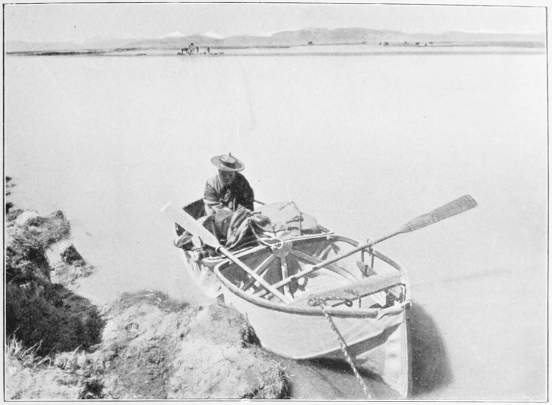
240. Lama in my Boat.
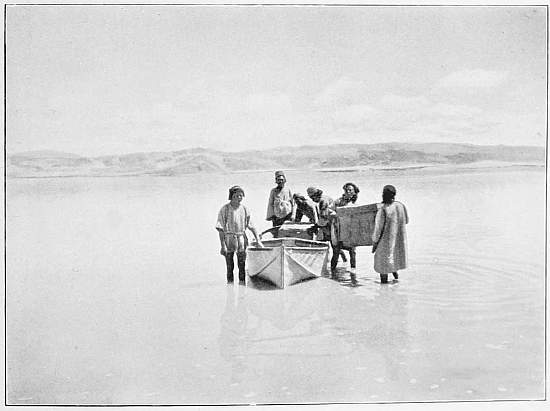
241. Loading the Boat with Boxes on crossing the Brahmaputra.
We ride on July 11 on to the south-west in a strong wind, passing already porous, melting snowdrifts. Solid rock is not to be seen, but all the detritus consists of granite and green schist. We follow a clearly marked nomad path, leading up to the small pass Tso-niti-kargang on the ridge which forms a watershed between the Chema-yundung and the Kubi-tsangpo. The large valley of the latter is below us to the south. The water of the Kubi-tsangpo is very muddy, but on the right bank is a perfectly clear moraine lake. From the south-east the affluent Lung-yung flows out of its deeply cut valley. The view is grand on all sides. From north-west to north-east extends a confused sea of mountains, the crests and ramifications of the Trans-Himalaya, intersected by the northern tributaries of the upper Tsangpo. To the south we have a panorama magnificent and overpowering in its fascinating wildness and whiteness, an irregular chain of huge peaks, sharp, black, and fissured, sometimes pointed like pyramids, sometimes broad and rounded, and behind them we see firn-fields from which the snow slides down to form glaciers among the dark rocks. Prominent in the south is the elevation Ngomo-dingding, and from its glaciers the Kubi-tsangpo derives a considerable part of its water. To the west-south-west lies the Dongdong, another mass with glaciers equally extensive, and to the right of it are heights called Chema-yundung-pu, from which the river of the same name takes its rise, and flows down circuitously to the confluence at Shamsang. To the south-east the position of the Nangsa-la is pointed out to me beyond the nearest mountains, where the river Gyang-chu, which we came across a few days before, has its source.
We go down among moraines, granite detritus, and boulders. Here three small clear moraine pools, called Tso-niti, lie at different heights. The ground becomes more level, and we pass a mani, a rivulet trickling among the rubbish, and a small pond, before we reach camp 200 in Lhayak, on the bank of the Kubi-tsangpo, where the pasturage is excellent and we find numerous traces of nomad camps. In several places we come across large sheets of fine thin birch bark, which have been detached by storms and carried by the wind over the mountains from the south.
Our three musketeers told us that all the nomads now sojourning in the Shamsang district would come up here in a few weeks to stay a month and a half, till the snow drove them away again. In winter the snow lies 5 feet deep, and many men and animals perish in the snowdrifts, when the herds go too high up the mountains and are surprised by early heavy falls of snow. The autumn before, I was told, 23 yaks were grazing up at the foot of Ngomo-dingding when it began to snow furiously. Several herdsmen hurried up to drive the animals down to lower ground, but the snow was heaped up in such large quantities that they had to turn back lest they should perish themselves. In the spring they went up, and found the skeletons and hides of the unfortunate animals. The Shamsang Gova had lately lost some horses in the same way. Even the wild asses cannot escape from the spring snow. They cannot run when the snow is deep, and after trying in vain to reach bare ground, they die of starvation and are frozen in the snowdrifts. Our three guides, who themselves pass the summer up here, assured me that the wild asses are frozen in an upright position, and often stand on all fours when the summer sun has thawed the snow. They had seen dead wild asses standing in herds as though they were alive.
The snow, which falls in winter on the source region of the Brahmaputra, melts in spring, and together with the river ice produces a flood of far larger volume, it is said, than the summer flood produced by rain. This is probably true of the uppermost course of the Tsangpo, but lower down the rain-flood is certainly the greater. In general, the variations in the water-level are more marked in the higher lands, and the further the water flows downstream the more the fluctuations tend to disappear.
“Is not our country hard and terrible to live in? Is not the Bombo Chimbo’s country (India) better?” asked my Tibetans.
“I cannot say that; in India there are tigers, snakes, poisonous insects, heat, fever, and plague to contend with, which are not met with up here in the fresh air.”
“Yes, but that is better than the continual wind, the sharp cold, and the fruitless waiting for rain. This year we have only had a couple of light showers, and we shall lose our herds if more rain does not come.”
“Well, the summer in Tibet is very pleasant when it rains, while in India it is suffocating; on the other hand, the winter in Tibet is severe and cruel, but comfortable in India.”
“Tell us, Bombo Chimbo, is it you, with your glass and measuring instruments, that is keeping back the rain this year? At this season it usually rains heavily, but you perhaps prefer clear weather, to be able to see the country and that the roads may not be soft.”
“No, I long for rain as much as you, for my animals are getting thin, and cannot eat their fill of this poor grass, which has stood here since last summer. Only the gods can control the weather, and the sons of men must take the rain and sunshine as they are sent to them from above.”
They looked at one another doubtfully. It was not the first time that they had ascribed to me powers as great as those of their own gods, and it would have been difficult to have convinced them of their error.
At midnight the men heard a one-year-old child crying and calling for help on the bank of the Kubi-tsangpo. They woke one another in astonishment, and Rabsang and two Tibetans went off with a gun, thinking that it was a ghost. When they came near they heard the child weeping quite distinctly, and our heroes were so frightened that they thought it safest to make all haste back again. When I asked them how they knew that it was a year-old child, they answered, that from the sound it could not have been younger or older. When I suggested that it might have been a wolf cub, as there were no human beings in the neighbourhood, they declared that it must have been an uneasy spirit wandering about the bank.
There must have been something supernatural about, for I dreamed in the night that all the fragments of birch bark which we had seen on our day’s ride were letters of invitation from the Maharaja of Nepal, that I had accepted the invitation, and was lying half asleep on a soft carpet of grass and listening to the rustle of the warm wind among the cedars of the Himalayas. The dream was so vivid that I could not think all day long of anything else but the warm beautiful land behind the mountains.
Even in camp No. 200 I perceived fairly clearly how the land lay, but we were not yet at the actual source, and therefore we continued our march south-westwards on July 12. The foot of the snowy mountains seemed quite near. The river is broad, and divided by islands of mud into several arms. On the left side of the valley, where we march, are a couple of walls of green and black schist, but elsewhere old moraines extend on all sides. We cross a stream flowing from the country below Dongdong to join the Kubi-tsangpo. The Tsechung-tso is a small moraine lake. The valley bottom rises slowly, and consists of loose material sparsely covered with grass. Occasionally a small erratic block of grey granite is seen. Rags, dung, and fragments of bone lie on the summer camping-grounds. At length the river becomes as broad as a small lake, enclosed in morainic rubbish and driftsand.
We camped at the stone wall of Shapka, one of the headquarters of the nomads. Here, on the right bank of the Kubi-tsangpo, stands a dark purple ridge of medium height with patches of snow, which melt in the course of the summer. The land at the foot of this colossal mountain is remarkably flat, and instead of a cone of detritus there is a stream expanded into a lake. The water from the melting snow has washed away all solid matter.
As we came to camp No. 201, at a height of 15,883 feet, the peaks disappeared in clouds, but just before sunset the sky cleared and the last clouds floated away like light white steam over the glaciers of Ngomo-dingding, which clearly displayed their grand structure, with high lateral moraines and concentric rings of grey lumpy terminal moraines. The surface, except where here and there blue crevasses yawned in the ice, was white with snow and the porous melting crust.
When the sun had set, nine peaks in a line from south-east to south-west stood out with remarkable sharpness. Raven-black pinnacles, cliffs and ridges rise out of the white snowfields, and the glaciers emerge from colossal portals. A whole village of tents rising to heaven! The source of the Brahmaputra could not be embellished with a grander and more magnificent background. Holy and thrice holy are these mountains, which from their cold lap give birth and sustenance to the river celebrated from time immemorial in legend and song, the river of Tibet and Assam, the river par excellence, the son of Brahma. One generation after another of black Tibetans has in the course of thousands of years listened to its roar between the two loftiest mountain systems of the world, the Himalaya and the Trans-Himalaya, and one generation after another of the various tribes of Assam has watered its fields with its life-giving floods and drunk of its blessed water. But where the source lay no one knew. Three expeditions had determined its position approximately, but none had been there. No geography had been able to tell us anything of the country round the source of the Brahmaputra. Only a small number of nomads repair thither yearly to spend a couple of short summer months. Here it is, here in the front of three glacier tongues, that the river so revered by the Hindu tribes begins its course of some 1800 miles through the grandest elevations of the world, from which its turbid volumes of water roll first to the east, then southwards, cutting a wild valley through the Himalayas, and finally flowing south-westwards over the plains of Assam. The upper Brahmaputra, the Tsangpo, is truly the chief artery of Tibet, for within its drainage basin is concentrated the great mass of its population, while its lower course is surrounded by the most fruitful and populous provinces of Assam. The Brahmaputra is therefore one of the noblest rivers of the world, and few waterways have a more illustrious descent and a more varied and more glorious career, for nations have grown up on its banks and have lived there, and their history and culture have been intimately connected with it since the earliest times of human records.
Busied with such thoughts, I went out again in the evening to gaze at the cliffs of the nine peaks which showed like dim misty shadows, while the ice and snowfields below, of the same colour as the sky, were not perceptible in the night. Then a flash of lightning blazed up behind Kubi-gangri, as the whole massive is called, and the crest crowned with eternal snow stood suddenly out in sharp pitch-black contours. Singular, entrancing land, where spirit voices are heard in the night and the sky blazes up in bluish light. I listened for a long time to the brook Shapka-chu, gently trickling down its stony bed to the bank of the Kubi-tsangpo.
We had still some way to go before we came to the actual source, and I could not conscientiously leave Kubi-gangri without determining the absolute height of the source by the boiling-point thermometer. Our Tibetans were exceedingly friendly, and seemed to take an interest in showing us this point, of which I had spoken so often during the past days and about which I had put so many questions. I was really thankful for, and overjoyed at, this unexpected favourable opportunity of fixing the position of the source, though I knew that my excursion to Kubi-gangri could only be a very cursory and defective reconnaissance. A thorough exploration of this neighbourhood would require several years, for the summer up here is short and the time for work is over in two months. But though I succeeded in learning only the chief outlines of the physical geography, I can count this excursion as one of the most important events of my last journey in Tibet. Accordingly, we decided to ride up to the source next day, July 13. Only Rabsang, Robert, and a Tibetan were to accompany me. The rest were to wait for our return under the command of Tsering.
CHAPTER XLIII
THE SOURCE OF THE SACRED RIVER—A DEPARTURE
We started off in beautiful weather, not a cloud hanging over the summits of Kubi-gangri. We followed the left bank of the Kubi-tsangpo, and rode along the foot of the huge moraines, which here rise fully 470 feet above the valley bottom, and which were formerly thrown up on the left or western side of the gigantic glacier, whence proceeded all the glacier tongues now remaining only in short lengths. The morainic character is plainly recognizable, sometimes in curved ridges and walls falling steeply on both sides, sometimes in rounded hillocks rising one above another. The surface is often covered with fine pebbles, grass, and lovely alpine flowers trying to make the most of the short summer. Here and there a landslip has taken place, and then it can be seen that the rock shows no trace of stratification. Occasionally we pass granite boulders, but they are small, the largest not more than 280 cubic feet. On the valley bottom are swamps with rank grass, and wild-geese are enjoying the summer in the ponds. We twice met with fresh spoor of small herds of wild yaks which had moved off to the right bank of the Kubi-tsangpo. The horses’ hoofs splashed in the swampy ground, seldom varied by small patches of boulder clay.
Numerous rivulets descend from the moraines. They are fed by the melting snowfields, and therefore, in contrast to the glacier brooks, are crystal clear. They have eroded deep valleys in the moraines, and one of them has deposited a great dejection cone at the mouth, over which the brook falls in ten channels, carrying 106 cubic feet of water. A very considerable proportion of the upper Brahmaputra’s water is derived from melted snow. Rivulets rushed and spurted all about in the rubbish, and all came from the snowfields, which struggled in vain against the heat of the spring sun.
Now we have right in front of us the immense glacier which descends from an extensive firn basin on the western foot of the Mukchung-simo massive. Between its terminal moraines and the older moraines we have skirted, a rather voluminous stream has eroded its valley. Its water is tolerably clear and green, so that it proceeds from snowfields. A little below the terminal moraine it unites with the numerous arms of the muddy glacier stream, of which the largest is the one which flows nearest to the foot of the Mukchung massive. Even 200 yards below the confluence the green water can be clearly distinguished from the brown, but afterwards the cold currents intermingle. Where the river, still divided into a number of meandering arms, turns past camp 201 to the north-east, it receives considerable additions from the glaciers lying further east, and thus the Kubi-tsangpo is formed.
Then we ride up, zigzagging among boulders and pebble beds, over ridges, banks, and erosion furrows, over brooks and treacherous bog, over grass and clumps of brushwood, to a commanding point of view on the top of the old moraine (16,453 feet). Before us is a chaos of huge, precipitous, fissured, black, bare rocks, summits, pyramids, columns, domes, and ridges, moraines, tongues of ice, snow and firn fields—a scene hard to beat for wild grandeur.
Here we made a halt, and I drew the panorama while the horses grazed on the slopes. The largest glacier, which comes from the Kubi-gangri proper, is entirely below us, and we have a bird’s-eye view of it. It is fed by three different firn-fields, and has two distinct medial moraines, which here and there rise into ridges where the ice has been thrust aside. The right lateral moraine is well defined, and is still partially covered with snow. The left is broad in its upper part but narrow below, where the green stream washes its base. Up above, a glacier from the west runs into the main glacier, and where the two join the side glacier is thrown up into a mighty wall, which merges into the left lateral moraine of the other. All the bottom of the glacier front is buried in rubbish, and the ice peeps out only here and there. Here are several small sheets of water, some of an intensely blue colour, others brown, with finely pulverized matter, showing that they are connected with the water of the ground moraine. Two of these small pools have vertical sides of blue ice like entrances to marvellous fairy grottos. A series of marginal crevasses are still partly covered with snow. The terminal moraine is a chaos of mounds, pebbles, and boulders, with patches of snow on the shady side. In a hollow between these hillocks flows the middle glacier stream, after passing two pools. The terminal moraine does not increase in size, for its material is slowly disintegrated and washed away by the stream, which winds in several arms over the even bed of the valley bottom just below in the most capricious curves.
An excursion over the surface of the glacier would not be difficult when one was once up on it. There are many dangerous crevasses concealed under the snow which may be avoided by keeping to the rubbish heaps of the medial moraines. The mass of the Kubi-gangri, which from our point of view lies farthest to the right, to the west-north-west, is called Gave-ting; from it descends the great side glacier.
The front of the main glacier, where the largest of all the glacier streams of the Kubi-gangri rises, is the actual source of the Brahmaputra. The other streams which enter it south-east of camp 201 are smaller and shorter. We could not get to them, for the horses sank too deep in the sand and mud of the main stream.
On our return we made a halt at the place where the principal branch of the Kubi-tsangpo comes out from under the ice, and I found that the source of the Brahmaputra lies at an altitude of 15,958 feet above sea-level. I must leave details for the scientific report of this journey, which will be published in due time.
On July 14 it seemed very hot in my tent, for even at seven o’clock in the morning the temperature was 45.1°; in the night there had been nearly 14½ degrees of frost. The sky was perfectly clear, and therefore I could not refrain from seeking another point of view to investigate the beautiful glaciers of the Kubi-gangri.
After arranging with Tsering that he should meet us in the valley of the Dongdong river, we rode up the banks and ridges of the old moraine, through its hollows and over its terraces of barren soil, which was now soft and treacherous from the melting of the snow, past pools of clear, green water, and to the highest point of its ridge, where there was nothing to hide the view.
I first took nine photographs, forming a consecutive series. Then a cloak was thrown over the stand to make a shelter against the strong wind, and in this sentry-box I sat for nearly four hours drawing a panorama which embraced the whole horizon. Meanwhile my companions lay down and snored, and I was glad to sit alone face to face with these royal mountain giants. The whole architecture is fantastically wild, and the only law which is strictly observed is that each glacier is confined between two huge black crests of rock.

242. Panorama of Kubi-gangri and the Langta-chen Glacier, with the Source of the Brahmaputra (from a Height of 16,453 feet, July 13, 1907). Sketch by the Author.
In order to give the reader a notion of the scene I here reproduce a part of the panorama embracing the Kubi-gangri (Illust. 242). To the south, 27° E., is a tetrahedral peak, which our guide called Ngoma-dingding. To the south, 11° E., rises another summit, of almost precisely the same form, which is called Absi. On the east of it lies the Ngoma-dingding glacier, and on the west the Absi glacier. West of this stands the lumpy Mukchung-simo group, with its culminating point lying south, 24° W. The northern side resembles a stable with straight short stalls, each containing a small hanging glacier. To the south-west rise two sharp pinnacles, and in the south, 57° W., a couple of dome-shaped summits consisting only of ice and snow; they belong to the Langta-chen massive, and their firns feed to a great extent the glacier in the front of which the Brahmaputra takes its rise. So the glacier may be called the Langta-chen. To the south, 70° W., 88° W., and north, 83° W., rise the summits of the Gave-ting group. To the north, 55° W., three peaks of the Dongdong appear, from which one of the sources of the Brahmaputra takes its rise, quite insignificant compared to the Kubi-tsangpo.
Towards the north-east the sharply defined valley of the Kubi-tsangpo runs downwards, and in the distance are seen the mountains of Chang-tang, pyramidal peaks of singular uniformity, and crowded together in great numbers, which form a finely jagged horizon, and in consequence of the great distance merge into the pink tint of the insignificant snowfields. The Trans-Himalaya seems on this side to widen out and become flatter than in the east.
It was late when we rode down the steep path to the camp on the Dongdong. And now we had to hurry westwards and make as many discoveries and collect as much information as possible on forbidden paths, in spite of the Mandarins and the Devashung.
On July 15 we left our former route to the right and directed our steps northwards over intricate moraines, seeing the snowy peaks of Dongdong and Chema-yundung still more clearly from the pass Kargan-la. On the 16th the sky was overcast, a couple of hail showers fell, and the hills around us changed to white. We rode north-westwards past two small lakes, and again fell in with solid rock—green and black schist. From the Tugri-la we had a fine view over a world of mountains, the names of which I have no time to record. We crossed another saddle, Sen-kamba-la, to reach the broad open valley of the Chema-yundung river, which descends from a very extensive glacier in the south belonging to the Chema-yundung-pu massive. Here were several nomad tents, and seven tents inhabited by pilgrims from Bongba stood on a rise. They were on their way with kith and kin to Kang-rinpoche to make the pilgrimage round the holy mountain. Most of the pilgrims from the far east take this southern route and return over the Marium-la.
July 17. It was very hot in the saddle with a temperature of 50° and quite calm air. The brown puppy was very tired of travelling, and drops fell from her hanging tongue, but she could not leave the antelopes and hares in peace. She darted after them full speed, but never caught them, and came back to me disappointed, but began again the useless pursuit. The Ronggak-chu is an affluent of the Chema, and comes from the north-west. We left the little double lake Kuru-chok in the south. To the west-south-west is the place where the Chema-yundung receives the Angsi-chu, the most westerly of all the headwaters of the Brahmaputra.
In the valley of the Tynchung we encamped beside some accommodating nomads, who quickly procured me fresh yaks, for the three musketeers turned back here to Shamsang, after doing their work well. The whole excursion to the sources of the Brahmaputra had cost 110 rupees, and it was well worth more. The natives said that ten robbers had recently made the neighbourhood unsafe, but immediately it was reported that a European caravan was approaching Tynchung, they had entirely disappeared, and therefore we were regarded as deliverers, and the people could not do too much for us. A Hindu merchant from Almora was camping here, buying sheep’s wool and salt from the nomads, and selling them frieze rugs and textiles from Agra and Amritsar.
Next day we crossed the Marnyak-la (17,395 feet) and had the Angsi-chu immediately below us, and on the 19th we left the river behind and followed its small tributary, the Loang-gonga, up to its source at the very low pass Tamlung or Tag-la, which is nothing more than a rise in an open longitudinal valley. But this pass is exceedingly important, for it is the watershed between the Brahmaputra and Manasarowar. Its height is 17,382 feet. To the south is spread out a succession of snowy peaks, and to the west-south-west is seen Gurla Mandatta or Memo-nani, a majestic and imposing group which belongs to the same Himalayan range as Kubi-gangri. The pass is situated among old moraines, where is the little insignificant lake Tamlung-tso, from which the Loang-gonga flows out. At some distance to the south is seen the low watershed between the Angsi-chu and the Gang-lung, a stream that comes from a massive of the same name, and, as the Tage-tsangpo, falls into Manasarowar. The very latest maps of western Tibet give a very incorrect representation of this country, which has never been visited by a European before. Instead of a clearly marked meridional range we found an open, hilly, longitudinal valley with the watershed running among its moraines. Here we took leave of the Brahmaputra, after passing half a year in its basin since crossing the Sela-la. We encamped at a place where the Gang-lung river breaks through a rampart of moraines, forming foaming cascades.
During the following day’s journey it flows through granitic moraines, drift sand, and morasses, and becomes a considerable stream, receiving numerous affluents from the south. A caravan of 50 yaks, and eight men from Purang, armed with guns, and clad in blue with fur-lined cloaks, were on the way to the fair in Gyanima. In the district Tagramoche, where we bivouacked, were many nomads and beggars with staves and bundles on the way to the holy mountain. We also met six merchants from Ladak, who were carrying dried peaches for sale on 45 asses. They had left home a month and a half previously.
On July 21 we rode down the Tage-bup valley among savage cliffs. On its bottom flows the Tage-tsangpo, changing its colour from light green over sandy ground to bluish-purple over dark detritus. Langchen-kamba is a small side-valley on the right, from which robbers are wont to sally forth against defenceless travellers. Just below the valley a spring bubbles forth with crystal-clear water at a temperature of 38°. It is considered holy, and is marked by a pole bedecked with rags and streamers like a scare-crow. This spring is also called Langchen-kamba.
A little farther down the spring Chakko stands on a steep slope on the right bank, and its water (40.3°) is collected in a round pit 3 feet deep. A wall is erected about it, covered with flat stones, on which figures of Buddha and holy texts are carved. Leaves from the holy scriptures are thrust between the stones of the wall, and streamers and rags fly from a pole. Through the water, clear as a mirror, could be seen blue and red beads, two inferior turquoises, some shells, and other trash, thrown in as offerings by pious pilgrims. The water is supposed to have miraculous powers. Murmuring prayers, our guide filled a wooden bowl with water and poured it over the head and mane of his horse to protect it from wolves. With the same object he tied a rag from the pole on to his horse’s forelock. He drank himself a good draught to render him invulnerable to the bullets of robbers. If a sheep or other animal is ill it is only necessary to sprinkle it with the holy water to make it well again. When a traveller or pilgrim stands at the well and pours water with both hands over his head, it guards him against falling into the hands of footpads, and from other misfortunes. And if he sits and meditates, drinks, and washes his head, hands, and legs, and has sufficient faith, then he finds gold coins and precious stones at the bottom of the well. The sick man who bathes his whole body in the miraculous water becomes strong again. It is a Lourdes in miniature. While my men were engaged in their ablutions I sat at the edge of the well and listened to the mystical music of the fluttering prayer-streamers, and found this fascinating Tibet more enigmatical at every step.
Then we rode over the Tage-tsangpo, where its valley opens into the flat basin of Manasarowar—a new chapter in the chronicles of our journey. Again Gurla Mandatta showed itself in all its glory, and in the north-west Kang-rinpoche or Kailas, the holy mountain, like a great chhorten on a lama’s grave, rose above the jagged ridge which forms the horizon in that direction. On seeing it all our men suddenly jumped out of their saddles and threw themselves down with their foreheads on the ground. Only Rabsang, a confirmed heathen, remained seated on his horse, and was afterwards well scolded by Tsering.
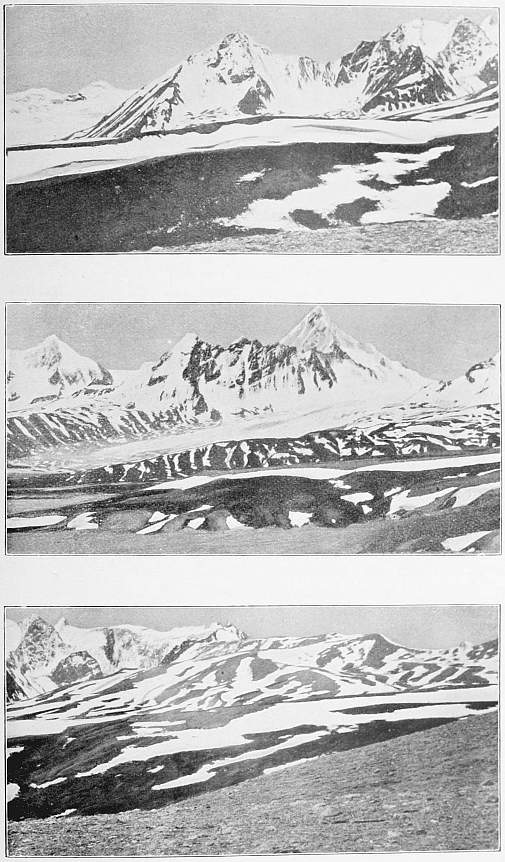
243, 244, 245. The Mountains at the Source of the Brahmaputra.
We are now out on open hilly ground, and see a glimpse of the holy lake Tso-mavang or Manasarowar. We encamp by a small lake called Tso-nyak, whither come Islam Ahun and Shukkur Ali, sent by Guffaru, who is become uneasy at our long absence. We send them back again to Tokchen with orders to Guffaru to proceed to the monastery Serolung-gompa on the holy lake, where we will meet him.
On July 22 we rode over the Tage-tsangpo, which here carried 291 cubic feet of water, where Rabsang got a thorough wetting in consequence of his horse coming a cropper among the boulders in the bed. Tsering said that he deserved a dip because he had not saluted Kang-rinpoche. Camp 210 was set up in the broad valley Namarding, where a clear brook flows to the Tage-tsangpo. The wind blew strongly, and the Tibetans said that the waves on Tso-mavang were as high and dark as nomad tents. Should we venture in our little canvas boat on the lake, exposed to all the winds? It must be very rough before I consented to give up the trip, for the lake had long been the subject of my dreams.
Next morning Tundup Sonam appeared with the news that the Gova of Tokchen would not let his yaks on hire for the journey to Serolung. I had therefore to ride to Tokchen by a road over the pass Karbu-la, and down the river Samo-tsangpo; it is full of fish, but we were asked not to disturb them, for they came up from the holy lake. We were all together again in Tokchen, and I found the Gova a decent fellow, who welcomed me with a large kadakh and a bowl of tsamba.
Now an hour of parting was come, for I sent from Tokchen thirteen of my men home to Ladak. I had several reasons for this. I did not need so many men in western Tibet; twelve were enough, and a small, light caravan accomplishes more and does not excite so much notice. The men were to travel along the great highway to Gartok under the experienced leadership of Guffaru, and there deposit all the baggage I could spare with the British agent, Thakur Jai Chand. I also sent to him a letter packet of three hundred pages to my parents, beside other correspondence. Of particular importance was a letter to Colonel Dunlop Smith, in which I asked for 6000 rupees, provisions, books, revolvers and ammunition, and things suitable for presents, such as gold and silver watches, as well as all the letters which must have accumulated at the Viceregal Lodge.
On the first evening, when I called together all the twenty-five men and told them my decision to send away thirteen, and asked which of them wished to go home, no one answered. They declared that they would follow me until I was tired of Tibet. Then I picked out thirteen and retained the best twelve men. Among these was Tashi, who with Tundup Sonam had accomplished the adventurous journey to Shigatse. But when he saw that I was in earnest about the dividing of the caravan, he begged me to let him go home, so he was exchanged for another man.
We stayed here two days to put everything in order. After the baggage was re-arranged I had only four boxes left, and the rest were to be carried away by Guffaru. Robert sat in my tent like a money-changer and piled up sovereigns and rupees in small heaps, the pay, gratuities, and travelling expenses of the men who were going home. Our treasury was relieved of 2118 rupees all at once. The important correspondence was enclosed in a case, which Guffaru carried in his belt. The men with him were allowed to keep two of our five guns. Late in the evening Guffaru came to my tent to receive his last instructions. Honest old Guffaru, he had in the autumn of his life performed wonders in the winter in Chang-tang, always composed and contented, always doing his duty in the smallest particular. Now he sat, with the tears falling on to his white beard, and thanked me for all I had done for him during the past year. I bade him weep no more, but rejoice that the hard time was over for him, and that he could return safe and sound to his people with 400 rupees in his purse. When we left Leh he was as poor as a church mouse, and now he was a rich man for his position, and he had not needed his shroud. I told him that I should miss him very much, but that I could not entrust the valuable baggage and important letters to any other hands but his.
When I came out of my tent early on the morning of the 26th the 13 yaks were laden and the thirteen men were ready to march off with their Tibetan guides. I thanked them for their faithfulness and patience during the time when they were exposed to so many dangers in my service, begged them to remember that they were responsible for the caravan on the way home, and told them that they must obey Guffaru, and that their character would suffer if they did not bear with one another on the way. If they were as conscientious on this journey as in my service, it would be well for them in the future, and perhaps our paths might cross again.
Then old Guffaru came forward, and fell on his knees before me, weeping loudly, and all the others in turn followed his example amid sobs and tears; I clapped them all on the shoulder and hoped that this bitter hour would soon be over. Then they took leave of their comrades, who, deeply moved, sent greetings to their parents, wives, and children in Ladak, and they marched off on foot, as they had travelled so many hundred miles, silent, drooping, and downcast, and soon disappeared behind the hills.
CHAPTER XLIV
A NIGHT ON MANASAROWAR
After Guffaru had set out with his men, the small caravan was organized which was to accompany me. It was led by Tsering, and the other men left were Bulu, Tundup Sonam, Rabsang, Rehim Ali, Shukkur Ali, Namgyal, Adul, Ishe, Lama, Galsang, and Rub Das. The Gova of Tokchen was given a Kashmir shawl, a turban, and some rupees for the services he had rendered us, and all the other Tibetans who had been friendly and helpful received presents. The dividing of the caravan had also the advantage that the Tibetans supposed that we were all making for the same destination by different routes, and that I should join Guffaru in Gartok and continue my journey to Ladak, as directed on the passport.
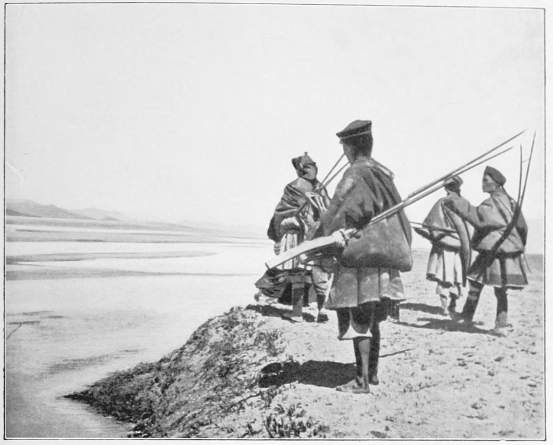
246. Tibetans on the Bank of the Soma-tsangpo.
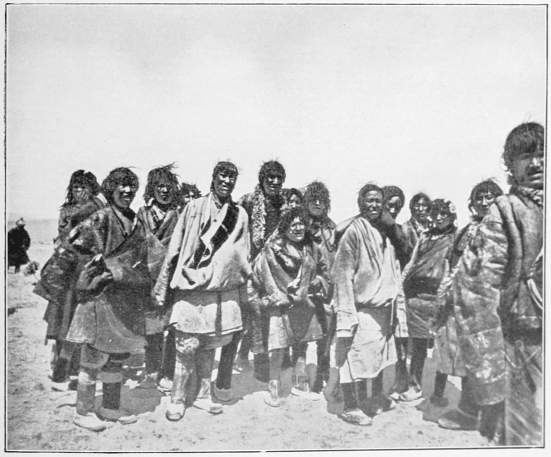
247. Group of Natives of Langmar.
With Robert, Rabsang, and two Tibetans I now ride down the Tokchen valley and up over the hills to the south-west. To the right of our route the turquoise-blue surface of the holy lake is displayed; how beautiful, how fascinating is the scene! One seems to breathe more freely and easily, one feels a pleasure in life, one longs to voyage over the blue depths and the sacred waves. For Manasarowar is the holiest and most famous of all the lakes of the world, the goal of the pilgrimage of innumerable pious Hindus, a lake celebrated in the most ancient religious hymns and songs, and in its clear waters the ashes of Hindus find a grave as desirable and honoured as in the turbid waters of the Ganges. During my stay in India I received letters from Hindus in which they asked me to explore the revered lake and the holy mountain Kailas, which lifts its summit in the north under a cupola of eternal snow, where Siva, one of the Indian Trinity, dwells in her paradise among a host of other deities; and they told me that if I could give them an exact description of the lake and river, they would remember me in their prayers and their gods would bless me. But that was not why I longed to be there. The lake had never been sounded—I would sink my lead to the bottom and make a map of its bed; I would follow its periphery and calculate how much water pours into its bosom on a summer day; I would investigate its hydrographic relation to the adjacent lake on the west, the Rakas-tal, a problem which various travellers in this region, from Moorcroft and Strachey to Ryder and Rawling, have explained differently; I would learn something of the monasteries and the life of Hindu and Tibetan pilgrims, for the lake is sacred in the eyes of Lamaists also, who call it Tso-mavang or Tso-rinpoche, the “Holy Lake.” How can Manasarowar and Kailas be the objects of divine honours from two religions so different as Hinduism and Lamaism unless it is that their overpowering beauty has appealed to and deeply impressed the human mind, and that they seemed to belong rather to heaven than to earth? Even the first view from the hills on the shore caused us to burst into tears of joy at the wonderful, magnificent landscape and its surpassing beauty. The oval lake, somewhat narrower in the south than the north, and with a diameter of about 15½ miles, lies like an enormous turquoise embedded between two of the finest and most famous mountain giants of the world, the Kailas in the north and Gurla Mandatta in the south, and between huge ranges, above which the two mountains uplift their crowns of bright white eternal snow. Yes, already I felt the strong fascination which held me fettered to the banks of Manasarowar, and I knew that I would not willingly leave the lake before I had listened, until I was weary, to the song of its waves.
We sat an hour and enjoyed the incomparable beauty of the scene. A slight ripple ruffled the surface of the water, but in the middle the lake was as smooth as if oil had been poured on it. The Tibetans said that it was always smooth in the middle except when a storm raged. To the south-south-west and south-west are seen the two summits of Gurla Mandatta, the western very flat, and reminding me of the Mustag-ata in the eastern Pamir. The Tibetans called the mountain sometimes Namo, sometimes Memo-nani. South, 60° W., a row of snowy heights rise behind the Purang valley. To the west-north-west is seen the small pyramidal hill where Chiu-gompa stands on the bank of the water channel which once ran into Rakas-tal. To the north-west a couple of lagoons lie on the shore of Manasarowar, and behind them rise chains and ramifications belonging to the Trans-Himalaya, and among them Kailas or Kang-rinpoche, the “Holy Mountain,” called also Gangri or the “Ice Mountain,” dominates the horizon unless its summit is veiled in clouds. And lastly, to the north, 20° W., we see the double-peaked Pundi, not far from the shore, and in the north the two valleys Pachen and Pachung, with roads which lead over the watershed of the Trans-Himalaya to Chang-tang.
When I asked our guides what they thought of a boat trip across the lake, they answered unhesitatingly that it was impossible; mortals who ventured on the lake, which was the home of the gods, must perish. Also in the middle Tso-mavang was not level as on the shore, but formed a transparent dome, and up its round arch no boat could mount; and even if we succeeded in getting the boat up, it would shoot down the other side with such velocity that it must capsize, and we should perish in the waves because we had excited the wrath of the god of the lake.
We mounted again and rode south-south-west over the hills to Serolung, the golden valley, where the monastery Serolung-gompa is hidden in the hollow. There I stayed four hours, making sketches and notes. Serolung, which contains thirty monks, most of whom were away wandering among the villages, is one of the eight convents which are set like precious stones in the chain which the pilgrims stretch round the lake, in the hope of acquiring merit in a future form of existence, of being freed from the burden of sin and the tortures of purgatorial fires, nay, perhaps, of sitting at the feet of the gods and eating tsamba out of golden bowls.
Our camp No. 212 was pitched immediately south of the mouth of the Serolung valley at the water’s edge. The strip of ground on the bank is quite narrow, and on the hills rising to the east of it are visible six horizontal strand lines, the highest lying 162 feet above the present level of the lake, which is 15,098 feet above the sea.
On July 27 I had a good sleep, and spent the rest of the day in making preparations for the first line of soundings, which was to cross the lake in a direction south, 59° W., where a gap appeared in the hills framing the lake. We waited for good weather, but the wind blew violently and the surf beat and foamed against the shore. I therefore resolved to wait till night, for of late the nights had been calmer than the days. On a trial trip we had found a depth of 130 feet not far from the shore, so we made ready a sounding line 490 feet long. Perhaps even this would not be long enough, for a lake lying among such high mountains is sure to be deep. Shukkur Ali was to go with me, and he accepted his fate with his usual composure, but Rehim Ali, the other victim, was frightened; it was all very well in the day, he said, but in the dark gloomy night on such a great lake! We should certainly have the same trouble as on Lake Lighten, he thought.
When the sun set the wind increased in strength, and heavy clouds spread up from the south-west. At seven o’clock it was pitch dark all round, not a star shone out, not a trace was visible of the outline of the shore and of the snowy mountains, and the sea was buried in the shades of night. But an hour later the wind fell, the air became quite calm, but the waves beat in a monotonous rhythm on the bank. The smoke of the camp fires rose straight up into the air.
Then I gave orders to set out. The baggage was stowed and the mast stepped to be ready if we had a favourable wind. Provisions for two days were put in the boat. I wore a leathern vest, Kashmir boots, and an Indian helmet, and sat on a cushion and a folded fur coat on the lee side of the rudder, on the other side of which the sounding-line with its knots lay ready on the gunwale. The log, Lyth’s current meter, was attached to the boat to register the whole length of the course, and compass, watch, note-book, and map sheets all lay close beside me, lighted by a Chinese paper lantern, which could be covered with a towel when we did not want the light. I used the towel after every sounding to dry my hands. Rehim Ali took his seat forward, Shukkur Ali in the stern half of the boat, where we were cramped for room and had to take care that we did not get entangled in the sounding-line.
Tsering took a sceptical view of the whole adventure. He said that the lake was full of wonders, and at the best we should be driven back by mysterious powers when we had rowed a little way out. And a Tibetan agreed with him, saying that we should never reach the western shore though we rowed with all our might, for the lake god would hold our boat fast, and while we thought that it was advancing it would really remain on the same spot, and finally the angry god would draw it down to the bottom.
Robert had orders to wait at camp No. 212 for our return, and when we put off from the bank at nine o’clock all bade us farewell in as warm and gentle a tone as though they thought that they had seen the last of us. Their spirits were not raised by the lightning which flashed in the south and might portend a storm. The darkness, however, was not so intense, for the moon was coming up, though it was still covered by the hills rising behind our camp. But its light threw a weird gleam over the lake, and in the south Gurla Mandatta rose like a ghost enveloped in a sheet of moonshine, snowfields, and glaciers.
At my command, the boatmen took a firm grip of the oars and the boat glided out from the beach, where our men stood in a silent thoughtful group. Our fires were seen for a while, but soon disappeared, for they were burning almost on a level with the water. Robert told me afterwards that the little boat sailing out into the darkness was a curious sight; owing to the lantern and the reflexion of the light on the mast the boat was visible at first, but when it reached the moon-lighted part of the lake it appeared only as a small black spot, which soon vanished.
The great lake was dark and mysterious in the night, and unknown depths lurked beneath us. The contours of the hills on the shore were still visible behind us, but we had not gone far before they were swallowed up by higher mountains farther off, which gradually came into view. After twenty minutes’ rowing we stopped and let down the line, sounding 135 feet. The roar of the surf on the beach was the only sound in the silence of night, except the splash of the oars and the voices of the oarsmen singing in time with their strokes. At the next sounding the depth was 141 feet. If the bottom did not fall more rapidly our line would be long enough. Every hour I recorded the temperatures of the air and the water. Now the god of sleep paid us a visit; Shukkur Ali yawned at every ninth stroke, and every yawn was so long that it lasted three strokes.
The air is quite still. A long, smooth swell causes the boat to rock slightly. All is quiet, and I ask myself involuntarily if other beings are listening to the splash of the oars as well as ourselves. It is warm, with a temperature of 46.9° at eleven o’clock. The next two depths are 143 and 164 feet. My oarsmen follow the soundings with deep interest, and look forward to the point where the depth will begin to decrease. They think it awful and uncanny to glide over such great depths in the dark night. Again blue lightning flashes behind Gurla Mandatta, which stands forth in a pitch black outline, after appearing just before in a white robe of moon-lighted snowfields. A little later all the southern sky flames up like a sea of fire; the flashes quickly follow one after the other, and shoot up to the zenith, seeming to stay a moment behind the mountains, and it becomes light as day, but when the glow dies out the darkness is more intense, and the sublime, poetic solemnity of the night is enhanced. By the light of the flashes I can see the faces of the two men, who are startled and uneasy, and do not dare to disturb the awful stillness by their singing.
When I let down the line at the fifth point, the two men asked permission to light their water-pipes. The depth was 181 feet. A slight south-westerly breeze rippled the surface. The cry of a water-bird broke shrilly on the silence of the night, and made us feel less lonely. A slight hiss of the surf breaking on the south-eastern shore was audible. In the south the clouds gathered round the summit of Gurla Mandatta, the breeze fell. We glided slowly over the inky black water, and between the wave crests the path of moonlight wound in bright sinuosities; the depth increased slowly 183.4 feet, 189.3, 192 and 212.6. The temperature was still 45.9°, and I did not want my fur coat.
The queen of night, with diamonds in her dark hair, looks down upon the holy lake. The midnight hour is passed, and the early morning hours creep slowly on. We sound 203, 200, 184, 184, 180, and 190 feet, and it seems therefore as if we had passed the deepest depression. Leaning on the gunwale I enjoy the voyage to the full, for nothing I remember in my long wanderings in Asia can compare with the overpowering beauty of this nocturnal sail. I seem to hear the gentle but powerful beat of the great heart of Nature, its pulsation growing weaker in the arms of night, and gaining fresh vigour in the glow of the morning red. The scene, gradually changing as the hours go by, seems to belong not to earth but to the outermost boundary of unattainable space, as though it lay much nearer heaven, the misty fairyland of dreams and imagination, of hope and yearning, than to the earth with its mortals, its cares, its sins, and its vanity. The moon describes its arch in the sky, its restless reflexion quivering on the water, and broken by the wake of the boat.
The queen of night and her robe become paler. The dark sky passes into light blue, and the morn draws nigh from the east. There is a faint dawn over the eastern mountains, and soon their outlines stand out sharply, as though cut out on black paper. The clouds, but now floating white over the lake, assume a faint rosy hue, which gradually grows stronger, and is reflected on the smooth water, calling forth a garden of fresh roses. We row among floating rose-beds, there is an odour of morning and pure water in the air, it grows lighter, the landscape regains its colour, and the new day, July 28, begins its triumphal progress over the earth. Only an inspired pencil and magic colours could depict the scene that met my eyes when the whole country lay in shadow, and only the highest peaks of Gurla Mandatta caught the first gleam of the rising sun. In the growing light of dawn the mountain, with its snowfields and glaciers, had shown silvery white and cold; but now! In a moment the extreme points of the summit began to glow with purple like liquid gold. And the brilliant illumination crept slowly like a mantle down the flanks of the mountain, and the thin white morning clouds, which hovered over the lower slopes and formed a girdle round a well-defined zone, floating freely like Saturn’s ring, and like it throwing a shadow on the fields of eternal snow, these too assumed a tinge of gold and purple, such as no mortal can describe. The colours, at first as light and fleeting as those of a young maiden in her ball-dress, became more pronounced, light concentrated itself on the eastern mountains, and over their sharp outlines a sheaf of bright rays fell from the upper limb of the sun upon the lake. And now day has won the victory, and I try dreamily to decide which spectacle has made the greater impression on me, the quiet moonlight, or the sunrise with its warm, rosy gleam on the eternal snow.
Phenomena like these are fleeting guests on the earth; they come and go in the early morning hours, they are only seen once in a lifetime, they are like a greeting from a better world, a flash from the island of the phœnix. Thousands and thousands of pilgrims have wandered round the lake in the course of centuries, and have seen the dawn and sunset, but have never witnessed the display which we gazed upon from the middle of the holy lake on this memorable night. But soon the magical effects of light and colour, which have quickly followed one another and held me entranced, fade away. The country assumes its usual aspect, and is overshadowed by dense clouds. Kailas and Gurla Mandatta vanish entirely, and only a snowy crest far away to the north-west is still dyed a deep carmine, only yonder a sheaf of sunbeams penetrates through an opening in the clouds. In that direction the mirror of the lake is tinged blue, but to the south green. The wild-geese have waked up, and they are heard cackling on their joyous flights, and now and then a gull or tern screams. Bundles of seaweed float about. The sky is threatening, but the air is calm, and only gentle swells, smooth as polished metal, disturb the water, which looks like the clearest curação. The boat moves with weary slowness to its destination, for now, at six o’clock in the morning, my oarsmen are tired and sleepy and quite at an end of their strength. They sleep and row alternately. “Hem-mala-hém” calls out Shukkur Ali, accenting the last syllable, when he energetically grasps his oar, but he goes to sleep between, and the oar hovers in the air; his own voice wakes him up, he dips the oar in and goes to sleep again.
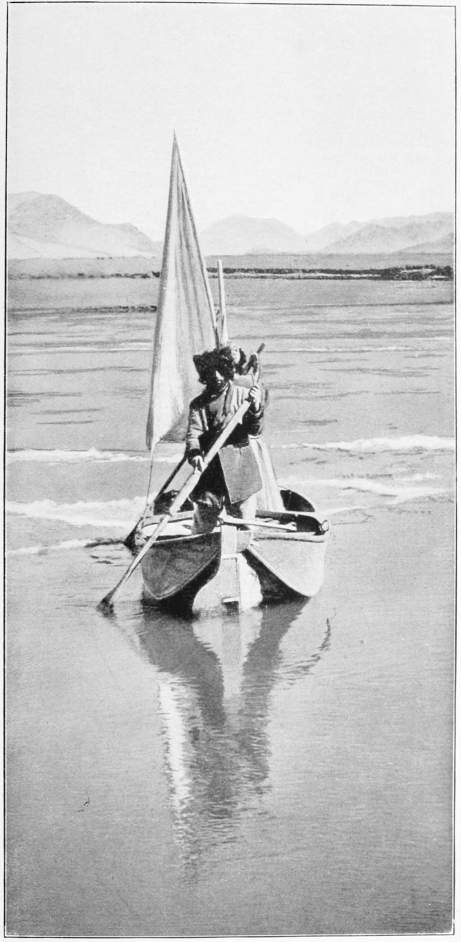
248. Robert in the Boat.
The hours pass by, but there is no sign that we are nearing our destination. We cannot decide which bank is nearest, and we seem to be in the centre of this boundless lake. In the midst of Gurla Mandatta is seen a huge deeply eroded ravine, its entrance standing out picturesquely below the dense mantle of clouds. For a moment, when all around lay buried in shadow, the interior was lighted up by the sun, and it presented a fantastic appearance, resembling a portal into a hall of the gigantic dome lighted up by innumerable candles. The valleys and erosion channels between the different spurs of the massive are sharply defined, and wind down to the lake among flat cones of detritus, the outer margins of which cause the variations in the depth of the bottom. This now increases again to 200, 203, 213, and 240 feet. At fourteen points, these included, the bottom temperature is observed. The sounding occupies a considerable time. The line must first be paid out to the 230 feet, and then be held still till the thermometer has assumed the bottom temperature, and then it must be drawn up again, the depth must be noted, the thermometer read, the temperature of the surface water and the air must be ascertained, and the log-reading taken.
Five furlongs to the north the smooth swell shows a curious fiery yellow colour, and I cannot make out the origin of this singular reflexion. The clouds gather in the south-west, and a breeze sweeps over the lake, producing waves which retard still more the progress of the boat. Rehim Ali cannot keep himself awake any longer, and Shukkur Ali is very comical in his overpowering sleepiness. The old man looks like a weather-beaten sea-dog in a south-wester—his Ladaki cap with its spreading flaps. He snoozes innocently with his oars up, and rows again and again in the air, still calling out his constant “Shu-ba-la-la.” He talks in his sleep. Rehim Ali wakes up and asks him what is the matter, and no one knows what it is all about. Towards seven o’clock the dustman pays me a visit, but is not admitted. Only for a moment I see red wild asses running over the water, hear harps playing sweetly in the air, and behold the great black head of a sea-serpent rise above the waves and then sink down again; green dolphins and small whales arch their backs among the waves—but no, I must keep awake, for a storm may come down upon us any moment. I give my boatmen a good douche with the hollow of my hand, wash my own hands and face, and order breakfast—a hard-boiled goose egg, a piece of bread, and a bowl of milk, and then I light my pipe and am as lively again as a lark. At the twentieth sounding-place, 259 feet deep, the other two follow my example.
At nine o’clock, when we have been exactly twelve hours on the water, we sound a depth of 268.4 feet, but the south-western shore seems to our eyes as far off as ever. Rehim Ali thinks it is awful to have so much water under the keel. The clouds on Gurla lift a little, and we see deeper into the recesses of the great valley the more we come opposite its mouth. The lower points of the snowfields come into sight below the clouds. West of them is seen a broad erosion channel, grey with detritus and dotted with dark brushwood. The water reflects the forms of the mountains like a mirror; it turns blue when the sky is clear, but green again as soon as the clouds gather. A shoal of fishes plays in the water and splashes on the surface.
And again the hours of the day pass by. We glide slowly forwards, now over calm rising swell, whispering gently as spirit voices, now over small pyramidal waves produced by the meeting of two systems of undulations from different directions. Four small squalls from different quarters threaten us, but we catch only a flip of their tails, which cannot stir up the waves to a dangerous height. The last, from the south-east, is the strongest, and then the sail is hoisted. But still the shore seems far distant; perhaps Tsering was right with his Lamaistic wisdom.
All details, however, become sharper and clearer. Gurla turns three mighty gables towards the lake, and between them huge fans of detritus and erosion channels come to view. The fans become flatter towards the shore, and extend under the water down to the greatest depths of the lake; on the north shore, where a wide plain lies, the lake bottom might be expected to sink more slowly. Gurla is a splendid background to the holy lake—no artist in the world could conceive anything more magnificent and interesting.
Then we sounded 253, 243, 253, 223, 190, 177, and 82 feet, and perceived at length that the shore was near, for yaks and sheep were visible on the hills. The sea was now fairly high, and we had to bale the boat twice, and my fur coat on the bottom was wet. The two tired and sleepy men laboured painfully at the oars. We talked of how pleasant it would be to land, kindle a fire, and take our tea and food, but the shore still retired before us, and the hours of the afternoon slipped past. Gurla seemed to rise in the south directly from the water, its level skirts and low slopes being much foreshortened. The monks of the monastery here do not depend for water on the brooks, but drink the holy water of the lake, which has in reality the taste of the purest, most wholesome, spring water. Its crystal purity and dark greenish-blue colour are as beautiful as the flavour, and to pilgrims from a distance the water of Manasarowar is preferable to sparkling champagne.
At last we were released from imprisonment in the boat. We saw the bottom through the clear water, and a few strokes of the oar brought the boat to a wall of clay and decaying weeds, which the winter ice had pushed up on the bank. Inside the wall lies a longish lagoon, with mud in which one sinks to the knee. The time was half-past one, so we had been 16½ hours on the lake. But when we had reached the shore we found it impossible to get on land. After I had thought over the matter, while the men looked about them, we rowed northwards, and after an hour and a half discovered a place where the boat could be drawn ashore. Then we had been eighteen hours on the water.
A herdsman was seen, but he made off quickly. Fuel was collected and a fire lighted. Tea was infused and mutton fried, and when the three of us had eaten our dinner a temporary tent was constructed of the oars, mast, and sail, in which I lay down to sleep towards seven o’clock, wrapped in my fur, and with the life-buoys for a pillow. I had toiled for thirty-one hours continuously, so I went to sleep at once, and knew nothing of the storm which raged all night, or of the twenty-five pilgrims who passed by at dawn on their circuit of the holy lake.
CHAPTER XLV
MORE LAKE VOYAGES
I was awakened at six o’clock, having felt no cold in the night, for the minimum temperature was 40°. The morning was fine, only too warm; the pilgrims had gone away; we ate our breakfast, pushed the boat into the water, and rowed about 90 yards from the shore towards the north-north-east and north-north-west, describing a slight bend to camp No. 214. On our left hand was a row of pebble mounds, gradually rising to the top of the promontory which separates Manasarowar from Rakas-tal.
Soon the monastery Gossul-gompa was seen on its pebble terrace, nearly 130 feet high, like a swallow’s nest hanging over the lake. A group of lamas stood silently watching the boat; they had never in their lives seen such a contrivance on the holy lake. When we drew near they vanished like rats into their holes, and only an old man remained sitting by a balustrade. I asked him the name of the monastery, and he said Gossul-gompa. The next point shut out the convent. The shore lagoons continue, though the margin below the hills is only 30 to 60 feet broad. The clay in which the lagoons are embedded is impermeable to water, but the lake has only to rise a couple of feet to find an outlet over the sandbank behind into the Rakas-tal, or Langak-tso, on the west. And when the channel at the north-west corner is silted up, as it is now, the Manasarowar has a subterranean outlet to the neighbouring lake, and its water consequently remains perfectly fresh.
I now intended to camp a little to the north at some suitable spot, and thence row the following day over the lake to our headquarters near Serolung-gompa. We took bearings of a cinnabar-red hill lying on the north side of a slightly indented bay of the western shore. A fresh southerly breeze was blowing, we hoisted the sail, and flew whizzing over the lake. The pilgrims watched our voyage with the greatest astonishment, and the monks of Gossul cautiously followed us on the hills, no doubt wondering how such sacrilege would end. The wild-geese swam with their young ones out into the lake, while other swimming birds took themselves off some 100 yards inland, perhaps taking the boat for a curious water-bird of unusual size.
We went ashore at the red promontory, and while fuel was being collected and the camp arranged, I reconnoitred the neighbourhood from the heights above the landing-place. On the inner side of the shallow bay I found a hollow with its bottom lower than the surface of the lake, and filled with salt water, and on the west side of this swamp lies the lowest dip in the isthmus separating the twin lakes. Up there runs the pilgrim road, worn down by hundreds of thousands of weary feet. Three armed horsemen rode along the way. They came up without dismounting, and evidently did not know what to make of me. They could easily have taken me prisoner now that I was separated from my men, but they did not think of it, and rode on. A furious storm swept over the lake, its surface was wildly agitated, and covered with white horses. The farther, eastern part was of a deep green colour, while on our western shore it was lighter. The water of the shore lagoons was dark purple from the reflexion of the dense clouds. Towards four o’clock the air became oppressively still, then the wind sprang up, and an equally violent north-west storm came down raging and roaring. The wild south-easterly waves were suppressed by it, and the undulations remained uncertain till the new wave system was established. There was rain in many places round the lake, but we felt only a few drops. About six o’clock the sky looked threatening, with pitch-dark clouds all around, and not a trace could be seen of the eastern shore; we seemed to stand on the coast of the ocean. Soon after the wind veered round to the east-south-east, and then the surf beat all the evening against our beach. How fortunate that the weather had not been like this the evening before!
We sat two hours by the fire and talked. Its flames flickered and darted in all directions, so that they singed Shukkur Ali’s goat’s beard. The weather was still so threatening that we made a shelter of the boat, in which I lay down early to sleep. Before dozing off I listened to the roar of the waves, and thought I heard all kinds of mysterious sounds in the night, but it was only the cry of water-birds and the howling of the wind among the hills.
The men had orders to call me before sunrise, for we must hasten if we wished to reach camp No. 212 before darkness set in. It was scarcely light when I came out of my shelter. The last provisions were consumed by the morning fire, and then we put off about half-past four in dull, disagreeable weather. The strong west wind carried us rapidly away from the shore—indeed, it was really too strong for our sail and mast, but it took us on and doubled our pace. We had been sheltered under the hills, but when we were a few minutes from the beach the lake became uncomfortably rough. But it was of little consequence, for we sailed with the waves and took in no water.
The men, too, were more alive than on the first nocturnal voyage. They had evidently made up their minds to reach their destination before night, and they rowed like galley-slaves with the whip hanging over them; they seemed to run a race with the west wind, and try to get away before the waves rose too madly. The water hissed and foamed round the boat, and bubbled in the wake as when butter is browned in a pan, and beneath us the lake boiled up. It was a fine voyage as we rocked, spinning rapidly over the holy waves.
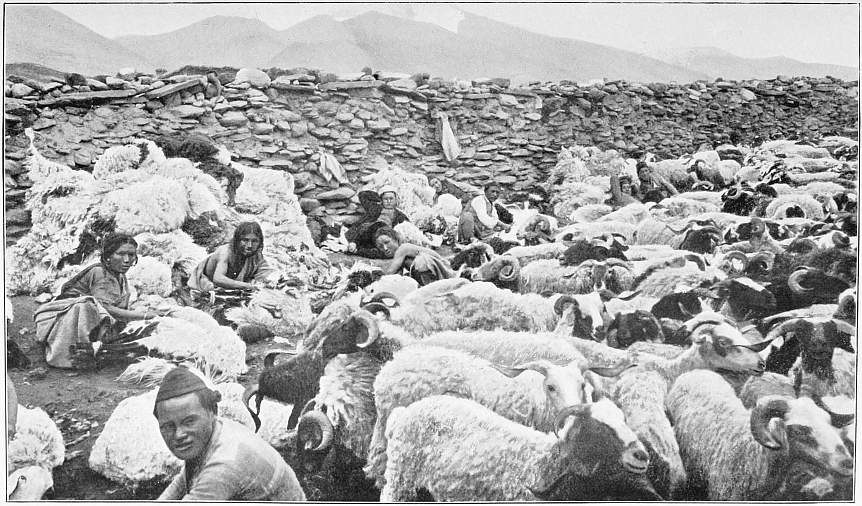
249. Sheep-shearing at Tugu-gompa on Manasarowar.
Shukkur Ali’s refrain to the strokes of the oars is now “Ya paté, parvardigar Rabel, alehmin” or “Illallah,” while Rehim Ali responds to the cry of his comrade with “Haap”—the p jerked out quickly and loudly like an explosion—and with the refrain “Illallah,” or “Svalallah.” The Arabic words are, as usual in Ladak, much corrupted, but they lighten the work, and after Shukkur Ali had yelled them out thirty-five times in a minute for nine hours as loudly as his vocal cords would let him, he was dreadfully hoarse in the evening.
Then the soundings were 131, 171, 171, 177, 177, 185, 187, and 177. Out beyond the abrasion terrace and its rather steep escarpment, the lake bottom is practically level. Hanging cloud fringes show that rain is pouring down in torrents on most sides, but we escape it. My excellent boatmen row twice as fast as on the first night, but it is impossible to induce them to row in time. If I loose the rudder a moment, my boat falls off to the north or south instead of making east, where camp No. 212 lies. If it is dark before we reach the shore, our men are to light a pile of wood to guide us.
The day draws to an end, the wind sweeps away the clouds, and they seem to gather round the mountains, which form a grand wreath around this pearl of lakes. The wind dies quite away, the sun scorches my weather-beaten face, and it is trying to the eyes when the sparkling gold of the sunbeams falls straight upon them. Their blinding light makes it difficult to distinguish our goal, but I hold the compass in my hand. The waves sink and become more languid, and the sea is again smooth as glass. Now we move more slowly, for the wind no longer pushes behind, but the men are unwearied; their boat-song dies away over the water, awaking no echo. The hills of the eastern shore show no perceptible difference in size between one sounding-point and the next. I sit dreaming, the rhythmical song and the splashing of the oars exercising a soporific effect. I seem to hear the tramp of a horse which bears a rider in silver harness over the granite mountains of the Trans-Himalaya through an unknown land, and in the dream I perceive that the features of the rider are my own. Then I am sad, for the dream is false. I have certainly crossed the Trans-Himalaya by three passes, but the most important part of the exploration has not been accomplished. That I have done my utmost in dealing both with the Tibetans and the Chinese to gain access to the country north of the Tsangpo is no consolation to me. If one can storm the opposing bulwark of Nature, one should be able to overcome the obstinacy of man. Up yonder in the north, behind Kailas, the Trans-Himalaya extends its granite ramparts, and I must go there though it cost me my life. I must go there, if I clothe myself in the rags of a mendicant lama and beg my way from one black tent to another.
But we are still on the holy lake; it is a day of rest and a summer’s day. I feel the skin of my face cracked by the burning of the sun. The hours crawl so slowly over the lake; patience, patience. The clouds display wonderful tone-effects; white and grey, sharply defined, they lie in different stages before the mountains, and behind them dark blue and purple curtains seem to hang down. We might be gliding over the bright floor of a temple hall, its walls richly decorated with flags and standards, which hang down from golden hooks on the ceiling of the sky, and touch the dust of earth with their fringes. The genii of Siva’s paradise seem to hover round us. Now Shukkur Ali has taken to a new cry: “Ya aferin adétt,” to which he adds “Ya, Allah,” as he lifts his oar, and Rehim Ali chimes in with “Shupp.” The depth still remains about 180 feet. To the south-east curious clouds are reflected in the lake, and a mist seems to be creeping over the water. All the tones are so light, airy, and grey that the landscape, which surrounds us like a ring where the water ends, seems hardly real. The twin summits of Pundi on the north-east are dark and solemn, and equally dark and solemn is the mirror of the lake. Silver beads drop from the oars and glitter like diamonds in the sun. I could live and die on this heavenly lake without ever growing weary of the wonderful spectacle always presenting fresh surprises.
Meanwhile a light south-easterly breeze disturbs again all the reflexions. The valleys Pachen and Pachung open their doors wider and wider, and allow us to see deeper into the recesses of the mountain. We recognize the hills above camp No. 212, but the tents are not visible. But we see a white spot on the northern shore which we take for a gompa. The depth is somewhat over 197 feet; “Ya bismillah hum!” is Shukkur Ali’s exclamation. At the sixteenth point the depth has again decreased, the south-easterly breeze has ceased, and the lake is again a sheet of glass. Now the tents can be seen as tiny specks, and we hope to complete this line also without a storm. A long, low, smooth swell of closely following waves, like the wake of a distant steamer, comes to meet us. How has it been produced, since the lake is quite peaceful? Perhaps by a slight convulsion of the earth’s crust, which has disturbed the shore. The undulations on this round lake are very peculiar. At point No. 20 the depth is only 128 feet, and now we have not far to go.