Front matter (continued 7)
Reading edition
The men are to come back on the 7th, and we wait for them till mid-day. There, too, they come: the black group is plainly visible; they march and march, but come no nearer. Ah, it is only some black stones dancing in the mirage. A little later Suen reports that some of the animals have run away, and consequently we have to remain the whole day at this dismal camp.
How slowly the hours pass on a day like this! I am a prisoner in my own tent, for cold and wind keep me from work out of doors. As long as the sun is above the horizon I pass the time very comfortably, for I can see the mountains, these silent, dreary, lonely mountains, where men never wander, and I see the sandspouts whirling along before the wind. But when the sun sets, the long winter evening begins, and I hear only the howl of the storm without. Patience! Spring will come some time. Every day that passes we are a step farther from this horrible winter. Brown Puppy and her whelp keep me company, and I look upon them as comrades in misfortune. She has her mat in a corner of the tent, and takes her meals when I do. The whelp we call Black Puppy amuses me immensely. He has begun to take notice of the world and the life around him. When the big dogs bark outside the tent, he turns his head and gives a feeble growl. When his mother leaves him on the mat in the cold, he makes an attempt at a bark and seems to think it strange. He wanders about the tent, though he is still so unsteady on his legs that he constantly topples over. He has already conceived a highly salutary respect for the brazier, and sniffs and shakes his head when he chances to come too near it. Sometimes it happens that he misses his mother in the night, when there may be as many as 54 degrees of frost in the tent; but his complaining squeal awakens me, and I take him under the furs—an attention he is very fond of. One morning he wakened me by crawling of his own accord on to my pillow and trying to get into my bed. After that I felt no concern about his future; he must learn how to make his way in life, and that he was doing.
On the 8th we went over a small pass 17,569 feet high. A horse and a mule perished on the way. Camp 299 was pitched where the first pasture was found, in a valley on the other side (16,946 feet). There was no water, but we had four sacks of ice. Seven sheep were left, and the raven had also come again.
The aim of our next day’s journey was to find water for the animals. My trusty white Ladaki horse, which I always rode, used to get my washing water every morning, and I used no soap that I might not spoil it for him. From a small rise in the ground we were able to enjoy the view I had so longed for—the great open plain we had crossed in the autumn of 1906. To the east-south-east I easily recognized the spur we passed then, and we could not be more than two days’ march from the Aksai-chin lake. I had now followed for several days much the same route as Crosby, and at the lake I should cross my own route of 1906, after which we should go down towards the Arport-tso, and, as last year, intersect the paths of Bower, Deasy, Rawling, and Zugmeyer.
The whole country lay under a vault of dense clouds. After a march of only 3 miles we found a flowing spring of beautiful water (33°), where camp No. 300 (16,329 feet) was pitched. In the evening my servants sang bright and happy melodies again, and Suen performed his most ridiculous dances. We were again up on the roof of the world, and all dreary Tibet lay in front of us. Should we be able to cross it with our little caravan?

CHAPTER LVIII
FORTY DEGREES BELOW ZERO
With fresh blocks of ice in our sacks we set out on January 10 straight towards the projection at the foot of which camp 8 had been pitched, and where I knew that the grass was good. The great level barren plain stretched between us and the spot, and we had 15 miles to cover. The wind was boisterous, and we were frozen through in a minute. In the lee of the caravan, which went in advance, lay a cloud of dust like smoke. The yellow hue of the grass could be seen from a distance, and the sight so refreshed my men that they began to sing on the march. The animals understood that they were coming to good pasturage, and quickened their pace without any shouts from the men. The tents were set up in the same place as last year, and here I closed my long circuitous route through Tibet. It was with a melancholy feeling I saw this place again, where Muhamed Isa had raised his tall cairn. Now we had avoided all dangers from Rudok, and we minded little that England and Russia had promised each other not to let a European into Tibet for three years. The height here was 16,198 feet.
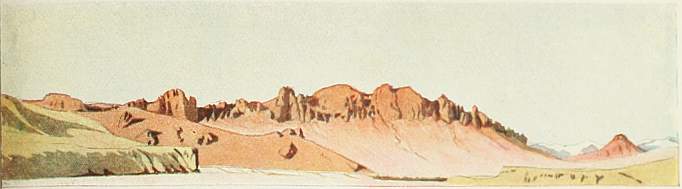
301. View from Camp 307.
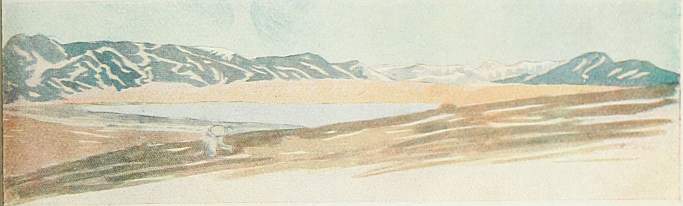
302. The small salt Lake south of Camp 309. (Smudge in sky caused by the freezing of the colour.)
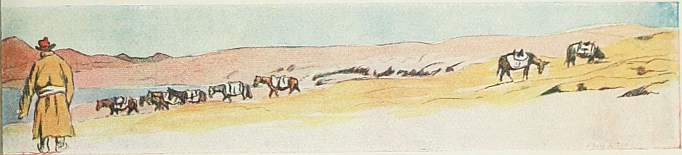
303. Horses going to drink at the lake near Camp 310. Abdul Kerim on the left.
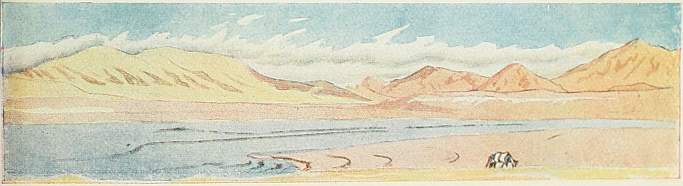
304. Mountain north-east of Camp 310; the freshwater Lake in the foreground.
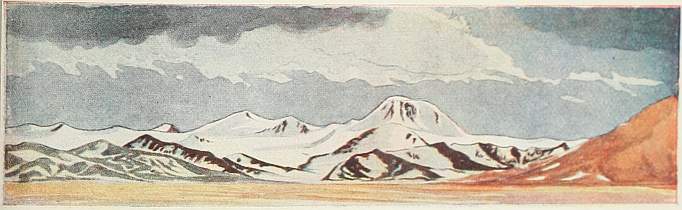
305. Storm Clouds over the snowy mountains south of Camp 312. Water-colour Sketches by the Author.
For several days I had spoken of this place with its good pasturage, and when we broke up our camp on the 11th I was able to promise my men a still better camp for the next night. They were astonished that I was so much at home in these dreary regions. The track of the great caravan of 1906 was blown away by the passage of many storms, but the Aksai-chin lake soon came into sight, its surface looking grey and dismal in the chilly weather. Six kiang spoors converged to the fine spring of fresh water near the shore, where we kindled our fires among the same stones as last time. Pasturage and fuel are abundant in the neighbourhood; it is a veritable oasis—the best camp we had had since Köteklik. But the storm still raged, and the salt waves rose high over the lake, cooled down to 20.7°, though there was no sign of ice. In the night it snowed hard again, and on the 12th, which was made a day of rest, the lake lay blue amidst a landscape of shining white.
When all goes well the Mohammedans read no prayers. Probably they think that when we can help ourselves it is unnecessary to disturb Allah.
We had to pay a horse as toll for the good pasturage. He lay frozen hard in the camp on the morning of the 13th, after a night temperature of −18.4°. The yellow dog remained beside him, and when he came late at night into the next camp, he was so fat and puffed up that it was evident he had stored up food for several days. Two ravens followed us with their hoarse croaking. Snow fell thickly and hid the view. A herd of antelopes disappeared like shadows in the mist. A sheep died on the way, and two more had to be killed, for they were worn-out; we had now only three left. The cold penetrated everywhere in the night, and the thermometer sank to −33°.
On January 14 we made south-eastwards over a plain of soft, tiring ground, which caused us the loss of a mule. The caravan moved very slowly forward and in close order; the animals marched more comfortably when they were together; those which would linger behind, overcome with fatigue, were driven forward by the Ladakis. At camp 304 the grass was poor, and two mules seemed to be near their end. The cold was fearfully sharp in the night. The thermometer fell to −39.6°, or to nearly 40 degrees below zero, and almost to the freezing-point of mercury. That was the lowest temperature I ever recorded in all my journeys in Asia.
But January 15 brought a fine morning and an Italian blue sky. Abdul Kerim and all the other Mohammedans waited on me, in a tragi-comical procession, with dried apricots and almonds, and a simultaneous cry of “Aid mubarek,” or “A blessed Festival.” One of the festivals of Islam fell on this day. Exceedingly comical was the procession of the four Lamaists, who came up as the others retired; and Lobsang, who led them, took off his cap and scratched his head in Tibetan fashion, but did not put out his tongue—he had no doubt learned in Leh that this performance was not pleasing to a European. I gave them 10 rupees each and handed the caravan bashi a watch, which he was to wind up well every evening to be sure of the time.
On we marched again, moving slowly, for the ground rose. We proceeded like a funeral procession, and Suen was the parson. There was no longer reason to fear thirst, for half the country was covered with snow. But every mile caused us a struggle, and it was long before we came to the cliff we were making for. We left a huge snowy massive on the right hand.
Next day’s march took us over a flat saddle to a small side valley where there was some grass. The temperature had been down to −29.9°, and I could not by any means get life into my feet. Sometimes they ached, sometimes there was an uncomfortable pricking in my toes, and then again they lost all feeling. During the day’s rest we allowed ourselves in camp 306 Tubges shot an antelope and an Ovis Ammon, a feat which prolonged the lives of our last two sheep. In the evening the men were cheerful and hopeful as they sat around the flesh-pot.
Gulam Razul had presented me with six bottles of whisky, which, sewed up in thick felt, had been brought all the way; for Ladakis maintain that when a mule shows signs of exhaustion and weakness it can be cured by giving it whisky or other spirits. But the bottles were heavy, so three of them were emptied and set up as a memorial on some stones. Perhaps some time or other they may be found by another traveller. The other three were kept.
On the 18th we continued to follow the same longitudinal valley. All the ranges in this country run east and west, the usual direction in Tibet. To the right was a lofty range we must cross if we would travel south-eastwards. Through a gap in the northern mountains was visible to the north-east the mighty snowy dome we had passed to the right of in 1906. Eastwards there seemed to be no obstacle in the way, but we diverged south-eastwards up a valley. Before we encamped (Illust. 301) another mule had fallen, and then we had lost a fourth of the caravan.
Next day we proceeded further up the valley. Sometimes it was only 10 yards broad between solid horizontal terraces. Below a steep crag lay five pot-stones, and therefore Tibetan hunters must have come thus far. The Ladakis were delighted to meet with signs of human beings again. The valley opened out into an extensive plain, and a gap was seen to the south-east, but as the ground was lower towards the east we turned our steps in that direction. From the low threshold the view was anything but encouraging—a world of mountains. We resolved to encamp where we were (17,405 feet high) and to try the other, southern, passage next day.
A miserable camp! The storm raged so violently that the tents could hardly be set up, and the iron tent-pegs beat together and rattled until they were fixed. We had first to make a fire before we could use our numbed hands, and a small stone wall had to be raised to prevent the fire from being carried away. Now Nature and the elements were against us, whereas we might in the future expect opposition from man. The pasture was wretched, and a grey horse and the last mule from Poonch lay dead in the morning. It was the senior of the veterans, for it had come with me all the way from Srinagar and had done good service, and I was grieved at losing it. Now there was only one creature left which had seen the first beginning of the caravan, namely, our brown Puppy. She and the little puppy kept me company in this oppressive, weary solitude.
From camp 309, where we stayed a day, there was an uninterrupted view over another longitudinal valley, to the south of the former. There lay a contracted salt lake. At almost every camp, as on the former journey, I drew a panorama of the surroundings, and tried sometimes to paint small water-colour drawings (Illust. 302). Then I had to sit in the opening of the tent and hold the block over the fire to prevent the brush freezing into a lump of ice. But the sky, which should have been of an even blue or grey tone, usually turned into a film of ice with strange stars and crystals.
In camp 310 we also remained a day, for the pasture was better than we had found for a long time. The grass grew in sand on the shore of a small freshwater lake with a free opening, where at length the animals got a good drink after having had to quench their thirst with snow. We had travelled 188 miles since Christmas Eve, or about 6½ miles a day on an average—a terribly slow pace. Now we had had a furious storm for three days, and here yellow whirls of sand flew over the ice and the wind moaned and rustled through the grass. Abdul Kerim sewed together a long Mohammedan coat for me, which I was to wear under my fur when I assumed my disguise.
On January 24 the whole country was covered with dazzling snow and the sun shone, but a stormy blast drove the fine snow particles in streaks over the land, and a roaring sound was heard. Antelopes careered lightly over the ground, dark against the white snow. A mule died on the way; not even Tibetan mules can bear this climate. I was benumbed and half-dead with cold before I reached the camp.
After a temperature of −21.3° the neighbourhood was enveloped in semi-darkness by heavy clouds. The jagged mountains to the south reminded me of a squadron of armoured vessels at gunnery practice in rainy weather. Their grey outlines peeped out from the low clouds. The valley was about 6 miles broad. Towards the east the snow lay less thickly, and finally only the footprints of wild animals were filled with snow, like a string of pearls in the dark ground.
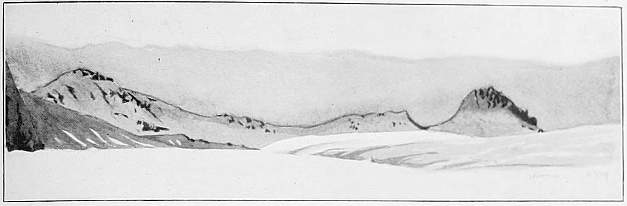
306. Camp 307.
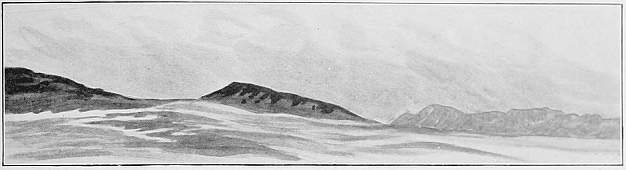
307. Camp 333. The Beginning of a Storm.
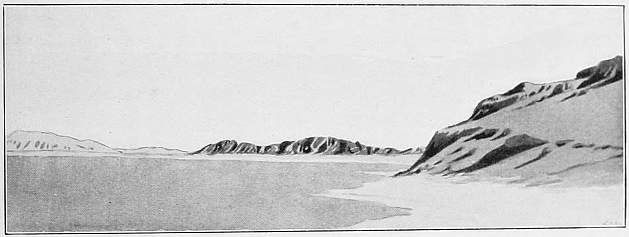
308. Camp 335. Lemchung-tso, looking East.
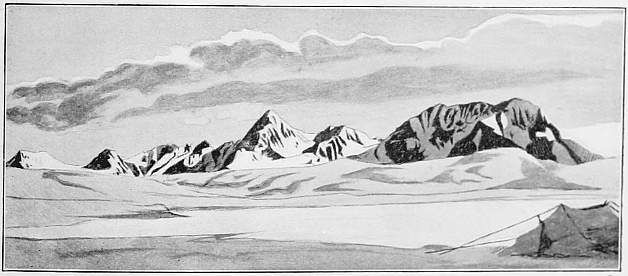
309. Camp 401. Kanchung-gangri from the North. In the foreground Lapchung-tso, the source of Chaktak- or Charta-tsangpo.
As I turn over the leaves of my diary of this terrible journey how often I come across the remark that this was the hardest day we had hitherto experienced. And yet days were always coming when we suffered still more. So it was on January 26. The sky was covered with such compact clouds that we might fancy we were riding under a prison vault. The storm raged with undiminished violence, and a quarter of an hour after I had mounted my horse I was benumbed and powerless. My hands ached, and I tried to thaw my right hand by breathing on it whenever I had to take a note, but after reading the compass for two seconds my hands lost all feeling. My feet troubled me less, for I had no feeling at all in them. I only hoped I should reach the camp before the blood froze in my veins (Illust. 305).
Then we come at length to the Arport-tso and leave the northern basin of the lake on our left, while a large basin swells out like a fjord towards the south. A mountain spur sends out a cape into the lake, which has a very irregular outline. It stands in our way. Shall we leave it on the right or left? We come up to the middle of the lake shore and wait while Lobsang goes to see if the caravan can travel over the ice. He hurries forward and makes us a sign to follow. We go down to the beach and along a spit which narrows down to a fine point.
Here the ice on our left hand has been piled up into hummocks, 6 feet high, of grand transparent green flat slabs, but on the right, as far as we can see over the southern basin, the ice spreads its level smooth sheet of a beautiful dark green colour like leaves of laurel and lilac. We feel the usual fascination of the ice, and stand and stare down into the dark cold depths. Drifting snow sweeps like comets’ tails over the smooth course. We stand on the very point of the promontory, with the narrowest part of the Arport-tso in front of us, for the lake is contracted like a wasp’s waist. Here there are fences, walls, and barriers raised by ice pressure, and between them snow is drifted up, hard and dry on the surface. It would have been quite impossible to march over the bare ice; the caravan would have been carried away like chaff before the wind. But the snow affords us an excellent path. Lobsang leads the way, guiding us in many a wind, but we get across and come to the farther shore at the foot of a cliff.
Worse followed, for the rocky point fell straight down to the lake on its eastern side, and here we had slippery ice swept clear of snow which we sanded. One horse or mule after another slipped and fell. Some of them made no attempt to get up again, but were dragged over the ice to firm ground, where their loads were put on again. Some fell with a heavy thud on the hard treacherous ice. We had to double a whole series of points in this way till we came to one where further progress was impossible, for at its foot issued forth springs which produced large openings in the ice. There icy cold waves beat with a sharp sound against the edges of the ice under the lash of the wind, which drove continually clouds of snow dancing like elves over the dark green field of ice. We had to struggle up over steep slopes till at last we reached, thoroughly tired out, an inlet where a few leaves of grass grew. We had left a mule on the ice, and two men went back and gave it a drop of whisky so that it could come on to the camp. But my brown horse from Shigatse, which had so often carried me up to the east gate of Tashi-lunpo, remained behind for good. It is sad and depressing when a veteran dies.
Arport-tso lies at a height of 17,382 feet. The water, which was drawn from an opening in the ice, was quite potable. There was a high pass in front of us to the south-east, but we could not reach it in one day, and we camped on the plain at the south-east of the lake where Rawling had once stayed. It was little more than a mile thither, but the grass was good and the animals needed nourishment. It snowed thickly all day. It was warm and comfortable under cover, and we pitied the poor animals which were out grazing in the cold. The small puppy had grown so much that he could wander alone between the tents watching for an opportunity to steal meat. A sheep was slaughtered.
At night the cold was more severe again, and the thermometer sank to −30.3°. The sick mule sought shelter behind the men’s tent, lay down at once, and gave vent to a piteous sound. I went out to look at it, and caused it to be put out of its misery.
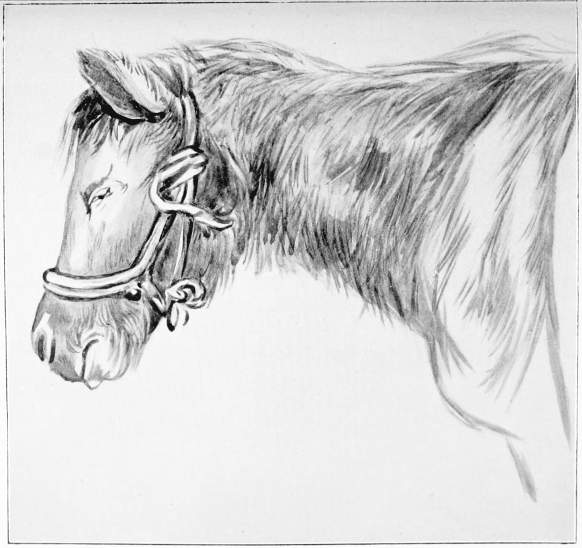
310. My Dying Pony. Sketched by the Author.
On the morning of the 28th we found two horses dead on the grass. One was one of the veterans of Leh which Robert had ridden, and which also bore me to the springs in the Sutlej bed. We had now only twenty-three animals left, and my small white Ladaki was the last of the veterans. Little I thought, as he carried me over the Chang-lung-yogma, that he would survive a hundred and fifty comrades. Every morning two long icicles hung down from his nostrils. He was taken great care of, and I always saved a piece of bread from my breakfast for him. I had a particular affection for him and for Brown Puppy. They had been with me so long, and had passed through so many adventures.
A loss of three animals in one day was serious for such a caravan as ours. How would it all end? We had still an immense distance before us. We struggled for three hours with halting steps up this terrible pass which had a height of 18,281 feet. We encamped in the shelter of a rock and killed the last worn-out sheep, and then had no live store of meat.
The temperature fell to −24.5°, and the first sound I heard in the morning of the 29th was the everlasting howl of the storm. We marched south-eastwards through snow a foot deep. “One of our worst days,” it is styled in my diary. We cared about nothing except to get to our camp alive. I had a scarf wound several times over my face, but it was quickly turned into a sheet of ice, which cracked when I turned my head. I tried to smoke a cigarette, but it froze on to my lips. Two horses died on the way, and Abdul Kerim’s horse took over the load of one of them, while the man himself went on foot like the others. I followed the track of the caravan with Kutus. Then we found Kunchuk Sonam and Suen unable to go further; they suffered from pains at the heart. I tried to cheer them up, and promised to give them medicine if they would follow slowly in the track of the caravan. Was it now the turn of the men after half the caravan had been lost? Quite overcome with fatigue they hobbled at twilight into camp.
Abdul Kerim came into my tent very cast down and asked if we should fall in with nomads within ten days, for otherwise he considered our condition desperate. In truth, I could give him no consolation, but could only tell him that we must go on as long as there was a single mule left, and then try to drag ourselves along to the nomads with as much food as we could carry. Now we thought no longer of pursuers behind, or of dangers before us, but only wished to preserve our lives and come to country where we could find means of subsistence. Behind us the snow obliterated our tracks, and the future awaited us with its impenetrable secrets.
CHAPTER LIX
IN THE SNOW
The storm howled round us all night long, and our thin tent canvas fluttered in the blast. Gulam awaked me with the information, “It is nasty weather to-day; we can see nothing.” Even the nearest mountains were hidden by the snow, and if I had not already taken a bearing along the valley in the direction south, 35° E., we could not have set out. This day, January 30, we had to keep together, for the driving snow obliterated the tracks immediately. We had two leaders, and I rode last along the trail, which at first was marked as a black winding line, but farther on, where the snow lay 2 feet deep, no ground or rubbish could be seen. A brown horse which carried no burden lay down and died in the snow. We could see the snow making ready its grave before it was cold. It vanished behind us in the dreadful solitude.
We move forwards at a very slow pace through the snowdrifts. The fury of the storm carries away the warning shouts from the lips of the guides and they do not reach our ears; we simply follow the trail. Lobsang goes first, and he often disappears in the dry loose snow and has to seek another direction. In the hollows the snow lies 3 feet deep, and we can take only one step at a time after the spades have cut us a ditch through the snow. One or other of the animals is always falling, and the removal of his load and readjusting it causes a block, for all must follow in the same furrow. All, men and animals, are half-dead with fatigue and labour for breath. The snow sweeps round us in suffocating wreaths; we turn our backs to the wind and lean forwards. Only the nearest mules are plainly visible, the fifth is indistinct, and those at the front are seen only as slight shadows amidst the universal whiteness. I cannot catch a glimpse of the guides. Thus the troop passes on a few steps till it comes to the next block, and when the mule immediately in front of me moves on again it is only to plunge into a hollow filled with snow, where two men wait to keep up its load. The direction is now east and the ground rises. A few such days and the caravan will be lost (Illust. 312).
At length we come to a low pass (18,268 feet high). Even at sea-level such a journey would be hard enough, but how much worse it is in a country which lies some hundreds of feet higher than Mont Blanc, and where there is nothing but granite. On the eastern side of the saddle the snow lay 3 feet deep in some places, and it seemed as though we should be stuck fast in the snowdrifts; and what had we to expect then? For the provender was coming to an end, and we must go on if we would find pasture. Now we went gently down, the snow became a little less deep, and we came to an expansion of the valley where there were stretches of ground swept bare by the blast. On the right appeared a slope where Abdul Karim thought he saw blades of grass sticking up out of the snow, and he asked permission to camp. It was difficult to set up the tents that evening. At dusk the two sick men came up, their faces blue and swollen.
A miserable camp! The storm increased to a hurricane, and nothing could be heard but its howling. When I looked out of my tent I could see nothing that was not white, and there was no difference between the ground, the mountains, and the sky—all being alike white. Not even the men’s tent could be distinguished in the driving snow. The fine particles penetrated into the tent and covered everything with a white powder. It was impossible to look for fuel, and at three o’clock the temperature in the tent was 1.4°. I could see nothing living outside, and I might have been quite alone in this wilderness.
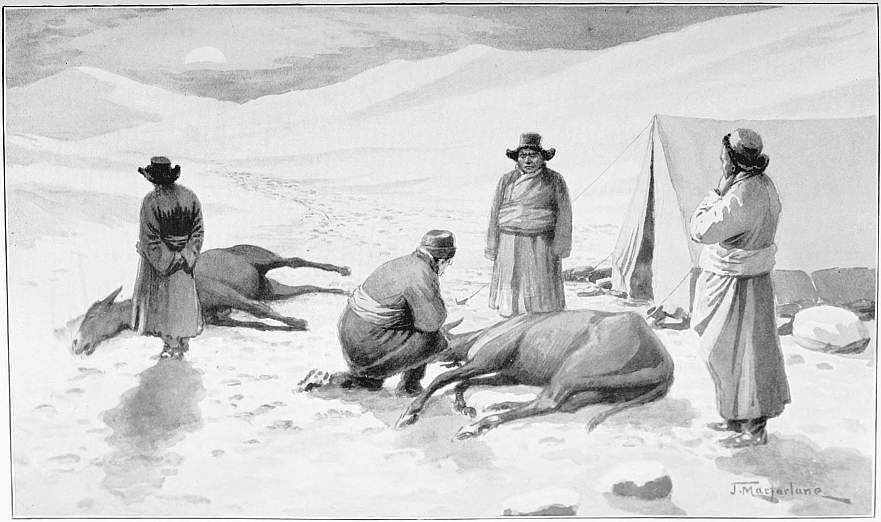
311. Lost beyond Recovery.
My trusty Gulam comes, however, at length with fire, for Lobsang and Sedik have found some brushwood. Gulam says that Sonam Kunchuk is ready to lay himself down on the snow and die, but I advise him to take a good dose of quinine instead. Late at night the tones of the hymn to Allah reach my ears, sounding softer and sadder than usual amid the raging of the storm. We are moving towards a dark destiny, I have attempted too much, and any moment the catastrophe may come. We are snowed up here, the animals must die of starvation and I myself—well, it is but a question of time.
A little below the camp the valley made a turn to the right. Thither the animals had gone at night, but came back as there was no grazing. A grey mule had stayed behind to die. It lay in a curious position, as though it had died in the act of getting up—on its knees with its nose pressed against the ground, and was frozen hard in this position. Yet the temperature fell only to −16.4°.
The storm continued with undiminished violence on January 31. We loaded the nineteen mules and horses and marched down the valley at random in the same dense snow. The snow came down in incredible quantities; such a snowstorm I had never witnessed even on the Pamir. We could not travel more than 2¾ miles, and then we halted and pitched the tents, which looked dirty against the pure snow. Four big wild yaks were moving over the slopes, tramping like snow-ploughs. The dogs made after them, but soon gave up the chase, for they could not go far in the drifts. The animals received their allowance of rice, and then trailed off to a hill where they poked about for the scanty grass.
I examined all the baggage with the help of Abdul Kerim and Gulam, and discarded all that could be spared. Unnecessary clothing and worn-out boots were burned, and reserve garments were brought out. My articles, note-books, and instruments were stuffed into two small sacks. Writing materials and other things for daily use were packed in a small handbag from Stockholm. The other chests were used as firewood, when the men had stripped off the leather coverings to make new shoe-soles. Even the box for the cooking utensils and the provision boxes were burned, and all the baggage was henceforth carried in sacks. By this means the loads were made lighter and more convenient, though there was more trouble in turning everything out of a sack when anything was wanted from the bottom.
In the afternoon there was a short break in the snowstorm. Beyond the white limits of the valley was seen to the south-east the large lake Shemen-tso, with a dark purple sky above it, presaging more snow. I took bearings of the next day’s route, and it was well I did so, for soon the snow began to fall again unusually thickly. It snowed all day and all night, and a swishing sound was heard as the snowflakes were driven by the wind against the canvas of the tent and from time to time slipped down. In the morning of February 1 piles of snow lay round the tents. The minimum temperature was only −0.8°, and it felt quite pleasant. We loaded our weary hungry pack animals and marched slowly south-eastwards. The gale blew from the south, and the snow pelted on to our faces.
Silently and heavily the fainting troop moved on towards the lake. All the men’s beards and moustaches were white with rime, and we seemed all to have turned grey in a night. Abdul Kerim walked in front with his staff, but he took a wrong direction, and I chose another leader. In some places we were nearly suffocated in the snow, and the crestfallen men stood in the drifts, at a loss what to do. But we plunged and floundered on a bit, and then stood still; then a little bit further. The pass over which we had made our way the previous day was no doubt blocked by snow. Had we reached it two days later we should never have forced a way over it. Now our retreat was cut off, and we must seek safety southwards. It was some consolation to know that we had burned our ships.
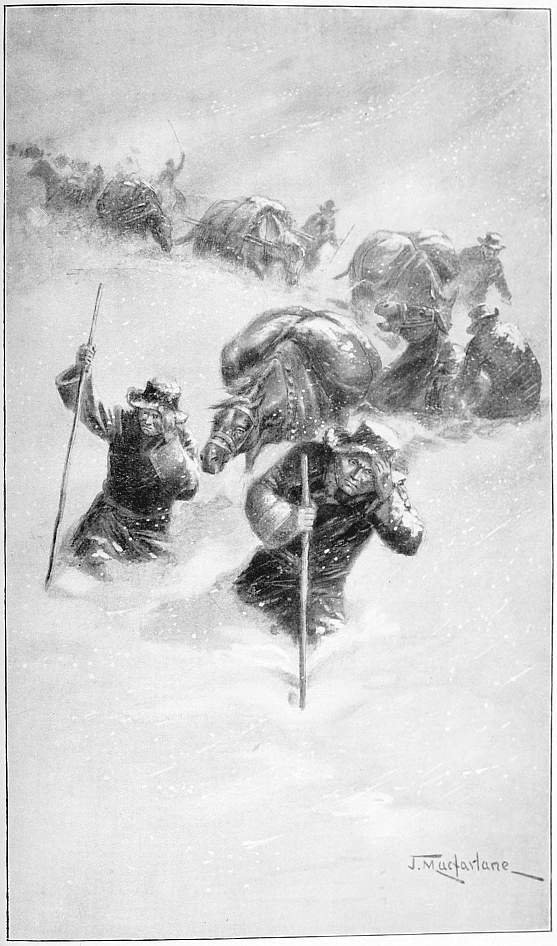
312. “If this continues a few days longer, we are lost.”
Fortunately the ground sloped down, and as we toiled on hour after hour the snow diminished and travelling became easier. But the storm, which had now raged for a fortnight, showed no signs of abatement. Down on the western flat by the lake the snow mantle was thin, and we encamped in a spot where the grass was not bad. I gave the men some cigarettes every evening—at other times they smoked yak-dung and filled their narghilés with tea-leaves.
The night was unusually mild, with the minimum temperature only 5.2°, but the clouds were as dense as ever and the snow fell unceasingly. It was dark all day, as though a curtain hung over the forbidden land. We stayed at camp 319. The storm blew from the south-west more wildly than usual. The animals grazed with their heads to leeward, and had to be driven windwards again every time they came to the edge of the restricted area of grass. On February 3, also, we remained where we were. All night long the hurricane had raged, tearing, raving, ploughing up the ground like a gigantic plough, and endeavouring to pull down our tents. In the evening I secured everything that could fly away if the tent were overthrown. In the morning all the animals had disappeared as though they had been carried away by the blast; at any rate, they had gone with the wind to the northern shore of the lake.
Immediately beyond our camp was a spring of fresh water and a round fold for sheep. I had ceased to look forward to spring, it seemed so hopelessly distant, and to be farther off every day that passed. Brown Puppy and Little Puppy kept me company as usual, and we played together to pass the hours of our imprisonment. Gulam continued to rub my feet, but with little result, for they remained numb and cold as ice. Then he brought two pairs of paipaks of thick felt and a pair of charuks or Yarkand boots of soft leather outside. They were really warmer than my Kashmir boots, which were ruthlessly burned.
CHAPTER LX
DEATH OF THE LAST VETERAN
Studded with twinkling stars the winter sky stretched its dark-blue canopy over our lonesome camp, and 50 degrees of frost foretold a clear day. On February 4 not a cloud hovered over the mountains, and this plateau, abandoned by gods and men, which had lately been buried under the white shroud of winter, was again illumined by bright sunlight. Sad news was brought me in the morning: a horse and a mule lay dead beside the tents. With the seventeen remaining animals we continued our journey along the irregular northern shore of the Shemen-tso (16,266 feet). The quantity of snow became less, and at camp 320 the gravelly ground was almost bare. The view over the lake was grand. Captain Rawling’s map of this district is executed with great accuracy.
On February 5, also, we encamped on the shore of the great lake, having followed the curves of its bays and capes. A mule died on the way. Though we had burned all we could dispense with, yet the loads were much too heavy for the surviving animals. A big strong mule always led the van, at the heels of Gulam; it carried at least two ordinary loads, and yet was fat and fresh. There was no sign of human beings. A flock of jackdaws were perched on a crag. At the camp the provisions were inspected, and we decided to relinquish three heavy sacks of rice. The rice was to be given on the following days, mixed with parched meal and water, to the animals. Of my provisions, only two boxes of tinned meat, some jam and biscuits, were left. We had not tasted meat for some time. The storm raged all day and the sun had vanished again.
On February 6 we passed a very abundant spring of water at a temperature of 46.2°, which poured into the lake. There flocks of sheep had recently drunk, and rows of cairns ran from the shore to guide antelopes into the traps in the ground. Now no game was seen except a single kiang. A mule died, and Abdul Kerim’s yellow horse fell by the way. Only fourteen animals reached the camp this day, and of these my small white Ladaki was in the worst plight; he stumbled and fell, and I made a somersault over his head.
The day after, we made a short journey, left the lake and its barren shore behind us, and set up our tents amid good grass. The weather was fine; at one o’clock the temperature was 14°, and it felt as though spring had come. All the animals lay down to rest and warm themselves in the sun. Only my small Ladaki began to graze immediately; he would not die, but would follow me to the end. Wild asses and antelopes grazed on the steppe, and hares were plentiful. I was alarmed by a message that three men could be seen at some distance to the north, and the caravan bashi wished me to come and examine them through my field-glass. Apparently they were on the way to our camp. But I had plenty of time to put on my disguise. I watched them a long time, till at last they turned into three wild yaks which had been lengthened out by mirage. We had no need yet to trouble ourselves about men, but perhaps these yaks were forerunners.
Now I had ridden my small white horse for the last time. On February 8, when we continued our march east-south-east after a minimum temperature of −18.9° he followed the caravan loose and unladen, and fell even without a rider. I rode instead a grey horse from Tikze. We made barely 5 miles, but yet the journey was full of events. On the other side on a low hill stood a Pantholops antelope, which did not run away though we were quite close. We soon noticed that it was held fast and was struggling to get free. The dogs rushed at it, but a couple of men hurried on to keep them off. The animal was fast in a snare laid in an antelope track, where also we noticed fresh footprints of two men. We were evidently not far from winter hunters, who perhaps had already caught sight of us. Perhaps they had seen me, the only one riding in European dress. Perhaps it was too late to disguise myself. All my plans would then be spoiled, and all the labours of the winter lost.
But at any rate we had now fresh meat. Let us examine the ingenious trap in which the game is caught. Plates of rib bones of antelopes are firmly fixed in a ring of hard twisted vegetable fibres, which form a funnel with the points in a ditch. The antelope is enticed into the trap by a row of small cairns, and tramps about in the funnel, the plates giving way, but forming immovable impediments when he attempts to draw his hoofs out. But the snare must be held secure if it is to have the desired effect. A rope as thick as a finger is made fast in the bottom of the ditch, which is filled with water, and after freezing becomes as hard as stone. The free end of the rope forms a noose above the ring of fibres, which tightens when the animal first attempts to lift his leg and holds down the funnel of ribs. The more the poor animal jumps about, the faster is the hold of the twisted snare.
The victim was slain; the dogs ate their fill of the entrails, and the meat made ordinary loads for four men. Then we went on. At the mouth of a valley to the south were seen a sheepfold and two black specks we took for stones. Beyond a grass-grown mound we found a pool of fresh water, and we pitched the camp near it. It was not long before the Ladakis were sitting round a fire and roasting pieces of delicate, much-appreciated meat.
Now, when we were evidently in the neighbourhood of human beings, it was time for me to give directions to my people. All were summoned to my tent. I told them that we should succeed in crossing the forbidden land only by craftiness and cautiousness, and that I had made the great sacrifices which they had witnessed only to see regions where no Sahib had ever been. If our scheme were to be successful, every man must do his duty and play his part well. Whenever Tibetans put the usual questions, whence we came and whither we were going, they should answer that we were all, without exception, Ladakis, in the service of a merchant named Gulam Razul, who had sent us to Chang-tang to find out how much wool could be bought from the nomads next summer. Abdul Kerim was our leader and chief, and had to manage our affairs. He was therefore given 100 rupees for expenses, and every evening when no one could spy upon us he was to render an account to me. I myself was one of his servants, a Mohammedan named—Abdurrahman, the caravan bashi suggested—but no; Hajji Baba sounded better to me. Accordingly, when we came among Tibetans, they should never forget and call me Sahib, but only Hajji Baba. All understood the matter and promised to do their best.
A little later, Lobsang came running up and declared that the two black stones were tents. We went out and examined them through the field-glass. Quite true; smoke rose from one of them, but neither men nor animals were visible. I at once ordered Abdul Kerim, Abdul Rasak, and Kutus to go and pay for the antelope, buy anything they could, and obtain information. They soon came back again and asked if it would not be wiser to avoid the tents and march on eastwards, the more so that the inmates might be robbers. No; these men had seen us and might send a report to Rudok, and then we should be stopped. It was best, then, to enter into friendly relations with the men and lull them into security. “Bismillah,” cried the three and took themselves off, while the others sat by the fire in lively conversation about the incidents of the day and the prospects of the future. It was now sixty-four days since we had left the last village in Ladak, while on the former journey we had been in solitude for eighty-one days.
After three hours my men returned. The two tents contained nine inmates—two grown-up men, two women, three girls, and two boys. The older man was named Purung Kungga, and he owned 150 sheep and 4 dogs, but no other animals. During their journey from Yildan their tents and goods were carried by sheep. They had arrived two months before, and intended to stay half a month more. The day before they had just been to look at their antelope trap, when they were alarmed at the sight of the caravan. They took it for granted that only robbers could be travelling in this district, which lay outside the haunts of honest and honourable men. The antelope had, then, been not more than an hour in the trap. Abdul Kerim paid 3 rupees for it, 3 for a sheep, and 1 for milk and butter. We could get more milk early in the morning, but we should have to send for it, for the nomads dared not come to our tents. We might have kept the antelope without compensation, for we were wayfarers and had a right to take what we found. In answer to their inquiry who we were, Abdul Kerim repeated the yarn he had just learned. The country about camp 324 is called Riochung. In one of the tents lay the hides and meat of nine antelopes. The people lived almost exclusively on the game they caught in their snares.
So far we had been fortunate. With provisions for twenty-one days instead of for seventy-five, we had struggled up to the Karakorum instead of finding a passage to the east; we had been persecuted by raging storms, biting cold, and deep snow all the way, and yet we had lighted on the first men. They were like a rock in the ocean, and now again we were to venture over the raging waves. This day found us only a few miles up a gently sloping valley filled with ice. Little Puppy was let loose and had to look after himself a bit. But he was soon tired, and lay down till Kunchuk fetched him.
February 10. The valley bottom is full of ice sheets, which we often cross after they have been strewn with sand. We wander through a labyrinth of clay hills. In an expansion to the left are seen three stone cabins and some mani heaps; here is the gold placer which Rawling calls Rungma-tok, and the hunters we saw yesterday Getsa-rung. The gold-diggers come hither only in summer. The camp to-day, No. 326, is in an excellent spot, with a sandy soil, plenty of fuel, and an unfrozen brook. It is pleasant to listen to the purling water, a sign of approaching spring. East and south-east rises a wreath of lofty mountains, which we have to surmount. As long as the ground is flat and there is grass the animals do very well, but they cannot endure a high pass. My white Ladaki has picked up again, and the men are ordered to tend him carefully.
February 11. We ascend the valley, and the snow becomes deeper again. In one place are seen fresh tracks of three men. We camp behind a cliff to get shelter from the wind, but first we have to cross the ice belt in the valley bottom, where a path has been recently sanded. It is evident that we shall soon fall in with men—perhaps on the march between the two camps. Therefore I put on my new Ladaki costume with a girdle round the waist. The white turban is kept ready at hand in case we meet Tibetans. The chapkan looks suspiciously clean, but Gulam undertakes to soil it with fat and soot. My soft leather vest is sacrificed and cut up for soles. After this camp Lobsang and Kutus were required to give me every evening lessons in Tibetan, and I arranged all the new words in a vocabulary, which afterwards grew to a considerable size. Thus we spent a couple of hours each day when all my literature was at an end. I especially practised the answers I was to give in case I, Hajji Baba, were subjected to cross-examination.
On the 12th we marched up through the snowdrifts in the valley, where small, graceful, elegant Goa antelopes were seen on two occasions. The camping-ground was so wretched that all the animals wandered back in the night to the former camp, and therefore the next day was lost, and we waited wearily. In my grey chapkan I am too conspicuous among the other ragamuffins, and whenever I have an opportunity I smear soot and butter on it and cut holes in it here and there. A continuation of such treatment will at length make it as disreputable as the others. I also try to leave off washing my face and hands, but do not succeed in looking as dirty as my men. With them the dirt seems to be engrained and never to be removed, and they could grow potatoes under their nails. My desire was to become like them as soon as possible, that I might escape the notice of the Tibetans.
February 14. Temperature −22.9°. Again we are a few miles nearer our destination and a day nearer spring. Our progress is slow, but we must be glad that we can get along at all. Camp 329 is in the valley leading to the pass, which we have taken several days to reach. A mule is fatigued and is relieved of his load. Some grass is again found, and all the animals go out to graze, except my small Ladaki, which stands beside my tent with drooping head and icicles under his eyes. He has been weeping, knowing well that he will never be able to cross over the pass and that we shall leave him. I sit beside him for several hours, patting and stroking him, and trying to induce him to eat lumps of meal mixed with rice. He revives again and goes slowly after his comrades.
February 15. Temperature −22.5°. A hard, toilsome day. Through ice and snow among sharp detritus we march up the valley. My white horse leads the way of his own accord and I ride in the rear. We keep together for some time, and ascend step by step towards the troublesome pass. But first one and then another lags behind. Among them is my white horse. I stop and whisper in pure Swedish into his ear: “Do not lose courage; put out all your strength and climb the pass, and then you will go down in a few days to fine rich pasture.” He raises his head, pricks up his ears, and gazes at me as I go on up to the pass with Kutus and Gulam. Only a couple of lively mules follow my horse and halt where he halts, at every twentieth step.
At last we came up to the flat pass, which attains to the considerable height of 18,553 feet. Here we waited a long time. The large black mule passed first over the snowy threshold of the pass and then the others, till nine baggage animals had gone by and my grey Tikze horse last. Abdul Kerim reported that four animals were thoroughly tired out. I ordered that they should be led step by step even till night if necessary, and he went down to them again. A little later appeared Tubges and Abdullah carrying two loads. One of the four animals had already departed this life.
To the west-north-west, the direction from which we had come, the view was magnificent—a sea of wild, red, gigantic undulations, with snow crowning the summits and streaming down their sides. During the last days we had noticed schists, porphyry, red and grey granite. The country was absolutely barren, and we must try to reach the nearest grass in the descending valley, but it was full of snow, and the train moved slowly and wearily through the drifts. I went on foot like the rest; every man carried a load to help the animals. All were silent, and tramped and balanced themselves in the track marked by the leader. The valley contracted to a ditch, and where the first yak-moss grew we threw down our burdens. A sorry camp in the close dismal valley. The last animals stood tied together, and were fed with pulverized yak-dung and moss mixed with meal and rice.
At dusk the other men came up leading a mule. Three animals were gone, and one of them was my small white Ladaki horse. He had struggled up to the very top of the pass, where I had sat watching for him in vain, and then had laid himself down to die. He had served me and carried me faithfully and patiently for a year and a half, and had never from the first been missing from the camping-ground, and now that the last of the veterans was gone I felt very lonely. During the whole journey he had never reached a higher spot than that whereon he died; on the very saddle of the pass his bones would be bleached by the winter storms and the summer sun. The caravan this evening was empty and forlorn, for I had lost a trusty friend. Now Brown Puppy was my consoler, for she had been with me from Srinagar, and her little whelp was the youngest and least anxious member of our struggling troop.
Two mules had crossed the pass but died in the valley. If another such pass lay in our way the caravan would perish. The loads were much too heavy for the surviving animals. A thorough weeding-out was necessary. My ulster and most of my European clothes were burned. Felt mats, tools, kitchen utensils, and spare shoes for the horses were thrown away. My small Swedish bag was burned, and all the medicines except the quinine jar were sacrificed; my European toilet necessaries, including my razors, went the same way, and only a piece of soap was kept. All European articles that were not absolutely indispensable were cast into the fire. I tore out of Fröding’s poems the leaves I did not know by heart, and left the rest at the camp. The remaining matches were distributed among the men; I kept myself twenty-four boxes, which must suffice until the time when we must use only flint and steel to preserve our incognito.
Cold and sad the night spread its wings over the silent valley where our lonely camp, a picture of desolation, was buried among black cliffs and white snowdrifts, while the stars came out above like lights burning round a bier.
While the lightened loads were being placed on the animals I started on foot followed by two men. One of them, Kutus, walked beside me, and I steadied myself by his shoulder as we floundered through the drifts. The wind blew furiously, and the snow danced in spirals and appeared as white clouds on all the crags and ridges. After a march of about 3 miles we encamped when we came to grass. Snow had to be melted in pots, for the animals had been long without drink. This process did not take so long now that only eleven animals were left.
With tottering steps we continued to the east-south-east on the 17th and 18th, sometimes along valleys, sometimes over open country, and always through deep tiring snow. Camp 333 (Illust. 307) was barely made ready when a terrible storm burst over us. The sky had been clear, and then all of a sudden the pure blue colour was wiped out by orange clouds of dust which swept up from the south-west. I was sitting in the lee of my tent when in an instant the contents of the brazier were carried away. A heap of wild asses’ dung which the men had collected also flew away, and we saw the small round balls dancing up the slopes as though they were racing. A herd of antelopes cantered past our camp, and their smooth coats shimmered like satin and velvet according as the hair was exposed to the wind and the light. Again our ears are filled with the din of the storm. I hurry inside, and hear from time to time a shout when some part of the men’s tent threatens to give way, or the sound of iron against iron when the tent-pegs have to be driven in again, or a singing dying-away sound when my towel is seized by the blast and borne away towards the foot of the mountains. We might be on an unsound vessel with the sails flapping and beating in cracking strips, and the mountain spurs, which still peep obscurely from the mist, might be dangerous and threatening reefs, against which we are to be dashed in a moment. Grand and majestic is such a storm when it sweeps over the earth in unbridled fury.
CHAPTER LXI
THIRTY DAYS OF STORM
On February 19 we had good country for travelling, declining gently to the shore of the Lemchung-tso, which appeared in the distance. I travelled mostly on foot, as I could easily do, for the storm had abated, but, as usual, we were chilled through by the wind, though the temperature rose to 28° at one o’clock. At the foot of some hills in the south we perceived numbers of black spots, which we took for tame yaks. They soon resolved themselves, however, into whole troops of antelopes, which sped in light springs over the plain northwards. Now were often seen signs of the summer visits of the Gertse nomads. We had left Deasy’s and Rawling’s routes a couple of days behind us, and now found ourselves on the western margin of one of the largest blank spaces in the map of Tibet.
After a grey horse had perished in the night we had only ten animals left, or a fourth of the original caravan. They were fed in the morning with meal and spent tea-leaves in water, which they swallowed with avidity. Our store of provisions would last out barely a month.
We were 6 or 7 miles from the shore of the lake, and on arriving there we encamped close to a cave in which a millstone and a couple of yak hides had been left in the summer. Along the shore ran a path worn by the feet of men. We stayed here a day and sorted out the baggage again. All spare instruments, such as thermometers, measuring tape, eye-glasses, etc., as well as some European garments, a couple of caps, bandages, portfolios, were sewed up, together with some stones, in a sack, and sunk in a hole in the ice, which covered the lake to a depth of nearly 3 feet. Now I had only three changes of under-clothing left, one of which might be sacrificed at the next sorting out—we were like a balloon from which ballast is thrown out to keep it in the air till it has crossed a sea and has firm ground below it.
In the evening we hear a whole orchestra of roaring winds. The air hurls itself down like cascades from the mountains on to the camp, and cannot rush fast enough over the clear ice of the lake, where the moon produces bright silvery streaks on the surface, while the mountains show a dark outline to the north. Grazing and fuel are plentiful to-day, and therefore we are in high spirits. The men sing, sometimes softly like a swinging lullaby or rounded billows in a bay, sometimes in the wild and passionate style of Asiatics, and dance around the fire. But when the most violent gusts rush down, they pause, prepared to prevent the tent from falling over the fire. They seem to sing responses to the storm, and I am pleased with the performance, for it chases away thoughts of the long hours of solitude, and calls forth pleasant dreams and hopes of spring, warm winds, discoveries and adventures in Tibet. I wonder daily how this journey will end, but every day I am a step nearer to the answer.
On February 22 we left the little freshwater lake on our left hand, while the Lemchung-tso proper extended its partly frozen surface to the right. In the middle the water was quite open and of a dark-green colour, and was lashed into vapour by the storm. To the east-south-east the country seemed favourable—an open plain, where no obstacle came in our way. In front of us were two grazing animals—perhaps yaks or wild asses. Gulam, who went in front, held up a field-glass and reported that they were horses. So we were near nomads again. We searched about in every direction but could perceive no tent. Had, perchance, the horses strayed away? However, they were not shy, but became very sprightly when they caught sight of us, galloped straight to the caravan, and greeted every horse and mule individually. After this civility they followed us all the way, prancing and neighing. They were three-year-old colts which had never carried a saddle or a load—fat, fresh, and nimble-footed, very different from our last three horses. When we encamped they went off to the south and were lost to sight. The storm increased in violence, and our last iron spade and a kettle were carried away by the wind, but were afterwards recovered.
February 23. The thermometer sank to −19.8°. Our last ten animals made a short day’s march along the same easy valley. I could perceive no trace of the “Snowy Range” of English maps in the prolongation of this valley. We observed a couple of tents in the mouth of a valley to the north, but we were now in no distress. I lived exclusively on tea, bread, and jam, of which there were still two pots left.
The storm continued next day also. We seldom covered more than 6 or 7 miles. In the past month we had travelled 220 miles, 30 more than in the previous month. During the evening and night the snow pelted on to our tents. I still had my warm comfortable bed, but at a pinch it would also go piecemeal into the fire. Everything that was discarded was burned or buried, lest, if it were left, it might arouse suspicions.
For another day’s march we had the advantage of this fine longitudinal valley, which imperceptibly rises to a flat threshold, beyond which we passed a gold placer. The holes from which the auriferous sand is extracted are 3 to 16 feet in diameter, and little more than 3 feet deep. It is evident that some of them have been dug out last summer. A little farther down gold had been searched for some time ago. Folds, stone shelters for marksmen, and stone cairns were to be seen in several places.
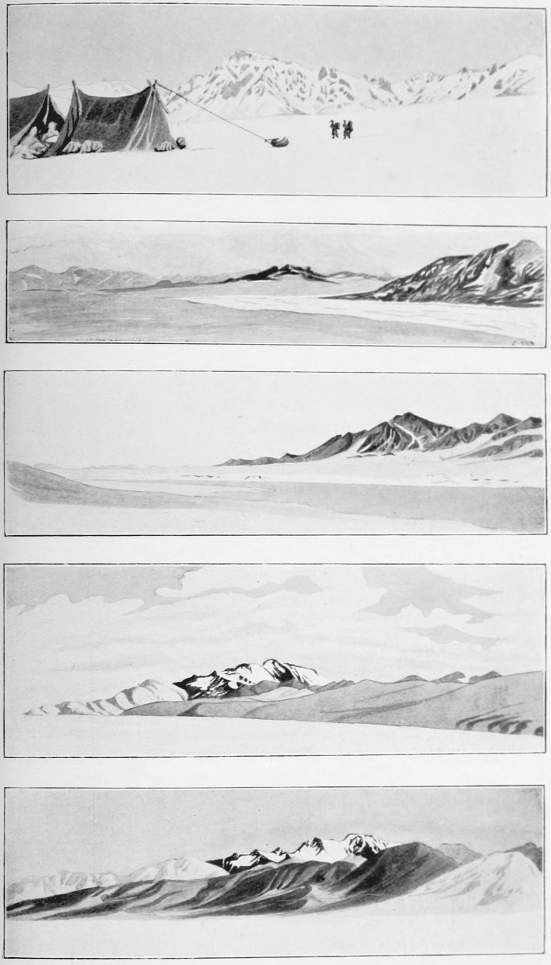
313, 314, 315, 316, 317. Panoramas from the Camps 318, 333, 335, 359, 360; in the last two, Sha-kangsham. After Water-colour Sketches by the Author.
Still lower down we came, on the following day, to a third placer, situated where the valley contracts to a trough. Here large sheepfolds and abundant tracks of men were found. The gold is washed out on flat stones in a flume 100 yards long. The valley afterwards contracts to a breadth of 5 yards, and the bottom is mostly filled with ice, here and there forming ledges. These had to be levelled with axes and strewn with sand, and each animal was led and held up by men. We could not afford to let any one of them break his leg and be lost to us. Then the ice came to an end, the valley opened out, and we pitched our tents in an extensive flat. Towards the east the land was all favourable, and no “Snowy Range” stood in our way. We could see 25 miles ahead. Tubges shot five hares and we had a feast that evening. A pack of wolves howled round the camp at night.
February 27. A thousand wild asses were seen on the plain which sloped down gently to the east-south-east. They formed dark lines, sometimes large, sometimes small, sometimes spots like a rosary. Some herds galloped off to a point about two hundred yards in front of the caravan, where they stood and gazed and then dispersed, springing away in graceful movements. Perhaps they were here for a great spring congress, to decide questions relating to their territory and pastures. It is certain that, like the nomads, they migrate at fixed seasons, for they also are dependent on the occurrence of grass and its varying abundance at different heights and different times of the year.
Farther down the plain, beyond a small cliff, were five herds of kiangs, the nearest of which numbered 133 head. They came galloping almost up to us. Lobsang ran towards them. Then they set off in wild flight one after another, their hoofs thundering over the ground, made a wide curve behind us, and vanished in a dense cloud of dust, the hard beat of their hoofs being still audible. A strong puff of wind dispersed the cloud, and they came into sight again; they stood quaking with fear, and looked at us, pricked up their ears, dilated their nostrils, and sniffed the wind.
To the south of our route we perceived two tents among small scattered heights. Abdul Kerim and two men went off to them while we pitched camp 341. On their return they reported that the tents were the property of a certain Tsering Ngorpel from Gertse, who had come hither with his family for two months and was going back in a month. They were poor people, and owned only 70 sheep and goats, 6 yaks, and 1 dog. The neighbourhood of camp 341 the man called Senes-yung-ringmo, and he said that if we marched south-eastwards we should almost daily meet with nomads from Gertse and Senkor, districts in the south which I had passed through in 1901. They were afraid of our men and would not let them enter the tents. Two fine sheep and a lump of butter were bought, and rescued us from starvation for a time. The hare meat was discarded and given to the dogs.
We made the two sheep carry themselves our newly-acquired store of meat to camp 342; we had no room for extra loads. We mounted slowly to a flat pass. Three tents stood in a side valley and some men came out to look at us, but we passed on without exchanging questions and answers. On February 29 the wind raged furiously all day long. Clouds swept ceaselessly over the country, and at one o’clock the temperature was 22.1°, quite low enough to chill a rider down to the bones and marrow.
In front of us lay a large flat hollow, in the midst of which two small lakes shone white with ice. We slowly approached the isthmus between them. A herd of antelopes took to flight and nearly fell over a lonely wild ass, which looked at them uneasily, but at the last moment they turned off in another direction as though they were afraid of him. On the left, in a deep trough running towards the lake, a flock of sheep was driven along by two shepherds. Wait one moment. Hand me the turban. Gulam wound it round my head, and then I went on foot like the rest. Along the shore a young man was driving six yaks. Abdul Kerim and Gulam went up to him while we set up the tents on the shore (15,200 feet).
After a while they returned with the yak-driver, a boy of fourteen in a large white skin hood. He was terribly frightened, and could with difficulty be persuaded to come to our tents; our intention was that he should guide two of our men to his dwelling. He called the lake Lumbur-ringmo. As my disguise was now complete, I went to look at the boy, who did not seem at all suspicious.
Lobsang and Tubges followed the boy to his tent, and after a long time returned with unwelcome news. Two Tibetans had rushed out of the tent, stopped them, and asked roughly what they wanted. They replied very quietly that they wished to buy food; but there was nothing of the kind for sale.
“But who are you?” an elderly man asked.
“We are Ladakis in the service of a merchant, and we are on the way to Saka-dzong,” they answered.
“No,” the Tibetan exclaimed; “you lie. No merchant travels this way, least of all in winter; there is no trade in Chang-tang.”
“We are not trading,” Lobsang replied; “we are commissioned to inquire how much sheep’s wool can be bought up next summer.”
“Sheep’s wool—in uninhabited districts! No; you are servants of a European, who keeps himself out of sight in one of your tents. Out with the truth, or it will be bad for you.”
“Ask the boy here,” returned Lobsang in his most innocent tone, “if he saw any European in our tent. We abhor Europeans as heartily as you. If you doubt us, you can come to our tents and see for yourself.”
“No, thank you; we will not come to your tent,” the old man answered, and disappeared with his people behind the black hangings.
Lobsang was very serious when he came back, and proposed that, if we had not already come to a standstill, we should in future set up our camp as far as possible from the nomads. I was alarmed, and I had a feeling that we should not advance much farther into the forbidden land. It was also disappointing to be so openly suspected to be a European.
Now good advice was precious, for evidently the nomads would betray us to the nearest authorities. At the evening’s lesson in Tibetan, which occupied some hours, I discussed the situation with Lobsang and Kutus. It was resolved that Abdul Kerim should go early in the morning to the tent, and if the nomads were still hostile we would try to lengthen our day’s march so as to get out of the way of a probable summons to stop.
This time Lobsang met with a better reception, as he could present our chief and leader, whom the nomads correctly addressed as bombo. The old man introduced himself under the name of Sogbarong Tsering Tundup—Sogbarong is his home in the west, and this name is placed before his own much as Anders Persson i Stor-gården. The old man invited his guests into his tent, took a couple of sheep’s trotters, cut them in pieces with an axe, threw them into the caldron, and offered some broth to Abdul Kerim, saying it was the only tea he had. In the tent were five antelopes cut up, a gun, a knife, and other articles. The old man did not this time express any suspicions of us, but related that a European with a large caravan had crossed the country to the east more than a year ago. He did not suspect, of course, that that same European was hiding in one of our tents. When the messengers came back they had a fine fat sheep and a can of milk with them.
This day, March 1, the wind was so strong that it was impossible to travel. My tent fell over and was held fast by the load of sand and stones on its folds. Not a trace of the surroundings was visible, and I should have obtained no notion of country on the route. At two o’clock Tsering Tundup and another Tibetan came to return the visit. They emerged from the mist only when they were close at hand, and a couple of men hastened to protect them from the dogs. The visit was a complete surprise, but there was nothing which could excite the least suspicion. My things were crammed into a sack, and I was disguised as usual; indeed, I had now no other clothing to put on. Even if they had come and looked into my tent there would have been no danger.
Our guests had capacious sheepskin coats drawn up above the belt so as to form the usual protruding bag where a large part of their property is stored. They wore hoods of sheepskin and looked like Samoyeds or Chukchis. They stood a while and chatted with our men in the wind, but I did not hear a word, though they were standing only 3 yards from the loophole in my tent through which I was watching them. After some hesitation, they went into Abdul Kerim’s tent, and then the yak question was discussed. They had only six yaks, which they required for their own journeys; but if we would buy sheep, they would let us have as many as twelve, and each sheep could easily carry a fifth part of a mule’s load. The offer was accepted with pleasure, and the price was fixed at 38 rupees. Then they went off through the storm and I felt safe again.
The purchase was concluded on March 2, and the twelve sheep stood with their heads together in the shelter of the men’s tent. To start on our travels was impossible, for we could not have kept our legs in such a storm. We therefore remained here another day, and the men had full occupation in sewing sacks for the sheep, arranging and weighing the loads. I was worse off, for I had nothing to do and nothing to read, but I sat and wrote Tibetan notes and entered new words in my lexicon. Then I heard a hasty step coming towards my tent; it was Kunchuk bringing fire. A rustle, an oath, all the contents are swept out of the shovel, and the man has to crawl back to the camp-fire for more embers. So the day passes and the storm roars, and every one is weary and listless.
During these stormy days our animals lay for the most part quietly in a hollow where they were sheltered from the wind. The storm kept them from grazing, and they were much enfeebled by fasting. A white mule, therefore, remained behind at Lumbur-ringmo-tso when we moved off south-eastwards on March 3 with 3 horses, 6 mules, and 12 sheep, delighted that we had passed this critical point with a whole skin. Freshwater springs formed a number of picturesque ice volcanoes on the shore of the small lake. Before we encamped behind a projecting cliff, we met three large flocks of sheep with their shepherds. On such occasions I always went on foot. The new sheep all carried burdens, and gave invaluable help to our tired animals. They were tied up every night between the tents that they might be safe from wolves, and the yellow dog from Gartok proved an excellent guard. They bleated piteously the first evening, probably distressed at leaving their native country. I was sorry for them, for they had been treated as cruelly as Uncle Tom, but in time they became quite accustomed to their new way of life.
Violent storms prevailed all day and all the following day, on which we passed two black tents. At every camp we had to take the greatest care that no pieces of paper, match-boxes, candle ends, or cigarette stumps were left lying about, for we might be sure that the Tibetans dwelling near would come and search about after we had left the spot. Our route took us over a low pass (16,030 feet). The rocks comprised weathered schists, quartzite, and granite—the last only in detached blocks. On the other side we followed a deeply excavated valley opening out on to a plain, and we were just setting up our tent by a projecting rock when two large black dogs came running towards us barking. Nomads, therefore, were encamping in the neighbourhood, and we must be on our guard. Abdul Kerim, who always showed himself prudent and tactful in delicate negotiations, went off to a tent which stood on the other side of the rock and was inhabited by four Senkor nomads who owned 400 sheep. The chief of them was named Shgoge, and sold us three sheep at 3 rupees a head, some butter and milk. He said that the country here, around camp 345, was called Pankur, and that we were three days’ journey from the encampment of the Gertse Pun, or the chief of Gertse. With him, however, we had nothing to do. It was to our interest to avoid as much as possible officials of all kinds, not to approach Gertse or Senkor in the west too closely, and not too near my route of 1906 to the east. We must steer our way through many pitfalls. Just in this district we crossed the meridian of 84° E., and my plan was to travel due south from the Tong-tso right across the large blank space. The continual storms which had done us so much harm, were so far advantageous to us that they enabled us to cross the great wastes without being much noticed. This day all was hazy from the dust, and our neighbours’ sheep, which passed my tent in long columns with shepherds and dogs, made a very curious spectacle in the dense mist.
March 5. Abdul Kerim obtained two more sheep, and now we had seventeen to help the mules and horses. Our intention was to increase our sheep caravan by degrees, and make ourselves independent of the other animals. We must also have a spare horse for Abdul Kerim, for he was our master, and it was incongruous that he should go on foot while I, a simple caravan man, rode. This day we had the storm at our back, and we travelled 8½ miles over the same even, excellent ground which had made progress easier since we left Lemchung-tso. We encamped at a sheepfold and enjoyed the feeling that there were no neighbours to spy on us. A sheep was slaughtered; only the worst were sacrificed for food, and were to be replaced by new ones when an opportunity presented itself.
CHAPTER LXII
ADVENTURES OF OURSELVES AND PUPPY IN NAGRONG
On March 6 we made another hop towards our destination. It is difficult to travel over the high plateaus of Tibet in winter, and we could not march more than four hours a day. The morning was clear, but we had not gone far beyond a small lake, with its mantle of ice covered with driftsand and dust, before the storm increased in violence and made me reel in the saddle. The clouds of dust became thicker, the sandspouts were dark reddish-brown at the base, and the gusts tore up furrows in the ground like ploughshares, while frequently spiral forms were seen which could only be produced by cyclonic whirlwinds. On the left hand shimmered a lake, its surface partly white with gypsum and salt, partly streaked brown with driftsand, and with open water only in two places; it was the ghost of a lake which was doomed to disappear.
Two built-up fireplaces served us capitally for a camping-ground on the shore where the grazing was good. On the eastern side of the lake was a brick-red ridge of medium height, which I wished to paint in order to record the effective tones in the dust mist. I waited for the others with Kutus and Gulam, and we had scarcely induced a fire to burn before the storm rose at noon to a hurricane. Now everything vanished—lake, ridge, all except the nearest tufts of grass. The fire was fenced in with stones and clods lest it should be blown away, sand and minute pebbles beat against my dry skin coat, and I had to cover all my face, for the skin smarted as though lashed by whip-cord, if it were exposed for a second to the wind. Fortunately the others made their way to us. Every man had to lend a hand to raise my tent. At length Gulam came crawling backwards and yelled into my ear that the tent was ready. With straddling legs and all my muscles on the stretch I fought my way to it, and was glad to catch hold of a tent rope before I was blown down. At last I was under cover and could recover my breath. The tent cloth was puffed out like a balloon, and threatened every moment to burst with a report. The sand and rubbish beat upon it, producing a deafening noise. It was as dark as at twilight, and the wind roared and whined through the grass. The men tried to set up their own tent, but when the wind had overturned it twice they let it lie, weighting it with the baggage that it might not fly away. Five Ladakis lay in the lee of my tent rolled up like hedgehogs, and I let them come in, where they sat silent and motionless for a couple of hours. The others had crept under the ruins of their unfortunate tent. Puppy and Little Puppy lay in a corner and kept each other warm. However, the temperature was 35.8°, and we had not had such warmth for three months. A long and dismal evening! It was with difficulty I got a piece of bread, a cup of tea, and a piece of dried meat. We were deaf and dizzy when at length we sought repose under our rugs, while the storm continued to rage outside.
I awoke to hear the same old music, and to go out to my horse was like plunging into icy-cold water. Neither the sky nor the horizon was visible, and the mountains were dim shadows. With Kutus and Gulam I led the way, following a path trodden by men. Dark, chill, and doleful was the land of eternal twilight, frost, and the wicked demons of the air. After a march of 8 miles we halted at the edge of a belt of ice, a frozen stream in several branches, which ran to the south-west. The gale flew over the clear sheet of ice, and the red dust was swept over it like flames. With the assistance of Kutus I slid over to the other side, and in the shelter of the opening of a small valley we made the usual fire.
The caravan came to the edge of the ice. It was impossible to sand a path, for the grains would have been swept away. The animals were led across singly, each helped over by several men. For all that a mule fell and gave a fearful wrench to one of its hind legs, and with great difficulty it was helped up to the camp. All of us had grey distorted faces, our eyes ran, full of sand and dust. My lips bled and my teeth were black. March is the worst month, but we had never experienced such bad weather before. What is the use of looking forward to spring when the days are darker as time goes on?
The injured mule had evidently dislocated its leg. It was thrown down and a rope was fastened round its hoof and the end was pulled by the men. When it was at full stretch Lobsang hit the rope hard with a tent-pole in order to set the dislocated joint in place again, but I could not perceive that the operation had any effect. No; the mule was lost to us just when we could ill afford to lose one of our best animals.
And it was lost indeed, for on the morning of March 8 it could not take a step. It was sad to pass the death sentence, and a pitiful sight when the fresh warm blood spurted out in powerful jets and moistened the barren soil. It lay quiet and patiently, and after a few convulsions expired, and was left in solitude when we moved on over the dreary waste.
But before starting I had ascended a hill and looked around. Which was more expedient—to travel north-east or south-west? Both directions lay out of our course. I decided for the south-west, and hastened down to my tent, where Gulam served up breakfast. Brown Puppy and Little Puppy gave me their company to get their share. Little Puppy had grown so much that he could do what he liked with his mother. When I gave her a piece of meat the young one flew upon her and took it away. I had to hold Little Puppy that his mother might eat in peace. When we set out, Puppy and the yellow dog remained behind with the slaughtered mule, finding a convenient point of departure in an open wound in the soft muscles of the neck. There they stood gorging when we started along the ice-belt of the stream towards the south-west.
With my usual followers I rode in advance. The suffocating, blinding, deafening storm was right in our faces. Gulam walked in front, stopped, looked through the field-glass, and gave me the sign to dismount. The stream swept round the foot of a cliff in front of us.
“What is it?” I asked Gulam when we came up to him.
“A large stone house with a wall and a couple of smaller huts. They are not visible at this moment because of the mist, but they lie close to the foot of the mountain.”
“Yes; now they can be seen. It is strange that no dogs rush at us.”
“What is to be done? Shall we turn back? Surely a chieftain lives here, and he will come and search us down to the skin.”
“No; it is too late, for we must have been seen already.”
How I regretted that we had not travelled to the north-east! But we must put on a good face in our unlucky situation. We passed the village at a distance of 100 yards, and halted in the shelter of the dark porphyry crag crowned by two chhortens and a mani. At least it was pleasant to get shelter for a moment. It was like taking refuge in a gateway when it pours. All around was dead and dreary; no one was seen; only a couple of jackdaws croaked, and a hare sped out of its form so near us that we could have caught it with the hand if we had been alert. Kutus and Gulam went out to gather fuel. I searched the suspicious neighbourhood with the field-glass, where treachery seemed to lurk behind every projection. It cleared a little towards the south-east, enough for me to detect a black tent of unusual size about 200 yards off. Four strings with prayer-streamers were stretched out from a high pole. I had been in hopes that we should get past the first dwellings, as no dogs had shown themselves, but I had never heard of an uninhabited tent. And the outward appearance of this tent indicated the presence of an important chief. Thanks to the mist, we had stumbled right on to his camp, and he would not be caught napping by poor strolling Ladakis.
Gulam had been to the large house, the yard door of which stood open, and had found in a shed a large quantity of fuel of a kind of shrub the Tibetans call ombo. So we waited and waited, expecting to see the caravan emerge from the mist, but when nothing was heard of it Kutus went out to search. It had wandered quite out of its course, and had made a long circuit round the house and tent, for the leaders were convinced that I wished to slip by unnoticed. A horse had fallen, and now we had only two left, and 5 mules out of 40 animals.
The three tents were set up in a line close together, and Abdul Kerim went with Kunchuk to the large tent. We saw through the mist that a man came out to meet them, and that all three went into the tent, and then we waited with our hearts in our mouths. The men returned at dusk with good news. The tent was inhabited by a lonely old Amchi-lama, i.e. a monk-doctor, who at the same time looked after the souls of the Nagrong nomads, determined from astrological books the lucky and unlucky days for baptisms and other affairs, and assisted people with the same remedies when they were sick, died, and finally were buried. He was from Sera in Lhasa, and had lived three years in Nagrong. The tent was a movable temple, furnished inside with altars, burning butter lamps, and votive bowls, where the hermit performed service—we heard him beating a temple drum at midnight. It belonged, as well as the large house, to the Gertse Pun Bombo, or the chief of the Gertse district, who a few days before had gone off a day’s journey to the east, with his flocks, children, and all, but was soon expected back in consequence of a dispute between two of his subjects. Perhaps, after all, it was well we travelled south-west instead of north-east, for we might have fallen into the jaws of the Gertse Pun himself. This potentate comes to Nagrong in late summer and takes up his abode in the stone house, while a hundred nomad tents are set up around and a fair is held.
The old lama had no servants, but every third day a man came to bring him wood. He must find it dull in the long winter evenings, when he hears the storm roaring outside, and silence reigns within around the gods who answer his prayers and the rolls of his drum with a smile of reconciliation. But probably he is a philosopher and has no fear of the dangers of the night. In his tent lay several sacks full of tsamba, barley, rice, and butter, but he had no authority to sell anything without the permission of the Gertse Pun. Instead, he pointed out where the tent of the Pun’s brother-in-law stood, where all kinds of prime goods could be bought.
We therefore decided to remain where we were over March 9, and Abdul Kerim with three attendants sought out the brother-in-law, met with a friendly reception, and bought five sheep and two goats, besides two sheep-loads of rice and as much barley, and also a bag of tobacco, which the men had long wanted. All day long I was a prisoner in my tent; my period of freedom was over. And when the evening came and enveloped the dreary Nagrong valley in its shadows, I could think of nothing else but my old trusty comrade, the oldest of all that had been with me in Tibet, Brown Puppy. In the company of the yellow dog she had remained in the morning with the mule which had dislocated its leg, and I had seen nothing of her since. We had hoped, however, that she would find us again, as she had so often done before, but now we were convinced that she had lost our trail, and, desperate and crazy with anxiety, was seeking for us over hill and dale, only to wander farther and farther from the right direction. It was useless to send men after her, and it was not advisable to divide our small party at such a critical time. The dogs had remained a long time tearing at the mule’s neck, and when at last they were satiated they had started to follow us and had lost our track in the terrible wind and sand clouds. If they once crossed over ice they would never find our track again. Now thoughts of my old tent companion worried me more than anything else. Only that very morning she had lain on her felt rug in the usual corner, and we had breakfasted together. Where was she? what was she doing at this moment? Day and night she would run barking and whining over desolate Chang-tang with her nose to the ground, searching for our track till her paws were torn and painful. What would she do when night came down with its dreadful darkness and its prowling wolves? Were the dogs keeping together, or were they seeking us along different paths, having lost each other? Would Puppy some time find a home with friendly nomads and lead a comfortable life again, or would she come to want and be tied outside a poor tent, and, pining in hopeless sorrow, remember her past life, which, from when she lapped milk in my room at Srinagar, had been spent in my caravan? I was never to receive an answer to these questions, for the parts she and the yellow dog played in our romance were ended. For the future her life would shape itself differently, but I was never to gain any knowledge of the remaining chapters of her existence. I lay awake at night thinking of her misfortune, and looked every morning to see if perchance she had come back in the night and was lying in her usual corner, and I fancied I heard her trotting outside my tent in the dusk, or thought I could distinguish the profile of a lonely half-starved dog on a mound or crag with its nose up and howling at the storm. For some time I suffered from a delusion, imagining that a shade, the restless soul, the invisible ghost of a dog followed me wherever I went. I felt the presence of an invisible dog which followed me into my tent, and among the Tibetans, and always whined and pleaded for help, and I was worried that I could give no help or consolation to my lost, wandering friend. But soon we had other things to think of, other dogs became my friends, and we were daily entangled in a skein of troubles which must lead to a crisis, and the cares of the past paled before the gravity of the moment.
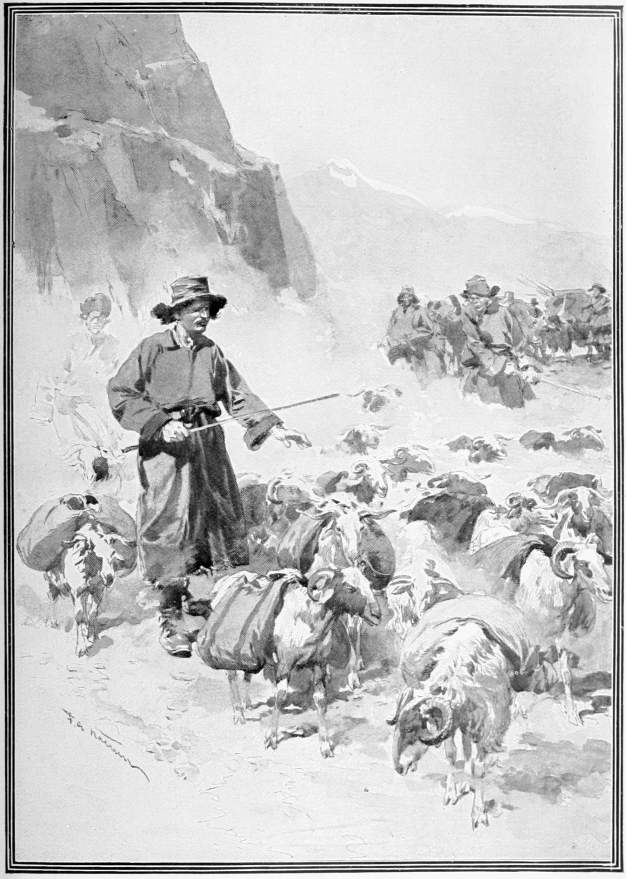
318. The Author as a Shepherd.
March 10. Such a day as this is interesting to look back on, but it was hard and cruel as long as it lasted. Before six o’clock I was awakened with the disquieting information that two Tibetans were approaching our tents. I made haste to dress myself and paint my face and hands black with a thin coating. Meanwhile the strangers arrived and were invited into Abdul Kerim’s tent, where I heard them talking pleasantly about sheep and money—so they were not spies; our time had not yet come. One of the guests was the brother-in-law, the other a neighbour of his, who, when he heard what a good price we paid for sheep, said he was ready to sell us four he had brought with him, as well as a lively goat. Abdul Kerim had received a general order to buy all the sheep he could procure, so he took them. The goat was, as has been said, a lively beast, and he ran off at once and could not be caught again.
The two Tibetans went off to the lama’s tent to drink tea, but the critical time was not yet over, for probably they would return to see us start. Therefore, while the tents were still standing, I set out with Tubges, Little Kunchuk, and “Snoring Kunchuk,” as we called Sonam Kunchuk on account of his terrible timber-sawing propensities, when they drove our thirty-one sheep down the valley. As we went off the Tibetans came out and watched us, but did not suspect anything wrong. To escape detection I had hurriedly turned to sheep-driving (Illust. 318), but I soon found that I had no natural aptitude for this occupation, so invigorating, but so trying to the patience. I fancied I imitated my Ladakis as closely as possible, whistled and shouted in the same way, and threw out my arms when a sheep left the crowd, but the animals showed me not the least obedience, but went where they liked when I was near. After an hour’s walk in the teeth of the wind I had had enough, and while the other shepherds went on with the sheep, Kunchuk and I stayed in a cranny out of sight of the lama’s tent, while I could look over all the valley.