Front matter (continued 6)
Reading edition
From the mountains on the northern side a flattish cone of detritus, or, more correctly, a slope bestrewn with rubbish, descends to the level, open valley. At its foot projects a slab of white rock with an almost horizontal bedding, underneath which several small springs well up out of the ground, forming weedy ponds and the source stream, which we had traced upwards, and which is the first and uppermost of the headwaters of the mighty Indus. The four largest springs, where they issued from the ground, had temperatures of 48.6°, 49.1°, 49.6°, and 50.4° respectively. They are said to emit the same quantity of water in winter and summer, but a little more after rainy seasons. Up on the slab of rock stand three tall cairns and a small cubical lhato containing votive pyramids of clay. And below the lhato is a quadrangular mani, with hundreds of red flagstones, some covered with fine close inscriptions, some bearing a single character 20 inches high. On two the wheel of life was incised, and on another a divine image, which I carried off as a souvenir of the source of the Indus.
Our guide said that the source Singi-kabab was reverenced because of its divine origin. When travellers reached this place or any other part of the upper Indus, they scooped up water with their hands, drank of it, and sprinkled their faces and heads with it.
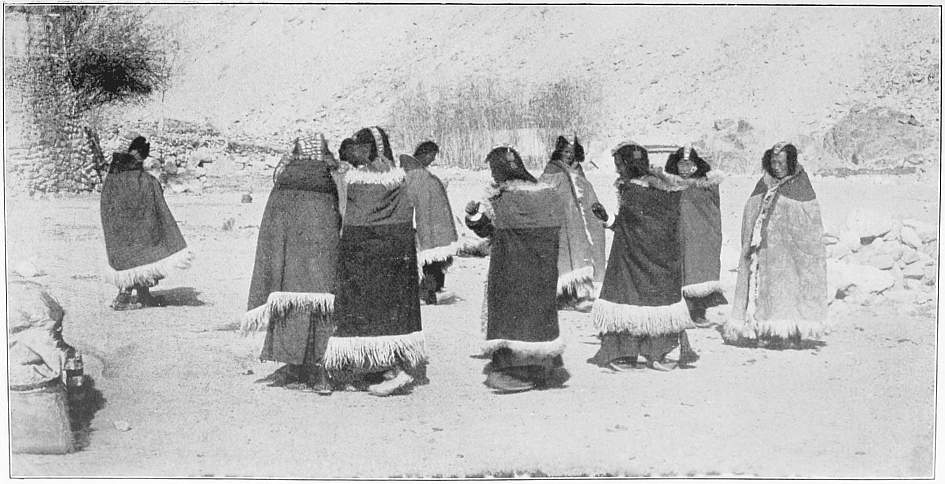
282. Dancing Women in Chushut, a Village on my Way back to Ladak.
Through the investigations made by Montgomerie’s pundits in the year 1867 it was known that the eastern arm of the Indus is the actual headwater, and I had afterwards an opportunity of proving by measurement that the western, Gartok, stream is considerably smaller. But no pundit had succeeded in penetrating to the source, and the one who had advanced nearest to it, namely, to a point 30 miles from it, had been attacked by robbers and forced to turn back. Consequently, until our time the erroneous opinion prevailed that the Indus had its source on the north flank of Kailas, and, thanks to those admirable robbers, the discovery of the Indus source was reserved for me and my five Ladakis.
We passed a memorable evening and a memorable night at this important geographical spot, situated 16,946 feet above sea-level. Here I stood and saw the Indus emerge from the lap of the earth. Here I stood and saw this unpretentious brook wind down the valley, and I thought of all the changes it must undergo before it passes between rocky cliffs, singing its roaring song in ever more powerful crescendo, down to the sea at Karachi, where steamers load and unload their cargoes. I thought of its restless course through western Tibet, through Ladak and Baltistan, past Skardu, where the apricot trees nod on its banks, through Dardistan and Kohistan, past Peshawar, and across the plains of the western Panjab, until at last it is swallowed up by the salt waves of the ocean, the Nirvana and the refuge of all weary rivers. Here I stood and wondered whether the Macedonian Alexander, when he crossed the Indus 2200 years ago, had any notion where its source lay, and I revelled in the consciousness that, except the Tibetans themselves, no other human being but myself had penetrated to this spot. Great obstacles had been placed in my way, but Providence had secured for me the triumph of reaching the actual sources of the Brahmaputra and Indus, and ascertaining the origin of these two historical rivers, which, like the claws of a crab, grip the highest of all the mountain systems of the world—the Himalayas. Their waters are born in the reservoirs of the firmament, and they roll down their floods to the lowlands to yield life and sustenance to fifty millions of human beings. Up here white monasteries stand peacefully on their banks, while in India pagodas and mosques are reflected in their waters; up here wolves, wild yaks, and wild sheep, roam about their valleys, while down below in India the eyes of tigers and leopards shine like glowing coals of fire from the jungles that skirt their banks, and poisonous snakes wriggle through the dense brushwood. Here in dreary Tibet icy storms and cold snowfalls lash their waves, while down in the flat country mild breezes whisper in the crowns of the palms and mango trees. I seemed to listen here to the beating of the pulses of these two renowned rivers, to watch the industry and rivalry which, through untold generations, have occupied unnumbered human lives, short and transitory as the life of the midge and the grass; all those wanderers on the earth and guests in the abodes of time, who have been born beside the fleeting current of these rivers, have drunk of their waters, have drawn from them life and strength for their fields, have lived and died on their banks, and have risen from the sheltered freedom of their valleys up to the realms of eternal hope. Not without pride, but still with a feeling of humble thankfulness, I stood there, conscious that I was the first white man who had ever penetrated to the sources of the Indus and Brahmaputra.

CHAPTER LIV
A RESOLUTION
From the source of the Indus we travelled on north-eastwards with our friendly guide to a locality called Yumba-matsen, which lies in lat. 32° N. And thence I betook myself to Gartok, the chief town of western Tibet and the residence of the two Garpuns, where I arrived after many adventures on September 26, having crossed the Trans-Himalaya for the fifth time by the Jukti-la (19,111 feet high). I must, alas! omit a description of this journey for the present, though it passed for the most part through unknown country. Mr. Calvert crossed over the Jukti-la two years before.
In Gartok (14,656 feet) a new period began. This town is a turning-point in the chronicles of my journey. In the first place, I again came into contact with the outer world. Thakur Jai Chand, the British commercial agent, handed me immediately on my arrival a thick packet of letters, including a quantity from my dear home, and others from Lord and Lady Minto and their daughters, from Colonel Dunlop Smith, Younghusband, O’Connor, Rawling, and many other friends in Europe and Asia. Nothing, however, was heard of the heavy consignment I expected from Simla. But soon afterwards I heard from Dunlop Smith that all I had ordered was on the way and would arrive in due course, and meantime I had to wait in patience.
The Garpuns at once sent me presents as a token of welcome, with the usual polite phrases. They were of too great importance to visit me first, so next day I went to them. The elder was ill; the younger, a gentleman from Lhasa, thirty-five years of age and of distinguished appearance, received me most cordially in his simple Government buildings, and was so little angry at the liberties I had recently taken that he did not even ask me where I had been. It was an irony of fate that a letter in most friendly terms and most liberal in its concessions, which I now received from Lien Darin by the hand of the Garpun, had not reached me until it was too late. When Lien Darin received my letter from Raga-tasam, he immediately sent off two Chinamen fully authorized to come to an agreement with me about the route I was to take. “For I shall be glad to know,” said the Amban of Lhasa, “that you are travelling by the road that suits you.” He was quite convinced that my movements, whichever way I took, would give no cause for political complications. And he concluded with the words: “Now, I hope that you will have a successful and peaceful journey, and I will pray for your health and prosperity.”
How I regretted now that I had not stayed in Saka, and so much the more when the Garpun told me that the two Chinamen had arrived with an escort of four Tibetans only two weeks after we had left! But the Garpun was friendly disposed towards me; he was the most powerful man in western Tibet, and could still throw open all doors for me, if he dared and was willing to do so.
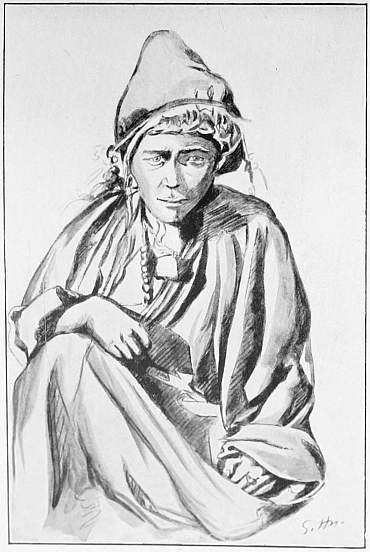
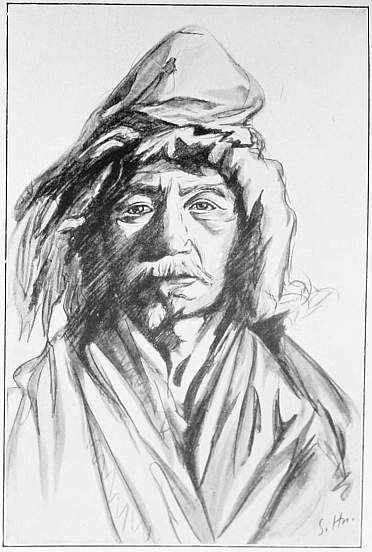
283. Old Woman. 284. Lama in Chushut.
Sketches by the Author.
I was, indeed, pleased and thankful for the results which I had already been able to secure. Besides many other problems that had been solved, I had crossed the Trans-Himalaya by five passes, namely, the Sela-la, Chang-la-Pod-la, Angden-la, Tseti-lachen-la, and Jukti-la, of which the first four had been entirely unknown. But between the Angden-la and the Tseti-lachen-la I had been obliged to leave a gap of quite 330 miles in the exploration of the Trans-Himalaya. Of this region nothing was known but the summits Ryder had seen from his route, and which he and Wood had measured by observation. We also possessed some uncertain statements of Nain Sing’s journey in 1873, but his route lay to the north of the blank patch, and this blank represented an area of 5300 square miles. I could not return home without having done all that was humanly possible to traverse the unknown country by at least one route. Precisely there was the line forming the watershed between the Indian Ocean and the inland drainage of the salt lakes on the Tibetan plateau. There many lakes and rivers might be expected to exist, and there lay the large province of Bongba, of which so many hazy reports had reached our ears from its northern, eastern, and southern boundaries. But the greatest and most important question of all was: Does the Nien-chen-tang-la run right through Tibet in a westerly and north-westerly direction to the north of the Tsangpo and the upper Indus? No European and no pundit had hitherto ventured on this problem; but Hodgson, Saunders, and Atkinson had many years before laid down a hypothetical range on their maps of Tibet. Did it actually exist? Or was a labyrinth of ranges hidden under the white space, or a comparatively flat plateau, on which foundation isolated snowy peaks and chains were based? Hypotheses are absolutely worthless compared to proved facts. Such facts I would procure. I knew that if I did not succeed now in penetrating into the country which on the latest English map of Tibet (1906, Map 1) bears only the word “Unexplored,” one fine day another explorer would come and rob me of this triumph. And this thought I could not endure.
In Gartok my old friend from Leh, the rich merchant Gulam Razul, was staying (Illust. 272). I consulted him, and he was to be my delivering angel. He took a very sanguine view of our position, for the Garpun owed him 7000 rupees for goods delivered, and feared his influence; he could therefore put pressure on the Viceroy of western Tibet. He first tried stratagem, which, however, completely failed, for the Garpun replied he was too fond of his head to expose it to risk by assisting a European who had no permission to travel about the country. Then we tried gold, but the Garpun answered most theatrically: “If this house were of gold and you offered it to me, I would not take it. If you travel on forbidden roads, I will send armed men after you who will force you to return hither.”
He was incorruptible, and he was too strong for us. How sorry I was now that I had not proceeded eastwards when I was in enjoyment of complete freedom at the source of the Indus and in Yumba-matsen! But no, that was impossible, for my cash-box was then not full enough, I had only five men with me, and I could not have left the rest of my caravan to their own devices.
What if I went down into Nepal and came back again into Tibet by unguarded roads? No, that would not do, for snow would soon close the Himalayan passes. And if we tried to slink through to Rudok and thence make eastwards? No, Rudok swarmed with spies. And soon Gulam Razul learned also that the Garpun had sent orders throughout his territory to stop me in case I attempted to travel even to Ladak by any other than the main high-road.
Thus we planned this and that, and mused day and night, sometimes in my tent, sometimes in Gulam Razul’s, and waited for the consignment from Simla, heard bells jingle when couriers came from the east, saw one merchant after another return from the fair in Lhasa, met the serpun or gold commissioner who came from Tok-jalung, and felt the cold of autumn cut our skins more sharply as the thermometer fell to −11°.
Then in lonely hours I came to the resolution to return to Ladak and thence, as in the year before, penetrate into Tibet from the north, traverse the whole country once more, and cross the blank space. I knew very well that by this roundabout way it would take half a year to reach districts situated only a month’s journey from Gartok. A new caravan would be necessary, new dangers and adventures awaited us, and winter was before us with its Arctic cold. But it must be done in spite of everything. I would not turn back until the obstacles in my way became quite insuperable. To enter Ladak, a country under British protection, was a risk, and therefore I must make all haste to cross the frontier again. I could not avoid Rawling’s and Deasy’s country, but what did it matter? My aim was the unknown region, which I would try to explore by some route or other.
Gulam Razul and Robert were the only ones who were initiated into my new plans, for in them I could place the blindest confidence. During our conferences we spoke in Persian, and Robert kept a watch that no eavesdropper came near my tent. Gulam Razul undertook to get together the new caravan from Leh, and it was to reach at a certain time Drugub, where I meant to dismiss my last thirteen men; they were worn-out and longed to get home. Gulam Razul undertook the responsibility of finding me fresh men.
On October 20 we left Gartok to await in Gar-gunsa the arrival of the consignment from India. Gulam Razul, Thakur Jai Chand, the postmaster Deni Das, and the doctor Mohanlal, also moved thither. Robert had heard in Gartok the sad news that his elder brother had died in Further India, and now he received a fresh blow, for his little brother, ten years old, had been drowned in Srinagar. He was inconsolable, and begged me to let him go home to his mother, who had now only one son left. So I was to lose him also.
Gulam Razul had three large tents within his fence of boughs (Illust. 254). There he sat like a pasha on his divan, smoked a large silver narghilé, and received his guests with Oriental dignity. He was jovial and agreeable, undertook to do everything, and thought nothing of difficulties. There we made our plans and long lists of things to be bought, and as my arrival in Ladak could not be kept secret for long, we spread the report that I wanted a new caravan for a journey to Khotan, and that I intended to travel to Pekin in the spring. For the success of the plan it was essential that no one should have any suspicion of my real intentions; for in that case, especial orders would be sent to Rudok and to the nomads. My own servants and all Hajji Nazer Shah’s household believed therefore that it was my settled purpose to go to Khotan, and that I had given up all thoughts of Tibet. I even went so far as to send a telegram from Drugub to Reuter’s correspondent in India, my friend Mr. Buck, with the information that I was about to make a short journey to Khotan. The object was to mislead the mandarins. If no one else would help me, I must help myself, and, if necessary, with cunning and trickery. None of my Indian friends must have any suspicion of my real plans, not even Colonel Dunlop Smith; it would, of course, be silly to put them in a position where they must either betray me or be disloyal to their own superiors. Except Gulam Razul and Robert, only my parents and sisters were let into the secret. But, unfortunately, I had given them a far too optimistic estimate of the length of my enterprise, and therefore when they heard no news they became day by day more uneasy, and at last came to the conclusion that I had come to grief (Illust. 234).
On October 29, 1907, Gulam Razul’s mules arrived, and were subjected to a thorough inspection. They were in splendid condition—small, sturdy, and sleek animals from Lhasa, accustomed to rarefied air, and, according to the owner, capable of enduring hardships of every kind. Gulam Razul even offered to buy them back at the price I paid, if they returned alive. I paid for all the twenty 1780 rupees. I still possessed five of my own animals, after a small white mule had been torn to pieces by wolves in Gartok. A whole pack had attacked our last six animals, the camp watchman had been unable to drive the wolves away, and the mule had been horribly wounded. He had been seen running before the wolves with his entrails trailing on the ground. The last mule from Poonch still survived, as well as my little Ladaki grey and one of his fellows, the veterans of Leh.
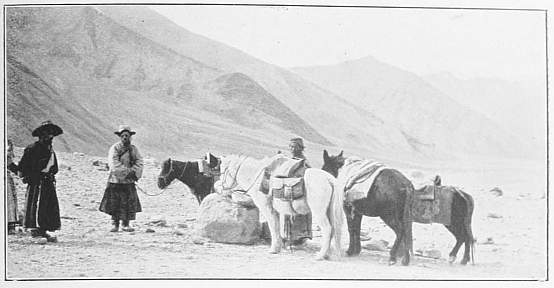
285. On the Way to Tankse.
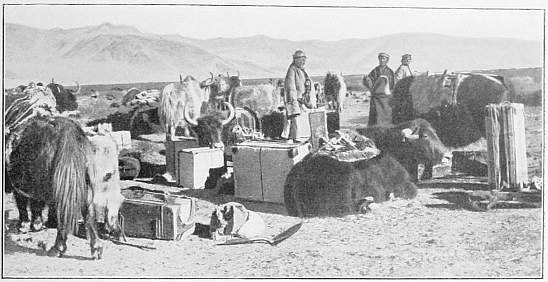
286. In the Indus Valley on the Way to Ladak.
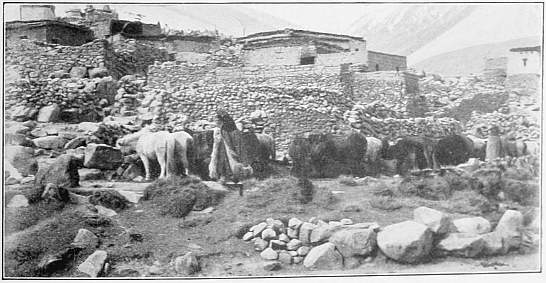
287. The New Horses and Mules at Drugub.
Gulam Razul also undertook to procure for me fifteen excellent horses from Ladak at a price of 1500 rupees. The other purchases consisted of: barley for the animals, 60 rupees; rice, 70 rupees; tsamba, 125 rupees; provender sacks, 60 rupees; clothes for the new men, 152 rupees; butter, 80 rupees; tea, 50 rupees; stearin candles and sugar, 104 rupees; a Lhasa skin coat for myself, 40 rupees; and a sleeping-bag of soft goatskin, also for myself, 25 rupees; in addition there was the hire of the pack animals which conveyed my baggage to Leh, 40 rupees, and the cost of transporting the newly purchased goods from Leh to Drugub, 20 rupees. Eleven men were to be enlisted in Leh, all having served in Hajji Nazer Shah’s commercial house and known as honest respectable people. They were to receive 15 rupees a month each, though their usual wages had not been more than 12, and three months’ pay in advance. The caravan bashi was to receive 50 rupees a month and be selected with very great care. My whole debt to Gulam Razul amounted to nearly 5000 rupees, for those who had had the trouble of making all these purchases were to receive a douceur over and above. I sent a note of hand to Colonel Dunlop Smith, with directions that this sum should be paid to Gulam Razul, in order that he might have security if I did not return from this journey.
On October 30 Gulam Razul sent his son to Leh to equip the new caravan, which was to reach Drugub, ready in all particulars, on November 30. For the valuable services rendered me on this occasion Gulam Razul afterwards received from H.M. King Gustaf of Sweden the gold medal “for distinguished service,” and I recommended him to the Indian Government for the title of honour, Khan Bahadur; of course I based my appeal in this case on the great commercial services he had rendered to the Indian Empire.
In Gar-gunsa I heard news of a new treaty between Great Britain and Russia, which had been concluded in October of this year. “Great Britain and Russia bind themselves not to allow any scientific expedition of any kind whatsoever to enter Tibet for the next three years without previous agreement, and call upon China to act similarly” (Illust. 274).
It seemed as though this clause were especially designed to meet my case. I said not a word to Gulam Razul about it. But I saw that I could no longer travel in Tibet as a European. Last year I had been successful when the political situation was still unsettled, but I had taught both the Chinese and Tibetans a lesson, and shown them that it was possible for a European to travel right across the country. I had also placed a weapon in their hands against me. I should not be able to manage it a second time. Now they would keep their eyes open along the periphery of the inhabited country. I must travel in disguise to attract as little attention as possible. Another courier was therefore sent to Leh to procure me a complete Ladaki costume in Mohammedan fashion. Gulam Razul also was of opinion that, considering all circumstances, it would be wisest to travel as a merchant. The new caravan leader was to be our master, while I myself should figure as “the least of his servants,” and keep myself out of sight in all negotiations.
The whole affair was a desperate game, a political and diplomatic game of chess, the stakes being my own life or great geographical discoveries. I, who had hitherto stood on the most friendly and confidential terms with the Tibetans, must now avoid them as enemies. I should not be able to see any Tibetan face to face, and should have to conceal my own eyes in order not to be caught. Therefore a large pair of round goggles with dark glasses was bought; inside them I fastened polished glasses of the strength suited to my sight. My European outfit was restricted as much as was at all possible; the large camera and the boat were sent to Leh with my other baggage, and I took with me only a small Richard’s camera.
The main point was that in inhabited districts I should conduct myself with Oriental self-control and be entirely passive. The outcome of this mad plan was to me enshrouded in impenetrable darkness. I only knew that I must go northwards from Drugub in the direction of the Karakorum pass, then turn to the east and south-east, and endeavour to cross from Lemchung-tso the blank space lying to the south of Bower’s route in 1891, and thence continue my journey through the great blank patch on the north of the upper Tsangpo. If I were successful, I would go south to India either through Nepal or through Gyangtse, where perhaps I might have an opportunity of meeting Major O’Connor, as I had always wished to do. Gulam Razul advised me to be very cautious, for the Rudok-dzong had a paid spy in Drugub, who had to report on the movements of Europeans on the English side of the frontier. This spy was one of the most dangerous reefs in my fairway; the suspicion of the Tibetans was at once roused when they found that I had bought twenty mules from Gulam Razul. The Garpun sent a messenger to find out what I wanted them for. He was told that they were for a journey to Khotan.
Thakur Jai Chand had an excellent jamadar whom he sent to meet the baggage coming from India. At length, in the beginning of November, we received news that the consignment was coming. Then Robert proposed to go to meet our wished-for guests with some of our new mules. Late on the evening of the 6th they all turned up when I was already in bed. They were five policemen from Rampur, one of them suffering from inflammation of the lungs and more dead than alive. When Robert met them they were so starved and exhausted that he had first to massage the whole party to put new life into them (Illust. 276).
I at once gave orders to light a roaring fire and serve tea. They came up with their laden mules, two Mohammedans, three Hindus—all in dark blue uniforms with tall blue-and-white turbans, rifles, and bayonets. I bade them welcome, thanked them for the excellent way in which they had performed their task, and made their corporal give me an account of their difficult and trying journey over the Ayi-la. Then they were shown to sleeping-places in a tent, and next day I looked through the nine chests sent to me by Colonel Dunlop Smith. Three of them contained 6000 rupees in silver, all of the Queen’s reign, none of the King’s, for the Tibetans will not take rupees on which King Edward’s face is stamped. The other boxes contained tinned meat of all kinds, preserves, chocolate, cheese, cakes and biscuits; cigars, cigarettes and tobacco; gold and silver watches, and revolvers with ammunition, for presents; cartridges for two of our guns; note-books and map paper; a whole library of new novels, including Jack London’s The Call of the Wild—a present from O’Connor and suitable reading for the adventurous time before us; an anemometer and a hydrometer, presents from the chief of the Central Meteorological Institute in Simla, Dr. Gilbert Walker; and a host of other necessary and acceptable articles. The amiable Colonel, his equally amiable sister, and his daughter, had had no end of trouble in selecting and purchasing the things, packing them up and transmitting them to Tibet. It was owing to their kindness that I was able for a long time to live like a prince, and I cannot be sufficiently grateful to them.
Now I had nothing more to wait for. The policemen were well paid, and I also bore the expense of their return journey and gave them winter clothing; took a hearty farewell of my sincere friend Gulam Razul, without whose help the new journey would have been impossible; thanked Thakur Jai Chand and the other Hindus for their kindness, and started off on November 9, 1907, north-westwards along the course of the upper Indus.
On the 26th we reached Tankse, where the dignitaries of the district and even the tesildar of Leh came to meet us. They had already heard that I intended to travel to Khotan in midwinter. The following day was to be a day of rest, for here I was to discharge all my old servants except Robert and the Gurkha, Rub Das. When I had breakfasted, Tsering carried out the plates and dishes, which now had many chips out of their enamel. “This is the last time, Tsering, that you will wait on me.” Then the old man began to weep, and hurried out quickly.
Then I summoned all the men to my tent and made them a speech, telling them that they had served me faithfully and obediently, and had well earned the comfort and repose that awaited them by their domestic hearths in the bosom of their families. I wished them good fortune and prosperity in the future, and reminded them of the loss we had all sustained by the death of Muhamed Isa—good old Muhamed Isa, who, when we were last at Tankse, had made all arrangements so cleverly and conscientiously. And to show them that we were not the only ones who mourned for him, I read them what Younghusband, O’Connor, and Rawling had written to me about the deceased.
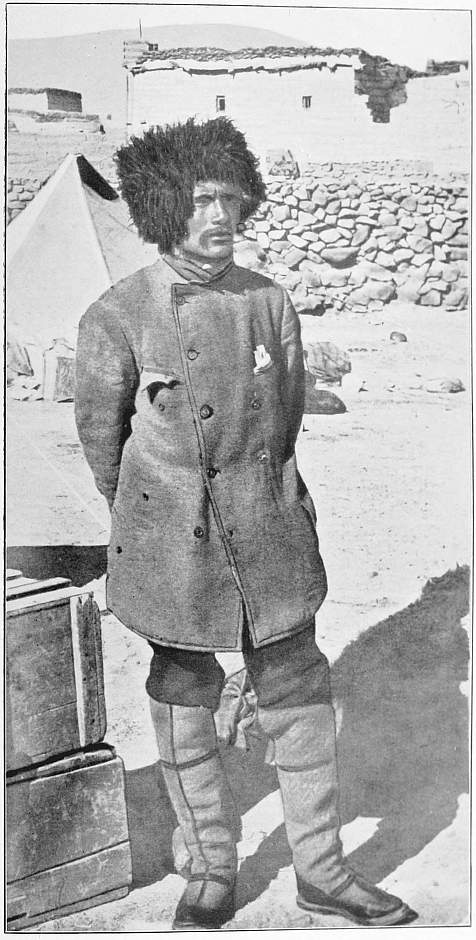
288. Robert in Winter Dress.
While their five horses and five yaks were being loaded with all their belongings, they came to me in my tent, one after another, to receive their pay and an extra present. Tsering, Rehim Ali, Shukkur Ali, and Tundup Sonam received especial gifts of money, the latter three having exposed themselves to danger on my account. Old Tsering asked to be allowed to keep the lame dog from the Ngangtse-tso; its bark before his hut in Leh would remind him of the time when the dog kept watch at our camp-fires. Shukkur Ali kept another dog from the same country. Now I had only the brown puppy, which, with Robert and the mule from Poonch, were among the oldest veterans of the caravan, all three having accompanied me from Srinagar.
And then came the bitter moment of parting. So much grief, such loud weeping! They could hardly tear themselves away. The tesildar was quite overcome at witnessing the deep attachment of my simple followers. The bonds were strong that were now torn asunder, for there is nothing which knits men together so firmly as common sufferings and dangers. I myself felt a catch in my throat, and, as the men reluctantly followed their yaks down the road to Drugub, I stood and watched them until they were out of sight. Then I dried my eyes before going into my tent, where Robert and the tesildar were waiting for me with tea and cakes served up by Rub Das. I could not help thinking of a funeral repast after an interment, at which a wreath of violets had been laid on the grave of a departed friend.
Next morning I awoke to new surroundings. All my old companions were scattered to the four winds, and now they were gone all seemed empty and deserted. Robert read off the meteorological instruments as usual, and Rub Das laid my breakfast as noiselessly as an elf. I was glad that in spite of everything I felt not the slightest irresolution. The same angel who had protected me on my former journey would again attend my steps. I seemed to hear once more in the distance the rustle of his wings in the cold winter nights on the Chang-tang.
CHAPTER LV
A NEW CHAPTER
As soon as we were ready we mounted our horses and rode down to Drugub. Soon the old village came in sight with the house in which I had dwelt six years before, and the garden in which we had halted in the year 1906. On a terrace below the village stood our three tents and a fourth. The jamadar Ishe, old Hiraman, who never omitted to greet me, and young Anmar Ju, another of my old friends, salaamed and presented to me my new men. These three had orders from the tesildar to accompany me to Shyok.
“Who is the caravan bashi?” I asked.
“I am,” answered a little wrinkled old man called Abdul Kerim, and wearing a large yellow skin-coat (Illust. 289).
“What are the names of the others?”
“Kutus, Gulam, Suen, Abdul Rasak, Sedik, Lobsang, Kunchuk, Gaffar, Abdullah, and Sonam Kunchuk.”
“You are then eleven men altogether—three Lamaists and eight Mohammedans?”
“Yes, Sahib.”
“I shall at some future time take down your names, ages, places of abode, the journeys you have made, the services you have been in, etc.”
It turned out that very few of them had ever been in the service of a European, but all had been employed by Nazer Shah, and his son Gulam Razul answered for them. Four had been in Lhasa, and almost all the Mohammedans in Yarkand, and all seemed pleasant and cheerful, and were in the prime of life.
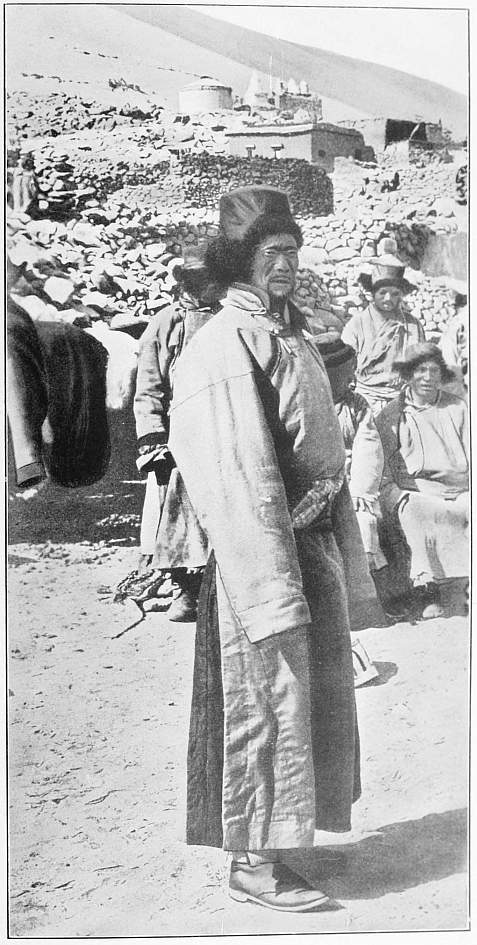
289. Abdul Kerim, the New Caravan Leader.
“Which of you is my cook?”
“I am,” answered Gulam, a comical little fellow, who immediately received a lecture from Rub Das how I was to be attended on (Illust. 291).
“Are you all Ladakis?”
“Yes, Sahib, all except Lobsang, who is a Tibetan from Gar-gunsa, but has married in Leh and has served with the Hajji Nazer Shah.”
I was somewhat loath to take a Tibetan with me on a journey where it was essential to keep the Tibetans as long as possible in the dark. If danger threatened, how easily he could betray me to his countrymen! I considered whether I would not exchange him for another man, or simply leave him behind. But how often had I reason subsequently to rejoice that I had not given effect to the suggestion! With the exception of the four Russian cossacks and Robert, Lobsang was the best servant who ever accompanied me on my journeys through the wilds of Asia. He was a splendid man, and I cherish a warm recollection of him (Illust. 290).
All were now welcomed into my service, and I expressed the hope that they would perform their duty as faithfully as their predecessors, promised them an extra donation of 50 rupees each if I were contented with them, and told them that I would pay the expenses of their return home from the point where our journey ended, just as I had done before. When it was known in Leh that I wanted fresh servants for the journey to Khotan, Guffaru and all the men I had sent home from Tokchen presented themselves and begged earnestly to be restored to my service. But the old Hajji had received strict directions from his son. Not one of my old servants might accompany me this time, for it would increase the danger if we met Tibetans with whom we were already acquainted.
The new horses seemed fine and strong, and stood, eating hay and barley, in a long row along a wall, beside the mules and the veterans from Leh. They were to be well fed, for the days of feasting would soon be over, and it would be well if they put on flesh, on which they could fall back in evil days. All the goods ordered were of the best quality, and packed in new strong boxes covered with leather (Illust. 287).
On the morning of November 29, 1907, three Tibetans came from Rudok-dzong and set up their tents on our left wing. There, I thought, now espionage is beginning. An hour later we heard the sound of bells up in the valley. The noise became louder and louder between the cliffs, and a great din was raised as thirty-four fine little mules with loads of salt passed by my tent. All had a chain of small bells round their necks, most of them were adorned with red and blue ribands, and some had large red tassels hanging at their chests, which almost touched the ground and swung about at every step. It was a bright and lively scene, and the jingle of bells allured me out to fresh adventures in distant regions. In the twinkling of an eye the animals were relieved of their loads and driven up the valley like a herd of wild asses, to graze on the scanty grass among the granite. The owners must then be traders. They afterwards came into my tent, took tea and cigarettes, and asked Abdul Kerim whither we were travelling. He answered without lying, “To Khotan.” It was I who lied. But had I told the truth, I should have been stopped in fourteen days, and might as well have gone home at once.
We had three new tents. The two larger accommodated my eleven servants; the smallest, which was so small that one could only stand upright under the ridge-pole, and could only hold a bed and two boxes, was mine. I wished to have one as small as possible that it might more easily be kept warm. All my baggage was re-packed. I gave some superfluous articles to Robert and to the Rev. Mr. Peter in Leh. There was a very thorough sorting out, and only what was absolutely indispensable was packed, filling two boxes, one of which chiefly contained Swedish and English books, sent by my sister Alma and Colonel Dunlop Smith. As soon as they were read, they would be offered to the winds. When I moved at night into my new tent and laid myself to rest in the large sleeping-bag lined with sheep’s wool, and covered myself, I was as warm and comfortable as in a bed at home.
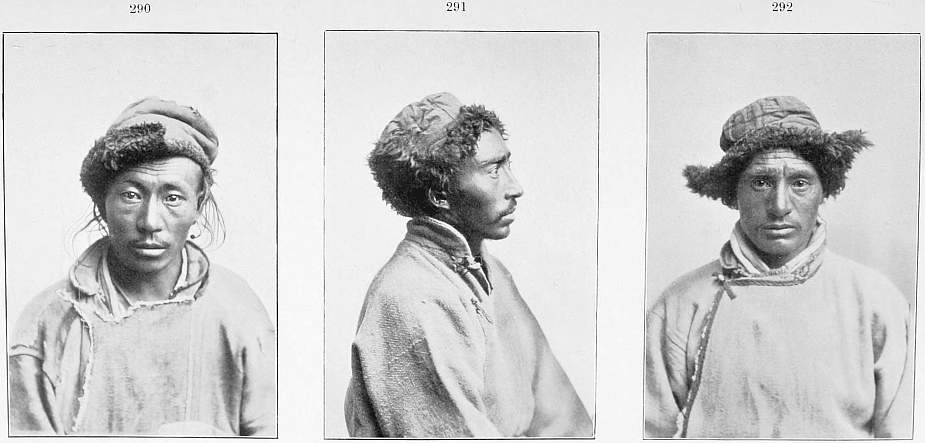
290. Lobsang; 291. Gulam; 292. Kutus—My Last Trusty Followers.
Gulam Razul’s son, Abdul Hai, visited me, and our business matters were transacted with him. Robert remained responsible for my heavy baggage until he had deposited it in the house of the Hajji Nazer Shah. It consisted of ten regulation horse-loads. In my leisure hours I wrote a heap of letters, which Robert was to hand in at the post-office in Leh.
We had now 21 mules and 19 horses, the brown puppy, and a large yellow dog from Gartok. All the mules and horses, except mine and Abdul Kerim’s saddle-horses, carried loads (Illusts. 296, 297, 298). I rode my little white Ladaki, which had grown marvellously strong again, and was as spirited as one of the new horses. He and two others were the survivors of the large caravan which had, on the former occasion, set out from Leh. In order to make sure that Abdul Kerim took sufficient provender, I told him he must not think that I would follow the direct road like ordinary caravans. I might make excursions right and left, and often remain stationary for a week at a time. He must, therefore, provide barley for the animals for two-and-a-half months, and he must take care that the provender we took with us lasted out. But it is stupid to trust to others. All the heavy baggage from Simla, the silver money, and the tinned provisions made four loads; Gulam’s chests of kitchen utensils, two; the tent, the bedding, and the belongings of the men made several loads; all the other animals were to be laden with rice, barley, and tsamba. We also took 25 sheep from Tankse.
In the night of December 3 the thermometer fell to −10.1°. Next morning all the baggage was packed up and carried down the valley to Shyok by coolies. Two fellows, as strong as bears, carried my two tent-boxes. The animals carried only their new saddles. One group after another marched off, and at last I remained alone. Then I shook hands with my faithful companion, Robert, thanked him for his invaluable services, his honesty, his courage, and his patience; asked him to greet for me the missionaries, Dr. Neve, and warm India; took leave also of honest Rub Das and all the others; mounted into my new Ladak saddle on my trusty white, and rode down to the Shyok valley with Anmar Ju. I was the last remaining of the original caravan, and was surrounded by men who were complete strangers to me. But I was also strange to them, and they had no suspicion of the foolhardy adventures I intended to lead them into. The wind, however, was the same, and the same stars would twinkle in the sky during the cold silent nights in Tibet. So I should not be quite alone.
It is little more than 6 miles to Shyok, and yet this short distance took almost eight hours. We had to cross the river six times, which just below the village of Drugub has cut a deep narrow passage between rocks of granite and gneiss. The first crossing was easy, for there the river had been frozen over in the night, and though the ice cracked, we passed over by a path strewn with sand. At the second passage the river was open, but broad and shallow, and the ice belts on both sides had been strewn with sand. The third, where we had to cross over again to the right bank, was very awkward, because ice belts suddenly ending in the middle were flooded in consequence of a damming up of the ice lower down. They could not therefore be strewn with sand, and we had to be careful lest we should fall out of the saddle when the horses set their feet down in the water 3 feet deep. It is little more agreeable when he jumps up on the opposite edge, and his hoofs slide about before he can get a firm foothold on the smooth ice.
Below this place was the fourth crossing—the worst of all—and here the whole train had come to a halt. On the right bank, where we stood, the river was broad and deep, with icy cold, dark-blue, transparent water winding down, but at the left bank lay a broad belt of ice. Suen, a tall, black-bearded man with very Jewish features, bared his body and examined the ford on horseback. In so doing he got into water so deep that his horse began to swim. Then he jumped in himself and swam to the edge of the ice, where it cost him great effort to climb up. Poor man! I shivered as I looked at him; he had been quite under water.
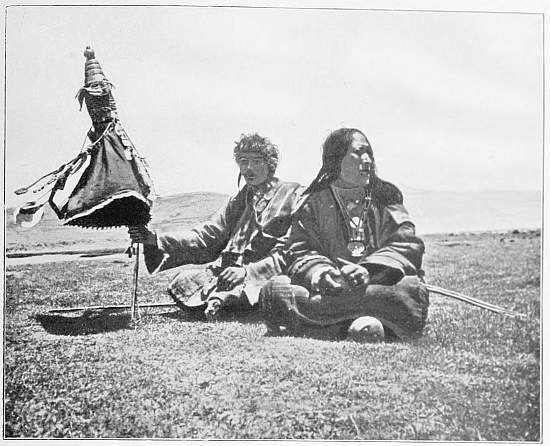
293. Beggars.
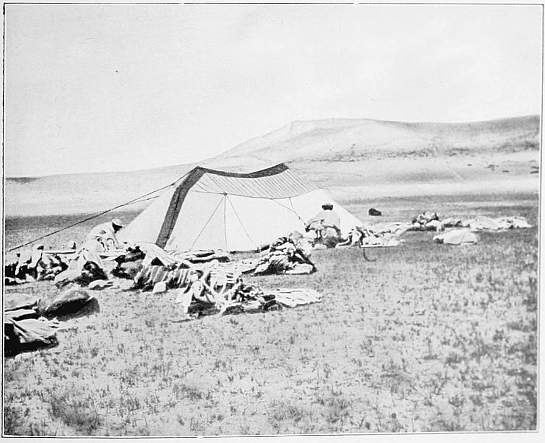
294. Abdul Kerim’s New Tent.
Four of the others made an attempt a little higher up, and got over, but they were up to their necks in water. Then the whole troop of mules and horses were driven into the river; the horses managed best. One mule, I felt sure, would be lost. He made no attempt to hoist himself on to the ice until he had been pelted with stones from our bank. And when at length he was up and was following the track of the others, the ice cracked and gave way under him, and there he lay enclosed. All five men had to pull him out and drag him over the ice to solid ground.
Barely 100 yards farther down is the fifth ford. Between the two stands a steep, smooth, projecting rock, its foot washed by the river. It is, however, possible to climb over the rock up small fissures and over slight projections and thus avoid the two detestable fords. Here all the baggage was carried over by the coolies, and I myself climbed over the rocks barefooted; a short way beyond this crag a strong man carried me over smooth flooded ice. Here we had plenty of time for meditation, while the animals were again driven through such deep water that they almost had to swim. All were wet up to the root of the tail and many had water over their backs. The poor creatures stood together closely in a group, with pieces of ice hanging from their flanks and knocking together like castanets. We kindled a fire that the five men who had been in the water might undress, dry themselves, and change every stitch of clothing.
Then we went some distance downstream to a place where the heavy provisions were piled up on the bank, and the poor animals had to enter the icy water before they had got warm again. Here the baggage had to be carried over the river by stark-naked men, who tried with staves in their hands to keep their equilibrium among the treacherous rounded stones in the river bed. An elderly man was seized with cramp when he was half-way across, and could not move a step. Two bold youths jumped into the water and dragged him to land. Two mules, which could not be induced by coaxing or scolding to enter the water, were tugged over with a rope. I had a guide before my horse, which was wet half-way up the saddle, so that I had to tuck up my legs as high as possible, and in this position it was very difficult to keep my balance, as the horse made unexpected jumps among the blocks. The men raised such a loud hurrah that the mountains rang again when I was over the last ford with a whole skin; a blazing fire prevented any ill effects from my foot-bath. Every man, who came across shivering, dripping, and blue with cold, had to sit down immediately by the fire. I could not understand why they were not frozen to death.
Then we rode in the twilight up and down hill, and it was pitch dark before a welcome blazing fire showed us that we were near the village of Shyok. We gathered round it as we came up, and delighted in its radiating heat. I could not help consoling myself with the thought that, if any pursuers followed me up from the English side, they would at any rate get a cold bath before they found me.
In the night the temperature fell to only 15.4°, but here we were at a height of only 12,365 feet. We stayed on December 5 in Shyok, to dry the pack-saddles and give the animals a day’s rest after their trying work. In the evening the men held a farewell festival, for Shyok was the last village in Ladak. As soon as the drums and flutes were heard, all the women and girls of the country flocked to the dance.
On December 6 we took leave of our last friends, and marched down the slopes to the floor of the Shyok valley, where the altitude is 12,300 feet; it was the lowest spot we were in for a long time (Illust. 300.) For from here we mounted northwards up the valley excavated by the great affluent of the Indus. There is no road or path to speak of, only rubbish and rounded boulders, but the scenery is wonderfully fine, and gigantic granite crags tower up on all sides. We crossed the river five times, which here carries about 420 cubic feet of water and has belts of ice of varying breadth. A solitary starved wanderer from Yarkand met us, and was given a meal of tsamba. We pitched our camp among the bushes in a bed of sand at Chong-yangal, where I had stayed in the year 1902.
We were now alone. Only one man not belonging to the caravan was still with us, Tubges of Shyok, who had charge of our sheep during the early days of our journey, especially at the fords. In the evening I had a conversation with Abdul Kerim, Kutus, and Gulam. I now told them that I would not travel to Khotan by the ordinary road, because I knew it already. We would strike more to the east, and the sooner we came up on to the plateau the better. They replied that Tubges knew the country well. He was called in to the consultation. What if we went through the Chang-chenmo valley to Pamzal and the Lanak-la? “No,” he answered, “that is impossible; one can go as far as Oro-rotse, but there the valley becomes as narrow as a corridor, and ice cascades and boulders cover the bottom of the valley. Animals cannot get through even without loads.” It was then evident that we must continue up the Shyok valley and watch for an opportunity of diverging eastwards.
So on the 7th we went on between grand mountain gables, silent and solemn, like Egyptian pyramids, like cathedrals and fortress towers. Between them detritus cones descend to the valley floor, where their bases are eroded by the high water of the summer flood and cut off in perpendicular walls. It must be a magnificent spectacle when the turbid thundering water rolls down from the melting snow of the Karakorum and fills all the valley, making its way with tremendous force to the Indus. An enormous block of perhaps 70,000 cubic feet has fallen down; it has cracked in falling, as though a giant had split it with his axe; one fancies one can see the gap it has left on the heights above. Four times the path crosses the stream, and the rather narrow opening of the Chang-chenmo valley is left on the right. We encamped among the dunes of Kaptar-khane. In the night the temperature fell to 2.5°.
The way is terribly trying, nothing but detritus and blocks of grey granite, against which the horses wear out their shoes. Again we crossed the river twice and set up our tents in the oasis Dung-yeilak, where a worn-out caravan from Khotan had already settled, and had sent a messenger to Nubra for help, as several of their horses had foundered.
As long as there was pasturage we could take matters quietly and make short marches. Only too soon the grass would come to an end, and then we must make more haste. So we rested a day when the merchant Muhamed Rehim from Khotan arrived at the oasis with his caravan. But he only remained an hour, for he wanted to reach warmer regions, and was glad to have the Karakorum pass behind him. He earnestly advised me to wait till spring, for the snow lay deeper than usual on the pass. One of his caravan men also came to me and gave me a handful of dried peaches. “Does the Sahib remember me?” he asked. “Certainly, you are Mollah Shah.” The good fellow, now fifty-seven years old, and with his beard greyer, had never visited his home in Cherchen again since he had left my service in the spring of 1902. What a singular wandering life, full of toil and adventure, these Asiatics lead! He implored me to engage him again, but I told him he ought to be glad to go down into Ladak instead of returning to the frightful pass in the middle of the icy winter. It would certainly have been pleasant to have with me an old tried companion. But no, he would have been out of place in my Ladaki company. Mollah Shah told us for our encouragement that a large caravan had lost fifty-two horses on the pass, and had been obliged to leave behind the greater part of their goods.
None of my people knew yet my actual plans. As long as we were on the great winter route to Eastern Turkestan they must all believe that Khotan was my destination. We had also the advantage that all who met us would report in Ladak that they had seen us on the great highway, and thus no suspicion would be aroused.
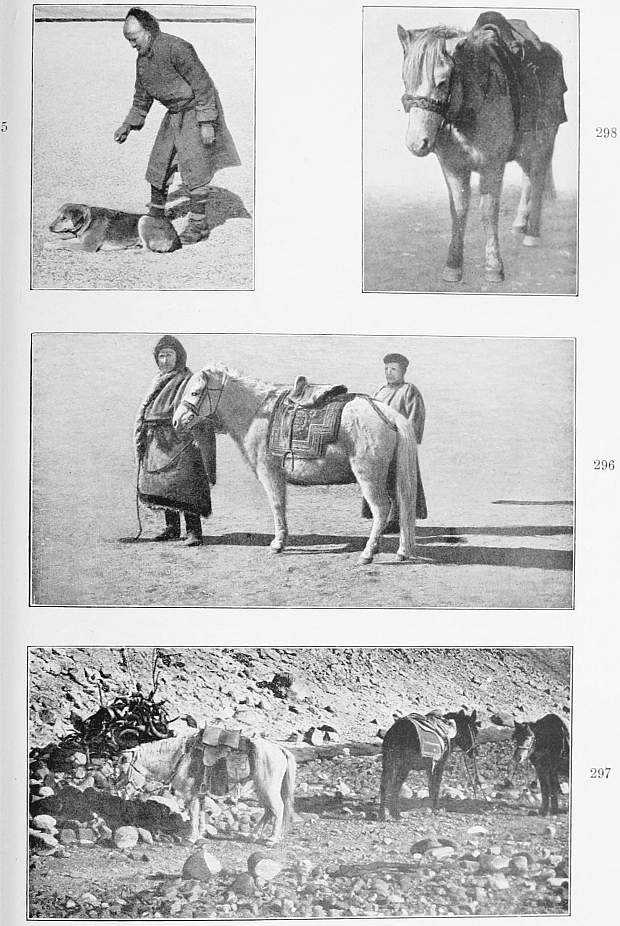
295. My Brown Puppy with my Cook, Tsering. 296, 297, 298. My White Ladaki Horse.
December 10. It was colder, the minimum temperature being −2.4°. My Curzon hat was burned in the fire. In its place I put on a large skin-cap which Muhamed Isa had sewed together, and wound round it a pugree as a protection against the sun. Arms of the river with a gentle current were covered with glittering ice, but the main stream, now much smaller, was nearly free. At the camp at Charvak a spring brook dashed down the rocks in a tinkling cascade, though the cold did all it could to silence it. The animals were driven up the slopes where the grass was better. A huge fire was lighted when the day declined, and a narrow sickle of a moon stood in the sky. Where the animals were driven up, there was a thundering fall of stones in the night, and some blocks rolled down and lay among our tents. It was a dangerous place.
We had a cold march on the way to Yulgunluk. When thick snow-clouds cover the sky, the wind blows in the traveller’s face, and the temperature at one o’clock is 14.9°, one feels the cold dreadfully, and has to tie a thick neck-cloth over the face. The valley is lifeless and deserted. Hitherto we had only seen a hare, an eagle, and a raven; the last followed us from camp to camp. Six times we crossed the stream; the brown puppy was carried over, but the yellow dog found his way across—he howled piteously whenever he had to go into the cold water.
In Yulgunluk also, at a height of 13,455 feet, we encamped a day. Now the thermometer fell in the night to −6.2°. This was the last really pleasant and agreeable oasis we came across. During the day of rest we heard the horses neighing with satisfaction on the pastures and the sheep bleating. The loads of provender were already smaller, so we could load four horses with good knotty firewood. On the right side of the valley rose a snowy mountain. As early as two o’clock the sun disappeared, but it lighted up the snow long after the valley lay in deep shadow; the sky was blue and cloudless. In the evening the men sang at the fire just the same melodies as their predecessors. The winter days are short, but they seem endlessly long to one tortured by the uncertainty of his cherished hopes. By eight o’clock the camp is quiet, and at nine Gulam brings in the last brazier after I have read the meteorological instruments. How I long to get out of this confined valley on to the plateau country! Here we are marching north-north-west, and I ought to be going east and south-east. If we could find a way up to the Chang-tang by one of the valleys to the east, we should be saved much time and many a weary step.
On December 13 we looked in vain for such a way. We crossed the river twice more on its ice-sheet. At the second ford the whole caravan passed over dry-shod, and only my small white horse broke through and I wet my feet. After a third crossing we camped in a desolate spot just opposite the Shialung valley. It looked promising. Tubges and Kutus were sent up the valley to spy out the land. In the evening they returned with the tidings that we could go a fairly long distance up the valley, but beyond it became impassable owing to deep basins, abundant ice, and large boulders, just as in the Drugub river. We must therefore keep on the route to the Karakorum pass. This increased the risks for the caravan, for it lengthened the distance; but, on the other hand, it lessened the danger of discovery, for when once we had got into Tibet we could avoid the most northern nomads.
Now Tubges begged permission to accompany me to the end, and his petition was eagerly supported by all the other men. I was the more willing to take him that he was a skilled hunter. I had now twelve men, and I made the thirteenth in the caravan. But we were not superstitious.
CHAPTER LVI
UP TO THE HEIGHTS OF DAPSANG
Heavy clouds and piercingly cold wind increased the difficulty of our march on December 14 up the valley. We saw two bales of goods, sewed up in linen and with the stamp of a Turkestan firm, lying on the ground, as though they had fallen from a dying horse, the carcase of which we had passed. Higher up two more. They contained silken materials from Khotan. So far the caravans come with failing strength after excessive exertions on the pass. They are like ships which must throw their cargo overboard when they begin to sink. At Köteklik also we found passable grass and firewood. Gulam is a capital cook; he prepares me the most delicate cutlets and rissoles, and for a change gives me chickens and eggs.
On the 15th there is little water in the valley; it runs under rubbish, but farther up the river is again fresh and clear. We frequently pass the remains of unfortunate caravans—dead horses, bales of goods, and pack-saddles from which the hay has been removed to save the life of a dying horse. We travel west-north-westwards, and therefore ever farther from our goal. But at length we come to a valley which will lead us in the right direction. We leave the Sasser valley to the left and enter a valley portal full of treacherous ice, often as thin as skin. We wait till our scouts have tried the ice, which they declare to be impassable. Tubges, however, finds another, longer way, over steep hills, and at their foot we pitch our camp.
Next morning we went over a steep spur of porphyry to reach a better place on the frozen river which was to afford us an easterly passage up to Murgu. We crossed again and again the strip of ice, which was first strewn with sand that the horses might not break their legs. As usual, two scouts went in advance. One of them came back and called to us from a distance that a fallen rock closed up the valley. On reaching the spot I found that a landslip had lately taken place. The blocks of porphyry barring the channel were as big as houses, and between them the river formed deep basins covered with a thin coat of ice. We had therefore to turn back and retrace our steps all the way down to camp No. 279, over the terrible rock, which on this side was so steep that each animal had to be shoved up separately, and the men had to look out for themselves when a pack got loose and rolled down the acclivity. Then we went some distance up the Sasser valley. A strong icy wind blew in our faces. Beside a wall of rock the dogs put up a hare which took refuge in a hole, but Kunchuk pulled him out again and he was condemned to be eaten. Our camp this time was in an almost barren place, and after all the fording of the river during the day icicles clinked on the flanks of our wearied animals.
It is evening again. The mountain spurs project, dark and rugged, into the valley like huge sarcophagi, and on them rest moon-lighted snowfields like shrouds. The Ladakis sing no more; their ditties are frozen on their lips. It is awfully quiet. The kitchen fire flickers with yellowish-red tongues in the white moonshine. One can almost hear the sound of the frost outside.
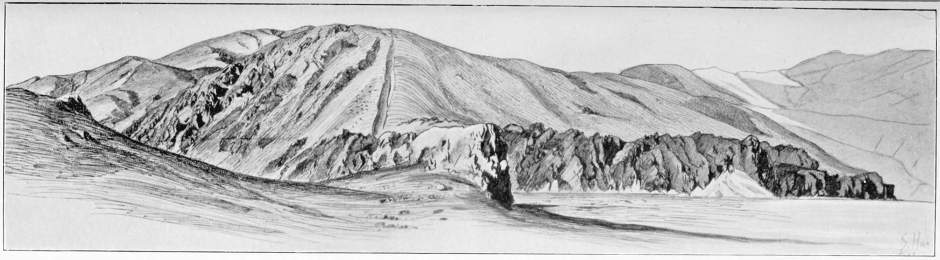
299. Panorama from Camp 422, Bongba.
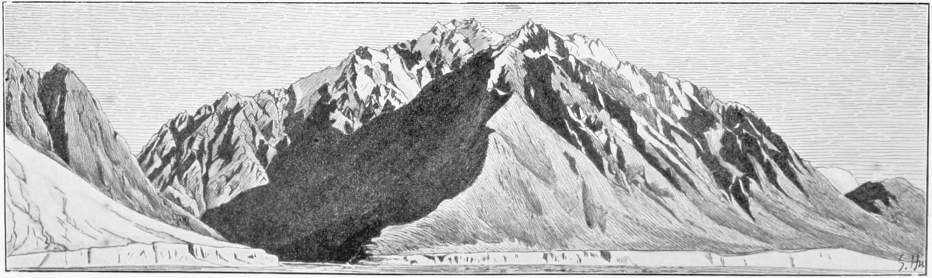
300. Panorama from Camp 277, Shyok Valley. Sketches by the Author.
After Gulam has brought in the last brazier I undress myself, put on my large woollen dressing-gown, set myself a while right over the fire to get a little heat into my body before I creep into my lair of fur, and smile to hear the yellow dog, who is lying outside, and barks and snarls at the increasing cold in the angriest and most comical tones. No wonder he is enraged, for the thermometer falls in the night to −12.8°. Then I hear a singular squeaking in Gulam’s tent. We had already anticipated a happy event, and now I inquired whether there was an addition to the Puppy family. Four small puppies had again come into the world. They had waited for the very coldest night we had yet experienced. Gulam had contrived a cage of frieze rugs in which Puppy lay, licking her young ones. Two of the tiny animals were of the female, two of the male sex; the former were drowned, for we thought that the others would grow stronger if they monopolized all the milk and heat that would otherwise have been divided among four. I sat by the hutch and studied the interesting group till I was so stiff with cold that I could hardly walk back to my tent. Next morning the tiny curs were going on splendidly; one of them whined in quite the orthodox fashion, and no doubt thought what a grim cold country fate had launched him into. We determined to take good care of them, for they would be pleasant companions for me. Up here they would at any rate be immune from the sickness which had carried off their elder sisters. Kunchuk had to carry them against his bare skin to keep them warm. Half-way Mamma Puppy was allowed to occupy herself for a while with her little ones, though these did not seem quite to understand the milk business.
We had a bad march on December 17. No shouts of encouragement were heard, but the caravan moved on slowly and apathetically. Within half an hour our feet were benumbed and lost all feeling. I wound the ends of my bashlik like a visor several times round my face up to the eyes, but the breath turned it into a thick crust of ice which froze to my moustache and beard, which I had allowed to grow since leaving Gartok to suit my intended Mohammedan disguise. All the men put on their furs. Dust and soil flew about, and our faces had a singular appearance.
At a place where a Yarkand caravan was encamped, we turned to the right up a very narrow valley, in which the floor, covered with bright milky-white ice, looked like a marble pavement between the rocky walls. Fortunately the Yarkand men had strewn sand over the ice, but still it did not prevent several of our animals from falling, so that they had to be loaded again.
When we at length camped in Long the temperature was at zero even at three o’clock. A second large Yarkand caravan, on the homeward journey, was halting here. The leaders asked us to travel with them over the Karakorum, but I refused, with the excuse that we could make only short day’s marches. Observation by any who might tell the Chinese in Yarkand that I had again passed over into Tibet was exactly what I must avoid above everything.
Here lay a poor man, both of whose feet had been frost-bitten on the Karakorum, so that the flesh and toes actually fell off. He crawled up to our camp and wept over his disastrous fate. He had been engaged with the Yarkand caravan we had met first, but as he had become incapable of work owing to his wounds, the barbarous merchant had dismissed him in the midst of the wilds and left him behind. In such a case it is hard to know what to do. We could not cure him, and to take him with us or give up a part of the caravan for him was out of the question. He said himself that he would crawl to Shyok, but how was he to get across the river? I let him warm himself at our fire, drink tea and eat, and on the 18th, when we went on after 56½° of frost in the night, I gave him tsamba for several days, matches, and a sum of money which would enable him to hire a horse from a caravan travelling to Shyok.
This day’s march took us eastwards to a place called Bulak (the spring); it should properly have been called Guristan (the graveyard), for here lay at least twenty dead horses. During a ride of two hours I had counted sixty-three carcases of horses; it is wonderful that trade on this caravan route, the highest in the world, can be profitable.
From there the route ran up the narrow fissured Murgu valley, at first up and down over hills, where numbers of dead horses, which had once been strong and fat, showed us the way. Then we descended a break-neck path into the deep valley, where spring water at the bottom formed cracked domes of ice. Then on the slopes of the left flank we climbed again up a zigzag path; the snow became deeper and was piled up, especially on the path, so smooth that if the horses had made a false step we should have been lost beyond recovery. The landscape was magnificent, but it could not be properly enjoyed when the temperature about one o’clock was only 0.3°. And then again we went down headlong to the valley bottom, where we passed over a natural bridge of rock improved by the hand of man. Our direction had been east, but now we diverged more and more to the north and north-west.
The snow becomes deeper, the sun sinks, the shadows creep up the reddish-yellow hills, the wind is stronger, and one thinks: If this lasts much longer I shall freeze. At last we halt at the foot of a terrace on the right side of the valley, where the sheep are driven into a cave to keep them warm in the night. I slip down from the saddle with all my limbs numbed, and long for a fire. Not a trace of organic life was to be seen at camp No. 283. The horses and mules were tethered so that they stood in a close pack.
At this unlucky camp I made the first discovery on this new journey through Tibet. Abdul Kerim came to me at the fire and said:
“Sahib, we have barley for eight to ten days more; but in that time we shall reach Shahidulla, where we can get everything.”
“Eight to ten days! Are you mad? Did you not obey my orders? Did I not tell you expressly to take barley for 2½ months?”
“I brought a supply with me which was enough for the journey to Khotan.”
“Did I not tell you that I was not going to Khotan by the ordinary route, but by roundabout ways which would demand at least two months?”
“Yes, Sahib, I have acted wrongly,” answered the old man, and began to sob. Abdul Kerim was an honest man, but he was stupid, and he had not the great experience of Muhamed Isa.
“You are caravan bashi, and the duty of a caravan leader is to see that there is sufficient provender for the journey. When the ten days are over, our animals will starve. What do you mean to do then?”
“Sahib, send me with some animals to Shahidulla. I can be back again in a fortnight.”
“You know that everything that happens in Shahidulla is reported to the Amban of Khotan. The Chinese must know nothing of our intentions.”
My first notion was to dismiss Abdul Kerim at once and to write to the Hajji Nazer Shah for more provender, which might be brought up on hired animals. But what would they think in western Tibet and Ladak if I sent for more provender from Leh when I was barely eight days’ journey from Shahidulla, which lies on the direct road to Khotan? My whole plan would be betrayed and must fail. I should be stopped by the first nomads, perhaps by the English whom I had so happily escaped hitherto. It was only necessary to forbid the natives to supply me with provisions and baggage animals. And if I procured all we wanted in Shahidulla, the Amban of Khotan would send word to Kashgar, whence a telegraph line runs through Asia to Pekin, where His Excellency Na Tang proved so absolutely immovable when the Swedish Minister Wallenberg had given himself so much trouble to obtain for me permission for a new journey through Tibet. Up here in this desolate valley my position was strong. We had sneaked quietly and cautiously through British territory without exciting suspicion. But as soon as we came into contact with the outer world we should be caught.
I sat in my tent all the evening, considering the matter from all sides, and measured the distances on my map with compasses. We were about 100 miles from my camp No. 8 of the preceding year, where the grass was so good. So far we could travel without the least difficulty. But beyond we had 430 miles more, to the district on the Tong-tso. However, before we came there we must meet with nomads and grazing land. The horses, indeed, would be lost, but the Tibetan mules were, so Gulam Razul said, accustomed to shift for themselves, and they were not given barley. The first step was to reach the free open Chang-tang and get out of this frightful mousetrap, the Shyok valley, which was always taking us further north-north-west. Even if we had to sacrifice everything and creep on all fours to the nearest tent, I would not give in: I would not depart a hair’s breadth from the original plan.
Night came with a clear sky, twinkling stars and sharp frost; by nine o’clock the temperature was down to −20.4°. The animals stood quietly crowded together to keep themselves warm. When I awoke occasionally I did not hear them, and they might have vanished. The minimum was reached at −31.2°. When I was awakened, Kutus had been out on the prowl into a broad valley, coming in from the east, and had found a road which, as far as he could see, was excellent. We had still two days’ journey from camp No. 283 to the dreaded Karakorum pass, which I wished to avoid. If we ascended the side valley eastwards, we should soon arrive at the main crest of the Karakorum range and be spared two days’ journey. I resolved to try it.
So we travelled on December 20 to the east-north-east over crunching snow. The valley looked very promising, especially as old horse tracks could be seen in some places. In the middle of the valley was the bed of a brook covered over with smooth, treacherous ice, but elsewhere there was nothing but detritus. After we had passed a hill thickly overgrown with burtse tufts, all vegetation ceased. At one o’clock the temperature was −5.8°. My beard was white with rime, my face-cloth turned into a mass of ice, and all the animals were white. For hours we slowly mounted upwards. In some places the valley was so contracted that it was only 2 yards broad. The best of the day was over when the caravan suddenly came to a halt. All was quiet in the front, and I waited with Kutus for whatever was to happen.
After a time came Abdul Kerim, much cast down, with the news that the valley was impassable at two places. I went to look. The first barrier of rocks might be forced, but the second was worse. We could certainly have dragged the baggage over the ice between and under the blocks, but there was no passage for the animals. Should we try to make a road along which the animals could be helped over the blocks by the united strength of the men? Yes; but first men must be sent up to find out whether there were more of such barriers to cross. When they came back with the news that the way was still worse above, I gave orders to pitch the camp, as the shades of evening were falling.
Good heavens, what a camp! Not a blade of grass, not a drop of water! Again we sat in a mousetrap between steep mountain walls, where, at any moment, devastating blocks might be detached from the sides by the frost. The horses scraped about in the snow looking for grass. During the night they roamed about, and stumbled over the tent ropes. The thermometer fell to −30.6°. One puppy lost his way, got outside, and came of his own accord into my tent; fortunately for him I was awakened by his whining, and gave him shelter in my bed, where he was warm and comfortable.
A frosty morning! we must take care not to touch metal, for it burns like fire. A mule made his way into my tent and looked for something edible in my washing-basin. To his great astonishment it stuck to his nose, and he took it a few steps with him. The hungry animals had consumed two empty sacks and six ropes during the night, and played the mischief with one another’s tails. In winter, life up here is a desperate struggle with the frost.
The orders for the day were to encamp in a place where there were stalks of yapchan and burtse, and remain there all the next day. I set out at a temperature of −23.8° and found the camp all ready on the right side of the valley. The animals were immediately sent up the slopes, and there grazed with a good appetite on the dry frozen stalks. During the day of rest, pieces of ice were hewn out of the brook and melted in the two large kettles of the men. Horses and mules were then able to drink their fill.
In the night a most welcome change took place in the weather, the whole sky was overcast, and the thermometer fell only to 1°; it felt quite warm in the morning. Some mules had stampeded, but Lobsang found them after a diligent search. I set out with Kutus soon after the caravan. We had not gone far when we saw Muhamed Isa’s white Shigatse horse lying frozen stiff in the snow. He had been in a wretched state for some days, and the last hardships had been too much for him. Worn-out and emaciated he really needed a long, long rest.
After a while we passed the valley junction and the unlucky camp No. 283, and were again on the great caravan route, the road of dead horses. Four lay in a ravine quite close together, as though they did not wish to part even in death. A large dapple-grey showed no change, but another horse looked as if it were stuffed, and a third, with its outstretched legs, resembled an overturned gymnasium horse. Some were nearly covered with snow, and others had fallen in a curious cramped position, but most of them lay as though death had surprised them when they were composing themselves to rest after violent exertion. Nearly all were hollow: the hide was stretched over the backbone and ribs, and they looked intact from the back, but on the other side it could be seen that they were only empty, dry skeletons, hard as iron, which rattled when the yellow dog, who had nothing else to eat on the way, pulled them about. The dogs barked at the first carcases, but soon they became familiar with the sight of them. What sufferings and what desperate struggles for life these dreary mountains must have witnessed in the course of time! Lying awake at night one fancies one hears the sighs of worn-out pack animals and their laboured breathing as they patiently go towards their end, and sees an endless parade of veterans condemned to die who can endure no more in the service of cruel man. When the dogs bark outside in the silent night they seem to bark at ghosts and apparitions who try with hesitating steps to make their way out of the snowfields that hold them fast, and intervene between them and the juicy meadows of Ladak. If any road in the world deserves the name “Via dolorosa,” it is the caravan road over the Karakorum pass connecting Eastern Turkestan with India. Like an enormous bridge of sighs it spans with its airy arches the highest mountain-land of Asia and of the world.
Higher and higher our slow train ascends the fissured valley where here and there small glacier tongues peep out between the steep crags. Frequently old camping-places are seen with ripped-up pack-saddles. Hurricanes from the south prevail here; fine red dust from weathered sandstone flies like clouds of blood through the valley and colours the snowfields red. The valley shrinks to a hollow way where a somewhat more sheltered spot bears the name “Daulet Bek ulldi” (where Daulet Bek died). Who was he? No one knows; but the name has remained. Probably an ordinary trader from Khotan or Yarkand, or a pilgrim who died on his wanderings, and therefore found the doors of paradise wide open. For over the Karakorum pass runs the main pilgrim route from Eastern Turkestan to Mecca.
The valley becomes ever smaller—a mere corridor between walls of red conglomerate. This is the Kizil-unkur, or the Red Hole, an appropriate name. Here the caravan has pitched its camp. Not a sign of organic life. The animals stand in a group, and the mules gnaw at the frozen dung of former visitors. From this hole the way rises up to the Dapsang plateau, where a snowstorm is now raging, and even in the valley flakes of snow dance and whirl in the air. In the twilight Tundup Sonam comes up with only twelve sheep; the others have been frozen to death on the way. Night falls threatening and awful on the everlasting snow. Everything up here is so dreary and cold (16,824 feet); there is nothing living far and wide, and yet the yellow dog fills the ravine with his barking.
The men set up the tents near together, and a very scanty fire burned among them, for we had to be economical with the firewood from Köteklik. The Mohammedans started a low charming song in rising and falling tones, and now and then a strong voice intoned a hollow “Allahu ekber.” When Gulam came with the brazier I asked him what it meant, and he said that it was a namas or hymn of prayer to Allah, that the Most High might protect us in the morning from the snowstorm. For if a caravan is caught in a snowstorm on the heights of Dapsang it is lost.
I often heard this melodious hymn again in days of hardship, and it always affected me painfully. Not as the reproachful warning clang of church bells ringing for service, when I pass a church door without going in, but because the men sang the hymn only when they were out of spirits and considered our position desperate. It seemed as though they would remind me that defeat awaited me, and that this time I had aimed too high.
CHAPTER LVII
ON THE ROOF OF THE WORLD
On Christmas Eve 1905 I had dined with Mr. and Mrs. Grant Duff in the hospitable English Embassy, and on another day supped with Count d’Apchier in the French Legation, and was invited to a reception by Count Rex in the German Embassy,—all in Teheran, now in such a disturbed state. The same day twelve months later I had still Muhamed Isa and Robert with me, and we were in inhabited country. Little I dreamt now that old Asia would demand still another Christmas Eve in my life, and that on December 24, 1908, I should sit at table amid a circle of pleasant and intelligent Japanese in distant Mukden, where a few years before the thunders of war had rolled above the graves of the Manchurian emperors. But this year, 1907, I was quite alone, and with twelve satellites on the way to my—Ukraine.
In the morning with a bright sun and calm weather the caravan marched slowly up towards the heights of Dapsang, while Kutus and I followed in the crunching snow. I had given Abdul Kerim orders to wait at the top. After I had read the instruments and found a height of 17,808 feet, I scoured the horizon with my field-glass—a confusion of snowy mountains. Only to the north-east a broad erosion furrow sloped gently down, and I chose that direction.
“Now we leave the Karakorum route and ride eastwards,” I said; “follow my track; I will ride in front.” The men stared in astonishment; they had looked forward to the gardens and vineyards of Khotan, and I offered them the granite and snowstorms of Chang-tang. They said nothing, however, but silently and patiently followed in my footsteps. It was not easy to lead the way, for the country was covered with deep snow. I directed Kutus, and he went before my horse to test the depth. The ground was quite level, but contained hollows where the snow lay 3 to 6 feet deep; and the crust was exceedingly treacherous, for sometimes it broke, and I was thrown out of the saddle, while the horse plunged and floundered like a dolphin, and was almost suffocated in the fine dry snow. We therefore turned back to try another direction.
Lobsang, who was always on the alert when we were in a critical situation, was already looking for a better way. But we must in any case cross the valley, and the men tramped out a furrow in the snow, through which the animals were led one at a time. The horses managed best, while the mules often fell and caused long delays. How far would this snow extend? It checked our progress and concealed any wretched pasture that might exist in some ravine. We crawled on like snails. I went on foot, and my skin coat felt as heavy as lead. But after several hours of hard toil we reached the terrace skirting the right side of the valley, where the snow was thinner and we made more progress.
Camp No. 287 was in the most desolate spot I can remember in all my travels, except the sandy sea of the Takla-makan desert. Behind us our trail wound through the white snow and in front all was snow. The animals were tethered close together, and they had a feed of corn in the evening.
After the day’s work was over I lighted two candles—usually I had but one—and set up the portraits of my family on a box, as I had often done before on Christmas Eves in Asia. At half-past eight o’clock the moon rose gloriously over the mountains to the east-north-east, and at nine the thermometer had sunk to −16.8°. I could not get the temperature above −4° in my tent, and my hands were so benumbed that I could not hold a book, but had to crawl into bed, which was the best thing to do—there one forgets Christmas with all its precious memories and its melancholy solitude.
The thermometer sank to −37.5°. A horse lay frozen hard in his place in the line; the others stood stupefied, with drooping heads, and great icicles on their noses. Christmas Eve brought us good weather. I almost longed for a snowstorm. We had no fear of pursuit, but if a Turkestan caravan now went down to Kizil-unkur, the men would see our trail in the snow and report that we were off to Tibet. A snowstorm would obliterate all traces.
Meanwhile we stumbled on eastwards through the snow. A spring supplied water where all the animals got a drink. We halted in a ravine with tufts of yapchan (17,087 feet). The animals made greedily for the dry hard stalks, which also provided us with a grand fire, and this evening it was warm and comfortable in my tent. I rejoiced to think that the days would again become longer, and subtracted the length of each day’s march from the distance between us and the Tong-tso. Ah, would we were there! And there we should be only on the northern margin of the blank space. What an immensely long way we had to travel!
Next day we followed the same flat valley eastwards between mountains of moderate height, making use of a path worn down by Pantholops antelopes. The snow became less deep and was only occasionally troublesome, usually covered with a crust as dry as parchment. When we had encamped in a perfectly barren spot, I consulted with Abdul Kerim. Only two sacks of barley were left. I saw that he had been weeping, and therefore I restrained my wrath. The others, too, were astonished and doleful. I had not yet said anything to them, but they understood that there was no question of Khotan. The men had tsamba for nearly three months and rice for two. I therefore ordered that some should be given to the horses when the barley was finished, but enough should be left for the men to last two months. The others gathered outside the tent during the consultation. Lobsang was calm and unconcerned, and could be heard singing and whistling as he watched the animals. I took to him most, perhaps because he was a Tibetan; but I liked them all, for they were capital fellows. In the evening they sang hymns to Allah, knowing that our situation was exceedingly critical.
Next day we started early, and I rode at the head of the caravan. We all had severe headaches, but the height was enormous (17,644 feet). We had marched little more than a mile when we found sparse grass in a slight hollow on the northern slopes. That was a Christmas box. Here we pitched our camp. The animals ran up to the pasture with their loads on. How they ate! It was a pleasure to see them. Suen cut ridiculous capers between the tents. The men were in high spirits. I heard no more hymns to Allah, but the caravan bashi, who seemed to think he was in some degree responsible for the spiritual welfare of all the Mohammedans, usually read every evening at sunset one of the five daily prayers. Our supply of fuel was at an end, but Lobsang found a hard moss which burned for a long time and gave out plenty of heat. Now I perceived that when we should some time part, I should miss Lobsang most.
On December 28, leaden clouds lay over the earth, and therefore the cold was less severe. We continued our course eastwards, and marched slowly till we came to a spring, which at the orifice had a temperature of 33.6°. The water felt quite warm; it formed large cakes of ice in the flat valley, which looked from a distance like a lake. While the men set up the tents here, Puppy, as usual, took charge of her young ones in a folded piece of felt. One of them had a white spot on the forehead and was my especial favourite, for he never whined unnecessarily. To-day he had opened his eyes and given a short glance at the cold inhospitable world around him. However, before my tent was ready, he died quite suddenly, and was buried under some stones that the yellow dog might not eat him up. Mamma Puppy looked for him, but soon contented herself with the last of the four. We would do all we could to keep this little creature.
On the way to the next camping-place, No. 292, we still followed the same blessed valley which had afforded us such an excellent route since Christmas Eve. The minimum temperature had fallen to −21.8°, as though a cold wave were passing over the country. At one place some wild yaks had left their visiting cards, and the men collected a sack of dung. Evidently these animals come hither only in summer; the winter is too cold even for them. A mule died before we reached a spring surrounded by fair grazing. So far we had got on well, but had made little progress; on the past six days we had covered only 47 miles.
December 30. With a minimum of zero and a temperature at one o’clock of 3.2° the range between day and night is not great. But now the sky was covered with dense clouds; it snowed and became half dark; the men could not tell in which direction they were marching, and asked where the sun rose. We had the help of the longitudinal valley for another day’s journey, and we followed it down to a junction of valleys where there was a huge sheet of ice. On the way I saw a flock of twenty-two wild sheep, which fled with great agility up a slope of detritus, bringing the stones rattling down.
In the evening I informed Abdul Kerim, Gulam, and Kutus that we were to advance into Tibet and steer our course past the Arport-tso to the upper Brahmaputra. And I told them that I should travel in disguise in order to escape notice. They were amazed, and asked if I should not expose my life to danger daily; but I calmed them, saying that all would go well if they only obeyed my orders implicitly. Our chief concern was to preserve our animals, for if the caravan were lost we should never get on. “Yes,” answered the caravan bashi, “if we only find good pasture, so that the animals can rest and eat their fill, we can certainly hold out for two months, but they will not bear long marches.”
Here we stood at a parting of the roads. Our valley opened into another, which came down from high mountains in the south, part of the Karakorum range. The united streams continued their course northwards, and could not be any other river but the upper course of the Karakash Darya; in its lower valley on the Khotan Darya I had many years before almost lost my life. Now the question was whether we should go up or down, and we decided to devote the last day of the year to finding out which was the better road, sending out Abdullah to reconnoitre south-eastwards, Tubges north-eastwards. As in any case we should have to cross the ice sheet, a path was sanded.
We packed the 6000 rupees Colonel Dunlop Smith had sent from India in two sacks, which were lighter than the wooden boxes, and these were to be used as firewood some time when all else failed. At every camp our baggage became lighter, as our provisions diminished, and I threw away one book after another after I had read them. I had received from home the numbers of a Swedish journal for half a year, and these were very useful in lighting our camp-fires. We had still nine sheep left, but the time was fast approaching when our meat supply would come to an end, for we could hardly reckon on finding game so soon.
New Year’s Day 1908 was bright and sunny—a good omen as regarded the dark riddles this year concealed. The two scouts returned with the same report: that there were no obstacles in the way; and I let them discuss the question themselves, and decide which way was the best. They chose Abdullah’s route, which led up the valley south-eastwards. The road here was excellent. At the mouth of the valley we found a couple of small round stone walls, which, however, might very well have been a hundred years old. The sight of a dead yak had an enlivening effect on us, contradictory as it may sound. Higher we mounted to where a lofty snow mountain with glaciers could be seen at the end of the valley. Then we stopped, and scouts were sent forwards. They declared that the way was impassable, and voted that Abdullah should be thrashed. But as such measures would have been of no use to us in our difficulty he got off with a good scolding. He admitted that he had not been so far up as we were now, yet on his return he had asked for, and been given, a bit of tobacco for his reconnoitring work. I told him that he had done a mean trick, and that he should never see the smoke of my tobacco again.
There was nothing to do but pitch our camp. A strong south-west wind blew, and fine snow was driven down from all the crests and summits. When the men went out to gather fuel they looked like Polar explorers. After all, New Year’s Day had brought us no good luck, but, on the contrary, a retreat.
This was commenced early on the morning of January 2, and we passed again camp 293, and marched onwards over slopes of detritus on the eastern side of the ice sheet. At one spot spring water formed a little bubbling fountain in the midst of the ice. After the valley had turned to the east-north-east we encamped in a corner where driftsand was piled up into hillocks.
I wanted to get out of this labyrinth of mountains and valleys which pour their waters into Eastern Turkestan. We were still in the basin of the Karakash river, and must sooner or later cross a pass separating it from the salt lakes of the Chang-tang. On the 3rd we again mounted up one of the head valleys and camped in its upper part, while the country was enveloped in a furious snowstorm. It continued till late in the evening, and what was most remarkable was that the stars shone all the time though the snow was falling thickly. Before, there had been blue-black clouds above us without a snowflake. Extraordinary land!
Next day we rested. The animals had been without drink for a long time, fuel was abundant, ice was taken from the river bed and melted in pots.
In this region the mountains are less continuous, and form sharp peaks and pyramids of small relative height. It snowed all night, but the morning of January 5 was fine as we travelled eastwards along the route Kutus had investigated. It led up over snow-covered ground to a small pass (17,995 feet), on the other side of which another branch of the Karakash crossed our course. We must get out of this entanglement, which delayed our march and told on our strength. As long as the animals kept up we had nothing to complain of. I was glad of every day that brought us a little nearer to spring and out of the winter’s cold. It penetrated through everything. My feet had no feeling in them. Gulam rubbed them and massaged me in the evening over the fire, but could not bring them to life. The ink was turned into a lump of ice and had to be thawed before the fire; when I wrote I had to bend over the brazier, and still the ink congealed in the pen and froze on the paper. Singularly enough I have still an unquenchable desire for ice-cold water and prefer it to warm tea, but the water we usually get is far from pleasant. It is generally Tubges who takes a spade and fills an empty sack with snow, and then melts it in a kettle. Gulam tries to persuade me to drink tea, and cannot understand how it is that I am not sick of water. It is no use being thirsty in the night: a cup of water standing near the brazier is frozen to the bottom in a quarter of an hour.
After a temperature of −28° and a stormy night, which drove the animals to seek shelter in the men’s tent, we crossed the broad valley up to the next pass. We left a lofty snow-covered mountain to the south. At the foot of a hill a wild yak was musing. When he saw our dark train against the white snow he made straight towards us, but before long he took his way through the valley and dashed in wild flight to the north, followed by our two dogs. It was very encouraging to find something living in this God-forgotten wilderness; for now we had lost even the raven.
It was a steep and slow ascent up to the pass, which had a height of 18,005 feet. We were surprised to find that it was a snow limit, for east of the pass there was no snow at all. As we descended the other side along a broad, open, sandy valley we had to be careful that we did not find ourselves without water in the evening. Far to the south appeared an ice sheet, but it lay too far out of our course. We therefore filled two sacks with snow from the last drift, encamped where thin tufts afforded fuel, and sent five men with all the animals southwards to the ice in search of water and fodder.
The water question now became pressing, for apparently we could not count on snow much farther. And we could not dig for water, as before, for the ground was frozen into stone. We must therefore proceed cautiously. We had a great open wilderness in front of us; we must make our way from one point of support to another, and explore the routes in advance, lest we might come to a catastrophe. I therefore gave orders that, now that the loads were considerably smaller, a couple of our animals should carry snow or ice. At every camp we left an empty meat-tin. I think less of the time soon approaching when the excellent goods from Simla will come to an end than of the fact that the burdens of our animals are daily becoming lighter. The rock specimens I collect do not weigh much. Of course the provender has long given out, but where the pasturage is scanty or altogether absent, loaves of parched meal are kneaded together for the animals.