Front matter (continued 2)
Reading edition
The river Kyam-chu enters the Amchok-tso on the north side, and only 1¼ miles to the west of its muddy delta the Dongmo-chu flows out of the lake towards its confluence with the Raga-tsangpo in the east. Properly speaking, the Dongmo is only the continuation of the Kyam-chu, with the lake hanging like a bag on its right bank.
After the boat has been folded up, Muhamed Isa has to show us the way on horseback over the grass-grown sandhills. He guides me across the twenty shallow and treacherously swampy delta arms of the Kyam-chu. It is dark, but a beacon fire has been lighted in the camp, and the cakes of dung are heated to whiteness in the strong wind, and shine like electric light.
Next day I was up before the sun, in order to take an observation. The thermometer had sunk in the night to 0.3°, and the wind blew regularly as a trade-wind. It is pleasant to see the day dawn in the east, and life begin anew among the tents. The hired yaks have lain tethered during the night, and now they are allowed to wander freely over the pasture. Sleepy yawns are heard in the tents, and men come out and make up the fires; the jug bubbles in which the morning tea is stirred up with butter, and kettles are set on three stones over the fire. The puppies play in the open, and are glad that they have not to roll about to-day in a basket.
The days and months fly by to a chorus of storms, and spring still delays its coming. In the evening songs of the Ladakis I fancy I hear an undertone of home-sickness, and they rejoice at every day’s march which brings us a little further westwards. When we woke next morning, it blew as fresh as ever, and Robert had made himself a mask with Tibetan spectacles sewed into the eye-holes; he looked very comical in this contrivance, which was very appropriate in this land of religious masquerades.
The road, ascending the broad valley of the Pu-chu, led over open, slightly undulating ground to Serme-lartsa. Here old Guffaru was reported sick; he suffered from colic, and was well nursed. But late at night Robert came breathless to my tent to tell me the old man was dying. When I came to the tent the son, whose duty it was to keep the shroud ready, sat weeping beside his father, while the other men warmed their caps over the fire and applied them to the body of the patient. I ordered him a cold compress, but he asked me, to the intense amusement of others, just to go back to my tent again. Muhamed Isa laughed till he rolled over. Guffaru sat upright on his bed, moaned and groaned, and begged me to go away. I gave him a strong dose of opium, and next morning he was so brisk that he walked all the way, though a horse was at his disposal. The remains of Burroughs and Wellcome’s medicine chest had saved his life; he was thankful and pleased that his shroud was not required this time.
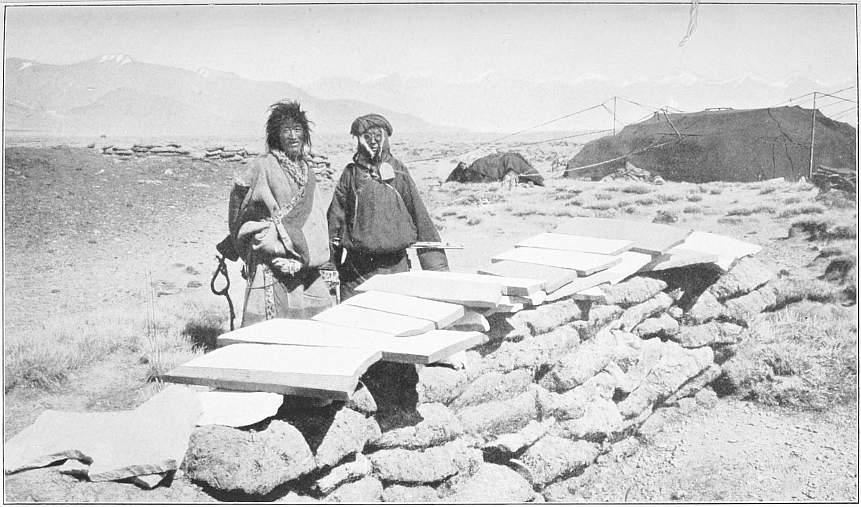
211. Manis on the Way to the Angden-la.
On May 11 we mounted to the pass Lungring (17,697 feet) in a bitterly cold snowstorm, and descended the valley of the same name to the bank of the upper Raga-tsangpo. On the 12th we marched upstream; the valley is broad, and is bounded on the north by great mountains. The thermometer had sunk to −0.8°, and the storm was dead against us. Occasionally it abated so much that we could hear the footfalls of the horses on the detritus, but we were benumbed when we came to the camp. Thick snow fell all the afternoon. My puppies sat together in the tent door and growled at the falling flakes, but when they saw it was no use, they snapped at the flakes as though they were flies and pawed at them. Then they went back into the tent, lay on the frieze blanket in the corner, and let it snow on.
On the next day’s march we passed Kamba-sumdo, where the two head sources of the Raga-tsangpo unite; the one, coming from the west, is named Chang-shung, the other, from the south-west, Lo-shung, i.e. “Northern” and “Southern Valley.” The Chang-shung is the larger. The Lo-shung we had to cross twice, and found the bed full of stones connected by slippery ice. In the west a large snow-covered ridge appeared, the Chomo-uchong, or “High Nun,” which was discovered by Nain Sing. Ryder measured it and produced an exact map of it. Belts of snow descend from the white summits down the dark flanks. Other Tibetans called it Chōōr-jong (Illust. 212).
Still marching south-westwards we approached at an acute angle the great main road between Lhasa and Ladak, the so-called tasam. As though to show its importance a caravan was just at the time travelling westwards in three columns. It moved so slowly through the landscape that we had to watch the mountain spur behind to convince ourselves that the small black lines were moving at all. Soon afterwards we pitched our tents in Raga-tasam (16,234 feet), a station on the great high-road, where we came in contact with the route of the English expedition under Ryder and Rawling for the first time since leaving Shigatse. Whatever the immediate future had in store for me, it was above all things my desire to avoid this route as much as possible. For the map which Ryder and Wood had executed is the best that has been surveyed of any part of Tibet; I could add nothing new to it with my modest equipment. But if I passed to the north or south of their line of march, I could supplement their map with my own explorations. In this I actually so far succeeded that out of eighty-three days’ marches to Tokchen on the Manasarowar only two-and-a-half days’ march ran along their route.
As I now perceived that we should have to travel on the road which Nain Sing in the year 1865, and Ryder and Rawling and their comrades in 1904, had passed along, I wrote, after consultation with Robert and Muhamed Isa, to Tang Darin and Lien Darin in Lhasa. I represented in an urgent appeal to the former, the High Commissioner, that it could not clash with any treaty if I, being already in Tibet, travelled to Ladak by one road or another, provided that I actually did go thither, and that I therefore begged permission to take the following route: I wished to take my homeward way past the lake Tedenam-tso, of which Nain Sing had heard, then to visit the Dangra-yum-tso, and thence to proceed to Tradum and to the Ghalaring-tso, the holy mountain Kailas, the Manasarowar lake, the sources of the Indus and the Brahmaputra, and lastly Gartok. To the other, the Amban of Lhasa, I also wrote about the way I desired to take, and promised to send him a report about it from Gartok. I told both that I wished for a speedy answer, and would wait for it in Raga-tasam.
As soon as I had come to a decision, I called Tundup Sonam and Tashi, and told them to get their sleep over by midnight. Then I wrote the above-mentioned letters and letters to my parents and to Major O’Connor. When my correspondence was ready, it was past midnight. The camp had lain several hours in sleep when I made the night watchman waken the two messengers and Muhamed Isa. Their orders were such as they had never received before. They were to travel day and night along the 220 miles to Shigatse and hand over my letters to Ma. They need not wait for an answer, for I had asked the Mandarins to send me special couriers. Provisions they need not take, for they would be able to get everything on the great high-road, and I gave them money to hire the horses they required. They would be able to reach their journey’s end in ten days, and in a month we ought to have an answer. If they did not find us in Raga-tasam on their return, they were to follow in our track.
Tundup Sonam and Tashi were in good spirits and full of hope when Muhamed Isa and I accompanied them outside the camp, and watched them disappear into the dark night. They made a detour to avoid the twelve black tents standing here, lest the numerous dogs of the village should bark. It was not far to the great high-road, and at the next tasam, as the stations are called, they could hire horses at daybreak. Muhamed Isa and I sat a while in my tent in lively conversation about our prospects. Not till I had crept into bed after a tiring day did it occur to me that it was perhaps cruel to let the two men ride alone day and night through Tibet. But it was too late, they must now fulfil their mission.
There was no hurry now. We stayed here seven days. Westwards the way was open, but not the way I wished to take, and therefore we were prisoners in our own tents. “Patience,” whispered the ceaseless winds. The unknown land lay to the north; I could not give it up till all my efforts had proved fruitless. We had cold unpleasant weather, with frequently more than 36 degrees of frost, and on the night of May 15 as much as 46.4 degrees. The Tibetans said that this neighbourhood is always cold, even when spring reigns all around.
I lay on my bed and read David Copperfield, Dombey and Son, and The Newcomes, for I had now a whole library to read through, the gift of the obliging Major O’Connor. Robert gave me lessons in Hindustani, and I drew types of the people. A puppy of the same age as our own warily came up to my tent and got a breakfast. Mamma Puppy was by no means pleased with this wayside guest, who looked comical, as shy and quiet as a mouse; he sat by the hour together at the fire and looked at me, at length falling asleep and turning on his side. When he appeared again at dinner, he was thoroughly worried by Puppy, but nevertheless went calmly to the family mat and laid himself down. Puppy was furious, but so dumbfoundered at this unexpected impudence that she laid herself down on the ground beside the mat.
Tibetans came every day to my tent and implored us to make a start. When this proved useless, they declared at length, that they could no longer supply us with provisions, for no more were to be had in the neighbourhood. I asked them, as an experiment, whether they would forward two letters to the Mandarins in Lhasa, but they replied that they had no authority to do this. They were much astonished when they heard that I had sent off letters five days previously. For two days I lay in bed, for I was quite at an end of my strength, and made Robert read to me.
On Whitsunday, May 19, we had another long palaver. The Tibetans read to me the instructions they had received from Lhasa, which were dated “on the tenth day of the second month in the year of the fiery sheep.” I was there called Hedin Sahib, and the orders contained the following clauses: “Send him out of the country. Let him not turn aside from the tasam, and guide him neither to the right nor to the left. Supply him with horses, yaks, servants, fuel, grass, and everything he wants. The prices he must pay are the usual prices fixed by the Government. Give him at once anything he asks for and refuse him nothing. But if he will not conform to the directions on his passport, but says he will take other routes independently, give him no provisions, but keep firm hold of him and send off messengers at once to the Devashung. Do not venture to think for yourselves, but obey. Any one in the provinces who does not obey will be beaten; so run the regulations you have to conform to. If he gives no trouble, see that the nomads serve him well and do him no harm on the way to Gartok. Then it will be the business of the Garpuns (the two Viceroys) to take him under their protection.”
And yet I was not satisfied. I told them that I could not think of conforming to my passport, which was contrary to my religion, and that I must go northwards from the Chomo-uchong to Saka-dzong. They were quite at liberty to send messengers to the Devashung. We would wait. Then they held a council, and at length agreed to let us take the northern route, but we must set out on May 21.
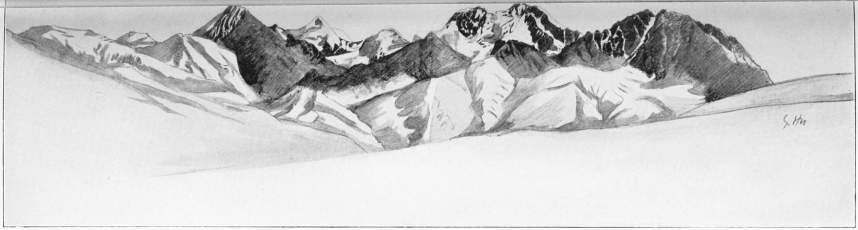
212. Chomo-uchong from Lamlung-la.
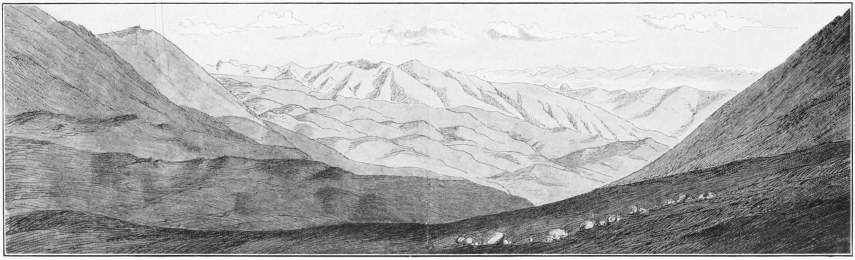
213. Panorama from the Ta-la. (The Brahmaputra Valley and the Himalayas in the background.) Sketches by the Author.
I lay on my bed and dreamed of the tramp of horses coming both from the east and the west, of the roads open to me to the mysterious mountain system in the north, round which my plans and my dreams circled continually like young eagles.
So we set out on May 21, north-westwards, and saw the summits of the Chomo-uchong disappear behind its outskirts. From the camp we could see several valleys in the north-west drained by the source streams of the Raga-tsangpo. Just beyond Raga-tasam we again left the route of the English expedition, and on the 22nd climbed up to the pass Ravak-la, which lies on a low ridge between two of the source streams of the Raga-tsangpo. On the 23rd we crossed four passes. The Kichung-la is the watershed between the Raga-loshung and the Chungsang, a river which takes an independent course to the Tsangpo. The ascent to the fourth pass, the Kanglung-la, was very tiresome, the ground consisting of wet alluvium, wherein the horses sank so deep that we preferred to go on foot and splash through the mud. We were now on the heights whence the water flows down to three of the northern tributaries of the Brahmaputra; the third flows to the Chaktak-tsangpo, which runs to the west of Saka-dzong. Here and there the snow, owing to wind, melting and freezing again, has assumed the form of upright blades, two feet high and sharp as a knife. Far to the south appear parts of the Himalayas, and we are here in a grand landscape of wild and fantastic relief. Now and then the view is obscured by dense showers of hail.
On the morning of the 24th all the country was hidden by thickly falling snow, and the weather at the end of May was more winterly than on the Chang-tang in December. We ride between steep cliffs down a deeply eroded valley, and side valleys run in with narrow deep openings. In one of them is a frozen waterfall. We often cross the clear water of the river which rushes along on its way to Saka-dzong and the Chaktak-tsangpo. Violent gusts of snow sweep through the valley from time to time, and then we can hardly see our hands, and the ground and the mountains become white. In the beautiful junction of valleys called Pangsetak our tents and those of the Tibetans were heavily weighted with snow.
On the 25th we go down further. Nomad tents are as rare as on the preceding days, for people come here only in summer. The path runs frequently up along the left terrace, high above the valley bottom, where the river has formed two large basins of dark-green water. We amused ourselves with rolling stones down the steep slope; they knocked against other boulders, dashed with a thundering noise into the valley, tearing up sand and dust, bounced up from the ground, and finally plunged into the basin, raising a cloud of spray. It was childish but very diverting. The valley passes into a plain, in the southern part of which runs the great high-road between Raga-tasam and Saka-dzong. The river we had followed down is the Kanglung-bupchu, but in Saka it is called Sa-chu-tsangpo. We pitched our camp in the mouth of the valley Basang on the north side of the plain.
From here to Saka-dzong is a short day’s journey. But, instead of travelling along this road, which Ryder has already laid down on his map, I wished to see the place where the Chaktak-tsangpo unites with the upper Brahmaputra. That would involve a long detour of four days’ journey, and to this our friends from Raga would not consent without the permission of the Governor of Saka. We therefore stayed a day in the Basang valley, while a messenger was sent to him. When the answer came it was, to our surprise, in the affirmative, but under the condition that the main part of the caravan should proceed straight to Saka-dzong. I even received a local passport for the excursion.
Among other natives who at this time sat for me as models was a youth of twenty years, named Ugyu, who had lived some years before with his mother and sisters in a valley to the north, where their tent was attacked and pillaged by robbers. They had defended themselves bravely with sabres and knives, but the robber band had had firearms, and Ugyu had been struck by a bullet, which had passed through his shoulder-blade and lung, and had come out at his breast. Large scars showed the course of the bullet. When one remembers that the leaden bullets of the Tibetans are as large as hazel-nuts, one is astonished that the boy did not die of internal hæmorrhage. He appeared, on the contrary, extraordinarily healthy and blooming, and had an amiable, sympathetic disposition.
I sat on a barley sack before Muhamed Isa’s tent and sketched. Meanwhile, the baggage and provisions were made ready for the excursion. My excellent caravan leader stood, tall and straight as a pole, watching the others filling the sacks we were to take with us. He had the boat also and everything we wanted for river measurements packed up. In the evening he arranged a farewell ball for Tsering, Shukkur Ali, Rabsang, Islam Ahun, and Ishe, who were to accompany Robert and me to the Tsangpo. He had bought in Shigatse a large fine guitar, on which he played himself in his tent. This evening the dancing and singing went off more gaily and merrily than ever. We expected good news from Lhasa, and were glad that the people in Saka had granted the permission I had asked for.
On the morning of May 27 the weather was really fine after a minimum of only 23°; had the spring come at last? The main caravan had already gone off westwards to Saka, and my party was ready when Muhamed Isa came to say farewell. He was ordered to remain in Saka till I returned, and to try by all means to gain the confidence of the officials by friendliness and prudent conduct. My small caravan was on the road to the south, and we stood alone on the deserted camping-ground. After he had received his instructions we mounted into our saddles at the same time and I rode after my men. I turned once more in the saddle and saw Muhamed Isa’s stately form upright on his grey horse, his pipe in his mouth, his green velvet cap on his head, and the black sheepskin loose on his shoulder, trotting quickly in the track of the caravan. It was the last time I saw him thus.
Soon we cross the great high-road, the tasam, and ride slowly up to the pass Gyebuk-la (15,846 feet), marked by four manis, which are covered with green flags of schist with incised Buddha images. The well-worn path, and three caravans of yaks which are just coming over the pass on the way to Saka-dzong, show us that this is an important trade-route. Two of the caravans came from the great town Tsongka-dzong, which lies five days’ journey southwards, not far from the frontier of Nepal. From Saka the caravans go over the Gyebuk-la, cross the Brahmaputra, ascend the Samderling valley, and by the Sukpu-la and Negu-la passes reach Tsongka-dzong, which supplies the nomads living in the north with barley. From Gyebuk-la there is a grand view over the sharp peaks and the glacier tongues of the Chomo-uchong. On the southern slopes of the pass there are pama bushes almost everywhere, and it is pleasant to see their fresh green needles again.
The road runs down the Kyerkye valley. On a smooth wall of rock “Om mani padme hum” is hewn in characters a yard high. At camp No. 167 the Tibetans of the neighbourhood came kindly to meet me and bid me welcome, and two of them led my horse by the bridle to my tent, as is the custom in this country.
Next day we march down the valley with fresh guides, and see several ruins telling of happier times now gone by. Terraced structures for irrigating the fields indicate that barley is grown in the district. In front of us is now the broad valley of the Brahmaputra, and we come to an arm of the river where a ferry is established to transport caravans and goods on the way between Tsongka-dzong and Saka-dzong from one side of the river to the other.
Camp No. 168 was pitched at the extremity of the tongue of gravel between the two rivers. The Chaktak-tsangpo had here a breadth of 92.2 feet, a maximum depth of 2.4 feet, an average velocity of 4.56 feet, and a discharge of 664 cubic feet per second. Its water was almost quite clear, and in consequence of its greater velocity forced its way far into the muddy water of the Brahmaputra. The latter had at mid-day a temperature of 48.9°, while the water of the tributary was a little warmer, namely, 49.8°. Our companions told us that all who come to the great river drink of the water, because it comes from the holy mountain Kailas, or Kang-rinpoche, in the far west.
Shukkur Ali sat with his ground line at a deep bay with slow eddies and pulled out of the water ten fine fish, a species of sheat with four soft barbs. He had raw meat as bait on his five hooks; at one end of the line a stone was tied, so that it could be thrown far out into deep water, and the other end was made fast to a peg driven in to the bank, and a stone was laid on the line so lightly in the fork of the peg that it fell when a fish bit. The fisherman can then occupy himself meanwhile with some manual work, such as mending shoes. He puts his fish in a small enclosed basin. The fish had white flesh, and were delicate.
On May 29 we measured the main river at a place where a low island divides it into two channels 175.5 and 180.4 feet broad respectively, with a maximum depth of 3.8 feet. Here the Brahmaputra carries 2532 cubic feet of water, and 3196 after receiving the Chaktak-tsangpo. At the confluence of the Dok-chu we had found only 2966 cubic feet, but the measurement was made a month and a half earlier. The ratio of the Brahmaputra to the Dok-chu was 5:2, and of the Brahmaputra to the Chaktak-tsangpo 7:2. The Dok-chu is therefore considerably larger than the Chaktak-tsangpo.
On May 30 we followed the broad valley of the Chaktak-tsangpo towards the north-west and west-north-west till we came to a district named Takbur, whence we intended to ride next day over the Takbur-la to Saka-dzong. But it did not come off; for before I was awakened, came a chief with five attendants and made a horrible disturbance with my men and our Tibetans from Kyerkye. The latter he beat with the flat of his sword, and he took away from the former the milk and butter they had bought the evening before, saying that no one had permission to sell us provisions. He told Robert that he had orders not to let us pass through to Saka-dzong, and that he would make us stay here three months. We might not hire yaks also—which was very inconvenient, as we had only a horse and a mule after all the hired animals had gone. We might not buy provisions; but this was not of much consequence, for Robert had shot four wild-geese and found a large quantity of eggs, and the river was full of fish.
I accordingly sent Islam Ahun and Ishe to Saka with a message that Muhamed Isa should send us five horses immediately. Then I summoned the supercilious chief to my tent, where he confirmed the accounts of my men. He declared that I had no right to deviate a single step from the great high-road, and that the district in which we were was under him, not under Saka-dzong, and therefore the local passport was worthless. He intended to carry out the orders he had received, as he valued his head. When I told him that I should report his uncivil behaviour to the Mandarins in Lhasa, he jumped up and drew his sword threateningly, but when he saw that my composure could not be shaken he quieted down. In the evening he came to tell us that we might cross the Takbur-la, and brought us both yaks and provisions. Who he was we could never discover, for in Saka no one would acknowledge that he knew him. Perhaps it was only a childish attempt to cure me of further deviations from the main road. However, it was a pity that we had lost a day here. When the morning of June 1 dawned, Islam Ahun and Ishe came with our horses, which we did not now need, and brought me greetings from Muhamed Isa, who sent word that all was well with the caravan; they were on friendly terms with the authorities, and were permitted to buy all they required.
We set off again northwards and marched through the Takbur valley, where there was abundance of game—hares, pheasants, and partridges—some of which Tsering shot, and foxes, marmots, and field-mice. In the distance we saw a grey prowling animal which we took for a lynx. There were also kiangs, which seemed very unconcerned. North-west, north, and north-east huge snowy mountains were seen from the Takbur-la (16,621 feet), of which Ryder and Wood had taken bearings. Like those Englishmen, I considered it certain that these peaks lay on the watershed of the Tsangpo, and belonged to the crest of the Trans-Himalaya. I had afterwards an opportunity of proving that this was a mistake. From the pass a river runs down to join the Sachu-tsangpo. Here we saw a number of yaks in the luxuriant grass, and a nearly tame kulan kept them company.
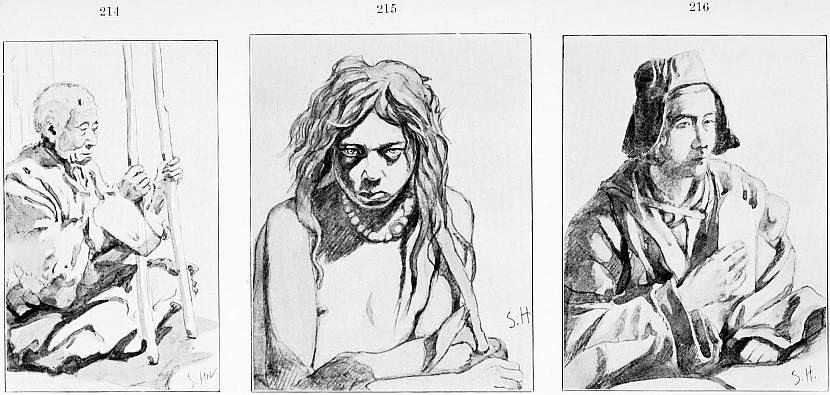
214. Beggar at Tashi-gembe. 215. Young Tibetan at the Mouth of the Chaktak-tsangpo. 216. Wandering Lama with a Wooden Glove in his Hand, such as is used to protect the Hands in the Prostration Pilgrimage round the Holy Mountain Kailas. Sketches by the Author.
Where the river emerges into the Saka plain, we passed on its left side over a last small spur of the mountain on which the pass is situated, and here I rested for an hour with Robert, to draw a panorama of the interesting country. Tsering marched on with his men, and disappeared as a speck on the great plain. To the east-north-east the white houses of Saka-dzong could be seen in the distance, and with the glass we could make out the camp, two black tents and a white, the latter Muhamed Isa’s.
Then we too passed across the plain. On the left stood four tents, where the sheep were being driven into the fold for the night. At one place the road divides; travellers who have nothing to do in Saka-dzong take the southern road. We cross the Sa-chu river and the overflow of a spring; there is a strong wind from the west, and we long for the tents and the warmth of the camp-fires. At last we are there. Guffaru comes to greet us, and all the others call out to us “Salaam!” and “Ju!” I look in vain for Muhamed Isa’s stalwart figure, and inquire for him. “He is lying in bed and has been ill all day,” they answer. I suppose that he has his usual headache again, go to the brazier in my tent, and let Robert, as usual, unpack the things I require for my evening work. We were tired and chilled through and longed for our supper.

CHAPTER XXXIX
MUHAMED ISA’S DEATH
We had not been sitting long when Rabsang came to say that Muhamed Isa had lost consciousness, and did not answer when he was spoken to. I now perceived that he had had an apoplectic fit, and hurried off with Robert to his tent, which stood close beside mine. An oil-lamp was burning beside the head of his bed, where his brother Tsering sat weeping. The sick man lay on his back, tall, strong, and straight. The mouth was a little drawn on the left side, and the pupil of the left eye seemed very small, while that of the right eye was normal. The pulse was regular and strong, beating 72. I at once ordered hot bottles to be laid at his feet, and a bag of ice on his head. His clothes were loosened; he breathed deeply and regularly. The eyes were half open, but were lustreless. I called his name loudly, but he gave little sign; he tried to turn his head and move his right arm, uttered a low groan, and then remained still again. Robert was shocked when I told him that Muhamed Isa would not see the sun rise again.
While we were sitting beside his bed I inquired the circumstances from Rehim Ali and Guffaru, who had been with him all day long. During the four days they had waited for us here, he had been quite well, and had never complained of headache. He had tried, in accordance with the last instructions I had given him at the camp in the Basang valley, to win the friendship and confidence of the authorities. The day before he had been still in excellent spirits, had drunk tea with his most intimate friends in the caravan, and had sung to the accompaniment of the guitar.
On this day, June 1, he had got up with the sun, drunk tea, and had had a stormy interview with two Tibetans from the dzong. They had refused to supply the caravan with provisions, and then insisted that the caravan should leave the place at once. He had answered that the Sahib would soon be back, and that it would go badly with them if they did not obey him. They had gone away in anger, and then Muhamed Isa had breakfasted about ten o’clock, and had slept an hour. When he rose, he had complained of headache.
When the sun had reached its noonday height he had gone to look out for us, and had then had a violent attack of sickness, fallen on his left side and lain senseless. The other men hurried up, carried him to his tent, and massaged his body. He was restored thereby to consciousness, and spoke much but indistinctly, and chiefly with the god of Islam:
“I was a Lamaist but went over to Islam; help me now, O Allah, out of this severe illness; let me recover; forgive me my sins and all the wrong I have done to others; let me live, O Allah, and I will always keep thy commandments and will never omit my prayers.”
Then he had admonished the others to do their duty as heretofore, and thanked them that they had so patiently assisted him in his misfortune. Now and then he had asked for cold water. He had felt his left arm with his right hand, and asked whose arm it was, and had also said that he did not feel the shoe on his left foot. The whole left side was quite paralysed. Sitting upright, and supported by cushions, he had made the following request to Guffaru: “Thou, who art old, and keepest the commandments of religion, wilt not pollute thy hands if thou takest a knife and cuttest my neck; cut deep down to the spine, for that will relieve my infernal headache.” In his fearful suffering he struck his right hand against a box. About an hour later another stroke deprived him of speech, and after that he had only made a sign with his right hand, as though in despair at the approach of death. Towards four o’clock Tsering had come and thrown himself over him, weeping loudly. Muhamed Isa had also wept, and pointed to his lips to intimate that he could not speak. When we entered his tent about five o’clock his consciousness was almost gone. He remained in the same condition for an hour and a half, breathing quietly, with his mouth closed. I went therefore to my dinner, which Adul had prepared for me.
Robert and I studied Burroughs and Wellcome’s medical handbook, to see that nothing had been omitted. About eight o’clock we returned to the sick-bed. Muhamed Isa was now breathing with his mouth open—a bad sign, showing that the muscles of the jaws were relaxed; the pulse beat 108, and was very weak. The despair of old Tsering when I told him all hope was gone, was heart-rending. Half an hour later the breathing became slower and weaker, and about nine o’clock the death-rattle commenced, and the struggle of the muscles of the chest to supply the lungs with sufficient air. About every fortieth respiration was deep, and then there was a pause before the next came. They were followed by moans. His feet grew cold in spite of the hot bottles, which were frequently changed. At a quarter-past nine the breathing became still slower and the intervals longer. A death spasm shook his body and slightly raised his shoulders; it was followed by another.
The Mohammedans whispered to Tsering that he should leave his place at the head, for a Mohammedan must hold the lower jaw and close the mouth after the last breath. But the sorrowing brother could only be brought to leave his place by force. A third and last spasm shook the dying man, produced by the cold of death. After a deep respiration he lay still for 20 seconds. We thought that life had flown, but he breathed again, and after another minute came the last feeble breath, and then old Guffaru bound a cloth under the chin and covered the face with a white kerchief. Then all was still, and, deeply moved, I bared my head before the awful majesty of Death.
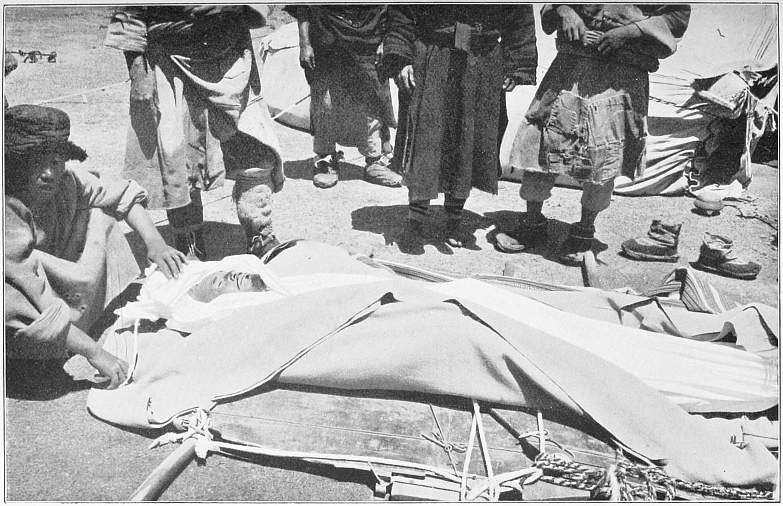
217. The Corpse of Muhamed Isa.
Horrified and dismayed, the Mohammedans poured into the tent, and the Lamaists after them, and I heard them from time to time call out in low tones, “La illaha il Allah!” Tsering was beside himself: he knelt by the dead, beat his forehead with his hands, wept aloud, nay, howled and bellowed, while large tears rolled down his furrowed sunburnt face. I patted him on the shoulder, and begged him to try and compose himself, go into his tent, drink tea, and lie down and rest. But he neither heard nor saw, and the others had to carry him to his tent, and I heard him wailing in the night as long as I lay awake. Yes, Death is an awful guest. We could hardly realize that he had so suddenly entered our peaceful camp.
I had a long conversation with Robert in my tent, and old Guffaru was sent for to receive my orders for the funeral. The Mohammedans were to watch in turn beside the body through the night. Early next morning the permission of the authorities would be obtained for the choice of a burying-place, and then the interment would take place.
At midnight I paid a last visit to my excellent, faithful caravan leader, who had fallen at his post in the prime of life. He lay long and straight, swathed in a shroud and a frieze rug, in the middle of his tent. At his head burned his oil-lamp, slightly flickering in the draught. The dead watch of five men sat mute and motionless, but rose when I entered. We uncovered his face; it was calm and dignified, and a slight smile played round the lips; the colour was pale, but slightly bronzed from the effect of wind and sun (Illust. 217). Arched over him was the half-dark bell of the tent—the tent which had fluttered in all the winds of heaven on the way through the Chang-tang, and from which Muhamed Isa’s merry jests had so often been heard in quiet cold Tibetan nights amidst the sound of flutes and guitars. Now depressing silence reigned around; only the stars sparkled with electric brilliancy.
How empty and dreary everything seemed when I woke on Sunday, June 2, the day of Muhamed Isa’s funeral! I went out and looked at the grave; it lay about 300 yards to the south-west of the camp. The Mohammedans had been early in the village to borrow a door, and had washed the body on it. Then they had wrapped it in Guffaru’s shroud, which was of thin linen, but quite white and clean. Muhamed Isa and I had often laughed together over the old man’s singular fancy of taking this death garment on the journey. Over the shroud (kafan) they had wrapped a grey frieze rug. The body lay now in the bright sunshine before the tent, on a bier consisting of the bottom of the two halves of the boat fastened together, and provided with four cross-poles for the bearers.
When all was ready the eight Mohammedans raised the bier on to their shoulders, and carried their chieftain and leader, royally tall, straight and cold, to his last resting-place. I walked immediately behind the bier, and then came Robert and some Lamaists; the rest were occupied at the grave, and only two remained in the camp, which could not be left unguarded. From Tsering’s tent a despairing wailing could still be heard. He had been persuaded not to come to the grave. He was heart and soul a Lamaist, and now he was troubled at the thought that he would never see his brother again, who had looked forward to the paradise of the Mohammedans. Some Tibetans stood at a distance. Slowly, solemnly, and mournfully the procession set itself in motion (Illust. 218). No ringing of bells, no strewn fir-branches, no chants spoke of an awakening beyond the valley of the shadow of death. But above us the turquoise-blue sky stretched its vault, and around us the lofty, desolate mountains held watch. In deep mournful voice the bearers sang, “La illaha il Allah,” in time with their heavy steps. They staggered under their burden, and had to change it frequently to the other shoulder, for Muhamed Isa was big, corpulent, and heavy.
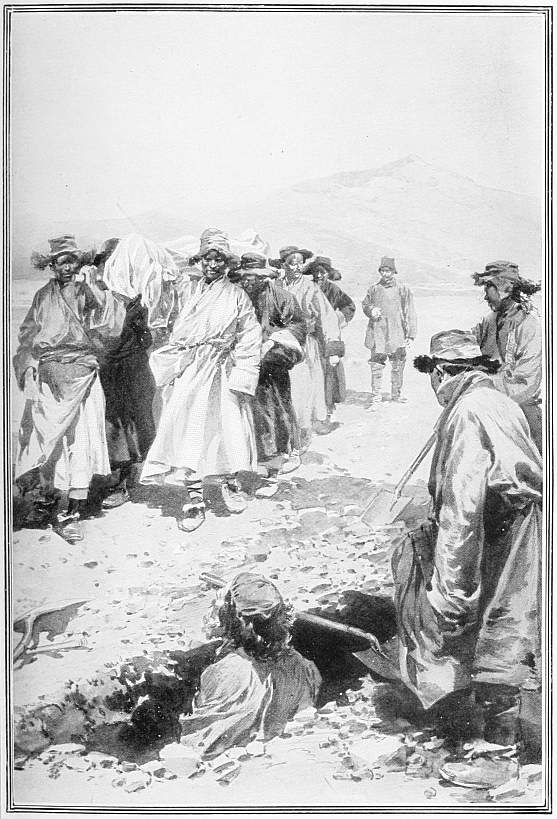
218. Muhamed Isa’s Funeral Procession.
At length we ascended a gravel terrace between two source streams. The bier was placed at the edge of the grave, which was not quite ready (Illusts. 219, 220, 221). It was deep, lay north and south, and had a cutting or niche on the left side, under which the body was to be laid, so that the earth might not press on it when the grave was filled in. Four men stood in the grave and received the body, and placed it, wrapped only in the white shroud, under the arch, arranging it so that the face was turned towards Mecca, where the hopes of all true believing pilgrims are centred.
Scarcely was all set in order when a painful incident occurred, an evil omen: the overhanging vault of loose, dry gravel fell in, burying the corpse completely, and partly covering the four men. There was silence, and the men looked at one another irresolute. Shukkur Ali broke the oppressive silence, jumped into the grave, out of which the others clambered, dug out the body again, and removed the gravel from the shroud as well as he could. A wall was then erected of sods cut from the bank of the brook so as to protect the body, the outer space was filled in with sand and stones, and finally a mound a yard high was thrown up over the grave, two stone slabs being placed at the head and foot.
When all was done the Lamaists went home, but the Mohammedans remained at the grave to pray for the deceased, sometimes kneeling, sometimes standing up with their palms before their face. Shukkur Ali, who had been Muhamed Isa’s old friend and comrade on many of his journeys in Asia, broke out into violent weeping and wailing, but the others mourned more quietly. Finally, I said a few words in Turki. During all my journeys I had never had a more efficient, experienced, and faithful caravan leader; he had maintained discipline in the caravan, been a father to the men, and taken the best care of the animals; he had been an excellent interpreter, and had treated the natives with prudence and tact. By his happy, humorous disposition he had kept all the others in good temper. In difficult situations he had always found the right way out. In unknown country he had climbed passes and summits to look for the best route—he had always gone himself and not sent others. His memory would always be cherished and honoured among us, and he had also earned a great name in the exploration of Asia, for during thirty years he had served many other Sahibs as faithfully and honestly as myself.
We went silently home after our day’s work.
In the lectionary of this Sunday occurred the Bible text, “Thou fool, this night thy soul shall be required of thee.”
Muhamed Isa had travelled far, and was highly respected in Asia. He had been in Saka-dzong before, in the year 1904, as Rawling and Ryder’s caravan leader. He little thought then that he would return once more, and here set up his tent for the last time after his long wanderings. In the Geographical Journal of April 1909, p. 422, Rawling refers to him as follows:—
Having mentioned Saka Dzong, let me break off one moment to pay a token of respect to the memory of that faithful servant of Sven Hedin who died here. Mohamed Isa was one of the finest characters it has been my fortune to be thrown with. Trustworthy and indomitable in his work, his knowledge of Asia was unequalled by any native, for he had accompanied Younghusband in his famous journey from China, he was with Carey, with Dalgleish who was afterwards murdered, and with Dutreuil de Rhins, when he was a helpless witness of his master’s violent death at the hands of the Tibetans. He acted as my caravan bashi in the Gartok expedition, accompanied Sven Hedin during his recent journey, and died, after thirty years of faithful service, at this desolate spot.
From letters I subsequently received from Younghusband, O’Connor, and Ryder, I learned that they also deeply mourned his loss.
The grave terrace rose close to the great high-road between Ladak and Lhasa on its northern side. The mound was next day covered with cut sods arranged in steps, and a small flagstone was set in the ground at the head of the grave, whereon passing Mohammedans could spread out a carpet and pray for the repose of the deceased. On a slab of slate, smoothed down with a chisel, I scratched the following inscription in English and in Roman letters:
MUHAMED ISA CARAVAN LEADER UNDER CAREY, DALGLEISH, DE RHINS, YOUNGHUSBAND RAWLING, RYDER AND OTHERS DIED IN THE SERVICE OF SVEN HEDIN AT SAKA-DZONG, ON JUNE 1, 1907 AT THE AGE OF 53 YEARS.
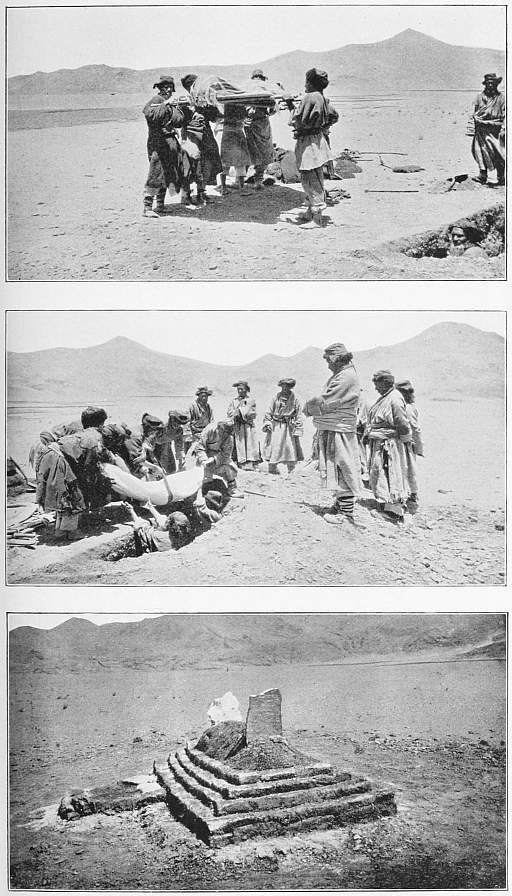
219, 220, 221. The Interment of Muhamed Isa.
The writing was then cut in the stone by Islam Ahun. The name was also engraved in Arabic, and at the top the formula, “Om mani padme hum,” in Tibetan characters, that the people of the country might respect the grave. Future travellers will find the stone in its place—if the Tibetans have not taken it away.
In the afternoon of June 3 I sent for Tsering to my tent. He was now calm and resigned. He was to be my cook and body-servant as before, but his pay would be raised to 20 rupees a month, and this rise was to date back to our departure from Leh. He was allowed to keep the watch I had given to his brother. Guffaru, the oldest of the men, was Muhamed Isa’s successor as caravan bashi, received the same increase of pay as Tsering, and was allowed to use Muhamed Isa’s grey horse and saddle. In future he would live with two other men in the tent of the deceased.
As I foresaw that the discipline would not be what it was in Muhamed Isa’s time, I spoke seriously to the men, telling them that they must obey Guffaru as blindly as they had his predecessor, that they ought to hold together as before and continue to serve me faithfully. If any one began to quarrel and was disobedient, he would at once be handed the pay due to him and be sent off to go where he liked. Now that we travelled with hired yaks I could very well spare half the men, and therefore it was their interest to conduct themselves so that they might be retained. Rabsang and Namgyal answered in the name of all, that they would hold together, serve me faithfully, and follow me anywhere.
Then Robert was commissioned to look through the property of the deceased in the presence of Tsering, Guffaru, Shukkur Ali, Rehim Ali, and the Hajji, and after he had made an inventory, to pack it in separate boxes, which were ultimately to be delivered to his wife in Leh together with his outstanding pay. Among his things were some articles of value which he had bought in Shigatse—carpets, tea-cups with metal saucers and covers, ornaments, and woven materials. He had left behind only 10 rupees in ready money, a proof that he had been thoroughly honest in his management of the business of the caravan.
After all relating to the interment had been carried out, the Mohammedans came to ask for a few rupees to enable them to hold a memorial feast in the evening in honour of the deceased. They would make a pudding, called halva, of flour, butter, and sugar, drink tea, and kill a sheep. The heathen also, as the Mohammedans called their Lamaist comrades, were to be present. They sang, ate, and drank, and probably hardly thought of the departed.
Two gentlemen from the dzong had been with me on June 2. The Governor himself was absent, travelling in his province to number the tents under his administration and to draw up a list of all the inhabited valleys—all by order of the Chinese. Pemba Tsering, the second in command, was very agreeable and polite, but regretted that he could not supply us with provisions any longer, as he must be prepared to furnish necessaries to the men who were constantly passing to and fro between Gartok and Lhasa. To confirm his words he called up the five Govas or district inspectors of the country, who declared that the poor country could not supply all the tsamba and barley we required. I intimated to them that we should still remain a few days awaiting the answer from Lhasa; then they rose, protesting that I might stay here as long as I liked, but that they would not provide me with provisions.
On the same day a large white-and-blue tent was set up by our camp, but it was not till June 4 that the occupants, the Govas of Tradum and Nyuku, paid me a visit. They had heard of our long stay, and wished to find out the state of affairs for themselves. The Nyuku Gova began the conversation:
“Saka and Tradum are put down on your passport, but not Nyuku. Should you, nevertheless, go thither, I will allow you to stay one night, but not longer, for it is stated in the passport that you must travel straight to Tradum.”
“My dear friend,” I replied, “when once I am in your place we shall become such good friends that you will ask me to stay a whole month to consolidate our friendship. Should you afterwards visit me in India, your visit will be the more agreeable the longer it lasts.”
He nodded with a roguish smile, and no doubt considered me a wag, but added that he must obey the orders he had received from the Devashung.
“When I am in correspondence with the Mandarins in Lhasa, and am waiting for their answer, the Devashung has no right to interfere.”
“Very well, then it will be best for you to remain here and not come to Tradum or Nyuku; provisions are still scarcer there.”
Afterwards Pemba Tsering came again, bringing two sacks of barley and a sheep. He had become much more compliant since he had talked with the other officials, and promised he would try to procure what we needed. We had still two poor horses and a mule from Shigatse, and he was to have one of the animals as a reward. After some consideration he chose the mule. The two horses we sold for a mere trifle to a stranger.
Now we longed to get away from this miserable Saka-dzong and its sad associations. Out in God’s open, glorious Nature the winds blow away sorrow. We daily calculated, Robert and I, how long it would be before Tundup Sonam and Tashi returned. If the answer were sent by the so-called Chinese flying post, it might arrive any moment. But the days passed and there was no news. One day some horsemen rode past our camp on the way to the west, and reported that they had seen my two messengers in Kung Gushuk’s garden in Shigatse, but they knew nothing of their further intentions. “Patience,” whispered the west wind again. In the maze of difficulties in which we became ever more involved, my hopes rested on the answer of the Chinamen. I had told the officials here that I would set off at once if they would allow us to take a more northern route to Nyuku, but, as they would not hear of it, we remained where we were.
When I looked out of my tent my eyes were attracted to the dark grave on its hill. It seemed as if the grave held us fast, though we longed to get away from it. All was dreary and dismal; we missed Muhamed Isa, and his absence caused a great blank. But life goes on as usual. When the sun rises, the women of the village stroll about collecting dung into baskets, while the men drive the yaks and horse to pasture. They sing and whistle, children scream and dogs bark. Blue smoke rises from the chimneys of the village or from the black tents standing within walls among the houses. From the roof of the Saka-gompa with a statue of Padma Sambhava the single lama of the monastery blows his conch. Ravens and bluish-grey pigeons pick up all kinds of morsels among the tents, and the wolves which have come down in the night retire again to the mountains. Riders and caravans pass eastwards to a better land, where poplars, willows, and fruit trees are clothed in their finest summer dress. But we are prisoners in this desolate country, with Muhamed Isa’s grave as a focus.
I soon perceived what a depressing effect the loss of the big powerful caravan leader had on my men: they became home-sick. They talked of the warmth of their own firesides, and they took to crocheting and knotting shoes for their children and acquaintances. They gathered round the evening fire and talked of the pleasant life in the villages of Ladak. Robert remarked how dreary and disagreeable Tibet was, and how warm and delightful it was in India; he was pining for his mother and his young wife. I should like to know whether any one was more eager to be off than myself, who had so much before me which must be accomplished. Yes, I saw only too plainly that I could not achieve all I was striving for with my present caravan; it was worn out and used up, which was really not to be wondered at after all it had gone through. My fate was driving me back to Ladak. But I must endeavour to make the most of my chances on the way. And then? All was dark to me. But I knew that I would never give in, and would not leave Tibet till I had done all that lay in my power to conquer the unknown land on the north of the upper Brahmaputra.
On the morning of the 5th came our old friend the Gova of Raga-tasam. He had heard that we were in difficulties, and offered to speak a good word on our behalf to Pemba Tsering. Afterwards the two came to my tent and informed me that I might take the northern route to Nyuku. The Gova received one of our best horses for his trouble. Now we had six left of our own horses, among them three veterans from Leh, two other horses and a mule. Next evening Guffaru came for the first time to receive instructions, and on June 7 we set out early.
I stopped a moment at the grave. It was striking and imposing in all its simplicity. In its dark chamber the weary one slumbers till the end of time. He listens to the howling of the western storms and the wolves, he freezes in the cold of winter, but he does not see the summer sun, and with longing for the well-remembered past he hears the horses stamping on the hard pebbles. I thought of the Lama Rinpoche in his dark den at Linga.
Farewell, and grateful thanks!
CHAPTER XL
ALONG BYWAYS TO TRADUM
The day was brilliant; it was not spring, it was summer. Flies, wasps, and gadflies buzzed in the air, and worms of all kinds crept out of the ground to enjoy the warm season, all too short here. It was hot, 70.2° at one o’clock. The sun seemed to be as scorching as in India. The Sa-chu valley widens out westwards; wild-geese, herons, and ducks sit on the banks of the river, and choughs croak on the mountain which we skirt on the right side of the valley. The fresh grass has sprouted out of the earth in its green summer garb, but it will not really thrive till after the warm rains. We meet a caravan of 200 yaks in five sections, each with two whistling drivers.
“Whence have you come?” I ask.
“From Tabie-tsaka, where we have been to fetch salt.”
“Where does the lake lie?”
“To the north, in Bongba, thirty days’ journey from here.”
“Does the road cross over high passes?”
“Yes, there is a high pass twelve days to the north.”
And then they passed on with their light-stepping yaks towards Saka-dzong. It was the first time I had heard this important lake mentioned, and I envied the men of the salt caravan who had traversed this way through the Trans-Himalaya quite unknown to Europeans.
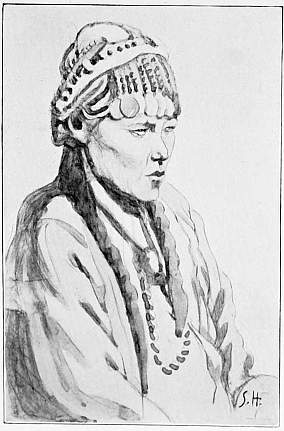
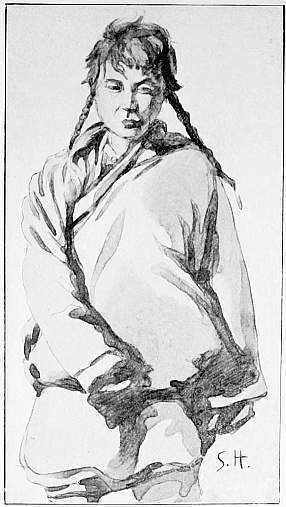
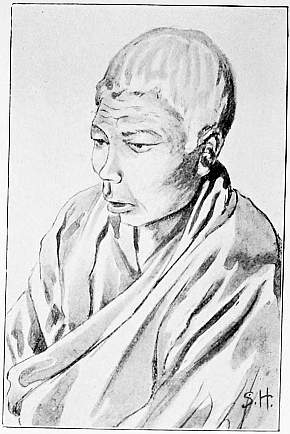
222. Woman at the Mouth of the Chaktak-tsangpo in the Tsangpo. 223. Tibetan of Saka. 224. Lama in Saka-dzong.
Sketches by the Author.
We left the tasam on our left; we turned aside north-westwards straight to the Targyaling-gompa standing with its red lhakang, its small white buildings, and its large chhorten on a terrace immediately above the spot where Guffaru has pitched the camp. Twenty lamas came down to find out whether we were thieves and robbers who intended to attack the convent. “Certainly not,” Guffaru answered, “we are peaceful travellers passing the night here.” “We will not allow it,” they replied; “you must remain on the high-road.” I now sent Rabsang up, and he was surrounded at the gate by thirty monks. He was told the same; a European had never been here, and none should ever enter the monastery. If the gentlemen of the dzong attempted to get us in, they should pay the penalty with their lives. Charming ecclesiastics! Even Rabsang, who was a Lamaist and wore several gaos on his neck, was not allowed in. He was in the service of a European. So inimically disposed were these monks that they stopped up the channel we drew our water from. The Devashung, they said, had nothing to do with them. We had heard in Saka-dzong that these monks were bellicose and independent; there they had said that the free-booter who had stopped us on May 31 must have been a disguised monk. But we could do without them and their monastery, which seemed small and unimportant.
Here our four puppies fell ill of a peculiar complaint: they ran about restlessly, snuffed and sneezed, had matter in their eyes, and no appetite. At night I heard one of my tent companions whine and howl, and next morning he lay dead on his rug.
Leaving Rawling’s and Ryder’s route to the left, we proceeded to the bank of the Chaktak-tsangpo and then northwards along the river. It has a swift current, but does not form rapids; to the south is seen the portal through which it emerges from the mountains. At the village Pasa-guk, which is larger than Saka-dzong, we bivouacked on the right bank. The river here was 141 feet broad, 2 ft. 7 in. deep at most, and carried 629 cubic feet of water. On May 28 it carried 664 cubic feet, but it receives the Sa-chu and other tributaries below the village Pasa-guk.
In the middle of the village is a serai with a large store of salt in bags. Here a market is held from time to time, salt being the medium of exchange. I tried to obtain further information about the country in the north, but when I compared the different data together, the result was a hopeless muddle. For instance, I asked travellers who came from Tabie-tsaka, how far they marched each day, and where they passed lakes, rivers, and passes; and when I added the distances together and laid down the direction on the map, the line reached to Kashgar, all through Tibet and Eastern Turkestan! It was impossible to obtain useful data about the country to the north. I must see it with my own eyes. But how would that be possible?
The Hajji came to me, angry and excited, to complain that Guffaru had struck him. I sat in judgment and heard evidence. The Hajji had refused to watch the horses when his turn came, and the caravan bashi had therefore thrashed him. The sentence was, that the Hajji should receive his discharge in Nyuku.
Robert and I sat on the velvety grass on the bank and gazed with longing eyes at the half-clear water dancing merrily on to its destination at the coast. An old man and a youth joined us, and entertained us with dance and song. The old man danced and stamped on the ground in a three-cornered mask of goat leather with red strips and bells, and the youth sang this unintelligible song:
Hail, O God, god of the pass! Many stars sparkle in the night. To-day is a fine day. Would that rain might come! Give me a bit of tea or a small coin. O, Cook, give me a pinch of meal and a radish. Such is the mask that is worn in the Chang-tang. At the right ear a curl, neither large nor small, At the left a pin, neither large nor small; Neither shade nor sun. There is a father’s pin and a mother’s pin. Everywhere we have pins with branches, For they guard us from all dangers. The horse holds his head high, And the rider holds his head high. The gods are high, the earth is low. You have gold and silver galore. May your cattle multiply, your flocks and your property increase! May your family increase! The King of Ladak sits between a golden and a silver king. Now is the song ended.
On June the 10th I left the Chaktak-tsangpo to the right, unfortunately without having learnt whence it comes. We ascended a side valley named Rock, in a north-westerly direction. We had previously passed two towers which had formerly been the fort of a rebellious lama. He was at feud with Saka-dzong, but was defeated. In the camp at the pool Churu the evening seemed to me fearfully long. Home-sickness had become infectious. The Ladakis sang no more, but made shoes for their children, and thereby turned their thoughts more intently to their home. I too found no rest after the day’s work. If we only knew what answer the Mandarins would send, but our messenger did not return. We seemed to have stumbled into a morass and to be stamping in it without moving on. Oh, thou dreary, awful Tibet, thou black, poor superstitious folk! In the stillness of the night the step of the camp watchman was pleasant company.
After a night temperature of 14.4° we rode on westwards over a very flat pass, a watershed between the Chaktak-tsangpo and Nyuku, along a road which had once been a tasam; numerous ruins and manis were memorials of that time. The district was thickly peopled by nomads, and black tents were often seen where sheep bleated and dogs barked; women and boys guarded the flocks, and yaks grazed on the slopes. The country calls to mind the summer pastures on the Pamir. A second puppy died in the night, and was almost eaten up by ravens before morning.
On June 12 we came again to the tasam at Nyuku where we set up our camp. The Gova of Nyuku, whose friendship I had gained at Saka-dzong, was very obliging, and said that I was quite at liberty to make another detour to the north, as I seemed to dislike the high-road. It would take me up to a pass, where almost all the mountains of the world could be seen, especially Lumbo-gangri immediately to the north. Here we should come in contact with people of the province of Bongba, who perhaps would sell us all necessaries. In Nyuku the third puppy died. The Tibetans said that it suffered from a throat complaint called gakpa, which is very common in the country. Mamma Puppy gave herself no trouble about her little ones when they were ill, but seemed rather to avoid them. We washed them with warm water, and tended them to the best of our power, and did everything we could think of to save the last. The Tibetans could not understand how we could make such a fuss about a dog.
Bluish-white flashes quivered over the mountains all the evening, and their outlines stood out sharp and dark in the lightning. That is a sign of the setting in of the monsoon rains on the southern flank of the Himalayas, and all look forward to them. When rain falls up here, the grass grows up in a couple of days, the cattle become fat and sleek, the milk is thick and yellow; at the present time it is thin and white, and produces little butter. The existence of the nomads, and indeed the prosperity of the whole country, depends on the monsoon. It is the summer pasture which helps the herds to endure the scarcity of the rest of the year. If the rains fail, the stock languish and die.
The night is silent. Only occasionally is heard the hearty laugh of a girl or the bark of a dog. The camp watchman hums an air to keep himself awake.
The 13th was a lazy day; we had to wait for Tundup Sonam and Tashi. I always shave myself on rest days—it is pleasant to feel clean, even when there is no one to smarten oneself up for. Robert shot three wild-geese, and caught two yellow goslings which walked into his tent and made hay there. We put them in the crystal-clear Men-chu river, hoping that some kindly goose-mamma would take to them.
From here it is said to be only four days’ journey to a district in Nepal, where there are fir-woods. Just fancy: fir-wood as in Sweden and in Simla! But we must remain in this dreary land.
Just as we were starting on the following day the Hajji, Islam Ahun, and Gaffar came to me, and demanded exemption from night duty and separate rations if they were to stay with me. I called all the other men together, and asked if any one else would join them now that they were to be dismissed. But no one wished to. Our Hajji, the only one of the Mohammedans who had been in Mecca—had indeed been twice there—was the only rascal in the caravan. He had instigated the others. In my experience Mecca pilgrims are always scoundrels. The Hajji declared that he preferred robbers and tramps on the road to Guffaru and the other Ladakis. The three men vanished from sight as we marched north-westwards up the valley of the Men-chu.
In camp No. 177, on June 15, I held a grand reception, for some chiefs from the direction of Bongba came to visit me, and our old friend, the Gova of Tradum, arrived. They decided that I might ride a short distance to the north, but only on condition that I came back the same day. So on the 16th we rode on fresh hired horses up to the Kilung-la, where the view was instructive and showed the lie of the land. Before us was the dark Lumbo-gangri with its deep wild valleys and steep cliffs, its small glacier tongues and caps of eternal snow. The men of the district said that the mountain was holy, and was a kind of portal or forecourt to the Kang-rinpoche, the celebrated pilgrimage mountain near the sources of the Indus. Behind Lumbo-gangri are the valley and river of the Rukyok-tsangpo, which flows to the Chaktak-tsangpo. It was now clear to me that these summits, of which bearings were taken by Ryder and Wood, could not lie on the watershed of the rivers flowing to the ocean. But no one knew the true aspect of the country farther north, and the Bongba men had been ordered to stop us if we tried to force our way in that direction. I could not by entreaties or threats obtain more than the view from the Kilung-la. The further we proceeded westwards the more of the blank space on the map was left behind us. That was exceedingly annoying, but my hopes were still fixed on the Chinese letters from Lhasa.
On the morning of the 17th all the mountains were covered with snow, but the day was warm and fine as we rode up to the Serchung-la, and saw to the south-west the northernmost crest of the Himalayas and the broad valley of the Brahmaputra. The valley descending from the pass is full of brushwood and drifting sand, which is piled up in dunes to a height of nearly 20 feet.
After an interesting and successful march we came to the valley junction Dambak-rong. But the day was not yet over. We heard that Nazer Shah’s son had arrived the day before at Tradum on his way to Ladak with twenty-two mules. A messenger was therefore despatched to ask him to wait for us, and give us tidings of Tundup Sonam and Tashi. The Gova of Tradum also rode home to get all in order against our arrival. A short time passed by, and then a horseman came up at a smart trot from the Serchung valley. He had evidently followed our track; he rode straight to my tent, dismounted, and handed me a letter with a large seal, bearing the words, “Imperial Chinese Mission, Tibet,” and the same in Chinese characters.
Now our fate would be settled. The Ladakis crowded round my tent. I perceived that they hoped we should be obliged to return by the direct road to Ladak. They longed for home, and were not inspired by the same interests as myself. The tension was extreme as I opened the letter. It was dated at Lhasa on June 3, and had been fourteen days on the way. It was written in faultless English by Ho Tsao Hsing, first secretary to H. E. Chang (Tang Darin), and ran as follows:
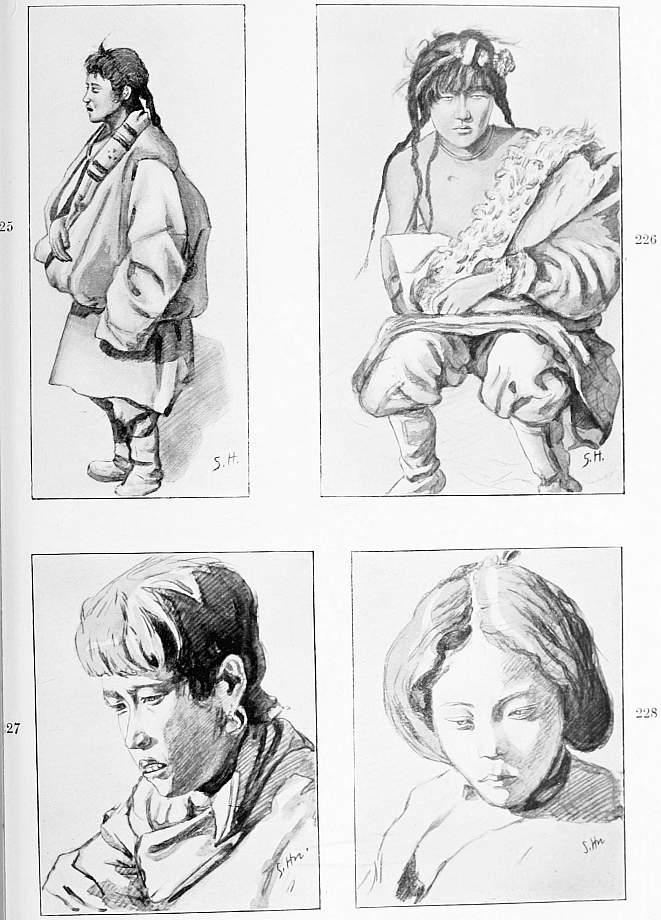
225, 226, 227, 228. Tibetan Boys and Girls of Saka and Tradum. Sketches by the Author.
Dear Dr. Hedin—Your letter to His Excellency Chang dated the 14th May was duly received. Knowing that you have arrived at Raka-tatsang, that Devashung hindered you to proceed forward. His Excellency is very sorry to hear such occurrence; and he instructed me to write you the following:—
That in His Excellency’s last letter to you he wrote you to return by the way you came; and now he does not understand why you are taking another road contrary to what he wrote you, consequently, you have met with such inconveniences, to which His Excellency regrets very much indeed. His Excellency has, now, again ordered Devashung and officials along the way to give you all possible protection and comfort, but he sincerely wishing you not to change your direction to the N.W., where both the country and people are wild [I wonder how he could know that], and that accidents might happen, which His Excellency can hardly bear any responsibility.
Therefore, His Excellency wishes you only to return by the way as you came, not to venture in other directions.
His Excellency gives his best regards to you and wishing you a happy and safe return.—I am yours very truly,
Ho Tsao Hsing.
That was all I got by the stratagem which had cost us so much loss of time. A positive prohibition to proceed north-westwards to the land of my dreams. Now the Devashung would issue fresh orders, and we should be watched more closely than ever. Now the iron gates would be closed again from the south, and the way to the forbidden land barred. Tang Darin was as immovable as the State Secretary for India, Lord Morley. But he stimulated my ambition, and for that I have to thank him. To begin with, we seized the copy of our passport, which was to be transferred from Gova to Gova all along the road.
But not yet had this fateful day come to a close. At sunset came Tundup Sonam and Tashi, dusty and ragged, with their bundles on their backs. “Welcome and well done, 20 rupees each and new suits of clothes is your reward. What news?” No letters, but only a note from Ma that he had forwarded my letters to Lhasa, and sent a letter from Gulam Kadir to Muhamed Isa. They had reached Shigatse in eleven days, and had rested there three days. Then they had set out from Tashi-lunpo directly westwards. They made a fast and long march on the first day, and climbed up to the pass Ta-la at sunset, where nine highwaymen, two with guns and the others with swords, fell upon them and threw them to the ground. The two guns were set on their rests and the barrels pointed to the men’s heads, the seven swords were drawn, and one of the robbers said:
“If you value your lives, hand out everything of value you have.”
Frightened out of their wits, the two Ladakis begged them to take all they wanted if they would only spare their lives. The nine robbers then opened their bundles and thoroughly plundered them, taking even their little gaos and images, as well as their cooking utensils and 18 rupees in silver. They were allowed to keep the clothes they had on their backs. By pure chance the robbers had overlooked a small packet of 30 tengas, which Tundup Sonam had put at the back of his girdle. The robbers cleared them out in a minute, and then disappeared into the mountains. Our two defeated heroes remained weeping on the battle-field till dark, and then they went off very slowly at first, turning round frequently and fancying they saw a robber in every shadow, but afterwards they quickened their pace almost to a run. Deadly tired, they crept under two boulders by the wayside, and next morning came to three black tents, where they got food, and were told that a lama had been robbed and stripped naked on the Ta-la two days before. But now they were safe, and it was touching to see how delighted they were to be with us again. They had seen Muhamed Isa’s grave, and the conversation about it reminded Tsering of his sorrow.
On June 18 we travel across open country to Tradum, our route following the northern side of the valley while the tasam runs along the southern. The ground was sandy. Small irritating horseflies buzz in the nostrils of the horses and drive them frantic. They walk with their noses on the ground like the wild asses to escape the flies. To the right is the Tuto-pukpa, a mountain to which corpses are carried on yaks from Tradum to be cut up. We ride between pools where wild-geese are plentiful with their pretty yellow goslings. At a projecting rock, cairns and streamer poles are set up; the wall of rock is black, but all the side facing the road is painted red—“Ah, this is blood on Balder’s sacrificial stone.” Here the village of Tradum can be seen, its temple and its chhorten on a hill. To the south-west the dark snow-crowned rampart of the Himalayas appears, wild, grand, and precipitous. To the south-east lies the tasam, a light winding riband, and our path runs into it; it is 40 feet broad between grass-grown terraces of sand; it is the great trunk-road of Tibet.
We had scarcely set up our camp when the discharged Hajji and his two companions came up and salaamed. But I was angry, and drove them away. I afterwards heard that they wept, and I was heartily sorry that I had been so unkind. But it was too late, for they were seen tramping out wearily into the steppe when the shades of evening fell.
The monastery Tradum-gompa is subject to Tashi-lunpo, and its five monks live on the produce of their sheep and yaks, and carry on trade with Nepal. Round the temple are eight chhortens, and in the lhakang, the hall of the gods, the immortal son of Sakya is enthroned between the eleven-headed, six-armed Avalokitesvara and other deities. On a small hill of schist above the convent is a hermit’s dwelling, where there is a splendid view over the Brahmaputra valley and the Tsa-chu-tsangpo as it emerges from the mountains.
Here died our fourth puppy, which I had hoped to keep as a remembrance of Shigatse. Mamma Puppy had now her mat to herself, and outside the tents lay the two black dogs from Ngangtse-tso.
The Gova of Tradum was an excellent, genial rogue, and had a thorough contempt for the Devashung. He would not let me follow up the Tsa-chu valley, but made no objection to an excursion to the Kore-la pass, two days’ journey off to the south-west, and belonging to the Himalayan range which is the watershed between the Ganges and the Brahmaputra. He also let us hire six horses, and gave us two guides for the journey, which was to be commenced on the morning of June 20.
The first night we were to encamp at the spot where the Tsa-chu-tsangpo enters the upper Brahmaputra. I rode south-south-west with my usual retinue over grassy steppe and sand-dunes. In front of us were three wanderers with bundles on their backs and staves in their hands. When we overtook them they stopped, came forward, and laid their foreheads on the ground at my feet. It was the Hajji and the two other men. I was glad of the opportunity of taking them into favour again. For the future they were to follow our yaks.
The camp was pitched on the right bank of the river, at the foot of the hill crowned by the ruins of the old Liktse monastery. Here an important trade-road crosses the river and a ferry maintains communication between the banks. The Tsa-chu river had here a breadth of 35½ yards, and a depth of barely 40 inches, while the Brahmaputra was 120 yards broad by 5¾ feet deep, and was much more imposing than farther down. The absolute height was 14,977 feet. It was not easy to carry the rope across the stream, for a strong south-west gale was blowing and the waves were high. Robert rowed out from the right bank with the rope, and from the left some Ladakis waded out as far as they could in the shallow, slowly deepening, water to catch the end thrown to them and secure it on shore. When at last we had stretched the rope across, it broke with the pressure of the wind and the waves, and the work had to be done again. We noted a temperature of 53.6° in the air and of 59.7° in the water, but the men were so chilled by the wind that they had to make a good fire. It also rained heavily—the first rain we had had since we left Ladak—and thunder rolled among the mountains.
For the first time the minimum temperature in the night, 37.8°, was above freezing-point, and the morning was beautiful after the storm: the sky was only half covered with bright summer clouds, not a breath of air stirred, and the surface of the river was smooth as a mirror, only slightly broken by slowly moving whirlpools. The ferry was already plying across with passengers and goods. The ferryman is paid a tenga for each passage, and he crosses over twice in the hour. Our horses and yaks were made to swim over the river after they had grazed at night on the steppes on the left bank.
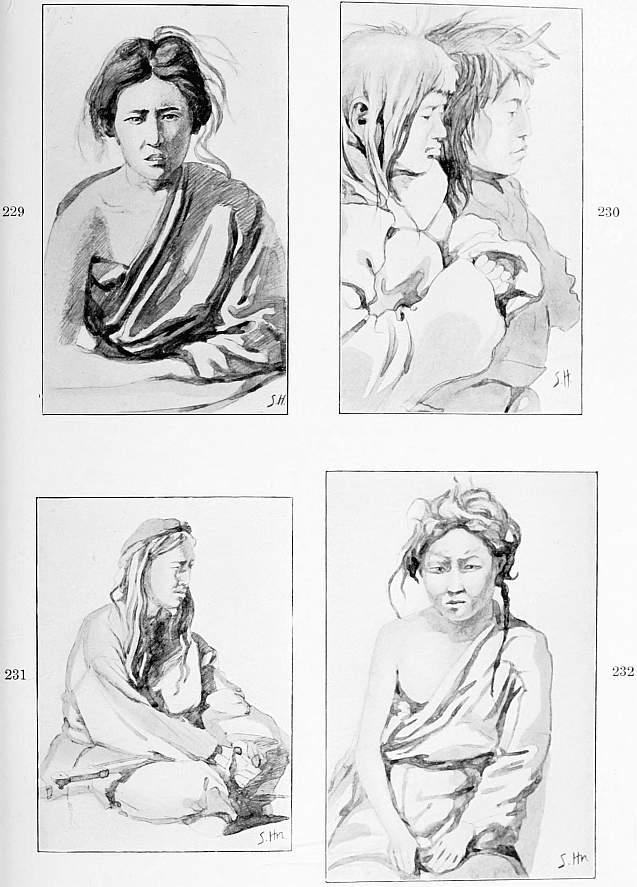
229. Woman of Nyuku. 230. Two Tibetans. 231. The Gova of Tuksum. 232. Girl at Pasa-guk. Sketches by the Author.
We rode 21½ miles on the 21st, but first paid a visit to the little Liktse-gompa monastery, which stands on the inner side of the hill, and therefore has not the fine view obtained from the old ruined monastery on the summit. From its window-openings the monks could watch the oscillating life of the river during the various seasons of the year: its slow fall in spring; its rise during summer, when volumes of turbid water come down from melting snowfields and glaciers; its decline in autumn, and the freezing of the river in the cold of winter. And they could see the breaking-up of the ice in spring, and the great clattering slabs dancing down the current. But now the prospect before the eyes of the ten monks is only a wretched loamy valley between barren hills, for their convent lies apart from all roads. Liktse-gompa is a dependency of Sera, but receives no support from it, and possesses no herds. The profits from the ferry are the only revenue of the monks. The abbot, Punjun Dung, with a red turban and a grey beard, showed me the gods in the lhakang, Buddha, Padma Sambhava, etc. Among the usual sacred objects on the altar were two human skulls converted into drinking vessels, one of them lined with silver. In the courtyard the holy dog was chained up.
Then we mounted and rode off quickly. We perceived at once that this road is much frequented. On the steppe and in open soft valley bottoms it is less clearly marked, for there every one marches where he likes; but over passes and on spurs with hard stone the tracks converge from all sides, and there the road has been trodden down and worn in the course of centuries. On the small pass Tsasa-la we met a large caravan laden with barley.
“Where have you come from?” I ask.
“From Mundang in the country of Lo Gapu.”
Mundang is marked on the English maps of Nepal, but who was Lo Gapu, “the King of the Southern Land”? It sounded so grand.
The next pass is called Dorab-la, and from the top we see the Chockar-shung-chu, a broad valley with a brook draining partly from the Kore-la, and flowing to the Brahmaputra.
While we are resting, Guffaru passes with his black baggage-train in close order, a troop of laden yaks, whistling and singing Tibetans, and some Ladakis with our own horses as a rearguard. They soon disappear in the dust of the road, two of our men resting a while in a cleft to take a puff or two from their weather-worn narghilés. From this point they march westwards to the rendezvous, while we continue southwards.
In the valley leading up to the Ngurkung-la a large salt caravan on the way to Nepal was encamped. The twelve leaders had piled up a fine shelter of sacks of salt against the violent wind. We then came to the very broad valley which ascends to the saddle of the pass visible in the south. We rode up for hours, though the ascent was not noticeable, but the wind was dead against us. To the right is the water-parting chain of the Himalayas which we had seen from Tradum. A curious, sharply outlined cloud, like a white torpedo, covered it, and from the northern extremity small fleecy flakes parted from time to time and floated away. We camped near some black tents in a side valley close to the extraordinarily flat pass.
CHAPTER XLI
A PEEP INTO NEPAL
It was on June 22 that I stood on the platform of the Kore-la pass and gave a stolen glance into Nepal, and tried to get a glimpse of Dhaulagiri peak, 26,670 feet high. But the morning was dull, heavy clouds lay like pillows on the earth, and nothing could be seen of the surrounding mountains. “We must wait till it clears,” was the only order I could give. But just then a milk-girl came from a camp of 20 tents which was near at hand. The people were Nepalese subjects, but were camping on the Tibetan side. The girl said that it was only a short day’s journey to the nearest permanent dwellings and gardens, and two days’ journey to Lo Gapu’s summer residence.
Then we thought: “We may as well ride down the southern side of the pass as stay up here in the wind.” No sooner said than done! The tents are folded up, the animals laden, we mount and ride along the eastern side of the valley up to the Kore-la, which from the Tibetan side little resembles a pass, for to the eye the grass-grown on unfruitful loose ground seems quite level. Of the snowy mountains on the western side of the valley only the dark base is visible; layers of clouds lie close above the earth; one feels as though one could push one’s head against the roof. A ruined house, where perhaps a frontier guard once dwelt, a couple of long manis, and loose blocks of conglomerate stand on the top. A caravan comes up from Nebuk in the bottom of the valley.
We look round in vain for the actual watershed, and find it only by noticing rivulets running together and flowing southwards. Here we light a fire and take observations. The view is marvellous, at any rate a relief such as we have not seen for a long time. The mighty snowy mountains to the south, which yesterday broke through the clouds, are, indeed, obscured, but our valleys fall steeply and unite into a large valley, in the depths of which grassy plots and fields shine in deep spring verdure amid the everlasting grey, yellow, and red landscape. Down below the sun is shining, and behind us the sky is clear above the Brahmaputra valley, while here and round all the snowy mountains float opaque clouds. From the saddle lying west of our point of vantage innumerable valleys radiate out; the surface of the ridges between them is nearly level, or dips gently to the south-east, while the valleys are deeply cut in like cañons, and the promontories at the meeting of the valleys are broken short off. Perhaps some of the nearest peaks of the Himalayas rise like islands above the sea of clouds, for here and there a reflexion from sun-lighted firn-fields seems to be trying to break through the veil of clouds (Illust. 233).
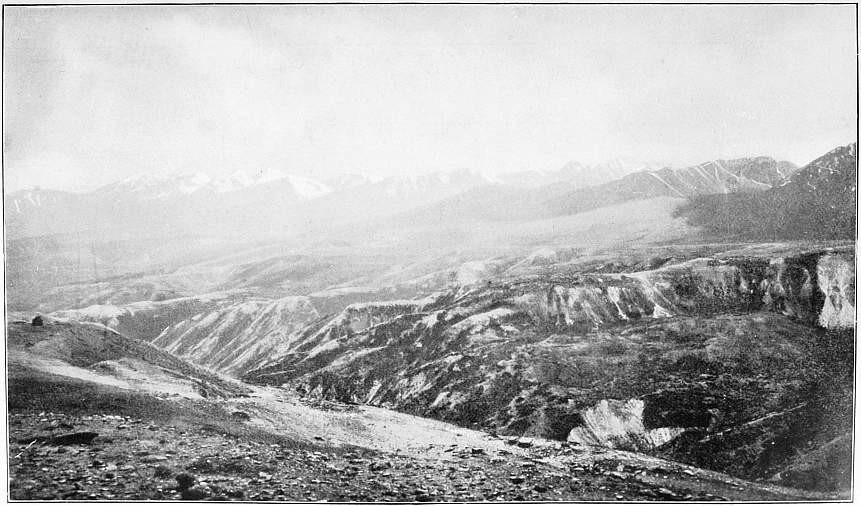
233. View from the Kore-la towards the South-West.
We stand on the frontier between Tibet and Nepal. Behind us to the north we have the flat, level land on the southern bank of the Tsangpo. We have mounted only 315 feet from the river to the Kore-la, where the height is 15,292 feet. And from the pass there is a headlong descent to the Kali Gandak, an affluent of the Ganges. By means of a canal cut through the Kore-la the Brahmaputra might be turned into the Ganges. Northern India needs water for irrigation, but the gain would perhaps be small, for the Brahmaputra in Assam would be as much diminished as the Ganges was increased. Tibet would lose by the change, and a number of villages on the Kali Gandak would be swept away. A new road would be opened for the invasion of India from the north, and therefore on the whole it is perhaps best for all parties concerned to leave things as they are. But the changes here indicated will some time come to pass without artificial aid, for the tentacles of the Kali Gandak are eating back northwards into the mountains much more quickly than the Tsangpo is eroding its valley. Some time or other, perhaps in a hundred thousand years, the Ganges system will have extended its tentacles to the bank of the Tsangpo, and then will be formed a bifurcation which, in the course of time, will bring about a total revolution in the proportions of the two rivers and their drainage areas.
Now we are in Nepal and go on foot down the declivities. Here little has been done to improve the road. Occasionally an awkward block of granite has been rolled away, leaving a gap in the breastwork; in other respects the caravan traffic has done most for the road, wearing it down. It is easy and pleasant to go down southwards towards denser air; it becomes warmer, and we breathe more easily; the verdure increases, and flowers of different colours make the grass gay. We try to forget that we must toil up all these slopes again; let us go down, down, to enjoy a summer life, if only for twenty-four hours, and forget dreary Tibet. An hour ago the wind blew icy cold on the pass, and now we feel the soft zephyrs gently caressing the heights. Robert takes in deep draughts of the tepid air and fancies he hears a whispered welcome to India; Tsering and Rabsang become lively and contented, and I muse over a visit to the King of the Southland.
Three horsemen rode slowly up the ascent. Two of them were turning their prayer-mills. They looked astonished. We asked whence they came and whither they were going. They were going to the tent village on the plateau. When they were told who we were, in answer to their question, they dismounted and begged pardon for not greeting us at first. I readily forgave them, for I looked like a ragged tramp. They advised us to pass the night in one of the houses of Lo Gapu, and invited us to visit them in their tent village on our way back.
The gradient becomes less steep, and we come to an expansion where three valleys meet, the Kungchuk-kong, which we have followed, in the middle, the Pama on the east, and the Damm on the west. From the Damm valley only comes a small gushing brook. We pass along the right side of the united valley. On the same side a very large valley opens, the Yamchuk-pu, with an irrigation channel running down from its brook to the villages and fields below. In the village Yamchuk we come to the first houses and trees. On the left side of the valley lies a large monastery with avenues of trees and long rows of manis; it is called Gubuk-gompa. Fields, grassy patches, and bushes become more numerous. Then comes a succession of villages on the left side of the valley, which is barely 2½ furlongs broad.
Below the side valley Gurkang-pu, on the left, pebble beds stand in perpendicular walls with numerous caves and grottos. These are apparently used as dwellings, for they are connected with the houses and walls in front of them. Lower down we come to the village Nebuk, among gardens. The architecture is of the usual Tibetan style, white and red masonry, flat roofs, and decorations of streamer poles. The vegetation becomes more luxuriant and the fields larger. We frequently pass ruined walls and towers, perhaps relics of the time when Nepal was at feud with Tibet. Now the densely peopled and well-tilled valley has a peaceful aspect, and no frontier guards hinder our advance.
The usual manis lie along the road, and a large red chhorten or stupa has a touch of the Indian style. Below three villages lying close together the valley contracts slightly. Near a lonely house we encamped in a lovely garden, with fine green trees, among waving cornfields. A woman told us that this place, called Nama-shu, belonged to Lo Gapu, and that no one might stay in the garden without his permission. However, we established ourselves there, and inhaled with delight the mild dense air, and heard the wind rustling through the tree-tops.
Soon two men appeared, who were in the service of Lo Gapu, asking for information about us. They said that we were in the district Tso, and that the river was called Tso-kharki-tsangpo. A village we can see just below our camp was named Nyanyo, and from there Mentang, the residence of Lo Gapu, could be reached by crossing only two spurs of the mountains, He, they said, was a frontier chief, who paid no tribute to the Maharaja of Nepal, but was obliged to pay a visit to His Highness every fifth year. He had 500 subjects. The people for three days farther south were Lamaists and spoke a Tibetan dialect, in which, however, many Indian and Persian words were incorporated.
When one of the men had obtained all the information he desired, he rode down the valley to make his report to the frontier chief. Meanwhile we held a consultation. I had only Robert, Tsering, Rabsang, and two Tibetans with me, and our funds consisted of only 24 rupees. The temptation was great to wander a few days more southwards through the wild deep valleys of the Himalayas. Here, in the Nama-shu camp, we were at a height of 12,487 feet, and therefore 2805 feet lower than the Kore-la. Every day’s journey southwards would bring us into a denser atmosphere, and even now we were not far from shady coniferous woods. But would it be prudent to advance further into Nepal? We were much puzzled, and considered the matter from all sides. Our money would not last more than two days. Our horses belonged to the Gova of Tradum, and we had agreed with him that we would only take a look into Nepal from the Kore-la, and now we had crossed the boundary and descended into a land where our position was less secure than in Tibet. We might fall into a trap before we were aware of it. Lo Gapu might arrest us and ask for orders from Khatmandu. The greatest danger, however, was that the Tibetans might close the frontier and render our return impossible, and then say that now we had left their country we might not enter again. And then we should be cut off from the main caravan, and all the results of my journey would be endangered. I therefore decided to turn back early next morning before Lo Gapu’s men had time to come up and arrest us.
The evening was fine and long, and we enjoyed it thoroughly under the rustling of the thickly foliaged trees. I felt perfectly comfortable and breathed freely: the heart had not to labour so heavily as on the Chang-tang; it worked for hours together without an effort; our feet were warm, and we slept as we had seldom done. For in the Chang-tang if one sleeps even eight hours one does not feel rested and refreshed on rising; one does not derive the proper benefit from sleep. Here we experienced a thoroughly comfortable feeling after our night’s rest, and our only disappointment came from the clouds, which concealed the summits of the Himalayas to the south and south-south-west. Only now and then the peaks looked forth for a minute.
On June 23 we mounted our horses again. We had heard no word of Lo Gapu. When the messenger had left us he was convinced that we should continue our way down the valley, and the little potentate was perhaps now expecting our arrival. He might wait! We rode slowly up to the Kore-la, left our old road to the right, and camped at Kung-muga.
I was sitting at my drawing when a horseman came clanking up. He held in his hand a green flag, a messenger’s badge among the Chinese and Tibetans. I felt sure that he had some connection with strict measures against us, but found that he was only the bearer of a proclamation from Lhasa to all the stations as far as Gartok, that horses and baggage animals should be supplied to two Chinamen who had been despatched to find me out and talk with me, and convey to me a letter from His Excellency, Lien Darin. They might be expected any moment.
Midsummer Day was as dull as possible. The whole country was buried in impenetrable fog, and even the adjoining tents were invisible. And when it had cleared a little, the mountains were still concealed. We rode north-westwards on an excellent road, and were astonished at the numerous manis with their close, fine, raised inscriptions on purple and dark-green schist; other prayer stones had characters 1.2 or 1.6 inches high, while the largest characters were nearly 8 inches high, so that there was only room for one character on each slab. Then six slabs were placed in a row to spell out the sacred formula, “Om mani padme hum.” On some votive stones the characters were red, cut out in round pieces of granite with a white underlayer. The largest mani was 262 feet long.